The Casual Blog

Getting a new floor, Ethiopian food, beautiful bugs, helping refugees, and our gun problem

Tiller7Bug 1
We’re living in a hotel in Cary while the floor of our condo is being removed and replaced. While I’m grateful we have the means to remedy our defective flooring, this has been a major project – like moving (lots of planning, arranging, sorting, boxing, and hauling), but without the ultimate gratification of a move. Flooring is one of those things I don’t usually think much about, and I will be glad to be finished with it.
Tiller7Bug 1-4

It’s unsettling to be uprooted. Our hotel is fine, with amenities including a gym, pool, free wi-fi, breakfasts included, and best and most unusual of all, they take doggies. At first our Stuart was discombobulated by the new situation, uninterested in his food (most unlike him), listless and particularly in need of affection.

Tiller7Bug 1-7
We all consoled each other, and we humans, though unsettled, did not lose our interest in food. On Friday evening we tried a new-to-us Ethiopian place called Awaze. Our servers were warm and friendly, and happy to give us coaching on the traditional forkless method of eating. You tear off a piece of injera, a spongy sort of bread that comes rolled up, pick up some of your main dish with it, then insert in mouth. We tried the vegetarian platter, a combo of most of their veggie entrees. Every bite was exotically spiced and delicious.

Tiller7Bug 1-6

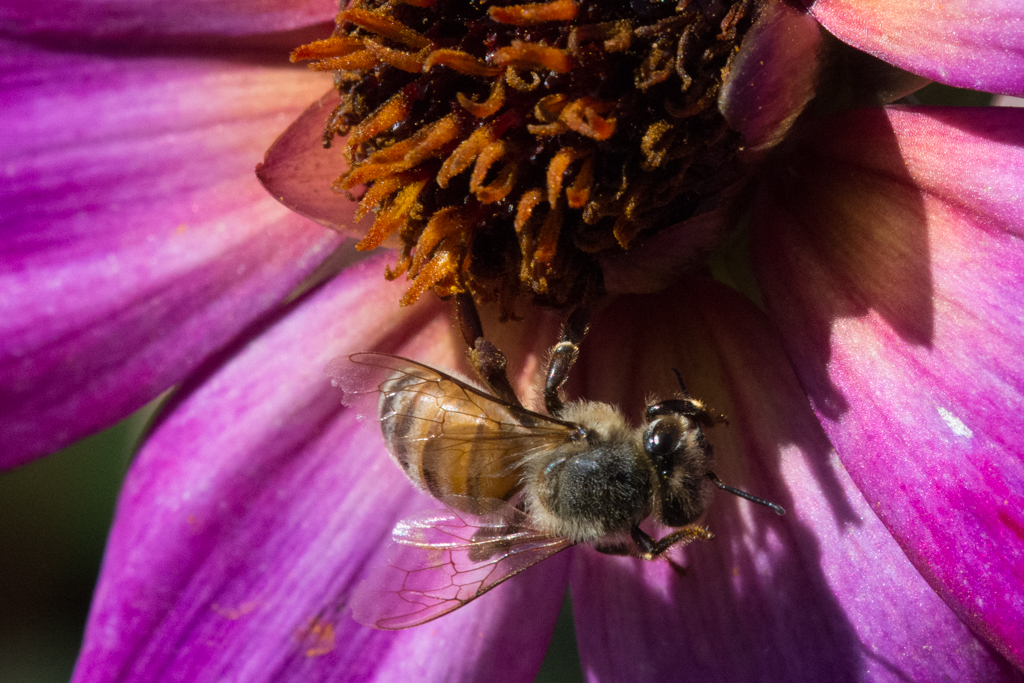
On Saturday morning I visited Raulston Arboretum, as I often do. One thing you discover when you regularly visit a garden: it’s never the same twice. There are major changes every week. This week it was lush and green, with lots of insect activity, including some gorgeous butterflies. The closer you look, the more beauty there is to see.
Tiller7Bug 1-2

This week I read the latest UN Report on Refugees. Did you know that we currently share the planet with the largest number of refugees and displaced persons in history – 65.3 million? That’s up from 59.5 million a year earlier. Children make up more than half of the total. The largest source countries are Syria, Afghanistan, and Somalia. This short UN film (scroll down to Global Trends) highlights the human dimensions of this catastrophe.

Inasmuch as these fellow human beings are in dire straits, and particularly in consideration of our partial responsibility from our destructive decades-long war in the Middle East, it would seem we should be working hard to help. For many, though, the primary concern seems to be that there could among these unfortunates uprooted by war and terrorism be terrorists. Based on this disproportionate fear, we’re doing almost nothing, and let the devil take the hindmost. This is an ethical failure of huge proportions. Consider a gift to the International Rescue Committee or another reputable charity serving refugees.
Tiller7Bug 1-5

There are occasional shining sparks of humanity. The New Yorker this week had a harrowing/inspiring piece by Ben Taub about the work of Doctors Without Borders and others providing medical care to displaced persons in Syria. The Assad government has denied health care to millions of civilians by systematically killing hundreds of health care workers and destroying hospitals. You might think this would drive out the surviving doctors, but there are still some who will not quit, and continue to save lives under unimaginably harsh conditions. Human kindness and courage still exist!
Tiller7Bug 1-8

Speaking of moxy, House Democrats showed some backbone this week in staging a sit in in support of gun control. The NRA’s bought-and-paid-for veto power over gun legislation is an extreme example of the corruption of our political system, and although it’s grotesque, we’ve come to accept it as unchangeable.

In the wake of the Orlando massacre, as dozens of Democrats disrupted House business demanding a vote on a gun control bill, it felt bracingly close to real change. The bill at issue was underwhelming – as the gun wingnuts correctly pointed out, the no-fly list is not a reliable source for identifying bad people – but the larger point was clear and important: we can no longer treat this corruption preventing sane gun laws as business as usual.
Tiller7Bug 1-3

The New Yorker noted this week that more Americans were killed by firearms in the past decade than in all of WWII. What is the root cause of the American obsession with guns and allergy to reasonable gun control? A lot of it surely involves high levels of irrational fear. What if we tried to help people find better ways to deal with their fears, and helped them see that in general guns make them less safe, not more?

Sure, that’s a tall order, but it’s worth a shot. Here are some first thoughts to get the ball rolling. Call out fearmongering by Fox News, Rush Limbaugh, and many others. Give away free copies of local crime statistics showing downward crime trends. Teach stress reduction techniques. Promote visits to the local arboretum.
Tiller7Bug 1-9

Finding hope after the Pulse massacre in Orlando

Tiller7Bug 1-4
It is not easy to see a bright side in the horrendous massacre last week at Pulse, the gay nightclub in Orlando, but it does force us to think. The wounds are still very raw, and the shock and sorrow are still overwhelming. But partly because this tragedy cannot be ignored, it may take us forward.

In the last few years, we have come a long way in coming to terms with the reality of alternative sexuality. More and more, people understand that LGBT people exist, that they have integrity, and that they are entitled to the same rights and same respect as others. There are, obviously, some who disagree, of which a few are hate-filled maniacs. But for most of us, gays are no longer the other. We love them, or not, for who they are.
Tiller7Bug 1-5

We should be grateful to LGBTs for many transformative contributions, but here’s one that’s not often noted: in proudly accepting their differentness, they help us do the same. As we gradually accept their variations, we more easily accept that we ourselves are each a little different. Those of us somewhere outside the mainstream, in our interests, passions, and styles, may especially feel this.
Tiller7Bug 1-2

Back in 1980 or so, my dear friend Tom Sulerzyski, who died in the first onslaught of AIDS, tried to explain to me what Stonewall meant, in terms of gay liberation. It took me some years before I understood what he was saying. At Stonewall, gay people stood up to mainstream power, and changed their state. They would no longer be subservient, mostly invisible victims.

I think the Pulse massacre and its aftermath will come to be seen as another milestone in gay liberation – when the murder of gays was finally, fully settled as being intolerable, beyond any debate. Acceptance of LGBTs and their communities will continue to increase.

This week there were a few voices trying to acknowledge the tragedy while avoiding references to the sexual orientation of the victims, but they were called out as ridiculous in the mainstream press. Even a lot of conservatives – even the Donald! – acknowledged that the tragedy was about gays. Even the Security Counsel of the UN, which includes countries where it is dangerous to be gay, deemed it unacceptable to target gays in condemning the massacre. United States diplomats led the effort on this resolution, for which U.S. citizens can be proud.
Tiller7Bug 1-3

For all the progress in tolerance and respect, there are still obvious dangers. The NY Times reported that LGBTs are still the most likely targets of hate crimes in the U.S. The Times story suggests that increasing tolerance may have the perverse effect of increasing hate crimes, as the hate-filled minority feels embattled and threatened.

There’s no quick fix for such mental problems. But here’s an idea: what if we kept powerful weapons designed expressly to kill many human beings out of the hands of everyone who might become mentally ill (that is, everyone)? And what if we made it a major priority to improve the quality and availability of health care available for mental illness?
Tiller7Bug 1-6

Not surprisingly, there is much confusion about how to interpret this heinous act. It has been seized on as an occasion for fear mongering and for demonizing Muslims by some (including, vociferously, the Donald). Did the Pulse massacre have anything to do with ISIS? The perpetrator apparently thought so. But is he actually a reliable source?

How often do people really understand why they do what they do? Much of what drives us is unconscious, and even the conscious part is highly unreliable, featuring narratives that serve to resolve interior conflicts and to rationalize imperfect perceptions. It seems unlikely that we can ever fully and truly understand human motivation, including our own.

The killer here was a violent, disturbed person, apparently guilty of spousal abuse, possibly a closeted, confused, self-hating gay. He is probably best viewed as pathetically deranged. There is no evidence so far that he was part of any large anti-western movement, or even of a tiny conspiracy of violent radicals. Certainly nothing we’ve learned would justify us in thinking these murders could possibly justify continuing our quixotic war on terror.

Flying, flowers, a fund raiser, Pavlensky, and secret condos for the superrich

Tiller7Bug 1-2
I got a flying start on Friday at the 6:00 a.m. Flywheel spin class . Last week I had a discouraging outing (scoring 162) and wondered if I’d started the inevitable downward slide. But this week I made a comeback, getting off to a good start and staying strong for 45 minutes. After trailing just behind the pacemakers, I pulled slightly ahead with about 6 minutes to go. But the fellow just behind would not concede. I pushed hard, but he pushed a little harder. Final score, Tiller 320. Rival 321. It would have been good to get two more points, but I was happy with my performance.
Tiller7Bug 1

On Friday afternoon we drove over to Chapel Hill for a fundraiser for Roy Cooper, the democratic candidate for governor here in NC, fighting the good fight to unseat incumbant Pat McCrory. Roy is our attorney general, and I also know him personally a little, from sometimes having the same early morning schedule at the gym. (He’s a good stretcher.)

He seemed cheerful on Friday. I told him I was glad to see he was standing strong against HB2 (the anti-transgender bathroom bill), and referred hm to my op-ed piece on the First Amendment violations by its supporters. He said he expected a tough campaign, andd I told him I expected him to sweep in while McCrory got swept out in a massive Trumpigeddon.

We had a nice chat with one of Roy’s daughters, and caught up with some old friends. Afterwards, we had dinner on Franklin Street at Lantern, a fine restaurant. They only had one vegetarian entrée, but it was a good one: wok-seared rice noodles.
Tiller7Bug 1-3

I took most of these photos at Raulston Arboretum on Saturday morning (the others are from last week). I’d been looking forward to watching the insects there and trying to capture some images with my Tamron 180 mm lens, a hefty tool that I use with a monopod. I had some successes, but a lot of misses, with some bizarre over- and underexposures. I took the lens back to Peace Camera in the afternoon. They agreed there was a problem and said they’d send it back to the factory for repair.
Tiller7Bug 1-8

This week I learned for the first time of the shocking and awesome work of Pytor Pavlensky, a Russian dissident performance artist. In his most recent work, he set fire to the front door of Russia’s principal intelligence agency, then waited to be arrested, which he was. Per the NY Times, “He has described his art as consisting of two parts: his actions and the reactions of the government, which he says tend to be mutually reinforcing.” His Wikipedia entry describes several even more shocking gestures of protest, such as sewing his mouth shut and nailing his scrotum to a crack in Red Square.

With this strange art, the point is completely clear. Pavlensky’s combination of extraordinary courage and imaginative vision is singular. The thuggish government of Vladimir Putin is a great target, of course, though there are aspects of our own government that could benefit from the abrasion of Pavlensky’s spirit.
Tiller7Bug 1-7

Every Sunday, one of my guilty pleasures is examining the full-page condo ads in the New York Times Magazine. These super-high-rise apartments have stunning city views, exquisite modernist decor, and multi-multi-million dollar price tags. They are sprouting like mushrooms in Manhattan. Who lives in such digs? Well, the Times sent a reporter to find out, and he found out remarkably little. Some of the most expensive real estate on earth is owned by Anonymous – that is, mysterious shell corporations.

What is there to hide? Could these super-luxury apartments amount to wealth storage containers for loot from first, second, and third world countries’ assorted dictators, authoritarian party leaders, and kleptocrats, along with their families and cronies? They could. Could they be the trophies of the lucky one percent of the one percent, mostly born with money and augmenting that through procurement of favorable tax laws? They could. It’s natural to be envious of such luxury. But just think of this gift: our lives are not burdened with fear that others may learn that our wealth is unfairly grifted and throw us in prison for corruption — or worse.
Tiller7Bug 1-6

Summer flowers, good Indian food, soccer, Chomsky, and a nuclear question

Tiller7Bug 1-2Saturday morning I went over to Durham to see what was blooming in Duke Gardens. It seemed like summer had arrived. The forest was really lush, and the birds were singing, but the riot of colorful spring flowers had passed. There were some swelling roses and irises, and lovely magnolias. I was hoping for butterflies, but saw only one, a buckeye, who declined to pose for a picture. As usual, walking through these beautiful gardens was calming and inspiring.
Tiller7Bug 1

That evening we tried a new south Indian vegetarian restaurant in Morrisville, Sai Krishna Bhavan. My colleague from the subcontinent recommended it as one of the best in the area, and we concurred. We had somosas, a rava masala (potato) dosa, and paneer tikka masala curry. We’d been forewarned that the food tended to be quite spicy, so we asked for a mild approach, and that worked well for us.
Tiller7Bug 1-6

We went from there to see the Railhawks play the Jacksonville Armada (soccer). The start of the game was delayed because of the threat of a thunderstorm, but we passed the time happily chatting with friends. Eventually, the Railhawks played, with moments of brilliance and moments of sheer ineptitude. The final score was 0-0, though it could easily have been 3-0, or maybe 0-3.
Tiller7Bug 1-5

We watched a documentary on Netflix, Requiem for the American Dream. It was centered around an interview with Noam Chomsky, a lefty intellectual I’ve long admired for his scholarship, courage, and honesty. In this film he addresses wealth inequality and related issues, including how government advantages the rich over the not rich. Chomsky, now 87, seems as lucid as ever.
Tiller7Bug 1-3

This week Hillary Clinton let loose a stinging attack on Donald Trump, and landed some body blows. She had some fun pointing up his more bizarre ideas, and posited that he is temperamentally unfit to have his finger on the trigger of the largest nuclear arsenal on earth.

I certainly agree, and would even agree that the thought of HC holding the nuclear football is not as alarming as DT. But here’s the thing: there’s no human temperamentally fit to wield nuclear super powers. We’re all prone to intense anger, fear, and other strong emotions that overwhelm our ability to think clearly. Every one of us has unknown biases, unfounded assumptions, and unsuspected blind-spots. Even leaving all that aside and assuming we’re able to be completely rational, our decisions can go awry because of misinformation or lack of data.

There are none of us that can be relied on with absolute certainty to make the right decision in an existential emergency. That’s one of the reasons we need to focus on reducing and ultimately eliminating nuclear stockpiles. As long as humans hold the power to unleash a catastrophic nuclear war, we are in dire peril.

I realize this is not particularly pleasant to think about. But there are uncomfortable realities of life that we have no choice but to eventually address, and this one needs to go at or near the top of the list. Of this I’m sure: we need to get over whatever is holding us back from moving forward in this discussion – maybe some combination of complacency and hopelessness. The first step is to recognize that the risks of nuclear miscalculations or accidents are real and unacceptable, and we don’t have to just accept them.
Tiller7Bug 1-4

A big spin, an op ed on free speech, Korean death fans, the unbelievable Donald, and what to say about Hiroshima

Tiller7Bug 1-3
Work bled over into Saturday, so I didn’t get outside for a photo-walk (these photos are from last week), but I did do an early spin class at Flywheel.All of my previous Flywheel spins there were 45 minutes, but this one was a full hour. I had some concerns that that extra quarter-hour could cause problems (such as woofing, or death), but I survived. Final score: 398. Finishing position: number one. Endorphins: plenty.

This week the Raleigh News & Observer and the Charlotte Observer published the op ed piece I co-authored with Michael Gerhardt about HB2 and the First Amendment. The thesis was that legislators who threaten retaliation for those who speak out against the transgender bathroom bill are chilling free speech guaranteed by the Constitution, and that should not be tolerated.

After I’d noticed the issue and decided it was serious, I reached out to Michael, a UNC Law professor and constitutional law expert, to see if he concurred in my analysis, and he suggested we collaborate on the piece. It was fun working together, and I got a kid-like thrill when the piece went live and people started posting reactions.
Tiller7Bug 1-4

Speaking of little newspaper pieces, there was a fascinating one in the NY Times this week about South Koreans’ fear of electric fans. South Koreans, a notably hard-working, sophisticated, tech-savvy people believe that sleeping with an electric fan blowing in the room can result in death. Fans are sold with special sleep timers. There are government warnings and media reports of fan deaths. Apparently this fear doesn’t exist outside South Korea.

We might once have thought it almost impossible for a large population to adopt an idea so comically loony, but no more. For example, right here in the USA, there are those who deny the fundamental facts of climate change or the need to do anything about it, including Donald Trump. And there is the stranger-than-truth story of Donald Trump, as of this week the official presumptive nominee of the Republican Party for president.

How could any significant number of people believe this man would make a good leader — of anything? How could anyone watch him for five minutes and fail to notice that he’s ignorant, crass, and shallow? How could large groups of people ignore the florid delusions and the almost non-stop lying, big lies, lies so blatant and transparent that they they seem proudly designed to be understood to be lies? Or the bullying, mean-spirited nastiness?

I’m not saying he’s all bad, mind you. At time he’s funny, and every now and again he says something that is not crazy. But it would be madness to entrust this guy with responsibility for addressing climate change, preventing nuclear war, or for cleaning up after himself, which is to say, any significant or insignificant responsibility. I continue to think that he will lose in a landslide that sweeps out a lot of other worse-than-useless pols. But even in that case, we’ll still have the not-so-funny, puzzling, and fairly disturbing reality that millions of our fellow citizens do not think the Donald is a contemptible joke.
Tiller7Bug 1-2

What would Trump say at Hiroshima? One shudders to think. This was clearly a problem this week for President Obama, a person in many ways Trump’s opposite. Let’s say you have sufficient moral capacity to understand it was horribly wrong to do a demo of the first atomic bomb by killing 140,000 civilians. Yet it would roil diplomatic alliances and certain important constituencies to apologize for this atrocity. So Obama, ever brilliant, delivered the most apologetic non-apology imaginable. He highlighted the horror, hugged victims, and called for movement towards a world without nuclear weapons.

His speech was in places Lincolnesque – moving, stirring, and inspiring — though also in places oddly ambiguous, disjointed, and restrained. Here are some of the good parts:

Why do we come to this place, to Hiroshima? We come to ponder a terrible force unleashed in a not-so-distant past. We come to mourn the dead, including over 100,000 Japanese men, women and children, thousands of Koreans, a dozen Americans held prisoner. Their souls speak to us. They ask us to look inward, to take stock of who we are and what we might become. . . .

Hiroshima teaches this truth. Technological progress without equivalent progress in human institutions can doom us. The scientific revolution that led to the splitting of an atom requires a moral revolution as well.

That I why we come to this place. We stand here in the middle of this city and force ourselves to imagine the moment the bomb fell. We force ourselves to feel the dread of children confused by what they see. We listen to a silent cry. . . .

Mere words cannot give voice to such suffering. But we have a shared responsibility to look directly into the eye of history and ask what we must do differently to curb such suffering again. . . . The memory of the morning of Aug. 6, 1945 must never fade. That memory allows us to fight complacency. It fuels our moral imagination. It allows us to change. . . .

Among those nations like my own that hold nuclear stockpiles, we must have the courage to escape the logic of fear and pursue a world without them. We may not realize this goal in my lifetime, but persistent effort can roll back the possibility of catastrophe. We can chart a course that leads to the destruction of these stockpiles. . . .

It’s clear that Obama understands the enormity of the nuclear peril, including the risk that our gigantic stockpile of nuclear weapons could end up destroying most every living thing on the planet including us. He’s repeatedly called attention to this existential risk. But he hasn’t made much progress in actually reducing it.

There are, of course, powerful institutional forces supporting the status quo of standing on the nuclear precipice – the military-industrial complex, now much more powerful than when President Eisenhower named it, and the fearful conservative mind set that exaggerates possible threats and reflexively resists reform. What if Obama just ordered destruction of half of our nukes? Would the missile officers refuse the order? Would there be impeachment proceedings, or a coup?

I doubt it, but there’s something that holds him back. Anyhow, he has made a judgment that he needs to change minds to prepare the way for a changed reality, and perhaps his speech will help with that.
Tiller7Bug 1

My Saturday: dog care, the arboretum, spinning, piano, golf, and Chinese food

Tiller7Bug 1
Sally went to Greensboro this week with her tennis team to play in the state championship, so I took over the primary dog duties – walking, feeding, and petting. Stuart, our friendly Beagle-Bassett mix, dropped into our life as a rescue pup 13 years ago, and grew up to become the best dog ever. In the last few months he has lost a lot of his sight and almost all of his hearing. But he still loves his walks, his food, and being petted. And I like petting him. It’s warm and calming.
Tiller7Bug 1-3
On Saturday morning, after taking care of Stuart and Rita (the cat), I went up to Raulston Arboretum with my camera. It had rained all night and stopped shortly before I got there. The garden was very lush, and the plants were glistening. There was hardly anyone else there, so I felt particularly privileged to see these beautiful blooms at their moment of perfection.

From the arboretum, I drove to Cameron Village to take a spin class at Flywheel with the peppy Vashti. She announced she was getting married next week, and seemed particularly energized. I battled hard with another rider for second place. My final score was 311, two points ahead of my rival. My average heart rate at 155, and my sweat was copious.
Tiller7Bug 1-2

That afternoon I worked on my photos in Lightroom, started writing an op-ed piece about transgender issues, and practiced the piano. I’m memorizing some gorgeous lyrical music by Schubert, Mendelssohn, and Brahms, and trying to master some challenging flying Chopin, Liszt and Debussy. For some time, I’ve been meaning to do some recording of my interpretations, which I will share on YouTube if I ever do.
Tiller7Bug 1-5

Afterwards, I went up to Golftec to practice my swing and check the results on their video monitors. After several weeks of lessons with Jessica, I’ve succeeded in eliminating some of my old, bad habits, and I understand a lot more about the elements of an effective swing, but my muscles are resistant to doing what’s needed. It’s discouraging. It could be that I’m close to the promised land, but I also might just be starting out on a long sojourn in the wilderness. It has occurred to me that it might be best to chuck it. But I still enjoy practicing and the beauty of the game, so I’m planning to forge on, at least for a while.
Tiller7Bug 1-6

Sally’s team won some and lost some, finishing in the middle of the pack, and she came home in the afternoon. For dinner we tried out a new restaurant in the neighborhood, China-O. Back in the day, Chinese was our favorite ethnic food, but then we moved on to other ethnicities, like Thai, Japanese, and Indian. China-O seems to be a sister of the adjacent Sushi-O, with similar mod decor, and seems to be emphasizing the Szechuan style. There were plenty of vegetarian options. Our dishes were spicy and delicious, and we’ll be going back.
Tiller7Bug 1-4

Getting close to big cats, a ballet Dream, transgender recognition, and Political Animals

Tiller7Bug 1
On Saturday morning I saw some big cats at the Conservators’ Center near Mebane, NC, where I got a tour with a group from the Carolina Nature Photographers’ Association. We got wonderfully close to lions, tigers, leopards, caracals, servals, and binturongs, as well as wolves, dingos, and coyotes. We were allowed to poke our lenses through holes in the fences, on the condition that we had to be ready to move back quickly when directed, which we were and did. A couple of times we heard several of the big cats roar together, which was a deep, rich sound. The friendly staff seemed devoted to these beautiful animals. Still, there’s no getting around the fact that their lives are unnaturally circumscribed, which made me kind of wistful.
Tiller7Bug 1-6

I got cheered up that evening by the Carolina Ballet’s last program of the season, with Robert Weiss’s Water Music and George Balanchine’s A Midsummer Night’s Dream. Water Music, with Handel’s iconic score, was at once regal and playful, danced with wonderful elegance by leads Margaret Severin-Hansen, Richard Krusch, and Alicia Fabry. Balanchine’s Dream, with Mendelssohn’s shimmering music, was gorgeous and funny. Pablo Javier Perez threatened to steal the show as an exotic Puck, and Ashley Hathaway, Lindsay Purrington, Adam Schiffer, and Oliver Beres had extended romantic complications. The children who played fireflies and ladybugs were delightful.
Tiller7Bug 1-7

With so much beauty and creativity in North Carolina, it’s particularly unfortunate that our Republican politicians continue to embarrass us on an industrial scale. We’re now known nationally and internationally for our anti-leadership in the area of transgender rights. This week they sued the Justice Department in federal court over their beloved HB 2, a/k/a the bathroom bill. I read the complaint, and I think I now understand how they can view themselves as non-discriminatory.

In a nutshell, these so-called conservatives do not believe transgender people actually exist. There are, for them, only two possible sexes, defined according to a look at the genitals of a just-emerged newborn. Any person whose behavior does not align with gender stereotypes – say, a person with a penis who likes wearing dresses – is by definition a fake and a fraud, and up to no good. We need to protect the children from them.

This binary categorization system is similar to that once widely used to marginalize and dehumanize blacks as inferior and gays as defective perverts. It is ignorant and mean. But, as I’ve noted, it is good that this prejudice is now out in the open where it can be debated and changed. The conservatives’ exclusion of gays from the joys and privileges of marriage got thrown on the ash heap of history more quickly than expected, and the view that trans people are not real people entitled to respect could change quickly, too.
Tiller7Bug 1-4

This week I finished reading Political Animals: How Our Stone Age Brains Get in the Way of Smart Politics, by Rick Shenkman. It’s about how our thinking processes often lead us astray because they were developed to serve hunter-gatherers living in small groups and facing many dangers (tigers, snakes, other hominoids). These thinking processes do not always work well in the modern world. For example, we’re strongly biased, when in doubt, to prioritize and react quickly to possible threats, and so overreact to some things that are not actually threats.

Shenkman, a historian, draws ideas from Kahneman and others, and applies them to illuminate various political and historical puzzles. He demonstrates that our powers of self-deception are amazing and almost limitless. I found particularly interesting his discussion of the evolutionary roots of empathy. He proposes that it was an evolutionary advantage to empathize and support our close kin, while regarding unrelated humans with indifference. By supporting and protecting kin who share more genes, our ancestors maximized the chances that their genes would be passed on, but doing the same for unrelated persons was wasted energy from the genes’ perspective.

It’s both helpful and disturbing that think that our most natural way of thinking is far from altruistic. It certainly could explain some of our puzzling indifference to war crimes not committed against ourselves and to large-scale humanitarian disasters, like the current refugee crisis. But we also know that it’s possible to acquire moral vision and empathy that extend beyond our close kin. This is one of the challenging lessons of Christianity (“love thy neighbor as thy self”) and other religions. We may be naturally selfish and brutish, but we can become better.
Tiller7Bug 1-5

More irises, a snake, and surviving an internet outage

Tiller7Bug 1-7
On Saturday morning, I saw some pretty irises at J.C. Raulston Arboretum on Saturday, including those pictured here. A plaque there said that J.C. Raulston was a highly respected professor of horticulture at N.C. State who founded the arboretum. He died in 1996 at age 56. The garden is a lovely memorial.

On Sunday, I went to Durant Park to try out some new graduated neutral density filters and other equipment. It was pretty and peaceful there. I saw a black snake climb around in and down from a tree. As I tried to photograph him, he calmly slithered toward me and gently passed within an inch of my foot.
Tiller7Bug 1-2

Tiller7Bug 1-3

Our wireless router died on Friday, and we felt very unsettled without our usual internet access. At some point, we got hooked. We need the internet for many practical things, but also just to feel potentially connected. Without it, we are not quite ourselves.

I made a trip to Best Buy (Amazon would have taken too long) and got a recommendation for a new Netgear router, with the assurance that set up would be no problem: “plug and play,” the sales guy said. This was not at all accurate. I spent about four hours on the project, counting time reading the useless instructions, Googling more instructions and FAQs, speaking with technicians, plugging and unplugging, and powering on and off. Finally, on Sunday afternoon, we got back online. It didn’t feel as good as I expected, but it was a relief, sort of like getting the water running again.

Tiller7Bug 1

Beauty, violence, and delusions: a Macbeth ballet, a Vietnam history, and a Kenya drone strike movie

Tiller7Bug 1-6
It was raining lightly on Saturday morning when I got to Raulston Arboretum, and there were quite a few new irises and roses. I enjoyed the colors, textures, and strange architecture, as accented by the raindrops. I had to work fast, because I’d scheduled a spin class for 9:30. But I had 25 minutes of strolling, peering, sniffing, and clicking, and made it to Flywheel in good time for the spin class with the cheery, peppy, hard-driving Vashti.

I’d felt a little discouraged after my spin class last week, when I was aiming for 300 points and managed only 281. I decided on a slightly different approach this week, involving more conscious pacing and allowing for short recovery periods. My results were better, with a final score of 307, and an average heart rate for the 45 minutes of 154, tying the record.

Tiller7Bug 1-10

That evening we went over to Durham for some food and ballet. We ate at Watts Grocery, where I had a delicious asparagus salad and couscous with beets. At DPAC we saw the new Carolina Ballet production of Macbeth. Shakespeare’s play is a bloody one, dense with painful emotion. This new ballet by Robert Weiss is also violent and anguished, but with interludes of light – friendship, play, and love. It succeeds as storytelling and as dance, with many subtleties and flourishes. Unfortunately, the music was not very interesting and highly repetitious. But I really liked the dancing, the craggy set, and the costumes.
Tiller7Bug 1-5

Speaking of bloody intervals, last week I finished reading a history of U.S. misconduct in Vietnam by Nick Turse, entitled Kill Anything That Moves. It is a difficult and almost unbearable story. The catalog of American atrocities is long – wanton murder of civilians, widespread rape, torture, and mutilation, not to mention the hundreds of thousands of civilians killed on a wholesale basis by massive bombing and artillery. Hardly any of those who engineered the policies behind this carnage or those who carried it out were held accountable.

This history has been substantially suppressed, ignored, and forgotten. The human capacity for sustaining ignorance and self-delusion is a remarkable thing. In general, we are amazingly adept at suppressing new information that’s inconsistent with our prior beliefs, at justifying bad conduct when it fits with our preferences and self-interest, and at repressing memories that don’t fit into our preferred narratives. For Americans, coming to grips with any story of American action where we aren’t heroes is extremely difficult.
Tiller7Bug 1-3

But doing so is important work. Understanding the conditions that give rise to cruelty can help us prevent it. Therefore, with some hesitation, I recommend Turse’s book, with the caveat that it should be read only by mature readers not currently considering suicide or other violence and that, when reading, they take frequent breaks from these dark chapters to get hugs and kisses from their loved ones. One of my takeaways was that it’s usually or never a good idea to invade distant countries where we are ignorant and contemptuous of the people and culture.
Tiller7Bug 1

We saw Eye in the Sky last week at the Raleigh Grande. It was our first visit to the recently upgraded theater, and we liked the soft reclining seats. The movie is about setting up a drone strike by combined British and American military leaders and technicians in Kenyan on Al-Shabab terrorists. The primary tension in the movie is whether they should fire a powerful hellfire missile when it looks like it will kill a sweet little girl.

I thought it was well-played, and it was interesting to see what may well be close to state-of-the-art spying and killing technology. It was nice, in a way, to think that some military leaders might find it hard to decide whether to kill one little girl when they had a chance to execute several terrorists. The big question I left with, though, was never addressed in the movie: why would the U.S. and Britain be devoting themselves to fighting enemies of Kenya?
Tiller7Bug 1-9

A surprise flower, Salgado photos, Mahler symphonies, stone-age brains, and bathroom fear-mongering

Tiller7Bug 1
Earlier this week Sally was eager to show me a flower: the first we’d ever seen on a houseplant we’d had for 20 years. It was completely unexpected, delicate, and lovely. You never know what amazing things will turn up in nature, even when it’s this highly domesticated. In photographing the plant with my macro lens and Lightroom software, I discovered new colors and textures.

Speaking of amazing nature, I’ve been spending some time looking at Genesis, a book by Sabastiao Salgado, the great Brazilian photographer. I wrote about being greatly moved in seeing his exhibition in New York last year, and I’m very glad I got the catalog. It shows some of the most pristine and awe-inspiring places on earth, such as the Antarctic,the Amazon, and West Papua, with their native animals and people. If you have a loved one interested in photography and nature, this would be a wonderful gift. It took Salgado 32 trips over 8 years to get these images. We can take it in a lot quicker, though I expect to be drawing inspiration from these photographs for decades.
Tiller7Bug 1-7

Speaking of art that is at once accessible and challenging, I’ve been gorging on the symphonies of Gustav Mahler (1860-1911) for the last few weeks. I first fell in love with this music as a teenager, and I’ve returned to it every so often with great joy. I have CDs of all Mahler’s symphonies, but recently I discovered a trove of recordings unknown to me on Spotify. This was a revelation: hearing multiple recordings of a great work expands understanding.

It turns out that there are at least several great orchestras and conductors around the globe that perform this music splendidly. Who knew that the Tokyo Metropolitan and Seoul Philharmonic orchestras would be so excellent? If you haven’t ever explored this music, now you can, with a low barrier to entry: some time, and an inexpensive Spotify subscription. I recommend starting with Symphony No. 1, and following that with No. 4, No. 5, No. 2, No. 9, No. 6, No. 7, and No. 3. I still struggle with No. 8, and I’m just starting to learn the posthumously completed No. 10. It takes some time to grasp this music, but it is completely worth it.
Tiller7Bug 1-4

I was happy to discover this week that Bill Moyers has a podcast, and the first edition I listened to was a good one: an interview with Rick Shenkman, a historian with an interest in evolutionary biology. Shenkman thinks that a lot of our political problems stem from our having brain structures well adapted to life as hunter-gatherers of a million years ago – stone age brains. We react strongly and quickly to threats, which works well in responding to possible attacks of poisonous snakes or sabre tooth tigers. When in peril, we can’t consciously think at all – we just react.

Speedy automatic responses helped our ancestors survive, and they sometimes helps us, too. But politicians have figured out how to exploit this feature. By giving alarming messages (e.g. we’re being invaded by criminal immigrants!), they generate fear that prevents rational thought. The antidote is to somehow get past the first excited emotional reaction and to do more rational thinking, looking at the evidence and considering the most likely explanations. But that’s not so easy.
Tiller7Bug 1-5
A case in point: transgender people in bathrooms. This has suddenly become a new front in the culture wars, right here in NC, with even presidential candidates weighing in. The dominant right-wing narrative has it that trans folks are actually male sexual predators who would molest little girls in the ladies’ room absent a statute to prevent them. The child molester story has undeniable force – it’s horrible to think of – but there has yet to be a single confirmed case of a man pretending to be a woman so he can go to the ladies’ room and molest little children. It’s just raw fear-mongering.
Tiller7Bug 1-6

The mean-spirited ignoramuses who form the majority of the NC legislature are apparently impervious either to reason or economic self-interest. For the immediate future, they will continue to embarrass themselves and us, and cause increased pain and fear for unfortunate minorities. But there’s one silver lining: more people are finding out that transgender people exist, and that they are not freaky perverts. The conversation on this has really gotten started. Maybe we’ll move from ignorance and fear to tolerance quickly, as we’ve recently done for gays. Let’s hope so.

Meanwhile, let’s have a laugh when we can. Here’s a link to a wonderful mock news story about the bathroom law, including enforcement by requiring birth certificates and genital checks at public bathrooms.