The Casual Blog

Category: Uncategorized

To Durham, for an excellent documentary festival, and Duke Gardens

_DSC8905_edited-1
This weekend we did a documentary film marathon at the Full Frame Film Festival in Durham. Starting Thursday evening, we watched films, talked, ate, slept, and repeated, until Sunday. Our film days ended about midnight, and we stayed close by in the Hampton Inn. This was our third year at the Festival, and each year we’ve gotten a little more adept at getting tickets, getting good seats, getting well fed, getting shelter, and otherwise taking care of business. This year was the most entertaining and thought-provoking yet.

What are documentaries? They start with something real, and try to say something true. Documentarians, like all of us, have their biases and other limitations, and they sometimes make mistakes. But sometimes they’re remarkably wise and brave. The Full Frame staff screened thousands of proposed films, and from these picked 80 or so. Those we saw were almost all excellent.
_DSC8949-1

We covered a lot of geography, including films set in North Korea, the Indian Himalayas, Afghanistan, Cambodia, Mexico, Russia, Finland, Utah, Pennsylvania, New York, West Virginia, and the Dark Net. The films that affected me the most were journalistic in orientation, but took on subject matter, or angles on subject matter, that don’t get much coverage in the mainstream press, either because they’re too complicated or too politically risky.

Some told stories that, without the courage and dedication of film makers willing to work for several years, would have never been told. There weren’t a lot of happy endings. But as Sally noted, there were a lot of pockets of inspiration — humans struggling valiantly against difficult natural or political circumstances.

It was also great that for most of the showings, the filmmakers were there to answer questions. Most of the showings we saw were sell outs or close, and there were rousing ovations for the creators. It was a really stimulating weekend. Here are a few of the highlights.

Deep Web. This was the story Ross Ulbricht and Silk Road, the online drug emporium. I thought I was more or less up to speed on the Dark Net, but I learned a lot, and got new perspectives on it and on the War on Drugs. The story of how the Dark Web and cryptography may affect the drug war is potentially huge. Director Alex Winter said he planned to add some material on the indicted FBI agents who worked on the case. Definitely worth seeing.

Meru. The story of the first ascent of an imposing 21 thousand foot peak in the Himalayas, and the three men who did it. I always have mixed feelngs about the sort of adventure, which is at once amazing, inspiring, and just too dangerous. But it was a thrilling cinematic experience.

Overburden. This was about the long sad relationship of Appalachia and coal. I had a particular interest in this, since I come from hearty coal mining stock, and I feel a real affinity for the beauty and pathos of this country. Overburden is the lingo of the mining companies for the plants and soil on the mountaintops that have to be stripped away to get the coal. This film focused on a couple of community activists who raised people’s consciousness on the environmental and social damage of this kind of minng.
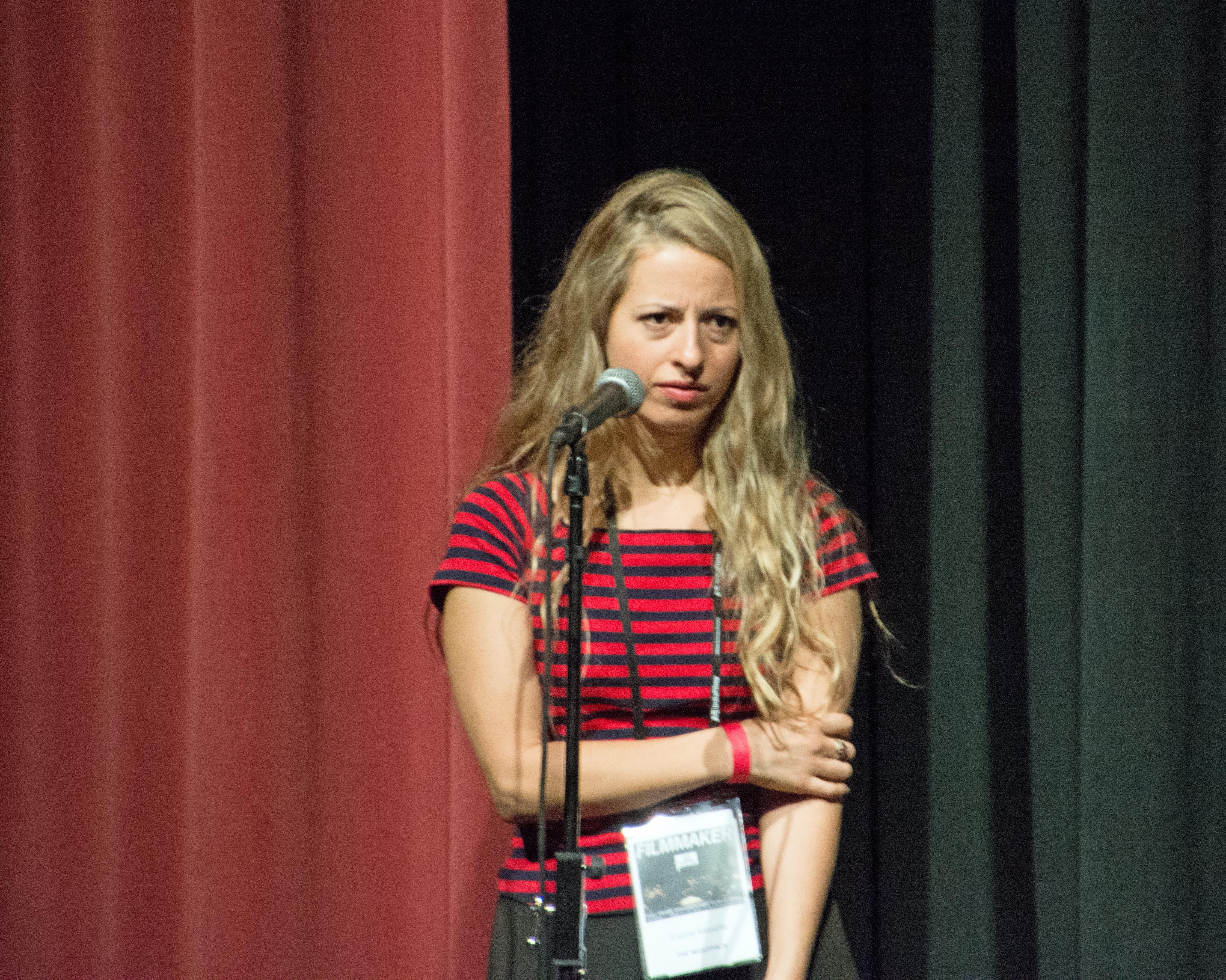
Crystal Moselle, director of The Wolfpack, answering questions

Crystal Moselle, director of The Wolfpack, answering questions

The Wolfpack. This concerned a family in New York who kept the kids inside their small apartment for almost their entire childhoods. Something was plainly wrong with the parents, but the kids seemed lively and creative, and probably not permanently impaired. The director, Crystal Moselle, spoke afterward, and gave some added context. She’d worked on the movie for about four years.

Peace Officer. This film was about the militarization of America’s police forces. The prime subject, William “Dub” Lawrence, is a former police officer and sheriff who started SWAT team in Utah that years later murdered his son-in-law. He’s an extraordinary person, who together with the directors spoke after the film. We were particularly happy that this one won an award — for human rights.

Peace Officer co-directors Scott Chritopherson and Brad Barber, and subject Dub Lawrence (speaking)

Peace Officer co-directors Scott Chritopherson and Brad Barber, and subject Dub Lawrence (speaking)

(T)error. This was about the FBI’s campaign against Islamic radicals using informants who try to entrap them in made up jihad efforts. It was a sort of a worm’s eye view, told from the perspective of an informant and a target. It would have been comical, had the subject not ultimately been sent to prison for eight years on a trumped up charge to shut him up. This one won a grand jury award.

(T)error co-directors Lyric Cabral and David Sutcliffe

(T)error co-directors Lyric Cabral and David Sutcliffe

Tell Spring Not to Come This Year. The subject of this was the Afghan National Army operating without the direct support of the US. They didn’t seem like a very well trained or determined fighting force. The Taliban seemed to be getting the upper hand. The battle scenes were vivid and harrowing. The co-director, Saeed Taji Farouki, spoke afterwards, with intelligence and humility.

Dogwood at Duke Gardens, April 12, 2015

Dogwood at Duke Gardens, April 12, 2015

On Sunday morning, we took a break to check out the Duke Gardens. It was a lovely, clear day, and lots of things were blooming, including early azaleas and rhododendrons. The tulips were spectacular. Sally noted that this garden, too, was a pocket of beauty that, in spite of everything, gave us hope for humanity.

Azalea at Duke Gardens

Azalea at Duke Gardens

_DSC9030_edited-1
_DSC9043_edited-1
_DSC9048_edited-1
_DSC9064_edited-1

Whistler skiing, Invisibilia, and Oliver Sacks’s farewell

The new boots, after day one at Whistler

The new boots, after day one at Whistler

Early Friday morning we flew to Dallas, where we changed planes and continued on to Vancouver, where we got a car and drove to Whistler to do some skiing. The flying part of the trip was uneventful, though sitting in an economy seat for seven hours takes its toll. It’s good to have some uninterrupted time to read, listen, and think, but in the last couple of hours my bottom started to ache and my legs wanted to move.

The traffic getting out of Vancouver was terrible. With only brief prior exposure, I’d thought of Vancouver as a friendly and modern mid-size city, all of which it may be, but the traffic was more like Sao Paulo. We watched traffic lights change two and three times to progress one block. It took an hour and a half to get clear of the city, which was especially frustrating after a long flight.

The coastal road north to Whistler was curvaceous and lovely, wooded with evergreens and islands to the east. It would have been an excellent stretch of road to drive with Clara. We finally made it to Whistler Village in late afternoon, and checked in and got the key code to our condo in the upper village. We dropped our gear, picked our bunks, and went out to rent necessary equipment. I’d bought my own boots, newly purchased, but needed to rent skis and poles. By the time this got done, we were very tired and hungry, and ate at the first place we could find.

Skiing on Saturday was, ultimately, fun, though I was disappointed at first. It hadn’t snowed for some weeks, and the coverage was not good — almost nonexistent at the lower lower elevations. Higher up, there was snow, but a lot of it was very hard. Still, we found areas of good snow, and enjoyed the long runs and varied terrain. Gabe led the way, and I raised my game just by trying to keep up. The vistas were stunningly beautiful.
IMG_0193_edited-1

During the trip out, I listened more to a marvelous podcast called Invisibilia. It’s an NPR-based show with a style that resembles Serial in tone and mindset, anchored by Alix Spiegel and Lulu Miller, two very smart, funny, curious women. Each episode takes on a question or oddity of human psychology or behavior. Without seeming either overly technical or overly simplistic, it manages the neat trick of being at once entertaining and thought-provoking.

The episode I listened to en route was about categories. We all have to have lots of them, and usually give them no thought. But as the show pointed out, it would be a huge problem if every time we saw a couch, we had to figure out what it was for, whether it was potentially dangerous, etc. It’s a very good thing that we recognize couches, not to mention other categories of furniture.

Much of the show concerned gender categories, and specifically a transgender person who reported the experience of switching between male and female orientations often. It focused mainly on the challenges this presented to the individual in terms of relationships and emotions, but it also pointed up how the male-female categorization affects the way we interact with the world.

I was also thinking about Oliver Sacks, who revealed in an op-ed piece in the NY Times this week that he will soon die of liver cancer. Sacks, a distinguished neurologist, has written many fascinating books and articles about psychological oddities. Now 81, he noted that he’s written 5 books since he turned 65. I was saddened to hear he wouldn’t be with us much longer, but also inspired by the courage and calmness with which he addressed the subject of dying.

He wrote:

I cannot pretend I am without fear. But my predominant feeling is one of gratitude. I have loved and been loved; I have been given much and I have given something in return; I have read and traveled and thought and written. I have had an intercourse with the world, the special intercourse of writers and readers.

Above all, I have been a sentient being, a thinking animal, on this beautiful planet, and that in itself has been an enormous privilege and adventure.

I’m hoping I’ll be able to say the same when the time comes.

New resolutions and my latest green smoothie

DSC_0013
I have a soft spot for New Year’s resolutions. It’s generally a good thing from time to time to think about where we are versus where we want to go. Few, if any, of us that are fully optimized. At the same time, there’s never any shortage of small feasible steps we could take to make our lives better.

But personal self-improvement resolutions usually don’t get the job done. A prime example is our most visible, common, and serious public health problem: obesity. There’s no great mystery what needs to be done (eat less and exercise more), and most of us who aren’t naturally optimized for body mass know that much perfectly well. Nevertheless, each year the incidence of obesity is about the same or worse, and the over all trend in the last thirty years is worse and worse.

Plainly this is not a simple problem with an easy solution, or we would have solved it. But part of the reason we can’t successfully address obesity and other serious behavioral problems is our poor understanding about how our own minds work — that is, our own impulses and motivations. As regular readers know, I’ve been learning more about this in the last couple of years from reading Daniel Kahneman, Michael Gazziniga, Jonathan Haidt, John Brooks, and Edward O. Wilson, and I’m currently reading Predictably Irrational by Dan Ariely. In addition to being inherently fascinating, these books have provided insights into life’s persistent problems, like over eating.

One of my main takeaways from these psychologists, biologists, and critics is that our reasoning processes, which seem at times so powerful and impressive, will get us only so far, and if we want to change behavior and minimize bad decisions we need other tools and tricks. Charles Duhigg’s book on habits and how to change them, which I wrote about recently, is a good signpost on this. If we understand our behavior in terms of the interaction of our emotional needs and our environment, we can experiment with changes.

But we may as well admit that eating is especially complicated. I’ve long been convinced that what we eat is a major component of how healthy we are and can expect in future to be. I try to keep up with current thinking about nutrition. Over the course of several years, I’ve developed a repertoire of habits that help me avoid most unhealthy foods and consume mostly things that have nutritional value.

But even so, I managed to pick up five pounds over the holidays. How did this happen? It was little things. Christmas parties and more restaurant meals, colleagues bringing to work delicious cookies that had to be sampled, and old friends sending gift baskets of treats. The combination of sweet things and childhood Christmas memories overwhelms all the circuits, and extra food is inserted in mouth, chewed, and swallowed. Of course, it was momentarily delightful, but it is so much harder to take the lbs off than to put them on.

Each year around January 2 we leave the land of the sweets and other excesses and things return to normal. New resolutions are made. Regarding eating, I’m trying some new ingredients in my breakfast green smoothies (pictured here and previously described here), including in various blendings, along with greens and fruit, hemp protein powder, marine phytoplankton, cacao nibs, and goji berries. It’s fun to mix a superdrink (as in superhero), and rewarding to be able to do something fabulously good for the body. I try to make it a point each day to be grateful for such good fortune.
DSC_0006

Wonderful Balanchine ballets, and friends

We just loved the new Carolina Ballet program, A Balanchine Celebration, which we saw when it opened on Thursday night.  It ran the emotional gamut, from wrenching (Agon) to carefree (Who Cares?), all, naturally, by George Balanchine, the greatest choreographer of the twentieth century.  
It was all wonderful, but I have to mention especially Lara O’Brien and Eugene Barnes in the Agon pas de deux, with music by Stravinsky.  As I mentioned to Lara afterward, it truly made me uncomfortable, as it surely is meant to do.  She took the angular movements to a frightening extreme.  I was reminded of something I once read about Suzanne Farrell:  she made the audience sweat.  Margaret Severin-Hansen and Pablo Javier Perez were deft and delightful in Tarantella.  I also had a new appreciation for Jan Burkhard in Valse Fantaisie and in Who Cares.  She’s got a spunk and sass, which worked particularly well in the Gershwin.
I need to give a special note of appreciation to the pianist for the Gershwin, Karl Moraski.  I was on the second row, practically inside the piano, and could hear every detail.  In my jazz period, I listened to multiple versions of all these iconic standards, and learned not just the tunes and harmonic structures, but also the words to all these songs.  Moraski was faithful to the spirit of the music; Gershwin would certainly have approved.  I spoke to him afterwards to congratulate him, and verified that he had done the arranging.  I noticed that the dancers seemed to be smiling a lot during the Gershwin, and wondered for a minute if they’d been coached smiling.  Then I realized I was smiling a lot, too.  The great music, and Balanchine’s lighthearted ballet translation of MGM musical-type dancing, was delightful.  
Last year we made a contribution that made us the pointe shoe sponsors of Lola Cooper, and so we always watch her performances with particular interest.  She had a charming pas de deuz with Nikolai Smirnov in the Gershwin piece, S’Wonderful.  She’s got a ton of warmth and vitality, and just keeps getting better.
One of the great things about having exceptional artists in the 42d largest city in America (as opposed, say, to the first, second, or third) is you can, if you want to, talk to them.  Earlier in the week, I’d sent Ricky Weiss a link to a Ted Talks talk by the choreographer Wayne McGregor.  At intermission, he told me that he really appreciated my sending it, and he absolutely hated it!  It was contrary to everything he believed dance should be trying to do.  He found it hollow and superficial.  I didn’t think it was quite that bad, but what do I know?  As I told Ricky, whatever the merits ot McGregor’s choreography, I thought it was worthwhile that the Ted conference was engaging with dance, and it suggested another avenue for exploring and communicating about creativity.  Ricky seemed to be of the view that there was no redeeming quality.  He just couldn’t stand it.  
At the other intermission, we had a glass of wine and a chocolate in the donor’s room, and two of the new dancers of the company came up and introduced themselves:  Colby and Laren Treat, who are twin sisters from Ilion, New York.  I was so impressed that they had the gumption to come right up to us and start talking.  That’s not an easy thing to do, for a young person or any person.  They were really friendly and had interesting things to say about the program.  
I feel so fortunate to be able to meet and be inspired by all these artists.  It’s one more great reason to live in Raleigh, NC.  Earlier in the week, I had lunch with my friend David Meeker, who was recruiting me to join the board the City of Raleigh Museum.  David is still in his twenties, but has contributed significantly to civic life by founding the Busy Bee Cafe and developing the building with Beazley’s and other properties.  We agreed that Raleigh had come a long way and had a ton of great things happening (e.g. arts, food, sports, commerce), but was still struggling with its branding.  I thought the museum might help develop a richer understanding of Raleigh, and agreed to consider joining the board.
As I’m posting this, we’re in RDU airport (free wifi!) about to depart for Italy.   is our first trip there, and has been a long time coming.  I almost made it when I was sixteen, and was recruited for an orchestral music program by the NC School of the Arts in Siena, but lacked the necessary funding.  I almost made it six years ago, but then my Mom fell ill.  So now we’re going to do it.  I’ve reviewed numerous guidebooks, and listened to 15 CDs of Pimsleur’s Italian.  I think it’s going to be great.  More to come.  

A juicy yoga class and other educational experiences

As much as I really love yoga, I go back and forth on Yvonne’s once-a-month Juicy Flow class at Blue Lotus. I like doing a class on Saturday mornings, and I like Yvonne, but I have the same issue the first Saturday every month.

Rather than her usual hour-and-a-half of Vinyasa (which is a lot), Juicy Flow is two hours, with a lot of fast movements. It’s eclectic. She puts a lot of thought into the music mix, which can range from goofy 80s pop to the world. In terms of movement, it’s always different, and there’s always something lively and fun. But it’s always exhausting, and tends to make me sore for a couple of days afterwards.

I was particularly hesitant about Juicy Flow this week, because I’ve been having some issues with my shoulders, and the class ordinarily stresses those parts. But I decided to give it a go. As usual, she’d come up with some demanding variations of traditional asanas, and several three-minute-long Kriya sequences of fast, big movements, including shoulder turns, squats, rolling up and down, scissoring legs, and open palm punches. There was also some free-form dancing.

Like every good yoga class, it was a learning experience — finding out some new things about what my body can and cannot do, and what the possibilities are. It was sufficiently demanding that I was not thinking about much of anything other than Yvonne’s directions. The two hours went fast. It was sweaty and exhausting, but also fun, and left me feeling amazingly calm and relaxed.

I was pleased to see news reports this week that Harvard and MIT are starting a free online education initiative called EdX. I might be interested in some courses. In fact, I’ve been auditing Michael Sandel’s Harvard course on justice (i.e. theories of ethics) through iTunes U. I usually watch Sandel or a Ted Talk in the early morning while getting my heart rate up on an exercise machine. It gets my head going.

Opening up the Ivy ivory tower strikes me as a very good thing for society in general, and I hope a lot of people will use it for continuing their education. It’s worrisome that anyone could think of college as the completion of an education. Seriously, has there ever been anyone who is reasonably well-educated after four years of college? College is kindergarten for adulthood. Getting fairly well educated takes a long time, and even then, there’s always more to explore.

Diving in the Galapagos Islands

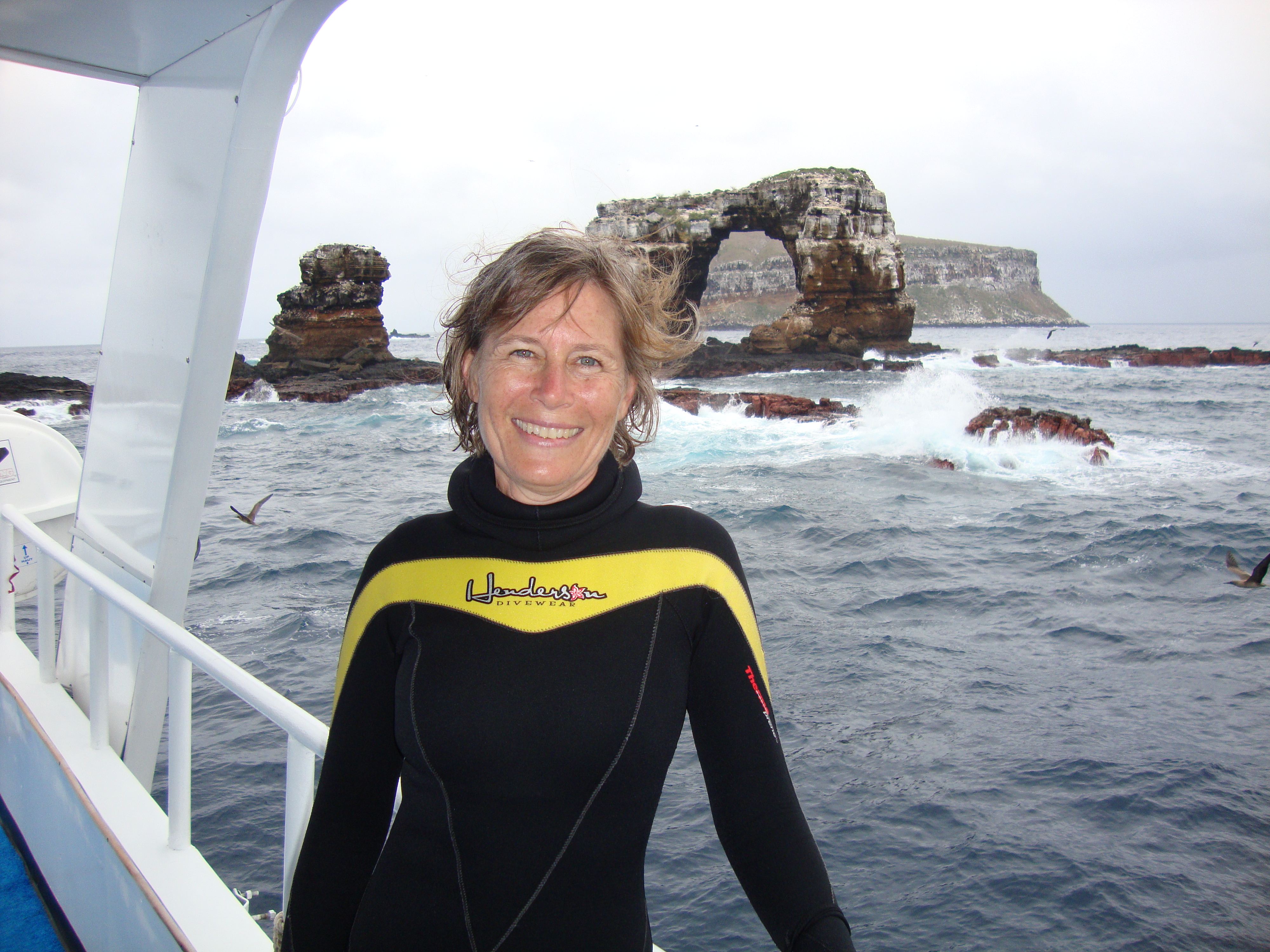
Sally at Darwin's Arch, Galapagos

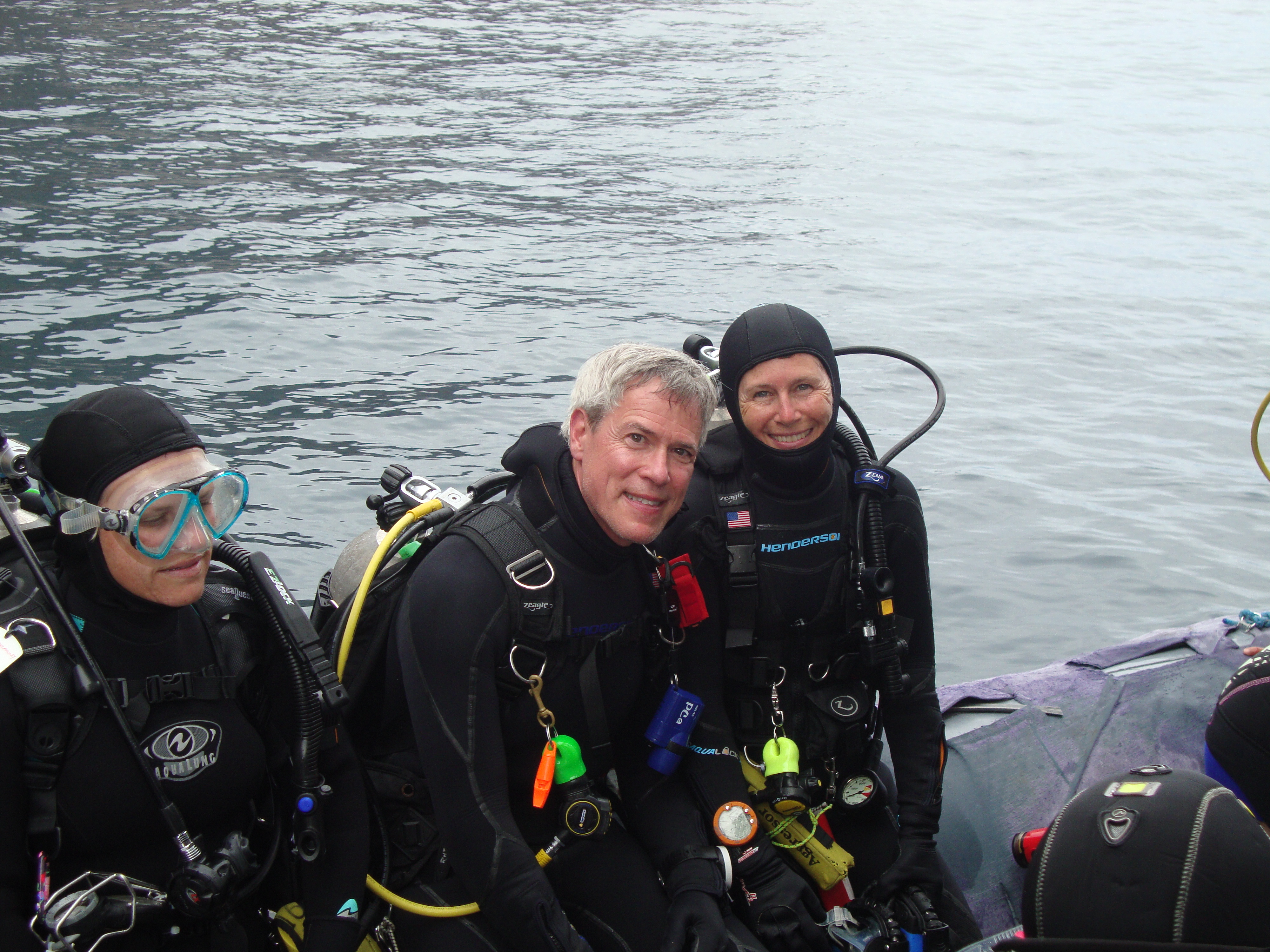
On Christmas day, we did our third day of scuba diving in the Galapagos Islands, some 600 miles west of the coast of Ecuador, at the foot of Darwin’s Arch. There was a strong current, and so we spent most of the fifty-minute dive clinging to barnacle-covered rocks. There were many patrolling hammerhead sharks, as well as a couple of large Galapagos sharks. We saw many large sea turtles and fine spotted moray eels. There were hundreds of small colorful tropical fish, such as Moorish idols, king angelfish, trumpetfish razor surgeonfish, Guineafowl puffers, barberfish and parrotfish, as well as huge schools of creolefish. It was fantastic!

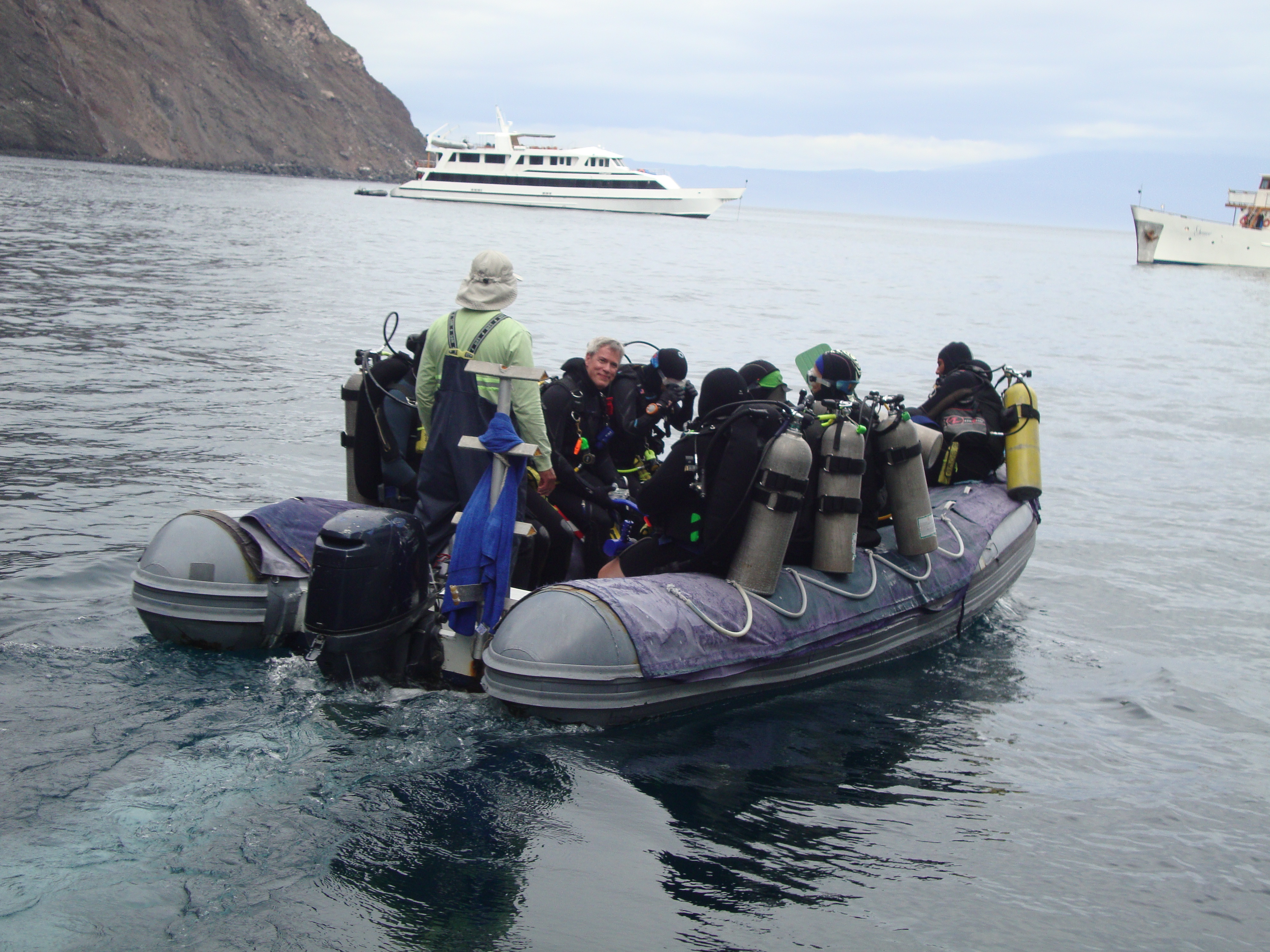
After the dive, we hoisted ourselves over the side of the inflatable dingy (or panga) and returned to the mother ship, the Galapagos Aggressor II. It was Sally’s hundredth dive. The crew presented her with a certificate, and our fellow divers gave her congratulations and hugs.

The Galapagos Aggressor II

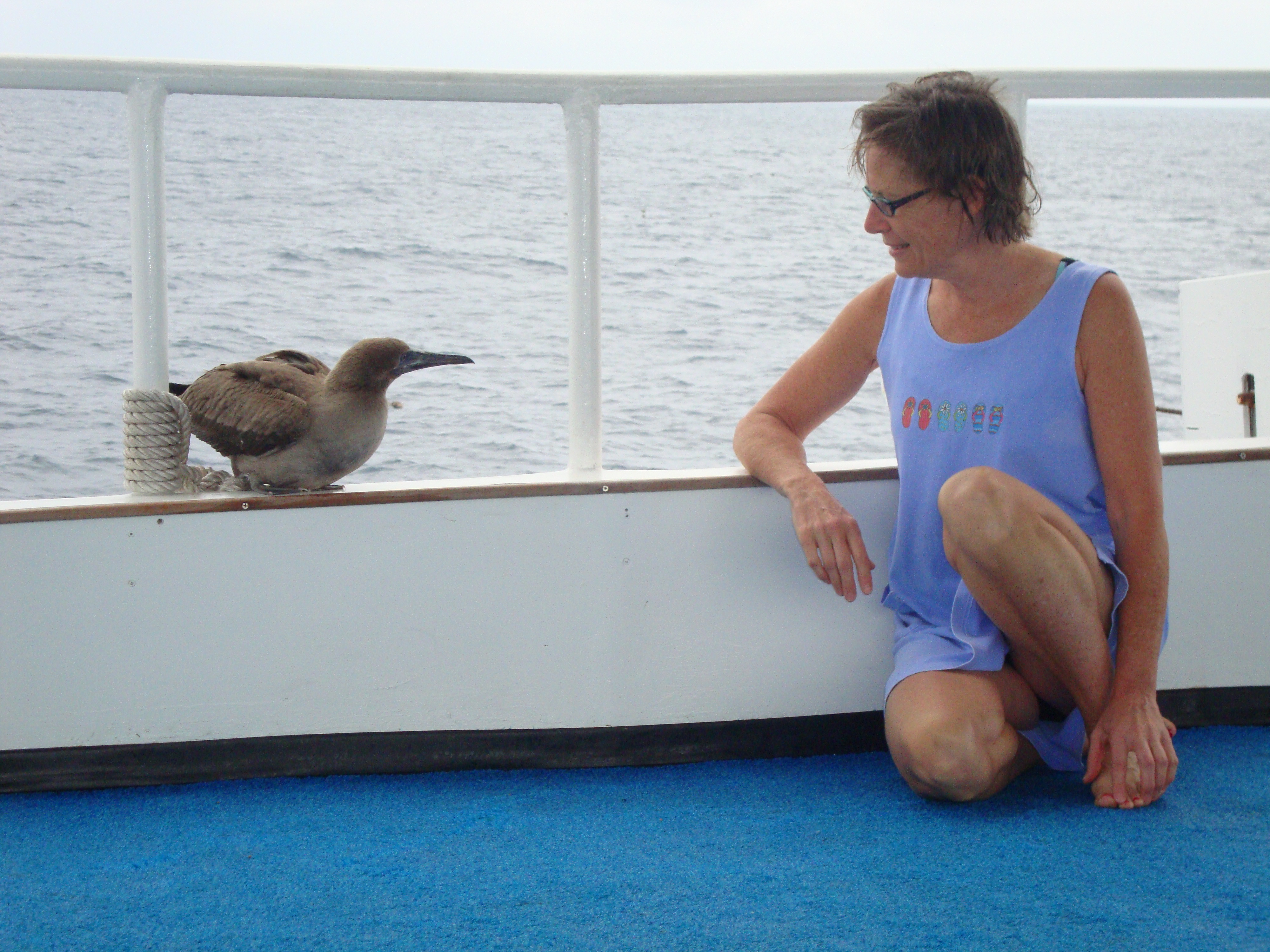
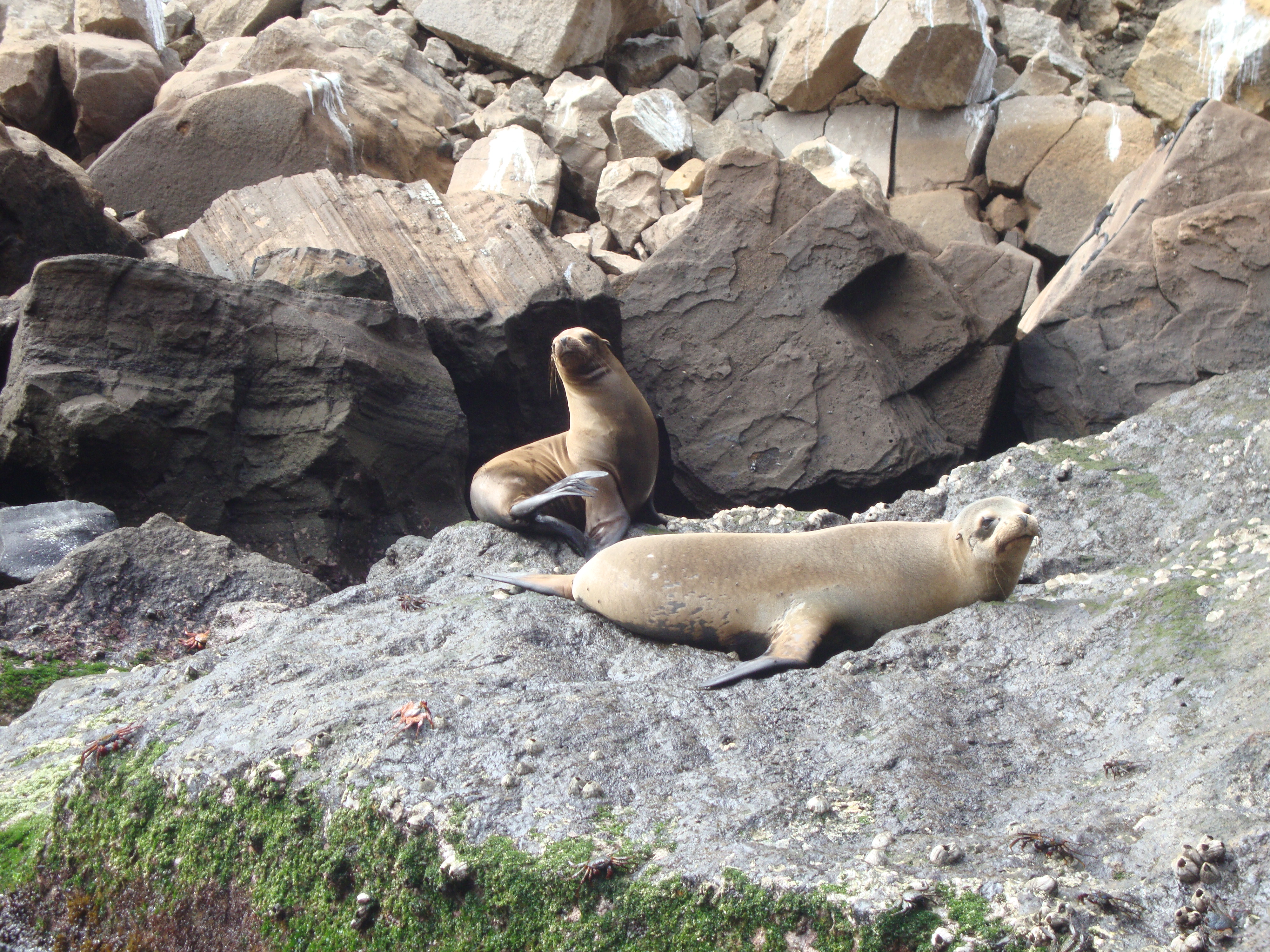
From the boat, we watched hundreds of flying boobies (large sea birds that resemble gulls with webbed feet) (Nazcas, red-footeds, and a few blue-footeds), frigate birds, swallow-tailed gulls, and storm petrols. Groups of dolphins came by periodically. Later that day, we did some snorkeling a few yards off of Darwin Island. The dolphins weren’t very interested in us, although I swam briefly with a group of six. We had better luck with a group of sea lions, who were curious about us, and came close by doing flips and loops.

Sally and a curious juvenile boobie (red footed, I think)

Darwin, like all of the islands we visited during the week, was the remains of a volcano that originated four or five million years ago — a mere babe in geological terms. It was mostly gray rock wall rising sharply several hundred feet to a plateau on top. It was very stark, but also thrumming with bird and sea life. We saw no other humans. It felt like the earth was brand new. The creativity and resourcefulness of nature was awe inspiring.

On the panga

During the trip, I finished reading The Better Angels of Our Nature by Steven Pinker. Pinker’s theseis is that human violence has declined dramatically over the course of history, and he explores the possible reasons for this. The book covers a lot of territory (all of human history) using a lot of tools (history, philosophy, statistics, biology, psychology), and still manages to be surprisingly lively and readable. Part of the book examines the increase in the last century of concerns for animal welfare — the sense that mindless cruelty to animals is unacceptable, and the suffering of animals is a moral concern. As with most violence, we’re ordinarily concerned with (and overgeneralize from) the violence and cruelty we observe, and tend to ignore examples of kindness and decency. It was cheering to learn of a trend toward greater respect for animal rights, and to consider that the trend could continue.

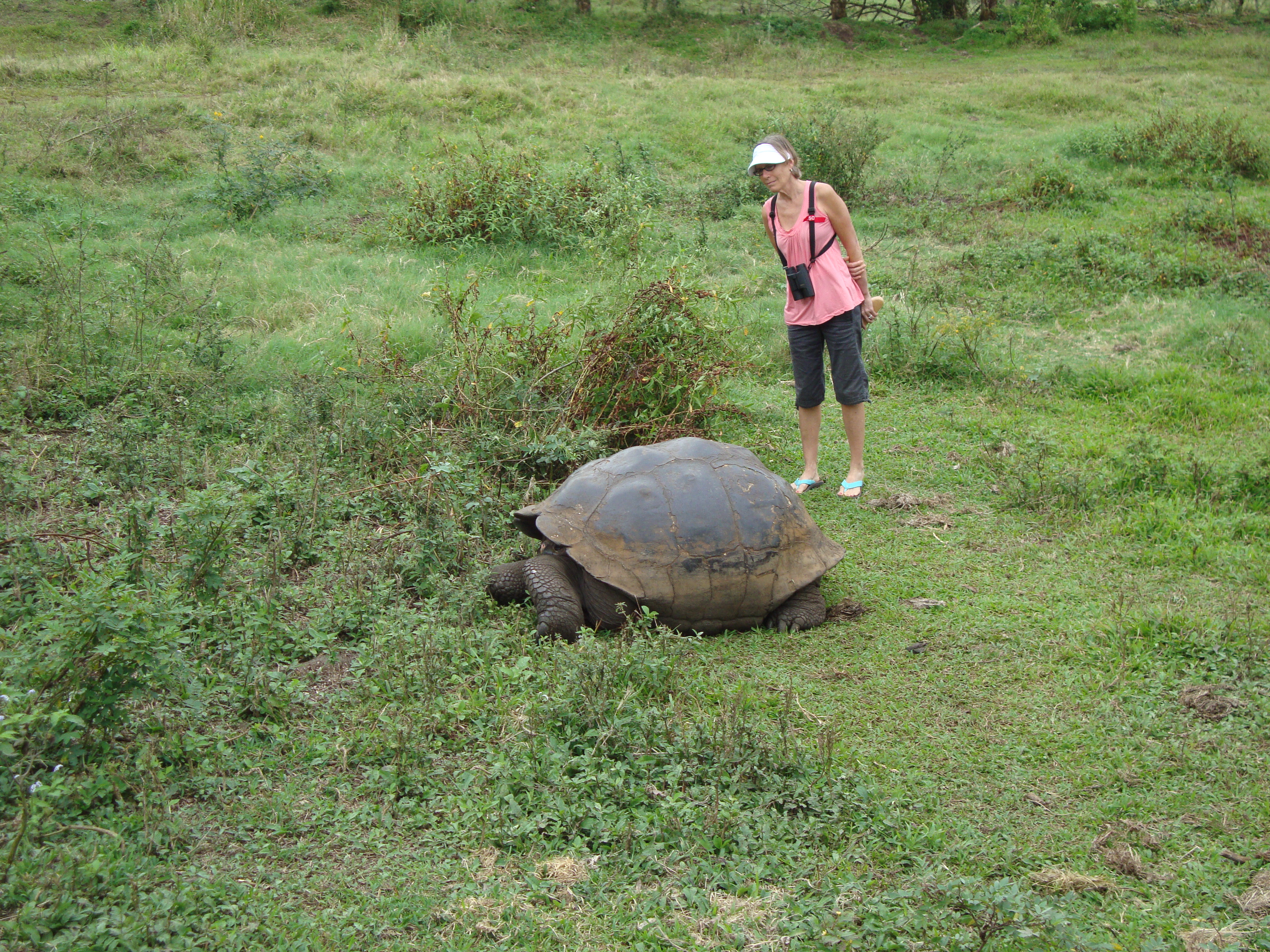
In our group of 11 divers, Sally and I were the only ones who did not dive with cameras. They were a cheerful, intelligent, and sociable group of folks, and all significantly more experienced at diving than we were. I’d taken the view that I’d prefer to look hard at what was in front of me without the distraction and intermediation of a camera, but especially after viewing some of their pictures, I was a little sorry that I didn’t get pictures of some of the amazing, strange, and beautiful things we saw under water. Perhaps next time. Here are some other above-water pictures from our trip.


How to change the world

At my early yoga class on Thursday, Sandy, the teacher, postulated that everything we do has ripple effects, first on our selves, and then on others. She suggested, as I understood it, that our yoga practice ia not purely personal. Our large, calming breaths lead to other good things for our bodies, which lead to other good things for others. Thus one person can change the world, at least a bit.

It’s hard to know if this is true, but it doesn’t seem completely crazy. There is no doubt that yoga has improved my levels of consciousness and happiness. And it’s possible that this has some small effect on others. And their attitudes affect others, and so on and on. I do not see this as a complete solution to anything, but it seems fairly clear that the human race, or even my little circle, has not come close to its carrying capacity for happiness, so the effort couldn’t do any harm.

In another effort to work for positive change, on Friday I flew to DC for the day and met with a group of folks at the Google offices to discuss possible approaches to future patent reform. The deep disconnect between the patent system as it was originally conceived and the way it sometimes works today to undermine innovation gets me worked up. Software innovation has very little to do with our patent system, which at times actually undermines such innovation.

It was good to brainstorm with some smart people with similar-but-not-identical perspectives. Anyhow, our ad hoc group made some progress in getting focused on possible areas for more work (e.g. damages apportionment, written description and enablement), and possible methodologies (e.g. a wiki), and agreed to keep working.

Changing the legal system, whether through better regulatory and court decisions or future legislation, even a little, is a daunting undertaking. I think the pro-reform forces have the better arguments, but better ideas do not always carry the day, as the recent legislative battles on patent reform demonstrated. Good policy reform arguments lose all the time, for all kinds of reasons, including self-interest, certainly, but also ignorance and inertia. It takes a lot of energy, commitment, and organization over the long term to achieve change. The first thing to do is not give up, and keep on thinking, and keep on communicating.

Speaking of change, I recommend the movie Amazing Grace (2006) about the ending of the British slave trade. Great Britain, a hugely powerful, successful country, the economy of which rested in significant part on slavery, decided in 1807 by act of Parliament to end slave trading. The change was in significant part due to the efforts of a relatively small group of abolutionists, including MP William Wilberforce. It took them some 25 years.

For more inspiration, on the trip to DC I reread some of Last Call by Daniel Okrent, a history of Prohibition. We all know that Prohibition (banning the sale of intoxicating beverages) was a disastrous policy, right? But we don’t all know, or at least I didn’t, how it came to be a cause, and then a Constitutional amendment. It’s a complicated story. There were many cross-currents and otherwise-unconnected groups that opposed alcoholic beverages in the 19th and early 20th centuries, including such disparate groups as religious revivalists, women’s rights advocates, advocates for the poor, anti-Semites (which disliked the successful Jewish distillers), and anti-Germans (which targeted the successful German beer brewers). These folks worked for decades to organize and change the United States from a hard-drinking country to an abstimonious one. And by gum, they changed the Constitution.

Unfortunately, they didn’t foresee that this would form the breeding ground for organized crime, violence, and massive corruption, among other problems. It made ordinary citizens who desired nothing more than a drink into law breakers, thereby undermining respect for the law more generally. As horribly wrong as the Prohibition forces were, I respect the idealism of some of them, and admire their pluck and persistence. The leaders who built popular support and those who organized legislative change could teach us a few things.

We, of course, wouldn’t do anything as silly as Prohibition, would we? Ha-ha! The NY Times yesterday had an interesting story entitled (somewhat confusingly) Police Officers Find That Dissent on Drug Laws May Come With a Price. In brief, a border patrol agent was dismissed for saying to another agent that if marijuana were legalized, the drug-related violence at the border would cease. It turns out that an outfit call Law Enforcement Against Prohibition (LEAP) supports this perspective, and includes 145 judges, prosecutors, and police offices, as well as an email list of 48,000.

These are courageous people. As one police officer said, “We all know the drug war is a bad joke. . . . But we also know that you’ll never get promoted if you’re seen as soft on drugs.” The very existence of LEAP suggests that the possibility of a more sane approach to regulating now-illegal drugs may be getting closer.

Thanksgiving in Nassau with sharks and Proust

Gabe, Jocelyn, reef shark, Rob, and Sally

For Thanksgiving we went down to Nassau, Bahamas, and did some scuba diving with sharks. I was looking forward to some time with Sally, Gabe, and Jocelyn, and also to the palm trees, beaches, and beautiful turquoise water. But we chose the destination in large part because of the abundance of reef sharks.

For those with long exposure to anti-shark hysteria (Jaws, cheesy nature channel specials), this probably sounds crazy. In fact, people do these dives safely every day. For me, there was some element of facing down an irrational inner fear, but the bigger driver was curiosity and a desire to experience a particularly beautiful force of nature.

We stayed at the Sheraton on Cable Beach, a large hotel with a white sandy beach, lots of curvaceous pools with waterfalls, palms, and plenty of deck chairs. The staff seemed friendly, though slightly shy. Restaurant service both in the hotel and elsewhere was surprisingly slow (except for Luciano’s, where the food and service were both excellent). One bummer: the food was much more expensive than I expected — about three times the price of equivalent meals at home. There was a casino, which we walked through, and where no one looked like an extra for Bond film. I tried, unsuccessfully, to comprehend why these people couldn’t find something more fun to do than just throw away their money.

Sheraton Hotel, Nassau, Bahamas -- our view

But there is no accounting for taste, and no explaining some of the strange things people like to do. Which brings me back to the sharks. Humans kill around 100 million of them a year (a substantial number of those by torture — cutting off fins for shark fin soup and leaving the fish to drown), whereas unprovoked sharks around the world account for around four human deaths a year. Of those exceedingly rare deaths, the perpetrators are only four of the 360 species (great white, oceanic whitetip, bull, and tiger). It is simply a myth that sharks are mindless killing machines. Some species are highly social and demonstrate problem solving skills, curiosity, and play.

Some species of modern sharks reached their current form about 100 million years ago, in the age of dinosaurs. Species come and go (for mammals, the average species lasts about a million years), but the sharks have remained. The basic, gorgeous design has clearly stood the test of time.

We dove with Stuart Cove’s dive operation, which was generally well run with cheerful young dive leaders and staff. Sally and I did ten dives and all. Gabe and Jocelyn were not certified divers, but after refreshing on their skills with a resort course, they came with us on four dives with an instructor, a smart, well-travelled (including a stint diving in Mozambique, which she recommended highly), and good-humored young Englishwoman named Ruth.

Gabe and Jocelyn at the start of a shark dive

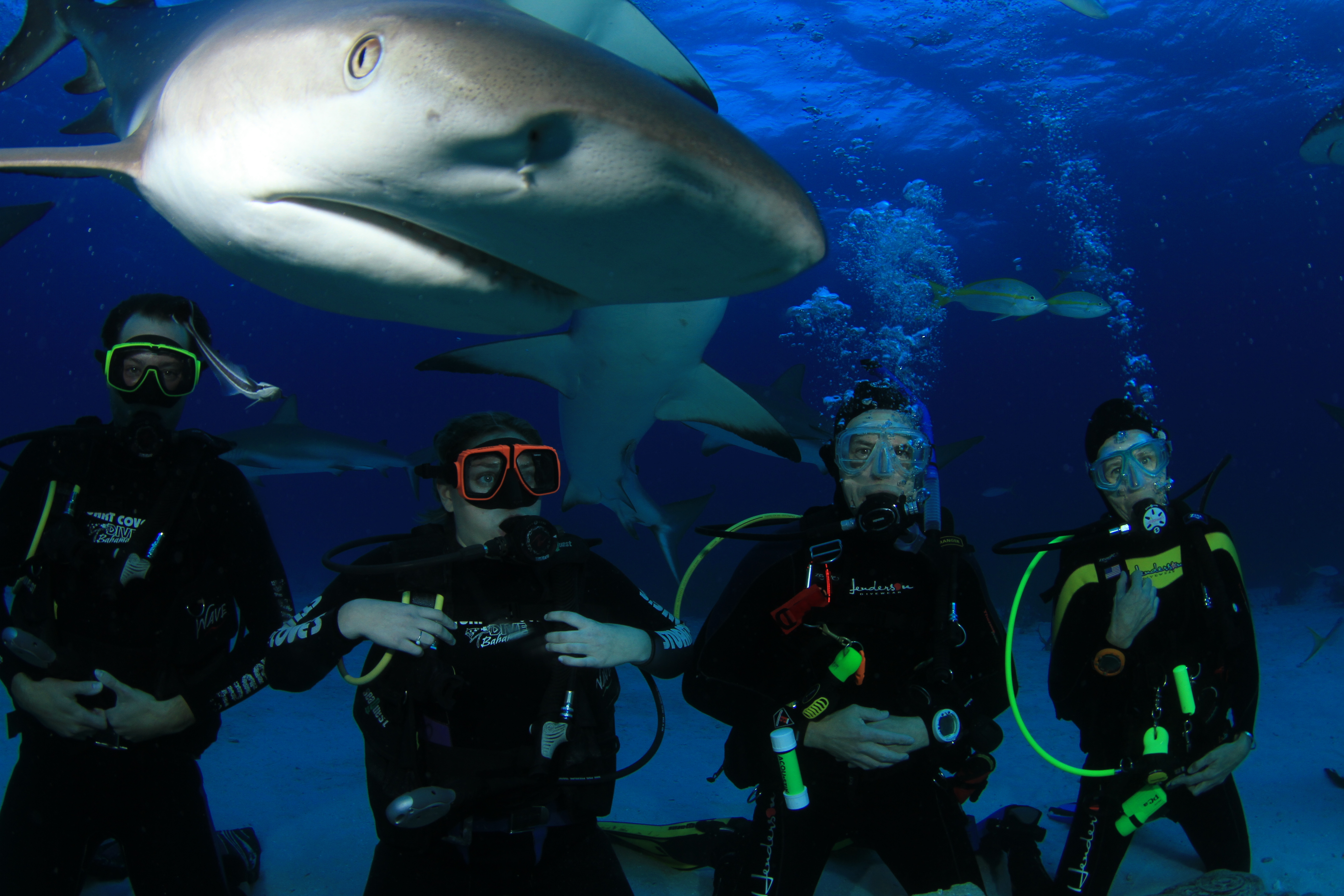
The climax of our diving was Thanksgiving day, when we did an area called Runway Wall, where Sally and I swam at about 70 feet (with G and S shallower) along a wall that goes down to a depth of 5,000 feet. Beside us, in front of us, and behind us were reef sharks. I counted 15. At times they swam quite close (inches), coming up on us from behind, or heading straight for us. We also got to within a few feet of a large sea turtle (probably a loggerhead), and saw a few Atlantic spadefish, a spotted drum, a spotted moray eel, and a Goliath grouper, along with many smaller fish.

After a surface interval, we descended again and sat in a circle in a sandy area. One of the staff, Rich, had donned a chain mail body suit, hood, and gloves, and brought down a cage with chum. The sharks increased in number (perhaps 20-25 showed up), and began swimming faster and closer to the cage. Rich would take a thin metal pole, spear a steak-size piece of chum, and whip it upward quickly, and the closest shark would instantly bite and swallow it. Rich would position himself in front of each diver and do some feeding while the staff took photos and videos.

I had mixed feelings about feeding sharks (or any wild animal), out of concern that it might lead to dependency or otherwise disrupt the ecosystem. I also wasn’t crazy about the emphasis on photography. But in the end I put those ideas to one side and was simply overwhelmed by the experience: about 50 minutes of a close encounter with prehistory. The distance between us got down to zero (I was bumped a few times). After a few minutes, I began to distinguish individual differences among the sharks. One had a mouth that gaped on one side, another had a fish hook in his back. They would swim in lazy circles, and then suddenly accelerate toward the food, sometimes colliding. All told, I was deeply moved by their power, grace, and beauty.

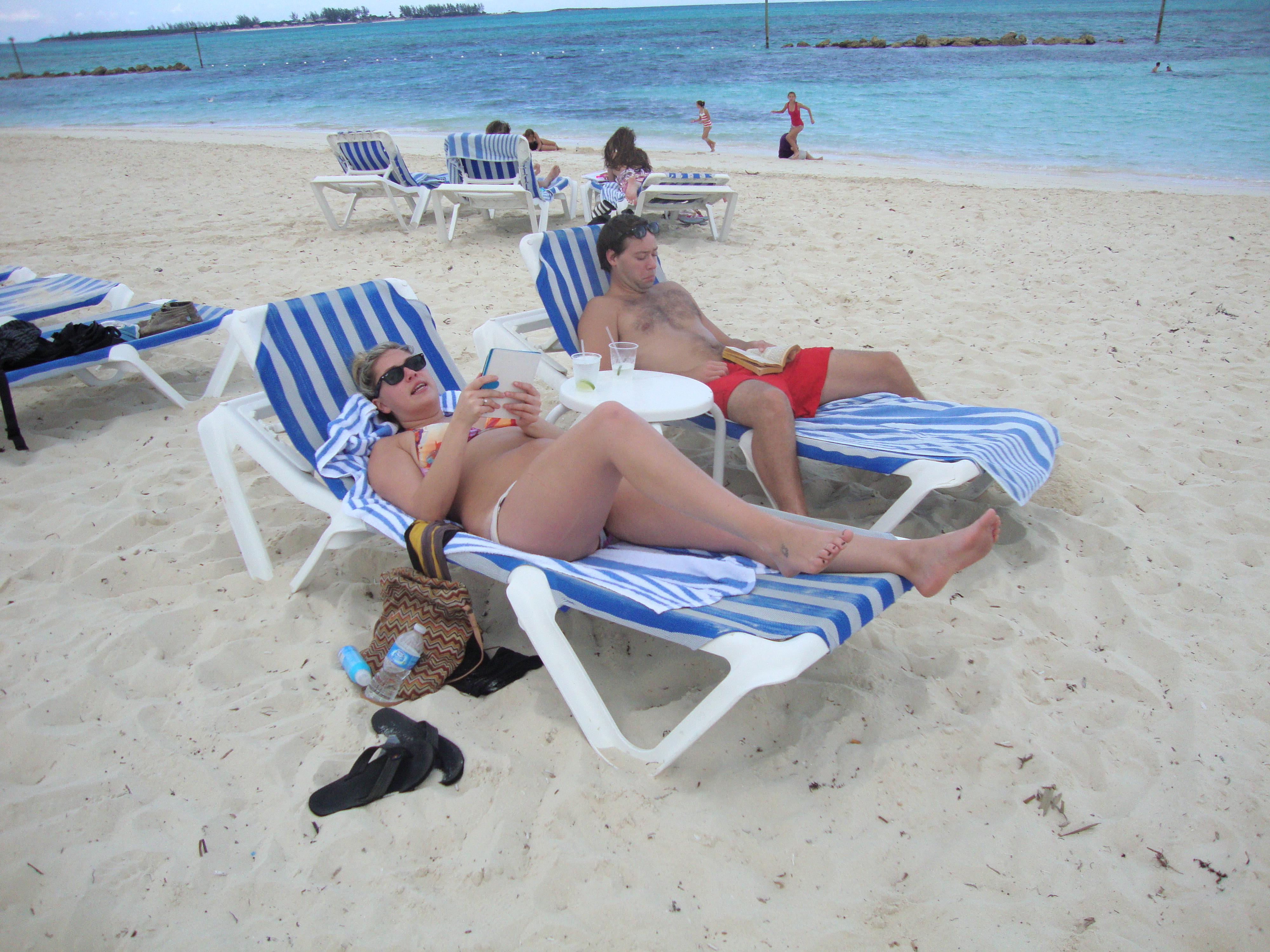
We did not dive on our last day before flying home to decrease the risk of decompression illness. We spent much of the day lounging on the beach or by one of the pools reading our various books. It was windy, sometimes cloudy, but sometimes sunny. It was lovely to see our kids reading for hours. I used to worry that they’d end up as hopeless TV addicts. But they didn’t!

I began rereading Swan’s Way, this time in a translation by Lydia Davis. Many years ago, I read the entirety of Remembrance of Things Past, and have from time to time returned to sections of it, but the length of the work is daunting in these frantic times. I found the Davis translation much more graceful and lively than the Moncrieff and Kilmartin. It may be that accumulating more life experience makes the book itself better. In any event, I was struck once again by the strange hypnotic beauty of the prose.

For the first time, I saw how the apparently casual, improvised sound of the early part of the book includes a lot of delicate prefiguring of people and events that will gradually come into sharp focus. There is so much richness in the book. It makes us realize how rich our own lives can be in perception and feeling, and makes us want to use our memories and our eyes, ears, noses, touch, and taste buds better. But it is not a self-help book; there’s something magical about it. I had the odd, strong feeling as I was reading that the book was my own consciousness coming into being. Of course, it’s only a novel — or is it?

More shark photos:


Opera, cocaine, yoga, fighting the power, and soccer

I seriously considered driving down to South Carolina this weekend to drive Clara on the Carolina Motorsports track, but decided the trip would probably create more stress than it would relieve. I needed to get some work done this weekend, and wanted to do some other fun things and take a few deep breaths.

On Friday evening Sally and I had dinner downtown at Buku, which had added some tasty and interesting vegetarian options, and went to the NC Opera’s production of Carmen. Carmen was first performed in 1875 shortly before Bizet died at age 36, and its first performance was a failure. Although it is full of wonderful melodies, it isn’t too hard to imagine why audiences initially had trouble with it. It celebrates freedom over responsibility, and its uninhibited sensuality is even today a little shocking.

When I saw the Metropolitan Opera’s production in New York last Thanksgiving, I was intoxicated. Elina Garanca as Carmen was sensational: beautiful in every way, and very sexy. The production was edgy, beginning with an initial scene that did more than casually suggest a gang rape by soldiers of Micaela. The acting was as good as the singing, and the settings were spectacular. My brain’s pleasure centers went into overdrive — dopamine city. Great opera is unquestionably better than cocaine. A possible solution to the drug/drug war problem: provide music and opera education (it is an acquired taste, and education is necessary), and great opera for everyone.

I gave some money recently to the NC Opera, because I really do want the art to survive and thrive, and I’m happy we have at least some live opera here in Raleigh. And I enjoyed Carmen on Friday night. As Carmen, Leann Sandel-Pantaleo sang beautifully, as did the other principals. The orchestra under the baton of Timothy Myers sounded good. But Carmen is more than just music. As drama, the production was flaccid. Instead of threats of violence and passion, we had too much sweetness. There’s not much to say about the sets; there wasn’t much to them. But it was still better than cocaine.

I got some deep breathing in at a Vinyasa yoga class with Yvonne at Blue Lotus on Saturday morning. Her 1.5 hour classes are always different, with a varying playlist of eastern plus western pop music and variations on classical poses. But they are always intense. I’ve learned that I need to take along some water and a towel, because I will be sweating. At times I’ve felt something close to desperation as to whether something uncomfortable is beyond endurance. But there are moments of sweet transcendence. And I always feel great afterwards. It isn’t just a physical thing. My mind feels more peaceful.

In the afternoon I took Diane (Sally’s mom) to North Hills to see the Metropolitan Opera’s simulcast of Donizetti’s Anna Bolena. It occurred to me that this might be too much cocaine for one weekend, but I wanted to see the new Met production. Seeing the HD simulcast isn’t the same as being at the Met in person, but seeing the live production has more electricity than seeing the same thing when rebroadcast. We learned at the beginning that people were watching in theatres all over the world, including, for the first time, Russia. It was good to share the experience with people in the theatre and around the globe.

In the production, there are 70 are so performers on stage, probably an equivalent number in the orchestra, and dozens behind the scenes. All performing difficult feats — walking a highwire without a net. It seems impossible that mere mortals could pull this off. But they did. It was stupendous. Anna Netrebko as the doomed bride of Henry VIII is compelling and heartbreaking. A great musician and a great actor. Yes, she needs to drop some weight. But I forgot that during the performance. It was truly intoxicating. Some of us in the theatre had to clap, even though she couldn’t hear us.

After I dropped Diane off, I drove by the old state capitol building and saw a couple of hundred people doing the Raleigh version of the Occupy Wall Street protest. I learned from the newspaper that 19 of them later got arrested for staying past their permitted time. Public protesting has always been problematic for me, because I can’t completely endorse any bumper-sticker-size slogan, and although I realize simplification can be politically useful and even necessary, it still bothers me.

But I’m glad that there are people who like demonstrations, and are prepared to make some public statements. The greed, ignorance, and indifference of the economic and political elites in the face of the long and continuing crisis in the economy should not be accepted calmly. Instead of going to jail, the worst malefactors of the economic meltdown are still earning multi-million dollar bonuses. Instead of instituting dramatic new regulatory structures, our politicians are doing nothing, or worse, promoting more deregulation. We’re on the edge of an economic cliff, and our leaders aren’t leading. We should be mad about these things, and gravely concerned about other existential threats (global warming, overpopulation, and nuclear weapons among them). And after we blow off some steam, we should get organized and work for change. Perhaps the Occupy Wall Street movement will spark something new.

Saturday night we went out to Cary for some minor league soccer. Our team, the Carolina Railhawks, had to beat the Minnesota Stars by 2 goals to advance in the playoffs. It was a beautiful, mild evening, and there was a large crowd out for the game. The Railhawks came from behind to win the initial game 4-3 — not enough to close out the series. They then played two 15 minute periods, which ended without further scoring. So the series was decided by a shootout. We lost 6-4. It was sort of a painful ending to a good season.

Hitting balls at the country club and watching chimney swifts

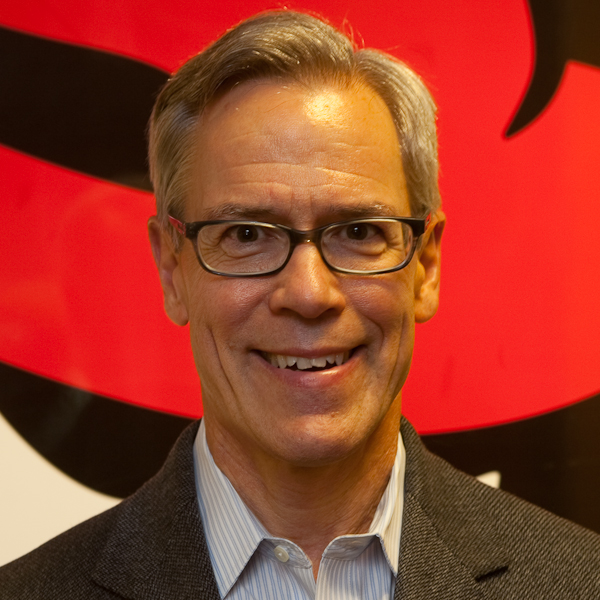
On Friday one of my Red Hat colleagues took some pictures of me for our website. In recent years I’ve got over some of the awkward self-consciousness of being peered into by a camera, though it is still slightly embarrassing. Anyhow, here is one of the pictures.

After work, I went over to Raleigh Country Club to practice at the driving range. I became a member at RCC a few weeks back. This is primarily a wonderful thing for which I am deeply grateful, but at the same time I have some cognitive dissonance. I do not come from a country club background. As a kid, I had friends who belonged and ones who didn’t, and didn’t see any systematic differences. But at some point I formed a view of country clubs as islands of unearned privilege, and of country clubbers as shallow, selfish snobs — people whose main political driver was paying less in taxes. Over time, I’ve known plenty of people who put the lie to that stereotype, but I still had trouble picturing myself wanting to join (to paraphrase Groucho Marx) any club that would have me as a member.

What changed? The most important thing was a deepening appreciation of golf. And the golf course at RCC is special. It’s the last course of Donald Ross, the legendary Scottish designer. The land rises and falls in a pleasing rhythm, with lakes and streams and bunkers, and mature trees, bushes, and flowers. It is beautiful, and also quite challenging. And it is less than 10 minutes from my apartment.

The staff has been really welcoming and friendly, as have most of the members. I really enjoy hitting balls on the driving range. When I hit a bad one, I just tee up another. I am playing with the concept that a more beautiful swing makes a more beautiful ball flight, and some of mine are flying well. But every now and again, I have an anxious moment when I feel out-of-place, and wonder if someone is about to quietly ask me to leave.

After hitting my quota at the range, I drove downtown and met Sally at the corner of Salisbury and Hargett Streets. She’d seen a story in the News and Observer about chimney swifts roosting in the Oddfellows Building there. We climbed the stairs of a parking garage across the street and looked upward.

Shortly before 7:00 pm, we saw the first few swifts appear from the northwest, and then there were more. Ultimately there were hundreds and hundreds, swarms of chimney swifts. They fluttered and veered, catching insects and making a high-pitched chatter. It was amazing. There was a kestrel that perched on the logo sign at the top of the Wachovia Building and occasionally swooped down, but the flock would counterattack. We’d hoped to see the swifts go down the Oddfellows Building chimney, but did not have a good angle to view the chimney. Finally it got dark, and we walked a couple of blocks to Dos Taquitos for dinner.