The Casual Blog

Work, Pilates, Bjork, and musical play time
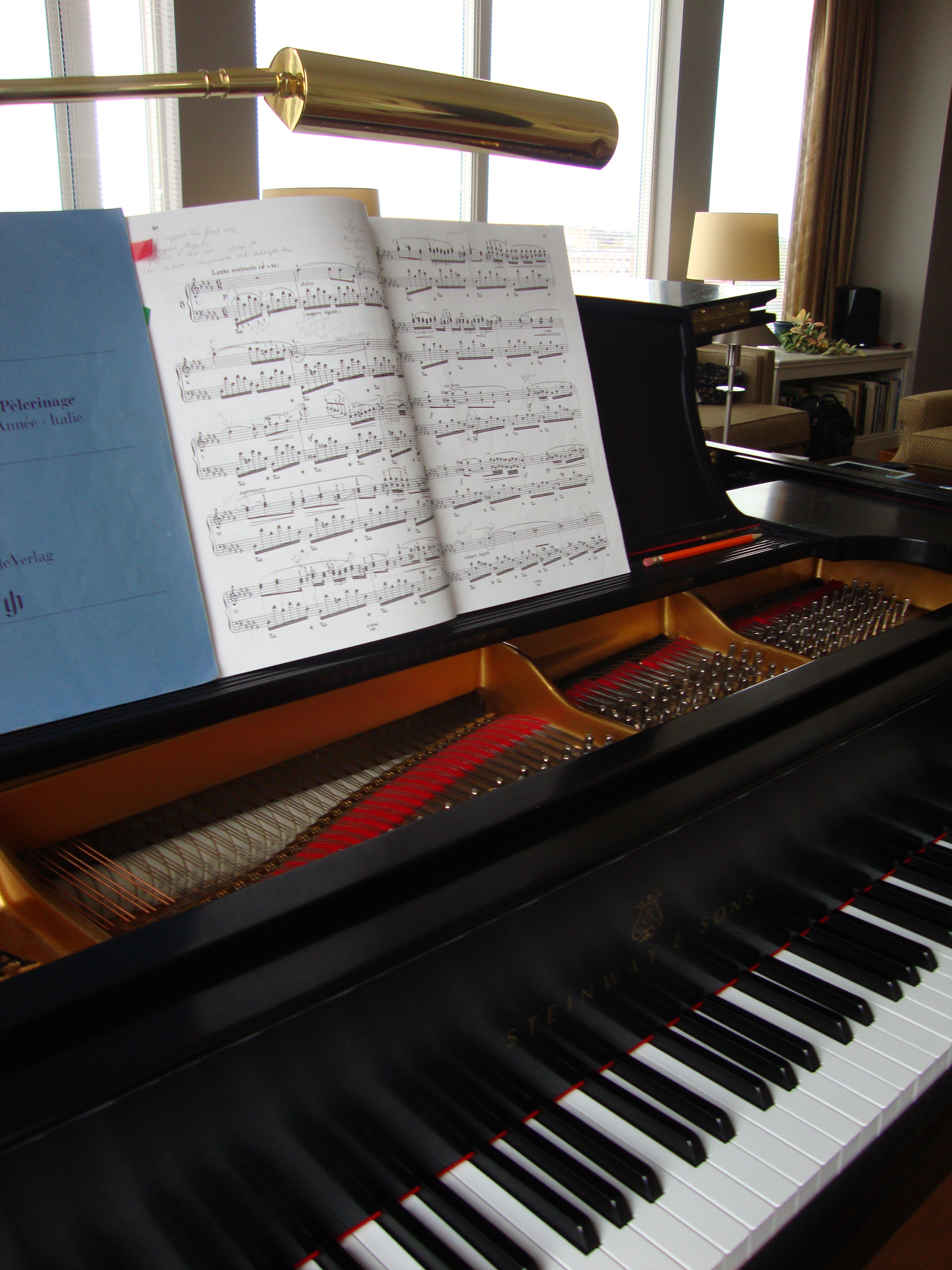
Nocturne in D flat major by Frederic Chopin

It was another busy week of many meetings, calls, and issues, with business dinners almost every night, and my email backlog continuing to pile up. But interesting, always interesting. On Friday I was scheduled to go to the coast for two days of wreck diving, but bad weather arrived and the trip was cancelled. I was not heartbroken. It was good to get some down time.

On Saturday morning it was cold and rainy. I thought of taking Yvonne’s open level Vinyasa yoga class at Blue Lotus, but learned from the web site that someone else was filling in for her. I check for alternatives, and found an early Pilates class at the Y. And so it was that I had my first Pilates experience. It was similar to yoga, with its emphasis on breathing throughout a series of exercises with unusual stretches and contractions. I found this particular class less strenuous than my normal yoga classes, and also less serenity-inducing. Still, I would do it again, especially if there’s no yoga available.

Other new things: earlier in the week I read a news story about Biophilia, the new multimedia production of Bjork, the Icelandic singer-songwriter, and downloaded the work to my iPad. Biophilia is in part a collection of songs about nature and science, but rather than being an album, it’s something we don’t have a word for yet. Bjork worked with scientists and artists to make interactive productions that allowed the listener to participate actively in the music by adding notes and altering images. After a few minutes of experimenting, I could make a bit of music with the tools provided, and participate in some of Bjork’s visions of microscopic, geologic, and celestial phenomena.

The idea of sharing a vision this way — not just providing passive entertainment, but inviting participation as a way of inspiring and teaching — is exciting, and the NY Times story took the view that it was ground breaking. For me, the experience was intriguing but not really thrilling. I liked being allowed to work with Bjork’s electronic instruments and play with her, but the musical possibilities were narrowly circumscribed and not expressive enough to satisfy me.

For example, by using the touch screen, in various songs you can add to Bjork’s fairly simple musical backdrop more harp notes or more synth notes, and play faster or slower, but so far as I could figure out without taking any new harmonic direction. The videos were in some cases beautiful, but the songs themselves were more performance art than either art music or dance music. Still, I liked the ideas, and I will probably play some more with Biophilia.
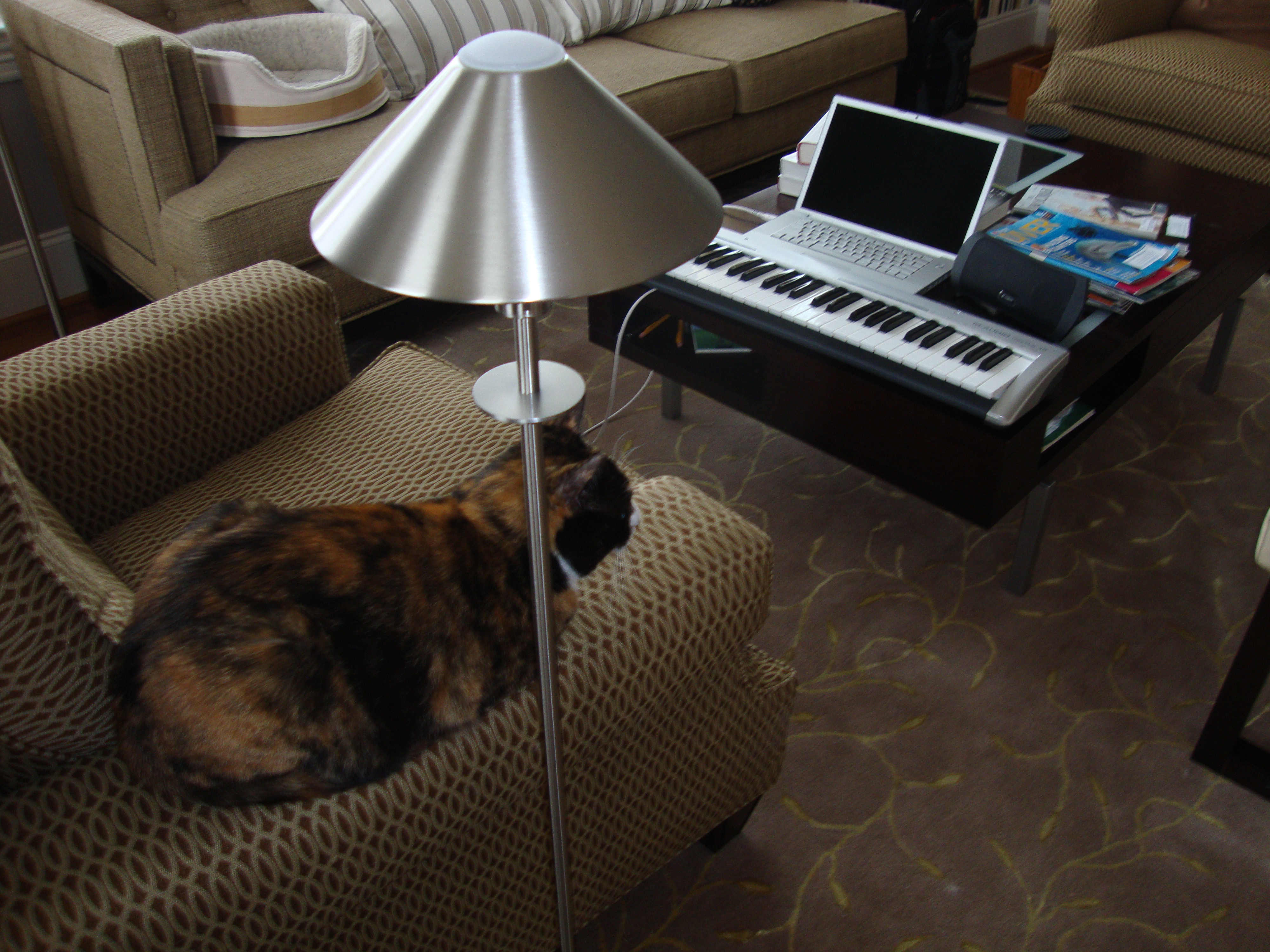
Phoebe, Holtkotter lamp, and music technology

The idea of using technology to express new musical thoughts has interested me for a while. This past spring, I began playing with the instruments built into GarageBand (a Mac application), and eventually purchased a cheap electronic keyboard and a cheap auxiliary speaker to experiment with. One of my ideas was to translate early music (1500s) through synthesizer voices to see what new things emerged. The sheet music came with a lot of interpretive problems, so I didn’t get far on the vector. But I had fun improvising with various synthesizer personalities using various systems, like Greek modes and pentatonic scales. I thought of it as playing, in the sense of playing a game. It’s a different kind of musical outlet.

Bjork’s idea of engineering a collaboration with an unknown audience has a distinguished heritage. It’s what we do when we open a volume of Chopin nocturnes and start to play. Chopin left us the architectural drawings, which the pianist uses to create musical in real time, while at the same time personalizing the structure with thousands of unwritten details according to the pianist’s experience, intelligence, and feelings.

This system — master composer, written music, trained pianist — has worked amazingly well for a couple of hundred years. It does, however, depend on musical education — there has to be a support system for training pianists, and also listeners. For music with the harmonic complexity of the great Western tradition, you have to learn a lot before you can interpret it, and you have to learn a fair bit to get deep enjoyment from listening to it. It is worth the effort.

I sometimes worry that there is a long historic curve in which our music devolves from the complex and brilliant to the simple and sweet, and from there to the just plain dumb. The traditional system of classical music education and performance is not in good health. But perhaps humans are just getting started in discovering what music can do. Who knows where it goes? We have to keep experimenting, keep creating. That’s what Bjork is doing, and good for her.
My budget solution: end the wars (Iraq, Afghanistan, and Drugs)

Yesterday the newspapers reported that the last U.S. soldiers would be out of Iraq by the end of this year. When the U.S. invaded Iraq eight years ago, I thought it was a terrible mistake, and everything I’ve learned about it since has strengthened that conviction, as thousands of U.S. soldiers and tens of thousands of Iraqis lost their lives, and as we increased our exposure to financial collapse by spending more than 800 billion borrowed dollars.

It’s good news that it’s over, and I wish I could feel happier about it. We’ve wreaked a lot of havoc in Iraq, and now we’re stopping. Have we learned anything? That’s doubtful. As a society, we’ve hardly thought about it at all.

As an undergraduate at Oberlin College, I had a concentration in political theory. I read Plato, Aristotle, Augustine, Aquinas, Montesqieu, Machiavelli, Hobbes, Locke, Rousseau, Adams, Marx, Nietzche, Bentham, Mill, Arendt, Rawls, and a lot of other interesting and challenging thinkers. For a long time, though, I had my doubts as to whether I’d learned anything at all useful.

Eventually, I came to the view that I learned one very useful thing: critical thinking. Engaging with lots of powerful ideas that were all, at least to some degree, wrong or unworkable helped develop a mental toolbox. This toolbox is useful in recognizing the weak points in arguments, discarding unfounded assumptions, and sometimes in making better decisions.

War is powerfully attractive at certain times and places. I am not immune to that attraction. Like lots of kids, I’m fascinated by weaponry (especially tanks and fighter jets), and I find military history interesting. But something in my moral education left me with the settled view that killing sentient beings is deeply tragic, and in most cases morally wrong.

Add this ethical orientation to a skeptical turn of mind, and maybe I can see through the attractions of war to the underlying horror more easily than most. Or perhaps I’m kidding myself. In any case, I have a high degree of confidence on the right way to go on this. While we’re wrapping things up in Iraq, let’s also quit sending our kids to kill and be killed in Afghanistan. There is no good reason for that war, either. We’ve spent more than $450 billion on it. Let’s stop the physical and financial bleeding.

Ditto on the war on drugs. This week’s (Oct. 17) New Yorker has a piece on the subject by Michael Specter. (Unfortunately only the first few paragraphs are available without charge online.) It starts with a discussion of Portugal’s experience of decriminalizing drugs ten years ago and treating addiction as a medical problem. “In most respects, the law seems to have worked: serious drug use is down significantly, particularly among young people; the burden on the criminal-justice system has eased; the number of people seeking treatment has grown; and the rates of drug-related deaths and cases of infectious diseases have fallen.”

Specter gives a balanced account of Portugal’s experience, and including quotes from critics of the change. Their criticisms seem mostly based on their belief that drugs are evil. Fine. But in Portugal lots of law enforcement and political leaders have given up on the idea that treating drug use as a crime can possibly succeed.

There was another good anti-drug-war piece this week by Doug Bandow, a fellow at the conservative a Cato Institute published in Forbes and republished by the Huffington Post.
According to Bandow,

Perhaps the most obvious cost of enforcing the drug laws is financial. Government must create an expansive and expensive enforcement apparatus, including financial and military aid to other governments. At the same time, the U.S. authorities must forgo any tax revenue from a licit drug market.According to Harvard’s Jeffrey A. Miron and doctoral candidate Katherine Waldock, in the U.S. alone “legalizing drugs would save roughly $41.3 billion per year in government expenditure on enforcement of prohibition” and “yield tax revenue of $46.7 billion annually.”

This cost is appalling, and it doesn’t even count such costs as ever expanding prison systems, corruption of law enforcement and government, breeding organized crime, and of course the human costs of broken families and lives.

But I see a little ray of hope. The national debt problem has come to be viewed as both serious and impossible to solve. However true that may be, it has created a sense of desperation in Washington. It’s just possible that drug war diehards could come to accept drug legalization as a necessary revenue-generating measure. This was part of what led to the repeal of Prohibition — the realists won the argument that we needed the tax revenues from liquor. Legalization, combined with a sensible regulation and taxation system, could make a significant dint in our budget shortfalls. Add that to ending unnecessary wars, controlling excessive military costs, cutting farm subsidies, getting health care costs under control, and voila!

Opera, cocaine, yoga, fighting the power, and soccer

I seriously considered driving down to South Carolina this weekend to drive Clara on the Carolina Motorsports track, but decided the trip would probably create more stress than it would relieve. I needed to get some work done this weekend, and wanted to do some other fun things and take a few deep breaths.

On Friday evening Sally and I had dinner downtown at Buku, which had added some tasty and interesting vegetarian options, and went to the NC Opera’s production of Carmen. Carmen was first performed in 1875 shortly before Bizet died at age 36, and its first performance was a failure. Although it is full of wonderful melodies, it isn’t too hard to imagine why audiences initially had trouble with it. It celebrates freedom over responsibility, and its uninhibited sensuality is even today a little shocking.

When I saw the Metropolitan Opera’s production in New York last Thanksgiving, I was intoxicated. Elina Garanca as Carmen was sensational: beautiful in every way, and very sexy. The production was edgy, beginning with an initial scene that did more than casually suggest a gang rape by soldiers of Micaela. The acting was as good as the singing, and the settings were spectacular. My brain’s pleasure centers went into overdrive — dopamine city. Great opera is unquestionably better than cocaine. A possible solution to the drug/drug war problem: provide music and opera education (it is an acquired taste, and education is necessary), and great opera for everyone.

I gave some money recently to the NC Opera, because I really do want the art to survive and thrive, and I’m happy we have at least some live opera here in Raleigh. And I enjoyed Carmen on Friday night. As Carmen, Leann Sandel-Pantaleo sang beautifully, as did the other principals. The orchestra under the baton of Timothy Myers sounded good. But Carmen is more than just music. As drama, the production was flaccid. Instead of threats of violence and passion, we had too much sweetness. There’s not much to say about the sets; there wasn’t much to them. But it was still better than cocaine.

I got some deep breathing in at a Vinyasa yoga class with Yvonne at Blue Lotus on Saturday morning. Her 1.5 hour classes are always different, with a varying playlist of eastern plus western pop music and variations on classical poses. But they are always intense. I’ve learned that I need to take along some water and a towel, because I will be sweating. At times I’ve felt something close to desperation as to whether something uncomfortable is beyond endurance. But there are moments of sweet transcendence. And I always feel great afterwards. It isn’t just a physical thing. My mind feels more peaceful.

In the afternoon I took Diane (Sally’s mom) to North Hills to see the Metropolitan Opera’s simulcast of Donizetti’s Anna Bolena. It occurred to me that this might be too much cocaine for one weekend, but I wanted to see the new Met production. Seeing the HD simulcast isn’t the same as being at the Met in person, but seeing the live production has more electricity than seeing the same thing when rebroadcast. We learned at the beginning that people were watching in theatres all over the world, including, for the first time, Russia. It was good to share the experience with people in the theatre and around the globe.

In the production, there are 70 are so performers on stage, probably an equivalent number in the orchestra, and dozens behind the scenes. All performing difficult feats — walking a highwire without a net. It seems impossible that mere mortals could pull this off. But they did. It was stupendous. Anna Netrebko as the doomed bride of Henry VIII is compelling and heartbreaking. A great musician and a great actor. Yes, she needs to drop some weight. But I forgot that during the performance. It was truly intoxicating. Some of us in the theatre had to clap, even though she couldn’t hear us.

After I dropped Diane off, I drove by the old state capitol building and saw a couple of hundred people doing the Raleigh version of the Occupy Wall Street protest. I learned from the newspaper that 19 of them later got arrested for staying past their permitted time. Public protesting has always been problematic for me, because I can’t completely endorse any bumper-sticker-size slogan, and although I realize simplification can be politically useful and even necessary, it still bothers me.

But I’m glad that there are people who like demonstrations, and are prepared to make some public statements. The greed, ignorance, and indifference of the economic and political elites in the face of the long and continuing crisis in the economy should not be accepted calmly. Instead of going to jail, the worst malefactors of the economic meltdown are still earning multi-million dollar bonuses. Instead of instituting dramatic new regulatory structures, our politicians are doing nothing, or worse, promoting more deregulation. We’re on the edge of an economic cliff, and our leaders aren’t leading. We should be mad about these things, and gravely concerned about other existential threats (global warming, overpopulation, and nuclear weapons among them). And after we blow off some steam, we should get organized and work for change. Perhaps the Occupy Wall Street movement will spark something new.

Saturday night we went out to Cary for some minor league soccer. Our team, the Carolina Railhawks, had to beat the Minnesota Stars by 2 goals to advance in the playoffs. It was a beautiful, mild evening, and there was a large crowd out for the game. The Railhawks came from behind to win the initial game 4-3 — not enough to close out the series. They then played two 15 minute periods, which ended without further scoring. So the series was decided by a shootout. We lost 6-4. It was sort of a painful ending to a good season.

Farewell and thank you, Steve Jobs

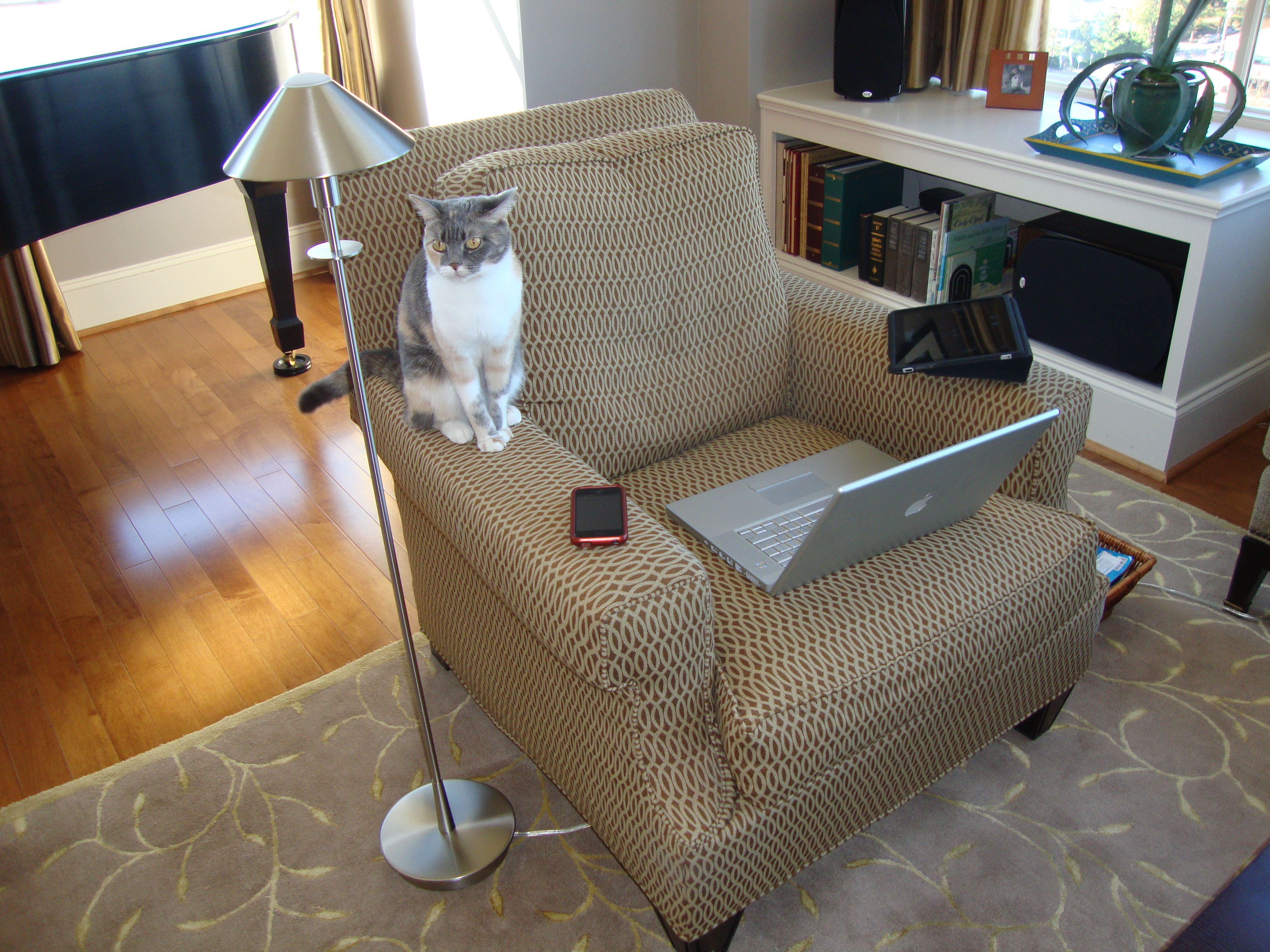
Rita with marvelous Apple devices

Appropriately enough, I got the sad news of Steve Jobs’s death from one of his devices. I was at home reading the news in El Pais on my MacBook Pro, with my iPad on one arm of the easy chair tuned to a Spanish-English dictionary and my iPhone on the other arm. (My iPod was recharging.) I don’t consider myself a huge Apple fanboy, but I cannot deny that these devices are marvelous and delight me every day. And so, like millions of others, I have a life that was changed in a positive way by Steve Jobs.

Jobs was just five months older than me, which brings to mind more-than-usual intimations of mortality. His killer, pancreatic cancer, was the same that killed my mother, so I’ve known for years that it’s a bad one. After her diagnosis, she was gone in four months. Watching Jobs’s string of successes over the last five years, I’ve been amazed at his tenacity and courage. Knowing that death was staring him in the face, he just kept on creating. This was one tough hombre.

Driving home the next day, I heard an excerpt on the radio of his 2005 Stanford commencement speech in which he set forth the following test. Every morning, he said, he asked himself, if this day were his last, would he want to spend it doing what he was planning to do. If the answer was consistently no, he changed course. I almost believe it. In any case, it’s courageous to attempt it.

A bit more of his remarkable Stanford speech:

“No one wants to die. Even people who want to go to heaven don’t want to die to get there. And yet death is the destination we all share. No one has ever escaped it. And that is as it should be, because Death is very likely the single best invention of Life. It is Life’s change agent. It clears out the old to make way for the new. Right now the new is you, but someday not too long from now, you will gradually become the old and be cleared away. Sorry to be so dramatic, but it is quite true.

“Your time is limited, so don’t waste it living someone else’s life. Don’t be trapped by dogma — which is living with the results of other people’s thinking. Don’t let the noise of others’ opinions drown out your own inner voice. And most important, have the courage to follow your heart and intuition. They somehow already know what you truly want to become. Everything else is secondary.”

In the Stanford speech, Jobs tells of taking a calligraphy course after dropping out of Reed College, and then a decade later finding that what he’d learned gave him direction in designing the first Mac. He clearly thought like an artist — perhaps even more than like an engineer. He’s quoted in the NY Times obit as saying that great products were a triumph of taste, of “trying to expose yourself to the best things humans have done and then trying to bring those things into what you are doing.” Amen.

Good conversations

One of my favorite movies is My Dinner with Andre. The 1981 movie is about as simple in concept as possible: two old friends have a conversation in a restaurant. It starts out like a typical conversation, though livelier and wittier than most, and gradually begins to soar and swoop. It’s like a duet, or a dance in words. The friends are having fun, but are also creating something. It sets a high bar for a great conversation, but it’s also inspiring. It shows that a good conversation is a work of art.

This week at Red Hat we had a meeting of our entire legal department, including colleagues from our foreign offices. I had five business dinners in a row, not to mention five business lunches and multiple impromptu encounters between meetings. There were plenty of conversations. A number of my colleagues were inspired talkers, and knew a lot about their subjects.

Some of our conversations were fairly ambitious: talking with Monica about European IP law; with Amanda about race in America; with Madeline and Kathal about blogs and the future of literature; with Mei about refusing membership in the Chinese Communist party; with Richard about the future of open source licensing, with Winston about conservative politics; and with Patrick about religion in Utah. There were many good stories: e.g. Eric on playing tennis with Andre Agassi; Emily on working with her personal trainer; and Jean on working as a flight attendant for Singapore Airlines.

It was varied and fun, and I felt grateful to be associated with a group of such interesting and stimulating people. But as Myra and I discussed, socializing in large doses is depleting. I felt really tired and ready to relax when we finished our meetings Friday afternoon. When I got home, I did some yoga, and then played some Chopin and Debussy. It always amazes me how half an hour of immersion in making music can refresh the mind and produce great happiness.

Sally mixed us basil gimlets (one of her signature drinks) and cooked a tofu curry while we listened to a Pandora mix of contemporary Indian music. At dinner we talked about some big subjects, including global warming and species extinction, which we both worry about. The topics are, of course, anxiety producing and sometimes depressing, and depression may lead towards hopelessness. And loneliness. These issues can be friend repellents: who wants to be with a depressing person who makes you depressed? This is another reason it is good to have a committed loving partner: you can talk about serious things.

We also talked about art and science. Recently I read The Wild Life in Our Bodies, by Rob Dunn (a professor at N.C. State), which discusses evolution of humans as a story that cannot be understood without appreciating our symbiotic microbes (fact: they’re more numerous in our body than human cells), parasitic worms (which may prevent disease), our former prey and predators, and other aspects of the natural world. The book is uneven, but the vision is sweeping and fascinating. It is my latest piece of evidence for the theory that scientific intuition and artistic intuition are very much alike, and they can be thrilling in much the same way.

Hitting balls at the country club and watching chimney swifts

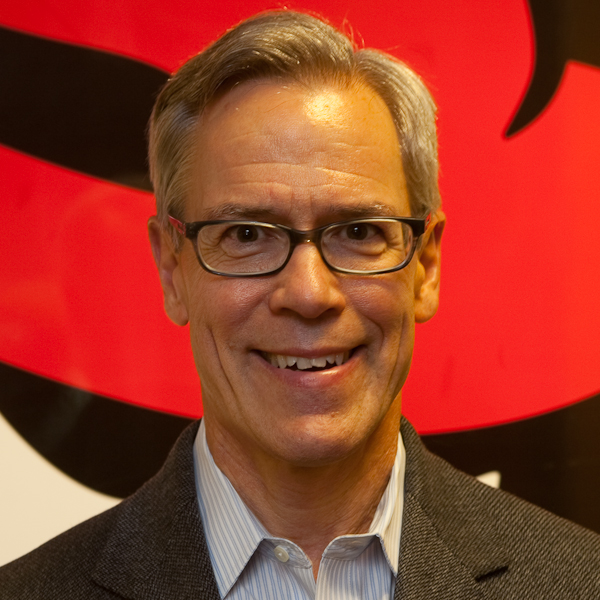
On Friday one of my Red Hat colleagues took some pictures of me for our website. In recent years I’ve got over some of the awkward self-consciousness of being peered into by a camera, though it is still slightly embarrassing. Anyhow, here is one of the pictures.

After work, I went over to Raleigh Country Club to practice at the driving range. I became a member at RCC a few weeks back. This is primarily a wonderful thing for which I am deeply grateful, but at the same time I have some cognitive dissonance. I do not come from a country club background. As a kid, I had friends who belonged and ones who didn’t, and didn’t see any systematic differences. But at some point I formed a view of country clubs as islands of unearned privilege, and of country clubbers as shallow, selfish snobs — people whose main political driver was paying less in taxes. Over time, I’ve known plenty of people who put the lie to that stereotype, but I still had trouble picturing myself wanting to join (to paraphrase Groucho Marx) any club that would have me as a member.

What changed? The most important thing was a deepening appreciation of golf. And the golf course at RCC is special. It’s the last course of Donald Ross, the legendary Scottish designer. The land rises and falls in a pleasing rhythm, with lakes and streams and bunkers, and mature trees, bushes, and flowers. It is beautiful, and also quite challenging. And it is less than 10 minutes from my apartment.

The staff has been really welcoming and friendly, as have most of the members. I really enjoy hitting balls on the driving range. When I hit a bad one, I just tee up another. I am playing with the concept that a more beautiful swing makes a more beautiful ball flight, and some of mine are flying well. But every now and again, I have an anxious moment when I feel out-of-place, and wonder if someone is about to quietly ask me to leave.

After hitting my quota at the range, I drove downtown and met Sally at the corner of Salisbury and Hargett Streets. She’d seen a story in the News and Observer about chimney swifts roosting in the Oddfellows Building there. We climbed the stairs of a parking garage across the street and looked upward.

Shortly before 7:00 pm, we saw the first few swifts appear from the northwest, and then there were more. Ultimately there were hundreds and hundreds, swarms of chimney swifts. They fluttered and veered, catching insects and making a high-pitched chatter. It was amazing. There was a kestrel that perched on the logo sign at the top of the Wachovia Building and occasionally swooped down, but the flock would counterattack. We’d hoped to see the swifts go down the Oddfellows Building chimney, but did not have a good angle to view the chimney. Finally it got dark, and we walked a couple of blocks to Dos Taquitos for dinner.

Track driving at VIR and chamber music

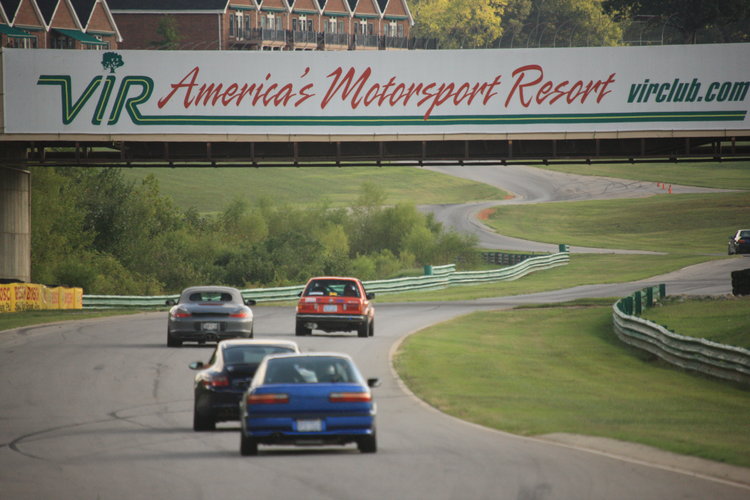
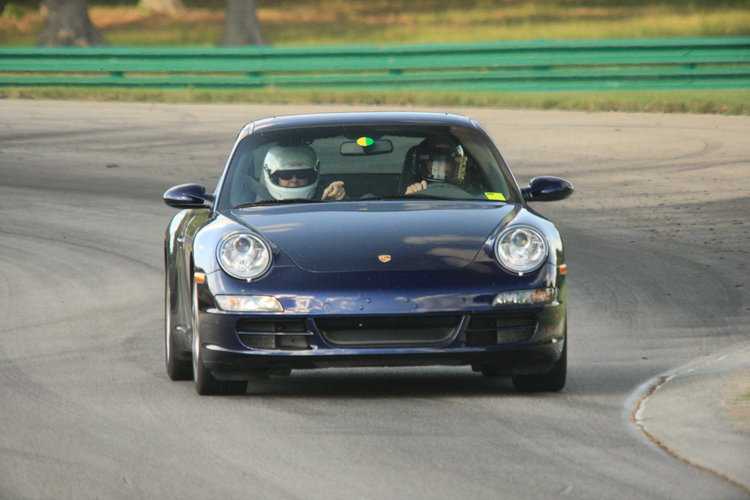
Clara and friends at VIR on 10 September 2011

We had plans to go to the North Carolina coast for some wreck diving this weekend, but the trip was cancelled because of rough (eight-foot!) seas. I was a little disappointed, but also a little relieved. The last couple of weeks have been turbo-charged at work, and on top of that I’ve had lots of extracurriculars. Today is gray, drizzly, and chilly — a great day to relax and reflect.

Last weekend was exciting, but not relaxing. I took Clara, my 911S, out for two days of hard track driving at Virginia International Raceway. She’s a great car, and did almost everything I asked. The weather was pleasantly warm and clear. My instructor, M, was very experienced and initiated me into some new aspects of track driving.

M gives a pointer

M stressed that the key to faster laps is smoothness and consistency — threshold braking at the same spot, hitting the same apex, coming into the throttle and tracking out all the way to the same track edge. It sounds like consistency could get boring, but for me it didn’t — perhaps because it’s so hard to do. As I got better in a particular difficult turn, it required throttle and brake adjustments for the following turns, which were seldom perfect. I had a couple of hair-raising moments, including a skid off the track and into the field (too much speed into turn 1), but no damage was done. There was plenty of exhilaration, and over all I felt an increase in competence.

This week I had two meetings with the Raleigh Chamber Music Guild, which recently elected me to its board of directors. I’ve loved chamber music, especially string quartets, since high school, and I’m pleased to be able to lend a hand to sustaining this great tradition. The RCMG is 70 years old, and has brought many world-class ensembles to this area. From what I’ve seen so far, the board seems like a good group. I’ve tried to make peace with the fact that some people don’t like chamber music (though I confess I cannot understand why), and just be grateful for the music and the people who enjoy it. They tend to be an educated, articulate demographic. But it isn’t easy for these music lovers to find each other or communicate about the music. It’s partly normal shyness, and also the difficulty of translating music and related feelings into words. RCMG may be a good venue for me and others to make some of these connections.

Another night this week I had a class on wreck diving, in preparation for diving on the Hyde and the Markham. Penetrating wrecks involves a higher level of risk than reef diving that we generally do, and it requires some training and careful preparation. I learned about various safety measures, including hazard assessment, redundant equipment, and laying a guide linet. I’m hoping to do the dives in late October.

Why do people engage in even mildly perilous situations, and imagine themselves in dire ones, when they don’t have to? People do it, at least to some degree, all the time — in sports, amusement parks, and scary movies. We’re funny animals, for sure, and we do some stupid things, but theres some sense to it. Maybe we confront manageable risks in play to prepare ourselves for real dangers. It could help develop some reserves of courage. And risk takes us out of our daily routine and out of ourselves. We forget ourselves, and feel more alive.

Republicans and science

Last week Paul Krugman departed from his usual subject matter (the economy) to present the case that Republicans are becoming the anti-science party. His argument included a quote from a Republican official accusing a conspiracy of scientists of fabricating global warming data to promote their own careers.

It would be nice if such lunacy could be dismissed as a fringe phenomenon. But the speaker was the current governor of Texas and a leading candidate for President. And according to Krugman only 21% of Iowa Republican voters believe in global warming, and only 35% of them believe in evolution. Holy Toledo!

Is it possible that we could elect as President a person who opposes factual analysis and critical thought generally? As unbelievable as it sounds, the answer, apparently, is yes. At any rate, none of the current Republican candidates is prepared to stand up for rational thought over patent nonsense when their potential supporters prefer the nonsense.

I’ve never considered it particularly heroic to acknowledge factual reality or base action on the best available data. I thought this was what people ordinarily did. There have always been people who were disconnected from reality, but traditionally we either feared or pitied them. No sane person would consider taking their views seriously. So how is it possible that the anti-science Republicans (surely, or at least I hope, still a minority among Republicans) have developed into a political force? This is crazy!

Now, I have nothing against people who prefer their fantasies to hard reality. It’s OK if they want to believe, for example, that it’s possible to have public services without paying taxes, or that climate change is nothing to worry about. But it would be folly to let such people have serious responsibility for anything. Just as we don’t let young children drive cars, we don’t want the anti-science people making important decisions. As opponents of science, they just don’t have the tools necessary for good decision-making. Why would we even consider trusting them?

An earthquake, a hurricane, a massage, a yoga lesson, and a haircut

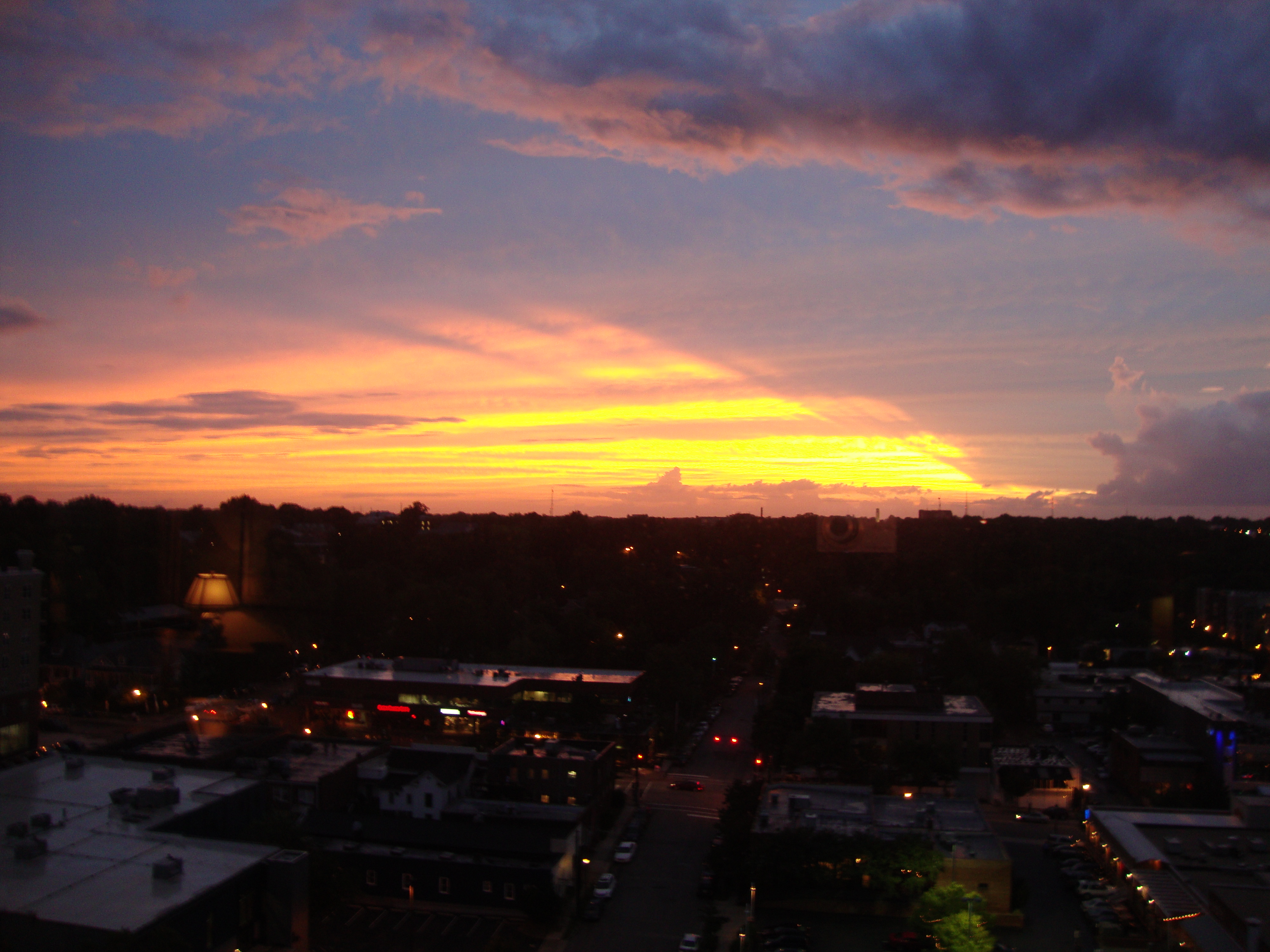
Sunset before Hurricane Irene

We’ve had a couple of unusual disturbances this week. On Tuesday, Raleigh was shaken for a few seconds by an earthquake that was centered in northern Virginia. In my office, it felt at first like heavy equipment was passing by, but it got more intense, and I started to consider evacuating. We seldom have earthquakes in the eastern U.S. We’re used to thinking of the earth as something solid that does not move, and it’s disturbing when it does.

A hurricane named Irene has been heading toward the eastern U.S. for several days, and finally hit the Outer Banks of N.C. this morning. We get hurricanes here from time to time, but this one has caused more than usual worry. In 1996 when Hurricane Fran hit our area, trees snapped in two in my yard, and the storm left us without power for days. Ever since, I’ve taken hurricanes seriously. At the moment, we’re getting light rain and gusty winds.

Meanwhile life goes on, with chores and challenges. This week I was particularly conscious of being part of a pleasing network of humans, including some who helped take good care of me, with some vivid moments of connection.

On Monday, I got over to Hands on Health, where Meredith had agreed to come in on her day off to give me a deep tissue massage. I’d anticipated that all the driving to, from, and at Road Atlanta would leave me with a tight neck and back, which it did, and that Meredith could help, which she did. She was cheerful and chatty, but deadly serious when it came to knotty muscles. There were some intense and difficult moments, but I left feeling wonderful.

On Wednesday, I had my first individual yoga lesson with Suzanne. I’ve taken one or two “early bird” classes a week with her for the last year or so, and have gradually come to really trust her. My main objective in taking an individual lesson was to make sure I had sound mechanics for my head stand and wasn’t about to hurt my neck. I also wanted to understand more about increasing my flexibility. Lately I’ve gone to a few advanced classes, and found them fairly humbling. There are certain things they do that I just can’t do.

Anyway, Suzanne helped me adjust expectations and feel better about where I am, as well as improving in some areas. For head stands, she taught me how to find the top of my head and where my weight needed to be. We did some bending and twisting, and talked about how you can have too much of a good thing. Although it looks good in class to have loose joints, as she does, she noted that looseness brings with it more risk of certain injuries. I also got her guidance on what to do with my mind during savasana. I’ve slowly come to really value yoga’s insistence on relaxation as an integral part of class. At the end of the session, I felt tremendous gratitude, both for Suzanne, and for my good health and well-being.

Because of the Road Atlanta trip, I’d missed my regular monthly haircut with Ann. She invited me to come in after work as her last appointment on Wednesday. Ann’s been cutting hair for me, Sally, and Gabe for many years. It’s always fun seeing her. She likes to talk, and we have great chats about our families, cars, restaurants, travel, and sports. As usual, I left looking better, and smiling.

Driving at Road Atlanta

Clara and friends at Road Atlanta

I had a few butterflies about taking Clara down to Road Atlanta for the Rezoom track event. There is, after all, an element of risk to pushing a car as hard as you can. But at the same time, there is something that felt right about the trip. A Porsche 911S was not created to be mere transportation. It is a sports car.

After a simple breakfast at the Holiday Inn, I was loading Clara when I saw some working-guy types staring at me. My first reaction was to assume they thought I was a twit. Then I realized they were admiring the car. This wasn’t exactly pleasant, but not exactly unpleasant. I wasn’t interested in attracting their attention, but I could understand it. It occurred to me that this is something that very attractive people must deal with: the slightly unsettling attention of strangers.

I had more butterflies when I saw the field, which included some true racing machines, stripped of creature comforts and equipped for massive speed. My instructor, Bryan, had one such: a Miata with everything torn out that didn’t have to do with the business of moving.

Bryan and his Miata

It also had an awesome paint job. Bryan introduced me to his track buddies, all from Jackson, Mississippi, and invited me to hang out at their canopy area.

The track was 2.54 miles — about the same size and shape as VIR, but more difficult. There are big elevation changes, and vertigo-inducing blind curves. Where VIR has fields to run off into if you misjudge a turn, RA has hard walls. Bryan took me as a passenger out as a passenger on the first session, and scared the bejesus out of me. It was a fast, very rough ride. I felt car sick, but managed, barely, to avoid spewing.

The drivers were divided into notice, intermediate, and advanced groups, and each drove 30 minutes per session. As a novice, with an hour between sessions, I looked at the other cars as they prepared to run or ran. I enjoyed talking with Bryan and his friends.

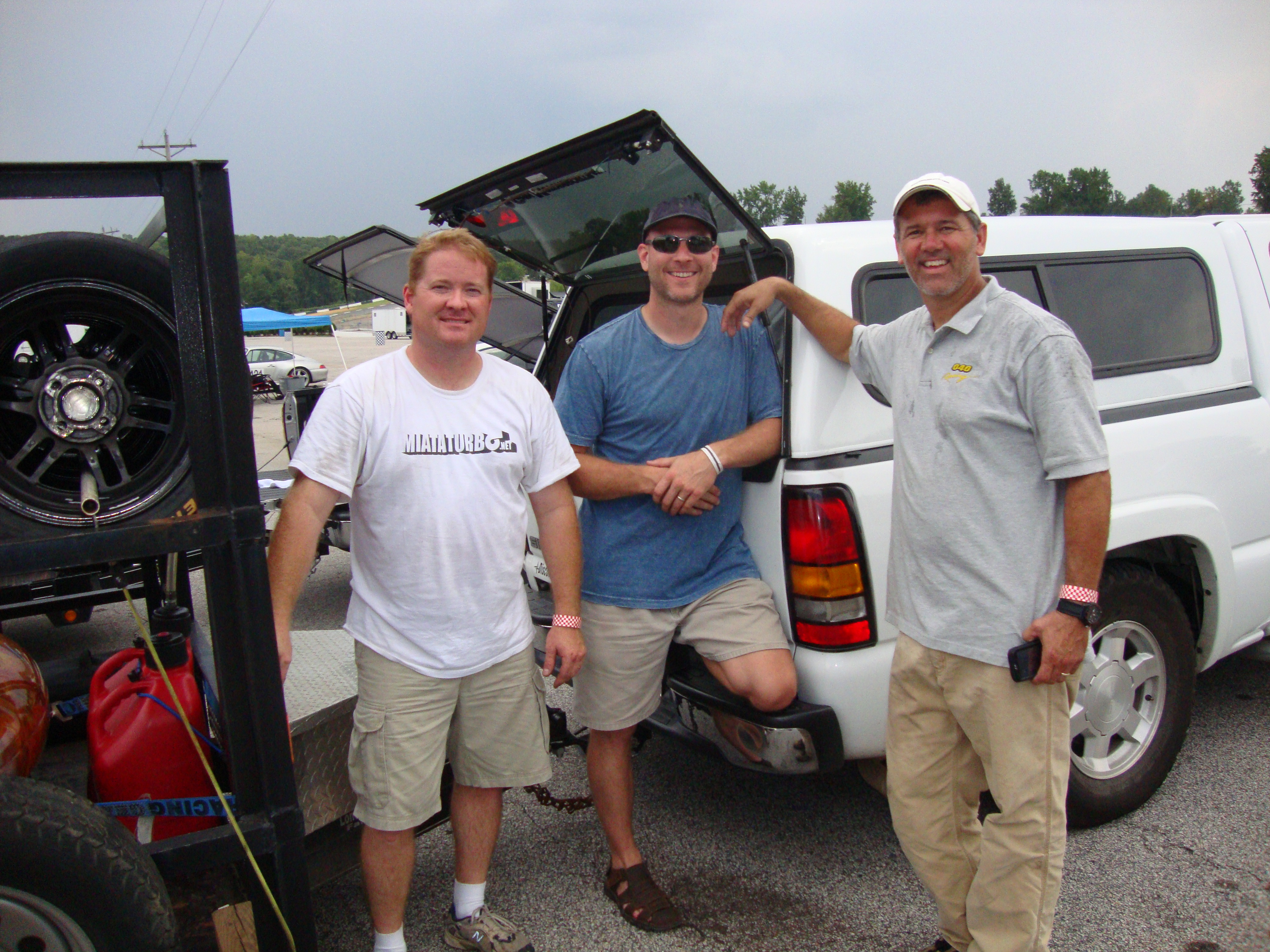
Bryan, Chris, and Snookie

They knew an amazing amount about cars. They must have thought I seemed a bit different, but they were really kind to me, and went out of their way to explain things and be helpful. It was great to hang out with them.

After the first couple of half-hour sessions, I began to get a feel for the track. It demanded total concentration. The senses are overloaded with sensations — screaming engines, rushing edges. There is no room for ordinary thought. Bryan kept coaching me to use more of the track and carry more speed through the turns. Gradually I got faster.

At times I couldn’t stop smiling. There were, however, some harrowing moments. Once I hit the gators at speed coming off the blind turn at number 12, and skidded dangerously. That scared me, and it took a few laps to regroup. As I kept pushing against the limits of the turns, a few times I found them, and barely hung on.

But with each session, my confidence increased, and on the second day I broke the two-minute barrier for a lap — a milestone. As I prepared for the fourth run of the day, Bryan announced I was ready to solo. He asked me not to do anything that would embarrass him. I was really pleased, and I didn’t.