The Casual Blog

How to change the world

At my early yoga class on Thursday, Sandy, the teacher, postulated that everything we do has ripple effects, first on our selves, and then on others. She suggested, as I understood it, that our yoga practice ia not purely personal. Our large, calming breaths lead to other good things for our bodies, which lead to other good things for others. Thus one person can change the world, at least a bit.

It’s hard to know if this is true, but it doesn’t seem completely crazy. There is no doubt that yoga has improved my levels of consciousness and happiness. And it’s possible that this has some small effect on others. And their attitudes affect others, and so on and on. I do not see this as a complete solution to anything, but it seems fairly clear that the human race, or even my little circle, has not come close to its carrying capacity for happiness, so the effort couldn’t do any harm.

In another effort to work for positive change, on Friday I flew to DC for the day and met with a group of folks at the Google offices to discuss possible approaches to future patent reform. The deep disconnect between the patent system as it was originally conceived and the way it sometimes works today to undermine innovation gets me worked up. Software innovation has very little to do with our patent system, which at times actually undermines such innovation.

It was good to brainstorm with some smart people with similar-but-not-identical perspectives. Anyhow, our ad hoc group made some progress in getting focused on possible areas for more work (e.g. damages apportionment, written description and enablement), and possible methodologies (e.g. a wiki), and agreed to keep working.

Changing the legal system, whether through better regulatory and court decisions or future legislation, even a little, is a daunting undertaking. I think the pro-reform forces have the better arguments, but better ideas do not always carry the day, as the recent legislative battles on patent reform demonstrated. Good policy reform arguments lose all the time, for all kinds of reasons, including self-interest, certainly, but also ignorance and inertia. It takes a lot of energy, commitment, and organization over the long term to achieve change. The first thing to do is not give up, and keep on thinking, and keep on communicating.

Speaking of change, I recommend the movie Amazing Grace (2006) about the ending of the British slave trade. Great Britain, a hugely powerful, successful country, the economy of which rested in significant part on slavery, decided in 1807 by act of Parliament to end slave trading. The change was in significant part due to the efforts of a relatively small group of abolutionists, including MP William Wilberforce. It took them some 25 years.

For more inspiration, on the trip to DC I reread some of Last Call by Daniel Okrent, a history of Prohibition. We all know that Prohibition (banning the sale of intoxicating beverages) was a disastrous policy, right? But we don’t all know, or at least I didn’t, how it came to be a cause, and then a Constitutional amendment. It’s a complicated story. There were many cross-currents and otherwise-unconnected groups that opposed alcoholic beverages in the 19th and early 20th centuries, including such disparate groups as religious revivalists, women’s rights advocates, advocates for the poor, anti-Semites (which disliked the successful Jewish distillers), and anti-Germans (which targeted the successful German beer brewers). These folks worked for decades to organize and change the United States from a hard-drinking country to an abstimonious one. And by gum, they changed the Constitution.

Unfortunately, they didn’t foresee that this would form the breeding ground for organized crime, violence, and massive corruption, among other problems. It made ordinary citizens who desired nothing more than a drink into law breakers, thereby undermining respect for the law more generally. As horribly wrong as the Prohibition forces were, I respect the idealism of some of them, and admire their pluck and persistence. The leaders who built popular support and those who organized legislative change could teach us a few things.

We, of course, wouldn’t do anything as silly as Prohibition, would we? Ha-ha! The NY Times yesterday had an interesting story entitled (somewhat confusingly) Police Officers Find That Dissent on Drug Laws May Come With a Price. In brief, a border patrol agent was dismissed for saying to another agent that if marijuana were legalized, the drug-related violence at the border would cease. It turns out that an outfit call Law Enforcement Against Prohibition (LEAP) supports this perspective, and includes 145 judges, prosecutors, and police offices, as well as an email list of 48,000.

These are courageous people. As one police officer said, “We all know the drug war is a bad joke. . . . But we also know that you’ll never get promoted if you’re seen as soft on drugs.” The very existence of LEAP suggests that the possibility of a more sane approach to regulating now-illegal drugs may be getting closer.


Thanksgiving in Nassau with sharks and Proust

Gabe, Jocelyn, reef shark, Rob, and Sally

For Thanksgiving we went down to Nassau, Bahamas, and did some scuba diving with sharks. I was looking forward to some time with Sally, Gabe, and Jocelyn, and also to the palm trees, beaches, and beautiful turquoise water. But we chose the destination in large part because of the abundance of reef sharks.

For those with long exposure to anti-shark hysteria (Jaws, cheesy nature channel specials), this probably sounds crazy. In fact, people do these dives safely every day. For me, there was some element of facing down an irrational inner fear, but the bigger driver was curiosity and a desire to experience a particularly beautiful force of nature.

We stayed at the Sheraton on Cable Beach, a large hotel with a white sandy beach, lots of curvaceous pools with waterfalls, palms, and plenty of deck chairs. The staff seemed friendly, though slightly shy. Restaurant service both in the hotel and elsewhere was surprisingly slow (except for Luciano’s, where the food and service were both excellent). One bummer: the food was much more expensive than I expected — about three times the price of equivalent meals at home. There was a casino, which we walked through, and where no one looked like an extra for Bond film. I tried, unsuccessfully, to comprehend why these people couldn’t find something more fun to do than just throw away their money.

Sheraton Hotel, Nassau, Bahamas -- our view

But there is no accounting for taste, and no explaining some of the strange things people like to do. Which brings me back to the sharks. Humans kill around 100 million of them a year (a substantial number of those by torture — cutting off fins for shark fin soup and leaving the fish to drown), whereas unprovoked sharks around the world account for around four human deaths a year. Of those exceedingly rare deaths, the perpetrators are only four of the 360 species (great white, oceanic whitetip, bull, and tiger). It is simply a myth that sharks are mindless killing machines. Some species are highly social and demonstrate problem solving skills, curiosity, and play.

Some species of modern sharks reached their current form about 100 million years ago, in the age of dinosaurs. Species come and go (for mammals, the average species lasts about a million years), but the sharks have remained. The basic, gorgeous design has clearly stood the test of time.

We dove with Stuart Cove’s dive operation, which was generally well run with cheerful young dive leaders and staff. Sally and I did ten dives and all. Gabe and Jocelyn were not certified divers, but after refreshing on their skills with a resort course, they came with us on four dives with an instructor, a smart, well-travelled (including a stint diving in Mozambique, which she recommended highly), and good-humored young Englishwoman named Ruth.

Gabe and Jocelyn at the start of a shark dive

The climax of our diving was Thanksgiving day, when we did an area called Runway Wall, where Sally and I swam at about 70 feet (with G and S shallower) along a wall that goes down to a depth of 5,000 feet. Beside us, in front of us, and behind us were reef sharks. I counted 15. At times they swam quite close (inches), coming up on us from behind, or heading straight for us. We also got to within a few feet of a large sea turtle (probably a loggerhead), and saw a few Atlantic spadefish, a spotted drum, a spotted moray eel, and a Goliath grouper, along with many smaller fish.

After a surface interval, we descended again and sat in a circle in a sandy area. One of the staff, Rich, had donned a chain mail body suit, hood, and gloves, and brought down a cage with chum. The sharks increased in number (perhaps 20-25 showed up), and began swimming faster and closer to the cage. Rich would take a thin metal pole, spear a steak-size piece of chum, and whip it upward quickly, and the closest shark would instantly bite and swallow it. Rich would position himself in front of each diver and do some feeding while the staff took photos and videos.

I had mixed feelings about feeding sharks (or any wild animal), out of concern that it might lead to dependency or otherwise disrupt the ecosystem. I also wasn’t crazy about the emphasis on photography. But in the end I put those ideas to one side and was simply overwhelmed by the experience: about 50 minutes of a close encounter with prehistory. The distance between us got down to zero (I was bumped a few times). After a few minutes, I began to distinguish individual differences among the sharks. One had a mouth that gaped on one side, another had a fish hook in his back. They would swim in lazy circles, and then suddenly accelerate toward the food, sometimes colliding. All told, I was deeply moved by their power, grace, and beauty.

We did not dive on our last day before flying home to decrease the risk of decompression illness. We spent much of the day lounging on the beach or by one of the pools reading our various books. It was windy, sometimes cloudy, but sometimes sunny. It was lovely to see our kids reading for hours. I used to worry that they’d end up as hopeless TV addicts. But they didn’t!

I began rereading Swan’s Way, this time in a translation by Lydia Davis. Many years ago, I read the entirety of Remembrance of Things Past, and have from time to time returned to sections of it, but the length of the work is daunting in these frantic times. I found the Davis translation much more graceful and lively than the Moncrieff and Kilmartin. It may be that accumulating more life experience makes the book itself better. In any event, I was struck once again by the strange hypnotic beauty of the prose.

For the first time, I saw how the apparently casual, improvised sound of the early part of the book includes a lot of delicate prefiguring of people and events that will gradually come into sharp focus. There is so much richness in the book. It makes us realize how rich our own lives can be in perception and feeling, and makes us want to use our memories and our eyes, ears, noses, touch, and taste buds better. But it is not a self-help book; there’s something magical about it. I had the odd, strong feeling as I was reading that the book was my own consciousness coming into being. Of course, it’s only a novel — or is it?

More shark photos:


Sleep walking, coming home, and good lies

Lately I’ve been feeling more-than-usually pleasantly aware of the world of the senses, such as fall light and colors, sounds of people walking, and even just breathing. There’s so much variation in perceptual engagement, both among people and for each person over time. I like to think yoga is helping to shift my perceptional experience towards greater engagement. But the changes are not uniform and consistent.

A dramatic case in point: I had a sleep walking experience a few nights ago. My only evidence was waking up with a badly bruised and scraped left shoulder. Seriously, I was hurt! I’d taken an Ambien, as I do now and again for insomnia, and attribute the bizarre incident to this usually reliable little helper. What did I do while in my altered state? Go to Fight Club? Could there be an outstanding warrant for my arrest? Could I defend based on lack of knowledge? Sleep walking unsettles the usual assumptions about intentional behavior and personality.

Gabe and Jocelyn Tiller flew in from Telluride, Colorado this week for a holiday. We hadn’t seen them for several months, and it was wonderful to be together again. But Gabe quickly put my fatherly affection to the test by asking for a loan of the 911 (Clara, that is) to go to Boone overnight to see an old girlfriend. I hesitated. I have feelings for Clara — if she were injured, I would be distraught. But I knew Gabe to be an excellent driver (I trained him). And I knew it would be good to share some my happiness with him. So I gave my blessing, and off they went. I experienced some separation anxiety, but Gabe brought Clara home safe and sound.

Jocelyn is blossoming. She’s gotten more blonde, and beams. Her work as a bartender seems to have enhanced her comedic skills, as well as her skill with a cocktail shaker. She made us a delicious green drink with creme de menthe for dessert.

Before and during dinner, Jocelyn, Sally, and I had a lively conversation about truth and lies. We found ourselves in agreement that absolute honesty was not only impossible, but also a bad idea. The social world as we know it depends on some degree of dishonesty. We all are taught that lying is wrong, but this is a lesson that would wreak havoc if taken literally. Could social life even continue if we always insisted on telling each other exactly what we thought of each other? In fact, there are important exceptions to the taboo against lying, Although there is no standard manual of exceptions, most of us eventually learn them. With experience and practice, we can distinguish between social lies that support and advance relationships, and those that undermine them.

Credibility and trust are vital to human relationships. The lies that undermine credibility and trust are the dangerous ones. As Jocelyn observed, it is puzzling and unsettling when one comes across an otherwise appealing person who is a habitual liar. Why don’t they see their lies as hurting themselves and others? Jocelyn theorized that this is manifestation of a mild species of sociopathy. They seem lack of empathy for others, and an unusual need for attention. Their lack of empathy and difficulty in forming human connections is distinctive, but not so dramatically so that the problem is easy to spot. I think she’s on to something.

Twenty-seven, headed down hill fast, and a note on healthy eating

Gabe Tiller at Telluride (February 9, 2011)

Gabe turned twenty-seven this week. I called to wish him a happy birthday, and felt more than usually happy myself. How wonderful to be twenty-seven! Particularly if you’re healthy, bright, athletic, good-looking, agreeable, upstanding, and employed, what could be more wonderful? Of course, that’s leaving aside all fears, insecurities, and uncertainties, of which there could be any number. But still, how marvelous to have traversed the perils of childhood and the agonies of adolescence, and stand no longer on the verge of adulthood, but actually there, strong, in your prime.

I told Gabe that it’s all down hill from here, but I was kidding. His first twenty-seven are, of course, my last twenty-seven, and I have to say that in many ways I feel healthier, more energetic, and happier than when he was born. How stressful it was to be a new parent. Also to be a grizzled veteran parent. And now, all that stress is gone! After all those years of parental anxiety and self-doubt, now he inspires me.

The picture above (which is Sally’s screen saver) reminds me of some of our skiing together the last couple of years. Even more vivid is his first POV ski video made at Telluride last March, which is exciting but I’m sure not nearly as hair-raising as the reality (such as that narrow chute). Seeing these images reminds me that I need to stay in really good shape so we can share more adventures next winter. As I mentioned to him this week, I’m thinking we should try heli-skiing (accessing backcountry powder by helicopter). He was definitely up for it.

The possibility of new adventures helps keep me focused with my continuing project to take good care of myself and eat healthy as much as reasonably possible. I’m trying to approach everyday eating in the spirit of doing a good, nourishing thing for my body — an act of kindness to my physical self. I’m steering clear of junk food, fast food, soda, and most processed food. It’s going pretty well.

Most days for breakfast I make a smoothie with dark green leafy plants (such as spinach, kale, collards, swiss chard, dandelion greens, etc.) and fruit (such as bananas and strawberries, or, this week, fresh pineapple and blueberries). In fact, I recently wore out our blender pitcher, which started leaking just outside the one-year warranty. Here’s a shout out to the good folks at Kitchen Aid, who did the right thing and agreed to replace it anyway! My smoothies are different every day and are mostly tasty (though sometimes less so — the mustard greens did not work for me) and always very green.

I’ve organized a system for addressing hunger pangs with healthy snacks such as unsalted cashews and almonds, apples, bananas, oranges, low-fat soy yogurt, and celery with peanut butter. For lunch, I typically have something like a microwave vegetarian Indian meal (Amy’s organic is good). And most nights Sally cooks a delicious vegetarian dinner, which just this week including Thai noodles with tofu (with whole wheat noodles) and Mom’s zucchini pie. She and I have gotten in the habit of having smaller portions. So my diet is mostly organic plant food of many types. I enjoy it very much.

Cultural diversity: yoga, Gambia, Lucretius, hockey, and Wagner

Looking west from the balcony

Daylight savings time ended this morning, and so we gained back the hour we lost in the spring. It’s strange that hours can be moved from one season to another. Anyhow, the leaves are changing, with yellows, oranges, and reds, and the temperatures are cooler. It’s fall.

Tuesday is my usual day for the Early Bird Yoga class at Blue Lotus with Suzanne. I normally get up at 5:30, do half an hour of interval work on the elliptical machine in my building, change out of my sweaty tee shirt into a fresh one, grab my yoga mat, and get to the 6:30 class in good time. Some yoga breathing, lowering, lifting, balancing and stretching is a good way to start the day.

Suzanne’s instructions are direct and clear, and her strength and grace are beautiful and inspiring. Each class is different, and lately she’s been taking us noticeably beyond our comfort zone. She seemed really pleased last week when she got us all up in tripod headstands. This week she had us all try side crow. This did not work at all for anyone (except her). Lately I’ve been working on front crow, and making progress, so perhaps we’ll do side crow one day.

Early Wednesday morning (5:40) I got in a cab to go to the airport. The cab driver was winded, and said he’d been doing jumping jacks to stay awake while waiting for me. It was better, he said, not to drink too much coffee. I agreed. He asked me where I was going, and I told him the bare fact (Boston), thinking I’d rather not get involved in a chat. There’s effort involved, and no guaranteed reward. But after a couple of minutes of silence, I relented. I figured I would try to be a decent chap and throw a lifeline to a lonely soul, so I asked him where he was from. Answer: Gambia, a tiny country in west Africa which I knew almost nothing about, and which he dearly loved.

He was a lively guy, and much more interesting than NPR. He described the government in terms that sounded benign though authoritarian, and improvements in roads, schools, and hospitals. He said that most people were at least part-time farmers and described how they stored crops in their own warehouses. When I asked him about his languages, he said he spoke seven, including three from Gambia and French, Spanish, and German. His English was accented but just fine.

The weather was clear and mild in northern Massachusetts, but there was still snow on the ground from an early season storm that had left many thousands without power. I did a bunch of meetings in Westford and then went down to Cambridge for more. On the flight back I read How to Read Montaigne by Terence Cave. Montaigne (1533-1592) is a startlingly original, modern thinker.

I was inspired to start exploring Montaigne by a few comments in an excellent book I finished a couple of weeks back: The Swerve: How the World Became Modern, by Stephen Greenblatt. The Swerve recounts the discovery in a monastery in 1417 of a copy of an ancient Roman manuscript, and explains how that discovery changed history. The discoverer, Poggio Bracciolini, was a former apostolic secretary for a deposed Pope with a classical education and passion for finding and saving ancient books. The book that was almost lost, On the Nature of Things, was written by Lucretius about 50 BCE. It’s an epic poem that describes the philosophy of Epicureanism. Greenblatt covers a lot of ground, from the philosophers of Greece and Rome, the creation of libraries, the fanaticism of early Christianity, the preservation of books in medieval monasteries, the intrigues of the popes, religious wars, the intellectuals of the Renaissance (including Montaigne), and onward.

In addition to a lot of lively history, there’s a pithy account of the ideas of Epicurus (b. 342 BCE), including the notion that the entire universe is constructed of tiny indivisible building blocks called atoms. This carried with it a view of the world as a natural phenomenon, not something magical created and controlled by gods. Epicurus espoused freedom from superstition and the pursuit of pleasure.

By pleasure he meant not pursuit of wealth or debauchery, but something more nuanced that included a sense of wonder at the beauty of the natural world.. According to Philodemus, a follower of Epicurus, “It is impossible to live pleasurably … without living prudently and honourably and justly, and also without living courageously and temperately and magnanimously, and without making friends, and without being philanthropic.” The Epicureans celebrated friendship, emphasized charity and forgiveness, and were suspicious of worldly ambition.

According to Greenblatt, Epicureans, including Lucretius, believed that the gods existed, but that they couldn’t possibly be concerned with human beings. Along with atoms, Lucretius’s ideas encompassed the notion that living beings have evolved through a long process of trial and error, that the world exists for reasons that have nothing to do with humans, that humans are not unique but rather linked to all other life forms and to inorganic matter, there is no afterlife, that religions are superstitious delusions based on longings, fears, and ignorance, and that by fashioning gods humans became enslaved to their own dreams. Happiness could be attained through discarding delusions through reasons, looking squarely at the true nature of things, and discovering a sense of wonder.

These ideas were, of course, not congenial to early Christians, who almost succeeded in stamping them out. But somehow a copy survived, which Poggio discovered and copied, and which is recopied many times, and ultimately influenced thinkers in subsequent generations up to our own. Greenblatt’s book is a true pleasure.

We saw some professional hockey on Friday night: the Caroline Hurricanes vs. the Washington Capitols. I’d learned from my new assistant about a free bus that runs between downtown and the hockey games, and it turned out that it made a stop right at our building. The bus arrived on time, with many cheerful fans dressed in Hurricanes red and white. We had a good view from box seats.

The Hurricanes started strong but collapsed in the third period and got trounced. As long as the game was close, it was fun. As with soccer, the more hockey I watch, the more I see and appreciate the incredible athleticism. The drama is simple, but effective: there’s a surge of great joy at every goal our team makes, and stab of pain at a goal of the opponents. The bus trip back home seemed slower and much less cheerful.

On Saturday we saw quite a different sort of drama, Siegfried, the third opera of Wager’s Ring cycle, broadcast live from the Metropolitan Opera to all over the world, including the North Hills Cinema. I know the music well from CDs, and love it, but had some qualms about the amount of sitting required: five and a half hours. Wagner is musically dense, and that’s a lot of Wagner. It was, it turned out, for us, incredibly powerful.

The story is about courage. Siegfried is a callow young hero who forges a magic sword and uses it to slay a dragon and an evil dwarf, then travels though a ring of fire to save and win a beautiful maiden. In pre-broadcast comments, Renee Fleming (a great soprano who would know) described Siegfried as the most difficult tenor role in the world. Our Siegfried was Jay Hunter Morris, a relative unknown who subbed in at the last moment and had a total of three performances under his belt when he performed before a worldwide audience of many thousands yesterday. This took true courage. Morris gave a performance for the ages, vocally powerful but nuanced throughout. The entire cast was superb, and the technical effects (especially the ring of fire) were impressive. Fabio Luisi conducted brilliantly. The famous horn solo, the exciting few bars that horn players test and polish their whole lives, was perfect.

This Siegfried, the opera, moved me deeply (tears). Driving home afterwards, I felt wrung out but exhilarated. Sally also loved it, and announced that she was now a Wagnerian. I found this very cheering.

Work, Pilates, Bjork, and musical play time

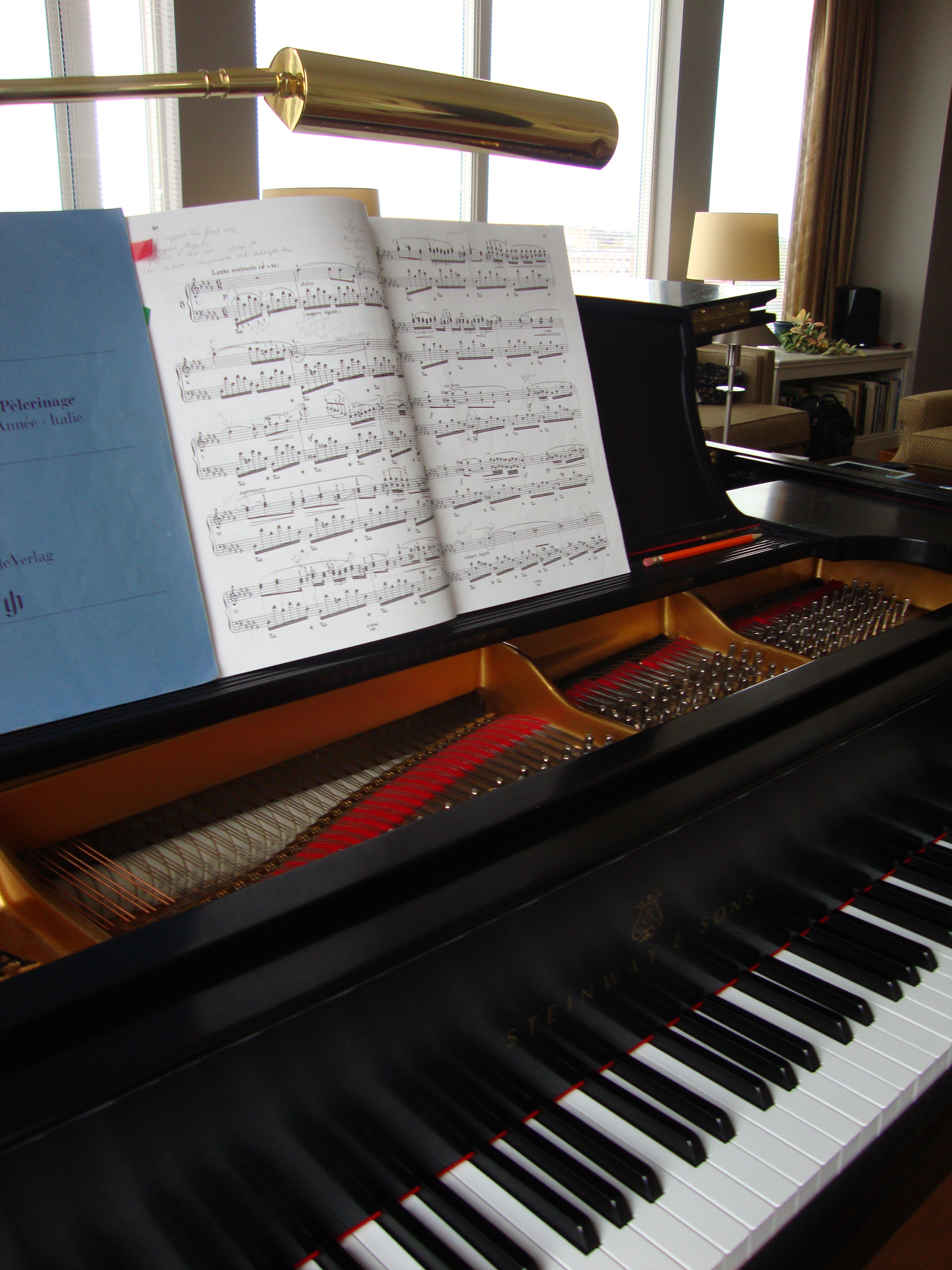
Nocturne in D flat major by Frederic Chopin

It was another busy week of many meetings, calls, and issues, with business dinners almost every night, and my email backlog continuing to pile up. But interesting, always interesting. On Friday I was scheduled to go to the coast for two days of wreck diving, but bad weather arrived and the trip was cancelled. I was not heartbroken. It was good to get some down time.

On Saturday morning it was cold and rainy. I thought of taking Yvonne’s open level Vinyasa yoga class at Blue Lotus, but learned from the web site that someone else was filling in for her. I check for alternatives, and found an early Pilates class at the Y. And so it was that I had my first Pilates experience. It was similar to yoga, with its emphasis on breathing throughout a series of exercises with unusual stretches and contractions. I found this particular class less strenuous than my normal yoga classes, and also less serenity-inducing. Still, I would do it again, especially if there’s no yoga available.

Other new things: earlier in the week I read a news story about Biophilia, the new multimedia production of Bjork, the Icelandic singer-songwriter, and downloaded the work to my iPad. Biophilia is in part a collection of songs about nature and science, but rather than being an album, it’s something we don’t have a word for yet. Bjork worked with scientists and artists to make interactive productions that allowed the listener to participate actively in the music by adding notes and altering images. After a few minutes of experimenting, I could make a bit of music with the tools provided, and participate in some of Bjork’s visions of microscopic, geologic, and celestial phenomena.

The idea of sharing a vision this way — not just providing passive entertainment, but inviting participation as a way of inspiring and teaching — is exciting, and the NY Times story took the view that it was ground breaking. For me, the experience was intriguing but not really thrilling. I liked being allowed to work with Bjork’s electronic instruments and play with her, but the musical possibilities were narrowly circumscribed and not expressive enough to satisfy me.

For example, by using the touch screen, in various songs you can add to Bjork’s fairly simple musical backdrop more harp notes or more synth notes, and play faster or slower, but so far as I could figure out without taking any new harmonic direction. The videos were in some cases beautiful, but the songs themselves were more performance art than either art music or dance music. Still, I liked the ideas, and I will probably play some more with Biophilia.

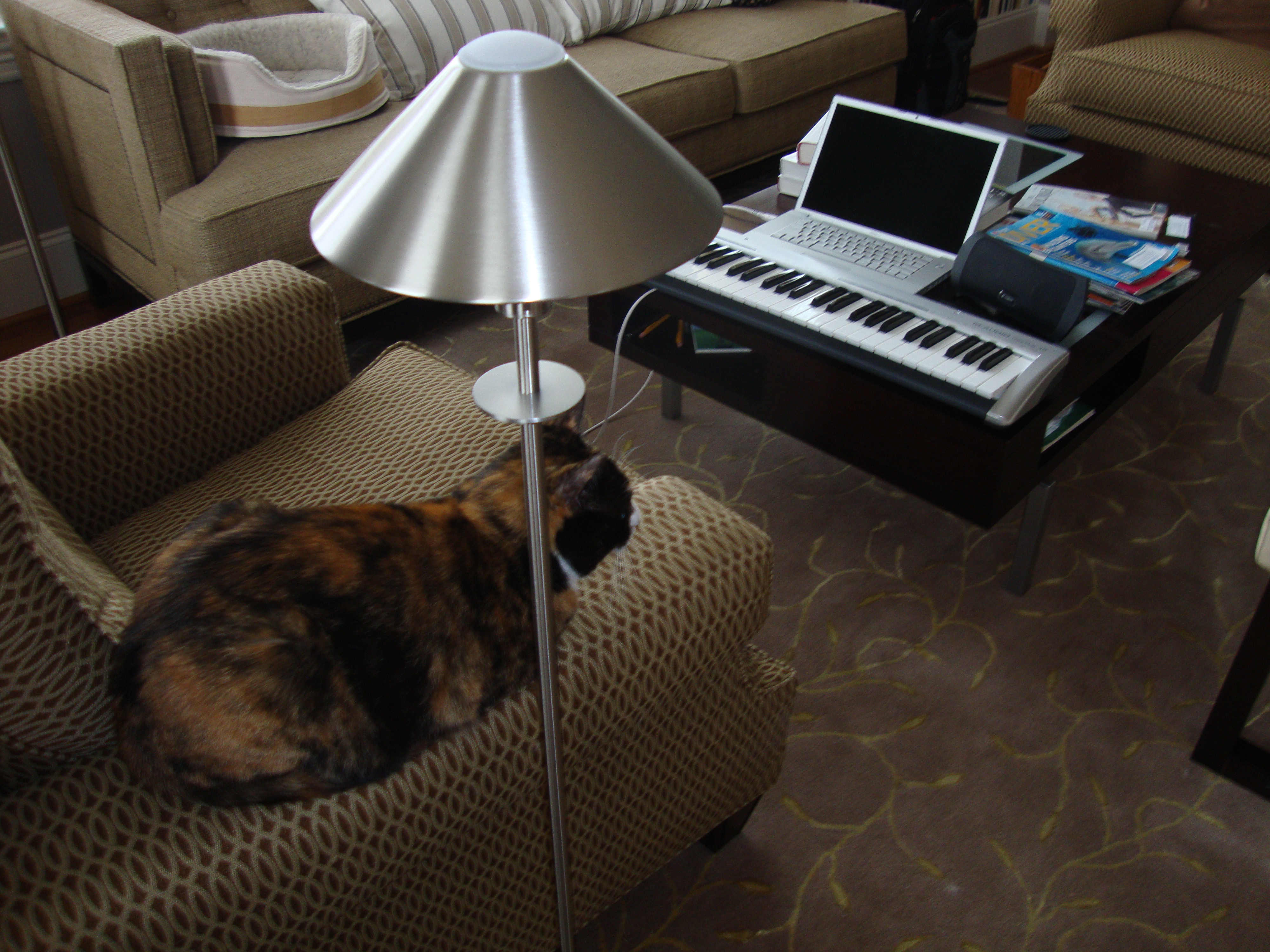
Phoebe, Holtkotter lamp, and music technology

The idea of using technology to express new musical thoughts has interested me for a while. This past spring, I began playing with the instruments built into GarageBand (a Mac application), and eventually purchased a cheap electronic keyboard and a cheap auxiliary speaker to experiment with. One of my ideas was to translate early music (1500s) through synthesizer voices to see what new things emerged. The sheet music came with a lot of interpretive problems, so I didn’t get far on the vector. But I had fun improvising with various synthesizer personalities using various systems, like Greek modes and pentatonic scales. I thought of it as playing, in the sense of playing a game. It’s a different kind of musical outlet.

Bjork’s idea of engineering a collaboration with an unknown audience has a distinguished heritage. It’s what we do when we open a volume of Chopin nocturnes and start to play. Chopin left us the architectural drawings, which the pianist uses to create musical in real time, while at the same time personalizing the structure with thousands of unwritten details according to the pianist’s experience, intelligence, and feelings.

This system — master composer, written music, trained pianist — has worked amazingly well for a couple of hundred years. It does, however, depend on musical education — there has to be a support system for training pianists, and also listeners. For music with the harmonic complexity of the great Western tradition, you have to learn a lot before you can interpret it, and you have to learn a fair bit to get deep enjoyment from listening to it. It is worth the effort.

I sometimes worry that there is a long historic curve in which our music devolves from the complex and brilliant to the simple and sweet, and from there to the just plain dumb. The traditional system of classical music education and performance is not in good health. But perhaps humans are just getting started in discovering what music can do. Who knows where it goes? We have to keep experimenting, keep creating. That’s what Bjork is doing, and good for her.

My budget solution: end the wars (Iraq, Afghanistan, and Drugs)

Yesterday the newspapers reported that the last U.S. soldiers would be out of Iraq by the end of this year. When the U.S. invaded Iraq eight years ago, I thought it was a terrible mistake, and everything I’ve learned about it since has strengthened that conviction, as thousands of U.S. soldiers and tens of thousands of Iraqis lost their lives, and as we increased our exposure to financial collapse by spending more than 800 billion borrowed dollars.

It’s good news that it’s over, and I wish I could feel happier about it. We’ve wreaked a lot of havoc in Iraq, and now we’re stopping. Have we learned anything? That’s doubtful. As a society, we’ve hardly thought about it at all.

As an undergraduate at Oberlin College, I had a concentration in political theory. I read Plato, Aristotle, Augustine, Aquinas, Montesqieu, Machiavelli, Hobbes, Locke, Rousseau, Adams, Marx, Nietzche, Bentham, Mill, Arendt, Rawls, and a lot of other interesting and challenging thinkers. For a long time, though, I had my doubts as to whether I’d learned anything at all useful.

Eventually, I came to the view that I learned one very useful thing: critical thinking. Engaging with lots of powerful ideas that were all, at least to some degree, wrong or unworkable helped develop a mental toolbox. This toolbox is useful in recognizing the weak points in arguments, discarding unfounded assumptions, and sometimes in making better decisions.

War is powerfully attractive at certain times and places. I am not immune to that attraction. Like lots of kids, I’m fascinated by weaponry (especially tanks and fighter jets), and I find military history interesting. But something in my moral education left me with the settled view that killing sentient beings is deeply tragic, and in most cases morally wrong.

Add this ethical orientation to a skeptical turn of mind, and maybe I can see through the attractions of war to the underlying horror more easily than most. Or perhaps I’m kidding myself. In any case, I have a high degree of confidence on the right way to go on this. While we’re wrapping things up in Iraq, let’s also quit sending our kids to kill and be killed in Afghanistan. There is no good reason for that war, either. We’ve spent more than $450 billion on it. Let’s stop the physical and financial bleeding.

Ditto on the war on drugs. This week’s (Oct. 17) New Yorker has a piece on the subject by Michael Specter. (Unfortunately only the first few paragraphs are available without charge online.) It starts with a discussion of Portugal’s experience of decriminalizing drugs ten years ago and treating addiction as a medical problem. “In most respects, the law seems to have worked: serious drug use is down significantly, particularly among young people; the burden on the criminal-justice system has eased; the number of people seeking treatment has grown; and the rates of drug-related deaths and cases of infectious diseases have fallen.”

Specter gives a balanced account of Portugal’s experience, and including quotes from critics of the change. Their criticisms seem mostly based on their belief that drugs are evil. Fine. But in Portugal lots of law enforcement and political leaders have given up on the idea that treating drug use as a crime can possibly succeed.

There was another good anti-drug-war piece this week by Doug Bandow, a fellow at the conservative a Cato Institute published in Forbes and republished by the Huffington Post.
According to Bandow,

Perhaps the most obvious cost of enforcing the drug laws is financial. Government must create an expansive and expensive enforcement apparatus, including financial and military aid to other governments. At the same time, the U.S. authorities must forgo any tax revenue from a licit drug market.According to Harvard’s Jeffrey A. Miron and doctoral candidate Katherine Waldock, in the U.S. alone “legalizing drugs would save roughly $41.3 billion per year in government expenditure on enforcement of prohibition” and “yield tax revenue of $46.7 billion annually.”

This cost is appalling, and it doesn’t even count such costs as ever expanding prison systems, corruption of law enforcement and government, breeding organized crime, and of course the human costs of broken families and lives.

But I see a little ray of hope. The national debt problem has come to be viewed as both serious and impossible to solve. However true that may be, it has created a sense of desperation in Washington. It’s just possible that drug war diehards could come to accept drug legalization as a necessary revenue-generating measure. This was part of what led to the repeal of Prohibition — the realists won the argument that we needed the tax revenues from liquor. Legalization, combined with a sensible regulation and taxation system, could make a significant dint in our budget shortfalls. Add that to ending unnecessary wars, controlling excessive military costs, cutting farm subsidies, getting health care costs under control, and voila!

Opera, cocaine, yoga, fighting the power, and soccer

I seriously considered driving down to South Carolina this weekend to drive Clara on the Carolina Motorsports track, but decided the trip would probably create more stress than it would relieve. I needed to get some work done this weekend, and wanted to do some other fun things and take a few deep breaths.

On Friday evening Sally and I had dinner downtown at Buku, which had added some tasty and interesting vegetarian options, and went to the NC Opera’s production of Carmen. Carmen was first performed in 1875 shortly before Bizet died at age 36, and its first performance was a failure. Although it is full of wonderful melodies, it isn’t too hard to imagine why audiences initially had trouble with it. It celebrates freedom over responsibility, and its uninhibited sensuality is even today a little shocking.

When I saw the Metropolitan Opera’s production in New York last Thanksgiving, I was intoxicated. Elina Garanca as Carmen was sensational: beautiful in every way, and very sexy. The production was edgy, beginning with an initial scene that did more than casually suggest a gang rape by soldiers of Micaela. The acting was as good as the singing, and the settings were spectacular. My brain’s pleasure centers went into overdrive — dopamine city. Great opera is unquestionably better than cocaine. A possible solution to the drug/drug war problem: provide music and opera education (it is an acquired taste, and education is necessary), and great opera for everyone.

I gave some money recently to the NC Opera, because I really do want the art to survive and thrive, and I’m happy we have at least some live opera here in Raleigh. And I enjoyed Carmen on Friday night. As Carmen, Leann Sandel-Pantaleo sang beautifully, as did the other principals. The orchestra under the baton of Timothy Myers sounded good. But Carmen is more than just music. As drama, the production was flaccid. Instead of threats of violence and passion, we had too much sweetness. There’s not much to say about the sets; there wasn’t much to them. But it was still better than cocaine.

I got some deep breathing in at a Vinyasa yoga class with Yvonne at Blue Lotus on Saturday morning. Her 1.5 hour classes are always different, with a varying playlist of eastern plus western pop music and variations on classical poses. But they are always intense. I’ve learned that I need to take along some water and a towel, because I will be sweating. At times I’ve felt something close to desperation as to whether something uncomfortable is beyond endurance. But there are moments of sweet transcendence. And I always feel great afterwards. It isn’t just a physical thing. My mind feels more peaceful.

In the afternoon I took Diane (Sally’s mom) to North Hills to see the Metropolitan Opera’s simulcast of Donizetti’s Anna Bolena. It occurred to me that this might be too much cocaine for one weekend, but I wanted to see the new Met production. Seeing the HD simulcast isn’t the same as being at the Met in person, but seeing the live production has more electricity than seeing the same thing when rebroadcast. We learned at the beginning that people were watching in theatres all over the world, including, for the first time, Russia. It was good to share the experience with people in the theatre and around the globe.

In the production, there are 70 are so performers on stage, probably an equivalent number in the orchestra, and dozens behind the scenes. All performing difficult feats — walking a highwire without a net. It seems impossible that mere mortals could pull this off. But they did. It was stupendous. Anna Netrebko as the doomed bride of Henry VIII is compelling and heartbreaking. A great musician and a great actor. Yes, she needs to drop some weight. But I forgot that during the performance. It was truly intoxicating. Some of us in the theatre had to clap, even though she couldn’t hear us.

After I dropped Diane off, I drove by the old state capitol building and saw a couple of hundred people doing the Raleigh version of the Occupy Wall Street protest. I learned from the newspaper that 19 of them later got arrested for staying past their permitted time. Public protesting has always been problematic for me, because I can’t completely endorse any bumper-sticker-size slogan, and although I realize simplification can be politically useful and even necessary, it still bothers me.

But I’m glad that there are people who like demonstrations, and are prepared to make some public statements. The greed, ignorance, and indifference of the economic and political elites in the face of the long and continuing crisis in the economy should not be accepted calmly. Instead of going to jail, the worst malefactors of the economic meltdown are still earning multi-million dollar bonuses. Instead of instituting dramatic new regulatory structures, our politicians are doing nothing, or worse, promoting more deregulation. We’re on the edge of an economic cliff, and our leaders aren’t leading. We should be mad about these things, and gravely concerned about other existential threats (global warming, overpopulation, and nuclear weapons among them). And after we blow off some steam, we should get organized and work for change. Perhaps the Occupy Wall Street movement will spark something new.

Saturday night we went out to Cary for some minor league soccer. Our team, the Carolina Railhawks, had to beat the Minnesota Stars by 2 goals to advance in the playoffs. It was a beautiful, mild evening, and there was a large crowd out for the game. The Railhawks came from behind to win the initial game 4-3 — not enough to close out the series. They then played two 15 minute periods, which ended without further scoring. So the series was decided by a shootout. We lost 6-4. It was sort of a painful ending to a good season.

Farewell and thank you, Steve Jobs

Rita with marvelous Apple devices

Appropriately enough, I got the sad news of Steve Jobs’s death from one of his devices. I was at home reading the news in El Pais on my MacBook Pro, with my iPad on one arm of the easy chair tuned to a Spanish-English dictionary and my iPhone on the other arm. (My iPod was recharging.) I don’t consider myself a huge Apple fanboy, but I cannot deny that these devices are marvelous and delight me every day. And so, like millions of others, I have a life that was changed in a positive way by Steve Jobs.

Jobs was just five months older than me, which brings to mind more-than-usual intimations of mortality. His killer, pancreatic cancer, was the same that killed my mother, so I’ve known for years that it’s a bad one. After her diagnosis, she was gone in four months. Watching Jobs’s string of successes over the last five years, I’ve been amazed at his tenacity and courage. Knowing that death was staring him in the face, he just kept on creating. This was one tough hombre.

Driving home the next day, I heard an excerpt on the radio of his 2005 Stanford commencement speech in which he set forth the following test. Every morning, he said, he asked himself, if this day were his last, would he want to spend it doing what he was planning to do. If the answer was consistently no, he changed course. I almost believe it. In any case, it’s courageous to attempt it.

A bit more of his remarkable Stanford speech:

“No one wants to die. Even people who want to go to heaven don’t want to die to get there. And yet death is the destination we all share. No one has ever escaped it. And that is as it should be, because Death is very likely the single best invention of Life. It is Life’s change agent. It clears out the old to make way for the new. Right now the new is you, but someday not too long from now, you will gradually become the old and be cleared away. Sorry to be so dramatic, but it is quite true.

“Your time is limited, so don’t waste it living someone else’s life. Don’t be trapped by dogma — which is living with the results of other people’s thinking. Don’t let the noise of others’ opinions drown out your own inner voice. And most important, have the courage to follow your heart and intuition. They somehow already know what you truly want to become. Everything else is secondary.”

In the Stanford speech, Jobs tells of taking a calligraphy course after dropping out of Reed College, and then a decade later finding that what he’d learned gave him direction in designing the first Mac. He clearly thought like an artist — perhaps even more than like an engineer. He’s quoted in the NY Times obit as saying that great products were a triumph of taste, of “trying to expose yourself to the best things humans have done and then trying to bring those things into what you are doing.” Amen.

Good conversations

One of my favorite movies is My Dinner with Andre. The 1981 movie is about as simple in concept as possible: two old friends have a conversation in a restaurant. It starts out like a typical conversation, though livelier and wittier than most, and gradually begins to soar and swoop. It’s like a duet, or a dance in words. The friends are having fun, but are also creating something. It sets a high bar for a great conversation, but it’s also inspiring. It shows that a good conversation is a work of art.

This week at Red Hat we had a meeting of our entire legal department, including colleagues from our foreign offices. I had five business dinners in a row, not to mention five business lunches and multiple impromptu encounters between meetings. There were plenty of conversations. A number of my colleagues were inspired talkers, and knew a lot about their subjects.

Some of our conversations were fairly ambitious: talking with Monica about European IP law; with Amanda about race in America; with Madeline and Kathal about blogs and the future of literature; with Mei about refusing membership in the Chinese Communist party; with Richard about the future of open source licensing, with Winston about conservative politics; and with Patrick about religion in Utah. There were many good stories: e.g. Eric on playing tennis with Andre Agassi; Emily on working with her personal trainer; and Jean on working as a flight attendant for Singapore Airlines.

It was varied and fun, and I felt grateful to be associated with a group of such interesting and stimulating people. But as Myra and I discussed, socializing in large doses is depleting. I felt really tired and ready to relax when we finished our meetings Friday afternoon. When I got home, I did some yoga, and then played some Chopin and Debussy. It always amazes me how half an hour of immersion in making music can refresh the mind and produce great happiness.

Sally mixed us basil gimlets (one of her signature drinks) and cooked a tofu curry while we listened to a Pandora mix of contemporary Indian music. At dinner we talked about some big subjects, including global warming and species extinction, which we both worry about. The topics are, of course, anxiety producing and sometimes depressing, and depression may lead towards hopelessness. And loneliness. These issues can be friend repellents: who wants to be with a depressing person who makes you depressed? This is another reason it is good to have a committed loving partner: you can talk about serious things.

We also talked about art and science. Recently I read The Wild Life in Our Bodies, by Rob Dunn (a professor at N.C. State), which discusses evolution of humans as a story that cannot be understood without appreciating our symbiotic microbes (fact: they’re more numerous in our body than human cells), parasitic worms (which may prevent disease), our former prey and predators, and other aspects of the natural world. The book is uneven, but the vision is sweeping and fascinating. It is my latest piece of evidence for the theory that scientific intuition and artistic intuition are very much alike, and they can be thrilling in much the same way.