The Casual Blog

Category: public policy

A new novel about AI and the Turing test

DSC_0032
Sally’s re-reading Anna Karenina, which seems to me both admirable and exhausting. The recent movie version with Keira Knightley was highly stylized, but reminded me of what I enjoyed about the book when I read it in my twenties. It is rich book, full of feeling and thinking. But it’s long!

As a teenager and young adult, I read a lot of long novels, including ones by Tolstoy, Dickens, Dostoyevsky, Trollope, Elliot, James, and Proust. My “big novel” period was a time when I was coming of age and constructing a particular consciousness. Those big books were part of the process.
DSC_0039

Nowadays most of my waking hours are spent working, and there is stiff competition for precious non-work time. I’m still interested, though, in novels, and especially ones that take on issues that haven’t been thoroughly mined out. I just finished one such: A Working Theory of Love, by Scott Hutchins (Kindle edition). It’s about a guy who’s working on an artificial intelligence program designed to pass the Turing test, which is a real competition suggested by Alan Turing.

The Turing test is designed to probe whether machines can think. The challenge is to build a computer that can persuade 30 percent of humans that it is human. (I wrote about a very interesting non-fiction account of the test and artificial intelligence, The Most Human Human, by Brian Christian, here.)

Hutchins’s narrator bases his program on his father’s diaries. After getting the computer to converse coherently, he works on humanizing it by adding emotion and sex drive. As the program improves he has the feeling that his father is coming back to life. This creates an interesting moral dilemma. His father had committed suicide, but the project seems to be denying him his freedom to choose death.

I found Hutchins’s premise thought-provoking, but I ultimately didn’t care very much for his narrator. But he’s where the action is. It’s exciting and terrifying to see how fast robotics and artificial intelligence are transforming the world. The AP did a good overview piece last week, which I recommend highly. As they note (and as I’ve noted before), jobs involving any sort of routine (most manufacturing, transportation, retail, and office work) will soon be gone forever, taken over by robots and AI. This means increasing efficiency and wealth for some, and unemployment and anomie for a great many others.

We’re going to need to re-think and re-size our social programs for a world where humans are not needed to produce most goods and services. This is a daunting task, even leaving aside the extreme polarization of our politics. The shift away from human labor as a process that is the source of economic value and meaning is hard for us to grasp and accept. But we somehow need to provide a safety net for the millions who will be affected.

I’m not prepared to propose a program, but I do have the name for one: the Big Deal. It will need to be bigger than FDR’s New Deal. It will surely involve some sort of cash payments and medical care. I’d also add a work program that channeled redundant workers to activities that would provide them with a sense of meaning and purpose, like caring for other humans.

Cats and curiosity, humans and dishonesty

Isabelle, a/k/a Izzie, "The Wild One"

Isabelle, a/k/a Izzie, “The Wild One”

There was an amazing story in the NY Times last week about a house cat that got lost 200 miles from home and somehow found its way over unfamiliar territory to its human family. It sounds impossible, but apparently there was adequate proof, including a computer chip in the cat.

Sally dearly loves our cats — Phoebe, Isabelle, and Rita. She buys them toys, speaks babytalk to them, and lets them sleep on top of her. They make her laugh and coo. I admit they are beautiful, but I have never been as smitten. They shed hair everywhere. They periodically throw up hairballs and other sundries, usually at a prominent spot on a nice rug, and sneakily try to steal food from our plates. But for the last several years, most of the time I paid them little attention, and they did the same to me.

Phoebe ('Feed Me")

Phoebe (‘Feed Me”)

Lately, though, they’ve been wooing me. Rita wants to cuddle with me in the easy chair. Isabelle follows me to the bathroom and nuzzles my leg. Phoebe likes to get into my lap when I’m eating. They’ve gotten me to pet them more. They purr more. They haven’t tried to bite me in quite some time. It’s nice.

I tend to think of our cats as not very bright, even for cats, and mainly enjoy their grace. But they do have skills. They are wonderful at rapid acceleration and deceleration, and do amazing leaps. They seem at times to concentrate completely and at other times to relax completely. And they are extremely curious about anything new. They’ll thoroughly explore every new paper bag and box.

Rita, the sweet one

Rita, the sweet one

They’re getting older. Phoebe is now 12, Isabelle is 10, and Rita is 6. Perhaps age has a mellowing effect and accounts for their increased affectionateness. Perhaps they detected some change in me. There’s no doubt but they are working on me, and making some changes.

Still curious about how humans work and why we do do so many silly things, I finished reading Predictably Irrational, the Hidden Forces that Shape Our Decisions, by Dan Ariely, a psychology and behavioral economics professor at Duke. His style is a bit chatty, but some of the substance is fascinating. Working along some of the lines of Kahneman and Tvesky, he examines such problems as our difficulties in managing our money or avoiding unhealthy food and our inability to foresee the bad decisions we may make when sexually aroused.

One of the most interesting chapters describes an experiment designed to examine cheating. A control group took a simple knowledge test, and other groups took the same test with the answers “accidentally” provided to subjects. The basic finding was that a majority of those given a bit of temptation and opportunity to cheat did so. But Ariely found that the cheaters didn’t cheat as much as they could have. Instead, most cheated only a modest amount. There seemed to be some threshold beneath which the dishonest behavior was not particularly troubling, and above which it was.

There was an interesting essay by James Nortz in the current Docket, the magazine of the Association of Corporate Counsel, which describes some more of Ariely’s work on honest and cheating from his book The (Honest) Truth About Dishonesty: How We Lie to Everyone — Especially Ourselves. Nortz proposes that we view dishonesty as a universal human trait, but one which manifests itself according to varying circumstances. He suggests that facing up to these disturbing realities could help us design better compliance and ethics programs.

Stuart, still the greatest

Stuart, still the greatest

Lincoln, political courage and pragmatism, and the war on drugs

As my Twitter followers (awful expression, sorry) and Facebook friends (also awful) already know, we saw the new movie Lincoln over the holiday, and really liked it. It works like a good old-fashioned Hollywood movie, which is to say it can be enjoyed as pure entertainment, but it does a lot more. It takes on a huge and deeply embarrassing subject, one that we still can barely bring ourselves to acknowledge or discuss a century and half later — American slavery — and contributes meaningfully to the dialog. This is remarkable. Kudos to Steven Spielberg and a great cast (especially Daniel Day-Lewis, Tommy Lee Jones, and Sally Field) and production team.

The movie reminds us that there are crucial moments when individual courage and moral vision matter. It concerns the last few weeks of the Civil War (1865) when the burning issues of how to stop the carnage and how to stop slavery were both pressing and pulling in opposite directions. About half of the members of Congress thought black people were subhuman and were opposed to recognizing them as in any sense equals. If the war ended, the matter of passing the Thirteenth Amendment ending slavery would become less politically pressing, and could conceivably not happen at all. The President was under great political pressure to end the horrific war, but insisting on abolition of slavery looked likely to prolong it. Resolving this dilemma required both courage and political genius.

David Brooks wrote an interesting column on Lincoln noting that the political solution required the President to act in ways that were, well, ethically questionable. That is, he engaged in tactics that could easily be viewed as bribery and other dishonesty. Brooks suggests that this is characteristic of politics — pure moral vision has to be balanced with pragmatic compromise to get anything done. Is some degree of dishonesty inescapable and even necessary for normal, effective politicians? I truly hope not, but it’s an interesting idea. In any case, the movie makes the case that Lincoln’s ethical compromises were justified.

Another theme of Lincoln is that words matter. The abolitionists, led by Thaddeus Stevens (Tommy Lee Jones) clearly saw the evil of slavery, and were prone to use language that prevented dialog with those that hated blacks, and also with those that saw slavery as a complex issue. Stevens could verbally disembowel his political opponents, but it just made them more determined to fight abolition. Persuading him to soften the rhetoric was a key part of the strategy for passing the Thirteenth Amendment.

And then there are the iconic words of Lincoln. The movie strains a little to get the Gettysburg Address and the Second Inaugural into the story, but the strain is worth it: these words are among his proudest accomplishments, now with quasi-Consitutional status, and are still inspiring. Listening to them again, I was struck by their chiseled beauty, but also their combination of directness with artful ambiguity. They start with a factual and moral premise that almost all could agree on — many have died, and it cannot be they have died in vain. The concept of equality is discussed, but the in terms that seem classical rather than radical. The idea of full equal rights for slaves is not explicitly mentioned, presumably because it would make political compromise impossible.

Speaking of issues that require some amount of political courage and some amount of pragmatism, here’s one: the war on drugs. There was good news a few weeks back when Colorado and Washington voted to legalize marijuana for recreational use. They expect to regulate and tax it and raise substantial revenue as a result. This seems rational in these tough budgetary times. As I’ve said before, it seems like terrible public policy to put people in prison for smoking marijuana. The drug war costs us more than $76 billion a year, including the costs of police, courts, prison buildings, guards, services, and foregone revenue. At the same time, we create an entire criminal economy that not only corrupts our society but wreaks violence across the globe.

Much of this is to discourage pot smoking. We’ve been trying it for several decades and it hasn’t work! Instead it has destroyed individual lives, families, communities, and governments. No matter how bad an idea you think pot smoking is (and I agree it can be bad for some people), you might still agree that the cost of the drug war is wildly disproportionate to its positive achievements. I”ve thought for a long time that the practical need to address budget woes and the huge economic upside of taxing marijuana might eventually overcome the moralism of those who support the drug war path. The votes in Colorado and Washington suggest on this I might be right.

Code Orange: Superstorm Sandy, climate change, and security threats

When Superstorm Sandy devastated the northeast earlier this week, Sally, Gabe, and Jocelyn were caught in New York City. Their planned short fun visit turned into a week-long ordeal. They were staying in SoHo when the storm hit and their hotel lost power and water, and stores, restaurants, and transportation systems all closed down. Thousands of flights, including theirs, were cancelled.

My sweet Tillers eventually made their way to the upper West Side and found a down-market hotel to stay in until LGA came back online and they could get flights out. As I write this, millions are still without electricity, water, food, and transportation, and dealing with enormous personal and financial losses.

I expected that the superstorm would get climate change and what to do about it onto the front page. Could there be any more dramatic example of what rising seas and increasingly severe storms could do to our coastal population centers? Wouldn’t the climate change-deniers find it impossible to deny the reality of such a catastrophe?

But the superstorm showed once again how difficult it is to get this difficult conversation going. It is not an issue politicians or editors, or ordinary people for that matter, usually like to talk about. Why? Because it is disturbing and depressing. We don’t have a comprehensive solution, but we can be pretty sure addressing it will require massive funding and considerable sacrifice. Some are receptive to voices that tell us we don’t need to sacrifice, because science is not 100% certain (which it never is). Humans in general, and Americans in particular, are usually good at recognizing and addressing emergencies like sinking ships and burning buildings. But if we’re not entirely convinced there’s a real emergency that has a direct impact on us, we generally prefer to kick the can down the road, and think about more cheerful things.

While New York was in the midst of the huge storm, it struck me that this disaster could be compared to a terrorist attack, and that it might be a good idea to use that comparison as a conceptual tool. It seems reasonable to think of climate change as a security issue. Massive storms threaten our lives and economy in much the way that bombs do. In terms of financial loss and dislocation, Sandy was far worse all of the terrorist attacks we’ve ever seen.

And the vocabulary of security seems to be one that gets people’s attention and inspires action. We’ve probably gone overboard in exaggerating the threat of terrorist attacks, as I’m reminded every time I get on an airplane, but that doesn’t mean we don’t have to address it.

To be sure, as to climate change, an important part of the worry is about the well-being of future generations, and it’s likely that most people give greater weight to the lives of living humans than to future ones. But as Superstorm Sandy showed dramatically, it’s also affecting us today.

Another thing that might help is basic science education. A lot of people don’t understand that science is in an important sense probabilistic. The most accurate conception we can ever form of nature includes a considerable range of uncertainty. There will never be a day when we can say with certainty that climate change was the sole or primary cause of a particular weather event, because of the inherent complexity of the ecosystem. But probabilities are also realities. Once the probability of rain gets high enough, we’ll take along an umbrella. If we can get a reasonable level of scientific literacy, we won’t use lack of complete certainty as an excuse for kicking the can down the road.

Sleepwalking and critical thinking

Some weeks ago I hurt myself sleepwalking when I wandered into the shower in the middle of the night. I remember not knowing where I was. I felt confused and frightened. Then I fell and hit my head on the tile, gashing my forehead, and woke up.

In the last couple of years, I’ve seen evidence a handful of times that I must have been sleepwalking in a fairly benign way, such as lights left on that I’d turned out the night before. On one occasion, I started to take off for a drive in the middle of the night and backed into a parked car. These incidents have been mildly or very unsettling. They make you wonder about what else is going on in your brain that you aren’t aware of.

Back in college, I enjoyed listening to a comedy album by Firesign Theatre titled Everything You Know Is Wrong. Earlier this week I checked out the first few minutes on in video form on YouTube, and verified that it still seems funny and disconcerting. The title has rattled around in my head for decades now ike a verbal Escher drawing, impossible either to forget or resolve. Lately it has seemed to me increasingly resonant as I’ve read more about neuroscience and consciousness. It’s inherently interesting, at least to me, and by moments I think it could lead toward a fuller, better understanding and a happier life. But if Everything I Know Is Wrong, this could also be wrong.

Speaking of sleepwalking, last month’s Scientific American had a somewhat sensationalistic but still interesting article on recent sleep research by James Vlahos titled The Case of the Sleeping Slayer. As you’d expect, it describes some violent and tragic cases, such as persons who commit murder while asleep, and also describes a new theory about the nature of sleep.

According to Vlahos, sleep is not a whole-brain phenomenon, but rather “a scattered, bottom-up process. ‘The new paradigm views sleep as an emergent property of the collective output of smaller functional units within the brain,” according to James Krueger of Washington State University. Krueger and other researchers think that individual parts of the brain “go to sleep at different times around the clock depending on how much they have been taxed recently.” What we think of as sleep (stillness, closed eyes, slackened muscles) happens when most of the neurons are in the sleep condition. Apparently parts of the brain may be snoozing without our looking like that.

There’s good evidence that other animals have modular sleeping habits. Vlahos’s article notes that dolphins sleep with half of heir brain at a time and keep an eye open for the non-sleep part. I’ve also read that birds also rest their brains in this modular way so they can always keep an eye out for predators. The theory seems promising. I occasionally note waking behaviours in myself, like forgetting where I parked, that could be explained by the partial wakefulness approach. It would explain not only sleepwalking, but other odd behavior, like people who sit on airplanes without reading anything.

When I get to thinking about thinking, I sometimes have flashbacks to the my days as a freshman at Oberlin College, where amidst the midwestern corn fields I got a hard blast of serious philosophy and critical thinking about social issues. It would be an understatement to say it was humbling. The air was dense with intense ideas. No matter how hard I worked, I usually had the feeling there was a lot I was missing, along with the feeling that some of my fellow students were getting a lot more. But by moments I felt real excitement as I wrestled with an idea and managed to pin it.

In retrospect, I think that learning the skill of wrestling with challenging ideas was more significant than any particular idea. A significant amount of what I learned was eventually superseded by new and better understandings. An example: we all took Freud seriously as a scientist, but now do not consider him as such.

But my teachers drilled into me the habit of testing an unfamiliar concept rather than simply swallowing it. It’s related to the scientific method in its insistence on evidence and logic, and its use of thought experiments. This habit of mind is sometimes called critical thinking. Once you start doing it, you tend to think it’s the best way to think.

My liberal arts education inspired me to be curious and to explore new ideas. But to some extent it may also have led me down the garden path. My recent reading in neuroscience and evolutionary biology has called into question some of my deeply held beliefs about the power of reason. It’s exciting, though: Its helping me understand various oddities about my own subjective experience and the observable lives of others.

If this sounds interesting, I recommend Jonathan Haidt’s recent book, The Righteous Mind, Why Good People Are Divided by Politics and Religion. You may recall that I wrote about this book some months back; I’ve been re-reading it and getting more out of it. Haidt, a professor at University of Virginia, (my law school alma mater) has a style that is accessible and friendly, but he challenges our usual was of thinking about thinking. The heart of his message is at odds with most of what I learned in my undergraduate years and have mostly assumed ever since.

There are a lot of big ideas in Haidt’s book, but probably the biggest is that the primary driver of our behavior is not rational conscious thought, but rather our unconscious system of feeling and emotion. It’s the system that tells us quickly what needs to be done. (Freud was right in guessing that there was subconscious, but he didn’t figure out much about what it did.) Haight compares our moral intuitions to an elephant, and the rational mind to the rider of the elephant. The rider developed to serve the elephant. The elephant usually goes where it wants to go, although the much-less-powerful rider can influence the elephant. This understanding of our nature leads Haidt to focus closely on the nature of our moral perceptions and beliefs.

Some of Haidt’s research relates to differences in moral systems among different communities. In one study, he used a questionnaire with narratives intended to invoke disgust (like incest and cruelty), but structured to defy an easy explanation for the disgust (no one was hurt). In the face of such dumbfounding problems, people came up with explanations for their feelings — but the explanations didn’t make much sense. This suggests that some of what our reasoning mind is doing is pretending to understand things it doesn’t, and making up post hoc rationalizations for feelings that start elsewhere.

Haidt contends that emotions are a kind of cognition — intuitive, rather than rational, but not inferior to reason. Intuitive processes are essential to our lives; we couldn’t possibly reason about the hundreds of decisions we make every day. We like or dislike things instantly and decisively, and adjust our behavior without noticing the process. Our conscious reasoning processes are along for the ride, and only get involved with explaining our behavior when there’s some anomaly or challenge.

Another theme of Haidt’s book relates to human cooperation. He observes that we are the best species in the animal kingdom at cooperating outside kinship groups. Haidt investigates this from an evolutionary perspective. In the days of our hunter-gatherer ancestors, we had to form effective groups in order to defendant against predators and find food. This involved development of intuitive cognitive skills, including the ability to easily track the emotions of other human beings.

Haidt suggests thinking about the most successful human groups not just as collections of individuals, but as superorganisms. Humans have evolved the ability by moments to lose their individuality and merge with a group, whether it be hunters, warriors, or dancers. Some of our peak moments come when we lose ourselves in such groups.

Looking at ourselves as having two natures, individual and group members, explains some of our apparent contradictions, such as how we can be both deeply selfish and deeply altruistic. Looking at emotions as driving reasoning explains a lot of political behavior, not to mention personal decisions that are from a rational standpoint inexplicable. It might even help us avoid some bad decisions.

How to eat and sleep better, and a brief report on my golfing

Sally and I stayed up late sipping wine with friends on Saturday night, and I overslept and almost missed my golf game at Raleigh Country Club on Sunday morning. I normally like to get to the course early and warm up before a round, but that didn’t work out. The day was sunny and mild, though breezy.

I walked the course with my push cart. My first drive was weak, and the succeeding drives were mostly shorter than my average.The rough was so thick that three balls disappeared never to be found, and those I found were difficult to liberate. These misfortunes and others caused several triple bogies and a disappointing net score of 103. Yet I hit some gorgeous approach shots. I sank three long putts (20-30 feet). But I missed three or four short ones (three to four feet). Golf is a beautiful but frustrating game.

Back in my New York days, everyone I knew read the Sunday New York Times. You had to read it too if you wanted to know what people were talking about and join in the conversation. I’ve kept the habit, though the original reason for it has largely gone by the wayside. Inasmuch as some of my best informed friends no longer read the Times, I will note two articles published today worth reading.

1. How to improve your health with food. An article by Dean Ornish, a professor of medicine at University of California, San Francisco, provides clinical support for the kind of eating I’ve been doing in the last few years. Ornish says “patients who ate mostly plant-based meals, with dishes like black bean vegetarian chili and whole wheat penne pasta with roasted vegetables, achieved reversal of even severe coronary artery disease. . . . The program [which included moderate exercise and stress management techniques] also led to improved blood flow and significantly less inflammation” and lowered risk of various types of cancer. The program also resulted in sustained weight loss.

According to Ornish, “Your diet needs to be high in healthful carbs like fruits, vegetables, whole grains, legumes, soy products in natural, unrefined forms and some fish, like salmon. There are hundreds of thousands of health-enhancing substances in these foods. And what’s good for you is good for the planet.” In contrast, he cites and large Harvard study that shows that consumption of red meat “is associated with an increased risk of premature death as well as greater incidence of cardiovascular disease, cancer and Type 2 diabetes.”

“About 75 percent of the 2.8 trillion in annual heath care costs in the United States is from chronic diseases that can often be reversed or prevented altogether by a healthy lifestyle. If we put money and effort into helping people make better food and exercise choices, we could improve our health and reduce the cost of health care.”

Ornish doesn’t say this, so I’ll say it: a vegetarian diet results in increased happiness. At least it does for me. There are so many delicious things to eat that also make you feel good. I mean physically and mentally, leaving aside the ethical dimension. But to be clear, the diet needs to include the kinds of foods noted above (though I take exception to the inclusion of fish on the list).

2. Rethinking Sleep. This article by David K Randall calls into question the standard wisdom that we all should be getting eight straight hours of sleep a night. It notes that much of the world today sleeps in other ways, such as millions of Chinese workers who stop for after-lunch naps. It also notes historical references to alternate sleep cycles, including from Chaucer, separating “firste sleep” and subsequent sleep. The article cites a current study in which a common pattern was for patients to wake up a little after midnight, stay up a couple of hours, and then go back to sleep.

This was of particular interest to me, because this happens to me a lot: I wake up in the middle of the night and can’t get back to sleep. I usually read something, and sometimes write. I enjoy the quiet time. But based on the received wisdom regarding how much sleep is generally needed, I’ve thought of it as sort of a health problem, and worried about it a bit. Now I’m wondering if the eight-hour sleep prescription is yet another instance of folk wisdom masquerading as medical science.

It’s reasonably clear that sleep serves some important functions for brain health, and that getting too little sleep can impair performance. But there’s evidence that power napping works well for some people. I’m hoping it gets to be more socially acceptable.

Great N.C. wreck diving, compassion for sea creatures, and collective intelligence


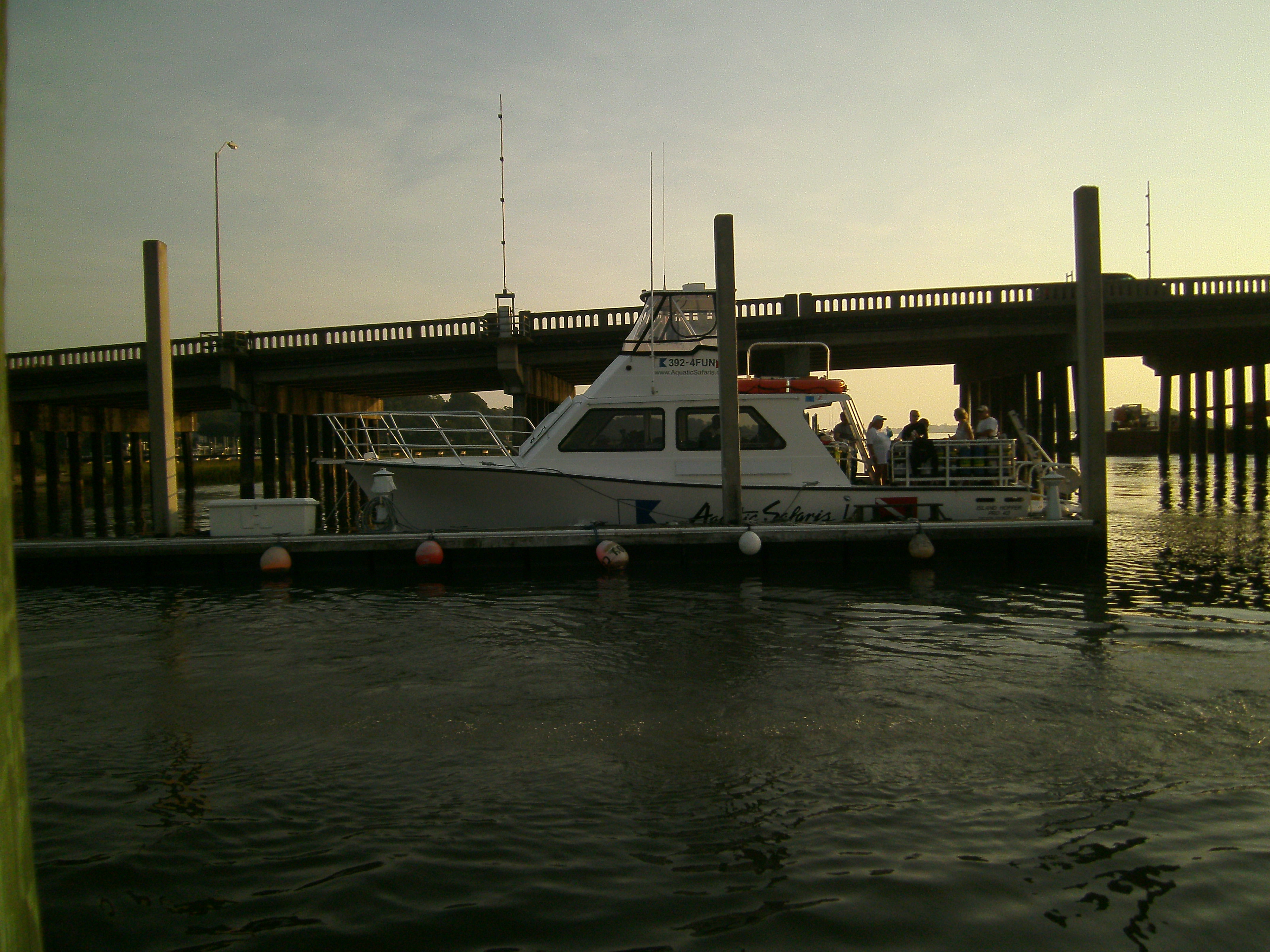
For Labor Day weekend, Sally and I went down to Wrightsville Beach, NC, for some wreck diving and extended our lucky streak of exceptional coastal dives. Our trip was organized by our friends at Down Under Surf and Scuba, and we went out on the Aquatic Safaris I. The 48-foot boat I carried 19 divers.

Saturday was warm and clear, with mild breezes and fairly calm seas. We dove the City of Houston, a passenger-freighter that foundered in a storm in 1878. She lies about 50 miles from Wrightsville. It took two and a half hours of hard traveling to get there. Shortly after we anchored and I visited the head, I felt queasy and promptly got sick. Then I felt mostly better, and we jumped in and headed down the anchor line to the wreck.

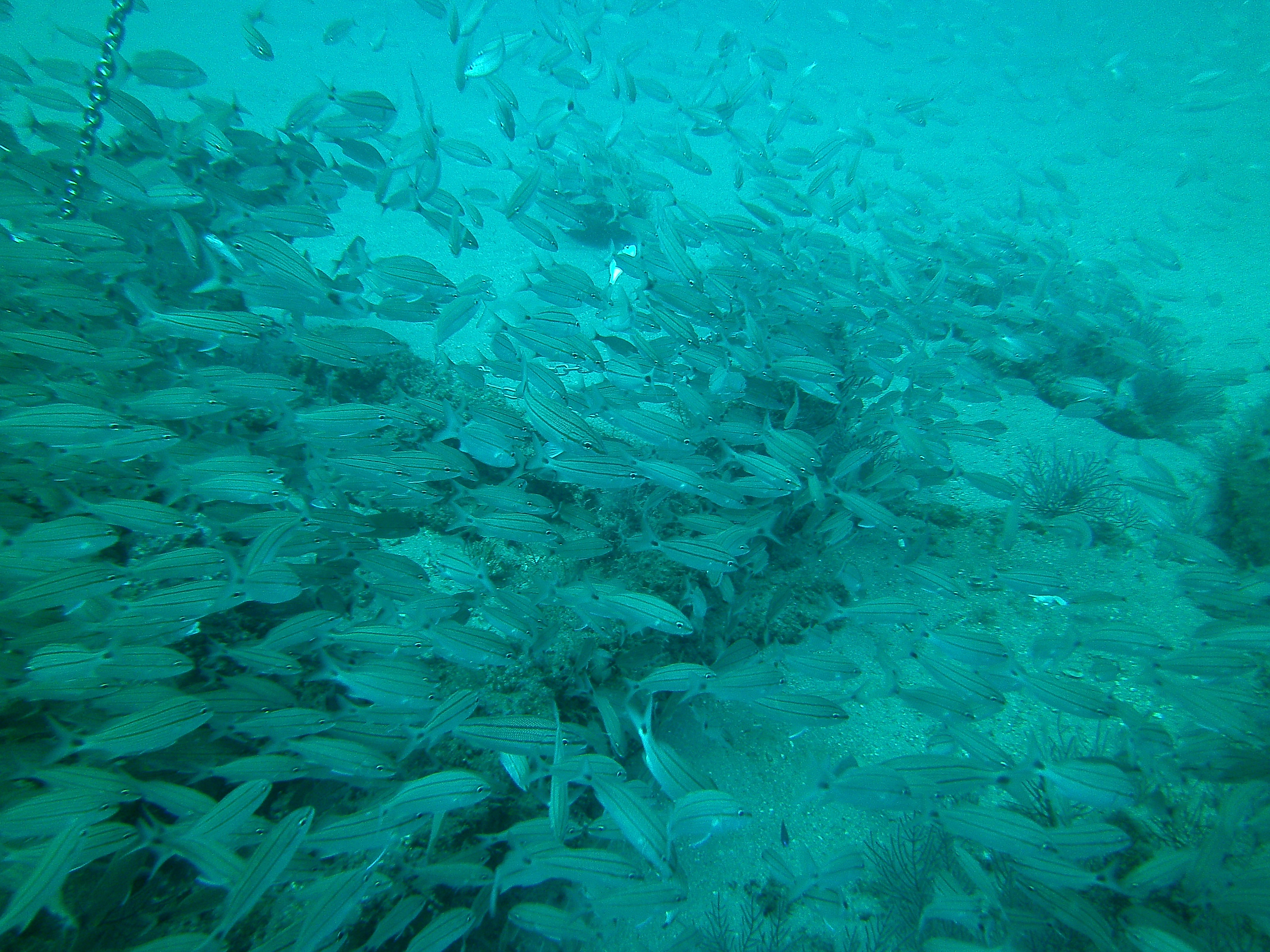
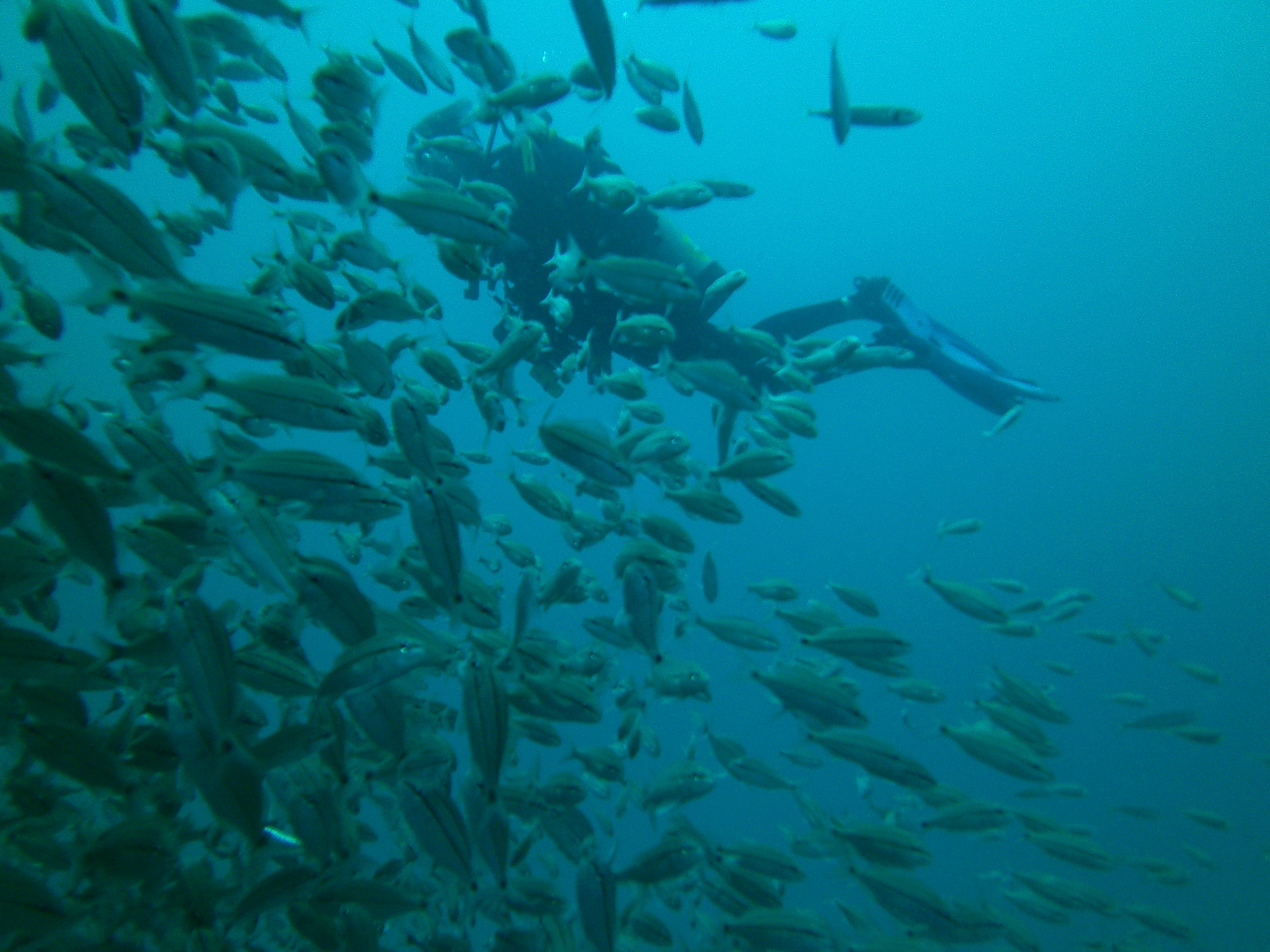
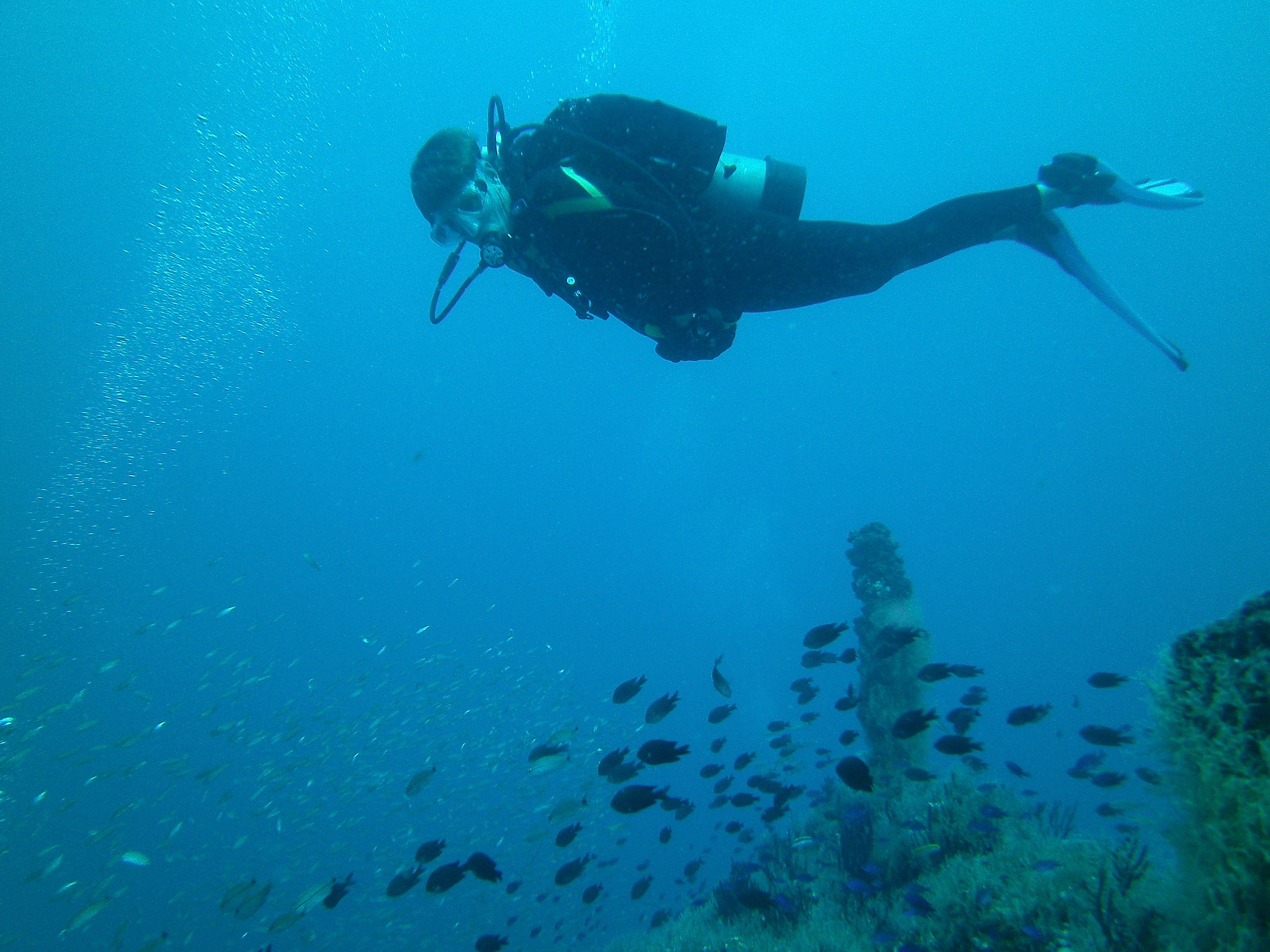
The Houston lies at about 95 feet down. Visibility was good (perhaps 60 feet) and the water temperature was a comfortable 82 degrees. There was a mild amount of current on the bottom. There were thousands of small fish. Our most dramatic sighting of the day was a goliath grouper, an enormous fellow, almost six feet long. My camera battery gave out when I tried to get a picture. I did, however, get some other pictures, including Sally examining something tiny with her magnifying glass (above) and great clouds of small fish.

After a second dive on the Houston, we headed in. Our seats were metal benches along the sides, in front of our tanks, so we couldn’t lean back and sleep. Some of our dive mates stretched out and slept on the deck, so it was difficult to move about as the boat sped along at a quick 25-knot pace. Diving sometimes takes fortitude.

We had a good Italian dinner with Sally’s sister in Wilmington at Nicola’s. There were a number of appealing vegetarian offerings. I had the eggplant rollatini with pink sauce, which was quite tasty. We had a lively conversation about, among other things, the automation of higher education, and how it is threatening the traditional university.

On Sunday we went out again on the Aquatic Safaris I, this time for a two-hour trip to the Normannia, a Danish freighter that foundered in 1924. The seas were calm and the trip went smoothly. I didn’t get sick. The wreck is about 115 feet deep. Like the previous day, the visibility was about 60 feet and the water was comfortable.

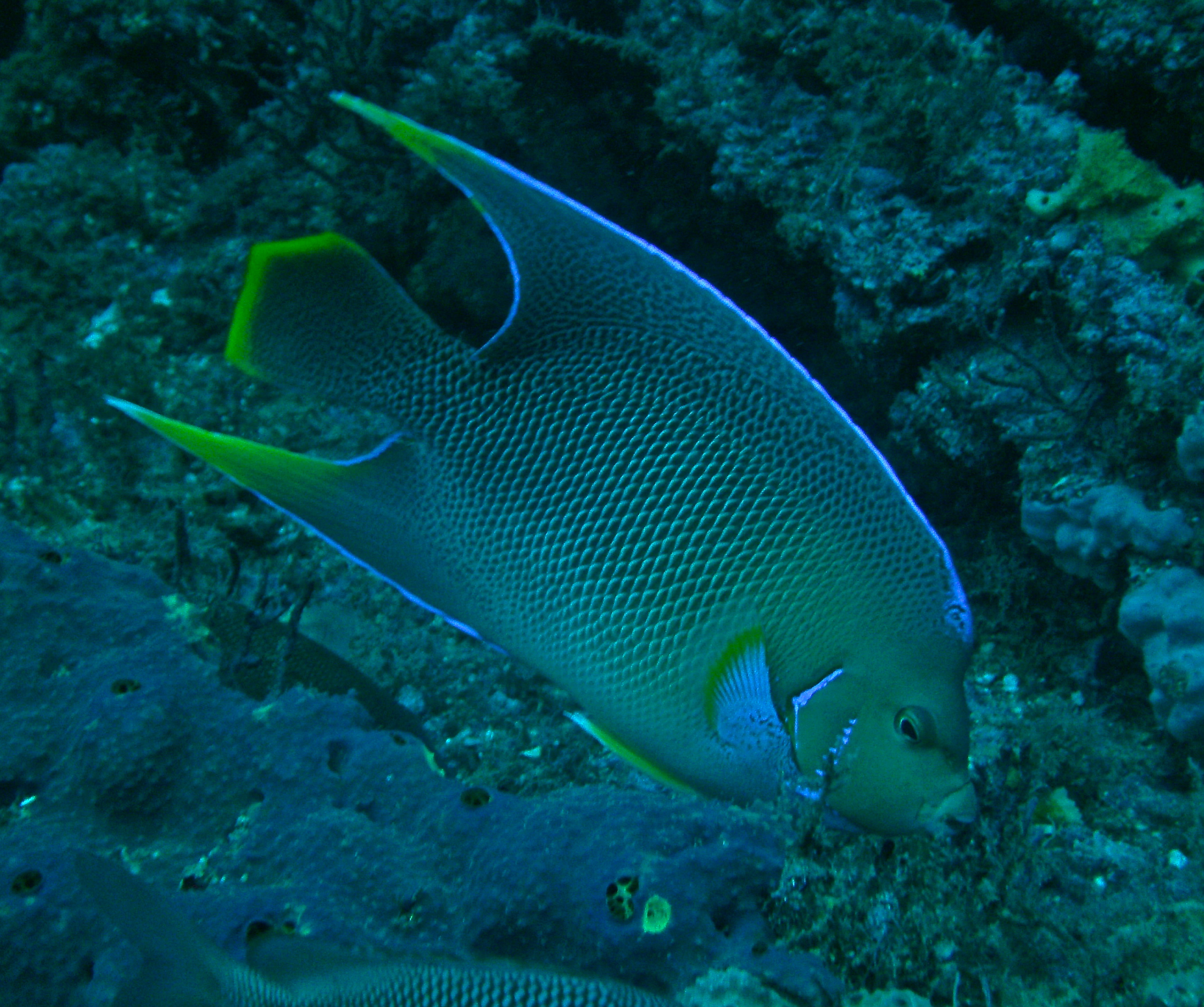
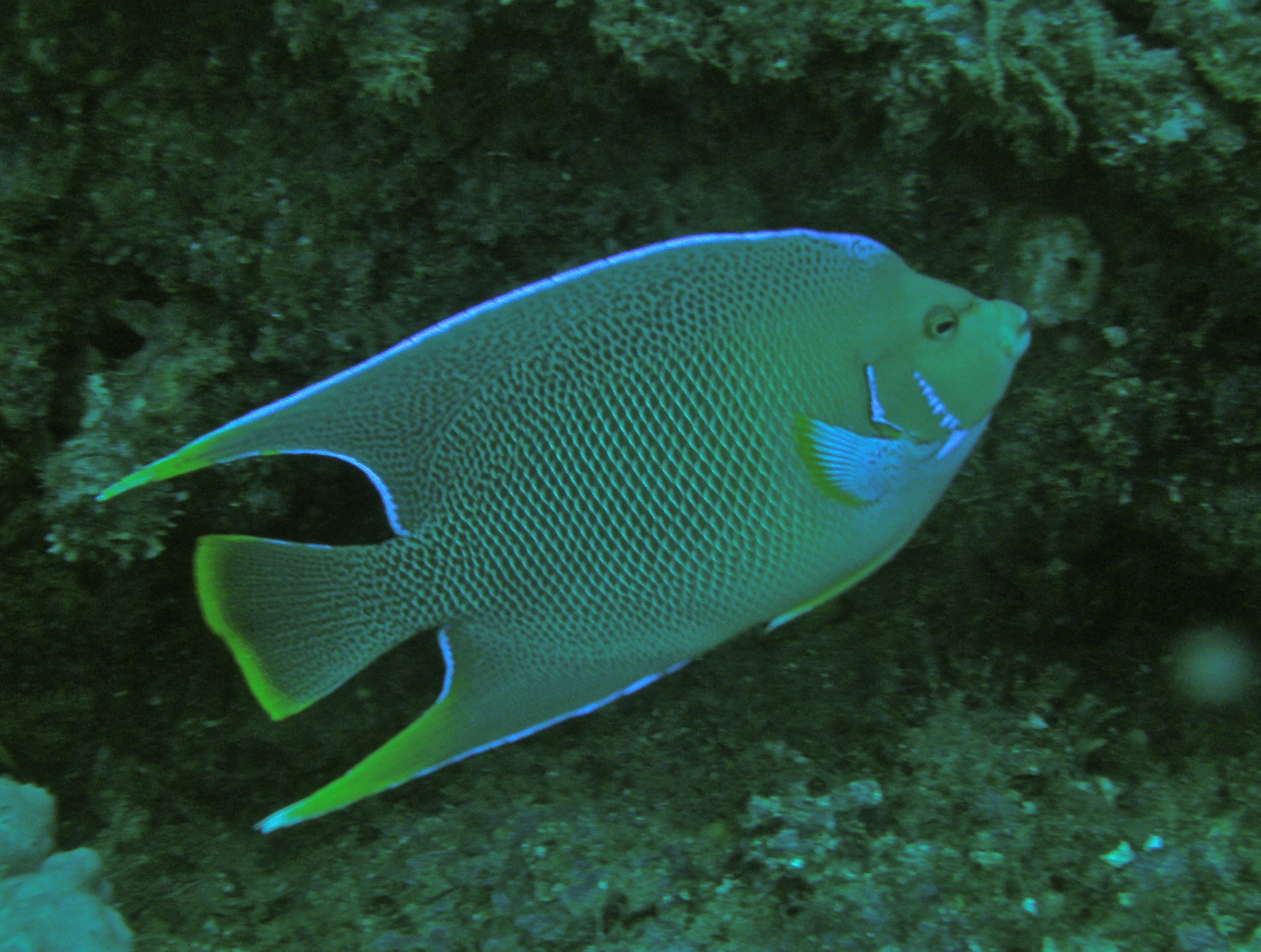
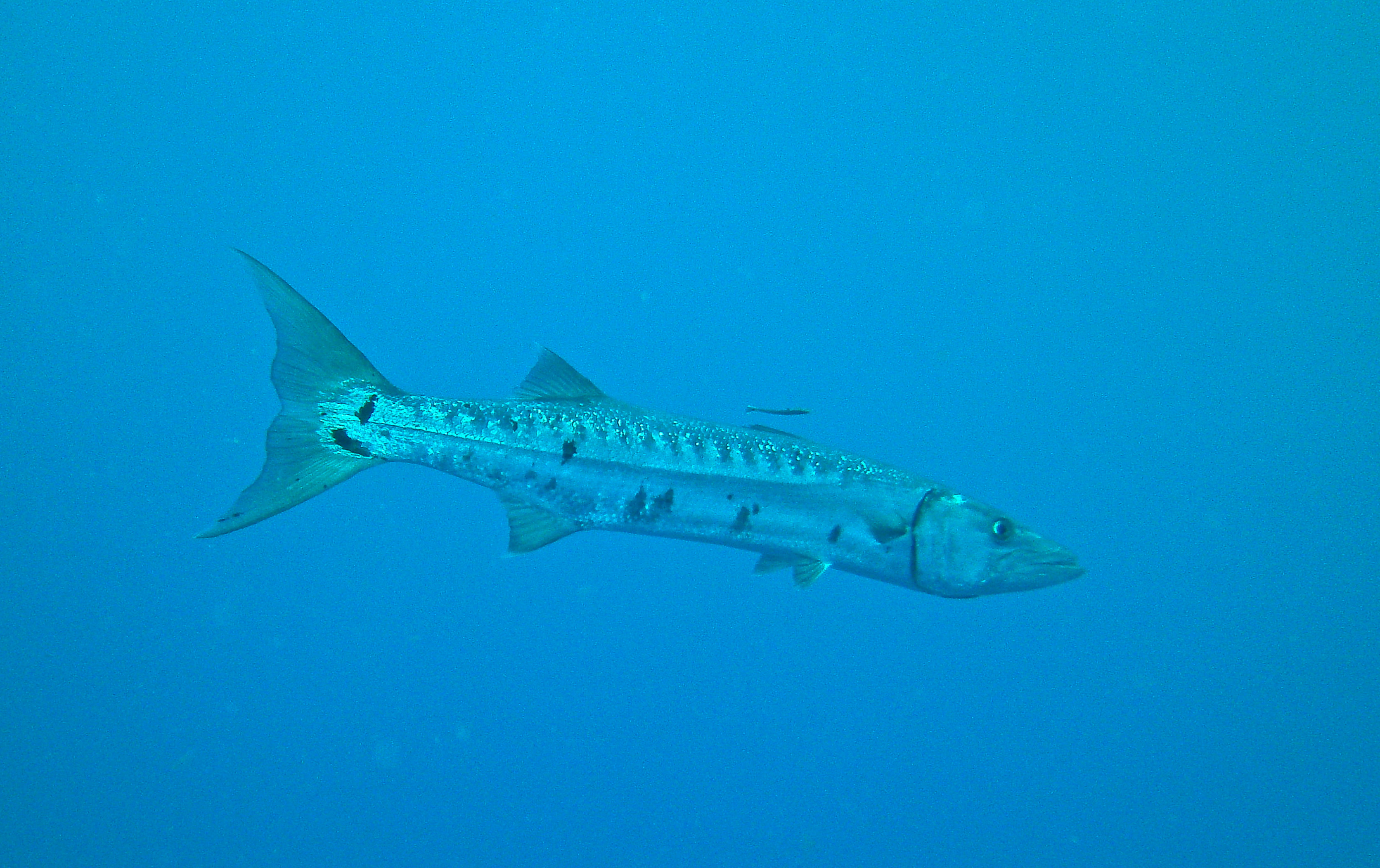
Even more than at the Houston, the Normannia had an amazing profusion of life. Along with thousands of small fish, we saw barracuda, a couple of gigantic lobsters, a well camouflaged frogfish, and my favorite, queen angelfish (several). I went to some trouble trying to get a good picture of one, and though these don’t really do it justice, they were the best I could do.

It is such a great pleasure to swim among fish. At times we were completely surrounded by thousands of small ones, and at times we swam alongside large ones. As I dive more, I feel increasingly touched by their beauty. They are amazingly varied in size, shape, color, and ways of moving about. Recent research indicates that they are much smarter than we’ve thought. For example, some can very quickly learn complex topography of a reef environment.


As I’ve spent more time with these creatures, I’ve come to consider them sentient beings worthy of respect and compassion. I regret to say I’m in a minority on this point. Among my fellow divers were some with spear guns and one who was capturing lobsters. I found it really painful to see him take an enormous lobster, perhaps decades old, and break off its antenna and shove it into an ice chest to suffocate.

My shipmate seemed otherwise a decent and friendly fellow. I’m certain he was not trying to torture the creature, though that was what he did. He didn’t derive pleasure from being cruel. He simply couldn’t comprehend that the animal was capable of suffering. I think he and others would find that expanding the circle of compassion to more animals is a happier and more fulfilling way to live.

Speaking of intelligence, I read recently that the human brain was unlikely to get larger in the normal course of future evolution, because it would serve no purpose. Brains working in isolation are not how things get done. Instead, as E.O. Wilson has pointed out, it’s humans’ ability to connect their individual brains that has been the secret to their evolutionary success. We keep getting better at that, developing over the millenia the tools of gesture, spoken language, and written language, with the internet being the latest game-changing technology.

In the midst of the depressing mendacity and nonsense of the Republican convention, I find it somewhat consoling to look at intelligence as potentially expanding through better networks. The Republicans are profoundly mistaken in thinking that entrepreneurs act primarily as fully independent rugged individualists. It’s more accurate, and also more useful, to look at achievement in terms of groups cooperating and competing. Our future success, and perhaps our survival, depends on our ability to improve our systems of cooperation, including our politics.

Upfitting my new Android phone and thinking more about accelerating technological change

This week I got my new Android smartphone upfitted with my email accounts and a variety of apps. I’d been reluctant to give up my old smartphone partly because of the investment, both in money and effort, of apps, but on reflection I realized that a good many of the apps I’d previously downloaded were seldom or never used. The move to the Galaxy was sort of like moving to a new apartment — a good opportunity for some app house cleaning.

I easily and with little expense replaced those things that were useful, like internet searching, weather reports, navigation, travel support, news, and music. I got my most used apps organized in folders that I could quickly get to. I installed personalized wallpaper (our dog Stuart). Everything seems to work fine, with the exception of the voice activated search feature, which is not ready for prime time.

Through clumsiness, I dropped the device a couple of times in the first few days, fortunately without causing damage. This provided some proof of its durability and toughness, but also served as a reminder that devices are not immortal. I ordered a Seido case for protection, which fits well and looks good. It has a neat little kickstand on the back.

I’ve been reading The Lights in the Tunnel: Automation, Accelerating Technology and the Economy of the Future, by Martin Ford. Like Brynjolfsson and McAfee, Ford starts with the premise that technology is developing at an ever-accelerating rate, and examines the economic implications of that development. As our machines get smarter and smarter, they will replace people in more and more jobs. At some point, the kinds of jobs that most people do will be taken over by the machines. Those people who’ve become redundant will not be able to earn an income, and so will not be able to buy goods and services, and their numbers will continue to grow. Producers of goods and services will eventually have no markets. Then the economy collapses. Q.E.D.

Ford thinks there is a possibility of avoiding economic meltdown, but he thinks that will require dramatic shifts in the economic order. To continue production, we’ll have to find a way to sustain consumption. Ford’s solution involves taxation of producers to redistribute wealth to consumers. He suggests that we think about a system where supplemental incomes is distributed to sustain the cycle of production and consumption. In this vision, the individual’s primary contribution is as a consumer, rather than a producer. Production is done by the machines.

I came upon a lengthy essay by Marshall Brain on this same subject titled Robotic Nation, which is well worth reading. Like Ford, Brain accepts the premise that Moore’s law and its corollaries are leading inexorably towards computers so powerful that they will render a great many human workers redundant. To address the problem of economic meltdown, Brain has proposed a concrete solution: the government pays $25,000 to every citizen. He sets out a variety of ways this could be financed, from selling advertising to a smorgasbord of taxes.

Assuming Brain and Ford are correct and we manage to avoid economic collapse, the question I keep coming back to is what are humans going to do once they’re obsolete as economic producers? How are they going to find meaning and joy?

I’d like to think that when robots have taken over most of the world’s work, people who get Brain’s $25,000 payments would devote themselves to communities and caring for others, exploring the mysteries of the physical universe with science, creating aesthetic wonder with the fine arts, expressing their physical energy in competition and travel, appreciating the delights of the world of the senses, and otherwise expanding and expressing their creative powers. But I have some concern that they might just watch more TV and eat more junk food. Think of WALL-E, the touching and intelligent animated Pixar movie about the eponymous robot, and the degenerate blobby humans in his world.

To avoid massive blobbiness, we’ll need to revise and expand our value systems. Fortunately, that’s something that we can get started on without a major political reform or expenditure of funds. Even if the robot-driven future never arrives, it would be a worthwhile project, since there’s a certain amount of blobbiness already.

The place where I’d begin is with a deeper understanding of how our brains function, how human communities function, and how our systems of values and morality currently work. There’s a lot of exciting cross-disciplinary work being done, and I’ve written about some of it in the last few months (including on books by Jonathan Haidt,Michael Gazzaniga, Daniel Kahneman and E.O Wilson). I’m on the lookout for more.

My new free smartphone, and some thoughts about technology and unemployment

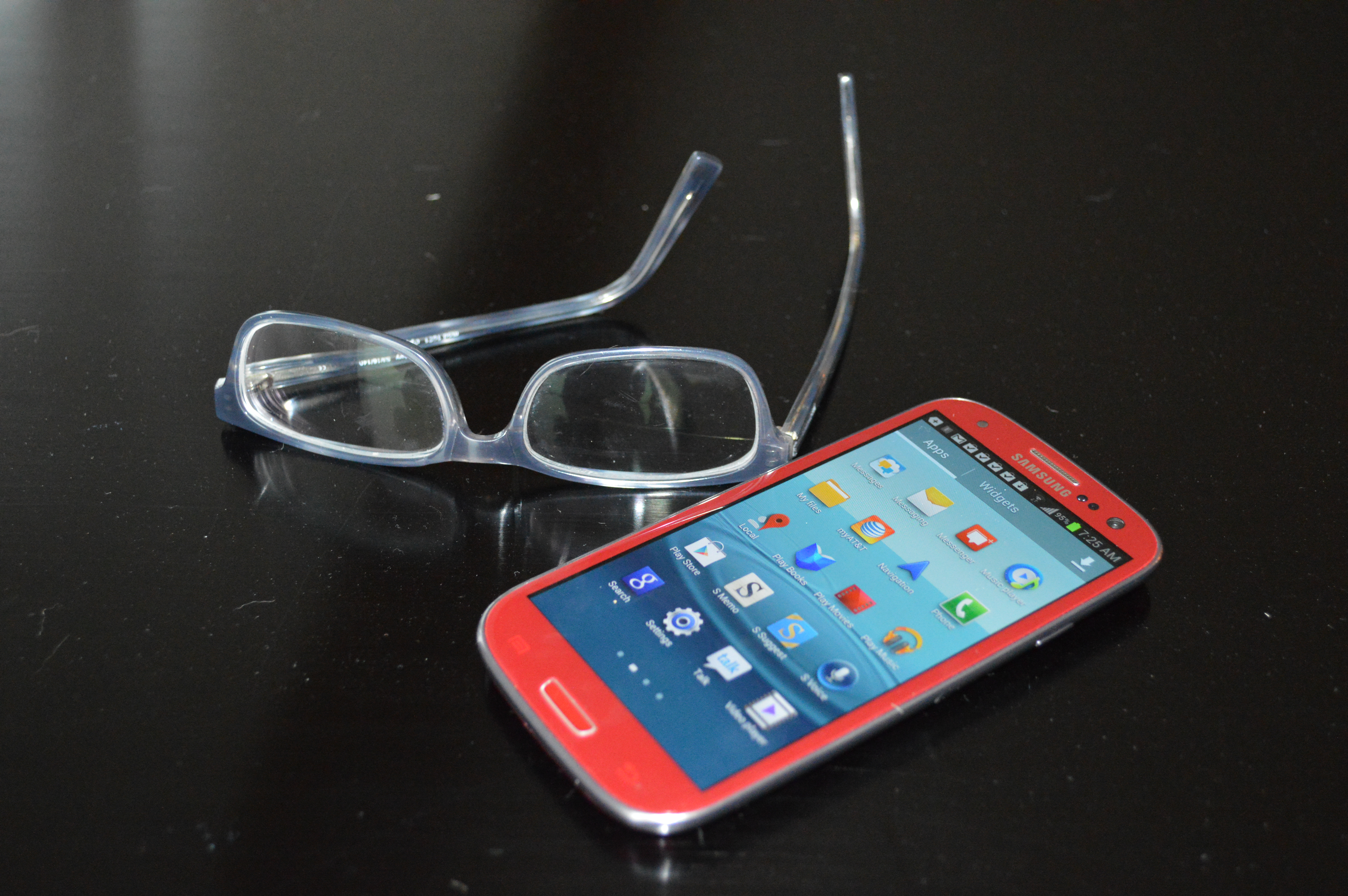
I got my first free (aka open source) smartphone a couple of days ago, a Samsung Galaxy S III with the Android operating system. I love the larger screen, with its excellent resolution, and the form factor in general — light, thin, and rounded, and still small enough to go in my pocket. It comes with a good array of apps, and there are thousands more available at free or low cost. The touchscreen interface is intuitive. The voice command option does not seem as smart as Siri is reported to be, but other apps load fast and work beautifully.

Will this change the place of a smartphone in my life? Probably a bit, because the bigger screen and faster speeds (4G) make it easier to use. The civil libertarian in me worries somewhat about the ability of such devices to track me and potentially invade my privacy, but I’m also amazed and happy with all the useful things it can do, such as helping me with directions, accessing every type of knowledge on the internet, performing word processing and other computing functions, entertaining me with movies, music, and photographs, and connecting me to people through text, email, and phone. Smartphones can potentially make us more productive and happier.

At the same time, our technology is transforming us in other ways that are more worrisome. This morning’s New York Times has a long story on remarkable advances in robotics, which are replacing skilled manufacturing jobs in electronics and logistics, along with lots of others. The story cites a book I recently read and would recommend: Race Against the Machine: How the Digital Revolution is Accelerating Innovation, Driving Productivity, and Irreversibly Transforming Employment and the Economy, by Erik Brynjolfsson and Andrew McAfee.

The authors, economists at MIT, present a clear overview of technological change, which they describe as increasing exponentially. Moore’s law continues to double processing power every 18 months, and software advances are moving much faster than that. Technology harbingers like Watson the Jeopardy champion and the Google self-driving car are the tip of the iceberg.

Brynjolfsson and McAfee recognize that computers can’t yet do everything humans can do, but they have already replaced many kinds of routine work, and inevitably will replace more and more skilled work. This accounts for part of our persistent problems of unemployment even as the economy is growing. Traditional economics assumes that new technologies will eventually produce new jobs, but B and M point out that if technology continues to improve exponentially, computers will be able to perform more and more human jobs better and more cheaply. It’s difficult to see how new jobs could equal those that are eliminated.

If they’re right (and I think they are), we’ve got major social dislocations ahead. In our society, people work not only to earn a living, but also define each other and themselves in large part according to their work. Thus unemployment is not just financially threatening — it’s humiliating. With more and more people unemployed, unable to buy goods and services and without social moorings, our social and financial system will face an existential crisis.

What is to be done? We’ll need to change the way we organize ourselves, the way we distribute wealth, and the way we think about value. We’ll need to find new approaches for valuing and caring for others, and for thinking about the meaning of our own lives.

I had a small epiphany on this yesterday when our friends Ken and Carol took us out on Falls Lake for some water skiing. They both retired early, and do things they enjoy doing, like boating, tennis, and travelling. I have trouble imagining myself retired in this sense. But as we sat on their boat on the lake in the late afternoon, we talked about our lives, told stories, and swam a little, and enjoyed the lake and surrounding forest. Then we took turns getting pulled by their quick little boat on one of their various toys. Ken rode a hydrofoil chair and a wakeboard, and I had a go with old school water skis, which I enjoyed enormously. These things have deep value: sharing stories and experiences.

Make way for Segways, Scouting intolerance, and speaking of ear protection


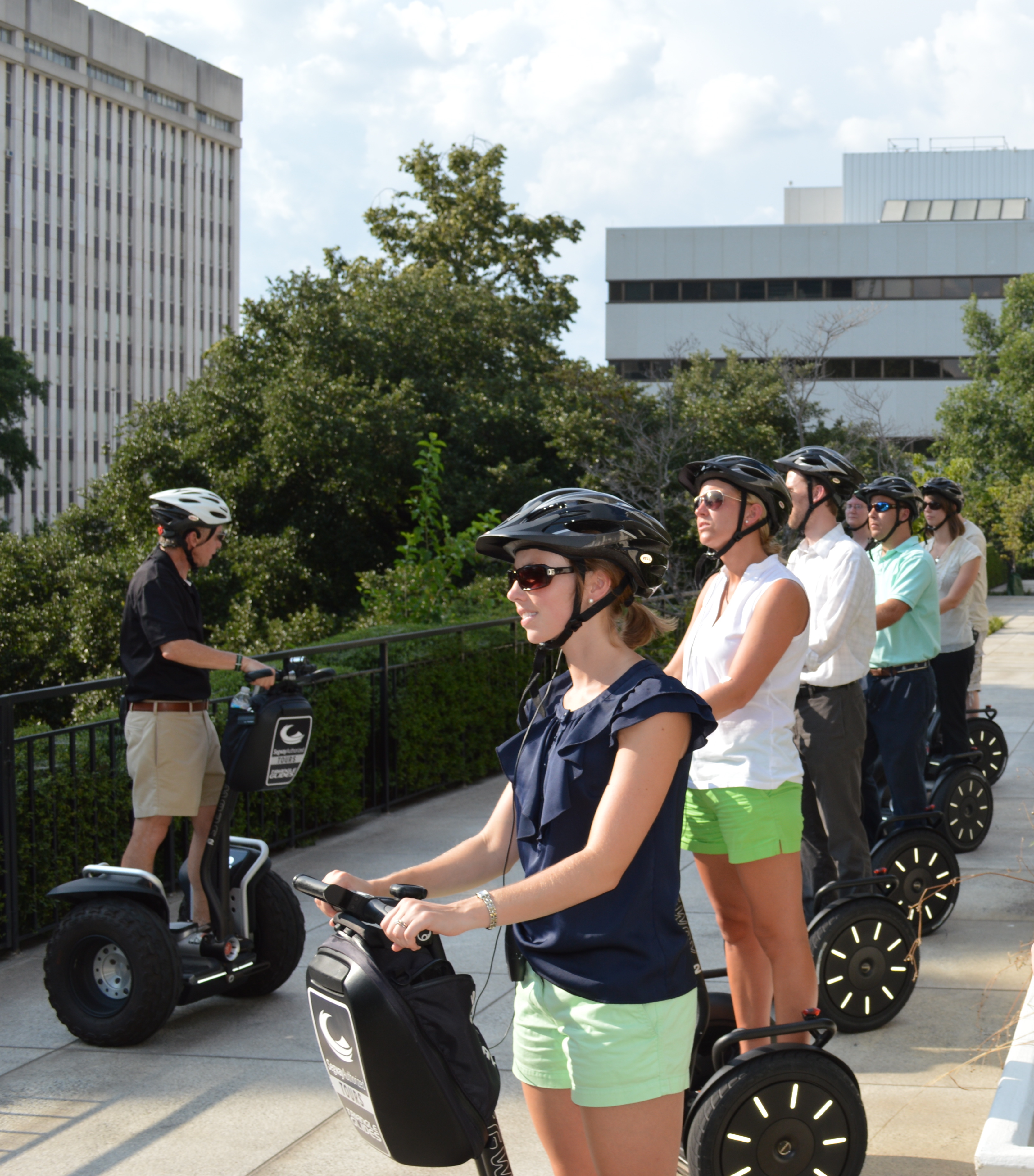
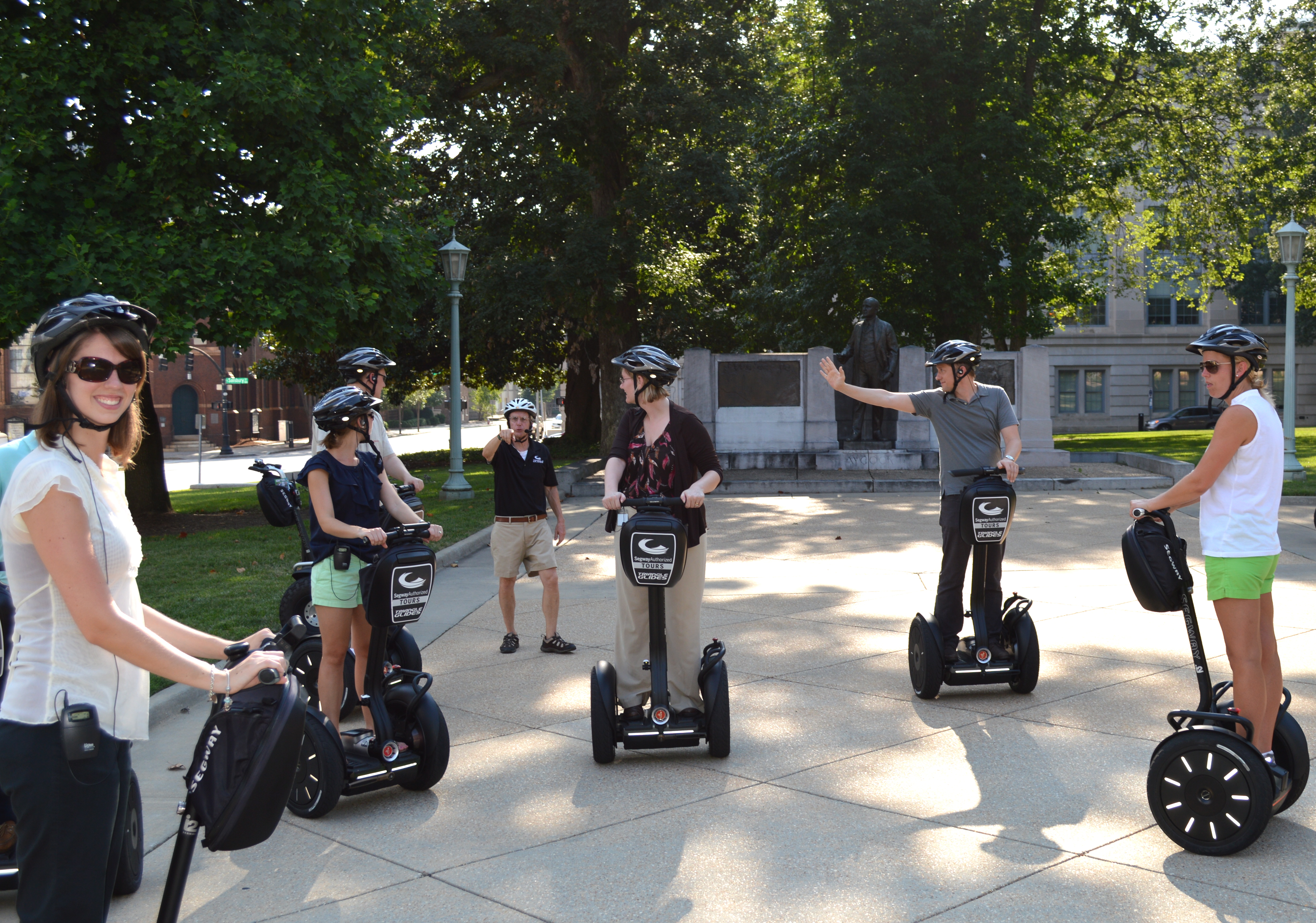
This week a group of us took an hour-long tour of downtown Raleigh on Segways, those self-balancing two-wheeled scooters. I learned that several Raleigh street names were the names of councilmen who approved the purchase of farmland for the city in 1792, and other similar facts. But more important, I learned how to move forward, backward, and turn. It takes approximately 5 minutes to learn, and 5 more to feel reasonably confident. A few minutes later at the old Capitol I was wondering how fast the thing would go, and the guide was begging me to slow down. I felt like one of the Jetsons.

When I think of fun adventures, I still think of my early years with the Boy Scouts. Even at the time, I thought the uniforms were a bit goofy, but I valued the friends I made and our close encounters with the natural world while camping, hiking, and canoeing. With this happy history, it pains me that the Scouts decided last week to reaffirm their ban on gay members. The Scouts instilled in me a highly serviceable code of conduct: a scout is “trustworthy, loyal, helpful, friendly, courteous, kind, obedient, cheerful, thrifty, brave, clean, and reverent.”

But there’s at least one cardinal virtue missing from the list: tolerance. Willingness to tolerate and accept differences is vital for individual and collective happiness. It doesn’t come easily or naturally, and it needs continual tending and encouragement. The Scouts should be promoting it without exception. As much as I was a committed Scout, as long as they have a policy of intolerance of gays and non-believers, I cannot support them.

At times it’s unclear whether unhealthy behavior is the result of ignorance or wilfulness. I’ve generally assumed that exposure to dangerous noise levels was an issue of ignorance. But a story in the NY Times last week suggested that some noise polluters had something close to a criminal mindset. Certain retailers, restaurants, and clubs have raised noise levels to the point where hearing loss is almost inevitable, and have done so with a view to attracting youthful customers to buy and drink more, and to repelling oldsters. If this is done knowingly, it’s despicable!

Young people, and indeed most people, assume that businesses and governments wouldn’t knowingly expose them to serious harm. It reminds me of marketing that used to hook kids on cigarettes, and still hooks them on sugary cereals and fatty fast food. According to the Times story, employees of noisy businesses have hearing and other problems, but regulations are almost never enforced, and few people complain. Here’s a thought — let’s start complaining.

Stuart, who had his tenth birthday this week, says, “Protect your precious ears!”