The Casual Blog

Category: public policy

Skiing in Virginia, and considering, has the NSA ended privacy as we know it?
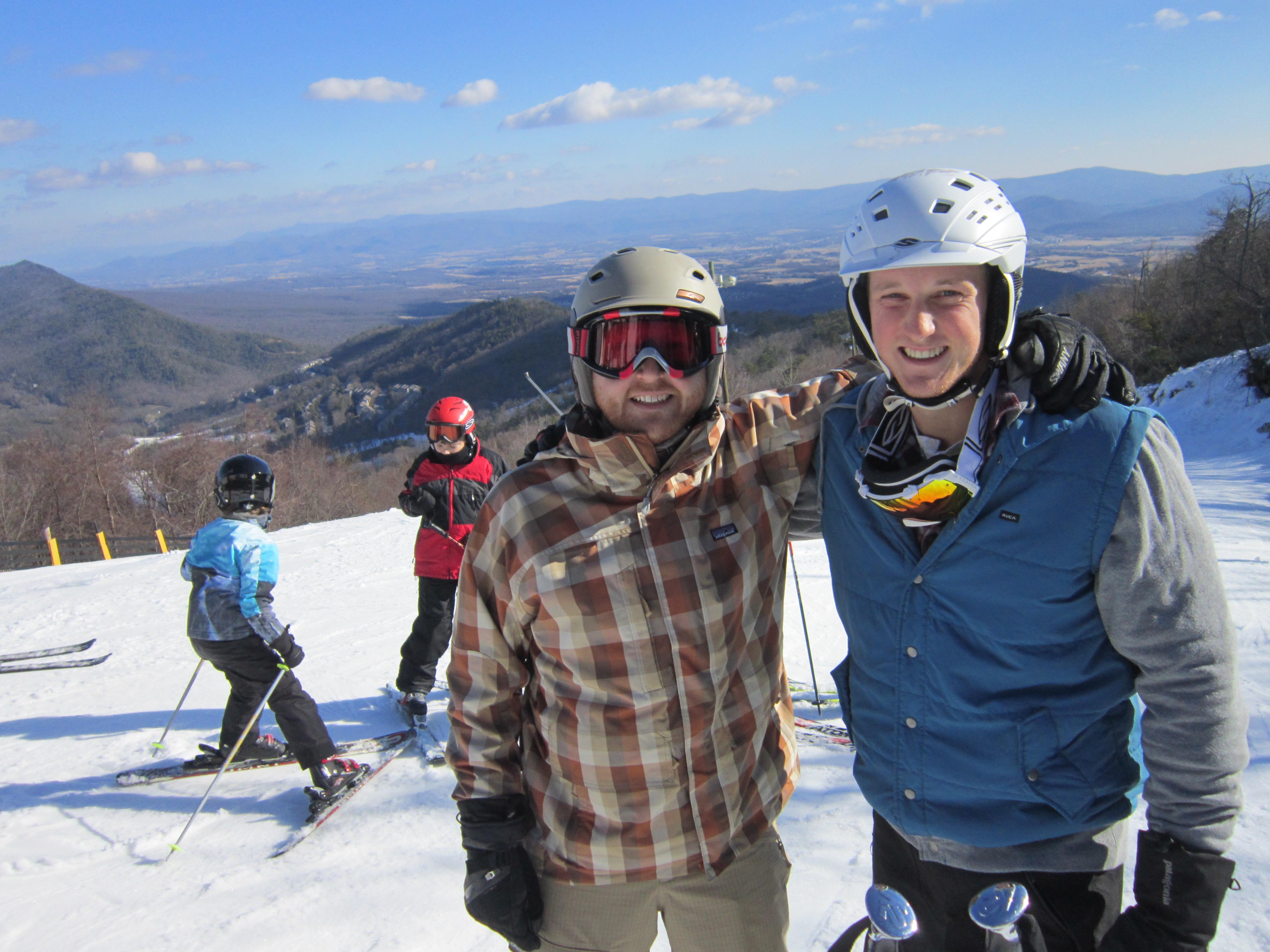
My nephews Josh and Adam, humoring me with a short pause on Sunday

My nephews Josh and Adam, humoring me with a short pause on Sunday

Last weekend I went skiing at Massanutten Resort, near Harrisonburg,l Virginia. I thought it would be good to see my brother and nephews, and have a little ski tune up before our Colorado trip in February. The drive up on Friday night was five and a half hours through fog and rain, and the ski conditions were far from optimal, but it was still well worth it.

On Saturday the weather report was for rain, and it did rain a bit, but the snow was pretty good. It was fun skiing with my nephews, both in their twenties and fast. They decided at lunch time to go to the movies, but my brother had ski patrol duty, and I decided to keep skiing with him on the advanced slope (number 6).

He had to leave for a period, and it got very foggy, with perhaps 50 feet of visibility. It rained a little. On the first run on my own, I noted that I didn’t see a single skier on the mountain. The same was true on the second, third – and fifth. It was the better part of an hour before a few other hardy souls ventured out.

Despite the fog, I enjoyed the skiing. I focused on sensing more of the ski edges, and making smooth, graceful turns. And I enjoyed the solitude of the trips up the mountain in the chair lift.

It occurred to later, though, that my smartphone was still sending out signals of my movements. My perception of privacy has been changing with the Snowden revelations, and I suspect I’m not alone. (LOL) Is it real so bad? I think it is, and have a concrete example.

A few weeks back, I wrote an email letter to the President. The gist of it was to commend him for commuting the sentences of some non-violent drug offenders, and to recommend that he expand that effort to help more of the thousands serving lengthy prison terms for minor drug crimes. As I prepared to send the email, I paused, thinking that this communication could easily mean a new NSA or other agency file would be opened on me, with unpredictable consequences.

Paranoid? Maybe. I sent the email anyway. But I expect that many citizens, now knowing how easily they can be monitored and how committed the spy bureaucracy is to expansive monitoring, might decide that expressing a political view just isn’t worth the risk of becoming a target.

There was a good piece in the New Yorker of a few weeks back by Ryan Lizza on the history of the NSA’s domestic metadata collection program, including efforts to establish a legal basis for it. It wasn’t surprising that a spy agency would tend to conceal its work, but it was surprising that agency representatives repeatedly lied to Congress and the FISA (special secret programs) court.

It raises the question, is this agency unconstrained by law? I expect most people involved in massive electronic surveillance are patriotic and well-intentioned, and not personally seeking world domination. But what if an agency with effectively unlimited resources and powers came within the control of a megalomaniac sociopath?Impossible? Remember J. Edgar Hoover?

If we’re lucky, we won’t become a police state in the Big Brother sense. But just knowing we’re subject to constant surveillance will probably change us. The interesting question is how much.

If the government forbade curtains on windows, we’d quit doing certain things within sight lines of the street. Maybe, without much discussion, we’ll get more guarded or stop discussing controversial topics using our electronic devices. Once that habit develops, it could extend to our face-to-face exchanges, or even our interior monologues. It wouldn’t happen all at once, but little by little. We might not even notice the change.

The justification for the government’s massive technology surveillance programs, of course, is prevention of terrorism. It’s hard to argue with that, since anything that grows the database of human activity could also increase information about terrorism. But is it possible that we’ve gone a little overboard with this fear-of-terrorism thing? Does it remind you a little of people preparing to end the world as we know with a nuclear conflagration it to prevent a takeover by communism?

There was a very interesting piece in Slate last week on the national hysteria over alleged sexual abuse and Satanic rituals in preschools back in the 80s. There were several of these cases in which little children testified that their preschool teachers molested them and also engaged in ritual murders and other bizarre and horrifying conduct.

Based almost exclusively on the testimony of the children, juries sent a number of these teachers to jail for lengthy terms. It slowly emerged that the abuse stories were fabrications produced by so-called therapists who essentially planted false memories in the children’s heads. Most of the teacher-victims eventually were freed.

In retrospect, the children’s stories seem way too bizarre to be believed – yet most of us believed. It’s a reminder of how our powers of reason and critical thinking are limited, and how they can be overwhelmed and defeated by sensational media and groupthink.

P.S. Needless to say, I paused again before publishing this post. But I think the danger of silence and retreat from dialog is even greater than the danger of surveillance run amok.

Sleepwalking, yoga, Bach, Schlosser on the nuclear precipice, and Spiegelman’s Maus

13 12 07_5337
So I apparently had another bizarre sleepwalking experience. After what seemed like a normal night’s sleep, I got up to find several unusual things. There were two wine glasses full of beer on the coffee table – one sitting on top of my laptop. There was a bowl with popcorn kernels, and a lot of popcorn on the floor. In the kitchen, the light on the stove hood vent was on, and the microwave popcorn wrappers were strewn about.

My first thought was that we’d had a break in, but the various quasi-valuable things in the vicinity were still around, and the door was locked from inside. That left just two possibilities – Sally and me. When she got up, she verified she had not knowingly done any of this eating and drinking.

From my prior somnambulism, I figured it had to be me. But I had absolutely no recollection of any such activity. And I would never, ever put beer in a wine glass – or worse, set the glass on my computer! And I did not know exactly how to operate the light on the stove hood, which I never use.

It is very strange to think of such complex activity happening without any consciousness whatever. Eating and drinking without meaning to is bad, but it could get worse. Is there any safety module that keeps the sleepwalker from going over the balcony rail? And falling twelve stories?
13 12 07_5349

In the last few days, I’ve taken note of various waking automatic behaviors and strange forgetful episodes. I expect everyone has some. Did I take that pill already or not? I parked that car, but where? My foot is bouncing up and down, which I did not tell it to do. Sally had a good one: she couldn’t find the pomegranate juice, and looked high and low, before realizing she’d already gotten it out of the refrigerator.

So a lot of our behavior is taking place without our consciously knowing anything about it. This is at times surely a good thing, allowing us to save mental energy for where it’s most needed. Cultivating good habits is partly an accommodation to the reality that there’s just not enough time or energy to think about every behavior. We choose a template that we think is likely to be effective in different future situations and repeat it until it is automatic.

But still, sleepwalking is pretty weird.

13 11 27_5360-1

Some yoga

The weather for most of this week was unseasonably warm and sunny, but it turned cold and rainy for the weekend. So no golf, but I did get in two yoga classes. On Saturday morning Suzanne filled in for Yvonne at Blue Lotus, and led an hour-long open level vinyasa class. She kept things flowing pretty fast, which I like, and I did a reasonable amount of sweating.

On Sunday morning, based on the recommendation of Larisa (my personal trainer), I tried a class with Hayley at Evolve. Her style involved holding poses for longer, which was challenging. When she said we’re going to do hand stands, I was surprised, but game. I managed to kick up and stay up for a while against the wall. Then Larisa asked Hayley to give me some pointers, and I had another go and managed to have a fairly spectacular crash. But I learned something: Hayley theorized that I got a little surprised when I touched the wall and let my elbow bend. Onward and upward.

Bach’s Christmas Oratorio

On Saturday night we had a fine Italian dinner a Caffe Luna, then went to a performance of the N.C. Symphony and the N.C. Master Chorale of Bach’s Christmas Oratorio. I was not familiar with the piece, but liked it very much. The chorus sounded great in some very challenging choral writing. The four soloists had pleasing voices and style, and the orchestra played well. Our friend trumpeter Paul Randall had a very high and prominent part in the last cantata, and shined.

My only complaint was conductor Grant Llewellyn seemed overly metronomic — without much rhythmic flexibility. I guess that’s one way to do it, but it seemed to me Bach would have liked more expression. We went out for a drink with Paul and a couple of his colleagues afterwards. It was interesting hearing the younger musicians talk about the intense challenges of auditioning for orchestra jobs.

Command and Control — the Nuclear Weapons Precipice

Speaking again of sleeping problems, for several nights recently I had anxiety dreams, inspired, I think, by reading Command and Control: Nuclear Weapons, the Damascus Accident, and the Illusion o Safety, by Eric Schlosser. The headline is: for decades we lived frighteningly close to the edge of an accidental nuclear disaster. A hydrogen bomb could have exploded in any of numerous training or maintenance accidents, while the huge arsenal of missiles could have been unleashed through computer error or human misjudgment.

In the final chapter Schlosser indicates that the risk of an accidental explosion from a US weapon has gone down, but it may have gone up in countries like Pakistan and India. And we’ve still got the irreducible human factor – that is, imperfect humans are in charge of these incredibly destructive weapons, and they could make a bad decision that could cost thousands or millions of lives.

Even before reading the book, I was generally of the view that it is insane to build, maintain, and keep on alert nuclear weapons capable of destroying many millions of innocent civilians and much of the planetary ecosystem – ending, as they say, life as we know it. This was true in the cold war, but even more so now, when there is no existential military threat. Why would any rational person or society do such a thing? After reading the book, and learning more about the theories of nuclear war and the practical engineering problems of the weapons, it seems even crazier.

How can it be that de-nuclearization is not a high priority issue in national and world politics? Of course, we do much hand wringing about Iran’s potential for a nuclear weapon, which makes it even odder that we somehow mostly avoid discussing our own weapons and their disastrous potential. It’s like we’re sleepwalking. Perhaps Schlosser’s book will help us start to wake up.

Maus

On a cheerier note (ha!), I started reading Maus, Art Spiegelman’s graphic novel masterpiece about the Holocaust. It’s in part about Spiegelman’s relationship with his father, who was concentration camp survivor. The early pages are about his life in pre-war Poland, first as a bachelor and then meeting Spiegelman’s mother. It’s surprisingly sweet, but also direct and honest, and remarkably vivid. I’ve never read anything remotely like it, and I really like it.

The State Fair, The Circle, and James Turrell

13 10 26_4911
It was clear and brisk in Raleigh early Saturday afternoon when Sally and I got on the bus for the N.C. State Fair. My last fair visit was with Jocelyn when she was in elementary school, about 14 years ago, and just before she began to much prefer going with friends rather than dad. In the years since I haven’t expected that the fun would outweigh justify the headaches of traffic jams and crowds. The convenience of the bus, which stopped on Hillsborough Street just a short walk from us, made us re-do the fun/not-fun calculus, and off we went.
13 10 26_4903

Our main objective was the agriculture exhibits. With most days full of hurry and technology it’s good to slow down and reconnect a little with the rural past. It’s terribly sad to think about mistreatment and needless slaughter of farm animals, but there’s also something sweet about getting close to the gorgeous prize-winning animals at the fair. The chickens and turkeys were amazingly varied, and the cows were generally good-tempered. I’m with Whitman: “I think I could turn and live with the animals, they are so placid and self-contained;
I stand and look at them long and long.”
13 10 26_4882

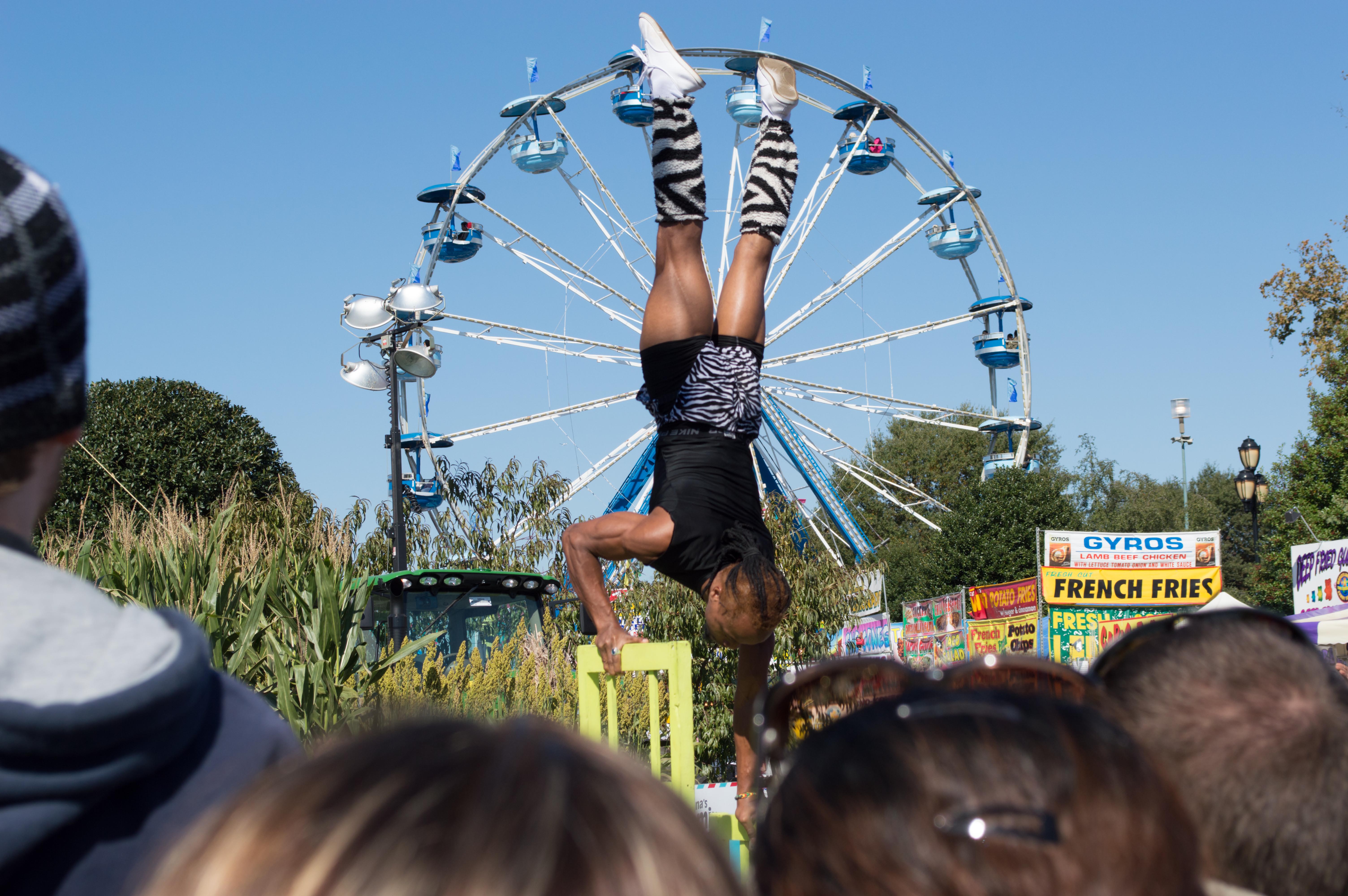
We also enjoyed the people watching. There were, of course, rural people, but it seemed like the crowd was much more ethnically diverse than years ago. We took in a free show by a troop of acrobats, including a handstand master. \13 10 26_4838
We also so a free show of stunt BMX bikers and motorcyclists. These guys were awesome.
13 10 26_4950

Also on Saturday I finished reading Dave Eggers’s new novel, The Circle. Set just a few years into the future, it’s about a young woman who goes to work for a tech company, the Circle, which sounds like a combination of Google and Facebook, and which has some cult-like qualities. It seeks total involvement and devotion from employees and may have a dream of world domination. The Circle promotes a vision of extreme transparency, pushing public officials and others to live completely on camera, open to full time universal internet scrutiny.

The idea is interesting, but the writing had about as much charm and verve as Newsweek. The subject of the book is how technology affects the human mind, but there wasn’t any depth to the characters, or much in the way of psychological insight.


Still, I liked the central thought experiment: what would happen if everyone’s life was totally visible and potentially viewable by everyone else? As The Circle notes, it would probably reduce crime. It would probably initially bring a feeling of a new kind of community. But would it destroy the possibility of human intimacy? Probably. And without intimacy, what would remain of meaning?

On Sunday morning I flew to Los Angeles for the annual meeting of the Association of Corporate Counsel, where I’m doing a presentation. In the afternoon I went to the L.A. County Museum of Art, where I wanted to see the special exhibit of the work of James Turrell. He’s best known for his work involving light and space, including environments that completely baffle our understanding of boundaries.

Turrell expects his viewers to enter into his work, literally and psychologically. I found it rewarding to do so. Although the work is primarily concerned with perception, it also inspires a surprising amount of feeling. For me it had some of the calming effects of meditation. I found myself looking at light differently as I left the museum.
13 10 12_4753

More cute cats (sorry), improving vision, getting fitter, web retail news, and tech trends

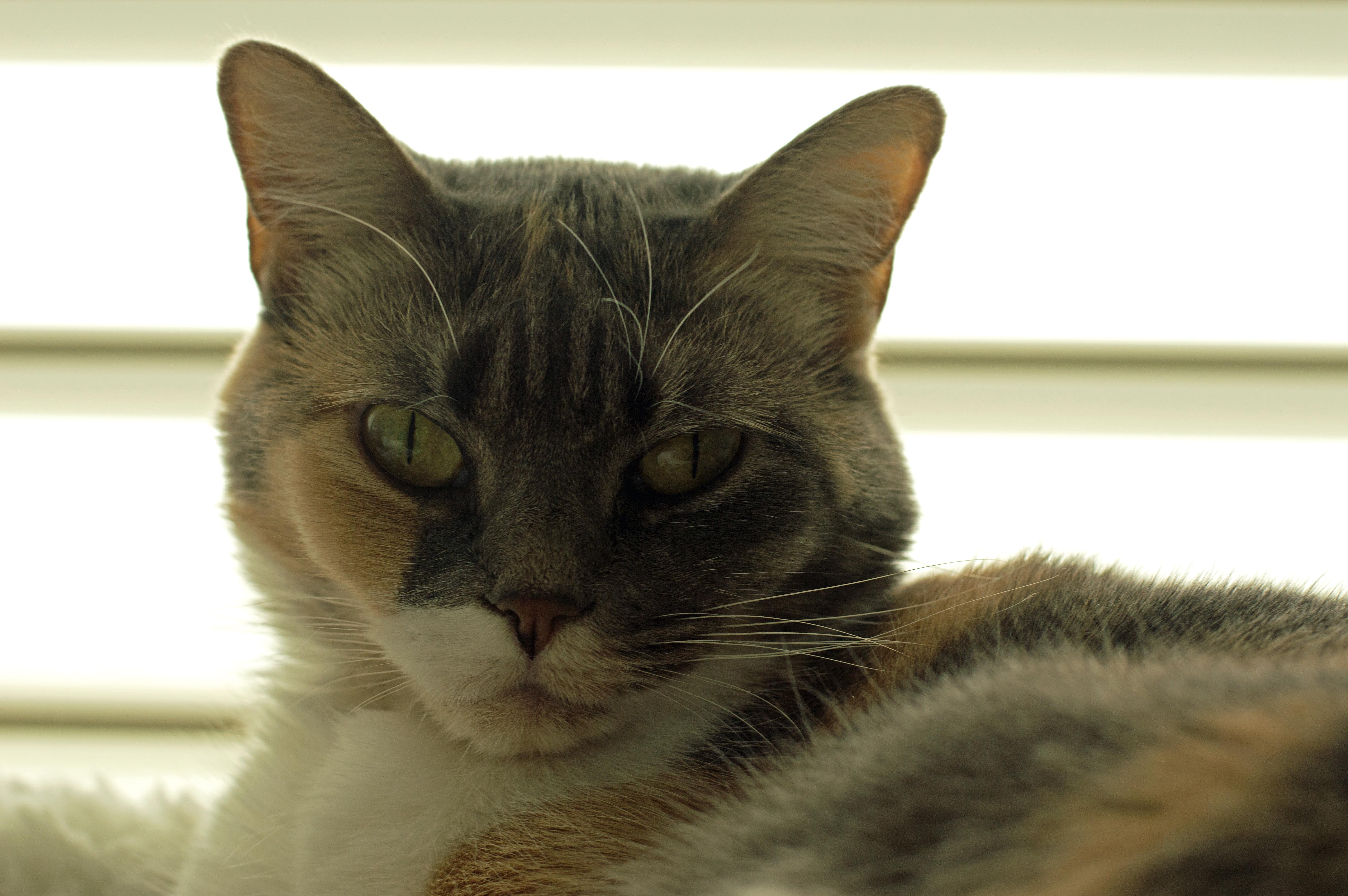
Isabel -- the mysterious one

Isabel

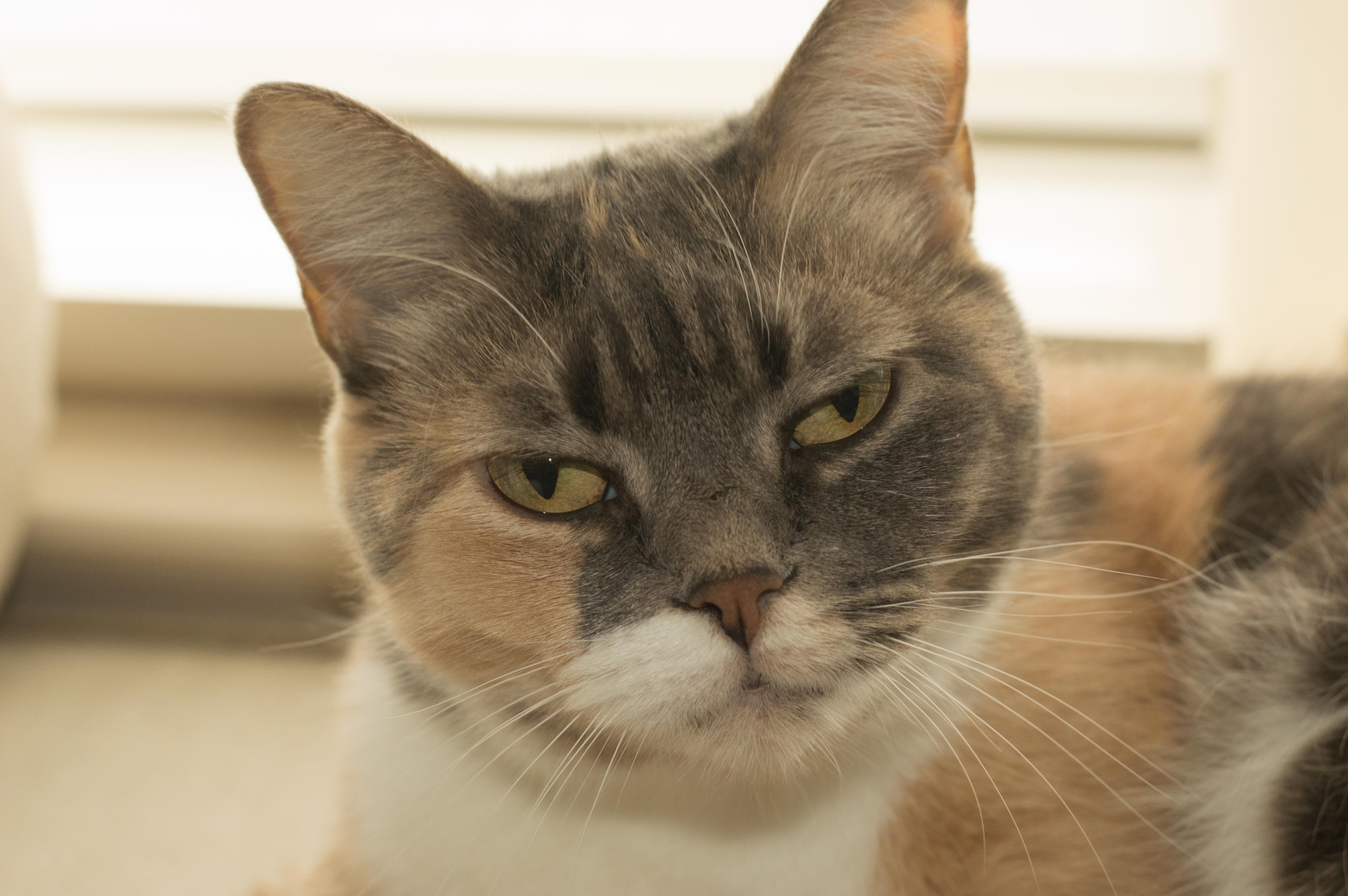
This week Sally spotted this bumper sticker: Life is a little better with a cat. That isn’t a very grand claim, which is what makes it appealing. “A little” seems about right. Our three (Phoebe, Isabel, and Rita) have been good sports in serving as my models.

Rita

Rita

I’m happy to report that my vision, while still blurry in the left eye, really improved this week. That eye is actually providing some useful signals for the first time in a long time. Also, my eye doc cleared me to resume normal exercise, and I happily did so.

Phoebe

Phoebe

After consultation with the ski friends, we agreed this week that the big ski event of 2014 would be a return to Telluride, Colorado, in February, where I’ll try to keep up, or semi-keep up, with young Gabe. And so at my early morning gym sessions I began focusing on some ski-oriented activities – lunges, side lunges, side kneel lunches, squats, with weights one-legged extension balances, duck walk with two big bands, step up onto medium table and balance, and jump up (landing softly) on the medium table.

I bought a speed jump rope and doing a few dozen speedy jumps between these activities, then worked on core matters with various species of crunches, reverse crunches, planks, and side planks. Finally, half an hour of straight cardio. I’ve been doing 10 minutes on the treadmill (with an incline), a few minutes on the ski (sideways push) machine, a few on the stairs (escalator type), and then some intervals on the elliptical. If there’s time after that, I’ll do 10 minutes of stretching and foam rolling.

I like using a heart rate monitor during work outs, which can confirm that I’m working hard, or at times show I’m not working as hard as I think. I got one when I began going to spinning classes, when I worried that keeping up with super fit young teachers could cause me to drive my poor heart into an extreme and dangerous state. But it’s gratifying to take it up into the red zone from time to time, which for me is in the 160s. I usually feel great afterwards.

My Polar heart rate monitor finally wore out this week For some months it had been behaving erratically, but I didn’t feel good about throwing it out while it was still sometimes working, so I was glad when it finally quit. I immediately went Googling to vet the options. I had some interest in finding a model that didn’t require a band around the chest, but learned that such models are not as accurate and do not give continuous read outs. I settled on a relatively cheap one, a Timex T5K541Personal Trainer, that did the two basic functions that I needed (tell the time and tell how fast my heart is going). I bought on Amazon, where as a Prime member I get free shipping, and had it two days later.

This isn’t quite instant gratification, but it’s close. I put this type of Internet retail plus efficient delivery in the pantheon of life-sweeting innovations, right up there with pay-at-the-pump gas, cash machines, and the lickless stamp. Amazon is now familiar, but we tried a similar new service for the first time last week called drugstore.com.

It does exactly what you’d expect. It has most of our preferred consumer products at normal drugstore prices, and can get them to us in two days. Shipping is free for orders of $35 or more. A bottle of Crew shampoo that I ordered had leaked a little in transit, but everything else arrived in a proper and timely manner. Ordering online made me realize I don’t particularly like chain drugstores, with all their household goods, toys, cards, and snack food. I’m perfectly happy to stay out of those places and just send out for the stuff. (For actual medical stuff, I do like my little neighborhood drugstore, Hayes Barton Pharmacy, where you still get the personal touch.)

Speaking of the constantly new, there’s a piece in the current New Yorker about the young tech entrepreneur scene in San Francisco. For those interested in tech business trends, this is a must read. (This link worked for me, but I’m afraid that non-subscribers will not be able to get it without paying.) The piece, by Nathan Heller, describes people who are starting one new business after another and working with a rock band, doing something arty, or going on meditation retreats in between their ventures. The very shape of business and finance is being transformed, getting smaller and faster. At the same time, the entrepreneurs are not only making money, but also having fun, and asking good questions about what makes life meaningful.

Stuart -- the best dog

Stuart — the best dog

How important is an afterlife?

13 08 24_3953
A short essay in the NY Times today proposed an interesting thought experiment: imagine that you knew all humanity would cease to exist in 30 days after your death. Would your view of your life’s significance change? Samuel Scheffler of New York University thinks the answer is yes. Even those of us who can’t take seriously the view of an afterlife in which our own consciousness continues after death still believe in another sort of afterlife – that is, that after we die the human race will continue for a good long time. If that were not the case, would anyone bother to seek a cure for cancer, or to make great art? Big projects, and especially ones that we know might not be completed in our lifetimes, depend on the assumption that the human race will continue.

Scheffler notes that even the most selfish and narcissistic of us almost certainly share this basic concern for continued human existence, for the selfish aims would also lose most of their meaning otherwise. He wraps up his elegant essay by noting this foundational assumption gives us a powerful incentive to address the very real threats to continued human survival – climate change, environmental degradation, and nuclear proliferation. The incentive isn’t just the abstract sense of duty to future generations, but our present reliance on those future beings to give life meaning now.
13 08 24_3952_edited-2

My eye surgery is scheduled for 6:00 a.m. tomorrow. I’ve managed not to think too much about it, but for the last few days I’ve felt unsettled. The operation on my left eye (my third in the last 10 months) will involve two procedures and two surgeons. One is my rockstar retinologist, Dr. Mruthyunjaya, who will remove the silicon oil in my eye and do some retina clean up, and the other, Dr. Vann, will work on what he described as “a big, honkin cataract.” I’m confident that the surgeons know their business. I’ve been touched by the kind support of friends and colleagues. It should go all right. I hope.

I took a walk this morning along the boardwalk that goes out over the small lake off of Raleigh Boulevard, where from time to time I’ve seen herons, kingfishers, various ducks, and lots of turtles. I wanted to try out my new Sigma 150-500mm lens with my new Manfrotto monopod, but there weren’t many water birds to see this time. The lens is a four-pound behemoth, challenging to handle, but the magnification is dramatic, and the image quality seemed generally good. I started to get comfortable with it, and look forward to taking many more and better pictures of birds and other wildlife. These are a start.
13 09 21_4416
13 09 21_4435
13 09 21_4446

Farewell to Cory Monteith of Glee, and a new pop science book on the unconscious

13 07 26_2802
Last week I was greatly saddened to hear of the death of Cory Monteith, the actor who played Finn in the TV show Glee. For a couple of years (though less so recently), Glee was one of my happiest guilty pleasures, a sweet spot on the largely mindless and boring TV firmament. I wouldn’t care to defend Glee as wholly original. It is, at one level, mostly about recycled pop songs, dance video conventions, and predictable plot lines. But they sing and dance with more than just precision. The total effect is of youthful energy and exuberance. Pop music that I never much cared for when it was new becomes fun and sometimes even moving.
13 07 26_2796

The existence of gays who were sweet, talented, and creative has been a major point of Glee, and it has pressed for tolerance for gays as a central value. How much has this affected the American zeitgeist? Some, I’ve got to think. The poll numbers of Americans supporting gay marriage have gone from negative to positive during the show’s run. Gay marriage is legal in several states, and the Supreme Court has gotten on board. Making anti-gay jokes and comments is becoming less socially acceptable. This is progress.
13 07 26_2815

Cory Monteith was probably the least flashy of core Glee cast in terms of good looks and song-and-dance talent. But he served as the anchor, allowing those around him to emote without floating into outer space. His relative normalcy gave the show more texture and sweetness than a simple music video. He was a point of stability.
13 07 26_2830

It was surprising, at least to me, to learn in his obituary that he “struggled with substance abuse,” and his death was attributed to a combination of alcohol and heroin. Plainly, he was a talented and hard-working actor. It simply is not possible to put out a weekly TV show without lots of hard work, and the supercharged Glee production numbers have got to be incredibly taxing on actors and crew alike. Monteith performed consistently at a high level, so it seems safe to say that he was not completely controlled by addiction. I don’t know more than that about his back story, and I won’t speculate. As I said, I’m sad such a talented young actor is gone.

I hope his death will encourage others to avoid addiction to dangerous drugs, but I also hope it will nudge forward the shift from a moralistic view of addiction. The “struggling with addiction” language in the news reports suggests a more medical view of the problem, instead of the traditional junkies-are-evil-zombies view. Glee reruns will give testimony for years to come that Monteith was so much more than that.
13 07 26_2848

There’s still a lot we don’t understand about our brains, but also so much we’re learning. I just finished a new book on this fascinating subject this week: Subliminal: How Your Unconscious Mind Rules Your Behavior, by Leonard Mlodinow. Mlodinow, a physicist by training, covers some of the same territory as Kahneman and Gazzaniga, taking an evolutionary perspective on the brain and describing research into conscious versus unconscious processes and the social nature of the human brain. But his emphasis is different, and in some ways more practical.

For example, he spends little time lamenting how little of our lives are lived at a conscious, rational level, instead emphasizing how useful and efficient our unconscious processes are. Yet we normally overlook this part of life or deny the extent to which it is critical. We trust our reasoning processes without noting their common biases and errors. We rely on our memories without accounting for their imprecision and shifts. Even our most basic perceptions and emotions are prone to manipulation and error. But Mlodinow is not a pessimist. Like Kahneman, he is ultimately hopeful that understanding how prone we are to mistakes and delusions can help us improve our lives.
13 07 26_2855

The photos above are from my latest photo safari to Raulston Arboretum on Saturday morning. As usual, there were new things blooming, including some spectacular lilies. Also there were quite a few butterflies, including a gorgeous tiger swallowtail.
13 07 26_2841

Fireworks, new bluebirds, right-wing NC Republicans, and bees at work

13 07 05_2398-1

Sally fixed chilled cucumber soup and two salads for our July 4th dinner, with homemade coffee ice cream for dessert. From our condo on the twelfth floor we had a good view of the fireworks show at Red Hat Amphitheater. Fireworks shows vary, but I’ve never seen one I really didn’t like, and this was no exception. OK, it could have been faster and bigger, but there were interesting shapes and sparkling colors, and lots of noise. This may be my favorite ritual in the American civil religion.
13 07 04_2543_edited-1

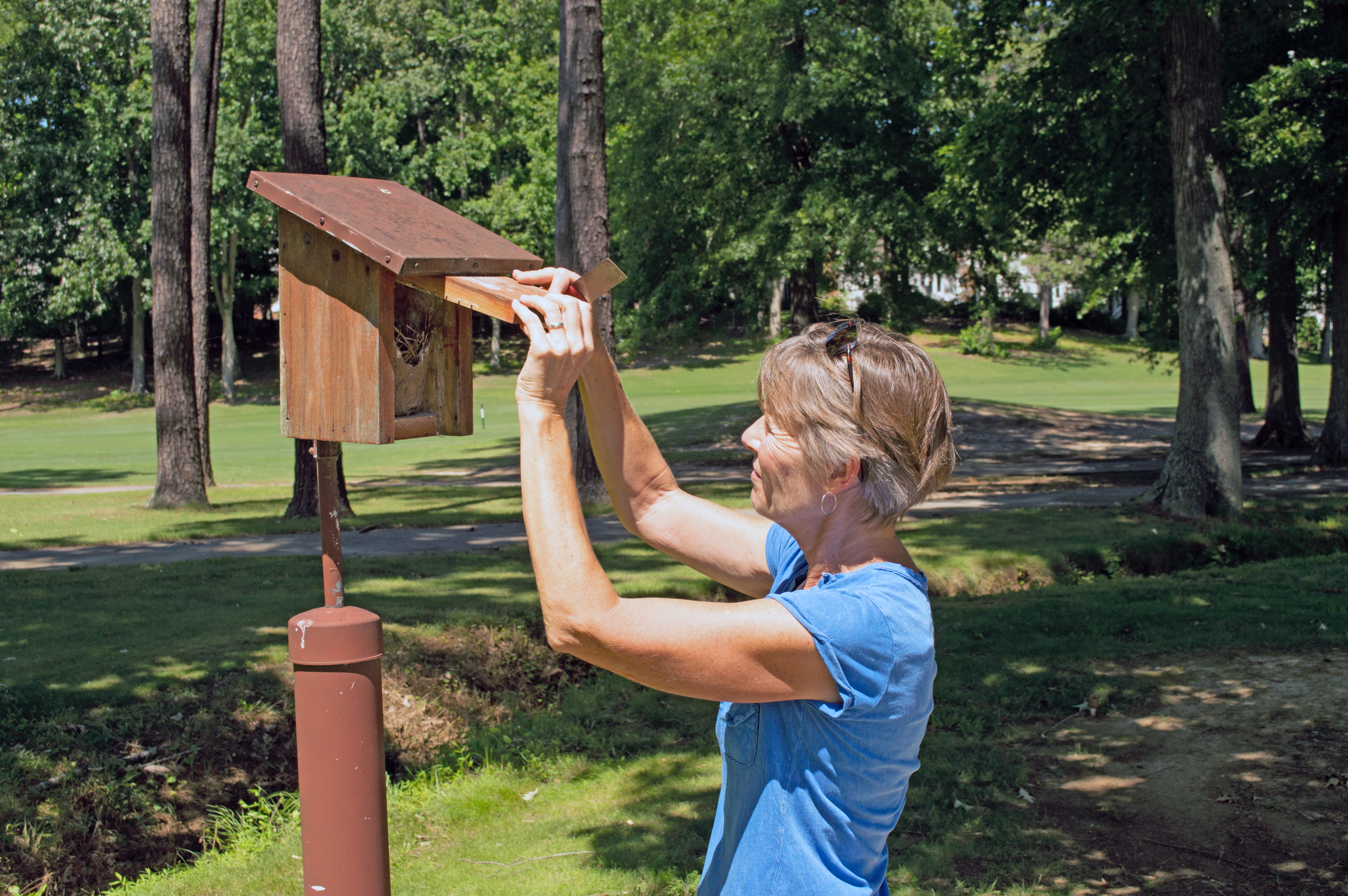
Earlier that day, Sally took me along when she monitored the bluebird houses at Lochmere Golf Club. She’d promised that there should be some new eggs and nestlings, and there were! We were pleased to see the new arrivals.
13 07 04_2570

Speaking of country clubs, the News & Observer reported this week that Carolina Country Club, Raleigh’s old line club, finally admitted its first black member. This was front page news, and I was glad to hear it. CCC maintained the color barrier for way too long. Now that the curse has been broken, I hope they will implement a policy of true non-discrimination going forward.

In my lifetime, we’ve made so much progress on the race issue, for which I am happy and grateful. For all my disappointments with President Obama, every day I feel proud and a little amazed that we have a black president. I can go for weeks or months without observing anything like the racial prejudice that was pervasive when I was a boy.

But we’re still not done. Republican measures to limit the voting power of blacks in NC and elsewhere by imposing ID requirements are moving forward. This is just shameful. With this movement in process, the Supreme Court was surely wrong in striking down part of the Voting Rights Act. There’s still a ways to go to build a color-blind society.
13 07 05_2414

Our North Carolina Republican legislators have gone on a right-wing tear this session. Some of their activities make sense from the point of view of bettering the lot of the wealthy or pandering to the ignorant, but some are inexplicable in ordinary moral or practical terms.

Does any rational person, no matter how selfish or cynical, think it makes sense to get more people carrying concealed firearms into more public spaces? Would a person with a shred of decency change the law to protect agriculture operations that abuse farm animals and criminalize the behavior of those who seek to expose the abuse? Would a normal caring parent or employer find it sane to reduce school funding and increase class size? Would any responsible leader or citizen turn down federal funds meant to help the unemployed or ailing? Does any moderately educated person school think that North Carolina has the right to establish its own state religion? In establishing the highest priorities, does anyone think Is outlawing Sharia law makes the top-thousand list?

And while we’re outlawing Sharia law, why not work in a slew of anti-abortion measures? This actually happened this week without fanfare and without the usual legislative formalities, presumably to minimize the chance of organized opposition. I’ve never found the abortion issue as easy as some of my friends, but the state Senate’s work this week under cover of darkness is really disturbing from a process point of view, and looks like a huge mistake. In the aftermath of this latest fiasco, my liberal friends were looking glum, and worrying at the damage this is doing both to the humans affected (such as women with unwanted pregnancies and poor people) and to the image of our state.
13 07 05_2401

This onslaught really doesn’t seem like the result of a theory of government. To the extent it has a direction, it seems aimed less at accomplishing any policy objective than at making liberals screaming mad. Once a liberal value gets identified, it is attacked with extreme prejudice.

To a certain extent, the NC right-wingers seem to be reproducing the values battles identified by national-level right-wingers. What else could be going on? I heard an NPR interview with Bill McKibben, an environmentalist and college professor, who said the problem with building a green movement was that a movement needed an enemy. In a sense, all of us are conflicted on environmental issues, since we all like cars and electricity. We can’t be our own enemy and still feel motivated to get into the streets. His solution was to declare the oil companies the enemy. This would, he thought, allow a green movement to cohere.
13 07 05_2480

So maybe that’s what our NC right-wingers are up to: building their group cohesion by identifying liberals as the enemy and trying to cut out their hearts (metaphorically speaking). It’s hard for a liberal to find a silver lining at the moment, but I’ll still take a swing. I don’t think this is the direction a majority of the state, or even a majority of Republicans, want to go. And by forcing minorities, low-income people, women, immigrants, and the reality-based community to see their common interest, the wing-nut legislators are increasing the chances that their “public service” will not last past the next election.
13 07 05_2466

In the meantime, President Obama has seized the initiative on climate change by ordering rules on power plant reductions for CO2 and other measures. Longtime readers of the Casual Blog will know that this is a big issue for me that I think should be a big issue for everyone. At issue are mass extinctions and dislocations on a scale previously unknown in human history. The significance is much greater than putting a man on the moon, and we ought to mobilize with a level of commitment on a scale comparable to the Apollo project. I hope this is the start.
13 07 05_2522

And while we’re on the subject of things to feel good about and continue working on, let us not forget, the long fight for gay rights has made real progress. The Supreme Court, a highly conservative institution (even if not all of its justices are conservative), struck down the Defense of Marriage Act! A majority recognized this as a human rights issue. It seems the tide has turned.
13 07 05_2538

Well, that’s it, I’m climbing off my soap box. I got out to Raulston Arboretum on Saturday and found a lot of bees hard at work. I took along my tripod and used a Nikkor 18-55 mm lens in aperture priority mode. Along with a variety of bees and flowers, I was struck by the sculptural qualities of some of the blooms. My favorites are above and below.
13 07 05_2396
13 07 05_2452

Hammering nails, my sweet cable repair robot, privacy concerns, and some flower pictures

13 06 21_2142
On Friday afternoon the Red Hat legal department in Raleigh worked on a Habitat for Humanity house in Apex. We met the owner to be, who sounded like he might have originally been from west Africa, and who said this was his dream house. I watched a group of colleagues get trained in installing windows, and then got drafted to do some work in the rafters, including repairing some mistakes of a previous crew.
13 06 21_2134

Hammering nails is not something I’m particularly good at, and I learned that this was even more true when standing on a ladder, reaching upward, and swinging within limited space. My wrist and arm got tired. But, though slow, I got quite a few nails well in, and avoided serious injury. I do not think the next crew will need to re-do them.
13 06 21_2133_edited-1

Speaking of repair work, I had an interesting experience on the frontiers of automation this week with my cable service, Time Warner. Our on-demand movie service didn’t work properly last week. When I called TW, my call was answered by an automated female voice of the sort that usually reads service options (press 2 for billing inquiries, etc.).

It (she) asked me to describe the problem. She then correctly paraphrased it, and said she’d be right back. Then she said that she’d checked and my cable box needed to be re-set. She said she would do that. She did it! This was the first fully automated repair encounter I’ve ever had, and it was excellent! When the automated repair entity told me I could hang up, I couldn’t help myself: I thanked her.
13 06 21_2205

On Saturday morning I got up with the plan of being at Raulston Arboretum when it opened at 8:00 a.m. to walk about and take some pictures with early light. I got slowed down by some interesting stories in the Times — market reactions to the Fed’s new strategy, dysfunctional courts in the Bronx, arms for Syrian rebels, protests in Brazil and Turkey, China’s and Russia’s economic policies. And particularly by the latest on Edward Snowden and the NSA surveillance program.

I’m still trying to figure out what I think about Snowden and the NSA data collectors. Clearly, it’s wrong to break your oath and betray your employer. Clearly, it’s wrong for the government to invade our privacy without due process. Clearly, it would be a mistake to acquiesce in terrorist plotting.

These conflicting imperatives make this a tough one. I tend to focus on the high risk of governmental abuse of power. Curiously, though, for some reason I’ve felt less fear and outrage over the data mining than I would have expected. I don’t think I’m alone on this. Possibly, as my colleague David said, we exhausted our outrage muscles over the Patriot Act, and the NSA intrusions are not such a big surprise.

We may have already passed an inflection point in the history of privacy. Most of us understand that Google, Facebook, Amazon, and others are using our data in ways we wouldn’t necessarily approve, but which don’t do any noticeable harm. Is the NSA program a bigger threat to civil liberties?

Well, the government is awesomely powerful, so the risk is plainly greater. But for most of us, the harm is abstract — an automated intrusion into our personal space that we never directly perceive. Will we eventually come to accept this diminution of private space as the new normal? Probably yes. Will that change our thinking and behavior? Probably yes.

A more immediate by-product of this affair is a new round of erosion of trust between government and the governed. Privacy’s cousin, honesty, has also been compromised. Can we ever be sure that any government explanation of the project is true?
13 06 21_2163

When I finally got to the arboretum, it was cloudy, but pleasantly mild, and many flowers were blooming. It smelled wonderful! I took many deep breaths. Wouldn’t it be nice if we could record those smells?

In the meantime, we’ve got digital photography, which is itself pretty amazing. I was looking for dramatic colors and shapes, and interesting textures. I was also thinking about the complex patterns that nature made, and others that the gardeners made, and others that only I could make on that particular morning with those particular blooms. I generally focused on the flowers that were at their resplendent peaks, but I also caught a few that were well into the process of dying, and beautiful in sadder way.
13 06 21_2170
13 06 21_2191
13 06 21_2154
13 06 21_2186
13 06 21_2179
13 06 21_2219
13 06 21_2156
13 06 21_2210
13 06 21_2217

Is it 1984, with the NSA as Big Brother, or will Watson come to the rescue? Plus notes on a birthday, an anniversary, a soccer game, and an opera documentary

13 06 09_1924_edited-1What to make of the federal government’s massive program for gathering telephone and social media data? My first reaction was fear and horror. Is 1984 finally here? Is the Fourth Amendment a quaint artifact of a bygone era? Of course, we don’t actually know very much about the program, which is still classified. Is it like Big Brother, or more like the airport security services of the TSA, which inconvenience millions and accomplishes little?

As for the TSA, no doubt it’s supposed to make us feel more secure about flying, but for me the predominant emotion is frustration, with additional notes of anger and humiliation when my property and person are touched by uniformed strangers. And we’re afraid that if we complain, we may get put on the do not fly list and subjected to even more frustration and humiliation. Dear NSA analyst, if you’re reading this, I swear I’m not going to cause any mayhem – please please don’t put me on the do not fly list.

I’m kidding, of course (no I’m not – I want to stay off that list). I seriously doubt humans look at more than an infinitesimal fraction of this data, which is sufficiently massive as to defy all hope of human comprehension. It may be that this is why the program continues to exist: it’s become so big and complicated that no one can understand it. The computer doing the heavy lifting has almost certainly surpassed its minders in the complex skills at the core of this program. So who can reasonably make a judgment as to whether it’s a useful or safe project. The computer?

I realize this sounds a bit science fictiony, but if it isn’t already true, it probably will be soon. Remember, IBM’s Watson didn’t just win at Jeopardy, he or it trounced the strongest human players to ever have played the game. The Times reported this morning that the NSA and CIA have been testing Watson for intelligence purposes the last couple of years. He’s already way better at quickly analyzing massive amounts of data than any human ever will be, and he’s likely getting smarter and smarter.

In some ways this is comforting. I greatly doubt that Watson or his peers in artificial intelligence mean us any harm. Good AI is, at least so far, not complicated by the emotions that drive human behavior, including those that make us behave badly. Watson is not greedy, or prejudiced, or power mad. Once he gets this security thing well in hand, maybe he can take on more governmental responsibility. Could this be the way out of partisan gridlock? Watson for president?

Speaking of technological transformations, I recommend an essay in today’s NY Times by Jaron Lanier called Fixing the Digital Economy. Lanier is wrestling with an issue I’ve also written about: what happens to the economy (i.e. us) as human labor is increasingly replaced by robots and AI? He suggests that the source of both increasing decentralization of power and increasing disparities in wealth is computing power, and that the most powerful players are the ones with the most server power. I think he’s wrong to emphasize giant computers as primary sources of wealth, but he’s thrown out some provocative ideas. Here’s one: let’s revamp the economy so that those who take your digital data pay you for it. We could set up market in which Google, Facebook, the NSA and other data miners send out quarterly checks to all of us who provide the data.

Speaking of data and devices, Sally had a birthday this week, and I got her an iPad mini. She was thrilled! I got it at the Apple store at the Crabtree Valley Mall, which as usual was packed, and where I had a completely satisfactory buying experience. My salesman was knowledgeable and funny in a dry way. There are things to dislike about Apple as an organization, but they are really good at customer service. And their devices are designed with emphasis on a pleasant, intuitive human-machine interface, so non-specialists can enjoy them.

We also had our 31st anniversary this week, and celebrated with a fancy dinner at St. Jacques. The restaurant sits in a common strip mall, but inside it manages to convey the joie de vivre of fine French cuisine. I love that they have a special vegetarian menu. It took a little too long to get a visit from the sommelier, but eventually he gave us his full attention. A true and expressive Frenchman, he dissuaded us from getting the chardonnay that we additionally asked about, and with a dramatic explanation of the food flavors and wine flavors at issue persuaded us to try a sauvignon blanc. It worked beautifully. We savored every bite and sip.
13 06 08_1940

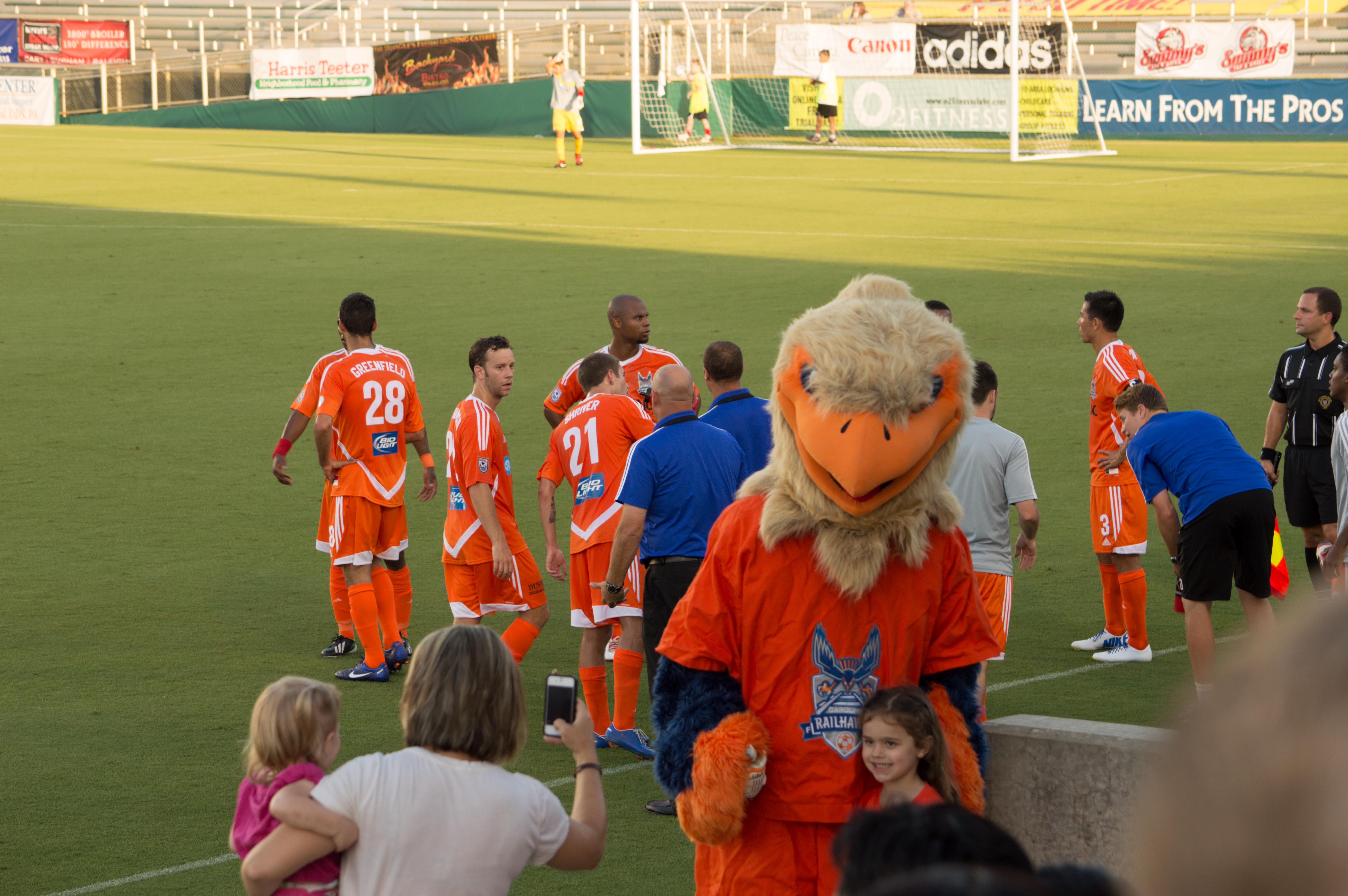
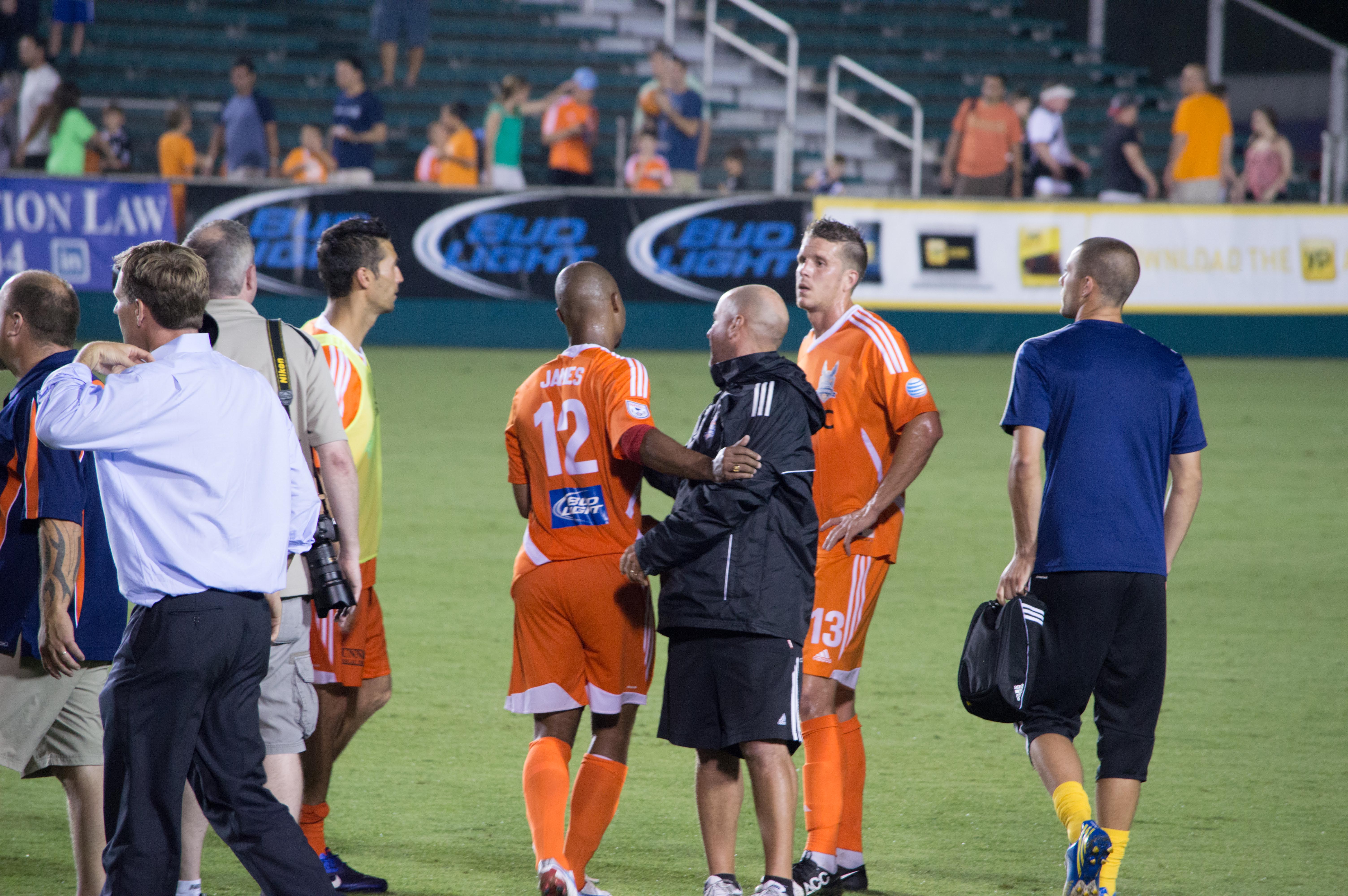
On Saturday night we went out to Cary to see a soccer game – the Carolina Railhawks played the Tampa Bay Rowdies. It was a clear, mild evening. We took along a couple of veggie subs at Jersey Mike’s, because last year we’d learned there wasn’t much in the way of healthful nourishment at the soccer stadium. But we were pleased to see they had improved their beer selection since last year. The field looked green and immaculate. We had good seats near centerfield on row G, and had a pleasant picnic there.
13 06 08_1967

The teams came into the game tied for the lead in the league and seemed well matched. I thought the Railhawks seemed sharper and less thuggish than last year. There were moments of skill and excitement, but no scoring until the 87th minute, when Tampa Bay took advantage of a defensive let down to put in a goal. When time expired there was an additional four minutes. During that time, the Railhawks proceeded to score, and then score again. We won!
13 06 08_1953

One of the Railhawks, Brian Ackley, is an old friend of Jocelyn’s going all the way back to middle school. We’d texted Jocelyn that we were going to the game, who’d texted Brian, and so he was prepared when we hailed him after the game and had a word. He’d played the last part of the game and had almost scored on a header. He’s a fine athlete and warm human being, and it was nice to see him.

Brian victorious (the Railhawk on the right)

Brian victorious (the Railhawk on the right)

When we got home, we watched a fine short documentary on HBO On Demand about Renee Fleming doing a master class for four aspiring young opera singers. The basic format, as with all master classes, is for a student to perform in front of other students and the master, and then receive criticism from the master. Here the students were all thrilled to have the opportunity to sing for Fleming, who is unquestionably one of our greatest singers. She was warm, generous, and a great listener. She gave some very specific advice on producing good vocal sounds, and spoke frankly about things like pre-concert nervousness. She gives a window into how difficult it is to be a great singer, but at the same time how wonderful.

More eye surgery, healthy habits, a gay marriage revelation, a new veggie restaurant, and the shame of the processed food industry

This week I had eye surgery to repair the effects of scar tissue from my previous eye surgery, with the understanding that there would probably be more surgery needed in future. And so in the space of a few weeks I’ve gone from an adult in remarkably good health with no history of hospitalization to a fairly experienced consumer of modern American medicine. There are, of course, some negatives, such as worry, fear, and pain, but I’m trying to stay positive. It’s a learning experience.

Most of my healthcare team at the Duke Eye Center, including nurses, orderlies, anesthesiologists, and doctors were surprisingly cheerful and supportive. The anesthesia was designed to keep me partially conscious, which it did, and so I was able to listen to the conversations of the team and the music they listened to (vintage rock, unfortunately). I was instructed to let them know if things hurt, and I did speak up a couple of times when it got fairly intense.

The operation involved removing scar tissue from my left retina and eye wall and reattaching the retina to the wall. It was an extremely delicate procedure and took about three hours. When Dr. Mruthyunjaya checked me the next day, he was pleased with the initial results, but noted that it would be some months before we’ll know how much vision I’ll have with that eye. At some point I’ll need cataract surgery as well. But that day I was able to see the top couple of lines of the eye chart, which was an enormous improvement from last check, when I couldn’t make out any letters at all.

Healthy Habits

I was banned from all strenuous exercise for at least a couple of weeks and possibly more. I’m not sure Dr. Mruthyunjaya appreciated that this was a fairly harsh sentence for a person like me, with a big exercise habit. Getting to the gym or other physical activity most every morning is something I just do. It makes me feel better for the rest of the day and is part of the long-term plan of staying healthy and happy. But I don’t think about the pluses and minuses at 5:15 a.m., which would be way too much work. It’s taken a long time to get to the point where exercise is almost automatic, and does not feel like dreary work. I don’t want to lose the habit.

With this partly in view, I decided to recommence my computer programming studies during the newly freed up early morning. I signed up with Codeacademy for their free online Python course. It should keep me in the habit of getting up early. So far, it’s been interesting and mostly fun, though also frustrating at occasional junctures when I get stuck. I’m thinking of it as a lot like learning Spanish: an exercise that at a minumum serves to stimulate the brain in a healthy way, and could turn into a skill that could come in handy.

Gay Marriage Switcheroo

Speaking of brains, in the news this week was a report that Senator Rob Portman, a Republican, had decided to switch from an opponent to a backer of gay marriage. His reason? His son came out as gay. I had two reactions to this:

1. good
and
2. you’ve got to be kidding me!

As to 1, I’m happy that Senator Portman has seen the light, and come to view gay people as entitled to the same civil rights as everyone else. But as to 2, coming to this view really shouldn’t depend on having a gay child!

All of us place special weight on the welfare of our loved ones, but that isn’t a very reliable starting place for broader moral reasoning or policy making. Otherwise, those with healthy families would have no concern for the less abled, and those in a majority race would ignore the rights of minorities. This would be a morality with severe myopia. I wonder how much conservative family values blather is accounted for by such myopia.

I don’t mean to be too hard on Senator Portman, who must surely possess more-than-usual courage to take issue with the conventional and rabid views of his party. We could all benefit from exercising our empathy muscles. Here’s a suggestion: what if we all spent five minutes a day imagining that a specific human in a group we generally dislike is our dearly beloved child? Our imaginations could extend the diameter of our circle of caring and feeling. This would be a good thing. I’ll go first, and try to think loving thoughts about a rightwing fringe Republican.

Trying a New Vegetarian Restaurant

Last night Sally and I tried Fiction Kitchen, Raleigh’s new vegetarian restaurant on Dawson Street. It was full when we got there, with a wait time of 45 minutes, which would exceed our usual supply of patience, but we found a place to stand near the bar and had some Chardonnay. The vibe was hip-funky, similar to Poole’s, but with a younger, edgier crowd — think tatoos, grad students, gays and lesbians, interracial couples, and even a few babies. Oh, and one middle-aged guy with a strangely red left eye swollen half-shut. The place hummed with the sound of many conversations.

The food was creative, with an emphasis on local seasonal ingredients. For appetizers, we had the wintery spring rolls with spicy peanut sauce and seasonal fritters, which had NC apples, spices, and bourbon-agave. We split two entrees, the sweet potato sushi rolls with sashimi tofu and braised tempeh with pesto grits. Every bite was tasty.

Shameful Goings on in the Processed Food Industry

It was really cheering to see a new vegetarian business in Raleigh doing so well. As regular readers know, I’m a big proponent of healthy, ethical eating, which is another habit that’s good for humans, and also fun. But there are powerful forces promoting unhealthy food. For evidence, see an op ed piece in today’s NY Times, by Michael Mudd, a former honcho with Kraft Foods, titled How to Force Ethics on the Food Industry.

As a former insider, Mudd seems credible when he characterizes the business of large food processors as “enticing people to consume more and more high-margin, low-nutrition branded products.” He describes how “relentless efforts were made to increase the number of ‘eating occasions’ people indulged in and the amount of food they consumed at each.”

According to Mudd, “Even as awareness grew of the health consequences of obesity, the industry continued to emphasize cheap and often unhealthful ingredients that maximized taste, shelf life and profits. More egregious, it aggressively promoted larger portion sizes, one of the few ways left to increase overall consumption in an otherwise slow-growth market.”

Mudd also describes the food industry’s clever PR efforts to deflect attention and regulation, such as attributing the obesity epidemic to other factors. There are, of course, multiple factors, but none with the same despicable level of conscious intent. At the same time, they contend they are giving the victims “what they want.” These wants, of course, are the product of advertising and food engineering. (There was a very interesting piece in the Times magazine by Michael Moss a couple of weeks ago on the dark art of synthesizing junk foods that are almost irresistible.)

For solutions, Mudd proposes federal and state taxes on sugared beverages and snacks that undermine health, which would generate funds for education programs and subsidize healthy foods for low-income people. He also recommends mandatory federal guidelines for marketing foods to children and better food labeling. This makes sense.