The Casual Blog

Category: public policy

The neverending war against terrorism: some questions

14 09 27_2794_edited-1

Having learned this week that our leaders have committed our military once again to fighting in the Middle East with Islamic fundamentalists that have not attacked our country and so far as is known do not immediately threaten to do so, I’m deeply disturbed. I admit that I have no particular Middle Eastern or military expertise, which, you may say, is a good enough reason to sit down and shut up. And I would agree it is a good enough reason for a bit of humility and for avoiding categorical pronouncements. But I would be remiss if I did not tell you, I have a few questions. They are as follows, colon.

Is it possible that we’ve overestimated the threat of terrorism and terrorists? Could the shocking violence of a few psychotic fanatics have caused us to be overcome with panic and fear, and to temporarily (at least) lose a good part of our capacity for reasoning and sound judgment?

Have we thoroughly considered what it means to send our sons and daughters to kill other human beings without firm evidence that they are mortal threats to us? Are we prepared for the deaths of more of our children, and the permanent physical and mental injury of many others, for objectives that are far from clear?

As for our latest enemies, can we conceive of the anger, despair, and vengefulness of those who survive attacks from our powerful weapons and have seen their families and comrades blown to pieces? Would we knowingly choose to perpetuate a cycle of blood oaths and revenge with no apparent end?

If we thought that yet another Middle Eastern war was ill-considered and likely to yield only further death, destruction and enormous waste of resources, could we stay silent? Have we really lost all hope that our political institutions allow for thoughtful debate and weighing of costs and benefits? If we started articulating to ourselves, and each other, our questions, and demanded that our leaders provide answers supported by evidence and reason, could we change course?
14 09 07_2445_edited-1

A new crane, a wrongful execution avoided, and factoring in dissonance

14 09 17_2621_edited-1I like watching work at construction sites, and I particularly like cranes. They denote strength and optimism. So it was a particular treat this week to get a close view of some hardworking guys putting up a big crane on a building site one block up from, and almost level with, our apartment. It took two guys about a day a a half to put up the structure, and a group of five worked on the cabling for another day and a half.
14 09 17_2633_edited-1

Exoneration

There are lots of good arguments against the death penalty, including that it doesn’t deter crime, it costs way too much, and it conflicts with the fundamental moral rule against killing. Recently I was powerfully reminded of another one: our criminal justice system inevitably gets some cases wrong and convicts innocent people.

It was front page national and local news recently that Henry Lee McCollum was found innocent after 31 years on death row. As a younger attorney, I volunteered to represent McCollum in one of his appeals (to the N.C. Supreme Court). He’d been convicted – found guilty beyond a reasonable doubt by a unanimous jury – of a horrible crime – a particularly gruesome rape and murder of a 13-year-old girl. After I’d spent many hours studying the record and the elaborate constitutional doctrines surrounding the death penalty, I pulled together a lengthy brief of what I thought were the best arguments for not executing him.

In my brief, I did not mention the possibility of innocence. Truly, despite McCollum’s innocence claims, I never seriously considered the possibility. He’d made an elaborate, detailed, signed confession. Why would anyone confess to a crime they didn’t commit?

Of course, we know now that this is all too possible. Coerced confessions happen. The case of the Central Park five, young men convicted of a brutal rape of a young woman jogging in the park back in the 80s, is a dramatic example. Just this month New York City agreed to a settlement of $41 million to compensate the young men for their wrongful conviction and imprisonment.

McCollum was and is a mentally disabled person (IQ of around 60, as I recall), and when I met him, in the visiting room at Central Prison, he seem gentle and soft spoken. He was still a teenager at the time of the crime. It’s not hard to imagine that he could be coerced into doing something contrary to his interests. Apparently after the interrogation and confession were complete, he asked, Can I go home now?
14 09 17_2652_edited-1

I’d thought about him from time to time over the years, and figured he would probably escape execution because of later developing Eighth Amendment (“cruel and unusual punishment”) law barring execution of the severely mentally disabled. It was cheering to hear that a team from the Center for Death Penalty Litigation had worked diligently on his behalf. But it’s also horrible to think of the injustice our state (that is, us) inflicted. Putting a man on death row for 31 years is, in a very real sense, robbing him of his life.

We now know that eye witness identifications are far from completely reliable. Confessions are not always reliable. Memories can seem absolutely certain, and still be wrong. We are inevitably going to make some mistakes in on the basic question of guilt or innocence. This argues strongly against punishing people with death.

Mistakes Were Made

The more I learn about how error-prone our thinking processes are, the more I think we should be a little more humble about the power of our brains and the reliability of our notions. I’m re-reading Mistakes Were Made (But Not by Me), by Carol Tavris and Elliott Aronson. Tavris and Aronson are social psychologists, and their book is a lively guide to the systemic flaws in our perceptions and theorizing. Their primary subject is cognitive dissonance, and the comedy and tragedy of self-justification that flow from it.
14 09 18_2687_edited-1

Dissonance occurs when we try to hold two conflicting ideas in our heads at once. It causes us discomfort, and we will perform remarkable mental gyrations to avoid it. Thus it is amazingly hard to talk someone out of strongly held beliefs. Dissonance makes us ignore and suppress facts and arguments that don’t fit with those beliefs. To avoid dissonance, we come up with justifications for our most egregious mistakes.

Tavris and Aronson convinced me that this is not something that happens only now and then, but rather is pervasive. One of their numerous examples is police coercion. The police “know” (strongly believe) that a suspect is guilty, and therefore feel justified in using extreme coercion to extract a confession. The innocent suspect is confronted with powerful dissonance – actual innocence and authority figures forcefully insisting on guilt. One path to eliminating dissonance is to confess. It isn’t that hard to imagine that a young or weak person could go that way.

They note that even scientists are vulnerable to this basic mechanism, but suggest that science itself can help us address our inborn tendency to avoid dissonance. The ability to allow for the possibility that we might be wrong is incredibly valuable. It can keep us from making terrible mistakes.
14 09 18_2668

My hopeful hand checkup, a new salad restaurant, a Porsche contretemps, and discussing legalization

14 08 03_1352I was a bit anxious about my check up for the torn ligament with the hand doctor earlier last week, but it turned out fine. After the doc twisting my fingers a bit and asked if it hurt (it did), he pronounced me improved, and lowered the chance of needing surgery to 5 percent (a big improvement from his previous estimate of 50 percent). He cleared me to play the piano gently (no Rachmaninoff, he said), but to otherwise keep my fingers taped up for another month. I asked about getting back to golf, and he strongly advised me to wait. This was disappointing, as I’d felt like this could be my year for a big golf breakthrough (as, admittedly, I’ve felt in previous years). Still, I I was pleased to be heading in the right direction.

Playing the piano again was a rich, dense, textured pleasure. Going a month without playing is something that I hadn’t done for at least 30 years, and I missed it. I started gently with some Chopin mazurkas, and then some nocturnes. I couldn’t resist trying some Rachmaninoff – the Elegie, op. 3. It was all a bit rough, but I felt I was listening better, hearing more nuance, and playing with more rhythmic freedom. Perhaps the forced time off did my ears some good.

14 08 03_1277The next day I discovered Happy and Hale, a relatively new take-out restaurant on Fayetteville Street a couple of blocks from my office. It serves only three things: salads, smoothies, and juices. All are not only super healthy, but also lively, interesting combinations of ingredients. My first experience was the quinoa salad, which had quinoa, black beans, avocado, cilantro, feta cheese, and a couple of other things, with red pepper vinagrette. It was amazingly tasty. There was a long line, but I found this more cheering than annoying. It was good to see people interesting in eating something healthy, and to see this little business doing well.

The next day, I took Clara to the Porsche dealer for servicing. Her check engine light had come on, but even before the that, I’d felt something wasn’t right. Giving her more throttle in the higher RPMs yielded more noise, but not more thrust. I suspected a transmission issue, which turned out to be correct. I needed a new clutch and new flywheel, and the cost was a big ouch.

Waiting for the parts to come in, I drove a loaner Ford Explorer (a sport ute). I just don’t get why people like this type of vehicle, at least when they don’t have a big group of kids or other heavy loads to haul. To me it was not fun to drive. After my sports car, It felt lumbering and awkward. I had the impression of barely having enough road, like a truck pulling a massive mobile home, needing a “wide load” sign to warn other vehicles.

But I admit that I liked the instrumentation. It had a touch screen set up for the climate control, radio, blue tooth, etc., and a handsome virtual compass. In reverse, the touch screen showed the view behind, with the danger zone outlined in red. It had some sort of RFD key that allowed the vehicle to unlock when I pulled the handle without the need for any use of the key. A nice convenience.
14 08 03_1253
Reading the New York Times is a settled part of my morning breakfast ritual, and there is a sense in which I always enjoy it. But golly, the news has been grim! Part of it is structural: in conventional journalistic thought, information usually only qualifies as news if it involves dramatic conflict. So we don’t hear anything about the peaceful countries in, say, Africa. But the lead stories recently inspire a special mixture of horror and hopelessness, because they’re big and absolutely beyond any individual control. Examples: Syria, Iraq, Afghanistan, Russia, Ukraine, Israel, Gaza, Nigeria, Washington.
14 08 03_1242
This week, though, there was a welcome exception. I was pleased to see the Times came out in favor of partially ending the war and drugs and legalizing marijuana. The editorial board had clearly had thought hard about it, and put some elbow grease into collecting the arguments: including the enormous human cost, the huge economic cost, and the relatively low risk. It felt like a watershed moment. Maybe now it will be possible that we can have a debate based more on facts and less on myth, moralism, and hysteria. I don’t think marijuana is a particularly good thing; for some people it’s surely an unhealthy thing. But criminalizing it has been an absolutely terrible thing.

So we might be close to overcoming this particular moral hysteria and to ending of prohibition. Perhaps some of our other seemingly intractable problems aren’t beyond all hope.
14 08 03_1250_edited-1

Fireworks, wildlife, and Carl Hart’s book debunking drug myths

14 07 04_0378_edited-1-1
Fourth of July fireworks are hard not to like. As a friend once observed of sex, even when it’s not particularly well done, it’s magnificent. On Friday we were planning to walk a few blocks to see the one of the two downtown Raleigh fireworks shows, but Sally was not feeling well, so we got some takeout Indian food from Blue Mango and watched from our twelfth-floor balcony.
14 07 04_0402_edited-1

That afternoon I’d Googled how to take good fireworks photos, which is a bit involved (use a tripod, remote control, bulb setting, manual focus, etc.), but I found it interesting. I got a few images I liked of the display at Red Hat Amphitheater. I could also see parts of the display at Memorial Auditorium, which appeared to be more magnificent, but this could be the grass-is-greener effect.
14 07 04_0404_edited-1-1

I continued exploring local parks, looking for dragonflies and other wildlife, this time stopping at Shelley Lake. There were lots of mallards and geese, but the one below, by herself, got my attention. I also stopped in at Raulston Arboretum on Sunday morning and focused on some little creatures communing with the flowers.
14 07 05_0538_edited-1

On Saturday I finished reading an unusual and worthwhile book: High Price: A Neuroscientist’s Journey of Self Discovery That Challenges Everything You Know About Drugs and Society, by Carl Hart. Hart is a professor at Columbia University who’s devoted his scholarly career to studying the effects of illegal drugs on the brain. His book is an autobiography of growing up poor and black in south Florida, and somehow not getting shot, becoming a dropout, becoming a hardened criminal, becoming an addict, or going to jail (which were common outcomes of his friends and family), and instead somehow getting an education, becoming a respected scientist, and learning to question his own assumptions. It’s remarkably honest.

I was particularly interested in his take on the war on drugs. As I’ve noted before, I view the drug prohibition regime as a terrible social policy from every perspective. Hart focuses particularly on the costs to the black community, with draconian laws resulting in mass long-term imprisonment and destruction of the social fabric. He combines an overview of the human toll with his own drug experiences.
14 07 06_0462_edited-1

Like almost all of us, he initially accepted uncritically the media/government claims that crack cocaine was a menace that threatened to make addicts of everyone who tried it and turn them into zombies who cared for nothing but the next high. He gradually realized, based on his own experience and his research, that this was a wild distortion of reality. Crack cocaine is chemically almost identical to cocaine, and the effects on the body are basically the same. The primary difference is social: crack cocaine is cheaper and marketed more to black communities, while cocaine is an expression of wealth and status. And crack prison sentences are much more severe.

This has become almost common knowledge, and the sentencing disparities have been substantially reduced (but not eliminated, unfortunately). For me, Hart’s account highlights how media and politics can create a moral panic, and even otherwise responsible scientists can get swept along. Thus the famous example of the experimental rats that can’t resist crack, which supposedly proved that crack was uniquely addictive. Hart explains that the rats, which are social creatures, were unhinged by isolation, and had no alternative activities to getting drugs.
14 07 06_0514_edited-1
Hart did experiments with human subjects who were in fact crack addicts, and offered them a choice of getting high or getting $5. They took the money frequently enough to disprove the idea that addicts cease caring about anything but drugs.

Hart contends that the problem of drugs in poor communities is complex, and viewing drugs as the primary source of social ills is mistaken. The kinds of social problems that he grew up with – domestic violence, petty crime, an extreme culture of honor magnifying violence, teenage pregnancy, and unemployment – preceded the arrival of crack. The central problem of poor communities is poverty. It’s not surprising that people with few other entertainment options are more prone to entertaining themselves with drugs.

Hart finds that the great majority of people who use drugs, including crack and heroin, are in no sense addicted. Most users have jobs, families, and orderly lives. The notion that addiction always results from exposure is simply false. This doesn’t mean that addiction never happens, or that it is not a serious medical and social problem. There are addicts who need help. But we need to get our facts straight, quit moralizing, and quit punishing people for addiction.

The war on drugs is a fascinating case study of how fantastically wrong ideas with horrendous consequences can propagate and take over entire societies. We tend to think of this happening in the distant past (think of witchcraft) or foreign lands (murderous religious extremists). But it happened to us! With all our wealth, education, science, and technology, we were still overpowered by groupthink that stopped critical thought. And while we may be winding down the war on drugs, it is definitely not over.

Thus it took courage for Hart to write this book. With an entire population raised on constant messages of moral panic, to challenge the basic foundations of the war on drugs is risky. You will be viewed by many as dangerous and immoral, which could be career-limiting.

But this book may help shift the debate. I was a little disappointed that Hart didn’t follow his sound reasoning all the way on the question of legalization, and ended up promoting instead decriminalization. As the Economist has repeatedly pointed out, decriminalization leaves the drug markets in the hands of criminals, whereas legalization with careful regulation would deprive criminals of a major source of revenue. But never mind. I’m grateful for Hart’s book.
14 07 06_0483_edited-1
14 07 06_0485_edited-1

Some new bug pics, a new smartphone friend, and more on robotization

14 06 07_9828_edited-1
This week I had a bit of a photography breakthrough. The books I’ve been reading advised against it, but I decided to experiment with the high-end ISO settings of my Nikon D71000.
14 06 07_9859_edited-1

Even at levels up to 5,000, I could not detect degradation in the image quality. This made it possible to use much smaller apertures with my 105 mm macro lens to get improved depth of field, while keeping shutter speeds high enough to capture some quickly moving insects. Here are a few of the images I got at Raulston Arboretum on Saturday morning. Thank you, brilliant sensor engineers of Nikon. Your technology is amazing and liberating.

14 06 07_9747

I got a Samsung Galaxy S5 smartphone this week, and I’m a little in love. It’s a marvelous device in most every way. The screen is a little larger than the S3 and a lot larger than the iPhone, but still fits in pants pockets. The screen is brighter and more vivid than leading competitors. It responds to you quickly, and gets things done more reliably. The voice recognition technology is improving, and sometimes works great. It is water resistant. It has biometric (finger swipe) security. Battery life is longer, and the battery is replaceable. (I always carry a backup.) And needless to say, as an effective interface to the internet, it can help answer any question that has an answer.
14 06 07_9901

As with every new device, there are switching costs and learning curves, but for me they turned out to be minor. My existing apps switched over automatically as soon as I followed the new phone protocol. I then spent a chunk of last weekend going through my apps, deleting those I never used, getting resituated with services I used (including hunting down old passwords), and getting the rest into new folders.
14 06 07_9849_edited-1

I kept the S5’s new health app, which can monitor your heart rate and count steps and calories, and experimented with its phone, which is surprisingly good – not not as good as my Nikon D7100, but also way less bulky. It took a few tries, but I eventually got my personal photos of roses and lilies on as wallpaper, found new ringtones that I kind of liked, got a pretty and practical new font. I put it in a handsome blue rubber case to protect against the inevitable jars, jolts, and plops. Even with the case, she’s amazingly thin and light.
14 06 07_9900

As I started to get to know her better, I noticed that the autofill feature of Swiftkey, which anticipates either the rest of a word I’m typing or the next word I was going to type, was getting more accurate. I’d type something like “Let’s” and up would pop “go.” Sure, that may seem obvious, but there were some that suggested a deeper understanding of my psyche, occasionally connecting words in a way that sounded like my own voice. This could be fun for a while, but it could also be heading towards a dark place. What if, when I typed I, it autofilled “worried that you might have taken my awkwardness for something more sinister, and resented it, when actually, I adore you.” And that was what I was starting to say? What if it allowed for the outsourcing not just of spelling and grammar, but actual feeling? Impossible? We shall see.

The effort, the struggle to communicate feeling in language is part of what I like about writing, and if that struggle were not so necessary our lives would be different, and possibly poorer. Could technology change the game on that? Of course.
14 06 07_9808_edited-1

Speaking of the transformative force of technology, this week I read the 2013 paper of Carl Frey and Michael Osborne out of Oxford on the continuing effects of computerization and roboticization. They draw on the work of Brynjolfsson and McAfee, which I’ve written about before, and add interesting historical and social context.

They find that 47% of American jobs are at risk of vanishing in the next decade or two as a result of increasing automation and artificial intelligence. That’s almost half! Jobs in manufacturing, transportation, logistics, office work, and administrative support are all at substantial risk, while jobs requiring creativity and social intelligence are less so. Big economic changes are coming, folks, just as big climate changes are coming, and we need to be preparing for both.
14 06 07_9780_edited-1
14 06 07_9782_edited-114 06 07_9784_edited-1

Warning: contains political content, and flowers

14 06 01_9706
There was a triathelon in Raleigh this morning, and the route included a road I was planning to take up to Raulston Arboretum to see the blossoms. So no go. I tried again in the late afternoon, and got to see the flowers in some wonderful golden sunlight. I’ve been learning to use the DSLR in manual mode without autofocus, and am just starting to feel comfortable taking full responsibility for the exposure. Most of these photos were taken with my Nikon 60 mm 1:2.8 macro lens. There was no postproduction Photoshopping of any sort. Pretty nice, huh?
14 05 25_9552

Being the President has got to be a pretty hard job. In addition to being hated with a white-hot hatred by many no matter what you do, your inner critic is also always there. You want to do the right thing, but what is the right thing? And when you’re reasonably sure you know the right thing, what if you can’t do it by yourself? Which of course is always the case.
14 06 01_9715

I really have many warm feelings for President Obama, and one of things that makes me proud of this country is that we elected him. But I’m so frustrated and disappointed with him. We’re still in Afghanistan, killing and being killed without any reasonably achievable objective, still brutalizing prisoners in Guantanamo, still imprisoning people and destroying families for victimless drug crimes, still running headlong toward climate apocalypse. We’ve instituted a surveillance state with the potential to rival Orwell’s darkest visions.

There are, no doubt, many forces quite separate from the President’s own desires that are driving these horrors and disasters. He probably regrets them. But like it or not, he’s the President, and that’s where the buck stops.
14 06 01_9720

The President’s speech at West Point this week proposed to reframe our global mission for the foreseeable future as stamping out terrorism. Is this less absurd than fighting to obliterate communism, or more? Is there any chance that we will ever kill every crazy fanatic that would like to do us harm? Does it really make sense to make this our mission?

So, you ask, have I got a better idea to address the real menace of the homicidal religious fanatics? I thought a bit, and had an idea: we change their minds. We get them to see things from our point of view. That would about do it, wouldn’t it? We help them to see that the idea of blowing up people as a suicide bomber and then being a martyr and having the 72 virgins in paradise is just nutty, and so they stop murdering people.
14 06 01_9709

You see the problem, of course: how do we change their minds? True, we do not currently have the technology to do this. We have amazingly little knowledge of why people think the way they do about the need for Sharia law, jihad, or most anything else. We assume it has to do with their culture and upbringing, with economic disadvantage and resentments, but we can’t frame those out with precision. More important, we have no precise knowledge of how to address and prevent really bad ideas, like racism or religious intolerance, or really bad acts, like suicide bombing.

Or anything else, for that matter. But what if we created a major program with some billions of dollars to figuring this out? And we’re already spending millions and millions to understand the brain and human behavior. If we treated it like the Apollo program, eventually we might get there. Instead of killing terrorists, and thereby creating new terrorists, we’d change their minds.
14 06 01_9728

This sounded like a good idea, but after a little more thinking, I realized it would probably be disastrous. If we replaced our vast ignorance of the causes of human behavior with perfect knowledge, we’d be even worse off.

Think about it. What if we figured out how to make everyone agree with us? What if our government, or any government, had the necessary tools to prevent opposing thoughts and eliminate all anger? Would that government happily tolerate reasonable people who advocate, say, a major change in abortion policy, or drug policy, or climate policy? Has there ever been a government that happily tolerated opposition? Once we got the terrorists minds under control, who would be next? Overly vocal dissidents?

Recovering, reading about B. Franklin, and addressing climate change

14 05 20_9462_edited-1
This week the weather in Raleigh was mild, and it was pleasant to walk to work. The walk takes 15-20 minutes, depending on how I catch the lights and whether I’m trying to get there for an early meeting. When I wasn’t especially pressed, I made a few pictures of people working and playing.
14 05 23_9501_edited-1

Now, after two weeks from our return from Dominica, my various wounds (assorted bruises, scrapes, and blisters) are mostly healed up. The most worrisome, my severely sprained right hand, is still swollen and sore, but hurting less, and I’m able to play octaves on the piano, though not loudly. It reminded me of when I first tried to learn to catch a football as a little kid, and jammed up my fingers.
14 05 20_9468

It is remarkable how the body can overcome and regenerate. In fact, did you ever notice how sometimes a new injury seems to help an old one to heal? My nagging shoulder issues, which I’ve been trying to get over for several months, seem to have gone away, cured or obscured by the addition of new, more pressing discomforts.
14 05 19_9472

It’s Memorial Day weekend, and we’re still full of memories of our friend Scott, who shuffled off this mortal coil right after leading our Dominica trip. He managed, by being an unusually vibrant and generous person, to hook himself into the fabric our lives, and his departure has ripped that fabric. We’ve been talking about him, his good deeds and his goofiness, and looking back at photos. For therapy and comfort, I’ve been rereading some of In Memoriam, Tennyson’s poetic memorial to his beloved friend Arthur Hallam. Yes, it rhymes, in a style that’s way out of fashion now, but it can still speak to us. It takes grief and loss seriously, and delves deep.
14 05 19_9470

As I’ve noted before, my favorite founding father is Benjamin Franklin. Last week I finished another biography of him, by H.W. Brands. Franklin was a protean genius with many aspects, and so the biographer will inevitably neglect some of them. Brands is most interested in the political and literary Franklin, and less in the scientist and philosopher. But in describing Franklin’s diplomatic efforts in England prior to the revolution and his diplomacy in France during it, he gave me new perspectives on the war. For those of us who cut our historical teeth on revisionism, it is reassuring that Franklin, who loved England dearly, could conclude that there was no alternative to war.

For all Franklin’s enormous fame during his lifetime, it’s interesting that there are significant gaps in the record, and much we don’t know about his inner life. But what keeps shining through is his insatiable curiosity about the natural world and his constant effort to make the human world better. It’s also inspiring to me, as I get on in years, that a good portion of his greatest achievements, including helping invent and establish American democracy, were in the last quarter of his long life.
14 05 17_9378

Apropos of making things better, there’s a good short op ed piece on climate change by Tom Friedman in the NY Times, which poses a question I’ve been wondering about: “How do we do something about [global warming] at the scale required, when many remain skeptical or preoccupied with the demands of daily life[?] He also quickly hones in on the central moral and political quandary – the conflict between the welfare of this generation and future generations: “our ethical values point one way, towards intergenerational responsibility, but our political system points another, towards the short-term horizon of the next generation.” (Quoting Thomas Wells, a Dutch philosopher.) Friedman argues for urgent change, including a carbon tax and energy efficiency standards. This seems sensible, at least as a starting place.
14 05 25_9560

On Sunday I took a walk through Raulston Arboretum, which I try to do once a week, but missed recently. I completely missed the irises — they’d come and gone while I was traveling. But the roses are in full bloom, and there are some remarkable lilies.
14 05 25_9563
14 05 25_957414 05 25_9553

Coral Reef Diving and Hiking in Dominica, West Indies

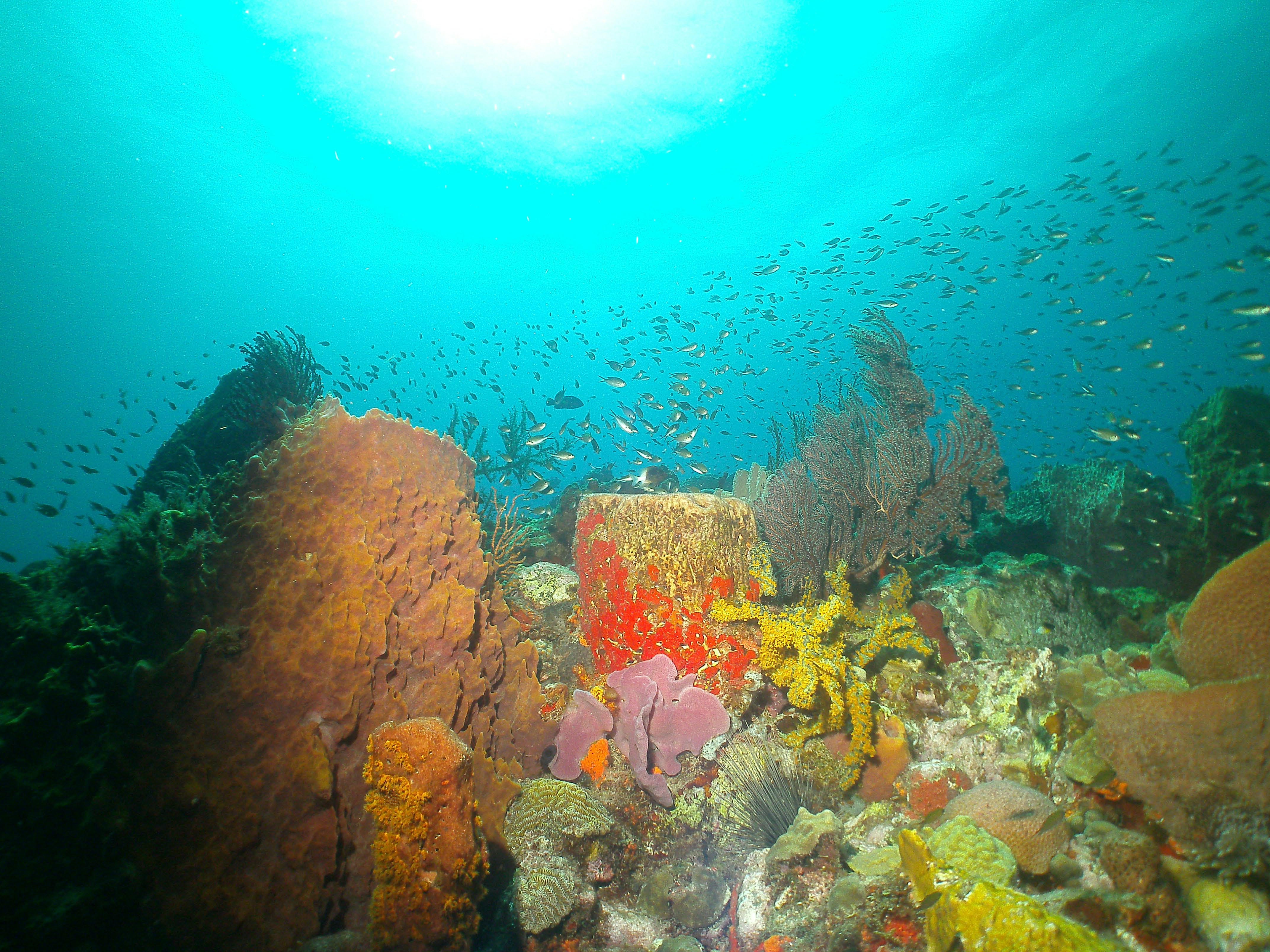
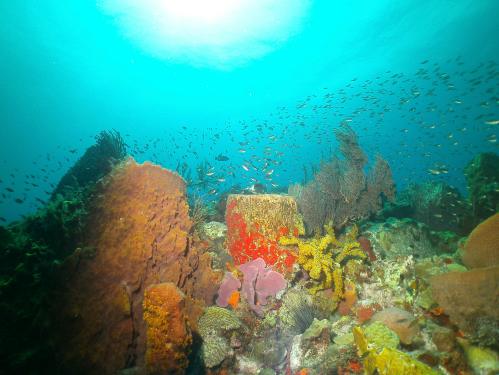
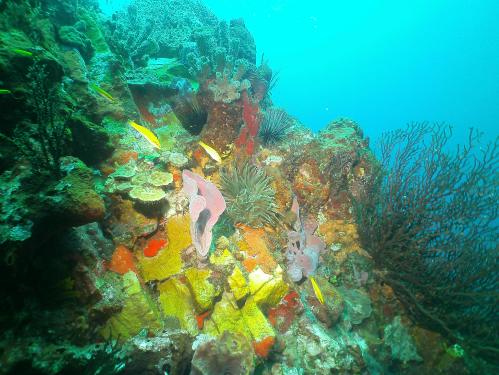
14 05 07_8847Coral reefs are one of nature’s most amazing creations. Untold millions of miniscule animals form structures of wildly varying forms, textures, and colors, and extend them widely over thousands of years. Some of the structures resemble terrestrial plants or animals, but others look like modernist architecture, surpassing the most fanciful creations of Gaudi. They are home to 25 percent of the ocean’s creatures, and a fundamental part of the planet’s infrastructure.
14 05 07_8851

As a diver, I relish the incredible privilege of time with strange and beautiful coral. I’m also acutely aware of their perilous situation, and the urgent need for action. Global warming and ocean acidification are killing coral reefs, and the consequences for all life that relies on the ocean may be catastrophic. I was slightly cheered to see the UN and US reports in the last few weeks highlighting these threats. Perhaps reality is sinking in, and perhaps it is not too late. I have my doubts, but I try to err on the side of optimism.
14 05 07_8870_edited-1

In any case, for the time being, there is awesome beauty to contemplate and celebrate. And so last week Sally and I made our first visit to the Caribbean Island of Dominica. I learned the correct pronunciation (doe-me-NEE-ka), and the location – part of the Lesser Antilles, to the south of Antigua and north of Saint Lucia. The terrain is mountainous, with peaks up to 4,747 feet, and much of it is covered with lush tropical rainforest. It is exceptionally beautiful.
14 05 07_8907

We stayed in the town of Roseau at a friendly, diver-oriented place called the Castle Comfort Lodge, and did our diving with Dive Dominica. The dive sites we did were mostly 20-30 minutes away by boat to the southern part of the island. Most days we did two dives in the morning and a land adventure in the afternoon, and twice we went out with the DD boat on night dives.
14 05 07_8905_edited-1

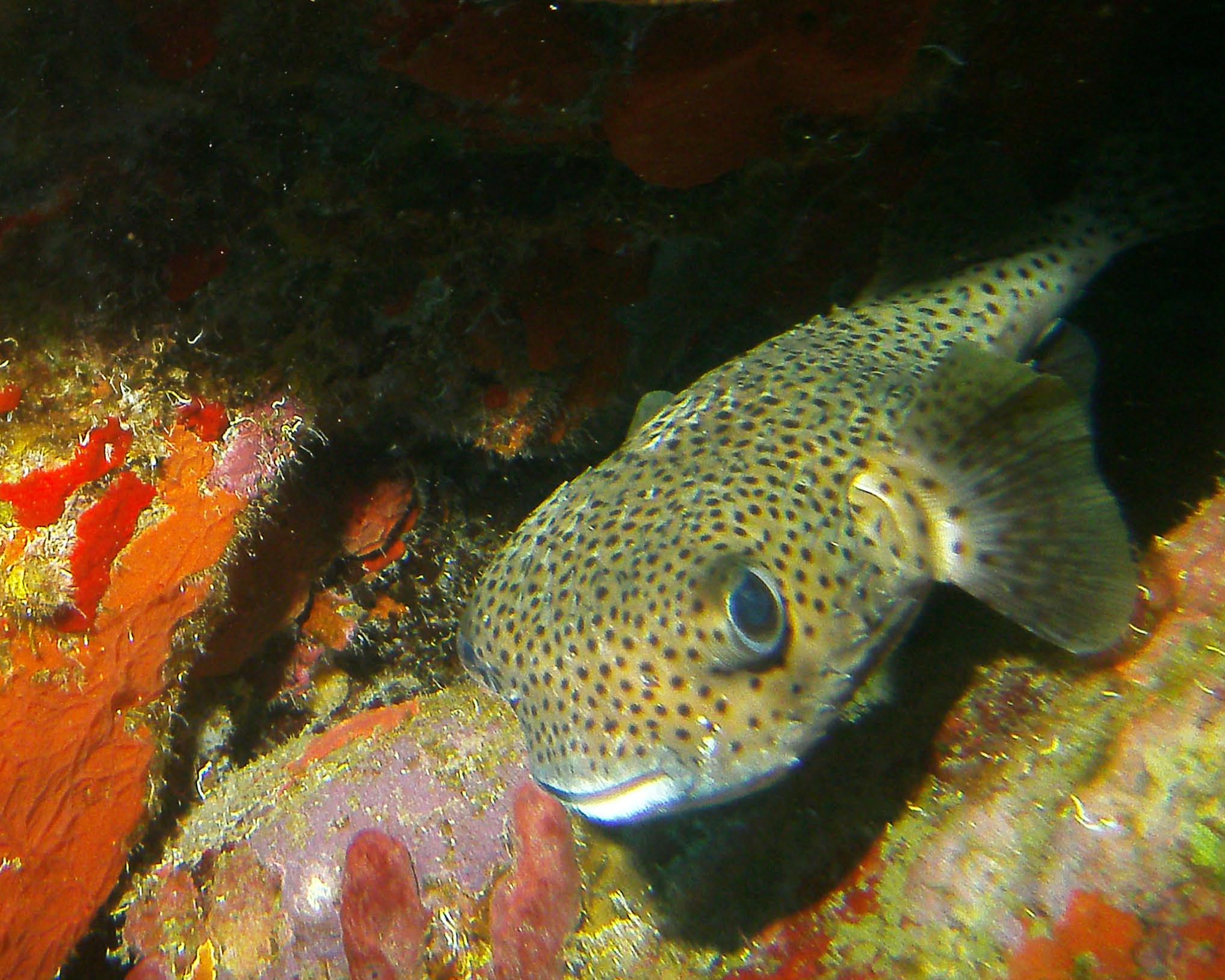
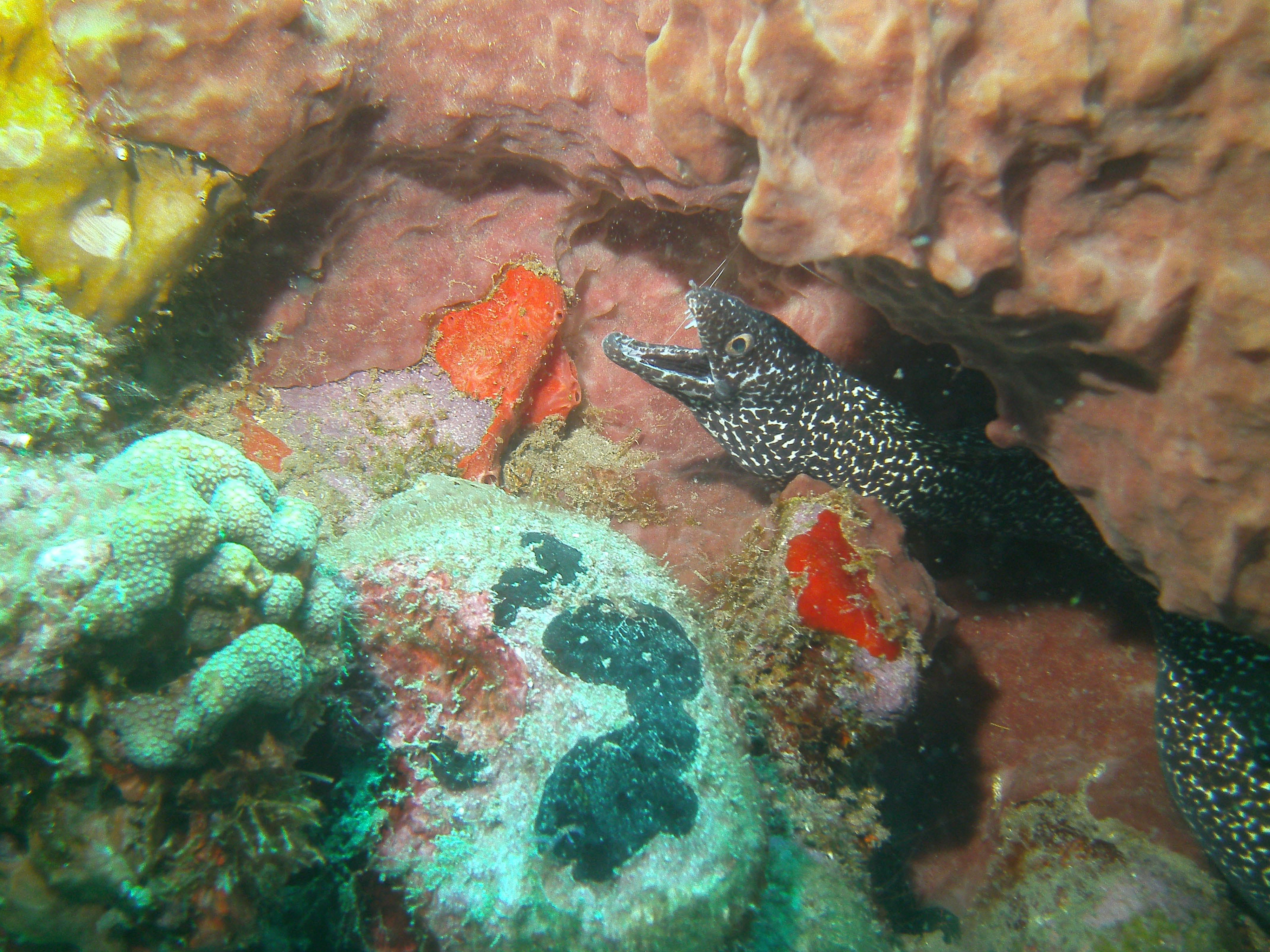
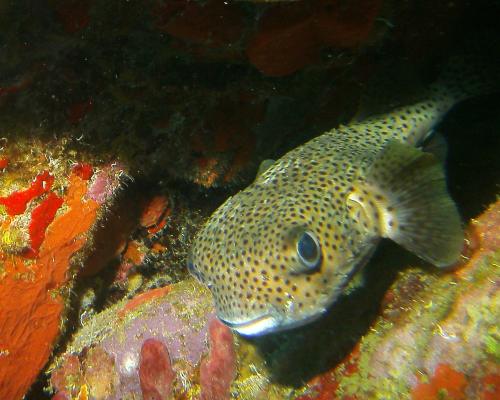
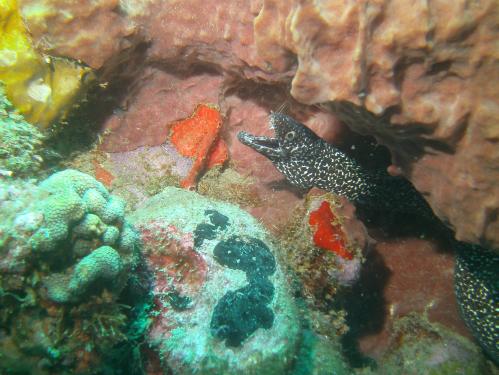
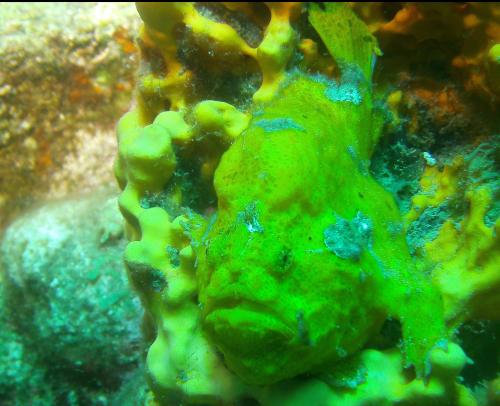
The water was a mild 81 degrees F, with visibility of 50-60 feet and little current. The coral seemed fairly healthy, with little bleaching, and lots of variety in shape, texture, and color. There were lots of tube sponges and crinoids, and some anemones. The most interesting new fish to us was the frog fish, a remarkably well-camouflaged and strange creature. Other highlights were scorpion fish, snake eels, electric eels, sea horses, balloon fish, trumpet fish and squid. There were many small colorful tropicals (such as butterflyfish, damsel fish, goat fish, and squirrel fish). However, I missed my beloved queen angelfish, and there were relatively few larger fish (such as groupers and barracuda), which was mildly disappointing. We saw only one shark all week (a sleeping nurse) and only a few hawksbill turtles. On the other hand, we saw quite a few large lobsters, large crabs, and small shrimp.
14 05 04_9285_edited-1

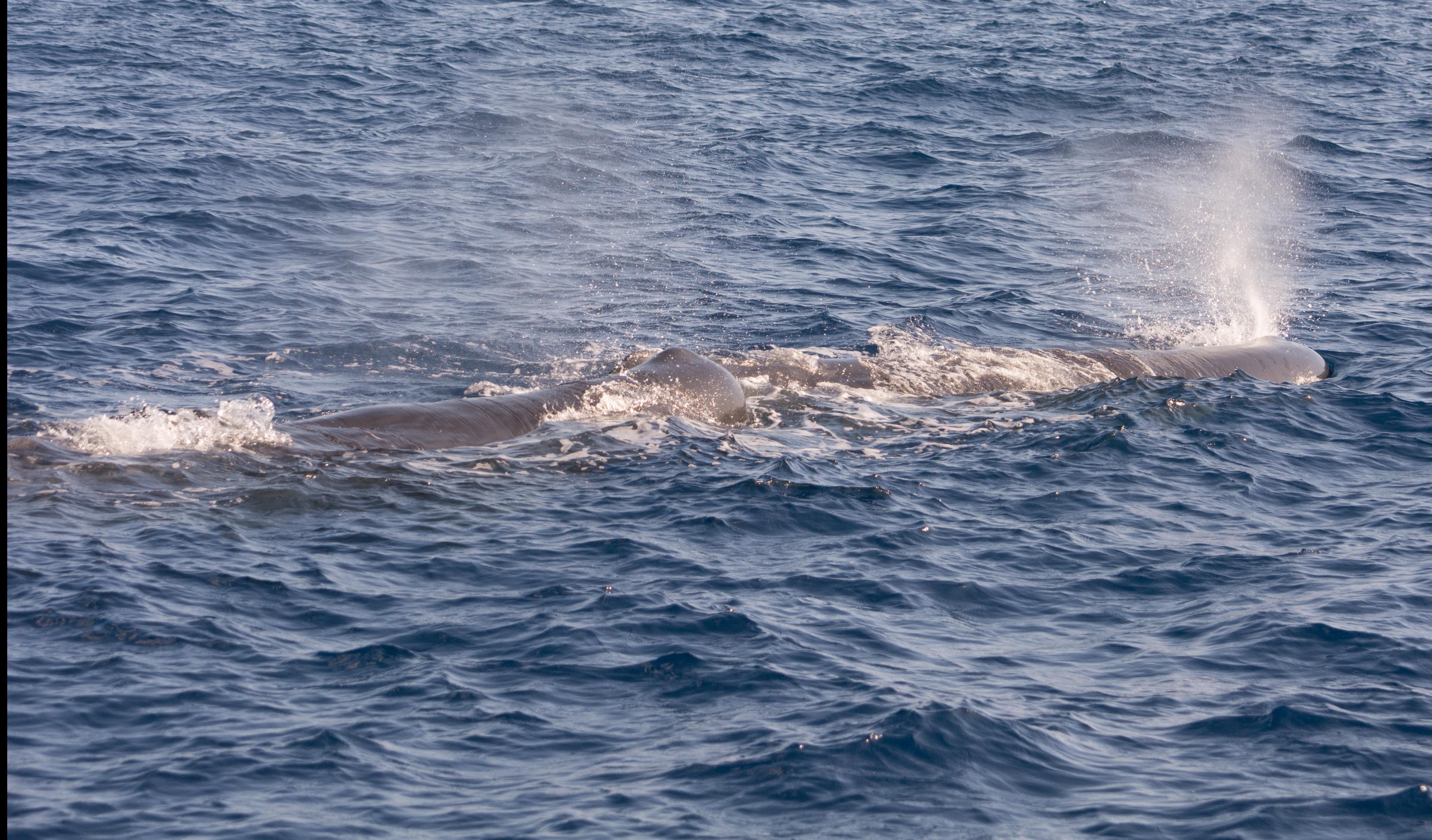
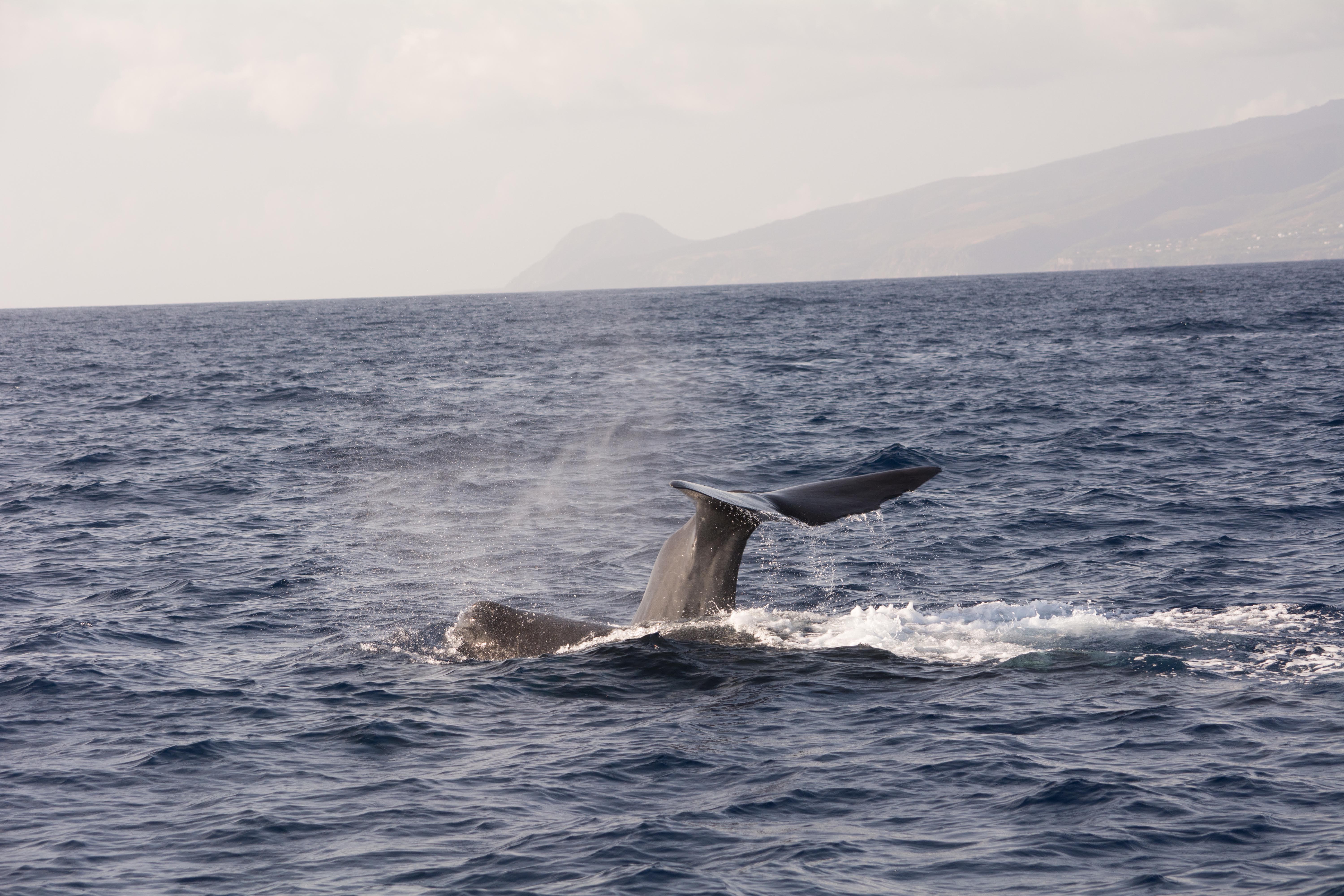
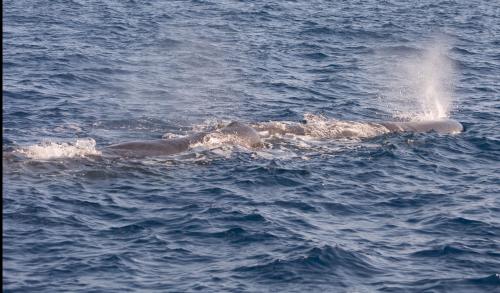
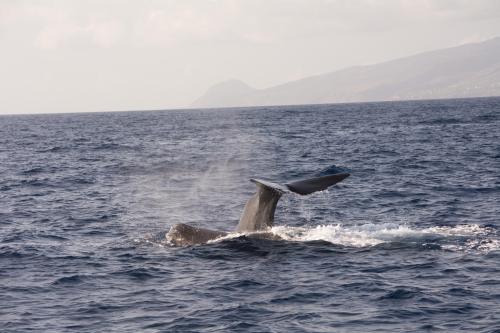
One afternoon we went on a whale-watching expedition and had good views of five sperm whales. The crew used underwater microphones to detect the whales’ signature clicks and then watched for them to spout. There was one pair that turned out to be a mother with a very large nursing daughter (pictured below as the mom descended). It was a thrill to see these remarkable creatures up close. We also were visited by a group of bottle nosed dolphins who came close to the boat to observe us.
14 05 04_9298

The next day one of our fellow divers, Shane Gero, turned out to be a sperm whale expert who’d spent several years studying the Dominica sperm whale families. We learned more about their family structure, habits, and culture. They eat giant squid, which live thousands of feet down. Family group are all females, joined by males only at breeding time. When orcas threaten the young, the family forms a circle around the babies, with heads inward, and ward off the attacker with their tails.
14 05 09_9067

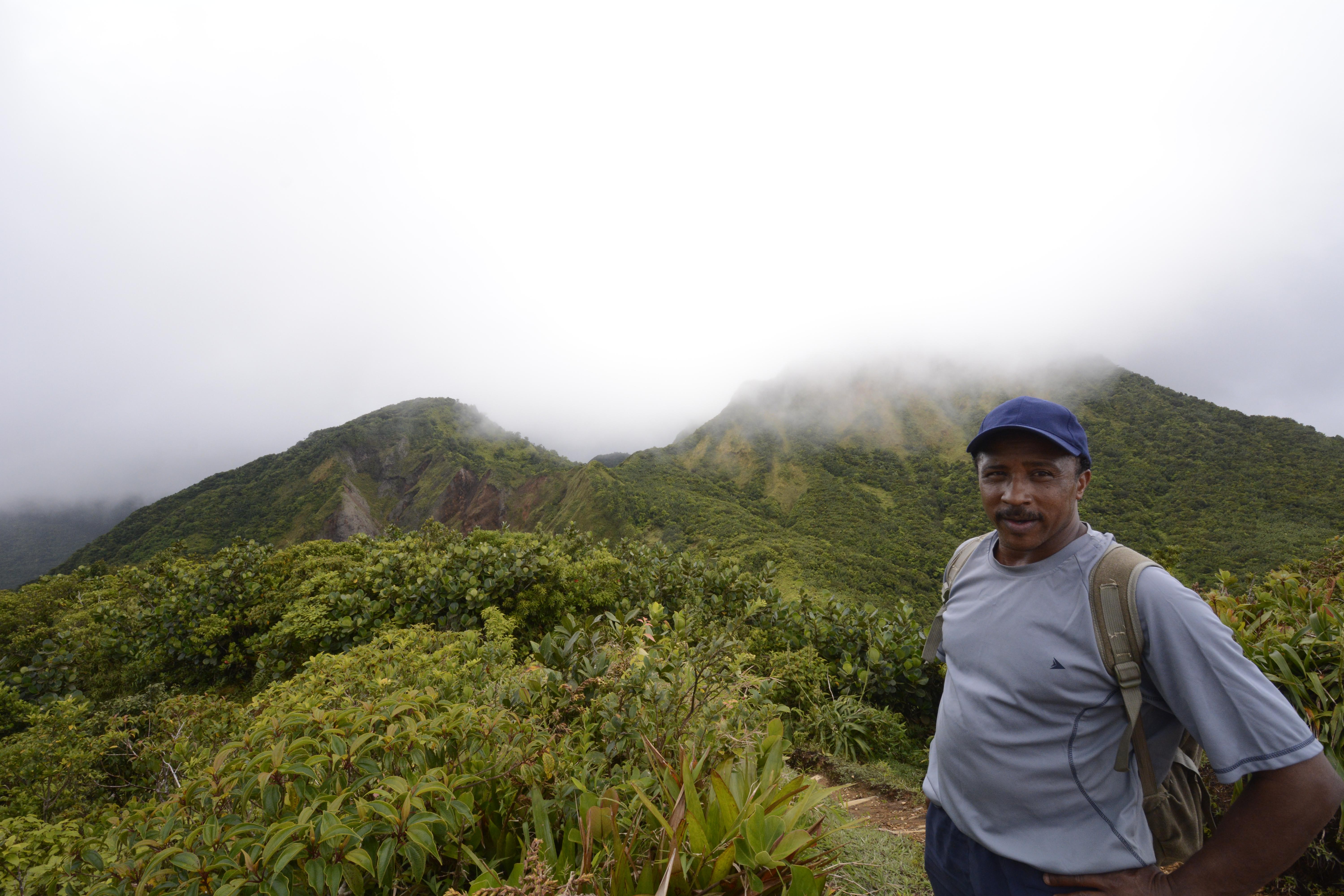
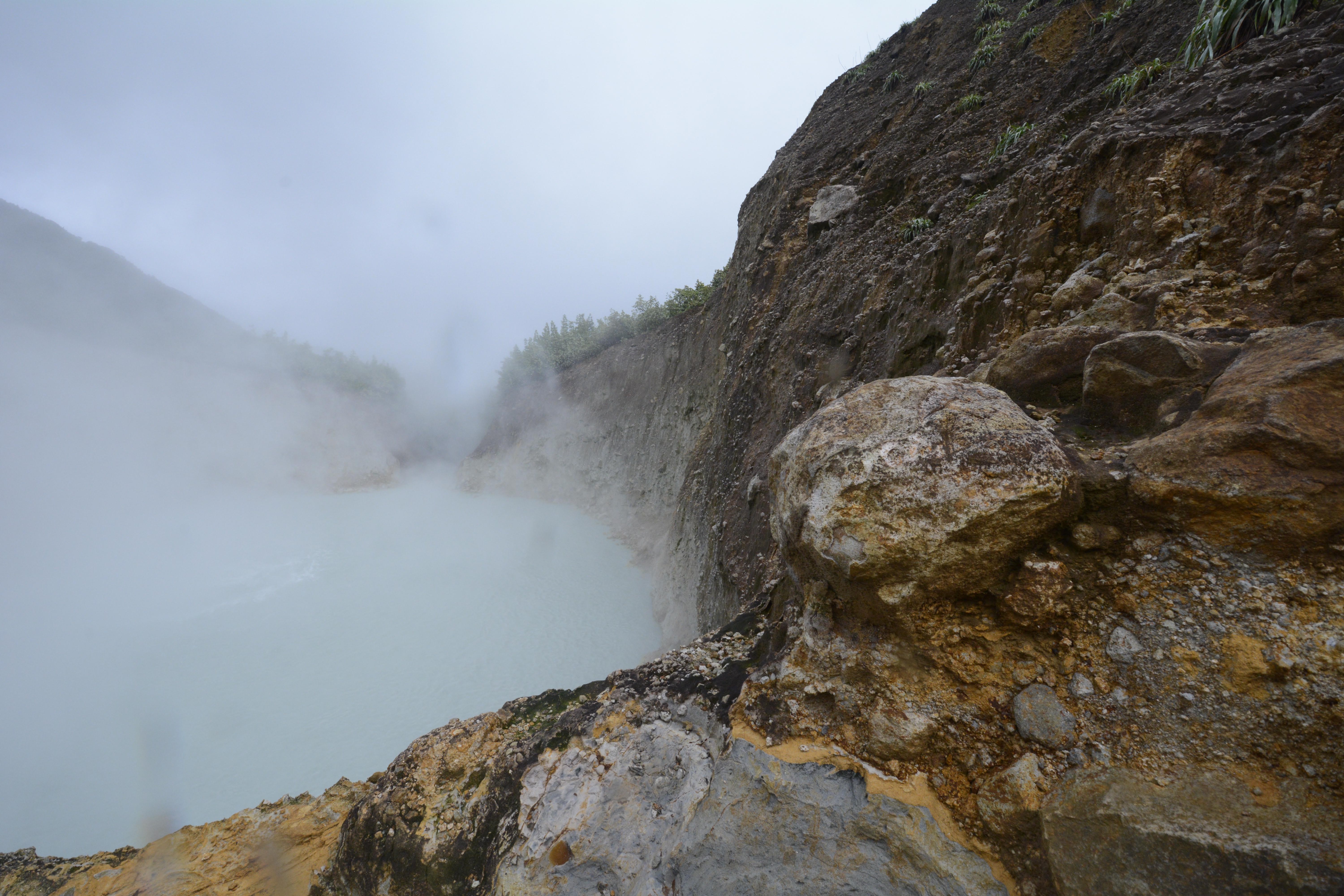
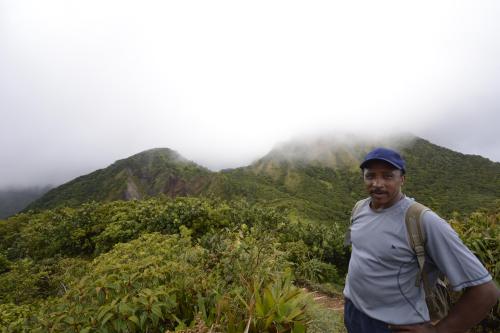
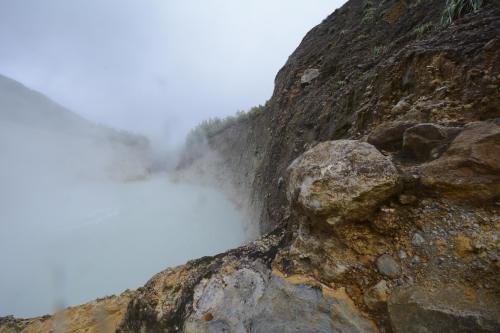
Our most remarkable land expedition was a hike to the Boiling Lake, an area of active volcanic activity, which took about seven arduous hours through the rainforest and up and down mountains. Along the way there were spectacular vistas, rivers, and waterfalls. For much of the time, though, I was entirely focussed on finding the next safe spot to put my foot, and in some climbing points, my hand. With Sally’s encouragement, I took along a walking stick, and was glad I did – it was helpful in many situations, such as stepping from rock to rock over fast-moving streams. We did not bring along rain gear, which was an unfortunate oversight – it rained on us for much of the hike and we were well soaked.
14 05 09_9074

I’d thought of hiking as a relatively placid physical activity, but this was anything but. It required engagement and commitment at the level of double black diamond skiing. I was very glad to get back at last, but soon began thinking about how I’d like to do more of it. I was, however, sore and beat up by the end of the week. I took a fall getting on the boat early in the week and badly sprained my right (dominant) hand, and worked up a major blister on my right foot. Paradise can be hard on a body!14 05 07_8856

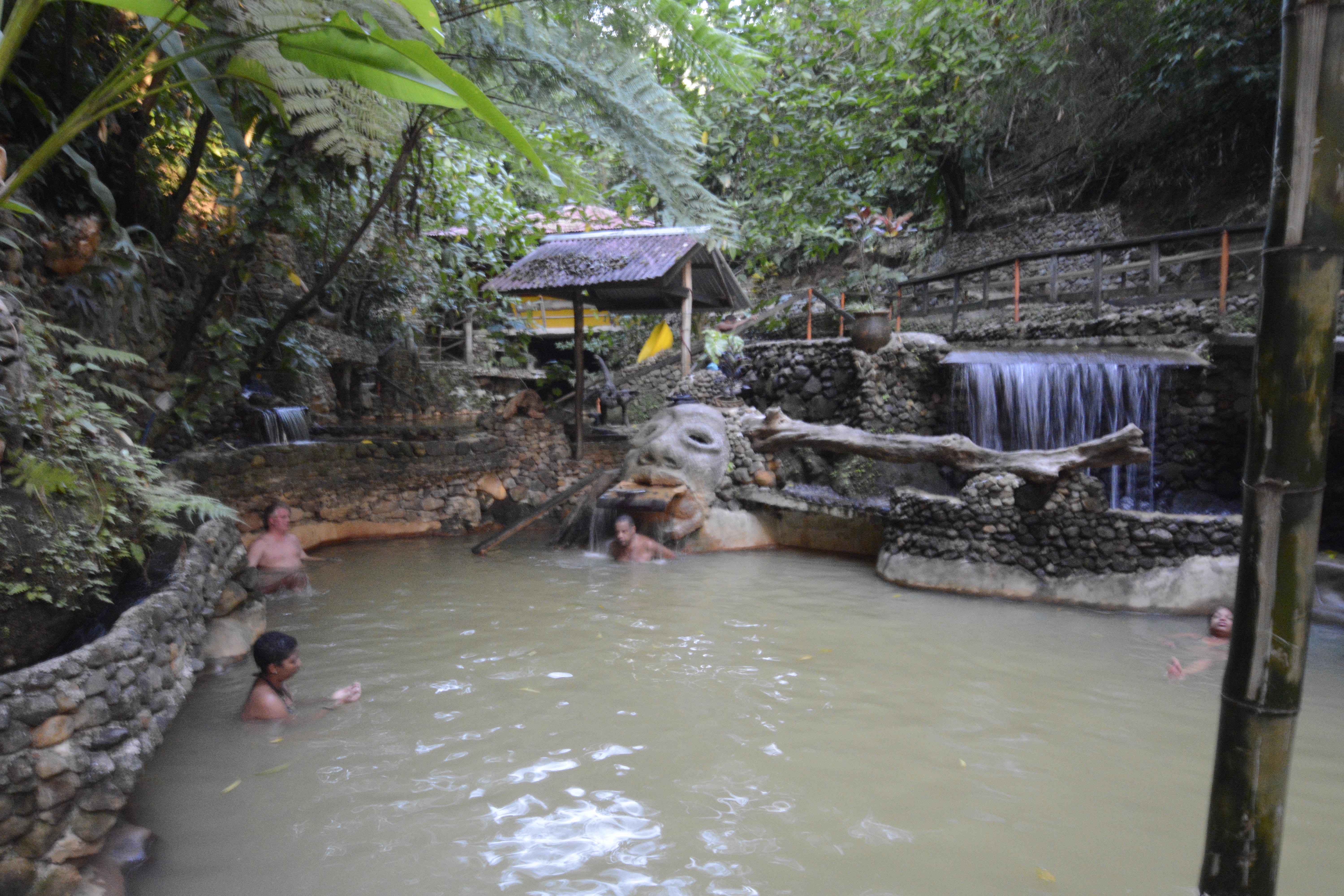
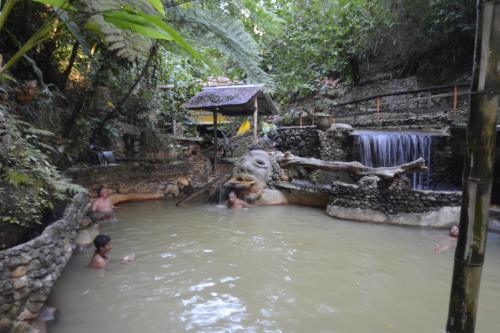
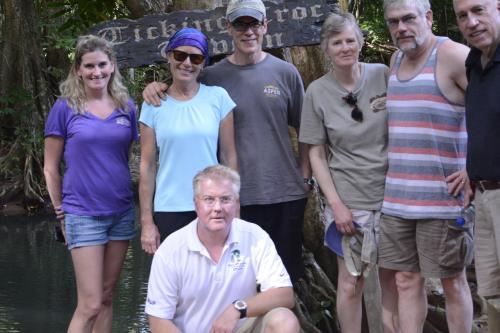
Our other land expeditions (including Trafalgar Falls, the Emerald Pool, the Carib Indian territory, and a boat trip on Indian River) were lovely and untaxing (aside from the twisty, bumpy drives to get there). We also had a good time soaking in the stone-lined hot springs named Screw Spa (sorry, but it’s true). A totally unexpected pleasure was meeting Miss Dominica 2013, Leslassa Armour-Hillingsford, a lovely and gracious young lady who helped us with our trip plans in her capacity as clerk for the family business (the Anchorage Hotel)
14 05 06_9214

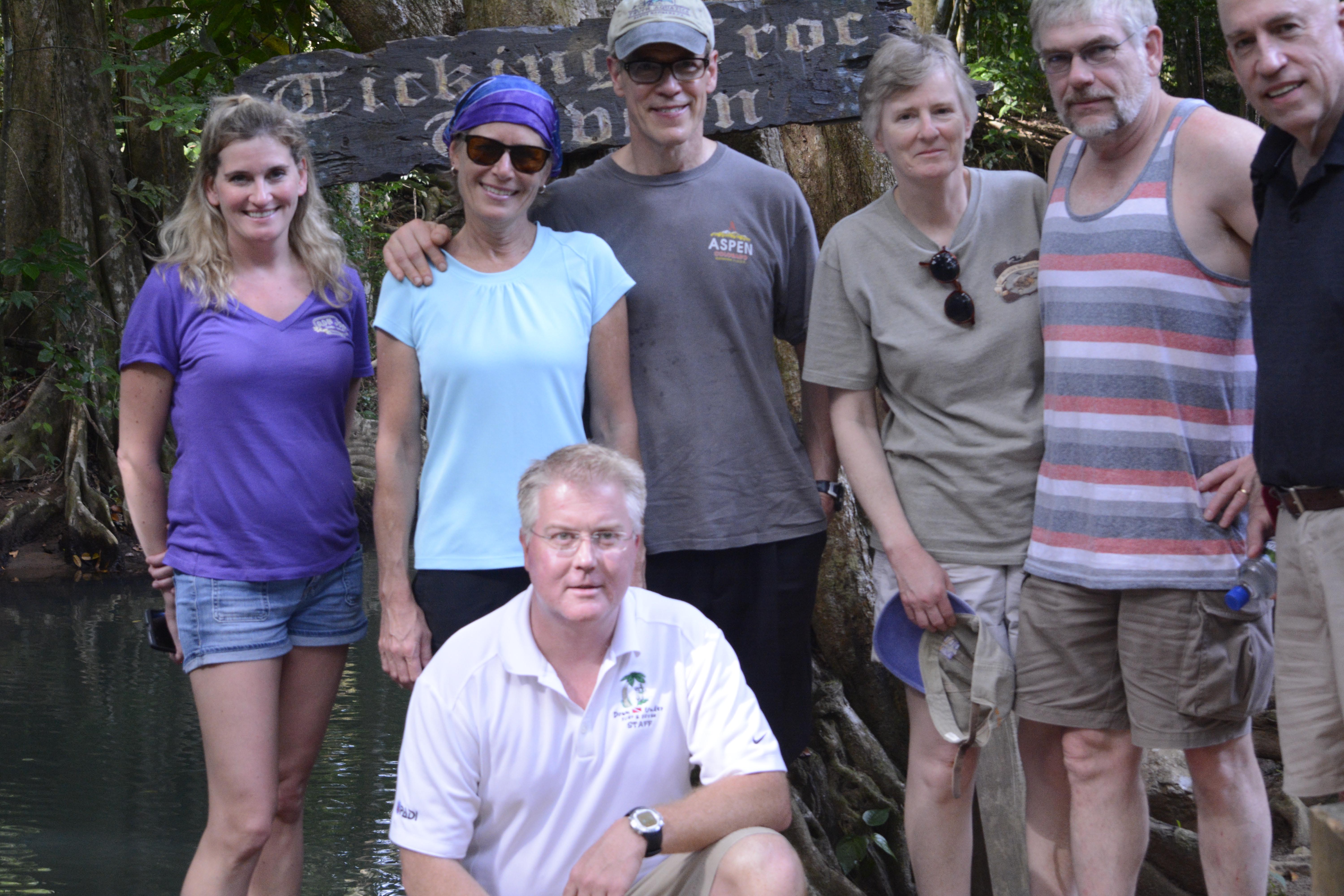
The trip was led by Scott Powell, proprietor of Down Under Surf and Scuba, with remarkable energy and good cheer. Scott made sure we had interesting dives, good meals, and fun activities. On the van ride back to the airport, Scott and I noticed that the driver was falling asleep and barely keeping the van on the twisty mountain roads. He worked hard to keep the poor fellow awake (and us alive) by asking him everything he could think of about local geography and culture. We made it, obviously (whew!). Good job, Scott!
14 05 08_9103

Full Frame Documentary Film Festival — some highlights

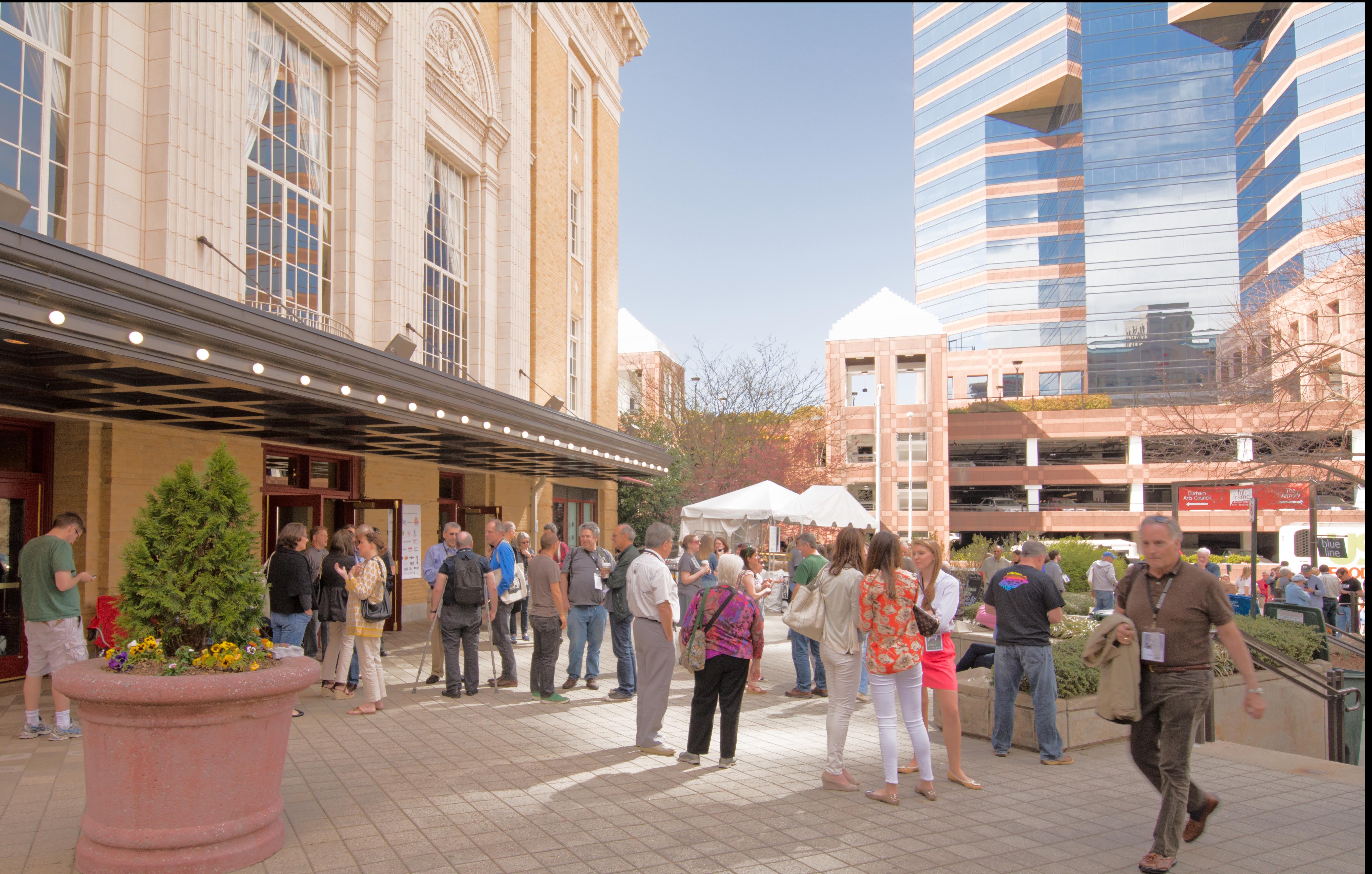
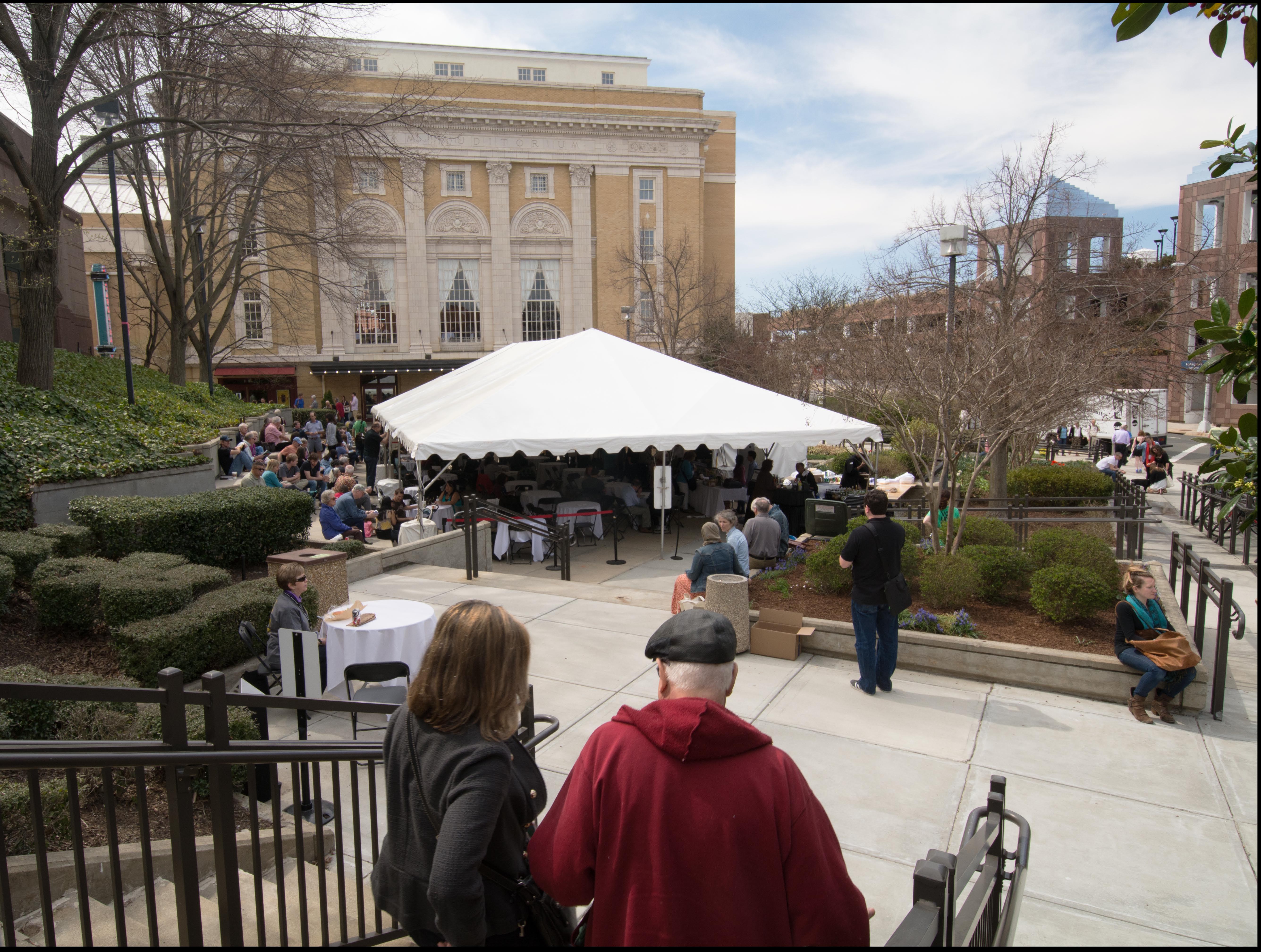
14 04 05_7994_edited-1Kudos to the Full Frame Documentary Film Festival which ran from last Thursday through the weekend in Durham, NC. The Festival had five main screens on which it screened more than 100 films. There were lots of helpful volunteers, and things ran on time and from what I saw, mostly glitch free. Many shows were sold out, and the crowds were enthusiastic.

I like documentaries most when the makers are passionate about the subject but also trying to maintain their critical distance and integrity. Documentary filmmakers, like all of us, have their blind spots and biases. Objectivity is a fine ideal, but I don’t think it’s possible to tell a coherent story based on reality in any medium without filtering, editing, and reworking; reality is just too messy to present raw. And no doubt some filmmakers are consciously manipulative. But a lot of documentary people seem to work hard to be truthful.

This was, I think true of all five films we saw, which covered a lot of artistic, social, and political ground. Here’s the list, in the order we saw them.

1. Afternoon of a Faun: Taniquil Le Clerq, by Nancy Buirski, is about the famous ballerina with the NY City Ballet. She married George Ballanchine and at her artistic peak contracted polio and never danced, or walked, again. This will be of most interest to other balletomanes, but I very much enjoyed the archival footage of Le Clerq and other great dancers and the interviews with Ballanchine, Jerome Robbins, Jacques d’Amboise, and others.

2. Whitey: The United States v. James J. Bulger, by Joe Berlinger, was organized around the criminal trial in Boston last year of Whitey Bulger, the crime boss who controlled South Boston for decades and then eluded capture for 16 years. You may recall from press reports that the trial was somewhat bizarre, in that Bulger didn’t deny many of the criminal acts that the government was trying to prove, but used the trial to deny that he was a government informant (“rat”) – which wasn’t an issue in the trial.

Bulger’s point seemed to be that a lot of state and federal law enforcement officials were working for him, rather than the other way around. There was ample proof that at least a couple of FBI agents were thoroughtly corrupt. This wasn’t so surprising – one expects that every barrel will have a few bad apples, – but there were indications that the officials working with Bulger were numerous and included some in high places (like the U.S. Attorney’s office). This could explain how he was permitted to run his operation for decades, murdering numerous people and destroying the lives of many others, while Italian Mafia competitors were arrested and convicted. The story was complicated, but the over all impression was that the law enforcement system came off the rails, and may not yet be back on them. It was truly shocking.
14 04 05_7997_edited-1

3. Freedom Summer, by Stanley Nelson, was about the struggle for Black voting rights in Mississippi, including the work by about a thousand mostly white college students who worked there in the summer of 1964. I knew these folks had been courageous and idealistic, but I hadn’t quite realized how harrowing things had been. The old guard racists were fire bombing and shooting at them, and killed three. The film was ultimately inspiring, reminding us that it may not be futile to work for political change in the face of difficult odds.

4. Ivory Tower, by Andrew Rossi, is about the structural problems of higher education in America, including dramatically risings costs, crushing student debt, deteriorating study habits, and confused mission (e.g. whether to get kids ready for the world of work, challenge them intellectually, or entertain them). I was particularly interested in the reporting new education models, incorporating MOOCs and hybrid approaches to teaching.

5. Rich Hill, by Tracy Droz Tragos and Andrew Droz Palermo, is an intimate look at the lives of three adolescent boys in a small Missouri town. The families were all working (at least at times) poor, and their situations were unsettled and frequently chaotic. With a lot of anger and despair, it was difficult to watch at times — almost too real, with no apparent good solutions.

In addition to the stimulating films, the food concession was good; I was very happy with my salad combo plate. There was an unfortunate postscript for me – I lost my iPad Air. I probably left it in the theatre on Saturday night. It has most of the books I’m reading on it, as well as many other things I care about. In short, it’s gotten to be more than just another computing device, but more like a little piece of me. I’m feeling a bit shaken to be missing it.
14 04 05_7987_edited-1

Bluebird skiing in Telluride, a brief briefing, and reading The Second Machine Age

14 02 26_7309
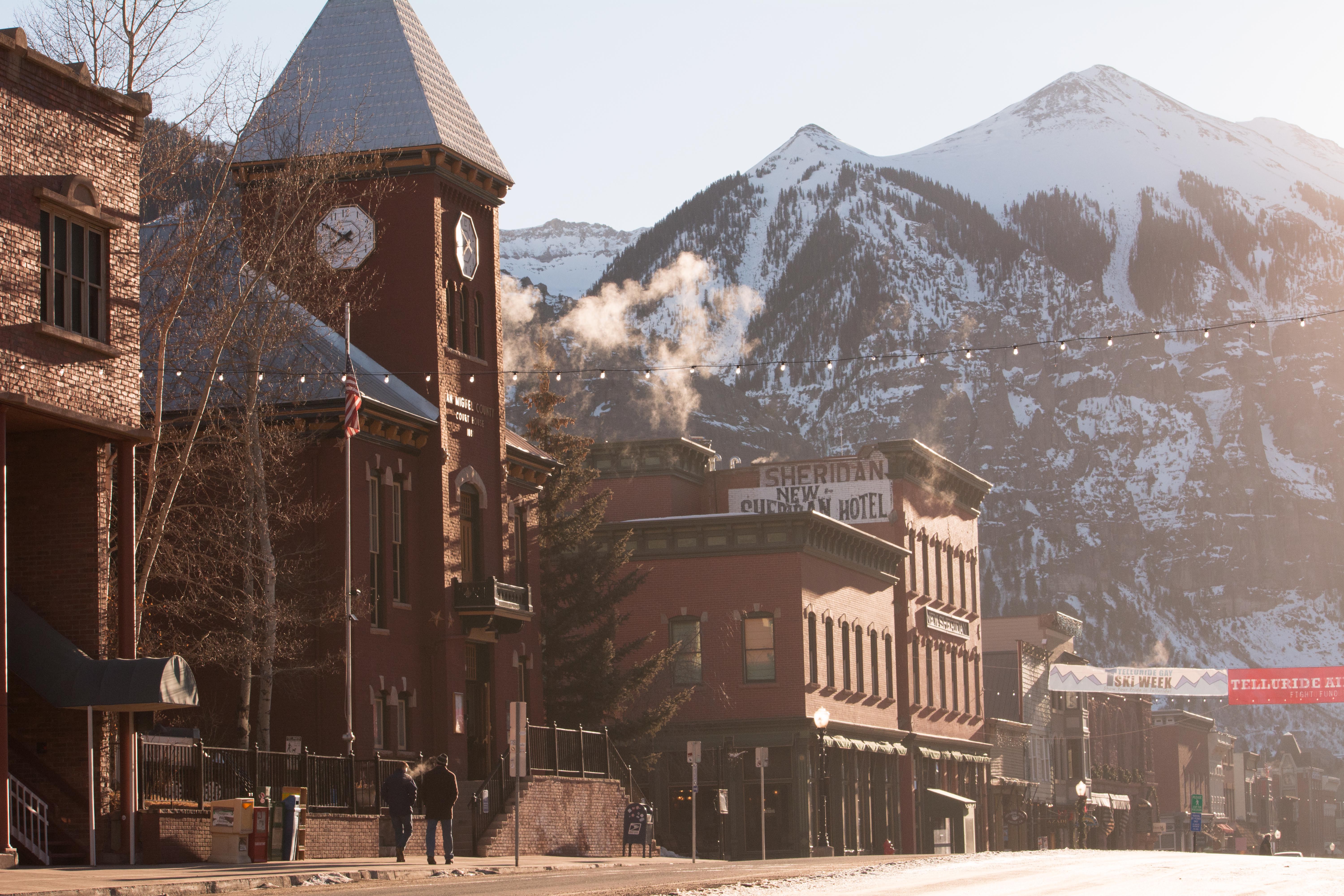
Last week Sally and I joined Gabe and several friends in Telluride, Colorado, for a few days of skiing, eating, and talking. When I describe Telluride, I always mention how beautiful it is, but when I got there, I realized I’d forgotten how massive and magnificent the mountains are. The craggy alpine vistas surround you, regal and timeless. And the town itself has a friendly, unassuming charm. I tried to capture some of these feelings, but was uncomfortable taking my D7100 onto the slopes, and so used my little Canon point-and-shoot up there.
14 02 25_7422_edited-1

Telluride has a lot of challenging terrain, and the question always is, can you handle it? Gabe Tiller has been living here five years, and he can answer that question with a yes. On our first day, he took me down a double black diamond mogul run called spiral stairs, which, once we were committed, he told me was “really steep.” He wasn’t kidding! He also led me into a tree run called Log Pile. These were pressing the outer edge of the envelope for me. Getting through in one piece was a great happiness!
14 02 26_7307
14 02 23_7352

Moguls — aka bumps, or areas of irregular snow that form in steep areas — are terrifying for beginners, frustrating for intermediates, and challenging in varying degrees for those more advanced. If you want to ski the steep wild places, you just need to figure out moguls, and there’s no simple solution. It’s like three-dimensional chess – or make that speed chess. We complimented Gabe on how smooth and strong he looked in the tough mogul runs, and he noted, with admirably humility, that it only took him five years of work.

There is no way I’ll ever reach Gabe’s level, but I got a bit stronger and more stylish this week. I averaged three falls a day, which I take as an indicator that I’m still pushing my limits and improving. I also found new joy in the gladed runs – basically moguls with trees. These require creativity and intense concentration. We did on called Captain Jack’s, which Gabe told me would get “kind of loggy.” Indeed. I had only one scary crash, after I saw Gabe flash by doing hyperspeed turns, and was inspired to give chase. I made the first three turns, but missed the fourth and ran into a tree. I did some minor damage to my left shoulder, but I think it will heal up OK. My worst injury was sunburn on my lips. I got everything except the lips protected with sunblock – a rookie mistake.
14 02 24_7340

Our four ski days were all remarkably clear and sunny, with pleasant ski temperatures in the mid-30s. The snow was generally good – not too hard and not too soft – Goldilocks snow. Of course, it’s always a treat to get fresh light powder, but if it doesn’t happen, I’ll take bluebird days and Goldilocks. We were on the lifts almost as soon as they opened at nine and went at it hard until 3:30 or so. Then hot tub, relaxing, cocktails, and dinner. We particularly enjoyed eating at the Telluride Bistro, Siam, 221, and Hongas.
14 02 25_7312

I had one important work project: an amicus brief in the U.S. Supreme Court in the case of Alice Corp. v. CLS Bank. The case involves a patent concerning financial intermediation, and presents the question of when software is patent eligible under 35 U.S.C. Section 101. I’ve thought about the paradox of software patents for a long time: how a system meant to foster innovation ends up hindering it. I was happy to take on the out-of-ordinary-course assignment of writing the brief myself, but the due date fell in the middle of the ski trip. With hard work, I got most of the writing done before the trip, and while my colleagues took care of cite checking and filing mechanics, I took responsibility for the needless worrying. In the end, I was reasonably happy with the brief, which I hope will help move the debate in the right direction. It can be downloaded here.
14 02 24_7333

For leisure reading, I made it most of the way through Brynjolfsson & McAfee’s new book , The Second Machine Age: Work, Progress, and Prosperity in a Time of Brilliant Technologies. Their subject is how robots and automation are dramatically changing the world. Technology tends to provide more and more extraordinary wealth for the lucky few and the risk of redundancy for the rest. It’s a good introduction to the subject. They explain with clarity and verve why technological change is accelerating, point up examples of the disruptive technologies just starting to take over human work, and play out some of the economic implications.

They seem determined to be optimistic about the future, with examples of how humans and machines can each complement the other. I didn’t think some of their policy prescriptions (e.g. improved education, improve infrastructure, immigration reform, IP reform ) matched up very well with the long-term risks they identified (that is, machines becoming better than humans at almost everything and destroying the labor market). They give some weight to the idea of a guaranteed basic income, which would serve the purpose of preventing mass starvation, but they worry that it might result in dysfunctional communities. The identify employment as a social good, and like the idea of a negative income tax, because it would subsidize and encourage employment. This seems worth thinking about.