The Casual Blog

Category: politics

Finding hope after the Pulse massacre in Orlando

Tiller7Bug 1-4
It is not easy to see a bright side in the horrendous massacre last week at Pulse, the gay nightclub in Orlando, but it does force us to think. The wounds are still very raw, and the shock and sorrow are still overwhelming. But partly because this tragedy cannot be ignored, it may take us forward.

In the last few years, we have come a long way in coming to terms with the reality of alternative sexuality. More and more, people understand that LGBT people exist, that they have integrity, and that they are entitled to the same rights and same respect as others. There are, obviously, some who disagree, of which a few are hate-filled maniacs. But for most of us, gays are no longer the other. We love them, or not, for who they are.

Tiller7Bug 1-5

We should be grateful to LGBTs for many transformative contributions, but here’s one that’s not often noted: in proudly accepting their differentness, they help us do the same. As we gradually accept their variations, we more easily accept that we ourselves are each a little different. Those of us somewhere outside the mainstream, in our interests, passions, and styles, may especially feel this.
Tiller7Bug 1-2

Back in 1980 or so, my dear friend Tom Sulerzyski, who died in the first onslaught of AIDS, tried to explain to me what Stonewall meant, in terms of gay liberation. It took me some years before I understood what he was saying. At Stonewall, gay people stood up to mainstream power, and changed their state. They would no longer be subservient, mostly invisible victims.

I think the Pulse massacre and its aftermath will come to be seen as another milestone in gay liberation – when the murder of gays was finally, fully settled as being intolerable, beyond any debate. Acceptance of LGBTs and their communities will continue to increase.

This week there were a few voices trying to acknowledge the tragedy while avoiding references to the sexual orientation of the victims, but they were called out as ridiculous in the mainstream press. Even a lot of conservatives – even the Donald! – acknowledged that the tragedy was about gays. Even the Security Counsel of the UN, which includes countries where it is dangerous to be gay, deemed it unacceptable to target gays in condemning the massacre. United States diplomats led the effort on this resolution, for which U.S. citizens can be proud.
Tiller7Bug 1-3

For all the progress in tolerance and respect, there are still obvious dangers. The NY Times reported that LGBTs are still the most likely targets of hate crimes in the U.S. The Times story suggests that increasing tolerance may have the perverse effect of increasing hate crimes, as the hate-filled minority feels embattled and threatened.

There’s no quick fix for such mental problems. But here’s an idea: what if we kept powerful weapons designed expressly to kill many human beings out of the hands of everyone who might become mentally ill (that is, everyone)? And what if we made it a major priority to improve the quality and availability of health care available for mental illness?
Tiller7Bug 1-6

Not surprisingly, there is much confusion about how to interpret this heinous act. It has been seized on as an occasion for fear mongering and for demonizing Muslims by some (including, vociferously, the Donald). Did the Pulse massacre have anything to do with ISIS? The perpetrator apparently thought so. But is he actually a reliable source?

How often do people really understand why they do what they do? Much of what drives us is unconscious, and even the conscious part is highly unreliable, featuring narratives that serve to resolve interior conflicts and to rationalize imperfect perceptions. It seems unlikely that we can ever fully and truly understand human motivation, including our own.

The killer here was a violent, disturbed person, apparently guilty of spousal abuse, possibly a closeted, confused, self-hating gay. He is probably best viewed as pathetically deranged. There is no evidence so far that he was part of any large anti-western movement, or even of a tiny conspiracy of violent radicals. Certainly nothing we’ve learned would justify us in thinking these murders could possibly justify continuing our quixotic war on terror.


Flying, flowers, a fund raiser, Pavlensky, and secret condos for the superrich

Tiller7Bug 1-2
I got a flying start on Friday at the 6:00 a.m. Flywheel spin class . Last week I had a discouraging outing (scoring 162) and wondered if I’d started the inevitable downward slide. But this week I made a comeback, getting off to a good start and staying strong for 45 minutes. After trailing just behind the pacemakers, I pulled slightly ahead with about 6 minutes to go. But the fellow just behind would not concede. I pushed hard, but he pushed a little harder. Final score, Tiller 320. Rival 321. It would have been good to get two more points, but I was happy with my performance.
Tiller7Bug 1

On Friday afternoon we drove over to Chapel Hill for a fundraiser for Roy Cooper, the democratic candidate for governor here in NC, fighting the good fight to unseat incumbant Pat McCrory. Roy is our attorney general, and I also know him personally a little, from sometimes having the same early morning schedule at the gym. (He’s a good stretcher.)

He seemed cheerful on Friday. I told him I was glad to see he was standing strong against HB2 (the anti-transgender bathroom bill), and referred hm to my op-ed piece on the First Amendment violations by its supporters. He said he expected a tough campaign, andd I told him I expected him to sweep in while McCrory got swept out in a massive Trumpigeddon.

We had a nice chat with one of Roy’s daughters, and caught up with some old friends. Afterwards, we had dinner on Franklin Street at Lantern, a fine restaurant. They only had one vegetarian entrée, but it was a good one: wok-seared rice noodles.
Tiller7Bug 1-3

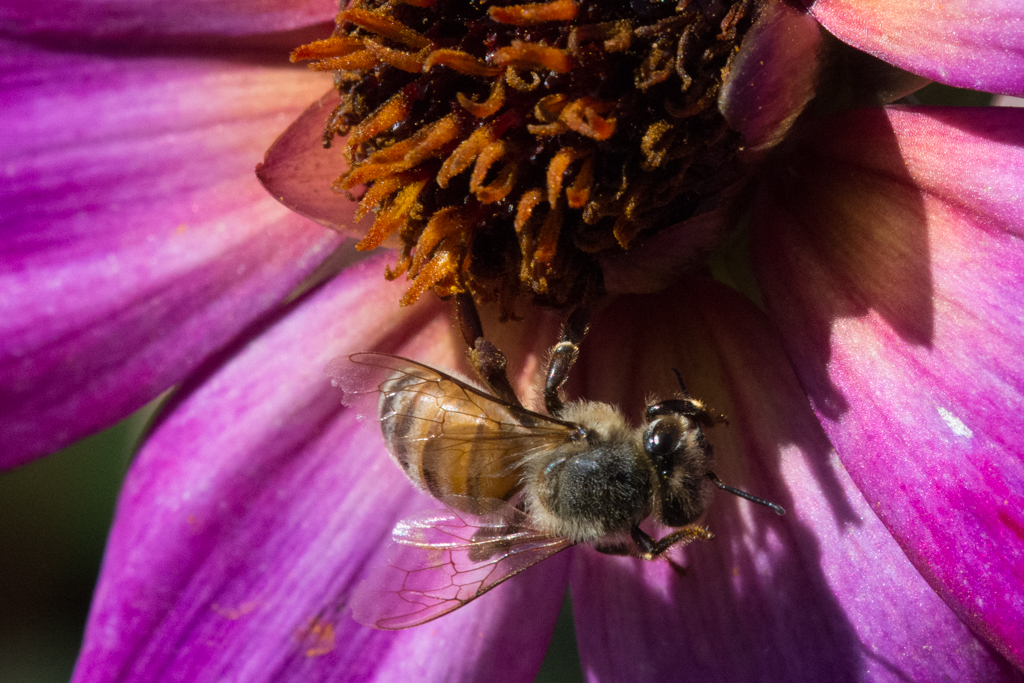
I took most of these photos at Raulston Arboretum on Saturday morning (the others are from last week). I’d been looking forward to watching the insects there and trying to capture some images with my Tamron 180 mm lens, a hefty tool that I use with a monopod. I had some successes, but a lot of misses, with some bizarre over- and underexposures. I took the lens back to Peace Camera in the afternoon. They agreed there was a problem and said they’d send it back to the factory for repair.
Tiller7Bug 1-8

This week I learned for the first time of the shocking and awesome work of Pytor Pavlensky, a Russian dissident performance artist. In his most recent work, he set fire to the front door of Russia’s principal intelligence agency, then waited to be arrested, which he was. Per the NY Times, “He has described his art as consisting of two parts: his actions and the reactions of the government, which he says tend to be mutually reinforcing.” His Wikipedia entry describes several even more shocking gestures of protest, such as sewing his mouth shut and nailing his scrotum to a crack in Red Square.

With this strange art, the point is completely clear. Pavlensky’s combination of extraordinary courage and imaginative vision is singular. The thuggish government of Vladimir Putin is a great target, of course, though there are aspects of our own government that could benefit from the abrasion of Pavlensky’s spirit.
Tiller7Bug 1-7

Every Sunday, one of my guilty pleasures is examining the full-page condo ads in the New York Times Magazine. These super-high-rise apartments have stunning city views, exquisite modernist decor, and multi-multi-million dollar price tags. They are sprouting like mushrooms in Manhattan. Who lives in such digs? Well, the Times sent a reporter to find out, and he found out remarkably little. Some of the most expensive real estate on earth is owned by Anonymous – that is, mysterious shell corporations.

What is there to hide? Could these super-luxury apartments amount to wealth storage containers for loot from first, second, and third world countries’ assorted dictators, authoritarian party leaders, and kleptocrats, along with their families and cronies? They could. Could they be the trophies of the lucky one percent of the one percent, mostly born with money and augmenting that through procurement of favorable tax laws? They could. It’s natural to be envious of such luxury. But just think of this gift: our lives are not burdened with fear that others may learn that our wealth is unfairly grifted and throw us in prison for corruption — or worse.
Tiller7Bug 1-6

A big spin, an op ed on free speech, Korean death fans, the unbelievable Donald, and what to say about Hiroshima

Tiller7Bug 1-3
Work bled over into Saturday, so I didn’t get outside for a photo-walk (these photos are from last week), but I did do an early spin class at Flywheel.All of my previous Flywheel spins there were 45 minutes, but this one was a full hour. I had some concerns that that extra quarter-hour could cause problems (such as woofing, or death), but I survived. Final score: 398. Finishing position: number one. Endorphins: plenty.

This week the Raleigh News & Observer and the Charlotte Observer published the op ed piece I co-authored with Michael Gerhardt about HB2 and the First Amendment. The thesis was that legislators who threaten retaliation for those who speak out against the transgender bathroom bill are chilling free speech guaranteed by the Constitution, and that should not be tolerated.

After I’d noticed the issue and decided it was serious, I reached out to Michael, a UNC Law professor and constitutional law expert, to see if he concurred in my analysis, and he suggested we collaborate on the piece. It was fun working together, and I got a kid-like thrill when the piece went live and people started posting reactions.
Tiller7Bug 1-4

Speaking of little newspaper pieces, there was a fascinating one in the NY Times this week about South Koreans’ fear of electric fans. South Koreans, a notably hard-working, sophisticated, tech-savvy people believe that sleeping with an electric fan blowing in the room can result in death. Fans are sold with special sleep timers. There are government warnings and media reports of fan deaths. Apparently this fear doesn’t exist outside South Korea.

We might once have thought it almost impossible for a large population to adopt an idea so comically loony, but no more. For example, right here in the USA, there are those who deny the fundamental facts of climate change or the need to do anything about it, including Donald Trump. And there is the stranger-than-truth story of Donald Trump, as of this week the official presumptive nominee of the Republican Party for president.

How could any significant number of people believe this man would make a good leader — of anything? How could anyone watch him for five minutes and fail to notice that he’s ignorant, crass, and shallow? How could large groups of people ignore the florid delusions and the almost non-stop lying, big lies, lies so blatant and transparent that they they seem proudly designed to be understood to be lies? Or the bullying, mean-spirited nastiness?

I’m not saying he’s all bad, mind you. At time he’s funny, and every now and again he says something that is not crazy. But it would be madness to entrust this guy with responsibility for addressing climate change, preventing nuclear war, or for cleaning up after himself, which is to say, any significant or insignificant responsibility. I continue to think that he will lose in a landslide that sweeps out a lot of other worse-than-useless pols. But even in that case, we’ll still have the not-so-funny, puzzling, and fairly disturbing reality that millions of our fellow citizens do not think the Donald is a contemptible joke.
Tiller7Bug 1-2

What would Trump say at Hiroshima? One shudders to think. This was clearly a problem this week for President Obama, a person in many ways Trump’s opposite. Let’s say you have sufficient moral capacity to understand it was horribly wrong to do a demo of the first atomic bomb by killing 140,000 civilians. Yet it would roil diplomatic alliances and certain important constituencies to apologize for this atrocity. So Obama, ever brilliant, delivered the most apologetic non-apology imaginable. He highlighted the horror, hugged victims, and called for movement towards a world without nuclear weapons.

His speech was in places Lincolnesque – moving, stirring, and inspiring — though also in places oddly ambiguous, disjointed, and restrained. Here are some of the good parts:

Why do we come to this place, to Hiroshima? We come to ponder a terrible force unleashed in a not-so-distant past. We come to mourn the dead, including over 100,000 Japanese men, women and children, thousands of Koreans, a dozen Americans held prisoner. Their souls speak to us. They ask us to look inward, to take stock of who we are and what we might become. . . .

Hiroshima teaches this truth. Technological progress without equivalent progress in human institutions can doom us. The scientific revolution that led to the splitting of an atom requires a moral revolution as well.

That I why we come to this place. We stand here in the middle of this city and force ourselves to imagine the moment the bomb fell. We force ourselves to feel the dread of children confused by what they see. We listen to a silent cry. . . .

Mere words cannot give voice to such suffering. But we have a shared responsibility to look directly into the eye of history and ask what we must do differently to curb such suffering again. . . . The memory of the morning of Aug. 6, 1945 must never fade. That memory allows us to fight complacency. It fuels our moral imagination. It allows us to change. . . .

Among those nations like my own that hold nuclear stockpiles, we must have the courage to escape the logic of fear and pursue a world without them. We may not realize this goal in my lifetime, but persistent effort can roll back the possibility of catastrophe. We can chart a course that leads to the destruction of these stockpiles. . . .

It’s clear that Obama understands the enormity of the nuclear peril, including the risk that our gigantic stockpile of nuclear weapons could end up destroying most every living thing on the planet including us. He’s repeatedly called attention to this existential risk. But he hasn’t made much progress in actually reducing it.

There are, of course, powerful institutional forces supporting the status quo of standing on the nuclear precipice – the military-industrial complex, now much more powerful than when President Eisenhower named it, and the fearful conservative mind set that exaggerates possible threats and reflexively resists reform. What if Obama just ordered destruction of half of our nukes? Would the missile officers refuse the order? Would there be impeachment proceedings, or a coup?

I doubt it, but there’s something that holds him back. Anyhow, he has made a judgment that he needs to change minds to prepare the way for a changed reality, and perhaps his speech will help with that.
Tiller7Bug 1

A surprise flower, Salgado photos, Mahler symphonies, stone-age brains, and bathroom fear-mongering

Tiller7Bug 1
Earlier this week Sally was eager to show me a flower: the first we’d ever seen on a houseplant we’d had for 20 years. It was completely unexpected, delicate, and lovely. You never know what amazing things will turn up in nature, even when it’s this highly domesticated. In photographing the plant with my macro lens and Lightroom software, I discovered new colors and textures.

Speaking of amazing nature, I’ve been spending some time looking at Genesis, a book by Sabastiao Salgado, the great Brazilian photographer. I wrote about being greatly moved in seeing his exhibition in New York last year, and I’m very glad I got the catalog. It shows some of the most pristine and awe-inspiring places on earth, such as the Antarctic,the Amazon, and West Papua, with their native animals and people. If you have a loved one interested in photography and nature, this would be a wonderful gift. It took Salgado 32 trips over 8 years to get these images. We can take it in a lot quicker, though I expect to be drawing inspiration from these photographs for decades.
Tiller7Bug 1-7

Speaking of art that is at once accessible and challenging, I’ve been gorging on the symphonies of Gustav Mahler (1860-1911) for the last few weeks. I first fell in love with this music as a teenager, and I’ve returned to it every so often with great joy. I have CDs of all Mahler’s symphonies, but recently I discovered a trove of recordings unknown to me on Spotify. This was a revelation: hearing multiple recordings of a great work expands understanding.

It turns out that there are at least several great orchestras and conductors around the globe that perform this music splendidly. Who knew that the Tokyo Metropolitan and Seoul Philharmonic orchestras would be so excellent? If you haven’t ever explored this music, now you can, with a low barrier to entry: some time, and an inexpensive Spotify subscription. I recommend starting with Symphony No. 1, and following that with No. 4, No. 5, No. 2, No. 9, No. 6, No. 7, and No. 3. I still struggle with No. 8, and I’m just starting to learn the posthumously completed No. 10. It takes some time to grasp this music, but it is completely worth it.
Tiller7Bug 1-4

I was happy to discover this week that Bill Moyers has a podcast, and the first edition I listened to was a good one: an interview with Rick Shenkman, a historian with an interest in evolutionary biology. Shenkman thinks that a lot of our political problems stem from our having brain structures well adapted to life as hunter-gatherers of a million years ago – stone age brains. We react strongly and quickly to threats, which works well in responding to possible attacks of poisonous snakes or sabre tooth tigers. When in peril, we can’t consciously think at all – we just react.

Speedy automatic responses helped our ancestors survive, and they sometimes helps us, too. But politicians have figured out how to exploit this feature. By giving alarming messages (e.g. we’re being invaded by criminal immigrants!), they generate fear that prevents rational thought. The antidote is to somehow get past the first excited emotional reaction and to do more rational thinking, looking at the evidence and considering the most likely explanations. But that’s not so easy.
Tiller7Bug 1-5
A case in point: transgender people in bathrooms. This has suddenly become a new front in the culture wars, right here in NC, with even presidential candidates weighing in. The dominant right-wing narrative has it that trans folks are actually male sexual predators who would molest little girls in the ladies’ room absent a statute to prevent them. The child molester story has undeniable force – it’s horrible to think of – but there has yet to be a single confirmed case of a man pretending to be a woman so he can go to the ladies’ room and molest little children. It’s just raw fear-mongering.
Tiller7Bug 1-6

The mean-spirited ignoramuses who form the majority of the NC legislature are apparently impervious either to reason or economic self-interest. For the immediate future, they will continue to embarrass themselves and us, and cause increased pain and fear for unfortunate minorities. But there’s one silver lining: more people are finding out that transgender people exist, and that they are not freaky perverts. The conversation on this has really gotten started. Maybe we’ll move from ignorance and fear to tolerance quickly, as we’ve recently done for gays. Let’s hope so.

Meanwhile, let’s have a laugh when we can. Here’s a link to a wonderful mock news story about the bathroom law, including enforcement by requiring birth certificates and genital checks at public bathrooms.

Foolish LGBT discrimination in NC, more spring blossoms, and an excellent Barber of Seville

Tiller7Bug 1-2
North Carolina is my home, and I love it very much. There is a lot of natural beauty, and there are a lot of smart, warm people. But boy, we’ve got some really ignorant political leadership. It is hard to believe, at this point in history, anyone would truly fear gay and transgender folks. And it’s just shameful to start a fear mongering campaign about the risks posed by improper usage of bathrooms. Has anyone ever heard of an LGBT bathroom attack, or even an awkward moment? Unfortunately, the stupidity and/or cynicism of our legislative Republicans has brought cascades of ridicule on our state, and it looks like there could be real economic damage. Eventually we’ll vote those rascals out (maybe in November?), but meanwhile, it’s painful and embarrassing.
Tiller7Bug 1-3

But again, this is a good place to live, and a good time. The azaleas blossomed this week in pinks, whites, and purples, and the delicate dogwoods (our state tree) flowered. It was rainy on Saturday morning, when I went to Raulston Arboretum, and it was awkward holding an umbrella over the camera while taking some of these pictures, but I liked the water on the flowers. On Sunday morning, I went over to Duke Gardens. It was sunny, but breezy, and the flowers tended to move about when I got ready to take their pictures.
Tiller7Bug 1-5

On Sunday afternoon, we went with Diane to the N.C. Opera’s production of Rossini’s The Barber of Seville. It was wonderful! There was so much life, so much warmth and humor. Previous productions I’ve seen were mostly about delivering those blockbuster arias, but this one was as much about the characters. Stage director Stephanie Havey made it as much fun to watch as it was to listen to, with lots of comedy, some of it Marxist madcap, but some of it almost Shakespearean. The period costumes had elements of whimsey. It took me a while to warm up to the sets, which were sort of postmodern antique facades that rolled in and out, but in the end they worked.Tiller7Bug 1-9

The singing was all very good, and some was superb. I adored the lovely Cecilia Hall as Rosina. She had a richness and fluidity to her mezzo, and she was a fine actress, with intelligence and quick wit. Tyler Simpson as Dr. Bartolo was hilariously grumpy and obtuse, and also a wonderful low baritone, with marvelous diction in the patter songs. Troy Cook as Figaro was instantly likeable, and highly musical. Conductor Timothy Myers led with musical insight. He knew when to take some luxurious time, and when to push quickly forward. The orchestra sounded really good. There were quite a few moments when I had goosebumps and watery eyes at so much rare beauty. It was a privilege.
Tiller7Bug 1-10

Justice Scalia’s passing, Beethoven quartets, and Reich on the problem of extreme inequality

Raleigh at sunrise

Raleigh at sunrise

Yesterday we were getting ready to head for Durham for dinner and a concert when I learned that Justice Scalia had died. The news was unexpected, and disorienting. I spent an intense year working a few steps away from him as one of his clerks, and felt close to him in a way. He was a good boss and mentor. Despite our very different political orientations, I admired his intelligence, energy, and humor. He demonstrated (including by hiring non-conservative clerks) that engaging with people who disagreed with one’s views was not a thing to avoid, but rather to embrace — stimulating and potentially creative. I disagreed with him vigorously on many things, but I liked him, and will miss him. This will take some time to process.

We met our friends John and Laurie for dinner at Dos Perros, a stylish Mexican restaurant, where we had good food and conversation. Then we went over to Duke’s Baldwin Auditorium to hear the Danish String Quartet, three young Danish guys, and one Norwegian one. They played an all Beethoven program, including two famous late quartets (Op. 131 and 135). This is challenging, craggy music, which the Scandinavians played with fearless commitment, embracing all the extremes of angularity and the subtlety. I thought the sound of violist Asbjorn Norgaard was particularly beautiful.

Zürich at sunset

Zurich at sunset

There’s been a lot in the press recently about the extreme inequality in the U.S., and frequent references to such facts as the top .1 percent own almost as much wealth as the bottom 90 percent. This seems disturbing on its face, but I got a much better grasp of its implications from reading Saving Capitalism: For the Many, Not the Few, by Robert Reich. Reich is a former Secretary of Labor (Clinton administration) and a professor of public policy at Berkeley. In Saving Capitalism, he argues that the increasing concentration of economic and political power in the hands of very wealthy individuals and corporations threatens the fabric of our society. Dramatic inequalities of wealth and opportunity strike the majority as deeply unfair, undermining the trust that’s essential for social order. Without redress, the system could fail.

Reich contends that the arguments over whether the free market is preferable to the government are based on a false premise, inasmuch as the market is created by human beings and is subject to modification, for better or worse, by those same beings. At various times in American history, the rules have been dramatically changed (the Jacksonian era, the Progressives in the late 19th and early 20th centuries, the New Deal), and they can be changed again. Only relatively recently have corporations been viewed as limited to serving shareholders, without regard to other stakeholders (employees, consumers, the public at large). The system can be fixed.

Reich is primarily focused on identifying the problems, rather than proposing solutions, but he does offer some preliminary thoughts on fixes. He notes that we need to get big money out of politics. Campaign finance reform is surely an important step. A more equitable tax system is another. We need to fix the rule system that applies to intellectual property, along with other legal reforms. Reich also favors a basic minimum income that guarantees everyone a minimally decent standard of living. He recognizes that automation and artificial intelligence are going to cost many more jobs, and we have to help those who get hurt. This is a timely book, well worth reading.

Spinning, credit card fraud problems, and the tax system for the super rich

Tiller7Bug 1-3

On Saturday morning I had a particularly good spinning outing led by Heather at Flywheel. The previous week was a disappointing one, when I tried hard to reach 300 but finished with a total score of 286.  It made me wonder if I’d finally started that long slide down to the bottom. But this week I finished first in the class with 341! My average heart rate for the 45 minutes was 157 — a record.  There was one guy who stayed close on my tail the whole way, and was just two points behind when the music stopped. Whew!

That afternoon, I had my monthly deep tissue massage session with Ken Katchuk (K2). Ken is really generous with his skills and time, and we set a new personal best: two hours and twenty minutes on the table. It was challenging at times, but we had a good talk about sports, movies, politics, and dogs, and I felt great afterwards.

One of the greatest of modern conveniences has got to be the credit card, which has greatly shrunk the time and distance between a wish and its fulfillment. How amazing to have a need or want, have an online merchant, have a credit card, and very quickly have that object of desire. At the end of this week, though, I had my Visa card declined, first at Happy and Hale (for a lovely salad), then at Hayes Barton Pharmacy, then at Fandango (movie tickets).

I called Capital One, and a cheery fellow in the fraud department read out several charges from Ft. Worth, Texas that were definitely not mine. He said someone had made a counterfeit version of my card. Anyhow, that account is now history. I’m happy Capital One detected the fraud promptly, and happy I won’t be responsible for the fraudulent charges. Still, it’s a bit of a pain, since I’ve got to get a new card and remember to pass then new number to various providers of goods and services.

I don’t suppose we’ll ever prevent all fraud, and we may even be headed in the opposite direction. There’s little doubt that our electronic transaction system is a point of vulnerability. There are highly skilled, ethically challenged people in front of computer screens all around the globe searching for ways to take our money. Thus I’ve gradually converted to non-obvious passwords. You do what you can.

Tiller7Bug 1-2Speaking of systems and fraud, the Times had a significant piece recently about the corruption just below the surface of the US tax system. Here’s a bit from the beginning:

With inequality at its highest levels in nearly a century and public debate rising over whether the government should respond to it through higher taxes on the wealthy, the very richest Americans have financed a sophisticated and astonishingly effective apparatus for shielding their fortunes. Some call it the “income defense industry,” consisting of a high-priced phalanx of lawyers, estate planners, lobbyists and anti-tax activists who exploit and defend a dizzying array of tax maneuvers, virtually none of them available to taxpayers of more modest means.

Operating largely out of public view — in tax court, through arcane legislative provisions and in private negotiations with the Internal Revenue Service — the wealthy have used their influence to steadily whittle away at the government’s ability to tax them. The effect has been to create a kind of private tax system, catering to only several thousand Americans.”

The article gives various examples, and explains that the very wealthiest and their tax experts are continually devising sophisticated new schemes. These same people are also the biggest contributors to political campaigns. Could these facts not be related? Once you begin to get you head around this, you might (unless you’re in the one-thousandth percentile) start to get mad. It’s not fair.

So why is this not a huge political issue? I see two main reasons. 1. The existing candidates for the most part are complicit in the status quo. 2. It’s too complicated. That’s part of the point: the tax dodges are designed by experts to defy understanding. Just comprehending a single tax scheme (there are many such) is beyond the mental capacity of most of us, including the IRS, and we’ve got other demands on our time and brain power.

I should note that there’s one major exception among the presidential candidates, who is very focused on the unfairness of favoring the super rich in the tax system: Bernie Sanders. He’s put the issue of addressing inequality and eliminating their special tax breaks  front and center. And against all odds, he’s still in the hunt for the democratic nomination. I have trouble picturing him in the oval office, but I’m very glad he’s getting fundamental issues like this one onto the discussion agenda.

Hitting the little white ball, the appalling debate, ocean concerns, and reading Hamilton

At Raulston Arboretum, September 18, 2015

At Raulston Arboretum, September 18, 2015

On Wednesday after work, I went over to Raleigh Country Club and practiced on the range for a bit. Lately I’ve been trying to get out to practice a couple of times a week, with a view to making prettier and longer parabolas. It looks so much easier than it is. The late afternoon was peaceful and mild.

Sally was waiting on the terrace looking out on hole number 10 when I finished, and we had dinner there. It was overcast, and looking west we couldn’t see the sun directly as it was setting. But suddenly the clouds lit up a bright orange-pink, and for a few minutes the colors were amazing.
Tiller1

After dinner, Sally had to go to her mom’s apartment to take care of Diane’s two greyhounds, and so I watched the Republican presidential debate alone. It was, of course, appalling, though also by moments fascinating. The eleven candidates were all, in their various ways, intelligent and well spoken, and also in varying degrees bizarre or utterly benighted. I watched a good chunk of the three-hour spectacle, and kept waiting for a serious treatment of the serious issue of climate change. From press accounts, it appears I missed a few brief comments on the subject, to the effect that either it’s a liberal conspiracy or there’s just nothing to be done about it, so there’s no point in thinking or talking about it. Appalling.

I read most of the World Wildlife Fund’s report this week on the state of the world’s oceans, and recommend it. The news, of course, is not good. About half the population of creatures that live in, on, and over the oceans have disappeared since 1970. Coral reefs, on which much ocean life depends, have likewise diminished, and may disappear by 2050. But the report presses the point that the situation is not hopeless. There are ways we can address the over fishing and climate change problems that largely account for the crisis.
Tiller4

Through diving dive on some of the world’s most beautiful coral reefs, I’ve developed a deep love for reef ecosystems, and will be seeing another one next week. Sally and I are leaving next Friday for a trip to see the reefs and animals of Mozambique. We’re hoping to see whale sharks, manta rays, humpback whales, and many other remarkable creatures. We’ll also be doing a land based photo safari in Kruger Park in South Africa. This trip has been a big dream, and has taken a lot of planning, but it should be amazing. Anyhow, I expect to be offline for a couple of weeks, but hope to have some good stories and pictures to post after that.

For this long trip, I’ll need some good books to read, and I’d expected I’d be working my way through Ron Chernow’s Hamilton, a biography of the Founding Father who was our first Secretary of the Treasury. But I’ve been so fascinated by the book that I may finish it before the trip. The Times review is here.

Hamilton, it turns out, was a brilliant, energetic, and passionate person, who accomplished an amazing amount in his short life. Among other things, he helped win the Revolutionary War as Washington’s most trusted aide-de-camp, played a primary role in fashioning the Constitution, wrote most of the Federalist to win passage of the Constitution, established a financial system for the new republic, and served as President Washington’s primary advisor. And he was handsome and well-liked by the ladies, and also the gentlemen. Of course, he had his flaws of character, and his enemies, including the sainted Thomas Jefferson and James Madison. The politics of the time were at least as ungentle as now. This is a remarkable and remarkably relevant book, which I highly recommend.
Tiller3

A photo contest, getting shoulder therapy, trying fasting, and not debating climate change

Rob Tiller -- Passionate Embrace -- 2015 (1 of 1)
Sally spotted a notice in the local paper of a nature photography contest at Raulston Arboretum. The theme was gardens and plants, which you may have noticed I have an interest in, and so I decided I might as well have a go.

Competition is a good way to make yourself try a little harder. With the thought of critical judging, I took a careful look through some of my favorite images, and found little disqualifying problems on most of them. Of those still left, some just didn’t touch me. That exercise alone was worthwhile, good for my eye and mind, win or lose. Ultimately, I settled on the two bees shown here, worked on them for a bit with Lightroom software, and got them printed on metallic paper nearby at JW Image. Still to do: getting them framed, submitted, back, and hung in the apartment.

Speaking of self-improvement, I finally decided this week to get physical therapy help for my left shoulder. I’d tried letting the thing heal itself with several weeks of relative rest (no heavy weight lifting), but that didn’t work. I got in to see Geert Audiens at Results Physiotherapy, who’d helped me with back and shoulder issues before. Geert quickly diagnosed a torn rotator cuff, which, he said, would get worse if not attended to. He predicted it would take several weeks of specialized exercises, but it would likely get better. It’s good to have well-functioning arms and shoulders. And so we began, with simple little exercises, antiinflammatories, and icing four times a day. It’s a substantial commitment, which I hope will be worth it.

I’ve also been experimenting for a few weeks with a modification of my food consumption. I’d somehow picked up 5 pounds that would not come off, even with hard cardio work outs and careful healthy eating. I saw a story on alternate day fasting for the weight control, which basically means eating very lightly (500 calories) every other day. I decided to have a go for two days a week, a variation which, I just learned by googling, has been promoted elsewhere by others.

My method was my normal greens-and-fruit smoothie for breakfast, salad for lunch, and nothing for dinner. The no eating intervals were challenging, especially at dinner time with Sally eating. But it helped clear the mind, and made me more conscious of eating well on the normal eating days. And I did get rid of those 5 pounds in about 3 weeks.
Raulston8-1-15-1779

The debate of the Republican presidential contenders this week promised to be rich with irony and ridiculousness, with the numerous conventional candidates facing off with the loutish Donald Trump. As a Democrat, I’d never looked forward to a Republican debate so much. There were, as it happened, no meltdowns. In fact, I was surprised at how articulate and intelligent most of the field seemed (with the Donald as usual the big exception).

Yet collectively they have such enormous blind spots. It’s difficult to see how you could propose to govern or even talk seriously about social policy without quickly getting to the issue of what to do about CO2-caused global warming and the many related problems, like rising oceans, mass extinctions, famine, resource-related wars, mass population dislocations, destructive storms, drought, etc. These related disasters are front page news now. Yet this issue doesn’t appear on the Republican agenda, except for opposing whatever action the President proposes. This is wildly irresponsible. The situation is dire, and getting worse.

Rolling Stone published a good piece featuring new climate change research by James Hansen and others, which I recommend. It isn’t easy to think about this problem, which makes us uncomfortable and unhappy, but we’ve got to do it. I was glad to see that Hansen thinks a carbon tax could potentially pull us out of our present suicidal course. Anyhow, we all need to get more educated on this, and to keep pressing our politicians for action.

Could Bernie Sanders be for real?

At Crabtree Swamp, July 11, 2015

At Crabtree Swamp, July 11, 2015

I’m starting to like Bernie Sanders. If you haven’t heard, he’s running for president, and the pundits agree that he has no chance. He’s a Senator from Vermont, a self-described socialist, 73 years old, and not faintly glamorous. When I first heard his story, I thought he must be crazy, or at least quixotic. But he’s been rising in the polls and in the early primary states he’s drawing enthusiastic crowds. I like his issues: fighting global warming, reducing income inequality, halting ill-conceived foreign military adventures, improving our health care system, reining in mass surveillance, reforming campaign finance, and others. This interview gives a sample.

This week I sent him a modest contribution. The pundits are probably right about his chances, but I’m supporting him because he’s already doing something important: broadening the dialog about our social problems and the possible solutions. Societal change is really difficult, but if it happens, it begins with a conversation to reset the agenda and take a fresh look at the possibilities.

There is certainly a diversity of views on offer this election cycle. Like everyone I know, I’m still shaking my head over Donald Trump’s astonishing pronouncement that Mexican immigrants are criminals and rapists. And I’m shaking my head harder that this buffoonish blowhard has vaulted to the front of the Republican pack. I don’t really believe there’s any way a majority goes for his know-nothingism. But this would be an interesting matchup: Trump v. Sanders. I say Sanders wins.