The Casual Blog

Category: art

In Boston, seeing Dutch masters, Four Big Ideas, and some problems in Afghanistan

Tiller5Bug 1
I was in Boston this week for the annual meeting of the Association of Corporate Counsel, where I was a presenter in a session on open source software licensing, and a student at various other continuing legal education sessions. Boston was having its first cold snap of the season, and I had neglected to bring a coat. Brrr!

I managed a quick visit to the Museum of Fine Arts, which I’d only visited once before a long time ago. It’s a really good museum! I was keen to see an exhibit called Class Distinctions, Dutch Painting in the Age of Rembrandt and Vermeer. I mainly wanted to see the two Vermeer works, A Lady Writing and the Astronomer. The Lady, who sits at her desk in a yellow fur-trimmed jacket, was ravishing. There were several excellent Rembrandts.

The exhibit was organized in sections according to the social classes depicted, starting with the nobility, through the merchants, and on down to the poorest. When they were made, the paintings served some of the same purposes as paintings today (e.g. status symbols for the high born), and sent elaborate social signals through the clothing, settings, and objects. My art history education was more oriented toward the formal properties of the works (color, line, texture, composition). This was instead approaching art more as anthropology, which seemed worthwhile.

One evening I met up with a couple of old friends from student days for a dinner at Puritan & Company on Cambridge Street. Through the years of career building and child raising, we’d almost lost touch. It was really gratifying to find that we could quickly reconnect. There was, naturally, news: jobs, travels, civic activities, kids, kids’ girl and boyfriends, parents, funny stories. The food (a southern, organic vibe) was good, too.

On the flight back, I was happy to see that I’d finally made it up the airline classification food chain at Delta to Zone 1 for boarding – that is, the first group (after families with children, business, first class, elite, diamond, service members, and others specially designated or needing special consideration). Well, it’s still good. I really like not having to worry whether there’s a place in the overhead bin for my carry on bag.

With some time for travel reading, I finished The Shape of the New: Four Big Ideas and How They Made the Modern World, by Scott L. Montgomery and Daniel Chirot, and I recommend it. The four ideas are the thought systems of Adam Smith (classical capitalism), Karl Marx (communism), Charles Darwin (evolution), and Thomas Jefferson and Alexander Hamilton (American democracy). Montgomery and Chirot do a good job giving lively short bios and summarizing the thought systems. They also give helpful context, including predecessors and successors. The second half of the book discusses the counter-enlightenment, including fascism, Christian fundamentalism, and Islamic fundamentalism. There’s a lot here to chew on.

Speaking of chewing, a few days ago, the President announced that instead of wrapping up the long war in Afghanistan, as previously promised, he’s sending more troops there. I was really sorry to hear this, as I’d say our Afghan adventure has been mainly a disaster, but my view seems to be in the minority. For anyone who cares to think more about this, I recommend a piece by Jeff Vaux in the Huffington Post, which is a bit of a rant, but not uncalled for.

Here are some excerpts: “After 14 years of fighting -at a cost of over 2200 American lives, 20,000 seriously wounded, countless mentally damaged and a trillion dollars – it is obvious that we cannot accomplish our stated objectives. The Taliban cannot be destroyed and the Afghan people will not support a US-imposed government. …

“Today the Taliban controls or is contesting more territory than at any time since the war began. Outside Kabul and a few other areas where mountains of our money buy molehills of temporary allegiance, the government’s army and police are hated for their oppression and human right abuses. Its courts are crooked and criminally unresponsive, while Taliban justice — although harsh — is swift, works without bribes and legal fees, and is honestly administered. Warlords, paid for and armed by the CIA and the Pentagon, indulge in brutal behavior toward their people, including a delight in raping children, which the US army orders its soldiers to ignore.”

Is this being unfair? Are we forgetting some benefits that could possibly justify all this wreckage and pain? Are we Americans (or anyone else) somehow safer, or have we just provided more inspiration and anger to those inclined to hate us?

Butterflies, Vermeer, and blind spots

Raulston Arboretum-1577

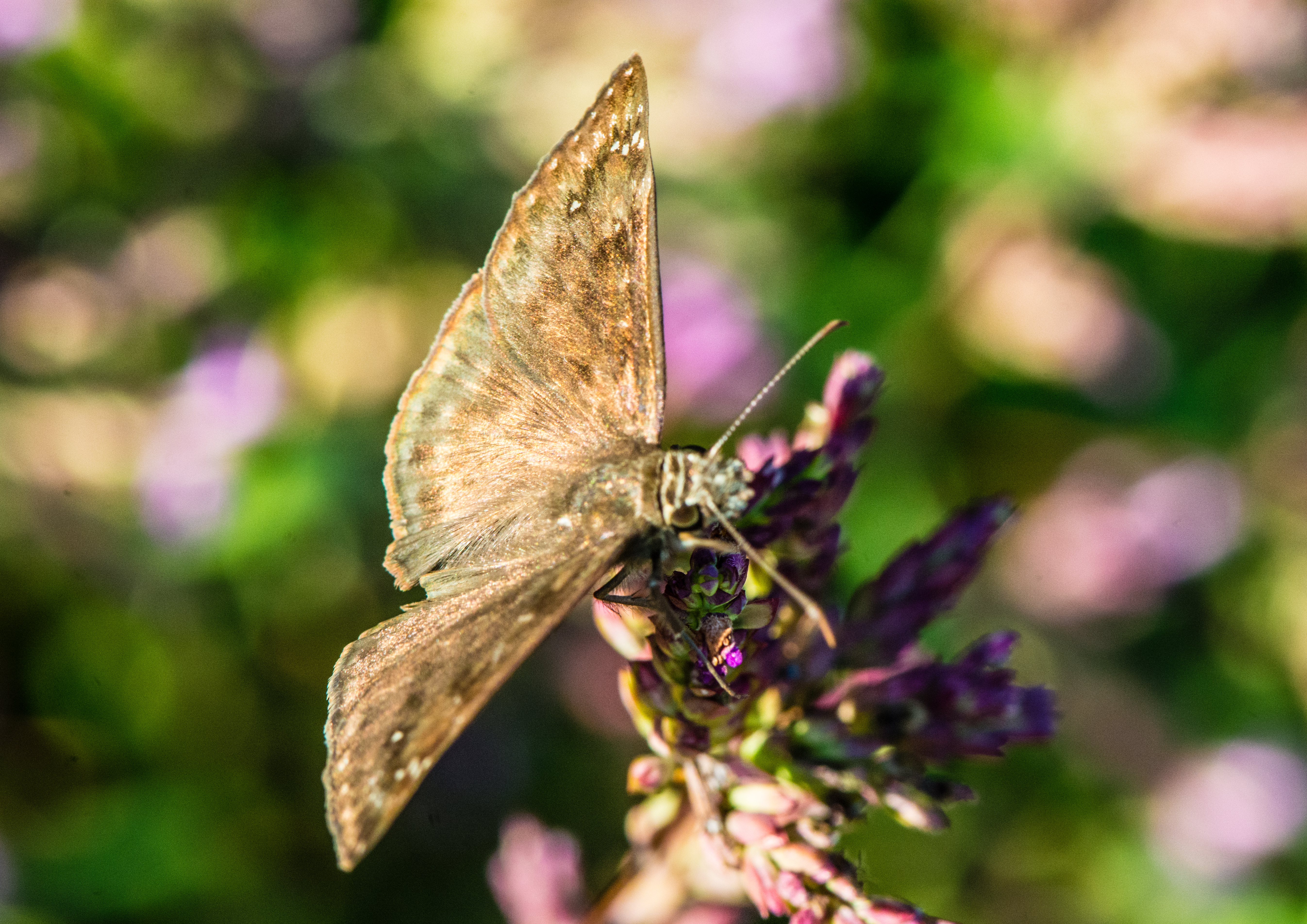
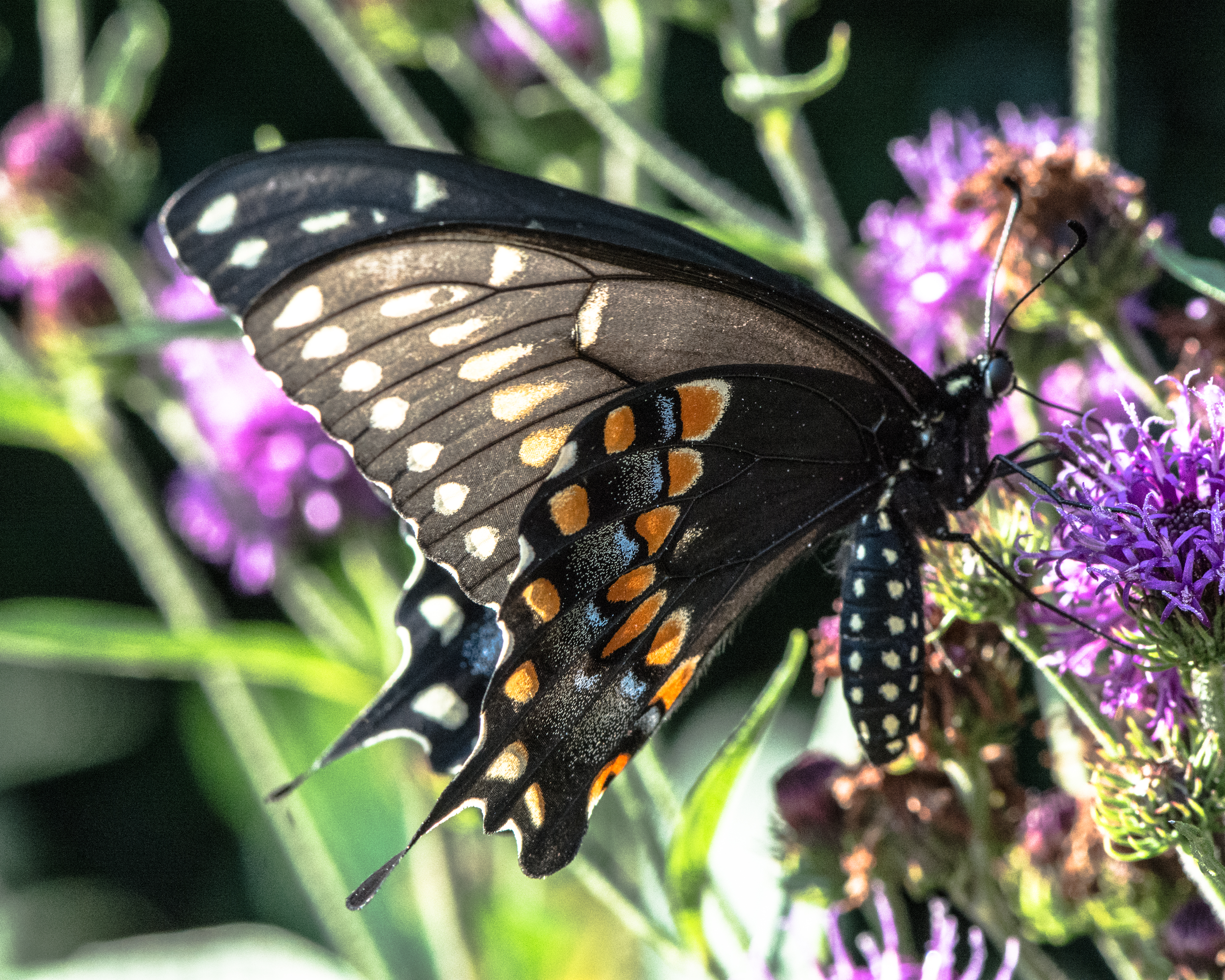
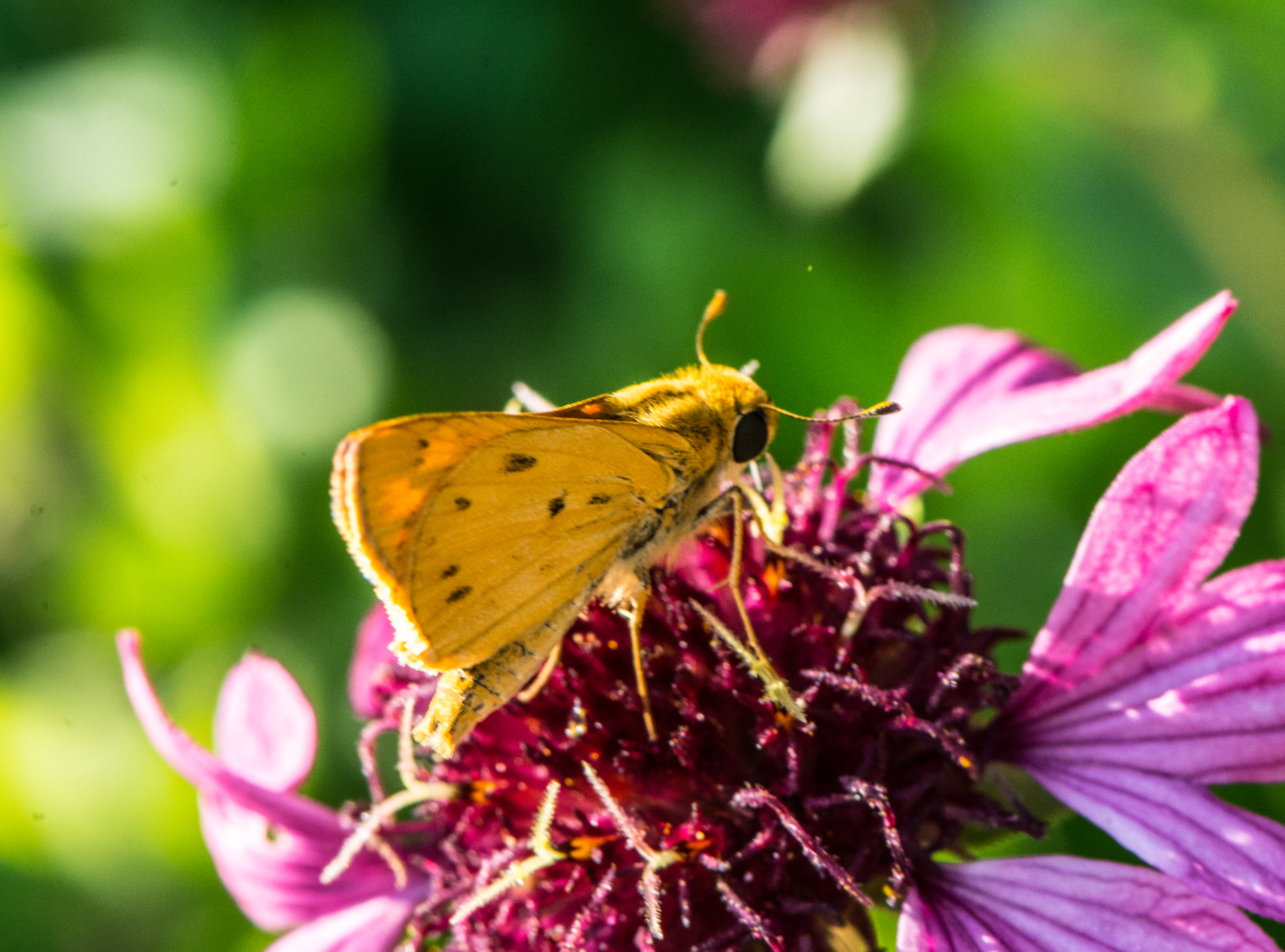
After work on Friday, I zipped up to Raulston Arboretum with my camera to see what was blooming and flying. It’s a lovely place, and it’s soothing to stroll among the quiet growing things. But when you’re trying to manually focus the camera on tiny quick-moving creatures, there’s a burst of adrenaline. When it all clicks, I feel happy. This week there was a profusion of butterflies, and I had good luck in capturing images of a few.
Raulston Arboretum-1587

I’ve been reading the book Diane gave me, Travels in Vermeer, by Michael White. It’s a memoir about a tough time in White’s personal life, which was relieved by his falling in love with the art of Vermeer, the 17th century Dutch artist. I share his passion for these rare paintings, and like his accounts of his personal encounters with the master’s work.

White shows how feelings flow out of the paintings, and how they reward the viewer who keeps looking and looking. This is one way to tell when art is truly great — when you can’t exhaust it. I had the bright idea of googling the paintings as I came to his descriptions, and confirmed that Google takes far less than a second to locate a decent image of any Vermeer you care to name. It enriched the reading experience.
Raulston Arboretum-1542

As I mentioned last week, I’ve been listening to audio book lectures while working out about ancient Greece and Rome. This week I learned that as much as a third of the population of classical Athens were slaves. For all the pathbreaking philosophers among the Greeks, it appears that none of those great minds questioned the institution of slavery. Though I found this surprising, it also occurred to me that there have been and are still huge blind spots in our moral vision. I’m thinking of those things that are almost impossible to think about, let alone criticize, let alone change, because they’re so integral to the way we live. An example: our industrialized cruelty to farm animals.

Raulston Arboretum, July 24, 2015

Raulston Arboretum, July 24, 2015

But these things can seem unshakably settled and then get unsettled. Think of progress on racism, sexism, homophobia, and our heedless destruction of the natural world. This seems to be happening with our views of imprisonment. This week President Obama visited a federal prison and spoke out about some of our most egregiously cruel practices with regard to convicted criminals, including solitary confinement.

What’s wrong with solitary confinement? The NY Times nailed it.

“When they get out, they are broken,” said Dr. Terry Kupers, a psychiatrist in California who consults on prison conditions and mental health programs. “This is permanent damage.” Cornell William Brooks, the president of the N.A.A.C.P., said prolonged solitary confinement amounted to torture. “Putting someone in solitary confinement does horrible things to a person’s personality, their psyche, their character,” he said.

It seems like we’re starting to be able to see this problem and address it.
Raulston Arboretum-1523

And it seems like a good thing that Iran has agreed in principle to back off from building nuclear weapons. What’s not to like? Our usual unquestioning acceptance of the possibility of massive nuclear destruction is sort of like the Greeks and slavery – we just can’t bring ourselves to think about it. But we know, in the back of our minds, that existing hydrogen bombs, always on alert and ready for launch, always subject to human error, could quickly end life as we know it. Shouldn’t we be pushing our governments to find ways to back off the nuclear precipice? If you aren’t familiar with the science regarding nuclear winter, information is here.
Raulston Arboretum-1514

Processing a hand problem, Shen Wei dance, and The Unpersuadables

Raulston 6-12-15-0039
It’s been more than a year since I injured my right hand in Dominica, and though it got better for a while, it still does not feel right. I was trying to play Chopin’s Fantaisie Impromptu recently, and just could not get the loud, fast parts to go loud and fast. I made an appointment with Dr. Edwards at the Raleigh Hand Clinic, with a view to getting a referral to an occupational therapist I’d heard about, and getting some helpful exercises to fix me up. I saw him on Friday, and got some bad news.

Based on X-rays (which he showed me on his iPhone), Dr. E quickly diagnosed osteoarthritis. This is one of those things that don’t get better, and generally get worse. He could not say how quickly it would progress. The doc recommended Aleve for pain. He mentioned that if it got a lot worse, I could eventually be a candidate for finger joint replacement surgery. Yikes!

As a youth, I tended to view intellectual pleasures as superior to physical ones, but eventually I came to welcome the physical side of life as a glorious thing. I’ve taken great satisfaction in dexterous use of my hands, on the piano keys, the computer keys, the camera buttons, and many other places. This diagnosis will take some time to process. Though, of course, life will go on.
Raulston 6-12-15-0050

On Saturday we met up with some friends in Durham and had fine dinner at Rue Cler. Then we walked over to DPAC and saw a modern dance program by Shen Wei, the first show of the season at the American Dance Festival. The first SW piece, Untitled No. 12-2, started slowly: the curtain came up to reveal gray fog, and there was silence and blankness happened for a surprisingly long interval. Then we saw projections of abstract paintings by Mr. Wei. Eventually the troop began a slow traverse of the stage, with accents by individuals. The music was sparse percussion sounds. I found the piece overly spare and intellectual and underly physical.

The second piece, Map, was much livelier, with music of Steve Reich and large helium balloons. The choreography seemed well atuned to the energetic music, with sweeping gestures and twists, and small groupings moving in and out of phase. We liked it.

Afterwards, we walked over to 21C, the new luxury hotel in the former SunTrust building, and looked at their bold and brash collection of contemporary art. It’s open to the public, and free, and fun. Afterwards we stopped in a new place, Bar Lusconi, for an exotic beer.
Raulston 6-12-15-0062

Today I finished reading The Unpersuadables: Adventures with the Enemies of Science, by Will Storr. Storr narrates his encounters with intelligent people who believe crazy things, such as Holocaust deniers, past life regressionists, alien abduction experiencers, climate change deniers, and young earth creationists. In interviews, Storr challenges these folks, and confirms that they are impervious to reason and facts. Nothing can shake their beliefs. By way of partial psychological explanation, he draws on the work of Kahneman, Haidt, Ariely, Gazzaniga, Tavris, and Aronson regarding the inherent flaws in our mental processes, such as cognitive dissonance, confirmation bias, and unstable memories.

Storr is a journalist rather than a scientist, but he incorporates good source material and has genuine insight into the powerful illusions of consciousness. The book is also surprisingly personal, as Storr unflinchingly addresses his own biases and weaknesses. He recognizes that scientists can at times be highly unscientific, engaging in groupthink and suppression of evidence that doesn’t fit their world view. Perhaps most amazingly, as he engages with individuals who construct bizarre and odious theories, he manages to subject their ideas to fair scrutiny and at the same time respect their humanity.
Raulston 6-12-15-0082

Our anniversary – Astonishing cave paintings – Our TSA – Fear itself

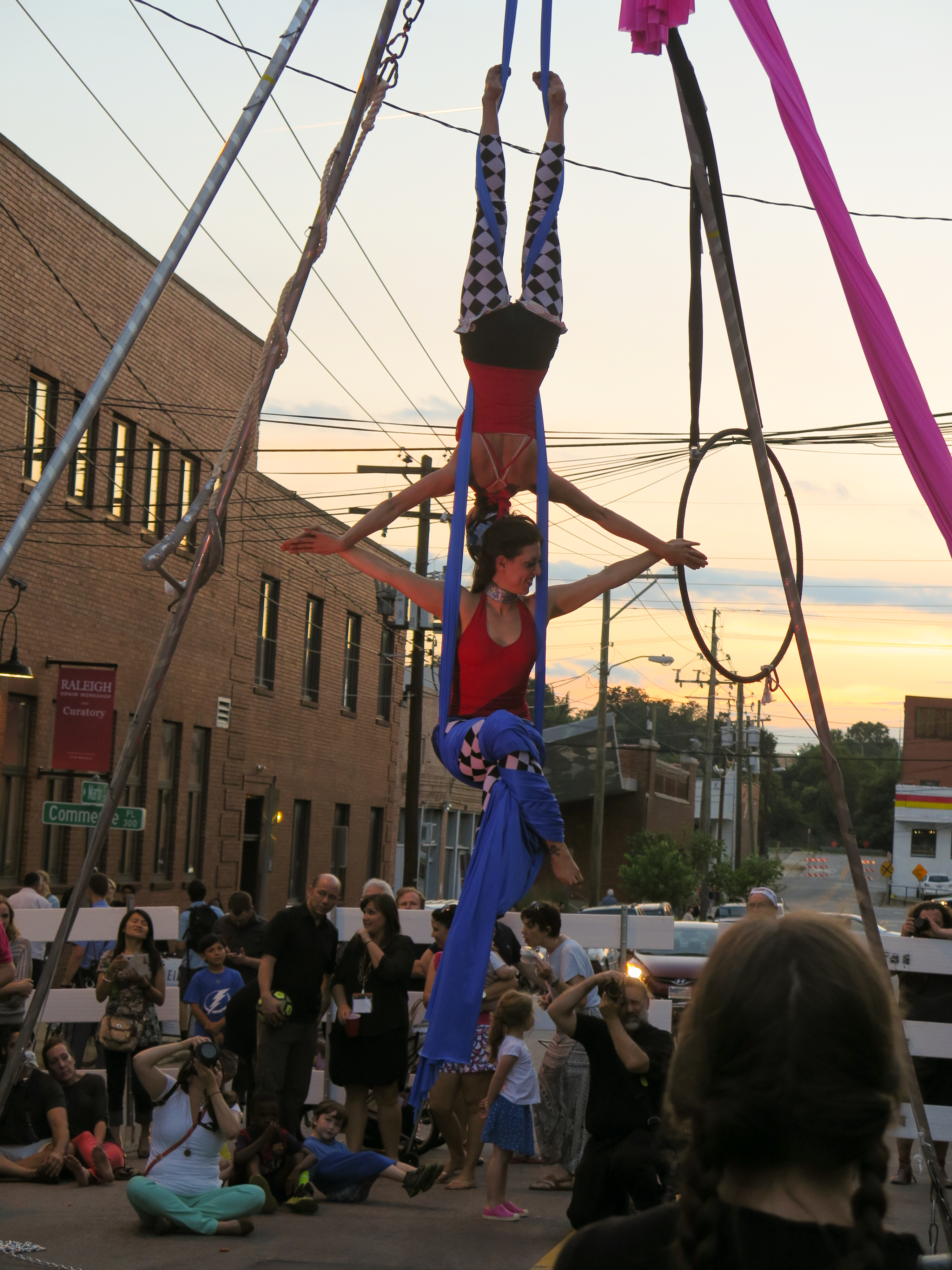
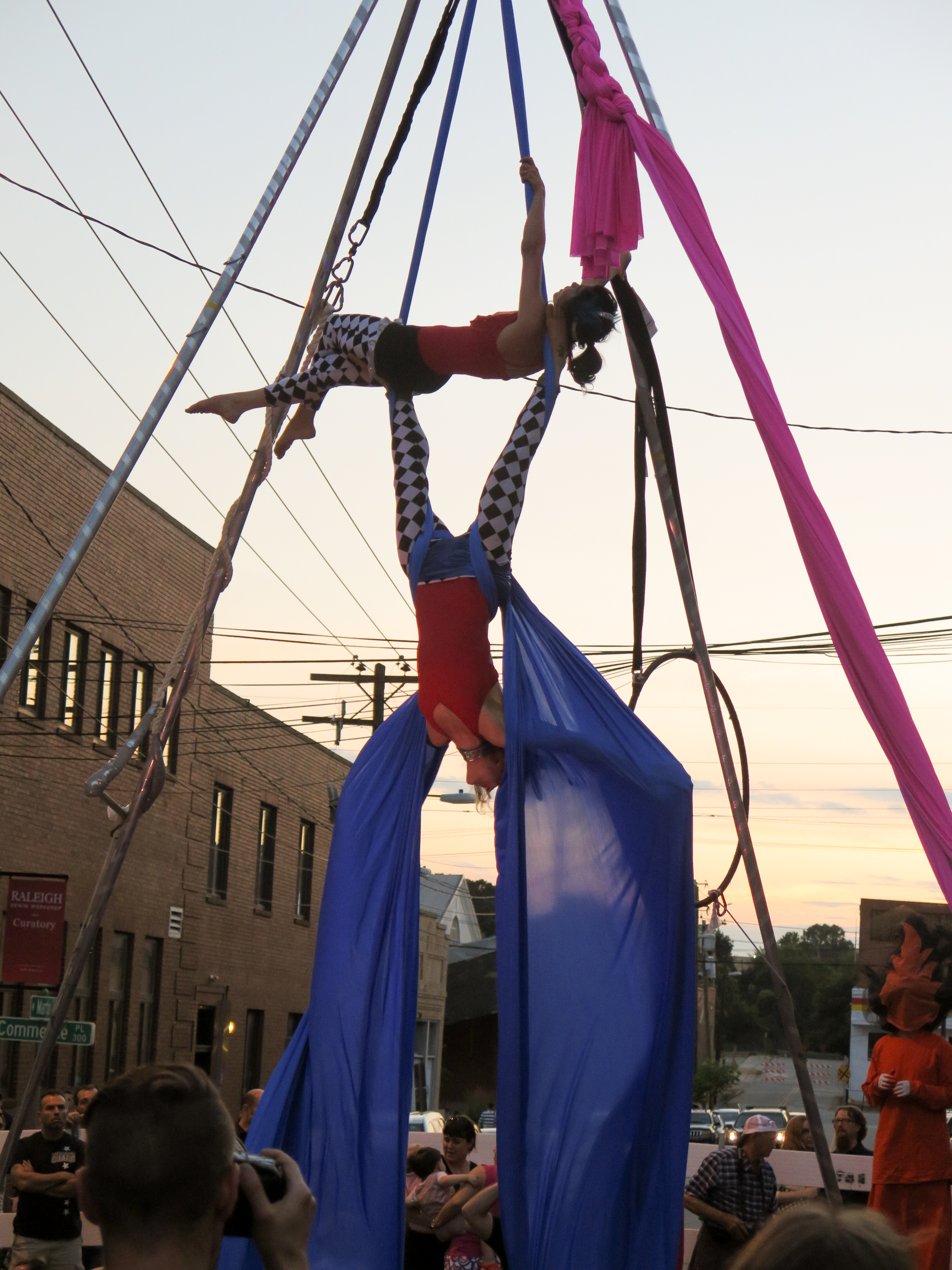
Performers on West Martin Street at sunset, June 5, 2015

Performers on West Martin Street at sunset, June 5, 2015

Friday was our 33rd anniversary. Yes, that is something. What amazing good fortune to find my beloved, to persuade her I was the one for her, and to get her to make me the happiest of men. We don’t usually do anniversary gifts, but we gave each other a kiss and affectionate cards, and I gave Sally a little heart-shaped stone, which she said she would treasure always. We had a fine Italian dinner at our old standby, Caffe Luna, where they had good pesto linguine and sweetly treated us to dessert.
20150605-IMG_0676First Friday-Anniversaryuntitled shoot

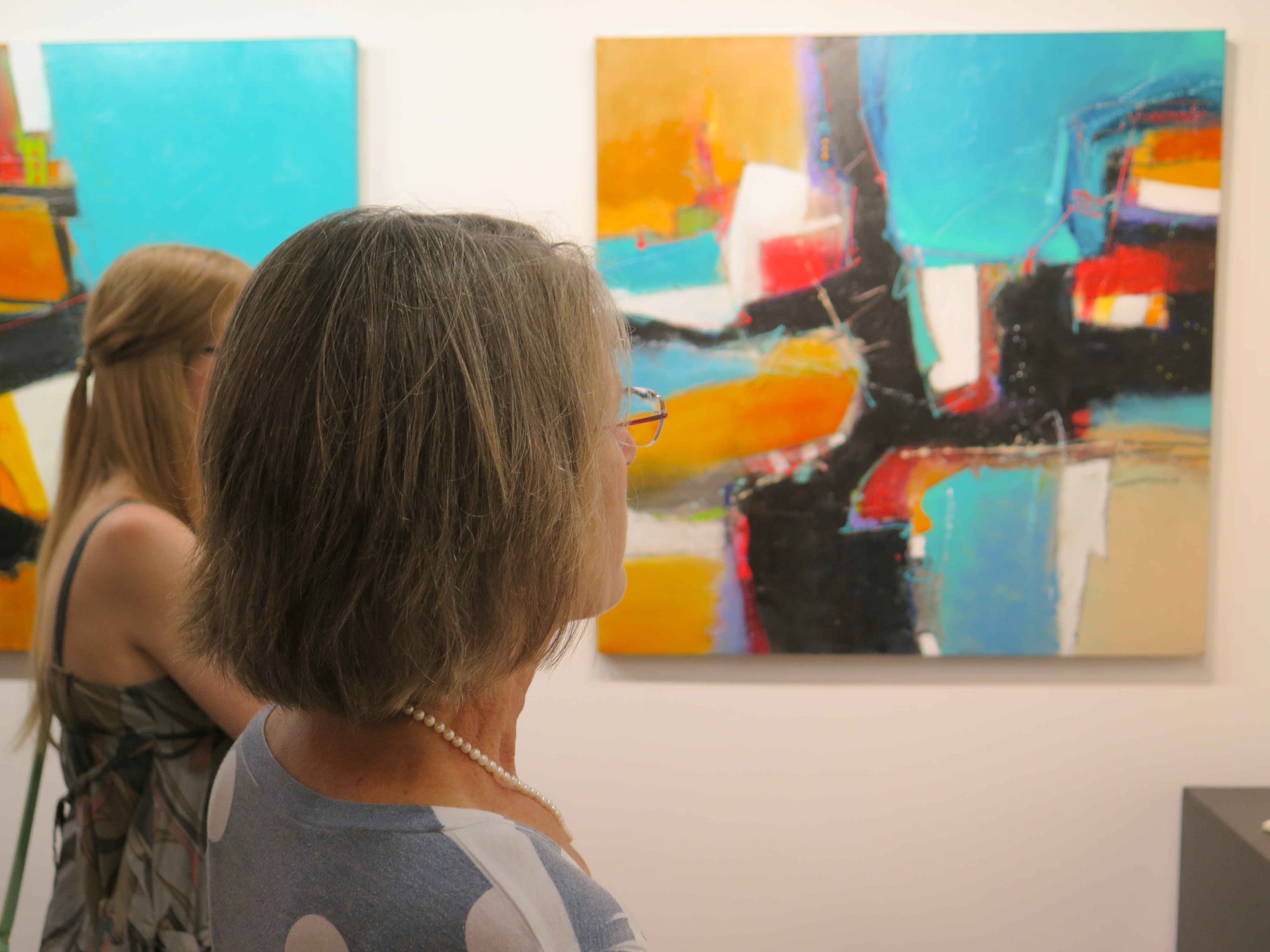
Then we looked in some galleries that were open late for First Friday. At ArtSpace, there were several engaging paintings that had been in a competition, and also some old friends to chat with. In the warehouse district, there was a mini-street fair, with circus performers and musicians. 311 Gallery had some colorful abstract paintings by Joseph DiGiulio that we particularly enjoyed.
20150605-IMG_0681First Friday-Anniversaryuntitled shoot

On Saturday evening, we cocooned at home: Indian takeout food from Blue Mango (delicious!) and Cave of Forgotten Dreams on Netflix. This documentary by Werner Herzog examines the Chauvet Cave paintings in Southern France. I’d been very curious to see these paintings, and since they are firmly closed to the public, this is likely the closest I’ll ever get. Herzog’s narration is rather stolid, but the paintings are thrilling. Painted some 30 thousand years ago, they depict bison, horses, rhinos and other creatures with astonishing freedom and vigor. Pictures are here.

At the gym, making my rounds among the various weight systems and cardio machines, I’ve been listening to a podcast called You Are Not So Smart. Its subject is human psychology, and particularly the biases and systemic flaws that our thinking is subject to. We tend to feel that our thinking is usually rational and objective, but this is very often not even close to true. Knowing this may sometimes help us avoid grievous mistakes. At any rate, it’s worth a shot.

Case in point: we learned last week that the TSA (the airport screening folks) performed quite badly in tests of their systems. When the testers impersonated potential terrorists, they were able to get forbidden items, like fake bombs and guns past the screeners in 95 percent of the cases. 95 percent! Let it be noted, however, that the screeners might have done better had they been tested on seizing expensive moisturizers and nail clippers.

Seriously, at first, I found this disturbing. And annoying! Think of almost every American air traveler, for years and years, all those hours, waiting anxiously in line – all the taking off your shoes, jackets, and belts, emptying all your pockets, pulling out laptops (but, oddly, not tablets), getting your privates exposed by scanning machines, and sometimes your stuff rifled through, and your self physically groped and interrogated, and occasionally missing your flight – and all of it accomplishing nothing.

The massive inconvenience that the TSA process imposes on the flying public looks like a huge waste of taxpayer dollars and time. But then I realized, we haven’t heard of any airplanes blowing up for a long time. If the TSA isn’t stopping would-be terrorists, and no planes are blowing up, that’s probably because there aren’t many terrorists trying to blow up planes. That’s a good thing! But it also suggests that the terrorist threat is way overblown (as I’ve long maintained).
20150606-_DSC0014First Friday-Anniversaryuntitled shoot-2

So why do we put up with this absurd system? The You Are Not So Smart podcast introduces various interesting terms for the psychological syndromes that lead us astray. I’m thinking there should be a name for the particular glitch in the human thinking system that inclines us to widespread panic once exposed to a dramatic dangerous event, like 9/11. Fourteen years after that horrible disaster, we’ve not seen anything remotely close to another such dangerous terrorist attack, and yet we’re obsessed with the idea.

What is the thing that makes us exaggerate our fear so much that we tolerate the TSA’s groping, the NSA’s incursions on our privacy, and invasions and occupations of countries that are not threatening us? Fearophilia? Politicians’ and journalists’ fear mongering helps produce it, so perhaps – mongerization? Probably not. Whatever we call it, it spreads rapidly through a population like a virus, and once an infection occurs it is devilishly hard to cure. For years now, we’ve seen the world through fear-colored glasses.

Part of this syndrome is a tendency to think violent radical ideologies are all focused on us, in a kind of mass egocentrism. This week the advances of ISIS gave strong evidence to the contrary, as these kooks with a surprising talent for horrific executions advanced in Syria and Iraq. As radical Sunnis, they’re eager to fight less radical Sunnis, Shiites, and any other Muslims or others that care to disagree with them, so they can establish the Caliphate. Do we care what their theological thinking is on this? Hardly. Who doesn’t have more interesting, pressing, and sane things to think about? It’s not our problem, or our world.

Last week there was NY Times reported that ISIS has been attacking the Taliban in Afghanistan. Which is worse? Before you answer, remember, we’ve been fighting the Taliban in Afghanistan since 2001, the longest war in American history. The Times also reported that Syria’s thuggish president Assad, a presumed target of ISIS, was coordinating with ISIS in giving air support for attacks on other rebel groups.

This seemed contrary to all previous reporting, and I wondered if it was pure propaganda (perhaps by another rebel group, or Assad, or ISIS, or – us?). But even if false, it reinforces that we cannot begin to fathom the complexity of the variables in this war, and so cannot reasonably hope to have a positive effect, let alone win it. It is just outside our realm, and our weapons will not resolve it.

Apropos of that, the Atlantic has a good piece by Dominic Tierney on the paradox of American military power: with the most powerful military on earth, we keep getting into military quagmires we cannot win. Tierney notes that we have failed to recognize that almost all modern wars are civil wars, in which our military advantage is less effective than in wars between nation states. And because we still think we cannot be defeated, we cannot admit defeat. The piece is bold, and worth reading.

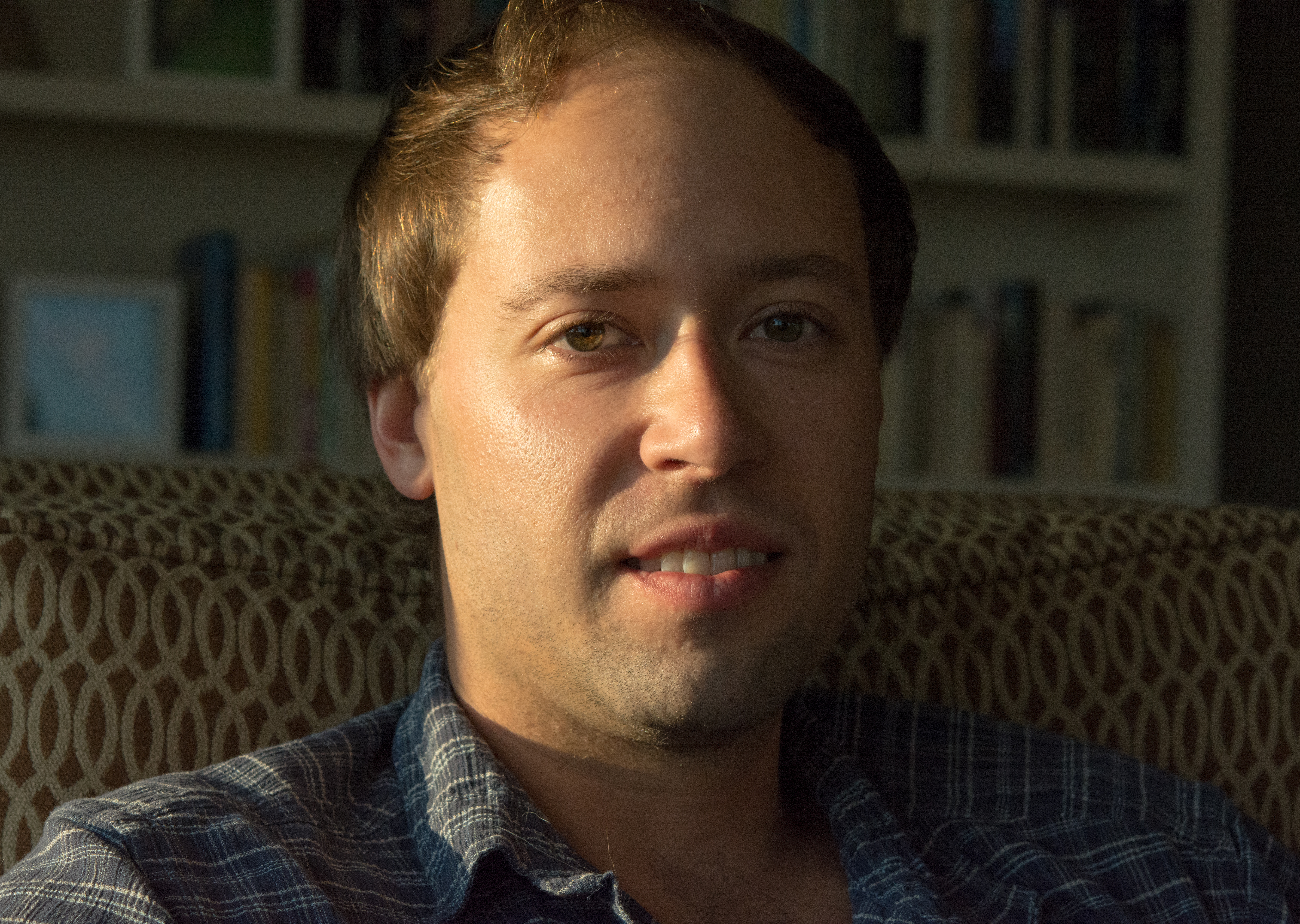
Gabe, testing out new glasses

Gabe, testing out new glasses

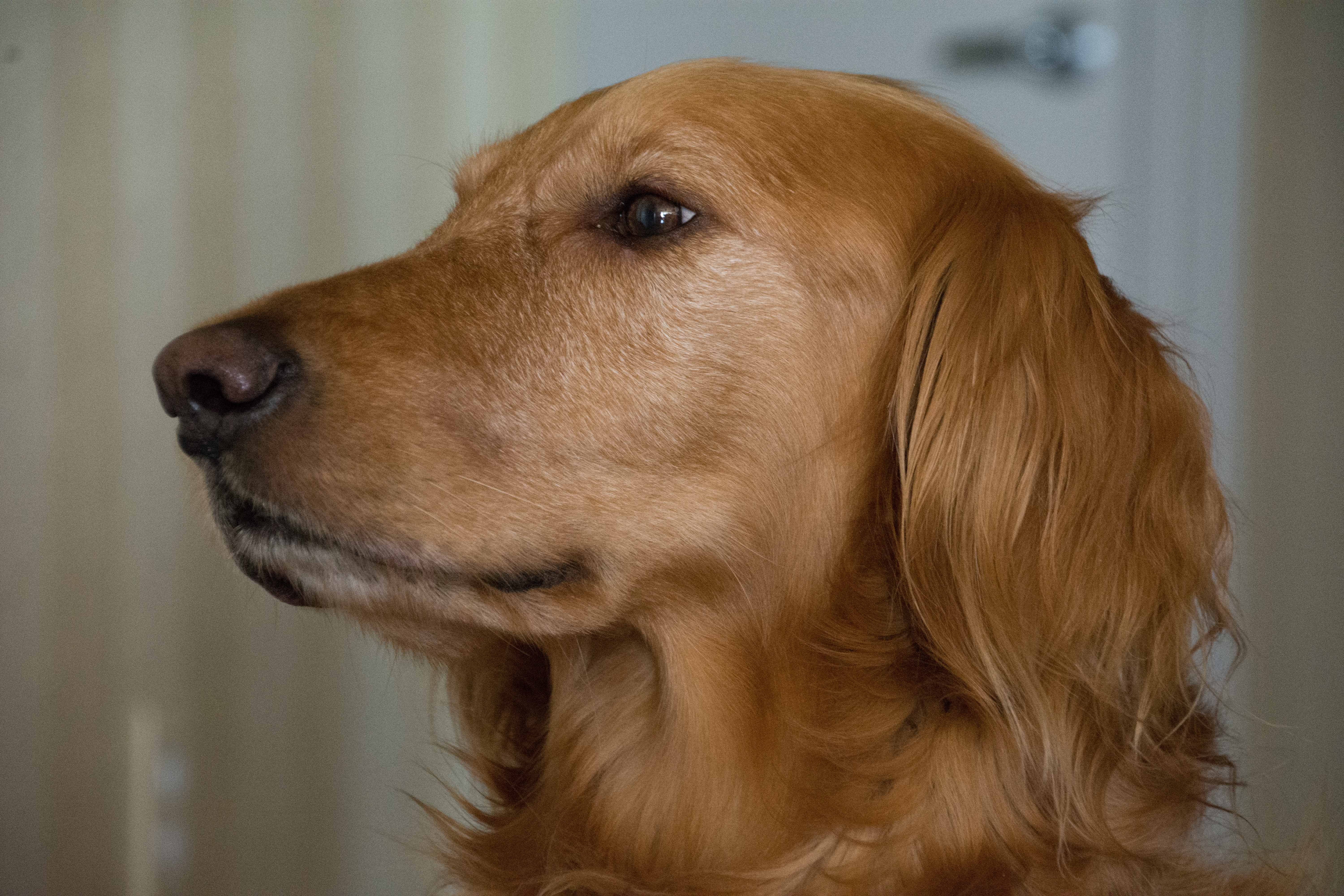
Gabe normally resists being photographed, but he agreed to let me take a few shots on Saturday at sunset. My favorite was one of him shirtless, looking handsome, but he did not want it published. I’ve also been trying to get a good shot of his golden retriever, Mowgli. He’s an affectionate dog, surprisingly laid back. This is the best pic so far.

20150606-_DSC9972First Friday-Anniversaryuntitled shoot

Our Memorial Day weekend in New York — great ballet, art, and ethnic food

The New York Palace (that's our place on the 32nd floor) and St. Patrick's Cathedral

The New York Palace (that’s our place on the 32nd floor) and St. Patrick’s Cathedral

For Memorial Day weekend, we went up to New York City to see our sweet Jocelyn and get an infusion of arts and food. I’d bought tickets to both the NYC Ballet and the American Ballet Theatre, and wanted to see the new Whitney Museum. We designated Jocelyn as the food concierge, and she booked us into some fun ethnic restaurants. After going back and forth, I decided not to lug along my big DSLR kit, and instead took my compact Canon G16, with the results shown here.

Sunset right after we checked in at the New York Palace

Sunset right after we checked in at the New York Palace

The flight up went smoothly (storage room remaining in the overhead bin, on time departure, seatmate not apparently infectious). I read a piece in the last New Yorker on Marc Andreessen, the famous Silicon Valley tech entrepreneur and venture capitalist. It was a good primer on what VC is and does, and seemed like a fair portrait of Andreesen and his firm (Andreesen Horowitz). He is, of course, intelligent and richer than Croesus, but, it turns out, sort of inexpressive and unadventurous in his personal life. (His likes watching television.) And for all his successful bets on where technology is about to go, he seems in complete denial about the big economic changes technology is bringing, like rising inequality and unemployment. Cognitive dissonance, perhaps?

We stayed at the New York Palace on Madison and 50th. This hotel opened in 1981, when we lived in Manhattan, and was known as the Helmsley Palace, with ads that featured a then-famous dragon lady named Leona Helmsley touting its remarkable luxuriousness in a loathsome way. Now rebranded (thank goodness), it is quite a fine hotel, and from our room on the 32d floor we had good views of Manhattan towers and a sliver of the East River.
IMG_0434
We had dinner in Curry Hill, the little Indian restaurant neighborhood at 28th and Lexington, at Chote Nawab. It’s a lively place, and the food was good, but our server was amazingly inattentive. Even so, we had fun catching up.

It was remarkably clear on Saturday morning and a bit chilly when we went down to the meat packing district to the new Whitney, which is situated on Gansevoort right where the High Line starts. It took a minute to absorb that the line to get in was a block long, and we kicked ourselves for not buying tickets in advance. But the line moved quickly, and we were inside in about 20 minutes. The place was crowded, but with a little patience we managed to get close to the pieces that interested us.

Eva Hesse's last work before her death at 34

Eva Hesse’s last work before her death at 34

The current exhibition is called America is Hard to See, which is so true, and is a loosely chronological survey of some of the key examples of the Whitney’s permanent collection. It starts on the eighth floor (the top) with the beginning of the 20th century, and comes down and toward the present. The works were given a good amount of space, and where there were narrative labels, they were helpful.

At this point in my own art historical education, Abstract Expressionism from the 50s seems more like an old friend than a shocker. But I found myself moved and shaken by some of the political art of the 60s (some of the big issues of that time are still big issues). I also engaged with the minimalism and conceptualism from more recent decades. It struck me that this was art intended to be discussed, to expand out into a social dialog. It wasn’t about just looking — it was also about talking.

The Whitney's decks

The Whitney’s decks

In addition to the fine display spaces, the new museum has large outdoor decks. We lucked out, with beautiful weather, and after each floor, we stepped out in the sun clear our heads and enjoy the wonderful cityscape views.

Looking south from the Whitney at the new Freedom Tower

Looking south from the Whitney at the new Freedom Tower

We’d thought of visiting some galleries in the area after the museum, but after two and a half hours at the Whitney I was more than sufficiently stimulated, and a bit wrung out. Jocelyn met us outside the museum, and we walked up to the Flatiron District, where we had good lunch at a Korean place called Barn Joo.

Then Jocelyn gave us a tour of her offices in the Flatiron Building. This iconic triangular building at 23d and Broadway, completed in 1902, was one of the first skyscrapers in New York. J’s employer, Macmillan Publishers, is now the sole tenant. The offices were nothing fancy, but still fun to see. It reminded me of our offices at The New Yorker in the late 70s. There was a great view of the Empire State Building from the northern point of the building.

The Flatiron Building

The Flatiron Building

We poked around in Eataly, a giant gourmet grocery and restaurants space, which was very crowded and fully of delicious smells. Jocelyn promoted the cookies at a bakery a few doors down as the best in New York, so we bought three and ordered coffee. The barista for some reason had trouble with our order, and took ten minutes to produce various beverages we had not ordered. We consumed them at a table near Madison Square Park. My cookie was a good mix of smooth and crunchy, and I enjoyed it very much.

The Empire State Building, from the Flatiron Building

The Empire State Building, from the Flatiron Building

We had dinner at Boulud Sud, a Mediterranean Restaurant at 64th St. near Lincoln Center. The place was bustling. There were no veggie options on the menu, but they proposed a gnocchi dish that was good.

We finished dinner with enough time (barely) to get to our seats at the Metropolitan Opera House to see the American Ballet Theatre perform Giselle. I was interested in Giselle in part for its historical significance as one of the oldest ballets still in the common repertoire. It was first performed in Paris in 1841, with Carlotta Grisi as Giselle and Lucien Petipa as Albrecht. It must have been astonishing at the time to see the women rise and hover en pointe.

This production had Stella Abrera as Giselle and Vladimir Shklyarov as Albrecht. Abrera was not previously known to me, but I will not forget her. She was sublime. Her gestures seemed somehow to be magnified and extended, with a remarkable emotional intensity, without being overstated. Shklyarov was also excellent. In the second act, the ethereal Wilis were spookily graceful, and when they tried to dance Albrecht to death, Shklyarov was so fervid that it seemed on the verge of real danger. The ovation was tremendous by New York standards, with the audience clapping for about 10 minutes. After I drafted this, I saw Alastair McCaulay’s review in the Times, which was a rave for Abrera.

The Metropolitan Museum of Art

The Metropolitan Museum of Art

On Sunday morning we took a taxi up to the Metropolitan Museum. I’d been looking forward to seeing an exhibit of the art of the plains Indians, but it had, unfortunately, closed. But there is always a lot to see at the Met. We started with a tiny exhibit of Van Gogh’s irises and roses, which had four paintings. The signs explained that the red pigment in the paintings had deteriorated and changed the colors of the paintings, and a video offered an interpretation of what they must have looked like. We spent time with the Lehman collection of Impressionists and Post-Impressionists, thirty or so great paintings that sum of the field amazingly well.

A Vermeer that just kills me

A Vermeer that just kills me

Then we made our way to the galleries with the Vermeers and Rembrandts. I listened to an interesting podcast the previous week with a debate on whether Rembrandt or Vermeer was the greater artist, and confirmed that I’m more of a Vermeer man. The Met has 5 of the 35 or so existing Vermeers, and I particularly love a couple of them. We also spent time looking at the pre-Colombian art, which is getting more and more interesting to me, and African art.
IMG_0605

We met Jocelyn for lunch on the West side at Nanoosh, a Mediterranean spot, and I had some delicious falafel. Then Jocelyn came with me to Lincoln Center to see the New York City Ballet perform La Sylphide. This was, again, for me partly about ballet history, since La Sylphide is another path-breaking early work, from 1834 by August Bournonville. Lauren Lovette was the Sylph, and Anthony Huxley was James. The corps of Sylphs in Act II was, like the Wilis in Giselle, all in diaphanous white tulle, and entrancing. Lovette danced beautifully.

Jocelyn outside the David H. Koch (aka "El Diablo") Theater

Jocelyn outside the David H. Koch (aka “El Diablo”) Theater

After the ballet we went down to the west Village, where we found an outside table and sipped wine, then had dinner at Pagani, an Italian restaurant. We liked our food, and the service was good until dessert time, when things suddenly came to a halt. The staff regrouped, though, and comped our tiramisu.

On Sunday morning we checked out and took a cab out to Jocelyn’s place in Fort Greene, Brooklyn. Her area seemed sort of Village-like, at least on a sunny Memorial Day holiday. We met up with our and J’s old friend Kathryn M, and ate at a South African restaurant called Madiba, which had a lot of funky charm, though it took a while to get a beer. I had the vegetable Durban curry, and liked it, and heard about Kathryn’s new admin job at Victoria’s Secret.

Then we went to the Brooklyn Botanic Gardens, where there were things that were blooming and things that were not. I didn’t see a great diversity of species, but the landscaping was pretty. We also took a stroll through some of Prospect Park. There were hundreds of Brooklynites picnicking, playing, and soaking in the sun.

Seeing a bit of Barcelona and Madrid

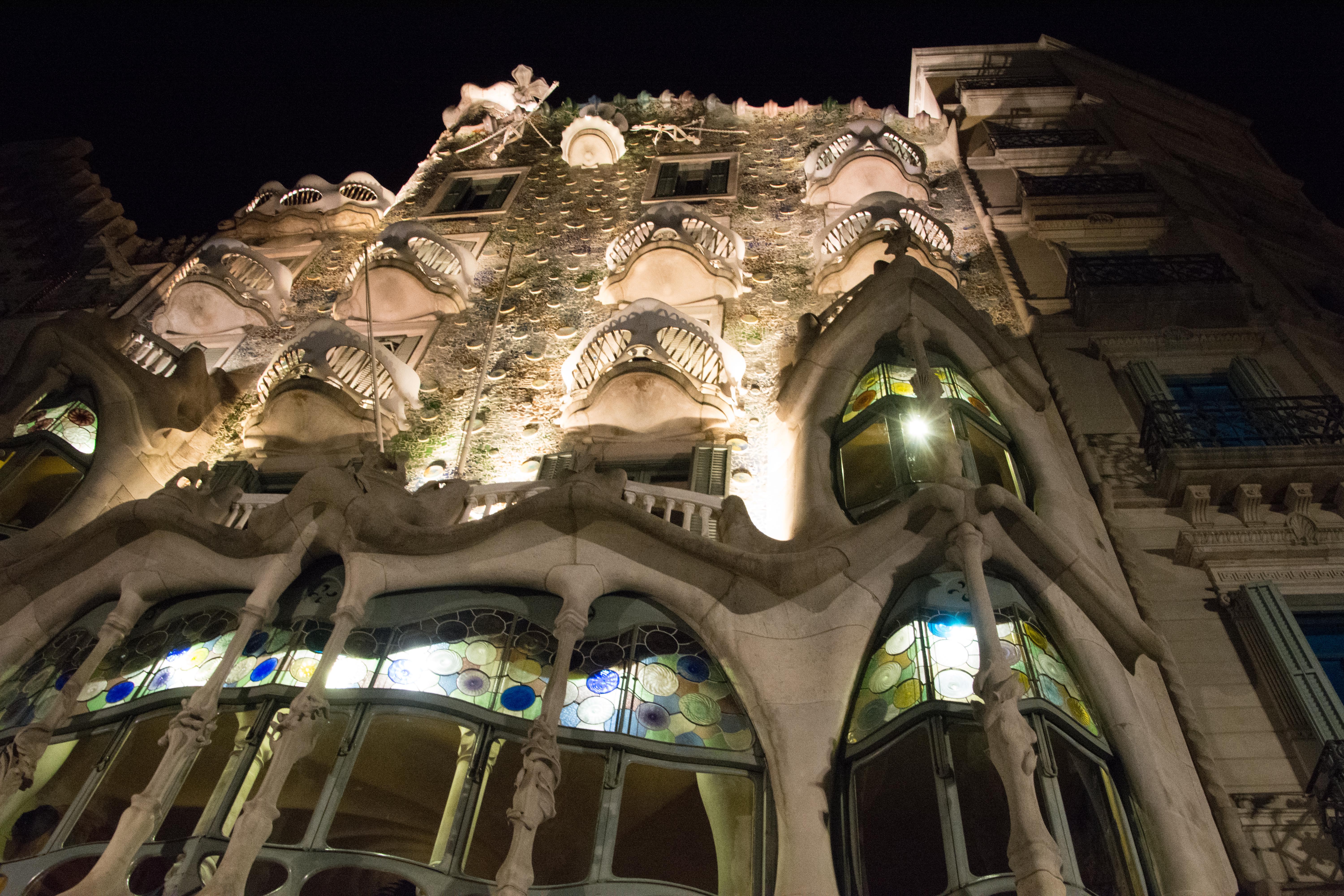
Antoni Gaudi's Casa Batllo

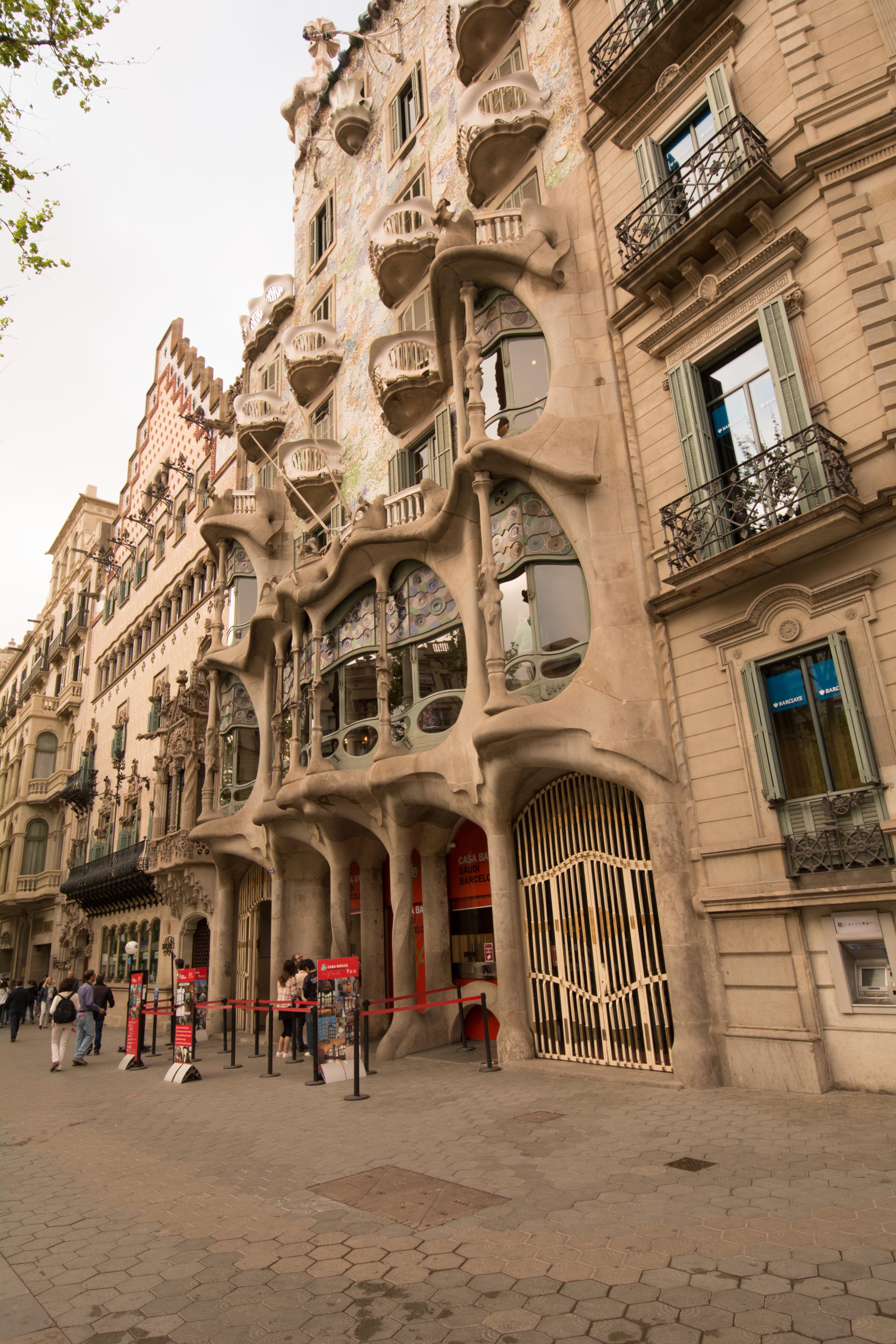
Antoni Gaudi’s Casa Batllo

Last week I went to Barcelona for the legal workshop of the Free Software Foundation Europe. The annual event attracts the leading legal thinkers on free and open source software from across Europe, as well as a good many from the US and Asia. This was my third year at the conference, and it was good to see friends and discuss FOSS issues. Before and after the conference I explored some of Barcelona and Madrid.

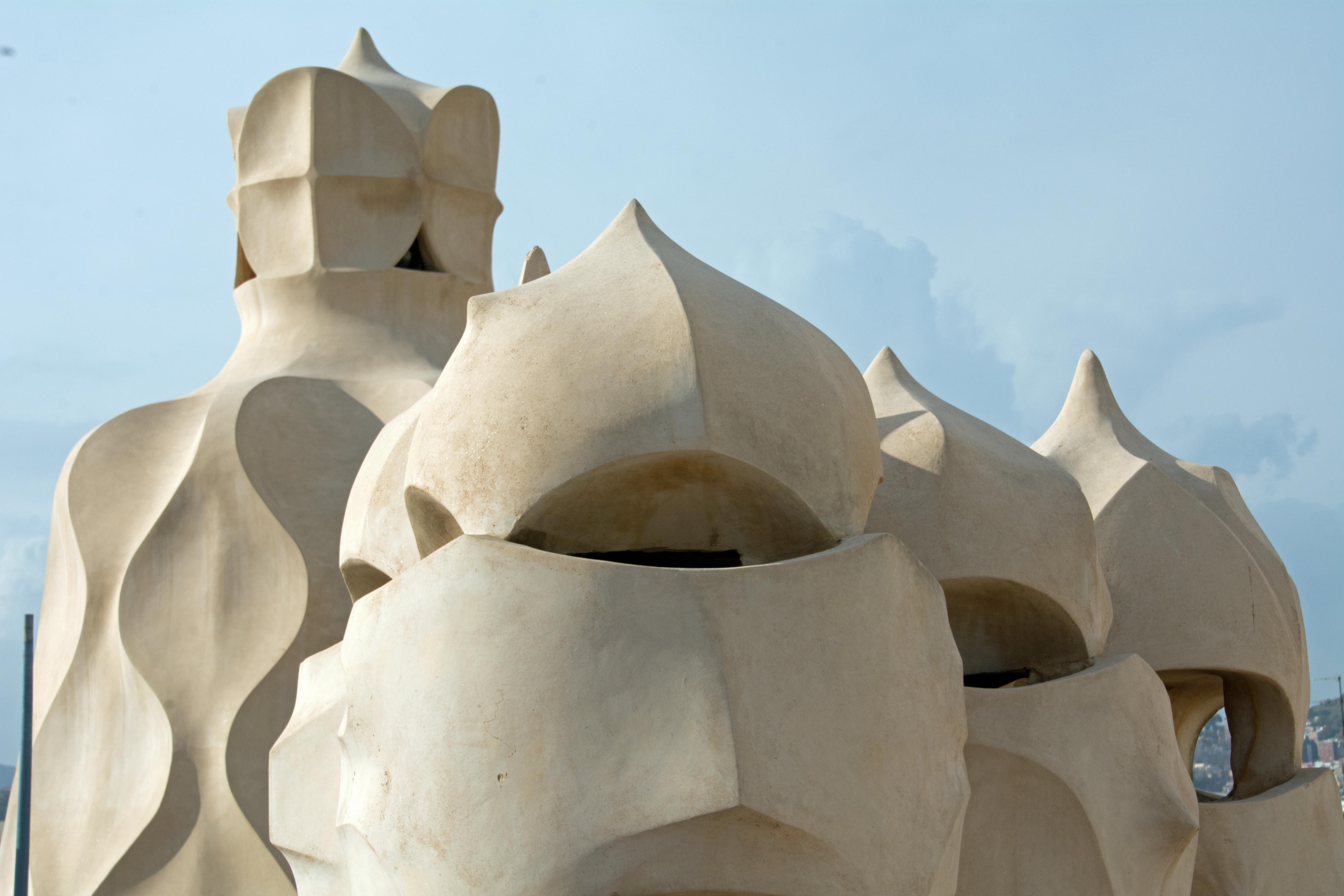
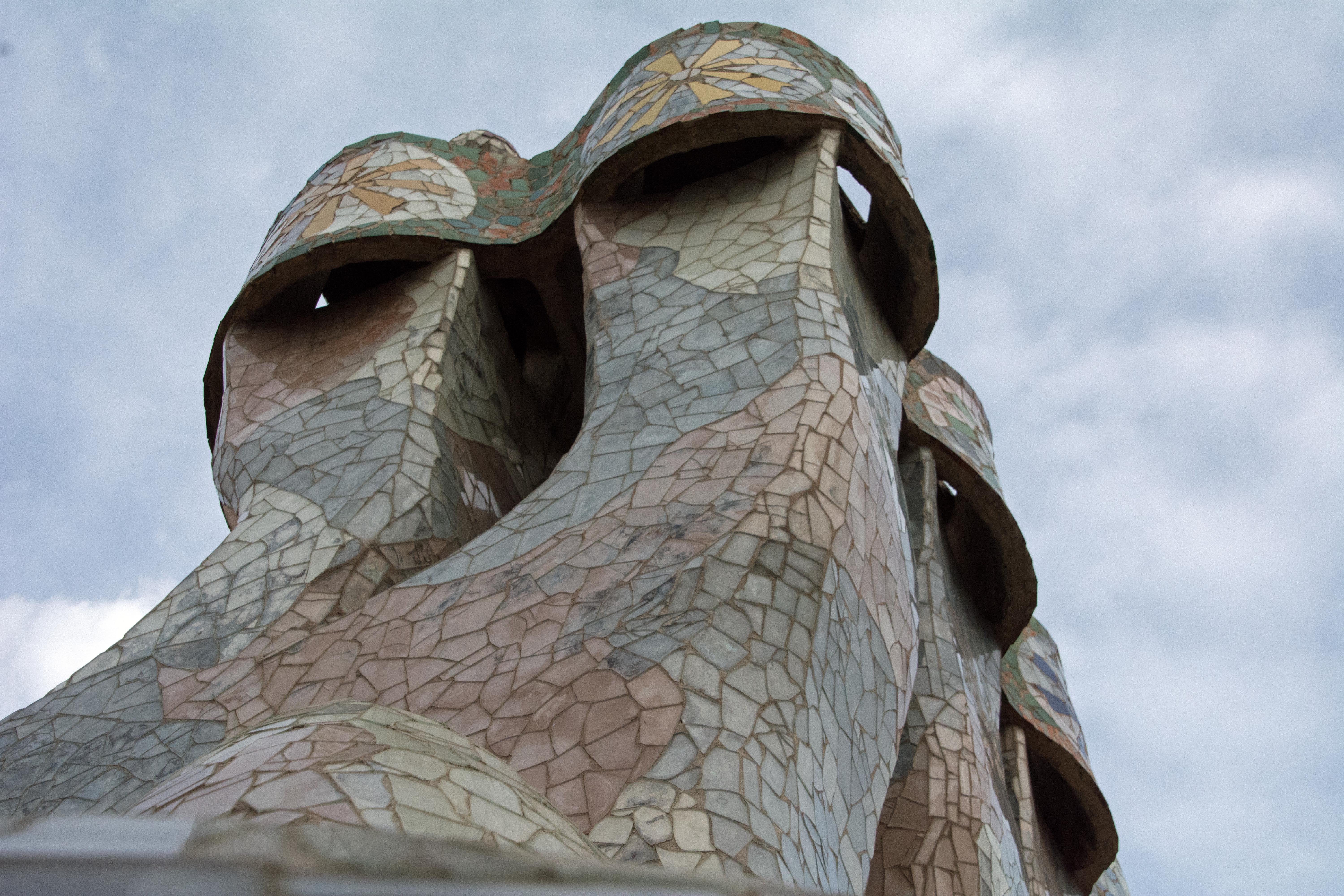
On the roof of Gaudi's La Pedrera

On the roof of Gaudi’s La Pedrera

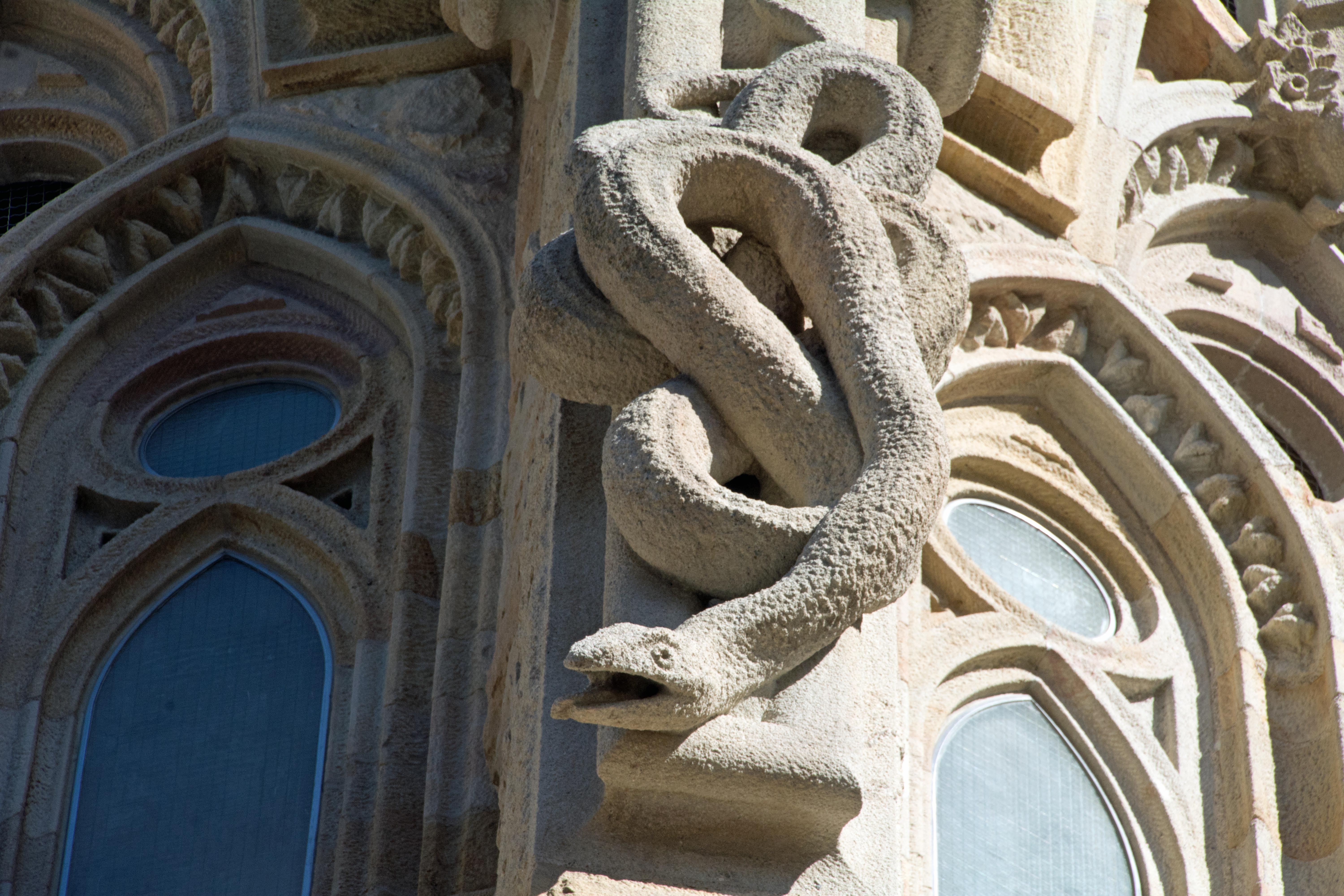
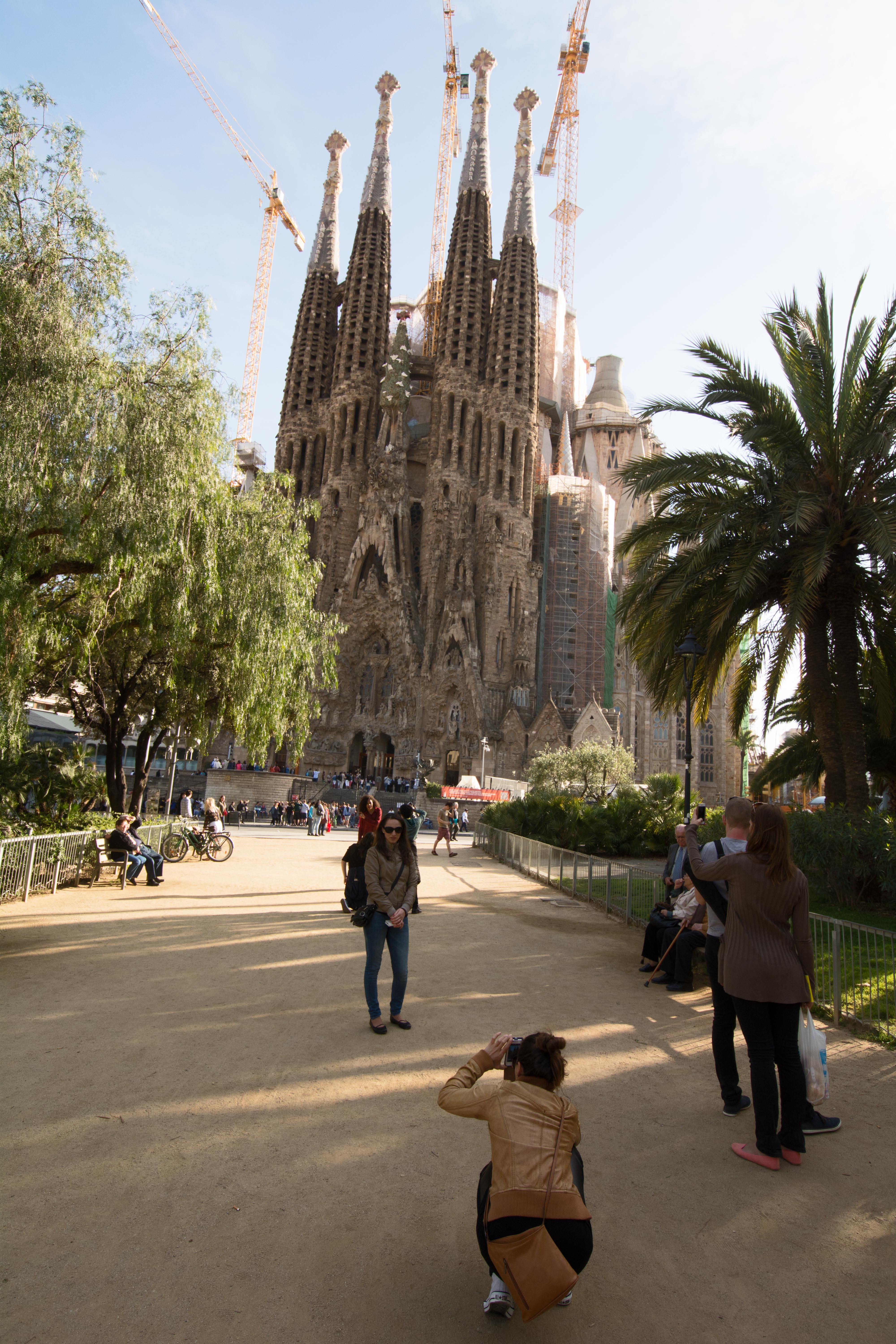
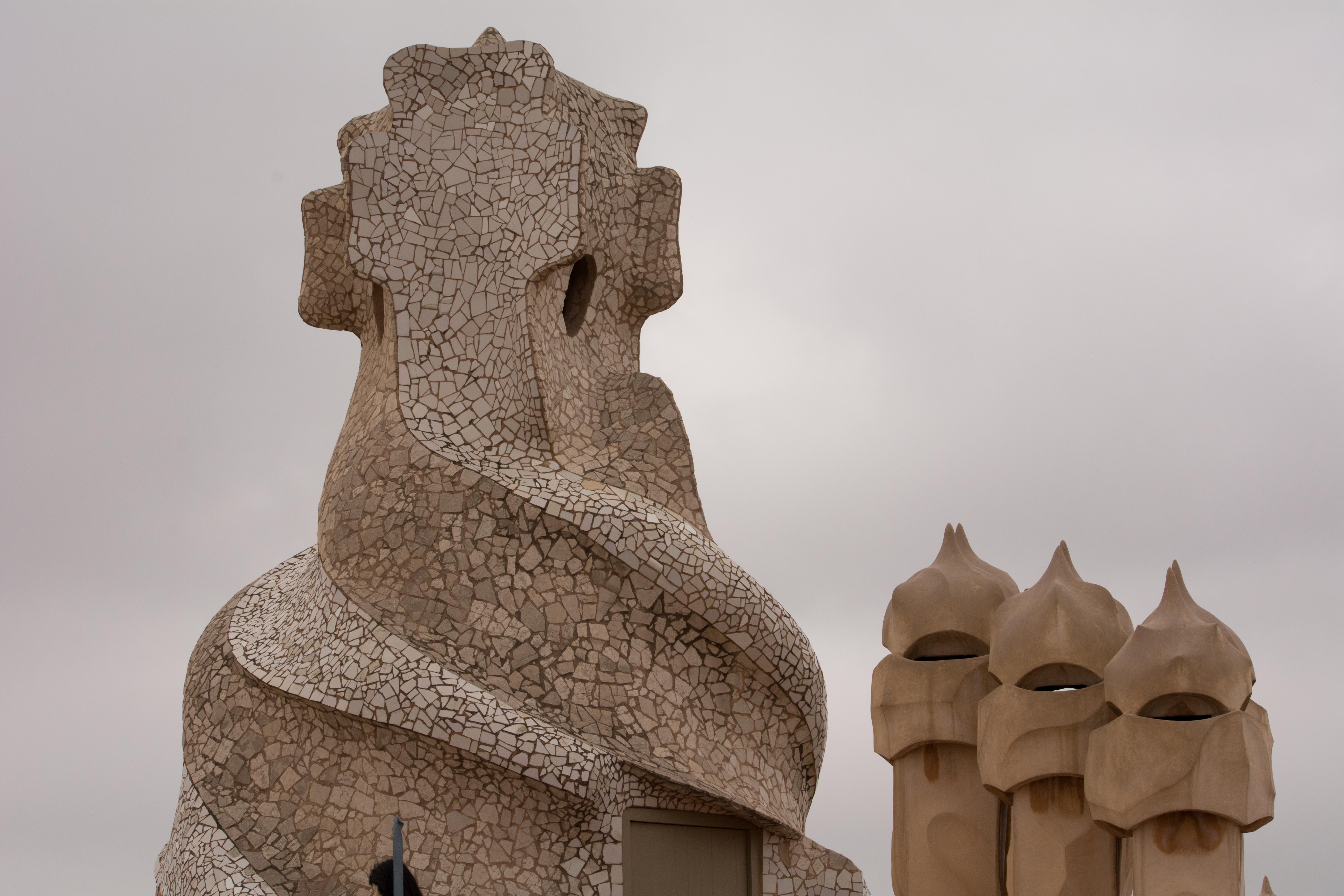
The conference hotel was on Passeig de Gracia, one of Barcelona’s busy, broad, tree-lines avenues, in the area of some of Antoni Gaudi’s strange and compelling buildings. The FSFE group had a guided tour of Casa Batllo, a row house that Gaudi transformed early in the twentieth century with themes of St. George and the dragon and forms of nature. I also visited La Pedrera, his famous apartment house with undulating walls and sculpted chimneys, and La Sagrada Familia, his still unfinished soaring and dripping cathedral. I still can’t say I really love Gaudi, but I respect his refusal to compromise his vision, and I find it cheering that the city embraces it.

La Sagrada Familia

La Sagrada Familia


_DSC9141_edited-1

On Saturday I went to Madrid to look about. This was ambitious — something like deciding after a visit to D.C. to have a day to see New York City. I got off to a rough start. The cab driver loaded my bag in the back of his hatch back vehicle, and as I stepped forward to hand him my backpack, he forcefully slammed the back gate down and hit my head. I noticed I was dripping blood as he guided me back to the hotel.

The desk clerks looked shocked to see me, and when I got to the bathroom I saw why: I looked like Carrie after the prom went bad. I thought I might need to go to the hospital for some stitches, but decided to try holding a dressing on it to get the bleeding stopped as we went to the airport. This worked, though I got blood on my shirt, and the front of my hair had a distinctive red cast.

Casa Batllo

Casa Batllo

My flight went smoothly, and after checking into a hotel near the airport and cleaning up, I took a shuttle into Madrid, arriving at the Puerta de Alcala around noon. The weather was clear and breezy, with temperatures in the mid sixties. I bought a cheap guide with a map and went into power tourist mode.

My first impressions were: Madrid is magnificent! The big public squares have impressive sculptures, fountains, and buildings, including many ornate baroque and classical facades. It seemed energized, like New York, but also stately, like Rome.

My primary objective was to see some of the great art there. I made my way to the Prado via the impressive Plaza de Cibeles. There was a line to get into the museum, but it moved quickly, and although it was crowded at first, the crowds quickly thinned. I’d expected a fusty museum, but it was not that at all. The art was given plenty of space and helpful labeling both in Spanish and English. It did not seem as comprehensive as the Met, but was more digestible.

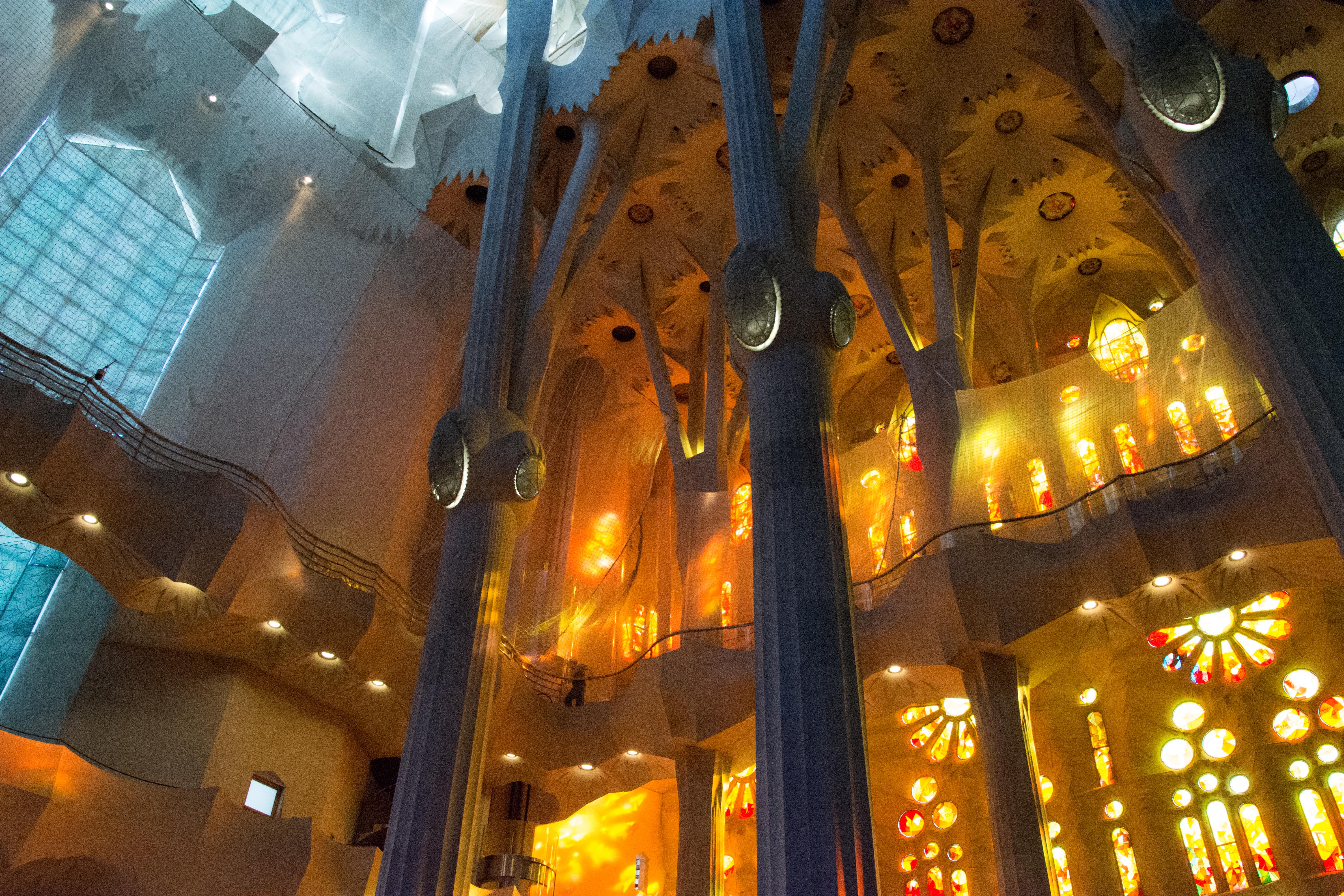
Inside La Sagrada Familia

Inside La Sagrada Familia

The particular strength of the collection is Spanish art, and I decided to focus on that. There are powerful collections of the iconic masters (El Greco, Valezquez, Goya), but good arguments for less well-known ones. None of these styles were new to me, but I tried to enter into the time and culture of some of the master works. There were some rooms that worked well as time machines, to scenes of battle, religious devotion, or daily life. I also looked at some of the works analytically, considering how the artist used the elements of line, form, texture, and, color to draw attention.

I’d planned to spend an hour or so at the Prado, but ended up staying for almost three. After a quick lunch, I took the short walk to the Reina Sofia museum, which is devoted mostly to twentieth century art. Here again, I found the works well displayed, though there was not much in the way of explanations. I was a bit puzzled by the organization, but there was a lot of great art, including particularly important works by Picasso, Gris, Leger, Braque, and an interesting collection of Surrealism.

In front of the Barcelona Museum of Contemporary Art

In front of the Barcelona Museum of Contemporary Art

There were also some good examples of more recent movements, including conceptualism. So many of these schools, such as Cubism, began as a challenge to conventional thought, but have become assimilated, with their primary perceived purpose now being to serve as status symbols. But it’s still possible to approach them as expressive statements, and confront their challenges — to be affected or even discombobulated by them.

I’d planned to visit the Royal Botanical Gardens, and also to visit Thyssen-Bornemisza museum, but it was after 6:00 when I left Reina Sofia — not enough time. I decided to do a walk across the downtown area with looks at the major thoroughfares and public squares. I went up Calle de Atocha to Plaza Mayor, where there were hundreds of people out to see other people. From there I went to Puerta del Sol, with more hundreds of pedestrians, and up Gran Via, which reminded me of the tourist frenzy on New York’s Broadway.

I was relieved to exit that and make my way to the peaceful and elegant garden at Plaza de Oriente. Heading back to the west, I went through little side streets looking for a place for dinner. I was tired of vegetarian tapas, and had trouble finding a good alternative. My Android device battery was almost dead, but I ultimately had enough juice to call on Yelp to help me find an Indian restaurant for dinner. I had some comfort food — vegetable somosas and palak paneer. It was good.

Taking in some art, sport, and food in New York

14 11 02_3603Last Friday I attended the Software Freedom Law Center’s tenth anniversary conference in New York, wishing my friends at the SFLC happy birthday and learning something about the state of the art in FOSS law. Afterwards I met up with Sally and daughter Jocelyn at the Warwick Hotel for a Manhattan weekend. I had in mind to see some painting, some photography, some opera, and some ballet, all of which we did, plus some good food and conversation and the New York City Marathan.

As for the painting, on Saturday we went to the Metropolitan Museum, where we focused mainly on the exhibit of recently donated Cubist paintings by Picasso, Braque, Leger, and Gris. Cubism has never been my favorite thing, but I was curious to see some reputed masterpieces not shown in public for generations. The exhibit ultimately had its way with me.

I’d known that Braque and Picasso collaborated, but I hadn’t understood that they were basically partners and co-inventors of the Cubist style. What remarkable courage for guys in their mid-twenties to work exclusively in a style that was so radically new and difficult. They must have known it would be tough to sell at a time when, I’m guessing, they needed money. How excited they must have been to be seeing visions no one had ever seen before, and imaging they would permanently change the cultural/visual world. And they were right!

Engaging with art, and particularly art that requires commitment and struggle, changes you at a fundamental level. Your brain rewires itself, neuronal axons and dendrites making new connections. You are a subtly different person afterwards, who sees the world a little differently.

And though it involved some commitment and struggle, I warmed up to the paintings. There is steely rigor, but there’s more than that. There are moods, from sunny to brooding, and a surprisingly amount of humor. But you have to give the paintings some time and let them speak.
14 11 02_3558

We met Jocelyn for lunch in a Korean place on 37th Street, where our table got covered with savory little vegetarian plates and vegetable dumplings. Our waitress intervened when she realized Sally didn’t know she was supposed to spice up and mix up her kimbap. It was drizzly and chill when we came out and walked up 6th Avenue to the International Museum of Photography.

There we saw an exhibit called Genesis by the Brazilian photographer Sebastiao Salgado. The black-and-white photos are of remote, vulnerable, and magnificent places around the globe, including Antarctica, Galapagos, Patagonia, Indonesia, and Africa. I was very moved by this art. The works were big, some like large posters, and they had lots to say. Some of the landscapes have a stately lyrical classicism, and his photos of indigenous people are frank and intimate. He succeeded in his aim of making me think more about how beautiful and fragile is our planet.

We had dinner at Robert restaurant on the 9th floor of Museum of Arts and Design looking out at Columbus Circle. The room had the energy of forward leaning design, and the food and service were both really good.

Then we walked up to the Metropolitan Opera to see The Death of Klinghoffer. After all the recent controversy (charges of anti-Semitism, which I thought were way off base), I had some worries that there would be protesters, and a tiny worry that there might be a homicidal fanatic ready to attack. But happily there were only normal opera folk. Sally and I both thought John Adams’s music was beautiful and expressive. However, I found the staging static and dull. I’m not sure how much this problem was a matter of direction and how much is inherent to the work. On the whole, I was glad I saw it, but a little disappointed.
14 11 02_3565

Sunday morning was clear but chilly as we walked up from the Warwick Hotel to Central Park South to a spot about half a mile from the end of the New York City Marathon. We saw the first wheelchair competitors, then the first women, and then the first men. After almost 26 miles, most looked like they were in a hard, painful place. But they were booking! The leaders were preceded by a truck with a sign showing the elapsed time. It was particularly interesting to see how close the fight was for number one and two for both women and men. As they passed us, both pairs were so close that I thought perhaps they were friends that enjoyed running together. The women’s finish was the closest in the history of the race, and the men’s was also quite close.
14 11 02_3585

After a quick lunch, Jocelyn came with me to Lincoln Center to a matinee performance of American Ballet Theatre. We saw Sinfonietta (music by Janacek, choreography byJiri Kylian), Bach Partita (Bach, Twyla Tharp), and Gaite Parisienne (Offenbach, Massine). I greatly enjoyed it all, but particularly adored Gaite Parisienne. It was like Nutcracker for grownups: sumptuous, slightly risque fun. Hee Seo was a gorgeous Glove Seller, and Herman Cornejo was a manic, hilarious Peruvian. There were a LOT of really good dancers!

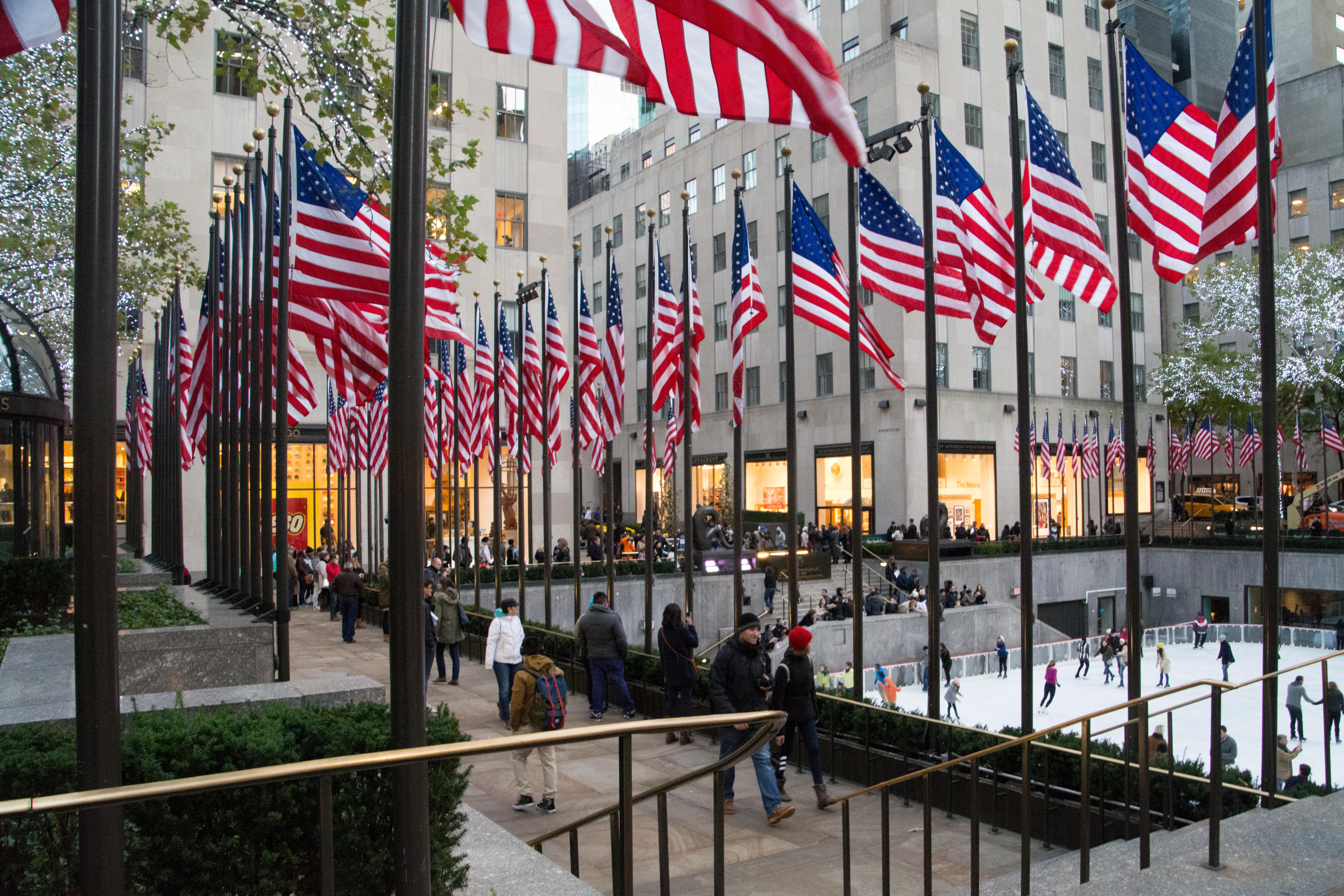
After Jocelyn got on the subway to go home to Brooklyn, I had a little time before we were due to head to the airport. I walked down Fifth Avenue and over to the skating rink at Rockefeller Center. I noted that the varied collection of flags from many nations had at some point been replaced by all US flags. Good looking flags, though .

My first visit to Barcelona

14 04 12_8135_edited-1
Last week I did a quick trip to Barcelona for the FSF-Europe Free Software Workshop, and got a chance to see the city a bit. There was good energy and good attendance at the conference, with some old friends and major thought leaders in free software, and my talk on software patents and the Supreme Court was well received. It was really cheering to be with a large group of really smart, really nice people working to advance the cause of free and open source software.
14 04 09_8236_edited-1

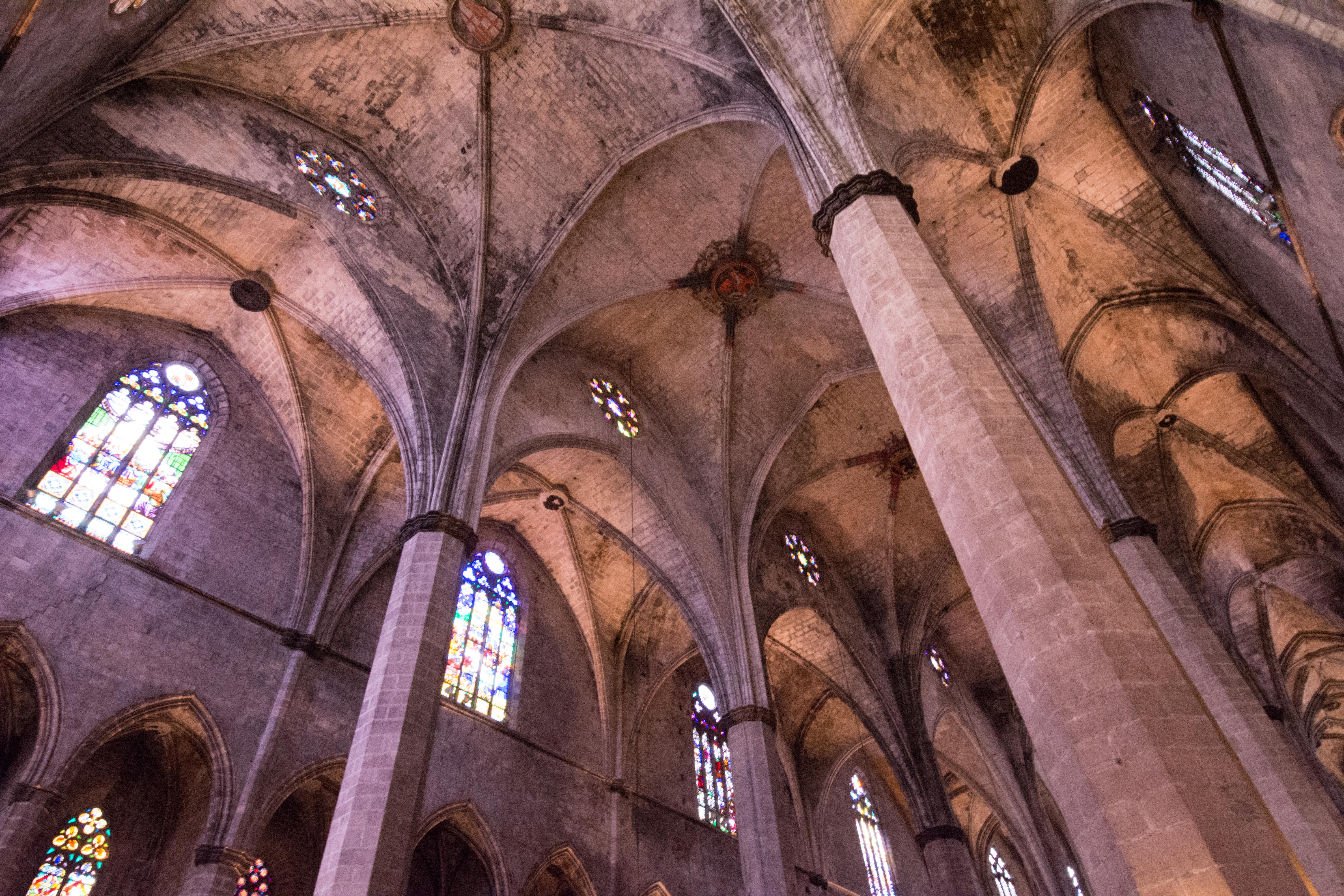
We took a tour of the Sagrada Familia, the famous cathedral designed by Anton Gaudi and still a work in progress 122 years after it was started. It’s a strange building, half modern and half gothic, and massive. As with the great gothic cathedrals, it overwhelms the senses – it’s impossible to take it all in at once. Our tour guide took us inside late in the day, as the light was changing quickly, and showed how the windows were designed to manipulate the light. The guide made it clear that the work is both source of controversy and of enormous pride for the Barcelonans. I can’t say I liked it, exactly, but I found it wildly ambitious, bizarre, and intriguing.
14 04 09_8208_edited-1

After the conference, starting Saturday morning, I shifted from work mode to super-tourist mode, and spent about 14 hours exploring the city. At first I thought it seemed a bit like a cross between Paris and Florence, but in the end I found it distinctive, just itself. It has grand boulevards with trees and fashionable shops, warrens of narrow medieval streets, and large parks. There are a couple of distinguished gothic cathedrals, some excellent art museums, and a modern (with TVs!) and efficient modern metro. It was easy to figure out how to get a ticket and get going in the right direction, and I never waited more than three minutes for a train.

Barcelona was energized and energizing. It seemed very cosmopolitan and sophisticated. The Catalans have their own language, Catalan, which seemed not too different from Spanish. Like people of other small European language groups, Barcelonans are more likely to need a second or third language. I found that the service people all spoke adequate-to-excellent English. In fact, using advanced Yankee detection radar, they sometimes spoke to me in English before I even opened my mouthand so I didn’t get to use my still-a-work-in-progress Spanish very much.
14 04 12_8116

Since the Barcelonans are so proud of Gaudi and the school of modernisme (which struck me as a species of art nouvea), I decided to check out another well-known Gaudi building — the Pedrero, an apartment building. Unfortunately the façade was covered up for renovation, but it was worth seeing the roof and a large apartment. The roof had mysterious sculptural objects with undulating surfaces, bulges, and points. I have no idea what they mean, but somehow in the context of city rooftops they work. The apartment was remarkably spacious, and well-furnished and decorated in the period.
14 04 12_8139

Gaudi was a visionary and a maverick, unwilling to accept existing conventions and aesthetic categories, like our Frank Lloyd Wright. But Gaudi’s aesthetic is odder – whimsical in places, but also suggesting memories of nightmares. It’s amazing that he found funding in the first place, and that he also found lasting fame. The local obsession with Guadi is another sign that Castilians are different in an interesting way.
14 04 12_8184
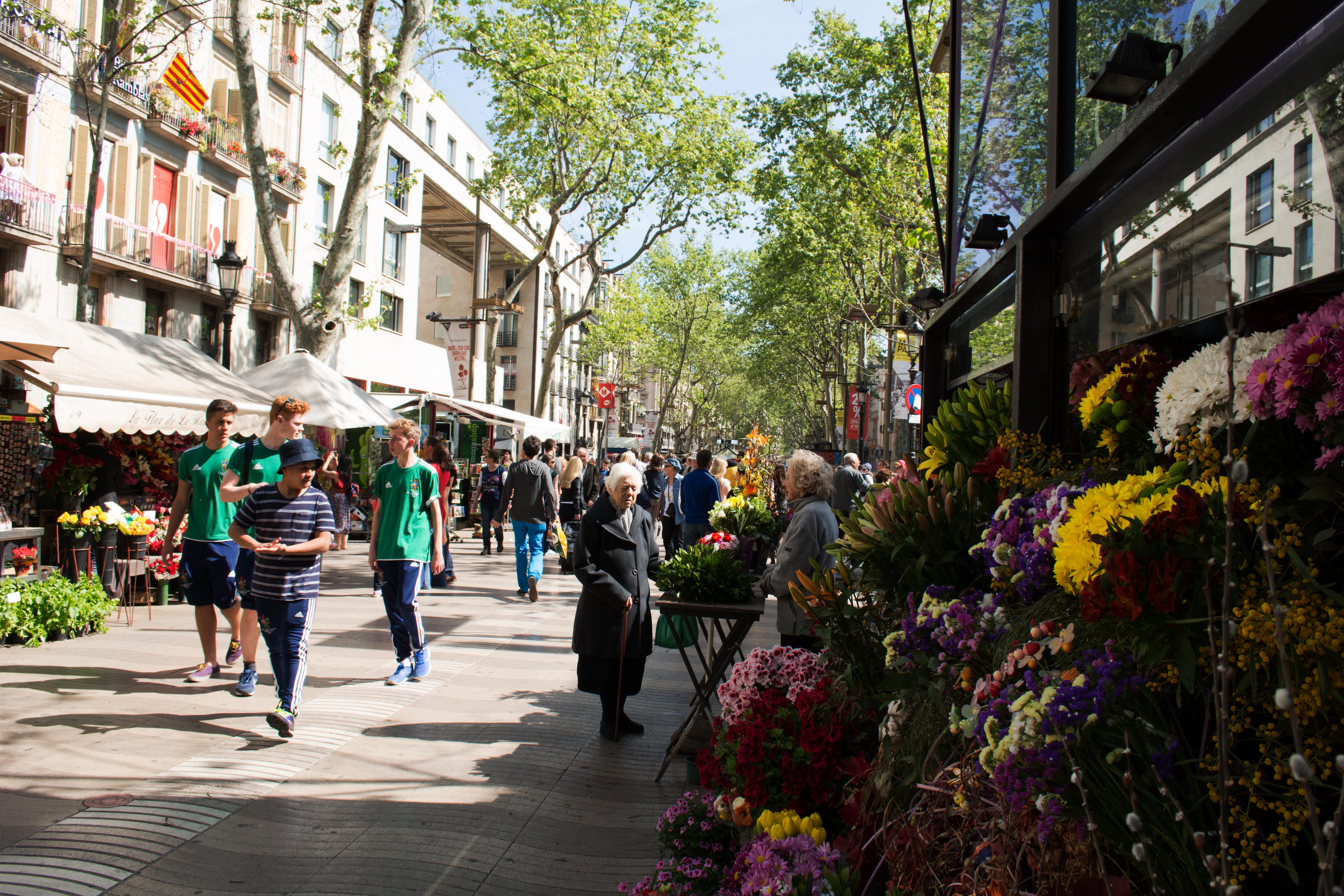
After looking at some other modernist buildings, including Casa Battlo, I took a longish walk south which included La Rambla, the famous pedestrians-only boulevard, and through the gothic quarter to the Picasso museum. It doesn’t have the world’s most distinguished Picassos, but for Picasso fans it’s satisfying – particularly some fine works from the blue period. There was also an interesting temporary exhibition on Picasso’s influence on contemporary art.

After more explorations in the old quarter, late in the afternoon I made my way across town to the Juan Miro museum. I came in with the impression that Miro was overrated – an artist who’d taken a few charming ideas, mined them out, and kept on digging. The museum showed that he had more range than I’d realized, and more willingness to experiment, assimilate new ideas, and grow. I particularly liked his found-object sculptures. The temporary exhibit included some interesting conceptual works, including one that showed, side by side, a three-foot-high pile of dirt and a three-foot-high pile of thick paint.

On the flight back on Sunday, I had a good block of reading time, and finally finished The Odyssey, in the Robert Fagles translation. I was sort of looking towards the suitors of Penelope getting their comeuppance, but even so the violence was so extreme it was shocking. Homer’s world was definitely different from ours. Were the suitors really so bad as to deserve butchering? But there were also surprisingly modern descriptions of affection and love. When Penelope finally realized that Odysseus was actually home, after twenty years’ absence, and husband and wife were united, it had the emotional resonance of Shakespeare’s greatest lovers. It made me eager to get home.

Our diving trip to Fiji

13 12 27_6468_edited-1
Over the end-of-year holiday Sally and I went to Fiji for some scuba diving. It was a long journey with some rough spots, but also some thrilling spots, and on balance it was worth it. For those who might consider such a trip, here’s some of the nitty gritty on the diving, and also a note about our stop on the way home at the Getty Museum.

I’d always thought of Fiji as one of those “island paradise” places in the Pacific, but in fact didn’t know that much about it. The reason we decided to go was we’d heard the scuba diving was good, and it’s relatively uncomplicated to get to from the US. It is situated north of New Zealand, west of Tonga, and east of Vanuatu. Although it looks like a tiny speck on the world map, it is made up of 332 islands, though most of the population of 860,000 lives on just two of them. The large islands are mountainous and very green

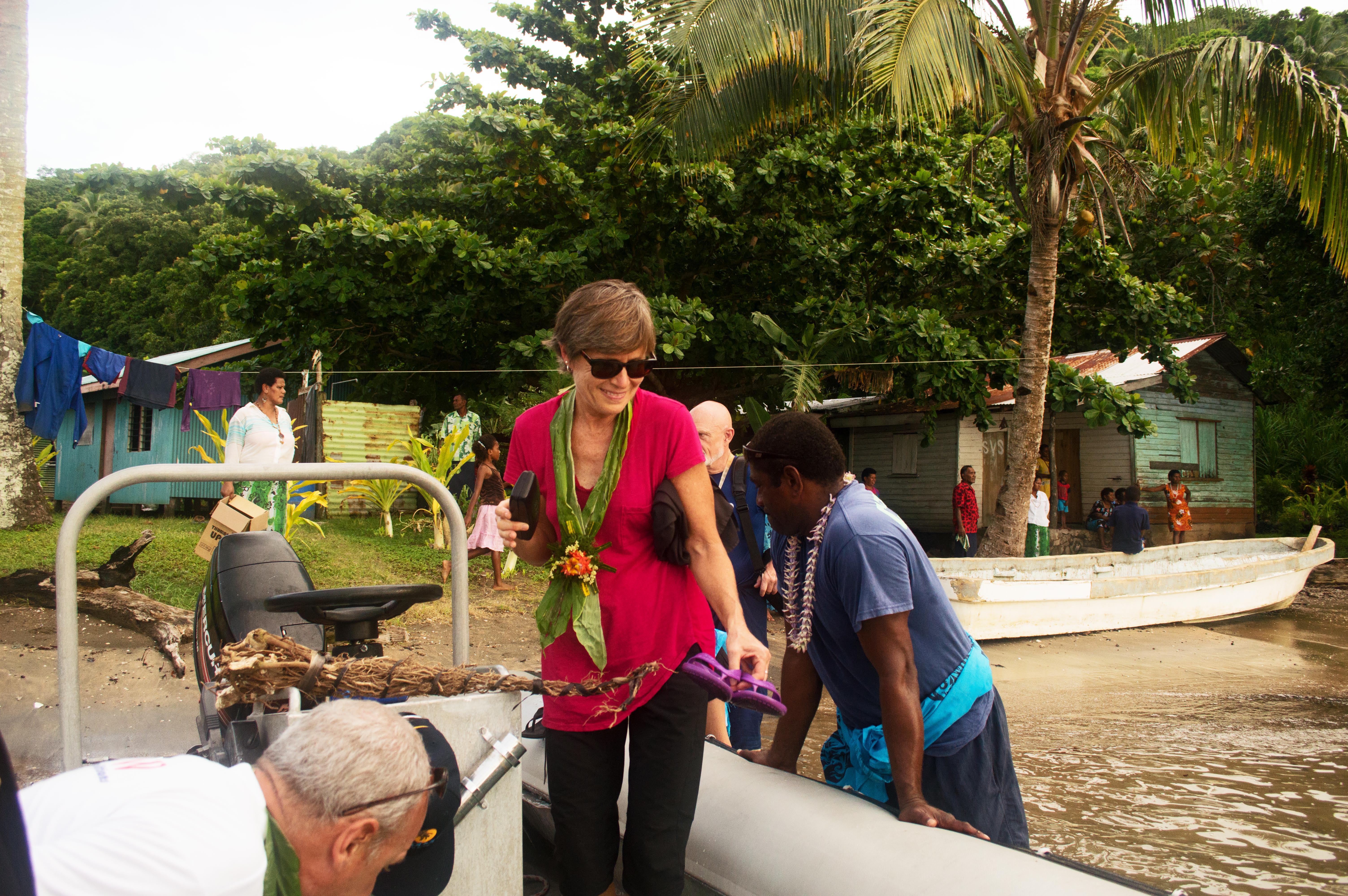
It took us about 26 hours door-to-door to get there. Going out, we had three flights, a long cab ride, a wait, and then an hour boat ride to get to Beqa (pronounced Ben-ga) Lagoon Resort. The staff was on the beach under the palms singing and clapping as we floated up. This was sweet, but we were surprised that there was no dry way to exit the boat. You had to step into the water and then onto the beach, and Sally was still in stockings, but on she went. One of the staff put a little garland with flowers around our neck.
13 12 25_6536_edited-1
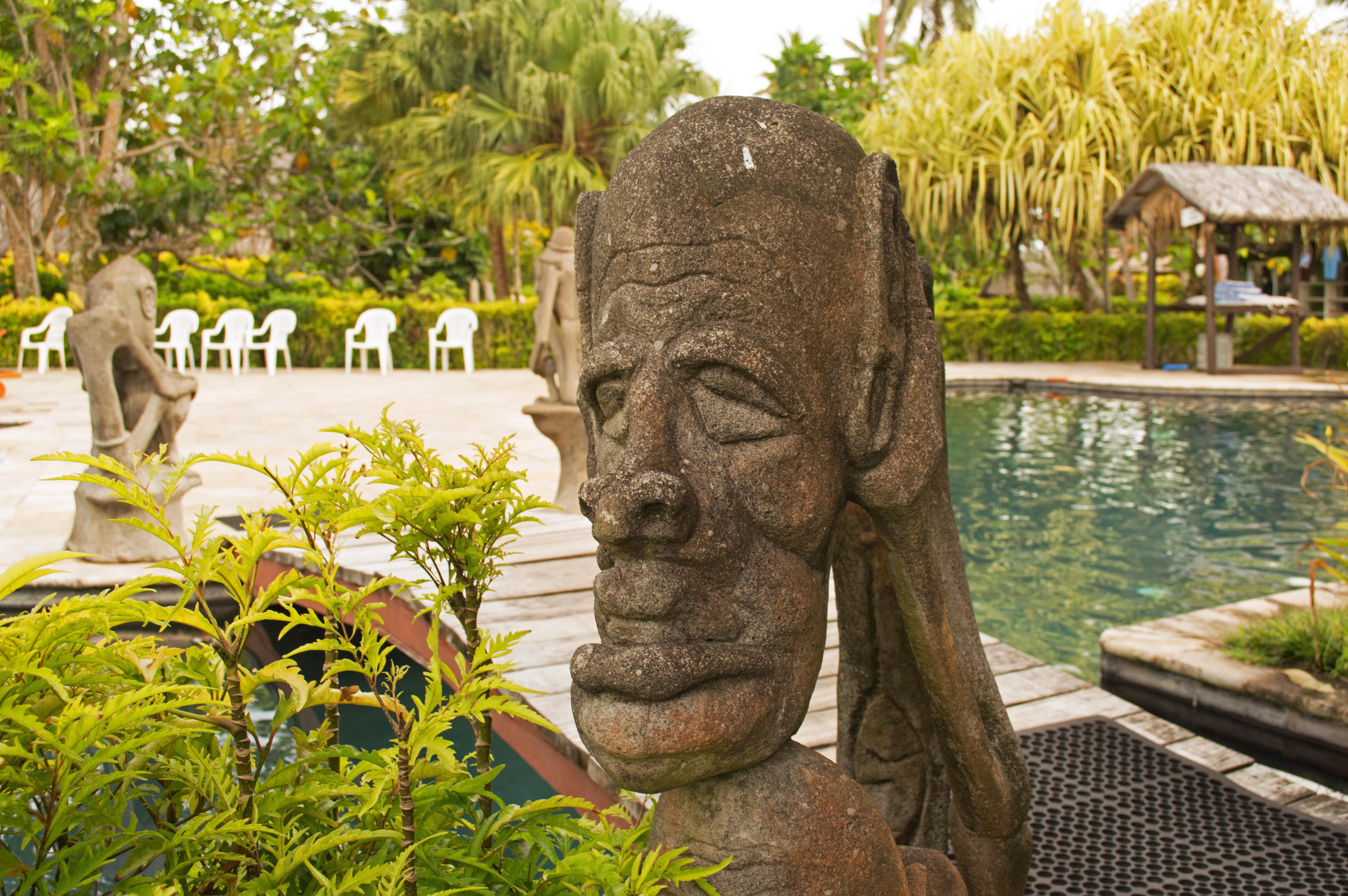
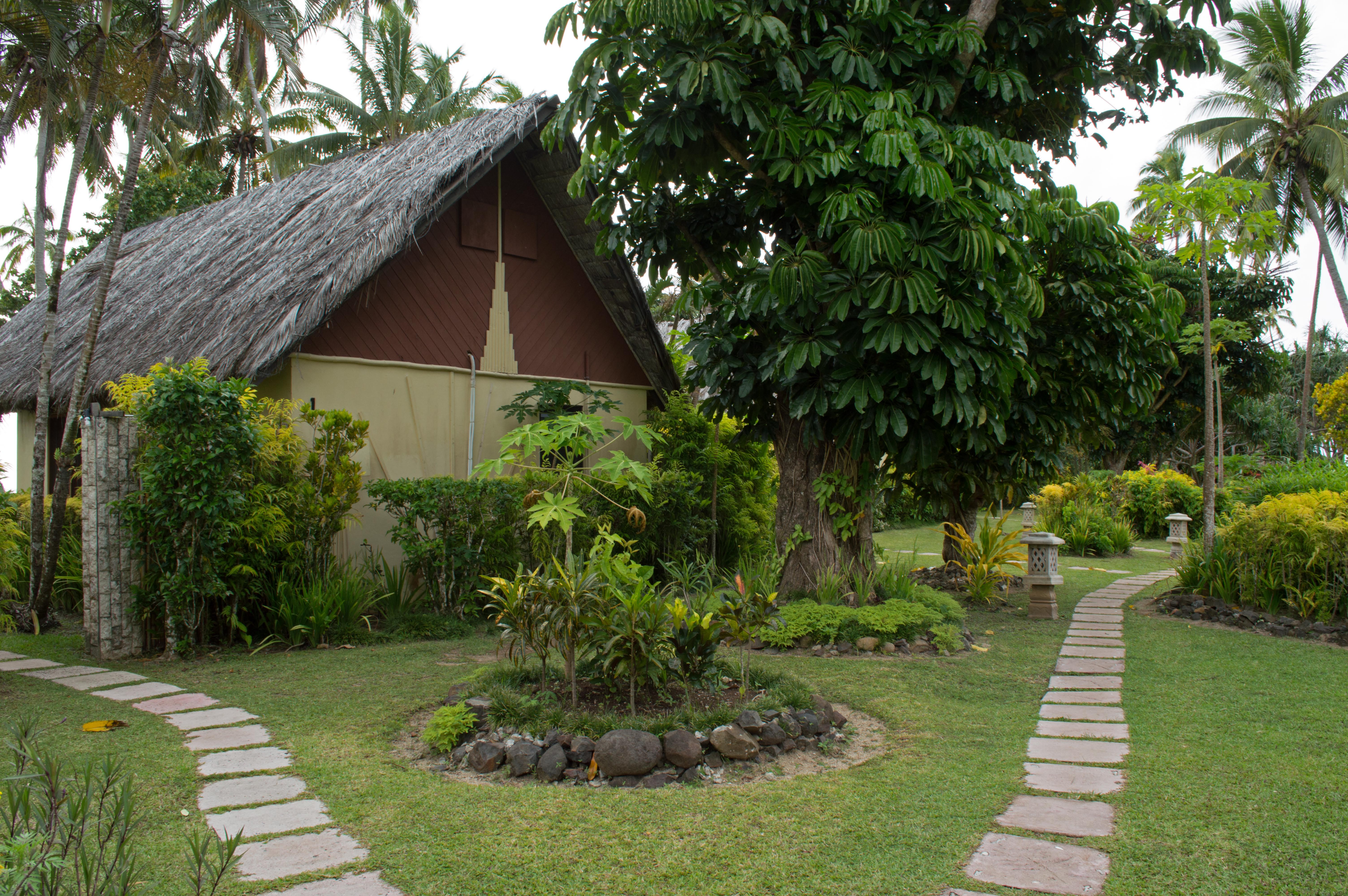
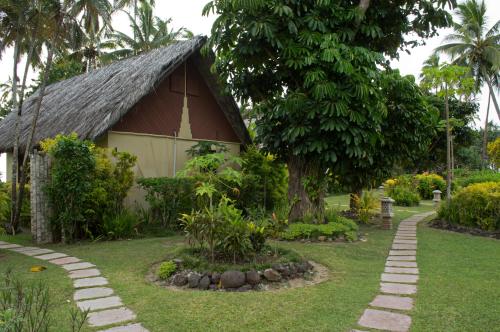
The resort didn’t look quite as gleaming as its website suggested, but it had tropical charm, with palms, flowers, sand, pools, and grass-roofed buildings, and the staff was warm, friendly, and competent. We were in Bure (which I’m guessing means cottage) No. 5, which fronted on the beach and had thick hedges on the side – great privacy. That afternoon, I did a short checkout dive, but otherwise we took it easy and had a couples massage at the spa. It was marvelous.

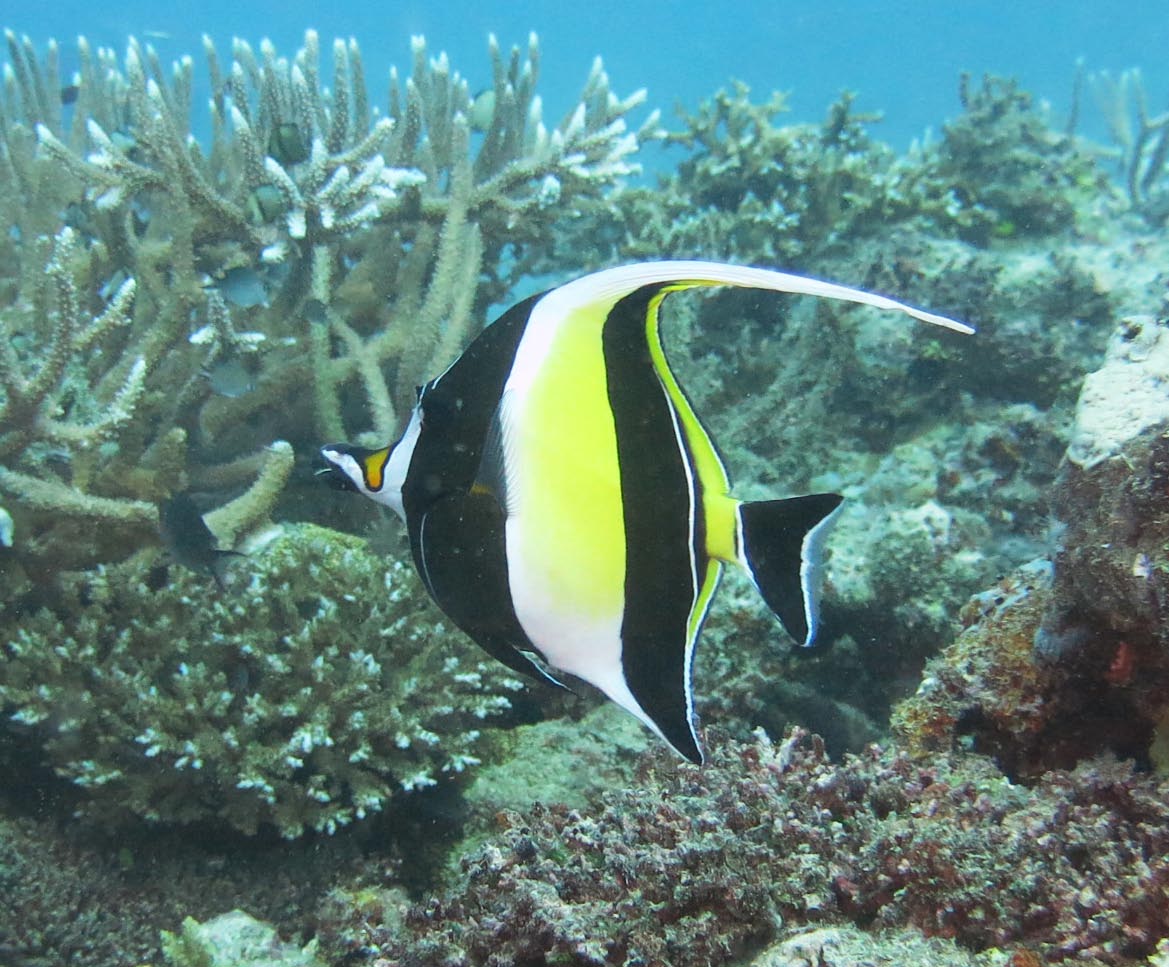
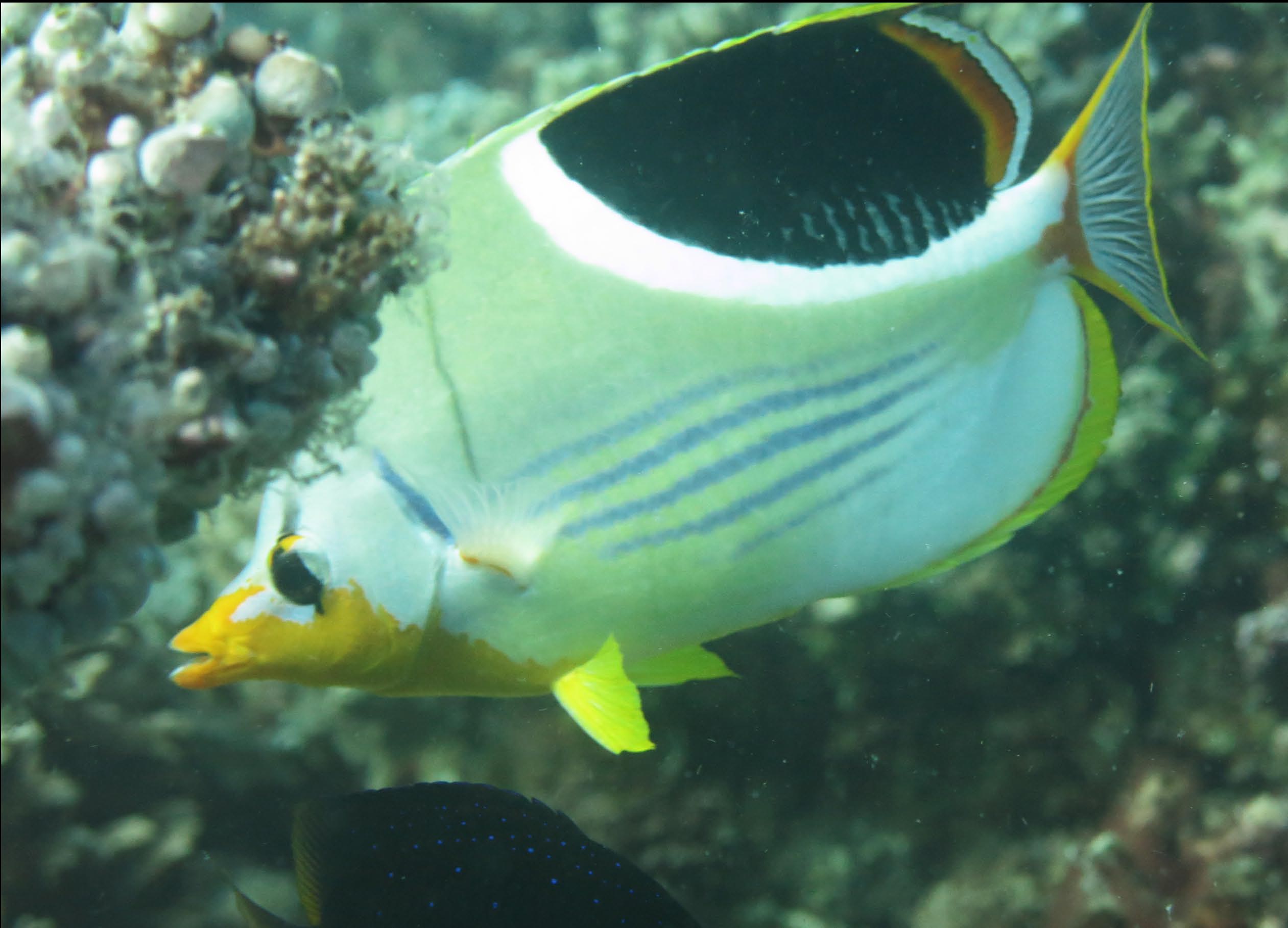
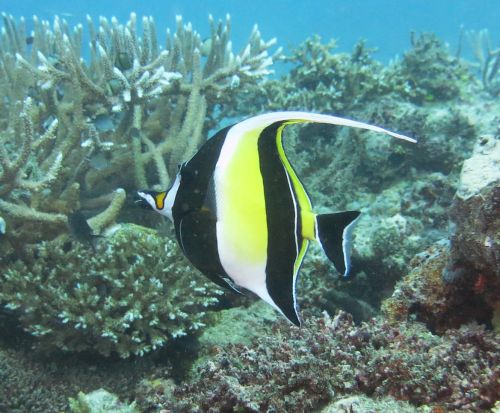
The next day we did two boat dives in the area. The water was a comfortable 82 degrees, but choppy, and the visibility was mediocre – at most 50 feet, rather than the super clear water we were expecting. We were looking forward to the fabled soft coral, of which we saw some, but we were also struck that there were big coral areas that were bleached white (prematurely dead). It was nice to see many small tropical fish that were new to us, including new species of angelfish, butterflyfish, damselfish, anemone fish, fusiliers, wrasse, parrot fish, and my new favorite, the Moorish idol.
14 01 02_6270_edited-1

At dinner that evening we sat down next to a youngish Swiss couple, Mark and Doris, who spoke excellent English and were charming and lively. We found a lot of interests in common, starting with diving but extending to skiing, travel, and world affairs. Our conversations that evening and for the rest of our stay were a highlight of the trip. As for the eating, the resort accommodated our request for vegetarian meals, and almost everything was tasty.

On the second day of Beqa diving, we enjoyed talking with Rick, a nice Mormon guy who owned a bunch of car dealerships in the heartland. He was up to speed on the self-driving car, a favorite subject of mine, and like me thinking about what this meant for employment and the economy. He was intrigued to hear about our scuba liveaboard trips, and wanted to learn more. He allowed, though, that he wasn’t sure he was passionate enough about diving to do a week focused entirely on that. I agreed – you’ve got to be passionate.
13 12 30_6421

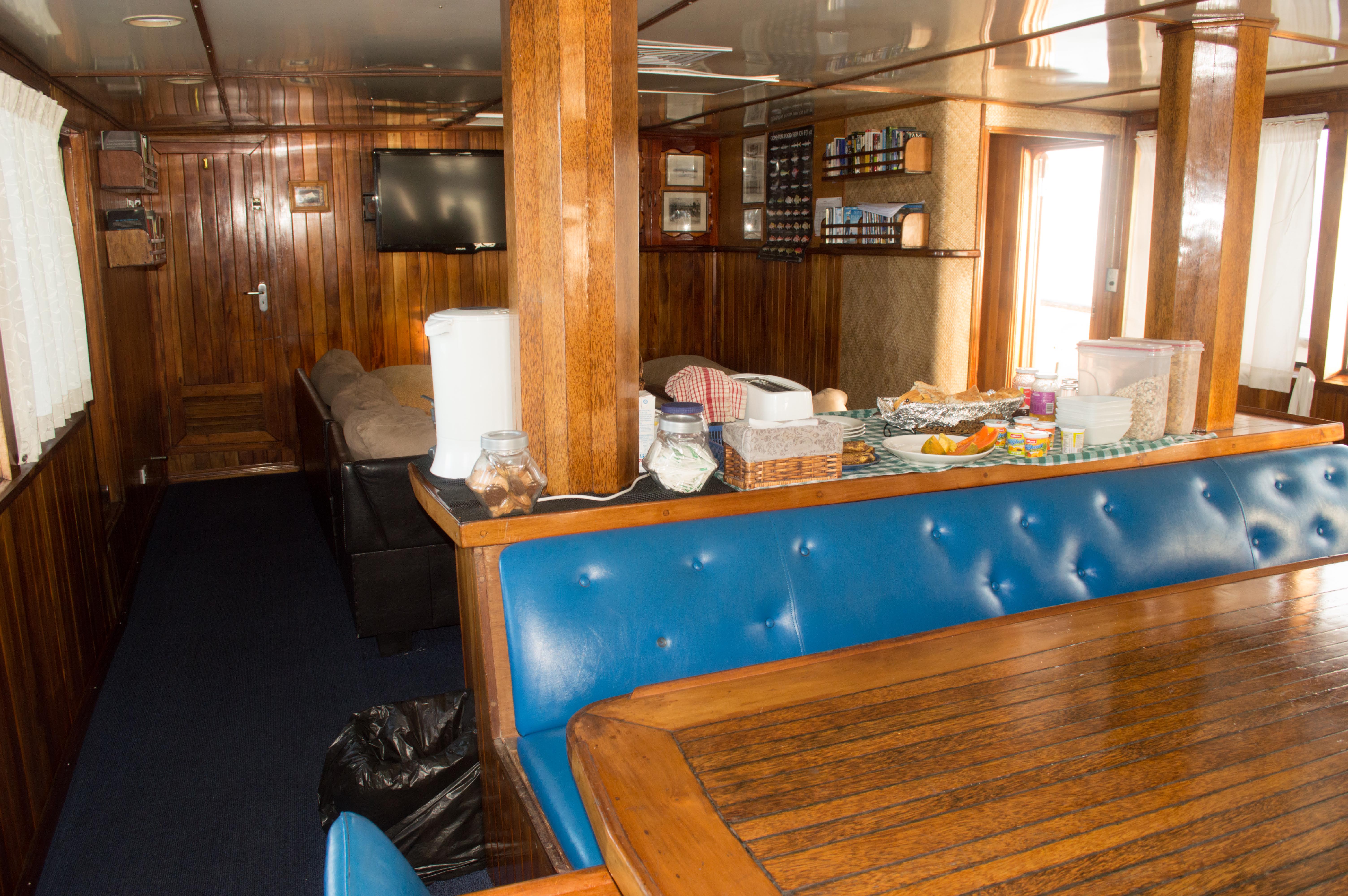
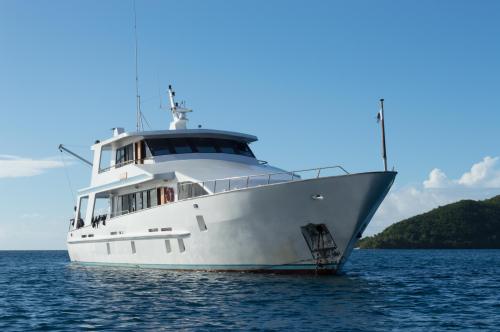
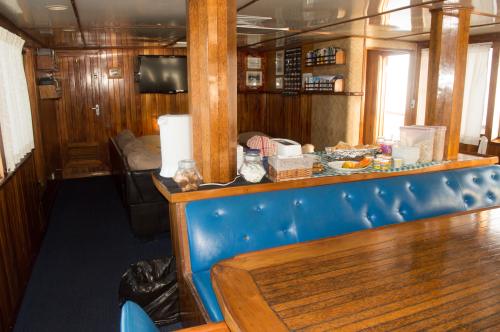
The next morning we crossed back over Beqa lagoon, and got a ride to our dive boat, the Island Dancer II. It was 101 feet long, 22 feet in the beam, and well-appointed for diving. Our cabin was on the main deck past eating/socializing area. It was air-conditioned and quite commodious and bright by marine standards, with a queen bed, desk, large windows, and private bathroom.
14 01 01_6316

Our crew, led by Captain Joji (pronounced Cho-chee) and divemaster Moses, was all Fijian, friendly and hardworking. Our seven shipmates were from D.C., San Francisco, Sydney, and Moscow, and all were very experienced divers who’d all been to several exotic dive locations before.
14 01 01_6376_edited-1

Our first night involved a nine-hour trip from Viti Levu (the main island) through the Makogai Channel toward Vanua Levu and Namena Reef. The weather was rainy, and the seas were choppy. The boat rocked enough to dump things off of countertops. Fortunately, our stomachs were up to the challenge (thank, Bonine). The next morning it was calm, and we did a check out dive – ostensibly to check how much weight we needed, but, I suspect, more to let the crew verify that no one was going to be a hazard to himself or others. That went smoothly, and we quickly settled into our routine.
13 12 29_5568

Our typical Island Dancer day went as follows: Up at 6:30 a.m. for pre-breakfast (e.g. yogurt, fruit, cereal), first dive at 7:30, breakfast of eggs or French toast at 9:00, second dive at 10:30, lunch at noon, third dive at 2:00 p.m., snack at 3:30, fourth dive at 4:30, dinner at 6:00, fifth dive (night dive) at 8:15, have a glass of wine at 9:30, and then sleep. In short, dive, eat, and sleep. In the background were gorgeous lush islands, lovely sunsets, and usually a mild tropical breeze. The water and air were both mostly in the low eighties. What could be more fun?13 12 31_5910_edited-1

OK, not everything was perfect. The visibility was disappointing. It ranged from a best of about 50 feet down to 20 or so – far from the 80-100 feet we were expecting. The captain said at one point it was as bad as he’d seen it in many years of diving the area. He said a tropical depression shortly before we arrived was responsible. So, that was unlucky. We were also initially struck that there were significant areas of the reefs bleached white with not a lot of animal life. There were fewer big animals (big fish, turtles, rays) than we had hoped. At least one person saw a manta ray, but we did not.

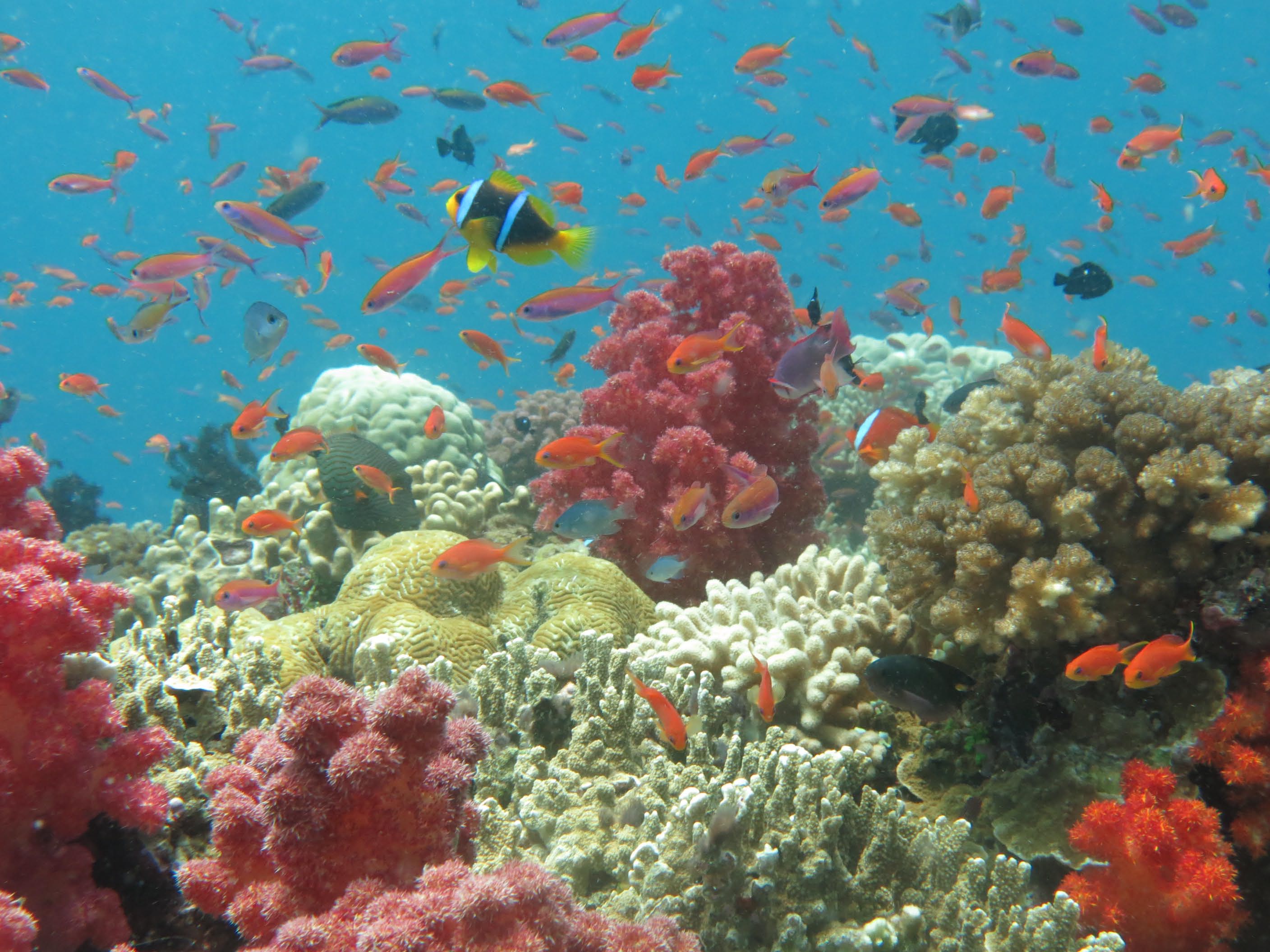
But still, there was a great deal to see. A typical site involved a pinnacle (that is, a column), of coral rising from the sand perhaps 50 feet. The top layer would generally be about 15 feet below the surface, and would have an enormous profusion of soft and hard coral, anemones, and thousands of tropical fish. With so many textures and colors, the coral looked in places like a fantastic garden – amazingly beautiful.
13 12 29_5526_edited-1

Along with the fish, we saw quite a few other interesting and strange small creatures, including various kinds of nudibranchs, flat worms, sea horses, tiny shrimp, pipe fish, blennies, and others still more obscure. There were a few turtles, and a couple of moray eels. One morning we watched a banded sea snake (highly poisonous) swimming for several minutes, and a very well-disguised octopus, who changed disguises a couple of more times. On one night dive we saw three leaf scorpionfish and a giant clam at least four feet across.
14 01 01_6149_edited-1
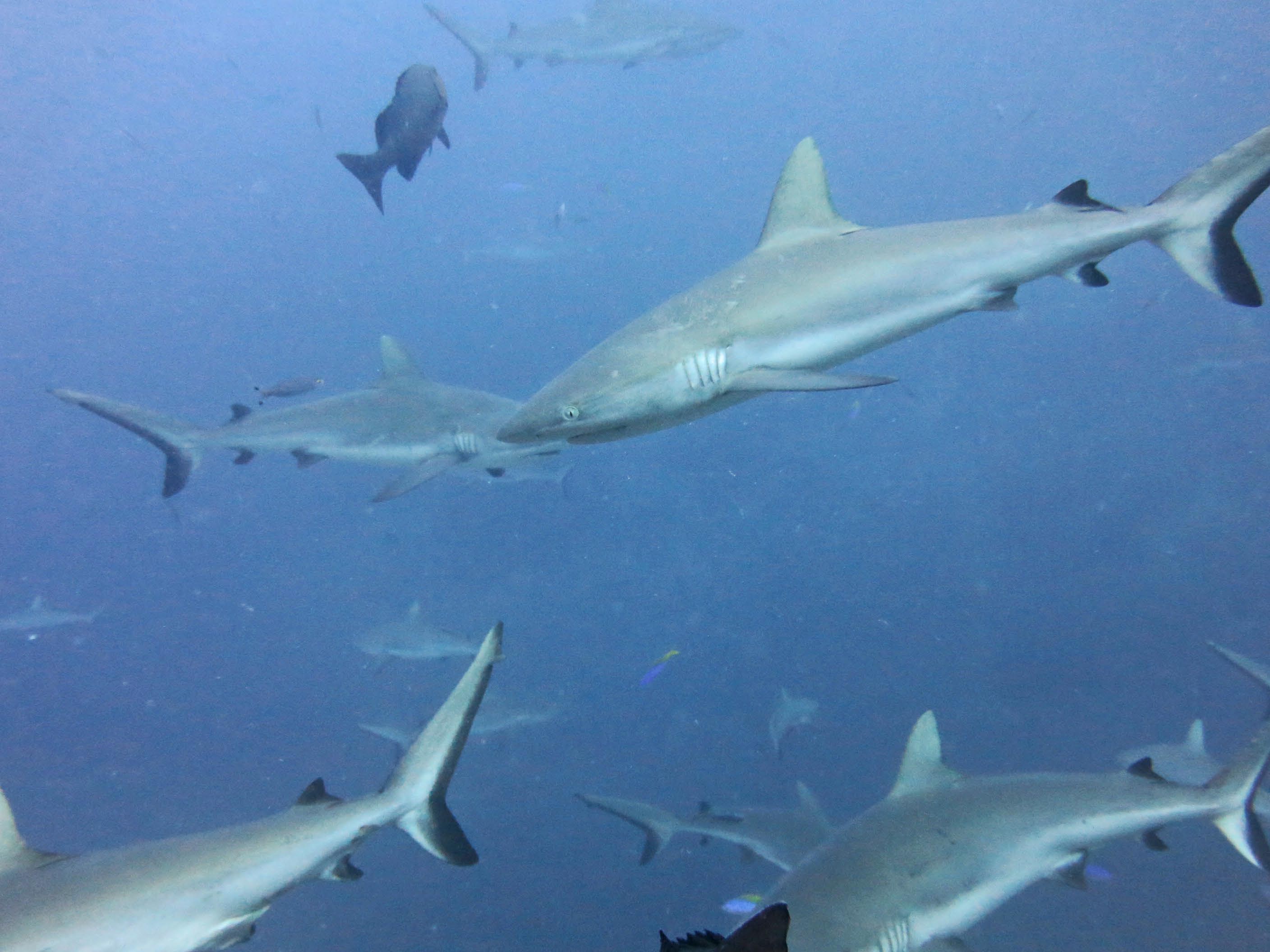
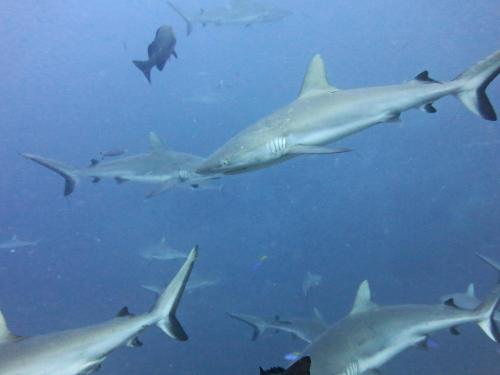
The fourth day in, off of Gau (pronounced Now) Island, we did two shark dives, where we saw dozens of gray reef sharks close up. With them were many red sea bass and smaller fish, as well as schools of barracuda. On the first dive we held in current behind a rock wall, while the sharks came in for fish heads. The second involved a drift dive in a fast current, with the sharks zooming in and out.
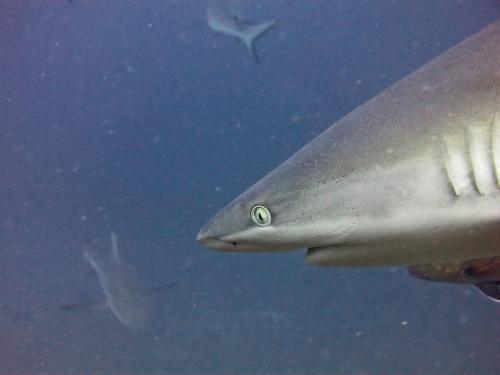
14 01 01_6122_edited-1
On that second dive, I got low on air, and shared Sally’s with her extra second stage as we got pushed hard by the current to the exit point. It was a challenging situation, but we worked well together, as usual. We saw a spotted eagle ray during the safety stop.
14 01 01_6372_edited-1

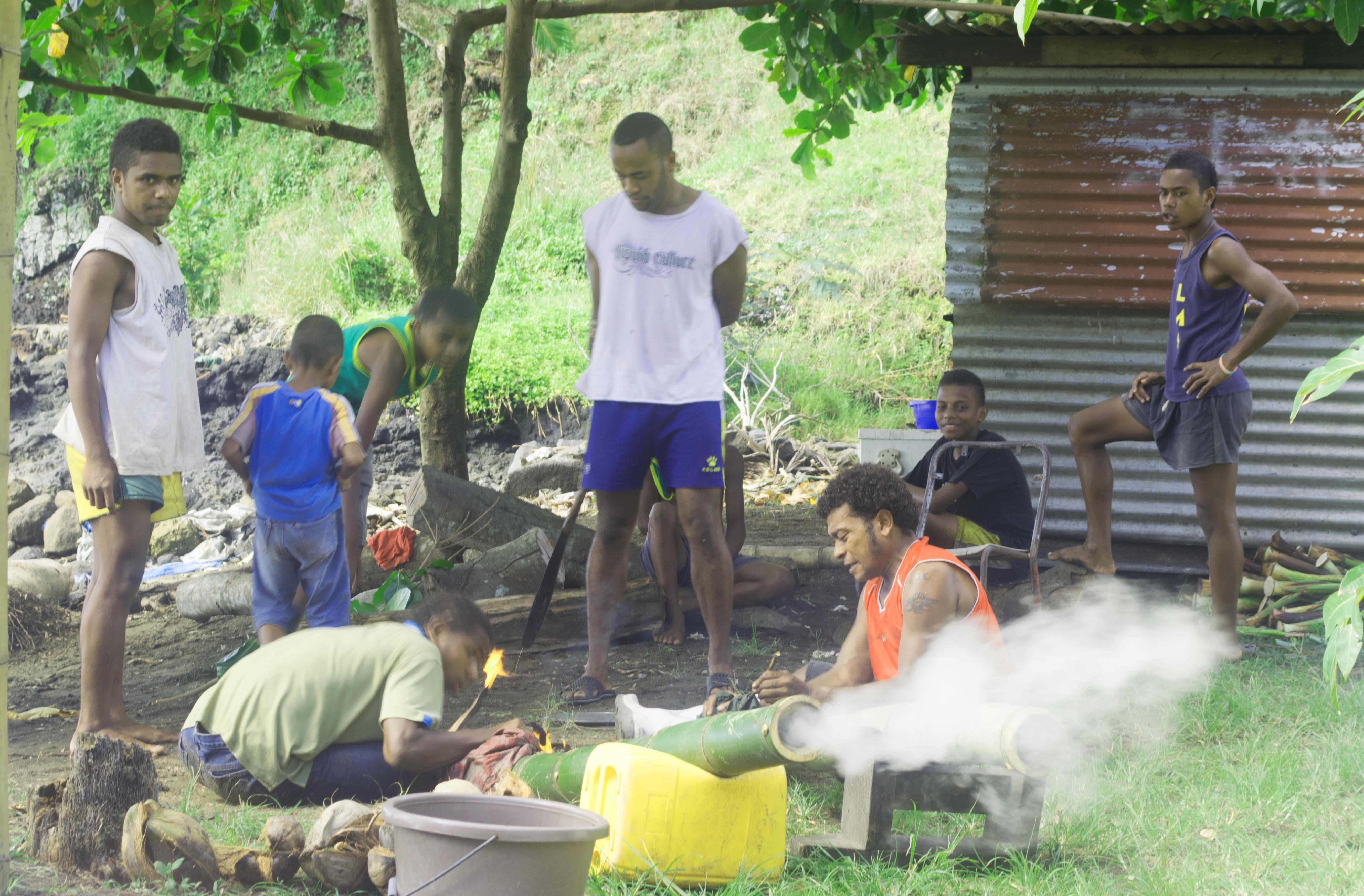
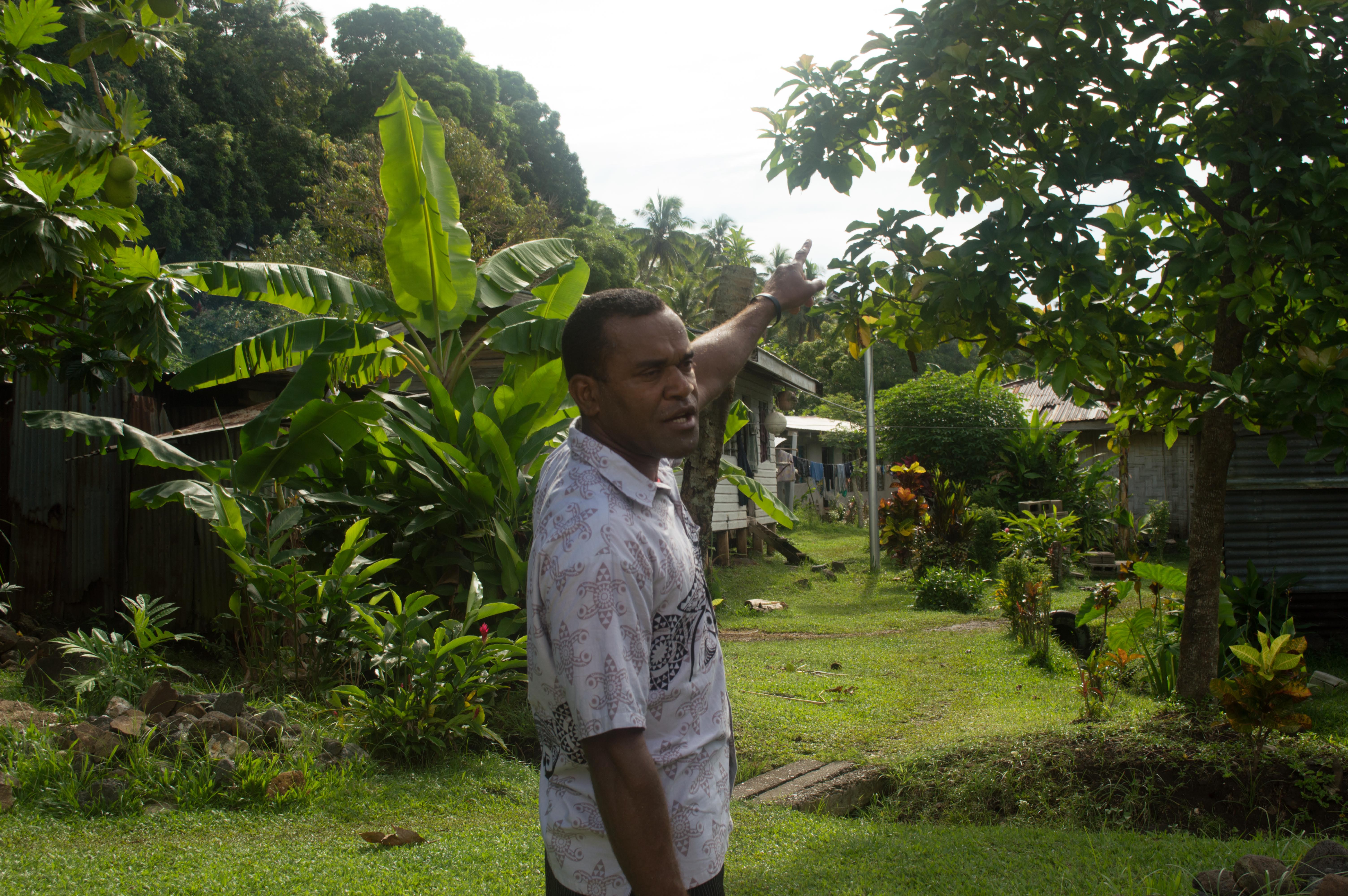
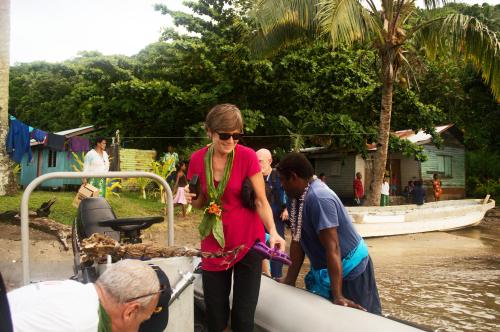
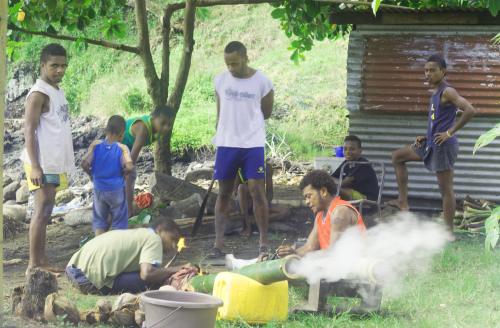
On the afternoon of the fourth day, we visited a little village on Gau island called Soma Soma. Our guide there told us that 114 people and 3 clans lived there. The people greeted us in a friendly way. Teenage boys were setting off fireworks with a palm cannon to celebrate the new year, and little kids were splashing in the water. We sampled kava, a watery drink made from soaking kava root. Supposedly it can produce a high, but I got only slight numbness in my mouth. The villagers did some singing and dancing, and got some of us to join in a dance.
14 01 01_6336_edited-1-1
14 01 01_6354

My Sea Life underwater camera quit working (wouldn’t turn on) after the second day of diving, and so I rented a little Canon G15 camera from the boat. Lacking a strobe, I used my Sola flash light for extra light, which was suboptimal. My photographic aspirations were simple, really – to get a few images that started to convey the incredible beauty down there – but it was still hard to do.

There were so many great shots that got away. A beautiful angelfish would present itself in all its splendor, and either the camera had gone to sleep, or wouldn’t focus. Or in the half second shutter lag interval, the fish would turn away, or another fish would swim between us, or another diver’s bubbles would mess things up. Then, after the shot, the camera would take a few second to recycle, during which time the subject fish would again look gorgeous, but as soon as the camera was ready to go – so was the fish. Some of those little fish are shy! Anyhow, I tried, and I a few times I got an image I liked.
14 01 01_6065_edited-1

Our trip back was a total of 41 hours, including layovers, but we made good use of the eleven-hour layover in L.A. with our first visit to the Getty Center. The logistics were a bit challenging, in that we couldn’t check our heavy dive bags and so had to cart them by cab and tram to the Getty’s coat check room, but it was worth it.

It is a wonderful museum! It’s perched on top of a hill, surrounded by gardens, with a good view of downtown L.A. It has several connected buildings, with a vibe that’s modern but evocative. The crowd was all ages, international, multiracial, and friendly.

And there was an outstanding collection of European art. We spent time looking at the excellent collection of paintings of Rembrandt and his contemporaries, and of the Impressionists and post-Impressionists. We also very much enjoyed the current exhibit of the works of Abelardo Morrell, a Cuban-American photographer. His works were highly conscious of texture and shape in a formal way, but also touched something emotionally powerful.

NYC: finding a nice hotel, good food, great art, and mildly disappointing opera

13 11 24_5292
Sally and I went up to New York City last weekend to see sweet Jocelyn, eat, and see some art and some opera. Here’s a report.

Accommodations

For all the great things about New York, one problem for visitors is that good hotels tend to be painfully expensive. In quest of the holy grail of a nice-but-not-exceedingly-dear hotel, we tried a new one: the Carlton, at Madison and 28th. Perhaps because it’s not in a high-profile neighborhood, the value proposition is strong: charm, good service, and rooms under $200.

The high-ceilinged lobby was an eclectic-but-stimulating mix of styles (modern, beaux arts, art nouveau). Our room was quiet and comfy. The shower pressure and hot water supply met Sally’s exacting standards. The furniture and fittings were attractive and modern, except for the bathroom sink, which was old school (rounded porcelain with no shelf space). The gym was adequate and available 24 hours. The location was a comfortable walk from the theatre district and within 10 cab-minutes of everything we had planned.

Food

Jocelyn was waiting for us at the hotel when we arrived, and she’d already scoped restaurants and made a reservation for that evening. We checked in, unpacked, and walked one block to Lexington Avenue and an area rife with Indian restaurants known as “Curry Hill.”

The one Jocelyn picked was Chote Nawab. We love eating Indian, although there are common shortcomings: the food often isn’t very pretty (lots of brown), or the atmosphere is a little formal and downbeat. But Chote Nawab was really lively, with many cheerful young people, excellent service, and delicious curries well presented. Jocelyn was as cheerful and lively as any. She was very excited about her new life in New York, and had lots to report.
13 11 23_5301

Art

On Saturday we did two very different art exhibits: the Art Spiegelman restrospective at the Jewish Museum (92d and Fifth) and the Dutch masters exhibit at the Frick (70th and Fifth).

I was generally aware of Art Spiegelman as a comics artist, but until this exhibit had no clue as to his wide range and depth. He uses a lot of styles and reference points, with courage, exuberance and also humility. His masterpiece, Maus, is a graphic novel about his father’s experience in the Holocaust, which established the graphic novel as a serious art form. The sections I looked at were intriguing and moving. After the show, I ordered a copy.
vermeer-670-girl-with-a-pearl-earring

The show at the Frick was headlined by Girl with a Pearl Earring by Johannes Vermeer (1632-75). This is a painting generally regarded as a transcendent masterpiece, and one that I’d been wanting to see for many years. Vermeer’s work is extremely subtle, with seemingly ordinary subject matter, and seeming straight-ahead realism, but a mysterious emotional power.

The Girl is, at first sight, a fairly ordinary girl. But with more time, the painting transmits a more complicated message. She looks as though she’s been surprised, but not unpleasantly so. Could something be going on between her and the artist, as Tracey Chevalier imagined in her novel? Maybe. The painting is ambiguous, but the truth seems just barely out of reach.

She gave me big, long-lasting goose bumps. I enjoyed the rest of the show, which included works by Rembrandt, Hals, and several other Dutchmen of the 17th century, but nothing that was as affecting. I also revisited the Frick’s permanent collection, which is one of the finest small collections of European painting in the world. Henry Clay Frick seems to have been a particularly brutal captain of industry in the gilded age, but still, he had very good taste. However good or bad the motivation for his philanthropy, I’m grateful.
More good food and some opera

After we finished at the Frick, Jocelyn, Sally and I walked across Central Park as the sun was setting. It was getting colder, so we stopped for some coffee, and then made our way to an early dinner at the Leopard, an Italian restaurant on west 67th Street.
13 11 23_5328
Jocelyn’s friend Mike joined us, and we had an extraordinarily fine meal. My ravioli with braised artichoke and a tomato marjoram sauce managed to be both hearty and delicate. We shared two desserts, which were delicious, and lost track of time. It was snowing when we got out on the street, and we had to hurry to Lincoln Center to make the 8:00 curtain at the Metropolitan Opera.

We saw Tchaikovsky’s Eugene Onegin, which is a new production for this season and was completely new to me. I thought the music was gorgeous – as fine as anything Tchaikovsky ever wrote. But dramatically the thing is puzzling and for substantial stretches fairly boring. Why does Eugene reject Tatiana? Why does he ultimately desperately long for her? I don’t know, and worse, the drama didn’t really make me care.

It was quite cold and snowing when we finished the opera at about 11:15, and there were many more people looking for cabs than there were cabs. We walked past Columbus Circle and over to Sixth Avenue, and finally found a cab to get us back to the Carlton.

A little more art
13 11 23_5313

On Sunday we had breakfast at the hotel, and then walked a few blocks up Madison to the Morgan Library. They had an exhibit of Leonardo’s drawings and notebooks, including the famous Codex on the Flight of Birds. Leonardo was, of course, an extraordinary individual – a true Renaissance man, curious about everything in the natural and human world, and constantly innovating, or imagining future innovations.

I didn’t realize how few paintings he made, perhaps because he was so interested in everything. His drawings seem effortless and timeless. But his presumed self portrait in red chalk shows an old, bearded man looking extremely remote and grumpy, if not bitter. It’s hard to reconcile his extreme gifts and imagination, which seem reason for great joy, with this persona.