The Casual Blog

Tag: NSA

Our old friend Stuart, rainy Duke Gardens, N.C. Opera, and Snowden reconsidered

Stuart Tiller, April 26, 2015

Stuart Tiller, April 26, 2015

This week I was particularly aware that our sweet Stuart is getting grayer and slower. He’s almost thirteen, so this is no great surprise. But I had a sudden pang when I realized he will not be with us too much longer. He still likes eating and going for walks, and from time to time wants to play with the tennis ball, but only for a bit. He still really likes being petted, as I like petting him. It’s a good thing now and again to pause to note how precious this short time together with a good friend is.
_DSC9485_edited-1

Azalea at Duke Gardens, April 25, 2015

Azelea at Duke Gardens, April 25, 2015

Duke Gardens. On Saturday morning I drove over to Durham to visit Duke Gardens. It started to rain just after I arrived, so I took along an umbrella and tried to keep my Nikon from getting too wet. The rain fell gently, and the gardens were very peaceful and beautiful. This is a place I would love to live if I were a plant. The azaleas were spectacular. In the terrace garden, the tulips were gone, replaced by a wild profusion of white irises, orange poppies, and many colorful spiky and flowing flowers I could not name.

_DSC9456_edited-1
_DSC9481_edited-1

N.C. Opera. On Sunday we saw and heard the final performance of N.C. Opera’s new production of Don Giovanni. It was excellent! It really is hard to believe that we’ve got opera of this quality right here in the Piedmont. The singers were all young, but they all were well-trained musicians with depth and maturity.

I was particularly struck that all three sopranos had gorgeous and powerful voices, and big personalities. Hailey Clark (Donna Elvira) was probably my favorite for the beauty of her tone, but Alexandra Loutsion (Donna Anna) was also a wonderful singer, and Jennifer Cherest (Zerlina) was quite charming. Adam Lau (Leporello) had a fine bass-baritone and good sense of humor. Jeongchelo Cha was Don Giovanni, and ultimately delivered a convincing performance of this deeply flawed but fascinating character.
_DSC9409_edited-1
Snowden reconsidered. I finished reading No Place to Hide, by Glen Greenwald, about breaking the Edward Snowden story. Parts of it read like a Le Carre thriller, but the main points are highly thought-provoking. As the real events began unfolding almost two years ago, it was unclear to me whether Snowden was a kook or fanatic, and whether his disclosures had done more harm to America than good. Greenwald’s book makes clear that Snowden was careful, thoughtful, and idealistic, and his revelations were considered ones that showed that our security apparatus has pushed aside and undermined some of our most important constitutional values. He makes a strong argument for viewing Snowden as a patriot.

It may well be that the NSA folks looking at our personal electronic information mean well, supposing that they might find hidden terrorist threats and suchlike. But even if their work was productive and effective (which it hasn’t been), it is corrosive.

The consciousness that we might be being watched is very close to the consciousness that we are being watched. In either case we lose an important component of personal freedom. Consciously or not, as we come to understand our electronic lives may be constantly monitored, we modify our thoughts and behaviors. We become more passive and compliant. Both our inner lives and our social lives are deprived of oxygen. This is a psychological force that is hard to resist, though of course we need to try.


_DSC9436_edited-1

A piano recital, Turing’s secrets, NSA surveillance, and the cure for addiction

_DSC8060_edited-1
It was rainy and raw on Friday evening when Sally and I drove over to Durham, and the traffic kept bunching up. We were a bit anxious about being late to meet our friends at Watts Grocery, and we were late – they’d already ordered drinks and salads. But they forgave us, we caught up, had a good dinner, and made it in good time to a concert at Duke’s Baldwin Auditorium, where we heard a program by the eminent pianist Jeremy Denk.

Denk is a musician’s musician. His program was, as he put it, a mix tape of Schubert dances shuffled together with short Janacek pieces, and also some atypical Haydn, some atypical Mozart, and Schumann’s odd and powerful Carnival. Everything he played seemed thought through to the smallest detail, but at the same time full of feeling.

For encores he played the slow movement of Ives’s Concord Sonata, and one of the slower Goldberg Variations, both of which were exceptionally colorful and beautiful. Though not a particularly good-looking guy, he was also fun to watch, with gestures that accorded with the music and magnified the feelings. Later, I re-read his wonderful autobiographical essay from the New Yorker, Every Good Boy Does Fine, which I highly recommend.
_DSC8033-1_edited-1

We saw The Imitation Game last week, which was a bit staid but also touching. I knew something of Alan Turing, including his brilliant contributions to computing theory (including the Turing machine and the Turing test) and that he helped break the Nazi’s Enigma code. I hadn’t known how he did it, or much about him as a person. From the movie, he appeared distinctly anti-social. This being Hollywood, it seems safe to assume he was probably even harder to like in real life. But he contributed enormously to the world, before being hounded to death at age 41 for the crime of being gay.

Turing’s death was a tragedy, but in earlier chapters he was lucky, in a way. How inspiring and daunting it must have been to think that thousands of lives, and perhaps the future of western civilization, depended on whether you could succeed in an almost impossibly difficult code-breaking task. And by golly, he did it!

Indeed, although I’ve never thought of it this way before, our forebears who found themselves facing Nazism and Fascism were lucky, in a similar way. They had an unambiguous enemy, a massive threat, that could only be defeated by joining together, and with heroism and sacrifice. We seem to need big enemies to unite us as a society. That may be why, when we don’t have big enemies, we magnify smaller ones.

And so, as I discussed here last week, we push forward with the 13-year-old war on terror, which continues to morph. This week a coup in Yemen resulted in headlines suggesting we should panic over a new terror threat. The coup was actually by sworn enemies of Al Qaeda, but the fear seemed to be that increasing disorder was likely to lead to increased space for militant anti-Americanism to expand. That’s possible, I guess. But it’s possible that this is a civil war with entirely different drivers, tribal, religious, or financial. Perhaps it’s not all about us.
_DSC8016-1_edited-1

The thing is, when we panic we do foolish and deplorable things – domestic spying, torture, assassinations, war. This week the New Yorker has a piece by Mattathias Schwartz about the NSA’s collection of internet searches, social media, and metadata on phone calls – hundreds of billions of records, at a cost of tens of billion of dollars ($10.5 billion in 2013). Schwartz examines the question of how many terrorist attacks were stopped by this program, and finds . . . perhaps one. Not exactly saving western civilization.

Actually, the one was not so much a potential attack, and not so much in the US, as a financial contribution of $8,500 by a Somali born U.S. citizen that may have been made to Somalian guerrillas (the Shabaab) who had jihadist ambitions and Al Qaeda connections. The evidence sounds ambiguous, but there were three convictions, and rightly or wrongly, the defendants were sentenced to prison terms of up to 18 years. That’s all we got, in return for billions of dollars and constant surveillance of our everyday lives that undermines our privacy, our public discourse, and our Constitution.
_DSC8025-1_edited-1

As crazy and depressing as this is, it should be noted that there’s hope: our mass panics can be overcome. For example, it seems like there’s a light at the end of the tunnel in our costly and tragic war on drugs, at least as to marijuana. With several states in various phases of legalization, it’s increasingly hard to argue that using pot should be punishable as a crime. But it is still being punished as a crime in places, and we’re still spending $51 billion a year on fighting drugs here and around the world.

Jocelyn pointed up a piece this week in the Huffington Post with a new, to me, take on drug addiction. A basic premise of the war on drugs is that some drugs are so fantastic that they’re irresistible, and so they take control of and destroy lives. But the piece, by Johann Hari, suggests an alternative paradigm.

Hari reexamines the famous rat-with-cocaine experiment, where the rat is alone in a cage and keeps taking cocaine until it dies. Later research by Professor Bruce Alexander focused on the environment of the rat – which was caged and alone. When rats were put in more stimulating environments, including toys and rat friends, and offered the same drugs, they mostly shunned them. Alexander found that even rats that were thoroughly addicted to heroin kicked the habit when they had the benefit of other rats to socialize with and stimulating environments.
_DSC7995-1_edited-1

The theory expounded by Hari is that what drives addiction is not primarily chemical hooks, but rather isolation, and that what prevents it are meaningful human connections. This may also explain some non-drug addictive behaviors, like gambling. That is, drugs or gambling may be responses to other problems, like loneliness.

Hari notes that Portugal, which once had a very high rate of drug use, decriminalized all drugs 15 years ago, and invested some of the money saved from drug warring in social programs, such as housing and jobs. The rate of injected drug use has fallen by 50 percent. Fifty percent! I recommend reading Hari’s piece.

Skiing in Virginia, and considering, has the NSA ended privacy as we know it?

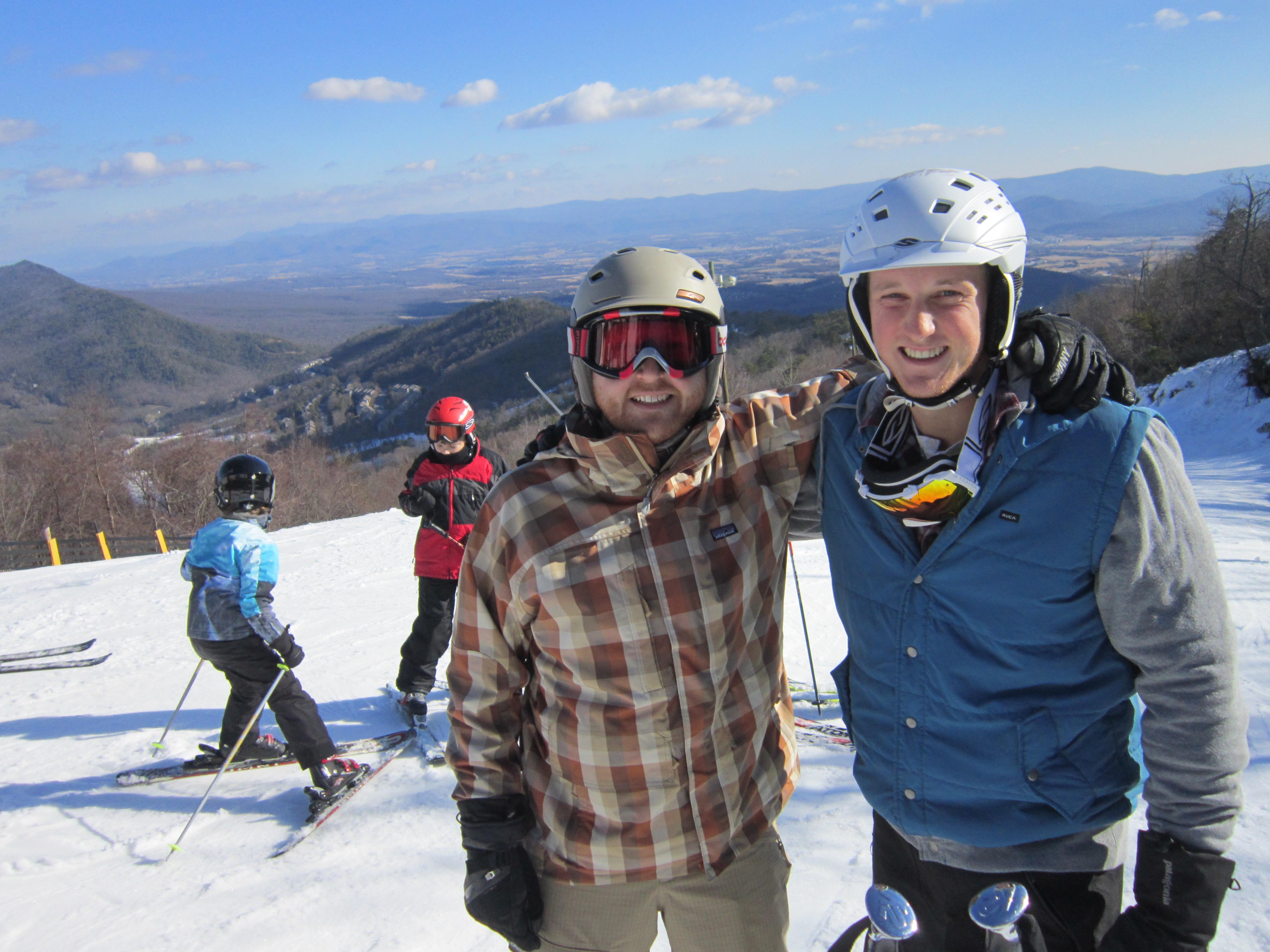
My nephews Josh and Adam, humoring me with a short pause on Sunday

My nephews Josh and Adam, humoring me with a short pause on Sunday

Last weekend I went skiing at Massanutten Resort, near Harrisonburg,l Virginia. I thought it would be good to see my brother and nephews, and have a little ski tune up before our Colorado trip in February. The drive up on Friday night was five and a half hours through fog and rain, and the ski conditions were far from optimal, but it was still well worth it.

On Saturday the weather report was for rain, and it did rain a bit, but the snow was pretty good. It was fun skiing with my nephews, both in their twenties and fast. They decided at lunch time to go to the movies, but my brother had ski patrol duty, and I decided to keep skiing with him on the advanced slope (number 6).

He had to leave for a period, and it got very foggy, with perhaps 50 feet of visibility. It rained a little. On the first run on my own, I noted that I didn’t see a single skier on the mountain. The same was true on the second, third – and fifth. It was the better part of an hour before a few other hardy souls ventured out.

Despite the fog, I enjoyed the skiing. I focused on sensing more of the ski edges, and making smooth, graceful turns. And I enjoyed the solitude of the trips up the mountain in the chair lift.

It occurred to later, though, that my smartphone was still sending out signals of my movements. My perception of privacy has been changing with the Snowden revelations, and I suspect I’m not alone. (LOL) Is it real so bad? I think it is, and have a concrete example.

A few weeks back, I wrote an email letter to the President. The gist of it was to commend him for commuting the sentences of some non-violent drug offenders, and to recommend that he expand that effort to help more of the thousands serving lengthy prison terms for minor drug crimes. As I prepared to send the email, I paused, thinking that this communication could easily mean a new NSA or other agency file would be opened on me, with unpredictable consequences.

Paranoid? Maybe. I sent the email anyway. But I expect that many citizens, now knowing how easily they can be monitored and how committed the spy bureaucracy is to expansive monitoring, might decide that expressing a political view just isn’t worth the risk of becoming a target.

There was a good piece in the New Yorker of a few weeks back by Ryan Lizza on the history of the NSA’s domestic metadata collection program, including efforts to establish a legal basis for it. It wasn’t surprising that a spy agency would tend to conceal its work, but it was surprising that agency representatives repeatedly lied to Congress and the FISA (special secret programs) court.

It raises the question, is this agency unconstrained by law? I expect most people involved in massive electronic surveillance are patriotic and well-intentioned, and not personally seeking world domination. But what if an agency with effectively unlimited resources and powers came within the control of a megalomaniac sociopath?Impossible? Remember J. Edgar Hoover?

If we’re lucky, we won’t become a police state in the Big Brother sense. But just knowing we’re subject to constant surveillance will probably change us. The interesting question is how much.

If the government forbade curtains on windows, we’d quit doing certain things within sight lines of the street. Maybe, without much discussion, we’ll get more guarded or stop discussing controversial topics using our electronic devices. Once that habit develops, it could extend to our face-to-face exchanges, or even our interior monologues. It wouldn’t happen all at once, but little by little. We might not even notice the change.

The justification for the government’s massive technology surveillance programs, of course, is prevention of terrorism. It’s hard to argue with that, since anything that grows the database of human activity could also increase information about terrorism. But is it possible that we’ve gone a little overboard with this fear-of-terrorism thing? Does it remind you a little of people preparing to end the world as we know with a nuclear conflagration it to prevent a takeover by communism?

There was a very interesting piece in Slate last week on the national hysteria over alleged sexual abuse and Satanic rituals in preschools back in the 80s. There were several of these cases in which little children testified that their preschool teachers molested them and also engaged in ritual murders and other bizarre and horrifying conduct.

Based almost exclusively on the testimony of the children, juries sent a number of these teachers to jail for lengthy terms. It slowly emerged that the abuse stories were fabrications produced by so-called therapists who essentially planted false memories in the children’s heads. Most of the teacher-victims eventually were freed.

In retrospect, the children’s stories seem way too bizarre to be believed – yet most of us believed. It’s a reminder of how our powers of reason and critical thinking are limited, and how they can be overwhelmed and defeated by sensational media and groupthink.

P.S. Needless to say, I paused again before publishing this post. But I think the danger of silence and retreat from dialog is even greater than the danger of surveillance run amok.

Is it 1984, with the NSA as Big Brother, or will Watson come to the rescue? Plus notes on a birthday, an anniversary, a soccer game, and an opera documentary

13 06 09_1924_edited-1What to make of the federal government’s massive program for gathering telephone and social media data? My first reaction was fear and horror. Is 1984 finally here? Is the Fourth Amendment a quaint artifact of a bygone era? Of course, we don’t actually know very much about the program, which is still classified. Is it like Big Brother, or more like the airport security services of the TSA, which inconvenience millions and accomplishes little?

As for the TSA, no doubt it’s supposed to make us feel more secure about flying, but for me the predominant emotion is frustration, with additional notes of anger and humiliation when my property and person are touched by uniformed strangers. And we’re afraid that if we complain, we may get put on the do not fly list and subjected to even more frustration and humiliation. Dear NSA analyst, if you’re reading this, I swear I’m not going to cause any mayhem – please please don’t put me on the do not fly list.

I’m kidding, of course (no I’m not – I want to stay off that list). I seriously doubt humans look at more than an infinitesimal fraction of this data, which is sufficiently massive as to defy all hope of human comprehension. It may be that this is why the program continues to exist: it’s become so big and complicated that no one can understand it. The computer doing the heavy lifting has almost certainly surpassed its minders in the complex skills at the core of this program. So who can reasonably make a judgment as to whether it’s a useful or safe project. The computer?

I realize this sounds a bit science fictiony, but if it isn’t already true, it probably will be soon. Remember, IBM’s Watson didn’t just win at Jeopardy, he or it trounced the strongest human players to ever have played the game. The Times reported this morning that the NSA and CIA have been testing Watson for intelligence purposes the last couple of years. He’s already way better at quickly analyzing massive amounts of data than any human ever will be, and he’s likely getting smarter and smarter.

In some ways this is comforting. I greatly doubt that Watson or his peers in artificial intelligence mean us any harm. Good AI is, at least so far, not complicated by the emotions that drive human behavior, including those that make us behave badly. Watson is not greedy, or prejudiced, or power mad. Once he gets this security thing well in hand, maybe he can take on more governmental responsibility. Could this be the way out of partisan gridlock? Watson for president?

Speaking of technological transformations, I recommend an essay in today’s NY Times by Jaron Lanier called Fixing the Digital Economy. Lanier is wrestling with an issue I’ve also written about: what happens to the economy (i.e. us) as human labor is increasingly replaced by robots and AI? He suggests that the source of both increasing decentralization of power and increasing disparities in wealth is computing power, and that the most powerful players are the ones with the most server power. I think he’s wrong to emphasize giant computers as primary sources of wealth, but he’s thrown out some provocative ideas. Here’s one: let’s revamp the economy so that those who take your digital data pay you for it. We could set up market in which Google, Facebook, the NSA and other data miners send out quarterly checks to all of us who provide the data.

Speaking of data and devices, Sally had a birthday this week, and I got her an iPad mini. She was thrilled! I got it at the Apple store at the Crabtree Valley Mall, which as usual was packed, and where I had a completely satisfactory buying experience. My salesman was knowledgeable and funny in a dry way. There are things to dislike about Apple as an organization, but they are really good at customer service. And their devices are designed with emphasis on a pleasant, intuitive human-machine interface, so non-specialists can enjoy them.

We also had our 31st anniversary this week, and celebrated with a fancy dinner at St. Jacques. The restaurant sits in a common strip mall, but inside it manages to convey the joie de vivre of fine French cuisine. I love that they have a special vegetarian menu. It took a little too long to get a visit from the sommelier, but eventually he gave us his full attention. A true and expressive Frenchman, he dissuaded us from getting the chardonnay that we additionally asked about, and with a dramatic explanation of the food flavors and wine flavors at issue persuaded us to try a sauvignon blanc. It worked beautifully. We savored every bite and sip.
13 06 08_1940

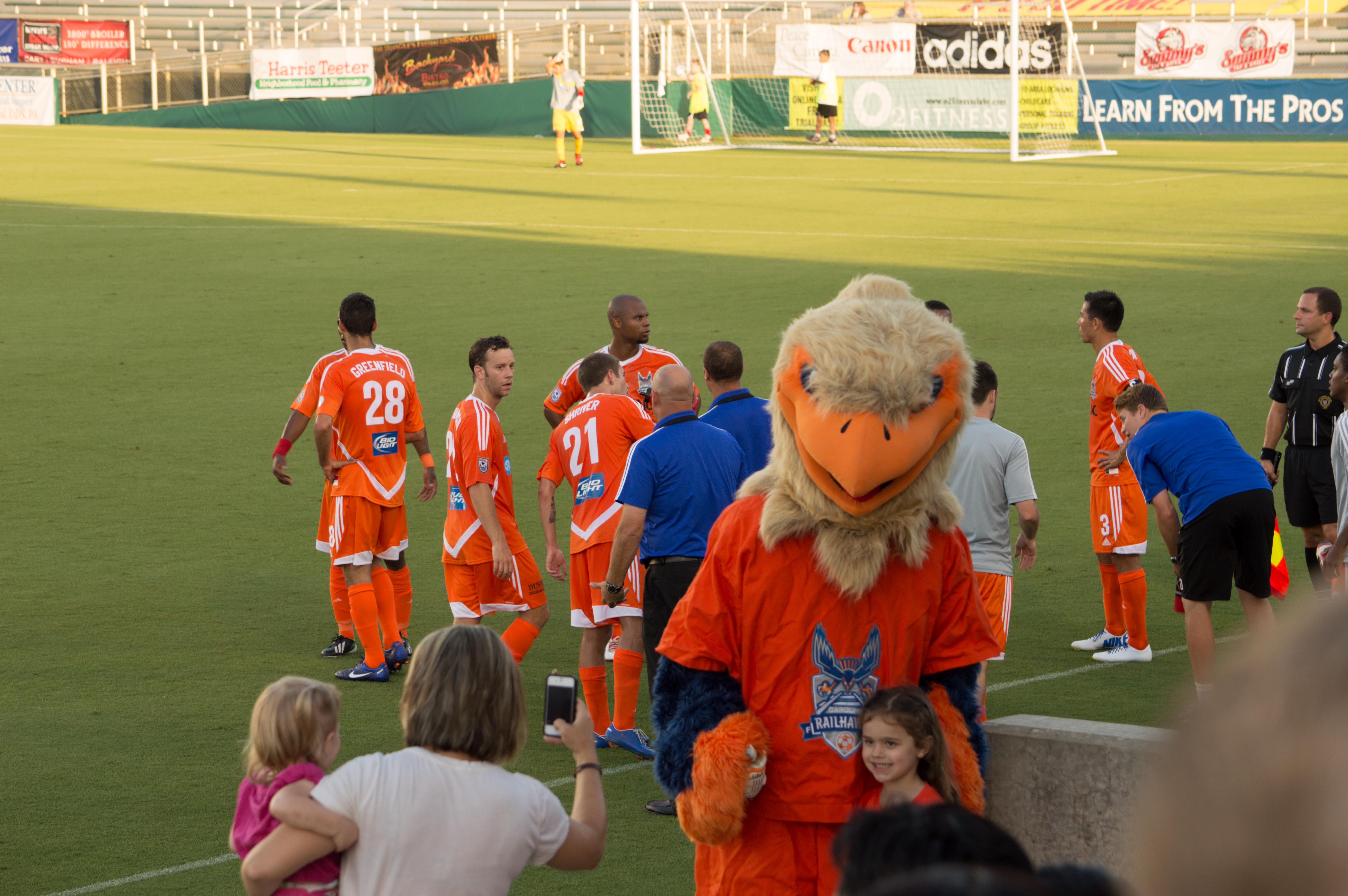
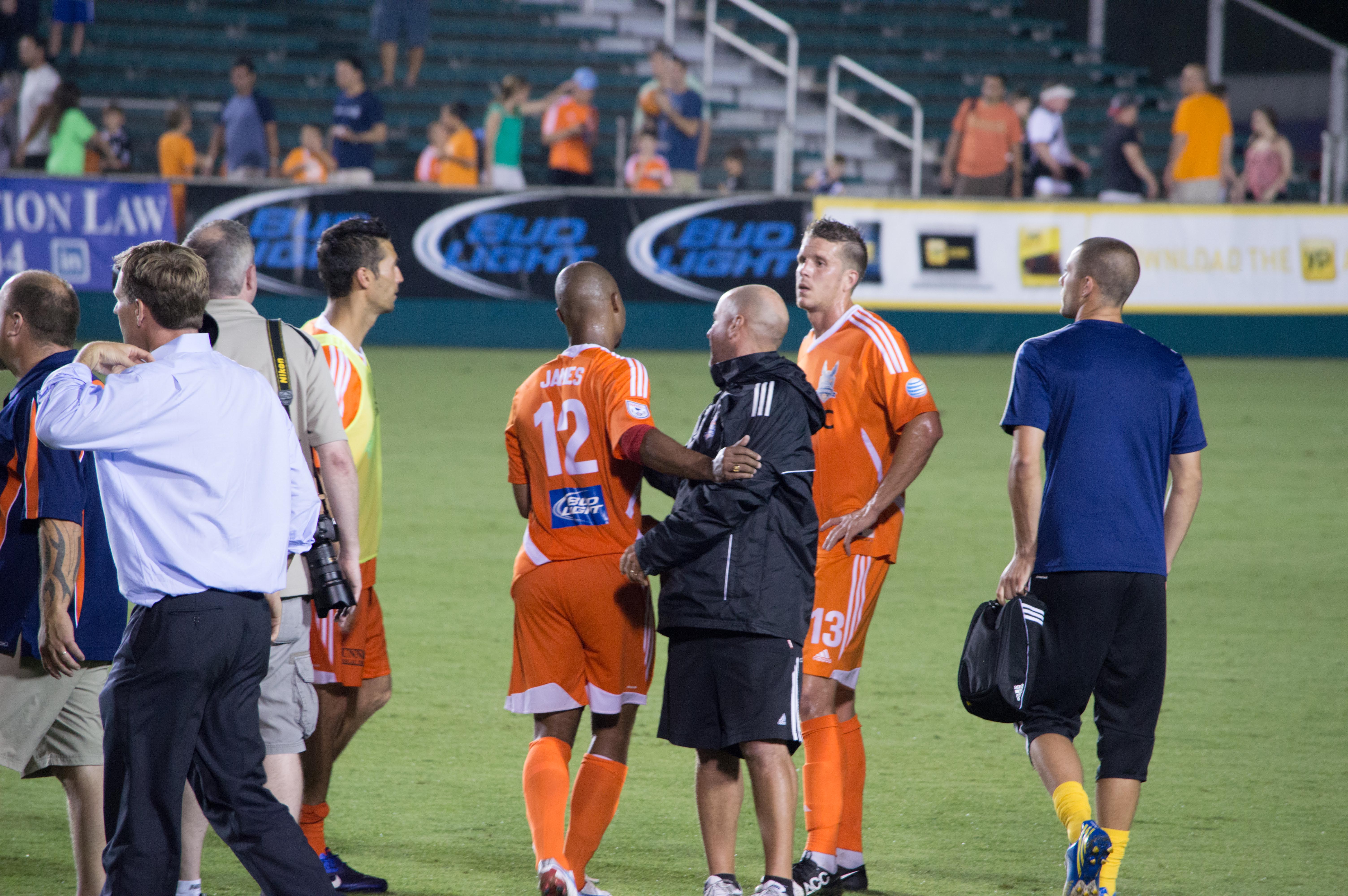
On Saturday night we went out to Cary to see a soccer game – the Carolina Railhawks played the Tampa Bay Rowdies. It was a clear, mild evening. We took along a couple of veggie subs at Jersey Mike’s, because last year we’d learned there wasn’t much in the way of healthful nourishment at the soccer stadium. But we were pleased to see they had improved their beer selection since last year. The field looked green and immaculate. We had good seats near centerfield on row G, and had a pleasant picnic there.
13 06 08_1967

The teams came into the game tied for the lead in the league and seemed well matched. I thought the Railhawks seemed sharper and less thuggish than last year. There were moments of skill and excitement, but no scoring until the 87th minute, when Tampa Bay took advantage of a defensive let down to put in a goal. When time expired there was an additional four minutes. During that time, the Railhawks proceeded to score, and then score again. We won!
13 06 08_1953

One of the Railhawks, Brian Ackley, is an old friend of Jocelyn’s going all the way back to middle school. We’d texted Jocelyn that we were going to the game, who’d texted Brian, and so he was prepared when we hailed him after the game and had a word. He’d played the last part of the game and had almost scored on a header. He’s a fine athlete and warm human being, and it was nice to see him.

Brian victorious (the Railhawk on the right)

Brian victorious (the Railhawk on the right)

When we got home, we watched a fine short documentary on HBO On Demand about Renee Fleming doing a master class for four aspiring young opera singers. The basic format, as with all master classes, is for a student to perform in front of other students and the master, and then receive criticism from the master. Here the students were all thrilled to have the opportunity to sing for Fleming, who is unquestionably one of our greatest singers. She was warm, generous, and a great listener. She gave some very specific advice on producing good vocal sounds, and spoke frankly about things like pre-concert nervousness. She gives a window into how difficult it is to be a great singer, but at the same time how wonderful.