The Casual Blog

Tag: John Adams

Music therapy, and looking for new bugs

umstead-bugsbug-1-2
My work days are often nonstop meetings, calls, and electronic documents about new technologies and difficult problems, and for several hours my left brain is going at full throttle. I like the intensity, but there are a lot of stress hormones. Without a dose of classical music after work, I’d likely redline and blow up. Playing the piano, even for just a half hour, is like a warm, soothing bath.

untitledbug-1-4

One of the pieces back on my musical workbench is Liszt’s famous Benediction de Dieu dans la Solitude. (There’s also some Schubert, Chopin, and Debussy.) I’ve been infatuated by the Liszt piece for a long time, but discouraged from committing to it by two things. First, it has some daunting technical demands, including reaches and stretches that are awkward and even painful. Olga, my teacher, suggested a (to me) non-obvious way of refingering to avoid the worst stretches, and I’ve been working out the details of the new approach.

The other blocker is the length. Most of the piano music I try to master and embody is on the short side by classical standards – under 6 minutes, which I view as pushing the limits of attention spans for most non-specialists. Benediction comes in at around 16 minutes. But what minutes! It’s very lyrical, elaborated by Liszt’s rich harmonies, and conceived with the piano’s singing qualities in mind. Here’s a couple of good and interestingly different performances from YouTube here and here

untitledbug-1-2

We’ve been particularly enjoying listening to music since we had our stereo system reworked last week. This was not entirely optional. Our former system involved in-wall and under-floor connections, which ceased working properly after our new floors were installed. Dr. Video, who installed the system, advised that fixing it would be quite expensive. We eventually decided to reposition the speakers on the large bookshelf, and powered them with a Yamaha R-700 receiver tucked in an adjacent closet. The speakers – two NHT Class Threes and a subwoofer – sounded good before, but with the new position and more power, they sound excellent.

untitledbug-1-6

We inaugurated the new sound set up with Harmonielehre, a piece for orchestra by the contemporary American composer John Adams. This is one of my favorite orchestral pieces of all time, and that’s including all the symphonies of Brahms, Bruckner, and Mahler. It manages to cover an enormous emotional range, from a bouncy and cheery to fiery and fierce to wistful and contemplative. The harmonic language is mostly tonal, but with piquant dissonances, and the rhythm manages to seem propulsive and natural, though it is anything but simple. It takes you on the journey of discovery, much as Mahler does. I have the version by the City of Birmingham Symphony, but various other are available on Youtube and Spotify. I highly recommend giving it a listen.
untitledbug-1-7

Another great stress reliever is a walk through the woods and around a lake. On Saturday and Sunday mornings, I went to Umstead and Lake Crabtree parks and moved slowly, looking closely in the grasses and bushes for interesting insects. Most of the little creatures I saw did not hang around long enough to have their pictures taken, but I got a few shots I liked.

umstead-bugsbug-1

Taking in some art, sport, and food in New York

14 11 02_3603Last Friday I attended the Software Freedom Law Center’s tenth anniversary conference in New York, wishing my friends at the SFLC happy birthday and learning something about the state of the art in FOSS law. Afterwards I met up with Sally and daughter Jocelyn at the Warwick Hotel for a Manhattan weekend. I had in mind to see some painting, some photography, some opera, and some ballet, all of which we did, plus some good food and conversation and the New York City Marathan.

As for the painting, on Saturday we went to the Metropolitan Museum, where we focused mainly on the exhibit of recently donated Cubist paintings by Picasso, Braque, Leger, and Gris. Cubism has never been my favorite thing, but I was curious to see some reputed masterpieces not shown in public for generations. The exhibit ultimately had its way with me.

I’d known that Braque and Picasso collaborated, but I hadn’t understood that they were basically partners and co-inventors of the Cubist style. What remarkable courage for guys in their mid-twenties to work exclusively in a style that was so radically new and difficult. They must have known it would be tough to sell at a time when, I’m guessing, they needed money. How excited they must have been to be seeing visions no one had ever seen before, and imaging they would permanently change the cultural/visual world. And they were right!

Engaging with art, and particularly art that requires commitment and struggle, changes you at a fundamental level. Your brain rewires itself, neuronal axons and dendrites making new connections. You are a subtly different person afterwards, who sees the world a little differently.

And though it involved some commitment and struggle, I warmed up to the paintings. There is steely rigor, but there’s more than that. There are moods, from sunny to brooding, and a surprisingly amount of humor. But you have to give the paintings some time and let them speak.
14 11 02_3558

We met Jocelyn for lunch in a Korean place on 37th Street, where our table got covered with savory little vegetarian plates and vegetable dumplings. Our waitress intervened when she realized Sally didn’t know she was supposed to spice up and mix up her kimbap. It was drizzly and chill when we came out and walked up 6th Avenue to the International Museum of Photography.

There we saw an exhibit called Genesis by the Brazilian photographer Sebastiao Salgado. The black-and-white photos are of remote, vulnerable, and magnificent places around the globe, including Antarctica, Galapagos, Patagonia, Indonesia, and Africa. I was very moved by this art. The works were big, some like large posters, and they had lots to say. Some of the landscapes have a stately lyrical classicism, and his photos of indigenous people are frank and intimate. He succeeded in his aim of making me think more about how beautiful and fragile is our planet.

We had dinner at Robert restaurant on the 9th floor of Museum of Arts and Design looking out at Columbus Circle. The room had the energy of forward leaning design, and the food and service were both really good.

Then we walked up to the Metropolitan Opera to see The Death of Klinghoffer. After all the recent controversy (charges of anti-Semitism, which I thought were way off base), I had some worries that there would be protesters, and a tiny worry that there might be a homicidal fanatic ready to attack. But happily there were only normal opera folk. Sally and I both thought John Adams’s music was beautiful and expressive. However, I found the staging static and dull. I’m not sure how much this problem was a matter of direction and how much is inherent to the work. On the whole, I was glad I saw it, but a little disappointed.
14 11 02_3565

Sunday morning was clear but chilly as we walked up from the Warwick Hotel to Central Park South to a spot about half a mile from the end of the New York City Marathon. We saw the first wheelchair competitors, then the first women, and then the first men. After almost 26 miles, most looked like they were in a hard, painful place. But they were booking! The leaders were preceded by a truck with a sign showing the elapsed time. It was particularly interesting to see how close the fight was for number one and two for both women and men. As they passed us, both pairs were so close that I thought perhaps they were friends that enjoyed running together. The women’s finish was the closest in the history of the race, and the men’s was also quite close.
14 11 02_3585

After a quick lunch, Jocelyn came with me to Lincoln Center to a matinee performance of American Ballet Theatre. We saw Sinfonietta (music by Janacek, choreography byJiri Kylian), Bach Partita (Bach, Twyla Tharp), and Gaite Parisienne (Offenbach, Massine). I greatly enjoyed it all, but particularly adored Gaite Parisienne. It was like Nutcracker for grownups: sumptuous, slightly risque fun. Hee Seo was a gorgeous Glove Seller, and Herman Cornejo was a manic, hilarious Peruvian. There were a LOT of really good dancers!

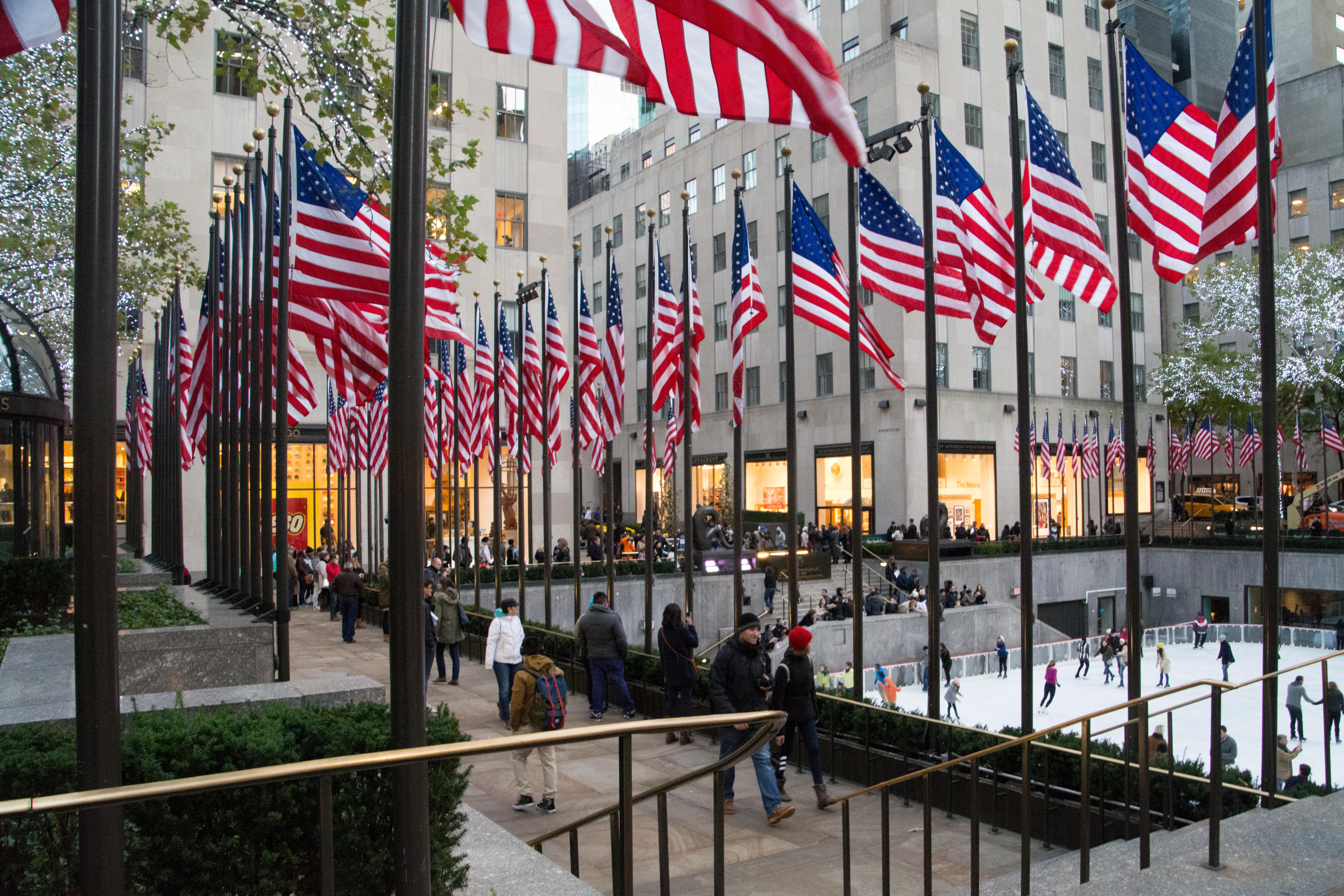
After Jocelyn got on the subway to go home to Brooklyn, I had a little time before we were due to head to the airport. I walked down Fifth Avenue and over to the skating rink at Rockefeller Center. I noted that the varied collection of flags from many nations had at some point been replaced by all US flags. Good looking flags, though .

Nixon in China

Saturday afternoon Sally and I made it to North Hills Cinema to see the Metropolitan Opera’s simulcast of Nixon in China by John Adams. I’d been looking forward to the event all season. Although I’d never seen NIC, I’m a big fan of Adams’s music for orchestra. It builds on the spare vocabulary of American minimalism both rhythmically and harmonically towards something that I think of as edgy romanticism.

The idea of an opera about Nixon going to China seemed at first outrageous and possibly hopeless. For those of us who observed Nixon in his lifetime, he seems a most unlikely hero. In retrospect, he looks a lot more moderate, responsible, and intelligent than we liberals thought at the time, particularly in comparison with today’s leading so-called conservatives. But even after giving extra credit, Nixon simply does not fit any standard opera hero template. At his very best, he was awkward, unsexy, and egotistical in an almost comic way.

Nixon in China takes all that and works with it. There is a comic and ironic aspect to the work, but that’s only one of many levels. The historical events are treated with some respect, and the humanity of the characters is acknowledged. But the music takes this material in surprising directions. Along with the simple storyline (the Nixons go to China) are several individual story lines that have the gauzy jumpy quality of dreams.

Adams himself conducted the performance on Saturday. At one intermission, he referred to the Met orchestra as a Ferrari of an orchestra — one of the best in the world — which I think is true. As Nixon, James Maddalena captures something of the weird contradictions of the man, though he seemed to have some difficult moments vocally. Janis Kelly was surprisingly touching as Pat Nixon, and had the vocal strength of a Wagnerian soprano. Kathleen Kim was funny but also terrifying as Madame Mao. It was good to hear the interviews with Peter Sellars, who’s both brilliant and comic, and Mark Morris, who’s brilliant as well.

I liked the music a lot, but I didn’t think this was necessarily the ultimate Nixon production. The Mark Morris dance sections were wonderful, but elsewhere big chunks of Sellars’s staging were surprisingly static. I thought the sets were in places too literal and in places too conceptual. But I would definitely watch it again, and I will be thinking about it for a while.