The Casual Blog

Why I am a vegetarian

Being a vegetarian is, in my view, a wonderful thing. Otherwise I would have eaten a plant-based diet for the last 15 years. But it is by moments challenging. One of the challenges is dealing with a question that comes up all the time, usually when I’m eating with people I don’t know well. At the worst possible moment — just as the food arrives — my companion asks, “So, why are you a vegetarian?” This is awkward. If you’re not already familiar with the issues, it could make you a bit uncomfortable, and spoil your appetite.

But as long as we’re not eating, let me satisfy the curious who wonder, Why be so difficult? Why not just enjoy a steak? I’ve tried to boil it down, and have ended up with three main reasons: better health, concern for other living creatures, and care for the environment.

I’ll start with good health, on the grounds that it is our most valuable possible possession — more than any number of mansions, yachts, and planes. It’s worth some time and effort to improve your odds for having a healthy life.

A simple way to improve those odds is eating a plant-based diet. Vegetarians typically have lower cholesterol, lower blood pressure, and a lower body mass index. They consume less dietary fat, which is associated with heart disease and cancer. They’re less exposed to the excessive antibiotics and hormones fed to farm animals. Studies have shown that they have a reduced risk of the big killer diseases of our society: heart disease, diabetes, obesity, and several forms of cancer.

At the same time, eating fruits and vegetables gives you the health benefits of antioxidants, including carotenoids, Vitamin C, and Vitamin E, and a wonderfully complete collection of other nutrients. It gives you more than enough protein, from such sources as whole grains, beans, nuts, and some vegetables.

Now, it is possible to have an unhealthy vegetarian diet. You could, for instance, subsist on Snickers and Cokes. To benefit from a veggie diet, you need to eat less processed food and sugar, and more whole grains, fruits and vegetables. Especially in the beginning, that takes some conscious effort. But there’s impressive evidence that it’s worth it, in terms of a healthier, and therefore happier, life.

My second main reason for not eating meat has to do with what meat is. Let me put this as delicately as possible. A hamburger is a cow that has passed on, and barbecue is a pig that has gone on to its reward. These animals are members of one of the great kingdoms of life — the kingdom animalia. Like humans. Farm animals have social structures, solve problems, and feel pleasure and pain. I believe their lives that are entitled to respect, and we make our lives nobler by giving that respect.

We generally recognize the worth of at least some non-human animals. Take my little dog, Stu, the sweetest dog in the world. He loves taking walks and being petted, and he makes strangers smile. I wouldn’t consider eating Stu, and I feel pretty much the same way about eating cows, pigs, and chickens. There’s hardly any difference, from a biological point of view. Most of the genes of Stu and farm animals are the same.

Most of us are revolted by wanton cruelty to animals. For me, it’s hard to ignore the cruelty associated with a steak or plate of barbecue. Most of the farm animals turned into food endure wretched lives filled with what amounts to torture before they are slaughtered. If you have any doubts about this, I recommend that you to watch the documentary Food, Inc., on factory farming and industrial slaughterhouses. Or read the Wikipedia article on factory farming. It is deeply disturbing.

My third reason for a plant-based diet is both ethical and practical: the meat industry is bad for the earth and the humans on the earth. Factory farming causes a host of environmental problems, including pollution of soil, water, and air, overuse of pesticides and herbicides, and habitat destruction.

Meat is a highly inefficient food. It takes 30 pounds of grain to make one pound of meat. We could feed 50 percent more people if we switched to a vegetarian diet. By eating meat, we waste a lot of energy, and burn a lot more fossil fuels. This contributes to global warming, which is an existential threat to the human race.

So there are my three main reasons for a plant-based diet – a healthier and happier life, respect for other living creatures, and taking better care of the environment. There’s actually one other reason, which is more selfish but also important. Taste! There are so many tasty plant foods, and so many textures and tastes that you start to notice when you eat less meat. Ancient cultures have developed exquisite cuisines based largely on plant foods. Think of Indian food, Thai food, and the Mediterranean diet.

Anyhow, those are my reasons for eating a plant-based diet. From now on, I can refer my interlocutors to my blog.

Curiosity, live chamber music, and wonderful ballet

Curiosity killed the cat, but I’ve come to see curiosity and openness to new experiences as major contributors to happiness. This week the NY Times science section had a story that supported this view. The story by John Tierney focuses on “novelty seeking” as a personality trait. According to one study, persons with the highest life satisfaction were those who scored high in novelty seeking and balanced that trait with high levels of persistence, meaning staying with an effort when there’s no immediate reward.

The same study mentioned a third trait associated with those who flourished most, in terms of health, friends, and emotional satisfaction, which it labeled “self-transcendence.” This is “the capacity to get lost in the moment doing what you love to do, to feel a connection to nature and humanity and the universe.” Tierney cites research indicating that novelty seekers exhibit more personality growth as they age. But it is also associated with such problems as gambling and drug addiction, compulsive spending, and criminal behavior. Too much of a good thing, perhaps.

I’ve noticed that lately I’m getting more and more enjoyment from music and dance, which may derive from persistently seeking novel forms and self-transcendence. I’ve been getting out to more live performances these last few years, which helps. I heard an interview with James Levine, the great conductor, in which he compared a recorded performance to music to a post card of a scenic view — that is, a pale reflection of the live event. That may be an exaggeration, but I think he was right that there is no good substitute for live performance.

And so Sally and I made our way to Fletcher Hall last Sunday afternoon to hear one of the world’s premier piano trios, named for its members: the Kalichstein- Laredo-Robinson Trio. They were master musicians and played an excellent program of Mozart, Debussy, Richard Danielpour (b. 1956), and Ravel. Laredo (violin) and Robinson (cello) have been married for 35 years, and the Danielpour piece was a duet written for them entitled Inventions on a Marriage. It covered a range of moods, from passionate to tender to humorous, and the musicians were, as you’d expect, in intimate communication.

Unfortunately, the audience was sparse — about 160 people. I felt embarrassed on behalf of Raleigh that there weren’t more people to hear these truly great performers. As a member of the board of the sponsor, the Raleigh Chamber Music Guild, I felt some responsibility. Afterwards, several board members exchanged emails theorizing about what happened.

Did we not publicize the event enough? I think we did not. Is the audience for this music disappearing? I sincerely hope not, but I guess it’s possible. Chamber groups like string quartets are what TV ad writers plug in when they want to quickly depict the opposite of cool and hip. And they aren’t really wrong. Unlike things that are cool, chamber music is not instantly accessible. It takes years of training and devotion to play, and it also takes education and experience to enjoy. Those of us who have been privileged to have such education had better figure out some way to educate others, or we may lose something precious.

Enjoying ballet also requires some amount of education and experience, although it doesn’t rank as high on the endangered-arts list. I’ve been fortunate to have had early exposure, starting with my sisters’ elementary ballet recitals and continuing through high school at the N.C. School of the Arts. I got to see George Balanchine’s New York City Ballet and other great companies. And I’m continuing to learn from watching the work of great choreographers and dancers, and also reading. I’ve almost finished Apollo’s Angel’s, Jennifer Homan’s impressive, and daunting, history of ballet.

On Thursday we went to opening night of the Carolina Ballet’s new program, Balanchine Rarities. The program opened with three short but very technically demanding Balanchine works. The dancers were beautiful, even in sequences that seemed designed to test their physical limits. I especially enjoyed A la Francaix, a piece in the playful spirit of Jerome Robbins’s Fancy-Free, with two rambunctious sailors, a fun-loving Flirt, a Dandy with a tennis racket, and a diaphanous Sylph, who competes with the Flirt for the Dandy. Jan Burkhard was delightful as the sexy Flirt, and Lindsay Purringon found a sweet combination of elegance and humor in the Sylph. Eugene Shlapko was athletic and funny as the Dandy. He’s getting better and better.

At intermission we talked with Lola Cooper, who had the night off. She was fighting a bad cold and losing her voice, but excited about working with Marina Eglevsky, who staged the Balanchine works. We also talked with Alicia Fabry, who had broken her right metatarsal the previous week during rehearsal. She was in a plastic cast and using a crutch. Poor thing! She said the break could have been worse and did not require surgery, but would take several weeks to heal.

The company also performed Lynn Taylor-Corbett’s Lost and Found, inspired by the 9/11 attacks and set to piano music by Robert Schumann. It is a elegaic work, somber but beautiful. The last work was Robert Weiss’s Moving Life to piano music of Erik Satie. Roy Dicks’s review in the News and Observer singled out Cecilia Iliesiu for her performance, which I thought was fitting; I also thought she seemed like a rising star.

Sensationalizing homophobia, engaging with aging, and testing mindful eating

Coming back yesterday from a short trip to Manhattan, I had a few minutes to spare in the crowded Delta terminal at LaGuardia. There were no seats near my departure gate, but I found one three gates away, and flipped through The New Yorker magazine. With only a few minutes, I purposely chose a story I expected to be relatively uninteresting — a piece by Ian Parker titled A Reporter at Large: The Story of a Suicide: Two College Roommates, a Webcam, and a Tragedy.

The story keyed off a widely reported incident at Rutgers University in 2010 in which a student spied on his roommate with a webcam and tweeted that he’d spotted homosexual behavior. The ensuing mediathon developed the story line that a heartless homophobe had posted video on the web that caused a vulnerable closeted gay student to kill himself — an emblematic hate crime.

In Parker’s reexamination, the popular media story turns out to be a gross distortion. Dharun Ravi, the surviving roommate, is now facing a criminal trial on vague charges with the potential of years in prison. Ravi created an extensive record of tweets, texts, and other communications that seem stupid and immature, but not unusually so for a 17-year-old. There turned out to be no web cast of video. The suicide victim was actually out of the closet. Ravi’s juvenile online socializing comes across as frenetic and somewhat pathetic. He seems smart, selfish, insecure, and not all that unusual.

I got a few a columns into the story before I decided with boarding time approaching I needed to position myself closer to my gate. I wheeled my possessions a hundred yards or so. Somewhere in that process, my New Yorker disappeared. I retraced my steps, but it had vanished. How annoying! I hope whoever recovered it enjoyed it. After I got home, I managed to download the piece to my iPad and finished it.

It’s too bad, in a way, that the facts don’t support the story line of a bullied gay martyr. Homophobia plainly exists, and violence against gays exists, and those things need to be publicly condemned and appropriately punished. Tyler Clementi’s suicide was unquestionably a tragedy. But, as Parker’s story shows, the cause is unknown, and probably complex. There’s no simple way to assign blame for it. The media’s hype and erroneous reporting fed hysteria and calls for revenge, and now comes a criminal trial that will at a minimum scar a second life.

As an alumnus of the editorial staff of The New Yorker, I enjoy flipping through it every week, though I admit to reading less of it than in days gone by. Last week I read with intense pleasure in the January 23d issue a piece by Donald Hall titled Out the Window: The View in Winter.

The 83-year-old poet has written about getting old. He now needs a wheelchair and has various physical problems. He’s conscious of being “a separate form of life,” treated with either indifference or too much solicitude. He spends a lot of time looking out the window at his bird feeder and the countryside beyond. The outline of his life sounds sad and dull.

This is the amazing thing, though: his life is full of incredible beauty! His descriptions of the drama at his bird feeder are marvelously clear and vivid. He writes of the sequential blossoming of spring flowers with rhythmic, muscular prose. To think that this depth of perception and power of expression can be part of growing old is inspiring.

I’d like to become more conscious of ordinary sensory experience, and to reduce, if only a little, the percentage of each day lived on autopilot. It’s challenging, though, to engage with the present. There are distractions inside and out. Art, like Hall’s essay, can help. I find yoga is also helpful. I hadn’t really thought of meal time as a possible aid, but was inspired by a column this week in the NY Times headed Mindful Eating as Food for Thought.

The basic notion is to focus carefully and completely while eating on the sensations of eating — the flavors, smells, and textures, down to tiny details. The way I normally eat involves talking to people, reading, listening to music, thinking about things, and sometimes combinations of these, jumping from one to the next, hardly noticing the food. Mindful eating is the opposite — quiet and slow.

According to the column, this approach to food is an antidote to over eating and helps with distractedness. It also could lead to greater pleasure. I was reminded of my old friend Tom, now departed many years, a casualty of AIDS, who considered great cooking to be an art entitled to no less respect than painting or music. Accordingly, he had an enthusiasm for high-end restaurants at a time when neither of us could well afford them. He once used part of his Watson fellowship money to treat me to a meal in a four-star restaurant in Paris. His only request was that we not talk while we ate. We enjoyed the incredible meal in perfect silence.

More recently, on an average day I have a hard time focusing for half an hour on anything, and that includes eating. But at least now I’m thinking about it. So far, I’ve managed to eat only a few mindful bites at the beginning of a meal, but I’m going to keep trying.

Climate changing and improving decision-making

It was unseasonably warm this week in central North Carolina. Some daffodils and forsythia are starting to bloom. They’re beautiful, of course, but there’s something that doesn’t feel right. They’re not supposed to be here for another month or so. It’s hard not to think about climate change (a/k/a global warming) and be worried.

At least, hard for some of us. There’s a vocal minority of climate change-deniers that somehow keep grabbing the spotlight and the microphone. They create enough of a stir to prevent any serious political discourse on the most serious global environmental problem humankind has ever faced. It’s bizarre.

Yesterday’s NY Times reports that Tea Party activists are fighting local efforts to conserve energy on the grounds that such efforts are part of a United Nations-led conspiracy. Fox News is also involved in spreading of this lunacy. What is wrong with these people? There should be no debate about whether or not to pay attention to overwhelming body of scientific evidence establishing global warming and its potentially disastrous consequences — but there is.

Our species is headed towards the edge of a cliff. We should be focusing enormous resources on minimizing CO2 and other emissions. This should be our new Apollo program — to land our grandchildren on a planet that’s sustainable.

We’ve really got to get this effort started. I suggest as a first step we agree that the opinions of science-deniers be subjected to appropriate brief ridicule and then ignored. Yes, everyone’s entitled to their opinions, but not every opinion is entitled to be taken seriously. Whether the source is ignorance, greed, or mental illness, opinions that have no basis in factual reality are at best a waste of time. In this case, they’re also increasing the risk of mortal peril. Basta!

For step two, or maybe step one-and-a-half, we should read Thinking, Fast and Slow, by Daniel Kahneman. I’m about two-thirds of the way through, and I’m confident it will be in my list of top thought-provoking books of 2012. Kahneman is a Nobel-prize-winning psychologist and founding father of behavioral economics. His most recent book summarizes the research he, Amos Tversky, and others have done in the last few decades into the psychology of decision-making.

Kahneman divides judgment into two main parts: intuitive processes (thinking fast) and rational ones (thinking slow). The fast part plays a much greater part in our decisions that we think. We all rely on heuristics and biases to simplify complex matters. This mode of thinking is important — without it we’d be paralyzed — but it also sometimes leads to very bad decisions. Understanding more about the points of failure of our ordinary thought processes may help us avoid some errors and make better decisions. I hope.

Beautiful Miami, and the social requirements for innovation

My room at the W in South Beach

My little burgundy Briggs & Riley roll aboard has been getting a work out these last few weeks. It was barely aired out from our trip to B’s memorial in New York before it got repacked and reloaded on American flight 1541 for Miami, where Red Hat hosted a management summit.

We stayed at the W, where I had a room with a balcony overlooking the beach. I never actually made it onto the beach (too busy), but I got a few deep breaths of ocean air and on the way to lunch by the pool glimpsed some pretty girls in bikinis. The room was hyper modern, black and off white, with mirrors, reflective metal, white granite, black wood, and many different textures. The shower was bounded with clear glass on one side and translucent glass on the other, with water jets arranged at the normal head level, along with chest level and thigh level. When I finally figured out that the hot and cold indicators were reversed, I had a great shower.

We had sessions with leading economists, business analysts, management experts and others about technology trends and best practices. We were also urged during breaks and meals to mingle and network. As a moderate introvert by nature, where the assigned mission is to make contacts in large groups of strangers and then having interesting conversations, I always feel a certain dread, which can verge on panic. What if can think of nothing to say? Or the new acquaintance has nothing to say?

Over the years, I’ve gotten more adept at handling or avoiding such social emergencies, and usually end up, despite the initial dread, talking with nice people and having a good time. And so it was in South Beach, where I met a lot of interesting and friendly Red Hatters, including some who shared some of my personal enthusiasms (such as sports cars, skiing, and music) or had surprising enthusiasms of their own (such as sailing, flying, and triathlon). Of course, everyone was very bright. I felt privileged to be associated with all those gifted people and with the mission of Red Hat.

Speaking of useful interactions, on the plane ride back, I read an interesting piece in the current New Yorker by Johah Lehrer called Groupthink: The Brainstorming Myth. (The link has only a blurb; payment is required for the entire article.) Lehrer recognizes that today creativity and innovation are generally the products of group collaboration. He notes that important scientific or technical problems are incredibly hard, and researchers are specialized, “because there’s only so much information one mind can handle.” As one scholar put it, “A hundred years ago, the Wright brothers could build an airplane all by themselves. . . . Now Boeing needs hundreds of engineers just to design and produce engines.” Because of complexity, “people must either work together or fail alone.”

Lehrer goes on to discuss the classic strategy for coming up with new ideas — brainstorming, or having groups quickly generate ideas while prohibiting all criticism. He provides scholarship showing that, despite being widely practiced, brainstorming isn’t very effective. More effective than simply encouraging ideas is allowing room for conflict and dissent. He also explores the optimum degree of social intimacy for producing a Broadway hit (moderate) and the kind of physical space that produces groundbreaking science (Building 20 at MIT). It’s worth reading.

A Philip Glass opera and remembering B Berkeley

Sally and Jocelyn at the Mill House Inn, East Hampton, New York

Thursday night I went with friends to see the NC Opera’s production of Les Enfants Terrible by Philip Glass. I was interested for three reasons: I like some of Glass’s minimalist music, I like to support the NC Opera, and this production was billed as a dance opera. Ricky Weiss, artistic director of the Carolina Ballet, choreographed and directed the production.

I liked it. The story is a strange, surreal, dark tale of a brother and sister who are close — too close. The music is both driving and dreamlike. Each character had two physical bodies — a singer and a dancer — and each body expressed part of the emotional reality. This opened up interesting expressive possibilities. Opera fans are familiar with the enormous range of emotional possibilities from singing plus acting, and adding dance in as a vital element was fascinating.

One problem, though, was that the dancers could so easily steal their scenes, without meaning to. They are so much more graceful and expressive than ordinary humans, and even more than trained actors. At times it was difficult to give equal weight to the non-dance parts of the action, because the dancers were so compelling. The singing was rather good, particularly the soprano Jessica Cates as Lise. But her dancer twin, Lara O’Brien, had tremendous emotional range, and a kind of wildness. I thought the idea of the singer-dancer pairs was great, and worth exploring further.

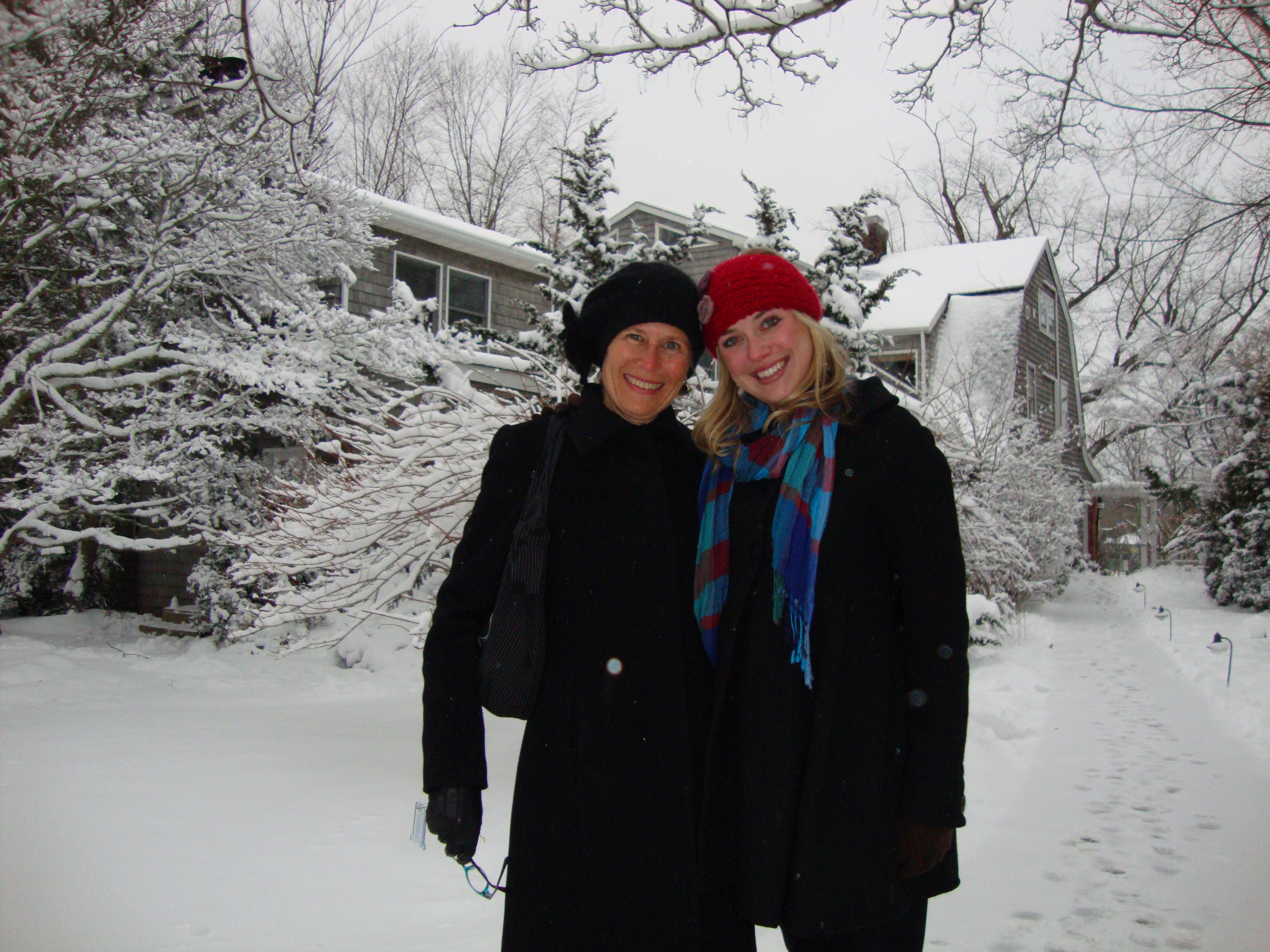
The next day Sally and I flew to New York to attend the memorial service for her father, Norborne Berkeley, Jr., affectionately known to my generation as B. Gabe and Jocelyn flew in from Colorado and we rendezvoused at a hotel near La Guardia, then drove out to East Hampton. I was so happy to see the kids! We stayed in a lovely bed and breakfast called The Mill House Inn. It was good to see the Berkeley side of the family, and revive happy memories of East Hampton from our younger days.

We drove by the old Berkeley place in Bridgehampton and did a little shopping in East Hampton. I bought Gabe a pair of corduroy pants and The Unbearable Lightness of Being by Milan Kundera, on the sole condition that once he finished it he tell me his impressions. Such a rich book, and I know too few people who have read it. It snowed six inches that night.

The service on Saturday was in an Episcapol church and was well attended despite the snow. It had a heavier religious component than I expected from this relatively unreligious family. But Bill Berkeley did a fine job in his eulogy recognizing the strengths and accomplishments of B, and the good qualities we’ll want to remember. B meant a great deal in my own life, and I’ll miss him.

How to keep lost weight from coming back

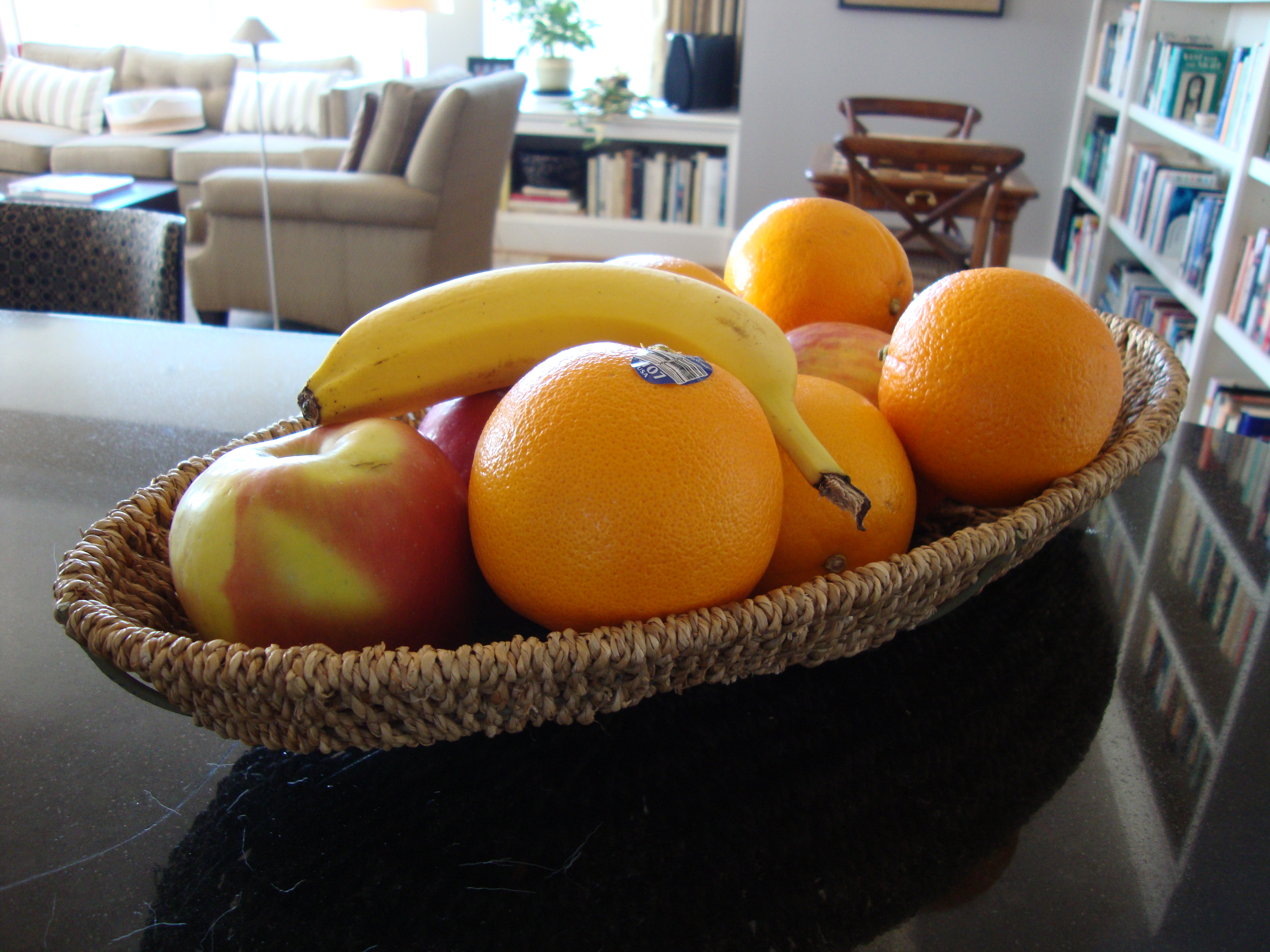
Healthy snacks on the counter at Casa Tiller

Returning from travels over the holiday break, I stepped on the scales to find myself three pounds heavier. It always happens! I swear, though there were temptations aplenty, I was reasonably moderate in my eating and drinking. How amazing that the body can accumulate mass so quickly! Also, a little scary.

In recent years, I’ve not been much concerned with losing weight, but I’ve been working hard not to add it. This basically means being careful about eating and diligent about exercising. That sounds — so — boring! Even if you do it, who wants to hear about it!

Thus, I was interested to read the NY Times magazine piece titled The Fat Trap: Do You Have to Be Superhuman to Lose Weight? by Tara Parker-Pope. According to the article, sustaining a healthy weight after losing a lot of pounds is not just unusual — it’s extraordinary. Those who do it are a “tiny percentage.”

That’s a bummer, both for the individuals who struggle with their weight and for our health as a society. Scientists are trying to figure out why people usually gain back weight after losing it and what can be done about it. Meanwhile, as a member of the fortunate “tiny percentage”, I may have something helpful to contribute. I’ve previously posted about losing 50 pounds, but here are some additional thoughts specifically related to how I’ve kept that weight off for several years.

It isn’t easy, but it also isn’t impossible — obviously! In fact, the methodology is basically the same as any worthwhile achievement that takes sustained effort. If you’ve learned to play the piano, speak a foreign language, play golf, or whatever, you’ve probably already employed most of the same methods you need for ongoing weight control. You need to find your motivation, keep it simple, be empirical, and have fun.

1. Find your motivation. Actors talk about needing to find a character’s motivation to bring the character to life. Try it: ask yourself what you really want, and why. For anything that’s going to take a long, sustained effort, you’ll need a motive that carries real meaning for you — something that’s more important than simply feeling good right now. It helps to articulate it clearly. My own guiding motivation has to do with the battle with father time. More concretely, I’m working today to be able to ski the deep snow in the big mountains of Colorado and Utah when I’m in my eighties. The snow on the mountains is beautiful. I sometimes think of this in the very early morning when it’s still dark and I’m making myself go to the gym.

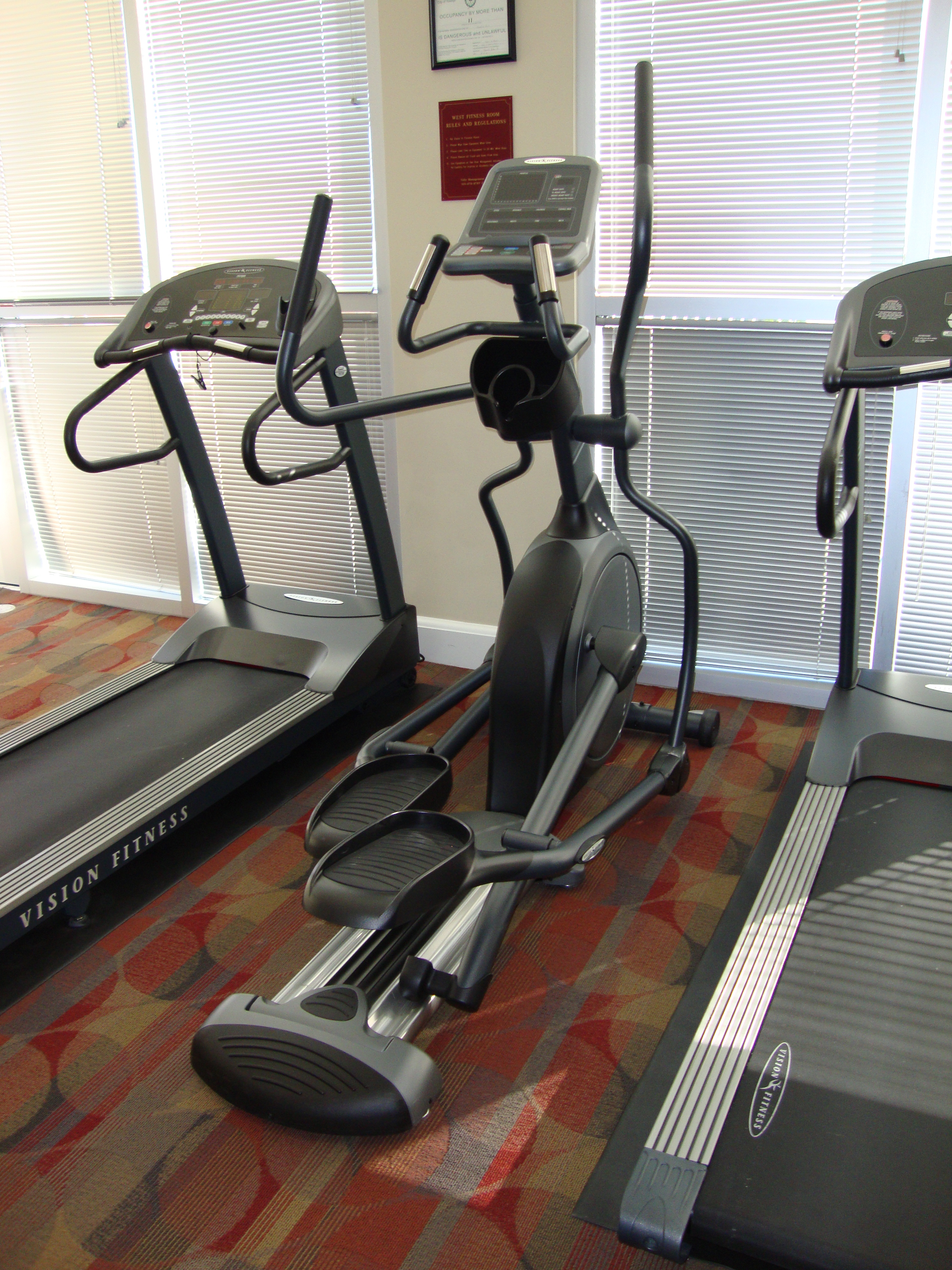
My friend in the gym on the roof -- the elliptical machine

2. Keep it simple. If a system is too complicated, it will not be sustainable. A good system is one you don’t have to think about very much once it’s in place. It involves turning good intentions into good habits. For myself, I have some simple rules that help in avoiding bad eating decisions, such as: no chips, no sodas, and no candy bars. For snacks, I put in place simple and nutritious substitutes, like apples, bananas, and baby carrots. If you are considering going vegetarian, I’ll note that one of its many benefits is helping to simplify the challenge of eating a healthy, less fattening diet. Anyhow, these types of snack choices have gradually become habitual for me, and as habits they don’t take much mental energy. Of course, there’s the countervailing powerful force of other lifelong personal habits, customs, traditions, and advertising tempting you to make bad eating choices. There will be slip ups — and hello, there’s three new pounds. Then you refocus, and move on.

3. Be empirical. Look at the available data, and consciously monitor how you feel. I bought a digital bathroom scale and use it every day. I watch food portions carefully, and notice whether I’m feeling too hungry or unenergetic. I have not adopted a single off-the-shelf theory of eating and exercise, because I think every body has somewhat different needs. What works for you may not work for me. You need to be experimental. If an approach isn’t working, chuck it, and try something else. If you test a healthy snack or an exercise approach that seems to work for you, try it again and see if it still works.

4. Be creative and playful. We’re talking about a long-term approach here, and if it is no fun, you will eventually give it up. Simple repetition is boring. Try out interesting new healthy foods and new exercises and sports. When traveling, I make it a little game in airports to find the least unhealthy meal, and to find something interesting to do in the little hotel gym. I vary activities over the course of a normal week, so that at the moment I alternate among the elliptical machine, the stationary bike, and swimming, and various types of resistance training. For more fun, I enjoy listening to music and reading while doing the elliptical. I’ve found that classes liven up the cycling experience. Every so often, I change the mix of activities and try something new.

So there you are, for whatever it’s worth. Having said all that, I’ll note again, sustaining weight loss isn’t easy. It takes conscious work every day and every meal. But it doesn’t have to be white-knuckle misery or boredom. The guidelines of motivation, simplicity, empiricism, and playfulness help. And developing skill with the guidelines could lead to other good things. They can be applied to any rewarding long-term objective, like learning a sport or a musical instrument.

Some thoughts on golf and Miami

One of the things I’d really like to improve in 2012 is chipping. Sure, I’d like to get more fit, be a better person, etc., but fulfilling this resolution could be transformative in a small, practical way. My golf game would be so pleased if I could consistently get short shots from off the green closer to the hole. Compared to a lot of things, it’s not that hard. It’s just a matter of practice.

You may ask, what is the point of golf? I’ve asked the same question many times. It can be, as the old saying goes, a good walk spoiled. It’s fears, frustrations, humiliations, and disappointments. At times it’s uncomfortable and even painful. But it’s also about overcoming these things. It’s about courage and strength. It’s very much about honesty and integrity, and friendship.

Golf is full of beauty — the beauty of unique gardens with flowers, trees, lakes, and birds, of magnificent vistas. The beauty of the little dimpled white ball flying as hoped for in a high parabola against a clear sky. It is wonderful to stroke a long putt that curves several feet before finding its way to the bottom of the hole. For all the horrors and rigors, there are incredible moments of transcendence.

And so it was with hope and pleasant anticipation that on Wednesday I played my first eighteen holes of 2012 at the Doral club, in Miami. The skies were blue, and although it was a bit cool and breezy, the palm trees seemed calm and welcoming. With some business colleagues I played Greg Norman’s Great White course. (The other, more famous course, the Blue Monster, was about to host a tournament and closed to the public.) There was lots of water, and lots of sandy waste areas. My tee shots were fairly consistent, and I hit some long and satisfying fairway woods. I did not find the greens particularly difficult. The trouble spots had to do with chips. I’d like to wipe a few of those from memory, such as shots within a few yards off the green that didn’t get to the green. Aaargh!

I stayed two nights at South Beach in a gorgeous little hotel called The Betsy. The lobby has dark wood, palms, and ceiling fans. My room had white furnishings accented with surprising tastefulness in bright pink and orange. There was a television in the bathroom mirror. I’d never thought of needing such a thing, but I loved it immediately. It really improved the shaving experience.

The art deco architecture and bright colors of South Beach are lovely. I’ve thought of Miami in recent years primarily as an airport which, once in, I looked forward to escaping, but I started to see it as a unique and lively international city. It reminded me that I need to keep working on my Spanish.

Diving in the Galapagos Islands

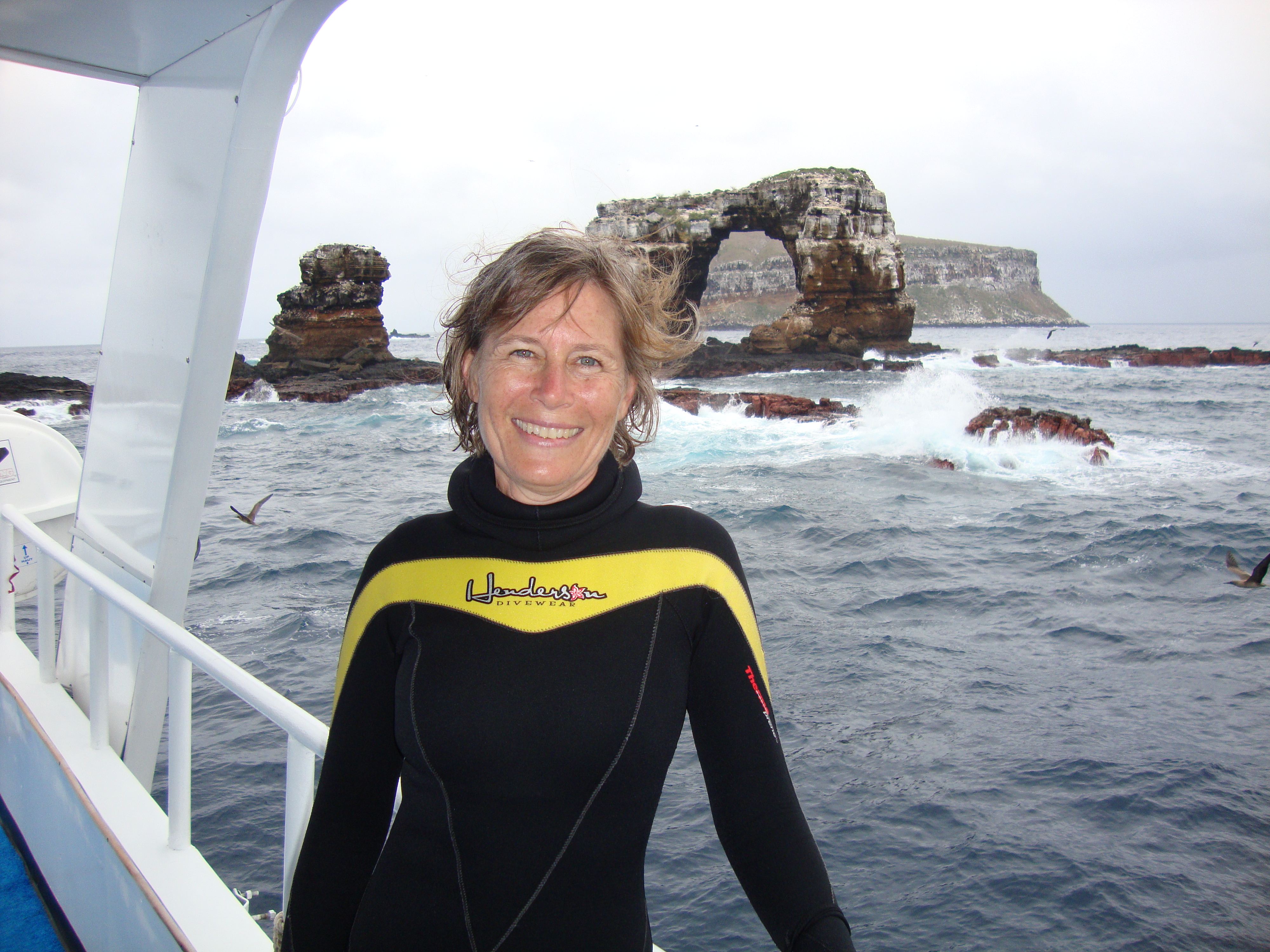
Sally at Darwin's Arch, Galapagos

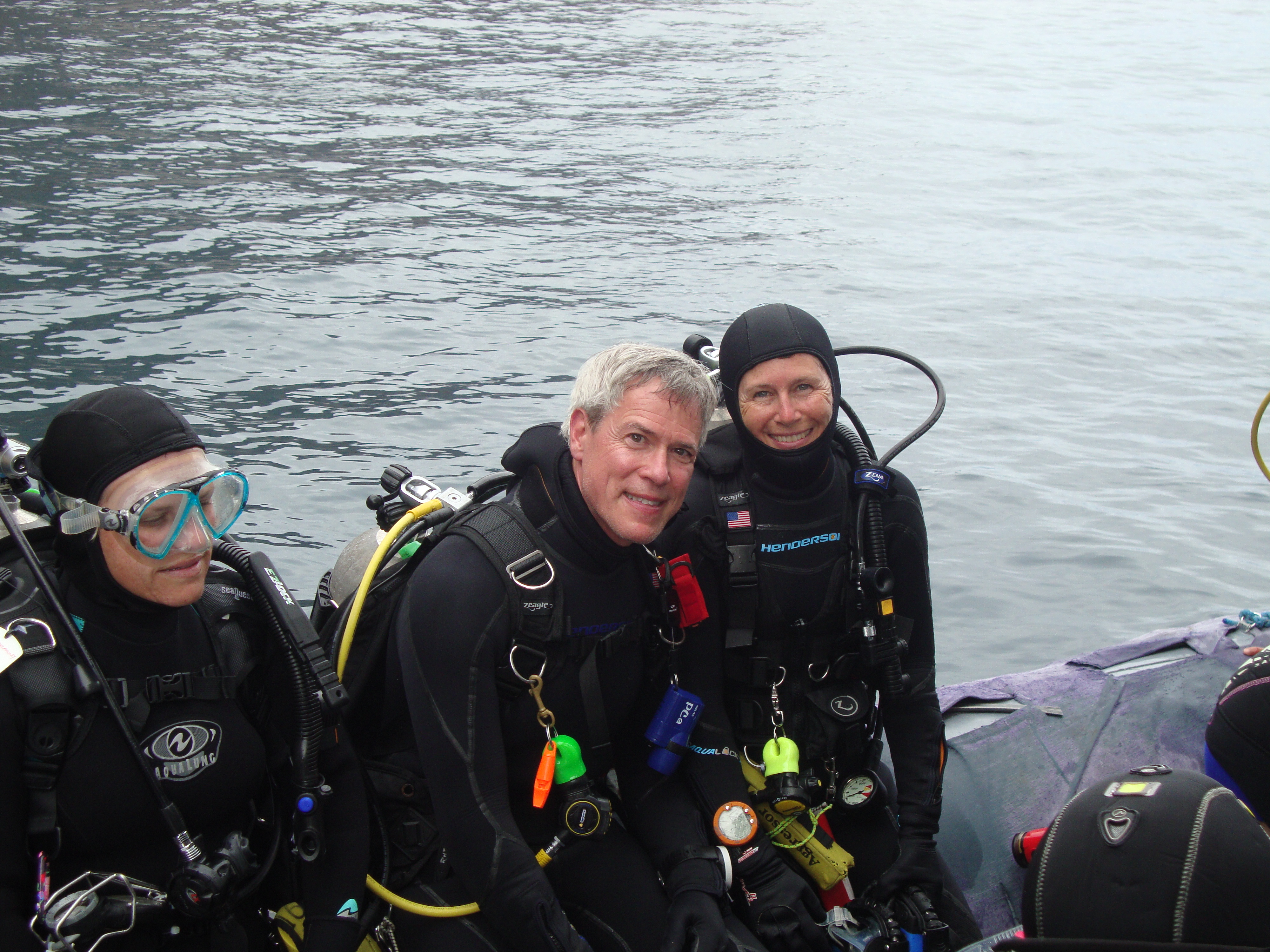
On Christmas day, we did our third day of scuba diving in the Galapagos Islands, some 600 miles west of the coast of Ecuador, at the foot of Darwin’s Arch. There was a strong current, and so we spent most of the fifty-minute dive clinging to barnacle-covered rocks. There were many patrolling hammerhead sharks, as well as a couple of large Galapagos sharks. We saw many large sea turtles and fine spotted moray eels. There were hundreds of small colorful tropical fish, such as Moorish idols, king angelfish, trumpetfish razor surgeonfish, Guineafowl puffers, barberfish and parrotfish, as well as huge schools of creolefish. It was fantastic!

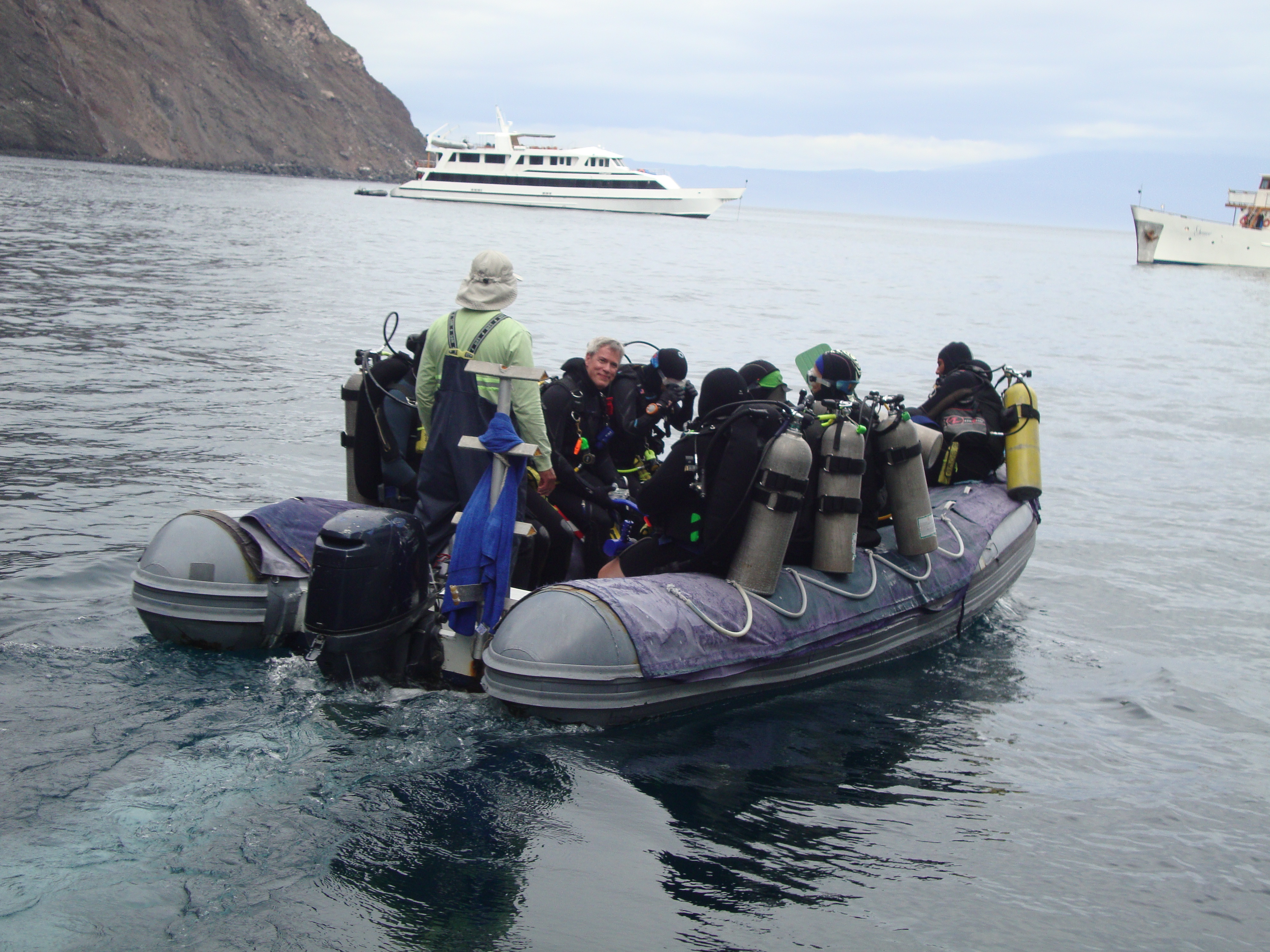
After the dive, we hoisted ourselves over the side of the inflatable dingy (or panga) and returned to the mother ship, the Galapagos Aggressor II. It was Sally’s hundredth dive. The crew presented her with a certificate, and our fellow divers gave her congratulations and hugs.

The Galapagos Aggressor II

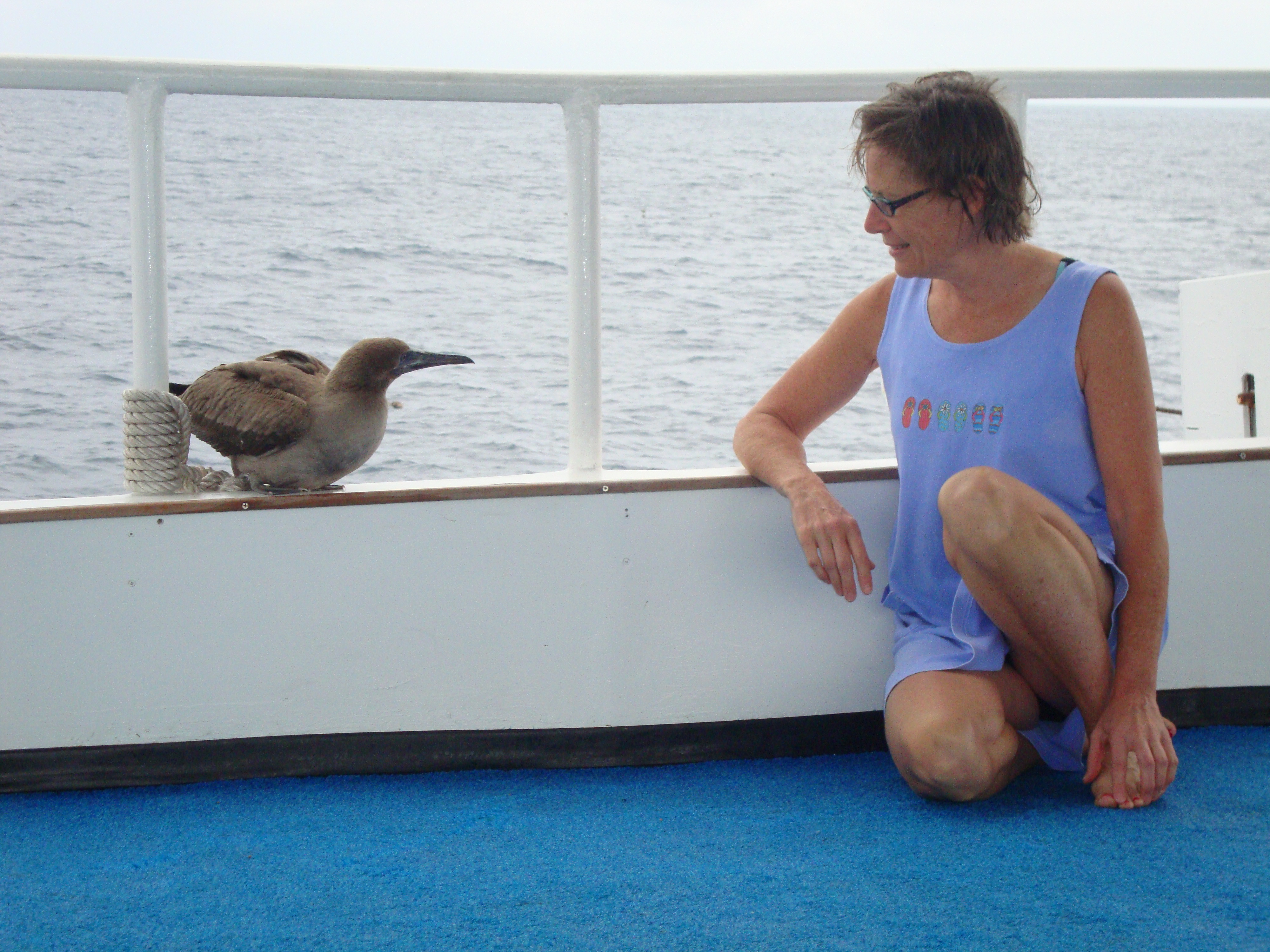
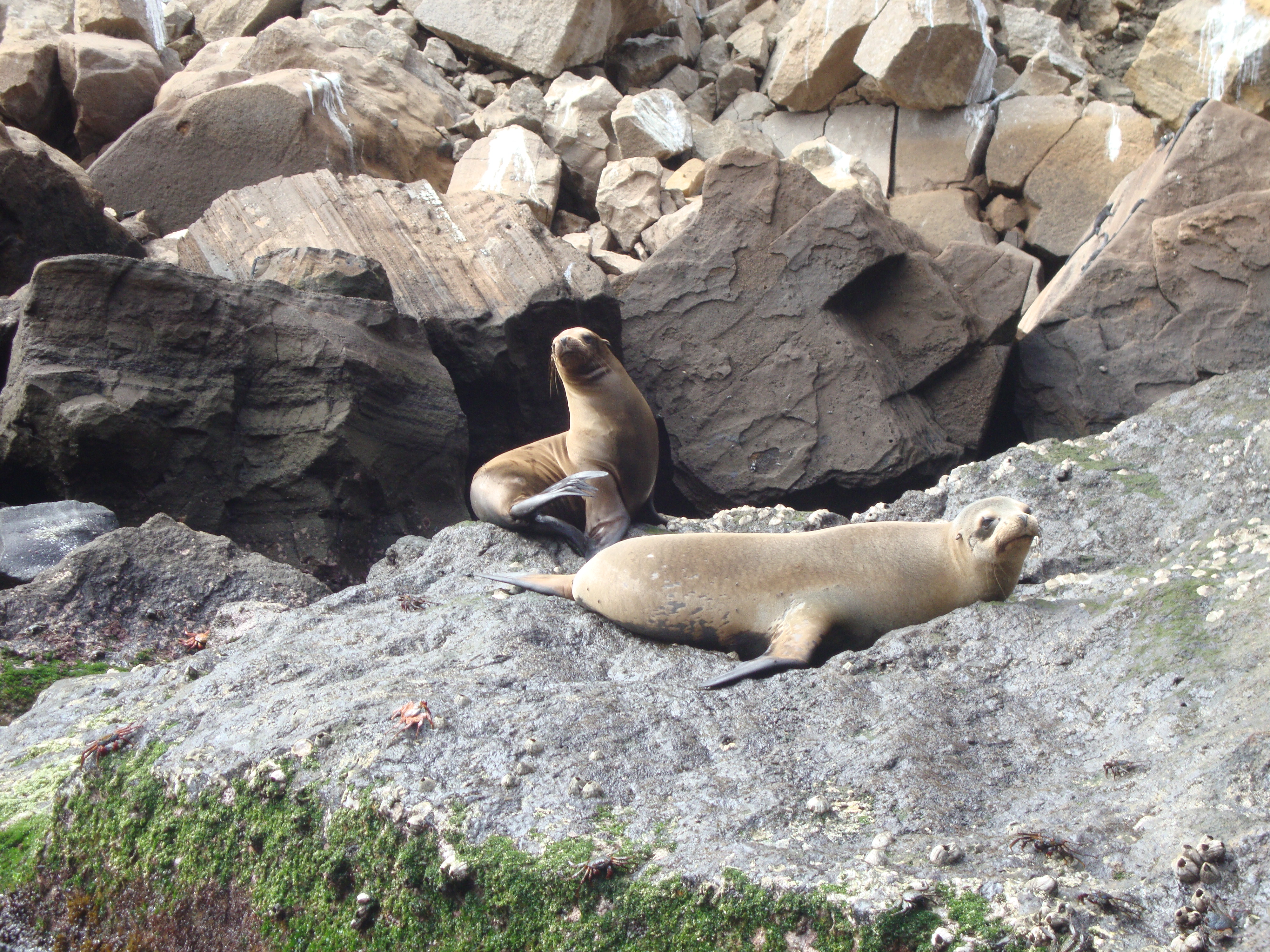
From the boat, we watched hundreds of flying boobies (large sea birds that resemble gulls with webbed feet) (Nazcas, red-footeds, and a few blue-footeds), frigate birds, swallow-tailed gulls, and storm petrols. Groups of dolphins came by periodically. Later that day, we did some snorkeling a few yards off of Darwin Island. The dolphins weren’t very interested in us, although I swam briefly with a group of six. We had better luck with a group of sea lions, who were curious about us, and came close by doing flips and loops.

Sally and a curious juvenile boobie (red footed, I think)

Darwin, like all of the islands we visited during the week, was the remains of a volcano that originated four or five million years ago — a mere babe in geological terms. It was mostly gray rock wall rising sharply several hundred feet to a plateau on top. It was very stark, but also thrumming with bird and sea life. We saw no other humans. It felt like the earth was brand new. The creativity and resourcefulness of nature was awe inspiring.

On the panga

During the trip, I finished reading The Better Angels of Our Nature by Steven Pinker. Pinker’s theseis is that human violence has declined dramatically over the course of history, and he explores the possible reasons for this. The book covers a lot of territory (all of human history) using a lot of tools (history, philosophy, statistics, biology, psychology), and still manages to be surprisingly lively and readable. Part of the book examines the increase in the last century of concerns for animal welfare — the sense that mindless cruelty to animals is unacceptable, and the suffering of animals is a moral concern. As with most violence, we’re ordinarily concerned with (and overgeneralize from) the violence and cruelty we observe, and tend to ignore examples of kindness and decency. It was cheering to learn of a trend toward greater respect for animal rights, and to consider that the trend could continue.

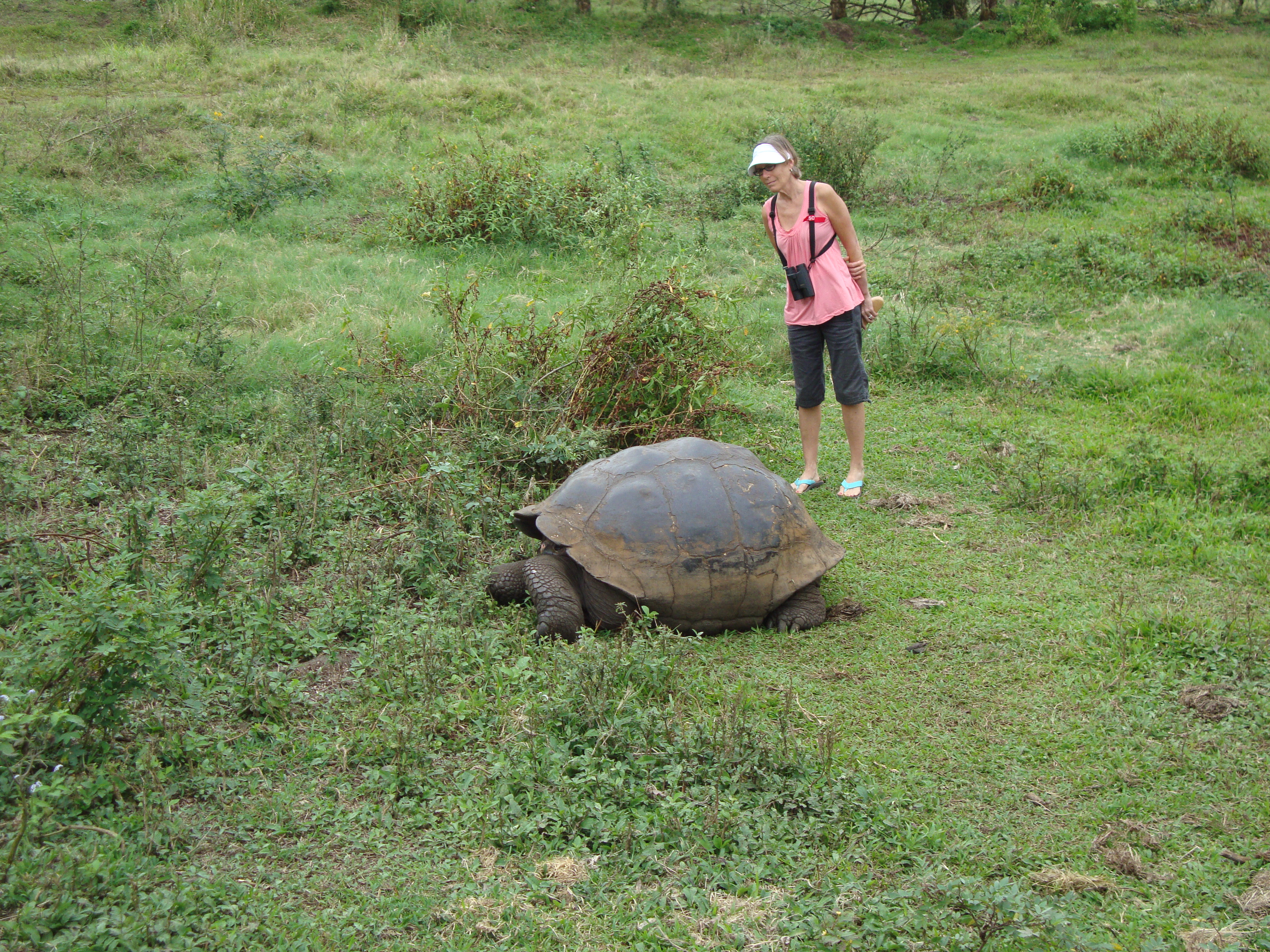
In our group of 11 divers, Sally and I were the only ones who did not dive with cameras. They were a cheerful, intelligent, and sociable group of folks, and all significantly more experienced at diving than we were. I’d taken the view that I’d prefer to look hard at what was in front of me without the distraction and intermediation of a camera, but especially after viewing some of their pictures, I was a little sorry that I didn’t get pictures of some of the amazing, strange, and beautiful things we saw under water. Perhaps next time. Here are some other above-water pictures from our trip.


The Nutcracker and a piano lesson

We went to the Carolina Ballet’s new production of The Nutcracker last week. Over the years, I’ve seen many Nutcrackers, from student productions to the NY City Ballet’s. In days gone by we used to listen to the Tchaikovsky music when we decorated the Christmas tree. I’ve never actually gotten sick of it, but a few years back I started to worry that it could happen. With the ballet music, just as earlier happened with the Brahms symphonies, I decided that I needed to be careful not to get so familiar as to lose the great joy of the thing. And so we hadn’t gone to the Carolina Ballet’s Nutcracker for the last couple of years.

I’m glad we returned. The CB production was substantially upgraded with new sets and effects. I enjoyed the upgraded magic tricks in Act 1, and thought the costumes in the ball scene were opulent. Act 1 is the children’s act — with magic tricks and children playing, but not a lot of dancing. Act 2 is more for the grown-ups, with a variety of virtuosic classical dance. The leading female roles in the performance I saw were wonderful, including Lilyan Vigo as a regal Sugarplum Fairy, Jan Burkhard as an outgoing Dewdrop, and Lara O’Brien as an unusually poignant, melancholy Tea. The men seemed especially athletic (gravity-defying) this year, including a particularly impressive Richard Krusch and Nikolai Smirnov.

Before the show, we agreed to celebrate the occasion by relaxing as completely as possible and just drink in the production — that is, clear the mind of everything except the beauty in the moment. We mostly succeeded. There were a couple of rough spots with the props, including the giant book with the false back that didn’t quite get closed in time. The sound quality from the live orchestra coming through speakers was less than excellent. But mostly we were swept away to a beautiful, magical place.

We met up with Lola and her boyfriend, Rodrigo, after the show, and learned that she’d had to switch roles at the last minute and, due to another dancer’s health problem, perform in a position she’d never done before. She said it was one of the least enjoyable shows of her life, because it took so much work, and was very far from solid. Of course, none of that was visible to us — she looked great. It was good, though, to be reminded of how hard the performers work to create the appearance of effortlessness.

At my piano lesson last week, Olga touched on this point. I’ve been bringing at least some memorized music to our lessons, and from time to time memory glitches occur. To fix this, part of her approach is to minimize dependence on muscle memory and build security through harmonic analysis. At the same time, she recommends thinking about the movements of the arms, wrists, and fingers as choreography — that is, gestures that have beauty separate from the beauty of the sound (but contributing to it). Planning the gestures and getting them ingrained is part of learning the piece.

At the lesson I began with Chopin’s mazurka opus 63, no. 3 (c sharp minor). (It’s unfortunate that great composers of the Romantic period passed on giving their works names. With 51 published mazurkas, it’s hard even for musicians to keep them straight by number. I generally try to think of a name for the ones I learn. I think of this one as: Sharp Longing.) It has unusually strange, sad harmonies and dissonances. I managed to play it coherently, and was pleased that Olga noted some interesting and lovely things. But, she noted, there was still a lot of work to do.

It is daunting to face Olga’s listening powers. At one point she perceived, correctly, that I was not carefully listening to what I was doing. “You’re faking it,” she said. Note, I was playing the right notes, but not balancing them in a considered way. This is a high standard — not just playing right, but playing with deep understanding. She acknowledges that there are many possible ways to play a phrase, but it is not acceptable to just play the notes without understanding and feeling.

As best I can tell, she does not draw a sharp line between the physical, intellectual, and emotional aspects of playing the piano. She recommended that I think about touching the keys as though I were speaking, which I found helpful. She also forced me to consider carefully about how my thumb moved to contact a key as opposed to the other fingers. We also talked for a while about the role of the elbow in certain situations. Not to mention the wrists! And that’s before we even get to the form or the music, or what it is trying to say. After the mazurka, we worked on the Etude Op. 25, No. 1, and Debussy’s Reverie. At the end, I felt tired, but inspired: there’s so much more challenging, beautiful music ahead.