The Casual Blog

Category: sports

Our dive trip to Cozumel

_DSC0015 copy

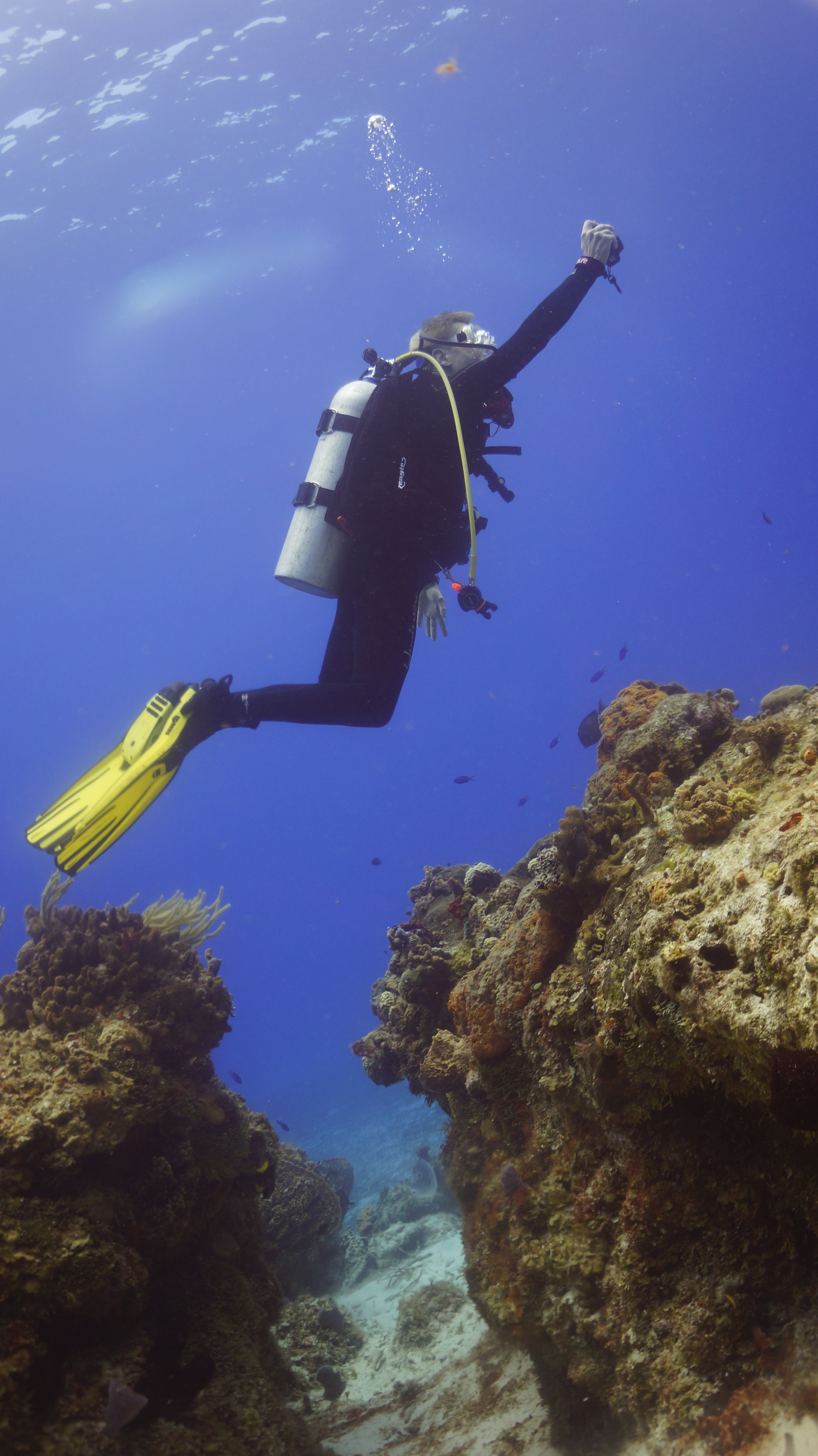
Sally and I just got back from a week of scuba diving in Cozumel, Mexico. As a friend recently noted, we like adventure vacations. If you do, too, you would probably like Cozumel. The diving was great, and the above-water scene was lively, too.

Cozumel is a warm and enterprising place. Most of the real beauty, for me, is in the reefs, but I also really liked the people. The Mexicans I met are mostly cheerful and good humored, but also polite and dignified. They worked hard to help us along our way.

The business of Cozumel is tourism, and there are many layers to this business, from high end hotels to street hawkers. A stroll through the main part of town takes you past many gold and silver jewelry shops, clothing shops, crafts establishments, restaurants, and shops selling Cuban cigars. Most of these shops have a person who will try to persuade you to look inside, some of whom are aggressive and insistent. It’s a bit annoying if you’re not interested in the goods, but the beautiful blue water fronting the main street makes up for any inconvenience.

2013 05 04_1376

I’d been planning to use more of my Spanish, which is still a work in progress, but had little occasion to. The sales and service people of Cozumel have highly developed antennae for spotting los norteamericanos, and encourage expenditures by using English, which ranged from adequate to impressive. A couple of waiters gently corrected my usage mistakes, which I appreciated, and I think they appreciated my making some effort with their language, but it was clearly not required.

Our hotel was the Casa Mexicana, a mod-looking place on the water in the center of town. Our rooms was attractive and comfortable, with a balcony overlooking the courtyard restaurant where we ate very satisfying breakfasts. The lobby was on the second floor with a pool and deck chairs overlooking the water. Lots of restaurants were within walking distance, though we took a taxi to our favorite, Casa Mission. The hotel was only a few steps from the shop of the folks who took us diving, Aqua Safari, and the boat dock was just across the street.

2013 05 09_1356

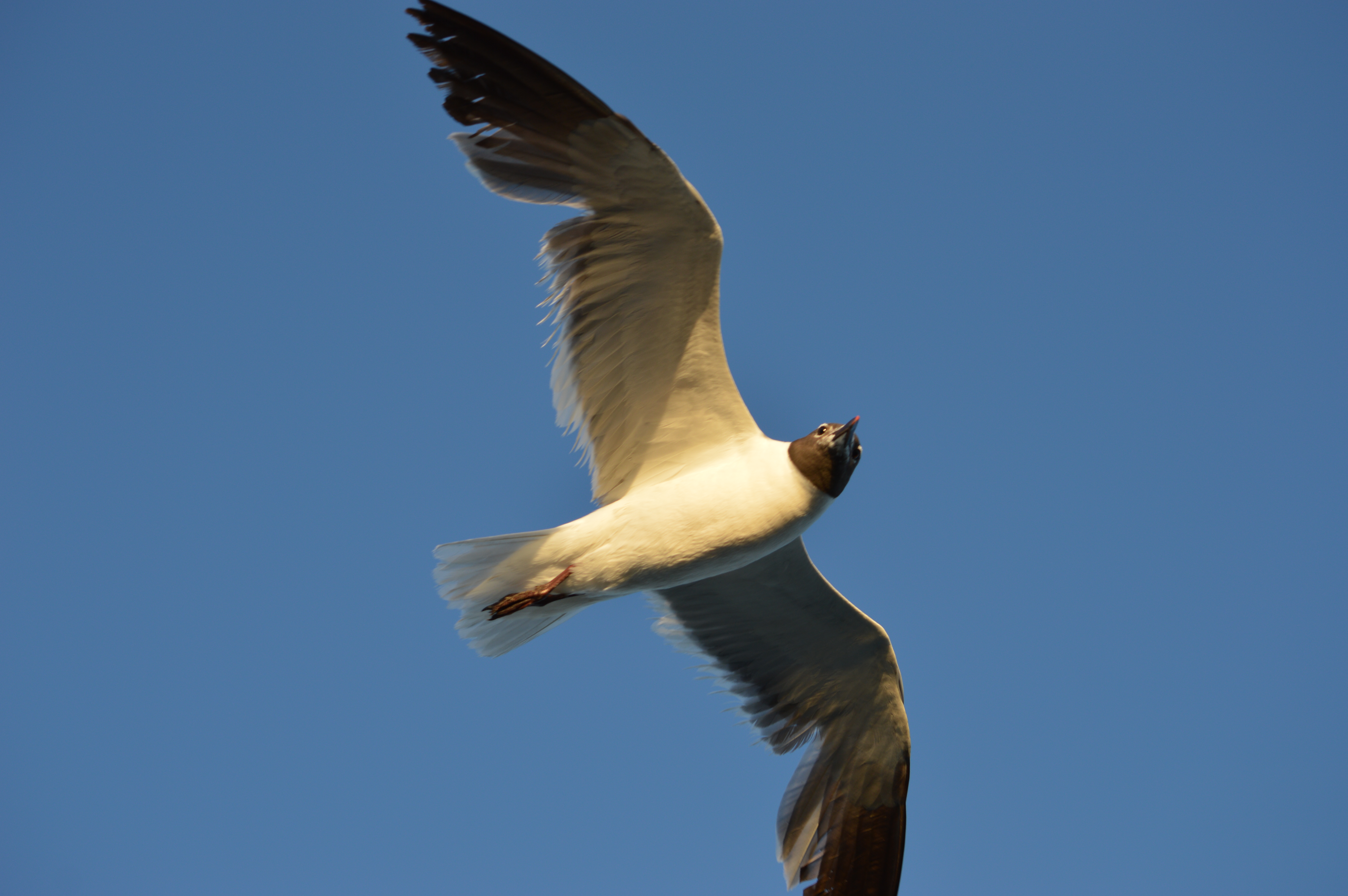
Our boats usually had about fifteen divers. These included our group of six organized by our friend Dan out of Down Under Surf and Scuba. We did two dives in the morning, and after returning to the dock, we either ate quickly and went out for an afternoon dive, or on two days relaxed and then went out again at 7:00 for a night dive. The boat rides to the dive sites were generally one to 1.5 hours. Our guides were experienced, and showed us many interesting places and creatures. Early May seemed a good time to be there – sunny, breezy, and not un-Godly hot.

Our dive environments fell into three main groups: coral walls that went much deeper than we could dive, coral patches separated by sandy areas, and large coral structures shaped like pillars, boulders, mesas, and canyons, which made me think of southwest Utah. There were dozens of species of live coral. Some were vivid colors (purple, orange, green, yellow, red), and we also saw the famous black coral. Their shapes and textures were fantastically varied, including ones that looked like cactuses, pillars, antlers, brains, and various vegetables.
SeaLife DC1400

SeaLife DC1400
Cozumel is famous for drift diving, meaning a trip that goes where the strong current takes you. This can be exhilarating, but is also challenging at times. In the strongest current, there is no easy way to stop or reverse course, and it can feel by moments like Lost in Space. This requires alertness to avoid collisions with people or coral, and limits the chances to take photographs or look at things with deliberation. There were dive sites with little current, though, which were calm and sweet.

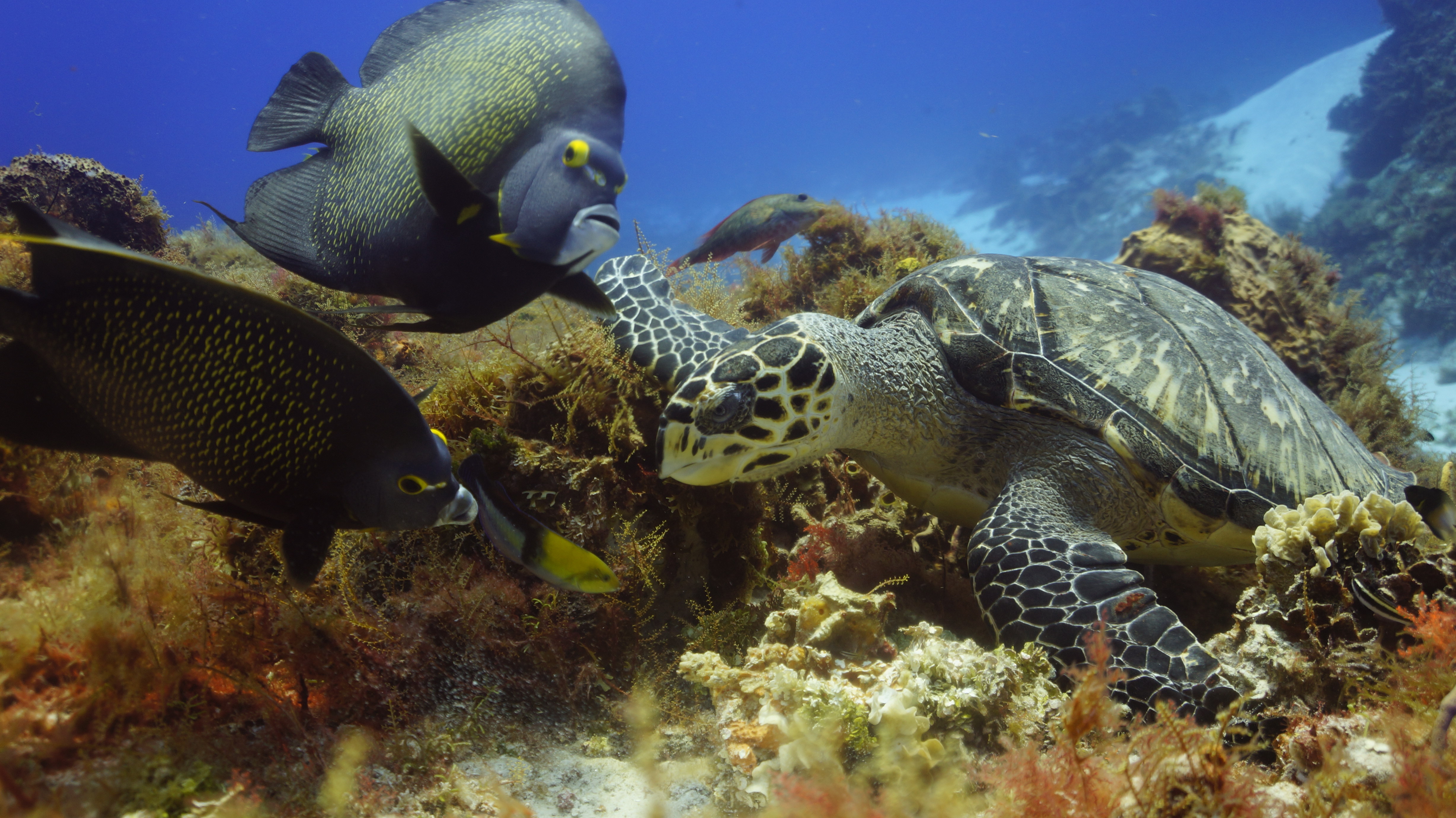
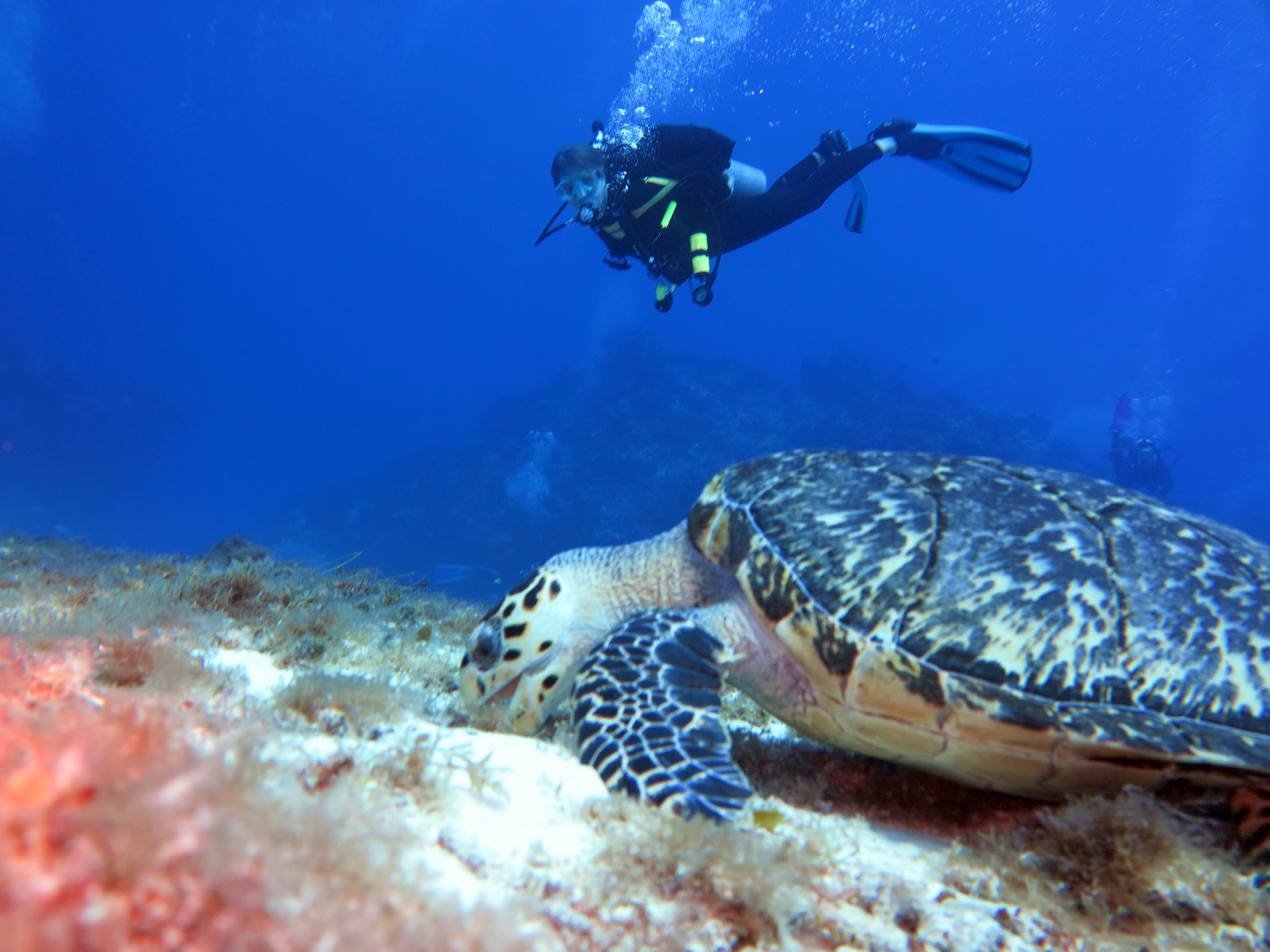
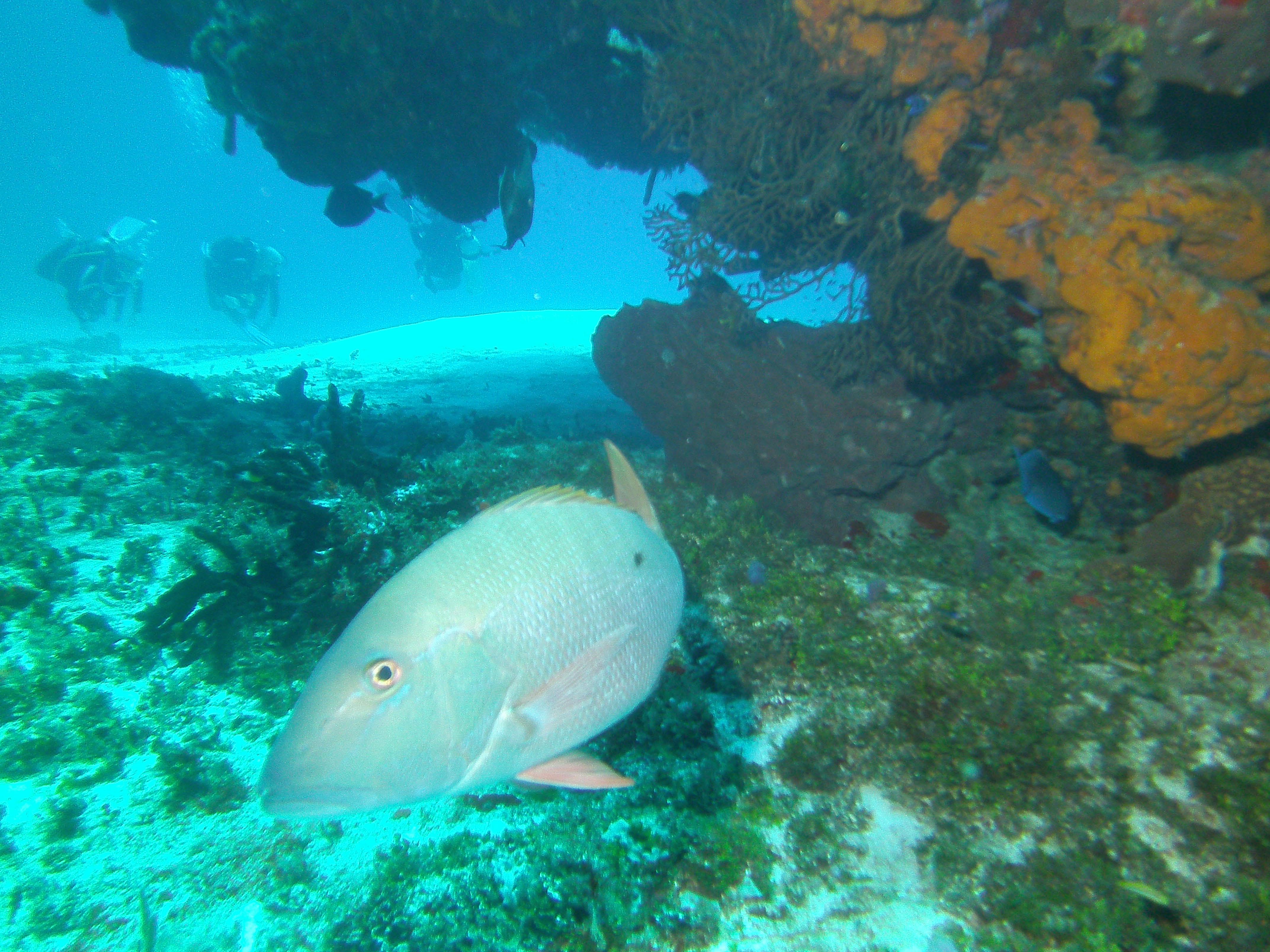
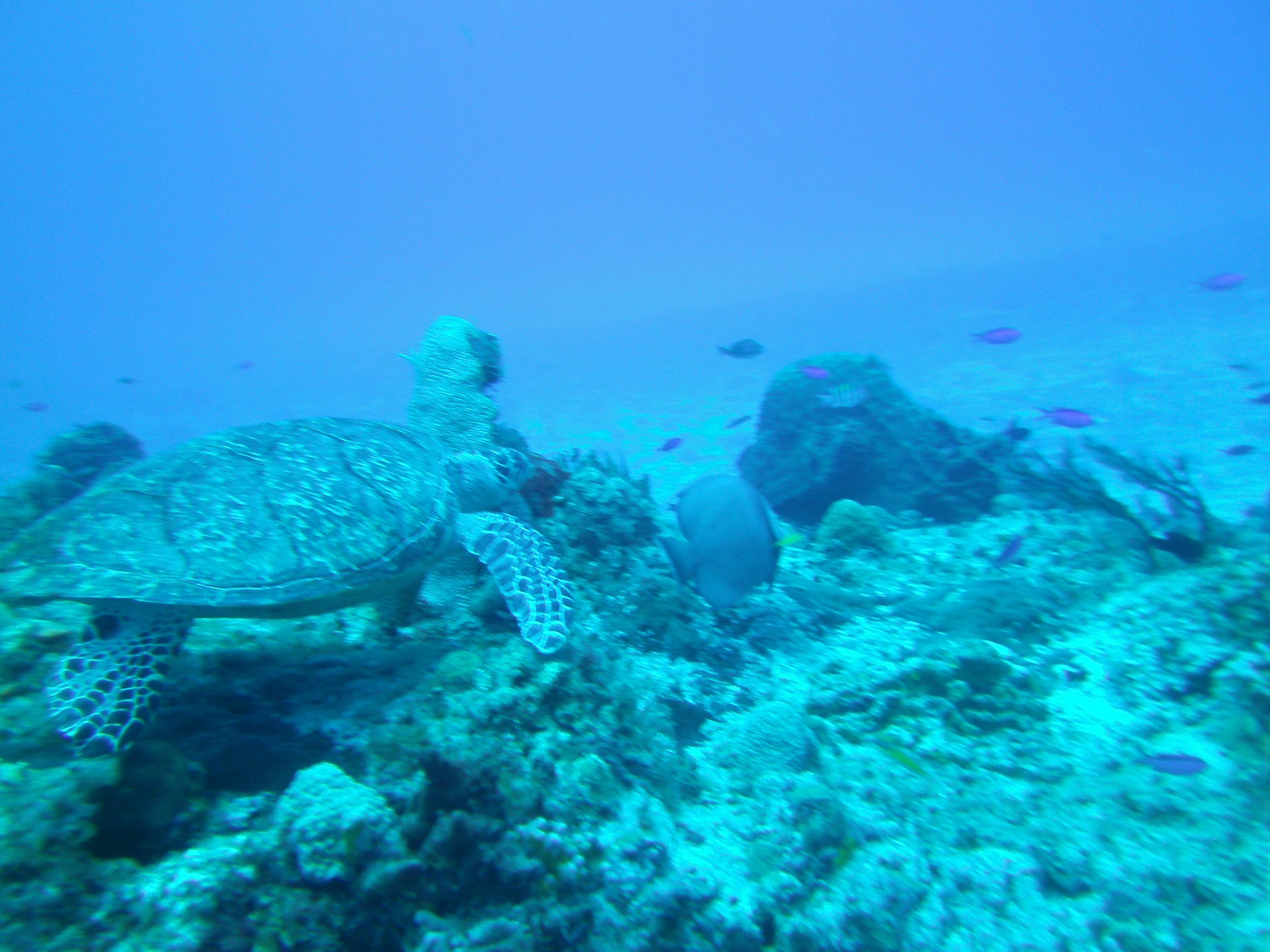
And of course, there were thousands of fish and other creatures. We’ve been trying to improve our identification skills, with the useful reference works on reef fish, creatures, and coral by Paul Humann and Ned Deloach. Sally was prepared to ID a green sea turtle, of which we saw only one, though we saw several hawksbills. She also introduced me to the whitenosed pipefish and various seahorses.
SeaLife DC1400
SeaLife DC1400
SeaLife DC1400

There was no shortage of bizarre looking creatures, including the porcupine fish, splendid toadfish, flying gurnard, smooth trunkfish, trumpetfish, honeycomb cowish, scrawled firefish, and queen triggerfish. We saw southern stingrays, as well as yellow rays and a Caribbean torpedo ray, and spotted and green moray eels. There were also large spiny lobsters and crabs. On a night dive I saw two octopuses that transformed themselves into objects of varying shapes and colors. It was fantastic!

One species we we pleased not to see many of was the lion fish. These invasive predators reproduce quickly, have no resident enemies, and consume voraciously. They’re now common in the northern Caribbean. Our main guide, Miguel, said that the dive guides in Cozumel had been authorized to kill them, and the numbers have been substantially reduced in the most dived areas of the south coast over the lat three years.

SeaLife DC1400
SeaLife DC1400

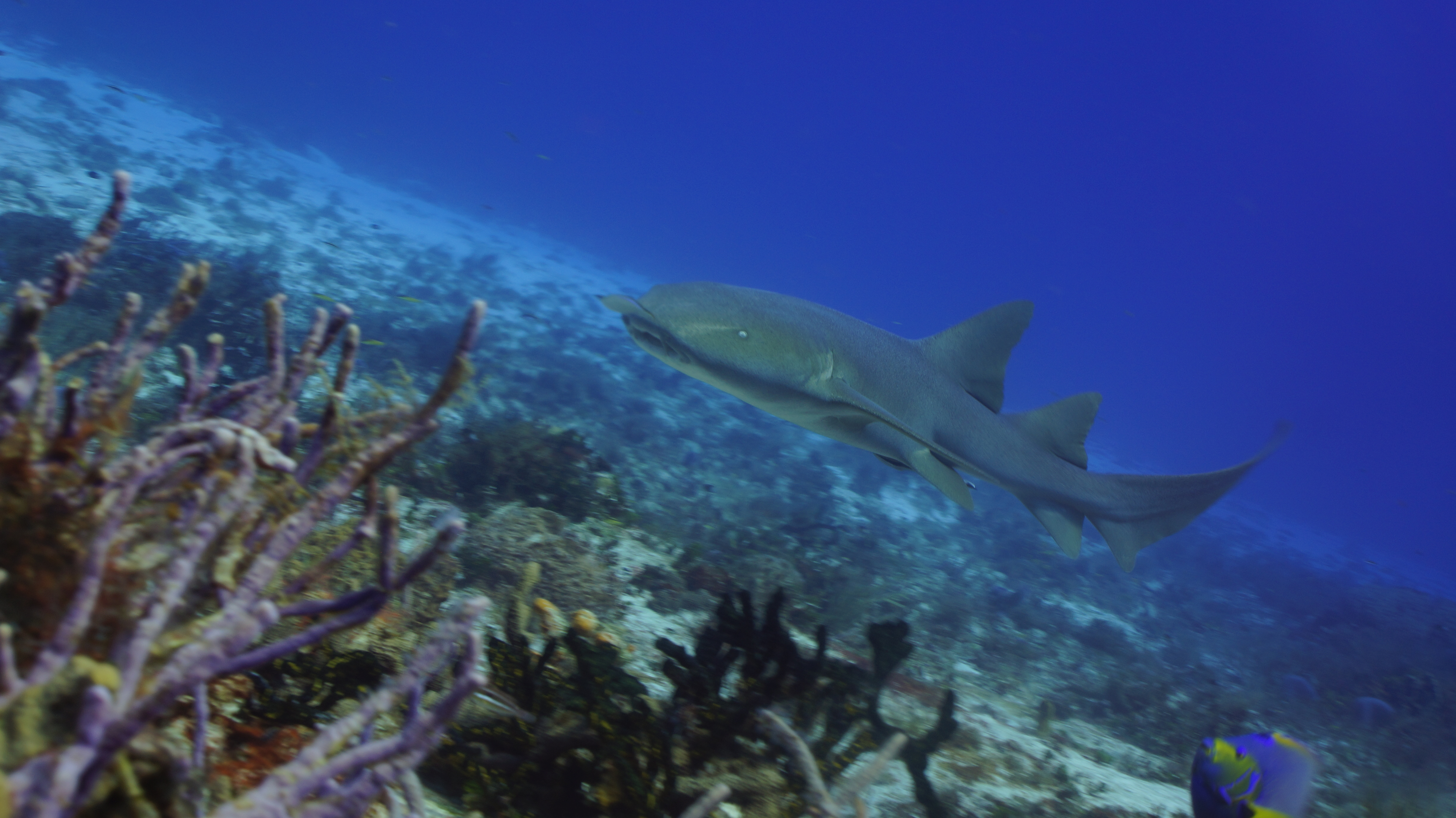
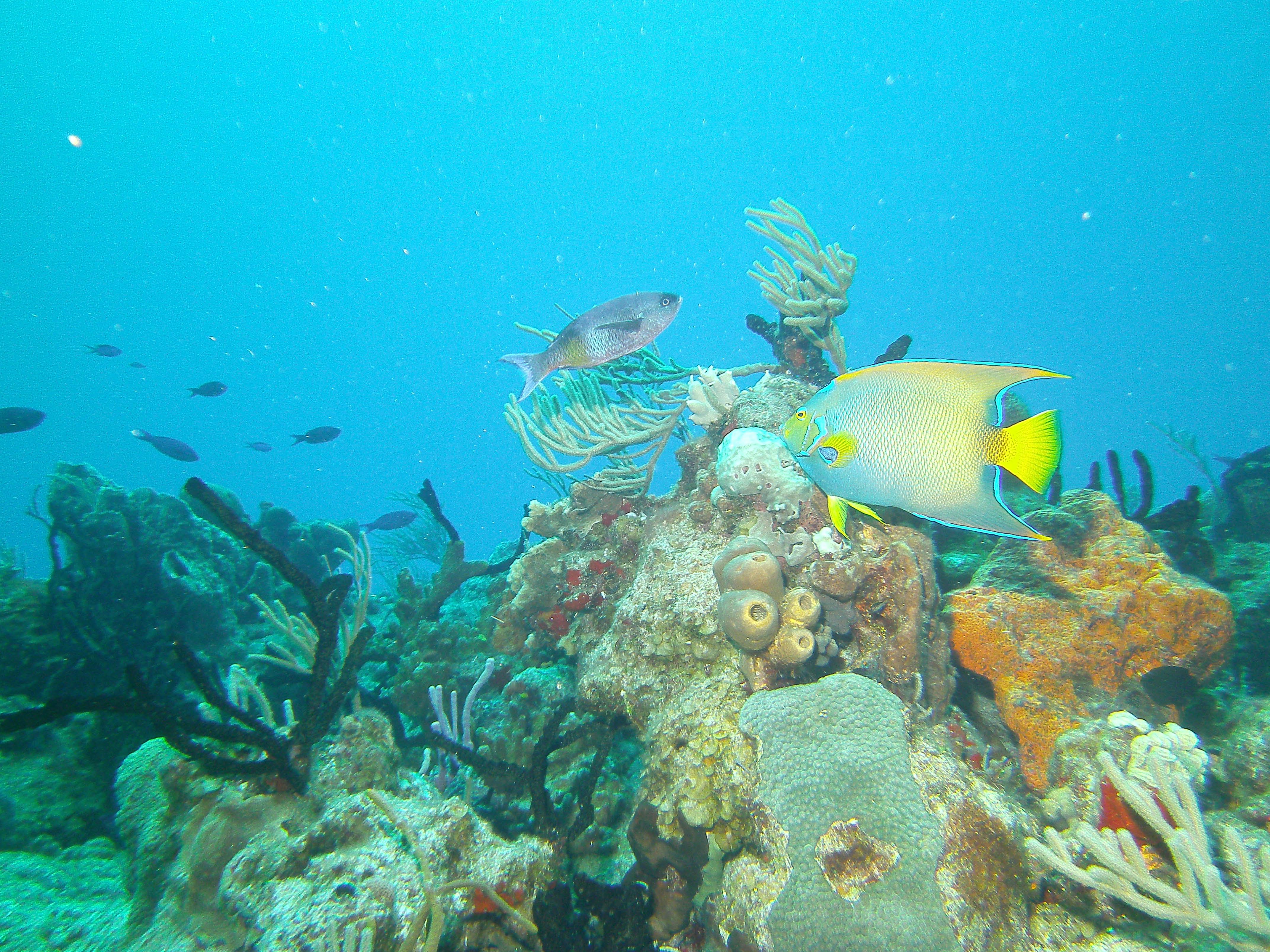
We also saw some big and medium creatures: nurse sharks, black groupers, barracuda, giant parrotfish, jacks, grunts, and snappers. I particularly adore the queen angelfish, and saw many, as well as French and gray angelfish. And there were untold numbers of colorful smaller tropicals – durgons, tangs, grunts, surgeon fish, butterflyfish, chromis, wrasse, and many others. The profusion of life is amazing, still!
_DSC0143 copy

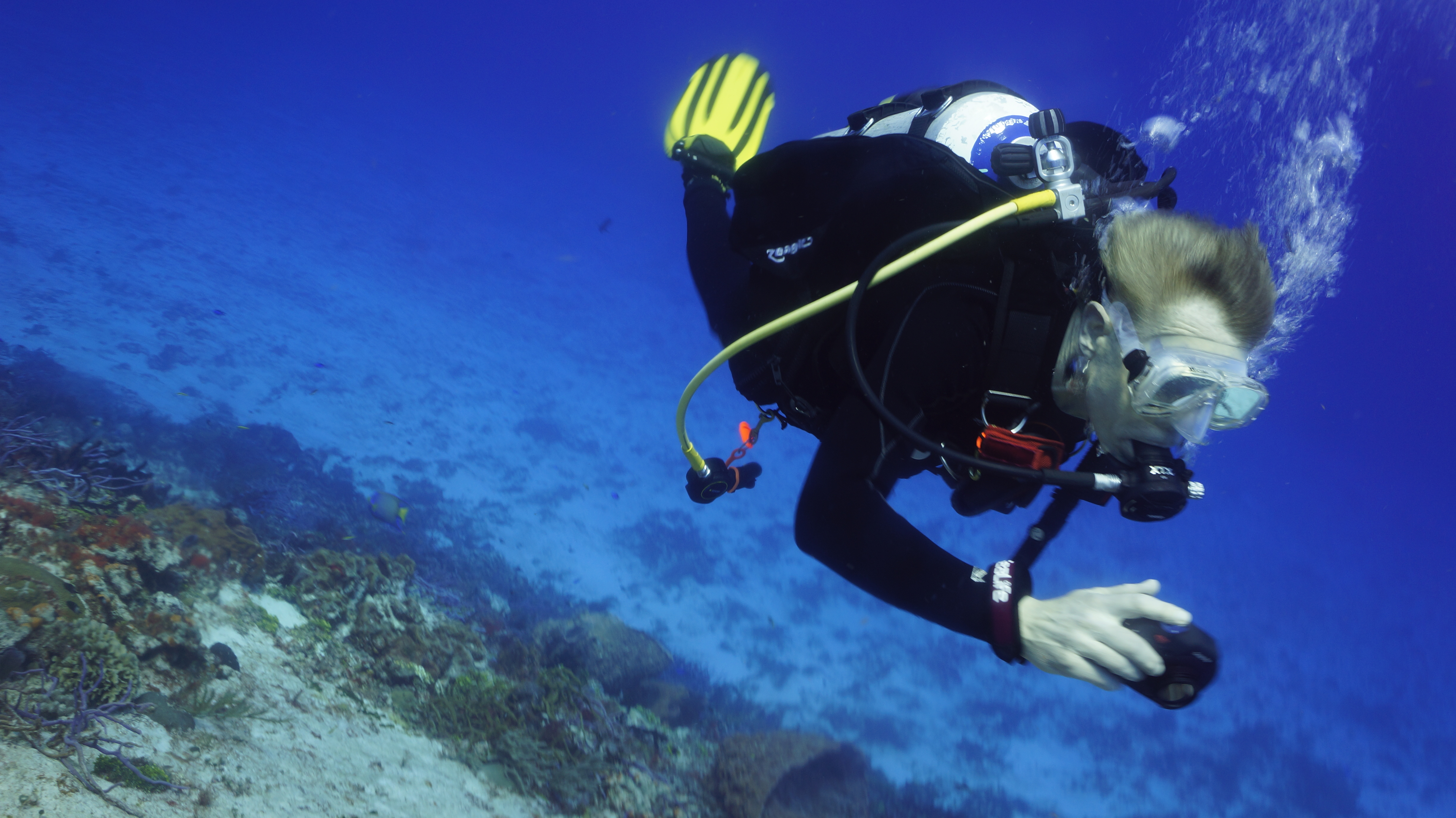
My camera strobe worked fine on day one and two, but then the supporting arm’s joint broke, and so my photographs after that were mostly by natural life. This was disappointing, because there are things that just can’t be captured without a strobe, but I liked some of the images I got. The pictures here are all mine, except the first, the one immediatelhy above, and the ones below of Sally and me, which were taken by Pete, a professional. (Yes, I realize his look a lot better than mine. My excuse is he had better equipment, though also probably more talent.)
_DSC0397 copy
_DSC0489 copy
_DSC0511 copy
IMG_9175 copy

_DSC0237 copy
_DSC0207 copy
_DSC0176 copy
_DSC0202 copy
IMG_9063 copy

The morning before our flight home, we rented a jet ski and sported about for a half hour. The machine, a Yamaha, seemed very powerful. The water was choppy, and I never quite managed to take the machine to full throttle, as it jumped and bucked. Sally rode behind me, and proclaimed herself thoroughly shaken and glad to still be alive when we were done. But note, she never complained or requested that we slow down. That’s my gal!


Lacrosse, seeing things, and ag-gag laws

Looking west at sunrise, April 13, 2013

Looking west at sunrise, April 13, 2013

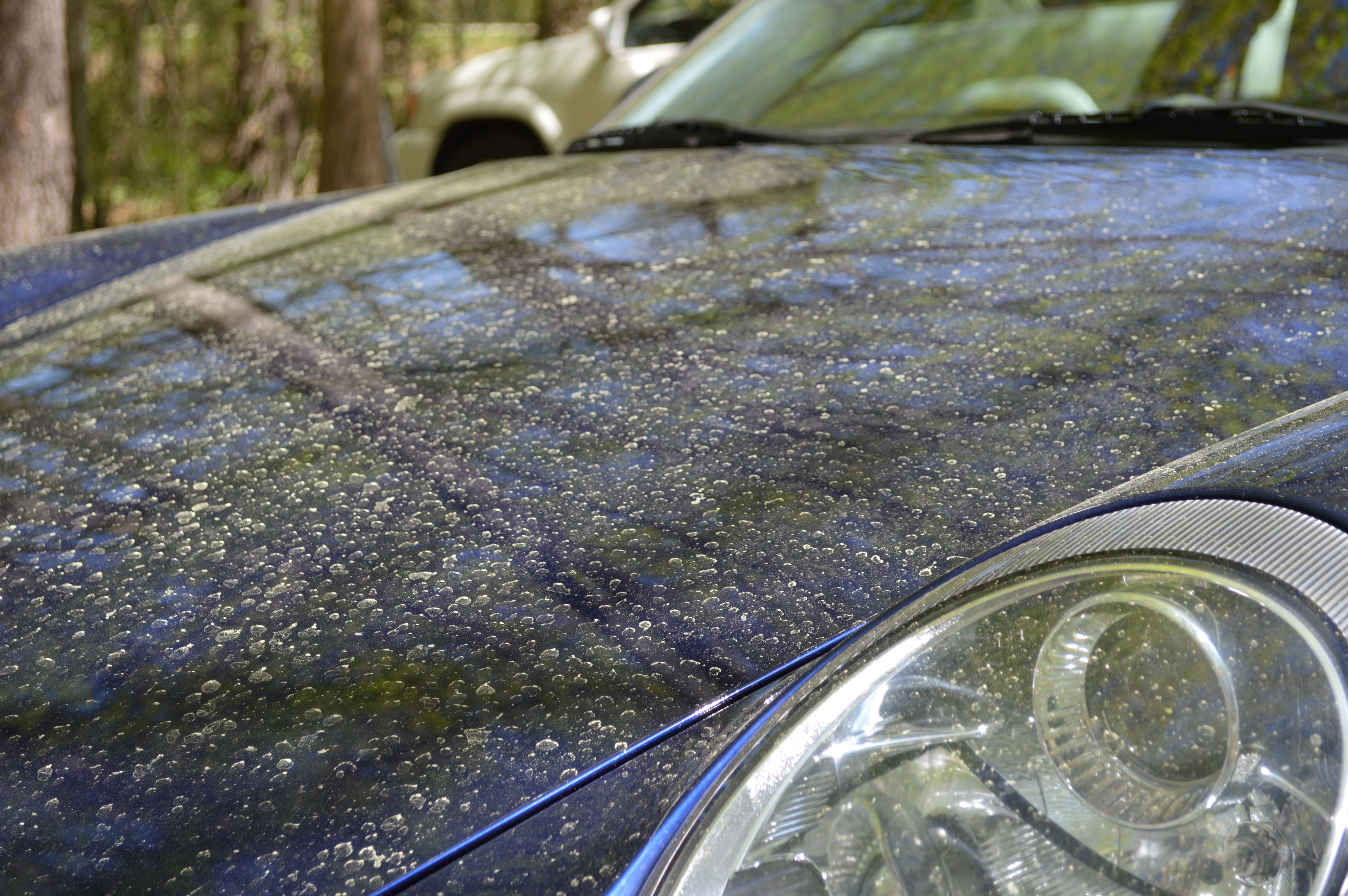
Friday evening was supposed to be rainy, but instead was sunny and mild, and the dogwoods had just blossomed. Looking out over Raleigh from our apartment, the deciduous trees are leafing in nicely, lots of pretty green. The pine pollen season is also here, with the yellow powder coating our cars, and causing woe to allergies.

Sally and I drove over to Durham with Sally’s mom to see the Duke lacrosse team take on Virginia. Diane, at age 82, has become a big lacrosse fan, and bought us tickets as a gift.

It was a good contest. The score was 9-9 at the half. Virginia scored three unanswered points in the first five minutes of the third period, but Duke worked its way back to a 14-all tie with eight minutes to go. The final score was 19-16, Duke.

DSC_0024

The sport is fast and exciting, and combines some of the best things about soccer (strategy, cunning) and hockey (speed and physicality). But we’re neophytes, and still trying to figure out why some outrageous things are penalized and other outrageous things aren’t. Are they really allowed to beat each other with those hard sticks?

During timeout, I enjoyed looking at the athletes and the fans in their summer clothes. I’m still very much in recovery mode after the second surgery on my left retina a few weeks back, and conscious at times of struggling to see, and at other times conscious of how extraordinary it is to see.

Tulips outside Diane's apartment

Tulips outside Diane’s apartment

At my appointment this week with Dr. M, my eye doc and new hero, he declared that he liked what he was seeing, and that things were coming along nicely. The retina was still attached, the scar tissue was settling down, and the hole in the macula showed signs of healing. I did not, however, do well on the eye test: the best I could do with the left eye was identify where the chart was — no letters. Dr. M said that this could improve after the next surgery in four or five months to remove the silicone gel (isn’t that a strange thing?) and probably remove the cataract that is probably forming.

This eye injury has been a reminder of how provisional the visual world is. At times I see things I know are not there, like bizarre floaters, and at times I see double images (one very blurry and one not). My depth perception is imprecise, so that tasks like putting a key in a lock are tricky. It’s harder to find things in the dishwasher, and easier to lose things most anywhere.

Of course, I’m not the only one with imperfect vision. Apparently we all (with normal vision) have a blind spot where the optic nerve attaches to the retina, but our interpretive consciousness smooths out this problem and makes the visual field seem uninterrupted. Vision involves photons and neurons in an unbelievably complex process. Our ordinary sensation of a smooth continuous visual world is both a gift and an illusion.

This is one of the many interesting points in Bruce Hood titled The Self Illusion: How the Social Brain Creates Identity (Oxford University Press 2012), which I’m currently reading. It’s a lively assemblage of neuroscience and philosophy organized around the issue of the nature of consciousness. The brain is an amazing thing, with billions of neurons and trillions of synapses, but we’re just starting to understand the correspondence between the biological processes and perceived experience. Still, the evidence is accumulating that our understanding of conscious experience as a literal reflection of reality is quite wrong. Hood’s book also builds on the work of Gazzaniga (which I wrote a bit about here) and Kahneman (whose fine recent book I noted here), and takes some of their ideas a bit further.

Hood may be right that when we think of ourselves we are thinking about a thing that doesn’t really exist, at least in the way we normally thing about it. But he also seems to think that we can’t possibly completely dispense with our conventional notions of the self. Even with his throughgoing scientific perspective, he admits that part of him still cannot let go of the notion that his self is a thing. It does shake things up to try to think otherwise.

Speaking of shaking, I was dismayed to learn this week that several states have enacted or worked on making it illegal to expose animal cruelty at slaughterhouses with “ag-gag” laws. I thought that this was an issue that almost everyone agreed on: it’s just wrong to wantonly abuse farm animals. The corollary would be, it’s a good thing to expose and prevent such abuse. Videos and reports of such conduct are disturbing, to be sure, but they help correct the system. Why would we want to make that illegal?

There is, of course, an opposing argument, which posits that secret videos distort the truth, and those unused to the sight of ordinary animal killing may misinterpret what they see. That seems pretty weak — not entirely false, but not a justification for limiting free speech and insulating unspeakable behavior. In a brilliant little op ed piece in the Times, Jedidiah Purdy, a Duke law professor, agreed to take it at face value, and proposed a solution: let’s put webcams in all the slaughterhouses. This radical transparency approach would be educational and probably discourage some abuse.

Pine pollen

Pine pollen

Time again to practice golf

IMG_0504
This weekend, after a spell of unseasonably cool weather, it finally started to feel like spring, and time once again for the game of golf. It’s a noble and beautiful game, played in lovely green gardens with flowering trees and streams. It requires strength and strategy, finesse and delicacy, repetition and creativity. There’s keen competition and also warm friendship. It is always challenging, and at times amazingly frustrating!

I’ve been re-reading my favorite golf instruction book, a book that changed my life, Ben Hogan’s Five Lessons (co-written with Herbert Warren Wind, the great New Yorker golf writer, whom I crossed paths with back in the day). It is remarkably careful and thorough, dissecting the intricate mechanics, helpful for beginners, but also with many details that will be understood only by more advanced students. It inspired me to check the details of my grip. Non-golfers, and many golfers, may not realize how intricate a matter it is to hold the club properly. Hogan (and Wind) realized. Anyhow, I decided to switch from the interlock grip to the overlap, with a view to hitting the ball farther. Will it help? We’ll see. For putting, it seemed promising. In practice I rolled in my first two hard breaking ten footers.

Practice, they say, makes perfect. An overstatement, of course, but practice is the way to cultivate a complex skill, like playing an instrument or a sport. I credit my early music training with instilling in me a belief in practice as a road to accomplishment. (Some of my thoughts on piano practice are here.) Fortunately, I actually like to practice golf. When things are working well, and the ball is flying high and long, it’s immediately satisfying. And when things aren’t, it’s an interesting puzzle: what’s not working properly? You can change a little of this and try again, and if that doesn’t work, try something else. It requires perseverance. It also requires patience. It takes time.

IMG_0523

On Friday (a holiday), I took a couple of hours to practice each of the basic skills — short irons, medium clubs, fairway woods, drives, finesse pitches, chips, and putts. (I didn’t have a chance to do sand shots.) In the full swing shots, I was focusing on getting more of my body into the shot by leading with the hips. Some were flying too much to the right, but I tagged a few quite properly. My sight problem made it difficult to see where the balls landed, but didn’t hinder my hitting.

On Saturday I played my first eighteen holes of the new year with friends at Raleigh Country Club. A lot of the grass was still brown, and the greens were bumpy from core aeration, but it was still good to be back. My playing was uneven, and the score was disappointing, but there were some good shots, and hope for the future.

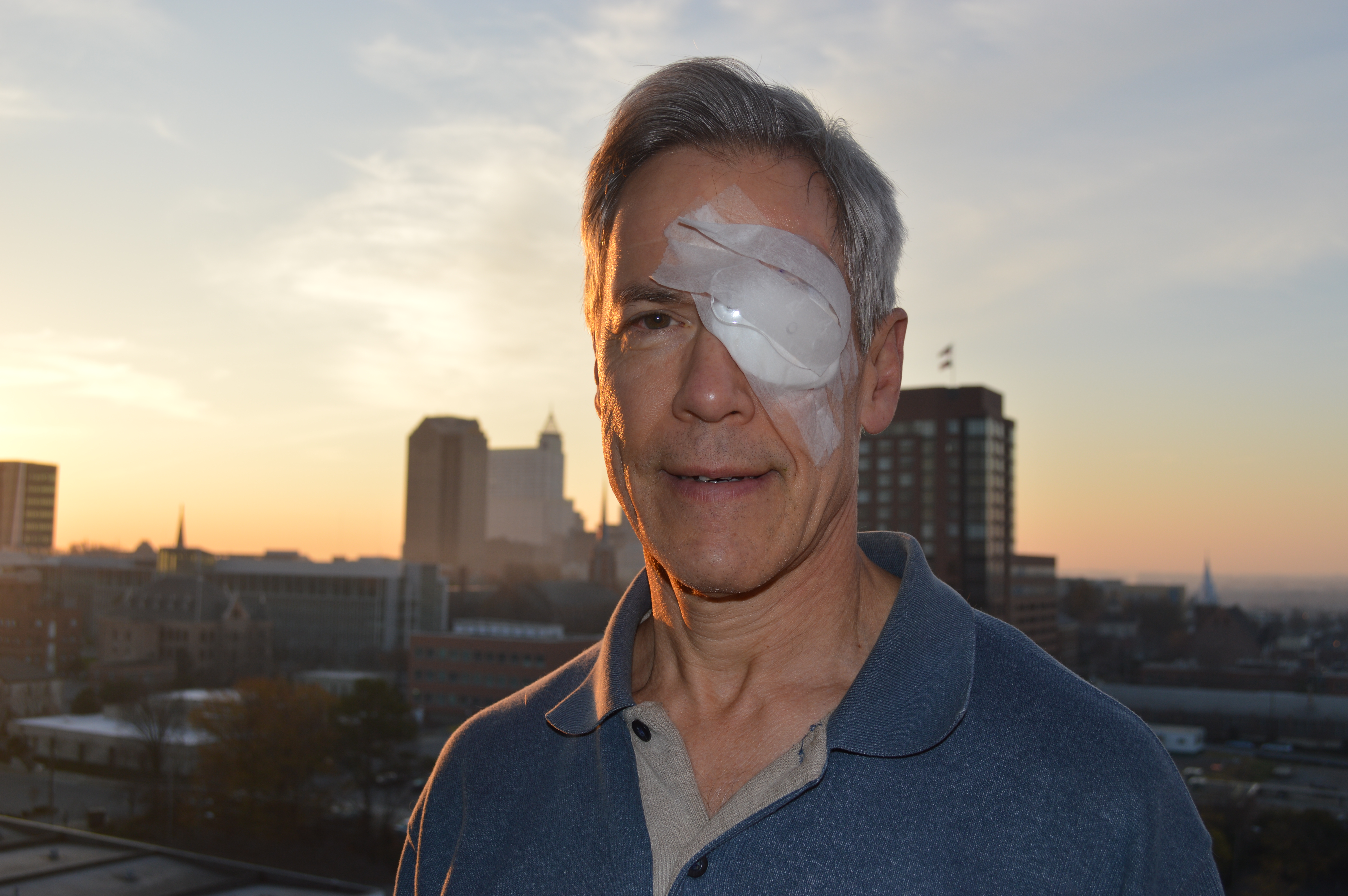
My emergency eye surgery

DSC_0031
It took several years for me to develop the exercise habit, but now it’s deeply ingrained. I don’t have to think about whether or not to work out, because it’s almost automatic. Most mornings I just pop out of bed at 5:15 or so and head to the gym, yoga studio, or pool. Then I challenge myself with interval training, free weights, down dogs and half moons, spinning, swimming, or more offbeat functional training movements, and normally feel clear-headed and energized afterwards.

This past week, though, following my emergency eye surgery, I’ve been under doctor’s orders not to exercise. This seems unnatural, and I’ve been feeling like a slug. Still, I’m trying to keep in mind that I’m a very lucky person.

The eye is a marvelous organ, which, like all organs, I generally take for granted. Until last week, most of my knowledge of its constituent parts dated back to about the fifth grade, and hadn’t much advanced in the years since. As an amateur of science, I’m always interested when I come upon a gap in my knowledge and an opportunity to fill it in. From this perspective, opportunity was knocking when I unexpectedly developed a detached and torn retina, and I got a crash course in eye physiology and repair techniques.

In brief, on Wednesday morning I worked out as usual, came home, showered, cleaned my glasses, put them on, and noticed that things looked a bit foggy. I cleaned my glasses again, but this didn’t fix it. I closed first one eye and the other, and found that only the left eye view was foggy. In the course of the day, this worsened, and I began to see increasingly dramatic floaters. I made up my mind to call for help if I didn’t improve over night, and I didn’t. My longtime optometrist and friend Don Cloninger worked me in and did several tests, from which he diagnosed a possible detached retina. I asked him to recommend a surgeon he would go to himself, to which he agreed, and got me an appointment with Dr. John Denny of NC Retina Associates.

My extracurricular science reading has at times filled me with a sense of awe and wonder at the things humans have figured out, but also has alerted me to vast areas of ignorance. In medical science as elsewhere, there are some problems we can solve with our technology, and many others that we can’t. Fortunately for me, detached retinas are well understood, and repair techniques are highly refined.

Dr. Denny described the success rate as 90 percent. There is no argument in favor of avoiding that last 10 percent. Once a retina detaches and tears as mine did, unless it is treated it will worsen until eyesight is gone. As to causation, Dr. D said it was the genes I was dealt plus age.
20121130_131124

My surgery, which was scheduled for the following day, was called a vitrectomy. The idea of sticking needles or other instruments in the eye sounds like medieval torture, and if you are squeamish you may want to skip this paragraph. I have a reasonably strong stomach, and I wanted to know the details of the treatment. It involved inserting very thin instruments into the eye, including a laser to do with Dr. Denny compared to spot welding. Most of my vitreous was temporarily replaced with a gas bubble, which pressed the retina back into place.

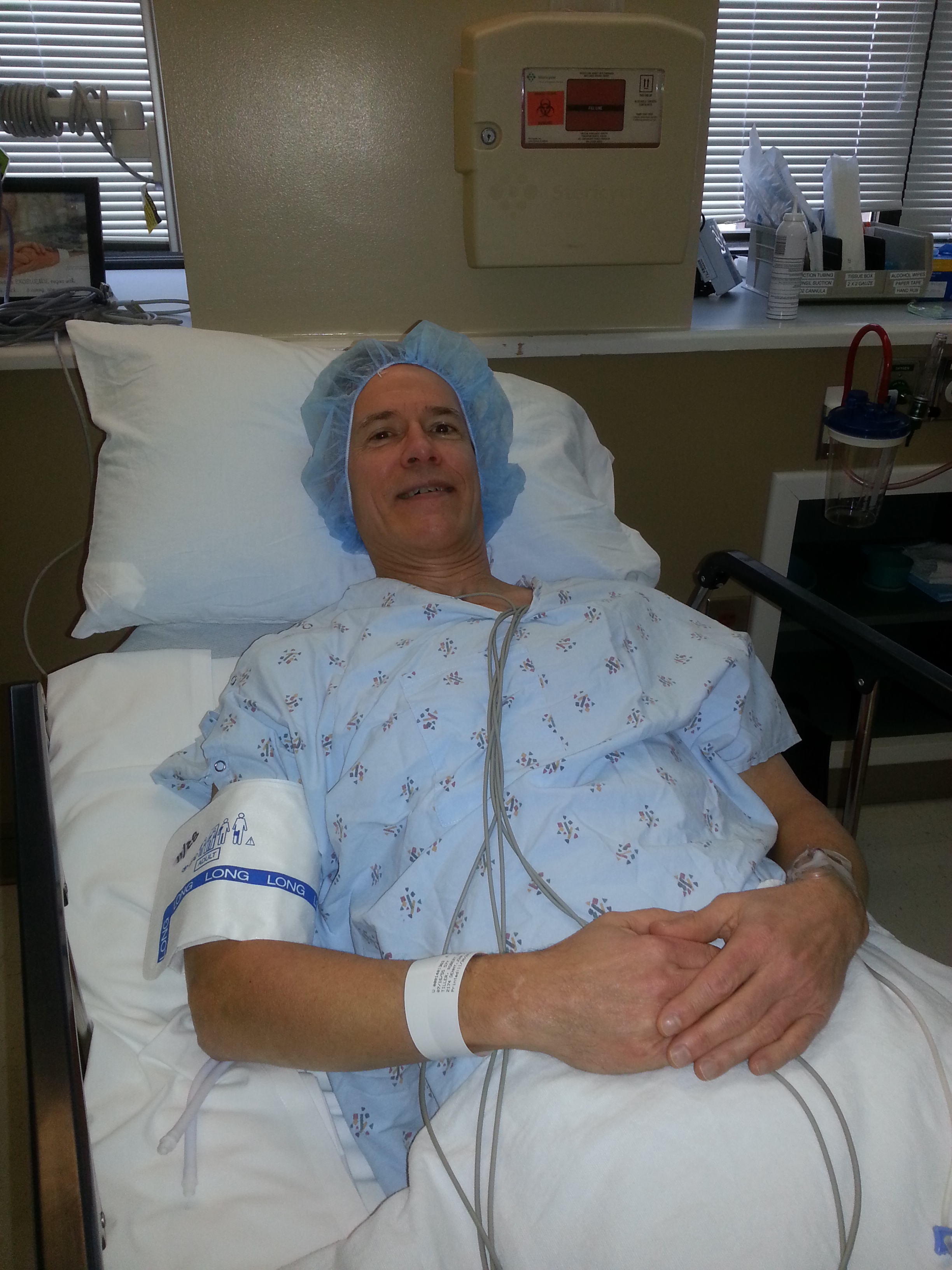
I’m not a big fan of hospitals, but I have to say I had a very positive experience at Rex Medical Center. My treatment team all introduced themselves in a friendly way and explained what they were going to be doing. My prep nurse did a great job at getting my IV in, and told me about the zumba class at her gym. The anesthesiologist told me that I would be semi-conscious during the procedure, but would not have traumatic memories. This last was certainly true. Afterwards, I was a little woozy from the anesthesia, but otherwise felt fine, and didn’t remember anything from the operation.
DSC_0035

My eye never did hurt, but I had to lie on my side for the next two days, which was a bore. I signed up for a free college history course with Coursera and listened to some lectures, which were well done. II also got a trial subscription for recorded books with Audible, and began my first MP3 book — The Adventures of Huckleberry Finn. Like many, I’d read it as a teenager, so I discovered a lot I didn’t remember and a lot I could not possibly have understood. It is an amazing book — humorous and tragic, understated and also epic.

I’m now one week out from surgery, and per Dr. Denny am healing normally, although my vision is still very blurry. One blurry eye and one clear one averages out to less-than-clear vision. I’ve been moving about more or less normally and driving, but more slowly and carefully than usual. I’d scheduled a day of track driving at VIR for next weekend, but decided it would be better not to push the envelope. I’m still hoping, though, to be ready for scuba diving in the Turks and Caicos over Christmas.
DSC_0051

Take care of your body

I used to regard the taking care of my body as sort of a bother — something much less important and interesting than, say, reading a good book. As I’ve gotten older, I’ve come round to thinking of it as a fundamental — the thing that has to be done before anything else can get done. Being happy depends in large part on being healthy. And just as some people look forward to taking care of their pets or their cars, I’ve come to value the opportunity to care of my body with healthy food and exercise.

Getting healthier has made me happier, and happy about getting healthier — a virtuous cycle. It’s hard to believe — ten years ago I wouldn’t have believed it myself — but I actually look forward to getting up at 5:15 and going to the gym.

Lately I’ve particularly enjoyed my once-a-week early morning workout with Larissa at Studio Revolution. She’s sparky and cheery, and always innovative. This past week she had me doing a lot of new movements that required balance and coordination, and thus concentration. It isn’t always clear why we’re doing these things, but over all they seem to be producing good results. My rule of decision is, when in doubt, just trust her, and do the exercise. This is, I think, a good general rule: if you want to accomplish something, find a good guru, and then do what she says.

I applied this rule recently to a nagging shoulder injury. Most of my joints were working just fine, but my right shoulder did not feel good. What caused it I do not know. I could do most of the activities of daily life, but certain movements, like reaching behind my back to wash it, or taking off a tee-shirt, were painful.

After trying to ignore it, I tried healing it myself through strengthening it, which didn’t work, and then tried resting it, which didn’t work I tried massage, which helped a bit, but then the problem returned. I finally decided to return to the same physical therapist who resolved my lower back problems some years ago, Geert Audiens at Avante Physical Therapy. And two weeks later I’m feeling much better.

Geert (prouncounded Heert) diagnosed a small rotator cuff injury. To fully explain the situation, he had to use a lot of vocabulary I didn’t know. But the bottom line was clear: I had an imbalance of muscles that was causing pressure on nerves. He treated it with various stretches, exercises, and icing, and prescribed a somewhat involved set of these measures as homework. The exercises mostly involved 3-pound weights, which are so small I found it hard to believe they could do anything. But, they do! It’s amazing! If you have this problem, I recommend seeing Geert, and do what he tells you to do.

My new free smartphone, and some thoughts about technology and unemployment

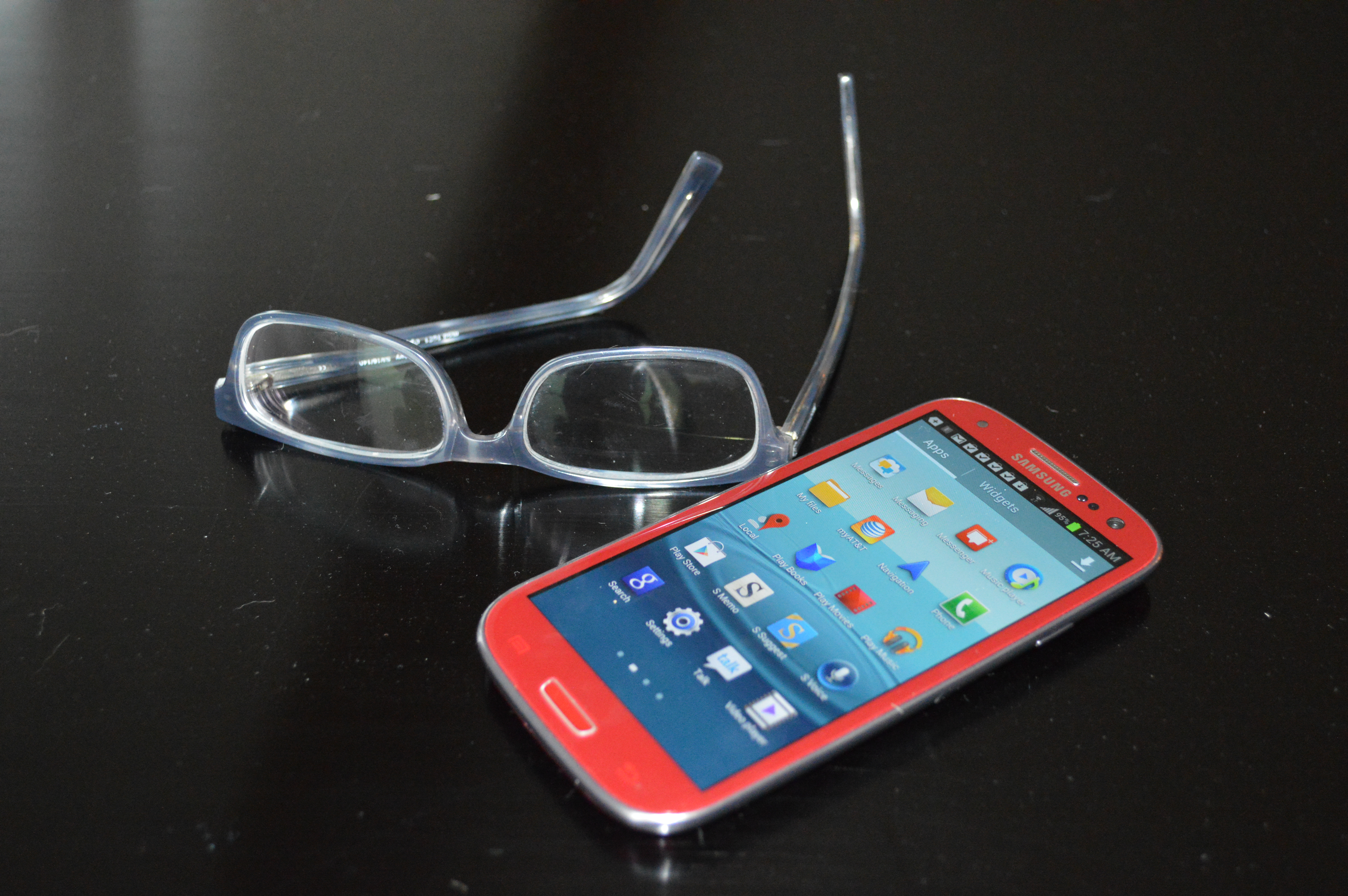
I got my first free (aka open source) smartphone a couple of days ago, a Samsung Galaxy S III with the Android operating system. I love the larger screen, with its excellent resolution, and the form factor in general — light, thin, and rounded, and still small enough to go in my pocket. It comes with a good array of apps, and there are thousands more available at free or low cost. The touchscreen interface is intuitive. The voice command option does not seem as smart as Siri is reported to be, but other apps load fast and work beautifully.

Will this change the place of a smartphone in my life? Probably a bit, because the bigger screen and faster speeds (4G) make it easier to use. The civil libertarian in me worries somewhat about the ability of such devices to track me and potentially invade my privacy, but I’m also amazed and happy with all the useful things it can do, such as helping me with directions, accessing every type of knowledge on the internet, performing word processing and other computing functions, entertaining me with movies, music, and photographs, and connecting me to people through text, email, and phone. Smartphones can potentially make us more productive and happier.

At the same time, our technology is transforming us in other ways that are more worrisome. This morning’s New York Times has a long story on remarkable advances in robotics, which are replacing skilled manufacturing jobs in electronics and logistics, along with lots of others. The story cites a book I recently read and would recommend: Race Against the Machine: How the Digital Revolution is Accelerating Innovation, Driving Productivity, and Irreversibly Transforming Employment and the Economy, by Erik Brynjolfsson and Andrew McAfee.

The authors, economists at MIT, present a clear overview of technological change, which they describe as increasing exponentially. Moore’s law continues to double processing power every 18 months, and software advances are moving much faster than that. Technology harbingers like Watson the Jeopardy champion and the Google self-driving car are the tip of the iceberg.

Brynjolfsson and McAfee recognize that computers can’t yet do everything humans can do, but they have already replaced many kinds of routine work, and inevitably will replace more and more skilled work. This accounts for part of our persistent problems of unemployment even as the economy is growing. Traditional economics assumes that new technologies will eventually produce new jobs, but B and M point out that if technology continues to improve exponentially, computers will be able to perform more and more human jobs better and more cheaply. It’s difficult to see how new jobs could equal those that are eliminated.

If they’re right (and I think they are), we’ve got major social dislocations ahead. In our society, people work not only to earn a living, but also define each other and themselves in large part according to their work. Thus unemployment is not just financially threatening — it’s humiliating. With more and more people unemployed, unable to buy goods and services and without social moorings, our social and financial system will face an existential crisis.

What is to be done? We’ll need to change the way we organize ourselves, the way we distribute wealth, and the way we think about value. We’ll need to find new approaches for valuing and caring for others, and for thinking about the meaning of our own lives.

I had a small epiphany on this yesterday when our friends Ken and Carol took us out on Falls Lake for some water skiing. They both retired early, and do things they enjoy doing, like boating, tennis, and travelling. I have trouble imagining myself retired in this sense. But as we sat on their boat on the lake in the late afternoon, we talked about our lives, told stories, and swam a little, and enjoyed the lake and surrounding forest. Then we took turns getting pulled by their quick little boat on one of their various toys. Ken rode a hydrofoil chair and a wakeboard, and I had a go with old school water skis, which I enjoyed enormously. These things have deep value: sharing stories and experiences.

Wreck diving off of Cape Hatteras

Sally and I did a diving trip out of Cape Hatteras last Thursday-Sunday. Although we live in North Carolina and love diving, these were our first NC dives. We’d assumed that the sea life in the vicinity would be sparse and the visibility poor, and that we’d find it a bit of a comedown after our Caribbean trips. It turned out this was way off. The NC ship wrecks we dove had a profusion of sea creatures and ample light. Thousands and thousands of little fish, and some very big ones.

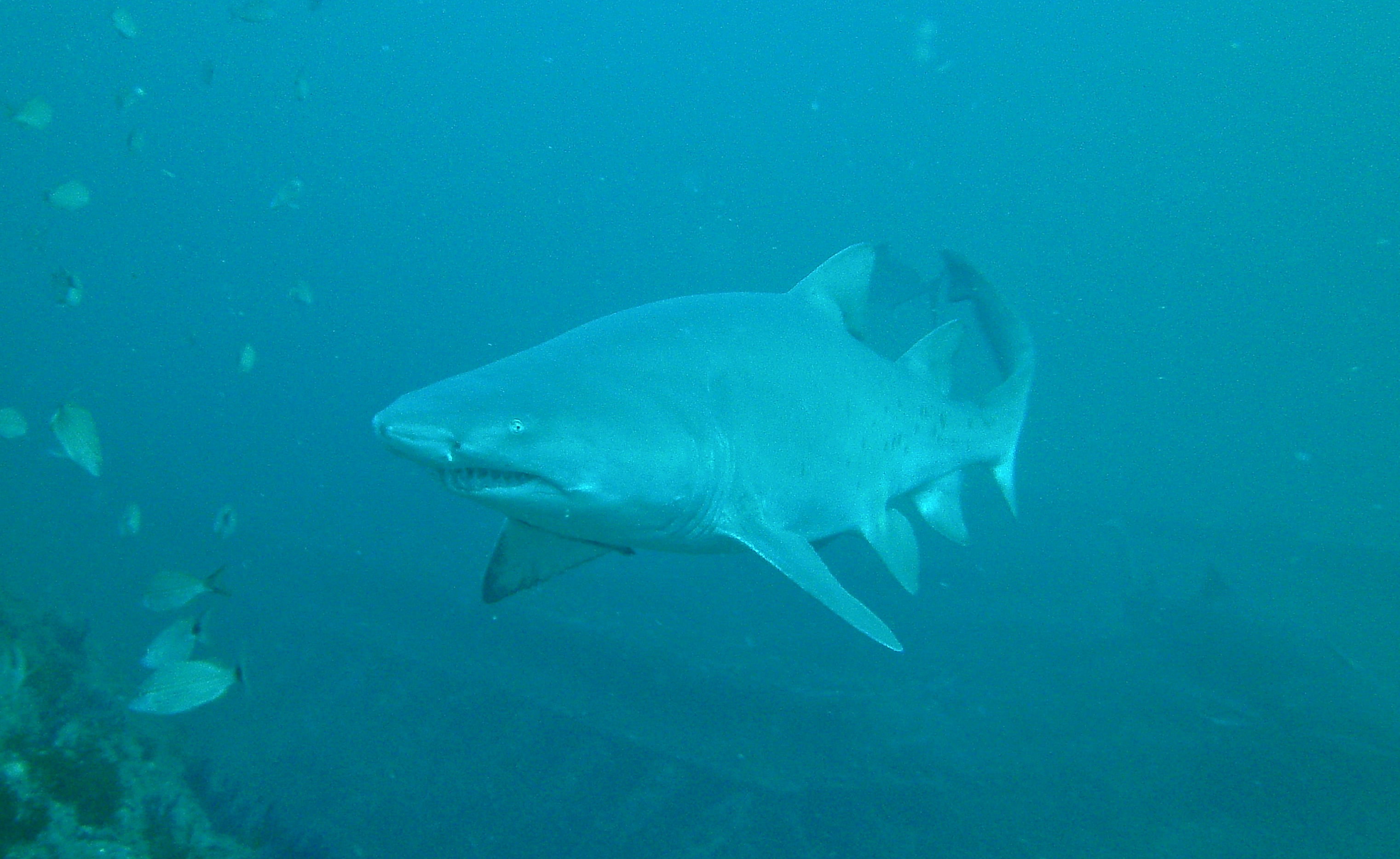
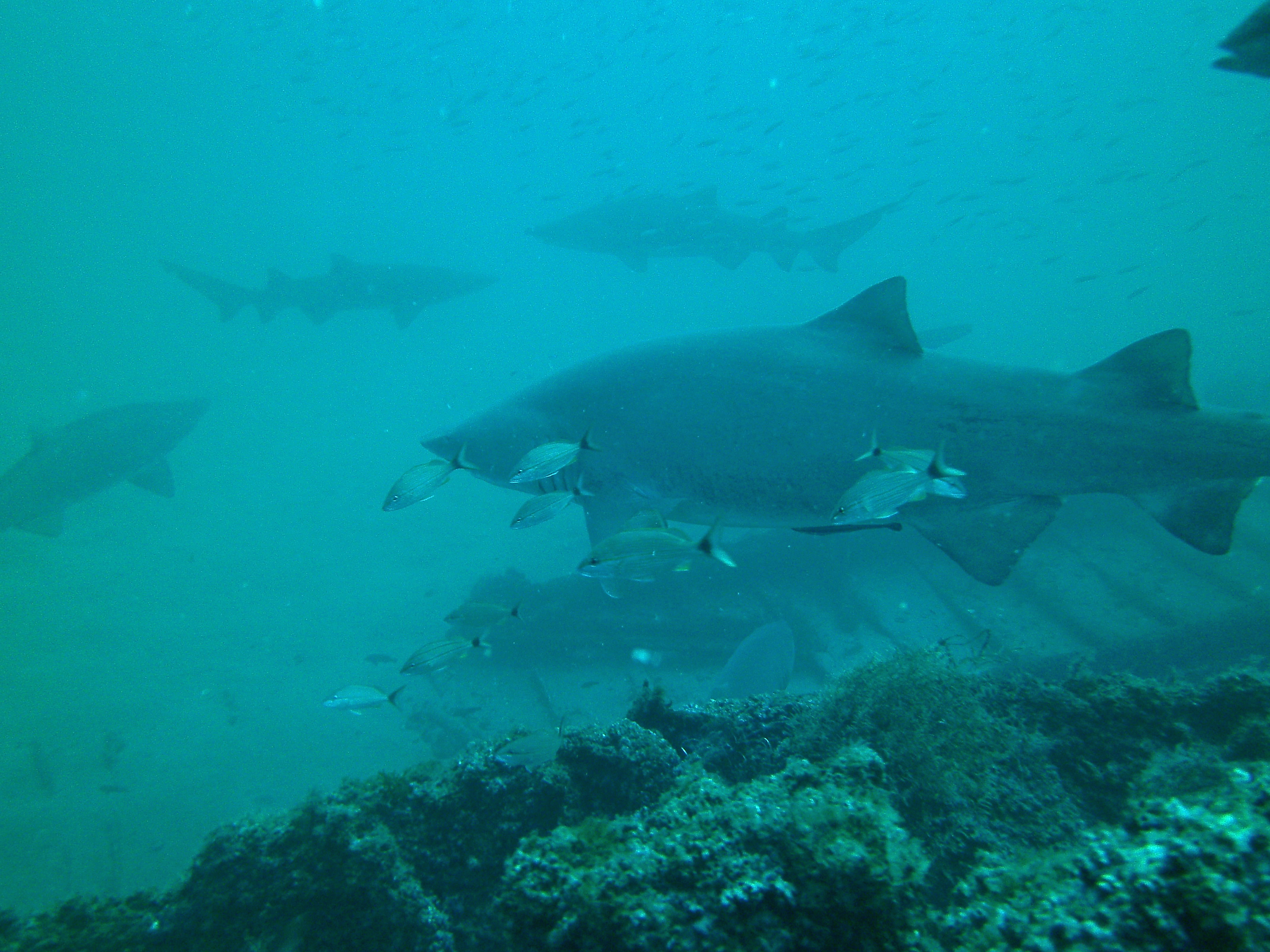
The most dramatic species we saw was the sand tiger shark. These shark are large (around 10 feet) and look mean. Apparently they are often used as the stock image for news stories about shark attacks. However, we saw dozens of them, and all were placid. They didn’t seem frightened of us, as was true of most of the species we saw, and we swam within a few feet of each other. They are beautifully designed and graceful, and of course, imposing.

I try to think of sharks in the way I think of bears — creatures that are potentially dangerous, but also fascinating parts of the natural world. They are not programmed killing machines or embodiments of evil. Shark attacks on humans are rare, and fatal attacks are freakishly rare — about ten a year worldwide. The risk of being killed in a shark attack is substantially less than being struck by lightning, or by an elephant. Also, as I learned this week, way less than the risk of being killed by a dog.

Why do most people fear them so much more intensely than, say bears or lightening? Shark phobia runs deep, and it’s unfortunate both for sharks that become victims of humans (100 million a year) and for humans who experience pointless fear rather than rapturous awe.

On this trip I tried underwater photography with a beginner-level underwater camera by Sea Life. I was glad I’d waited till I was reasonably competent as a diver to try this, because it could distract from doing the things that have got to be done in diving and enjoying the basic experience. But I was ready to give it a shot. Most of the images I got were not great, but I liked a few, and I had fun hunting for interesting things and fun looking at them afterwards.

NC wreck diving involves boat rides to the ship wrecks. Our longest trip, to the Proteus, took about two and a half hours. I wasn’t looking forward the boat ride part of the experience, but we had good weather — mostly clear skies and calm seas. Our vessel, the Under Pressure, was a 41 foot former commercial fishing boat that was substantially unfitted to accommodate six diving customers. It had a special lift on the back of the boat to haul out divers.

Once well offshore, out of sight of land, I was struck by how horizontal the landscape was. 360 degrees of flatness. At the same time, the quality of the water, its color and its energy kept changing. We saw flying fish, jumping dolphins, and one sea turtle on the surface. There were various gulls, pelicans, terns, and other sea birds. I spent part of the travel time recalling some of the great poems of Yeats, Frost, and Stevens.

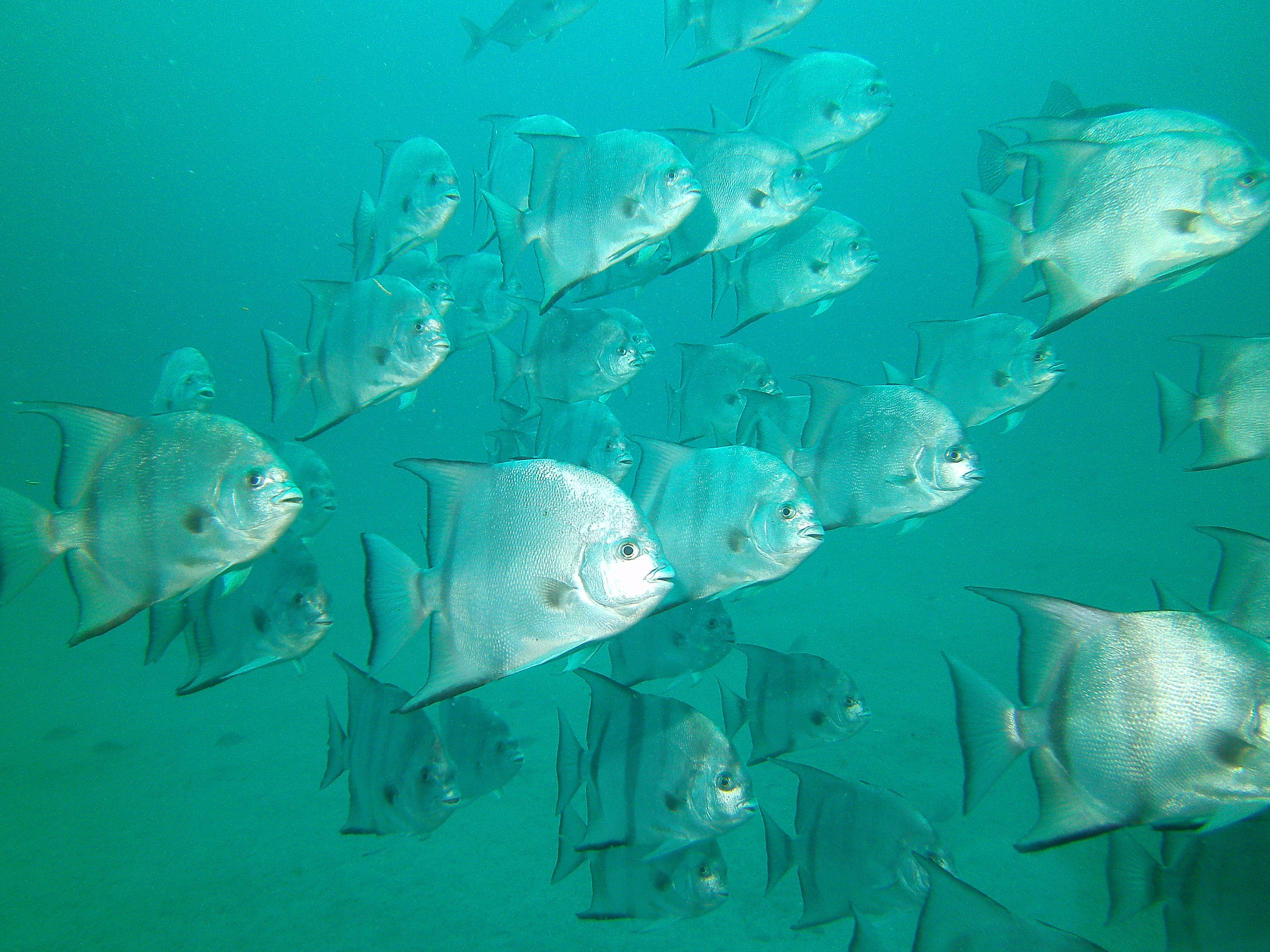
Besides the Proteus, we did dives on the Dixie Arrow, the Kashena, the Monihan, the Abrams, and the tug near the channel. The wrecks were in varying states of ruin, but had attracted lots if life. Besides sharks, we saw a good number of sting rays, barracuda, tuna, snapper, a large sea turtle, and the occasional butterflyfish. Several people saw an octopus on the Arrow, but we missed it. We saw enormous clouds of thousands of tiny fish, which the locals refer to as “bait balls.”

Visibility for most of our dives was good — more than 70 feet. Our deepest dive, to the Proteus, was about 120 feet down. Bottom temperature was around 80. Current and waves were minimal for the first three days, though more challenging for the final day. I had an oxygen leak (which turned out to be from my BC inflator), which required me to cut the dive short and to ask Sally to share her air as we came back. Fortunately, she agreed. It was a learning experience.

Speaking of learning, I need to give a special shout out to Scott Powell, owner of Down Under Surf and Scuba, who organized the trip, led our group, and taught my course in wreck diving. Scott is a diving professional of the highest caliber, but he seems to really enjoy helping those of us less accomplished. He’s one of those rare gifted teachers that just loves his subject, never make you feel inferior, but make you excited about getting better. His passion and enthusiasm for diving are infectious and inspiring.

It’s too hot for golf, and catching up on Mad Men and Girls


On Friday the temperature got up to Fahrenheit 105 here, setting a record. As happens periodically, I’ve been thinking lately about improving my golf game, and I was planning to do some practicing after work. My thought was to hit a 20 or so mid irons/hybrids, about the same number of three woods, then about the same number of drives. Then I thought I’d’d hit some finesse shots of thirty to sixty yards, some sand shots, some short chips, and some putts.

I enjoy swinging a golf club and watching the arc of the ball, and I don’t mind a bit of heat and sweat. But there comes a point somewhere in the high nineties when it’s just not fun anymore. I decided Friday was such a day, and cancelled the golf idea. Instead I went home and had one of Sally’s cocktails, a new recipe called Dirty Dick’s Downfall, involving Bombay Sapphire gin, dry vermouth, and Campari. It was delicious.

Lately we’ve been watching the early episodes of Mad Men, which we continued on Friday. We don’t watch much TV for the obvious reasons — it’s mostly dreck, we’re busy, and we usually have more interesting things to do. But after listening to enough interesting people make provocative comments about Mad Men, I decided to give it a chance. It still amazes me a bit that this is so easy with our little Roku box and streaming Netflix. We’re now up to episode 19 of the available 52.

The first thing I liked about Mad Men was the look. I was a kid in the early sixties, and the mise en scene take me back to when I was beginning to take shape as a personality. The clothes are spot on, as are the interiors and the ugly cars. The show reminds me of how much people smoked and drank — a lot! Smoking was, and is, a terrible habit, but the depiction seems true and evocative.

At first I had my doubts that a show about the advertising business could avoid boring clichés. I didn’t particularly like any of the characters, and the rampant sexism made me wince. But after a few episodes I began to see that beneath the gleaming, glamorous surface of the show there was another level. The writing and acting don’t call attention to this, and this is part of what I like. We are often unsure about the interior lives of the characters, which at first I took to be a failure, but I gradually came to see it as a conscious artistic strategy. Not all questions have answers. It’s bracing, and leaves room for imagination.

For all the boisterous high living, there is something fundamentally sad about the characters. Sadness is a part of normal life, of course, but is not usually visible or sustained on TV. This is part of what makes the show provocative. I don’t know if this eventually adds up to real tragedy, but even if it loses its way and flames out, it’s been worth watching.

Apropos of television, I’ll note one other show I thought well worth watching this season: Girls. The HBO comedy written and directed by and starring twenty-five-year-old Lena Dunham is about a group of young women living in Brooklyn. Dunham went to Oberlin, my alma mater, and I recognize something in her sensibility of my Oberlin and my early days in New York. It manages the amazing high wire act of being original and funny, at times scandalous, and at times undeniably true and moving. N.B., it is most definitely not suitable for children and may offend those offended by sexual subject matter.

My Father’s Day trip to a new race track (CMP)

Last weekend, I took Clara down to Carolina Motorsports Park in Kershaw, S.C. for some track driving. My Garmin GPS guided us down country roads and through small Baptist towns. I’ve gotten to like as a companion the Garmin’s female voice, except when she says, “Recalculating.” This can be interpreted as, “Can’t you even follow a simple instruction!” I’d like to defend myself, for example, when she didn’t describe a particular turn clearly, but we cannot have a dialog — yet. Anyhow, this was a pleasant trip of just three hours.

CMP is a road track with 14 turns, and my first objective was to learn the line for each turn. Even with this clear commitment and my experienced teacher beside me, I found it challenging to memorize the exact turning points of the track. There’s so much kinetic sensation, so much noise. After a dozen or so laps, I started to build up a body of knowledge, but even then, I had a few lapses.

In addition to learning the track, I learned more about performance driving techniques, including rev matching, dealing with understeer, the beginnings of trail breaking, and assorted other bits of car stuff. Not surprisingly, almost everyone at the event was into cars, and some were clearly crazy for cars.

Car-philia seems to be less common today than in my youth, as young people adore their smartphones more than their wheels. I remember my dad talking to relatives, acquaintances, and strangers about their cars and his, Ford versus Chevy, this year’s models versus last year’s, and on and on, and remember wondering why adults were always so boring. But the worm has turned, and now I find it all enjoyable. Even technical discussions of specific engine problems that I know absolutely nothing about, which I used to make me feel incompetent and confused, now seem intriguing, even though part of me realize we’re talking about relatively ancient technology.

At this event, organized by the Tar Heel Sports Car Club, there were some cars like Clara, pretty street cars with lots of power and a racing heritage. A Lamborghini stood out as the exotic queen of this subgroup.

But there were also a fair number of cars that at first glance looked like sad junkers, and on closer inspection turned out to be highly elaborate racing machines. I began to see how it could be fun to have an ugly car for which the only concern would be track performance. It would be nice, in a way, to not worry that Clara’s beautiful body might be seriously maimed by a poorly judged turn followed by a high-speed encounter with the tire wall.


On the other hand, this would involve a significant investment in infrastructure: a trailer, a vehicle to tow a trailer, a place to stow the trailer and vehicle, more tires, tools, etc. And a lot more time to take care of it all. There’s the rub. This would be fun, but there’s an opportunity cost — other fun foregone, other thoughts unthought.

My teacher, John, was a friendly, funny guy who turned out to know not only a ton about driving and cars, but also a lot about contemporary technology. We had a great conversation about robotics and economics.

He predicted that in the not-distant future driverless cars would end the need to buy a personal car, as groups of people subscribe to a share of a fleet of driverless cars that can appear to convey them at any time. In his view, states will eventually put strict legal limits on human driving, on the grounds that driverless cars are so much safer and more environmentally sound. The driverless cars will go much faster safely, and work together in a network to police themselves. If one should go rogue, the others will cooperate to avoid being damaged and to deal appropriately with the offender.

I told John about a story the prior week in the WSJ about the bomb-squad robots of the US Army in Afghanistan. The robots have saved plenty of human lives, which is good. But the surprising thing was that the units get attached to their particular robots and treat them as companions. When a unit’s robot gets blown up, when feasible it is shipped to the robot hospital. Its companion soldiers at times are specific that they want their robot repaired and returned to the unit, rather than a replacement.

I stayed at the Colony Inn in Camden in a ground floor room that opened onto the parking lot. It featured the three c’s: clean, comfortable, and quiet, and entirely worth $65 dollars a night, even if they didn’t throw in breakfast. I watched some of the Master’s golf tournament on non-HD TV and sipped some wine from the Piggly Wiggly. At the urging of Larisa, my personal trainer, I’d bought some TRX portable trainer cables. In the morning, since the Colony had no gym, I hooked the the TRX systen to the door and got in a workout.

It is my custom in all hotels to leave a few dollars for the housekeepers, which I figure they can use and which may create good karma. I was glad that I followed this custom at the Colony. When I checked out I left behind my phone charger. The manager gave me a call to let me know, and I was able to retrieve the charger. This was excellent karma.

There was nothing remotely like healthy vegetarian food at the snack bar at the track, but happily I found a Subway sandwich shop a few miles down the road. Oh Subway, you are the best! In the ugly wilderness of industrialized and unhealthy fast food, so many times you have nourished me well. I ordered my usual: whole grain bread, a variety of greens and vegetables, and that delightful honey-mustard dressing. It was tasty. My Subway sandwich guy made eyes at Clara.

I did not have any serious driving errors on this trip, but as I increased my speeds I also increased the stress on my brakes, and learned what happens when brakes overheat. It is more exciting than desirable to have big speed approaching a tight turn, to hit the brake pedal hard, and find that it goes all the way to the floor with half the usual braking power. I somehow stayed on the track. John counseled me to take the last few laps of that session slower and to drive a few minutes afterwards to cool the brakes down.

On the trip back, I got a call from Jocelyn, who wished me a happy Father’s Day. I regard this holiday as even more synthetic than Mother’s Day, an occasion for retailers to encourage watch and tie consumption and, except to them, of little real value. Yet it was ever so sweet to hear her voice. As I told her, she was one of my two proudest achievements as a father.

She’s currently working her first retail job in a high-end sportswear store in Telluride. It doesn’t sound like her ideal career path, but at least it’s a job. She’s been going out with a cute guy, a river rafting and fly fishing guide whom she really likes. It seemed like she was doing OK.

Later I got a Father’s Day text from Gabe, which said I was the best dad, which I am sure is not true, but I was grateful for the thought.

Getting over personal trainer-phobia

Although I’ve worked out at various gyms over the years, I haven’t had a personal trainer — until now. My reasoning was that exercising isn’t all that complicated, and if I couldn’t figure out how to do something by myself I wouldn’t care to admit it. Some people seemed to find trainers helpful in getting motivated, but I didn’t really have a problem motivating myself. But I recently was got over my trainer-phobia, and it made me reflect on the value of good teachers.

To state the obvious, staying reasonably fit is a good idea for a lot of reasons: feel better, get sick less, look better, think more clearly, live longer, etc. But it isn’t so easy. It takes persistent, continuous effort. It’s a challenge to find the necessary time (early mornings work for me) and to find ways of moving that you enjoy. But over time, it can get to be a habit.

At that point, there’s a different kind of problem. Doing the same thing over and over gets boring, and also at a certain point stops producing improvements. You need to change things up now and again. So staying fit takes some creativity and a willingness to try new things. In recent times, I’ve gotten out of my comfort zone by exploring yoga, and more recently got an introduction to the Pilates system. My teacher, Julee, recently left to go to med school, but not before reminding me of the value of having a guide in a new area.

In domains other than fitness, I already knew this. Learning new things is wonderful. Through trying to teach myself about things as diverse as science, music, and various languages, I’ve come to the general view that the best way to learn a new thing is to find a good teacher. It isn’t the only way, but it’s the most efficient and fun, and so the one most likely to succeed. A good teacher knows the ultimate goal, but also the interim levels, and taking into account your particular strengths and weaknesses, she will propose various possible ways for you to get to the next level. She guides you past blind alleys and hazards. You waste less time, and make faster progress. This makes it less likely you will give up. You work harder when someone else challenges you. You want to acquire the skill, but you also want to please your teacher. And if you’re fortunate, you and your teacher will form a meaningful human connection.

Anyhow, Julee’s departure, though sad for me, made me think about other things that I might like to try. My yoga teachers at Blue Lotus directed me towards Studio Revolution, just a few doors down the street. And so it was that I began working once a week on functional and TRX training with Larisa. We’re doing lots of variations on lunges, bends, twists, and squats, pulling against cords, moving sand bags, throwing heavy balls, and other tools for increasing core strength. She has introduced me to foam rollers. Larisa’s also making me conscious of which muscles are working in various movements, and which ones aren’t. I’m meeting some parts of my own body for the first time.