The Casual Blog

Category: art

My quickie to Rio

13 11 18_5266_edited-1
I had a short work trip to Rio this week – down by the red eye on Sunday night, and back by the red eye on Tuesday night. Though I wasn’t looking forward to the long (9.5 hours from Atlanta) flight, there were several good things.

1. Pre-check. I got pre-check status on another recent flight, and this time I happily concluded it was not purely by accident. Pre-check means you can keep your clothes on and keep your computers bagged when you do the security line. For me, it also meant a much shorter line. Should I feel guilty about being such a privileged character? Maybe, but I don’t.

2. Zone two. For some reason I had my priority boarding status seriously downgraded this year, and have been put in zone three (the last group) on several flights. I’m always pulling a roll aboard and toting a knapsack, which means I need a significant chunk of overhead storage space. Boarding with the last group means all overhead space may be gone. This makes me a little anxious and grumpy. Getting zone two means a positive attitude adjustment, and there was more than enough space for my bags. Whew!
13 11 19_5203_edited-1-1

3. Use of electronic devices. Because of the recent FAA rule change, I didn’t have to turn off my tablet device and MP3 device when they shut the cabin doors or began the descent, and was able to use it throughout the flight. One of things I actually like about flying is the opportunity to do some reading and listen to music, but as more of my reading has migrated to the ebook format, the no-devices rule was a real inconvenience. So, one small step in the direction of rationality and happiness.

4. Delta’s Boeing 767-400. A handsome plane with four aisle seats per row and a reasonable amount of leg room, even in the prole seats. Delta communicated the regulation pre-flight data with a video that had some quirky understated humor. But they still include a careful explanation of how to fasten a seat belt. Really now, is there anyone who needs coaching on that?

13 11 19_5217-1

5. Zolpidem. I usually have trouble sleeping on planes, but 12.5 mg of generic Ambien really did the trick. I got a solid six hours. I considered getting one of those horseshoe-shaped pillows. I decided against it, based on the principle of when in doubt, leave it out (lighter is better when traveling). This was not a great call – I got some neck soreness from sitting-sleep. Next 9-hour-plus trip, I want that pillow.

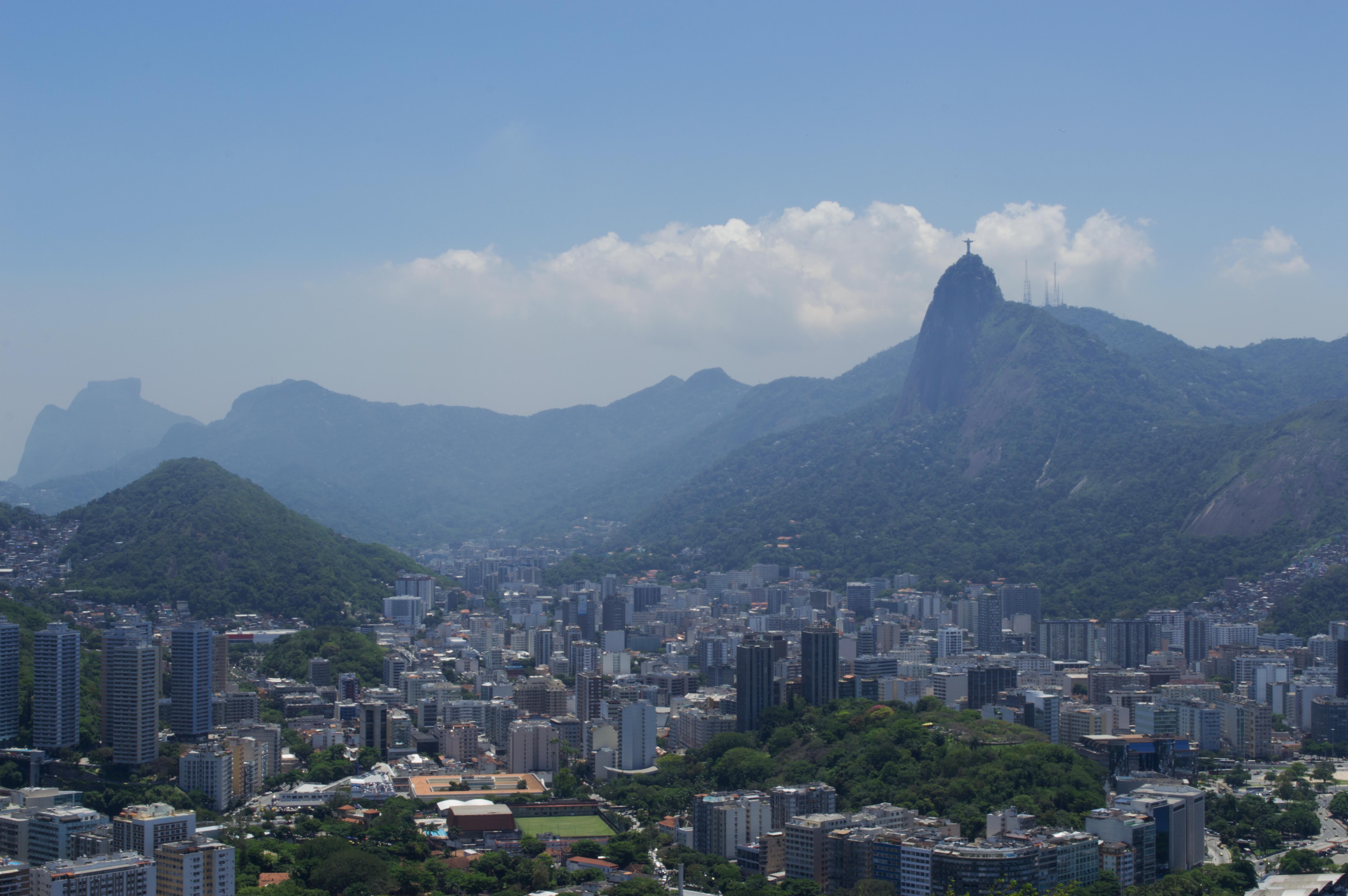
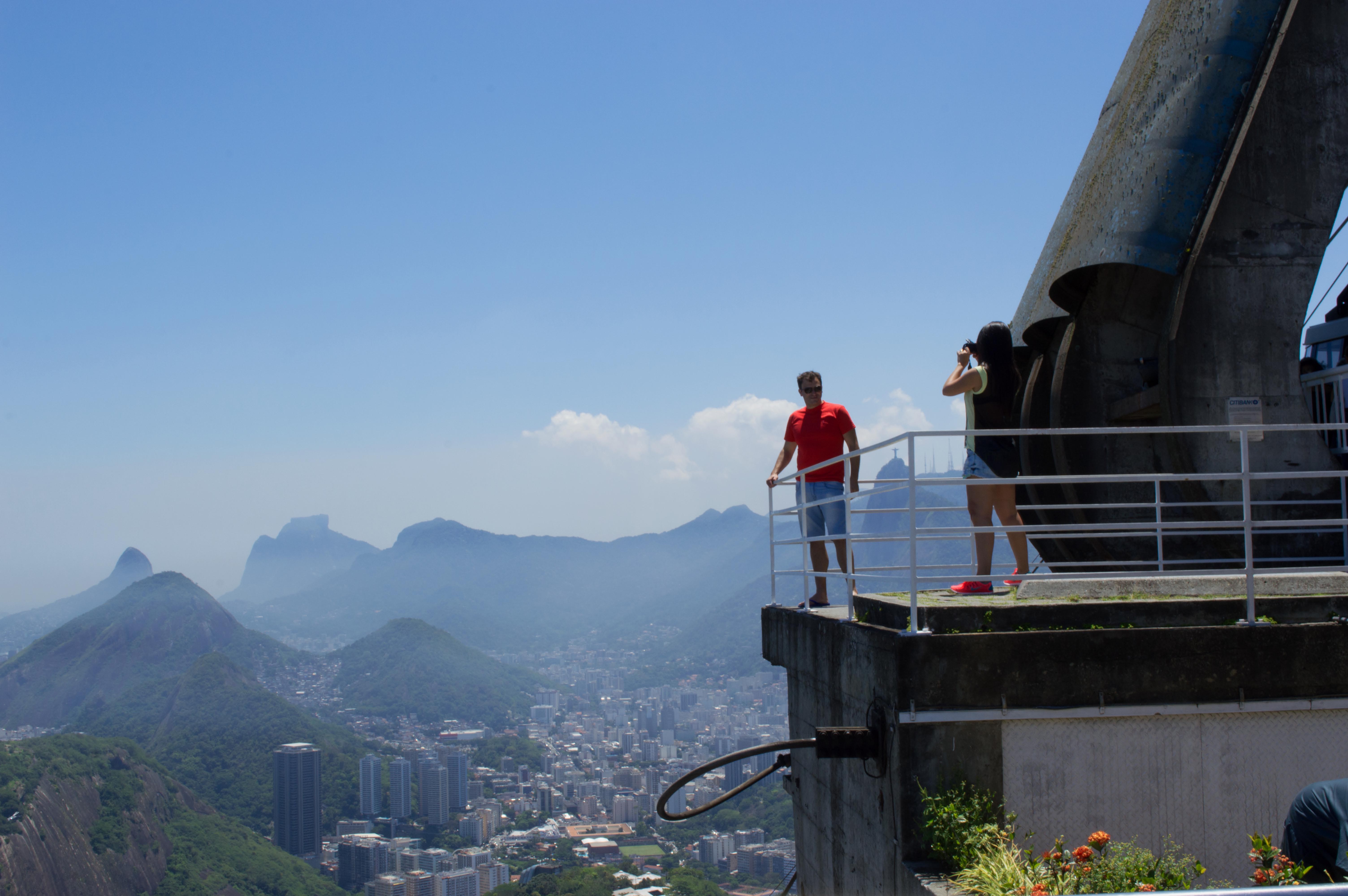
6. Rio de Janeiro. After working late on Monday night, I finished with what had to be done early Tuesday afternoon, and got a quick tour of Rio. My guide was Mr. Fred, who didn’t speak much English, but was cheerful and a good driver. Highlights were the tram up to Sugarloaf mountain, the little train up to Cristo Redentor, and drive-bys of the big beaches, including Copacabana and Ipanema.
13 11 19_5194_edited-1-1

Rio is a sexy city, with lots of curves and indentations, as well as many upthrusting hard places. There are spots where you can see at one time mountains, forests, cliffs, massive high rises, giant slums, beaches, boats, and ocean. It is spectacular.
13 11 19_5215_edited-1

7. Girl with a Pearl Earring. I read most of Tracy Chevalier’s book on the plane, and liked it. I picked it up in preparation for a short trip to New York in significant part to see Vermeer’s famous painting of the same title. The book consists of a historically informed imaging of the possible backstory of the painting.

The girl narrates the story of going to work as a maid for the Vermeer household and becoming involved with the painter’s work. I learned some interesting things about eighteenth century Dutch domestic life and painting techniques, and also something about how to look at those remarkable paintings. I was surprised how involved I got with the girl, whose life was narrow in a way, but also rich in texture and feeling. Note, the movie of the book with Scarlett Johansson was enjoyable but no substitute for psychological subtlety of the book.
13 11 19_5195_edited-1

The State Fair, The Circle, and James Turrell

13 10 26_4911
It was clear and brisk in Raleigh early Saturday afternoon when Sally and I got on the bus for the N.C. State Fair. My last fair visit was with Jocelyn when she was in elementary school, about 14 years ago, and just before she began to much prefer going with friends rather than dad. In the years since I haven’t expected that the fun would outweigh justify the headaches of traffic jams and crowds. The convenience of the bus, which stopped on Hillsborough Street just a short walk from us, made us re-do the fun/not-fun calculus, and off we went.
13 10 26_4903

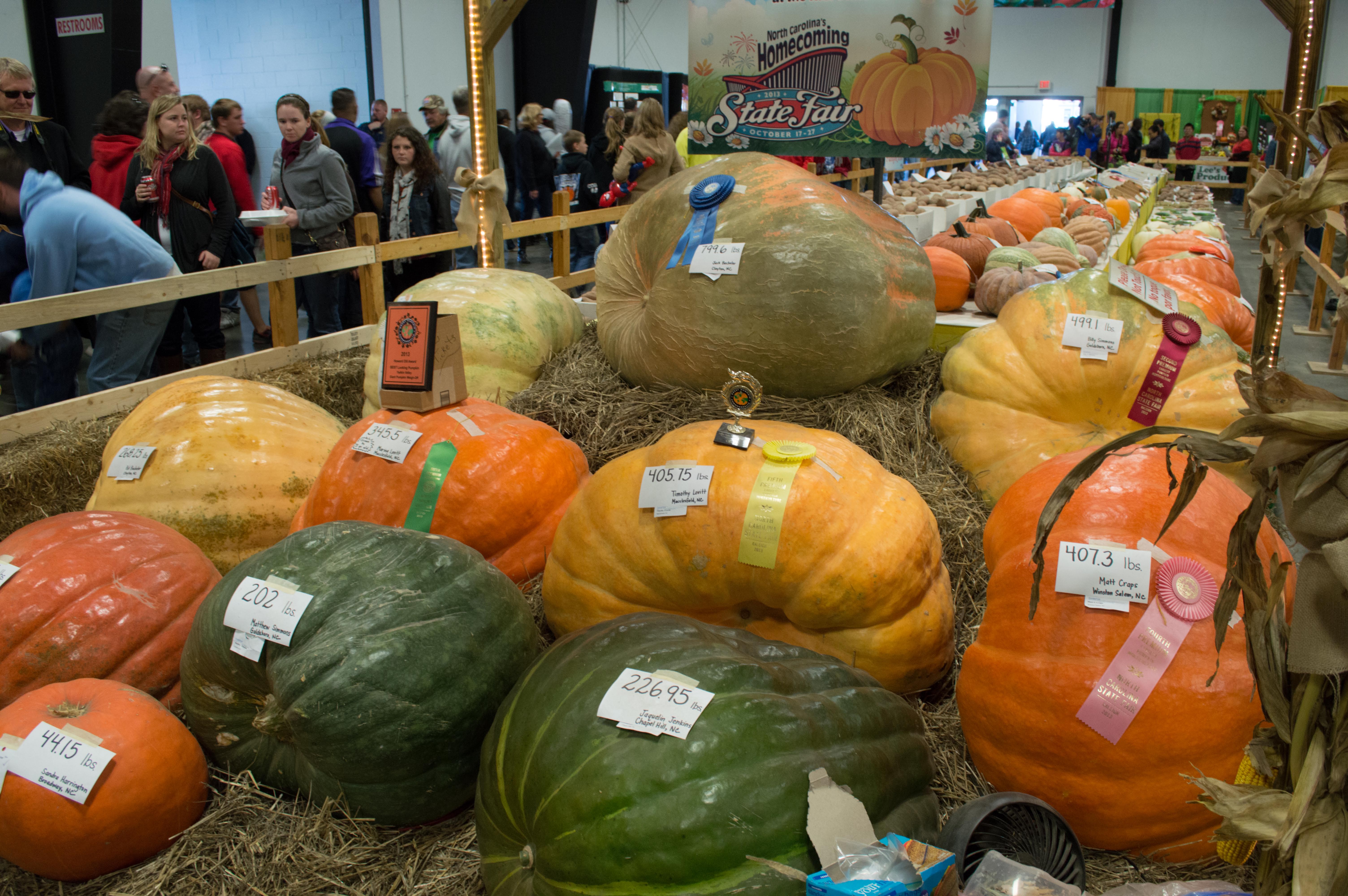
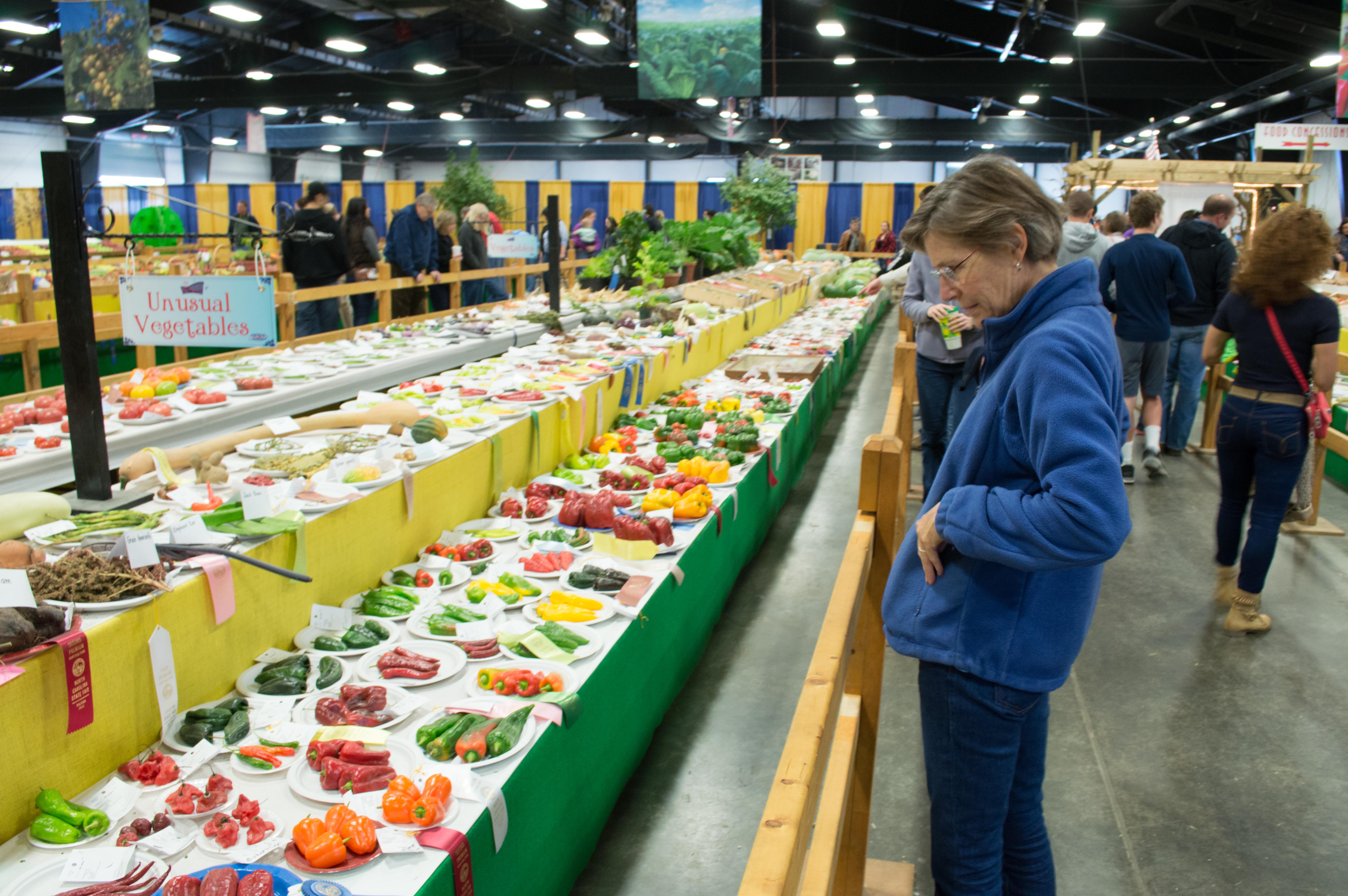
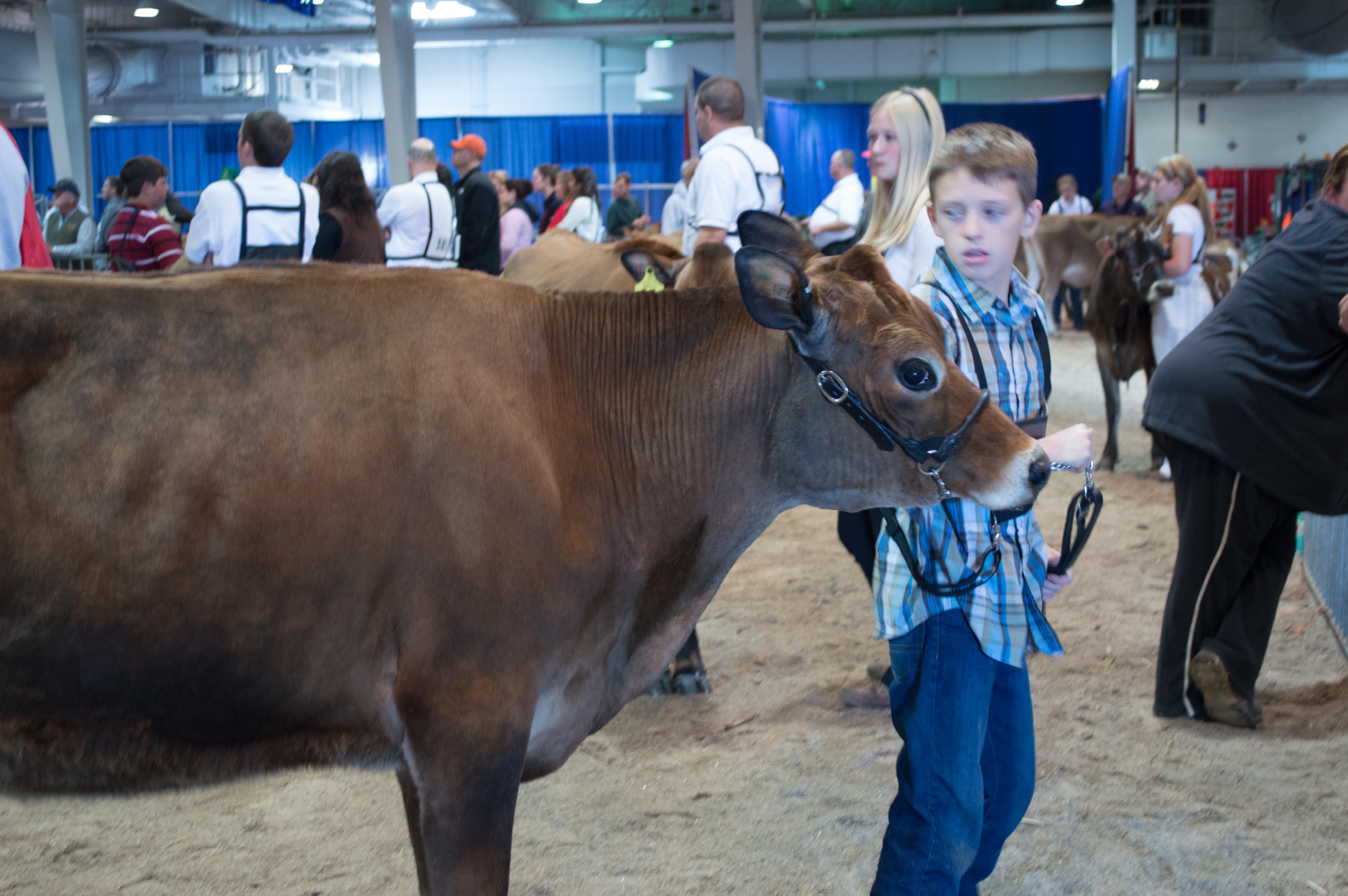
Our main objective was the agriculture exhibits. With most days full of hurry and technology it’s good to slow down and reconnect a little with the rural past. It’s terribly sad to think about mistreatment and needless slaughter of farm animals, but there’s also something sweet about getting close to the gorgeous prize-winning animals at the fair. The chickens and turkeys were amazingly varied, and the cows were generally good-tempered. I’m with Whitman: “I think I could turn and live with the animals, they are so placid and self-contained;
I stand and look at them long and long.”
13 10 26_4882

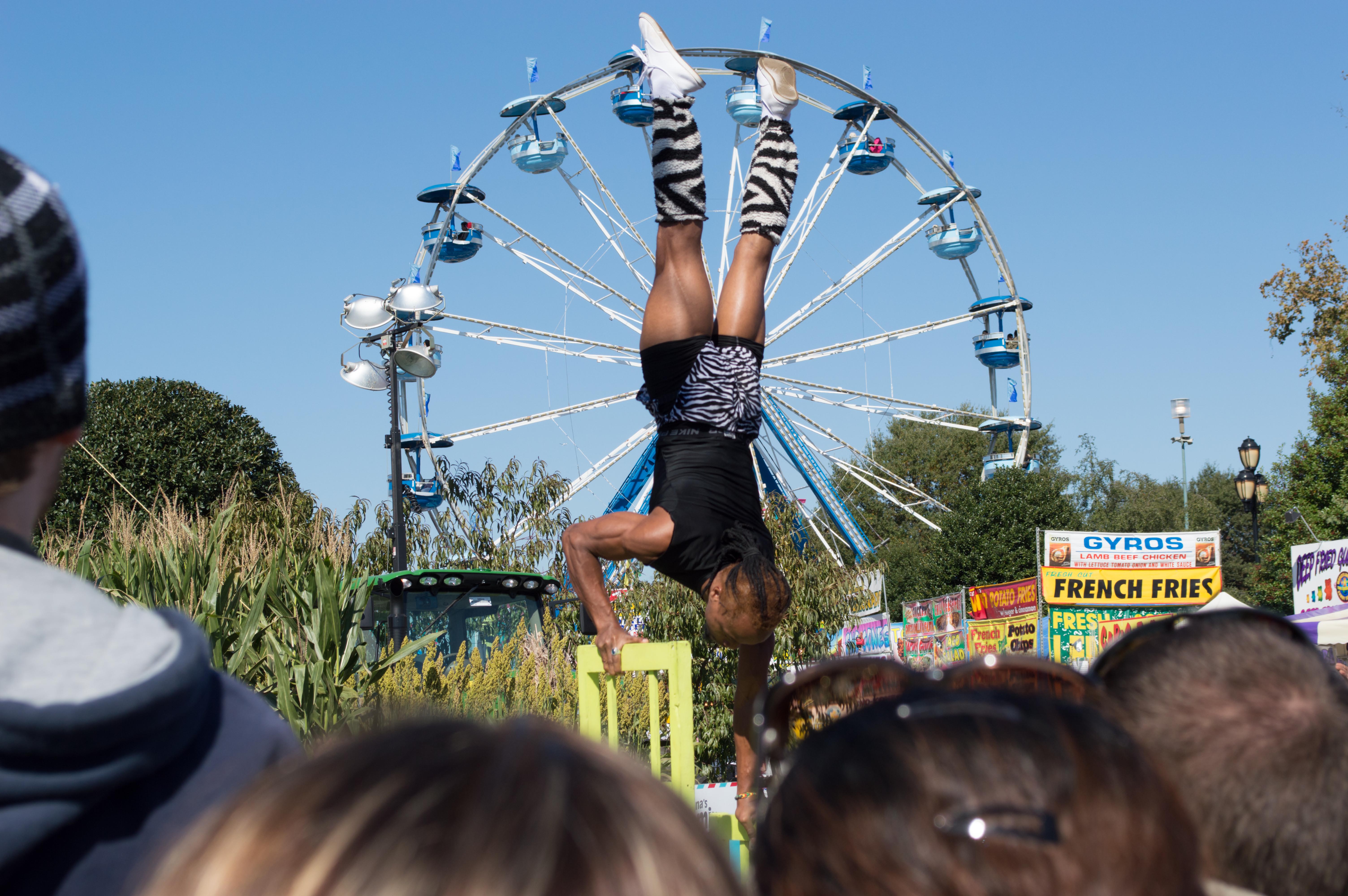
We also enjoyed the people watching. There were, of course, rural people, but it seemed like the crowd was much more ethnically diverse than years ago. We took in a free show by a troop of acrobats, including a handstand master. \13 10 26_4838
We also so a free show of stunt BMX bikers and motorcyclists. These guys were awesome.
13 10 26_4950

Also on Saturday I finished reading Dave Eggers’s new novel, The Circle. Set just a few years into the future, it’s about a young woman who goes to work for a tech company, the Circle, which sounds like a combination of Google and Facebook, and which has some cult-like qualities. It seeks total involvement and devotion from employees and may have a dream of world domination. The Circle promotes a vision of extreme transparency, pushing public officials and others to live completely on camera, open to full time universal internet scrutiny.

The idea is interesting, but the writing had about as much charm and verve as Newsweek. The subject of the book is how technology affects the human mind, but there wasn’t any depth to the characters, or much in the way of psychological insight.
Still, I liked the central thought experiment: what would happen if everyone’s life was totally visible and potentially viewable by everyone else? As The Circle notes, it would probably reduce crime. It would probably initially bring a feeling of a new kind of community. But would it destroy the possibility of human intimacy? Probably. And without intimacy, what would remain of meaning?

On Sunday morning I flew to Los Angeles for the annual meeting of the Association of Corporate Counsel, where I’m doing a presentation. In the afternoon I went to the L.A. County Museum of Art, where I wanted to see the special exhibit of the work of James Turrell. He’s best known for his work involving light and space, including environments that completely baffle our understanding of boundaries.

Turrell expects his viewers to enter into his work, literally and psychologically. I found it rewarding to do so. Although the work is primarily concerned with perception, it also inspires a surprising amount of feeling. For me it had some of the calming effects of meditation. I found myself looking at light differently as I left the museum.
13 10 12_4753

Amazing drawings, the N.C. Zoo, and some photos of butterflies

13 07 28_3063
Congratulations, to Jocelyn, who just graduated from the Columbia University publishing program. Now she’s hunting for a publishing job in New York, and we’re hopeful that she’ll quickly find one. (If you have any leads, please let me know.)

This week she sent me this link to a group of drawings and paintings that are astonishing in their photographic realism. Truly, the work is uncanny. I had no idea that there were humans with such technical facility.

But after the initial shock of astonishment wore off a bit, I wondered a little what was the point. If you could do the same thing with a camera, why wouldn’t you just use the camera? I suppose it might be like deciding to hike when you could drive, or building furniture with hand tools rather than power tools. There could be joy in the activity.

At any rate, I’m so glad I’ve got a camera, because it would take me at least another lifetime to learn to draw like these artists. Lately I’ve been learning more about my Nikon D3200, and having fun with it.
13 07 28_3013_edited-1

Week before last, I took the Sally and the camera over to the N.C. Zoo in Asheboro. We took in most of the Africa section, which features a spacious layout for such iconic species as elephants, giraffes, and rhinos, and relatively humane enclosures for the lions, chimps, baboons, lemurs, and exotic birds.
13 07 28_3084

We saw an adorable and sociable ostrich (above). I was also particularly touched by a baby baboon, just 6 months old, who rode about on mama, dropped off to bother brother, and hitched another ride on top of an aunt. We also enjoyed the many swimming turtles, including snappers, we saw from the bridge at the entrance.

I generally associate zoos with children, and recalled with pleasure taking my kids years ago, but also was reminded of the many challenges of young children and their needs (“I’m thirsty.” “I’m hungry” “I’m tired.” “I’m bored.”) It was good for a change to have no worries of that sort, and freedom to just enjoy the animals and environments.
13 07 28_3108_edited-1

Of course I have mixed feelings: it doesn’t feel quite right to cage these creatures up, even in nice cages. In the best of worlds they’d be free to live as best they could in habitat unmarred by humans. But in an imperfect world, I appreciate the chance to get close to these marvelous creatures.
13 08 09_3558

As a birthday present to myself I recently got a new tool: AF-S VR Micro-Nikkor 105 mm f/2.8G IF-ED. It’s a high quality macro lens suitable for extreme closeups. I’m interested in doing more with flowers and insects. Yesterday morning I got to Raulston Arboretum just after it opened at 8:00 a.m., and had good light, and proceeded thereafter to Fletcher Park. There were bees and butterflies hard at work, including these.
13 08 09_3576_edited-1-1
13 08 09_3523
13 08 09_3483
13 08 09_3513

Home alone with the animals and our new doggy portrait

13 05 31_1866
Sally went to Ashville with her tennis team to compete in the state finals this week. They’ve had success this year competing at the 4.0 senior level, and Sally’s feeling good about her game. I was happy for her, but a little melancholy to be home alone. I missed her.

So did the animals. The first day they spent time sitting by the front door waiting for her. The cats showered me with affection that they would normally give to her, and Stuart was much more excited than usual when I came home from work. Our routine called for a pee walk outside and dinner, which are certainly high points of any dog’s day, but even after dinner he wanted extra petting.
13 05 31_1862_edited-1
Stuart was immortalized recently in a drawing by Sally’s cousin, Alison (Muffy) Brush. Muffy turned out to be really talented, and we were very pleased with the work. It’s based on some of my photographs, but captures his essence much better than the photos did. As our dance friends will note, he has beautiful turnout. I think Sally’s frame selection really works.

Stuart is 10 now, and showing his age. He’s a basset-beagle mix – a bagle, or perhaps a beset. He still likes people and being petted – he’s met many people during elevator rides and is quite popular in the building – but unlike in his younger days, he’s wary of other dogs. Anyhow, as we often say, he’s a good dog. Handsome, too, I think.

I was somewhat the worse for wear from our trip to the Outer Banks last weekend. For the first time in many moons, I went for a substantial run – four miles – on Sunday. It was a lovely day, sunny and mild, and I felt fine, even when I got my heart rate up to the low 160s. Only hours later did I begin to feel pain in my knee, and more and more soreness in my quadriceps. The next day I was so sore I could barely walk.

Also, according to my usual pre-morning-shower weigh-ins, I somehow gained 6.8 pounds between Friday and Tuesday. This was a shock! Did I really eat that much? I enjoyed Keith’s food, but I consciously kept from stuffing myself – no second helpings, for example. I snacked on pistachios, which were kept in a bowl that somehow never emptied out, and that may have had something to do with it.

Anyhow, I was gimpy and heavy, but things improved over the course of the week. On Friday, I got to the gym when it opened at 5:30 a.m. and got in a mega-workout: 30 minutes of lunges, squats, step-ups etc. a 50-minute spin class (a major aerobic accomplishment), 25 minutes of upper body work, 10 minutes of core exercises, and 10 minutes of stretching. By the time of my morning weigh-in, I had lost 3 pounds from the previous day, and six for the week.

On the drive back from Corolla, Sally and I talked about possibilities for our next adventure. We try to do something fun outside the usual routine every month or so, and the next four week interval brings us almost to the July 4 week. The Fourth is on Thursday, so if I can get off that Friday, presto, we’ve got a four-day weekend. We’ve been wanting to visit Gabe in Colorado, and also wanting for a long time to visit some of the beautiful country in southern Utah, which is within driving distance of Telluride. I took on the job of researching the possibilities of fitting this into a July 4 trip.

Saturday morning I decided to skip yoga and go on a little photo safari to see what was blooming at Raulston Arboretum. There were some beautiful flowers, and it was quiet and calm. I made a few images I liked. 13 05 31_1883
13 05 31_1885
13 05 31_1900
13 05 31_1911
13 05 31_1888
13 05 31_1892
13 05 31_1917

Educational opportunities

Jocelyn doesn’t use the phone for talking too much anymore, at least to her dad, but she called this week to tell me she was admitted to the Columbia University publishing program. She was thrilled, relieved, and ready to start a new chapter: life in New York City. Her boss at the apres ski bar in Telluride agreed to buy her aging Nissan Altima, and she asked me to figure out the legalities. I said I’d be happy to do so.

Whatever doubts I may have about job prospects in the publishing business, I’m keeping to myself for the time being. It’s wonderful to see Jocelyn, so smart and talented, moving forward and exploring. Wouldn’t it be nice if we could all go to New York and be students again?

As a matter of fact, one of the great things about my job is that I get to talk to and learn from really interesting and gifted people. This week I had lunch with Jamie Boyle, professor of law at Duke and one of the most clear-eyed scholars of intellectual property law. His last book, The Public Domain: Enclosing the Commons of the Mind, explains with clarity and force some of the enormous problems with our patent and copyright systems, including how IP law can hinder innovation and creativity. He really is a brilliant guy, and a delightful conversationalist.

We ate at the Washington Duke Inn, which has a cozy clubby feel, and talked about some of the usual things, like sports and food, but also about his leading role in producing the Hargreaves Commission report, which advocated an evidence-based approach to IP protection. We discussed the possibilities for patent reform in Congress and the courts. We also talked about some of the hyper conservative activity in the N.C. legislature, and the N.C. constitutional amendment against gay marriage. We agreed that this right-wing crowd has gone beyond being embarrassing and is hurting the reputation and economy of our state. I also got to see his new car, a sporty and beautiful Jaguar XK.

In other education news, the NY Times reported this week that EdX, the online education consortium, has developed software that automatically grades students’ essays. Its new software is, it says, not perfect but about as reliable as human graders, and gives almost instant feedback to the student. This could be a game changer in education at all levels, potentially helping students with instant feedback, and also potentially eliminating a lot of teaching jobs. Will the net of it be better education at lower cost? And/or will it be another nail in the coffin of the traditional university, without a satisfactory replacement on the horizon?

David Brooks wrote a good column this week about online education and the role of the university. He proposed regarding the mission of higher education as having a technical knowledge part and a practical part. Technical knowledge is about things like formulas and facts, and practical knowledge is about skills that can’t be written down and memorized. Online outfits like EdX and Coursera can cover the technical part, but at least so far aren’t as effective at the practical part. We seem to need human-to-human interaction to learn some things.

Three Sparrows and a Cup, by Byron Gin

Three Sparrows and a Cup, by Byron Gin

At any rate, the human touch is a pleasant thing. On Friday Sally and I went out to First Friday, downtown Raleigh’s monthly art and food celebration. We stopped in the Adam Cave Gallery, where we’d bought a painting some months back, and met the painter, Byron Gin. His current show, titled Aviary, continues the theme of the work we bought, with abstract elements, rough textures, and birds. Byron was a pleasant, soft-spoken guy, who seemed happy to discuss how he made his paintings. We remembered the painting we bought, and it was good to be able to tell him how it had brought as daily joy. Among other things, we learned that we shared an interest in bird feeders and photography.

For dinner, we tried without success to get into Bida Manda (wait time 1.75 hours), Centro (wait time 1.5 hours), and noted crammed dining rooms or lines out the door at Caffe Luna, Remedy Diner, and Sitti. It’s good to see our restaurants doing a brisk business, but when you’re hungry, you’re hungry. We finally got a table at Gravy, an Italian place, and had a pleasant meal including a Tuscan Chianti.

On Saturday, we went over to Durham to take in some of the Full Frame Documentary Film Festival. The festival is an annual event that this year featured more than 100 documentaries, 7 different screens, and hundreds of cinephiles, which we somehow had never managed to get to in years past. The afternoon was sunny, and there was a happy energy to the crowd, an eclectic mix that reminded me of Oberlin (where the film club screened classic films once a week) and upper west side New York. The films we saw were all sold out, as were several others we couldn’t get tickets for.

Our favorites were a double bill by featured film maker Jennifer Yu: The Guide and Breathing Lessons. The first was about a park in Mozambique and a young man whose big dream was to be a tour guide. It explored serious environmental issues with a light touch. It featured E.O. Wilson, who at 82 was still charmingly fascinated by ants and other small creatures. Breathing Lessons was about Mark O’Brien, a writer who was paralyzed by polio as a child and spent most of the rest of his life in an iron lung. He seemed very honest about living with an extreme disability. Yu was in attendance, and after each film answered questions from the audience. She seemed really smart and likeable.

Tire service, and new interior design

Tire care and repair is something I don’t usually think about very much. But there are times when it comes to the forefront of vital issues, and last week was such a time.

Some weeks back, my left front Michelin Pilot Super Sport (a primo tire) developed a slow leak, and was nearly flat by the time I first noticed it. I began stopping at the quickie mart every few days for air. On the latest fill stop, I apparently broke the valve stem on the left back Sport, which began hissing. Replacing the cap stopped the noise, but I wasn’t confident that it stopped the leak. I had visions of flat tires, waiting for a AAA tow truck, and the slightly condescending sympathy that car rescue guys can’t help feeling for those that need rescue.

In the end, I kept enough air to drive to the repair shop. I did a bit of Google searching on Raleigh tire shops, and settled on Murray’s New and Used Tires. The web site emphasized that it was a family business and an ethic of service to the customer, and had several positive costomer reviews.

When I got to Murray’s, even before I was completely out of the car, a young man was asking how they could help me. He went to get some pliers and made an adjustment to the back valve stem that fixed it immmediately. Hurray! He then offered to check the front tire, which he had off in a matter of seconds, and he located the hole a few seconds later. He said they’d fix it for $28 and guarantee the patch for the life of the tire. Not bad! I waited in their main office, where they offered me a coffee in a friendly way. Ten minutes later I leaving fully repaired and only $28 to the negative.

It is really cheering to discover a great service provider — one that can not only perform the service competently, but does it with pride and a certain style, and seems to enjoy displaying their expertise. The team at Murray’s had that air of competence and also of getting a kick out of life. I thought I might enjoy such work, though perhaps not for very long. In any case, I was really grateful that they could do it.

One downside: in a moment of weakness I agreed to give them my email address, and shortly after rhey began sending spammy ads to my email and phone. I guess they need more business. Please go over there if you have a tire problem and tell them it was not because of the spam, which they should stop.

Service, or helping othere, is a beautiful thhg. As social animals, we are always seeking ways to connect, and the services we give are primary connections. When we serve others and receive services, we build relationships and communities. With this in mind, I look differently at the person who is helping me buy groceries or clothes, or repair tires. The exchange is not just about money, but also about being humans together.

This has been one of the satisfying things about upgrading our apartment decor. Working with Blair Sutton has reminded me that there are types of skill and talent that are both enormous and sometimes barely noticeable. Blair makes good design look really easy, and fun. I know it’s not that easy, but it seems an authentic expression of who she is. In this sense and others, she is a true artist.

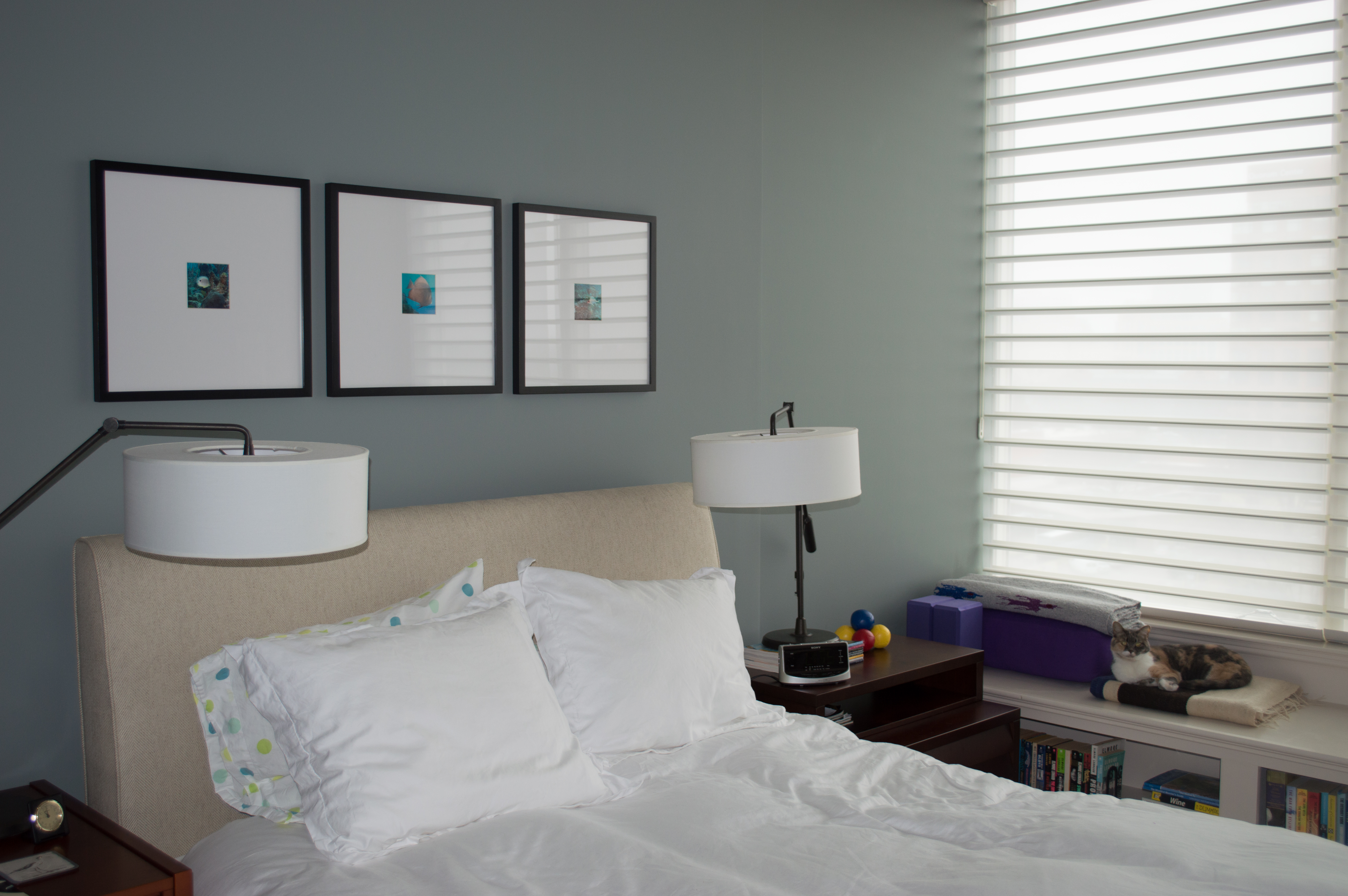
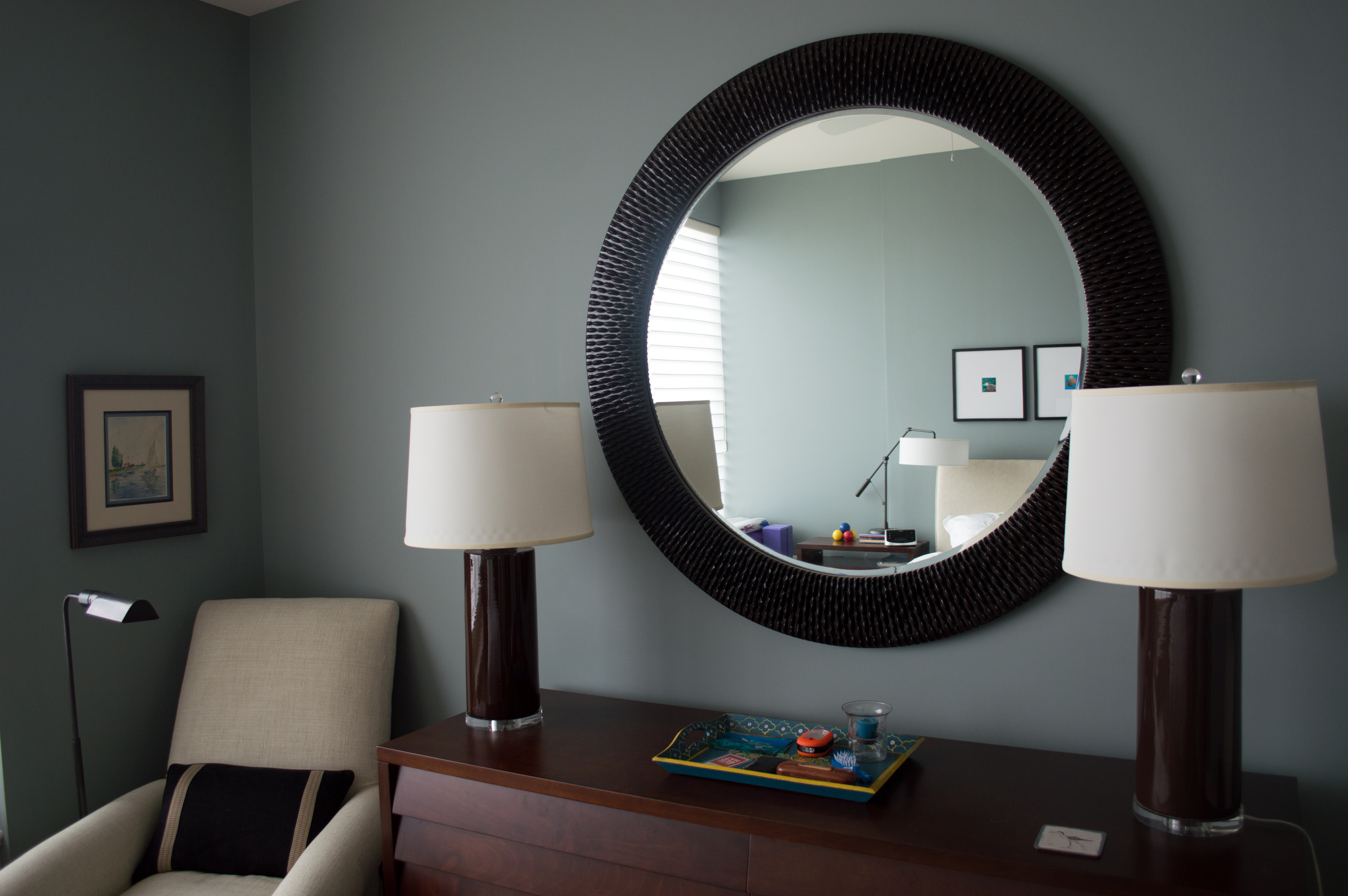
Our most recent project, the guest bedroom, was in full flight this week. The reason — once we got the other room looking good, the guest bedroom looked dowdy — the slippery slope when you start improving things. Blair consulted with us on functions we needed, like a desk for me and more storage for us both, and came up with a design that seemed like it had been somehow buried in our subconscious.

Blair hooked us up with some excellent painters, who covered over the cherry walls, which just never worked, with a cool gray. The painters seemed to like to paint, and were really good at it. The new furniture arrived, including a cute and functional desk that reminds me of Shaker furniture. We got sconces, and got electricians to put in the sconces, as well as to reroute the cable hookup to the other side of the room. The electricians also put spot lights on our new paintings, which makes them pop. They also gave good service.

We’re still waiting for the new headboard and a couple of other items, after which I’ll post some photos.

Art, technology, and our bedroom v. 2.0

2013 01 12_0714_edited-1
I saw a story this week about the predictions of various tech company execs as to developments in 2013. The most interesting one to me was that 2013 would be the year of art. The prediction was that the coming year should bring a shift in which technology begins to enable a new creativity.

It struck me as unlikely that we’d see such a major cultural shift this year, but I liked the idea of focusing on how technology might advance creativity. Clearly, it sometimes does the opposite. Television, for example, has on balance surely made us duller, and I worry that Facebook may be no better. But the internet opens a vast number of possibilities, and the tools and portals keep improving.

A case in point: one of my 2012 projects was to learn to draw on my iPad. I found the tools I tried awkward and glitchy. The line would be flowing fine and then for no apparent reason stop working, and need to be reset. Frustrating. I put that endeavor aside for the time being. But the prospect of an amazingly convenient and flexible drawing tool with all the convenience of a tablet is close, if it’s not here already.

As regular readers have heard, I’ve been experimenting with digital photography in recent months. My hope was that with my entry-level DSLR (a Nikon D3200), I might find expressive possibilities that exceeded those of my trusty-but-inflexible Canon point-and-shoot. In any event, getting new equipment tends to inspire new efforts. This is, of course, a slippery slope — it’s possible to shovel a lot of money out the door on fantastic lenses and other equipment without realizing much of an artistic ROI — but so far I’ve kept equipment urges under control, and I’ve made some images I liked.

Lately I’ve been focusing more on what to do with those images Again, technology is expanding the possibilities. I’ve been experimenting with Photoshop Elements to tweak them, and with Flickr and Dropbox for storing and sharing them. Some I’ve shared in this blog. Sally gave me my first digital photo display frame for Christmas, and I set it up with a slide show of my images from our Christmas diving trip to the Turks and Caicos. I’ve been turning it on when I sit down for breakfast, and getting a quick taste of the remarkable beauty of the reefs.

Rita Tiller in bedroom v. 2.0

Rita Tiller in bedroom v. 2.0

Last week I took on a bit of a retro project. In the fall, we engaged Blair Sutton, an interior designer, to help us re-do our bedroom, which had a traditional look that didn’t work with the rest of the space. Blair somehow took our vague concepts and came up with a design that was contemporary but also relaxed and calming. She is truly an artist. One of her ideas concerned the space on the wall over the bed.

She proposed three frames from Pottery Barn hung side by side to be filled with small images of our creation. I’d been thinking for a while about getting some of my own images on our walls, but it never got high enough in the priority queue until Blair’s directive. I took the triptych as a challenge, and though it took a while, it finally got me focussed.

Eventually I picked three images from the Turks and Caicos set (two of which I previously published here) and took them to Rite Aid drugstore to print. (There turned out to be a small learning curve on this. I actually had to take them in twice, because I didn’t get them in an acceptable format the first time.) Anyhow, the prints turned out fine, and Sally volunteered to do the framing. We were both happy with the results, and enjoyed the collaborative process.
2013 01 12_0716_edited-1

Thanks to Joni Mitchell and my Supreme Court co-clerks


Happy Thanksgiving! I’m so thankful for Joni Mitchell, whose beautiful album Blue we listened we listened to last night. I’m still new enough to Spotify to find it marvelous to have instant access to such gorgeousness.

Blue is a unique shade of blue. Our experience of art depends on what we bring to it, of course, and my experience of Blue is rich in nostalgia for Paris, where I first heard it my friend Greg’s place in the Latin Quarter on his little cassette tape player. But I loved it just as much when it was new.

Notes of sadness, loneliness, and longing are balanced with joy and exhilaration. Yet it doesn’t seem calculated. It seems like a soul that’s seeking another soul, completely and almost frighteningly honest. Joni seems so vulnerable, and takes so many risks, that it’s unsettling. At the same time, it’s so sweet and true. Truly, I’m thankful for Joni and Blue.

Apropos of nostalgia and gratitude, I had another heavy dose week before last when I reunited in D.C. with my fellow Supreme Court clerks at the Court to honor one of our number, Justice Elena Kagan. In 1987, when I was one year out of law school, I won the lottery and got picked to join this extremely gifted group as a clerk for Justice Antonin Scalia.

The clerkship was a great honor, but also terrifying. Clerks are tasked with constantly and quickly mastering new areas of law without glitches that could lead to major policy errors or loss of life. This is not hyperbole. The death penalty docket involved review of cases a few hours before scheduled executions, which carries with it a level of responsibility that can cause severe sleeping problems.
During that year, the coin of the realm was legal knowledge and reasoning, and in these my co-clerks were often brilliant in a way I often found humbling. Fortunately my class was not only fearsomely bright but also distinguished by a high rate of decency, fellow feeling, and good humor.

Saturday afternoon, Justice Kagan led a tour of the Court for a dozen or so of us. As she observed, the Court was the same, or at least much the same. It was fun catching up on everyone’s doings. As we were entering the courtroom, I asked Elena if Justice Scalia was treating her all right, and she told me about going hunting with him. In her chambers, the technology seemed upgraded, and she had three computer screens. However, she said she could only use two of them at a time. Elena has a great smile and a great laugh, and was full of warmth and charm.
We had dinner that night at the Court, where more old friends showed up. Teresa Roseborough, who was our wonderful organizer-in-chief, had a slide show of us looking younger, and asked us each to stand up and give a story about our time at the Court.

There were many good stories. I reminisced about the basketball games on the highest court in the land. I was one of the less skilled players, but was still made to feel welcome. I noted that Elena and I had once scrambled for the same loose ball and our two heads had collided hard. It really hurt! Fortunately we didn’t sustain any serious damage. To think that I could have caused a head injury that would have changed the course of history!

Ballet paintings, fossils, and a piano recital

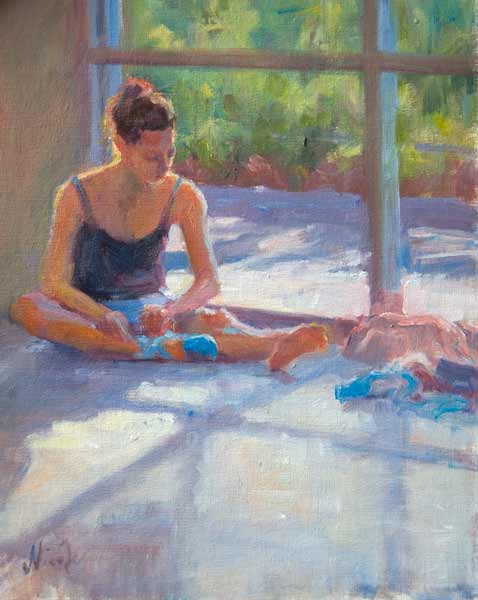
Light on One’s Feet by Nicole White Kennedy

Last Thursday Sally and I had lunch at the Remedy Diner, where my sandwich was the Tempeh Tantrum, then went to a gallery to to look at paintings by Nicole White Kennedy. Kennedy, a local artist, paints in an Impressionist/Post Impressionist style that I once thought of as old hat. My early art education stressed the triumph of modernism and abstraction. But over the years I’ve really enjoyed Kennedy’s landscapes and cityscapes in her husband’s fine Italian restaurant, Caffe Luna. I’ve gradually gotten past my prejudice in favor of the modernist aesthetic. Artists show us multiple ways to see the world, and it’s fun to try different ones.

Anyhow, I was intrigued to learn that Kennedy had worked up a show of works featuring dancers from the Carolina Ballet. We really liked the show. No doubt it helped that we came to it as balletomanes, and that we could recognize some of our favorite ballerinas. But she unquestionably had a feel for the interiors and exteriors of the dancers and their work places.

I was conscious that the works owed a debt to Degas, both in their behind-the-scenes intimacy and the juxtaposition of ethereal sweetness and stark angularity, but I didn’t find this bothersome. Artists always borrow ideas from other artists and build on them, just like scientists and inventors. We were particularly touched by the paintings above and just below, and bought them.

Dancer Removing Turquoise Points by NWK

The next day I flew up to DC for a gathering at the Supreme Court in honor of my old friend Justice Elena Kagan, which was highly nostalgic and which I will try to write about soon. But as post-election therapy, I’m focusing just now on art. With my free morning I sampled the Smithsonian museums, which always make me proud and happy to live in the USA.


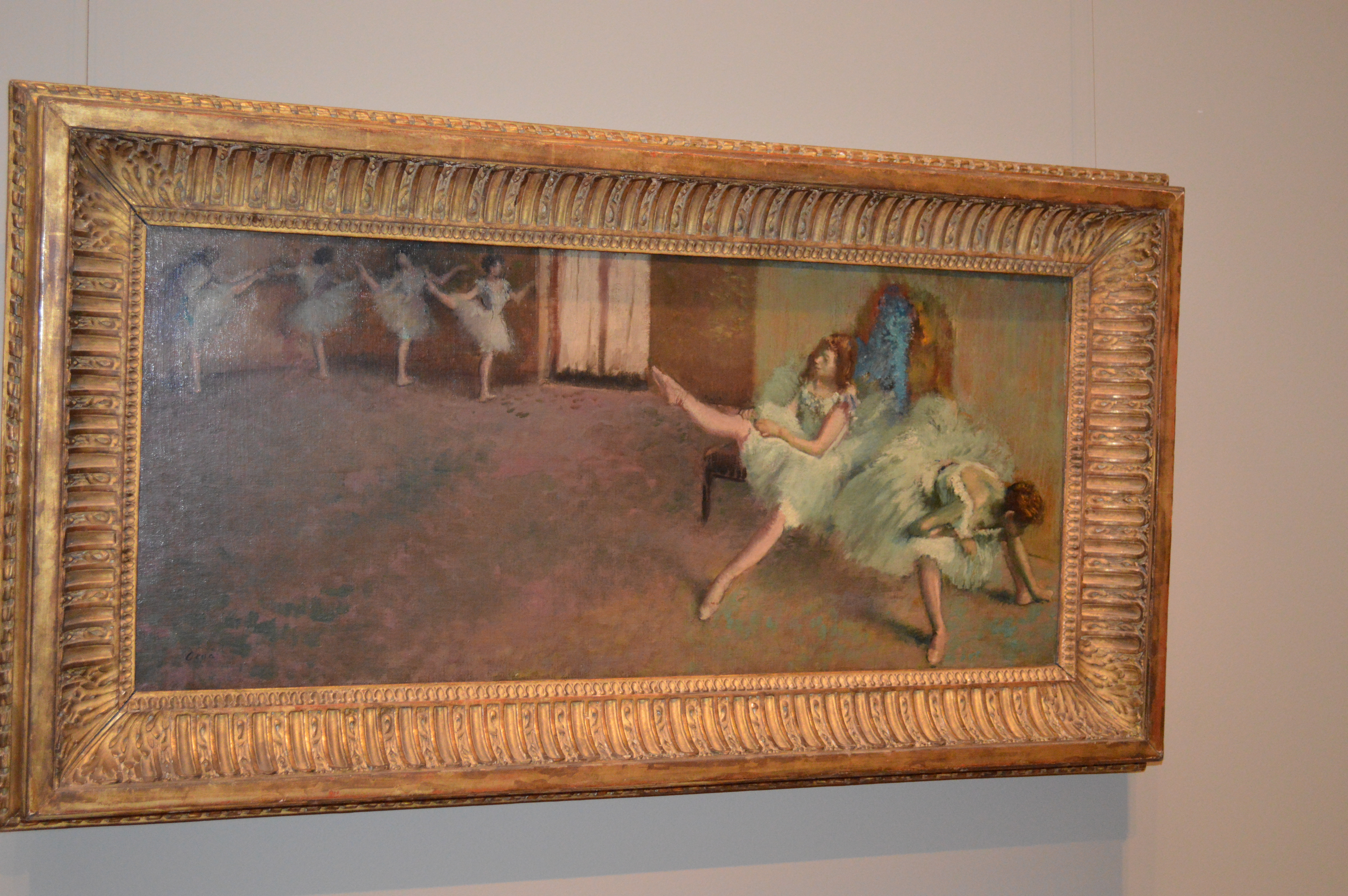
First I visited some of my favorite works at the National Gallery. These included the Rembrandts and other Dutch masters, including especially the two exquisite Vermeers, as well as the French Impressionists. Still thinking about dancers and art, I paid particular attention to the Degas paintings and sculptures of dancers. He clearly loved the subject, and it touched me. But I must say, his dancers are not as lithe and athletic as the Carolna Ballet ones.

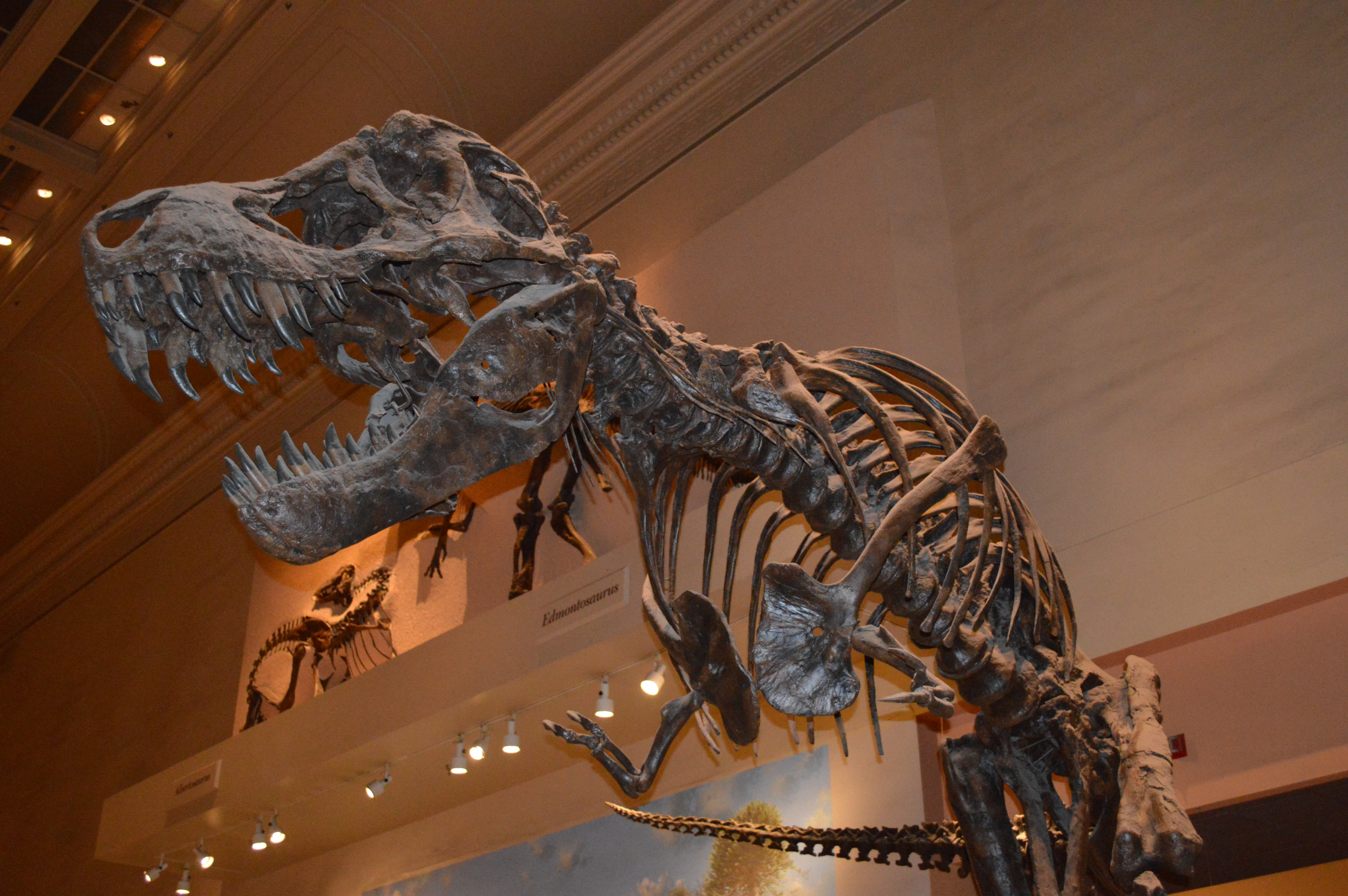
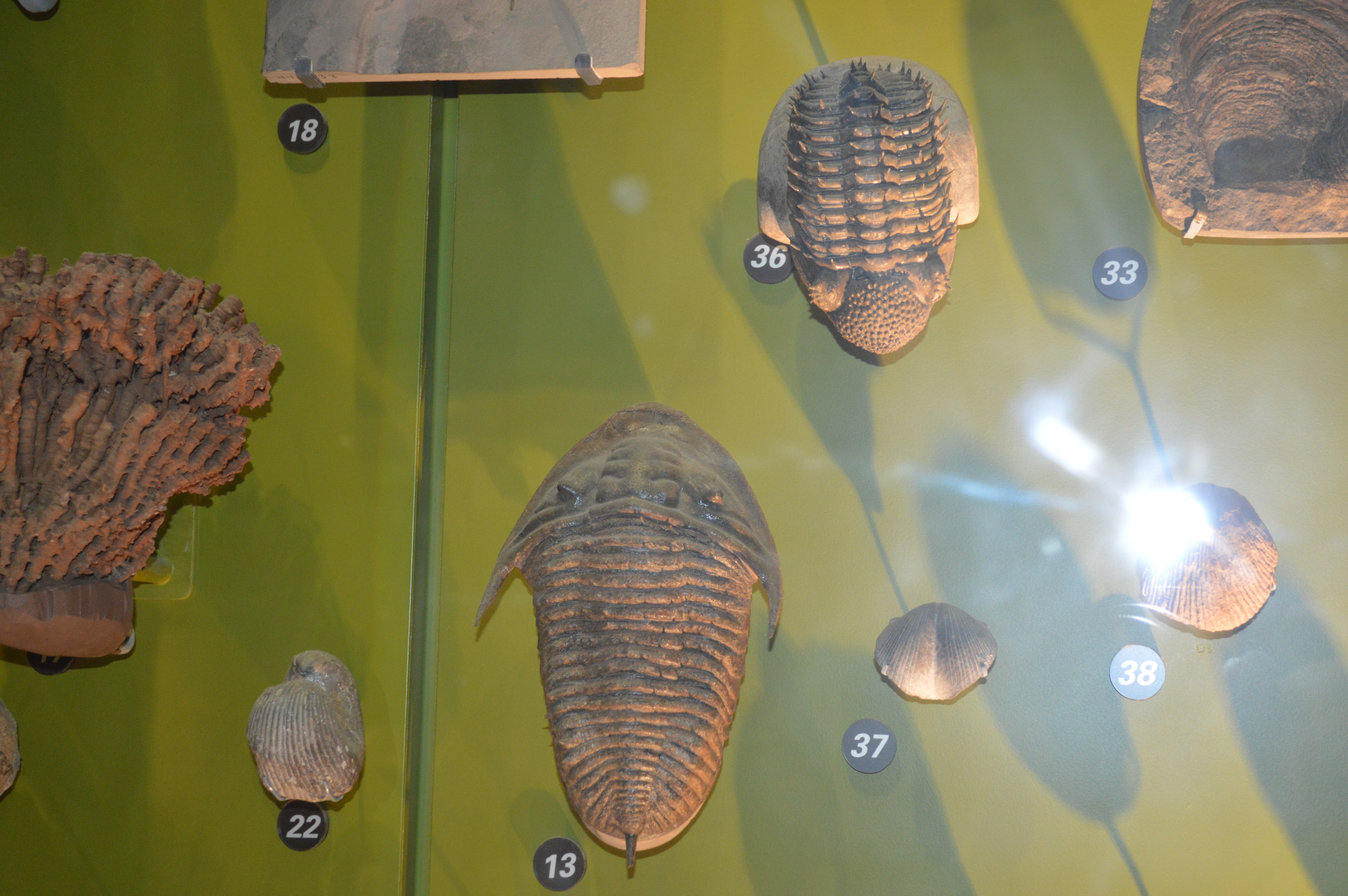
Next, I walked down the Mall to the Museum of Natural History. As always, I enjoyed looking at the dinosaur fossils, but I wanted to have a close look at the trilobites, which are much much older than dinosaurs.

Trilobites were marine arthropods that began their run around 520 million years ago. They developed an amazing variety of body types during the 270 million years (give or take) that preceded their extinction. RIP. Nature has done a lot of amazing experiments!

I returned to Raleigh on Sunday afternoon in time to go to the recital of my piano teacher, Olga Kleiankina. Her program, like her, was Russian: Alexandr Scriabin (1872-1915), Nikolai Medtner (1880-1951), and Sergai Rachmaninoff (1973-43). She played brilliantly. She’d told me a couple of weeks ago that she was struggling with memorizing the Medtner piece (the Tempest Sonata), and I was feeling a little anxious for her, but she seemed completely in command. The piece was very dense, and at first I was a bit bewildered, but then I got my bearings. I particularly enjoyed the Scriabin Black Mass sonata. From our work together, I know how intensely she focuses on sound colors, and now that I’ve learned to hear some of those things, the music took on a new dimension.

There was a good piece on the Sunday NY Times about the sense of hearing, and the difference between hearing and listening. According to Seth Horowitz, we react to auditory signals 10 times faster than visual ones. Hearing is an early warning system, among other things. He notes that close listening is hard in a world where there are endless distractions, but that we can get better at it. I concur.

Our week in Tuscany


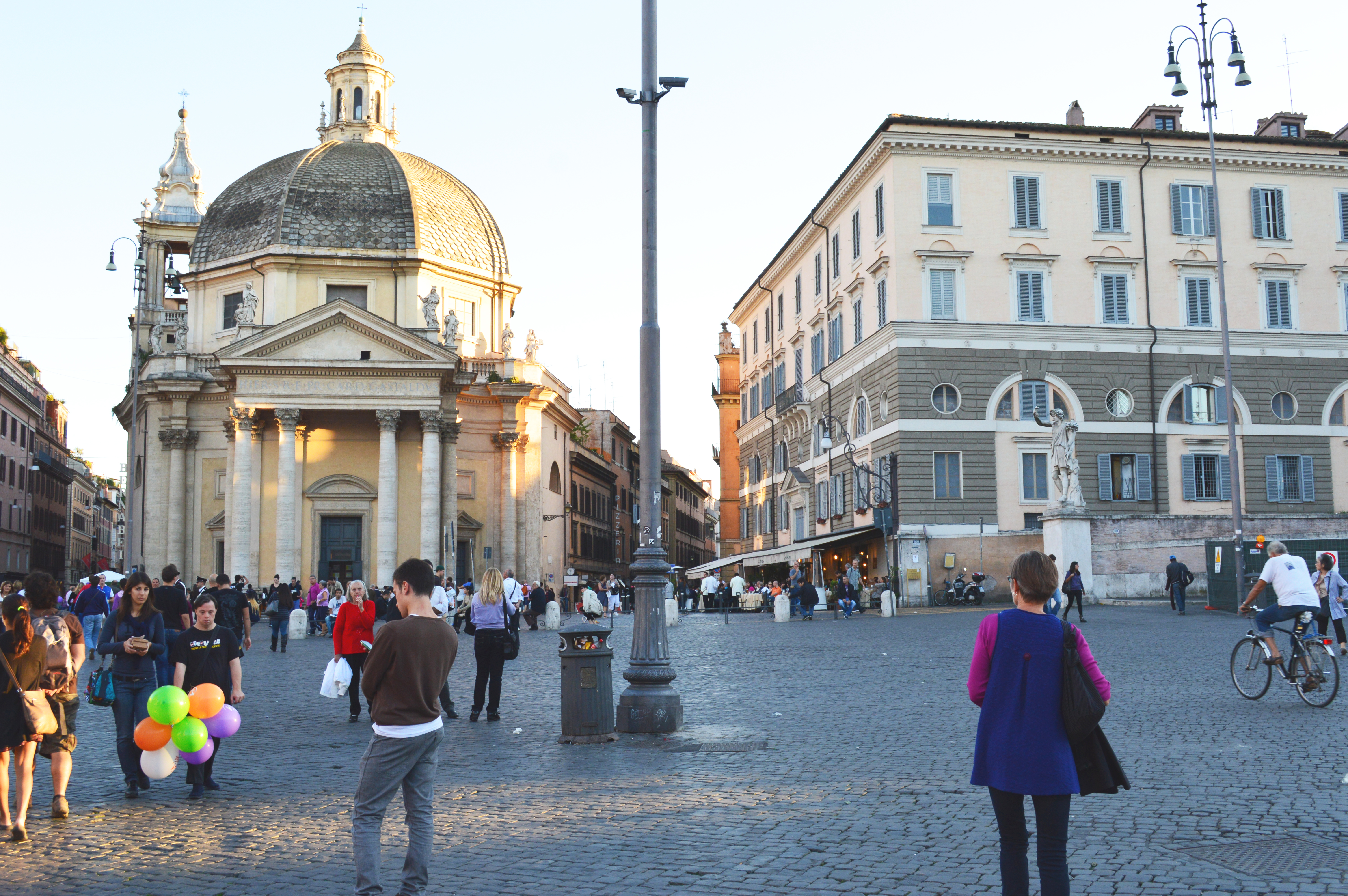
Sally and I got back on Sunday from our first trip to Italy, where we saw the major tourist sites of Rome, Siena, and Florence, as well as five medieval cities in central Tuscany. We took in a ton of Renaissance art and architecture, wandered for miles through narrow streets, and drank some wonderful wines. We also had our share of minor travel tribulations, such as lost luggage, lost car, and just plain lost. We got soaked by a sudden downpour on the way to the Vatican, but for the most part the skies were blue and temperatures were mild.

Hearing about other people’s vacations is usually either frustrating or boring, and I will therefore spare you a blow by blow of the beautiful places and fine food. But I will say, if at all possible, you should go. It was an amazing feast for the senses and the mind.

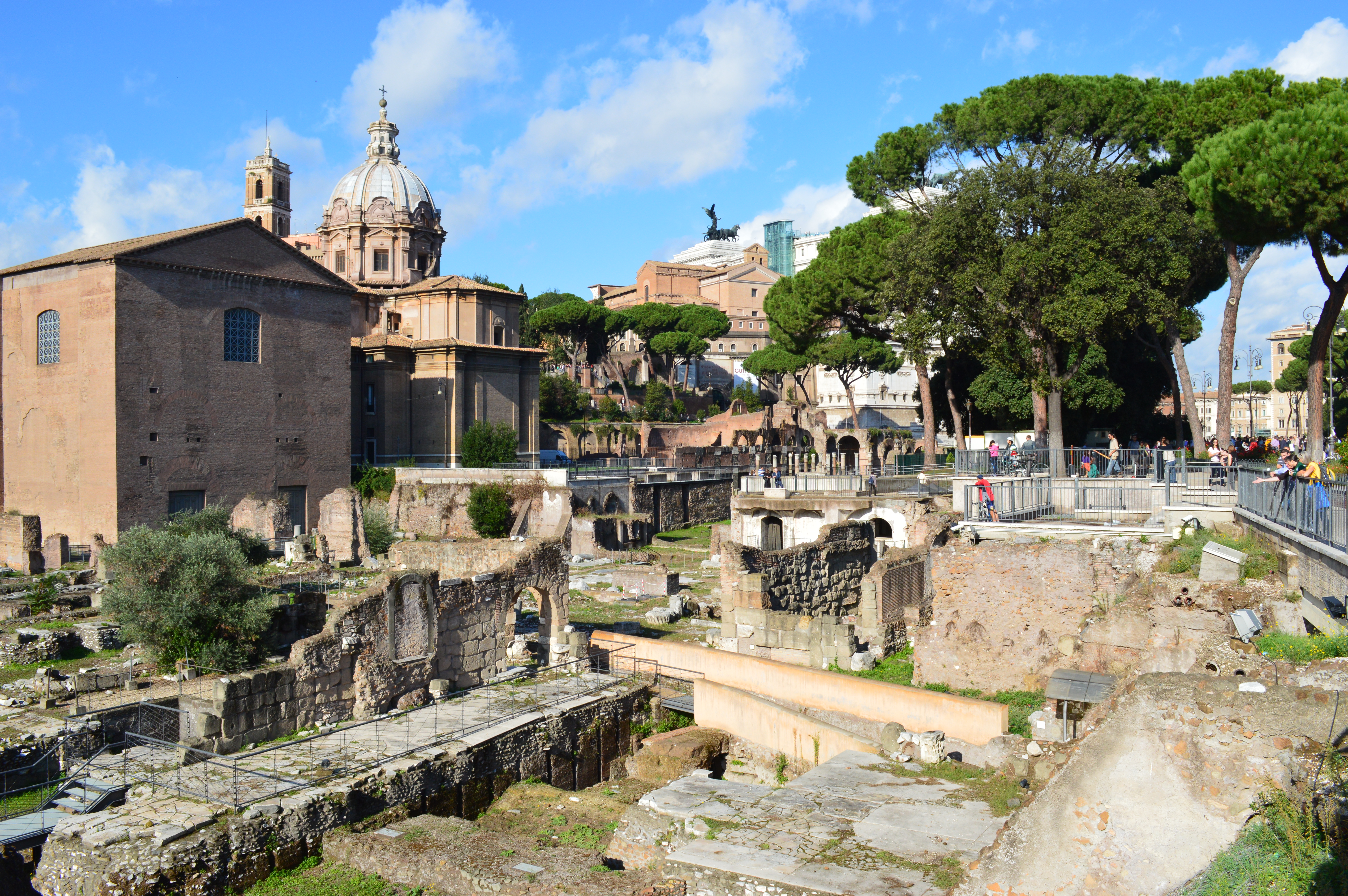
It was also a time machine. The antiquities of Rome, like the Colosseum and the Forum, are awe inspiring. I asked myself, would I have enjoyed gladiators fighting to the death or religious dissidents being fed to the lions? Probably not, but who knows? The Romans’ appropriation of Greek art, followed by the Renaissance reappropriation of those same ideas, all made sense. But the hard phyical facts were also mildly shocking. There were a lot of statues of nude people! I get that they decided to glorify the human form, but faced with all those bare bodies, it seems fairly obvious these were highly sensual people.

With the benefit of some education in art history, I was looking forward to many great masterpieces, and they were certainly there. We made a particular point of seeking out the paintings of Caravaggio, which are amazingly powerful, and the great sculptures of Michelangelo. I will also note that the Sistine Chapel ceiling was awesome. There were so many other master works that I looked at hard and was touched by.

At the same time, I was struck at how many fine examples of Renaissance and Baroque art were connected, using the same subjects, the same gestures, the same costumes, and so forth. So many Annunciations, so many Adorations, so many Crucifixions, with so many similar arrangements. Clearly artists were borrowing from each other all the time. On the trip, I finished reading The Knock Off Economy: How Imitation Sparks Innovation, by Kal Raustiala and Chris Sprigman. It makes the case that creative endeavors in certain fields, including fashion, haute cuisine, and football, develop through copying unconstrained by intellectual property law. Looking at art in terms of what is shared rather than what is original to the artist goes against the grain of art history as I learned it, but it helped me think about the art without getting completely overwhelmed. The art tells us about the community of people that it grew out of, and connects us with those communities.

There did come a point each day when I reached then saturation point, and could not stand to look at on more beautiful Madonna. But looking at these ancient objects had affected my perceptions. As I emerged from the last 12th or 14th century church of the day, I had the impression that the people around me were unusually vivid. Their faces seemed brighter. And they moved!

The Italians are not intent on your being a great art scholar. I was surprised at museums and churches generally gave little information about their treasures. They also are not much concerned with providing public restrooms. I finally figured out that it’s accepted to duck into a bar. Even so, there were further challenges, like finding water, soap, and paper towels all in one place. It is really disheartening, after a long search for a WC, and a moment of sweet release, to soap up your hands only to find there is nothing to rinse with.

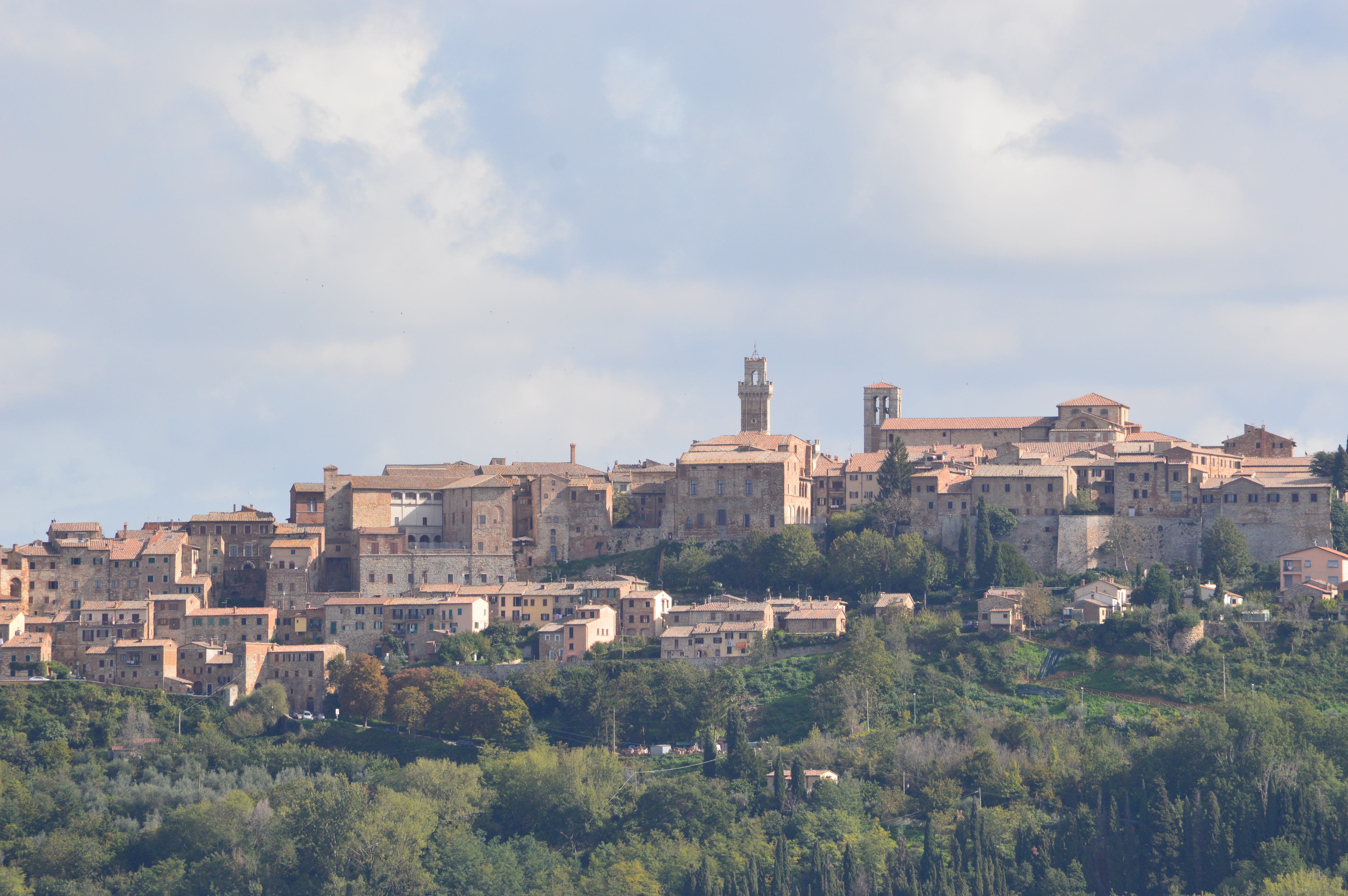
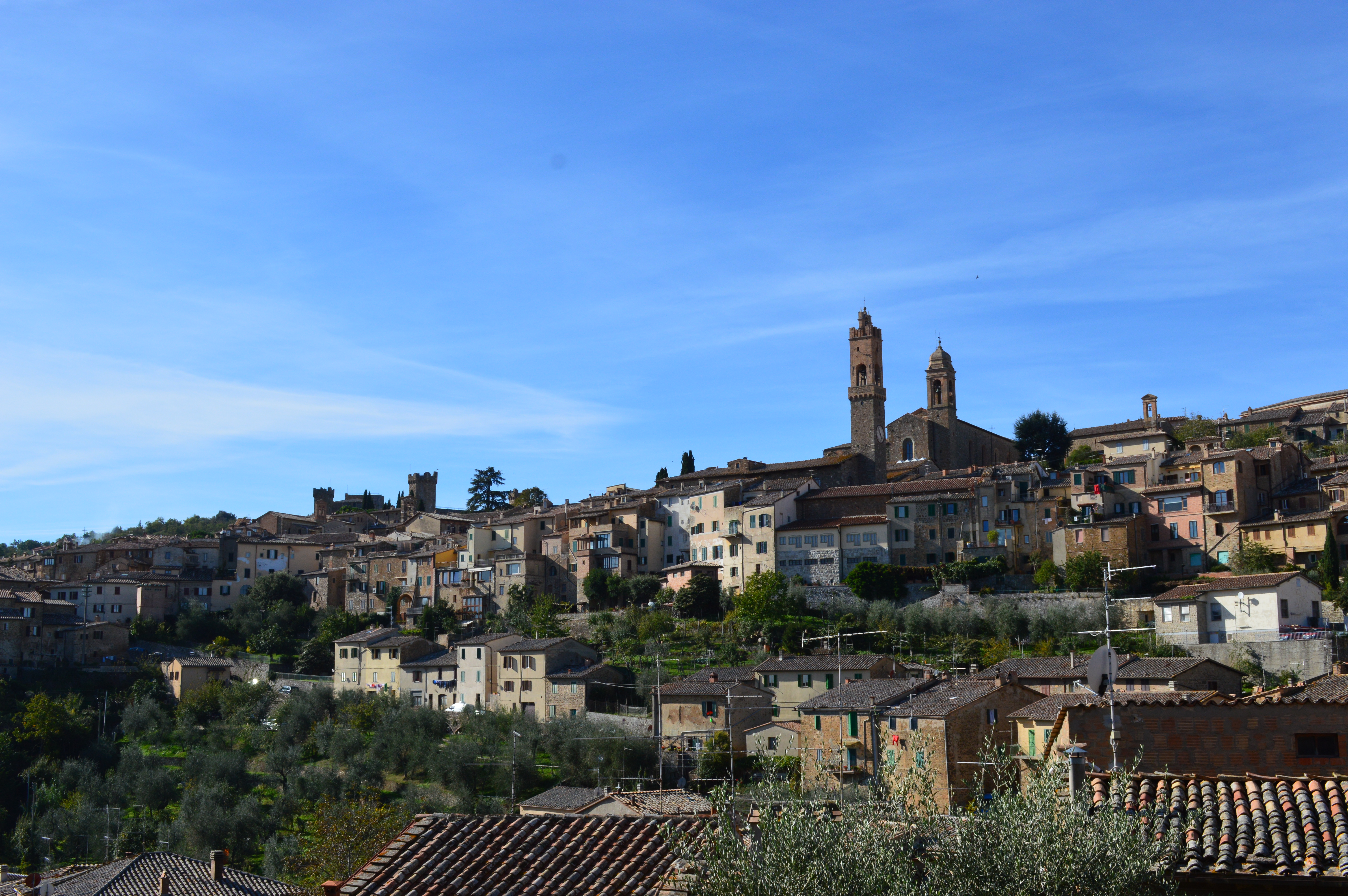
But these things pass. After two days in Rome, we spent two days based in Siena, a marvelous Medieval city, and ventured out by car to see the Tuscan countryside and taking in the beautiful ancient towns of San Gigminiano, Volterra, Montelcino, Pienza, and Moltepulciano. It was a great pleasure to drive the winding roads among vineyards and olive orchards. Seeing so much land devoted to wine gave me a new understanding and respect for the place of wine in this culture.

I’ve long had a fascination with medieval architecture. Walking along the narrow streets gives a window into a different kind of community. Somehow these people of several centuries ago organized themselves to produce a kind of hive that worked very well and endured. Their walls and battlements prove that fear and violence were part of their world, but their churches show that they had moments of peace and transcendence. By the way, the streets in these hill towns can be unbelievably steep. Montepulciano was especially challenging. Our work outs finally paid off; we were in good enough physical shape to walk them.

We also adored Siena. We we disconcerted at first that cars zoom down the narrow streets dodging pedestrians, rather than pedestrians dodging cars — the pedestrians seemed at high risk — but we got used to it. We developed a taste for gelatos. A high point was climbing the circular staircase of the spectacular cathedral to look out over the city at sunset.

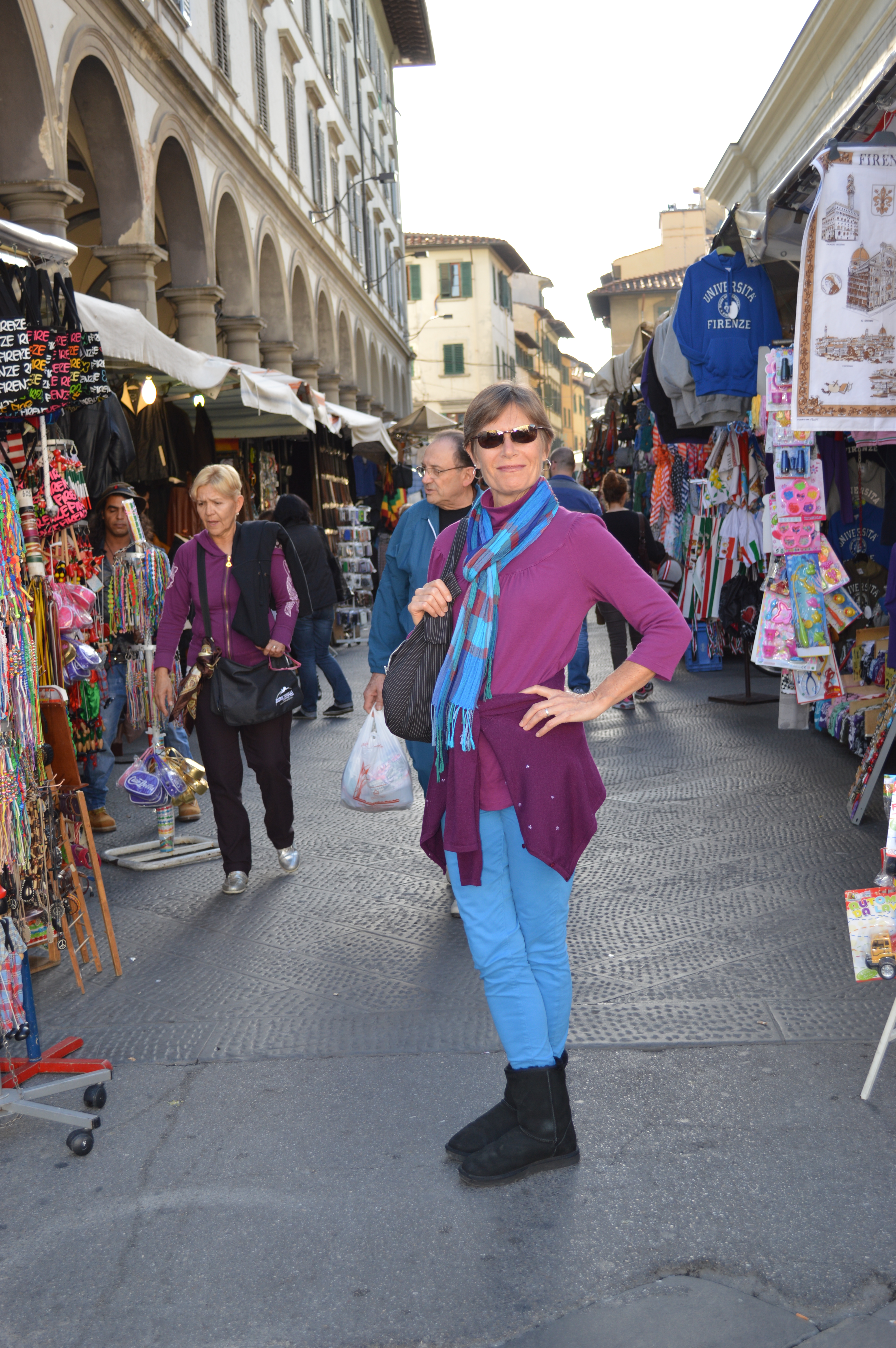
Arriving in Florence was another jump in the time machine, this time to the high Renaissance. It’s beautiful, and also easier to walk in. And the old part of the city thrummed with people. We did the famous churches and museums, including the Duomo, the Uffizi,the Accademia, Santa Croce, Santa Maria Novello, and San Marco. We crossed the Ponte Vecchio at sunset and sipped wine at an outdoor table at Piazza de Signoria. What a beautiful place! We agreed that Florence goes on the list of our favorite cities.