The Casual Blog

Tag: snow

Eureka! On Trump’s refusal to defend the Constitution

Sally’s orchid

I thought I’d had a eureka moment last week, when I glimpsed a rock solid case for impeaching Trump sitting in plain view.  Simply put, Trump has clearly violated his oath to “support, protect, and defend the Constitution” by refusing to recognize and defend against Russia’s attacks on our elections.  There may be other powerful reasons for ending this presidency that emerge out of Mueller’s and others’ investigations, but this one is here now.

But I haven’t seen a bandwagon, or even a small wagon, for this idea, and I started to wonder if I’d missed the boat.   So this week I did some research to make sure there wasn’t some little known legal doctrine or evidentiary issue that might require me to issue a correction and apology to Mr. Trump.  So far, I’ve seen nothing to apologize for, and discovered a bit more.

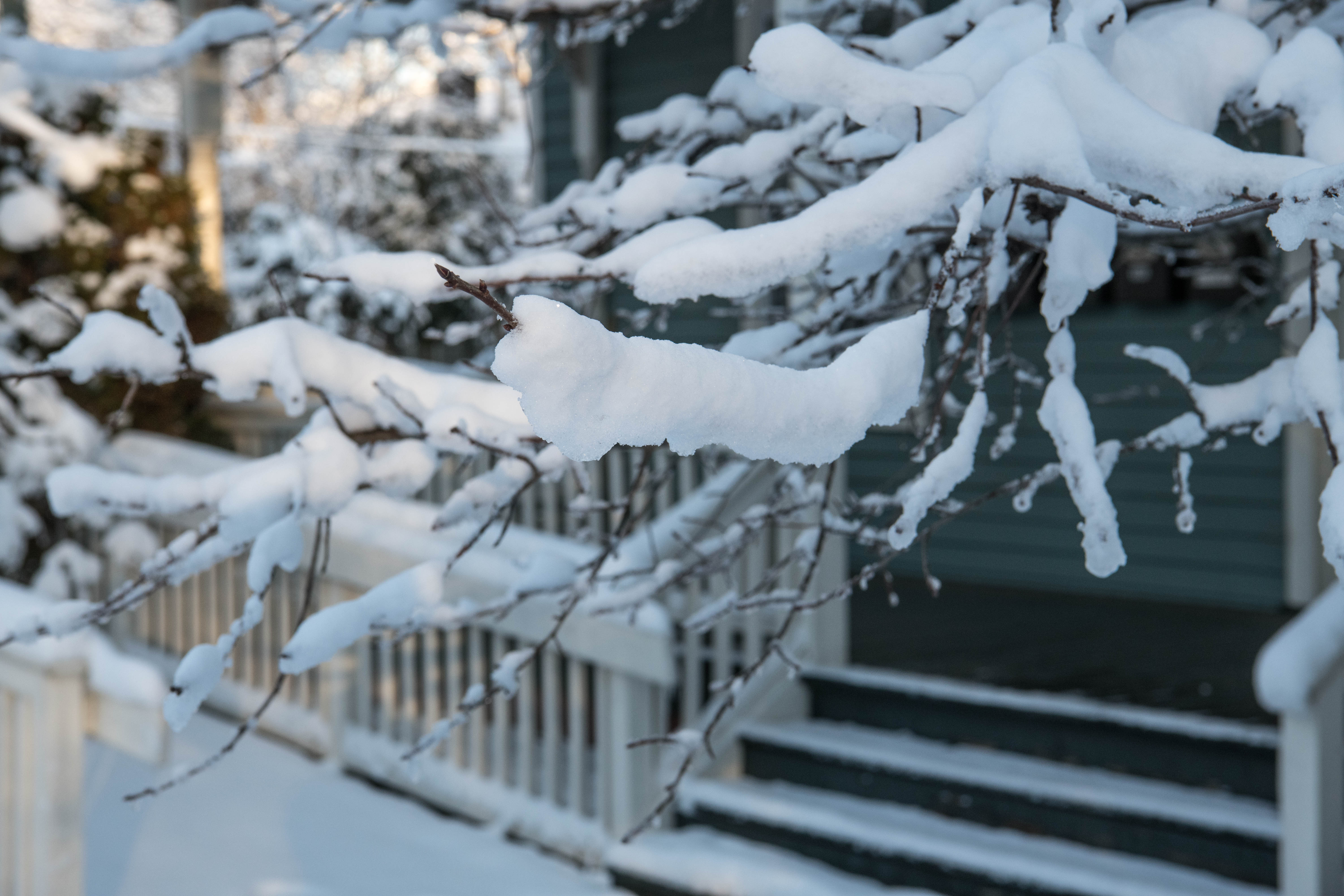
Is this this too much on Trump?  Perhaps.  I don’t want to worry you or myself  sick.  I find it therapeutic to regularly step outdoors and spend some time with the beauty of nature.  A walk in the woods helps, and so does a stroll around the block, which is what I did when we had this week in Raleigh.  Light, powdery snow, no good for snowballs, but pleasant to hike in, and it made the trees sparkle.  
While we were snowed in, I looked closely at Sally’s new orchid (which is part of nature, though also of art) and took some pictures.  I used a tripod with focusing rails to make several exposures, then figured out how to stitch them together in Photoshop.  It was more complicated than I expected, but I figured it out and liked the image above.

Anyhow, my legal research turned up no authority indicating that the presidential oath means anything other than what it says, which is that the President is constitutionally obliged to protect and defend the Constitution.  Free and fair elections are at the foundation of our constitutional system.  It’s beyond dispute that Russia interfered with our 2016 election, and we need to defend against likely future attacks.  
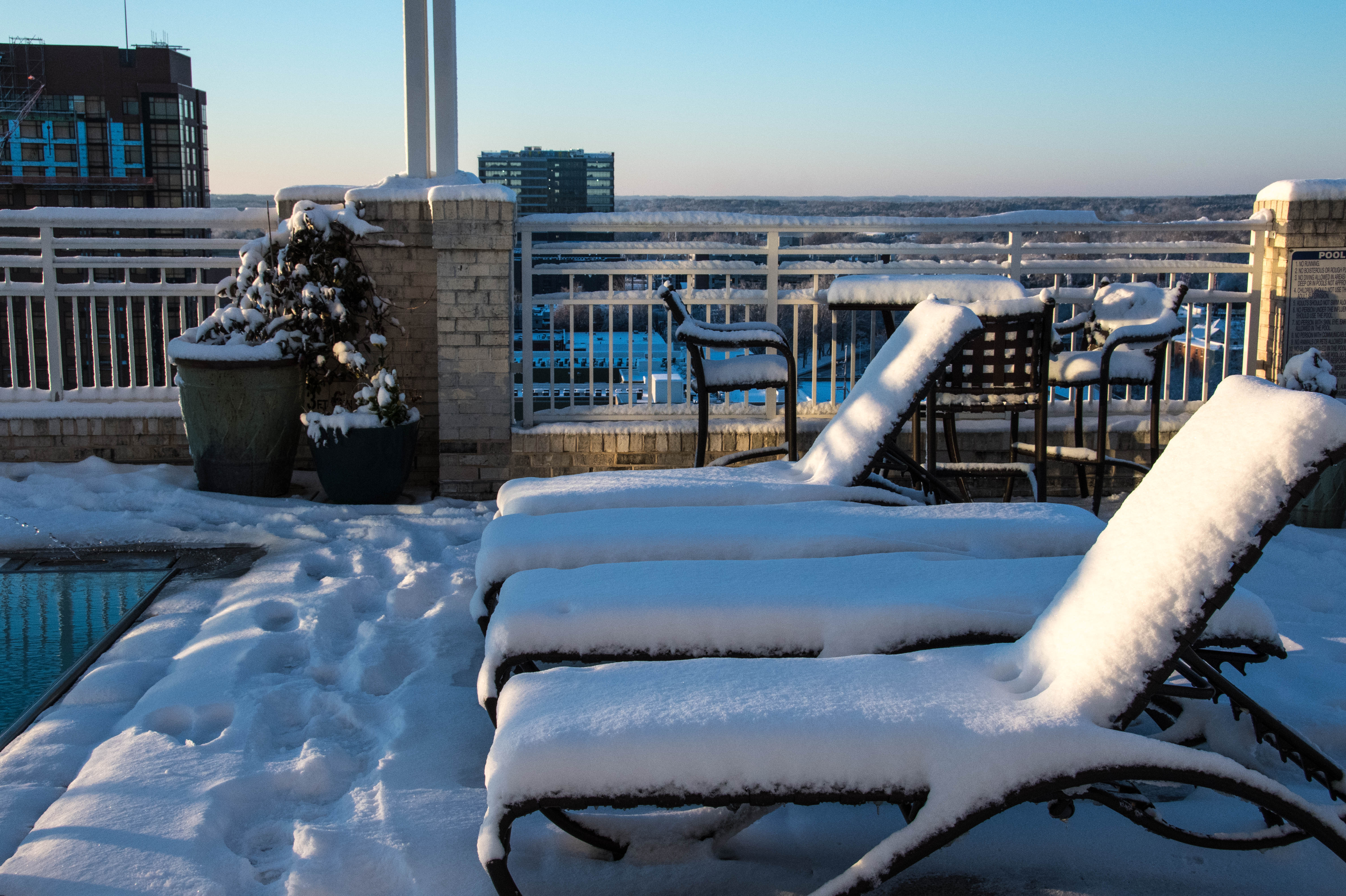
At sunrise by the roof top pool

This is not a Republican/Democrat issue.  In fact, a bipartisan group of Senators, including Republicans Rubio, McCain, and Graham, co-sponsored a bill last week to impose sanctions on Russia for its interference with our elections and military aggression.  In an op-ed piece in the Washington Post, Senators Rubio and Van Hollen put the issue squarely: 

While the 2016 election may have left our country divided on many issues, it exposed one critical problem that should unite all Americans:  Our democratic process is vulnerable to attacks by hostile foreign powers.  

As our intelligence community unanimously assessed, Russia used social media channels to influence and mislead voters.  It also hacked political campaign committees and local elections boards in a brazen attempt to undermine and subvert our elections.  There is no reason to think this meddling will be an isolated incident.  In fact, we expect the threat will grow in future years.  The United States must do everything possible to prevent these attacks in the future — and lay out the consequences well in advance of our next elections.  

The sanctions proposed by this new bill seem reasonable.  But the President is still declining to take action.  In fact, he has repeatedly attempted to divert attention from this serious problem.  Over and over, he’s called it “fake news,” a “hoax,” and a  “witch hunt.”  He’s praised Vladimir Putin as brilliant and a strong leader.  Using Stalin’s chilling phrase, he’s called the free press the enemy of the people.  

This is beyond not normal.  However innocent or not innocent his motives, he’s violated his constitutional oath.  We should not be tolerating this.  


Picturing light snow, and thinking about privacy and our digital selves

14 01 29_6909
It snowed in Raleigh this week, which was kind of exciting and kind of annoying. I love the transformative quality of snow – all that clean white soft quietness. But moving about in a normal human way becomes difficult. When I tried to drive rear-wheel-drive Clara to work, we got stuck as soon as I cleared the door of the apartment building garage. Unable to get up the modest slope, we managed to back down to a lucky parking space, and I walked the mile or so into work – in 18 degree cold. Burrr!
14 01 29_6916-1

On the way, I used my new camera, a Nikon D7100 with a Nikkor 10-24mm lens, to get a few images of my snowy neighborhood. I forgot to adjust the ISO, which I’d previously set at 800, but it didn’t seem to cause noise problems. I’ve been reading a book titled Mastering the Nikon D7100, which sounds very boring, but doesn’t seem so at all – which suggests I’m becoming a photo nerd. Oh well. There really is a lot to learn about this camera, but it can do so much! It sounds a little weird, but I’m feeling warmly towards it – almost like a new friend.
14 01 29_6919_edited-1

Speaking of digital devices and friends, there was a lively essay by Colin Koopman in the NY Times this week about why we’re struggling so to grasp the nature of the problem with the NSA’s increasing intrusiveness into our lives. Koopman proposes that we should start viewing ourselves more as data (“info persons”). It is, after all, the way we’re viewed by our internet service providers (Google, Bing, Facebook,LinkedIn, Twitter, Amazon, eBay, Opentable, Angry Birds, etc. etc.).

Koopman proposes a simple thought experiment: imagine what would happen if all our digital data, from social security numbers to credit card accounts, medical records, school records, bank records, insurance records, search queries, book preferences, food preferences, porn preferences, avatars, Instagrams, Tweats, and posts – suddenly disappeared. Try it.

When I did, my stomach did a quick shimmy and I felt a bit of vertigo.

His point, I think, is that we have trouble grasping the privacy issue posed by mass electronic surveillance, because we have trouble grasping how our digital technology has transformed us, changed what a human being is. Our digital selves are an increasingly integral part of the human fabric. Because we still don’t quite get how they relate to the pre-digital revolution part of our lives, we tend to not notice them or downplay their significance.

But advertisers and spys have realized that, from another point of view, the digital self is a high value target, enabling the intruder to predict with a high degree of accuracy what we will buy on Amazon and view of Netflix tonight and do with ourselves tomorrow. The new Age of Information is transforming commerce and law enforcement, but it we haven’t evolved political or legal tools to address it.

Our privacy is closely related to our dignity, and to community. We all have imperfections or oddities that we prefer to keep concealed. They may be physical flaws, financial limitations, unusual appetites, or unpopular ideas. Our ability to maintain self-respect and to live in cooperative groups depends on a tacit mutual agreement to respect boundaries for these differences, and to not insist that they be exposed.

We didn’t realize until recently that just by using the new normal tools of communication and commerce, we had opened the door on our private selves. Once we know that our health problems, financial problems, sexual proclivities, and other traits are within view of strangers, we feel diminished and alienated. This is why, even leaving aside the risk of tyranny, data privacy matters.

Speaking of technology and transformation, on Friday we had a nice dinner at Capital Club 16 (an eclectic and vegetarian-friendly place) and went over to Mission Valley to see Her, starring Joaquin Phoenix, the voice of Scarlett Johansson, and the wonderful Amy Adams. It’s about a new sort of digital assistant app that is so human that humans fall in love with it – and it with them.

The premise didn’t seem farfetched to me. I thought it was touching and unsettling, though kind of slow toward the end. The next day I was still thinking about the themes: how prone to loneliness we are, how desperate to connect, how ecstatic in love, how despondent in loss, how changeable, and also how resilient.
14 01 29_6925_edited-1

Travel, randomness, and good fortune

Last week I spent a couple of days in San Jose and Palo Alto at meetings of the Linux Foundation counsel group.  I did three presentations myself and heard talks on virtualization, open source license enforcement, trademarks and open source, patent troll lawsuits, and other topics of professional interest.  I had a chance to socialize with some very bright and knowledgeable open source legal people and catch up on industry news and gossip.  The days were lively, but long, starting with a working breakfast and ending with a working dinner, and I was ready to head home on Thursday.

The flight from San Jose took me to Dallas.  As chance would have it, Dallas experienced its heaviest snowfall in history that day.  Across the eastern U.S., tens of thousands of flights were cancelled in what was described as the worst travel day since 9/11.  My flight into DFW landed on time, but sat on the runway for almost an hour.  By the time I made it to the gate for the connecting flight, which was due to leave at 3, it was 3 sharp, and too late.  The next flight was in 5 hours.  I claimed a spot at stall with a bar stool and free electricity, plugged in my laptop, and got some work done.

Eventually I came to a stopping place, gave up my precious electrical connection, and looked about for coffee and something to eat.  For some reason, people were more than usually chatty.  I normally keep chats with strangers during air travel to a minimum, primarily because I’m trying to get other things done. Also, with a tendency toward the introvert side of the personality scale, I tend to see the cost-benefit analysis of a one-time talk as more on the cost side.  But in the various lines and pauses on Thursday, I met a photographer from Dallas, a defense department weapons system specialist from Dayton, and a salesperson for highway building equipment from San Diego, all interesting and pleasant.

The snow continued to come down throughout the afternoon, and I kept expecting to hear that the Raleigh flight was cancelled.  Instead, AA loaded up in a timely manner, and closed the door.  My seatmate had the Wall Street Journal, and agreed to share it.  Things were looking good, and then they froze.  We eventually spent more than 4 hours on the runway waiting for de-icing, being de-iced, and taking off.  I finally got home about 4:15 am.  The total travel time was 17.5 hours.   Happy as I was to be home, it took me another couple of hours to get to sleep.  I was late for my 9 am interview with a prospective intern.

On the trip I finished The Drunkard’s Walk:  How Randomness Rules Our Lives, by Leonard Mlodinow.  It is an account for non-mathematicians of the history and meaning of the great ideas of probability and statistics.  Mlodinow explains that without an appreciation for probability and statistics, people have an overwhelming tendency to find patterns and meaning where there is none, and greatly overestimate the amount of control they have over their own fate.  This is almost certainly true, but it’s a bit depressing.  It’s therefore possible that people who understand it generally don’t care to talk about it.  One positive point Mlodinow makes late in the book:  success and happiness are more likely if we take more chances.  That is, you can’t win the coin toss if you don’t toss the coin.