The Casual Blog

Tag: Renee Fleming

Is it 1984, with the NSA as Big Brother, or will Watson come to the rescue? Plus notes on a birthday, an anniversary, a soccer game, and an opera documentary
13 06 09_1924_edited-1What to make of the federal government’s massive program for gathering telephone and social media data? My first reaction was fear and horror. Is 1984 finally here? Is the Fourth Amendment a quaint artifact of a bygone era? Of course, we don’t actually know very much about the program, which is still classified. Is it like Big Brother, or more like the airport security services of the TSA, which inconvenience millions and accomplishes little?

As for the TSA, no doubt it’s supposed to make us feel more secure about flying, but for me the predominant emotion is frustration, with additional notes of anger and humiliation when my property and person are touched by uniformed strangers. And we’re afraid that if we complain, we may get put on the do not fly list and subjected to even more frustration and humiliation. Dear NSA analyst, if you’re reading this, I swear I’m not going to cause any mayhem – please please don’t put me on the do not fly list.

I’m kidding, of course (no I’m not – I want to stay off that list). I seriously doubt humans look at more than an infinitesimal fraction of this data, which is sufficiently massive as to defy all hope of human comprehension. It may be that this is why the program continues to exist: it’s become so big and complicated that no one can understand it. The computer doing the heavy lifting has almost certainly surpassed its minders in the complex skills at the core of this program. So who can reasonably make a judgment as to whether it’s a useful or safe project. The computer?

I realize this sounds a bit science fictiony, but if it isn’t already true, it probably will be soon. Remember, IBM’s Watson didn’t just win at Jeopardy, he or it trounced the strongest human players to ever have played the game. The Times reported this morning that the NSA and CIA have been testing Watson for intelligence purposes the last couple of years. He’s already way better at quickly analyzing massive amounts of data than any human ever will be, and he’s likely getting smarter and smarter.

In some ways this is comforting. I greatly doubt that Watson or his peers in artificial intelligence mean us any harm. Good AI is, at least so far, not complicated by the emotions that drive human behavior, including those that make us behave badly. Watson is not greedy, or prejudiced, or power mad. Once he gets this security thing well in hand, maybe he can take on more governmental responsibility. Could this be the way out of partisan gridlock? Watson for president?

Speaking of technological transformations, I recommend an essay in today’s NY Times by Jaron Lanier called Fixing the Digital Economy. Lanier is wrestling with an issue I’ve also written about: what happens to the economy (i.e. us) as human labor is increasingly replaced by robots and AI? He suggests that the source of both increasing decentralization of power and increasing disparities in wealth is computing power, and that the most powerful players are the ones with the most server power. I think he’s wrong to emphasize giant computers as primary sources of wealth, but he’s thrown out some provocative ideas. Here’s one: let’s revamp the economy so that those who take your digital data pay you for it. We could set up market in which Google, Facebook, the NSA and other data miners send out quarterly checks to all of us who provide the data.

Speaking of data and devices, Sally had a birthday this week, and I got her an iPad mini. She was thrilled! I got it at the Apple store at the Crabtree Valley Mall, which as usual was packed, and where I had a completely satisfactory buying experience. My salesman was knowledgeable and funny in a dry way. There are things to dislike about Apple as an organization, but they are really good at customer service. And their devices are designed with emphasis on a pleasant, intuitive human-machine interface, so non-specialists can enjoy them.

We also had our 31st anniversary this week, and celebrated with a fancy dinner at St. Jacques. The restaurant sits in a common strip mall, but inside it manages to convey the joie de vivre of fine French cuisine. I love that they have a special vegetarian menu. It took a little too long to get a visit from the sommelier, but eventually he gave us his full attention. A true and expressive Frenchman, he dissuaded us from getting the chardonnay that we additionally asked about, and with a dramatic explanation of the food flavors and wine flavors at issue persuaded us to try a sauvignon blanc. It worked beautifully. We savored every bite and sip.

13 06 08_1940

On Saturday night we went out to Cary to see a soccer game – the Carolina Railhawks played the Tampa Bay Rowdies. It was a clear, mild evening. We took along a couple of veggie subs at Jersey Mike’s, because last year we’d learned there wasn’t much in the way of healthful nourishment at the soccer stadium. But we were pleased to see they had improved their beer selection since last year. The field looked green and immaculate. We had good seats near centerfield on row G, and had a pleasant picnic there.
13 06 08_1967

The teams came into the game tied for the lead in the league and seemed well matched. I thought the Railhawks seemed sharper and less thuggish than last year. There were moments of skill and excitement, but no scoring until the 87th minute, when Tampa Bay took advantage of a defensive let down to put in a goal. When time expired there was an additional four minutes. During that time, the Railhawks proceeded to score, and then score again. We won!

13 06 08_1953

One of the Railhawks, Brian Ackley, is an old friend of Jocelyn’s going all the way back to middle school. We’d texted Jocelyn that we were going to the game, who’d texted Brian, and so he was prepared when we hailed him after the game and had a word. He’d played the last part of the game and had almost scored on a header. He’s a fine athlete and warm human being, and it was nice to see him.

Brian victorious (the Railhawk on the right)

Brian victorious (the Railhawk on the right)

When we got home, we watched a fine short documentary on HBO On Demand about Renee Fleming doing a master class for four aspiring young opera singers. The basic format, as with all master classes, is for a student to perform in front of other students and the master, and then receive criticism from the master. Here the students were all thrilled to have the opportunity to sing for Fleming, who is unquestionably one of our greatest singers. She was warm, generous, and a great listener. She gave some very specific advice on producing good vocal sounds, and spoke frankly about things like pre-concert nervousness. She gives a window into how difficult it is to be a great singer, but at the same time how wonderful.
Cultural diversity: yoga, Gambia, Lucretius, hockey, and Wagner

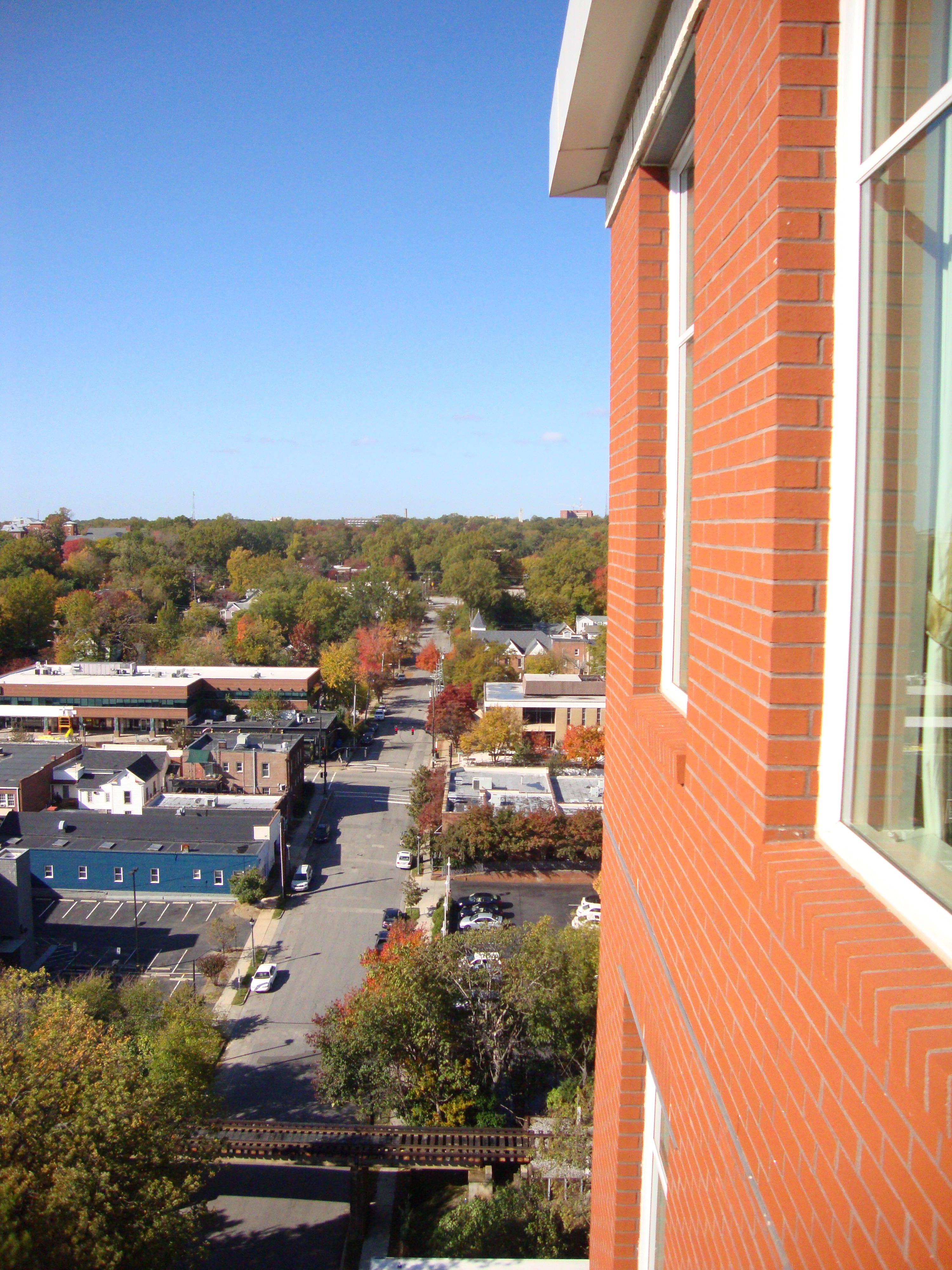
Looking west from the balcony

Daylight savings time ended this morning, and so we gained back the hour we lost in the spring. It’s strange that hours can be moved from one season to another. Anyhow, the leaves are changing, with yellows, oranges, and reds, and the temperatures are cooler. It’s fall.

Tuesday is my usual day for the Early Bird Yoga class at Blue Lotus with Suzanne. I normally get up at 5:30, do half an hour of interval work on the elliptical machine in my building, change out of my sweaty tee shirt into a fresh one, grab my yoga mat, and get to the 6:30 class in good time. Some yoga breathing, lowering, lifting, balancing and stretching is a good way to start the day.

Suzanne’s instructions are direct and clear, and her strength and grace are beautiful and inspiring. Each class is different, and lately she’s been taking us noticeably beyond our comfort zone. She seemed really pleased last week when she got us all up in tripod headstands. This week she had us all try side crow. This did not work at all for anyone (except her). Lately I’ve been working on front crow, and making progress, so perhaps we’ll do side crow one day.

Early Wednesday morning (5:40) I got in a cab to go to the airport. The cab driver was winded, and said he’d been doing jumping jacks to stay awake while waiting for me. It was better, he said, not to drink too much coffee. I agreed. He asked me where I was going, and I told him the bare fact (Boston), thinking I’d rather not get involved in a chat. There’s effort involved, and no guaranteed reward. But after a couple of minutes of silence, I relented. I figured I would try to be a decent chap and throw a lifeline to a lonely soul, so I asked him where he was from. Answer: Gambia, a tiny country in west Africa which I knew almost nothing about, and which he dearly loved.

He was a lively guy, and much more interesting than NPR. He described the government in terms that sounded benign though authoritarian, and improvements in roads, schools, and hospitals. He said that most people were at least part-time farmers and described how they stored crops in their own warehouses. When I asked him about his languages, he said he spoke seven, including three from Gambia and French, Spanish, and German. His English was accented but just fine.

The weather was clear and mild in northern Massachusetts, but there was still snow on the ground from an early season storm that had left many thousands without power. I did a bunch of meetings in Westford and then went down to Cambridge for more. On the flight back I read How to Read Montaigne by Terence Cave. Montaigne (1533-1592) is a startlingly original, modern thinker.

I was inspired to start exploring Montaigne by a few comments in an excellent book I finished a couple of weeks back: The Swerve: How the World Became Modern, by Stephen Greenblatt. The Swerve recounts the discovery in a monastery in 1417 of a copy of an ancient Roman manuscript, and explains how that discovery changed history. The discoverer, Poggio Bracciolini, was a former apostolic secretary for a deposed Pope with a classical education and passion for finding and saving ancient books. The book that was almost lost, On the Nature of Things, was written by Lucretius about 50 BCE. It’s an epic poem that describes the philosophy of Epicureanism. Greenblatt covers a lot of ground, from the philosophers of Greece and Rome, the creation of libraries, the fanaticism of early Christianity, the preservation of books in medieval monasteries, the intrigues of the popes, religious wars, the intellectuals of the Renaissance (including Montaigne), and onward.

In addition to a lot of lively history, there’s a pithy account of the ideas of Epicurus (b. 342 BCE), including the notion that the entire universe is constructed of tiny indivisible building blocks called atoms. This carried with it a view of the world as a natural phenomenon, not something magical created and controlled by gods. Epicurus espoused freedom from superstition and the pursuit of pleasure.

By pleasure he meant not pursuit of wealth or debauchery, but something more nuanced that included a sense of wonder at the beauty of the natural world.. According to Philodemus, a follower of Epicurus, “It is impossible to live pleasurably … without living prudently and honourably and justly, and also without living courageously and temperately and magnanimously, and without making friends, and without being philanthropic.” The Epicureans celebrated friendship, emphasized charity and forgiveness, and were suspicious of worldly ambition.

According to Greenblatt, Epicureans, including Lucretius, believed that the gods existed, but that they couldn’t possibly be concerned with human beings. Along with atoms, Lucretius’s ideas encompassed the notion that living beings have evolved through a long process of trial and error, that the world exists for reasons that have nothing to do with humans, that humans are not unique but rather linked to all other life forms and to inorganic matter, there is no afterlife, that religions are superstitious delusions based on longings, fears, and ignorance, and that by fashioning gods humans became enslaved to their own dreams. Happiness could be attained through discarding delusions through reasons, looking squarely at the true nature of things, and discovering a sense of wonder.

These ideas were, of course, not congenial to early Christians, who almost succeeded in stamping them out. But somehow a copy survived, which Poggio discovered and copied, and which is recopied many times, and ultimately influenced thinkers in subsequent generations up to our own. Greenblatt’s book is a true pleasure.

We saw some professional hockey on Friday night: the Caroline Hurricanes vs. the Washington Capitols. I’d learned from my new assistant about a free bus that runs between downtown and the hockey games, and it turned out that it made a stop right at our building. The bus arrived on time, with many cheerful fans dressed in Hurricanes red and white. We had a good view from box seats.

The Hurricanes started strong but collapsed in the third period and got trounced. As long as the game was close, it was fun. As with soccer, the more hockey I watch, the more I see and appreciate the incredible athleticism. The drama is simple, but effective: there’s a surge of great joy at every goal our team makes, and stab of pain at a goal of the opponents. The bus trip back home seemed slower and much less cheerful.

On Saturday we saw quite a different sort of drama, Siegfried, the third opera of Wager’s Ring cycle, broadcast live from the Metropolitan Opera to all over the world, including the North Hills Cinema. I know the music well from CDs, and love it, but had some qualms about the amount of sitting required: five and a half hours. Wagner is musically dense, and that’s a lot of Wagner. It was, it turned out, for us, incredibly powerful.

The story is about courage. Siegfried is a callow young hero who forges a magic sword and uses it to slay a dragon and an evil dwarf, then travels though a ring of fire to save and win a beautiful maiden. In pre-broadcast comments, Renee Fleming (a great soprano who would know) described Siegfried as the most difficult tenor role in the world. Our Siegfried was Jay Hunter Morris, a relative unknown who subbed in at the last moment and had a total of three performances under his belt when he performed before a worldwide audience of many thousands yesterday. This took true courage. Morris gave a performance for the ages, vocally powerful but nuanced throughout. The entire cast was superb, and the technical effects (especially the ring of fire) were impressive. Fabio Luisi conducted brilliantly. The famous horn solo, the exciting few bars that horn players test and polish their whole lives, was perfect.

This Siegfried, the opera, moved me deeply (tears). Driving home afterwards, I felt wrung out but exhilarated. Sally also loved it, and announced that she was now a Wagnerian. I found this very cheering.