The Casual Blog

Tag: Nasher Museum

Precancerousness, Eno hiking, Dolci paintings, some Debussy and Liszt, and support for a plant-based diet

The Eno River, by the Eno Trace trail

This week I got a one page report that said the polyp removed during my recent colonoscopy was precancerous.  I’m not exactly sure what that means.  It sounds better than cancerous, but definitely not as good as non-cancerous.  Do they really know when something will become cancerous, or is it more like, we aren’t exactly sure, and don’t want to say there’s nothing to worry about?  The net seemed to be, it’s good they removed it, because it might not have been harmless.  In any case, it’s gone.  But instead of the usual ten-year interval for the next colonoscopy, they want me to come back in five.  So I’m twice as valuable as the usual  patient.   

On Saturday morning I drove over to Eno River State Park and hiked in the Fews Ford area.  There was frost on the grass, and some ice on the river, but it was sunny and calm.  A flock of robins was hunting for breakfast.  I stepped carefully on the rocks and didn’t get wet or twist an ankle, and got these pictures.  

Afterwards I stopped in Durham at the Nasher Museum to see the Carlo Dolci exhibit.  Dolci was a favored court painter for the Medicis in Florence in the 1600s.  Apparently he fell out of favor among art critics in the 19th century, and this is the first major exhibit of his work.  Dolci apparently was a pious Catholic, and in his work mostly focused on the popular religious subjects of the time, usually with close attention to two or three figures.  He had a great color sense, and fanatical attention to detail. And amazing commitment and endurance:  some of these paintings took several years to paint.    
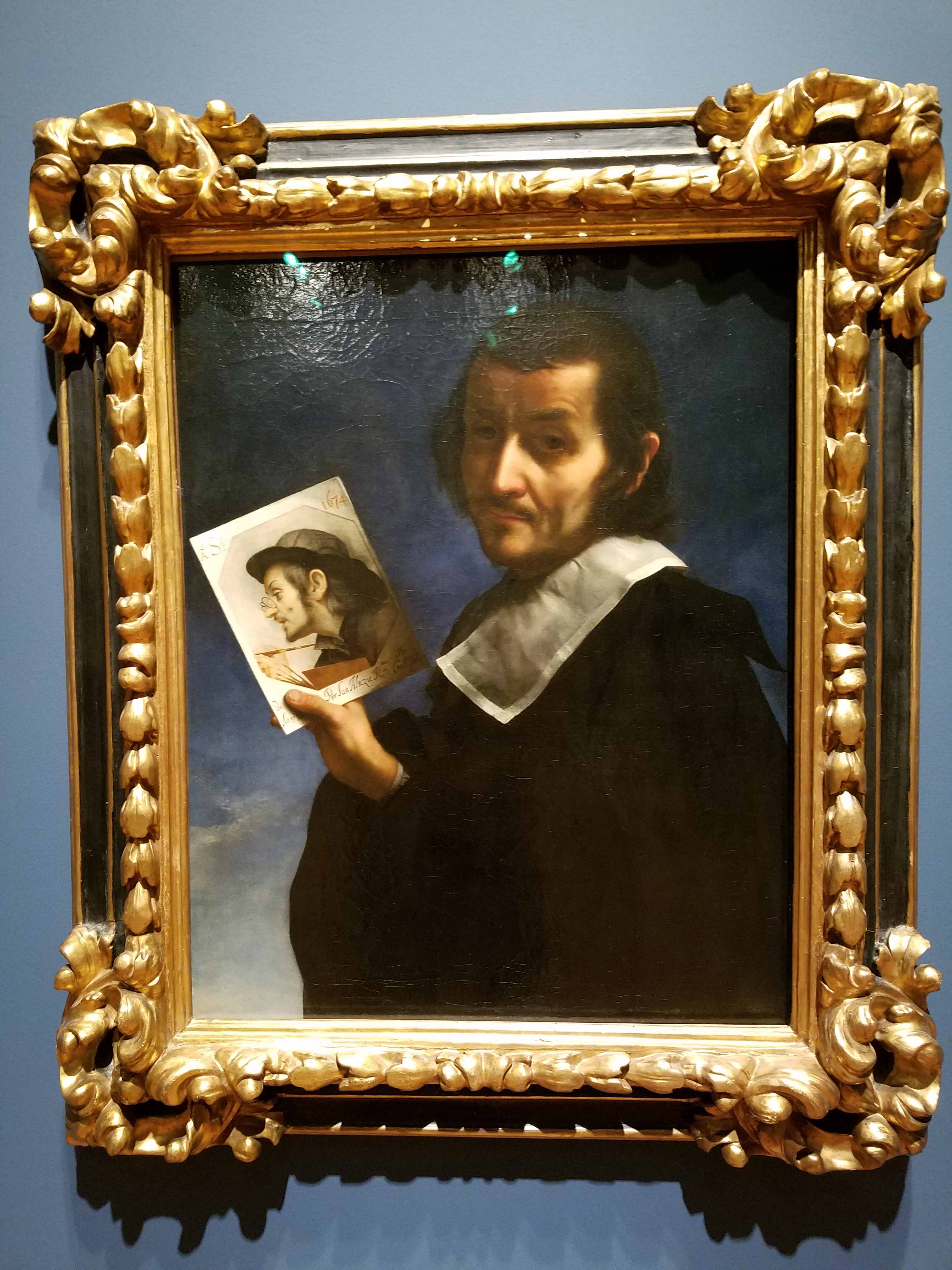
Self portrait of Carlo Dolci

The Nasher also had a fascinating exhibit of the large bird’s eye view of Venice made in 1500 by Jacopo de’ Barbari.  The general accuracy of the aerial view has been confirmed by satellite imagery, so we know this work as a stunning feat of imagination and technical wizardry.  The Nasher did a state-of-the-art presentation using several large touch screens that allowed further exploration and play.  
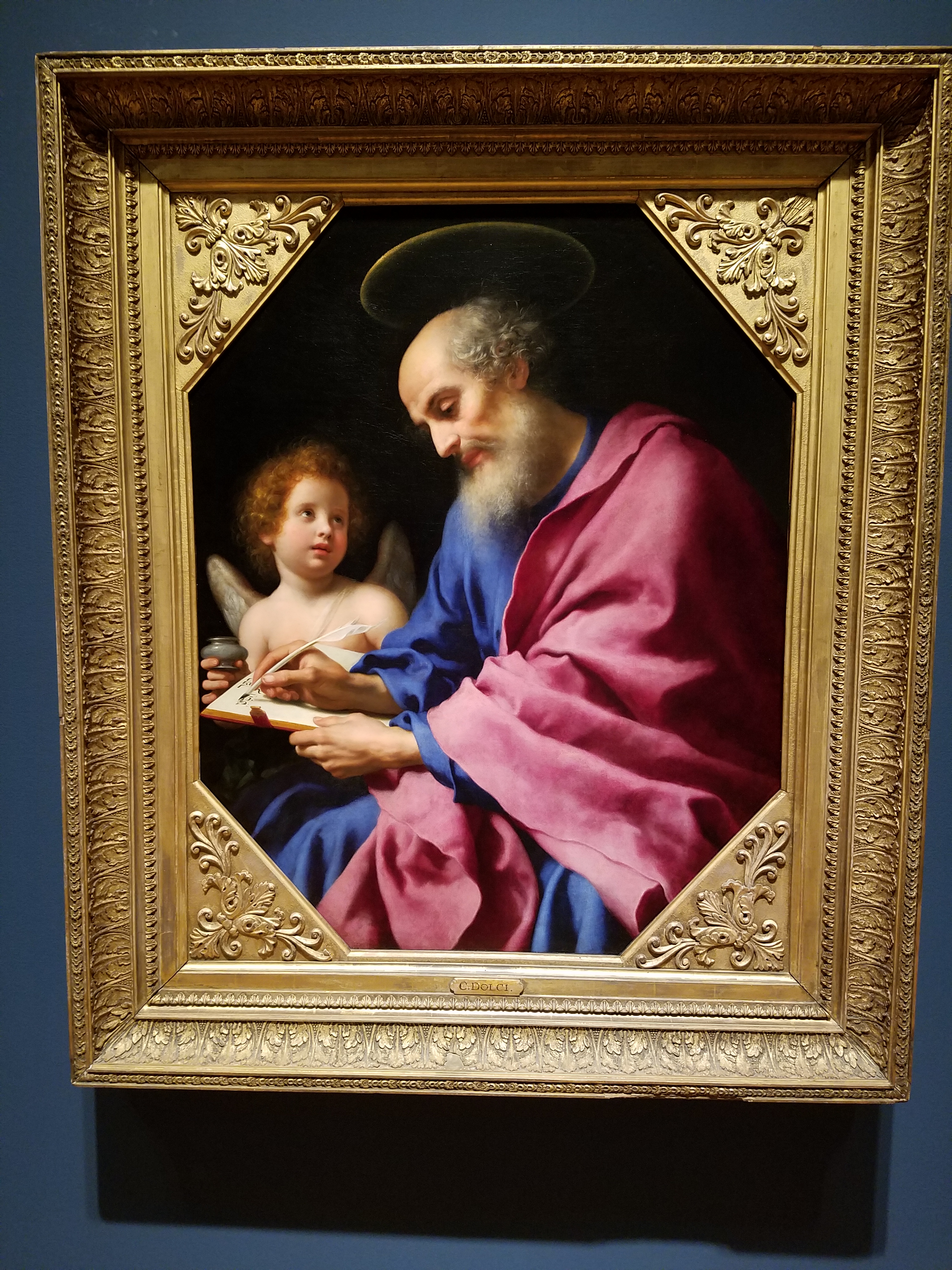
Dolci’s St. Matthew Writing His Gospel (1640s)

That afternoon I had a piano lesson with Olga.  At her suggestion, I’ve been working on Debussy’s L’Isle Joyeuse, and contrary to her suggestion, I’ve continued working on Liszt’s Benediction de Dieu dans la Solitude.  The Debussy work is about atmospheres, and has some unusual technical challenges, but I can already see that with practice it can be played.  The Liszt piece is a labor of love — lots of labor that could only be justified by love.  The harmonies are deliciously rich and full of surprises, but it requires a big investment of practice time.   

It being the holiday season, we’ve been eating more with friends recently, and the subject of why we’re eating a plant-based diet comes up regularly.  It’s always a bit awkward to discuss this at meal time, since the background facts are likely to produce a less cheery vibe for the animal eaters in the group.

But I continue to think a lot about the relation between our food, our ethics, and our health, and I’m always glad to find others willing to discuss those issues.  There seems to be growing awareness of the extreme cruelty of industrial animal farming, of the enormous environmental damage this system causes, and of the damage that eating animals and animal products does to human bodies.  We recently saw two documentaries on these issues on Netflix, and found them well worth watching.  Live and Let Live is a pithy overview of the ethical and health issues involved in eating animals.    What the Health focuses on the health benefits of a plant-based diet, and the seemingly willful silence of mainstream health organizations regarding the health problems associated with animal products.  

A new floor disaster, a glorious chorus, the latest flowers, and provocative art by Abney

Duke Gardens on Saturday morning

Last week we had a minor household disaster.  Sometime in the middle of the night, the dishwasher overflowed and got the hardwood floor well soaked.  Within a few hours, the floor was badly warped, and it began to sink in that we were going to need an entire new floor.  We’d just gotten new hardwoods 10 months ago, which involved lots of packing and hotel life.  We aren’t looking forward to more of the same, though there’s one improvement:  it looks like the homeowners’ insurance will pay this time.  

On Friday we had a delicious Korean meal at Kimbap, then went to a concert by the N.C. Master Chorale.  The theme was war and peace, always a timely subject, and drew on music by Josquin (c. 1450), through Bach, Mendelssohn, and several living composers.  Some of the lyrics were poignant, and the musicianship was at a high level.  This is an excellent chorus!  Congratulations and many thanks to music director Al Sturgis.

On Saturday morning it had just stopped raining when I went over to Durham to see what was blooming at the Sarah P. Duke Gardens.  I hadn’t realized it was graduation time until I saw a lot of families with their new grads in caps and gowns posing for pictures.  The flowers were completely different from my last visit, and I was a little sorry my early spring favorites were all gone.  Still, there were some beautiful things growing, and lots of birds singing.

On the way back, I stopped at the nearby Nasher Museum of Art , and checked out Royal Flush, a show by Nina Chanel Abney.  Abney is a young African-American artist, and she’s clearly interested in matters of race, but also in lots of other things, including mass media, gender, celebrity, state-sanctioned violence, and inequality.  She has a bright palette, and a broad visual vocabulary that includes abstraction and figuration.  In some of her work there is a lot of humor, but some is biting and dark.  It’s worth seeing.

At least it was for me.  What you get from an art exhibit depends a lot on what you bring to it.  If you invest some time in looking at art, you start to see more.    

There was a report this week of an art prank in which students put a store-bought pineapple in an exhibition, which a janitor then covered by a glass case and became the subject of art criticism.  This reminded me of Marcel Duchamp’s famous work of 1917, Fountain, an ordinary urinal submitted for exhibit as a work of art.

Fountain was the subject of a show I saw last week in New York at the Francis M. Naumann gallery that presented 31 artists paying it homage.  I’d formerly thought of Fountain as a clever and outrageous stunt, which it certainly was.  But it was clearly more, or we wouldn’t still be thinking about it 100 years later.

Duchamp may have been getting at this:  art is not fundamentally about objects, but how we think about objects.  That is, the distinguishing characteristic that causes something to be a work of art is that we think of it as such.

While looking at art can change us in various ways and make us look at the world differently, we as viewers also are continually bringing art into existence, and changing its boundaries.  The more we are open to new experiences, curious, and brave, the more art can be generated.  At the same time, we keep growing.

In the news: some problems with our nukes

This week there was some good and some bad technology news, but first the good news. Kudos to the European Space Agency, which managed the remarkable feat of landing a robot on a modest-sized comet. Understanding and managing the risk of asteroid and comet collisions is a big challenge, and it appears we’re making progress. Also three cheers that the world’s two largest contributors to global warming (that’s us and China) officially agreed to work on it. Sure, talk is cheap, but it’s a step in the right direction.

But I wanted to call attention to a news story that you may have missed, as I almost did: two separate Pentagon studies concluded that the infrastructure of our nuclear program is in serious disrepair and will cost billions to fix. The NY Times put this on page A16 (news death valley).

Though far from the front page, the language was strong: “a searing indictment” of how nuclear weapons facilities have been allowed to decay. They described “a culture of micromanagement and attention to the smallest detail . . . creating busywork, while huge problems with equipment and readiness, most arising from the age of the systems, were ignored.” One study found that morale was low and turnover high among crews for intercontinental ballistic missiles and long-range bombers. Missile submarines were frequently out of service.

You may remember the cheating scandal involving missile crews of some months back. One of the new reports blamed not the crews but “a culture of extreme testing” in which tests were required to be near perfect so that good results could be reported up the chain of command, instead of a program to improve the crews’ readiness.

A few months back I wrote about reading Eric Schlosser’s excellent book, Command and Control, Nuclear Weapons, the Damascus Accident, and the Illusion of Safety. The book cites chapter and verse of major problems in our nuclear program, including some that put Americans at serious risk of a catastrophic accidental nuclear explosion. Schlosser found there had been important improvements in safety, but the Times story made me worry.

The Times also reported that the President had told the Pentagon to plan for 12 new missile submarines, up to 100 new bombers, and 400 land-based missiles. Holy kamoly! I thought we were at least keeping in sight the possibility of reducing our nuclear stockpiles and the threat of nuclear war.

Before we spend billions or trillions more, I’d like to hear a good answer to the question, what is the purpose of our nuclear weapons? What good do they do?

The conventional wisdom, more or less, is that we need them to deter nuclear attacks and maintain our prestige. But no nation is currently threatening us, or anyone, with a nuclear attack. Only one nation has ever been the victim of a nuclear attack (by us, on Japan). All other nations without nuclear weapons – that is, those with no deterrence forces – have not come under nuclear attack. That includes ones that got us and other nuclear powers really mad, like North Korea, Vietnam, Cuba, Venezuela, Iran, Iraq, Libya, and Syria.

Furthermore, even if North Korea or Iran somehow managed to destroy one of our cites with a nuke, does anyone seriously think we’d retaliate against their civilians with a massive nuclear attack? I submit that deterrence, whatever its validity as a theory in the cold war, is valid no longer.

As to prestige, our nuclear weapons have not appeared to strengthen our negotiating power with enemies or friends. Iran and North Korea have been notably unimpressed. And our nukes certainly haven’t saved us the trouble of fighting conventional wars. We have surely not won the contest of who can spend the least on actual war fighting, having spent over a trillion dollars fighting in Iraq and Afghanistan. The nation with the most nuclear weapons is also the nation that has lost the most treasure through conventional warfare.

A major nuclear war would not only destroy millions of lives directly, but would alter the earth’s ecosystem so as to cause untold additional deaths. As Jonathan Schell explained in The Fate of the Earth, it could amount to the end of human civilization, not to mention the extinction of countless other animals and plants.

It would be nice to think that mismanagement of our nuclear force has reduced this risk, but I’m afraid that it suggests an increased risk of nuclear accidents, and an uncertain capacity for disaster. I submit we need to change our direction, and recommend a visit to http://nuclearrisk.org

Let me close on a positive note: civilization still exists! In fact, right here in Raleigh, NC, there is great music making and art. Last Sunday, the N.C. Opera did an excellent concert presentation of part of Richard Wagner’s Tristan and Isolde. This is very dramatic, romantic music. They did the prelude and second act, which focuses on the intoxicating love story of the title characters. Jay Hunter Morris, who was a sensation in the Met’s recent Siegfried, was a sensitive and moving Tristan, and Heidi Melton was an Isolde for the ages. Her voice was amazingly powerful, but also warm, flexible, and true. Conductor Timothy Myers seemed to have a real feeling for this strange and irresistible music, and he had a good band. Thank you N.C. Opera!

I should also give a plug for the current exhibits at Duke’s Nasher Museum of Art, which we visited on Sunday afternoon. We started with the late works of Joan Miro. I liked his sculptures, better than his paintings. It was inspiring to see him continuing to experiment with new ideas into his 70s and 80s. There was also a strong exhibit of the work of Robert Rauschenberg. I never quite got Rauschenberg before, but it really helped seeing the wide range of techniques and concepts he worked with. It turns out he was serious about his photography, as well as his painting and constructions. I liked it.