The Casual Blog

Tag: death

Izzie the cat, questionable executions, and ballet love
Tiller7Bug 1-2
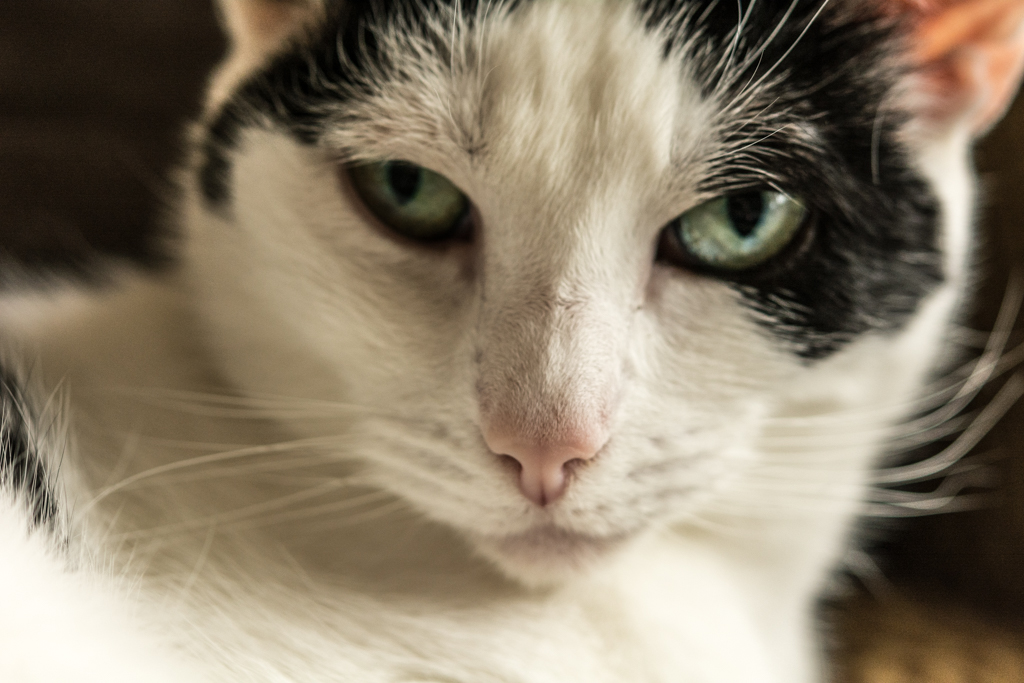
Izzie the cat took her last trip to the vet this week. After almost 14 years together, we were sad. Our pets enrich our lives and make us better, more loving humans, even the ones with mercurial moods like Izzie. One minute, she would be seeking affection, angelically purring, and hissing like a little demon the next. Of course, we probably seemed strange to her.

From time to time I tried to get her to do some modeling for me and my camera, but she never cared much for that. I cannot say that any of my photos quite got her essence. White with black splotches and wings, she was a strange, pretty thing. It will be a slightly different world without her.

Deciding to put down a beloved pet is a hard decision. We considered for a while the evidence of Izzie’s diminishing capacities and increasing behavioral problems, and balanced as best we could the pros and the cons. In the end, we decided it was a good time for her death. But there remains a little nagging discomfort, along with sadness. To actively take on the choice of life or death is unsettling, which it should be.
Tiller7Bug 1-3

This week U.S. fighter planes reportedly blew up several dozen people in a Libyan terrorist training camp. The target was a single Tunisian individual I’d never heard of, Noureddine Chouchane, based on his participation in terrorist attacks in Tunisia. I found this disturbing. Assuming Noureddine Chouchane was a thoroughly evil person who committed heinous acts (we couldn’t possibly get that wrong, could we?), should we be the judges and executioners for all terrorist acts, no matter how far removed from the U.S.? And even if we can justify that, how to justify taking the lives of dozens of other people who, so far as we know, committed no crimes? Do we really think it’s OK to kill all potential terrorists (who are, after all, also potential future non-terrorists)?

The Times had a story this week headlined (in the print edition) “Scars Left by American Bombs Resist Fading, 25 Years Later.” The particular scar in issue was damage from our bombing of civilians in 1991 at the beginning of the Persian Gulf War. We dropped an especially powerful bunker busting bomb on a shelter in a middle class Baghdad neighborhood and killed 408 people, most of whom were burned alive.

I can see how ordinary Iraqis could find this a moral outrage. Wouldn’t anyone? Yet I had never heard of the incident before, and after digging through 25 years of Times coverage on Iraq, couldn’t find an earlier story about it. It makes you wonder whether there are some other military atrocities that even faithful Times readers have not heard about.
Tiller7Bug 1-4

The Atlantic has a good piece by Peter Beinart titled “Why Attacking ISIS Won’t Make America Safer.” Beinart notes that most Americans favor attacking ISIS, but argues that history shows that our military actions in the Middle East have resulted in inceased, not decreased, terrorist attacks. He calls it “the terror trap”: the more terrorists we kill, the more terrorists there are trying to kill us. Beinart doesn’t say this, but I will: the military solution will not work.

On a lighter note: Saturday night we went to the new Carolina Ballet show, Love Speaks. It was delightful! The theme of romantic love never gets old, and it’s right in the sweet spot of this wonderfully talented company. Lynn Taylor-Corbett’s new work has a narrator providing some poetry of Shakespeare, and a sort of Elizabethan look, but also kind of jazzy, with quickly developing flirtations, fascinations, and jealousies. I really liked it. I also particularly enjoyed Jan Burkhard and Richard Krusch in the balcony scene of Weiss’s Romeo and Juliet. It was profoundly romantic.
Tiller7Bug 1-5

Liberation — death, sorrow, life

The Gulf of Mexico oil spill has been a big news story these last few weeks, but the news reports have given little coverage to the fact that millions of sea creatures that will die.  Our scuba experiences in the last couple of years have made us more conscious of the teeming life in the oceans, the unbelievable profusion, a cornucopia of bizarre, beautiful life.  The loss of life now taking place is impossible to fully grasp, and painful to consider.  I think it’s good, though, to try grasping it, and accept the pain of it.

We humans are generally deathophobes.  At the same time, it’s obvious that death is a fundamental part of life.  It’s in front, behind, and all around us, and avoiding it is really not possible.  We may as well have a little courage and honesty and figure out how to think about it.

I keep coming back to the line by Wallace Stevens in his poem Sunday Morning:  “Death is the mother of beauty.”  When I first read it, I thought he was just being provocative, but I now see he was struggling with something profound.  It isn’t that death itself is beautiful.  But it is an integral part of the natural cycle of change, which is a defining characteristic of life.  In Sunday Morning, Stevens asks, “Is there no change of death in paradise?  Does ripe fruit never fall?”  The Talking Heads got at the same idea with the funny line, “Heaven/ is a place/ where nothing/ ever happens.”  Such a paradise would be inhuman.  And very boring.

But coming to terms with this part of reality is not just a matter of working through the ideas.  It’s also accepting some unpleasant feelings, like grief and sorrow.  It seems natural to avoid such things, but it won’t work.  Those feelings are integral to the human experience; they’ll always be there.  We may as well face them with honesty and courage.  Opening ourselves to those feelings makes us more human.  It’s liberating.

Sally had a harsh and sad confrontation with one animal’s death this week.  She was monitoring her blue bird boxes at the Lochmere golf course for new for baby blue birds, which is usually a cheering thing.  She came upon  a young Canada goose that had had a horrible accident that destroyed its beak and left it bloody and mutilated.   It could still move, but was plainly suffering and unable to survive long.  The poor thing needed to be euthanized, but there was no practical way to capture it without making matters worse.  She had no confidence that the animal control service would be able to assist without increasing the animal’s fear and pain.  There was no solution, other than nature itself.

Sally began to cry as she told the story, and continued to wonder whether there was something else she could have done.  She is a tender-hearted soul, and I love her for it.  I was reminded of the time years ago when she arrived home in tears at having run over a little frog as she was parking her car.  I knew then, once again, that she was the girl for me.

Christmas gifts and losses

Shopping is not something I do for fun.  But with the hard deadline of Christmas looming, today I finally faced up to the inevitable:  I needed to focus on buying some presents.  It is hard to think that anyone in my present-buying orbit really needs any material thing that I might give, but tradition is powerful.  I braved the traffic, the lines, and the bewildering cornucopia of goods, and found some things at last.  Whew.

One thing I like about the fall and winter holidays is childhood memories.  How wonderful it was to look forward to a visit from Santa Claus!  What fun to see relatives and friends!   Ah, the sweets and smells of baking cookies!  It is hard, though, to think of those I loved who are gone.

As I slowly made my way through mall-oriented traffic, I heard an unusual radio story on NPR’s This American Life.   A man explained how his mother committed suicide at age 79 with the knowledge of her friends and family and with his support.  She was not depressed or terminally ill, though she was conscious of struggling with dementia.  She read Final Exit and composed a plan involving an overdose of sleeping pills and a plastic bag.  Then she practiced the technique repeatedly, with her son’s supervision.  The composing and carrying out of the plan took place over many years.

When she finally picked a day, she let those close to her know, and had final visits.  The last person she saw was her son.  She was concerned that he not be exposed to legal risk, and so he left her for some period while she carried out the plan.  He said that he was worried, when he returned, that she might have taken the pills but been unsuccessful.  She was, however, dead.  In recounting this, he was clearly moved and sorry she was gone, but he was neither critical nor admiring of her decision.  It was her decision, he said.  She lived life on her own terms.

The interviewer observed that it was highly unusual for people to be able to talk about death freely and deal with it with such directness.  The son noted that his mother spent time working on it, and it got easier.  They also discussed how unfortunate it was that our legal system makes it impossible for persons who choose the terms of their death to be with family at the end.

I found all this both unsettling and encouraging.  It would be good to be as comfortable with death as with other fundamental facts of human existence.  I’m certainly not there yet.  But it sounded like the mother, and to some extent the son, made it.