The Casual Blog

Ups and downs in Telluride

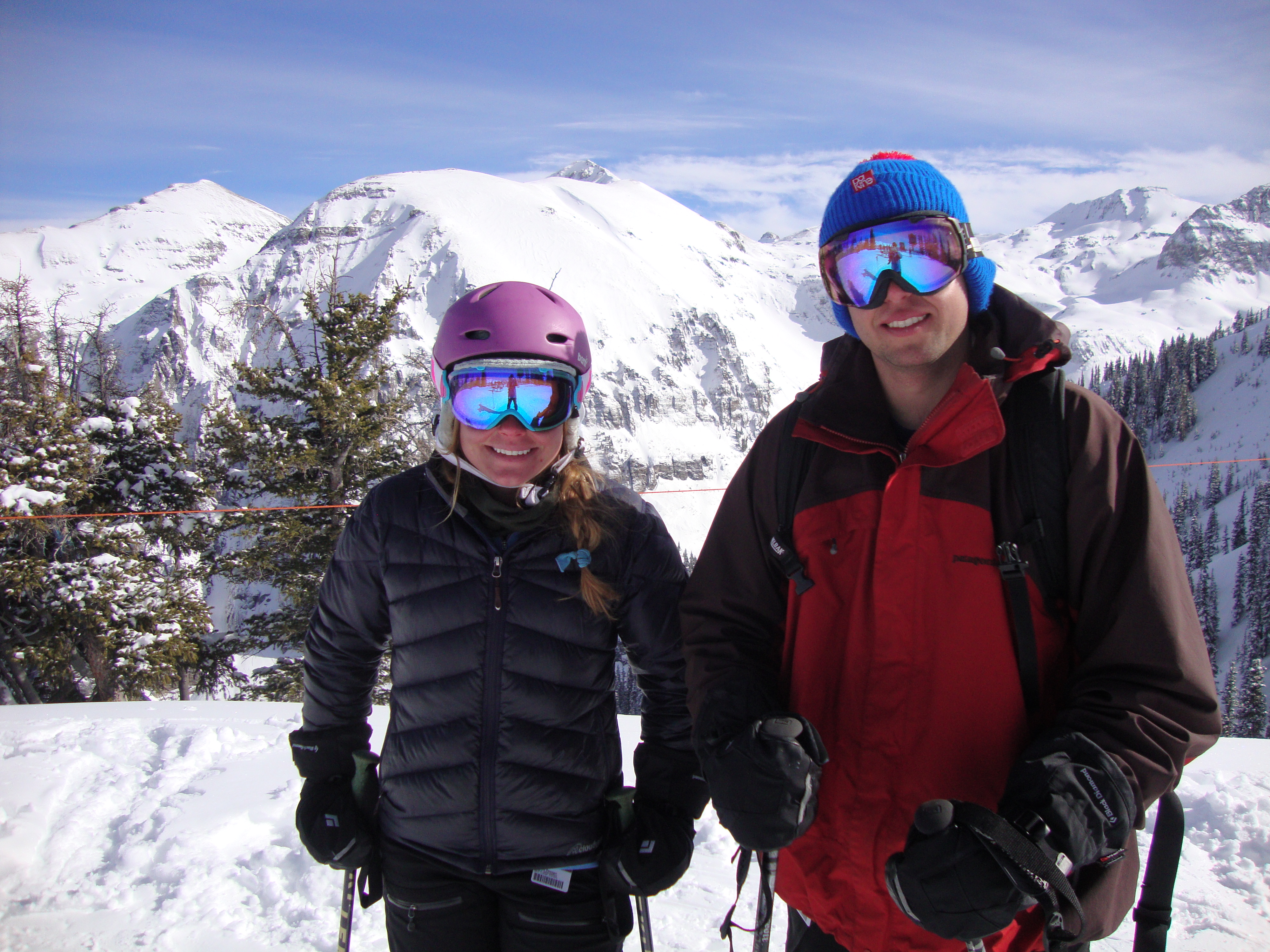
My life is full of technology and intense mental activity, and I’m glad of it, but from time to time I crave an interlude of pure natural beauty and physical activity. And so for a long President’s Day weekend, we skied Telluride, Colorado, where the San Juan mountains look something like the Alps — jagged and imposing, yet peaceful in a way.

Set a human body sliding down the snowy slopes, and interesting things happen. Exhilaration at the speed, microbursts of fear, quick happy recoveries, or minor disasters. I had my most dramatic fall on Bushwacker, reportedly the steepest groomed run in America, where I’d got off the groomed terrain and into the bumps. Tips crossed, I launched over the top of my skis, which came off the boots as designed, but rather than stopping I then found myself sliding fast downhill headfirst and accelerating. I eventually managed to flip over, spin around, and dig my boot heels into the snow to brake. By this time, one ski was 200 yards below me and one pole was 50 yards above (a classic yard sale). I am always happy to rely on the kindness of strangers, and gratefully accepted assistance of one who picked up my pole and another who helped me resituate on one ski. Then I lowered myself inelegantly down the slope to retrieve the other.

A couple of my colleagues at Red Hat have written about failing fast and often as a means to success, which in skiing translates as falling fast and often. It entails some moments of embarrassment. But by golly, I’ve really improved this year. I took on steep, deep powder runs, glades, and double black moguls, as well as carving on high-speed cruisers, all with great joy (and occasional terror).

We had fresh snow falling our first day and night, and a classic powder day the second day. I insisted that our group (Sally, Charles, Chuck, and later David and Kimberlie) move out early to try for first tracks. We found lots of beautiful light snow and varied terrain. Those first two days I stayed well within my comfort zone and had great fun. Each night we ate in good restaurants, (Excelsior, Rustico, Honga’s, and Siam), and one night had delicious pizza served by my sweet Jocelyn at the Brown Dog. The group included old familiar friends and lively new ones, and there was good conversation and laughter.

On day three the skies had cleared, and Gabe and Lindsey, who live in Telluride, had days off and came out to play. They knew the mountains well, and managed to locate pockets of non-skied-out powder. For the first time I felt reasonably comfortable on steep gladed runs. I was inspired by their beautiful skiing, and proud that I could more or less keep up with them. Riding up the long chair lifts, we caught up on things in general, considered the state of the world, and got to be better friends.
Watson, human games, and the twilight of the gods

Sally and I flew out to Telluride, CO yesterday for a late winter ski adventure. On the flight from Raleigh were our good friend Charles and Chuck, and we looked forward to meeting up with Gabe and Jocelyn. The flights took off on time and progressed in an orderly way. I made some progress getting through back issues of The New Yorker, Scientific American and Golf Digest, listened to Mozart and Debussy. And as often happens when I travel at 35,000 feet, I found myself in a contemplative mood. As Garrison Keillor says of his private eye character: one man’s still trying to find the answer to life’s eternal questions.

What is the meaning of play? When humans have taken care of the essentials — food, clothing, shelter, sex — it is a large part of what they do. I suspect the same is true of all animals, based on the birds, squirrels, fish, cats, dogs, and other creatures I’ve observed. They all love to play. Children love to play. Put a random group of four-year olds together and a game will almost always develop.

The games people play vary widely according to their age, traditions, fitness, intelligence, financial resources, and moxy. Some like skiing, some prefer bowing. Some go for chess, and others like checkers. The arts are unquestionably a form of play; we even refer to musical activity as playing music. A lot of our verbal activity has little to do with survival and qualifies as mostly play.

Smarter-than-normal people tend to like games requiring a good memory and a quick tongue, and to view success in those games as a badge of honor. Before this week, we mostly felt confident that, whatever our weaknesses and failings, we were superior to all other known beings at such activities. After Watson’s triumphant performance at Jeopardy this week, that’s over.

I didn’t see the entire three Jeopardy sessions, but I saw enough to get the idea. The gifted engineers at IBM have taken artificial intelligence to a whole new level. (By the way, congratulations, guys.) Watson has incredible facility with language and memory. The humans never had a chance. I was reminded of the song about John Henry, the great swinger of the hammer, who drove himself to death but couldn’t beat the machine. (Bruce Springstein does a great high-energy version of the song.). Admittedly, Watson’s abilities don’t extend to the entire range of human intelligence. For example, it isn’t good at creative reasoning — yet. But the day when it will be considered hopelessly romantic to think that humans could be more intelligent than machines is well within view.

So where does that leave us as a species? Consciously or subconsciously, we justify a lot of atrocities on the theory that we’re superior as a species to all others, Could Watson make us just a bit more humble? Could it inspire a bit of self-examination? If intelligence isn’t our greatest achievement, if compared to our computers we’re not really very bright, perhaps we’ll come to view our most important defining characteristics as other human qualities, like love and kindness. What if we consciously cultivated those qualities?

Nixon in China

Saturday afternoon Sally and I made it to North Hills Cinema to see the Metropolitan Opera’s simulcast of Nixon in China by John Adams. I’d been looking forward to the event all season. Although I’d never seen NIC, I’m a big fan of Adams’s music for orchestra. It builds on the spare vocabulary of American minimalism both rhythmically and harmonically towards something that I think of as edgy romanticism.

The idea of an opera about Nixon going to China seemed at first outrageous and possibly hopeless. For those of us who observed Nixon in his lifetime, he seems a most unlikely hero. In retrospect, he looks a lot more moderate, responsible, and intelligent than we liberals thought at the time, particularly in comparison with today’s leading so-called conservatives. But even after giving extra credit, Nixon simply does not fit any standard opera hero template. At his very best, he was awkward, unsexy, and egotistical in an almost comic way.

Nixon in China takes all that and works with it. There is a comic and ironic aspect to the work, but that’s only one of many levels. The historical events are treated with some respect, and the humanity of the characters is acknowledged. But the music takes this material in surprising directions. Along with the simple storyline (the Nixons go to China) are several individual story lines that have the gauzy jumpy quality of dreams.

Adams himself conducted the performance on Saturday. At one intermission, he referred to the Met orchestra as a Ferrari of an orchestra — one of the best in the world — which I think is true. As Nixon, James Maddalena captures something of the weird contradictions of the man, though he seemed to have some difficult moments vocally. Janis Kelly was surprisingly touching as Pat Nixon, and had the vocal strength of a Wagnerian soprano. Kathleen Kim was funny but also terrifying as Madame Mao. It was good to hear the interviews with Peter Sellars, who’s both brilliant and comic, and Mark Morris, who’s brilliant as well.

I liked the music a lot, but I didn’t think this was necessarily the ultimate Nixon production. The Mark Morris dance sections were wonderful, but elsewhere big chunks of Sellars’s staging were surprisingly static. I thought the sets were in places too literal and in places too conceptual. But I would definitely watch it again, and I will be thinking about it for a while.

Congratulations to courageous young revolutionaries of Egypt, and best wishes

Yesterday a group of brave young people in Egypt accomplished something astonishing. They rid their country of a tyrant. They did so mainly through peaceful but strenuous protests. The group is hard to sum up. They didn’t fit into one of the few usual story lines that Western news sources normally recycle, such as radical Muslims or corrupt elites. The protesters lacked a clear leader or ideology.

But one thing they had in abundance was courage. They faced a security apparatus famous for torturing opponents and making them disappear, an awesomely powerful military, and leaders with no apparent humanity or conscience. The faced a very real risk of widespread imprisonment, injury, or death. No one before had ever done exactly what they did. But they overcame their fears and doubts, and changed the world. Their accomplishment bears comparison to those of Gandhi and King — but they did it faster, with less bloodshed, and without a Gandhi or King.

Was technology an enabler of the Egyptian revolution? There were early stories about Twitter and Facebook facilitating organization of the protests. However, the protests continued to grow after the government crippled the internet. It seems too simple (and suspiciously western-centric) to give too much credit to Twitter. Still, it may have played a role. Even this possibility will make dissidents, and entrenched dictatorships, think differently about the internet from now on. It isn’t hard to believe that new internet tools will help humans organize more powerfully.

Exciting revolutionary moments have often been succeeded by periods of monstrous brutality, as in France, Russia, and China. But it doesn’t always work out that way. The revolution generation in the United States somehow managed to fashion a fairer government. Plainly, the young revolutionaries of Egypt believe it can be done. So we shall see. Whatever the outcome, I honor those courageous young Egyptians and wish them well.

Piano lesson

One door closes, and another one opens. My piano teacher for the last four years, Randy Love, left for a sabbatical in China last month. Our piano lessons, at intervals of once a month or so, have taken me a long way along the path of the great western piano music tradition. The tradition is based on written texts, but much of it is unwritten, transmitted from teacher to student. Randy has transmitted much, and been an excellent master and a good friend.

During that time, I’ve enjoyed gaining fluency at the keyboard, but I don’t view increased technical mastery as the most valuable accomplishment. Much more important, and also much harder to express, is a change in the experience of the music. “Music is feeling, not sound,” according to Wallace Stevens (in Peter Quince at the Clavier). Stevens was on to something, although music is, obviously, sound. There’s a type of emotional energy stored in written musical texts and released and renewed with each performance. And there are many levels to that emotional experience.

So I went in search of a new master, and found myself yesterday at the music building at N.C. State in the studio of Olga Kleiankina. She’s a Russian with degrees from schools in Moldova and Romania, a masters from Bowling Green and a doctorate from University of Michigan, and joined the NCSU faculty last years as head of the piano program. She’s got an impressive amount of performance experience, and is an active concert artist. She was friendly but focussed. Straight away, she invited me to try out her two pianos, and after playing a bit of Chopin on each, I settled on the Mason and Hamlin over the Yamaha. Then she asked me what I’d brought to play for her. I played the first half of Chopin’s nocturne in D flat, Op. 27, No. 2, one of Chopin’s most beautiful, lyrical pieces, very like an operatic aria, with a broad emotional range. I played it rather well, with real feeling, I thought.

Olga was polite, but wasted no time with compliments. She said she could help me with my technique, and plunged in. It was quite bracing. We worked hard on weight transfer, activating the back and arm and relaxing the wrist. She showed me different ways of positioning the fingers on the keys for different sounds. She also talked about the shape of the gestures of the hand as it related to the flow of the music. She demonstrated this in various ways, including taking my hand and guiding it. I’ve usually thought of the physical aspect of piano playing as supporting but separate from the musical part, but Olga seemed to view the two as unified. Beautiful movements make beautiful sounds. She also demonstrated a level of attention to detail that was inspiring, and daunting.

At the end of the lesson, I felt like I could be at the foot of a new mountain. There’s a long way to go to reconfigure my playing along the dimension Olga pointed to. It will be challenging, and maybe transformative.

So long, Krispy Kreme, and hello health

It was bittersweet to learn last week that the Krispy Kreme store in downtown Raleigh was closing due to lack of business. When a business fails, individuals suffer hardships. As a downtown Raleigh resident, I’m particularly eager to see businesses here succeed.

And Krispy Kreme and I go way back. As a boy I was a patron of the first Krispy Kreme store, in Winston-Salem. There you could sit at the counter and eat hot glazed doughnuts while watching more fresh ones coming off the conveyer belt. It was one of the few places in town open 24 hours. After finishing my paper route at 5:30 a.m., I’d sometimes stop in there for a delicious sugary treat. It was also a favorite late night spot for teenage munchie runs. Good times.

But in recent years I’ve come to associate Krispy Kreme doughnuts and similar sweet products with less cheerful things, like obesity, diabetes, heart disease, and death. The products are more like cigarettes than food. The nutritional content is minimal, and the high sugar and fat content are unhealthy. This is not exactly big news. In a sense, everyone knows that too much fat and sugar are bad for you. But it continues to be a difficult fact for people to face and do something about. That much is obvious from our obesity epidemic.

We’ve made slow but meaningful progress in the last 50 years addressing the deadly public health effects of smoking. We’ve substantially reduced smoking rates, and therefore smoking deaths. The basic facts about smoking and cancer are now common knowledge, as a result of government requirements for warnings on cigarette labeling and restrictions on cigarette advertising. We have not done anything like this with risky sweet food products that kill people.

If anything, we’ve headed in the opposite direction. Information about nutrition is obscured by industry and federal agencies. Our government transfers our tax dollars to agribusinesses as large subsidies for production of excess corn, which is processed into high fructose corn syrup and added to many common food items. Thus healthy unprocessed food seems unusual and, by comparison, expensive. Thousands of advertisements have convinced us that sweet, fatty food products produce good feelings of love and fun.

Sure, it’s possible to get sound nutrition information and it’s possible to eat in a healthy way, but our culture makes it quite challenging. People who make a point of trying to avoid unhealthy food are viewed with puzzlement and sometimes anger. It’s no fun being ridiculed as a food nut. It’s easier to go along with the crowd.

Lifetime Fitness gym recently published an article by Pilar Gerasimo titled “Being Healthy is a Revolutionary Act,” That’s putting it too strongly, but it is certainly an act that defies settled conventions. The related web site does a good job of putting in bumper-sticker form some home truths about health and nutrition. http://revolutionaryact.com/ The first home truth gets down to business: “The Way We are Live Is Crazy,” based on our rates of obesity and chronic illness. But, it says, we can change.

Maybe so. If Krispy Kreme is doing less business, it probably isn’t because their doughnuts don’t taste good. They taste too good! It’s possible that more people are facing the fact that we can’t go on eating like this.

Integrity and the financial crisis

What good is integrity? Why shouldn’t you, or me, or anybody always act according to what feels good at the moment? Our brains are wired to seek pleasure, so it’s not surprising when people act selfishly. The interesting thing is that we usually act with a view to other values and concerns, like the welfare of others. What would happen if that were not true?

We now know what happens to a financial system: the financial crisis of 2008 to the present. And we need to understand more about the crisis to prevent a recurrence. The new report this week of the Financial Crisis Inquiry Commission is not a bad place to start. From the sections I’ve had a chance to read, the report is highly readable, and available for free at http://www.fcic.gov/report.

Tens of millions have lost their jobs, and millions more have lost their homes. Still more millions have lost billions of their life savings. It’s hard to comprehend the scope of the financial crisis, but it was and is, in human terms, a disaster. The stock market just this week got back to the pre-crisis level, and economic confidence is increasing. Maybe the worst is behind us, but unemployment is still high. But we haven’t made much progress in understanding the reasons for the crisis, which we need to do if we want a systematic fix.

The problem is, it’s complicated. I’ve read a fair bit on the subject, and know a lot more about mortgage-backed securities and credit default swaps than I did before the crisis (which was close to nothing). Two books I found particularly interesting and helpful were The Big Short by Michael Lewis and 13 Bankers by Simon Johnson and James Kwak.

But at the end of the day, there are so many facets that it’s extremely hard to grasp. The connections between the housing market, interests rates, mortgage lending, household debt, securitization, bank policies, over-the-counter derivatives, and financial regulation are complex. Those best positioned to understand the complexity as it arose (such as investment professionals and financial regulators) were those most responsible for causing it. For the most part, they didn’t didn’t grasp the big picture any better than the rest of us.

But they didn’t really want to understand. Their value system was corrupted. Some were blinded by greed, and others were made complacent by ideology. Those who were making unbelievable amounts of money had no motive to question the viability of sub-prime mortgages backed securities, not to mention synthetic derivatives and related credit default swaps. Those in charge of regulating markets abdicated their authority and justified themselves with the half-baked theory that markets required no regulation. Many borrowed more than they could afford without thinking through the possible consequences. The rest of us happily tagged along as our retirement accounts grew and housing prices increased. There was a culture of heedlessness. This was a massive failure of integrity.

So what is to be done? We can start by recognizing that there was a massive ethical failure, and that ethical conduct is vital to the health of our economic system. I was pleasantly surprised that the Financial Crisis Inquiry Commission’s report seems to have done just that, among other things. The report is 500-some pages, but if that’s too much of a good thing (very possible), it’s worthwhile to read the 14-page conclusion, which does a good job of summing up the issues.

I quote: “The integrity of our financial markets and the public’s trust in those markets are essential to the economic well-being of our nation. The soundness and the sustained prosperity of the financial system and our economy rely on the notions of fair dealing, responsibility, and transparency. In our economy, we expect businesses and individuals to pursue profits, at the same time that they produce products and services of quality and conduct themselves well. Unfortunately . . . we witnessed an erosion of standards and ethics that exacerbated the financial crisis.”

Your brain on music

Why do we love music? The question has always bothered me. There’s no doubt that music is a powerful force, but how does it work? It seems like a fundamental human activity, practiced in every society now and as far back as we have knowledge. As a thoroughgoing Darwinist, I assume musical activity must confer some evolutionary advantage, like being able to throw a spear well or make a fire. But it’s by no means obvious what music contributes to survival, or even what it does to make us happier.

For a philosophically inclined musician, that’s troubling. The question has a moral aspect. We can use our limited energy in various ways, with various positive or negative outputs. We can, for example, help feed the poor, ignore the poor, or rob the poor, and the choice partially defines us. If we’re making music, and not feeding the poor or doing some equally valuable thing, how can we justify it?

Last week I learned of a study that gave a new perspective on these questions. Neurologists at McGill University did brain imaging using PET and fMRI techniques that established that the music can cause the neurotransmitter dopamine to be released in the brian. http://tiny.cc/38ko7 Dopamine is part of the deep reward system involving the limbic system. It makes it pleasurable for individuals to do things that are good for the species, like eating and having sex. In other words, dopamine is connected to key behaviors, and drives those behaviors.

So in some sense, music is as significant as eating and sex. We can do without any of those things, at least for a while, but they are fundamental to human animals as a whole. This doesn’t answer the basic why questions of music, but it suggests the possibility of an answer. At any rate, it shows that music can be something powerful.

The McGill researchers found that dopamine release levels vary with different kinds of music, and related those variations to the what they called “chills,” and I call goosebumps. So not all music is created equal. I’ve developed as my own test for when music is most effective the monitor of when it makes a lot of goosebumps. Thanks to the neurologists for a new way of thinking about this amazing thing.

Mayhem in Tucson, and the politics of evil

The killing spree by a mentally ill young man in Tucson last week was shocking and sad, as senseless mayhem always is. But there’s something about this attack that’s especially worrisome. The main target (who miraculously survived) was a moderate Democratic congresswoman. A number of right wing pundits have made careers of demonizing such politicians and fanning ignorance into raging anger. Palin, Limbaugh, O’Reilly, Beck and others have persuaded millions that non-right-wingers are not merely misguided, but essentially and utterly evil. It isn’t hard to imagine that their intense, emotional rhetoric would lead unbalanced minds to violent action.

We usually think of political differences as less important than, say, differences in moral values, but lately the two kinds of differences have converged and made it hard to address real social problems. Paul Krugman in the NY Times was insightful and eloquent on this issue. http://www.nytimes.com/2011/01/14/opinion/14krugman.html?em&exprod=myyahoo

Krugman points out that the right wing has developed a view of government as opposed to their natural rights. They regard “taxes and regulation as tyrannical impositions on their liberty.” Thus they view health reform (and lots of other government programs) as a moral outrage, and most of what government does as illegitimate. It follows from this that those who believe government has an important role to play in addressing serious social problems are evil enemies.

This is, of course, a radical view, with no more basis in our traditions than in reason. It’s probable that this approach in its strong form is a fringe phenomenon. But the Tucson mayhem brought home that such ideology may still seriously threaten our public life. The sophisticated right-wing PR machine makes unbalanced individuals even more unbalanced, and there will be a certain percentage of these who enjoy shooting assault weapons. Krugman is probably right that no amount of reasonable discussion will persuade the right wingers, and we can’t hope to prevent all mental illness. But Krugman thinks we may be able to agree that it’s wrong to incite violence. That seems little enough to ask.

The Black Swan — a ballet fan’s take

On Saturday night Sally and I did dinner and a movie — Tom Yum Thai and The Black Swan. I had the tofu spicy noodles, which were tasty (medium spicy means spicy!). We were looking forward to and slightly dreading The Black Swan, but for ballet fans, it’s hard to avoid it. Hollywood makes about one big ballet movie a generation, so this may be it for a while.

There were several things about the movie I liked. Natalie Portman as the rising ballerina has a porcelain mixture of delicate fragility and surprising power. She is convincing as a normal, if unusually hardworking and talented, young woman. But little by little, the mask slips, and we realize she is laboring hard to portray normality, and she’s becoming deranged. She has a lot of close-ups, and her fleeting micro expressions and larger meltdowns convey an interior tempest. Watching her is at first just fun, and then, increasingly, excruciating, but never boring. It’s an impressive performance.

The movie got a lot of little things about ballet right or at least close, from the dancer’s preparation of toe shoes to costuming details. It’s not a bad introduction to what happens behind the curtain leading up to and during a production. It also conveyed the unusual combination of camaraderie and intense competition among dancers.

I also liked one of the central themes: that dancing is more than the steps. Ballet is full of paradoxes. To fulfill the basic demands of the form is tremendously difficult. Mastering the vocabulary of movements require tremendous physical ability plus years of training, and the enormous technical demands are complicated by the need to assimilate generations of custom and tradition. To be even adequate as a dancer requires an extraordinary human. But the technical achievement alone is not the real point. A true artist is not simply going through a predetermined set of movements. A great ballet performance explores and communicates difficult-to-reach emotions. This does not always happen, but when it does, it is sublime.

The Black Swan in effect said this, although it will probably not convince ballet skeptics that it really happens. The dancing in the movie does not look hokey, which is good. But it never seems transcendent. This is problematic for the story line, which concerns transcendence. But the failure of the dancing to catch fire didn’t disappoint me greatly. It is, after all, a movie. To see real ballet, you need to go to the ballet.

My bigger problem with the movie was that it organized itself around the stereotype that the quest for beauty is a dangerous obsession, and the artist is a sort of madman/woman. As with all stereotypes, there’s a grain of truth in the mad artist story, but great art does not at all depend on sickness. It is fundamentally healthy and life affirming. Mental illnesses of an artist are real problems for the artist. Of course, a movie about a well-balanced young woman pursuing dancing greatness in a calm and well balanced manner would have had less kick. And probably zero box office.

But it’s disturbing to think that a lot of people will take away the idea that great ballerinas must be crazy or that there’s something basically sick about the art. It’s also unfortunate that there are a few scenes of gore in the movie that will disgust some audience members and overwhelm all their other impressions. For those with reasonably a reasonably strong tolerance for suspense and gore, though, The Black Swan is worth seeing. I’m not sure how I’ll feel about the movie as time goes by, but it certainly transported me out of my usual world and into another one.