The Casual Blog

Tag: yoga

Cultural diversity: yoga, Gambia, Lucretius, hockey, and Wagner
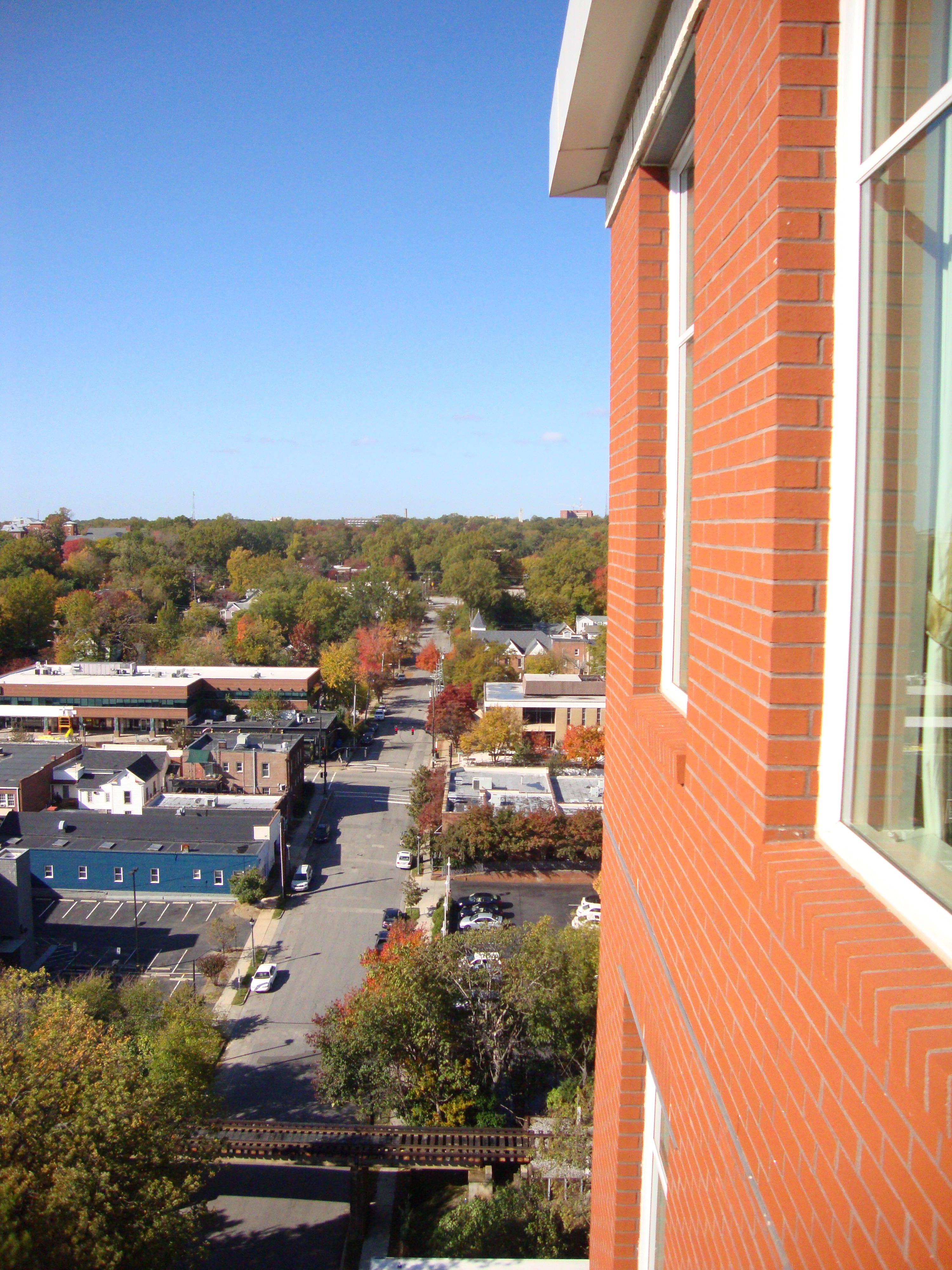
Looking west from the balcony

Daylight savings time ended this morning, and so we gained back the hour we lost in the spring. It’s strange that hours can be moved from one season to another. Anyhow, the leaves are changing, with yellows, oranges, and reds, and the temperatures are cooler. It’s fall.

Tuesday is my usual day for the Early Bird Yoga class at Blue Lotus with Suzanne. I normally get up at 5:30, do half an hour of interval work on the elliptical machine in my building, change out of my sweaty tee shirt into a fresh one, grab my yoga mat, and get to the 6:30 class in good time. Some yoga breathing, lowering, lifting, balancing and stretching is a good way to start the day.

Suzanne’s instructions are direct and clear, and her strength and grace are beautiful and inspiring. Each class is different, and lately she’s been taking us noticeably beyond our comfort zone. She seemed really pleased last week when she got us all up in tripod headstands. This week she had us all try side crow. This did not work at all for anyone (except her). Lately I’ve been working on front crow, and making progress, so perhaps we’ll do side crow one day.

Early Wednesday morning (5:40) I got in a cab to go to the airport. The cab driver was winded, and said he’d been doing jumping jacks to stay awake while waiting for me. It was better, he said, not to drink too much coffee. I agreed. He asked me where I was going, and I told him the bare fact (Boston), thinking I’d rather not get involved in a chat. There’s effort involved, and no guaranteed reward. But after a couple of minutes of silence, I relented. I figured I would try to be a decent chap and throw a lifeline to a lonely soul, so I asked him where he was from. Answer: Gambia, a tiny country in west Africa which I knew almost nothing about, and which he dearly loved.

He was a lively guy, and much more interesting than NPR. He described the government in terms that sounded benign though authoritarian, and improvements in roads, schools, and hospitals. He said that most people were at least part-time farmers and described how they stored crops in their own warehouses. When I asked him about his languages, he said he spoke seven, including three from Gambia and French, Spanish, and German. His English was accented but just fine.

The weather was clear and mild in northern Massachusetts, but there was still snow on the ground from an early season storm that had left many thousands without power. I did a bunch of meetings in Westford and then went down to Cambridge for more. On the flight back I read How to Read Montaigne by Terence Cave. Montaigne (1533-1592) is a startlingly original, modern thinker.

I was inspired to start exploring Montaigne by a few comments in an excellent book I finished a couple of weeks back: The Swerve: How the World Became Modern, by Stephen Greenblatt. The Swerve recounts the discovery in a monastery in 1417 of a copy of an ancient Roman manuscript, and explains how that discovery changed history. The discoverer, Poggio Bracciolini, was a former apostolic secretary for a deposed Pope with a classical education and passion for finding and saving ancient books. The book that was almost lost, On the Nature of Things, was written by Lucretius about 50 BCE. It’s an epic poem that describes the philosophy of Epicureanism. Greenblatt covers a lot of ground, from the philosophers of Greece and Rome, the creation of libraries, the fanaticism of early Christianity, the preservation of books in medieval monasteries, the intrigues of the popes, religious wars, the intellectuals of the Renaissance (including Montaigne), and onward.

In addition to a lot of lively history, there’s a pithy account of the ideas of Epicurus (b. 342 BCE), including the notion that the entire universe is constructed of tiny indivisible building blocks called atoms. This carried with it a view of the world as a natural phenomenon, not something magical created and controlled by gods. Epicurus espoused freedom from superstition and the pursuit of pleasure.

By pleasure he meant not pursuit of wealth or debauchery, but something more nuanced that included a sense of wonder at the beauty of the natural world.. According to Philodemus, a follower of Epicurus, “It is impossible to live pleasurably … without living prudently and honourably and justly, and also without living courageously and temperately and magnanimously, and without making friends, and without being philanthropic.” The Epicureans celebrated friendship, emphasized charity and forgiveness, and were suspicious of worldly ambition.

According to Greenblatt, Epicureans, including Lucretius, believed that the gods existed, but that they couldn’t possibly be concerned with human beings. Along with atoms, Lucretius’s ideas encompassed the notion that living beings have evolved through a long process of trial and error, that the world exists for reasons that have nothing to do with humans, that humans are not unique but rather linked to all other life forms and to inorganic matter, there is no afterlife, that religions are superstitious delusions based on longings, fears, and ignorance, and that by fashioning gods humans became enslaved to their own dreams. Happiness could be attained through discarding delusions through reasons, looking squarely at the true nature of things, and discovering a sense of wonder.

These ideas were, of course, not congenial to early Christians, who almost succeeded in stamping them out. But somehow a copy survived, which Poggio discovered and copied, and which is recopied many times, and ultimately influenced thinkers in subsequent generations up to our own. Greenblatt’s book is a true pleasure.

We saw some professional hockey on Friday night: the Caroline Hurricanes vs. the Washington Capitols. I’d learned from my new assistant about a free bus that runs between downtown and the hockey games, and it turned out that it made a stop right at our building. The bus arrived on time, with many cheerful fans dressed in Hurricanes red and white. We had a good view from box seats.

The Hurricanes started strong but collapsed in the third period and got trounced. As long as the game was close, it was fun. As with soccer, the more hockey I watch, the more I see and appreciate the incredible athleticism. The drama is simple, but effective: there’s a surge of great joy at every goal our team makes, and stab of pain at a goal of the opponents. The bus trip back home seemed slower and much less cheerful.

On Saturday we saw quite a different sort of drama, Siegfried, the third opera of Wager’s Ring cycle, broadcast live from the Metropolitan Opera to all over the world, including the North Hills Cinema. I know the music well from CDs, and love it, but had some qualms about the amount of sitting required: five and a half hours. Wagner is musically dense, and that’s a lot of Wagner. It was, it turned out, for us, incredibly powerful.

The story is about courage. Siegfried is a callow young hero who forges a magic sword and uses it to slay a dragon and an evil dwarf, then travels though a ring of fire to save and win a beautiful maiden. In pre-broadcast comments, Renee Fleming (a great soprano who would know) described Siegfried as the most difficult tenor role in the world. Our Siegfried was Jay Hunter Morris, a relative unknown who subbed in at the last moment and had a total of three performances under his belt when he performed before a worldwide audience of many thousands yesterday. This took true courage. Morris gave a performance for the ages, vocally powerful but nuanced throughout. The entire cast was superb, and the technical effects (especially the ring of fire) were impressive. Fabio Luisi conducted brilliantly. The famous horn solo, the exciting few bars that horn players test and polish their whole lives, was perfect.

This Siegfried, the opera, moved me deeply (tears). Driving home afterwards, I felt wrung out but exhilarated. Sally also loved it, and announced that she was now a Wagnerian. I found this very cheering.
An earthquake, a hurricane, a massage, a yoga lesson, and a haircut

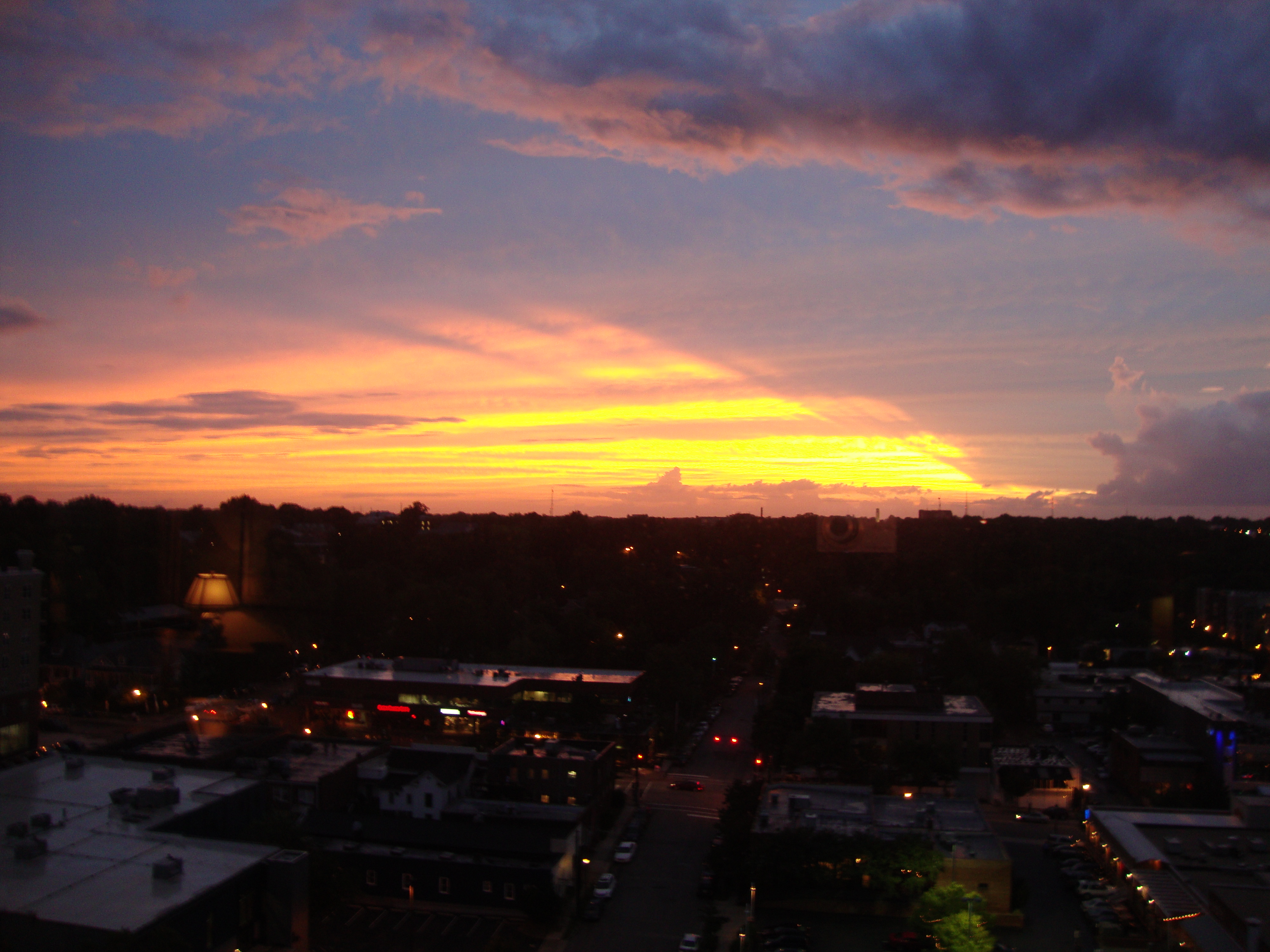
Sunset before Hurricane Irene

We’ve had a couple of unusual disturbances this week. On Tuesday, Raleigh was shaken for a few seconds by an earthquake that was centered in northern Virginia. In my office, it felt at first like heavy equipment was passing by, but it got more intense, and I started to consider evacuating. We seldom have earthquakes in the eastern U.S. We’re used to thinking of the earth as something solid that does not move, and it’s disturbing when it does.

A hurricane named Irene has been heading toward the eastern U.S. for several days, and finally hit the Outer Banks of N.C. this morning. We get hurricanes here from time to time, but this one has caused more than usual worry. In 1996 when Hurricane Fran hit our area, trees snapped in two in my yard, and the storm left us without power for days. Ever since, I’ve taken hurricanes seriously. At the moment, we’re getting light rain and gusty winds.

Meanwhile life goes on, with chores and challenges. This week I was particularly conscious of being part of a pleasing network of humans, including some who helped take good care of me, with some vivid moments of connection.

On Monday, I got over to Hands on Health, where Meredith had agreed to come in on her day off to give me a deep tissue massage. I’d anticipated that all the driving to, from, and at Road Atlanta would leave me with a tight neck and back, which it did, and that Meredith could help, which she did. She was cheerful and chatty, but deadly serious when it came to knotty muscles. There were some intense and difficult moments, but I left feeling wonderful.

On Wednesday, I had my first individual yoga lesson with Suzanne. I’ve taken one or two “early bird” classes a week with her for the last year or so, and have gradually come to really trust her. My main objective in taking an individual lesson was to make sure I had sound mechanics for my head stand and wasn’t about to hurt my neck. I also wanted to understand more about increasing my flexibility. Lately I’ve gone to a few advanced classes, and found them fairly humbling. There are certain things they do that I just can’t do.

Anyway, Suzanne helped me adjust expectations and feel better about where I am, as well as improving in some areas. For head stands, she taught me how to find the top of my head and where my weight needed to be. We did some bending and twisting, and talked about how you can have too much of a good thing. Although it looks good in class to have loose joints, as she does, she noted that looseness brings with it more risk of certain injuries. I also got her guidance on what to do with my mind during savasana. I’ve slowly come to really value yoga’s insistence on relaxation as an integral part of class. At the end of the session, I felt tremendous gratitude, both for Suzanne, and for my good health and well-being.

Because of the Road Atlanta trip, I’d missed my regular monthly haircut with Ann. She invited me to come in after work as her last appointment on Wednesday. Ann’s been cutting hair for me, Sally, and Gabe for many years. It’s always fun seeing her. She likes to talk, and we have great chats about our families, cars, restaurants, travel, and sports. As usual, I left looking better, and smiling.

Gary Player’s diet and exercise routine, and a few thoughts on yoga

One of the nice things about getting older is that you gradually worry less about being cool. You slowly realize it’s almost impossible to be old and cool, and give up on the idea. Letting go of such worry frees up some energy for more fun.

Age is tough on a body. Fight as we will, eventually we’ll all succumb. But I see no real choice but to fight. Over time I’ve become more dedicated to the battle for good health, though it occasionally strikes me that it could be viewed as hopeless, ridiculous, or both. A middle-aged white guy sweating — for what? It’s certainly not cool.

Thus I was cheered and inspired this week by an account of Gary Player’s fitness program now that he’s 75. As golfers know, Player is a legendary player, with more than 160 tournament victories. In his prime, the man was known to be serious about exercise, and he still is. His routine involves 1,000 sit ups and push ups every morning. He does lunges and squats, works with weights, and runs, swims, and does stairs. As for diet, Player says that it’s 70 percent of the fitness puzzle. He eats a mostly vegetarian diet heavy in fruits and vegetables, and aims for portions about half the size he used to eat. He says he has more energy since he cut the meat, and his stomach works better.

I also have found that a diet of moderate portions of plant foods is energizing. And so is regular morning exercising. Lately I’ve been noticing how during most of my waking hours I feel really good, and feeling grateful for it.

I’m especially grateful to my yoga teachers (Yvonne, Suzanne, Kathleen, Jill, and others). Over the past couple of years, yoga has gradually insinuated itself into my life, and has become a good friend. Lately I’ve been doing two or three classes a week at Blue Lotus. Every teacher and every class of every teacher is different. Some classes are quite arduous (think high heart rates and lots of sweat) with an element of risk, and some are very slow and calm.

When I began, I’d expected that yoga would help my flexibility and balance, which it has, but it has done some other good things that I hadn’t expected. It has made me a better breather and more conscious of the significance of breath. It has helped my focus and concentration. And it has made me view relaxation as an essential element of good health.

There’s also something pleasing about exercising in a class. It’s sometimes humbling but often inspiring to see so much strength and grace in the group as it moves together. I like the sound of people breathing in unison. It’s good to be with people who are committed to taking good care of their bodies. And it’s fun.

A spring baseball game and a crazy yoga class

In early spring, it is most pleasant to go to a minor league baseball game. On Friday night, Sally and I went over to Durham to see our first Bulls game of the season, where they played Syracuse. Just as we got to the stadium parking, it began to rain, and just as we got to the gate to hand over our home-printed ticket, it started to pour — so much so that the scanner had trouble reading our tickets. So we got wet, and it continued to rain for most of the next hour. But the sky kept getting brighter, and we had pizza and beer, talked, and looked at the types in the crowd.

When the rain finally stopped, we watched the stadium crew roll up the giant tarps that covered the infield and sweep the baselines. We watched the Syracuse pitcher warm up, throwing gently at first, then harder and harder. We’d bought tickets four rows back from the field halfway down the third base line, but after some quick soul-searching decided to award ourselves a free upgrade to empty seats in the area immediately behind home plate. I used my jacket to dry the seats as best I could (i.e. not completely), which Sally supplemented with paper napkins, and we sat down.

Both pitchers were throwing fastballs around 91 MPH, which doesn’t look amazing on TV, but from behind home plate is fairly impressive. The batters on deck warmed up directly in front of us, and I studied their mechanics with the thought of improving my golf swing. These were strong young guys. And the game unfolded slowly but distinctly, as baseball games will. The first Bulls batter hit a home run on the first pitch, and there was no further scoring for several innings. Yet there were jabs of excitement here and there — a close play at first, a double, a stolen base, an out at home plate, a double play. Between innings there were mascot antics, T-shirt giveaways, and contests for little kids. We never quite got dry, though, and as it got cooler we felt chilly. We packed it in after six innings. The Bulls eventually won 3-1.

I was disdainful of baseball for part of my youth and generally indifferent to it for many years. I still don’t find it very engaging on television, but a live game is something else. It isn’t so much the drama, but something else. The combination of genes and training that makes a ball move quickly from pitcher to batter, from batter to shortstop, and shortstop to first is awesome. The green grass, the red clay, and the white baselines are beautiful.

The next morning I did a two-hour yoga class at Blue Lotus with Yvonne aptly named Juicy Flow yoga. Yvonne likes to push herself and her classes to their limits, and her normal Saturday classes of an hour and a half are not for sissies. Her longer Juicy Flow class is about moving with music, sometimes rapidly for several minutes, in unfamiliar ways. The music is an eclectic mix of east and west, soul, disco, rock, and other. It’s lively fun, at least at first. I sweated a ton, and my mat got so wet it was difficult to do a down dog. I pushed hard for an hour and a half, then suddenly hit the wall and felt like I might get sick. I noted with some alarm that my upper body strength, which is usually good, was gone; I couldn’t hold my arms over my head. Never was I more relieved to lie on my back in shavasana for a few minutes, just breathing.

My finger health problem

Why is it other people’s health problems are so uninteresting, and my own are so fascinating? I’m kidding. Kind of. At one level, I understand that my own health problems are of no particular general interest, but I do find them relatively interesting. It would not surprise me at all to learn that everybody else thinks the same.

At any rate, I work hard to minimize certain health risks. I consciously avoid eating things that have no nutritional value, and consciously eat a balanced vegetarian diet. I get up early to exercise most days, either swimming, spinning, lifting, doing yoga, or the elliptical machine. I use sunscreen and drink filtered water. And so on. I even quit using pans with Teflon.

None of which will help me against the wrong piece of bad luck, be it my own cells malfunctioning, an invading superbug, or a drunk driver running a stop light. But I like improving the odds. And for the most part, I like the process. True, I still haven’t figured out how to make an omelette that doesn’t stick without Teflon, which is unfortunate. But I actually look forward happily to yoga class, for example. (Which reminds me, after some struggle, I finally managed to do an unaided head stand for the first time this week. Hurray!)

The net of my exercise-and-eating program, good genes, and good luck has been a long run of no health problems that seemed interesting enough to talk about, even to me. I didn’t have even a cold in three years (though that particular string was broken by an enterprising but not particularly dramatic virus last week).

But starting last Sunday, I had a bizarre problem that seemed small at first: the tip of my left forefinger was exceedingly tender. I initially thought I must have somehow bruised it, but this seemed unlikely — it would have taken a memorable blow, like slamming it in a car door, to produce such discomfort. Over the next couple of days, it became swollen and took on hues of red or purple. It was warm to the touch, and it throbbed. I couldn’t play the piano without causing great pain, and any small ordinary knock on the finger was agonizing. I began to wonder what life would be like after amputation of a left forefinger, or the possibility that there was a serious internal problem there that could spread.

So I made a rare appointment with my GP, Dr. Gagliardi, who generally knows me only from check ups that are not as frequent as he would like. He diagnosed the problem in a matter of seconds as paronychia (an infection), and said he would cut it to let out the fluid. I noted that I have a reasonably high pain threshold, but because of the extreme sensitivity of the finger, it would be nice to have some anesthetic for this operation. He said that was impractical. So I took a deep breath.

Fortunately, he found some deed skin to cut on, and I never felt a thing when he did the cutting. And in a moment a yellow pus began to emerge in surprising quantities. I began to feel better almost immediately. I’m using a prescription antibiotic cream and band aids to complete my recovery. The wonders of modern medicine! Every now and again, it works really well! Thanks, Dr. G!

Good sports

Last Friday I reached my latest swimming objective: 1500 meters of freestyle without a break. This was for me, a considerable achievement, which not so long ago I found almost impossible to imagine. I’ve been doing a 1500-meter workout for some months, but with 30 second breaks at various intervals. A few weeks back, I decided to work towards doing the distance non-stop. I began gradually reducing the breaks, from 10, to 5, to 3, to 2, and finally to 1. Then, finally, none.

On Saturday morning I did an hour and a half of Vinyasa yoga in an open level class at Blue Lotus with Yvonne. That’s a lot of yoga! I tried very hard not to look at my watch, but once I was well drenched with sweat, I checked to see if we were almost done — and we were only half way through. I still can’t figure out at all why this strange system works, but it does: I felt absolutely wonderful at the end.

That evening Sally and I went out to Zebulon to see the Carolina Mudcats play the Mobile Baybears. It was a warm but not sweltering night, and we had great seats — a few yards beyond first base on the first row, close to the visitor’s bull pen. From this close in view, we could see how fast they run, how hard they throw, and generally how amazing they are. This is AA-level baseball, where the players are serious contenders for the big leagues. The pitchers were throwing fastballs in the mid-90s, and I don’t think I saw any errors. There is something really pleasing about seeing a real life high-quality baseball game on an August evening. The competitive drama is involving, but the whole experience is also relaxing. It’s good to have a beer and slice of pizza, listen to the buzz of the crowd, the organ, the announcer, the crack of the bat. It was a good, close game, which Mobile won 2-1.

When I stop to think about it, it amazes me how much I’ve changed with regard to physical activity and sports in recent years. As a kid, I played the usual sports, and used to imagine that I would play well one day, but in competition I never managed a level much higher than average or worse. And gradually, I came to think of myself as a non-athlete and sports-phobe. Particularly during adolescence, it was annoying to see the social advantages (in particular, success with girls) that accrued to the gifted athletes. I looked forward to adulthood as a time in which sports and athletics would be no longer relevant, and my lack of any particular athletic giftedness would cease to be a liability.

In retrospect, I can see this was partly a problem of lack of time. Part of the problem with athletic skills and kids is the same as with academic skills, which is that kids learn at different rates. This is kind of obvious, but schools are not set up to address accommodate different rates of learning. Instead, a class is given a set time in which everyone must master a set of skills, and those who are slower are shamed and punished. And those slower kids eventually figure out how to avoid the painful activity, perhaps by dropping out. While I was generally one of the quicker kids at mastering schoolwork skills, I was not so in sports. Because of my July birthday, I was always one of the youngest in the class, which was part of the problem. But of course, I had no idea of that issue at the time. I just knew that my relative lack of success in sports was somewhat painful. Like other slow learners, I eventually opted out.

Fortunately, over the years, I’ve found that the level of mastery needed for enjoyment of many activities activity is not impossibly high and with no tight time deadlines I’ve reached that level in some things I really enjoy. This has been the trajectory with swimming, skiing and golf, and I’m starting to see the outlines of that level of accomplishment for yoga. Slow and steady wins the race.

Dropping some weight and hitting some golf balls

I came back from the long weekend in St. Croix five pounds heavier than when I left.  It’s difficult to account for the sudden gain, since I was reasonably careful about not over eating and held the veggie line against temptation.  Perhaps our very pleasant seaside daiquiris, pina coladas, and pain killers had something to do with it.  In any case, I managed to shed all the extra weight this week with some vigorous early morning workouts, and as of this morning was at my fighting weight of 160.

Earlier this week the NY Times published a piece by Gretchen Reynolds on the positive effects of exercise on the brain.  http://tiny.cc/deokh  Studies with rats show the exercising rats with much superior brain functioning (“little rat geniuses”), and the apparent interaction of BMP and Noggin leading to increased production of neurons.  I can believe it.   When I first began regular exercise in my college years, I viewed it as primarily benefitting the cardiovascular system, but especially in recent times, I find that I feel duller if I can’t find time for a workout.

We’ve had a record-setting heat wave this week.  This Saturday morning, I was hoping to get an outdoor swim at Lifetime Fitness, but unfortunately the outdoor lanes were all taken when I got there at 6:40.  I made do with the indoor pool for 60 laps, then 15 minutes of yoga in the sauna, then 5 minutes in the steam room (whew!).  Then I headed over to Lake Jordan to drive my sports car on some backwoods roads.

I ended up at the end of a gravel road off US 64 at a down-on-its-luck golf range with a old barn on one side.  There was no one there when I showed up, but a guy emerged from a small adjacent house and got me a bucket of golf balls.  He couldn’t take a credit card, and couldn’t break a $20, but he agreed to let me have a $9 bucket for all the smaller bills I had ($7).  Then he drove off, and left me alone to practice.   The grass was very long, and so I was effectively working on shots from the rough.  A good thing to practice, though not so fun.  I got sweaty and tired, and was happy to get to the bottom of the bucket and see the last ball fly away.

More fun at Red Hat, trying Mirage, yoga, and mindful driving

After the intensity of the trial in Texas and a great win, it was another intense week back at the Raleigh office of Red Hat, digging out of the pile of backlogged work and dealing with new emergencies.  Not for the first time, I felt on Friday as though I’d done a months’ worth of work in a week.  The range of activities was typical, but as always, varied — from solving specific IP problems to formulating strategy to addressing customers’ legal questions to being interviewed by reporters to writing and editing for opensource.com to drafting commercial agreements to dealing with management challenges — and along with these dozens there were literally dozens more still on the short term to-do list. I deal with one interesting issue after another, some of them important, all day every day.  I am never bored.  Is it stimulating?  Yes.  Exhilarating?  Yes.  Stressful?  Yes.

So as a matter of surviving and flourishing, on weekends I try to find some space to recharge and rebalance — some social time, some time alone, some time to care for the mind and body.  As to the social part, on Friday Sally and I went to Mirage, a  brand new club on the ground floor of our condo building which was having its pre-grand-opening.  It’s large (capacity 650) with a dance floor, large island bar on the ground floor, sushi bar in the back, second floor balcony space with another bar, and various side rooms.  The decor uses Egyptian motifs in a Vegas way, large video projections, a mirrored ball, and the waitresses in short gold-plated dresses.  The over all effect was glitzy but not gaudy.  We ran into Charles, who did a short speech as part of the dedication, and Ann and several people who live in the building.  We enjoyed talking to friends.  The sound engineering seemed good — very loud, but somehow tweaked so that it was still possible to talk.  Also, happily, the sound was not audible in our apartment.

I woke up early on Saturday and started to head over to Pullen Park to swim some laps, but then checked to see whether there was a  yoga class at Blue Lotus, which is next door.  There was:  Yvonne was scheduled for 8:00 to do an hour and a half open level class.  From past experience, I’d learned that open classes with Yvonne are fairly advanced classes, and for less advanced students, there’s no quarter given.   So it proved to be.  Yvonne likes to share inspirational words on such themes as oneness and truth, and she pushes the class past known limits of strength and flexibility.  After the first half hour, I wondered whether I could just hang on to the end.  I did, barely, soaked in sweat.  But I felt good the rest of the day.  I have no well-developed theory of why yoga helps over all well-being, but for me, it does.

I took my little German sports car out for a run in the afternoon.  Just east of Raleigh, Old Milbournie Road winds through farm fields and pastures, forests, lakes, and country stores.  It’s got some great curves and hills — an excellent road for just driving for fun.   When I got there, there was a caravan of minivans and pickup trucks led by someone proceeding 10 miles under the speed limit (45).  I had in mind the possibility of exceeding the speed limit (no worries — not too much), but this was clearly  not going to happen, so I tried to practice patience and enjoy the beautiful countryside.  Coming back, though, I had a stretch of the road to myself.  I felt the subtle weight shifts as the vehicle took the curves at speed, and the G forces as I accelerated out of them.  The sound of the exhaust note rising and falling as I shifted between third and fourth was like music.

Our computers, ourselves

More proof that computers and humans are becoming one:  a  NY Times yesterday on the dozens of computers embedded in each of our automobiles.  http://tiny.cc/mwFgt Millions of lines of code accompany us on each on of our daily drives.  In many ways, this is a good thing.  Microprocessors assist with all basic functions of a higher-end car, including unlocking it, accelerating, steering, traction control, and braking, not to mention air bags, climate control, and entertainment.  They improve engine efficiency, warn when tire pressure is low, correct certain driving errors, and generally make sure things are OK.  We hardly notice them, but they’re always there, taking care of us.

The trajectory of this technology seems clear:  the driverless vehicle.  How long until we have them?  We already do.  Last year, in the most recent DARMA competition, cars navigated through an urban environment without realtime human intervention.  http://tiny.cc/O2tdy High end consumer cars now can park themselves.  Indeed, computers already do most of the work flying planes, piloting ships, and directing missiles.  So, how long until we’re required to give up driving our cars and let the much-more-safe-and-reliable computers take over?

This is a somewhat painful question for me, as a person who loves cars, and technology, and also has a soft spot for humans.   I’ll resist giving up (the last part of the) control of my beautiful BMW.  And I have some worries about becoming like the bloated and clumsy humans in Wall-e who had no function other than leisure.  There may be a middle way, though, between a human dominated world and a computer dominated world.

Just now, it feels like we’re an an awkward intermediate stage of evolution in relation to our computers.  A couple of weeks ago, the Times ran a piece noting that email and the internet had become a necessary part of a middle class vacation.  http://tiny.cc/CQqj0 I can confirm, as it noted, that in the last five years, checking email and the internet during vacations and weekends has gone from a novelty to a necessity.

When Blackberries first came on the scene a few years back, I initially thought the increasing frequency of people checking their email — whether in exotic locals, local restaurants, elevators, or bathrooms — was mainly a new type of status display.  It seemed to say:   I have new technology and I’m so important many people must get their orders from me, and I cannot pause to pay attention to anyone else or my surroundings.

Old fashioned ego is surely part of it, but I no longer think it’s the largest part.  The technology requires that we work harder.  It has made it possible for more people to contact more people (not to mention that more bots contact more people), creating an escalating flood of information.  This has an overwhelming effect on those who rely for their livelihood on being a bit smarter than others, whether they sell products, provide advice, manage projects, or offer services.  For those people, information is necessary for survival.  The flood of data in their in box may  include something important.  Success depends on knowing more than the competition, and survival depends on not falling behind.  There is no rational choice other than to try to keep up.

So how can we keep from being devoured by our technology?  That is the question.  Yoga?