The Casual Blog

Tag: Whitney Museum

On Broadway, fake news, and some new (to me) art

blogpicbug-1
Last week I went to a conference in New York and stayed for the weekend to see loved ones and take in some culture. Midtown was decorated for the holidays, including wreaths, angels, and a very big evergreen with ornaments at Rockefeller Center. It was cheering. Crowded, though. We finally gave up on taxis, on the grounds of slowness, and embraced the subway.

On Broadway we saw The Encounter, a one-man show starring Simon McBurney as a nameless storyteller. His story is about a solo expedition in the Amazon to contact the Mayoruna people, and it’s engrossing. But the performance is as much about the power of our imagination as about the story. The audience members wear headphones, bringing us into an intimate relationship with the storyteller’s voice and the exotic sounds of the jungle. The storyteller repeatedly reminds us that we are in a story, but even with this warning, we can’t help becoming immersed. McBurney manages to get us to look at ourselves in the act of being manipulated.

Fake News
As fake news came into better focus over the last couple if weeks, I’ve felt dread and wonder at how easily people can be deceived by various hoaxes, and then become passionately committed to remaining in their deceived state. At its most bizarre and extreme (as in, the hoax that the Clintons are running a child sex slave business in a D.C. pizzeria), many enthusiasts cannot be dissuaded by reports debunking the tale in the mainstream media. They view these as part of the conspiracy — a cover up.

This is obviously nutty, and it would be nice to think you and I could never be taken in by such craziness. Or would it? Recently I’ve found myself wondering more about whether particular news reports are correct, and even whether my most basic assumptions are reliable. This is uncomfortable, but it’s actually a good thing. Always keeping in view the possibility that we may be wrong makes us more likely to consider new information and open to revising our beliefs — updating our credences, as Bayesians say. It also fosters a degree of humility, as we recognize that none of us has perfect knowledge, and all of us are prone to error.

That said, some descriptions of events are more wrong than others, and certain wrong ones are dangerous — like one inspiring an armed man showing up at a pizza parlor to avenge an made-up crime against children. In the long term, better education may be the way to address the mass hoax problem. There are various mental resources involved in assessing possible new facts, which include a good fund of background knowledge, evaluation of the reliability of sources, and weighing of evidence.

These resources and skills take time to acquire. In the short term, we need to use our best hostage negotiation skills with people seized by a dangerous conspiracy theory — try to keep the conversation going, and if they’re armed, be prepared to dive for cover.


New (to me) art

While in New York, I saw a lot of interesting art, including video work. At the New Museum, there was an exhibit of the work of Pipilotti Rist, a Swiss artist, who used video technology to explore nature. There were early works designed for a single viewer to insert her head up through a hole in a pyramid with the base on a wall to watch a screen and be surrounded by sound. Her more recent works are large-scale installations intended for groups of viewers.

In one work, she placed beds on the gallery floor and watery images on the ceiling, surrounded by meditative music, which led strangers to lie down together, look upwards, and relax. The images weren’t all that interesting, but the experience was. We were taken both inward and outward, into our feelings and out into relationships, as the artist made us into part of the art.

Video art is challenging, in that it resists skimming. You have to give it some time. And a given work may be boring, or anyway, not for you. But unlike painting, which lives most comfortably in a private dwelling, video’s natural home can be in a museum, where it can keep on playing and waiting for the right people to watch it. And those people can share it, and have a communal experience.

Also at the New Museum, I spent some time with the Cheng Ran’s work, Diary of a Madman, which is an outsider’s view of the gritty side of New York. Where Rist was loosely improvisatory and mostly cheerful, Ran was focused and melancholy, with exquisite technique and tight control. He visibly struggled to extend the expressive possibilities of new technology and embrace the world of humans and their detritus.

At the Whitney, I took in Dreamlands: Immersive Cinema and Art, which had a lot of video artists’ work displayed on large screens and other surfaces. A lot of the work was interesting mainly as art history, rather than as a provocative message for right now, but there were some provocations. My favorite piece was by Andrea Crespo, titled Neurolibidinal Induction Complex 2.2. It used words (isolated emotions, for example) and colors to give us a reboot. I also particularly liked the work of Lynn Hershmann Leeson, which included female cyborgs and bots, including one with an unsettling holographic gaze who could do an irritating conversation with you.

I also spent some time looking at Bruce Conner’s Crossroads, It’s a slow motion depiction of U.S. nuclear tests off Bikini Island in 1946. If you tend to think that nuclear weapons are an existential threat to the human species, you will continue to think that after seeing the film. Seeing the images is sobering, and may make us think more about stopping the madness, which we clearly need to do.

We went out to the Brooklyn Museum to see the work of Marilyn Minter, known for her explorations of female faces and forms and of the dark underside of fashion. I wasn’t crazy about her monumental paintings, but I liked her quirky videos. At MOMA, we saw the Francis Picabia exhibit, which we liked. He had a great visual imagination, great technical ingenuity, and a willingness to continually experiment. His was a questing spirit.

Finally, while Sally went to the Breuer and saw (at my recommendation) the fine Kelly James Marshall exhibition, I went to the Met to see Beyond Caravaggio — paintings of Valentin de Boulogne, a French artist who worked in Rome in the early 1600s. I really liked Valentin! The paintings had much of the intensity of Caravaggio, with his amazing understanding of light and the human figure, but had a broader emotional range, including people who were clearly individuals, with secrets and regrets.
Inspiring art in New York

OLYMPUS DIGITAL CAMERA
This week I had a conference in New York on patents and patent trolls. I stayed in the conference hotel, the Times Square Sheraton. I was on the 32nd floor. Though there were minor glitches — no way to raise the window shade, wi-fi that required a long tech services call, slow elevator service — it was a reasonably nice hotel, and conveniently located.

After the conference, I took a vacation day to make a long weekend, and saw some old friends and some art. NPR had a story recently on the sale of the art collection of David Bowie. Asked to describe the collection, an art person said the works were mainly bold, and seemed to be things Bowie bought because they spoke to him, rather than as investments. He bought art for inspiration. That seemed to me a good criterion for deciding what art to spend time with, and so I made a point of looking for work that might inspire me.

On Thursday evening, I met up with Jocelyn in Chelsea, and got my introduction to gallery opening night, which happens every Thursday. We looked into four or five galleries, sipped cheap Chardonnay, and checked out the new work. Although I didn’t see anything life changing, there was work worth talking about, and we had fun talking.
OLYMPUS DIGITAL CAMERA

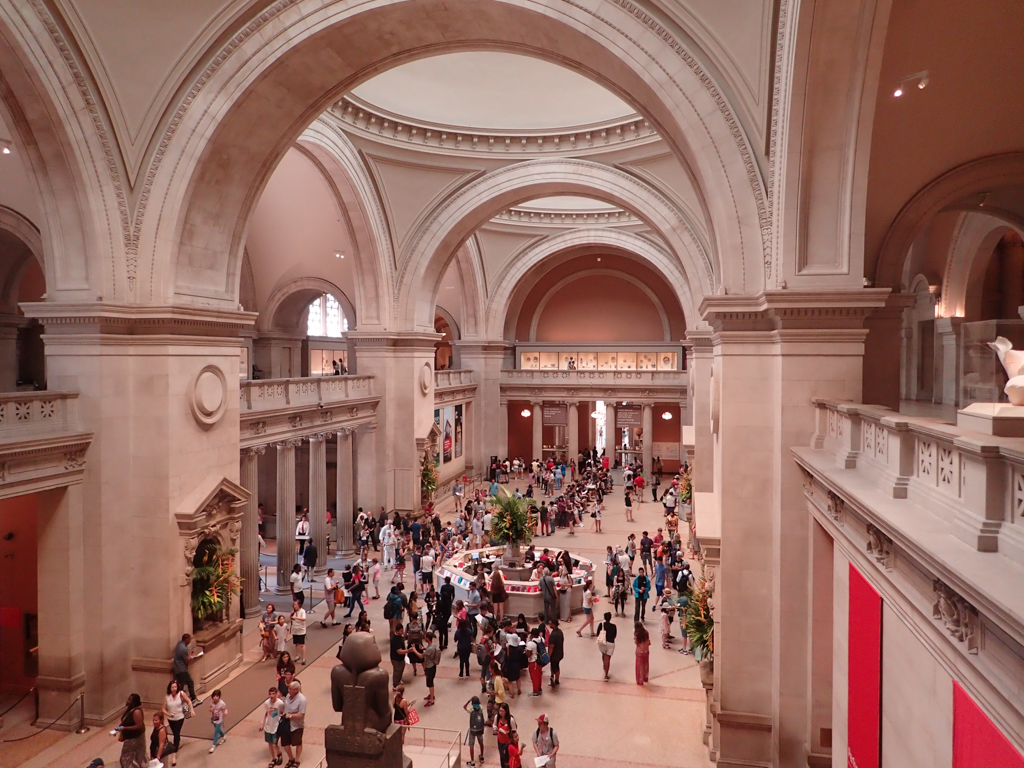
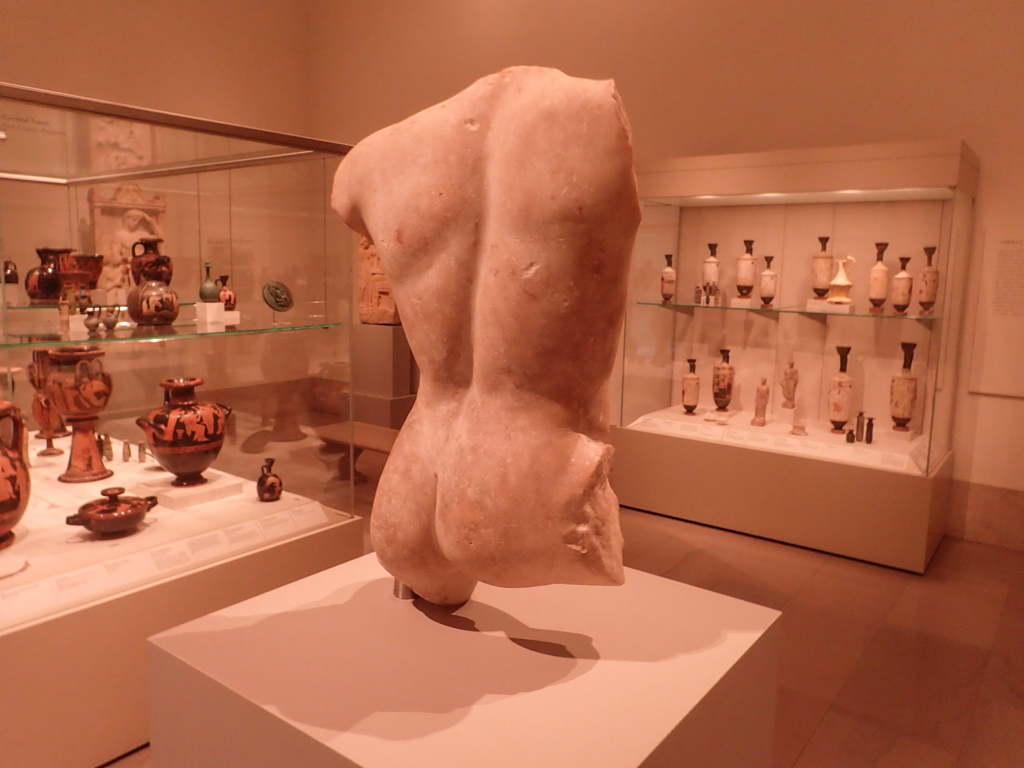
On Friday morning, I spent some time at the Metropolitan Museum. I focused on the Greco-Roman collection and art of ancient Near Eastern civilizations. These very old objects (some several thousand years old) are powerful, but also somehow calming. Civilizations rise and fall, but as far back as we can look, humans have a drive to make things of beauty.

In the afternoon, I went to the Met Breuer and saw In the Beginning, photographs of Diane Arbus. I’d thought of Arbus as being mainly about pictures of sideshow freaks and other oddities. This turned out to be not completely untrue, but still really wrong. Her portraits take their subjects completely seriously, regarding them as specific individuals with dignity. Arbus somehow got them to open up, and we find ourselves connecting with them. It’s a strange feeling, a new domain of human experience. Afterwards, looking around at ordinary people, I felt more curious, and noticed fleeting expressions and feelings.
imagejpeg_1

Jocelyn and I had a pre-theater dinner at the Robert, where we had a table by the window looking out from the 9th floor on Columbus Circle, Central Park, and Broadway. J had requested this particular spot, and it was truly a spectacular panorama. The couple ahead of us must have liked it, too, because they sat for forty minutes longer than expected, and caused us to get started on dinner behind schedule. The staff comped our cocktails, and sped service up to help us get out in time for our show. It was a hot struggling walk through the Times Square tourist crowd to get to the Minskoff theater, but we made it, with about ninety seconds to spare.

We saw The Lion King. It was, of course, wonderful. There’s a reason that it’s a huge long-running success, with a sweet story of coming of age, soaring melodies and exciting drumming, and those fantastic puppet costumes. I’m normally more of an opera person, and felt slightly out of place joining the LK crowd. But as Jocelyn noted, it would be too bad if you couldn’t enjoy something when they main thing it does is make you smile. We were definitely smiling.
OLYMPUS DIGITAL CAMERA

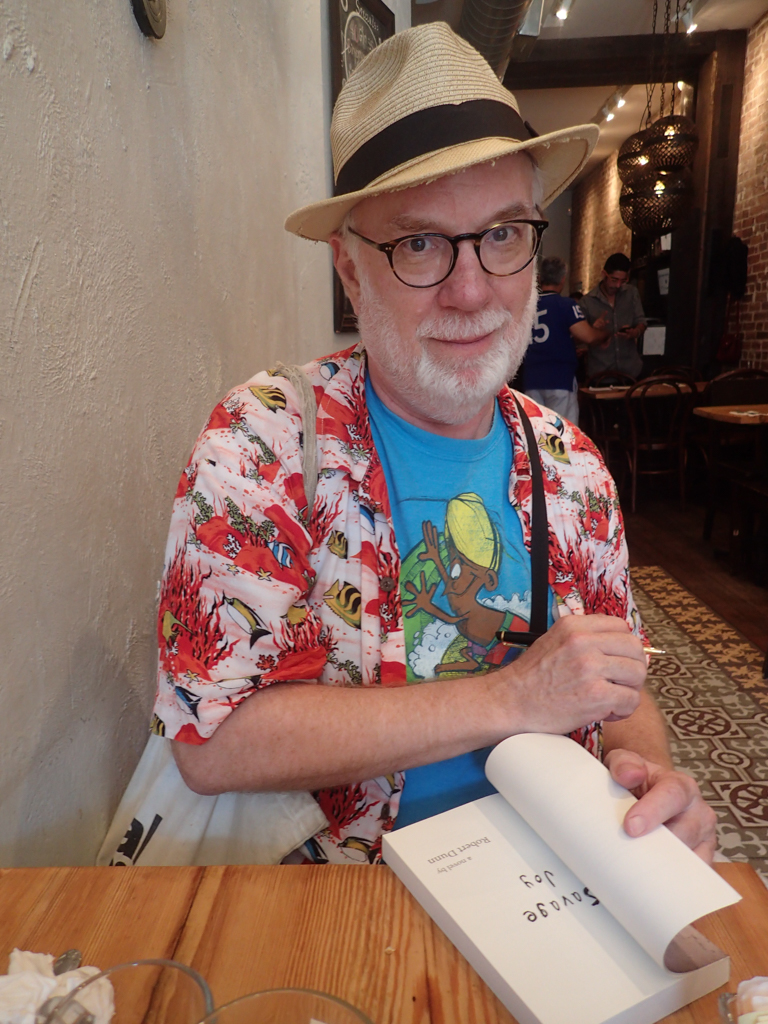
On Saturday, I had lunch with my old friend Bob Dunn, who gave me a copy of his new novel Savage Joy. He had news of several former colleagues from our New Yorker days, and caught me up on his writing, photography, teaching, and other career developments. We also discussed Trump.

The other art exhibit I saw that particularly affected me was by Danny Lyon, titled Message to the Future, at the Whitney. Lyon’s photography was highly socially engaged, including stints photographing the Civil Rights movement in the 1960s, migrant farm workers, prisoners, and other outsiders. Like Arbus, his subjects are particular individuals, rather than symbols. He’s adept at telling their stories. I was also intrigued by his montages, which combine photos and other materials in a way that suggests a multiplicity of connections. I watched a chunk of his film on a tattoo artist, which was painfully intimate.
IMG_5426

Our Memorial Day weekend in New York — great ballet, art, and ethnic food

The New York Palace (that's our place on the 32nd floor) and St. Patrick's Cathedral

The New York Palace (that’s our place on the 32nd floor) and St. Patrick’s Cathedral

For Memorial Day weekend, we went up to New York City to see our sweet Jocelyn and get an infusion of arts and food. I’d bought tickets to both the NYC Ballet and the American Ballet Theatre, and wanted to see the new Whitney Museum. We designated Jocelyn as the food concierge, and she booked us into some fun ethnic restaurants. After going back and forth, I decided not to lug along my big DSLR kit, and instead took my compact Canon G16, with the results shown here.

Sunset right after we checked in at the New York Palace

Sunset right after we checked in at the New York Palace

The flight up went smoothly (storage room remaining in the overhead bin, on time departure, seatmate not apparently infectious). I read a piece in the last New Yorker on Marc Andreessen, the famous Silicon Valley tech entrepreneur and venture capitalist. It was a good primer on what VC is and does, and seemed like a fair portrait of Andreesen and his firm (Andreesen Horowitz). He is, of course, intelligent and richer than Croesus, but, it turns out, sort of inexpressive and unadventurous in his personal life. (His likes watching television.) And for all his successful bets on where technology is about to go, he seems in complete denial about the big economic changes technology is bringing, like rising inequality and unemployment. Cognitive dissonance, perhaps?

We stayed at the New York Palace on Madison and 50th. This hotel opened in 1981, when we lived in Manhattan, and was known as the Helmsley Palace, with ads that featured a then-famous dragon lady named Leona Helmsley touting its remarkable luxuriousness in a loathsome way. Now rebranded (thank goodness), it is quite a fine hotel, and from our room on the 32d floor we had good views of Manhattan towers and a sliver of the East River.
IMG_0434
We had dinner in Curry Hill, the little Indian restaurant neighborhood at 28th and Lexington, at Chote Nawab. It’s a lively place, and the food was good, but our server was amazingly inattentive. Even so, we had fun catching up.

It was remarkably clear on Saturday morning and a bit chilly when we went down to the meat packing district to the new Whitney, which is situated on Gansevoort right where the High Line starts. It took a minute to absorb that the line to get in was a block long, and we kicked ourselves for not buying tickets in advance. But the line moved quickly, and we were inside in about 20 minutes. The place was crowded, but with a little patience we managed to get close to the pieces that interested us.

Eva Hesse's last work before her death at 34

Eva Hesse’s last work before her death at 34

The current exhibition is called America is Hard to See, which is so true, and is a loosely chronological survey of some of the key examples of the Whitney’s permanent collection. It starts on the eighth floor (the top) with the beginning of the 20th century, and comes down and toward the present. The works were given a good amount of space, and where there were narrative labels, they were helpful.

At this point in my own art historical education, Abstract Expressionism from the 50s seems more like an old friend than a shocker. But I found myself moved and shaken by some of the political art of the 60s (some of the big issues of that time are still big issues). I also engaged with the minimalism and conceptualism from more recent decades. It struck me that this was art intended to be discussed, to expand out into a social dialog. It wasn’t about just looking — it was also about talking.

The Whitney's decks

The Whitney’s decks

In addition to the fine display spaces, the new museum has large outdoor decks. We lucked out, with beautiful weather, and after each floor, we stepped out in the sun clear our heads and enjoy the wonderful cityscape views.

Looking south from the Whitney at the new Freedom Tower

Looking south from the Whitney at the new Freedom Tower

We’d thought of visiting some galleries in the area after the museum, but after two and a half hours at the Whitney I was more than sufficiently stimulated, and a bit wrung out. Jocelyn met us outside the museum, and we walked up to the Flatiron District, where we had good lunch at a Korean place called Barn Joo.

Then Jocelyn gave us a tour of her offices in the Flatiron Building. This iconic triangular building at 23d and Broadway, completed in 1902, was one of the first skyscrapers in New York. J’s employer, Macmillan Publishers, is now the sole tenant. The offices were nothing fancy, but still fun to see. It reminded me of our offices at The New Yorker in the late 70s. There was a great view of the Empire State Building from the northern point of the building.

The Flatiron Building

The Flatiron Building

We poked around in Eataly, a giant gourmet grocery and restaurants space, which was very crowded and fully of delicious smells. Jocelyn promoted the cookies at a bakery a few doors down as the best in New York, so we bought three and ordered coffee. The barista for some reason had trouble with our order, and took ten minutes to produce various beverages we had not ordered. We consumed them at a table near Madison Square Park. My cookie was a good mix of smooth and crunchy, and I enjoyed it very much.

The Empire State Building, from the Flatiron Building

The Empire State Building, from the Flatiron Building

We had dinner at Boulud Sud, a Mediterranean Restaurant at 64th St. near Lincoln Center. The place was bustling. There were no veggie options on the menu, but they proposed a gnocchi dish that was good.

We finished dinner with enough time (barely) to get to our seats at the Metropolitan Opera House to see the American Ballet Theatre perform Giselle. I was interested in Giselle in part for its historical significance as one of the oldest ballets still in the common repertoire. It was first performed in Paris in 1841, with Carlotta Grisi as Giselle and Lucien Petipa as Albrecht. It must have been astonishing at the time to see the women rise and hover en pointe.

This production had Stella Abrera as Giselle and Vladimir Shklyarov as Albrecht. Abrera was not previously known to me, but I will not forget her. She was sublime. Her gestures seemed somehow to be magnified and extended, with a remarkable emotional intensity, without being overstated. Shklyarov was also excellent. In the second act, the ethereal Wilis were spookily graceful, and when they tried to dance Albrecht to death, Shklyarov was so fervid that it seemed on the verge of real danger. The ovation was tremendous by New York standards, with the audience clapping for about 10 minutes. After I drafted this, I saw Alastair McCaulay’s review in the Times, which was a rave for Abrera.

The Metropolitan Museum of Art

The Metropolitan Museum of Art

On Sunday morning we took a taxi up to the Metropolitan Museum. I’d been looking forward to seeing an exhibit of the art of the plains Indians, but it had, unfortunately, closed. But there is always a lot to see at the Met. We started with a tiny exhibit of Van Gogh’s irises and roses, which had four paintings. The signs explained that the red pigment in the paintings had deteriorated and changed the colors of the paintings, and a video offered an interpretation of what they must have looked like. We spent time with the Lehman collection of Impressionists and Post-Impressionists, thirty or so great paintings that sum of the field amazingly well.

A Vermeer that just kills me

A Vermeer that just kills me

Then we made our way to the galleries with the Vermeers and Rembrandts. I listened to an interesting podcast the previous week with a debate on whether Rembrandt or Vermeer was the greater artist, and confirmed that I’m more of a Vermeer man. The Met has 5 of the 35 or so existing Vermeers, and I particularly love a couple of them. We also spent time looking at the pre-Colombian art, which is getting more and more interesting to me, and African art.
IMG_0605

We met Jocelyn for lunch on the West side at Nanoosh, a Mediterranean spot, and I had some delicious falafel. Then Jocelyn came with me to Lincoln Center to see the New York City Ballet perform La Sylphide. This was, again, for me partly about ballet history, since La Sylphide is another path-breaking early work, from 1834 by August Bournonville. Lauren Lovette was the Sylph, and Anthony Huxley was James. The corps of Sylphs in Act II was, like the Wilis in Giselle, all in diaphanous white tulle, and entrancing. Lovette danced beautifully.

Jocelyn outside the David H. Koch (aka "El Diablo") Theater

Jocelyn outside the David H. Koch (aka “El Diablo”) Theater

After the ballet we went down to the west Village, where we found an outside table and sipped wine, then had dinner at Pagani, an Italian restaurant. We liked our food, and the service was good until dessert time, when things suddenly came to a halt. The staff regrouped, though, and comped our tiramisu.

On Sunday morning we checked out and took a cab out to Jocelyn’s place in Fort Greene, Brooklyn. Her area seemed sort of Village-like, at least on a sunny Memorial Day holiday. We met up with our and J’s old friend Kathryn M, and ate at a South African restaurant called Madiba, which had a lot of funky charm, though it took a while to get a beer. I had the vegetable Durban curry, and liked it, and heard about Kathryn’s new admin job at Victoria’s Secret.

Then we went to the Brooklyn Botanic Gardens, where there were things that were blooming and things that were not. I didn’t see a great diversity of species, but the landscaping was pretty. We also took a stroll through some of Prospect Park. There were hundreds of Brooklynites picnicking, playing, and soaking in the sun.