The Casual Blog

Tag: vegetarian

Twenty-seven, headed down hill fast, and a note on healthy eating

Gabe Tiller at Telluride (February 9, 2011)

Gabe turned twenty-seven this week. I called to wish him a happy birthday, and felt more than usually happy myself. How wonderful to be twenty-seven! Particularly if you’re healthy, bright, athletic, good-looking, agreeable, upstanding, and employed, what could be more wonderful? Of course, that’s leaving aside all fears, insecurities, and uncertainties, of which there could be any number. But still, how marvelous to have traversed the perils of childhood and the agonies of adolescence, and stand no longer on the verge of adulthood, but actually there, strong, in your prime.

I told Gabe that it’s all down hill from here, but I was kidding. His first twenty-seven are, of course, my last twenty-seven, and I have to say that in many ways I feel healthier, more energetic, and happier than when he was born. How stressful it was to be a new parent. Also to be a grizzled veteran parent. And now, all that stress is gone! After all those years of parental anxiety and self-doubt, now he inspires me.

The picture above (which is Sally’s screen saver) reminds me of some of our skiing together the last couple of years. Even more vivid is his first POV ski video made at Telluride last March, which is exciting but I’m sure not nearly as hair-raising as the reality (such as that narrow chute). Seeing these images reminds me that I need to stay in really good shape so we can share more adventures next winter. As I mentioned to him this week, I’m thinking we should try heli-skiing (accessing backcountry powder by helicopter). He was definitely up for it.

The possibility of new adventures helps keep me focused with my continuing project to take good care of myself and eat healthy as much as reasonably possible. I’m trying to approach everyday eating in the spirit of doing a good, nourishing thing for my body — an act of kindness to my physical self. I’m steering clear of junk food, fast food, soda, and most processed food. It’s going pretty well.

Most days for breakfast I make a smoothie with dark green leafy plants (such as spinach, kale, collards, swiss chard, dandelion greens, etc.) and fruit (such as bananas and strawberries, or, this week, fresh pineapple and blueberries). In fact, I recently wore out our blender pitcher, which started leaking just outside the one-year warranty. Here’s a shout out to the good folks at Kitchen Aid, who did the right thing and agreed to replace it anyway! My smoothies are different every day and are mostly tasty (though sometimes less so — the mustard greens did not work for me) and always very green.

I’ve organized a system for addressing hunger pangs with healthy snacks such as unsalted cashews and almonds, apples, bananas, oranges, low-fat soy yogurt, and celery with peanut butter. For lunch, I typically have something like a microwave vegetarian Indian meal (Amy’s organic is good). And most nights Sally cooks a delicious vegetarian dinner, which just this week including Thai noodles with tofu (with whole wheat noodles) and Mom’s zucchini pie. She and I have gotten in the habit of having smaller portions. So my diet is mostly organic plant food of many types. I enjoy it very much.

Gary Player’s diet and exercise routine, and a few thoughts on yoga

One of the nice things about getting older is that you gradually worry less about being cool. You slowly realize it’s almost impossible to be old and cool, and give up on the idea. Letting go of such worry frees up some energy for more fun.

Age is tough on a body. Fight as we will, eventually we’ll all succumb. But I see no real choice but to fight. Over time I’ve become more dedicated to the battle for good health, though it occasionally strikes me that it could be viewed as hopeless, ridiculous, or both. A middle-aged white guy sweating — for what? It’s certainly not cool.

Thus I was cheered and inspired this week by an account of Gary Player’s fitness program now that he’s 75. As golfers know, Player is a legendary player, with more than 160 tournament victories. In his prime, the man was known to be serious about exercise, and he still is. His routine involves 1,000 sit ups and push ups every morning. He does lunges and squats, works with weights, and runs, swims, and does stairs. As for diet, Player says that it’s 70 percent of the fitness puzzle. He eats a mostly vegetarian diet heavy in fruits and vegetables, and aims for portions about half the size he used to eat. He says he has more energy since he cut the meat, and his stomach works better.

I also have found that a diet of moderate portions of plant foods is energizing. And so is regular morning exercising. Lately I’ve been noticing how during most of my waking hours I feel really good, and feeling grateful for it.

I’m especially grateful to my yoga teachers (Yvonne, Suzanne, Kathleen, Jill, and others). Over the past couple of years, yoga has gradually insinuated itself into my life, and has become a good friend. Lately I’ve been doing two or three classes a week at Blue Lotus. Every teacher and every class of every teacher is different. Some classes are quite arduous (think high heart rates and lots of sweat) with an element of risk, and some are very slow and calm.

When I began, I’d expected that yoga would help my flexibility and balance, which it has, but it has done some other good things that I hadn’t expected. It has made me a better breather and more conscious of the significance of breath. It has helped my focus and concentration. And it has made me view relaxation as an essential element of good health.

There’s also something pleasing about exercising in a class. It’s sometimes humbling but often inspiring to see so much strength and grace in the group as it moves together. I like the sound of people breathing in unison. It’s good to be with people who are committed to taking good care of their bodies. And it’s fun.

Golfing at Turnberry, Scotland

Turnberry, Scotland (Kintyre)

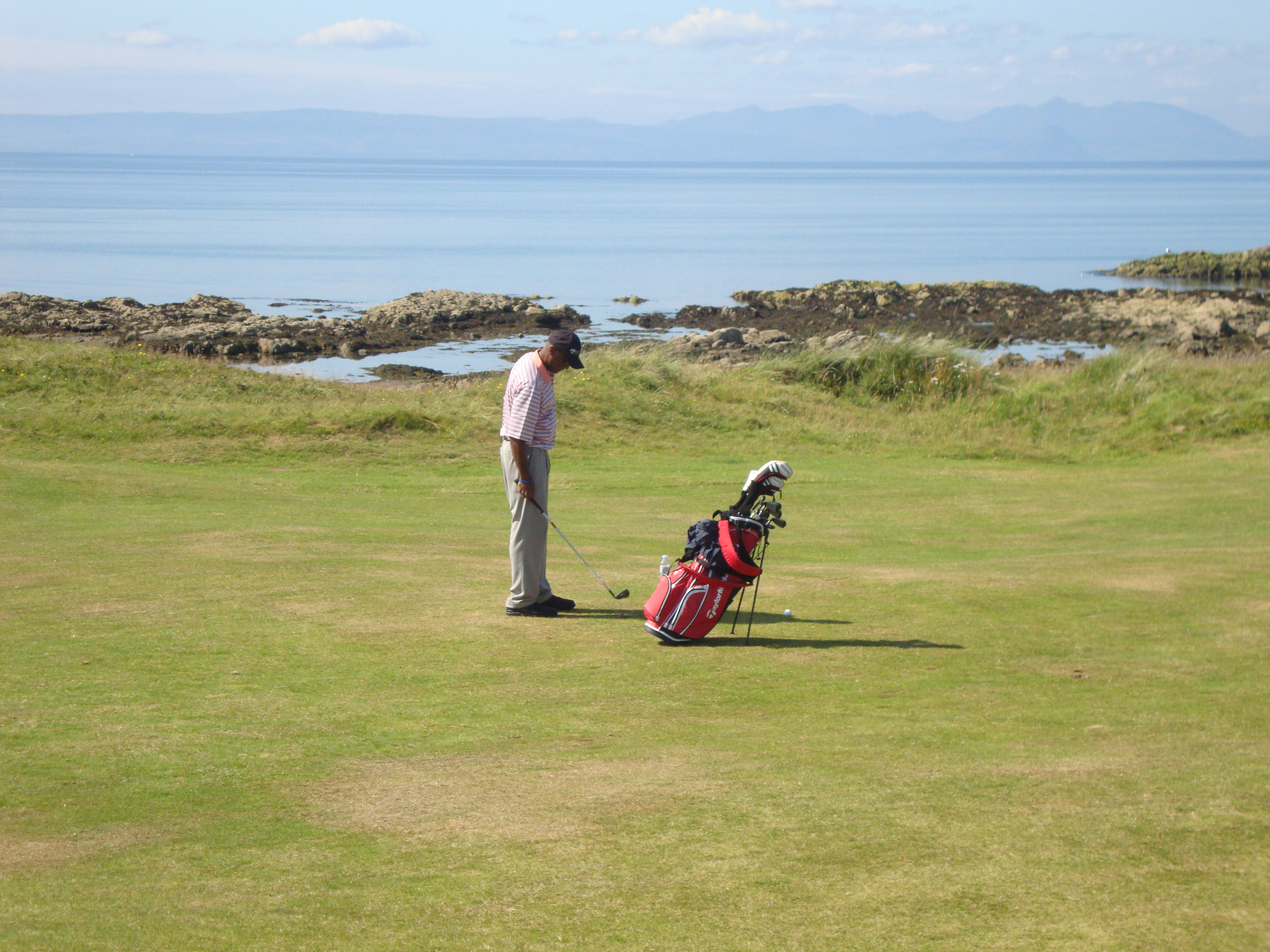
Last week I played golf at Turnberry, Scotland, rated the number one course in the British Isles, and the site of numerous British Opens. Is it really so great? In a word, yes. It was golf nirvana.

I played the famous Ailsa course the day I arrived, immediately after traveling all night. The day was sunny and mild — possibly too pleasant for a representative experience. At almost every hole, I had a shiver at the beauty. It had a raw, untamed quality, but I gradually realized that it brilliantly combined the natural contours of the terrain with a deep understanding of the essence of golf. Its authors and keepers loved the land, and the game.

It demanded constant vigilance and focus. The hazards were, in golfing terms, serious — deep bunkers with walled backs, knee-high grass, spiny gorse, and water. I had one disastrous descent into a bunker, costing four strokes to get out. But I generally controlled the ball well, with a handful of excellent shots. I did not putt particularly well till the end, when I finished with a flourish — sinking a thirty-footer on 18 for a birdy. I ended up with a 92.

I played the Kintyre course the next day. The skies were overcast, threatening (but never quite delivering) rain, and there were gusty winds — proper Scottish golfing weather. The ocean is a bigger element in this course, and the bunkers less. It seemed less imposing than Ailsa, with views of the surrounding hills and pastures, but the level of difficulty was challenging enough. I played reasonably well for me on the first nine (46), but had a couple of bad blow ups in the second and finished with a 99.

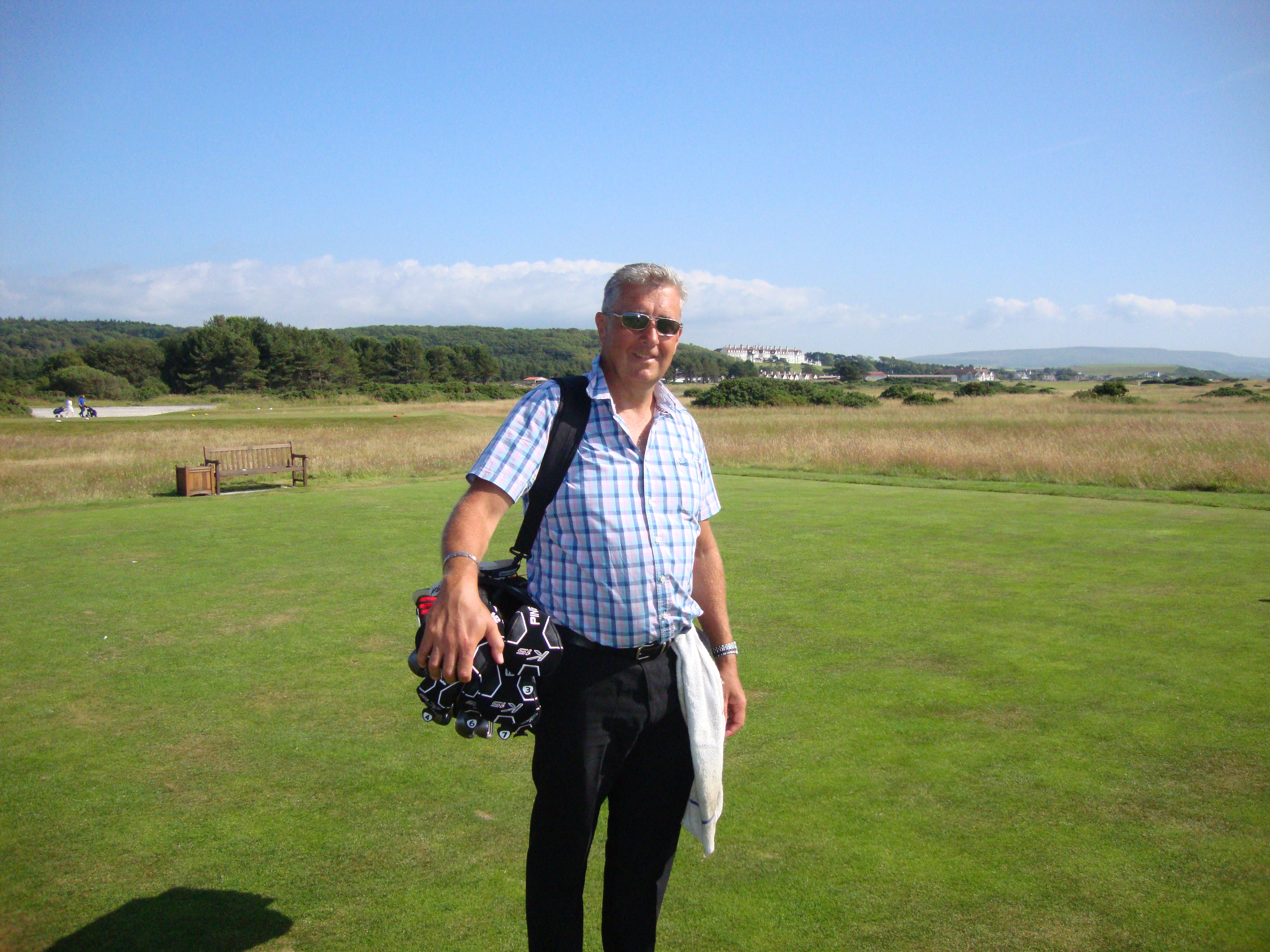
Jim, my caddie, and a Linux fan

There is something about Scotland that spoke to me powerfully. The people seemed friendly, but practical and tough and very proud of their country. The countryside was rolling and rugged. I got a lesson in single malt whiskey, and learned that it a dash of water loosens it up.

After finishing my meetings, I had a few hours to walk about in Glasgow, and found it a lively, modern city with Victorian charm. I made a stop at the Gallery of Modern Art to see works of several contemporary artists, and also visited the Kelvingrove Museum. Their collection of Impressionists and Post Impressionists is quite good, and I also liked their collection of 16th century armor. There were lots of people out in Kelvingrove Park, which reminded me of Central Park in New York, but with grass tennis courts and lawn bowling.

The trip back was long — about 19 hours all told. It started with a 5 hour delay because of weather in Newark, and the 7 air hours were bumpy. One good word for Continental — they provided surprisingly tasty curry as part of my requested vegetarian meal. I ran out of electricity on both my iPod and iPad, and came close to running out of other reading material (horrors!).

The Newark to Raleigh leg was uneventful until near the end, when the pilot suddenly pulled up from the final approach and banked to circle around. My first thought was that I might have a rookie pilot, but he explained that there was a local thunderstorm with microbursts of wind. A few minutes later we made the final approach, and the plane began bucking and shimmying. I focused on deep calming yoga breaths.

Open source ballet

A good conversation over a fine dinner is one of life’s true pleasures. Sally and I went out with our ballerina, Lola Cooper, for dinner at Solas last night and had a great time. By virtue of our donations to Carolina Ballet, we’ve become the sponsors of Lola’s pointe shoes, an essential tool for classical dance. We’ve talked with her several times, but hadn’t had a chance to break bread together before. Happily, Solas has a special menu for vegetarians, which they will produce if you ask.

Lola, it turns out, in addition to being a rising star, is a lively and interesting young woman. Ballet dancers are almost by definition highly focused individuals. The form demands a lot from its embodiers: years of rigorous training, physical stress, competitive pressure, performance anxieties, and unremitting discipline. In exchange, dancers get a shot at transcendence. It’s hard to be a great dancer and a scholar, for example. Not impossible, certainly, as I’ve been reminded recently in reading Apollo’s Angels, a history of ballet by Jennifer Homans, a former dancer. But challenging.

Anyway, Lola’s pursuing a bachelor’s at N.C. State and keeping her intellectual side engaged. We talked about travelling in South America, organic food, painting, yoga, and families. All interesting and fun. And dance, of course. She told us about some of her personal challenges with a grueling rehearsal and performance schedule. I told her the short version of my idea for open source ballet.

The idea is to adapt some of the concepts of open source software to dance. Open source software developers hold that the best way to make great software is to freely share code and ideas in a collaborative way. They use internet tools to leap over barriers of geography. Instead of holding onto the copyright in their work, they use open source licenses to encourage use of the code by others. As this methodology has spread through the tech world in the last three decades, it has resulted in an astonishing amount of creativity and innovation in software development.

How does this apply to dance? Dance is in part a collaborative art that draws on the creativity of others. Choreography uses a vocabulary of movement that has been developed by prior generations and that continues to be enriched by artists today. Although the sharing of movement ideas is not always acknowledged, it is a fundamental part of how ballet is made. Of course, each real artist makes work that is also in important ways original. But it is hard to conceive of a new ballet that owes nothing to ballets that came before.

So there’s an aspect of ballet that is already collaborative. In general, though, there’s a concern in ballet with trying to protect the intellectual property rights associated with a new dance work by limiting recording and forbidding copying of recordings. The background assumption is that the creative work could be stolen to the detriment of the owner. But is that likely? It might well be that videos of a ballet would proliferate, but this would only be bad if it hurt the market for recordings (which is negligible), or the market for live performance of the work. In fact, it would probably expand the audience for the work and enhance the reputation of the choreographer and performers.

This open source approach flies into the face of conventional intellectual property ideas. Those ideas are so familiar that they seem natural, and it seems unnatural to give up certain intellectual property rights and encourage free use. But open source has worked for software, and it’s being adopted in science, education, and the arts.

The ballet application could be tried as an experiment on a limited basis, even with a single DVD of a single performance. A license that allowed free copying and a marketing campaign that encouraged such activity could put the work into the hands of new potential dance fans and supporters. It could help ticket sales and budget challenges. And it would let the artists do more of what they’re good at: transcendence, and sharing transcendence.

A difficult but ultimately satisfying swim, beautiful blossoms, and some good news regarding veggie burgers

It seems that the greater the struggle to swim some laps, the better I feel afterwards. At 6:00 a.m. this morning, I got to the pool with a plan to swim 40 lengths of freestyle (more than half a mile), and felt my heart racing uncomfortably after the first 4. But I struggled along, finished the 40, and then did 8 kickboard laps, 8 backstroke, and 8 breaststroke, and then 15 minutes of yoga. The endorphins were excellent! Driving home, I just couldn’t get over how beautiful everything looked! Blossoming dogwoods and cherry trees, blooming azaleas, and thousands of dewy green buds.

For breakfast I made myself a green smoothy in the blender with rainbow chard, apple, and banana, with some orange juice and soy milk. It tasted earthy — not delicious, exactly, but satisfying as a kindness to the body. And, reading the NY Times, along with frightening and disturbing news (nuclear plant catastrophe in Japan, mayhem in Libya), I found a cheery story: veggie burgers are getting better and more popular. http://tiny.cc/p97hm Admittedly, veggie burgers have a checkered history, but the ones in the Times story sounded delicious. According to the story, there was a 26 percent increase in menu items labeled vegetarian or vegan between the late 2008 and late 2010. That’s a remarkable increase.

I’ve been a committed plant food eater for about 15 years now, and my personal experiment has been highly successful in this respect: I feel happier and healthier than I did 15 (or even 30) years ago. But as a social matter, the veggie life has been a challenge. My non-veggie friends don’t get the point, and there’s way too much friction in figuring out ways to eat out together. It’s cheering to think that help may be on the way, in terms of increasing numbers of veggie menu items. Cheering also to think more people are eating plant-based diets that will help them be healthier.

My finger health problem

Why is it other people’s health problems are so uninteresting, and my own are so fascinating? I’m kidding. Kind of. At one level, I understand that my own health problems are of no particular general interest, but I do find them relatively interesting. It would not surprise me at all to learn that everybody else thinks the same.

At any rate, I work hard to minimize certain health risks. I consciously avoid eating things that have no nutritional value, and consciously eat a balanced vegetarian diet. I get up early to exercise most days, either swimming, spinning, lifting, doing yoga, or the elliptical machine. I use sunscreen and drink filtered water. And so on. I even quit using pans with Teflon.

None of which will help me against the wrong piece of bad luck, be it my own cells malfunctioning, an invading superbug, or a drunk driver running a stop light. But I like improving the odds. And for the most part, I like the process. True, I still haven’t figured out how to make an omelette that doesn’t stick without Teflon, which is unfortunate. But I actually look forward happily to yoga class, for example. (Which reminds me, after some struggle, I finally managed to do an unaided head stand for the first time this week. Hurray!)

The net of my exercise-and-eating program, good genes, and good luck has been a long run of no health problems that seemed interesting enough to talk about, even to me. I didn’t have even a cold in three years (though that particular string was broken by an enterprising but not particularly dramatic virus last week).

But starting last Sunday, I had a bizarre problem that seemed small at first: the tip of my left forefinger was exceedingly tender. I initially thought I must have somehow bruised it, but this seemed unlikely — it would have taken a memorable blow, like slamming it in a car door, to produce such discomfort. Over the next couple of days, it became swollen and took on hues of red or purple. It was warm to the touch, and it throbbed. I couldn’t play the piano without causing great pain, and any small ordinary knock on the finger was agonizing. I began to wonder what life would be like after amputation of a left forefinger, or the possibility that there was a serious internal problem there that could spread.

So I made a rare appointment with my GP, Dr. Gagliardi, who generally knows me only from check ups that are not as frequent as he would like. He diagnosed the problem in a matter of seconds as paronychia (an infection), and said he would cut it to let out the fluid. I noted that I have a reasonably high pain threshold, but because of the extreme sensitivity of the finger, it would be nice to have some anesthetic for this operation. He said that was impractical. So I took a deep breath.

Fortunately, he found some deed skin to cut on, and I never felt a thing when he did the cutting. And in a moment a yellow pus began to emerge in surprising quantities. I began to feel better almost immediately. I’m using a prescription antibiotic cream and band aids to complete my recovery. The wonders of modern medicine! Every now and again, it works really well! Thanks, Dr. G!

A proposal that we stop spending tax dollars on promoting cheese eating and think more about our food

Food is not only good to eat. It’s good to think about, and also sometimes bad to eat. Here’s some food news from today’s NY Times — a piece headlined While Warning About Fat, U.S. Pushes Cheese Sales. http://tiny.cc/fsi57. It turns out that millions of our tax dollars go towards encouraging cheese eating. Some of the taxes we’ve paid have gone to develop fast food with more cheese in it, such as a new super-cheesy type of Domino’s Pizza.

According to the Times, cheese is now the largest source of saturated fat in the American diet. Saturated fat is linked to heart disease and obesity, which are associated with premature death. Of course, cheese tastes good, and eating a little isn’t a huge risk factor. But why would we even think about involving government in promoting it?

Apparently the reason has to do with a special interest: the dairy industry. People are getting the message that the fat in milk is unhealthy, and buying less high-fat milk. This means dairy producers have excess capacity. Too bad for them. Subsidizing cheese is like subsidizing tobacco. It’s not only dumb — it’s wrong. Here’s an idea for Republicans interested in eliminating wasteful government programs: let’s cut this out.

When we had dinner at home Thursday night, Sally and I talked about our own eating decisions and customs. This is a subject we try to avoid when eating in company, because it detracts from the enjoyment of food and friendship. When the issue of vegetarianism comes up, some non-vegetarians are curious, but others react defensively. For most people, it involves thinking about animals and nutrition in a different way that is at first uncomfortable. For us, it has involved many years of both thinking and practical experience that are difficult to reduce to a short explanation. And there are many topics for dinner conversation that are easier and more fun.

Yet not discussing it bothers me almost as much as discussing it. As with other enormous moral issues such as slavery and genocide, the decision not to speak out has moral implications. I try to be as honest as I can about my thoughts and feelings, and dislike leaving the false impression that the basic cruelty of industrialized animal production and consumption is a minor matter, or that I think it’s fine to kill sentient creatures when there are better choices easily available.

But giving value to the welfare of animals or changing eating habits goes strongly against the grain of our culture. Our habits of eating have deep roots and a multitude of personal associations and meanings, and it’s hard for most people to think about changing them. So we have a kind of gridlock involving morality and culture: it’s morally unacceptable not to confront the situation, and also culturally unacceptable to do so.

So I’m very happy as a plant-based eater that my values and eating habits are better aligned than ever before. (I should note that I don’t think they’re by any means perfectly aligned, and should confess that I still eat some cheese.) I’m very happy that I have interesting, varied, tasty meals a high percentage of the time. I’m also very happy that my diet is doing a lot of good for my health. But I’m not so happy that this puts me at odds with some people.

A bunion, a birthday, and an edible work of art

While we were at the class at the Carolina Ballet studio last week, at one point Peggy Severin-Hansen sat on the floor beside me and did some work on her feet.  We’ve been watching her for many years as she rose through the company ranks to become a soloist, and we just love her dancing.  Having the chance to see her working on the bandages on her toes was  intimate, like being in the family.  I thought of sharing with her that I too have foot problems (a bunion) but thought better of it.  She probably wouldn’t have appreciated the comparison.

One of the problems of a bunion, in addition to discomfort, is that it isn’t a good conversational topic. Other people’s health problems are usually uninteresting, but not all are equally off-putting.  There’s no particular stigma to talking about knee problems, wrist problems, or back problems.  But bunions are generally an older person’s issue.  Who likes to think about getting old?  Not me.  I do, however, now understand why there is a section for Dr. Scholl’s foot care products in the pharmacy.  It’s become one of my favorite sections.

As of yesterday, I know how it feels to be 55 years old.  I hate to make a big deal of birthdays, but I’m struck by how big a number this is.  It is clearly no longer the early fifties.  It is old enough to be a parent to two full-grown adults, and in theory old enough to be a grandparent.

But I feel young!  Both in good ways (plenty of energy and enthusiasm) and not-so-good ways (areas of uncertainty and insecurity).  In many ways, I’m healthier and happier than I was in my twenties.  I never completely lose sight of the possibility that there could be a piano hanging over my head and about to drop, in the form of a serious illness or random accident.  But with enough time and some good luck, perhaps I’ll someday look back over many years and think how young I was in 2010, but how I still feel remarkably young, all things considered.  Of course, this may turn out to be my apogee.

To celebrate the day, Sally got us a table at Second Empire, one of our favorite restaurants, and we walked there from our apartment.  It’s a restored grand old residence with elaborate ornamentation, and very traditional in a way.  But it avoids being stuffy with eclectic art, jazz, a great staff and highly imaginative food.  Our server was Katrina.  She was lively, smart, and friendly, and completely undaunted when I told her that we were vegetarians and wanted them to create something special for us.  She assured us they liked vegetarians and would enjoy the challenge to their creativity.  Music to my ears!

In fact, everything on the menu looked great except the animals, and our only suggestions were that there be pasta and perhaps a Spanish theme.  The dish that arrived had rigatoni and spices, with a unique combination of textures and tastes.  It was excellent!  For dessert, I planned to sample Sally’s cake, but they brought me delicious ice cream with a candle in it and a happy birthday message written on the plate in chocolate.  When we got the check, I thought they’d accidentally undercharged us, since there was just one main dish listed.  When I asked Katrina, she assured me that they’d considered the dish that we shared to be one.  Truly, this a great and wonderful restaurant.

A beach trip, with a note on failure

For Memorial Day, we took Clara on her first road trip out to Jane and Keith’s beach place.  I enjoyed the drive.  We came over the bridge towards Nags Head just as the sun was setting.  The Outer Banks are not Monte Carlo.  It’s not about glamor.  But the area can induce serenity and happiness.  Traffic on the island moved slowly, and we sampled the local radio stations — a fundamentalist preacher, 80s rock, country, and my favorite, hip hop.  It was good at last to see Corolla again.

Keith is a grill chef extraordinaire, and for our benefit volunteered to go all vegetarian for the weekend.  Having recently mastered gluten-free cooking, he seemed to appreciate the challenge, like a high jumper who wants to go higher.  He made waffles with fruit and honey whip cream for breakfast.  Delicious!  A tomato cucumber soup with hot cheese pie for lunch.  Scrumptious!  Stuffed peppers and corn flan. Extraordinary!  He tried a rich chocolate torte, which he judged too dry and threw out.  The second effort was a great success.

We went to the beach in the afternoon,  Sally donned a wet suit and swam with my niece Kylie and nephew David.  I piloted a kite for a bit before it crashed, and I reread a bit of Endurance, by Alfred Lansing, the incredible story of Ernest Shackleton’s 1914 expedition to cross Antarctica, which was a failure in terms of its original mission, but a success in terms of its plan B — survival.  It’s nice to a frigid, desperate story and a sunny beach.

David, 10, is mad for lacrosse, and insisted while we were on the beach I learn something about it.  He let me use the shorter stick.  Under his intense coaching, I managed to make some catches and throws, and was pleased.  I also missed some catches and made some bad throws, which was less fun.  But I persisted for a while, even with little expectation of ever being any good, partly to humor David, and partly to continue road testing my theory of failure.

It’s this:  greater acceptance of failure increases the possibilities for happiness.  Part of the reason is that we learn from failure.  In any new endeavor, we start out incompetent, so we make mistakes, and if we persist we gradually work out how to make fewer mistakes.  Every significant accomplishment (apart from the occasional stroke of pure luck) is the result of many failures.

But there’s a broader reason for greater tolerance for failure.  Clearly, failure does not always lead to success.  Most of the things we could try will not turn out well, because no one can be good at everything. But if we decline to accept our own failure, we narrow our range of experience.  I might have missed lacrosse, or skiing, or Liszt.  If we give ourselves permission to fail, we can try new things, and be happier.

Up in the air: Dallas travel routines and adventures

I’m wearing a groove in the stratosphere at 30,000 feet between Raleigh and Dallas.  As we near a federal trial on patent infringement in the Eastern District of Texas, I’m learning well the routines of our airlines and regulators.  My former resentment at being required at the security gate to remove my shoes and computers and be scanned and sometimes frisked has mostly been replaced with resignation (“let’s just get this done”).  The required speech by the flight attendants on seat belt, emergency oxygen, no smoking, and exit rows has become like the Mass, almost impossible to listen to and understand because it’s so familiar.

There are, of course, better and worse routines.  I achieved Priority One status with American a few months back, and it made me happier than I expected.  Before I got Priority Oneitized, I had not realized that the reason I was generally among the last to be called for seating and generally seated in the back of the plane was that others had higher status in one of its several flavors.   Thus, pre-Priority-Oneitization, I was always, with reason, worried about finding a spot in the overhead bin for my rollaboard case; on full planes the bins were always close to full.  Post PO, I get seated early, hoist my case and wedge it in to a convenient overhead spot without danger to nearby boarders, settle into my seat, and watch the later boarders struggle with the problem of crowded bin space.  Do I feel badly?  A little.  Not too much.

I’ve also learned to work around some of the little difficulties and indignities that have become routine parts of air travel.  I make it a little game to see if I can nourish myself with only relatively healthy, relatively tasty vegetarian food.  Yes, it’s very challenging in airports, where the main food groups are “fast” and “junk.”  But it’s not impossible.  I typically pause in Terminal Two in Raleigh at Camden Foods to buy a hummus wrap, grab some paper towels from the men’s room to use as napkins, and look forward to a relatively calm dinner once on board.

One of the joys of travel, though, is unpredictability.  Last week my temporary assistant booked my Dallas trip, and being new she did not know to use my frequent flyer number.  I was again one of the unwashed, in the boarding group “not yet,” in the seat “way back,” between two other passengers.  Surrounding me were people who seemed unused to flying.  It was unusually hot and unusually noisy.  I had an eight-inch thick stack of memos, reports, and articles to get through.

The woman to my right (by the window), seemed to be turned toward me when I sat down, and I thought at first she was saying something to me.  She didn’t respond to my greeting and seemed to be talking to empty space.  I then assumed she had a cellphone somewhere.  It turned out that she was speaking with a fellow in the row behind us, and she continued talking between her seat and mine in the space next to my right ear.  At first I thought she was wrapping up a conversation started prior to boarding, but this turned out to be wrong.  I then thought of offering to switch seats, but the fellow seemed to be also chatting with another fellow next to him, and I couldn’t figure out the relationships.  Eventually I deduced that my seat mate and her aft friend were co-workers headed to a conference who had discovered a mutual attraction.  There was not a lot of personal content, but the tones were highly animated.  Flirting, in short.  It flared up, settled down, flared again, and so on.  At the earliest permitted moment (after “the captain has turned off the fasten seatbealts sign”), I got my noise-cancelling headphones in place and tuned out as much of the chat as I could.

In due course I unwrapped by hummus wrap, trying not to spread hummus on the memo I was reading and marking up, trying to avoid getting food on my pants (there were no back up pants) or shirt, hoping I wouldn’t run out of paper towels (my napkins).  And hoping that the one remaining routine meaningful service of the flight attendants, the drink cart, would come quickly.  It is difficult to eat a hummus wrap without something to drink.  I just learned this fact on that flight.  The mouth gets very dry.

At just this point a passenger on the flight passed out.  People craned their necks trying to see what happened.  I couldn’t see anything, but my aisle-side seatmate briefed me.  An attendant made an announcement in a serious voice asking if there were a doctor on the plane.  There was.  The passenger soon revived, and the doctor gave his opinion that an emergency stop was not necessary.  I was glad that the passenger was apparently all right.  I was sorry, though, that the flight attendants determined they could not distribute any beverages.  They announced that this was due to the medical emergency.  Given that the patient seemed normal and a doctor was watching the situation, I wondered at this explanation.  My mouth got dryer.

An hour later, I smelled a strange smell, similar to rubbing alcohol, which at first I thought might have to do with the “medical emergency.”  Then I recognized it as nail polish.  Then I realized that my seat mate had paused in her conversation to do her nails.  In the confined space, the odor was powerful and made my eyes water.  I examined the distance between the bottle of red liquid, the edge of the seat tray, and my knee, and wondered how likely it was that a sudden bump could cause the bottle to turn and spill its contents onto my pants.  I tried to remember if I’d ever seen anyone do her nails on a plane before, and couldn’t remember a case.  I wondered if this was because it was illegal or just impolite.

I worried a little that I might be getting to be a grouchy curmudgeon.  She dried them with by waving, fingers spread, the traditional method.  Then I noticed they were beautiful.