The Casual Blog

Tag: The Wild Swans at Coole

The Wild Swans at Pungo
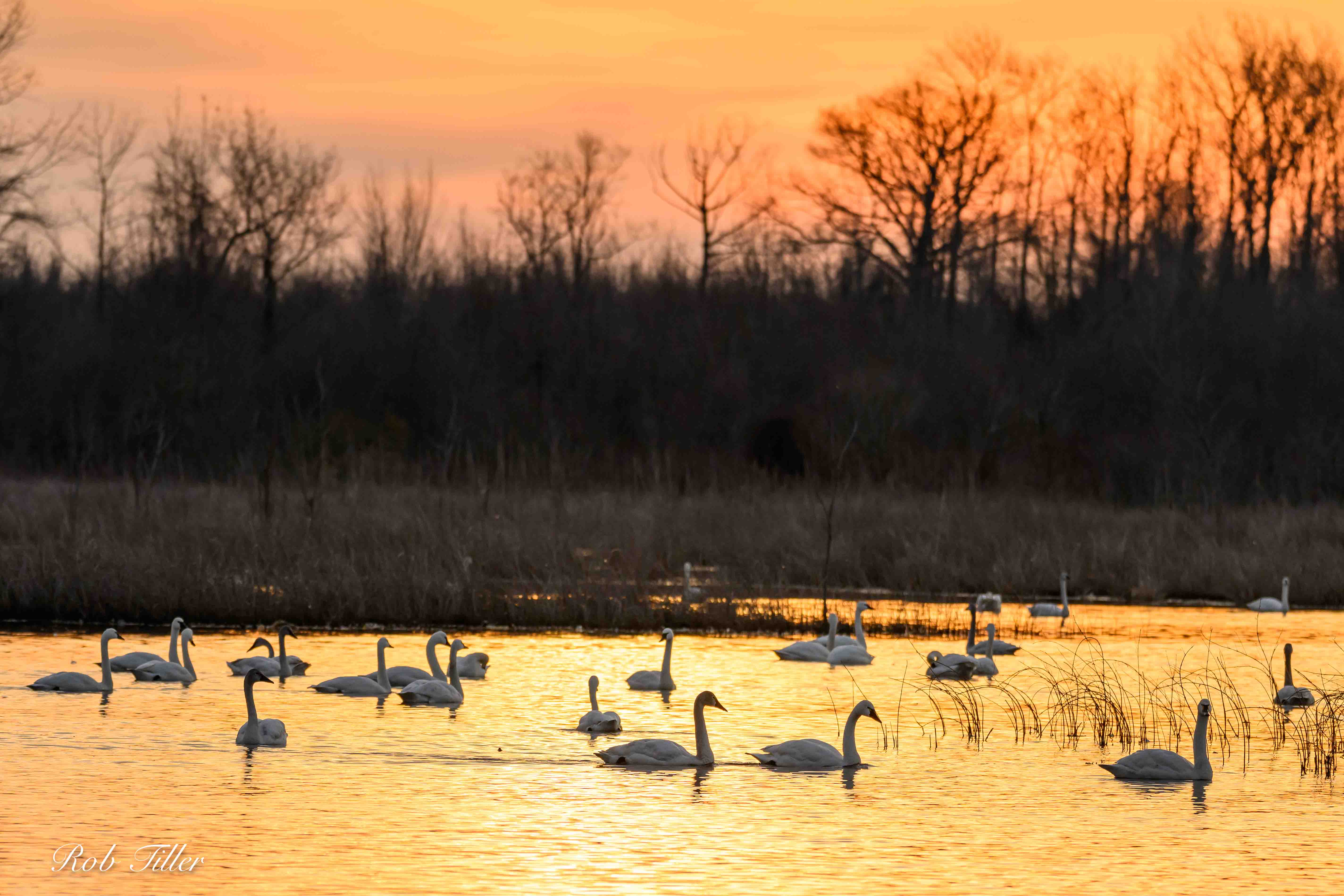
Last week I drove to the Pungo Lake area of the Pocosin Lakes National Wildlife Refuge to look for tundra swans and other birds.  In the last couple of years I didn’t see too many swans there, but this time, there were a lot!  

Tundra swans are big birds (think 6 foot wingspans, 20 pounds) that  migrate thousands of miles every year between their breeding grounds in the Arctic and points south, of which eastern North Carolina is a major one.  They are sociable creatures that can form flocks of hundreds or thousands.   They’re very vocal, calling each other with loud honks, and large groups can sound like a stadium full of football fans.
The basic family unit includes a cob (male) and a pen (female) that mate for life.  Cygnets (the kids) may stay with their parents for up to a year.  The cygnets go through a brownish phase before getting their white adult plumage.   
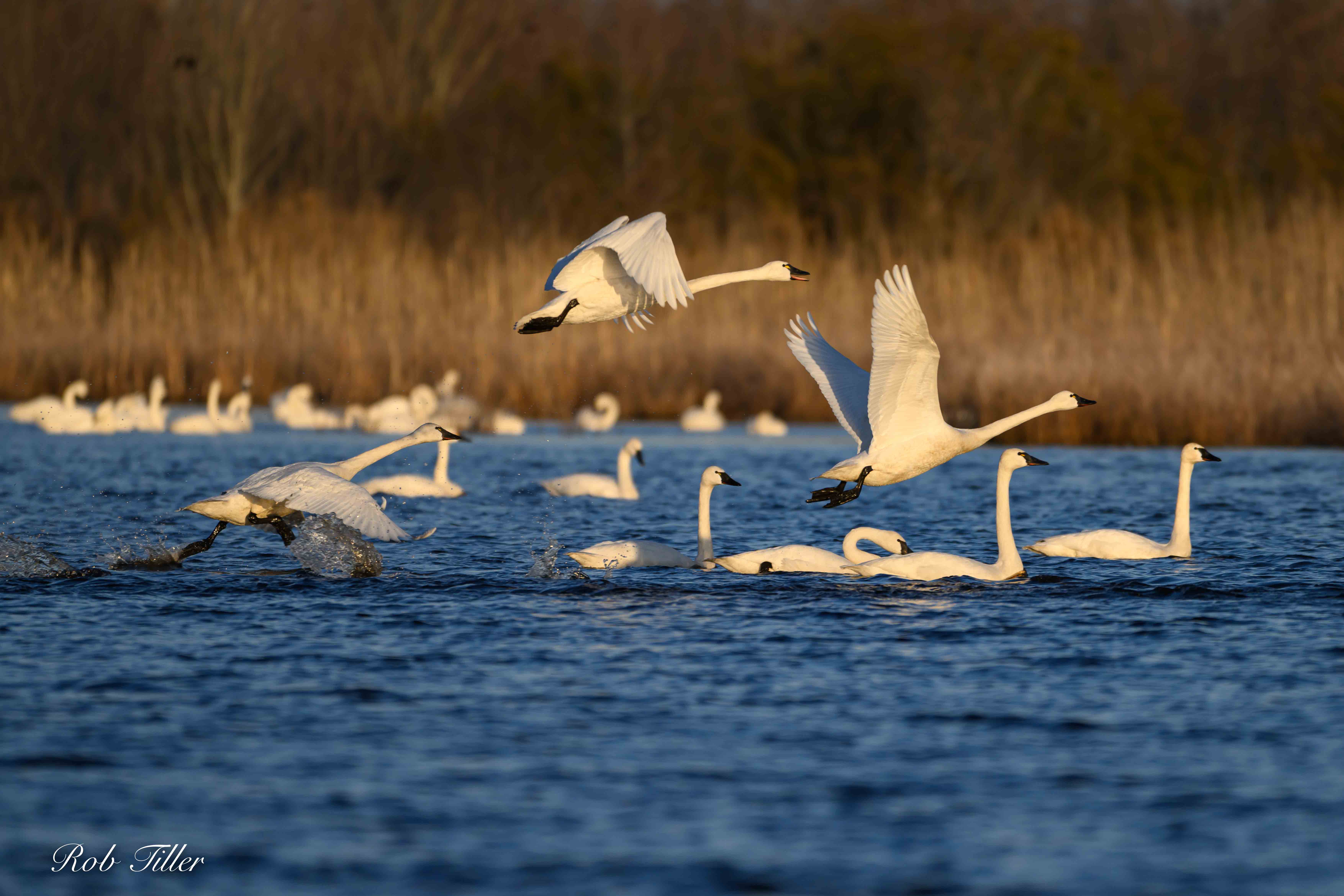
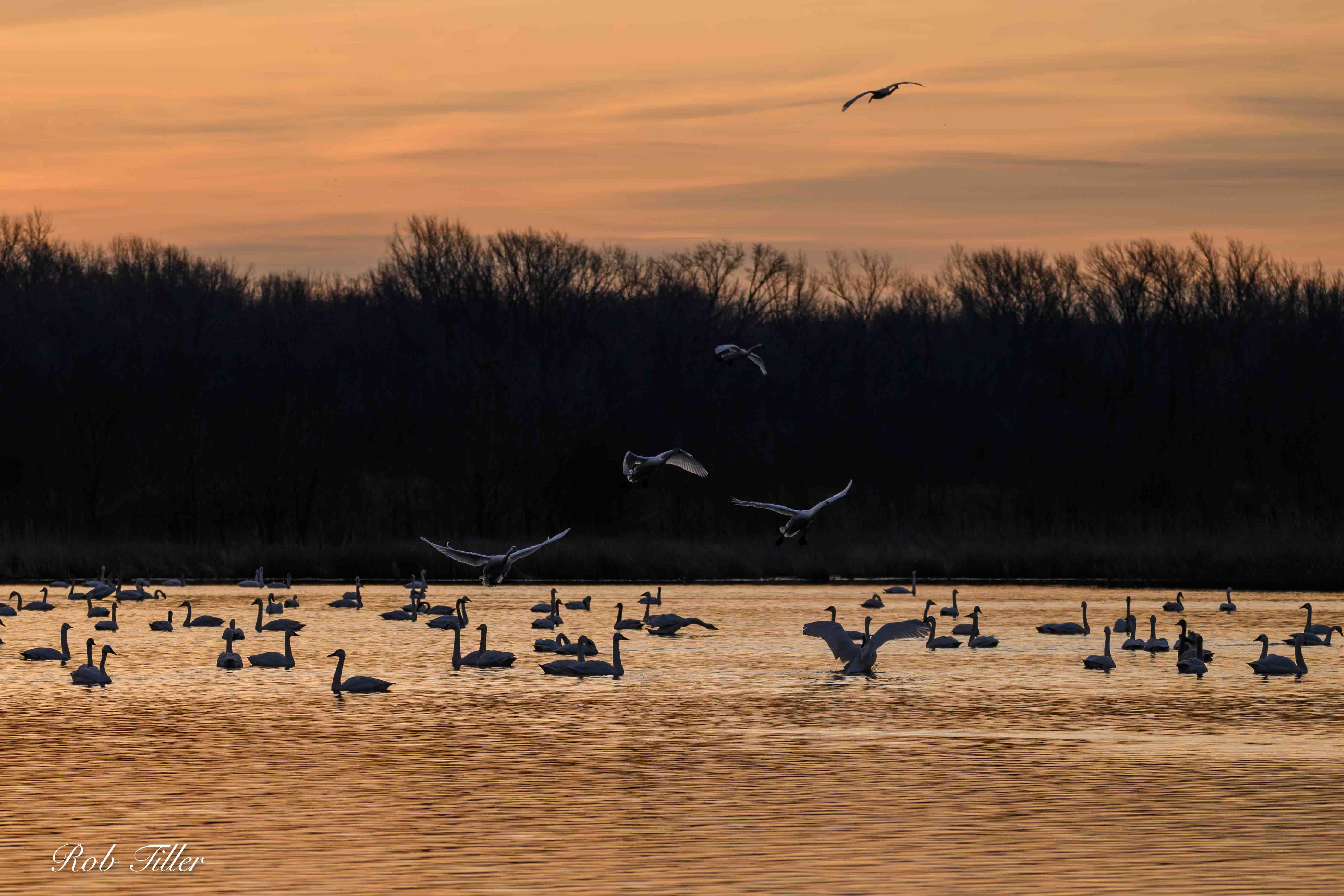
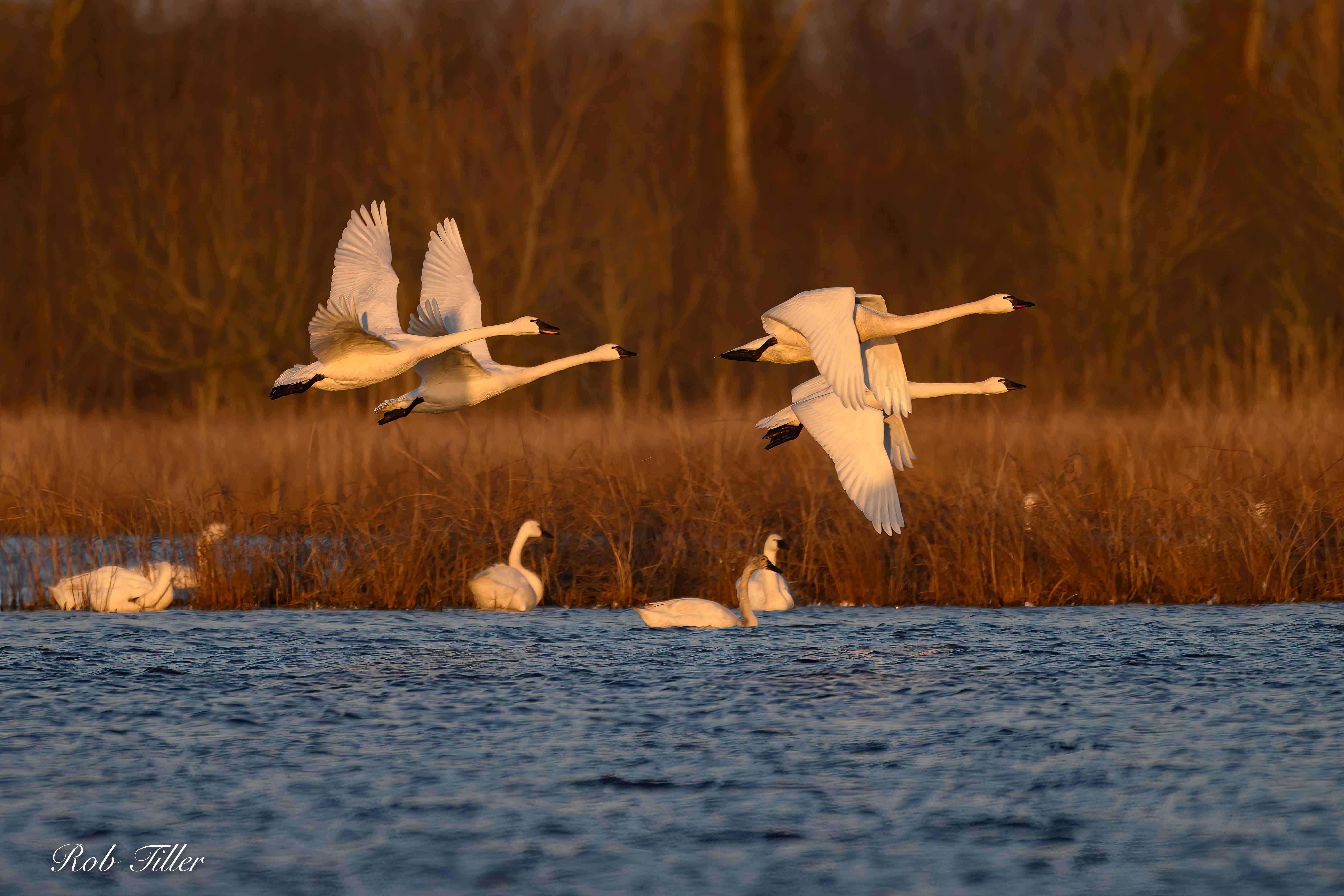
The swans are strong, graceful flyers, and calm, stately swimmers.  But they have to work hard to get airborne!  From a seat on the water, they flap vigorously while running along the surface. 
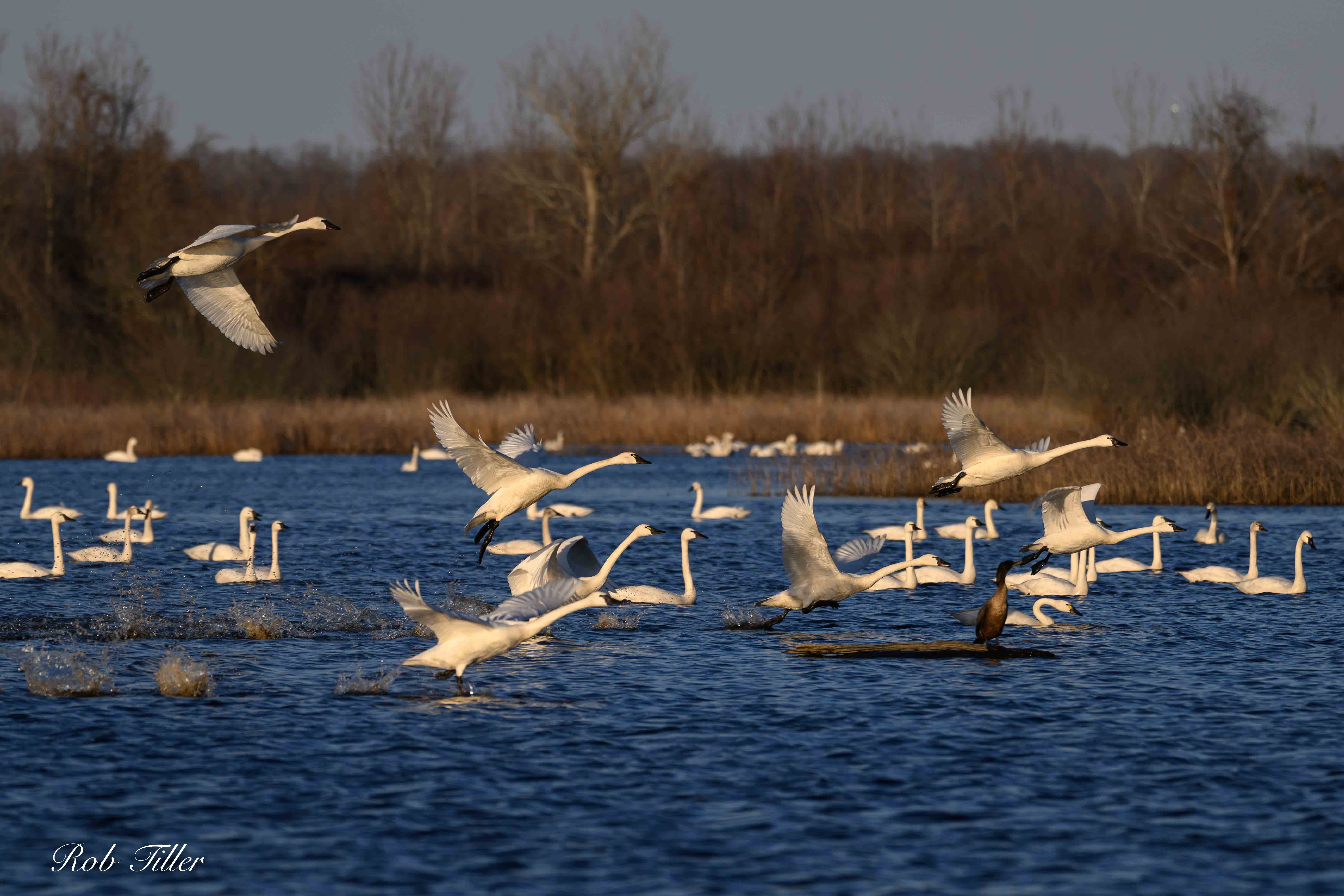
One afternoon I watched and listened as dozens of them did this maneuver.  There were only a couple of other folks on the shore of the pond, who like me were trying to take pictures.  It was a little chilly, but sunny, and peaceful, at least for those of us who didn’t need to take off.  
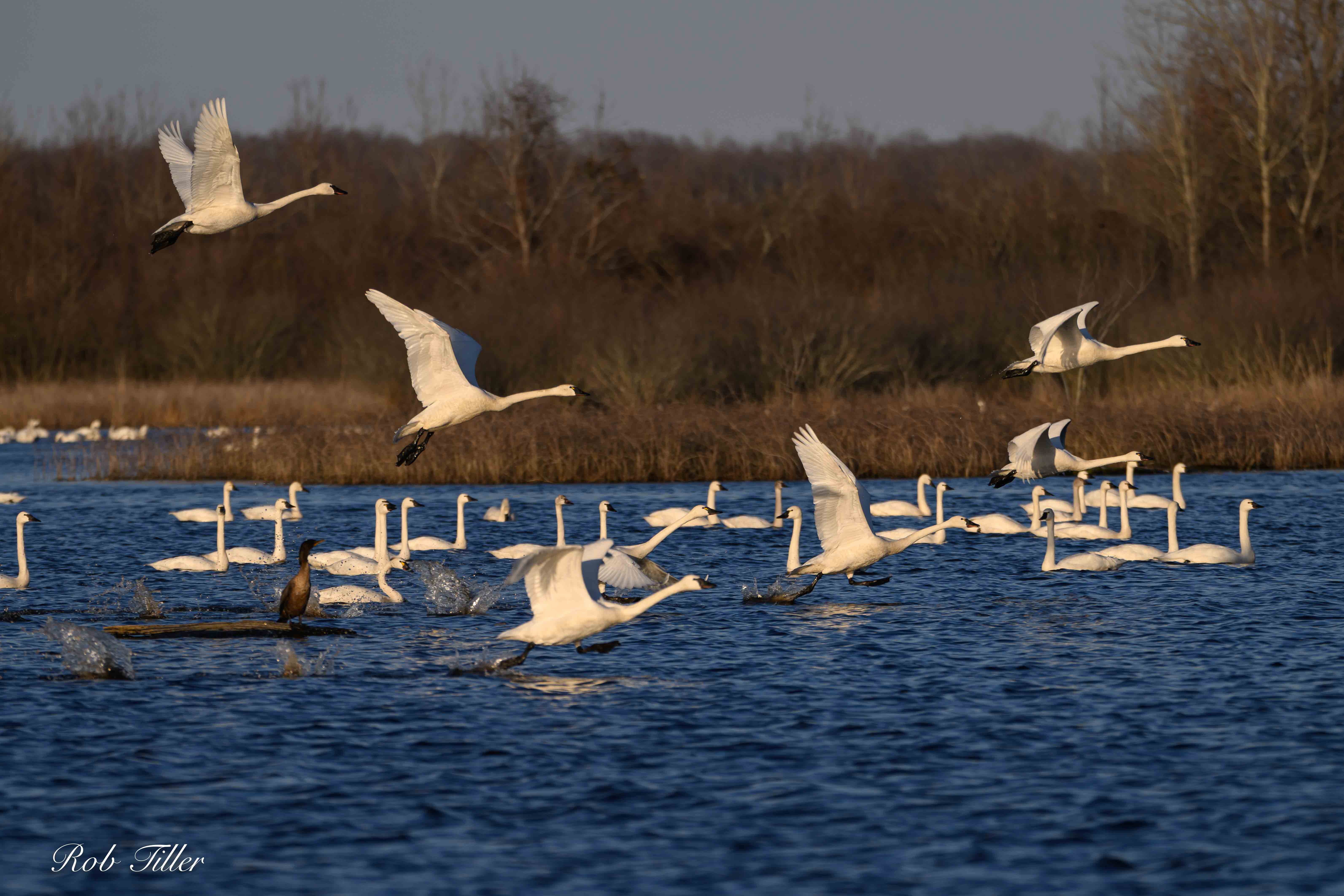
“Their clamorous wings” as they climbed put me in mind of Yeats’s wonderful poem The Wild Swans at Coole.  It’s a meditation on aging and mortality, together with the consolation of nature’s lasting vigor.  Yeats lauds the beauty of the birds, and their independence from us, with their own passions and conquests.    

Speaking of mortality and the lessons animals teach us, I was saddened to hear today of the death at 73 of Steven Wise, a pioneering crusader for animal rights.  The NY Times obit is here

Wise brought lawsuits on behalf of chimpanzees and other animals arguing that they were legal persons entitled to certain rights.  His legal work, writing, and teaching brought increasing attention to the question of how we should treat non-human animals.  Although his approach seemed to me problematic, since it was centered on arguments about certain animals’ human-like abilities, I greatly admired his intelligence, courage, and passion.  

I finished a new book directed at the question of whether humans have free will:  Free Agents:  How Evolution Gave Us Free Will, by Kevin J. Mitchell.  Mitchell is a professor of genetics and neuroscience at Trinity College Dublin.  His book addresses deep questions around the meaning of life with a lot of information about the workings of the brain.

Mitchell has an answer for determinists like Robert Sapolsky, who hold that all our behavior is predetermined by physics, and that our impression of mental independence is an illusion.  Starting with the simplest forms of microbial life, Mitchell applies Darwin’s theory of evolution and argues that agency and purpose are fundamental characteristics of life.  
I didn’t get all Mitchell’s explanations of brain cell biology, but I think I got the basic ideas.  Animals evolve to survive, which requires that they learn to respond to an ever-changing environment.  The most complicated brains we know of (our own) not only make top down decisions related to survival, but are capable of changing our own more basic processes and thinking about our own thoughts.  

Mitchell notes that there are various ways of thinking about freedom, and every being is constrained by its environment, biology, inherited traits, memories, etc.  But within those constraints, Mitchell contends we make meaningful choices.  This makes sense. 

In addition to providing a persuasive framework for thinking about free will, Mitchell’s account emphasizes the interconnectedness of the world.  He suggests that we are not independent objects, but a large set of processes that are acted upon, and act upon, everything else.  The book is an encouraging integration of science and spirit.

Wild swans in eastern North Carolina and posthumanism

blogpicbug-1

This past weekend I drove to eastern North Carolina to see wintering tundra swans and other brilliant creatures.  The swans were there — hundreds of them!  These are majestic birds, with long necks and seven-foot wingspans.  They look quiet and elegant as they swim, but they’re very vocal, barking and squawking, sounding from a distance like a huge crowd of little kids at an exciting  sporting event.  

For part of the time I was travelling with members of the Carolinas Nature Photographers Association.  We stayed in the Holiday Inn Express in Plymouth, which was fine.  The CNPA folks were friendly and knowledgeable, and I enjoyed talking with them about such things as camera lenses, post-processing, and wildlife.  I took these pictures with my Nikon D7100 and a Sigma 150-500 lens (a beastly large piece of glass) on a Vanguard tripod.

blogpicbug-1-7

To get to the birdy places, we had to drive a good ways down muddy dirt roads.  I unwisely brought my sports car, and was more than a little anxious at points that we’d get stuck in the mud, with uncertain prospects of getting unstuck.  We never quite got caught, though we did get muddy.  We explored Pocosin Lakes (mostly at Pungo Lake) and Lake Mattamuskeet.

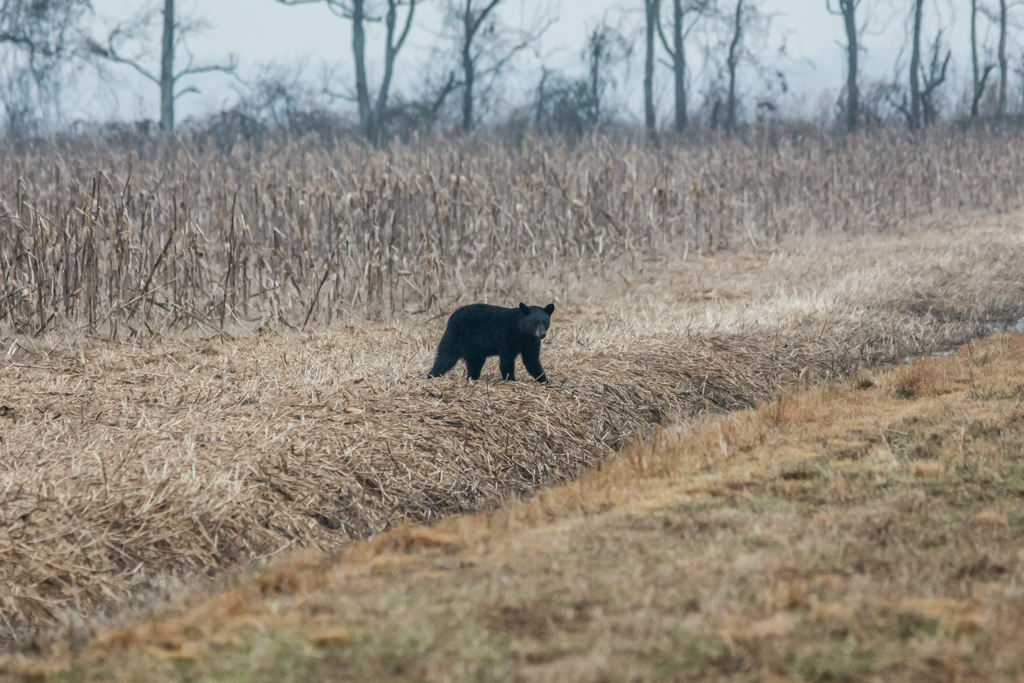
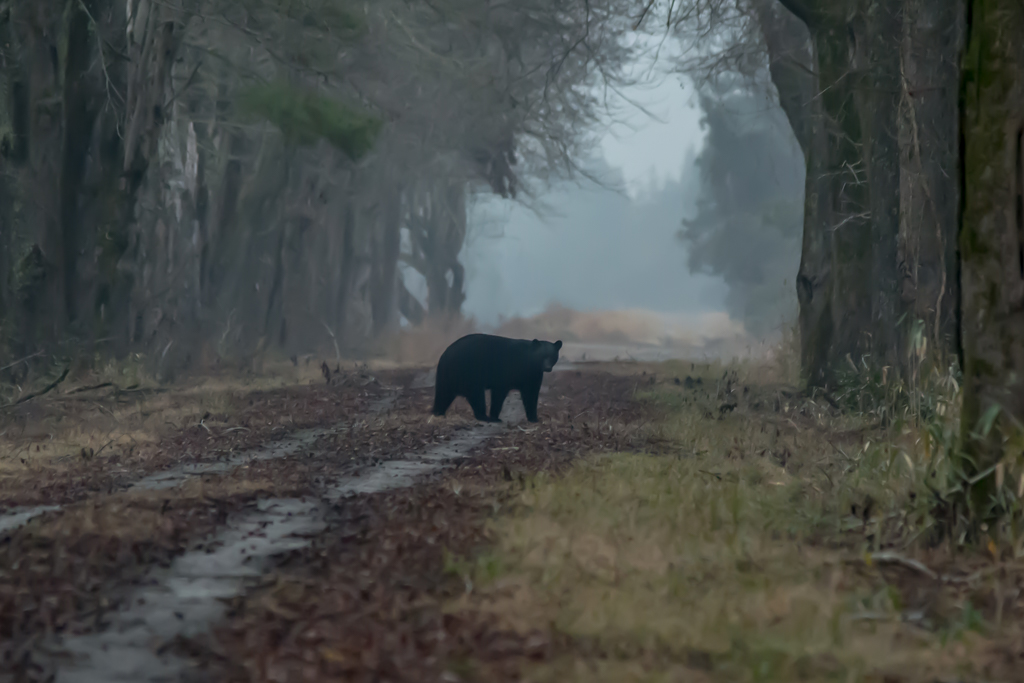
Once I got over the initial goosebumps of seeing the crowds of swans, I started looking for snow geese, but without success.  I  did see various pretty ducks, including northern pintails and northern shovelers, as well as great egrets, great blue herons, and black crowned night herons.  I also saw three black bears, including a youngster.

blogpicbug-1-9

It was wonderfully absorbing and calming to be beside the water, removed from civilization, relatively (my phone had 0 bars ).  Given the fraughtness of our current political drift, it was a particularly good time to be outdoors and close to all that non-human life.  Earlier in the week, I’d read an intriguing column about posthumanism, which resonated with me strongly.

blogpicbug-1-11

More and more, I’ve found myself unsatisfied with the common assumption that people are by definition superior to other animals, and disturbed by the dark implications of that assumption.  It turns out that these are issues addressed by posthumanist thinkers.  The column, an interview by Natasha Leonard of Cary Wolfe, is worth reading in its entirety, but here’s a sample.

Humanism provides an important cultural inheritance and legacy, no doubt, but hardly the kind of vocabulary that can describe the complex ways that human beings are intertwined with and shaped by the nonhuman world in which they live, and that brings together what the humanist philosophical tradition considered ontologically separate and discrete domains like “human” and “animal,” or “biological” and “mechanical.”

. . .

So on the other hand, what one wants to do is to find a way of valuing nonhuman life not because it is some diminished or second-class form of the human, but because the diversity and abundance of life is to be valued for what it is in its own right, in its difference and uniqueness. An elephant or a dolphin or a chimpanzee isn’t worthy of respect because it embodies some normative form of the “human” plus or minus a handful of relevant moral characteristics. It’s worthy of respect for reasons that call upon us to come up with another moral vocabulary, a vocabulary that starts by acknowledging that whatever it is we value ethically and morally in various forms of life, it has nothing to do with the biological designation of “human” or “animal.”

. . .

My position has always been that all of these racist and sexist hierarchies have always been tacitly grounded in the deepest — and often most invisible – hierarchy of all: the ontological divide between human and animal life, which in turn grounds a pernicious ethical hierarchy. As long as you take it for granted that it’s O.K. to commit violence against animals simply because of their biological designation, then that same logic will be available to you to commit violence against any other being, of whatever species, human or not, that you can characterize as a “lower” or more “primitive” form of life. This is obvious in the history of slavery, imperialism and violence against indigenous peoples. And that’s exactly what racism and misogyny do: use a racial or sexual taxonomy to countenance a violence that doesn’t count as violence because it’s practiced on people who are assumed to be lower or lesser, and who in that sense somehow “deserve it.”

That’s why the discourse of animalization is so powerful, because it uses a biological or racial taxonomy to institute an ethical divide between who is “killable but not murderable,” those who are “properly” human and those who aren’t. So the first imperative of posthumanism is to insist that when we are talking about who can and can’t be treated in a particular way, the first thing we have to do is throw out the distinction between “human” and “animal” — and indeed throw out the desire to think that we can index our treatment of various beings, human or not, to some biological, taxonomic designation. Does this mean that all forms of life are somehow “the same”? No, it means exactly the opposite: that the question of “human” versus “animal” is a woefully inadequate philosophical tool to make sense of the amazing diversity of different forms of life on the planet, how they experience the world, and how they should be treated.

I was enough intrigued by this to download Wolfe’s latest book, but soon found it tough sledding.  Based on Wolfe’s many references to Jacques Derrida, it sounded like I might need to go back and get a deeper understanding of Derrida’s work.  I downloaded Derrida:  A Very Short Introduction, by Simon Glendinning, which at any rate hasn’t yet been hopelessly confusing.  This might be fun and illuminating (though it might not).  

Anyhow, the swans made me think of  The Wild Swans at Coole by W.B. Yeats, just as Yeats had helped draw me towards the swans.  I once memorized these stark and poignant lines and enjoyed rereading them, and hope you will as well.  It’s an amazing feat to combine with seeming simplicity such wonderful sensuality and the steady-eyed confrontation of  death, that most difficult of subjects.


The trees are in their autumn beauty,

The woodland paths are dry,

Under the October twilight the water

Mirrors a still sky;

Upon the brimming water among the stones

Are nine-and-fifty swans.


The nineteenth autumn has come upon me

Since I first made my count;

I saw, before I had well finished,

All suddenly mount

And scatter wheeling in great broken rings

Upon their clamorous wings.


I have looked upon those brilliant creatures,

And now my heart is sore.

All’s changed since I, hearing at twilight,

The first time on this shore,

The bell-beat of their wings above my head,

Trod with a lighter tread.


Unwearied still, lover by lover,

They paddle in the cold

Companionable streams or climb the air;

Their hearts have not grown old;

Passion or conquest, wander where they will,

Attend upon them still.


But now they drift on the still water,

Mysterious, beautiful;

Among what rushes will they build,

By what lake’s edge or pool

Delight men’s eyes when I awake some day

To find they have flown away?