The Casual Blog

Tag: Steven Wise

The Wild Swans at Pungo
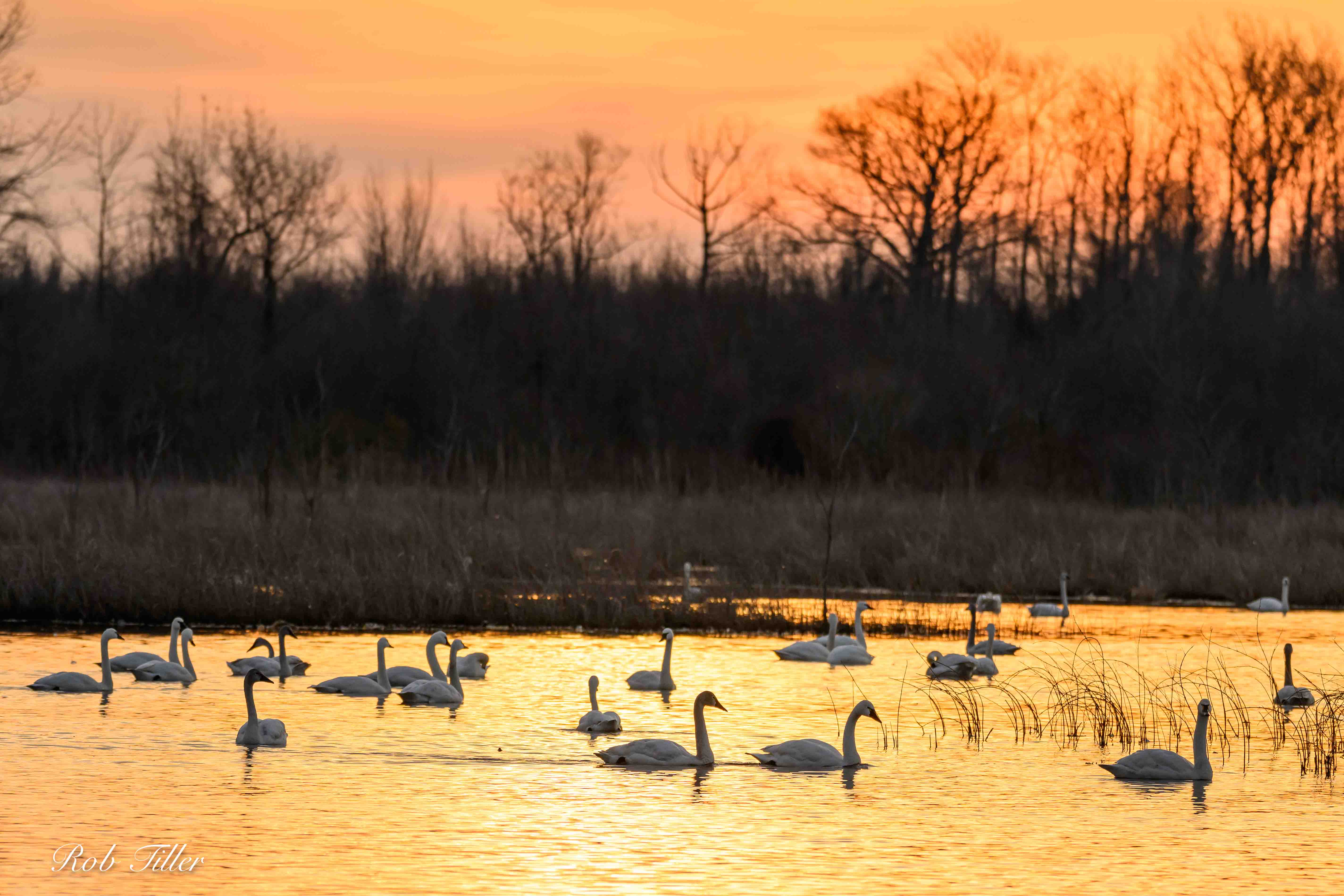
Last week I drove to the Pungo Lake area of the Pocosin Lakes National Wildlife Refuge to look for tundra swans and other birds.  In the last couple of years I didn’t see too many swans there, but this time, there were a lot!  

Tundra swans are big birds (think 6 foot wingspans, 20 pounds) that  migrate thousands of miles every year between their breeding grounds in the Arctic and points south, of which eastern North Carolina is a major one.  They are sociable creatures that can form flocks of hundreds or thousands.   They’re very vocal, calling each other with loud honks, and large groups can sound like a stadium full of football fans.
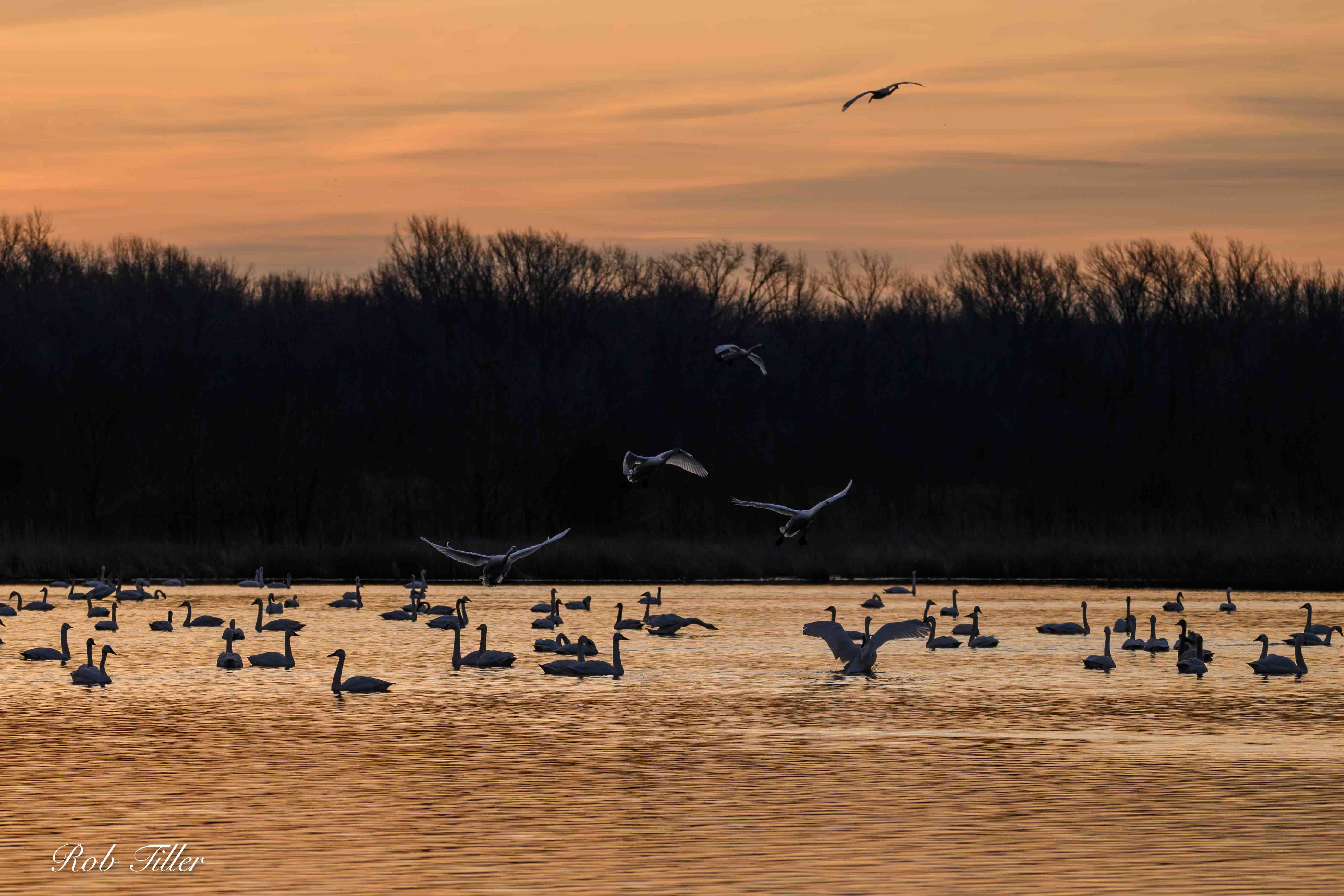
The basic family unit includes a cob (male) and a pen (female) that mate for life.  Cygnets (the kids) may stay with their parents for up to a year.  The cygnets go through a brownish phase before getting their white adult plumage.   
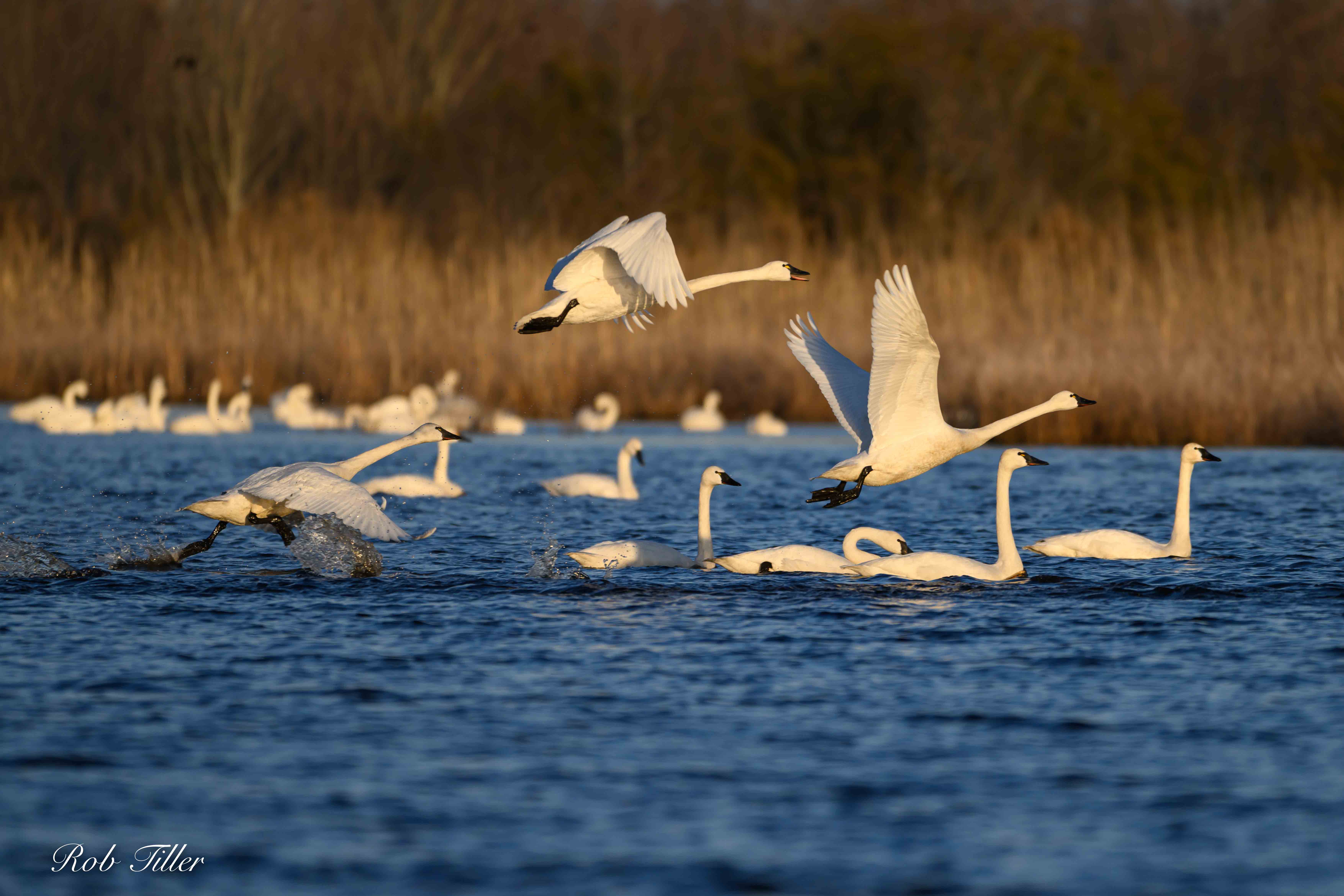
The swans are strong, graceful flyers, and calm, stately swimmers.  But they have to work hard to get airborne!  From a seat on the water, they flap vigorously while running along the surface. 
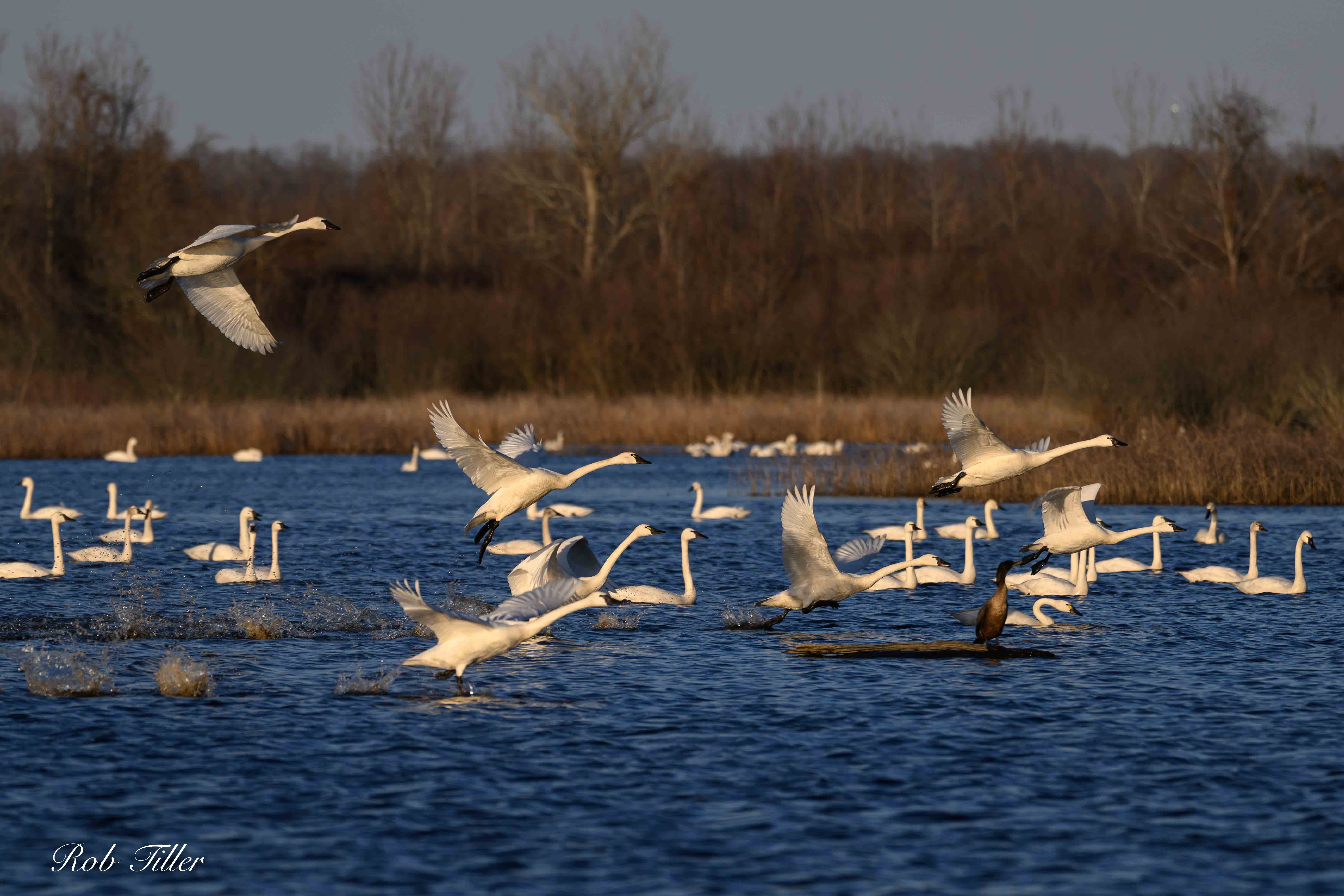
One afternoon I watched and listened as dozens of them did this maneuver.  There were only a couple of other folks on the shore of the pond, who like me were trying to take pictures.  It was a little chilly, but sunny, and peaceful, at least for those of us who didn’t need to take off.  
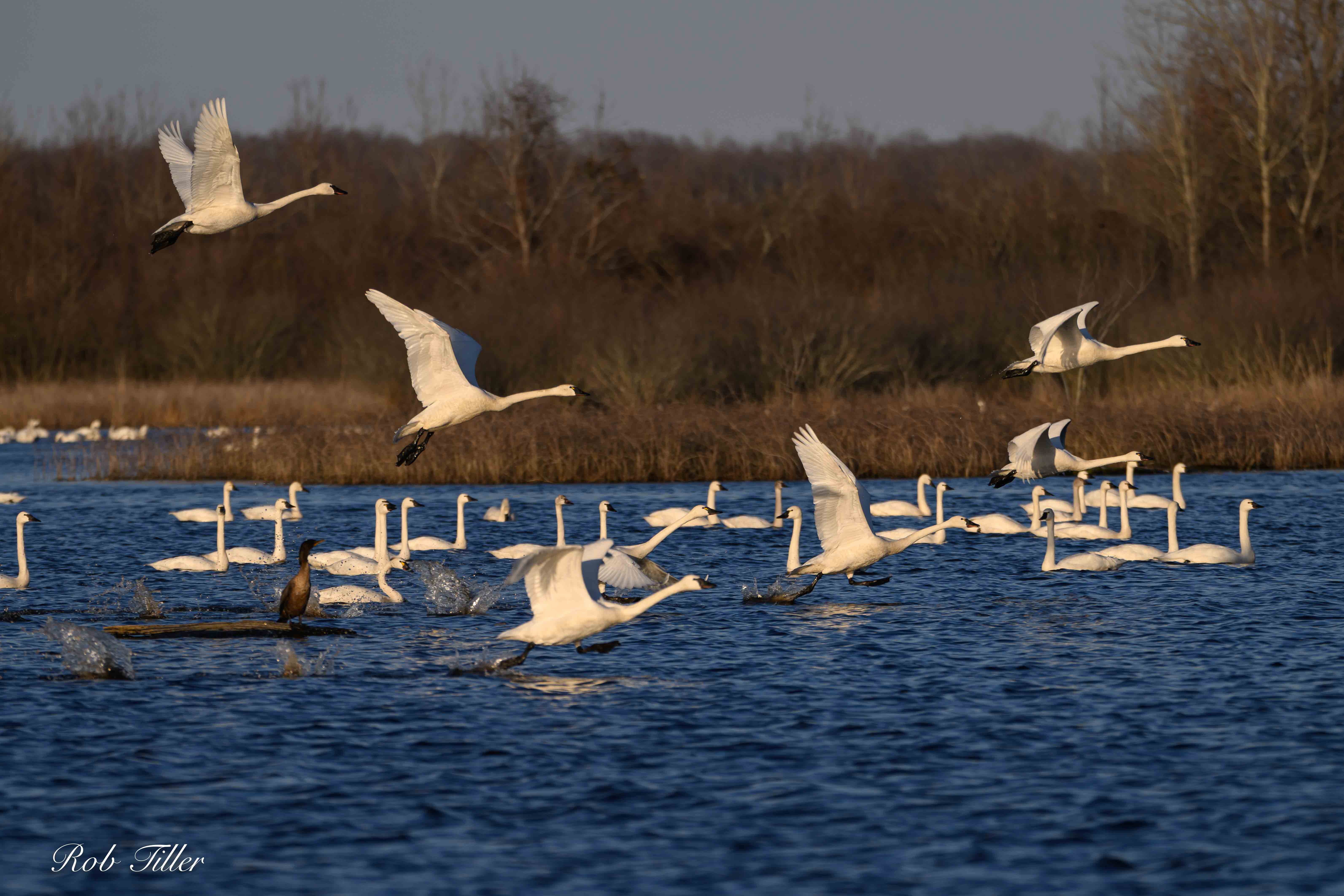
“Their clamorous wings” as they climbed put me in mind of Yeats’s wonderful poem The Wild Swans at Coole.  It’s a meditation on aging and mortality, together with the consolation of nature’s lasting vigor.  Yeats lauds the beauty of the birds, and their independence from us, with their own passions and conquests.    

Speaking of mortality and the lessons animals teach us, I was saddened to hear today of the death at 73 of Steven Wise, a pioneering crusader for animal rights.  The NY Times obit is here

Wise brought lawsuits on behalf of chimpanzees and other animals arguing that they were legal persons entitled to certain rights.  His legal work, writing, and teaching brought increasing attention to the question of how we should treat non-human animals.  Although his approach seemed to me problematic, since it was centered on arguments about certain animals’ human-like abilities, I greatly admired his intelligence, courage, and passion.  

I finished a new book directed at the question of whether humans have free will:  Free Agents:  How Evolution Gave Us Free Will, by Kevin J. Mitchell.  Mitchell is a professor of genetics and neuroscience at Trinity College Dublin.  His book addresses deep questions around the meaning of life with a lot of information about the workings of the brain.

Mitchell has an answer for determinists like Robert Sapolsky, who hold that all our behavior is predetermined by physics, and that our impression of mental independence is an illusion.  Starting with the simplest forms of microbial life, Mitchell applies Darwin’s theory of evolution and argues that agency and purpose are fundamental characteristics of life.  

I didn’t get all Mitchell’s explanations of brain cell biology, but I think I got the basic ideas.  Animals evolve to survive, which requires that they learn to respond to an ever-changing environment.  The most complicated brains we know of (our own) not only make top down decisions related to survival, but are capable of changing our own more basic processes and thinking about our own thoughts.  

Mitchell notes that there are various ways of thinking about freedom, and every being is constrained by its environment, biology, inherited traits, memories, etc.  But within those constraints, Mitchell contends we make meaningful choices.  This makes sense. 

In addition to providing a persuasive framework for thinking about free will, Mitchell’s account emphasizes the interconnectedness of the world.  He suggests that we are not independent objects, but a large set of processes that are acted upon, and act upon, everything else.  The book is an encouraging integration of science and spirit.

A thought-provoking documentary film festival in Durham

20160409_093135
Having had such a good time last year at the Full Frame Documentary Film Festival, this year we decided to go all in. We got a room at the downtown Marriott, which connects to the site in the Durham Convention Center, and took some vacation so we could stay all four days. We saw some excellent documentaries, met some interesting people, and had a lot of good conversations and other fun.
20160408_183622

In high school I had a music theory teacher who was a practitioner of Eckankar, which teaches that the soul can separate from the body and travel about. I ordinarily think of Eckankar as an example of the useful rule that there’s no idea so bizarre that some subpopulation won’t believe it. Still, this weekend was soul travel of a sort. The documentaries whisked us around the world and also transported us into some remote and unfamiliar interior landscapes.

Another thing I like about documentaries is that in general they try to be truthful. Even when the filmmaker has a strong point of view, she’ll almost inevitably provide evidence for other points of view. We were particularly interested this year in the films that took on complex social issues. For several of those, the filmmakers answered questions afterwards, and the messages they thought they were sending were not always the same as the ones we took away. I viewed that not so much as an indication of the filmmaker’s weakness as of the medium’s strength.
20160409_095106

There were more than 100 films screened, of which we saw 17, including several that I expect to be thinking about for quite a while. Here are some quick notes on my favorites.

Weiner. This was about Anthony Weiner and his New York mayoral campaign, which ended in ignominy because of his social media sexting. Weiner became a late night TV punchline, and so it was a surprise to see him presented as a complex person with a great deal of intelligence and drive. As Sally noted, it was a great reminder that headlines can be misleading. I sat next to co-director Josh Kriegman at another film, and was happy to learn from him that Weiner is still married.

Sonita. Sonita is a 15-year-old Afghan girl living in Tehran who wants to be a successful rap artist. As crazy as it sounds, she may just do it. From her first informal performance with her girlfriends, you sense a prodigious talent. The odds against her are huge at the beginning, as her poor, traditional family plans to sell her to be married, but she records Brides for Sale, which becomes a minor sensation, and things start to happen. You should check out her gut-punching music video, which is here.
20160408_123303
Clinica de Migrantes. A clinic in south Philadelphia provides primary medical care for mostly Hispanic undocumented immigrant workers. The volunteer doctors and other personnel are overworked and overwhelmed, but they somehow soldier on, with empathy and kindness. The patients look a lot like the people we see cleaning our hotel rooms, preparing restaurant food, building our houses, and caring for our yards and our children. The film doesn’t preach about the injustice of leaving these people out of the health care system, but quietly makes you feel it. It also reminds you that there are some really good people in the world.

Unlocking the Cage. The subject is Steven Wise and the Nonhuman Rights Project, which has brought habeas corpus petitions on behalf of caged chimpanzees. Wise has worked for 30 years for animal rights, and has succeeded in raising the profile of the issues. He maintains a remarkable air of humanity and decency even with those who think he must be crazy.
20160407_095000

Raising Bertie. This film was made about 100 miles from here as the crow flies in Bertie Co., N.C., a poor, rural, majority African-American area. The filmmakers spent 6 years following 3 young black men trying to get through high school and become adults. They make some of the same mistakes that their parents made, such as starting families when they’re much too young, and struggle to find decent jobs. It’s a subject that we all think we know about, but have never seen this intimately, and it’s powerful. We got to meet with one of the filmmakers and a couple of the film’s subjects in the hotel bar last night.

Tony Robbins: I Am Not Your Guru. This film by master documentarian Joe Berlinger follow self-help impressario Robbins through a six-day seminar for which he charges $5,000 per head. It struck me as a mix of evangelical Christian revival and new product sales force meeting, where the attendees were encouraged to get excited and emotional and commit to a better life or more productive next quarter. Robbins struck me as a snake oil salesperson, though more well-meaning than some. I was surprised to learn, when Berlinger spoke afterwards, that he had attended a Robbins seminar and found it life changing in a good way. But as noted above, this disconnect speaks well of the medium, and also of Berlinger, in allowing for different interpretations.

Don’t Blink: Robert Frank. Laura Israel, the director, worked with Frank for years as an editor before making this remarkable film. I just started looking hard at Frank’s intense, quirky photography in the last couple of years, and came to this documentary knowing nothing of his experimental films and other work. I came away with even more respect for Frank, and more curiosity. The film says something fundamental about how artists make art: they never stop experimenting.

I could go on, but, enough. Footnote: I made all these photographs except the tulips on a Samsung Galaxy S7, which I got a week ago. So far, it seems like a very smart smartphone, with a surprisingly credible camera.
Tiller7Bug 1-12