The Casual Blog

Tag: scuba diving

Diving in the Galapagos Islands
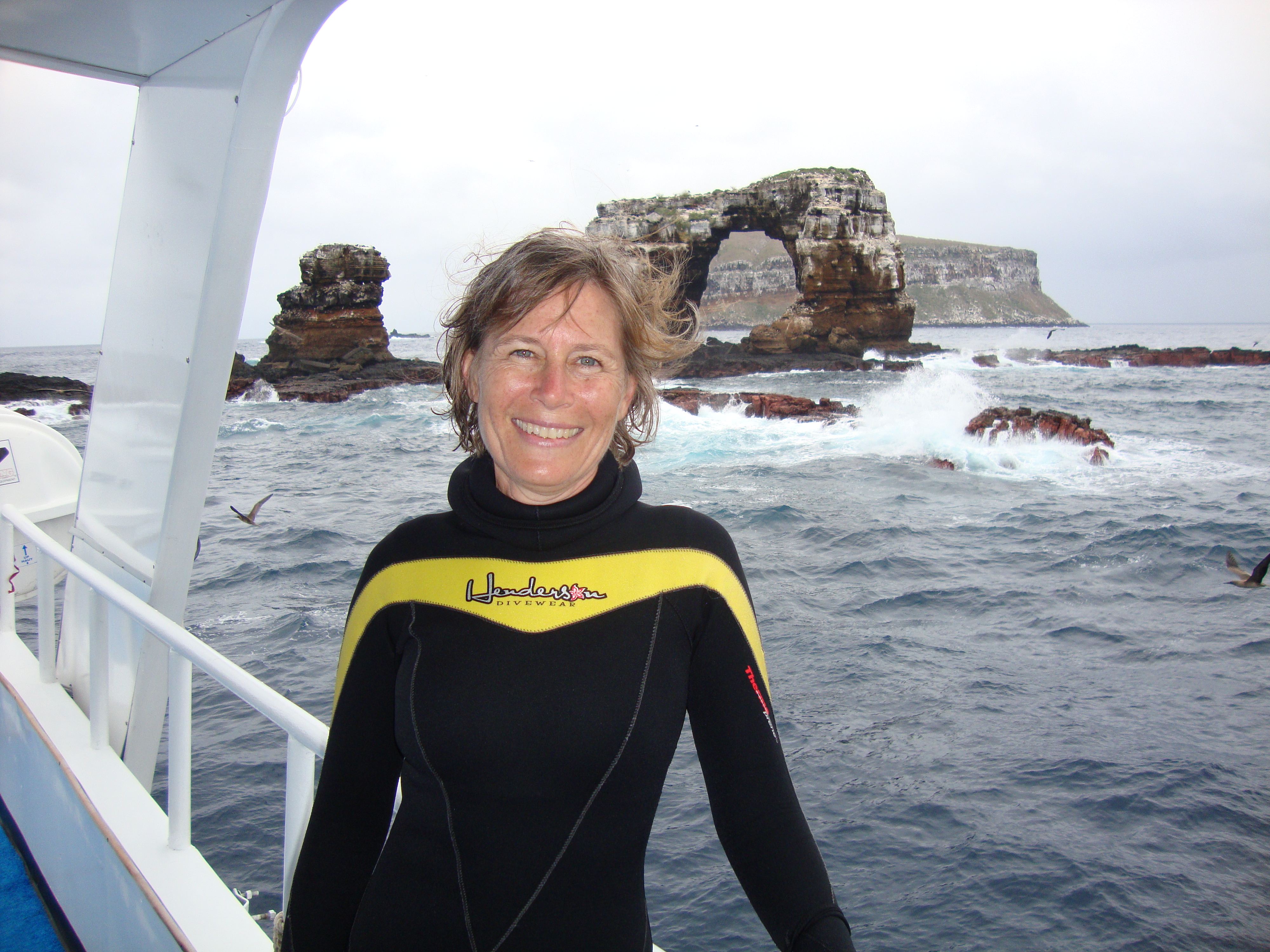
Sally at Darwin's Arch, Galapagos

On Christmas day, we did our third day of scuba diving in the Galapagos Islands, some 600 miles west of the coast of Ecuador, at the foot of Darwin’s Arch. There was a strong current, and so we spent most of the fifty-minute dive clinging to barnacle-covered rocks. There were many patrolling hammerhead sharks, as well as a couple of large Galapagos sharks. We saw many large sea turtles and fine spotted moray eels. There were hundreds of small colorful tropical fish, such as Moorish idols, king angelfish, trumpetfish razor surgeonfish, Guineafowl puffers, barberfish and parrotfish, as well as huge schools of creolefish. It was fantastic!

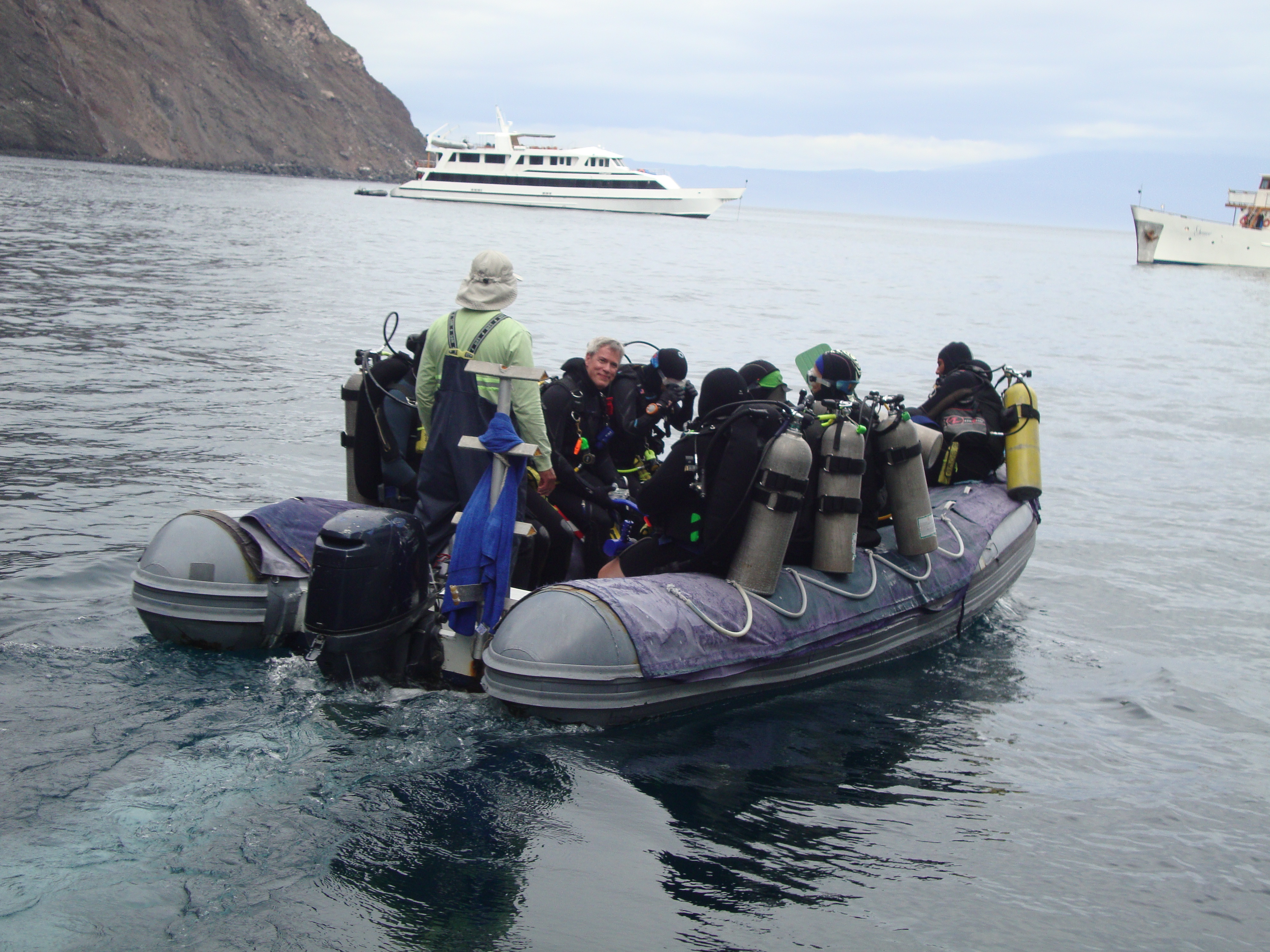
After the dive, we hoisted ourselves over the side of the inflatable dingy (or panga) and returned to the mother ship, the Galapagos Aggressor II. It was Sally’s hundredth dive. The crew presented her with a certificate, and our fellow divers gave her congratulations and hugs.
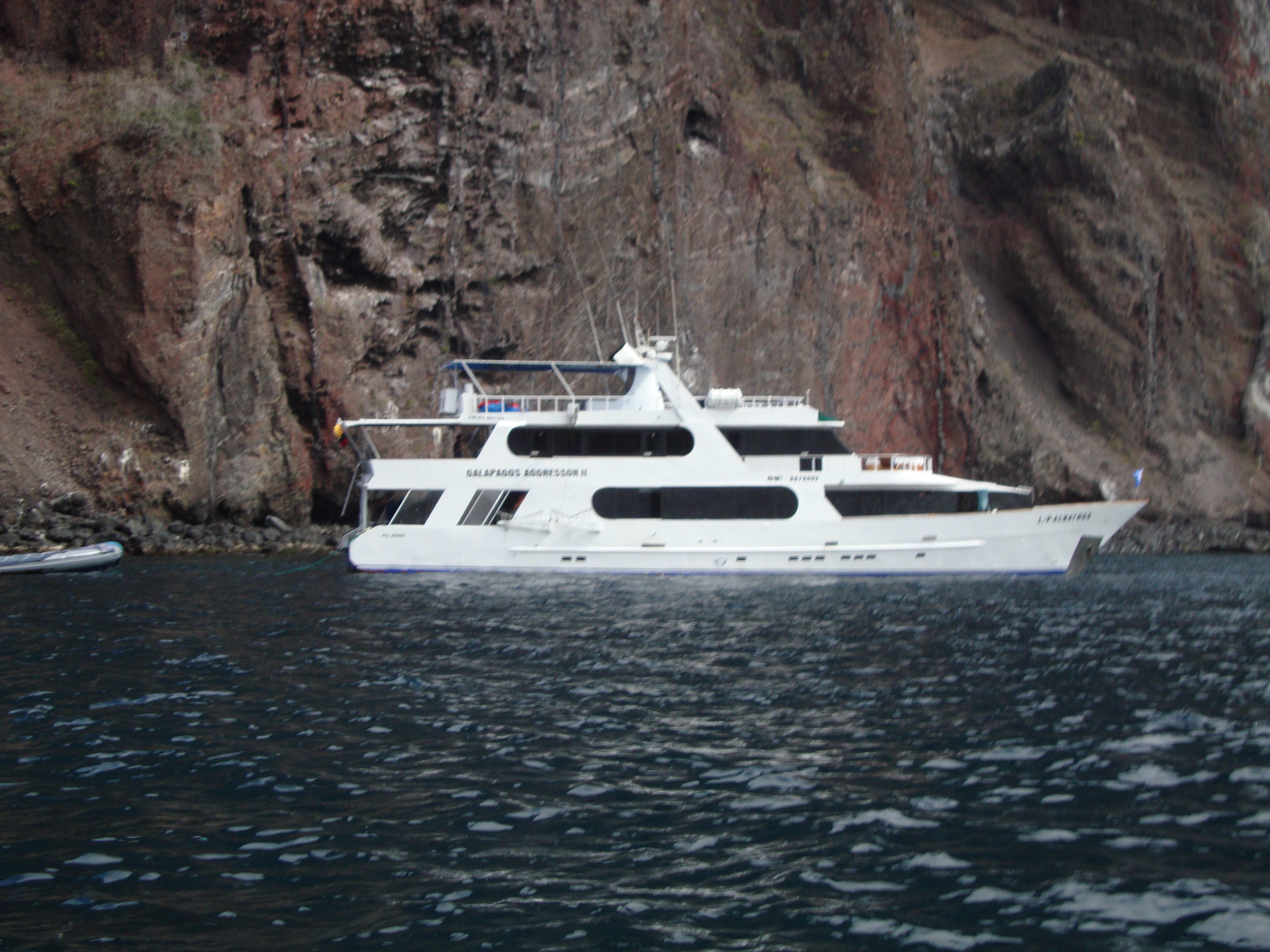
The Galapagos Aggressor II

From the boat, we watched hundreds of flying boobies (large sea birds that resemble gulls with webbed feet) (Nazcas, red-footeds, and a few blue-footeds), frigate birds, swallow-tailed gulls, and storm petrols. Groups of dolphins came by periodically. Later that day, we did some snorkeling a few yards off of Darwin Island. The dolphins weren’t very interested in us, although I swam briefly with a group of six. We had better luck with a group of sea lions, who were curious about us, and came close by doing flips and loops.
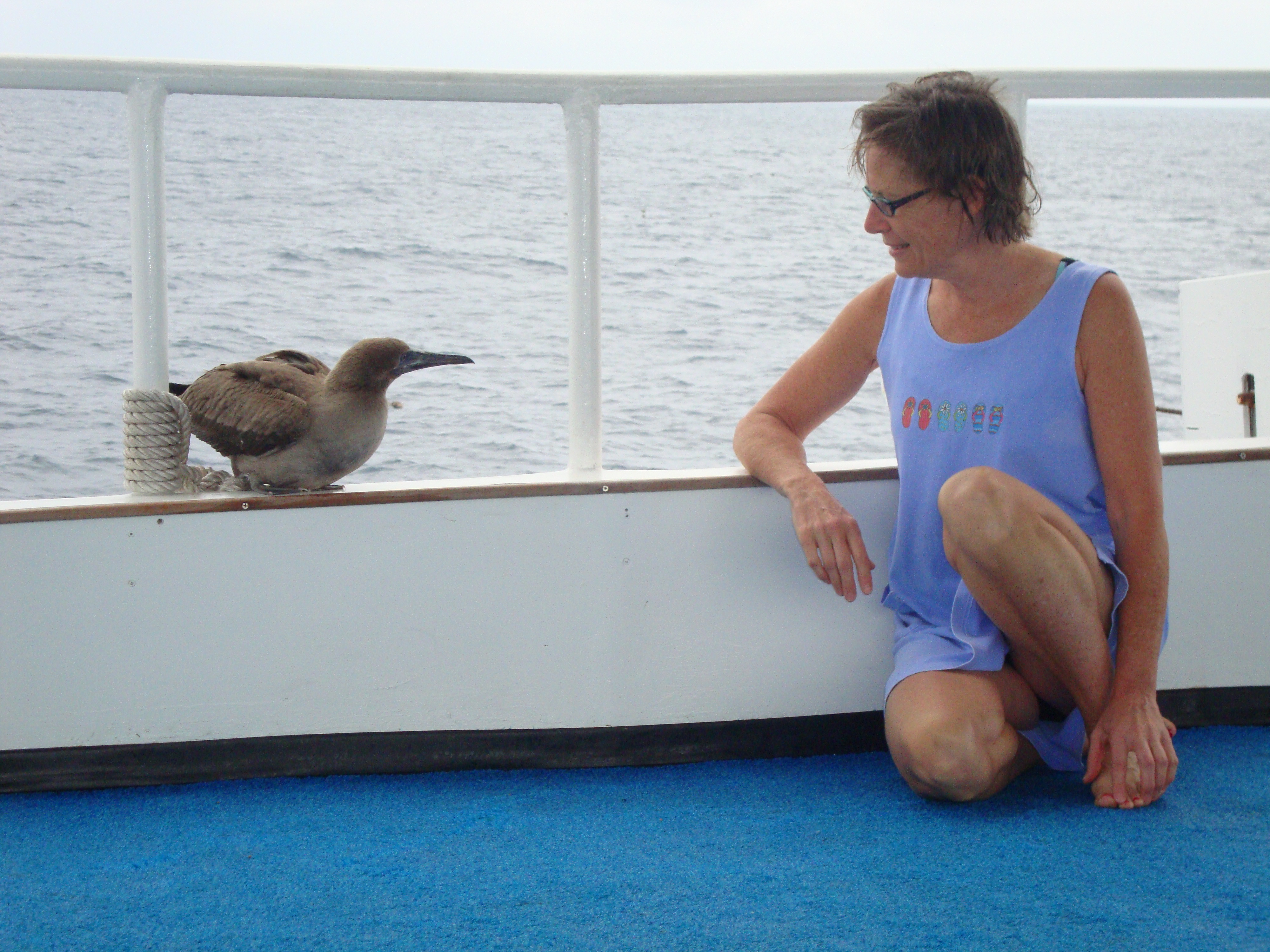
Sally and a curious juvenile boobie (red footed, I think)

Darwin, like all of the islands we visited during the week, was the remains of a volcano that originated four or five million years ago — a mere babe in geological terms. It was mostly gray rock wall rising sharply several hundred feet to a plateau on top. It was very stark, but also thrumming with bird and sea life. We saw no other humans. It felt like the earth was brand new. The creativity and resourcefulness of nature was awe inspiring.
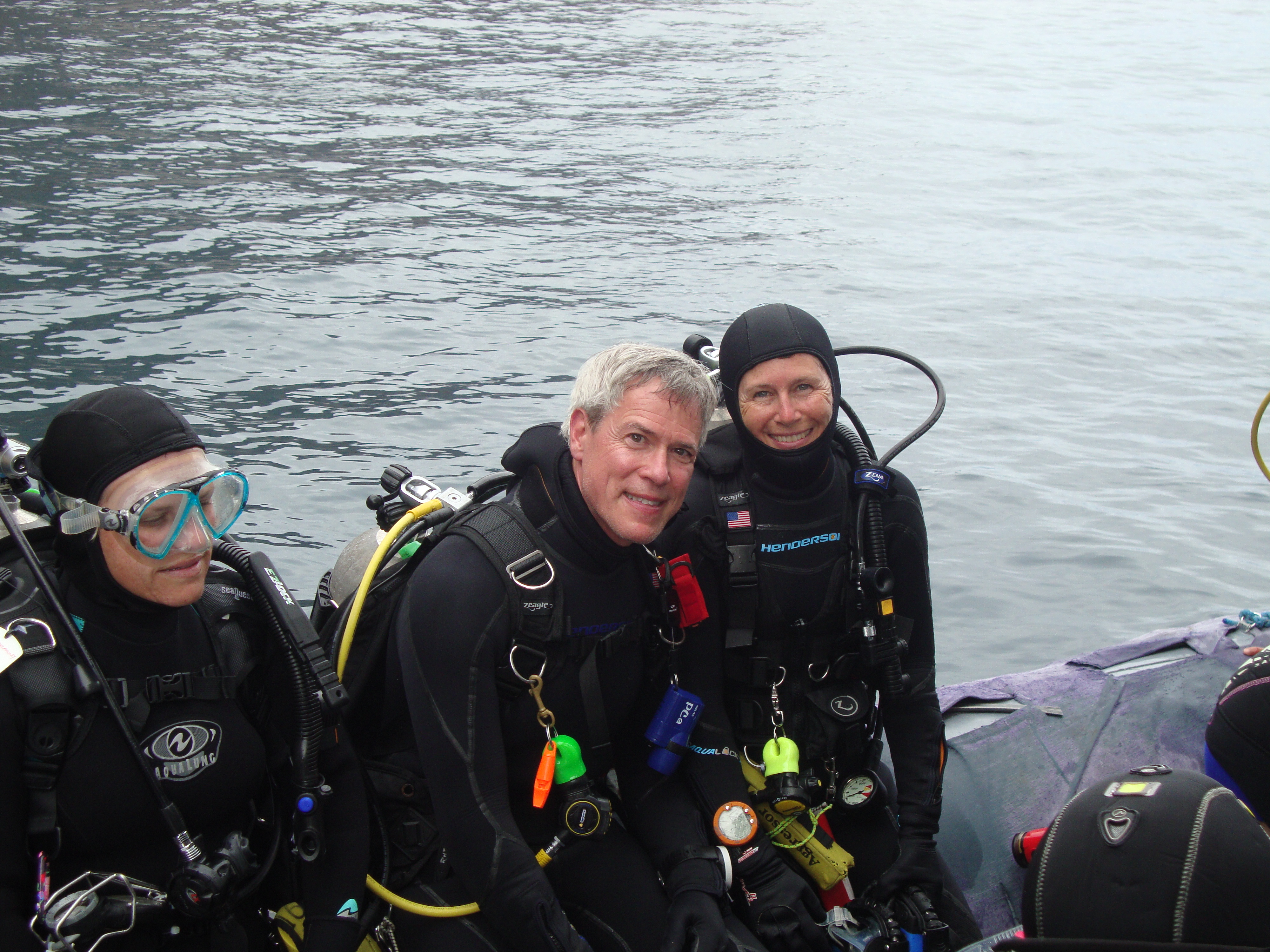
On the panga

During the trip, I finished reading The Better Angels of Our Nature by Steven Pinker. Pinker’s theseis is that human violence has declined dramatically over the course of history, and he explores the possible reasons for this. The book covers a lot of territory (all of human history) using a lot of tools (history, philosophy, statistics, biology, psychology), and still manages to be surprisingly lively and readable. Part of the book examines the increase in the last century of concerns for animal welfare — the sense that mindless cruelty to animals is unacceptable, and the suffering of animals is a moral concern. As with most violence, we’re ordinarily concerned with (and overgeneralize from) the violence and cruelty we observe, and tend to ignore examples of kindness and decency. It was cheering to learn of a trend toward greater respect for animal rights, and to consider that the trend could continue.

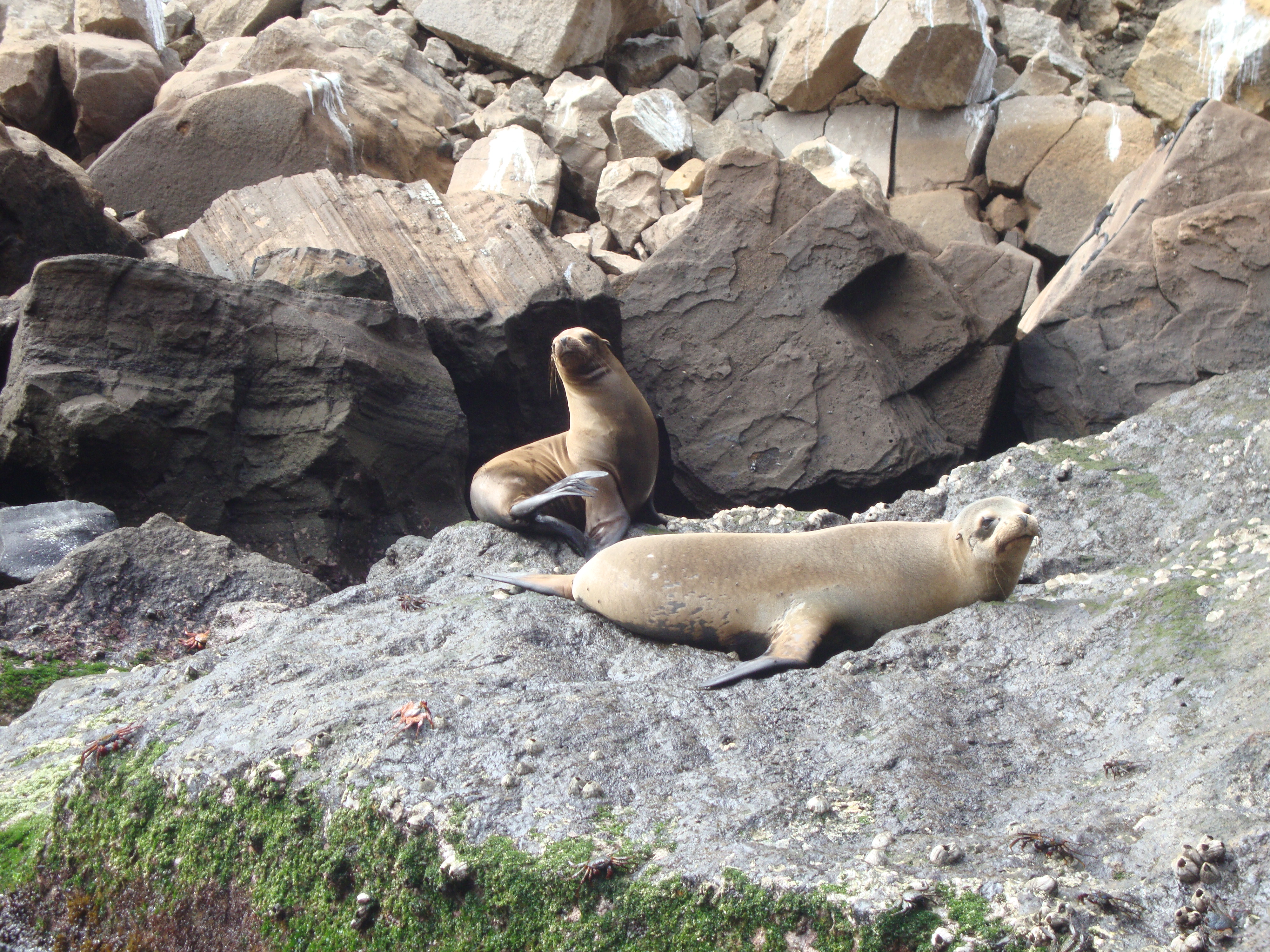
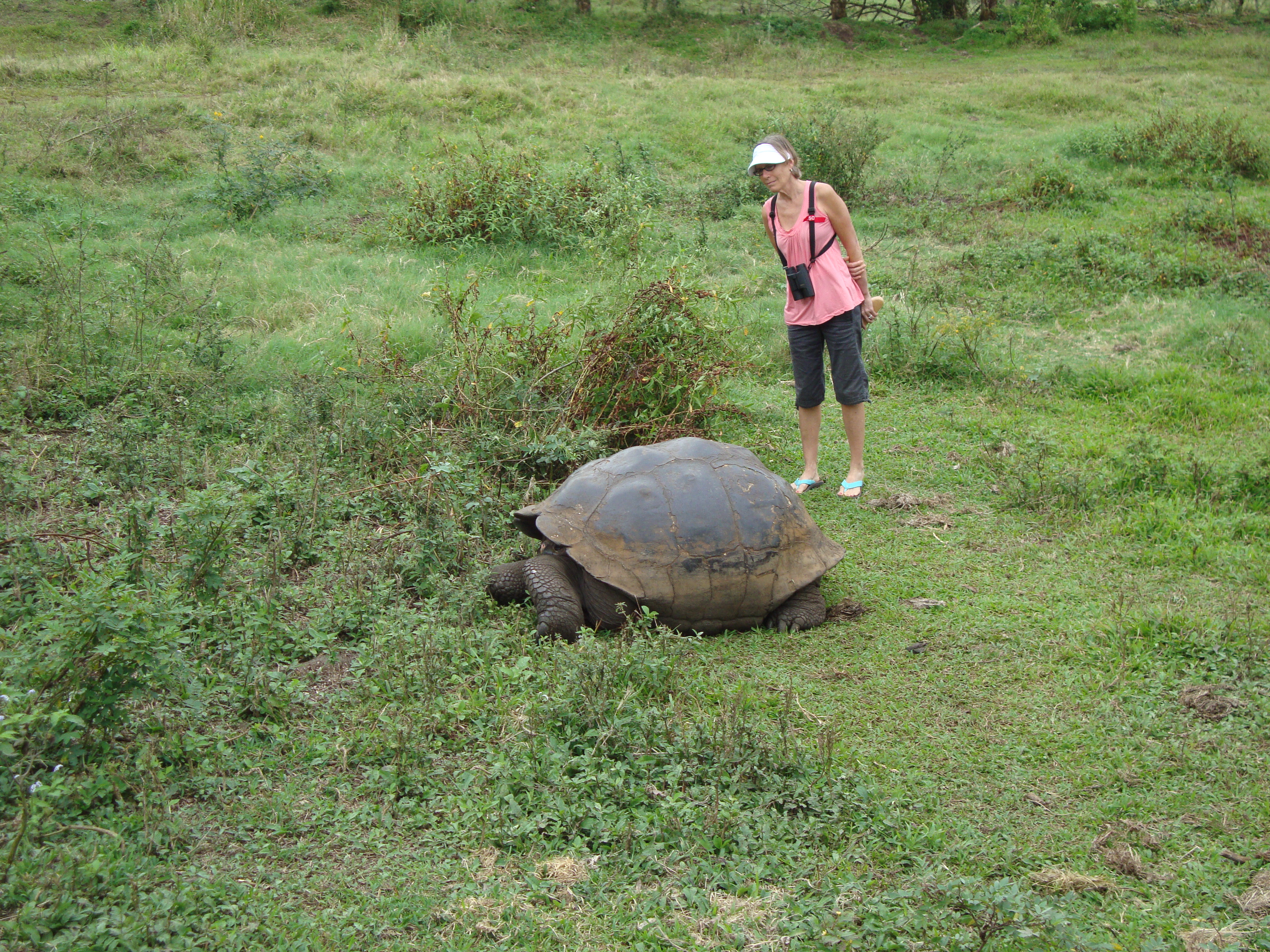
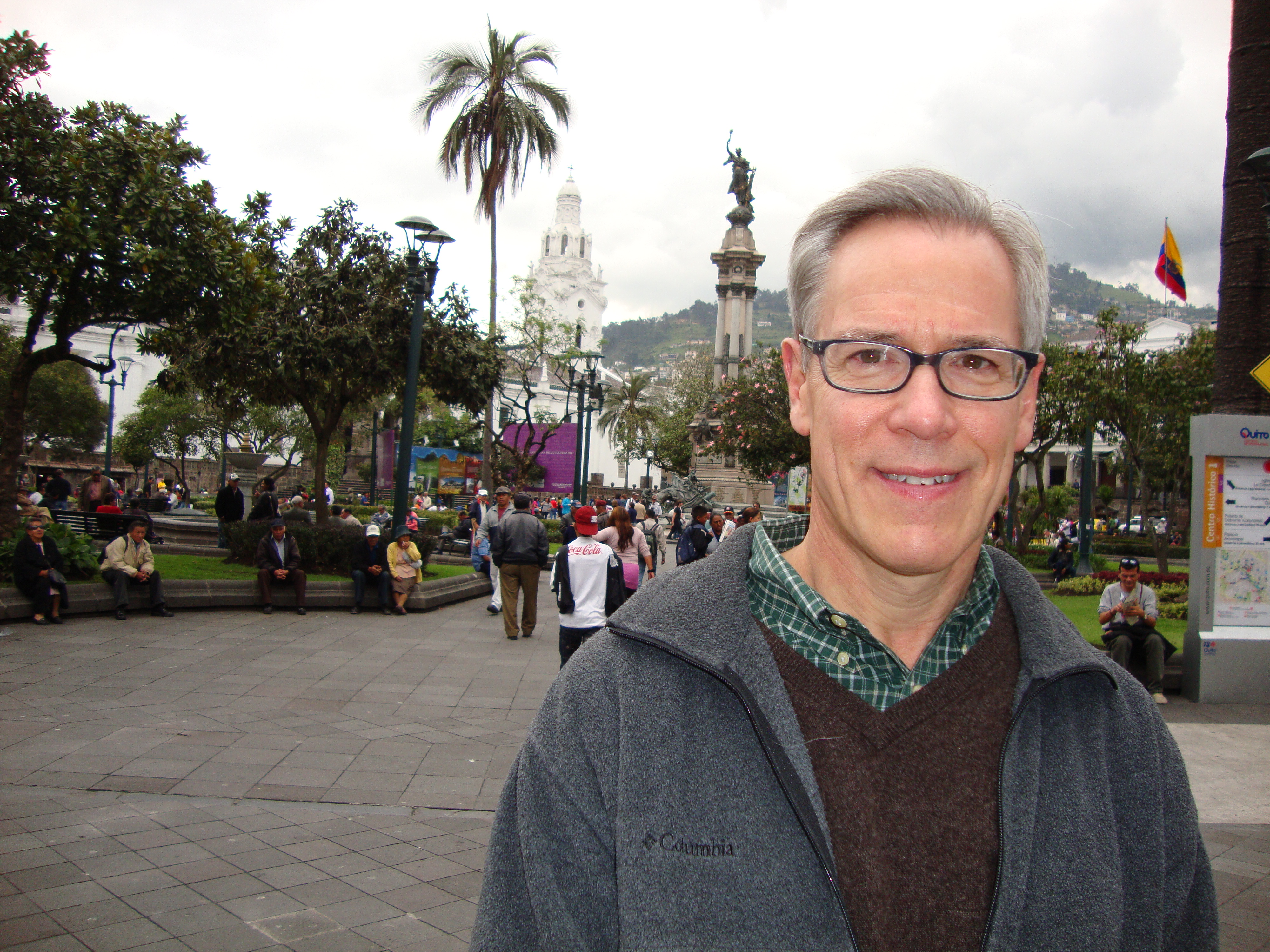
In our group of 11 divers, Sally and I were the only ones who did not dive with cameras. They were a cheerful, intelligent, and sociable group of folks, and all significantly more experienced at diving than we were. I’d taken the view that I’d prefer to look hard at what was in front of me without the distraction and intermediation of a camera, but especially after viewing some of their pictures, I was a little sorry that I didn’t get pictures of some of the amazing, strange, and beautiful things we saw under water. Perhaps next time. Here are some other above-water pictures from our trip.
Caribbean diving in Honduras

Yesterday Sally and I returned to Raleigh after a week of scuba diving in Roatan, Honduras. We explored the second longest barrier reef in the world and were overcome by the incredible beauty under the water. It was intoxicating: thousands of luminous fish, enormous sea turtles, exquisite sea horses, exotic invertebrates, and vast coral structures in rainbow colors, I highly recommend it, though I hope not too many people go, particularly if they’re careless divers. The reef is ancient but fragile, still teeming with life, but threatened by human activity.

We stayed at CoCo View Resort, an establishment designed for divers. There’s no casino, no television, and little in the way of shopping or other entertainment. The focus is scuba. The hotel is on a small island that’s a short swim from the edge of the reef, and a number if prime locations are within a ten-minute boat ride. They have convenient, well-organized lockers a few steps from the boat docks, and the boats are well set up for diving. Our captain, known as Gringo, and divemaster, Mark, were friendly, knowledgeable, and hard-working. They took us on four boat dives a day, and most nights we went on an additional dive off the shore. My total of dives for the week was 24, while Sally did 21. This meant that most of our time was either preparing to dive, diving, and preparing to dive again, with short intervals for eating and sleeping. I did manage to sneak in a bit of reading and a couple of naps in the hammock on our balcony that overlooked the bright green water of the bay.

Personal highlights included ten sea turtles in one day, including one that I spotted while swimming in for a close look at a pair of queen angelfish. We saw almost as many sea horses in one day, several scorpion fish, and four species of eels. On one night dive we saw three octopuses, including one that we watched for several minutes as it changed colors and shapes in a brilliant attempt to camouflage itself against various backgrounds. On our last day we saw our first ever squids, a pair that hovered near us for a couple of minutes, than swam almost close enough to touch.

There were also, unfortunately, lionfish in greater abundance than we’ve previously seen. This fast-multiplying invasive species is disrupting reef ecosystems across the Caribbean. Mark had a license to kill these destructive predators, and at one point executed six in two minutes. Another time, after an execution, he offered the remains to a spotted eel, which emerged from its hole for the snack. Mark confirmed that the lionfish seemed to have cut into the populations of other creatures. I wondered if the lack of sharks and rays (we saw only one southern sting ray) was a consequence.

We went with a group of about a dozen other divers organized by Dan P. and Down Under Surf and Scuba. Most of the other divers were very experienced. We learned more about diving and new species from them, and enjoyed their company. The vibe was friendly and relaxed.

It was fantastic to swim with large schools of small, brightly colored fish, and also to hunt for hidden treasures — well camouflaged and bizarre creatures. As the week went on, I found it more and more satisfying to focus directly on the coral. The variety of structures was remarkable. There were species that resembled various plants and ones that looked like rocky organisms. Late in the trip, I used my flashlight to inspect the coral at 70 feet, and discovered that species I’d first taken to be dull gray or brown were quite colorful — burgundy, lime, mauve.

And as I spent more hours underwater, I felt more peaceful, less distracted, more focussed. There were only a couple of painful moments. I got stung by fire coral on my hand, which felt like a burn, and stung by an unseen creature on my lip, which felt like a wasp. But mostly I felt deeply happy. I wondered, as we prepared to leave, whether, with more time, I’d keep getting better at looking at tiny things, and enjoy them even more.

Greetings from St. Croix

Last July 4 weekend Sally and I decided to burn a vacation day to make a four-day  trip to St. Croix.  The main objective was to dive some of the largest coral reefs in the hemisphere.  We were eager to try out some new diving equipment and see some exotic flora and fauna.  The program we settled on involved a night dive, four daytime dives, and a snorkeling trip.

The diving was rewarding.  The reefs were reasonably healthy, and there were luminous tropical fish in abundance.  We saw our first spotted eagle ray, a magnificent and haunting creature.  We had our first see horses, first spotted moray eel, and first rock beauty.  We saw two large sea turtles and barracuda. Especially on the night dive, we saw many bizarre critters whose names we didn’t know.  It’s hard to do justice to the beauty of  reef diving.  The visibility was not great by Caribbean standards – around 40 feet most of the time – but we could see a lot.   So much life, in so many shapes and colors, some shy, some friendly, some intimidating.

Along with the diving, we had several unusually rewarding talks with various travel companions.  On the flight down, we met a 22-year-old guy working on Wall Street with a hedge fund.  One of our divemasters was a guy from Indianapolis, another from New Zealand, and another from northern Virginia.  They all had interesting personal stories.

I’ve been thinking recently about the way we each create and embody stories.  Constructing them is part of the work of being human, and communicating them is a defining characteristic of our species.  That is, to be complete, actualized humans, we need to tell our stories to each other.  On this theory, I’ve been more conscious of encouraging people to tell their stories, particularly if it seems they might be at all interesting.  I’m usually not disappointed.  Often stories that I expected to be ordinary turn out to be unusual and absorbing.

I used to have an aversion to the clichéd expressions of small talk, but fortunately I got over that. I’m now convinced that these clichés serve a very important purpose as tools for encouraging story telling.  “Where are you from?” is an invitation to begin a narrative.   The same goes for “How are you doing?”  From there, the story can go in any direction.

We had our setbacks and frustrations.  My regulator malfunctioned when we first tried a night dive at the Fredricksted pier, so we had to scrub that attempt.  The next night we made the intimidating jump from the pier to the dark water below, but got separated halfway through the dive.  The travel home involved painfully slow gate agents and customs agents, and a connection in Miami that was too close for comfort.  But we made it, and it was worth the trouble.