The Casual Blog

Tag: Scriabin

Ballet paintings, fossils, and a piano recital

Light on One’s Feet by Nicole White Kennedy

Last Thursday Sally and I had lunch at the Remedy Diner, where my sandwich was the Tempeh Tantrum, then went to a gallery to to look at paintings by Nicole White Kennedy. Kennedy, a local artist, paints in an Impressionist/Post Impressionist style that I once thought of as old hat. My early art education stressed the triumph of modernism and abstraction. But over the years I’ve really enjoyed Kennedy’s landscapes and cityscapes in her husband’s fine Italian restaurant, Caffe Luna. I’ve gradually gotten past my prejudice in favor of the modernist aesthetic. Artists show us multiple ways to see the world, and it’s fun to try different ones.

Anyhow, I was intrigued to learn that Kennedy had worked up a show of works featuring dancers from the Carolina Ballet. We really liked the show. No doubt it helped that we came to it as balletomanes, and that we could recognize some of our favorite ballerinas. But she unquestionably had a feel for the interiors and exteriors of the dancers and their work places.

I was conscious that the works owed a debt to Degas, both in their behind-the-scenes intimacy and the juxtaposition of ethereal sweetness and stark angularity, but I didn’t find this bothersome. Artists always borrow ideas from other artists and build on them, just like scientists and inventors. We were particularly touched by the paintings above and just below, and bought them.
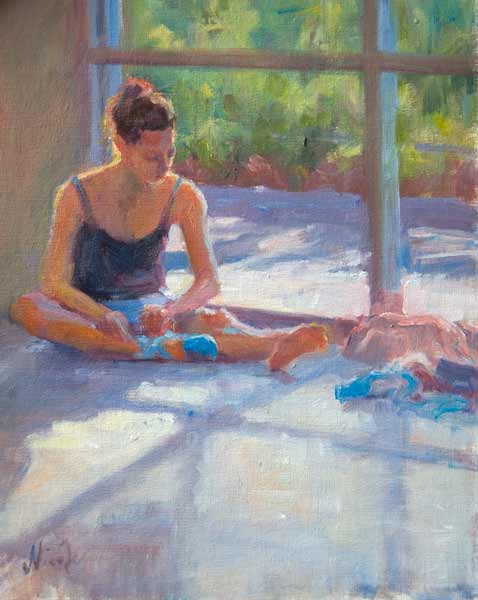
Dancer Removing Turquoise Points by NWK

The next day I flew up to DC for a gathering at the Supreme Court in honor of my old friend Justice Elena Kagan, which was highly nostalgic and which I will try to write about soon. But as post-election therapy, I’m focusing just now on art. With my free morning I sampled the Smithsonian museums, which always make me proud and happy to live in the USA.


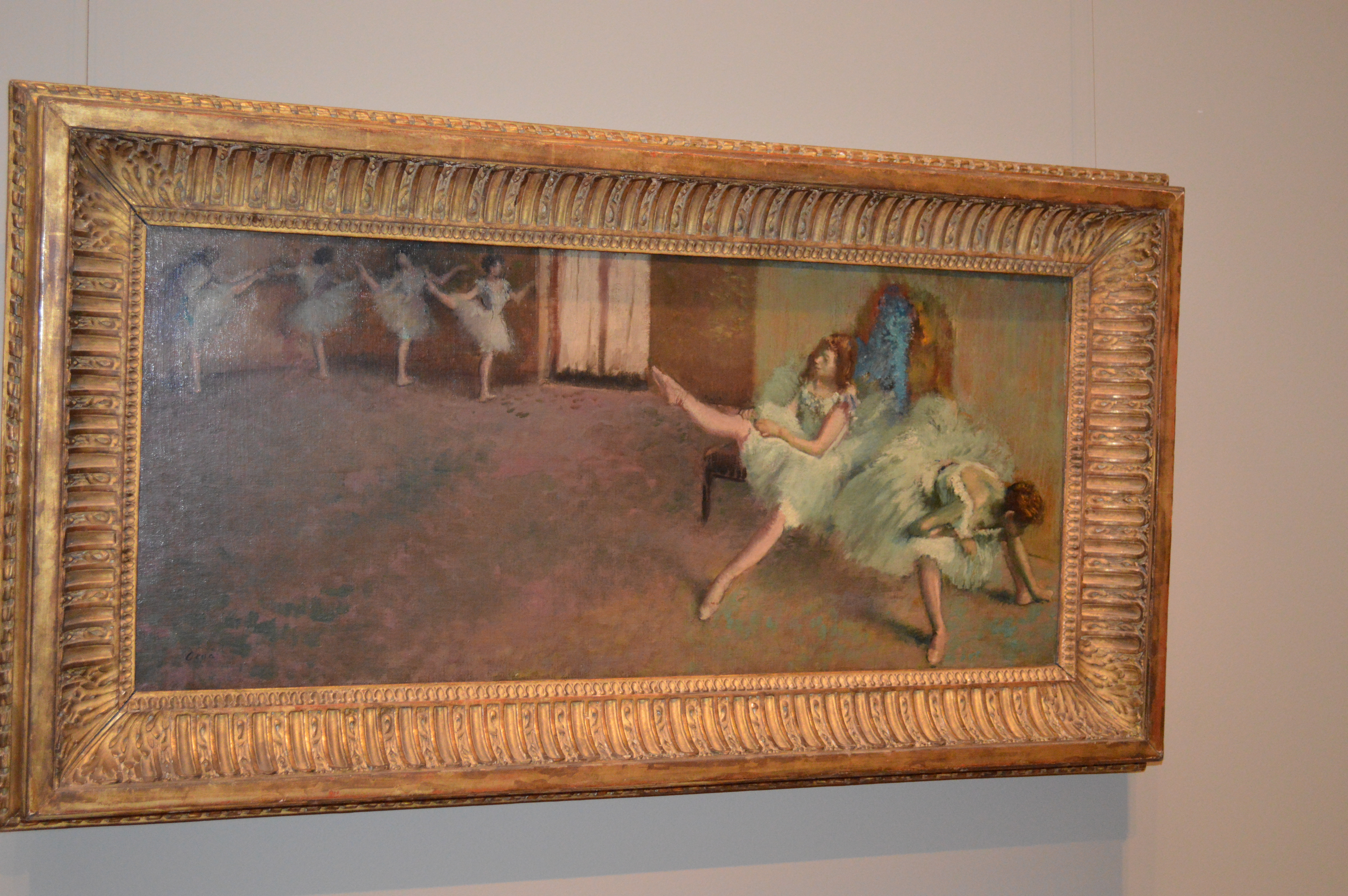
First I visited some of my favorite works at the National Gallery. These included the Rembrandts and other Dutch masters, including especially the two exquisite Vermeers, as well as the French Impressionists. Still thinking about dancers and art, I paid particular attention to the Degas paintings and sculptures of dancers. He clearly loved the subject, and it touched me. But I must say, his dancers are not as lithe and athletic as the Carolna Ballet ones.
Next, I walked down the Mall to the Museum of Natural History. As always, I enjoyed looking at the dinosaur fossils, but I wanted to have a close look at the trilobites, which are much much older than dinosaurs.

Trilobites were marine arthropods that began their run around 520 million years ago. They developed an amazing variety of body types during the 270 million years (give or take) that preceded their extinction. RIP. Nature has done a lot of amazing experiments!

I returned to Raleigh on Sunday afternoon in time to go to the recital of my piano teacher, Olga Kleiankina. Her program, like her, was Russian: Alexandr Scriabin (1872-1915), Nikolai Medtner (1880-1951), and Sergai Rachmaninoff (1973-43). She played brilliantly. She’d told me a couple of weeks ago that she was struggling with memorizing the Medtner piece (the Tempest Sonata), and I was feeling a little anxious for her, but she seemed completely in command. The piece was very dense, and at first I was a bit bewildered, but then I got my bearings. I particularly enjoyed the Scriabin Black Mass sonata. From our work together, I know how intensely she focuses on sound colors, and now that I’ve learned to hear some of those things, the music took on a new dimension.

There was a good piece on the Sunday NY Times about the sense of hearing, and the difference between hearing and listening. According to Seth Horowitz, we react to auditory signals 10 times faster than visual ones. Hearing is an early warning system, among other things. He notes that close listening is hard in a world where there are endless distractions, but that we can get better at it. I concur.

My latest piano lesson, a new Indian restaurant, and some good news in the Sunday Times

At home with Stuart and the Sunday New York Times

On Saturday morning I had my first piano lesson with Olga in several weeks. I played the second Scriabin prelude, Debussy’s Reverie, Chopin’s etude in c minor op. 25, no. 12, and Liszt’s Un Sospiro. We continued to talk about subtle aspects of touch and tone. In slow lyrical passages, she asked me to keep listening closely to tones as they decay all the way to the next note — a more intense kind of listening. She got me focused on my elbow as a tool in shaping a long melodic line. In the etude, she coached me on how to make it really loud and fast. After I played the Liszt for her last time, she was inspired to learn the piece, and this time she taught me some of the tricks she’d developed for the tricky places. By the end, I felt exhausted but inspired.

That night Sally and I had dinner at a new Indian restaurant in our neighborhood called Blue Mango. I usually like Indian food as food, but as a restaurant dining experience is often lackluster. Many dishes that I like arrive in the form of brown goop; the emphasis is not on the presentation. Mantra, another Indian restaurant close to us that opened a few months back, departed from this stereotype and presented food that was pleasant to look at as well as to eat. Blue Mango’s dishes were not as pretty, but the restaurant had a cool vibe, and the food was very tasty. Service was friendly but still getting the kinks out. The veggie samosas were excellent.

We ate early with a view to seeing an 8:00 movie at the Blue Ridge, a second run theatre where tickets cost $2. We who are normally so lucky were not so at the Blue Ridge. Every parking spot in the place was taken. We drove around for 10 minutes looking, and finally came home. We ended up watching Trading Places with Eddie Murphy and Dan Aykroyd, which was kind of funny.

Early Sunday morning is the time to get a paper copy of the New York Times and a cup of coffee, and start with the front page. With the sections properly sorted and ready for perusal, I find spending some time with the paper soothing, even when the news of the day involves various disasters. The Times makes mistakes, but it never gives up, and from time to time it is enlightening. Also, it is a sort of barometer of ideas that are getting solidified in public consciousness, and thus a leading indicator of possible social change.

Today I was happy to see a front-page story on solitary confinement in U.S. prisons. Erica Goode writes that the supermax prison model that has grown in the last three decades and kept prisoners in nearly complete isolation has resulted in increased prison violence, increased recidivism, and, for the prisoners, increased mental illness — all at enormous expense to the government (i.e. your and my tax dollars at work). There was an excellent piece on psychological costs of solitary confinement by Atal Gawande in the New Yorker some months back. Anyhow, Goode reports good news: several states have been reducing the numbers of prisoners in solitary confinement. The motivation appears to be more cost savings in tough budget times than humanitarian concerns, but still, progress is progress.

On the cover of the Sunday Review section is a piece by Mark Bittman on the problems of eating chickens, and alternatives to doing so. Bittman asks, “Would I rather eat cruelly raised, polluting, unhealthful chicken, or a plant product that’s nutritionally similar or superior, good enough to fool me and requires no antibiotics, butting off of heads or other nasty things?” Or putting it another way, “If you know that food won’t hurt your body or the environment and it didn’t cause any suffering to an animal, why wouldn’t you choose it?” According to the story, there are new fake chicken products that are perfectly fine. That sounds like good news for the chicken species, and for humans.

Also in the Review section, Tom Friedman writes about the greatest non-natural resource a country can have — a good education system. He cites a recent study comparing the wealth of countries according to their natural resources such as oil and metals and the education level of their citizens. More oil resources do not lead to higher levels of knowledge and skills, but knowledge and skills are tied to countries’ economic success. Friedman is surely right that education should take pride of place as a societal focus.

One story I expected to see in the Review section, but didn’t, was the report earlier in the week that the televangelist Pat Robertson had spoken in favor of legalization of marijuana. My comment on Twitter (see @robtiller) was: Pigs fly! Robertson’s positions are generally consistent with the “conservative” “Christian” “family values” camp, and I would have guessed that even if he privately concluded that prohibition was a failure, he would be the last person to speak out on the subject. But he has acknowledged that the war on drugs has failed, after enormous expenditures and a huge toll of imprisoned victims. He proposes that we treat marijuana like we treat alcohol. It pains me to say so, but for once, I strenuously agree with the man. The important question, though, is will his followers?