The Casual Blog

Tag: Robert Weiss

A fine start to a new dance season

Looking south from Casa Tiller at sunrise.

Raleigh, where I live, is definitely not New York or San Francisco, but still, it has interesting people, universities, sports, and good restaurants. Also, lots of beautiful trees. And a thriving arts scene, including excellent music and dance. I’m particularly proud of our ballet company, the Carolina Ballet, which punches way above its weight class, both in terms of great choreography and great dancers. It started its fifteenth season this week.

On Friday we had a fine dinner at Poole’s Diner and then saw the new program, which features four works by artistic director Robert Weiss. Weiss, an alum of the City Ballet, is a legitimate and distinguished heir of George Balanchine, and he’s still creating masterworks. Each piece of the new program was quite different from the others and touched on different emotional places.

My favorite was a new piece titled Meditation from Thais, with familiar music by Jules Massenet. It was an adagio pas de deux performed by Lara O’Brien and Marcelo Martinez. The dancers, both in white leotards, began clasped together in single shape, which gracefully transformed itself and then divided into other aspects. There were no program notes on the piece, probably because the subject was clear: a man and a woman. It was sensuous. Lara is at once willowy and strong, and in this piece, intensely tragic.

The other new Weiss ballet was Intimate Voices to music by Jean Sibelius. Its theme seemed to be families and loss. The distinguished cast was headed by Melissa Podcasy, who is retiring after this program and assuming new coaching duties. Fortunately, she’s still in great form. The first movement had gorgeous Edwardian costumes, with the ladies in pastels and hats and the gentlemen in tails, and ended with a patriarch’s death. The scenery involved projections of country scenes, which were effective. I found the piece touching and look forward to seeing it again.

We talked with Ricky Weiss at intermission. He was happy with the performances, but worried about the company’s finances. Ballet is a labor-intensive business, and even with dancers working for less than seems fair and reasonable, the costs are high, and balancing the budget is a constant challenge.

The most cheerful piece was the first one, set to Prokofiev’s first (“Classical”) symphony. This involved classical costumes, complete with tutus, and a more traditional movement vocabulary. The last piece was Symposium to music of Leonard Bernstein, which is one of my favorite Weiss ballets. Eugene Barnes was particularly wonderful as Dionysos.

On Saturday we walked a few blocks to the SparkCon street festival and looked at dozens of pastel drawings on the Fayetteville Street pavement. There were musicians and circus performers, and lots of spectators. At sunset we went to the top of a parking deck at Salisbury and Hargett and watched hundreds of chimney swifts darting and swarming, and finally dropping into a large chimney.
Curiosity, live chamber music, and wonderful ballet

Curiosity killed the cat, but I’ve come to see curiosity and openness to new experiences as major contributors to happiness. This week the NY Times science section had a story that supported this view. The story by John Tierney focuses on “novelty seeking” as a personality trait. According to one study, persons with the highest life satisfaction were those who scored high in novelty seeking and balanced that trait with high levels of persistence, meaning staying with an effort when there’s no immediate reward.

The same study mentioned a third trait associated with those who flourished most, in terms of health, friends, and emotional satisfaction, which it labeled “self-transcendence.” This is “the capacity to get lost in the moment doing what you love to do, to feel a connection to nature and humanity and the universe.” Tierney cites research indicating that novelty seekers exhibit more personality growth as they age. But it is also associated with such problems as gambling and drug addiction, compulsive spending, and criminal behavior. Too much of a good thing, perhaps.

I’ve noticed that lately I’m getting more and more enjoyment from music and dance, which may derive from persistently seeking novel forms and self-transcendence. I’ve been getting out to more live performances these last few years, which helps. I heard an interview with James Levine, the great conductor, in which he compared a recorded performance to music to a post card of a scenic view — that is, a pale reflection of the live event. That may be an exaggeration, but I think he was right that there is no good substitute for live performance.

And so Sally and I made our way to Fletcher Hall last Sunday afternoon to hear one of the world’s premier piano trios, named for its members: the Kalichstein- Laredo-Robinson Trio. They were master musicians and played an excellent program of Mozart, Debussy, Richard Danielpour (b. 1956), and Ravel. Laredo (violin) and Robinson (cello) have been married for 35 years, and the Danielpour piece was a duet written for them entitled Inventions on a Marriage. It covered a range of moods, from passionate to tender to humorous, and the musicians were, as you’d expect, in intimate communication.

Unfortunately, the audience was sparse — about 160 people. I felt embarrassed on behalf of Raleigh that there weren’t more people to hear these truly great performers. As a member of the board of the sponsor, the Raleigh Chamber Music Guild, I felt some responsibility. Afterwards, several board members exchanged emails theorizing about what happened.

Did we not publicize the event enough? I think we did not. Is the audience for this music disappearing? I sincerely hope not, but I guess it’s possible. Chamber groups like string quartets are what TV ad writers plug in when they want to quickly depict the opposite of cool and hip. And they aren’t really wrong. Unlike things that are cool, chamber music is not instantly accessible. It takes years of training and devotion to play, and it also takes education and experience to enjoy. Those of us who have been privileged to have such education had better figure out some way to educate others, or we may lose something precious.

Enjoying ballet also requires some amount of education and experience, although it doesn’t rank as high on the endangered-arts list. I’ve been fortunate to have had early exposure, starting with my sisters’ elementary ballet recitals and continuing through high school at the N.C. School of the Arts. I got to see George Balanchine’s New York City Ballet and other great companies. And I’m continuing to learn from watching the work of great choreographers and dancers, and also reading. I’ve almost finished Apollo’s Angel’s, Jennifer Homan’s impressive, and daunting, history of ballet.

On Thursday we went to opening night of the Carolina Ballet’s new program, Balanchine Rarities. The program opened with three short but very technically demanding Balanchine works. The dancers were beautiful, even in sequences that seemed designed to test their physical limits. I especially enjoyed A la Francaix, a piece in the playful spirit of Jerome Robbins’s Fancy-Free, with two rambunctious sailors, a fun-loving Flirt, a Dandy with a tennis racket, and a diaphanous Sylph, who competes with the Flirt for the Dandy. Jan Burkhard was delightful as the sexy Flirt, and Lindsay Purringon found a sweet combination of elegance and humor in the Sylph. Eugene Shlapko was athletic and funny as the Dandy. He’s getting better and better.

At intermission we talked with Lola Cooper, who had the night off. She was fighting a bad cold and losing her voice, but excited about working with Marina Eglevsky, who staged the Balanchine works. We also talked with Alicia Fabry, who had broken her right metatarsal the previous week during rehearsal. She was in a plastic cast and using a crutch. Poor thing! She said the break could have been worse and did not require surgery, but would take several weeks to heal.

The company also performed Lynn Taylor-Corbett’s Lost and Found, inspired by the 9/11 attacks and set to piano music by Robert Schumann. It is a elegaic work, somber but beautiful. The last work was Robert Weiss’s Moving Life to piano music of Erik Satie. Roy Dicks’s review in the News and Observer singled out Cecilia Iliesiu for her performance, which I thought was fitting; I also thought she seemed like a rising star.

A Philip Glass opera and remembering B Berkeley

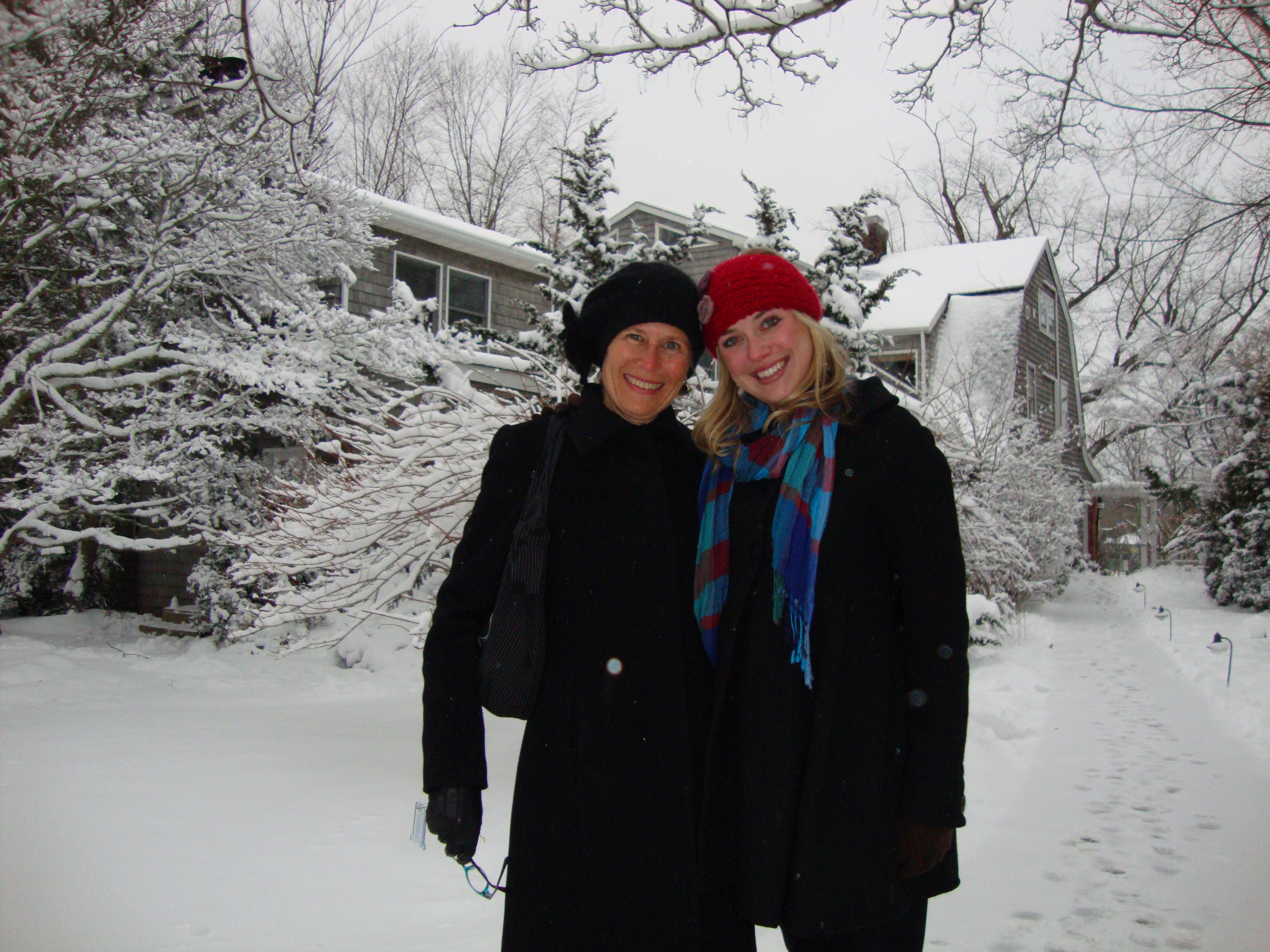
Sally and Jocelyn at the Mill House Inn, East Hampton, New York

Thursday night I went with friends to see the NC Opera’s production of Les Enfants Terrible by Philip Glass. I was interested for three reasons: I like some of Glass’s minimalist music, I like to support the NC Opera, and this production was billed as a dance opera. Ricky Weiss, artistic director of the Carolina Ballet, choreographed and directed the production.

I liked it. The story is a strange, surreal, dark tale of a brother and sister who are close — too close. The music is both driving and dreamlike. Each character had two physical bodies — a singer and a dancer — and each body expressed part of the emotional reality. This opened up interesting expressive possibilities. Opera fans are familiar with the enormous range of emotional possibilities from singing plus acting, and adding dance in as a vital element was fascinating.

One problem, though, was that the dancers could so easily steal their scenes, without meaning to. They are so much more graceful and expressive than ordinary humans, and even more than trained actors. At times it was difficult to give equal weight to the non-dance parts of the action, because the dancers were so compelling. The singing was rather good, particularly the soprano Jessica Cates as Lise. But her dancer twin, Lara O’Brien, had tremendous emotional range, and a kind of wildness. I thought the idea of the singer-dancer pairs was great, and worth exploring further.

The next day Sally and I flew to New York to attend the memorial service for her father, Norborne Berkeley, Jr., affectionately known to my generation as B. Gabe and Jocelyn flew in from Colorado and we rendezvoused at a hotel near La Guardia, then drove out to East Hampton. I was so happy to see the kids! We stayed in a lovely bed and breakfast called The Mill House Inn. It was good to see the Berkeley side of the family, and revive happy memories of East Hampton from our younger days.

We drove by the old Berkeley place in Bridgehampton and did a little shopping in East Hampton. I bought Gabe a pair of corduroy pants and The Unbearable Lightness of Being by Milan Kundera, on the sole condition that once he finished it he tell me his impressions. Such a rich book, and I know too few people who have read it. It snowed six inches that night.

The service on Saturday was in an Episcapol church and was well attended despite the snow. It had a heavier religious component than I expected from this relatively unreligious family. But Bill Berkeley did a fine job in his eulogy recognizing the strengths and accomplishments of B, and the good qualities we’ll want to remember. B meant a great deal in my own life, and I’ll miss him.

Discussing open source ballet with Robert Weiss

Do open source software and ballet have anything in common? Sure, they have some obvious differences. But they share an imperative to collaborate and a creative spirit. Anyhow, I’m a big fan of both, and I’ve been thinking about whether some of the lessons of open source could be applied to ballet. Last week got a chance to kick ideas on this around with a great choreographer, Robert Weiss.

Weiss, who goes by Ricky, is artistic director of the Carolina Ballet, which plays out of Raleigh, N.C. He spent the early part of his career as a dancer at the New York City Ballet with its famous director, George Balanchine. In more than a decade with the Carolina Ballet, he has been a prolific choreographer, producing dozens of ballets. He’s also recruited superbly talented dancers from around the world and melded them into an outstanding company. When we met last week, along with my friend CB Board Chair Melanie Dubis, at Buku for lunch, I thought, this must be close to the world’s greatest job — working every day with beautiful, talented, dedicated people to create art for the ages. What could be more wonderful?

When we met for lunch last week, it quickly became clear that it would be more wonderful to not be constantly worried about money. If only, he said, he had better funding, he could spend more time thinking about dance and less about fund raising. Ballet is an art form that entails numbers of dancers, all requiring paychecks, and the same for musicians, costume designers and costumers, set designers and sets, lighting designers and lights, stage management and crew, and of course, choreographers. As an art, it is capital intensive. There are inherent barriers to reaching a wide audience, including lack of exposure to the form and its traditions.

As Ricky described the process of creating a new work, it was plain that it was highly collaborative. When he choreographs a new work, it is created on specific dancers, and the work is shaped in view of their individual qualities. The work draws on a tradition that goes back to the Renaissance, with a large vocabulary of movements that are available for re-use. (As Ricky warmed to the subject, he stood up from the table and showed a couple of classical gestures, and his sudden transformation from regular person to dancer was electrifying.) And of course, there’s collaboration with the aforementioned costume designers, set designers, and many others. It is in general an art of great idealism and unselfishness, at least in the sense that almost no one expects to get rich from it, and many are prepared to subsist on a shoestring budget.

But in ballet as in most of our endeavors, there is an unexamined assumption that intellectual property protection is important. Thus copying of videoed performances is subject to the draconian penalties of copyright law. The dances are kept locked down, on the assumption that making them freely available could result in lost value. I raised the question with Rocky and Melanie whether this really makes sense. Is copyright protection actually increasing the value proposition of ballet, or is it lessening it?

As I explained, the open source software community has learned some lessons about this that the rest of the world is starting to apply. Open source innovators, whose projects are based on freely sharing their code, realized that the traditional approach to intellectual property would not work for them, and so they created new licensing models, such as the GPL, that encouraged sharing and re-use. That approach has led to incredible growth in open source software. The model is spreading outward to other creative endeavors with such tools as Creative Commons licensing.

Could it be that less IP protectiveness could expand the audience for ballet and bring in new funding? What if, instead of protecting ballet as carefully as possible with copyright, the product was unlocked and made available under a Creative Commons license? For example, if well-produced video of the Carolina Ballet was readily available on the internet without charge, couldn’t that introduce many more people to ballet, with some of them eventually becoming balletomanes?

Ricky noted that even the best video of ballet is only a pale reflection of the experience of live performance. But he also admitted that he knew of people who had had transformative personal experience through a recorded performance. He also noted that it would require funding to make video recordings of a quality that he’d be comfortable presenting in public. (Footnote: a couple of days after our meeting, I saw a documentary on the choreographer Jerome Robbins called Something to Dance About, which is great, and illustrates how video can communicate something meaningful about dance.)

Open source innovation generally involves experimentation. I noted that there could be approaches to video and to funding that none of us has thought of yet. We agreed to talk more about what might be possible. It may be that you have ideas or experience in applying open source methods to artistic endeavors. If you have ideas, please share them.

New dancers, and a new restaurant

On Saturday afternoon we went to the Carolina Ballet to see the same show we saw three weeks back, but with different dancers. The first work, the Ugly Duckling, by Lynn Taylor-Corbett, is a bright, jazzy ballet. It’s plainly engineered with children in mind, but the sweetness is balanced by stabs of darkness and menace. We saw Lara O’Brien, the original UD, at the beginning of this run, and on Saturday saw Lindsay Purrington in the title role. It was an interesting contrast. Lara was both regal and comic. There was never a question, though, that she was a swan. Lindsay brought to the surface more of the pathos of the story — the moments of confusion, hurt, and fear — and her transformation into a swan was a difficult journey. I found it surprisingly touching.

Margaret Severin-Hansen and Richard Krusch performed a pas de deux entitled Flower Festival in Genzano. It was very classical, and very beautiful. For moments the law of gravity seemed to be suspended, and the dancers seemed to be impossibly light, almost floating. Peggy is such an awesome technician that she makes you forget about technique, and get to the essence. She projected innocence, charm, and love.

Robert Weiss’s newest ballet is entitled Grieg: Piano Concerto. I played a version of the piece as a young piano student, and have never been overly fond of it since. But Weiss has put its somewhat diffuse Romanticism to good use. The ballet is in parts fast and furious, with dancers shooting about both horizontally and vertically. The allegro ensemble sections seem almost frighteningly complex. There are some wonderful quiet, tender moments as well. On Saturday, Lara O’Brien, Jan Burkhard, and Lola Cooper took the principal female roles, and were lovely. Lola performed the role created for Melissa Podcassy, which includes a long adagio solo. She radiated confidence.

After the performance, we talked for a while with Lola and her father, Brian, who was visiting from New York. She described days of five-hour rehearsals for the next show followed by a two-hour performance in the evening, and then the same again the next day. Grueling, clearly. But she wasn’t complaining.

That evening we ate for the first time at Market, a relatively new restaurant in Raleigh’s Mordecai neighborhood. It features fresh, local ingredients, and has a simply furnished dining room that makes you think organic. The service was friendly and helpful. The had the sweet potato latkes and the vegetarian stir fry, neither of which were like anything I’d ever eaten and both of which were delicious. We split a piece of pumpkin cheesecake, which was also unexpectedly delightful. We liked the place.

Ballet class and open source

This week Sally and I went over to the Carolina Ballet studio at lunch time and sat in on a class taught by Ricky Weiss.  We needed to return a borrowed DVD, and also to meet Lola Cooper, a dancer whose shoes we’d decided to pay for.  We sat in front of the class close to the first line of dancers, which felt awkward at first.  I wondered if we would be a distraction or otherwise be inhibiting.  I would certainly feel ill at ease practicing the piano in front of strangers.

I gradually realized that our presence mattered little if at all.  The dancers were deeply focused on their work.  Their dress was varied, with some in leotards, some in sweats, some in shorts.  It was, of course, an attractive group — youthful and graceful.  Also remarkably strong and powerful.

Weiss didn’t have to say very much to direct the dancers.  A couple of comments, a couple of gestures, and he’d have the dozens of dancers moving in a new complex pattern in unison.  There is, of course, a ballet vocabulary of movement that has a long history, in which all these  professionals have long been schooled.  But the complex combinations of movements were demanding.  There were, not surprisingly, struggle and mistakes.

Practice makes perfect.  This aspect of ballet is very like classical music.  The musician’s performance is the net of hours and years of diligent practice, considering each tiny detail, shoring up each possible point of failure, developing the mind and body to serve a particular musical message.  It takes repetition, with the challenge of somehow avoiding mindless repetition.  I think of practicing the piano as a tool for exploring something inside that is otherwise unreachable, for connecting with both the deeper self and something greater than the self.  But it also is a discipline that looks toward the future, and the possibility of greater transcendence, paid for by hard, diligent effort.

One important difference from music was the social aspect of ballet class.  The dancers worked very hard, but there was also laughter.    A few times, they applauded for the extraordinary sequences of their colleagues.  At one point, Weiss directed the dancers to spin and do enormous hurdling leaps towards the corner where we sat.  Teams of three dancers at a time came flying at a high rate of speed directly towards us.  I tried to stay cool, but I was aware that  a small miscalculation by one of them could result in serious injury — to us!  They came close.  Ballet is more dangerous than you normally think.

After the class, we met Lola.  In the class, she showed grace and powerful technique, and in conversation, she was poised and confident.  She told us about her early enthusiasm for horses, her six years as a student at the American Ballet school, and her time in Seattle.   Along with seeking her pursuit of artistic excellence, she’s also a communications major at N.C. State.

She asked what we did, and I told her a little about my work with open source software.  I tried out on her my idea that open source methods are actually close to how a ballet is made.  A choreographer borrows freely, taking preexisting ideas from all available sources, and modifies those materials to make something new.  It’s very similar to the method of open source software developers.  Lola didn’t appear to buy it, but I still think the idea has merit.  She invited us to see her do a solo in a couple of weeks, which should be fun.

Money, and the ballet

There’s a tension between art and money.  Money is instrumental, a means to an end.  It’s associated with commerce and a variety of  tawdry of human attitudes and behaviors. Randy Newman’s song, It’s Money that I Love, is deliciously ironic, since it’s simply pathetic to love money.  Art is different.  It’s nourishing.  It opens doors.  It expresses our best, and makes us better.  Art feels ambivalent about money, but somehow they need to get along.

Last week I found myself reflecting on art and money after Ginny Hall invited Sally and me to take a tour of the studios and offices of the Carolina Ballet with Ricky Weiss, the company’s artistic director.   We’ve had season tickets for the last decade, starting shortly after the beginning of the company, and have seen all or almost all of Weiss’s ballets, some of them multiple times.  He’s a great choreographer in Balanchine tradition.  He has achieved something truly incredible in building a very strong company in our own Raleigh, North Carolina, and we’re so grateful.

As a longtime fan, I looked forward to talking with Weiss, but felt some anxiety about the money issue. I was well aware that the company needed it to survive.  Sally and I had discussed a possible contribution several times and agreed that we’d feel good about making a meaningful gift.  But it was not something I looked forward to discussing.  Where I’m from, we didn’t like to talk openly about money.  I’m not clear on the reasons, but we didn’t talk about things like salaries and prices for big ticket items.  It was taboo.

In the end, though, our meeting was surprisingly fun.  Weiss and Hall walked us through the studios and work spaces, which were not especially beautiful, but that was part of the point.  He made clear that he’s very conscious of managing money carefully, not spending it on things that don’t matter, and spending as much as he can afford on what counts.  He talked in detail of the cost of point shoes, costumes, and sets, of paying the dancers and staff, and of expenses such as disability insurance.  He compared his productions to those in New York, and admitted his sets were less elaborate, but he took pride that his productions cost a fraction of those.  As a person interested in the backstage, I found all this really interesting.

Weiss told us about falling in love with the ballet as a kid, dancing for Balanchine for 19 years at the City Ballet, leaving to become artistic director for the Pennsylvania Ballet, and leaving there under difficult circumstances.  He also described a six-year period of free lancing and searching without success for  the right position.  He said that during this time he considered leaving the field.  (This would have been a tragedy.)  He talked about the Ward Purrington’s long effort to bring professional ballet to Raleigh with no idea of the long odds against success.

I’d wondered whether Weiss, with his enormous and continual creativity, would find it interesting or helpful to have a philosophy of art and dance.  He did.  He seems to view ballet as not simply expressive, but also magical, transcendental, and yet at the same time basic to human existence, like food.  I was surprised, then, that he had no real trouble with the idea that some people don’t especially enjoy ballet, or even actively dislike it.  He didn’t feel compelled to win over everyone.  He noted lightly that someone once took him to a hockey game, and he didn’t particularly like it.

It turned out that Weiss had an unexpected gift for asking for money.  Without any hints from us, he at last said he’d like us to consider giving the exact amount that we’d already decided we wanted to give.  It was uncanny.  I felt happy and excited.  It’s wonderful that we can help with something that has brought us so much joy.