The Casual Blog

Tag: piano

No illusions, but not disillusioned
DSC_0034
At my post-surgery eye checkup on Thursday, after being scanned, poked and peered at, I was happy to hear Dr. Mruthyunjaya declare, “I like what I’m seeing.” My retina was back where it was supposed to be. This doesn’t mean everything will be just fine. Vision in my left eye is quite blurry now, and it will be some months before we’ll know how much there will finally be. The likeliest answer is substantially less than before. But as Dr. M’s fellow, Dr. Martell, pointed out, even if there’s a lot of blur, it could still help with peripheral vision, and serve as a backup in the event of a right eye catastrophe.

Anyhow, it is what it is. The Nigerian novelist Chinua Achebe died this week at age 82. I have not read his work, but the Times obit made me think I might like it. It quoted Nadine Gordimer as saying he was “a writer who has no illusions but is not disillusioned.” A good way to be.

I was also happy that Dr. M cleared me to resume exercising, though he suggested I wait another week before my next killer spin class. So early Friday morning, my usual spinning day, I happily did a functional fitness routine and a half hour on the escalator stairs. The stairs are a relatively new machine at O2 Fitness, and they are remarkably effective at pushing up your heart rate. As usual, while sweating away I listened to some opera (the incredible second act of Mozart’s Marriage of Figaro) with my MP3 device and read on my tablet device.

I reread some on the ideas of Jonathan Haidt in The Righteous Mind: Why Good People Are Divided by Religion and Politics, whose name is pronounced “Hite,” as I learned this week when I heard him give a lecture at Duke. My earlier thoughts on Haidt’s theory are here, but I’m still processing his big ideas, which point dramatically away from traditional political theory and its reliance on rationality. His TED talk on the differences in ethical systems between liberals and conservatives is a nice introduction to his theory.

As Haidt observes in the TED talk, there are two types of people: those who like new ideas and experiences and those who prefer the safe and familiar. He notes that the latter are the people who like to eat at Applebee’s.

On Thursday Sally and I tried for the second time to eat at a new restaurant in our neighborhood, Dos Taquitos, and again failed. The place was cheerily hopping but the wait time was too long for us, so we went down Glenwood Avenue to the uncrowded Blue Mango for some Indian food. We had a delicious meal featuring masaledar allo gobhi (cauliflaur and potatos) and eggplant bhartha. We couldn’t finish it, and I asked for a take-home box, which I carefully prepared and then accidentally left on the table. Darn!

For more new musical ideas, I had a piano lesson with Olga on Saturday morning. It was invigorating! I played Liszt’s Liebestraum (Dream of Love) No. 3, a famously beautiful piece (here played wonderfully by Evgeny Kissin). She gave me a massive compliment, and I quote: “Wow!” She thought I’d vastly improved, and was getting a richer sound. But of course, it can always be better. We worked on getting a more stable connection between the body and the instrument, including not just the fingers, but also the back and the core. She showed me on a type of touch involving a very relaxed hand with mostly arm movement. She also gave me some new ideas on pedaling, including using a slow, slightly delayed release. As she noted, it makes magic.
DSC_0039

How to learn to play the piano

My working days are long, interesting, and often stressful. It’s hard on the brain. To refresh, most evenings I spend a little time playing music on the piano. It works. After a few minutes, my load has magically lifted.

For as far back as I can remember, I thought that the piano was an amazing thing. On holidays when my older cousins play Chopsticks and Heart and Soul on my grandmother’s spinet, I was (in retrospect, ridiculously) transported. I looked so simple, a black box, quite plain, but it produced music. All you had to do was press some buttons. But I quickly learned, when I tried pressing the buttons, it was harder than it looked.

Eventually I learned to play. In my less-than-perfect way, I’ve played the music of giants, running the genius of Chopin, Liszt, Debussy and many others straight into my head and out again, through my fingers, onto the keys, onto the strings, and into my ears, and sometimes the ears of friends. I learned the fundamentals of jazz and played the great songs of Kern, Gershwin, Berlin, and many others. Every Christmas, I play some carols and also some truly awful stuff that makes me smile, like The Christmas Song by Alvin and the Chipmunks. Another guilty pleasure for me is reading through transcriptions of Strauss waltzes and the marches of John Philip Sousa. It’s fun.

Of course, as they say, there’s no accounting for taste, and to each his own. But the piano accommodates an amazing range of musical expression. If you can’t immediately find a musical collaborator who likes the music you care about, no problem. You can approximate a full orchestra, melody and harmony, soprano, alto, tenor, and bass, all by yourself. Why doesn’t everyone do it?

This is the unfortunate thing: it’s a complicated skill and takes a considerable amount of time and effort to learn. In an age when we are accustomed to instant gratification, the gratification of playing the piano is highly delayed. You need to program your brain for several new skill sets. Reading music is a bit like reading a foreign language, which is hard enough, but you need to read it vertically, on two staffs, as well as horizontally. The sign system has many odd symbols, like sharps and flats, and double sharps and flats. You have to learn about meter and rhythm and tempo. You also have to learn bits of Italian, French, and German.

All this is separate and apart from another big challenge: how to touch the right keys rather than the wrong ones. And even that is not the whole story. You can touch the right keys, but in the wrong way, and make sounds that resemble the music, but aren’t really it. In other words, making real music requires more than just playing the notes. It requires getting in touch in a deep way with what the music is, and learning how to translate thought and bodily energy into sound that in turn evokes feeling.

Although learning all this was, in retrospect, an amazing challenge, I have to say, I always liked it. When I played beginner pieces, I thought they sounded good, and when I played intermediate student pieces, I thought they sounded good. Because they were at always just beyond the edge of the skills I had at the time, they were challenging and involving, and I felt a sense of accomplishment when I mastered them. So what might sound like a dreary journey actually had many wonderful episodes.

So what is the secret to learning the piano? Everyone already knows part of it: you’ve got to practice. By practice, I mean a concentrated daily devotion to the musical problems before you. If you’re working, as I am at the moment, on Un Sospiro, a gorgeous piece by Liszt, you will need to use skills you’ve built over a period of years, and also some new skills that are not in your repertoire. For these, you need time in the workshop, like an inventor trying to solve a technical problem. It’s lonely work at times, but then there are satisfying breakthroughs. Practice means asking many questions: what is the the best way to play each note, each chord, each phrase, and all the phrases of the piece? The process is potentially endless.

So if you understand the meaning of practice, how do you get yourself to do it? You need to start with a strong sense of purpose. It takes a full-hearted resolve. And then you need to figure out how to fit thirty minutes a day or so in for the work. And then, stay with it, week after week, month after month, year after year. Eventually, it becomes a habit. At that point, there’s a shift, and instead of being hard to do it, it’s hard not to do it.

But it can’t be a mindless habit. You have to somehow keep it fresh and stay mentally engaged. This is a separate challenge, and for this you will almost certainly need a good teacher. As I noted in my last post, you should find a good teacher for any complex skill, but you’d be making a big mistake to invest a lot of energy into playing the piano without a teacher. You’d waste precious time and probably be so frustrated you’d ultimately give up.

You always remember your first teacher. My first piano teacher, Mrs. McGee, had white hair, bad breath, and hands that were red and scaly, like lobster claws. I was 12 when I started with her. In her living room, where I waited for her to finish with the student ahead of me, she had a stack of Cosmopolitan magazines, which I perused with great interest. But eventually it would be time for the lesson. And I would learn something I never knew before.

My latest piano lesson, a new Indian restaurant, and some good news in the Sunday Times

At home with Stuart and the Sunday New York Times

On Saturday morning I had my first piano lesson with Olga in several weeks. I played the second Scriabin prelude, Debussy’s Reverie, Chopin’s etude in c minor op. 25, no. 12, and Liszt’s Un Sospiro. We continued to talk about subtle aspects of touch and tone. In slow lyrical passages, she asked me to keep listening closely to tones as they decay all the way to the next note — a more intense kind of listening. She got me focused on my elbow as a tool in shaping a long melodic line. In the etude, she coached me on how to make it really loud and fast. After I played the Liszt for her last time, she was inspired to learn the piece, and this time she taught me some of the tricks she’d developed for the tricky places. By the end, I felt exhausted but inspired.

That night Sally and I had dinner at a new Indian restaurant in our neighborhood called Blue Mango. I usually like Indian food as food, but as a restaurant dining experience is often lackluster. Many dishes that I like arrive in the form of brown goop; the emphasis is not on the presentation. Mantra, another Indian restaurant close to us that opened a few months back, departed from this stereotype and presented food that was pleasant to look at as well as to eat. Blue Mango’s dishes were not as pretty, but the restaurant had a cool vibe, and the food was very tasty. Service was friendly but still getting the kinks out. The veggie samosas were excellent.

We ate early with a view to seeing an 8:00 movie at the Blue Ridge, a second run theatre where tickets cost $2. We who are normally so lucky were not so at the Blue Ridge. Every parking spot in the place was taken. We drove around for 10 minutes looking, and finally came home. We ended up watching Trading Places with Eddie Murphy and Dan Aykroyd, which was kind of funny.

Early Sunday morning is the time to get a paper copy of the New York Times and a cup of coffee, and start with the front page. With the sections properly sorted and ready for perusal, I find spending some time with the paper soothing, even when the news of the day involves various disasters. The Times makes mistakes, but it never gives up, and from time to time it is enlightening. Also, it is a sort of barometer of ideas that are getting solidified in public consciousness, and thus a leading indicator of possible social change.

Today I was happy to see a front-page story on solitary confinement in U.S. prisons. Erica Goode writes that the supermax prison model that has grown in the last three decades and kept prisoners in nearly complete isolation has resulted in increased prison violence, increased recidivism, and, for the prisoners, increased mental illness — all at enormous expense to the government (i.e. your and my tax dollars at work). There was an excellent piece on psychological costs of solitary confinement by Atal Gawande in the New Yorker some months back. Anyhow, Goode reports good news: several states have been reducing the numbers of prisoners in solitary confinement. The motivation appears to be more cost savings in tough budget times than humanitarian concerns, but still, progress is progress.

On the cover of the Sunday Review section is a piece by Mark Bittman on the problems of eating chickens, and alternatives to doing so. Bittman asks, “Would I rather eat cruelly raised, polluting, unhealthful chicken, or a plant product that’s nutritionally similar or superior, good enough to fool me and requires no antibiotics, butting off of heads or other nasty things?” Or putting it another way, “If you know that food won’t hurt your body or the environment and it didn’t cause any suffering to an animal, why wouldn’t you choose it?” According to the story, there are new fake chicken products that are perfectly fine. That sounds like good news for the chicken species, and for humans.

Also in the Review section, Tom Friedman writes about the greatest non-natural resource a country can have — a good education system. He cites a recent study comparing the wealth of countries according to their natural resources such as oil and metals and the education level of their citizens. More oil resources do not lead to higher levels of knowledge and skills, but knowledge and skills are tied to countries’ economic success. Friedman is surely right that education should take pride of place as a societal focus.

One story I expected to see in the Review section, but didn’t, was the report earlier in the week that the televangelist Pat Robertson had spoken in favor of legalization of marijuana. My comment on Twitter (see @robtiller) was: Pigs fly! Robertson’s positions are generally consistent with the “conservative” “Christian” “family values” camp, and I would have guessed that even if he privately concluded that prohibition was a failure, he would be the last person to speak out on the subject. But he has acknowledged that the war on drugs has failed, after enormous expenditures and a huge toll of imprisoned victims. He proposes that we treat marijuana like we treat alcohol. It pains me to say so, but for once, I strenuously agree with the man. The important question, though, is will his followers?

Piano v. synthesizer

After several lessons, Olga, my new piano teacher, recently departed for Rumania for the summer, leaving me with a lot of musical ideas, but with no particular urgency to practice up for the next lesson. And so I found a sliver of time and energy to explore an area I’d been curious about for a while: musical technology and synthesizers.

My computing devices contain synthesizers and virtual studios, and after some casual experimenting I realized there’s a lot of potential for musical fun. Without any particular effort or expenditure, I have at my disposal musical tools that would have cost tens of thousands of dollars thirty years ago. But figuring out how to make them more expressive takes some time and energy.

My first objective was to make some techno dance music. It’s odd, I know, for a person with predominantly classical tastes, but I sometimes enjoy listening to this stuff when driving for fun. GarageBand, an Apple program, includes prefab loops that can be used for this purpose, and I soon had some sonic space that was reasonably entertaining. I then got curious about what else could be done, and started to experiment with non-pre-fab elements. It was sufficiently fun that I bought a cheap MIDI keyboard and a little wireless auxiliary speaker.

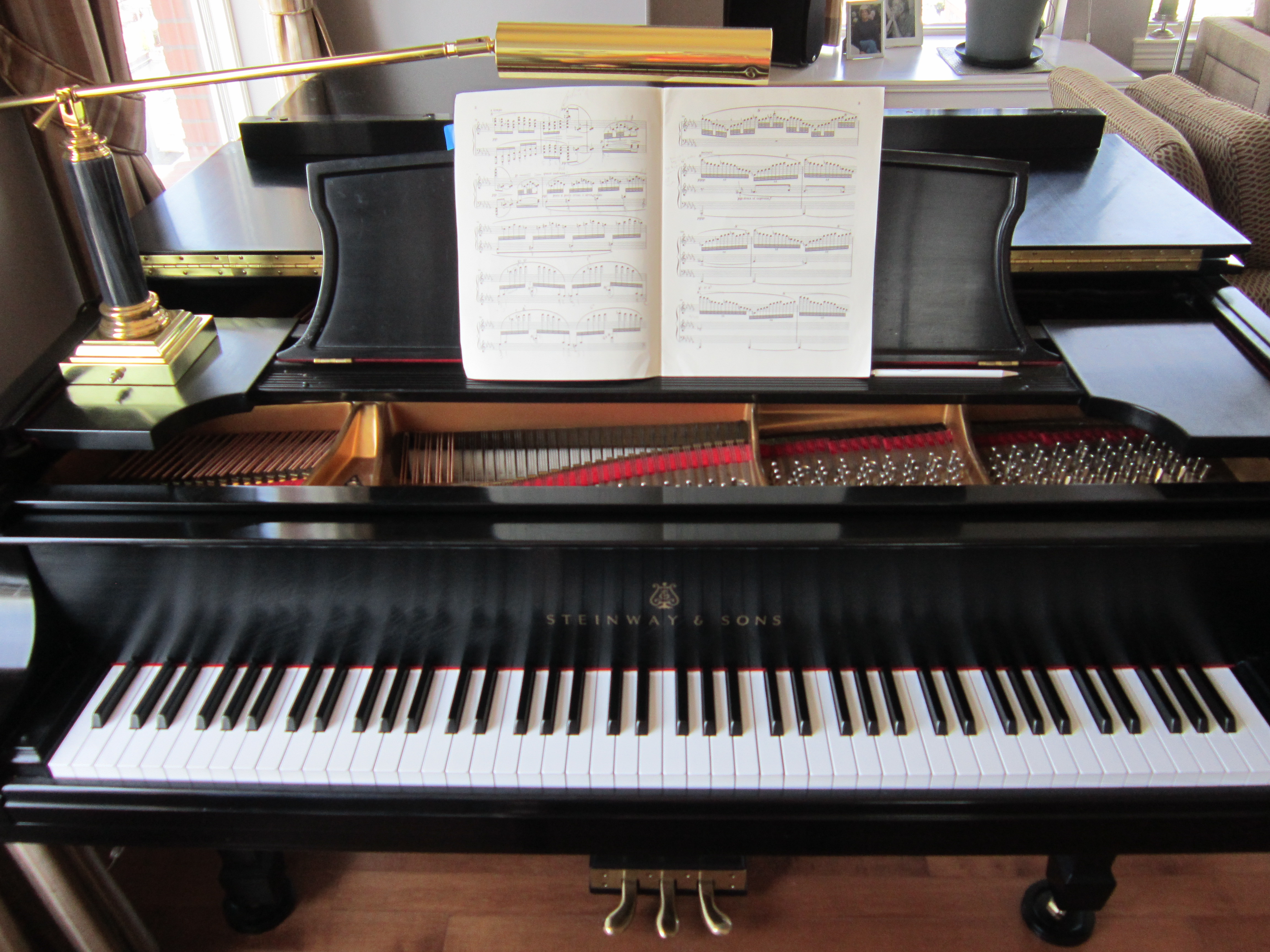
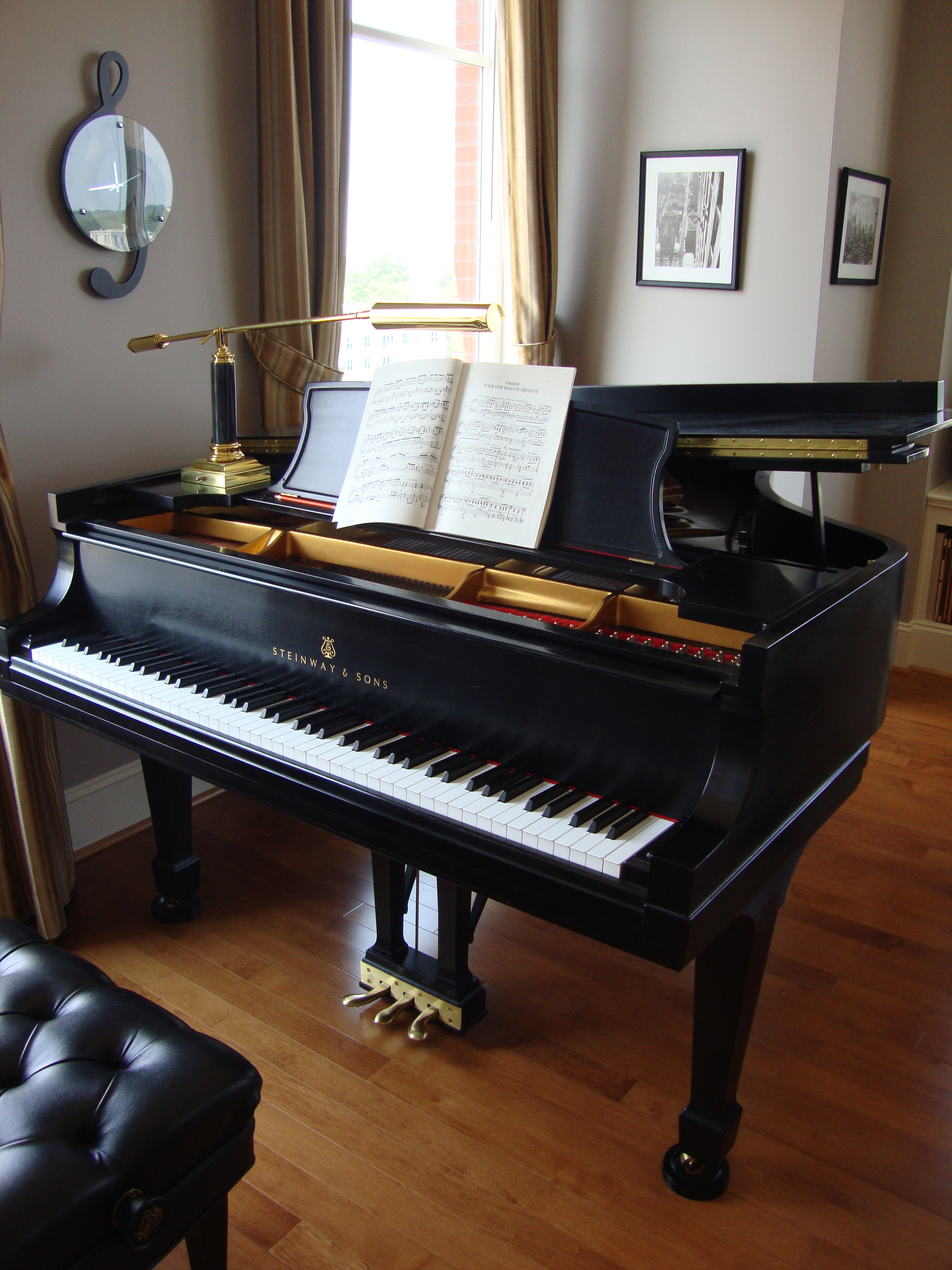
This was a significant step, because I have a strong prejudice against electronic keyboards. The interface looks like that of a real piano, which is deceptive, because the two instruments are very different. A great piano, like my Steinway grand, allows for a subtle connection between the human and the string. The basic technology is now antique (19th century), but still, they have thousands of parts and are said to be among the most complicated mechanical machines on earth. Each piano is also an individual, in a way that each electronic keyboard is not. The wood comes from particular trees that grew as they grew in a particular place during particular years.

A great piano has the capacity for nuance. I used to think of a key on the keyboard as similar to an on-off switch, but Olga persuaded me this is a mistake bordering on sacrilege. Her thing is to focus on nuances of touch and the associated nuances of sound. She hears details so tiny that it took a while for her to convince me they really existed, another period for me to begin perceiving them, and another period for me to begin to use them. It’s a little embarrassing to admit I was previously barely aware of this level of listening and touching, in spite of many years of making music.

Once you begin really listening hard at this level, the experience of music changes. There’s good news and bad news. It’s harder to reach a point of complete satisfaction with a performance, but at the same time the experience is richer and deeper. Anyhow, there’s no going back. Once your ears are opened, focused concentration on subtle nuances seems essential to any significant musical experience.

In revealing a level of this, Olga did a demonstration of various ways of touching C-5 for different colors of sound. One way she thinks of the touch is like dance, with the gesture of the hand choreographed to produce a particular color. Speaking of the subtle differences in sound produced by different gestures, she said (with a Russian accent), “I don’t know why it makes a difference. It just does. The piano is a mysterious instrument.”

Electronic keyboards are complicated, but somehow not mysterious. I have doubts that digital sound creation will ever be as personal and emotionally rich for me. But there is an amazing variety of things that the synthesizer can do. It’s different, and it’s good to change things up from time to time. So I’ll be experimenting, and see where it leads.

Piano lesson

One door closes, and another one opens. My piano teacher for the last four years, Randy Love, left for a sabbatical in China last month. Our piano lessons, at intervals of once a month or so, have taken me a long way along the path of the great western piano music tradition. The tradition is based on written texts, but much of it is unwritten, transmitted from teacher to student. Randy has transmitted much, and been an excellent master and a good friend.

During that time, I’ve enjoyed gaining fluency at the keyboard, but I don’t view increased technical mastery as the most valuable accomplishment. Much more important, and also much harder to express, is a change in the experience of the music. “Music is feeling, not sound,” according to Wallace Stevens (in Peter Quince at the Clavier). Stevens was on to something, although music is, obviously, sound. There’s a type of emotional energy stored in written musical texts and released and renewed with each performance. And there are many levels to that emotional experience.

So I went in search of a new master, and found myself yesterday at the music building at N.C. State in the studio of Olga Kleiankina. She’s a Russian with degrees from schools in Moldova and Romania, a masters from Bowling Green and a doctorate from University of Michigan, and joined the NCSU faculty last years as head of the piano program. She’s got an impressive amount of performance experience, and is an active concert artist. She was friendly but focussed. Straight away, she invited me to try out her two pianos, and after playing a bit of Chopin on each, I settled on the Mason and Hamlin over the Yamaha. Then she asked me what I’d brought to play for her. I played the first half of Chopin’s nocturne in D flat, Op. 27, No. 2, one of Chopin’s most beautiful, lyrical pieces, very like an operatic aria, with a broad emotional range. I played it rather well, with real feeling, I thought.

Olga was polite, but wasted no time with compliments. She said she could help me with my technique, and plunged in. It was quite bracing. We worked hard on weight transfer, activating the back and arm and relaxing the wrist. She showed me different ways of positioning the fingers on the keys for different sounds. She also talked about the shape of the gestures of the hand as it related to the flow of the music. She demonstrated this in various ways, including taking my hand and guiding it. I’ve usually thought of the physical aspect of piano playing as supporting but separate from the musical part, but Olga seemed to view the two as unified. Beautiful movements make beautiful sounds. She also demonstrated a level of attention to detail that was inspiring, and daunting.

At the end of the lesson, I felt like I could be at the foot of a new mountain. There’s a long way to go to reconfigure my playing along the dimension Olga pointed to. It will be challenging, and maybe transformative.

Starting the weekend with some exercise and music

Late Friday afternoon I returned some phone calls, cleaned out my e-mail queue, checked my to-do list one last time, jammed some weekend work in my book bag, and did the short drive home. Sally had left for a tennis tournament, but had first fed the animals, so they were sleepy. I played the piano for a few minutes and moved to a different mind zone — a Chopin nocturne (D flat major), a Debussy prelude (La cathedrale engloutie), Liszt’s Sonneto del Petrarca 47. I also played J. Strauss’s Blue Danube waltzes in honor of the poor Danube, currently under assault by toxic sludge. I filled a small plate with some leftover pepper casserole and brown rice, warmed it in the microwave, poured a glass of pinot gris, and had a quiet, delicious dinner.

Then I walked over to hear the N.C. Symphony do the first fall concert of our series. It was a lovely fall evening, mild and clear, and I savored the walk. This is one of the pleasant things about living in downtown Raleigh. There were two new buildings going up along the way, and people on Fayetteville Street eating dinner at sidewalk tables or walking about.

I had an unusually strong sense of physical well being. It was a good week for exercising — no travel or serious time crunches at work — so I’d gotten up at 5:30 a.m. every day to either swim a freestyle mile (2x), do a yoga class, or take a spinning class (2x). Spinning is still new to me, and I’m still enthusiastic — it’s an amazing aerobic workout. The basic idea of stationary bike plus music, rhythmic movement, group activity, and a cheerleading coach previously struck me as not at all my style, but it is remarkably effective in (a) raising my heartrate, (b) making me sweat, and (c) leaving me feeling pleasantly endorphinized.

With fall in the air, I’m looking forward to winter, and skiing in Colorado, and I’m using ski thoughts for extra workout motivation. Last year the hour-long climb in the snow at over 12,000 feet up the narrow ridge to Highlands Bowl at Aspen Highlands taught my body a brutal lesson it won’t soon forget. I was, in truth, too whipped to attack the long double black diamond run from the top, but there was no alternative way down. I survived, but next year I hope to do more than merely survive such situations — to exult! That may be too much to hope for. It will always be difficult to go from a few hundred feet above sea level one day to vigorous activity at several thousand feet the next, but I’m looking to be in better shape next season and bettering my odds.

At a leisurely pace, it took 23 minutes to walk to the concert hall. (Afterwards I picked up the pace and got home in under 20.) I was interested to hear Rachmaninoff’s first piano concerto. The composer was still a student when he made it, but it has the seeds of the more familiar and almost too gorgeous second concerto. It is certainly a virtuoso showpiece, and Jean-Philippe Collard played it with power and authority. I was mainly interested in the second half of the concert, a performance of Sibelius’s Fifth Symphony, a piece I was not familiar with. It was strange and beautiful, with novel and varied textures, and diverging moods. It approached the richness of Mahler. There were good loud places, where the brass expressed themselves fully, and a fine solo for the bassoon. I plan to get a recording and listen to it some more.