The Casual Blog

Tag: nature

Falklands nourishment, and disrespecting Trump
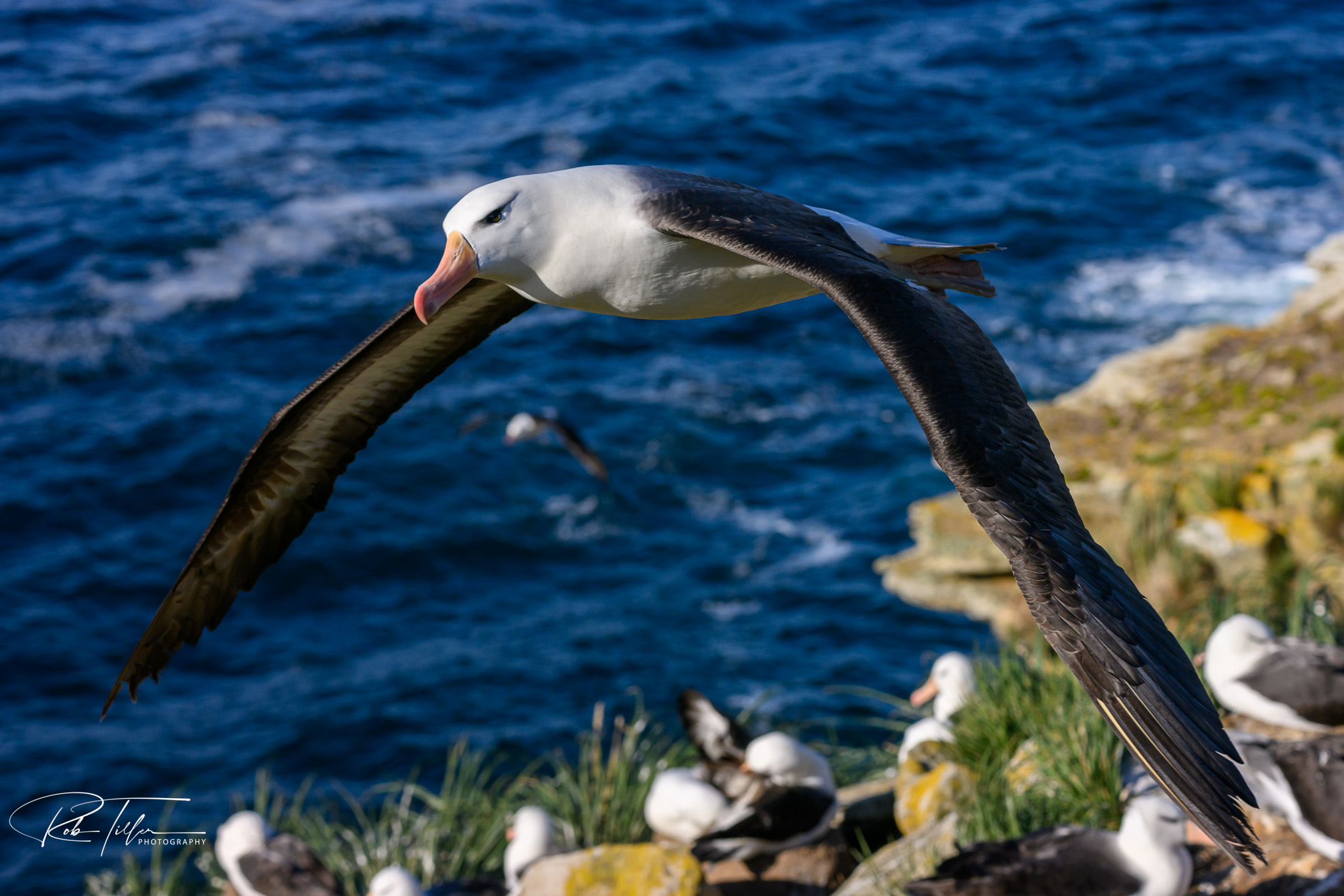
Black-browed albatross

In my recent trip to the Falkland Islands, I took around 50 thousand pictures of the animals that live there.  Reviewing them was a lot of work, but also enriching. I’ve been struck again and again at how amazing nature is.  
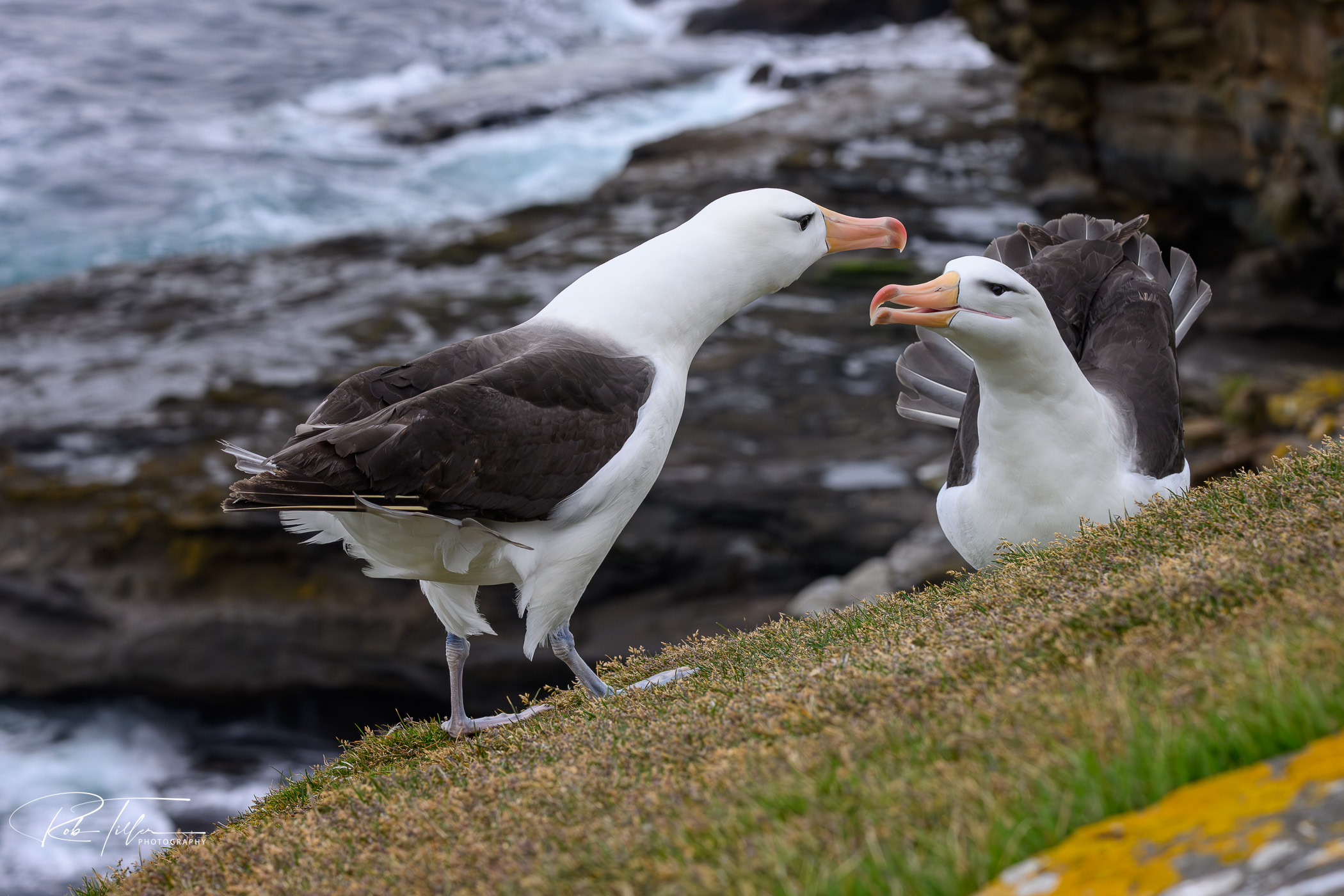
Somehow all these wonderful creatures evolved and became perfectly adapted to thrive in their harsh environment.  I particularly enjoyed seeing young animals courting and playfully rough housing, and the miracle of new life in the dense, noisy rookeries.  
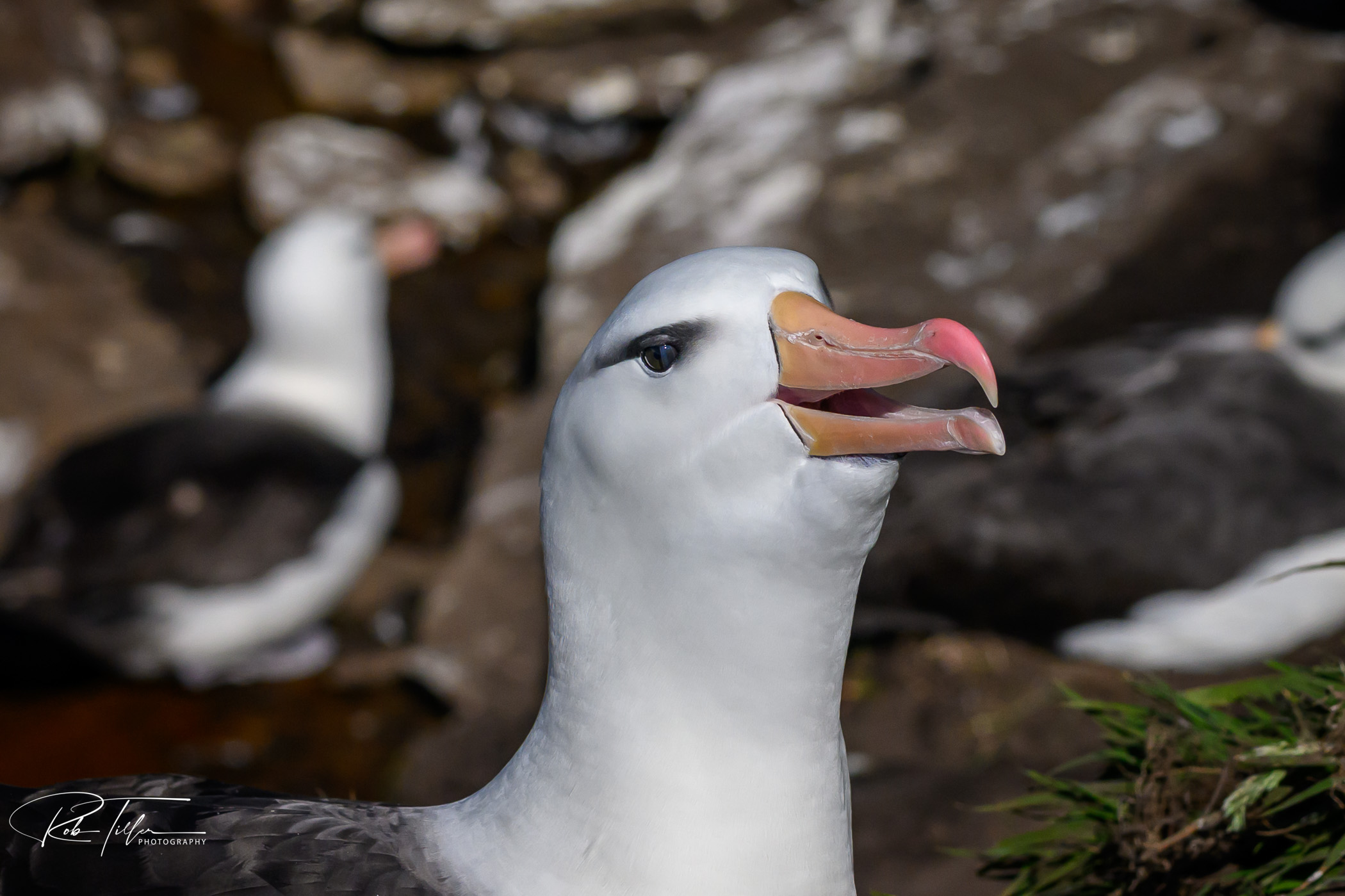
Although the weather was rough at times, spending time with these animals inspired a sense of wonder and inner peace, and I hope these pictures communicate that.  In these dark times, we need to take peace and spiritual nourishment where we can find it.  

Magellanic penguins

In the past weeks, we’ve seen a dramatic escalation in the signature violence of the Trump administration.  Several US cities seem to be coming under quasi-military occupation, including  Washington, Los Angeles, Chicago, Memphis, New Orleans, Minneapolis, and Portland. Protestors and bystanders are being attacked with chemical weapons, beatings, and bullets.  

Imperial cormorant rookery

A massive US military force has anchored in the Caribbean and invaded Venezuela, while we’re bombing various countries in Africa and the Middle East.  Now Trump is threatening to invade several more countries.  European nations are making contingency plans to defend Greenland from the US, while our friendly northern neighbor, Canada, is considering steps to defend itself.  

There’s a common thread between the violent attacks by Trump’s goons in our cities and the violence against other countries.  Trump rejects the values and aspirations that we’ve taken for granted as essential for both civil society and international relations.  Values like freedom, democracy, rule of law, and mutual respect are under siege.  In their place, Trump is attempting to substitute greed and lawless violence.  
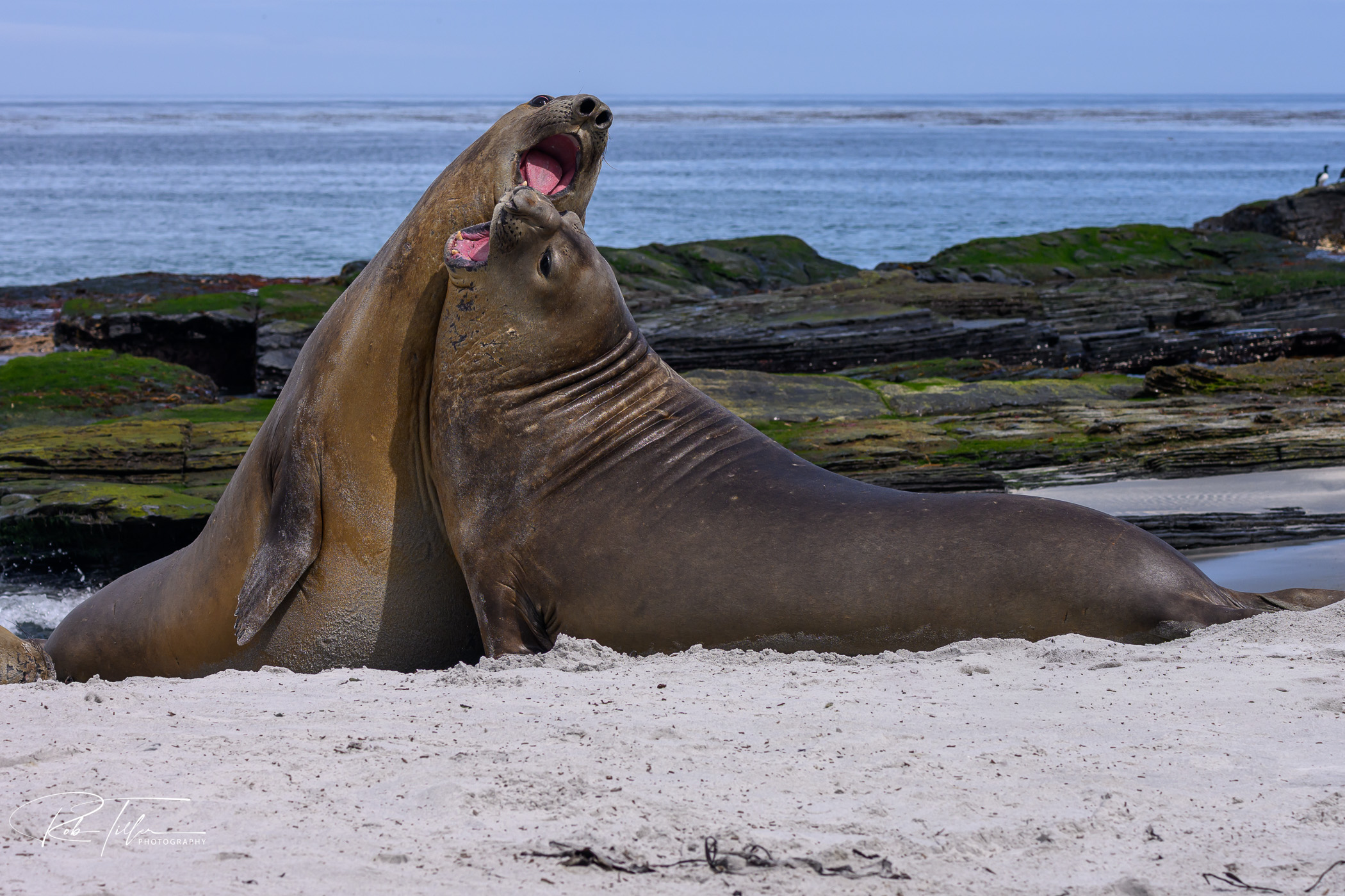
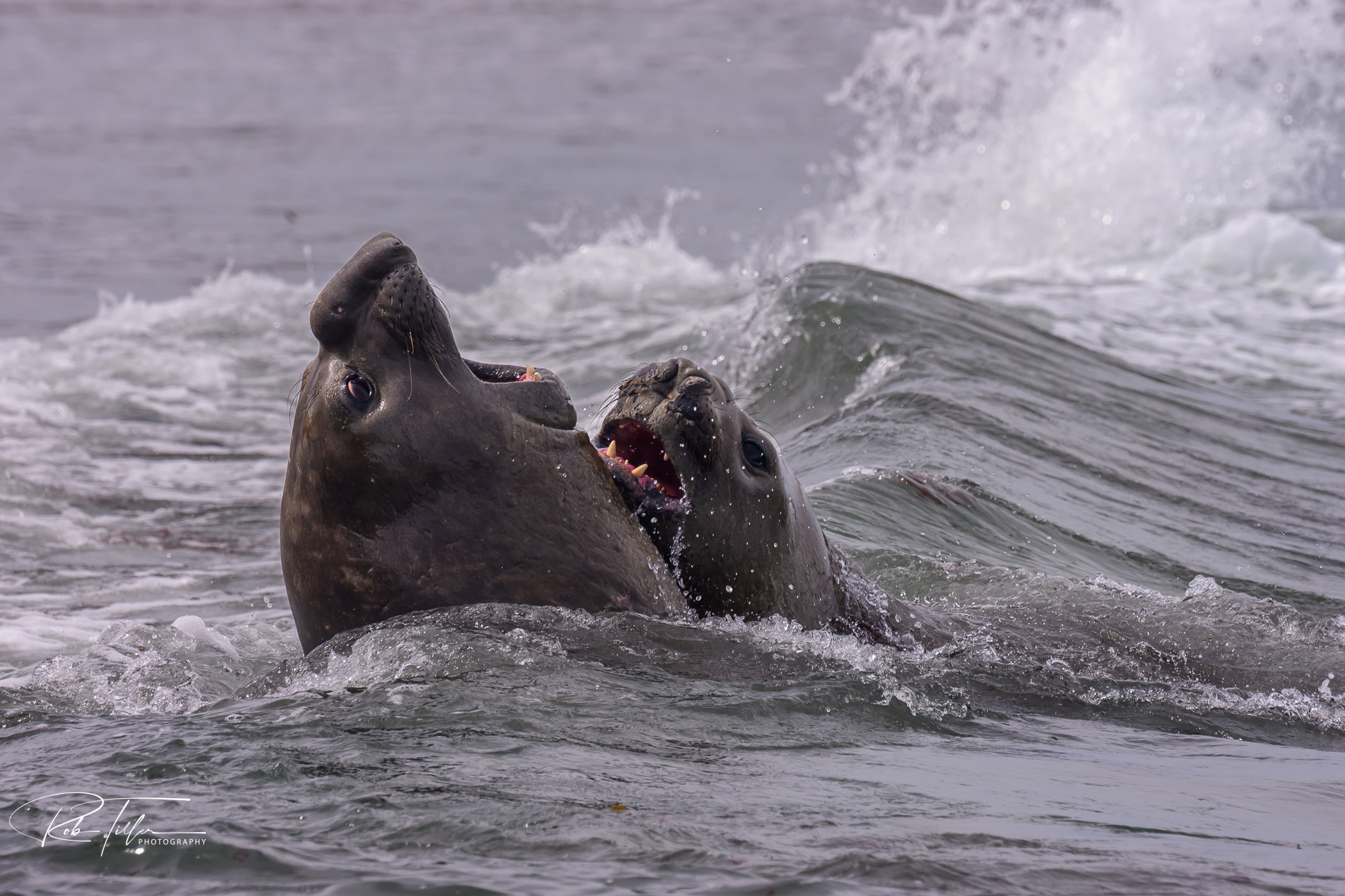
Southern elephant seals

Trump contends he isn’t bound by US or international law.  Stephen Miller may have articulated the MAGA world view best when he declared this week that the real world is governed by force and power.  

The Miller “realist” view has a grain of truth, of course:  governments have and exercise power.  But the Miller view is myopic and distorted.  Throughout history, governments that are essentially despotic tyrannies have failed, because the governed resent and reject them.  More successful governments incorporate non-despotic elements, including fair legal systems, representation through free elections, and checks on executive power, as well as systems for promoting citizens’ health, education, and welfare. 
In the realm of international affairs, the notion that states prosper through pure brute force has been tested through two world wars and numerous other conflicts, and it hasn’t worked.  Instead, the most prosperous period in human history has occurred since WWII, under a widely adopted  voluntary framework of international law.  Despite imperfections, this framework, which generally prohibits invading other countries and stealing their resources, has helped to minimize warfare and promoted more peace.  
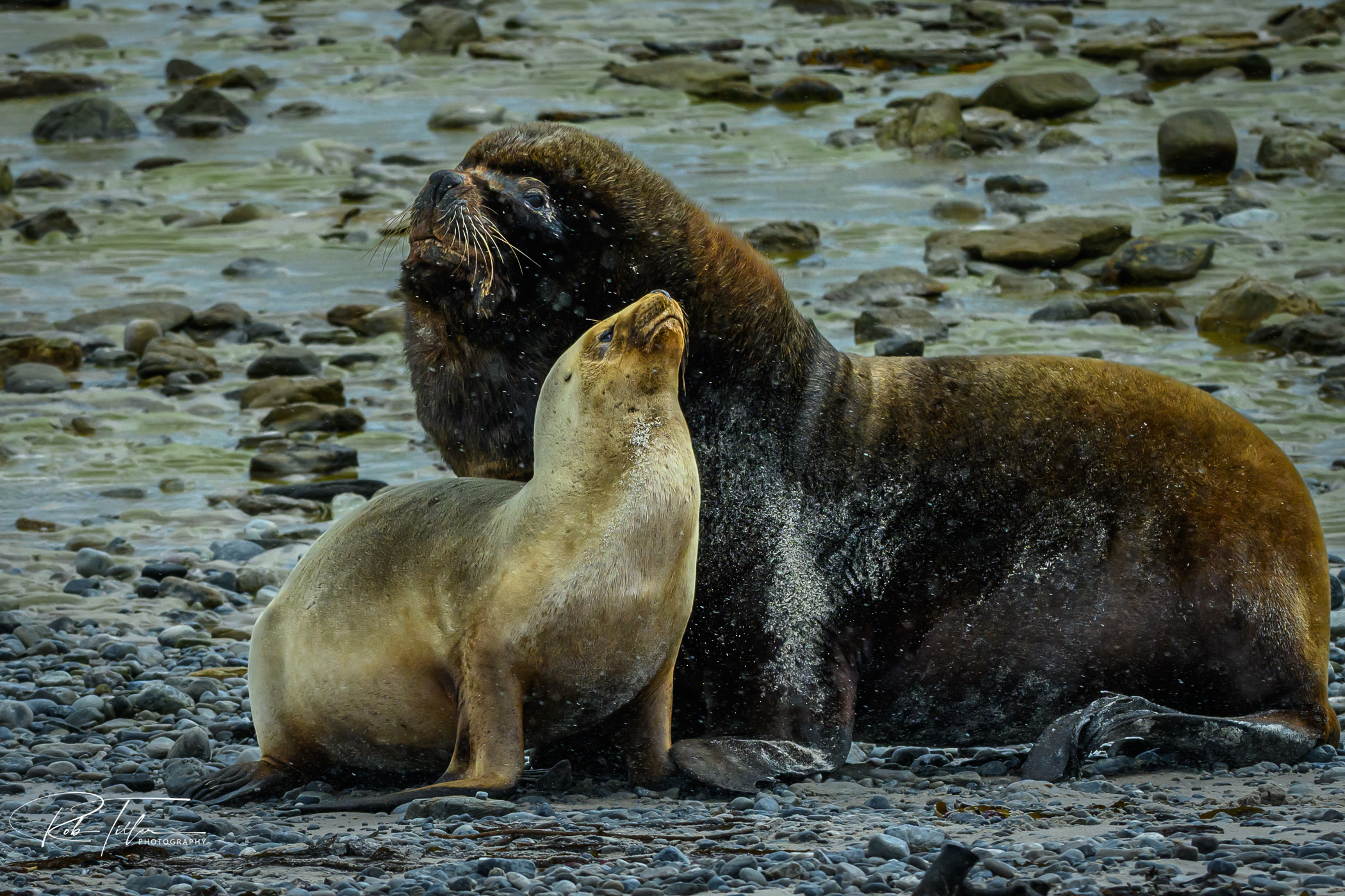
Sea lions

Trump’s recent move to steal the oil of Venezuela is brazenly criminal, and also idiotic.  The demand for the sludgy oil is low, the practical barriers to development are high, and renewable substitutes for fossil fuel are getting ever cheaper.  Plainly, the best thing for planet Earth is to leave that oil in the ground and move as quickly as possible away from fossil fuels.  

So why is Trump spending hundreds of millions of our tax dollars on a smash and grab operation for that sludgy oil?  For that matter, why threaten to seize the territory of friendly long time allies like Denmark or Canada?  Or attempt to take control of American cities with armed masked thugs?  
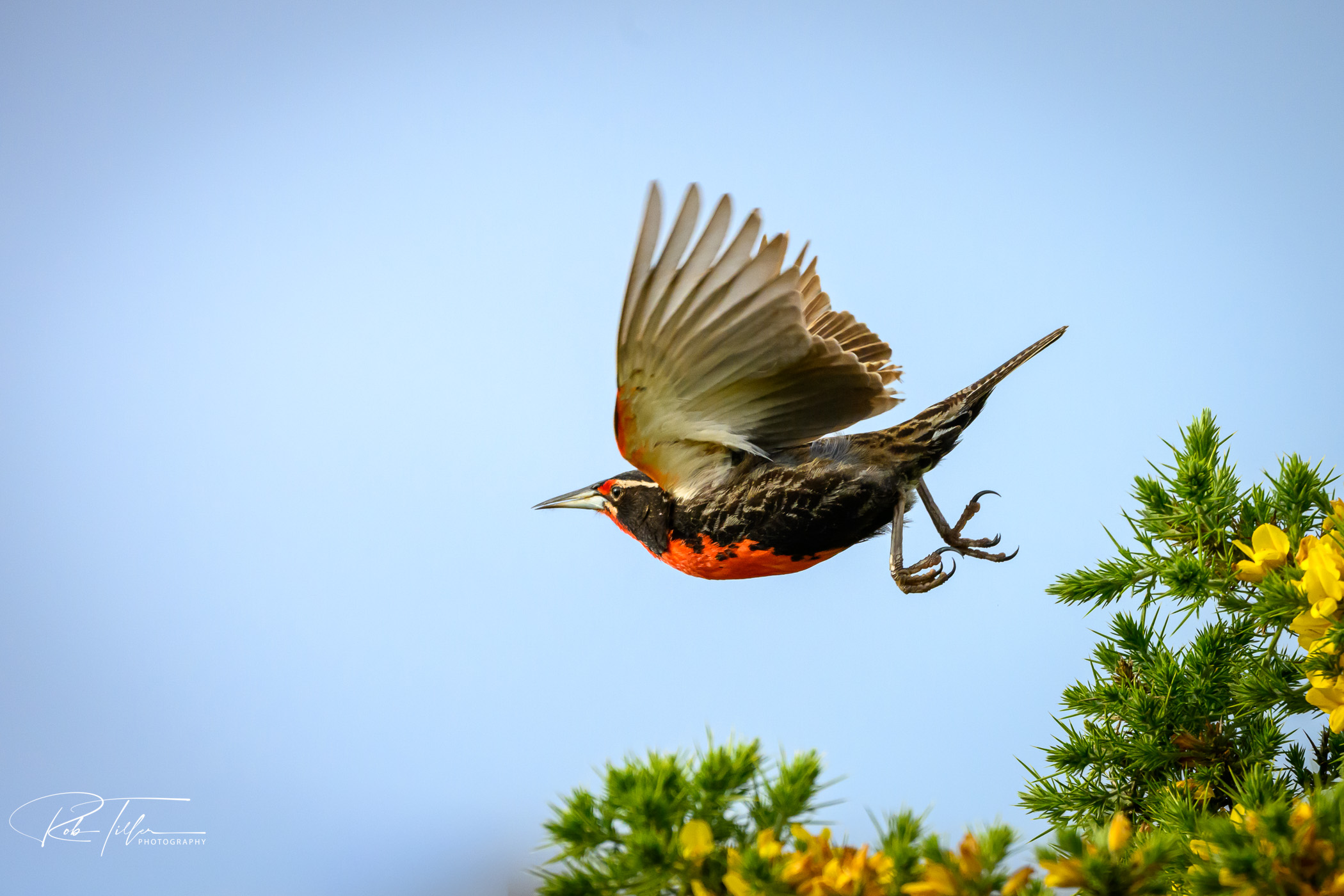
Long-tailed meadowlark

It’s obvious that Trump isn’t too smart, but dumbness alone isn’t an adequate explanation for his escalating wide-ranging threats and violence.  There’s a persuasive explanation in Thomas Edsall’s latest NY Times column. It seems that Trump has become addicted to power.  

Edsall quotes Professor Manfred Kets de Vries as follows: 

It is possible to become addicted to power — particularly for certain character structures. Individuals with pronounced narcissistic, paranoid or psychopathic tendencies are especially vulnerable. For them, power does not merely enable action; it regulates inner states that would otherwise feel unmanageable.

Donald Trump is an extreme illustration of this dynamic. From a psychoanalytic perspective, his narcissism is malignant in the sense that it is organized around a profound inner emptiness.

Malignant narcissism is a combination of narcissism and psychopathology. Because there is little internal capacity for self-soothing or self-valuation, he requires continuous external affirmation to feel real and intact. Power supplies that affirmation. Visibility, dominance and constant stimulation temporarily fill the void.

Crested caracara

As Edsall explains, psychologists say that power stimulates the brain much like an addictive drug.  The sensation can be intoxicating, but as with other addictions, the power addict develops tolerance, a need for ever increasing doses.  It leads to poor decision making, as delusions of omnipotence  are thwarted by reality.  This causes feelings of frustration and rage, and impulsive and foolish behavior.  
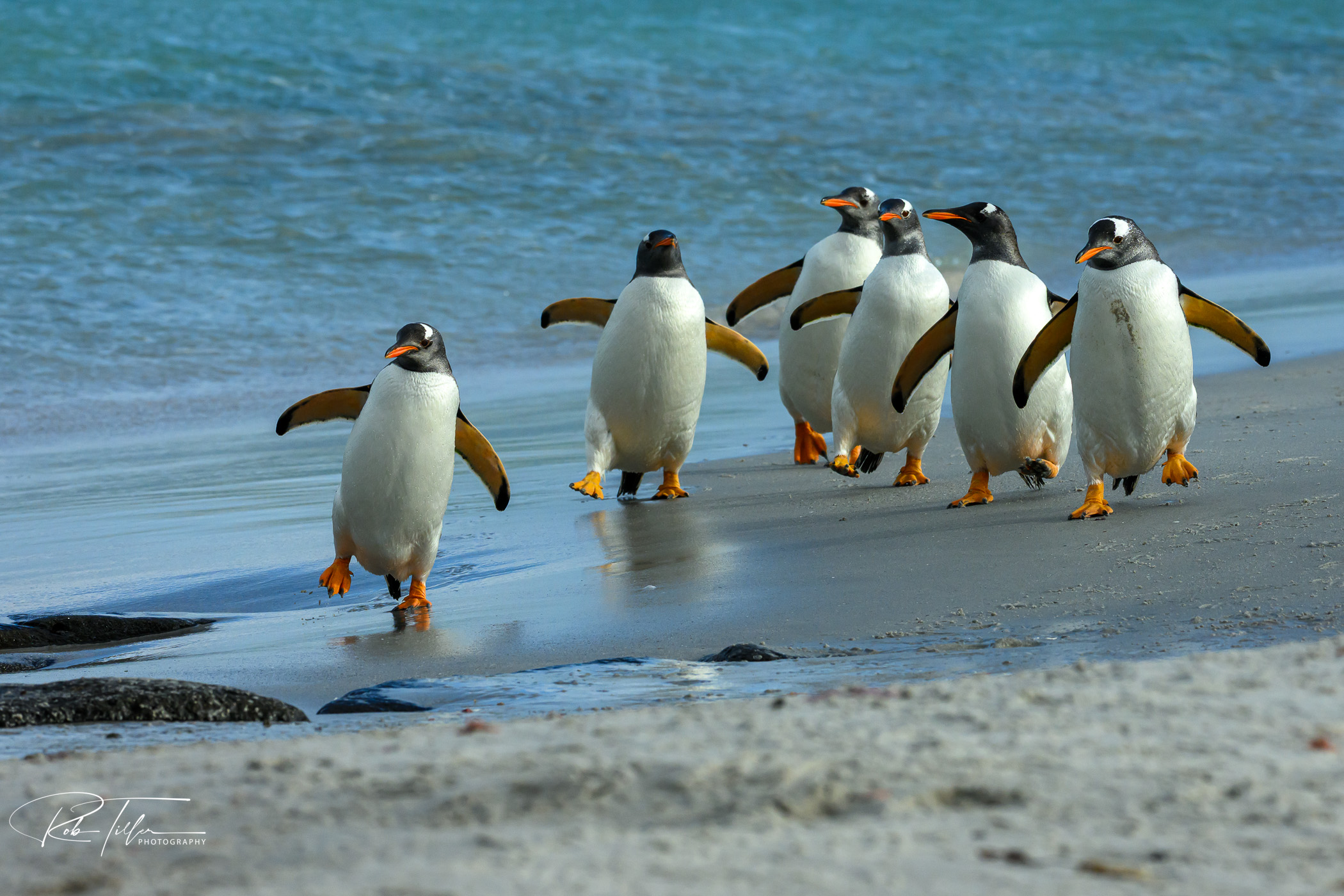
Gentoo penguins

Adam Galinsky, a professor at Columbia, also explains some of Trump’s behavior as an attempt to address his insecurity and feelings of being disrespected.  It’s telling that Trump attempted to justify the killing of Renee Good in Minneapolis by saying she was “very, very disrespectful to law enforcement.”  That is, he has proposed that police shootings can be justified by the victim’s disrespect.  This is not the law in America.  It’s lawless tyranny.
Is disrespect a central driver of the MAGA movement?   David Frum, in the Atlantic Daily, writes  “MAGA is many things, but above all it’s a movement about redistributing respect away from those who command too much (overeducated coastal elites) to those who don’t have enough (white Americans without advanced degrees who feel left behind).” 

Frum says, “ICE is violence-prone in part because the agency has lowered its training standards and ditched much of its background vetting to meet the president’s grandiose deportation targets. But more fundamentally, ICE is violence-prone because its main purpose has become theatrical. Under present leadership, ICE is less a law-enforcement agency than it is a content creator.”
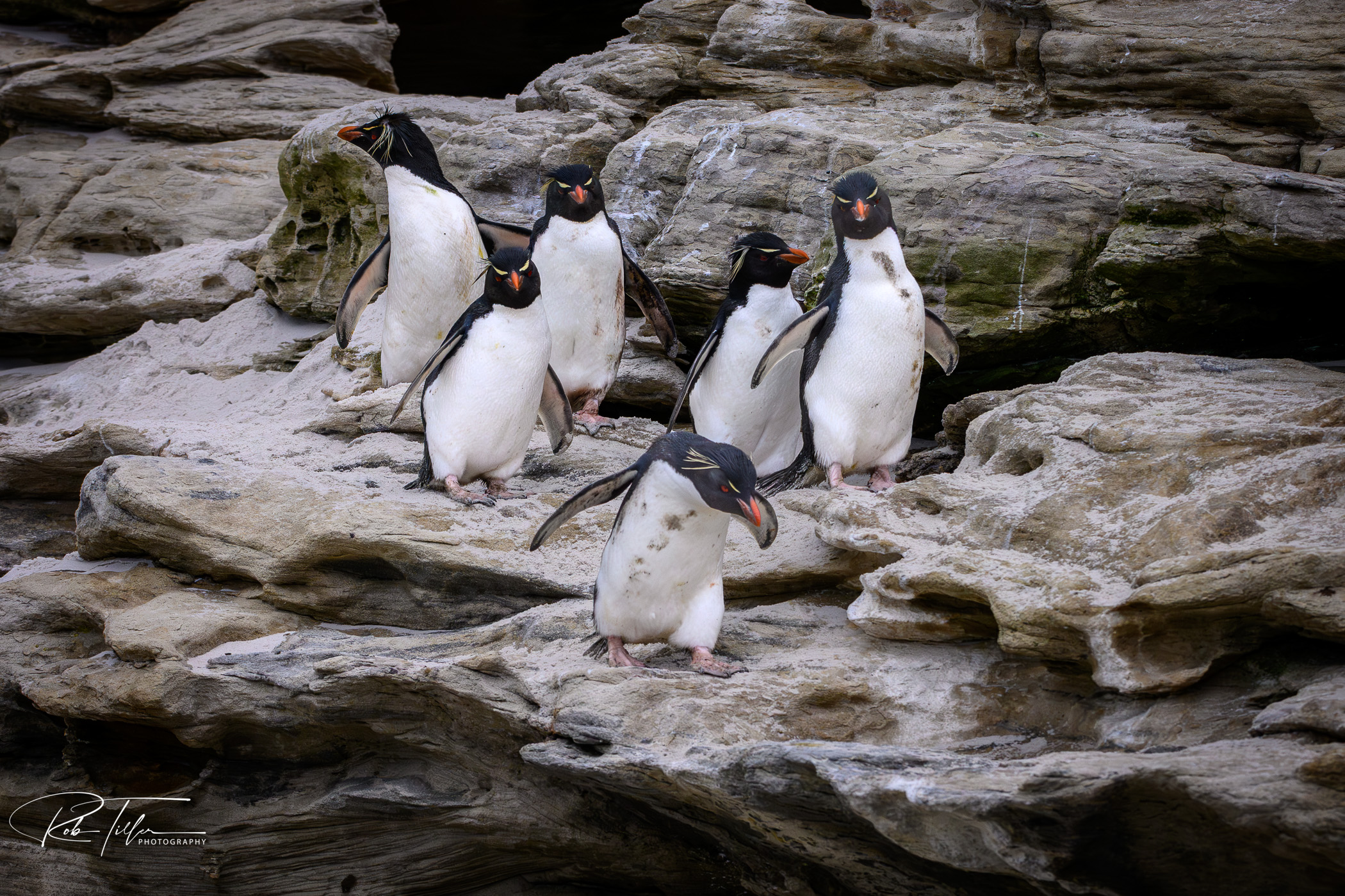
Southern rockhopper penguins

This content, Frum suggests, is about demonstrating that disrespect will not be tolerated.  In the MAGA framework, foreigners, racial minorities, religious minorities, LGBTQ+ folks, women, and anyone else suspected of disrespect for white Christian males must either demonstrate subservience or face violent consequences.  
So here we are:  our leader is a rapidly deteriorating guy of barely average intelligence and way below average morality trying to compensate for his inner emptiness and unhappiness with more and more dramatic gestures of violence and domination.  And his ardent followers share some of his worst traits and continue to support him.
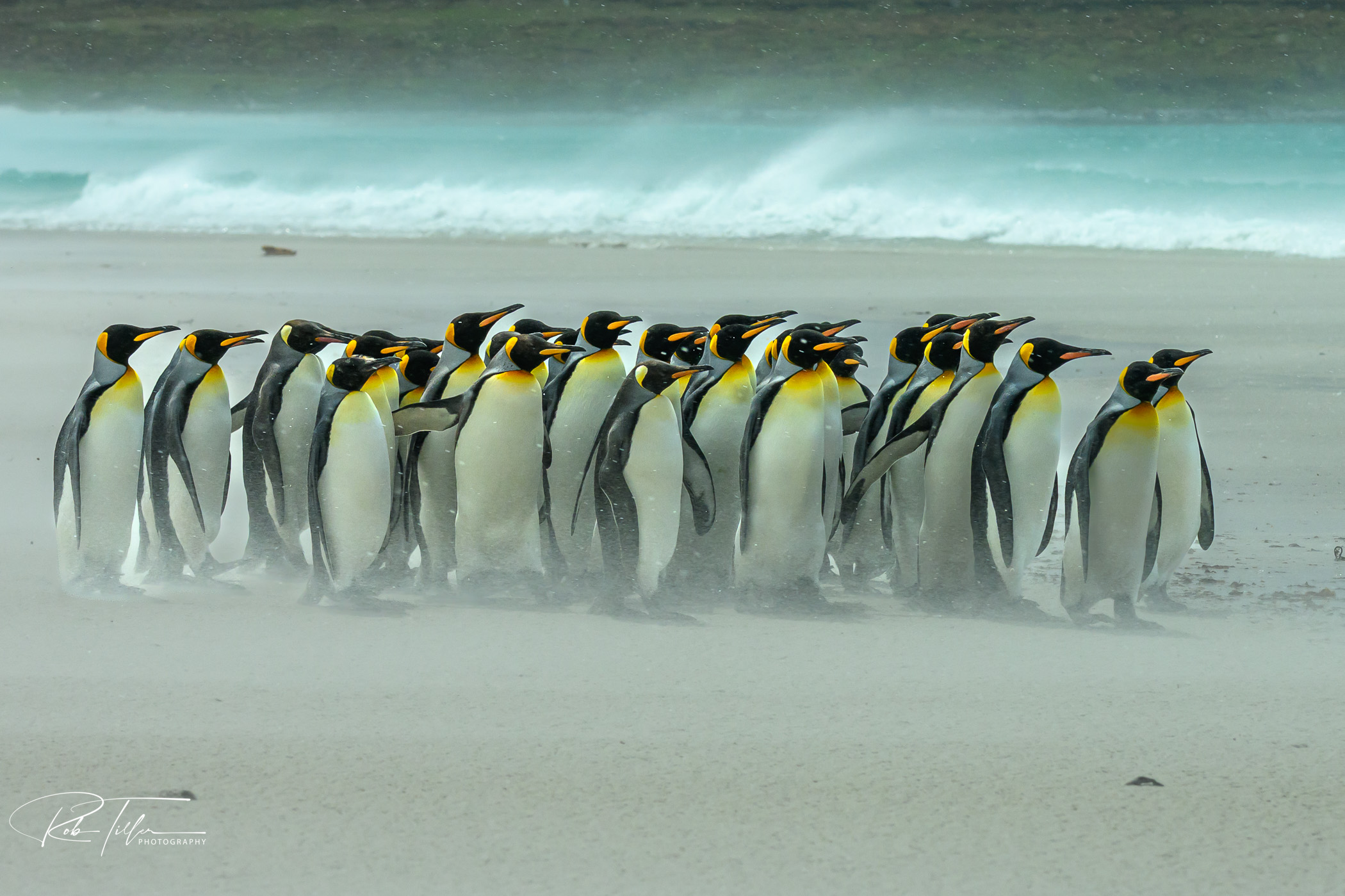
King penguins

Fortunately, the worm may be starting to turn.   In the last few days, a few Republicans in Congress are starting to break ranks and speak out against the lawlessness.  Public support for ICE and for Trump continues to drop.  Thousands of Americans are daring to take to the streets in opposition to ICE violence.  

Also, Trump, who hardly ever makes a truthful statement, said one reality based and encouraging thing this past week:  that if the Democrats win the mid-terms, he’s going to face impeachment.  Inshallah!

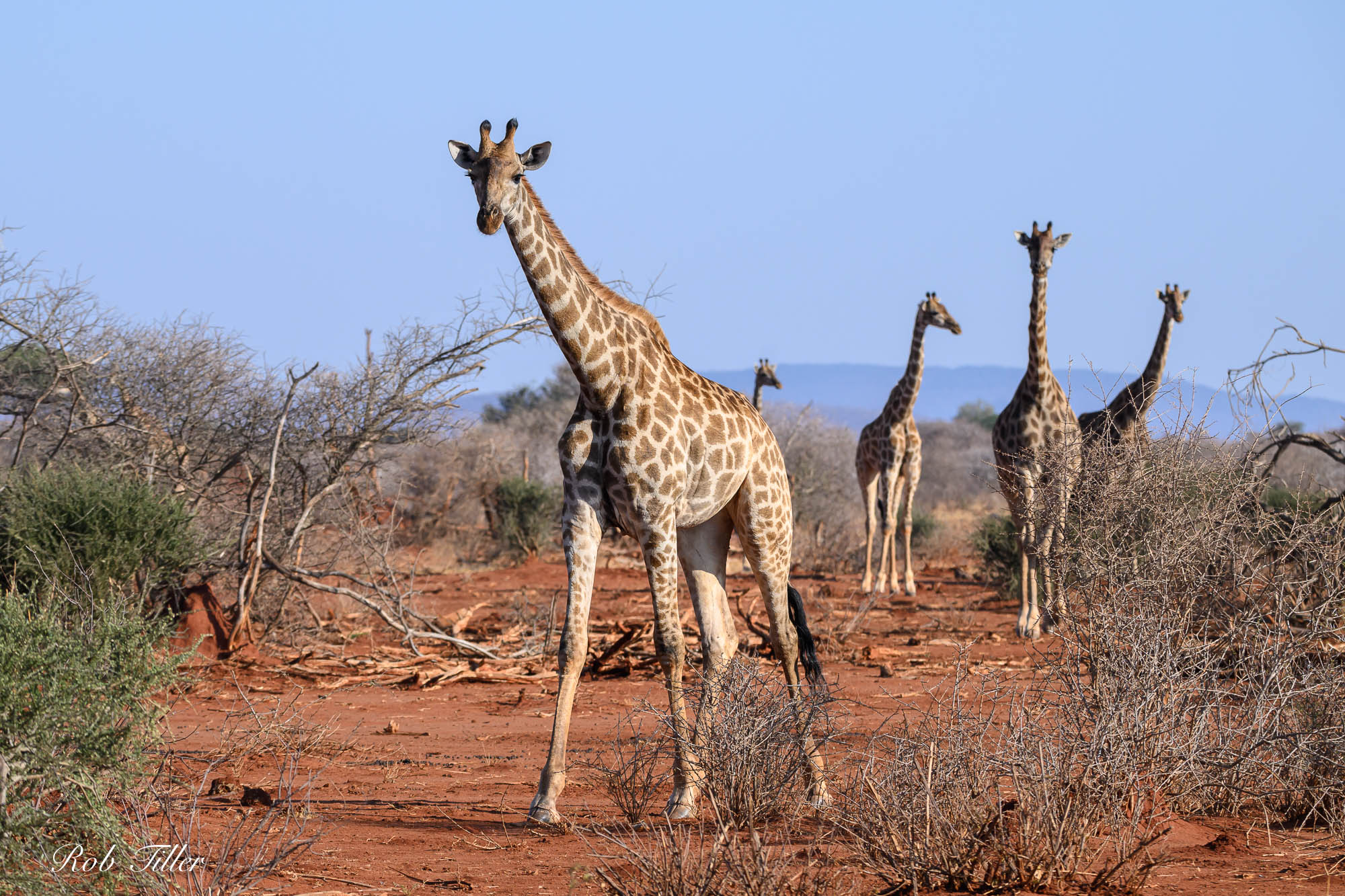
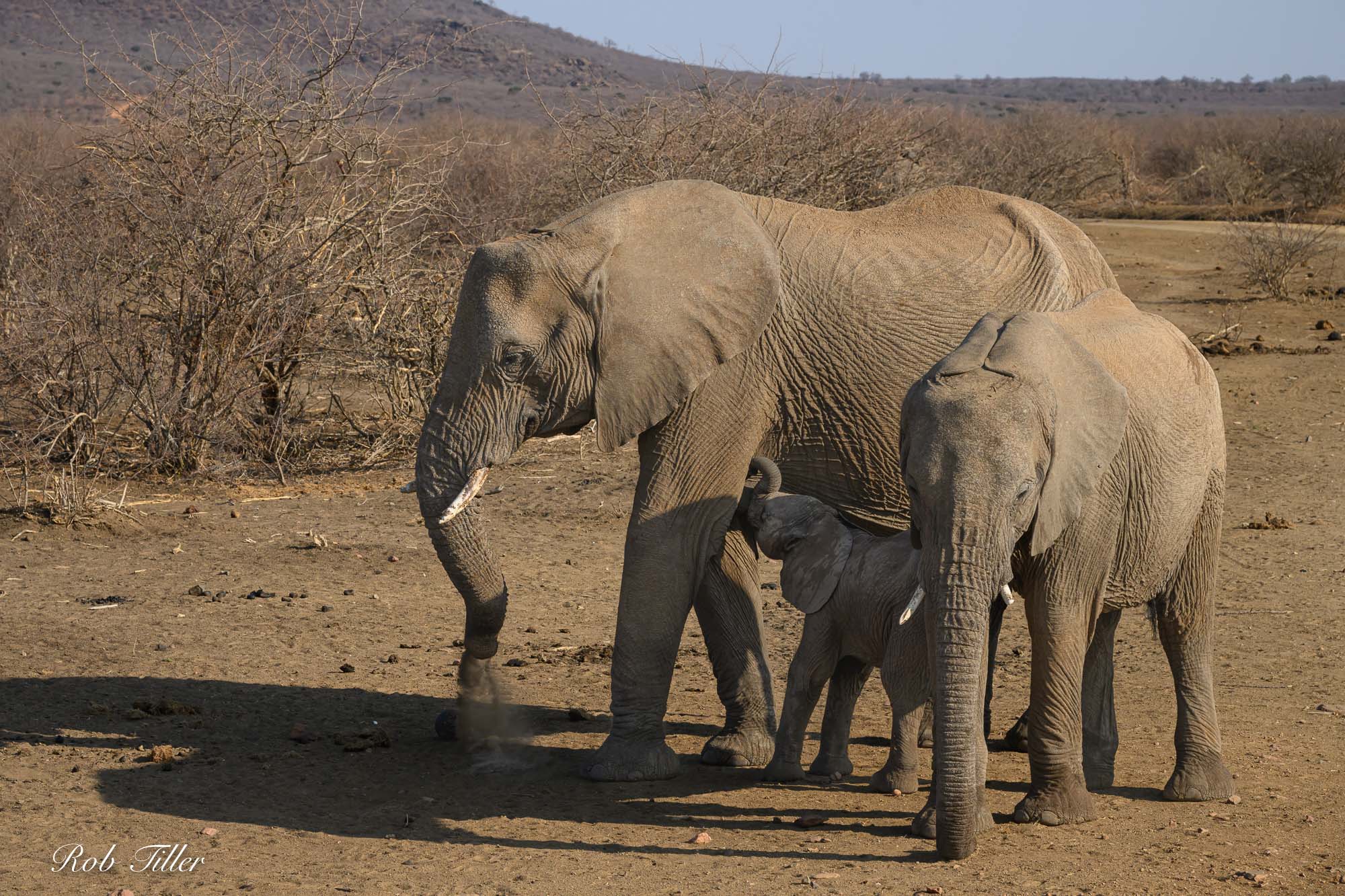
More on our South African safari and new discoveries on birds and plants

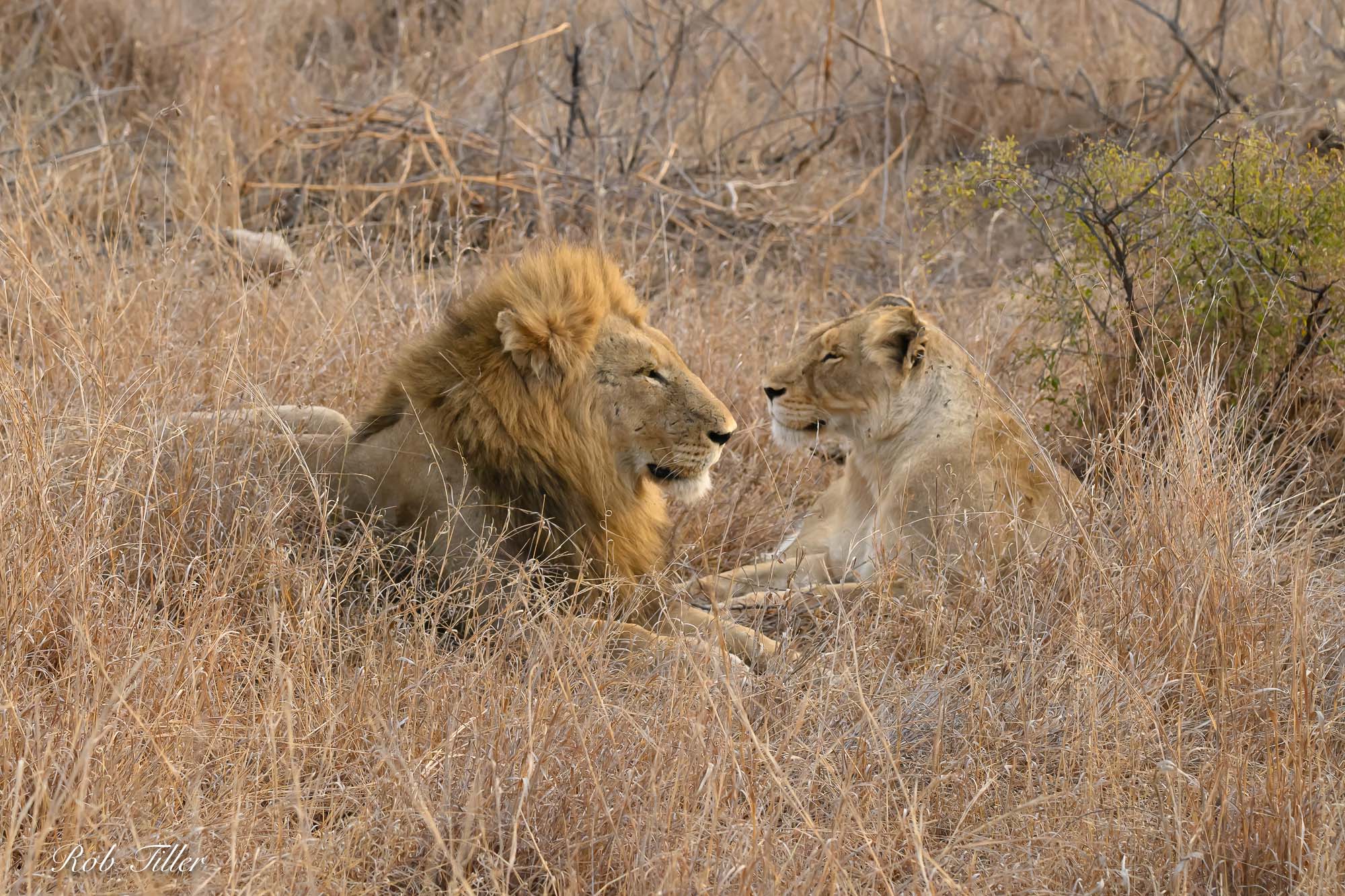
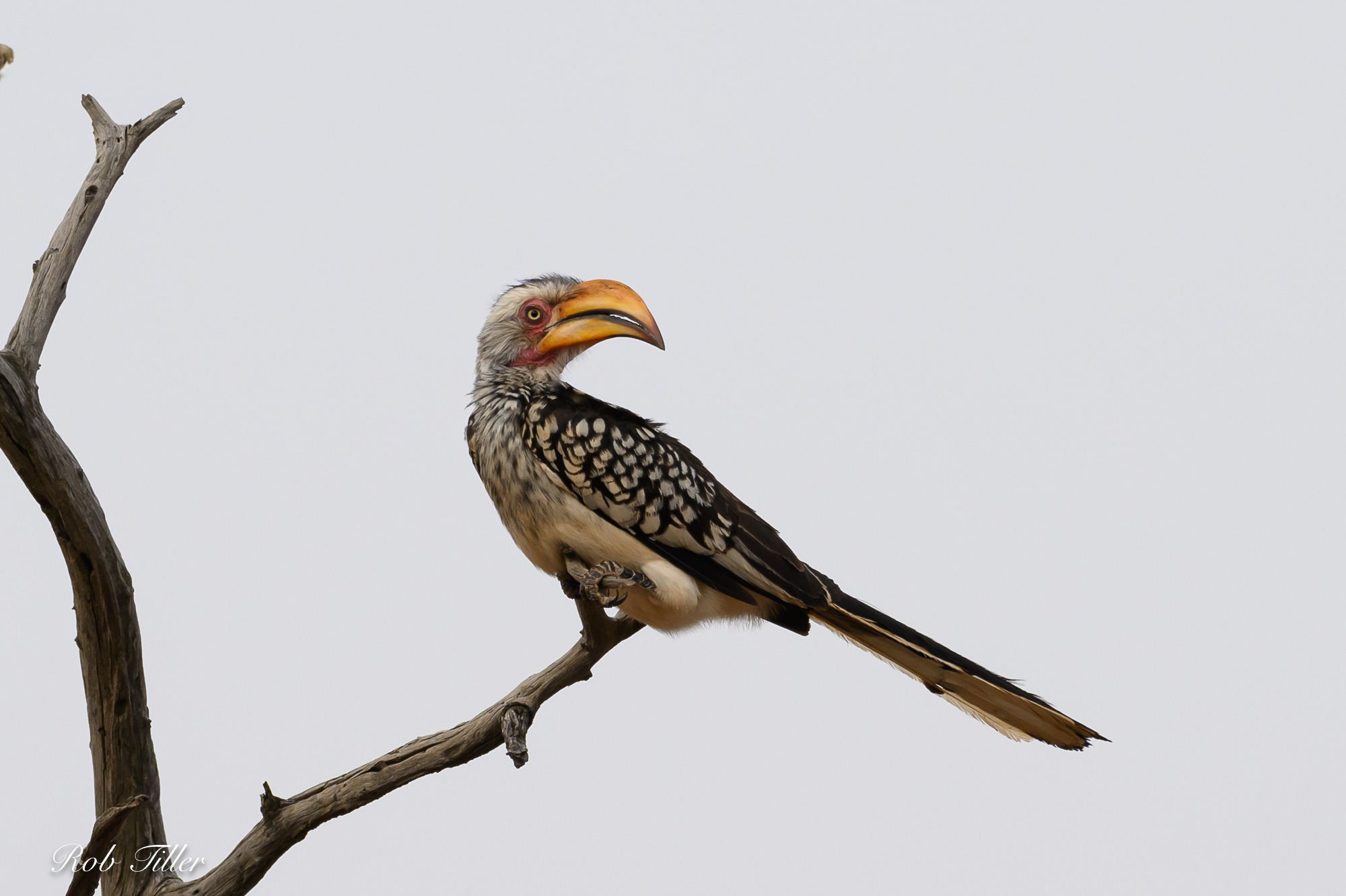
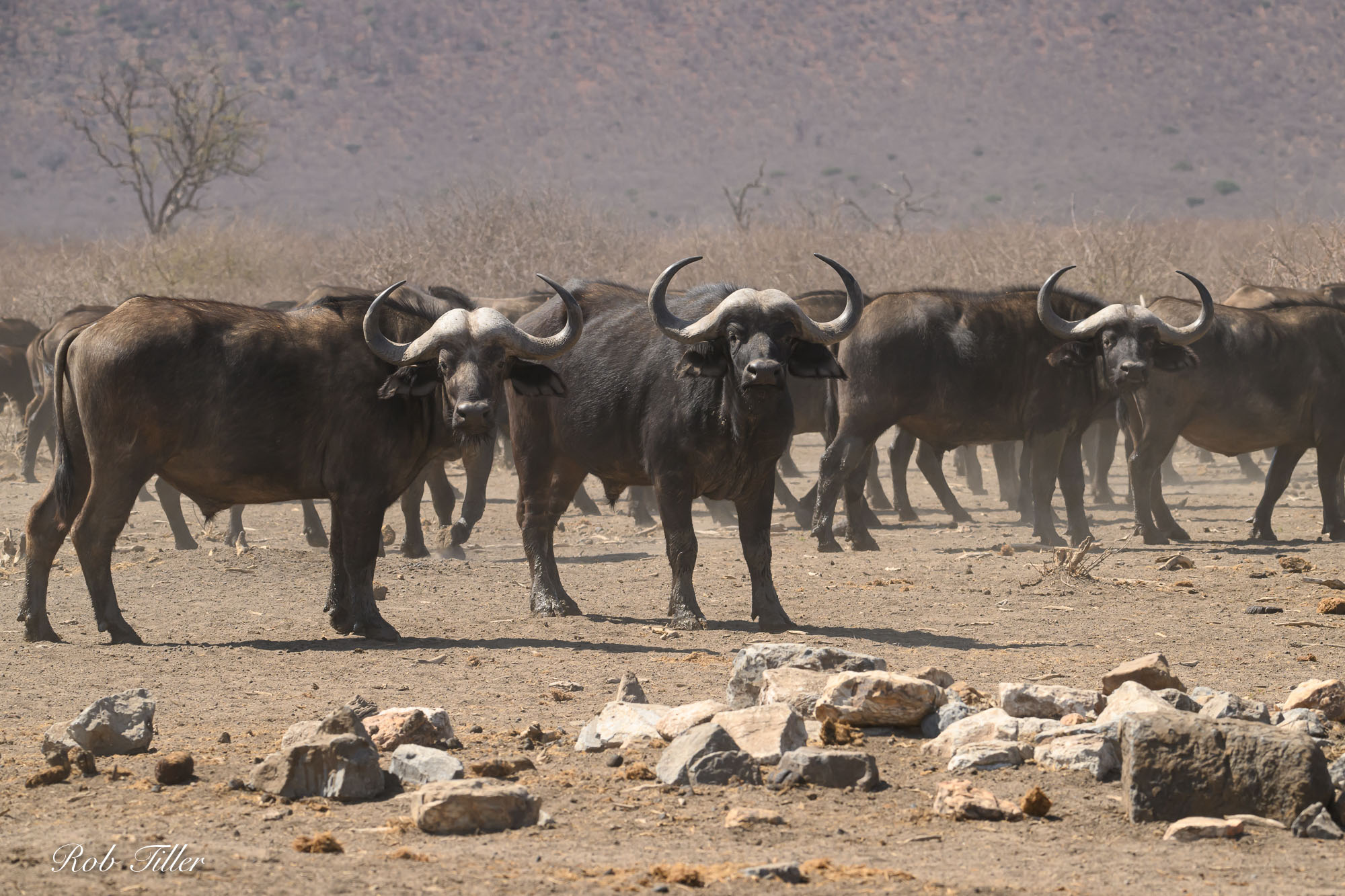
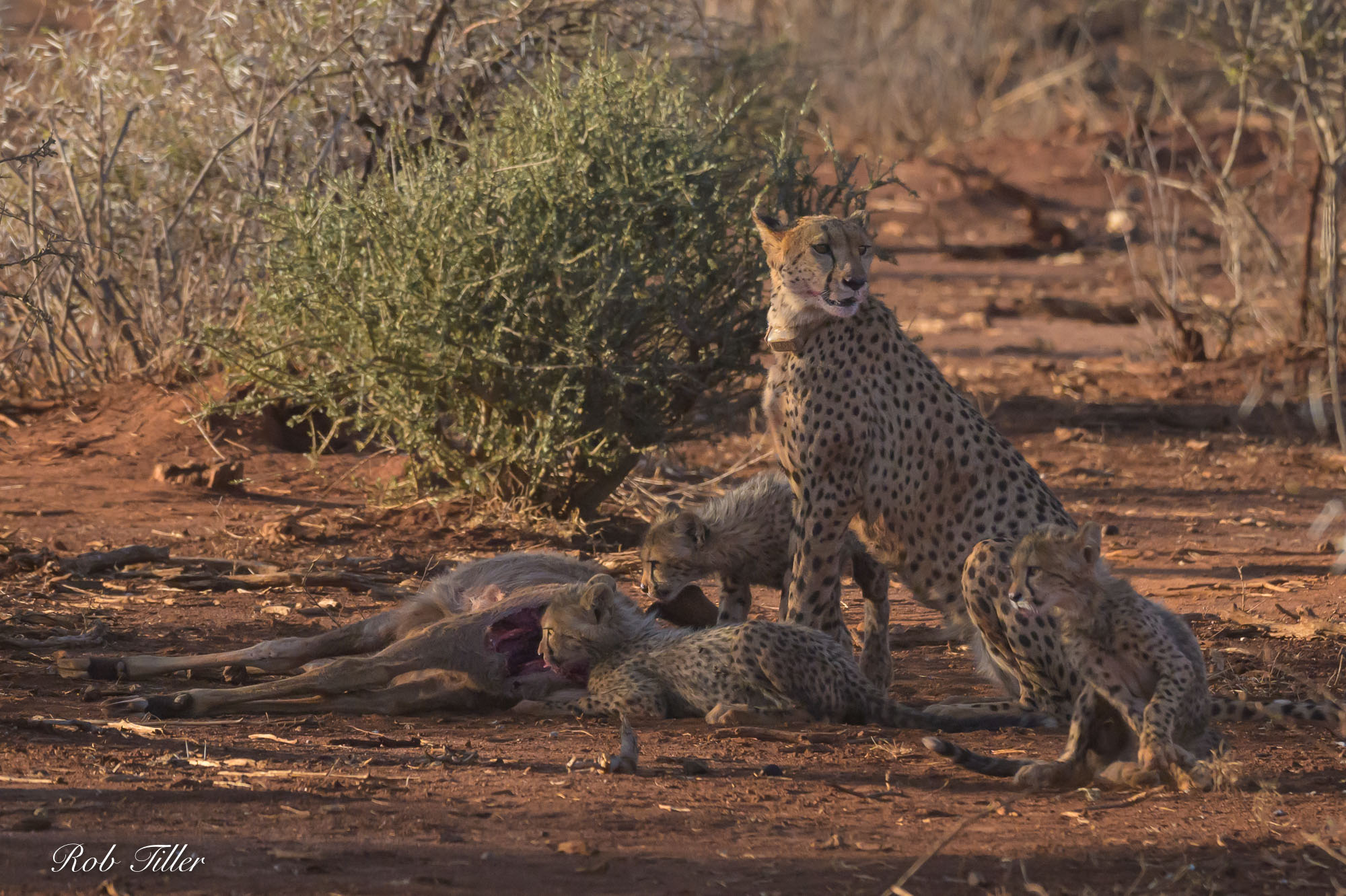
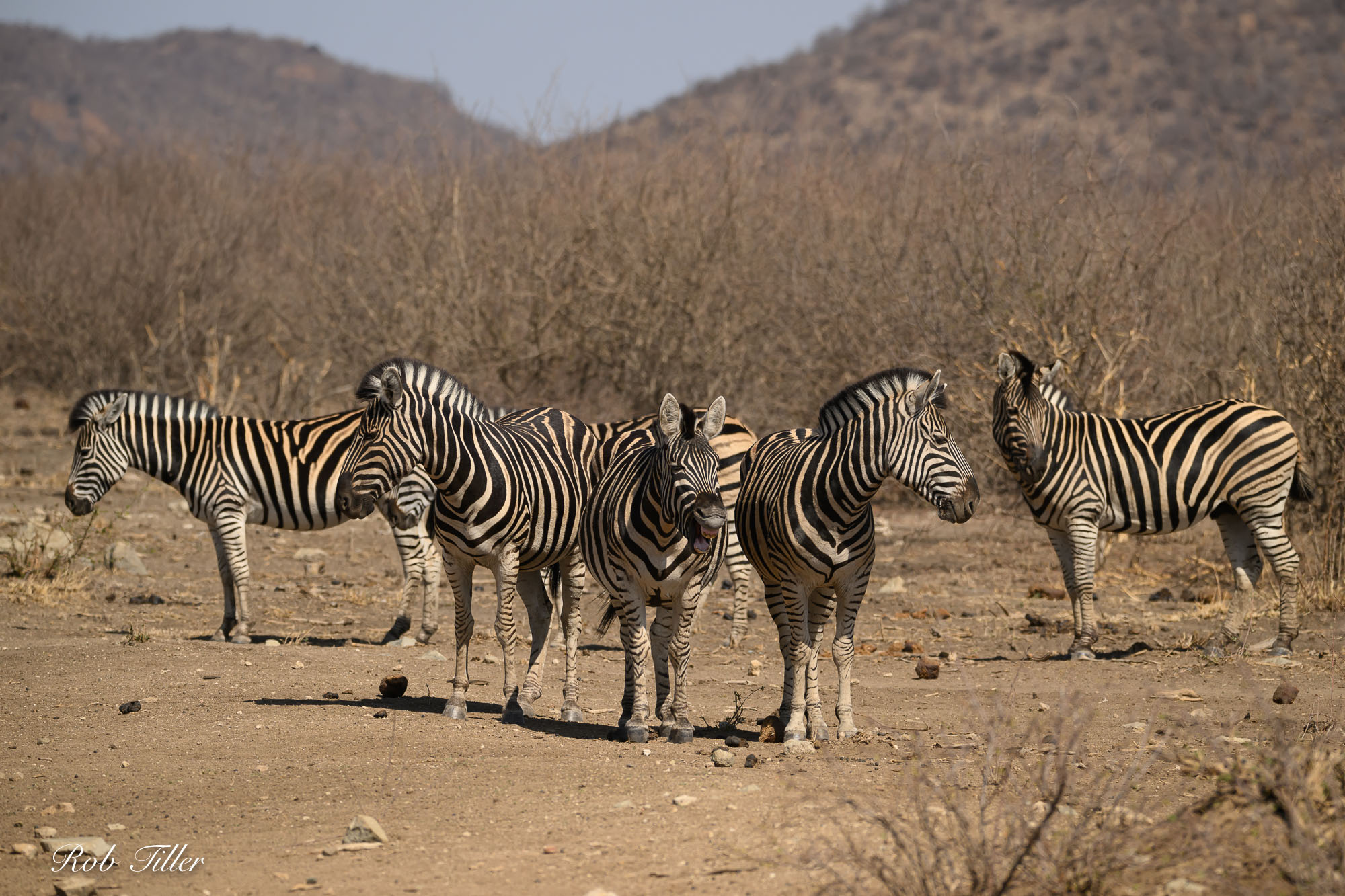
I finally finished going through the thousands of pictures I took during our South Africa safari, and found a few more I wanted to share. 

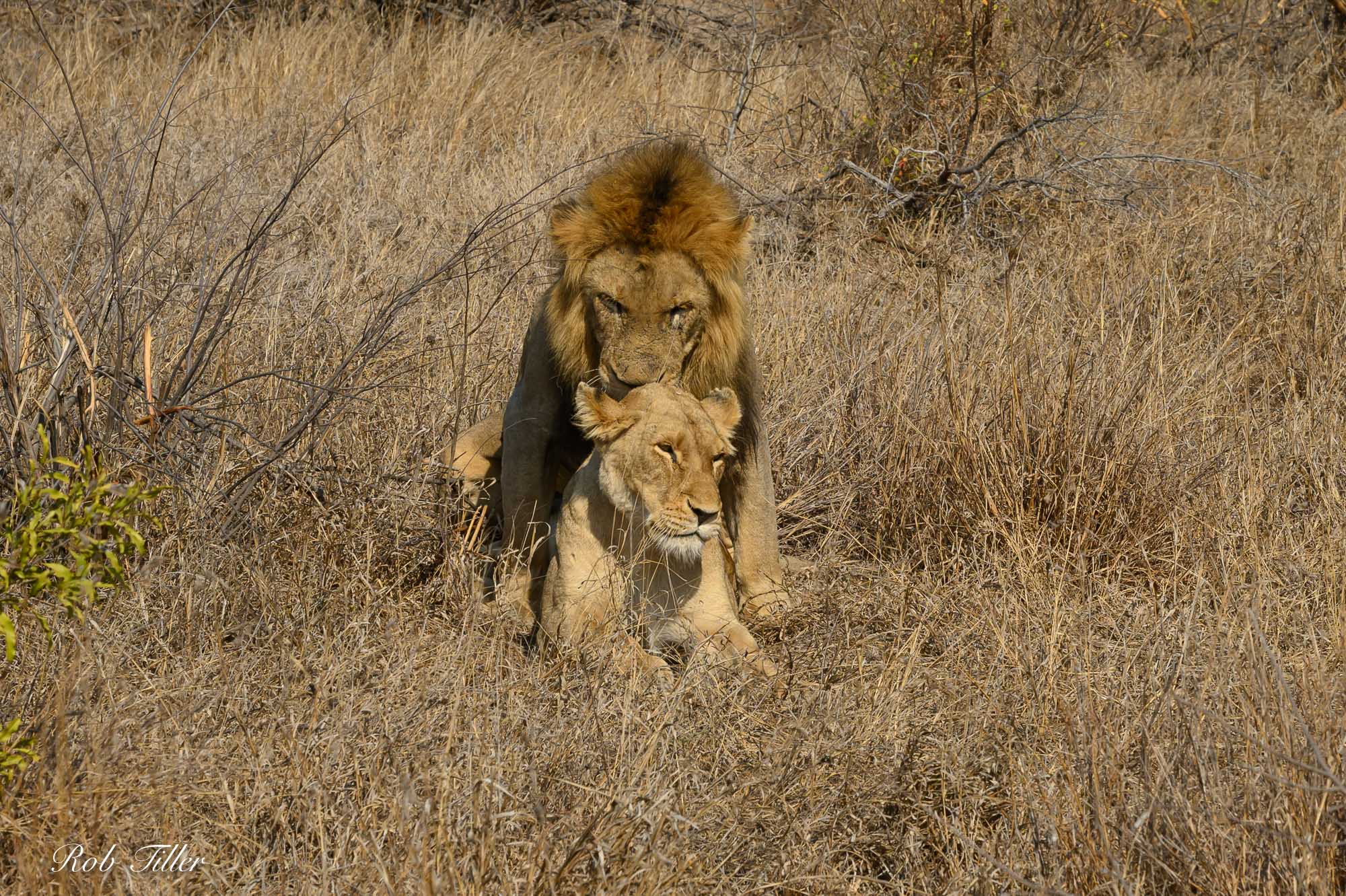
During the safari, we saw animals doing many of the things we know they have to do, like eating, drinking, bathing, teaching their young, and mating.  We didn’t see any actual kills, but we did see several big cats feeding on recent kills.   I debated whether to share photographs of those, since it’s unavoidably sad, and perhaps upsetting, to deal with the death of a beautiful creature like an impala.  But I also see an element of beauty in the predator and his or her success.  

The lions, leopards, and cheetahs must kill to survive and to feed their young.  It’s just the way they’re made.  It turns out that it’s quite difficult for them to hunt successfully, and they often fail.  Grazing animals are highly sensitive to predator risks, and most of them are, when healthy, either faster or stronger than their predators.  On this trip, we watched a hidden lion lie in ambush for lengthy periods hoping, unsuccessfully, for an unwary zebra or impala.  

The grazing animals that the big cats catch are generally the old, young, or ill.  In fact, their hunting is important for the health of the grazing herds.  It  keeps diseases in check and prevents overpopulation and overgrazing that would lead to more death.  Nature generally manages to keep things remarkably well balanced among predators, prey, and plants, when there isn’t human interference.

There’s a vast amount that we do not know about nature, which is exciting, in a way:  there’s so much more to learn.  This week the New Yorker had a lively and interesting piece by Rivka Galchen about what scientists are learning about bird song. 

I’ve been interested in bird song for many years, but mainly as a way to identify birds that won’t allow themselves to be seen.  From watching flocks of big birds like tundra swans and Canada geese, I’d come to suspect that their vocalizations allowed them to coordinate their travels together.  Now researchers are confirming the suspicion that their sounds have a lot of communicative content.  

Scientists have long recognized that birds make specific alarm calls, and are learning that some of those calls differentiate the threats of, say, a hawk or a snake.  It turns out that bird parents make sounds while incubating their eggs that the developing baby bird learns.  We’re learning that bird communication is more complex than we thought, which indicates that their intelligence is more complex than we thought.  

With fall arriving, it’s gotten a bit chilly for me to have my morning tea on our deck, but when it’s mild I like to sit out there as the sun is rising and listen to the birds.  I’ve been using the Merlin app to identify calls and songs I don’t already know.  The app has gotten a lot better over the last couple of years, and is almost always accurate, at least as to the birds I’m familiar with.  

Speaking of the natural world, I’m in the midst of a remarkable book about plants:  The Light Eaters:  How the Unseen World of Plant Intelligence Offers a New Understanding of Life on Earth, by Zoe Schlanger.  Schlanger has reviewed the scientific literature and interviewed leading botany experts researching how plants sense the world and deal with their environments.  Her style is friendly and approachable, and her content is at times mind blowing.  

It turns out that plants are much more  proactive than we used to think.  There are species that modify their chemistry in response to predators to make themselves less appetizing.  There are ones that send out chemical signals to warn others of their kind of particular predators.  Some even send out chemical signals to summon insects that will prey upon the plants’ enemies.  

There is considerable evidence that plants respond to touch.   Some researchers have found that they respond to certain sounds, which we might call hearing.  They modify their behavior to avoid threats and to improve their nutrition.  The puzzle is that they lack a clear hearing organ, like an ear, or a centralized interpretive organ, like a brain.  How they do it is yet to be discovered.  

But it’s hard to avoid the thought that plants are in some sense conscious.  Schlanger recognizes that the idea of plant intelligence is still controversial in the botanical science world, and gives credit to scientists for being cautious and careful.  In this time of great anxiety about the human world of politics and war, her new book is a welcome reminder that, quite apart from humans, the world has been and continues to be full of wonders.   

The Wild Swans at Pungo

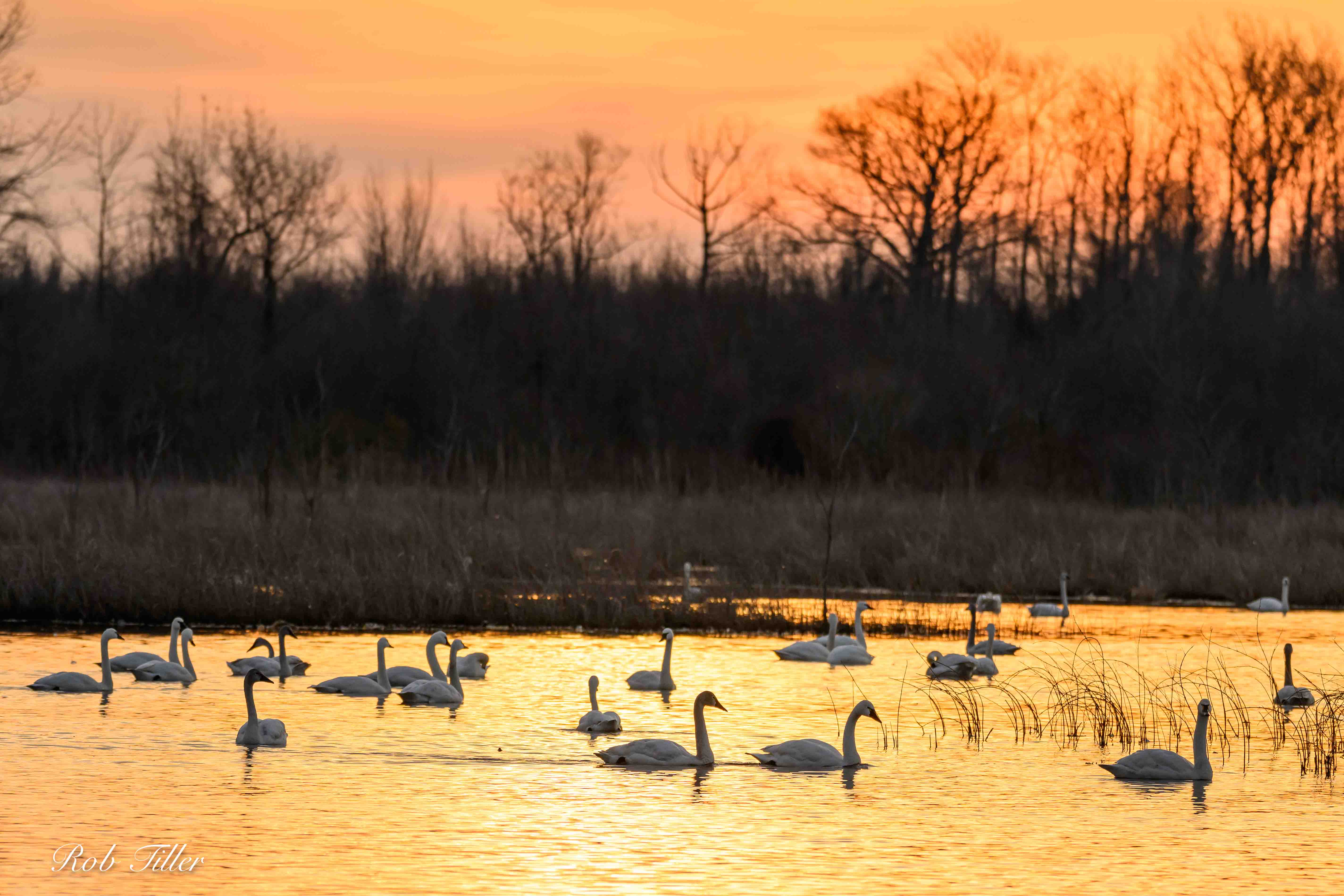
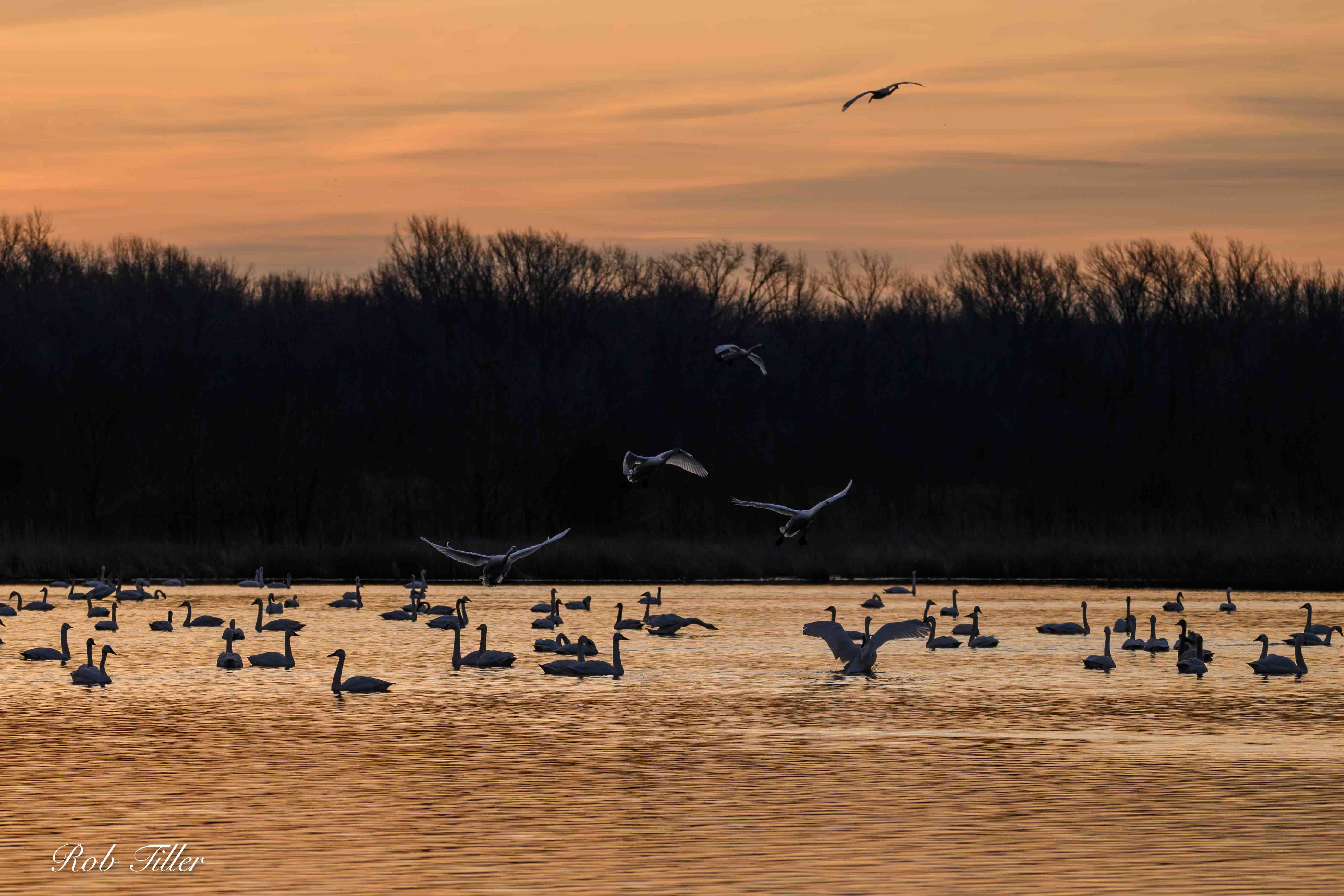
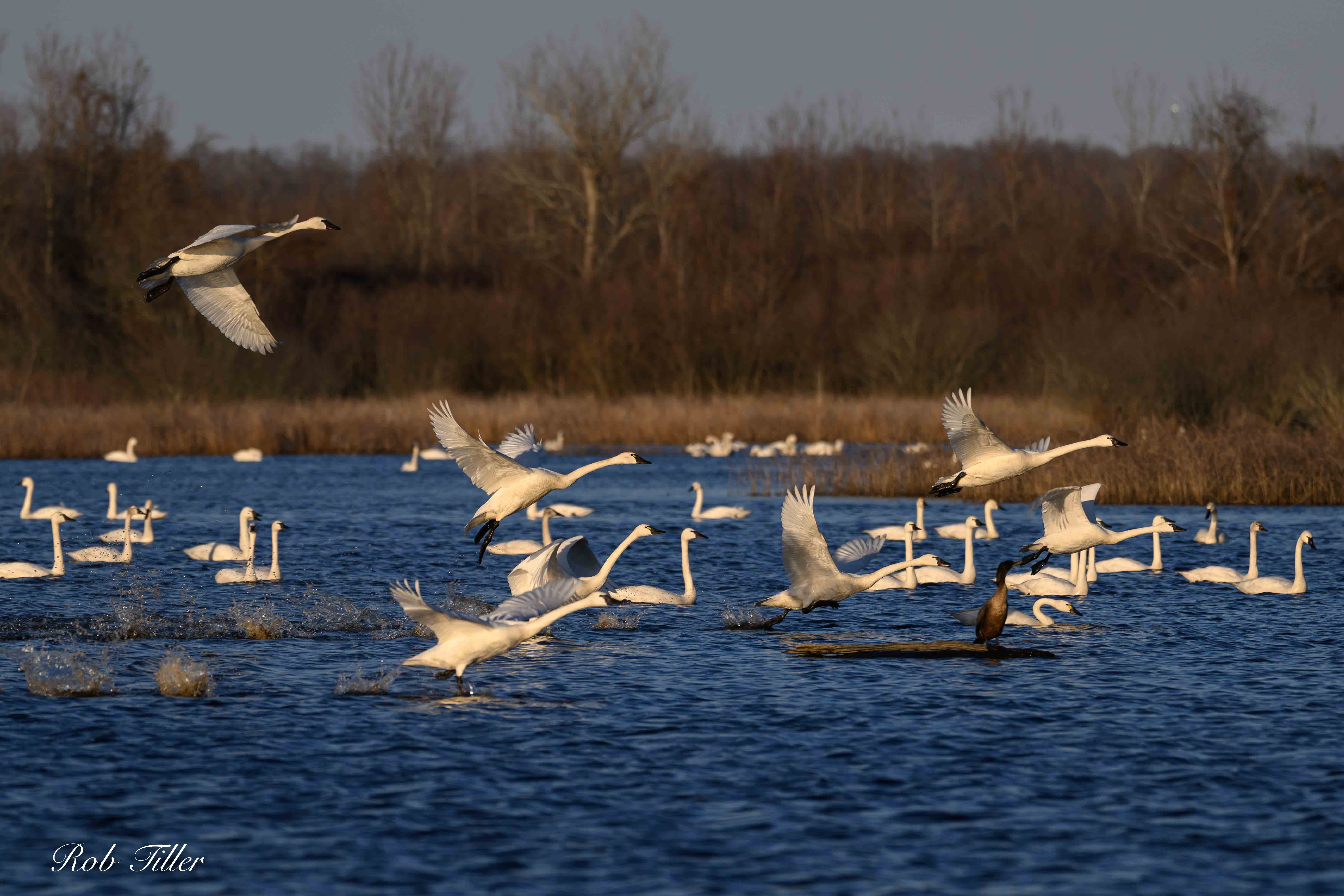
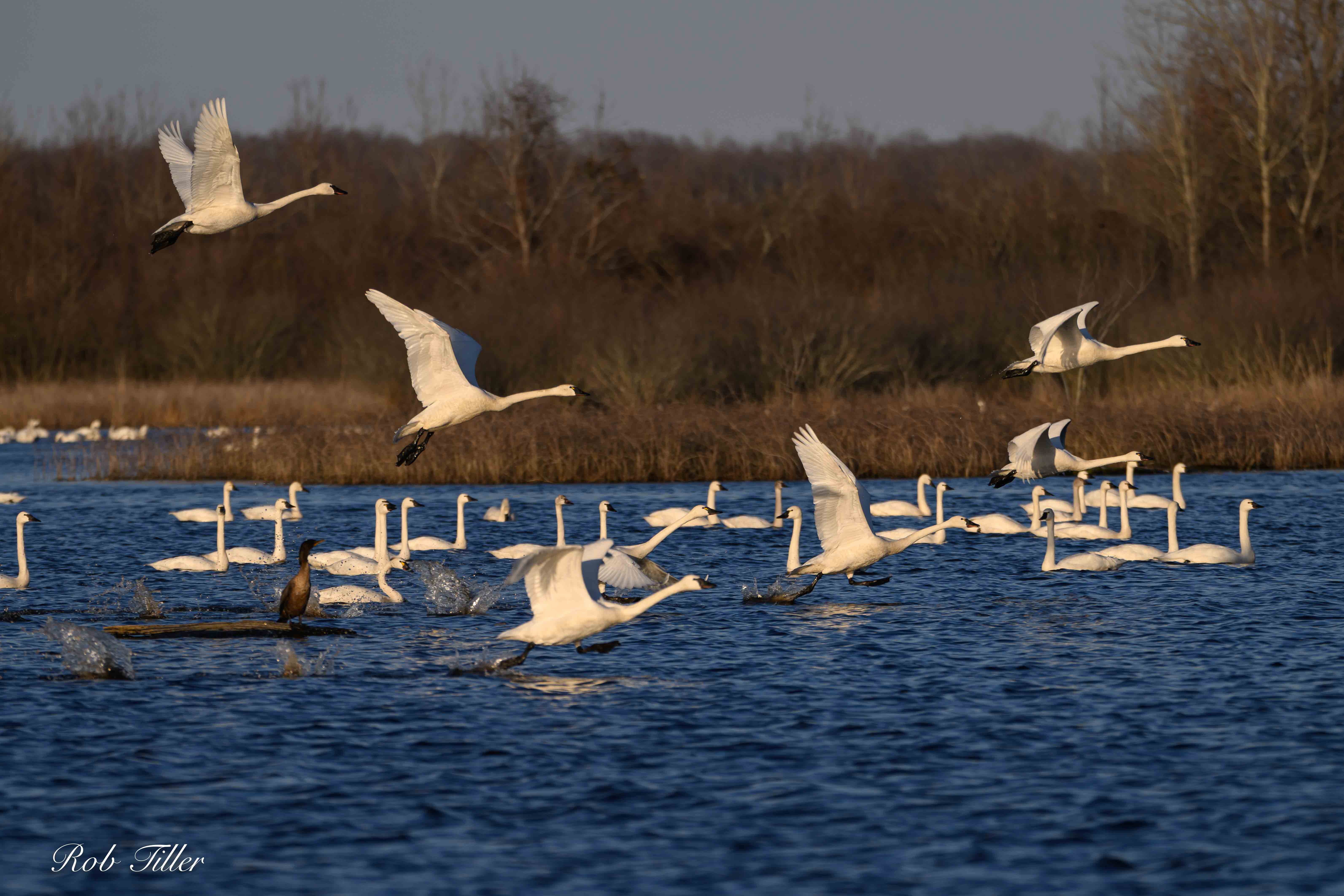
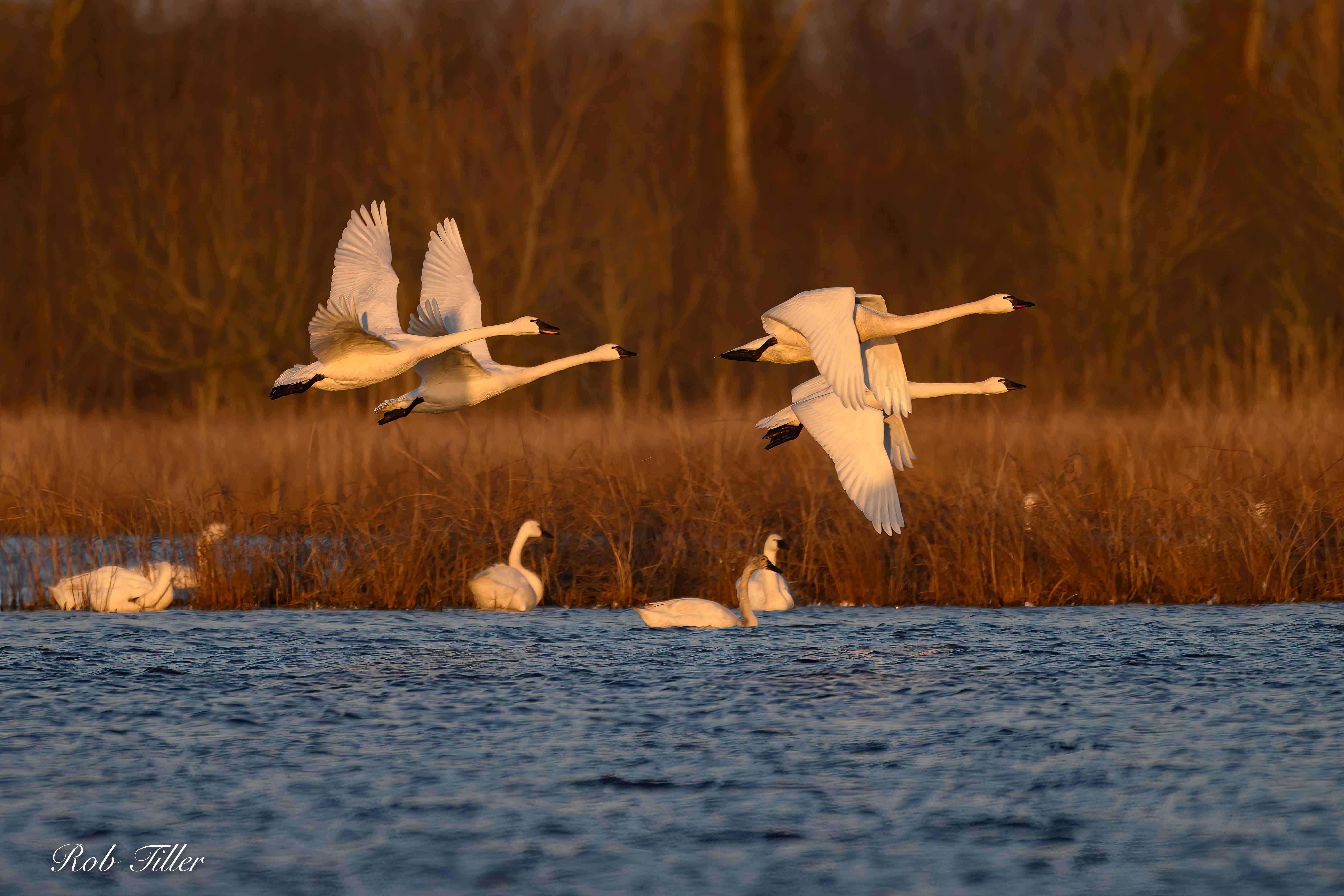
Last week I drove to the Pungo Lake area of the Pocosin Lakes National Wildlife Refuge to look for tundra swans and other birds.  In the last couple of years I didn’t see too many swans there, but this time, there were a lot!  
Tundra swans are big birds (think 6 foot wingspans, 20 pounds) that  migrate thousands of miles every year between their breeding grounds in the Arctic and points south, of which eastern North Carolina is a major one.  They are sociable creatures that can form flocks of hundreds or thousands.   They’re very vocal, calling each other with loud honks, and large groups can sound like a stadium full of football fans.

The basic family unit includes a cob (male) and a pen (female) that mate for life.  Cygnets (the kids) may stay with their parents for up to a year.  The cygnets go through a brownish phase before getting their white adult plumage.   

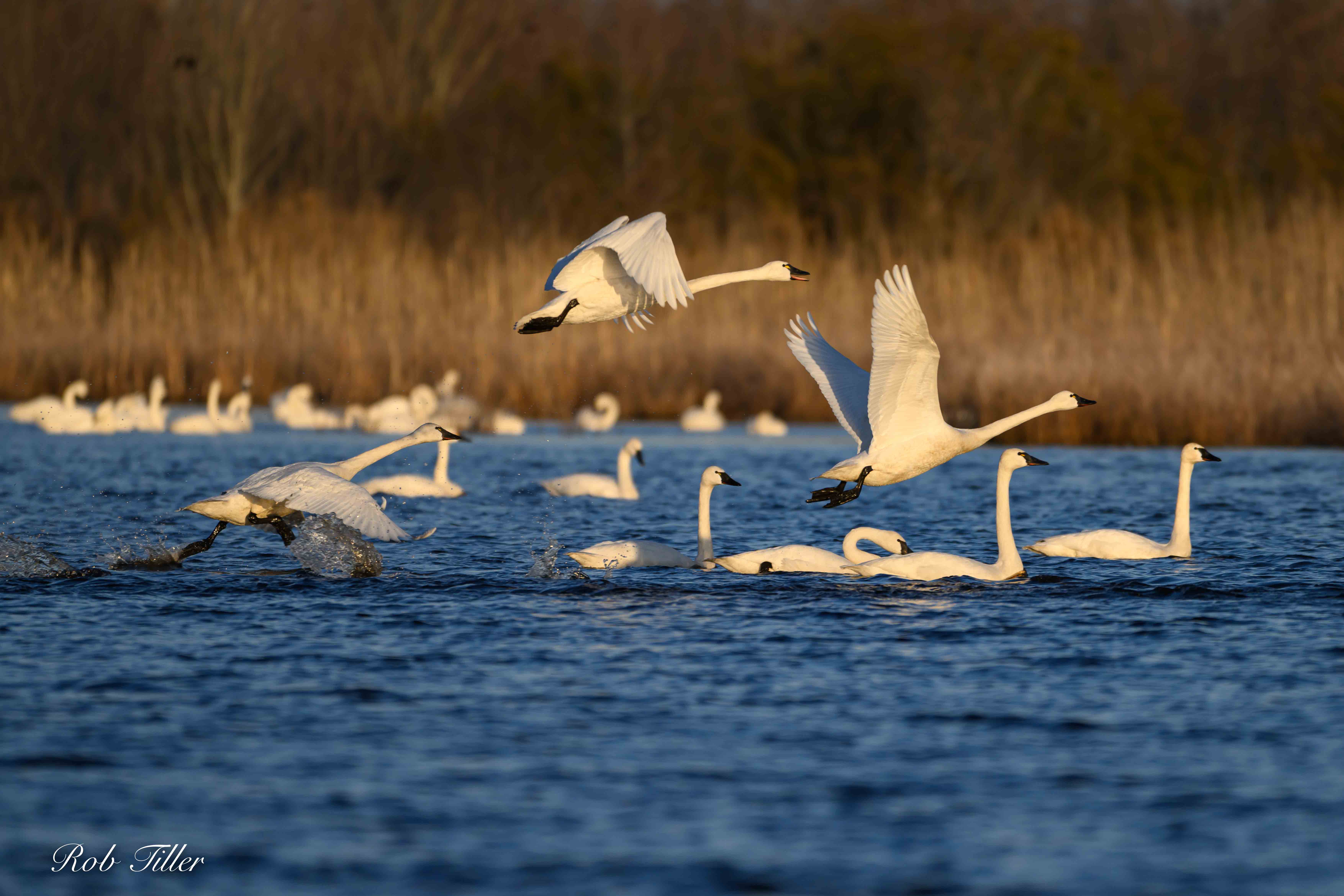
The swans are strong, graceful flyers, and calm, stately swimmers.  But they have to work hard to get airborne!  From a seat on the water, they flap vigorously while running along the surface. 

One afternoon I watched and listened as dozens of them did this maneuver.  There were only a couple of other folks on the shore of the pond, who like me were trying to take pictures.  It was a little chilly, but sunny, and peaceful, at least for those of us who didn’t need to take off.  

“Their clamorous wings” as they climbed put me in mind of Yeats’s wonderful poem The Wild Swans at Coole.  It’s a meditation on aging and mortality, together with the consolation of nature’s lasting vigor.  Yeats lauds the beauty of the birds, and their independence from us, with their own passions and conquests.    

Speaking of mortality and the lessons animals teach us, I was saddened to hear today of the death at 73 of Steven Wise, a pioneering crusader for animal rights.  The NY Times obit is here

Wise brought lawsuits on behalf of chimpanzees and other animals arguing that they were legal persons entitled to certain rights.  His legal work, writing, and teaching brought increasing attention to the question of how we should treat non-human animals.  Although his approach seemed to me problematic, since it was centered on arguments about certain animals’ human-like abilities, I greatly admired his intelligence, courage, and passion.  

I finished a new book directed at the question of whether humans have free will:  Free Agents:  How Evolution Gave Us Free Will, by Kevin J. Mitchell.  Mitchell is a professor of genetics and neuroscience at Trinity College Dublin.  His book addresses deep questions around the meaning of life with a lot of information about the workings of the brain.

Mitchell has an answer for determinists like Robert Sapolsky, who hold that all our behavior is predetermined by physics, and that our impression of mental independence is an illusion.  Starting with the simplest forms of microbial life, Mitchell applies Darwin’s theory of evolution and argues that agency and purpose are fundamental characteristics of life.  

I didn’t get all Mitchell’s explanations of brain cell biology, but I think I got the basic ideas.  Animals evolve to survive, which requires that they learn to respond to an ever-changing environment.  The most complicated brains we know of (our own) not only make top down decisions related to survival, but are capable of changing our own more basic processes and thinking about our own thoughts.  

Mitchell notes that there are various ways of thinking about freedom, and every being is constrained by its environment, biology, inherited traits, memories, etc.  But within those constraints, Mitchell contends we make meaningful choices.  This makes sense. 

In addition to providing a persuasive framework for thinking about free will, Mitchell’s account emphasizes the interconnectedness of the world.  He suggests that we are not independent objects, but a large set of processes that are acted upon, and act upon, everything else.  The book is an encouraging integration of science and spirit.

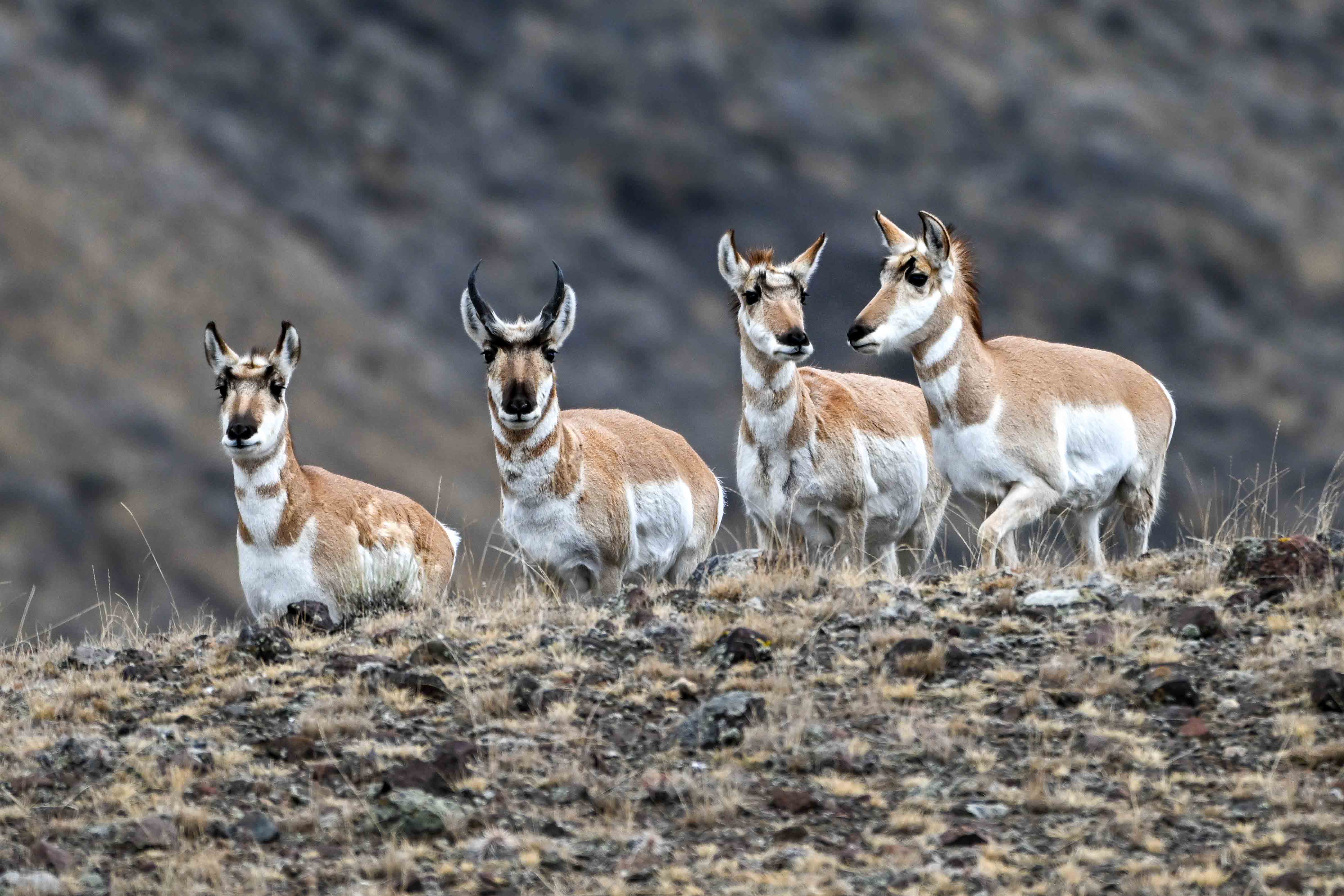
Winter wildlife in Yellowstone

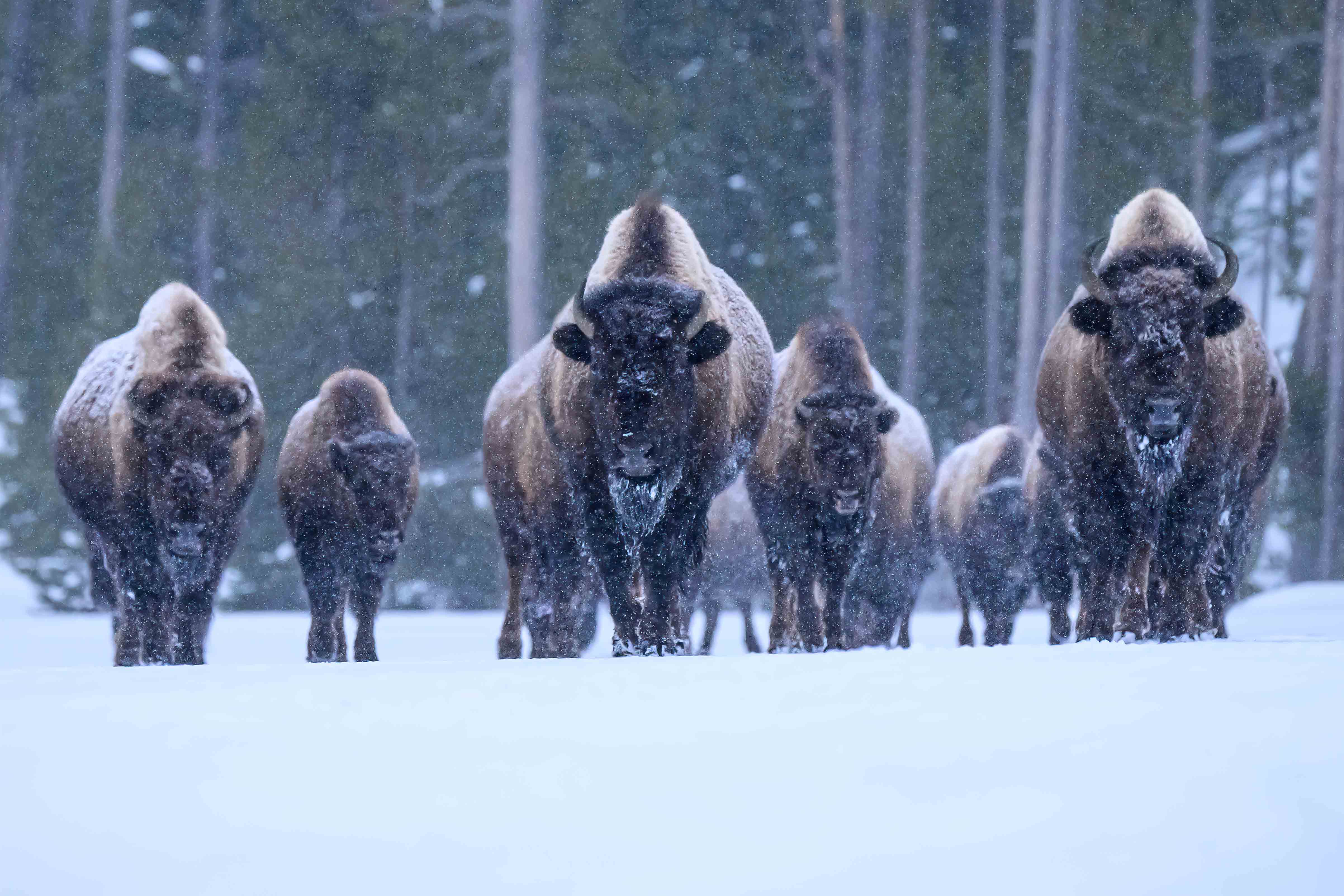
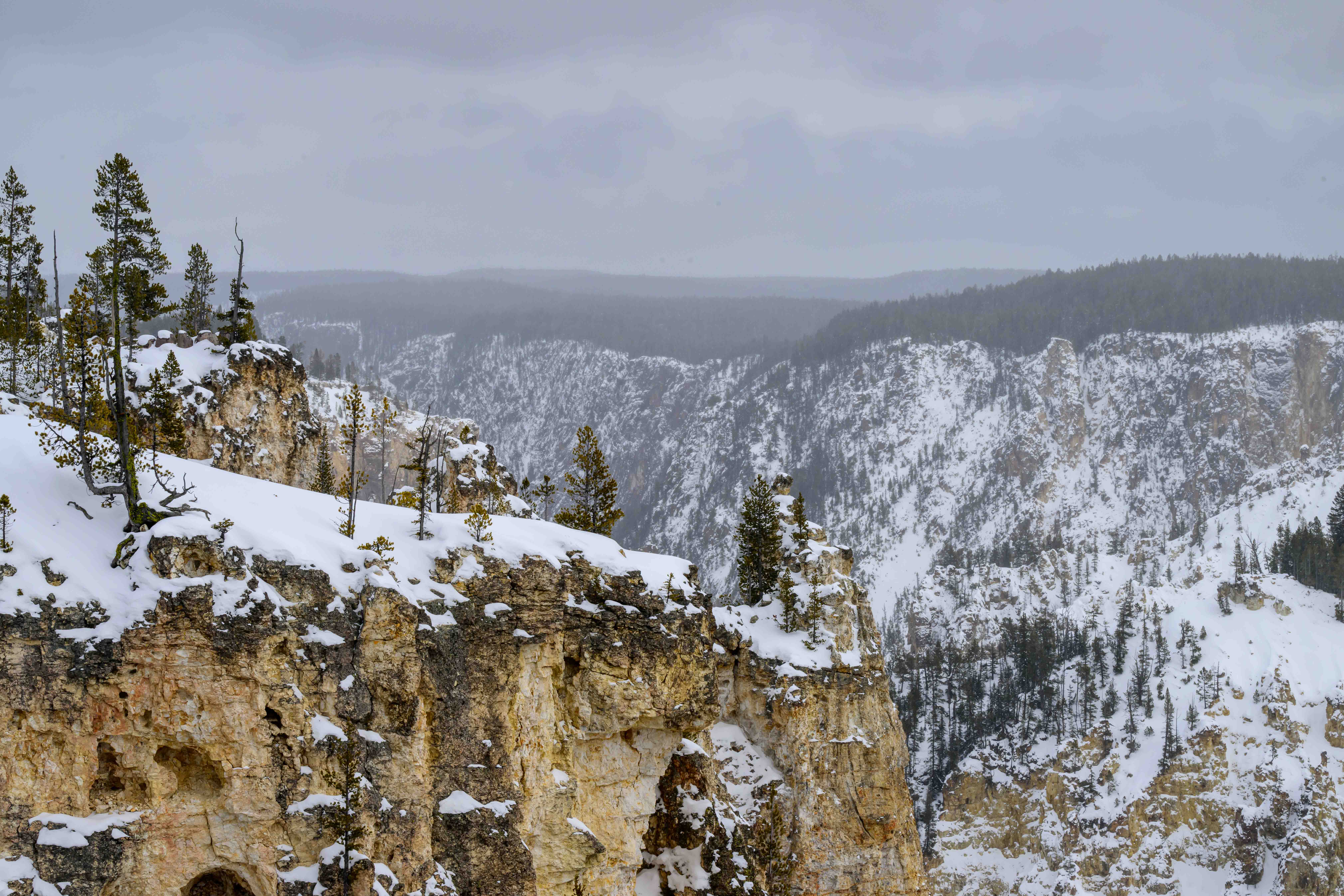
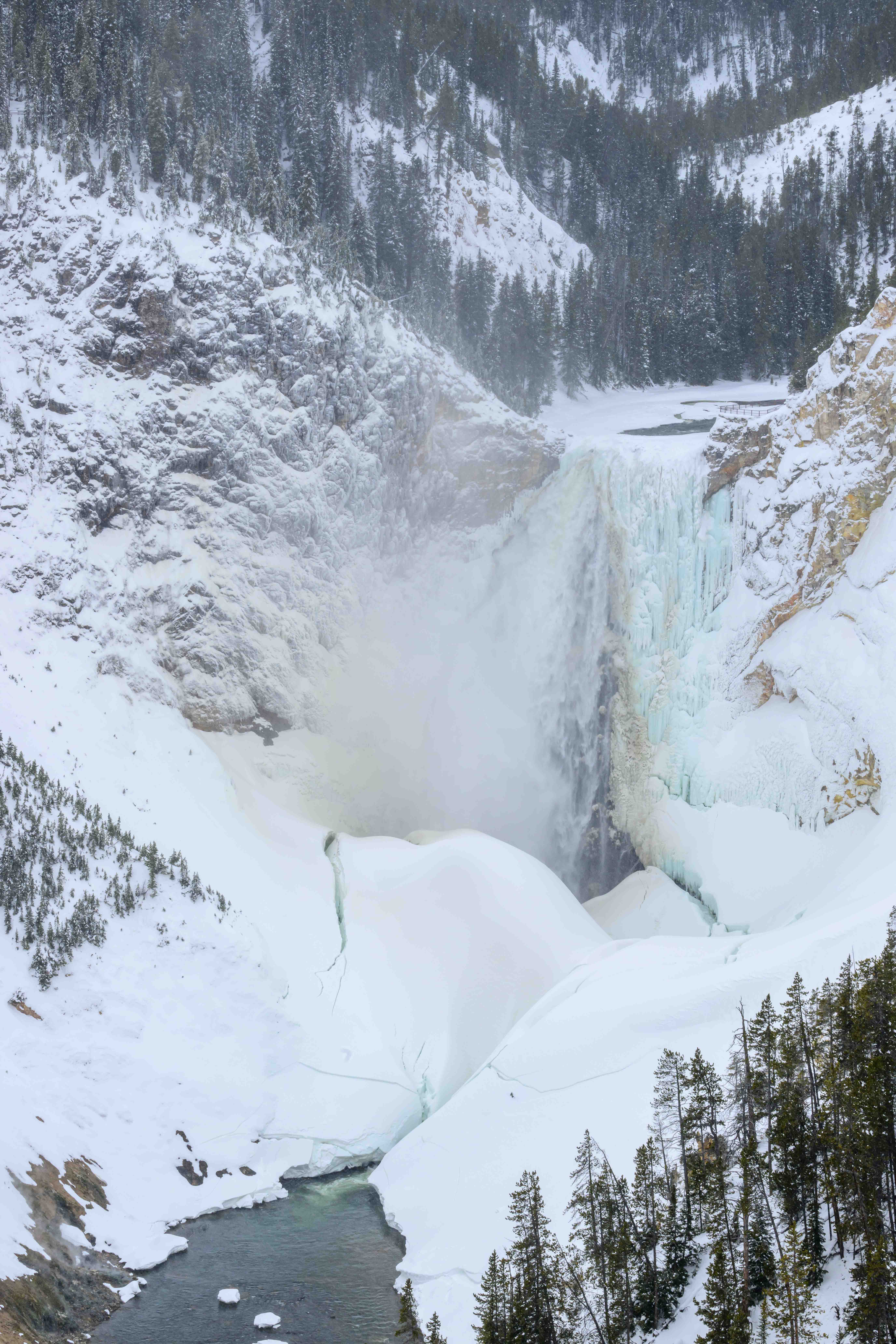
Toward the end of January I was in Yellowstone National Park, where I saw quite a few animals and took a lot of photographs.  I’m still sorting and weeding them, but here are some I thought were worth sharing.  Looking at the images reminds me of what an amazing world we live in, and makes me want to get back out into nature.  

Yellowstone is a unique and beautiful place.  It’s centered on a dormant super volcano (a caldera) and has over half the world’s geysers.  It has high mountains, canyons, lakes, and waterfalls, as well as unusual hydrothermal features.  It is famous for its megafauna, including wolves, bison, coyotes, pronghorn, elk, and moose. 

Normally Yellowstone is very cold and snowy in January, but this year it wasn’t as cold and not so snowy.  This meant it wasn’t as physically tough on the photographer, but also not quite as beautifully otherworldly as most years.  

Still, I had a great time and had some excellent wildlife encounters.  For three days, I was with a group organized by NANPA venturing out of West Yellowstone, and then I went with my friend Barry W. for three more days based in Mammoth Hot Springs Lodge.  

Among the highlights were some close encounters with bison, which are numerous there.  These big, powerful icons of the West were usually grazing peacefully, but could be skittish.  And of course, they could be dangerous if provoked.  

At one point in the Lamar Valley, Barry and I were photographing a large herd, and didn’t notice until too late that some of them had gotten between us and our vehicle.  For a few minutes we were wondering about how to escape, but when another car came along, we jogged behind it as the bison got out of the way.  

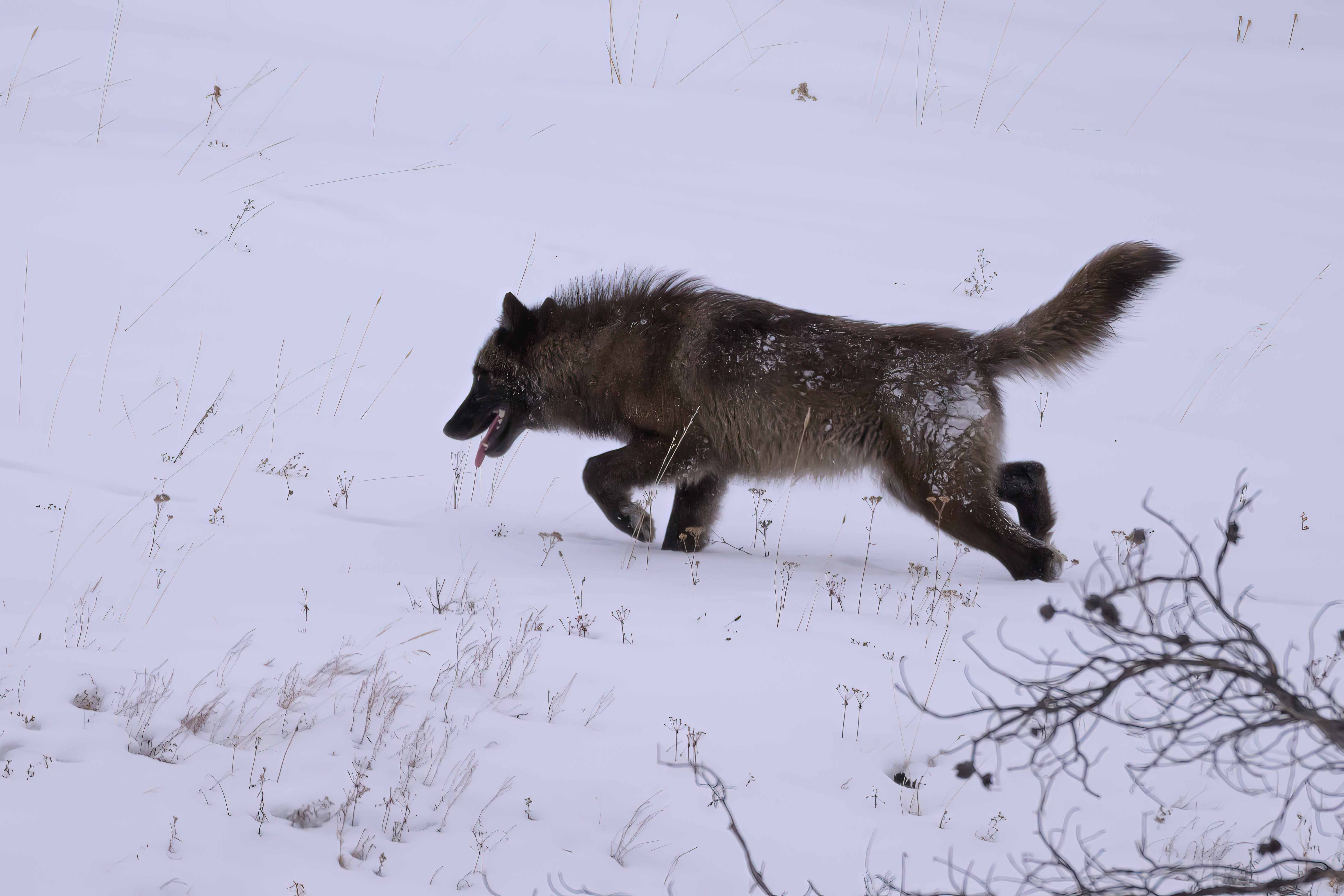
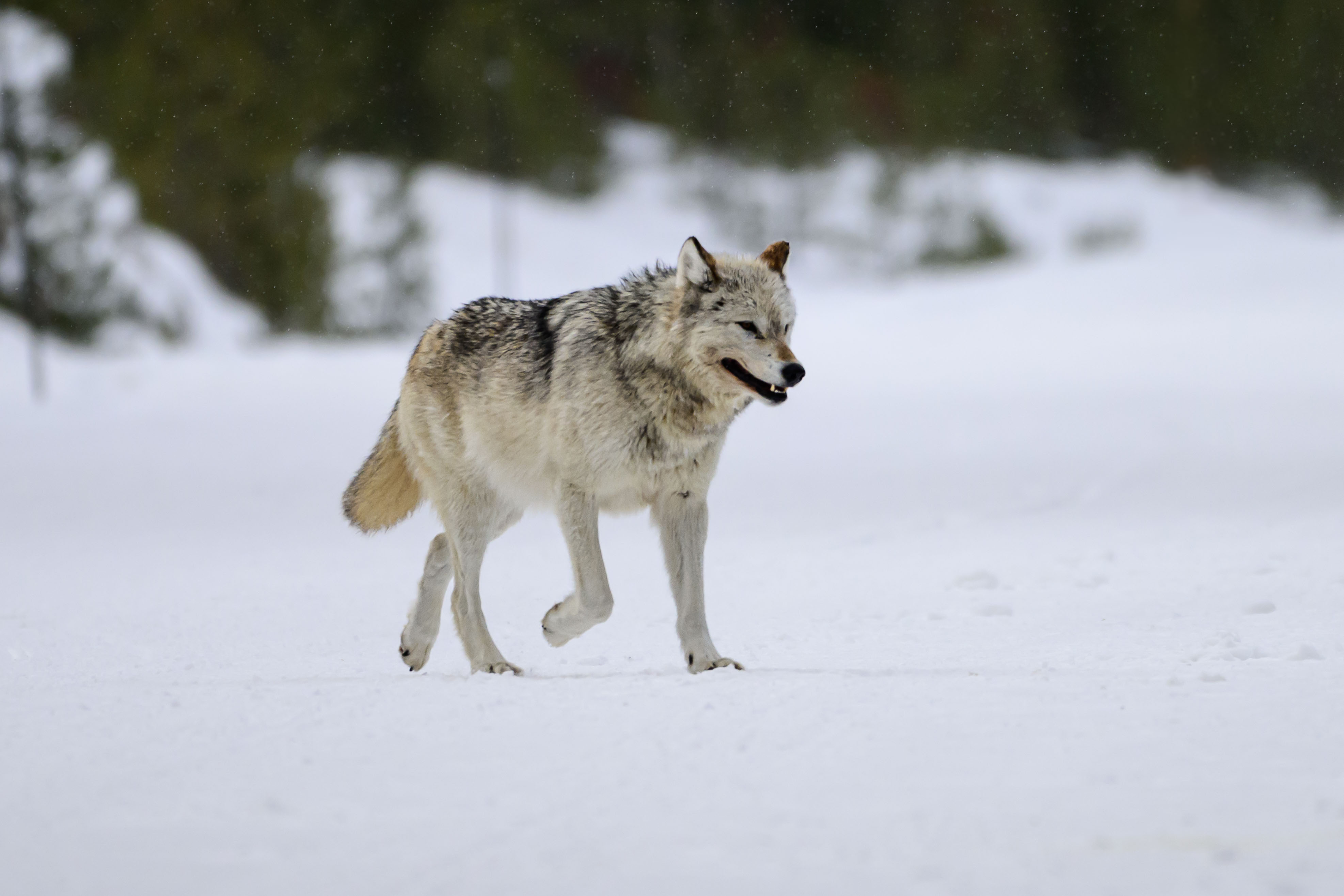
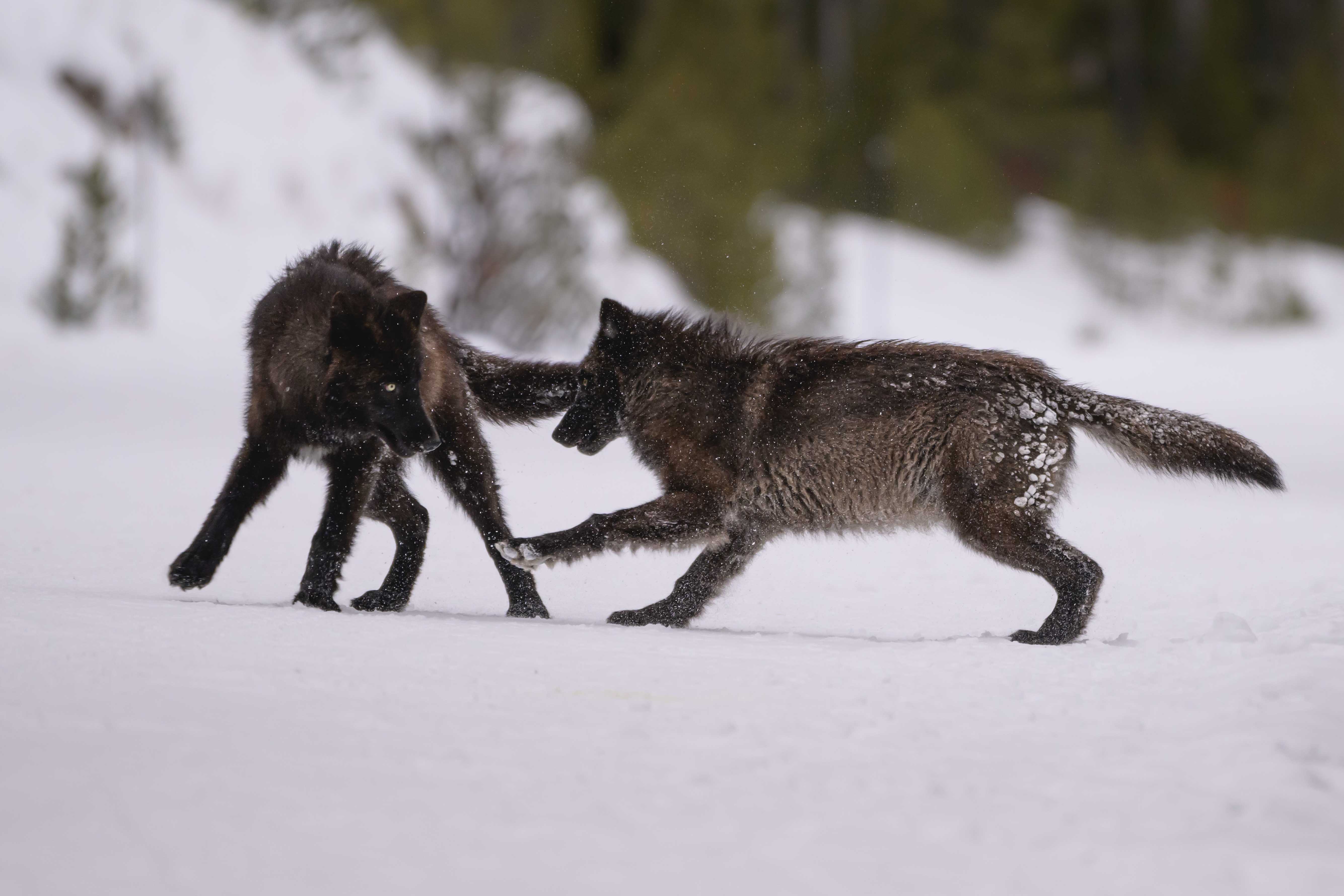
We were privileged to see a dozen or so of the resident gray wolves (some of which are black), which are usually not easy to find.  Wolves have a bad rap as scary beasts, drummed into us from childhood by stories like little red riding hood, the three little pigs, and the boy who cried wolf. In fact, wolf attacks on humans are very rare.  

On the other hand, humans are highly threatening to wolves.  We very nearly caused their extinction in the last century, and continue out of ignorance, perversity, or greed to kill them and destroy their habitats.  Still, there’s a wider understanding now that as apex predators, wolves are important contributors to their ecosystems.  For example, gray wolves keep elk, moose, and deer populations in check, preventing overgrazing by the ungulates and providing nourishment to other species.  

The NY Times had a good summary of the current controversies surrounding wolves.   The anti-wolf movement involves the interests of ranchers, who don’t like it when wolves kill their cattle.  One of the solutions to that problem is a program for the state to pay ranchers for animals killed by wolves, which apparently lessens the conflicts, but not perfectly.  

It seems to me self-evident that wolves are not just inconvenient objects to be subjugated, but sentient beings entitled to respect.  They have interests, families, and friends.  We have started to learn how to live alongside them and work out human-wolf conflicts, and I’m hoping we’ll continue that process, and continue enjoying their mysterious beauty.  

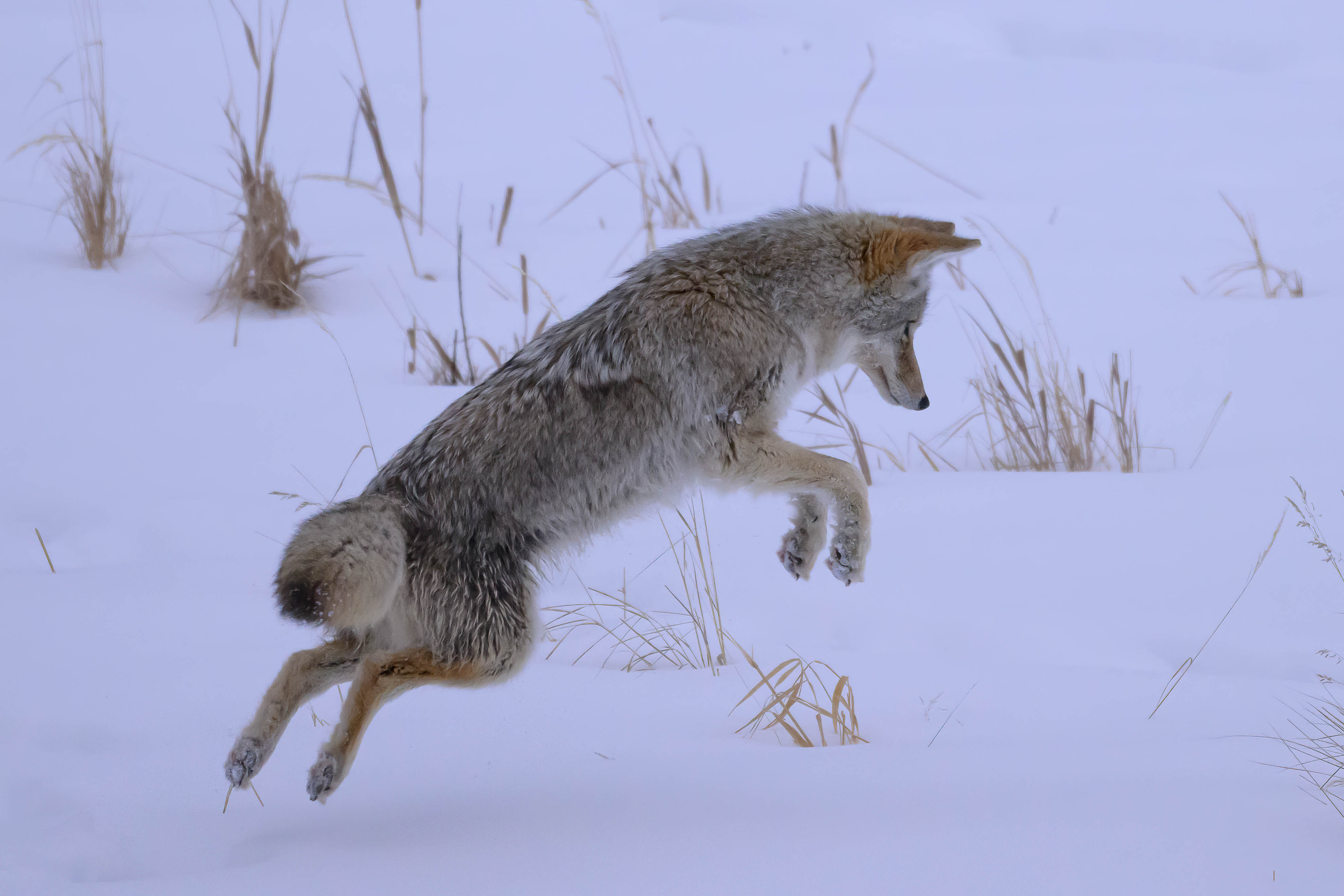
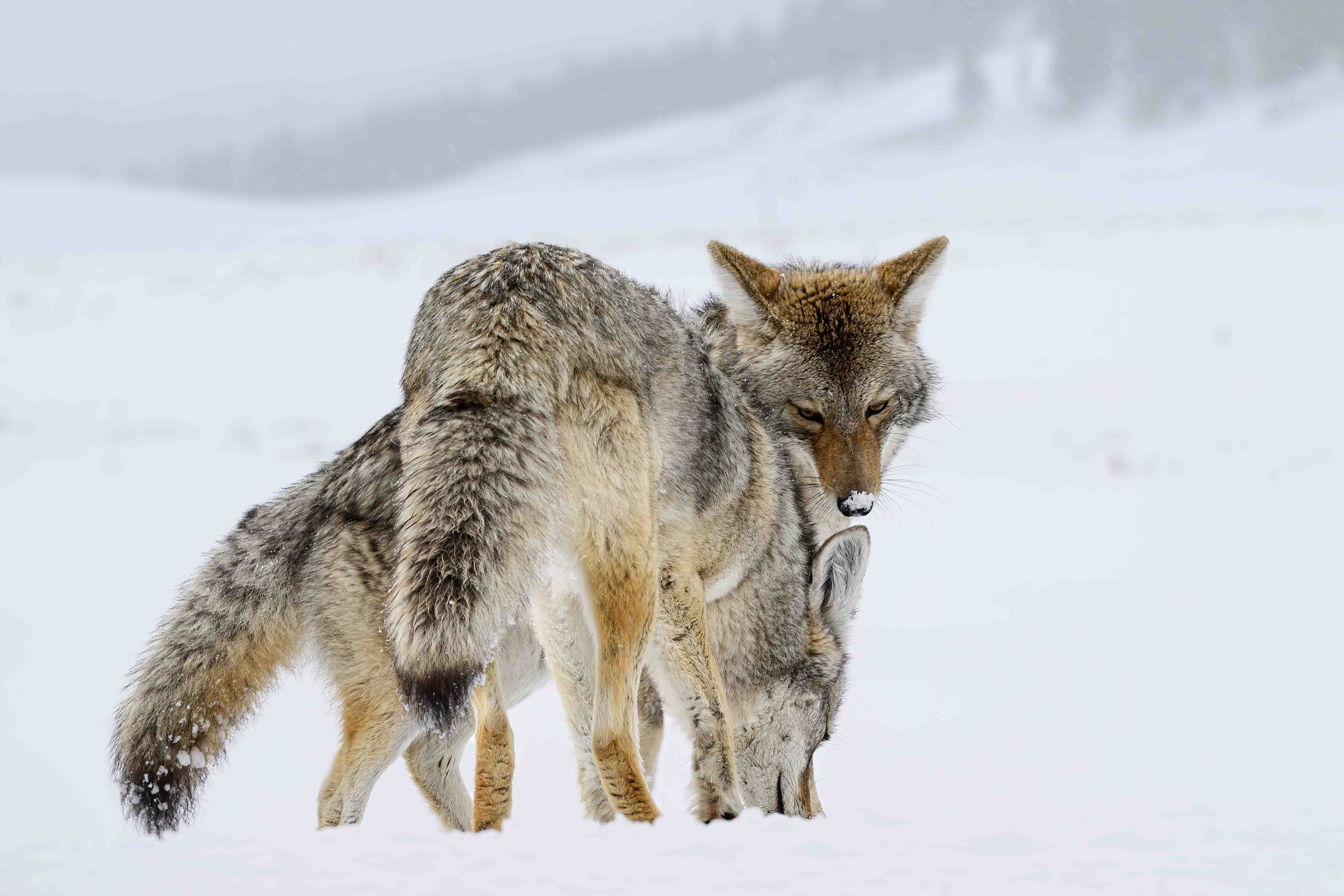
Among nature enthusiasts, coyotes don’t inspire as much excitement as wolves, but I was still excited to see several of them in Yellowstone.  They are close relatives to wolves and look a lot like them, but smaller, with narrower features and larger ears.  

It’s hard to argue they’re less pretty than wolves, so their poor PR probably has to do with their being relatively common.  Their prey includes mice, which they can hear tunneling under the snow, and catch by leaping on them.  I got one shot of a leap, which yielded no mouse, and also saw a pair of them flirting.  

One thing I like about a long trip is having a good block of time to read.  I’ve really been enjoying rereading the first few Aubrey-Matarin novels by Patrick O’Brian, and finished the fourth one in Yellowstone.  These are historical novels about life in the British Royal Navy around 1800, when Britain was fighting hard to rule the waves.  O’Brian was clearly passionate about getting the history right, but also brilliant in his depictions of navy life and the inner lives of his characters. 

In the twenty-five or so years since I first read O’Brian’s series, I’ve learned some things about the history of the British empire and its depredations, including violent exploitation of entire civilizations, slavery, piracy, and drug dealing.  These, though not discussed by O’Brian, were part of the mission of the Royal Navy.  But those sailors also embodied more admirable objectives and virtues, such as scientific research, artistic expression, decency, honor, and courage.  Like us, they were complicated.

Speaking of the arts, David Brooks recently had a good column in the NY Times making the case for reading literature and welcoming other cultural experiences.  He made a good argument for the liberal arts as vehicles for greater self understanding.  Great novels, for example, deepen our understanding of the inner lives of others and ourselves.  

“Artistic creation is the elemental human act. When they are making pictures or poems or stories, artists are constructing a complex, coherent representation of the world. That’s what all of us are doing every minute as we’re looking around. We’re all artists of a sort. The universe is a silent, colorless place. It’s just waves and particles out there. But by using our imaginations, we construct colors and sounds, tastes and stories, drama, laughter, joy and sorrow.

“Works of culture make us better perceivers. We artists learn from other artists. Paintings, poems, novels and music help multiply and refine the models we use to perceive and construct reality.”

These thoughts are particularly timely as universities across the U.S. are cutting their liberal arts programs, apparently on the theory that the only point of higher education is to prepare young folks to do a particular kind of job.  As a former liberal arts student myself, I have a bias, but I think treating education as purely instrumental is a disservice to students, both materially and spiritually. 

With advancing technology, including AI, many technical skills that are valuable today will be useless down the road, and students with only those skills will be in trouble.  They’ll need a broader base, including the meta skill of quickly learning new skills.  Meanwhile, without exposure to the world of the arts and ideas, they may miss so much that makes life meaningful and rewarding.