The Casual Blog

Tag: free will

The Wild Swans at Pungo
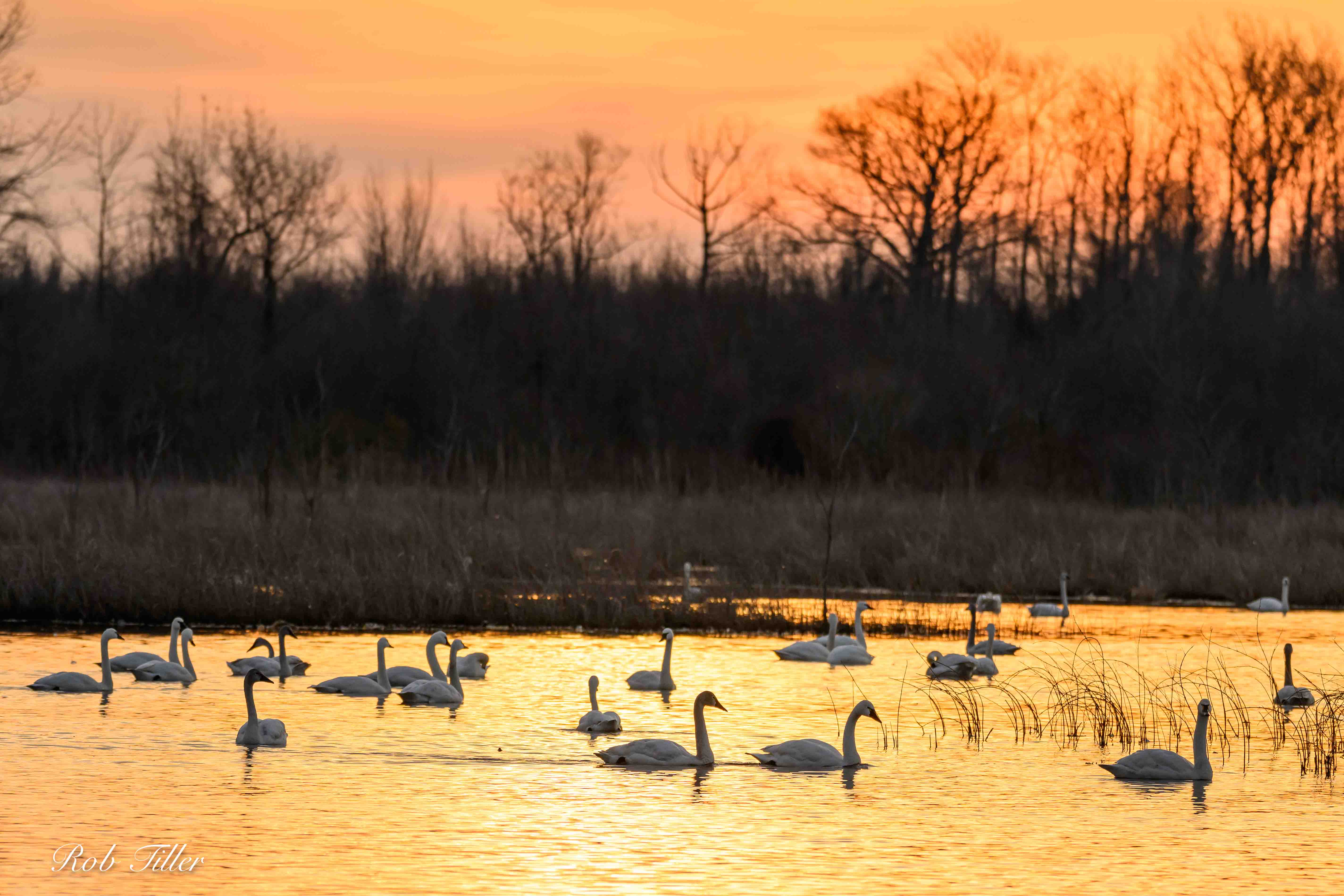
Last week I drove to the Pungo Lake area of the Pocosin Lakes National Wildlife Refuge to look for tundra swans and other birds.  In the last couple of years I didn’t see too many swans there, but this time, there were a lot!  

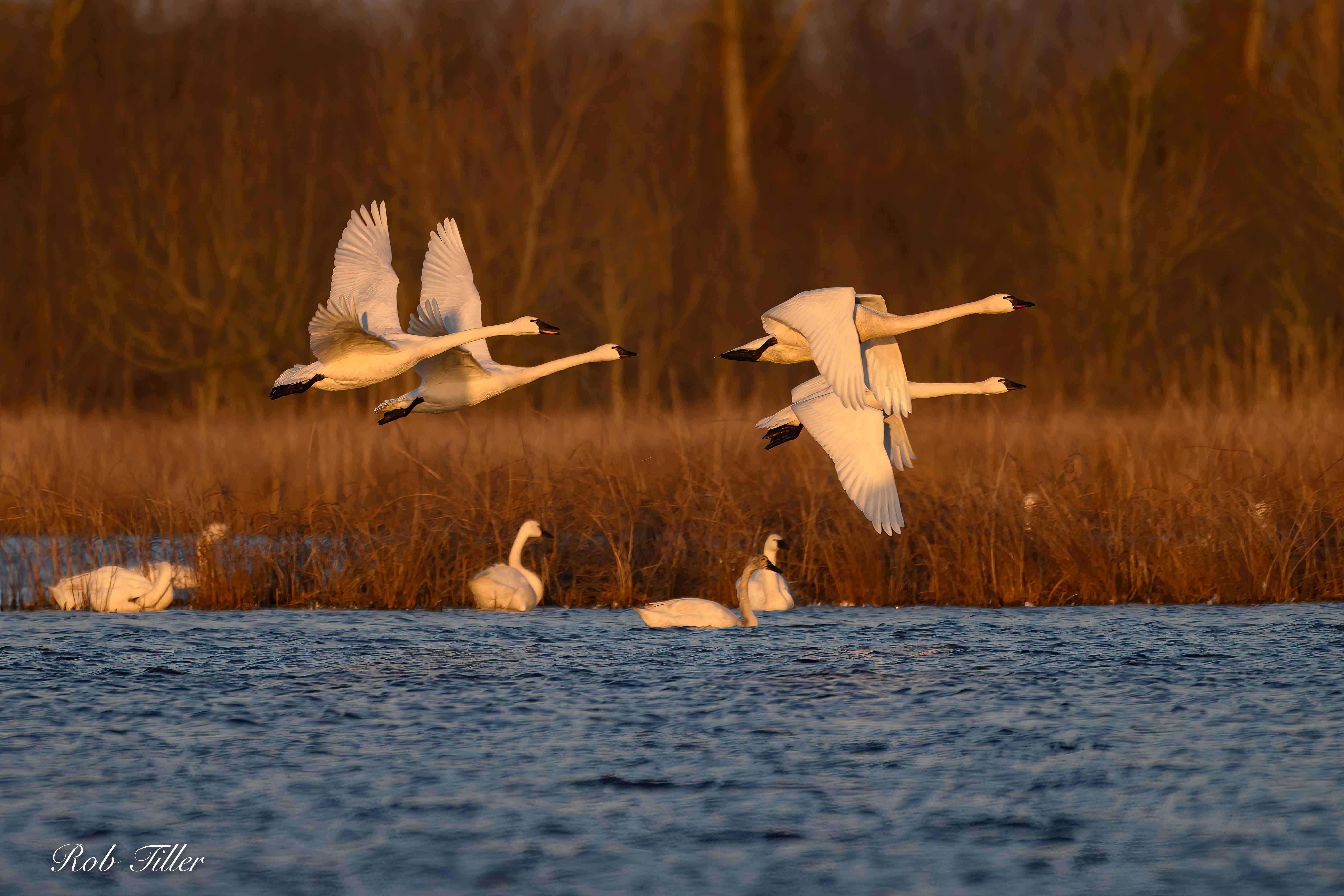
Tundra swans are big birds (think 6 foot wingspans, 20 pounds) that  migrate thousands of miles every year between their breeding grounds in the Arctic and points south, of which eastern North Carolina is a major one.  They are sociable creatures that can form flocks of hundreds or thousands.   They’re very vocal, calling each other with loud honks, and large groups can sound like a stadium full of football fans.
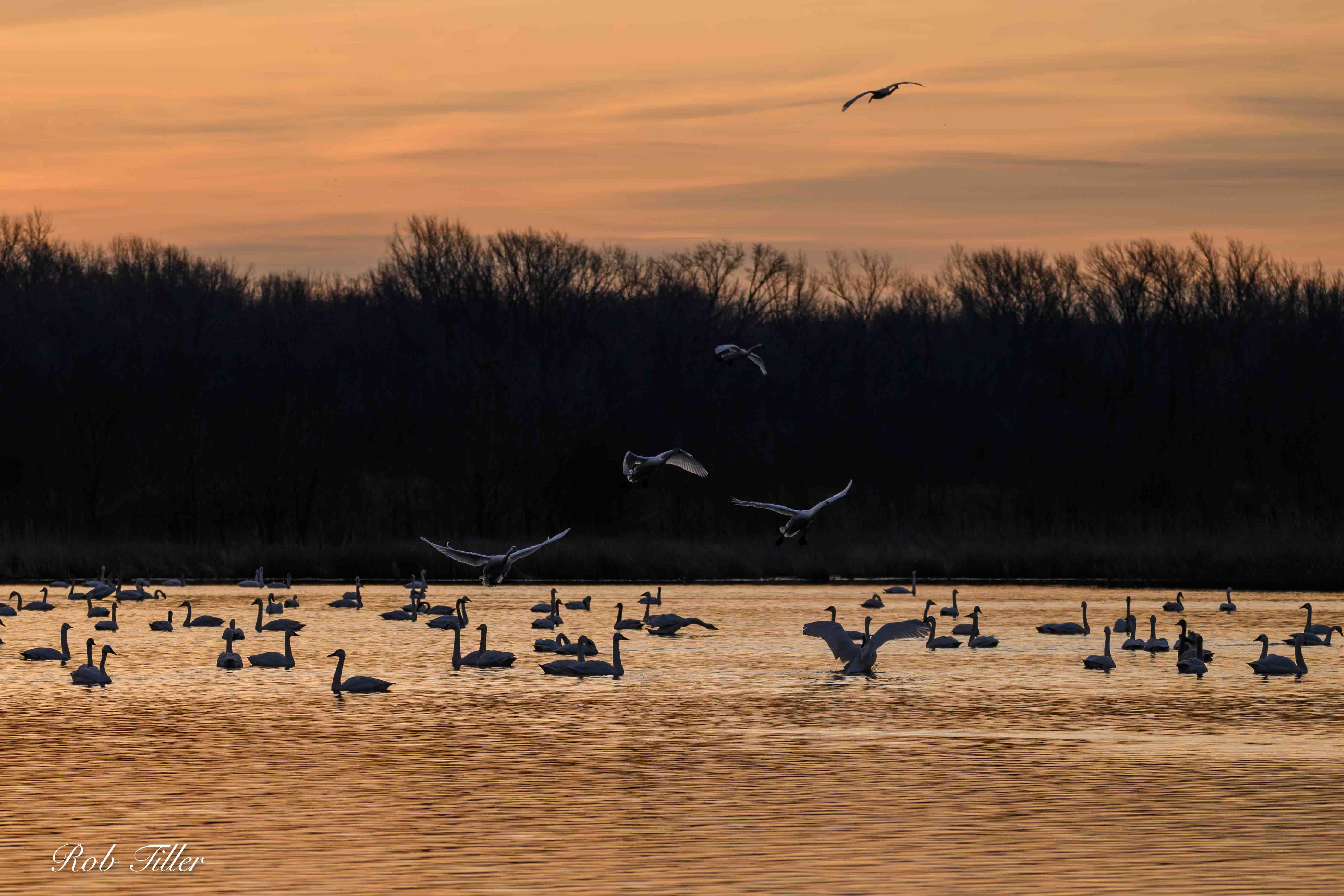
The basic family unit includes a cob (male) and a pen (female) that mate for life.  Cygnets (the kids) may stay with their parents for up to a year.  The cygnets go through a brownish phase before getting their white adult plumage.   
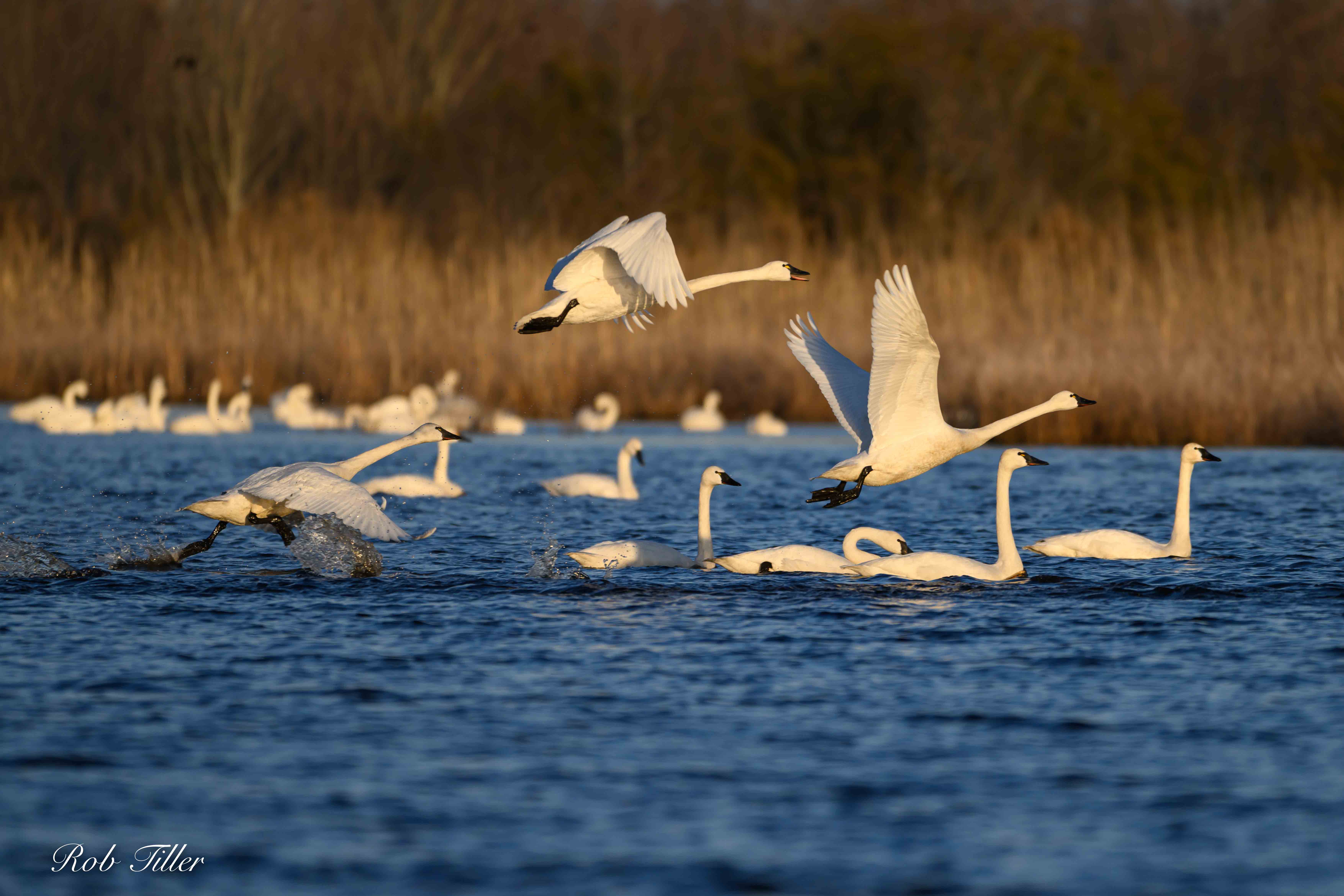
The swans are strong, graceful flyers, and calm, stately swimmers.  But they have to work hard to get airborne!  From a seat on the water, they flap vigorously while running along the surface. 
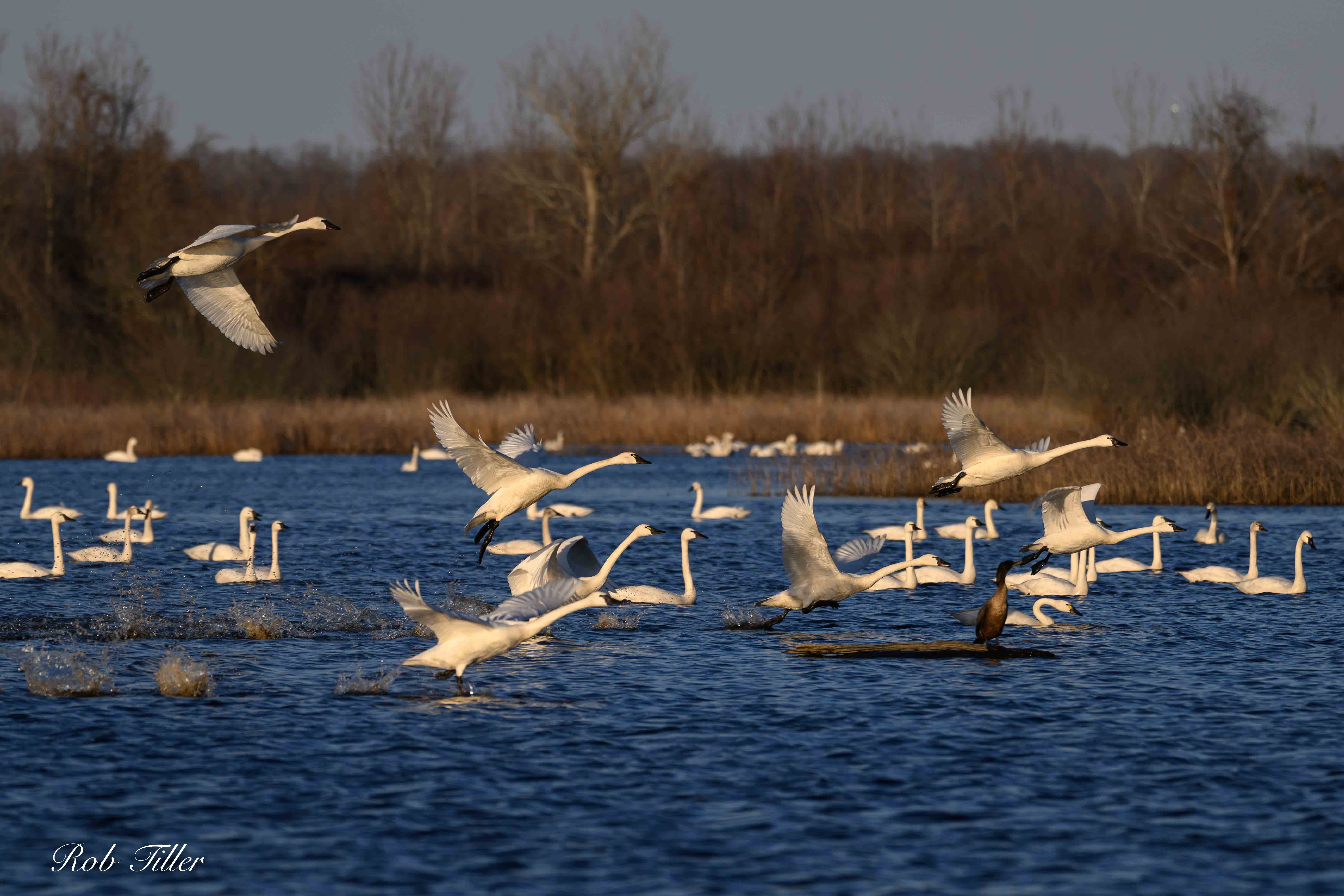
One afternoon I watched and listened as dozens of them did this maneuver.  There were only a couple of other folks on the shore of the pond, who like me were trying to take pictures.  It was a little chilly, but sunny, and peaceful, at least for those of us who didn’t need to take off.  
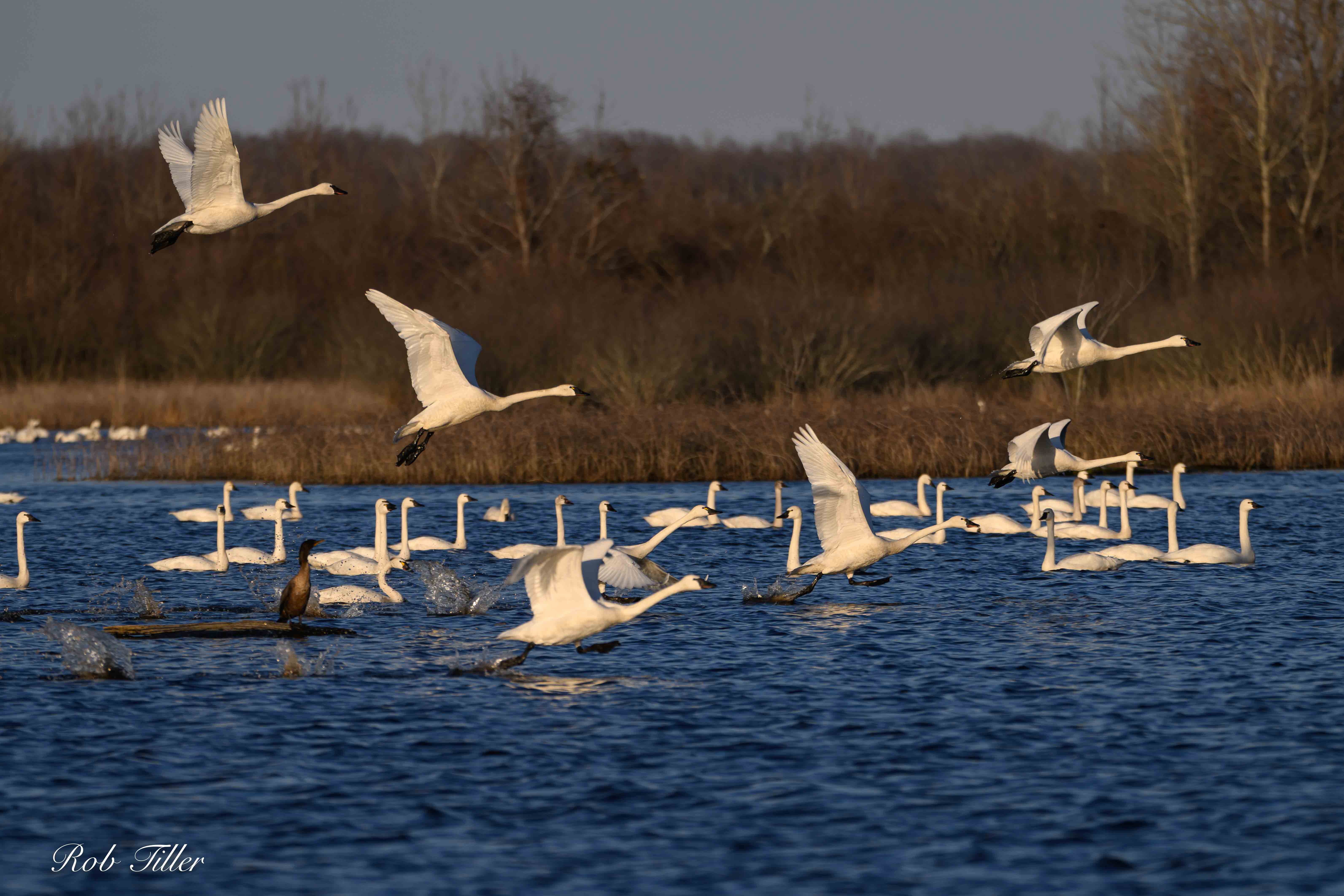
“Their clamorous wings” as they climbed put me in mind of Yeats’s wonderful poem The Wild Swans at Coole.  It’s a meditation on aging and mortality, together with the consolation of nature’s lasting vigor.  Yeats lauds the beauty of the birds, and their independence from us, with their own passions and conquests.    

Speaking of mortality and the lessons animals teach us, I was saddened to hear today of the death at 73 of Steven Wise, a pioneering crusader for animal rights.  The NY Times obit is here

Wise brought lawsuits on behalf of chimpanzees and other animals arguing that they were legal persons entitled to certain rights.  His legal work, writing, and teaching brought increasing attention to the question of how we should treat non-human animals.  Although his approach seemed to me problematic, since it was centered on arguments about certain animals’ human-like abilities, I greatly admired his intelligence, courage, and passion.  

I finished a new book directed at the question of whether humans have free will:  Free Agents:  How Evolution Gave Us Free Will, by Kevin J. Mitchell.  Mitchell is a professor of genetics and neuroscience at Trinity College Dublin.  His book addresses deep questions around the meaning of life with a lot of information about the workings of the brain.

Mitchell has an answer for determinists like Robert Sapolsky, who hold that all our behavior is predetermined by physics, and that our impression of mental independence is an illusion.  Starting with the simplest forms of microbial life, Mitchell applies Darwin’s theory of evolution and argues that agency and purpose are fundamental characteristics of life.  
I didn’t get all Mitchell’s explanations of brain cell biology, but I think I got the basic ideas.  Animals evolve to survive, which requires that they learn to respond to an ever-changing environment.  The most complicated brains we know of (our own) not only make top down decisions related to survival, but are capable of changing our own more basic processes and thinking about our own thoughts.  

Mitchell notes that there are various ways of thinking about freedom, and every being is constrained by its environment, biology, inherited traits, memories, etc.  But within those constraints, Mitchell contends we make meaningful choices.  This makes sense. 

In addition to providing a persuasive framework for thinking about free will, Mitchell’s account emphasizes the interconnectedness of the world.  He suggests that we are not independent objects, but a large set of processes that are acted upon, and act upon, everything else.  The book is an encouraging integration of science and spirit.

More polar bears, and some comments on Trump, free will, Empire, and Life on Our Planet

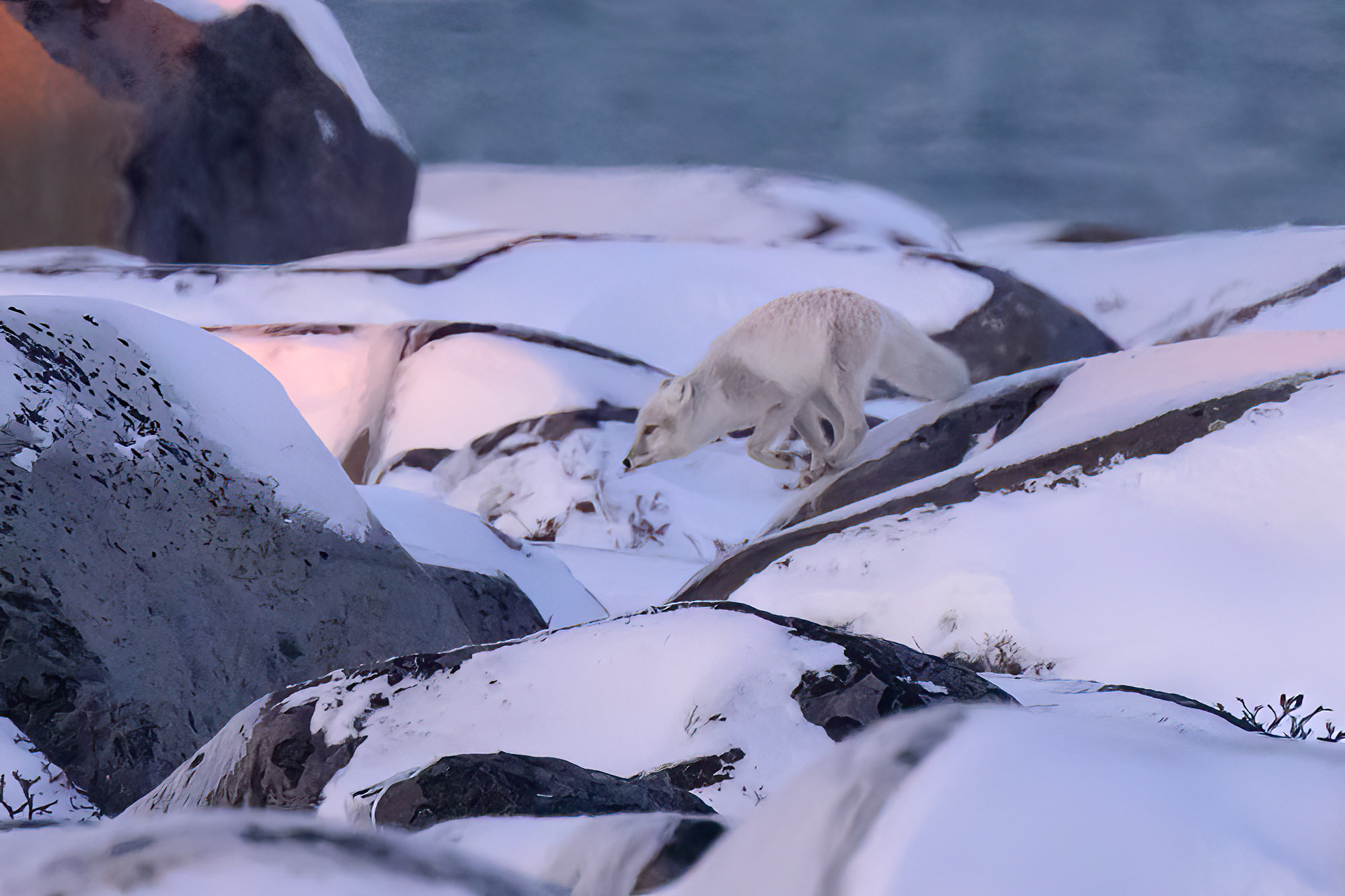
I’m still processing my trip to northern Manitoba, and wanted to share a few more photographs from that extraordinary journey.  I also made a short YouTube slideshow of favorites. Recently I’ve been making a particular point of cultivating gratitude, having so much to be grateful for, and that expedition was especially worthy.

Alongside those good feelings, I’m feeling discombobulated about  what is happening in American politics.  At this point, it’s virtually certain that the Republican party, traditionally a cheerleader for conservatism, will nominate for President a most unconservative candidate:  Donald J. Trump.  And polls say there’s a reasonable possibility that Trump will win.  

This in spite of what by now it’s hard not to know about Trump:  his deep dishonesty, his ignorance, his cruelty, his contempt for others (other races, other nationalities, other gender identities), his indifference to the dire straits of our planet.  Plus his track record of crimes (including molesting women), inciting hatred, undermining the rule of law, encouraging thuggery, promoting deranged conspiracy theories, and threatening nuclear war.  Also, he made a determined attempt to overthrow the U.S. government and seize power.  Now he’s acknowledging his intention to act as a dictator and treat his opponents “like vermin.”  

A lot of people, including some that are dear to me, are not much put off by this appalling record.  This has given a hard shake to some of my long-held beliefs and assumptions.  What we take to be reality really seems to vary a lot from brain to brain.  There’s a lot less agreement than I thought about fundamental moral concepts like right and wrong.   

I am grateful, though, for this wake up call:  it’s good to reexamine our assumptions about how people work, individually and collectively.  We have a lot of deep-seated, pre-Trump systemic problems, such as inability to face up to climate change and the horrors of animal agribusiness, that suggest systematic brain malfunctions.  Maybe if we understood ourselves better, we could behave better.

Against this background I’ve been processing the ideas of Robert Sapolsky in his new book, Determined:  A Science of Life Without Free Will.  I read Sapolsky’s last book, Behave, but so far have only read reviews and listened to podcasts discussing Determined.  The most thought-provoking of these was Nikhil Krishnan writing in The New Yorker. 

Sapolsky contends that there is no such thing as free will, because our every action and thought is the result of causes outside of ourselves.  In his view, the only significant differences between people are physical and environmental.  Individuals deserve neither praise for their achievements nor blame for their failures, because both are the result of forces outside of themselves.  

Sapolsky recognizes that his view is hard to square with life as most of us live it.  It’s hard to imagine not being grateful for a kindness or resentful of a slight, and hard to think that serious crimes are not deserving of punishment.  But he marshals plenty of evidence for the position that we are at bottom the result of genes and environment, and our usual habits of mind fail to reckon with that reality.  

I’m a big proponent of trying to see our connectedness with everything – to each other, to animals, to sun, air, water, soil, and so on – and acknowledging that we can hardly exist as unconnected individuals.  I’m with Sapolsky as far as that.  But it seems paralyzing to hold that none of our decisions can fairly be called our own.  There wouldn’t be much point in trying to figure out the right thing to do and then doing it.  The very concept of the individual, which we seem to need in some contexts, seems to collapse.  

This is disturbing, and I’ve been struggling with what to make of it.  I don’t have a comprehensive response to Sapolsky, but I will note one big problem with his framework.  There’s plenty of evidence that human ideas, coming out of individual minds, affect the world.  

The way we think matters at every level, from how we care for ourselves to how we conduct our politics.  And guiding ideas change.  We’ve seen bad ideas that had terrible effects, and we’ve seen some of those get rejected and replaced over time.  We have good reasons for examining our own ideas, and those of others – including Sapolsky’s.

On a less philosophical note, I recently discovered a very fine history podcast called Empire.  The subject matter is various empires of history, with the initial episodes focussing on the British East India Company in (of course) India.  

The hosts are accomplished scholars but not at all stuffy.  Indeed, they are wonderfully human and quite witty.  Some of their subjects involve gruesome violence, but the hosts point up a better moral perspective than some of our forebears had.  A historical perspective can be helpful in these trying times.  

Finally, Sally and I just finished watching Life On Our Planet, a documentary series on Netflix, and I highly recommend it.  In eight episodes, it beautifully summarizes four billion years of evolution.  The dinosaur parts were especially impressive; the animations looked amazingly realistic.  Here again, when I worry about where we’re going, it’s helpful to get some perspective from the long history of life.  Species rise and fall, and new ones rise.  

Science news — the Higgs boson, global warming, the nature of consciousness

I’ve been trying to follow the story of the search for the Higgs boson for a long time, and so I felt excited by reports this week that scientists at CERN have discovered a new particle that could be it. Quantum mechanics is not something I would ever aspire to have a deep grasp of, but even skimming the surface is mind bending. The subatomic world has different rules from ours.

I also really like the purity of the enterprise. It’s primarily driven by curiosity, rather than motives of profit or power. These scientists aren’t much interested in practical applications; they want the truth. (Of course, they also may want tenure, grants, Nobel Prizes, dates, etc.) It’s cheering that there is still, in some places, political and financial support that makes their (very expensive) experiments possible.

Another thing that’s particularly cool about the Higgs search is that it is a massive collaboration. Thousands and thousands of scientists are involved. According to the Times account, there were two teams of 3,000 physicists each analyzing the data from hundreds of trillions of proton collisions in the latest round of the CERN effort. They’ve found ways, which I’m sure involve the Internet and massive computing power, to share their knowledge and coordinate their efforts. This is very different from the model of scientific discovery I was taught as a kid, where individuals worked by themselves in their laboratories until their eureka moment. It’s encouraging that scientists are learning to collaborate better just as they take on ever larger problems.

The practicality of the Higgs work may be to the researchers’ advantage in making them a low-value political target. This contrasts sharply with global warming research. In my home state of North Carolina, a majority of our legislators (mostly Republicans) embarrassed themselves again this week by enacting legislation designed to suppress, or at least defer, scientific reports of rising sea levels caused by global warming.

The coastal development lobby seems to have been involved. As my friend and House representative Deborah Ross cleverly observed, putting our heads in the sand is not really doing property owners any favors — they need real information. I’d also note that the sea is not going to read the study anyway. It is both funny and scary that a significant portion of our political leaders (for now a majority in NC) are either willfully ignorant or cynically determined to oppose science where it conflicts with their self-interest.

Yet science hasn’t thrown in the towel yet, and I’ve got to think that the truth will out. Speaking a little more of science, I’ve been reading a new book by Michael Gazzaniga titled Who’s in Charge: Free Will and the Science of the Brain. It’s about recent discoveries and theories in neuroscience, and parts of it are mind boggling. Gazzaniga is a distinguished professor (University of California) and researcher in cognitive neuroscience who made ground-breaking discoveries in the area of split-brain research.

Gazzaniga covers a lot of territory, and I will not attempt to summarize (indeed, I’m not certain I completely grasp) his view of free will. For me, the most stimulating sections had to do with his his model of conscious thought. At least since the time of the Periclean Athens, we’ve thought of our conscious experience as objective — that is, what you see is what there is to see, what you hear is objectively present in nature, and so on as to other senses and perceptions. In everyday life, we experience all these sensations predictable and reliable, and have difficulty imagining them as error prone and misleading.

I’ve read several interesting books recently discussing research on this, including Jonathan Haidt’s, Daniel Kahneman’s, and Jonah Lehrer’s, but Gazzinaga seems to have the clearest theoretical model and best supported theory for why we can’t accept that our conscious perceptions are at best an incomplete and fallible approximation of physical reality. His model of the mind involves hundreds or thousands of modules working on, say, vision, and forwarding their data to a module in the left brain which he calls The Interpreter.

The Interpreter takes in what it can (not everything), makes some quick guesstimates as to what data is reliable and what should be tossed out, fills in any gaps in the data with best guesses, and presents the result to consciousness as reality. Despite all the guesswork and potential for errors, the result feels to us instantaneous, smooth, continuous, and objective. If there are glaring problems or inconsistencies, The Interpreter comes up with a narrative or story that “explains” them. We are, in a really fundamental sense, story-telling animals.

Another aspect of Gazzaniga’s model struck me as particularly thought-provoking was his discussion of emergence theory. While giving respect and consideration to the researchers working at the scale of neurons and brain structures, Gazzinaga deems it unlikely that that approach will never explain conscious experience. The brain is just too complex.

Emergence theory addresses itself to phenomena are matters that arise out of inputs so numerous as to be incalculable. Examples include snowflakes, traffic jams and weather, which are in the aggregate clearly products of much simpler phenomena (hydrogen atoms, carburetors and other auto parts, breezes etc.), but which contain too many variables to be predictable. The brain’s 100 billion neurons and vastly larger number of synapses far exceeds the complexity of our analytical tools.

Finally, I was intrigued that Gazzaniga suggests the possibility that the basic unit of analysis for the study of human consciousness should not be an individual brain, but rather, groups of brains. That is, intelligence may be best understood as emerging from humans interacting with each other. The individual brain in isolation knows nothing that we would call intelligence, but needs other brains to develop. Prisoners in prolonged isolation quite literally lose their minds. We’ve barely begun to consider consciousness in terms of systems of brains, rather than individual brains. It could change the way we approach education, law, and most everything else.