Kayaking at Robertson Mill Pond, in a warming world, with our new “energy emergency”

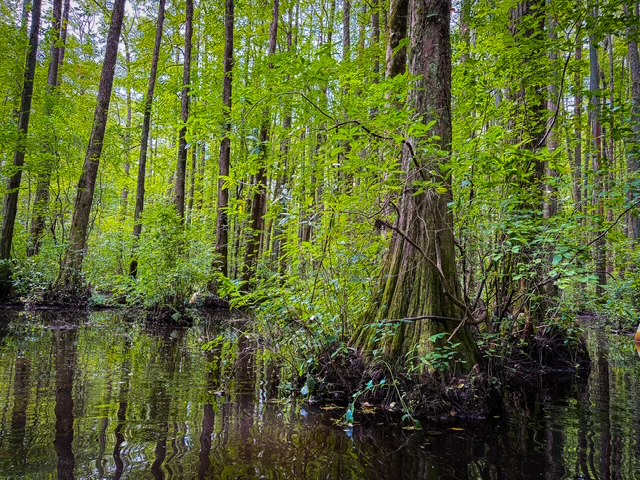
Last Monday I took my kayak to Robertson Mill Pond Preserve, which is just east of Raleigh. The park is basically a swamp shaded by cypress and other trees, with a kayaking course laid out with numbered buoys. I was the only person there. I paddled gently in the shallow water and listened to the birds singing. It was very peaceful and soothing, except when I couldn’t find the next guide buoy and got lost for a bit.
I didn’t take my big Nikon camera, which I’d hate to drop in the water, but I made a few snaps with my iPhone. It wasn’t too hot that day, and it didn’t rain while I was paddling. But the heat has made it tough to do very much outdoors on a lot of days this summer. I played golf on Wednesday afternoon, when the temperature was in the low 90s, and was sweating profusely after walking hole number 1.
Global warming has been on my mind this summer, because it seems to be coming at us hard. Hotter and hotter weather, more intense storms, floods, fires, and other climate-related disasters are a fact of life. I’d have thought that there could be no denying it for anyone who can’t always stay in the air conditioning.
Large populations are already facing droughts, crop failures, wars, displacements, and other disasters related to higher temperatures. At the micro level, hotter temperatures cause increases in crime and domestic violence. All the science tells us that unless we take action, all these problems are going to get a lot worse.

So why aren’t we doing everything we can to mitigate our crisis? Well, part of the answer is, follow the money. It’s no secret that those who profit from the fossil fuel system are always keen to make more money, and highly resistant to having less. President Trump promised the fossil fuel moguls that he would be their boy if they gave him enormous campaign contributions. They did, and in at least this one instance, he kept his promise. See this article.
Climate experts are being fired or sidelined and agencies organized to protect public health are being dismantled. Rules discouraging fossil fuel emissions and encouraging EVs are being dropped. Subsidies for green energy have been undone, and new subsidies for fossil fuels enacted. The endangerment finding that is foundational for EPA regulation is being reversed. There’s even a plan to shut down satellites that measure CO2.
This is truly perverse. How could it be justified? Why of course: just say there’s a national emergency! As with other Trumpian outrages (like militarization of the border and starting a trade war with tariffs), the President, with no factual basis, declared a national energy emergency.
Like autocrats before him, Trump cynically exploits the blind spots and weaknesses of the citizenry. One of his trademark moves is to sound the alarm: we have everything to fear! By raising the panic level, he lessens the chance that people will be able to engage in critical thought. Thus we learned that immigrants are generally rapists and killers, that peer nations are deadly drug dealers, and that Democratic leaders are Satanic pedophiles. And now, he says we have an energy crisis — not too much fossil fuel usage, but too little!
None of these claims has a grain of truth, but that hasn’t stopped them from propagating on right wing media. And the flood of truly frightening things, like widespread cruelty to immigrants, imposing militarization in our cities, attacking our universities, betraying our allies, undermining the rule of law, fomenting stagflation, and halting vaccine and other scientific research, is exhausting. There’s hardly enough time to get up to speed on one outrage before there’s a new one.
So even for a well educated and dedicated progressive, it’s tough to keep up with the news, and with everything there is to worry about, to stay engaged on climate change. But the consequences of not doing so could be disastrous, as in, the end of civilization as we know it.
One other aspect of this problem, and then I’ll stop: most Americans are not well educated. Fewer than half have more than a high school degree. More than half read at below a sixth grade level. This is not a bug for MAGA; it’s a feature. Ignorance is a key enabler of the Trumpian movement. This partially explains the attacks on universities and public education.
So it’s not surprising that a lot of people have trouble processing the science of climate change, or even understanding what science is. And it’s not surprising that they’re preoccupied with the price of gas and other daily necessities. Most don’t have enough money for a major health emergency, and many can’t fund a car breakdown emergency. Climate change is, for them, not the most immediately pressing issue.
The widening of the income gap between the well off and everyone else over the last several decades is a big part of the explanation for Make America Great Again. Working class people really were better off, relatively speaking, in the mid-twentieth century. There were more unionized jobs, and more respect for such jobs. Various institutions, like unions, churches, social clubs, and sports, gave a sense of community and connectedness. We’ve lost a lot of that. It’s understandable that working people feel they’ve gotten a bad deal, and it’s not fair.
As many others have noted, it’s truly ironic that a make-believe-super-rich-guy-failed-businessman-grifter like Donald J. Trump could successfully win the love of masses of the not well off. Yet he did, by acknowledging their anxiety and sense that the system was unfair, as well as by appealing to their prejudices. Can he keep their love as he makes sure the economy worsens, the housing crisis worsens, the health care system worsens, and the planet heats up? Probably not.
In any case, we’re all here together on our one precious, fragile planet. We need to keep talking to each other, with patience, with respect, but also with urgency.
 The Casual Blog