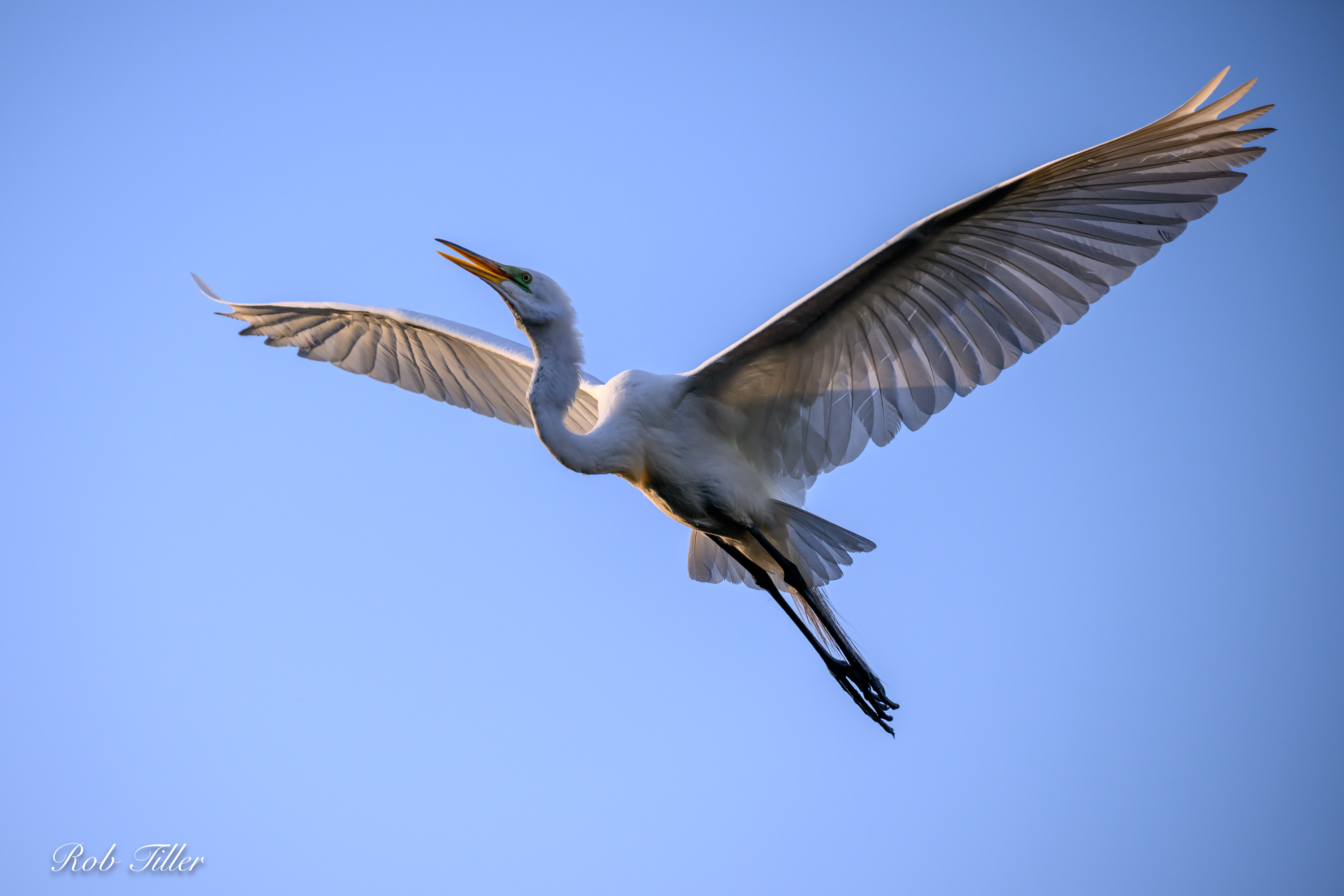
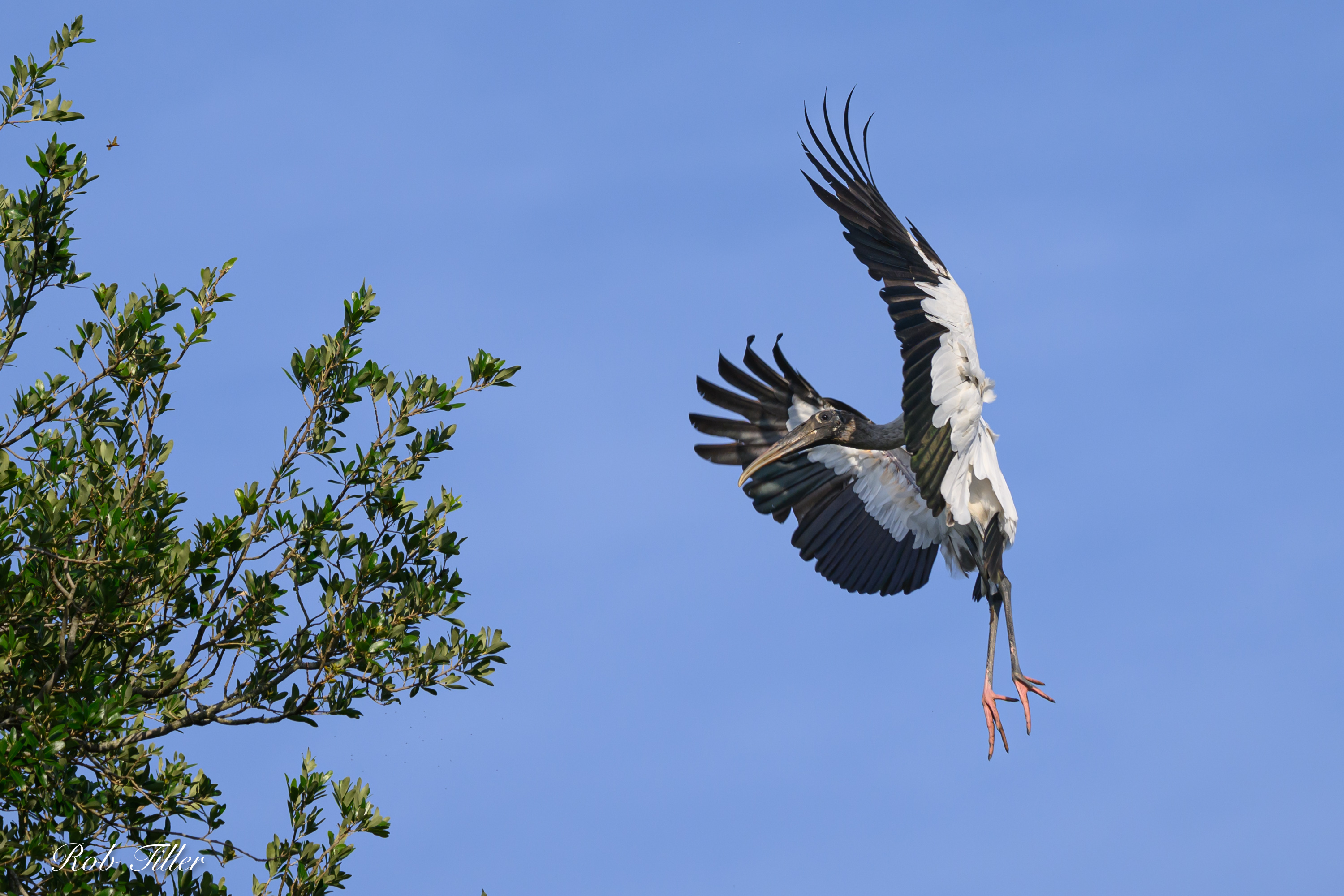
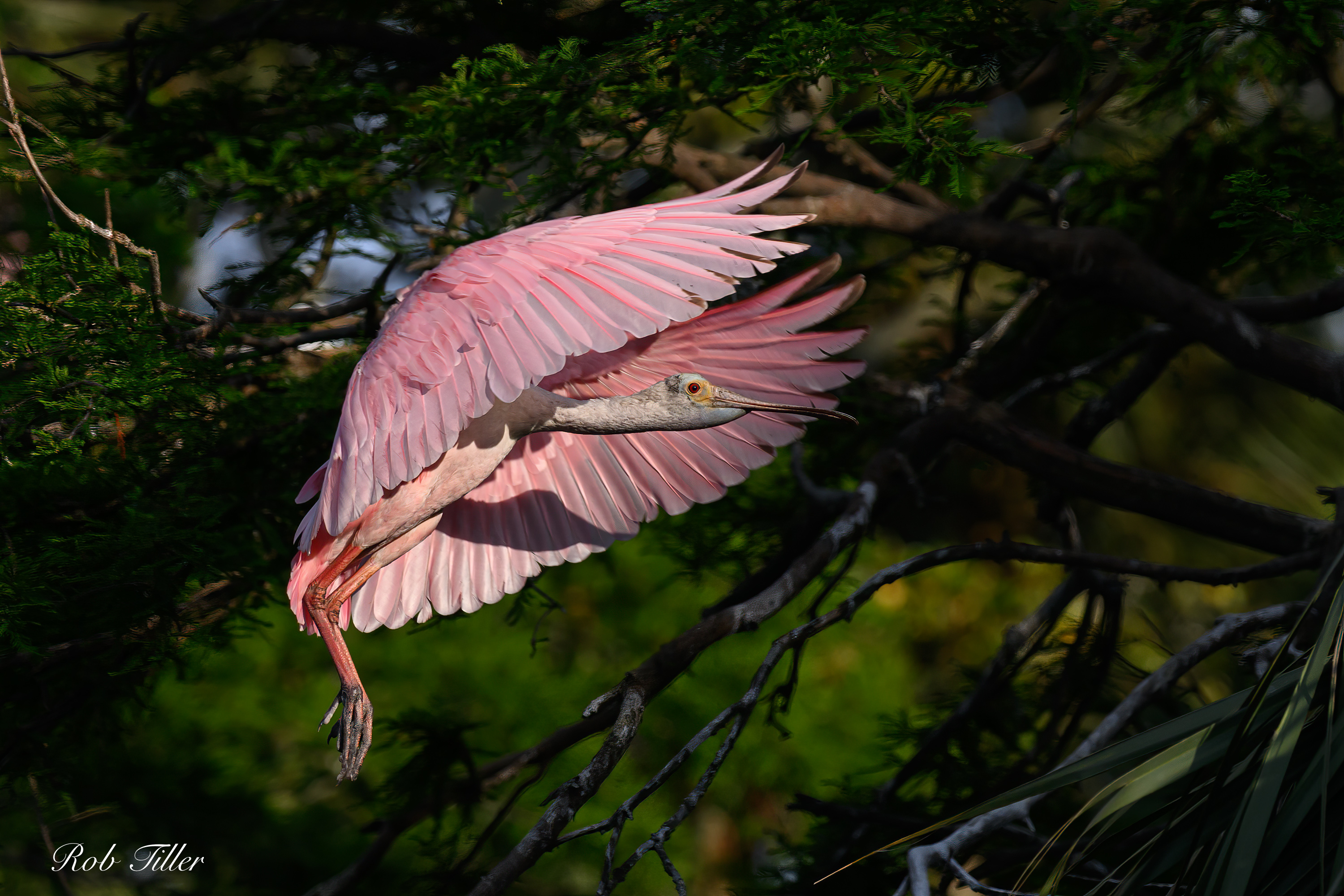
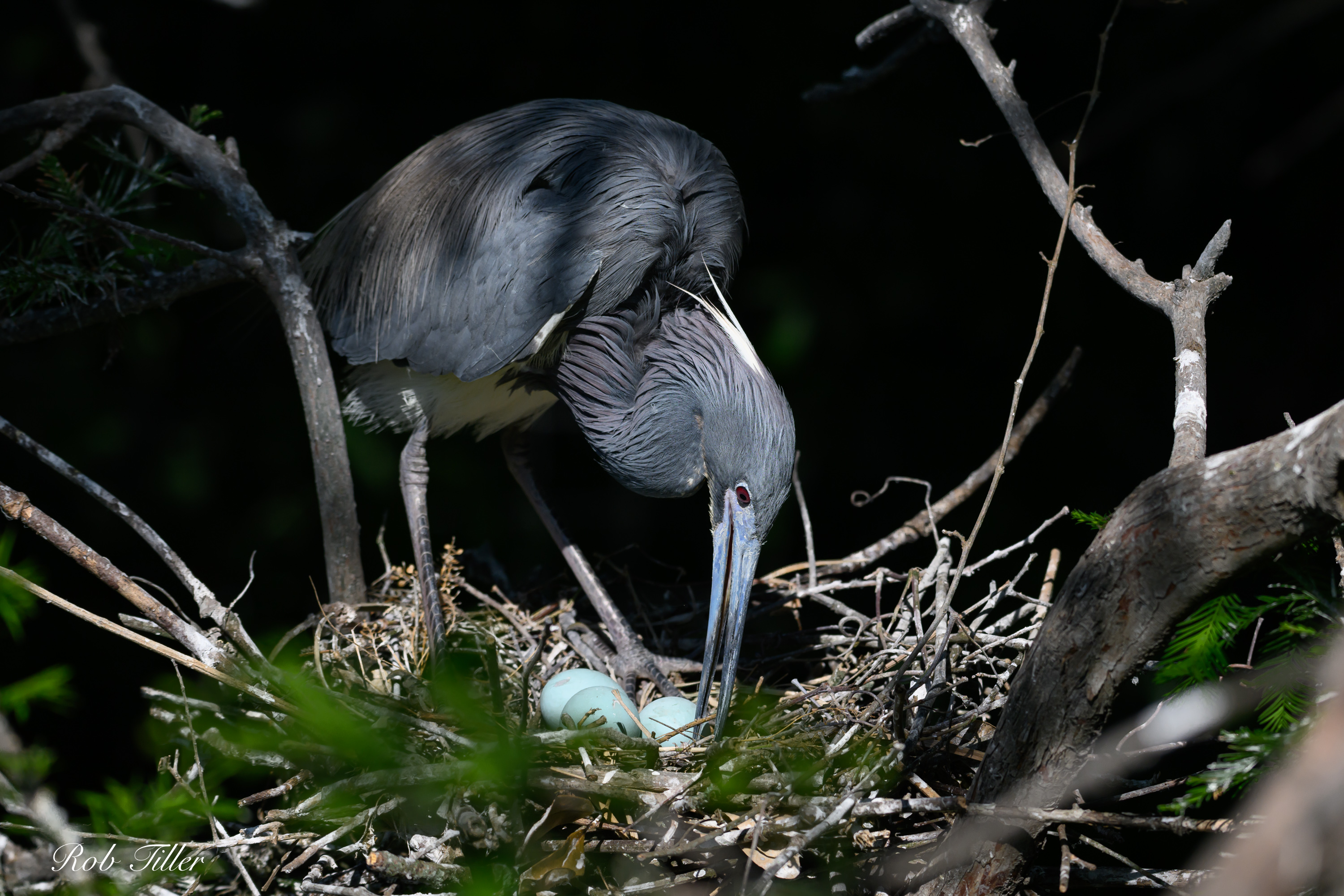
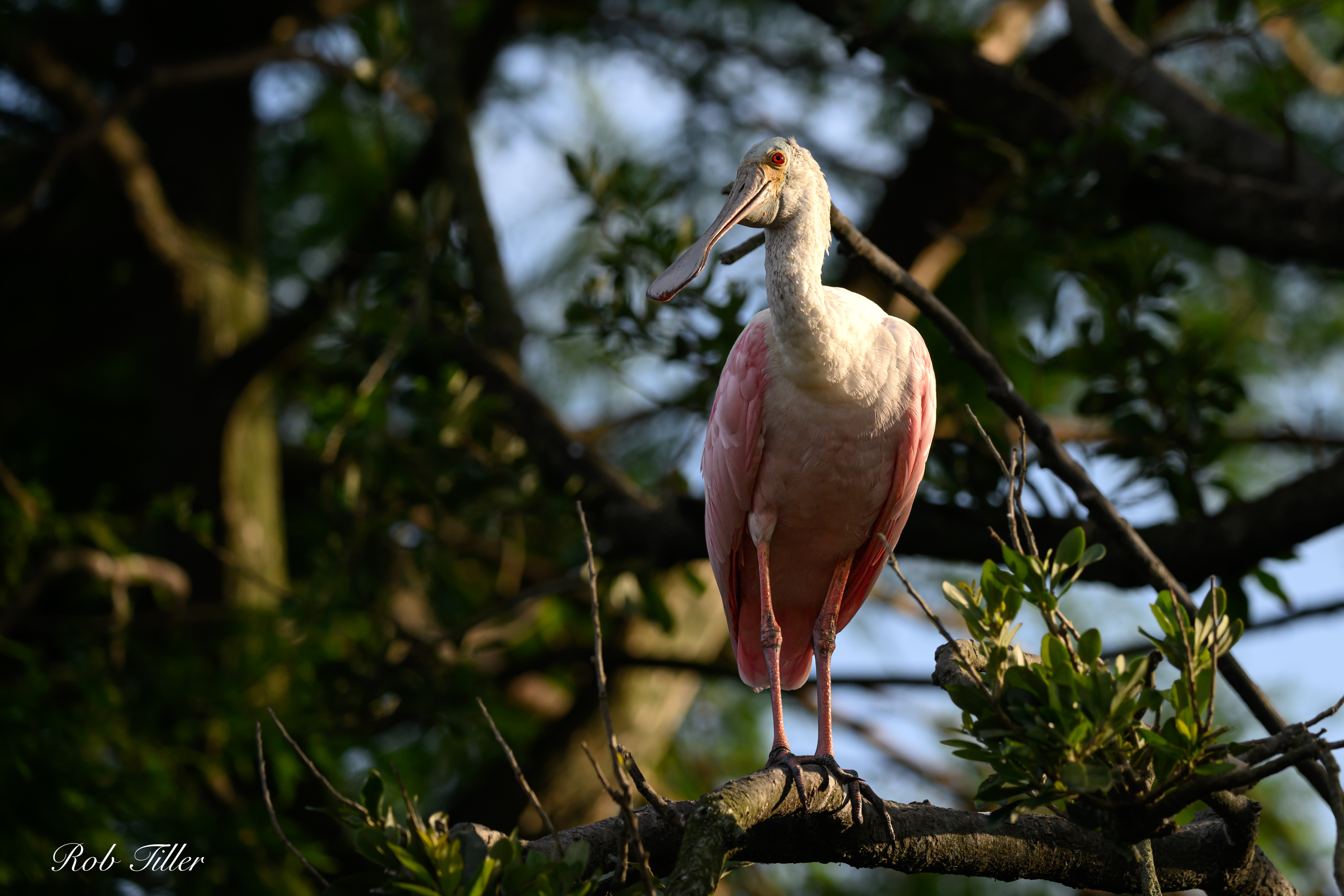
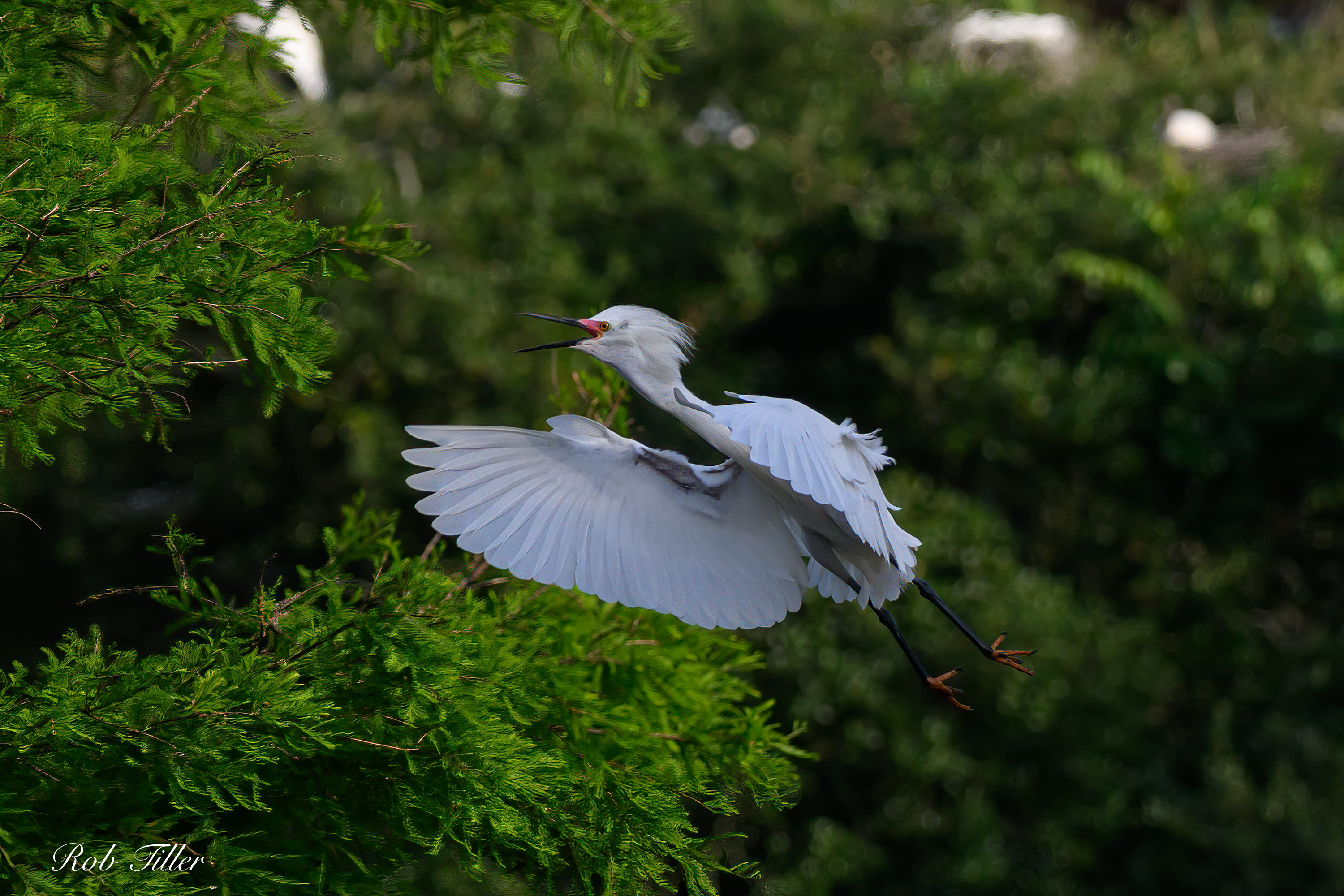
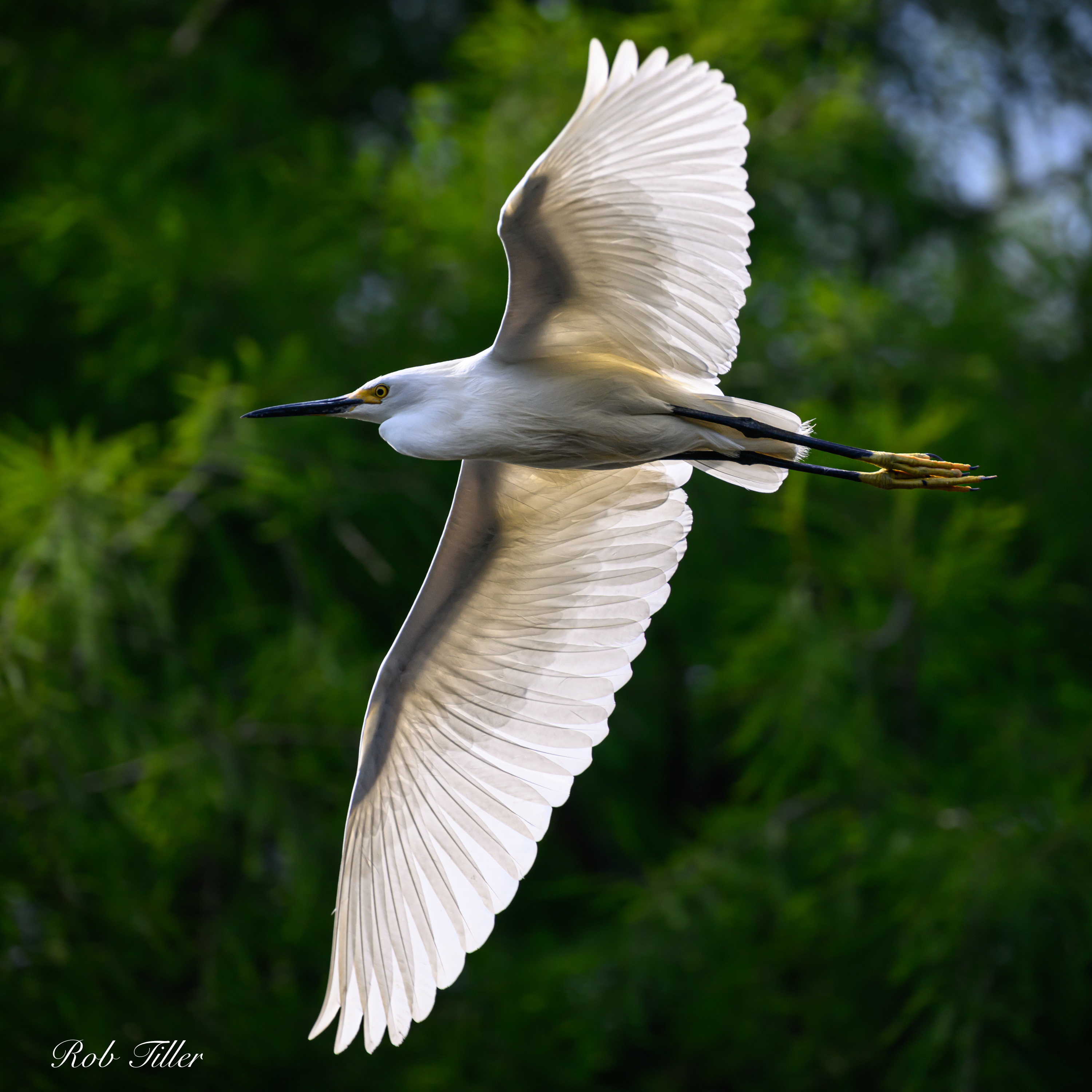
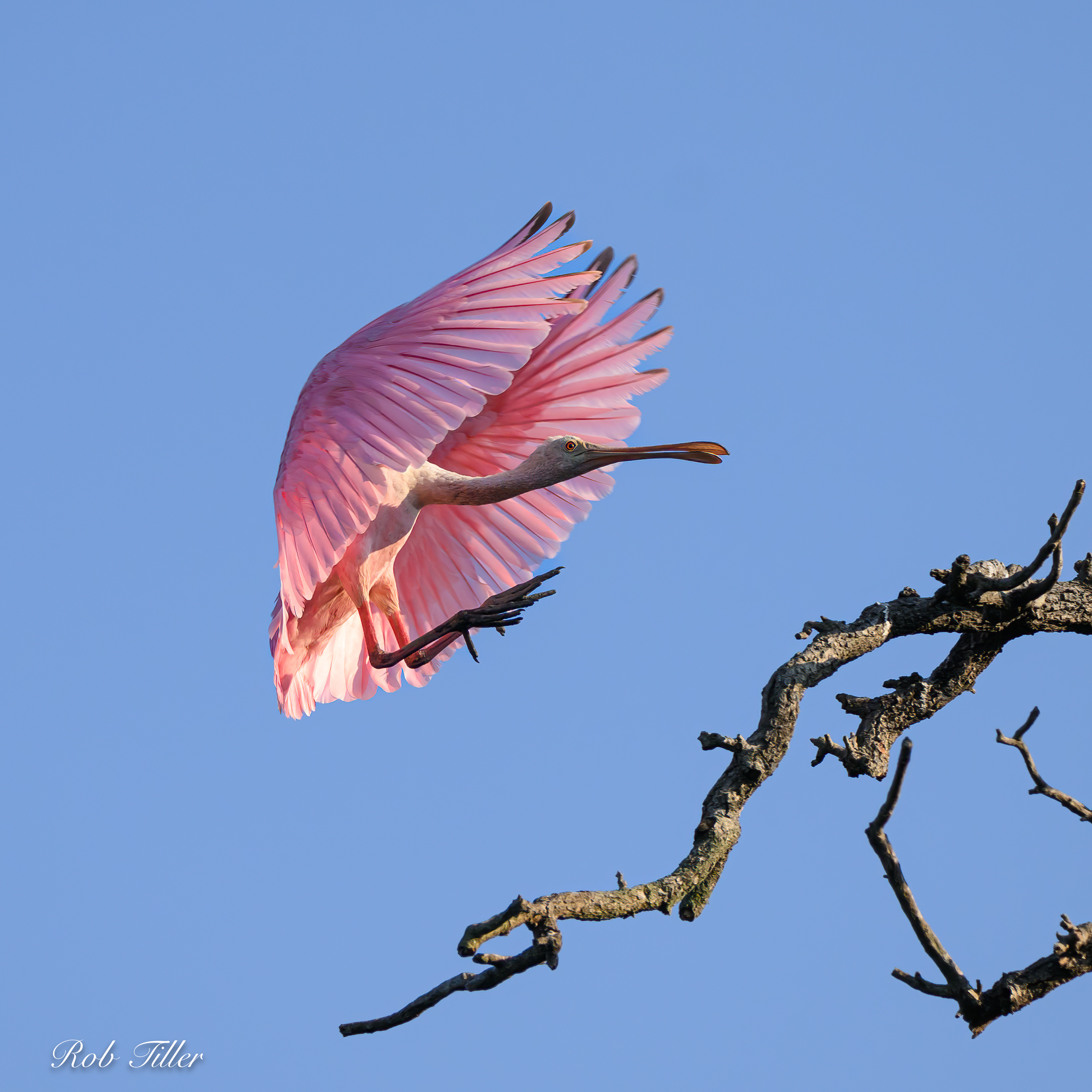
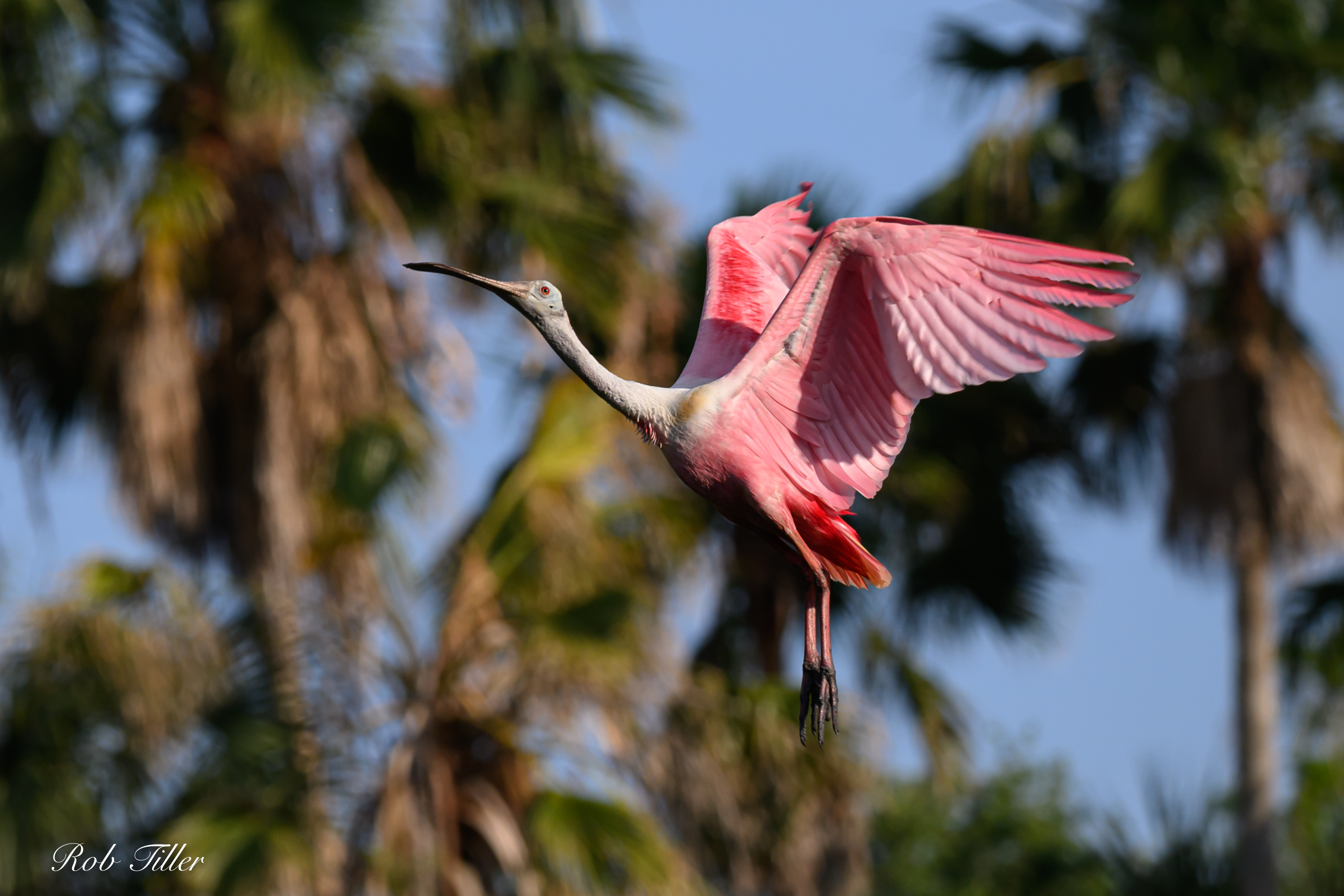
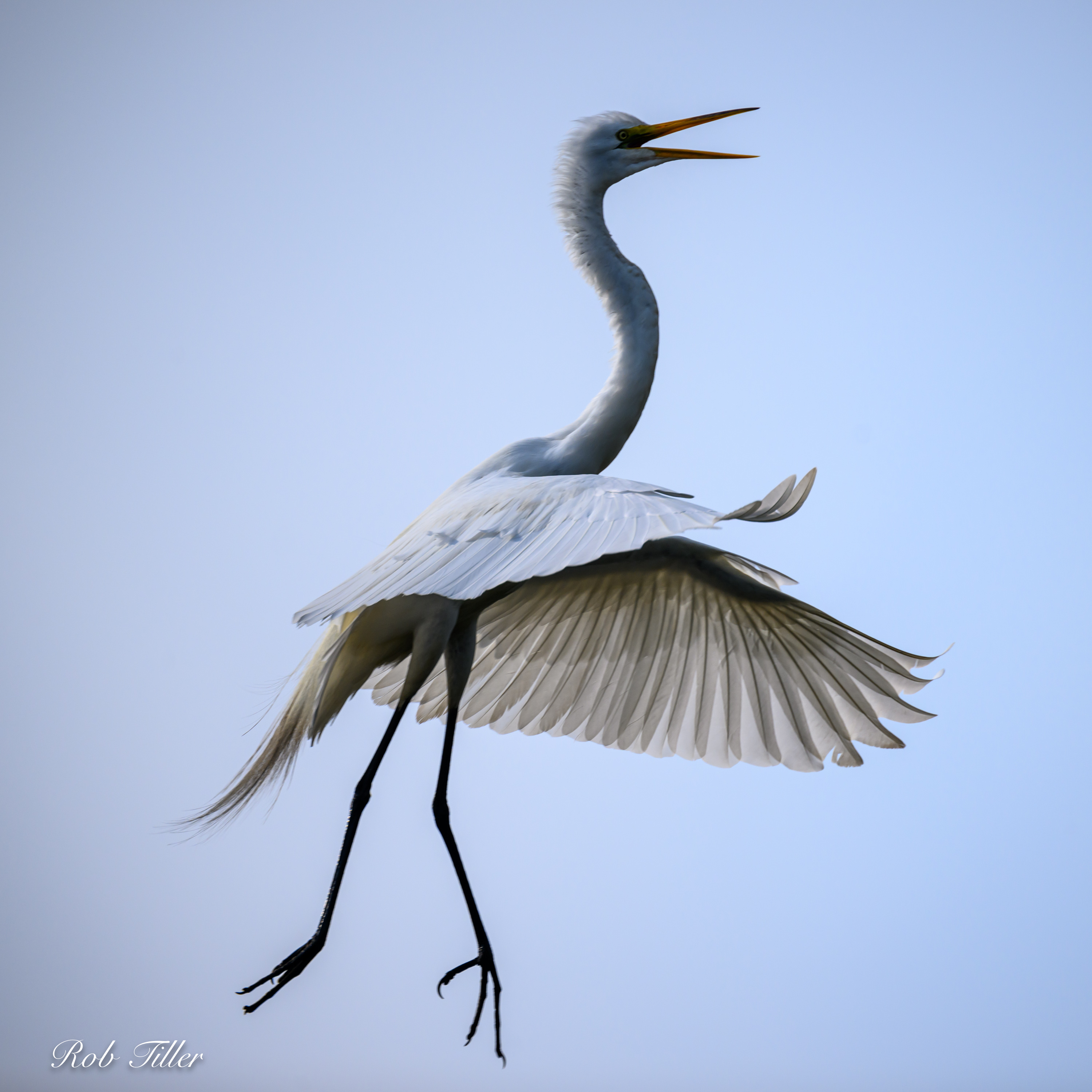
Summer is definitely here in Raleigh: uncomfortably hot and humid. I’m spending more time indoors, and finally finished sorting through the photographs I took while traveling in the spring. In this post, I wanted to share a few more of the photos I took in St. Augustine of roseate spoonbills, great egrets, snowy egrets, wood storks, and tricolored herons, and a few thoughts on recent political events.
In less than a week, we’ve just had two extreme events in our national political life. President Biden crashed and burned in his debate with Donald Trump, substantially increasing the chances that Trump will win the presidency in November. And the Supreme Court almost completely immunized Trump from criminal liability for his effort to overthrow the government in 2021. It decreed that the next president is free to commit crimes, heinous or otherwise, that are in any way related to his official duties.
This Supreme Court decision (which I, as a former Supreme Court clerk, had the training to read, and did read) is truly shocking. By holding that the president acting as president is not subject to criminal law, it fundamentally changes the nature of the presidency to something like a monarchy. In view of the definite possibility that a convicted felon, an incorrigible career grifter without any apparent moral restraint, will be our next president, the decision seems wildly irresponsible.
There was more than a whiff of corruption in the Trump White House, as Trump’s businesses raked in billions of dollars. He has promised to use the Department of Justice to persecute political opponents. He has proposed shooting peaceful protesters and shoplifters. He sought IRS audits of his enemies. He directed the persecution of tax-paying immigrants and the kidnapping of immigrant children. Not least, he encouraged a violent attack on Congress in an attempt to nullify the 2020 election.
Trump has shown no hint of moderating his inclinations. In his first term, subordinates sometimes discouraged or resisted his most outrageous proposals, but that is much less likely to happen if he’s reelected. Non-MAGA true believers will be excluded from significant roles. The true believers will know that Trump can and does protect those who carry out his orders with pardons.
Also, those collaborators will now understand that if they are accused of criminal activity ordered by Trump, the Supreme Court will probably be on their side. The Court’s new theory of the need for extreme Executive power may mean protection for those who implement Executive crimes. In sum, the new decision increases the already high risk that electing Trump as President will be a disaster for American democracy.
One of the benefits of studying history is perspective; it can help us take a longer view of our current situation. For example, it’s helpful to remember that our republic has survived crises in the past, like the Civil War, the corruption of the gilded age, the ascendance of the Ku Klux Klan, American Nazis during World War II, and the McCarthy red scare. We also survived Trump I. At the moment, I feel more despairing than hopeful for American democracy, but I’m trying not to give up hope.
I went down to St. Augustine, Florida, a couple of weeks ago to photograph some of the big wading birds there. I took a lot of photos at the Alligator Farm, where there’s a rookery of nesting great egrets, snowy egrets, cattle egrets, little blue herons, tricolored herons, wood storks, white ibises, and (my favorite) roseate spoonbills. The birds hatch their chicks in trees over a big pond area full of alligators. Apparently the birds feel safe and protected from tree-climbing predators there.
It really was quite wonderful to see all these creatures flying, fighting, mating, working on their nests, and feeding the chicks. I haven’t had time to go through all the thousands of pictures I took, but I did make one pass through the ones from April 26, when we had some beautiful light. These ones were all taken that day.
At times I feel a bit of an odd duck for caring about birds, but I was reassured by a great little essay in the NY Times on how birding can change your life. The essay is by Ed Yong, who wrote An Immense World, a fine book about the sensory worlds of non-human animals.
Yong describes describes some of the nuts and bolts of learning how to identify birds. But the really interesting discussion was how he found himself changed by birding. He discovered a new connection to nature and new appreciation for the small wonders of life. He found himself living more in the present, and with a greater appreciation for his own life, just as it is.
I’m not as serious a birder as Yong – I don’t keep a life list or take on arduous travel to see one new species. But I’m still studying up on resident species when I go to a new place, and working to identify birds I’m not familiar with. I heartily endorse Yong’s view that birds make life better.
Speaking of animals, we saw a recent documentary series on Netflix that I recommend: You Are What You Eat. It centers on a nutrition study at Stanford University of identical twins. The idea was to discover how much different diets affected genetically identical people.
The big takeaway was that a plant-based diet was generally much more healthy than other options. The series also notes, without hammering on, how animal agriculture is terrible for the climate and for both farmed and wild animals. Despite the serious content, the filmmakers managed to leaven their presentation with some humor.
Finally, I want to recommend a good podcast series called The Rest Is History. The format is a conversation between two Brits, Tom Holland and Dominic Sandbrook, about a historical period or incident that they’ve gotten interested in. They are funny and smart, and some of the subjects are fascinating.
I found their series on the rise of German Nazism particularly interesting. Holland and Sandbrook investigated how an ideology that they (and most of us) regard as bizarre and inhuman could have seemed exciting and completely valid to many Germans of that time.
Discussing Nazism is a delicate business, since it understandably arouses strong emotions. It’s uncomfortable, and we tend to think it’s not worth the bother, assuming that we know everything worth knowing about it anyway. Of course, that’s unlikely, since like all mass movements, it was complicated. But it’s possible to be clear that the systematic mass murder of Jews and other groups by the Nazis was horrific, while also wondering about what German leaders and ordinary Germans were thinking as crimes against humanity took shape.
As Holland and Sandbrook note, the Nazis believed they were acting based on science, and were addressing an existential threat to their nation. Some of such thinking is still with us. Eugenics, the “science” of superior and inferior races, was integral to their thinking, and it was then considered actual (rather than crackpot) science in many other places, including the US.
The Germans of the 1920s and 30s feared for their future, based on widespread poverty and the postwar economic crisis. They sought to explain their problems by identifying scapegoats, including especially the Jews. Their anger and fear of supposedly inferior races and cultures is not so different from the hostility towards immigrants that is now a central feature of politics in the US and Europe.
The Nazi leadership effectively used the modern media of the time, including radio and film, to amplify their message. Holland and Sandbrook point up a program to get a radio within earshot of every German so that they could not avoid hearing Hitler’s speeches. The incessant repetition of lies about Jews and others made it hard to keep contrary views in mind. Our social media is different, but likewise tends to create information bubbles that can separate us from reality.
Holland and Sandbrook suggest that the impulses of Germans who supported Nazism, like the desire for excitement and hostility to out groups, is pretty normal. Humans are social animals, and our behavior is powerfully influenced by those around us. Once Nazism attained a degree of popular support, doubters were more inclined to go along with the crowd, as people normally do. And once the movement was strong enough, dissenters were either squashed or silenced themselves.
From time to time, I’ve wondered what I would have done if I’d been a German in the 1930s as the Nazis rose to power and took over the country. We know from studying Germany’s experience that most people were swept along without dissenting, and it’s possible that I would have been one of that herd. Of course, I like to think I’d have been unusually independent and courageous, but it’s hard to be sure.
Anyhow, the Rest Is History podcast series on Nazism is thought provoking and timely. We know from Germany’s experience that facism can happen to countries populated by people who are generally sane and decent. I dearly hope the US is not headed in such a direction, but it’s clearly not impossible. It’s worth taking the time to look closer at Germany’s history, and do everything we can to go in a better direction.
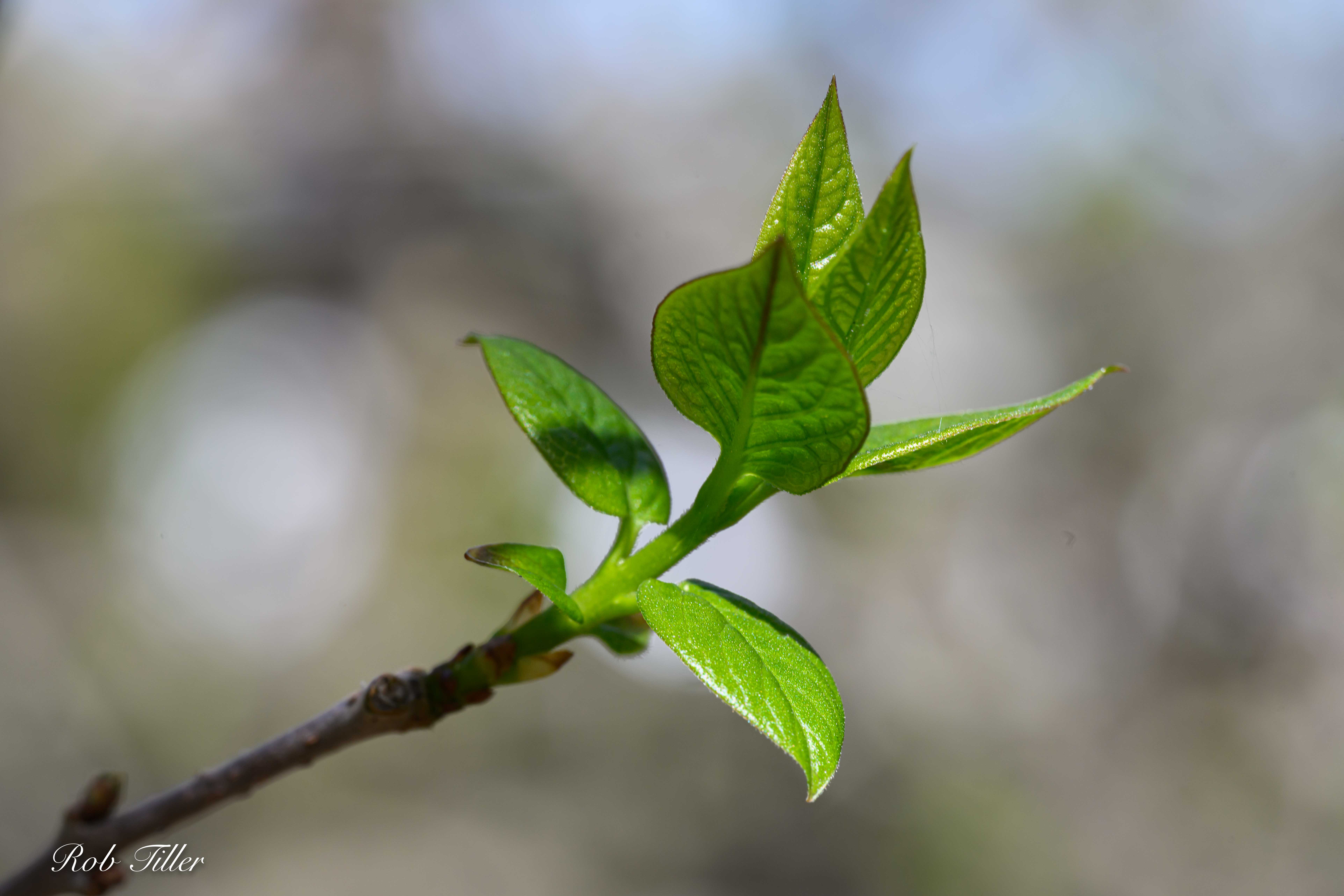
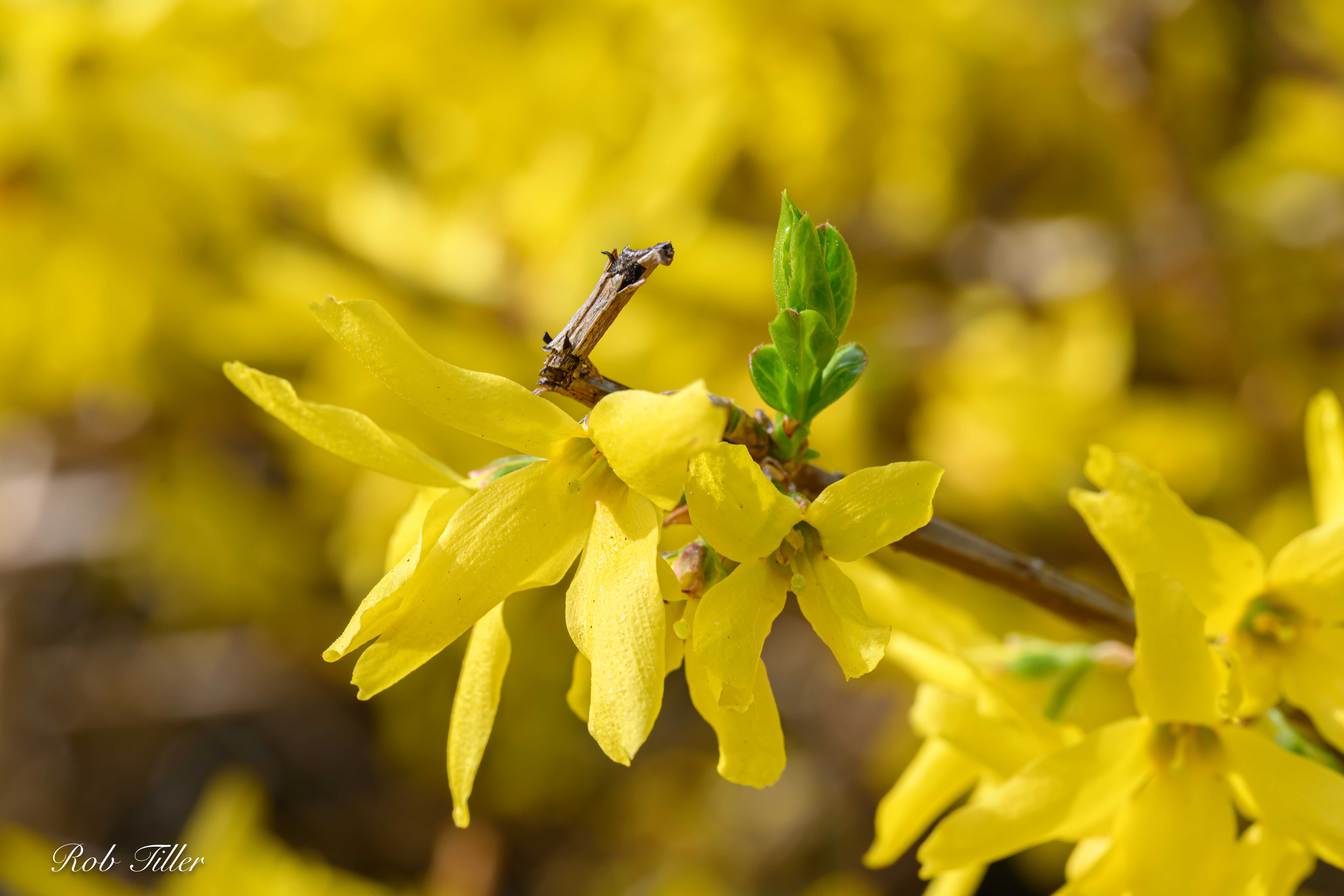
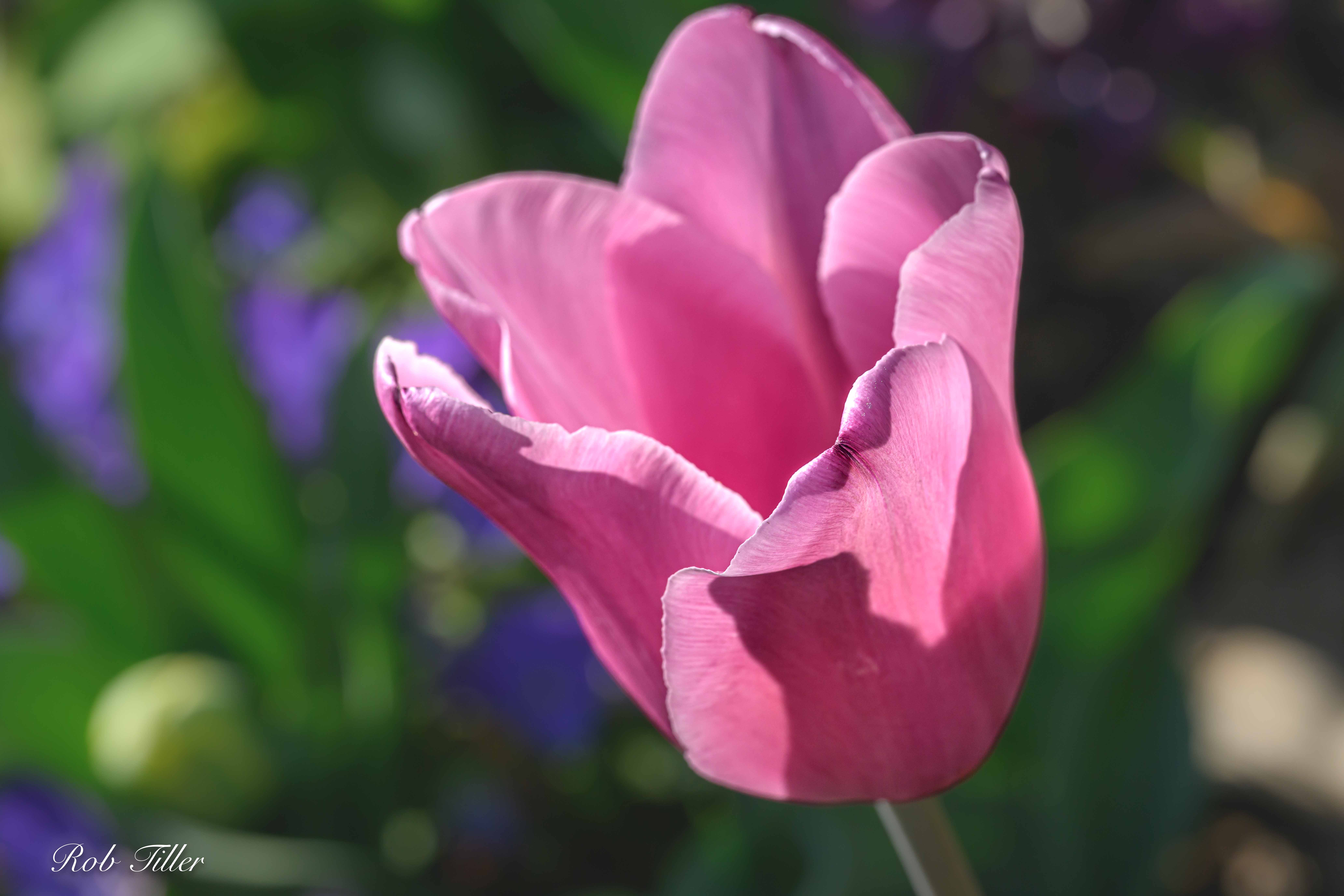
Spring is finally here, I’m happy to say. We visited our loved ones at beautiful Beaufort, N.C., a couple of weeks ago and saw some of the wild horses there. In Raleigh, the trees are starting to leaf in, and the early flowers have popped up, seemingly out of nowhere, with vivid colors. I enjoy them every year, but this year is especially good. The flowers below were from Raulston Arboretum, Fletcher Park, and the backyard of casa Tiller.
This week we watched The Zone of Interest, which won the Oscar for Best Foreign Film and is now streamable on Prime. I highly recommend it. The story concerns a family living a normal happy life right next to the Auschwitz death camp. It raises some tough and timely questions about human behavior and ethics. I expect we’ll be thinking about it for a long time.
Our immigration situation also raises some tough and timely questions. These days it’s often referred to as the immigration crisis, which is certainly true from the perspective of people desperately fleeing violence and poverty. But there’s a massive misunderstanding of the situation, as shown in a recent Gallup poll. Immigration was most frequently cited as America’s biggest problem, and the number of Americans who think that has gone up.
This is both understandable and absurd. Fear of foreigners is nothing new, and has long been exploited by leaders for political advantage . But we truly are a nation of immigrants. They are running some of our most successful corporations, as well as building our houses, manning our hospitals and factories, picking our crops, and taking care of our children. If there’s energy and creativity required, we rely a lot on immigrants, just as we rely on them to do a lot of unpleasant work that we want to be sure is done well.
It should be obvious, but apparently needs saying, that we’ve always been a multi-racial, multi-ethnic, multi-religious country. The majority of us have ancestors that came from some other country not so long ago. And we have friends, neighbors, and service providers who have different skin colors, different languages, and different customs. We’ve got lots of problems, but our diversity is not a problem. It’s a strength.
With all the actual problems we’re facing, it’s really disturbing that the non-problem of immigration has become a central flash point of our politics. Whipping up more fear of immigrants was and is one of Trump’s main tactics; it’s hard to imagine his succeeding without it. But even mainstream Democrats now believe we have a border crisis that is not of our own making, and that we somehow have to prevent more foreigners from getting in.
Franklin Roosevelt had a famous line in his inaugural address in 1933: “The only thing we have to fear is fear itself.” He probably meant to reassure a nation in the throes of a financial depression with the thought that fears weren’t themselves likely to be fatal, and economic problems were solvable.
But Roosevelt’s words have a different resonance now. We truly have good reason to be afraid of the current panic about immigrants, because it is perilous, both for ourselves and others. I’m thinking of three serious risks.
First, it could lead to the end of democracy as we know it. Hard as it is to believe, there is a real possibility that Donald Trump could become the next president. Trump has proudly declared his intention to become a dictator, to persecute his political enemies, to shoot peaceful protesters, to take away rights from women and minorities, and to fundamentally alter the constitutional order. He undermines the rule of law with his claims to be immune from prosecution for any crime and pardons for his convicted criminal pals. Again, his appeal is based in large part on his demagoguery about immigrants, whom he viciously and groundlessly characterizes as criminals, rapists, and animals.
Second, our draconian limitation on immigration is a self-inflicted wound, in that we need immigrant workers. The idea that immigrants cause harm by taking Americans’ jobs is mistaken. They pay more in taxers than they use in services. Many of them start businesses and create new jobs. As noted, they do a lot of the most important high-level work we have, as well as some of the most difficult and dangerous jobs. For example, without them, our food supply chain doesn’t work, or our cutting edge AI tools. We have a labor shortage, and with an aging population, that problem is getting worse. We need more immigrants.
Third, there’s morality: treating immigrants with disrespect and cruelty diminishes us. Refusing to respond to the needs of desperate people fleeing war, violence, and grinding poverty is a stain on our own humanity. It takes work to get rid of our natural compassion for people in need, but some of our political and thought leaders have pulled us along that path. They whip up our ordinary caution about people we don’t yet know into anger, hatred, and panic.
In considering what we owe immigrants, it’s worth noting that we in the U.S. bear substantial responsibility for some of the problems that are driving people from their countries of birth. We’ve done more than our share to create the worldwide climate crisis, with the rising heat, drought, fires, and storms that make some areas inhospitable or uninhabitable.
Driven by greed and fear of Communism, we’ve also played a role in creating the chronic violence that drives emigration out of some countries, including El Salvador, Nicaragua, Guatemala, Honduras, Venezuela, Haiti, and Cuba, not to mention the Middle East and Southeast Asia. We have a lot to atone for.
The solution is not simple. The system we’ve constructed for our border is deeply flawed, and fixing it will not be easy. We don’t have the necessary plans or resources in place to implement the current problematic laws. More fundamentally, we need to rethink certain assumptions, including notions of what a great nation is and what borders are for, and that will take time.
But it’s obvious that we need to stop panicking about immigrants. We need to start seeing them as people and learning about their situations. We need to have conversations about what the options are for helping them. We need to rediscover our natural compassion, generosity, and love. People in dire need offer us an opportunity to be more compassionate and generous. Let us be thankful for that opportunity, and take it.
I thought I’d share a few more pictures from my Yellowstone trip in January, and a brief account of my trip last week in Vail, Colorado, where I took no pictures but did a lot of skiing.
Vail is enormous: 5,317 acres and 3,450 feet of vertical. The longest run is four miles. There are some 26 lifts, and navigating the area is demanding. They don’t hand out maps any more, so you need to get their app with the layout and learn to use it.
I met my old friend John A. out there, and we stayed at the Grand Hyatt in West Vail. The hotel was attractive and comfortable, and had its own ski shop and a ski lift just outside the back door. I brought my own boots, but rented skis –Volkyl Mantra XXs, a good, versatile ski, but a bit stiffer than my ideal. It snowed the night I arrived.
It continued to snow all that day, which was exciting, but visibility was very limited. At one point I fell while going down a steep mogul field that I hadn’t realized was a steep mogul field. I was exhausted by the time I got down to the lift, and then I realized I’d lost my goggles somewhere up the mountain. I’d forgotten to bring my contact lenses, and my glasses iced up, making it hard to see anything. My legs got tired. It was a tough day.
But the next two days were sunny and clear, with just the right chilliness for the snow. I got some new goggles. What a joy skiing is when everything clicks! We cruised on the cruiser runs and worked the less difficult black runs in the back bowls. It wasn’t crowded, and it was beautiful. Happiness!
John and I ate well and had some good arguments. It seems like these days many of us are afraid of arguments, and hesitate to express ourselves when there could be conflict. But it really is a good idea to talk with people who don’t agree with you about everything. Sometimes you learn things!
When I wasn’t skiing, eating, or talking, I did some reading, including an interesting new book, The Case for Open Borders, by John Washington. The southern U.S. border has been the subject of much alarm and controversy recently, and I thought it would be good to get a new perspective on the issue.
Washington proposes that we rethink the whole subject of borders, which he argues are artificial constructs that do more harm than good. He presents evidence that immigration is a positive force for the receiving country, both economically and morally.
It’s unfortunate that a lot of people are fearful of people who look different, speak another language, or have different customs. That common fear has been made much worse by some cynical politicians, who characterize them as dangerous criminals and thieves stealing jobs. In fact, the opposite is closer to the truth.
In fact, the NY Times had an article last week about the positive economic contributions of immigrants. They helped our economy recover from the pandemic quicker than expected by filling necessary jobs. They continue to help us get work done, and help support their relatives back home.
As climate change makes it harder to grow food in some areas and causes floods, fires, and other disasters, there will continue to be a lot of people who have no choice but to flee. America is still a land of opportunity, and there’s an opportunity here for us: to be more compassionate and to help those who desperately need help.
I’ll mention one other thing that isn’t usually a welcome dinner table topic: the increasing risk of nuclear war. I’ve long thought that our unwillingness to look squarely at what a nuclear conflict would mean increases the chance it will happen. With arms racing again picking up speed and war in Europe raging, it’s high time to think again about how to lower this terrifying risk. The Times started a series this week on this topic, and the first piece was appropriately arresting. I hope a lot of people will read it.
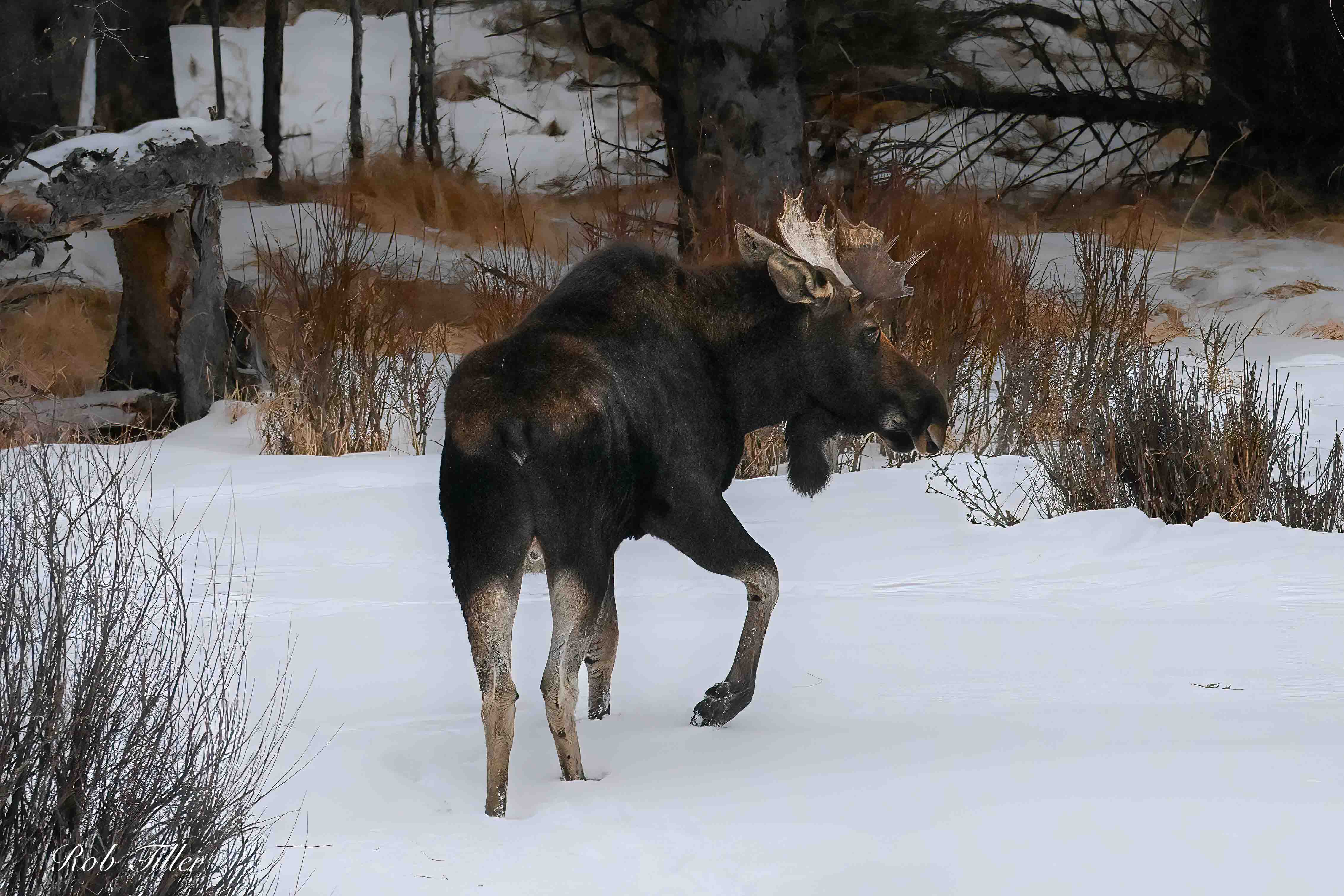
Toward the end of January I was in Yellowstone National Park, where I saw quite a few animals and took a lot of photographs. I’m still sorting and weeding them, but here are some I thought were worth sharing. Looking at the images reminds me of what an amazing world we live in, and makes me want to get back out into nature.
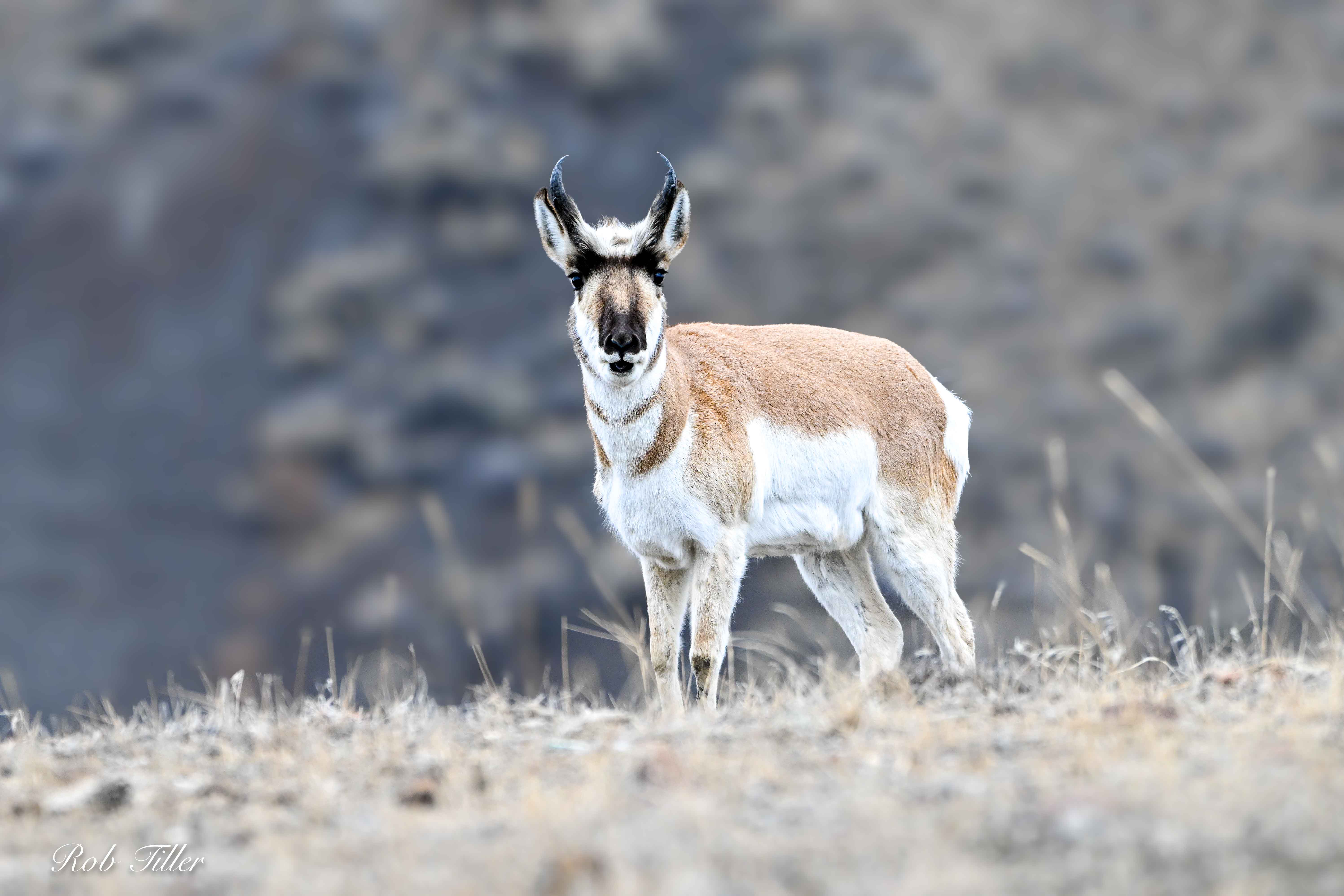
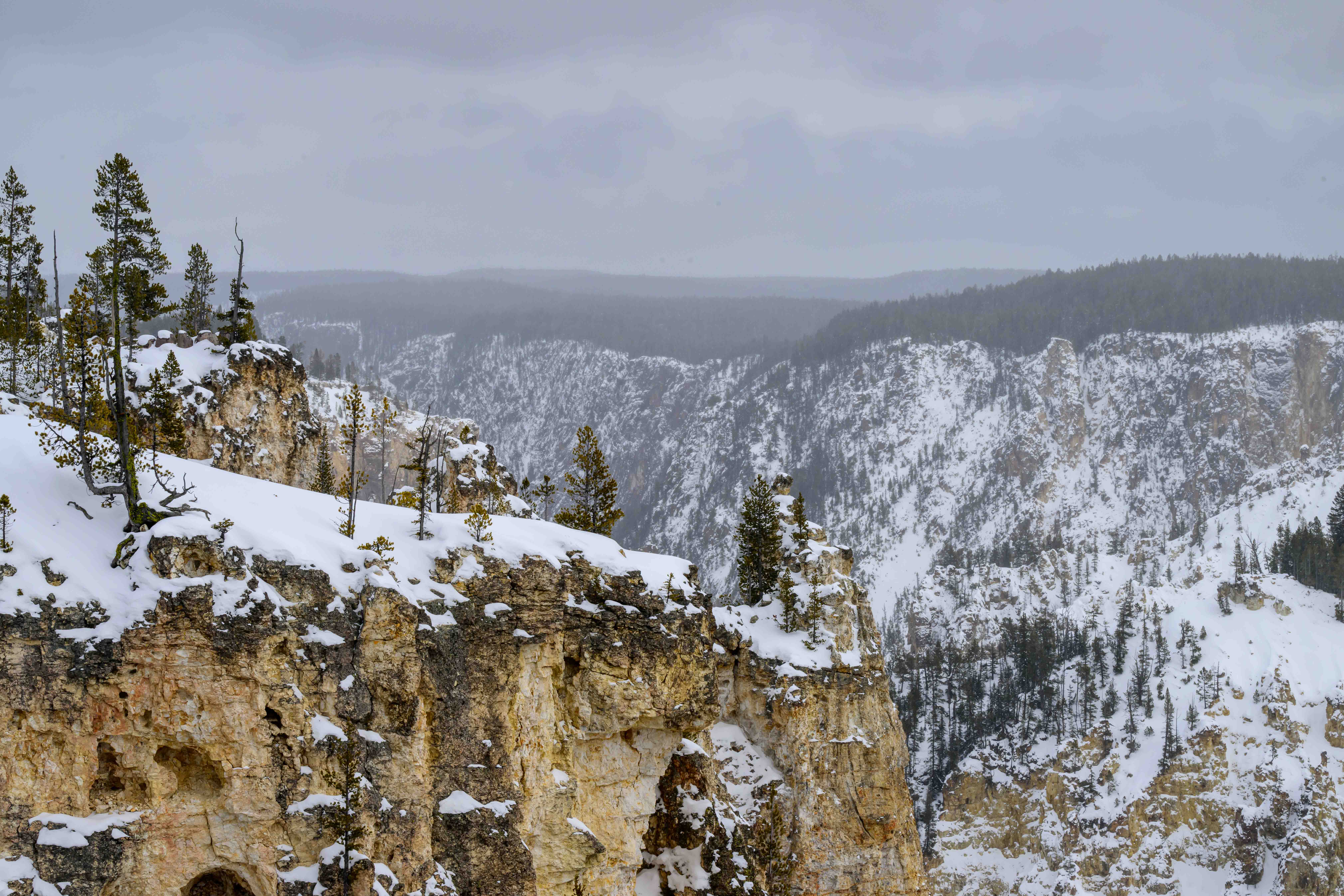
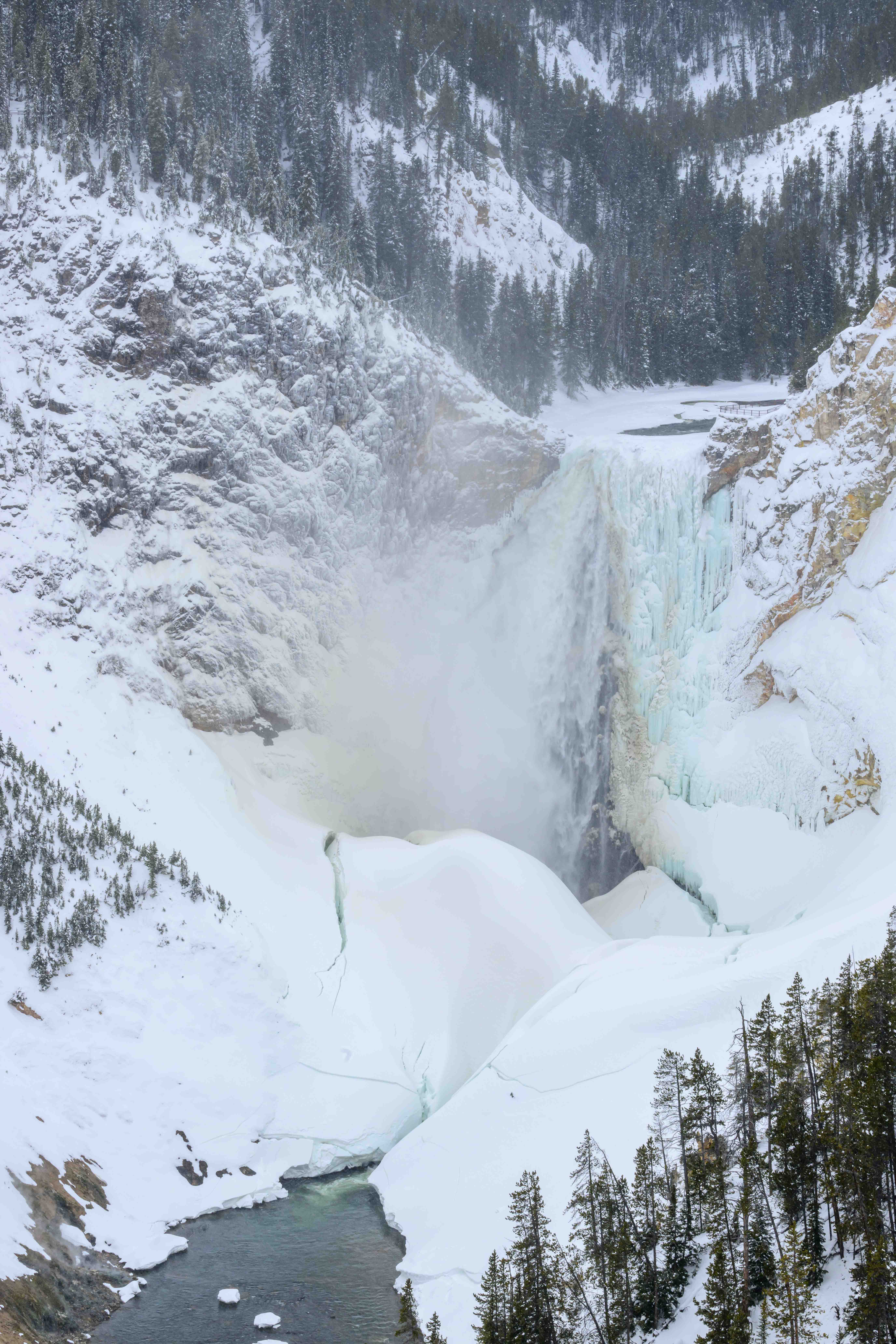
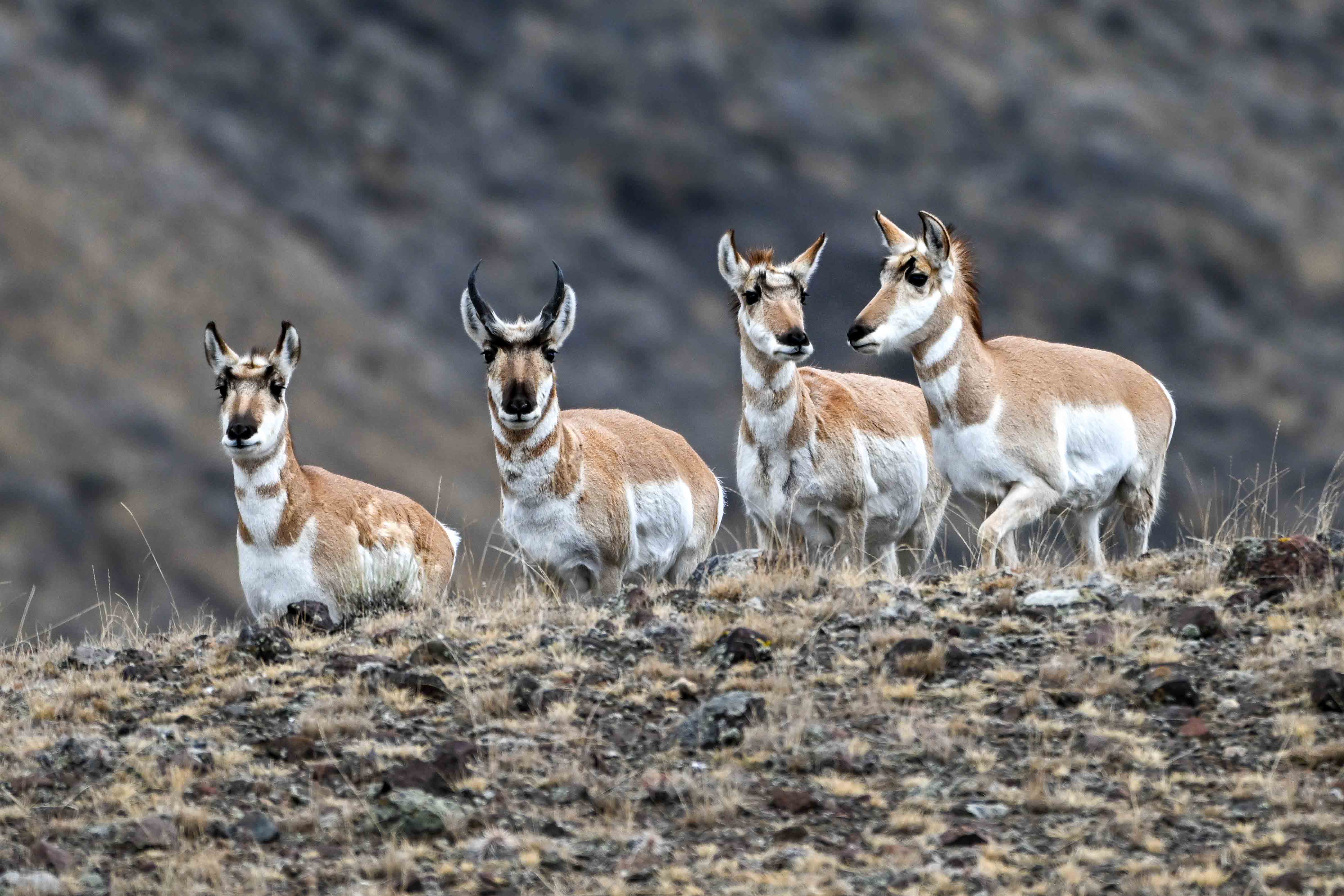
Yellowstone is a unique and beautiful place. It’s centered on a dormant super volcano (a caldera) and has over half the world’s geysers. It has high mountains, canyons, lakes, and waterfalls, as well as unusual hydrothermal features. It is famous for its megafauna, including wolves, bison, coyotes, pronghorn, elk, and moose.
Normally Yellowstone is very cold and snowy in January, but this year it wasn’t as cold and not so snowy. This meant it wasn’t as physically tough on the photographer, but also not quite as beautifully otherworldly as most years.
Still, I had a great time and had some excellent wildlife encounters. For three days, I was with a group organized by NANPA venturing out of West Yellowstone, and then I went with my friend Barry W. for three more days based in Mammoth Hot Springs Lodge.
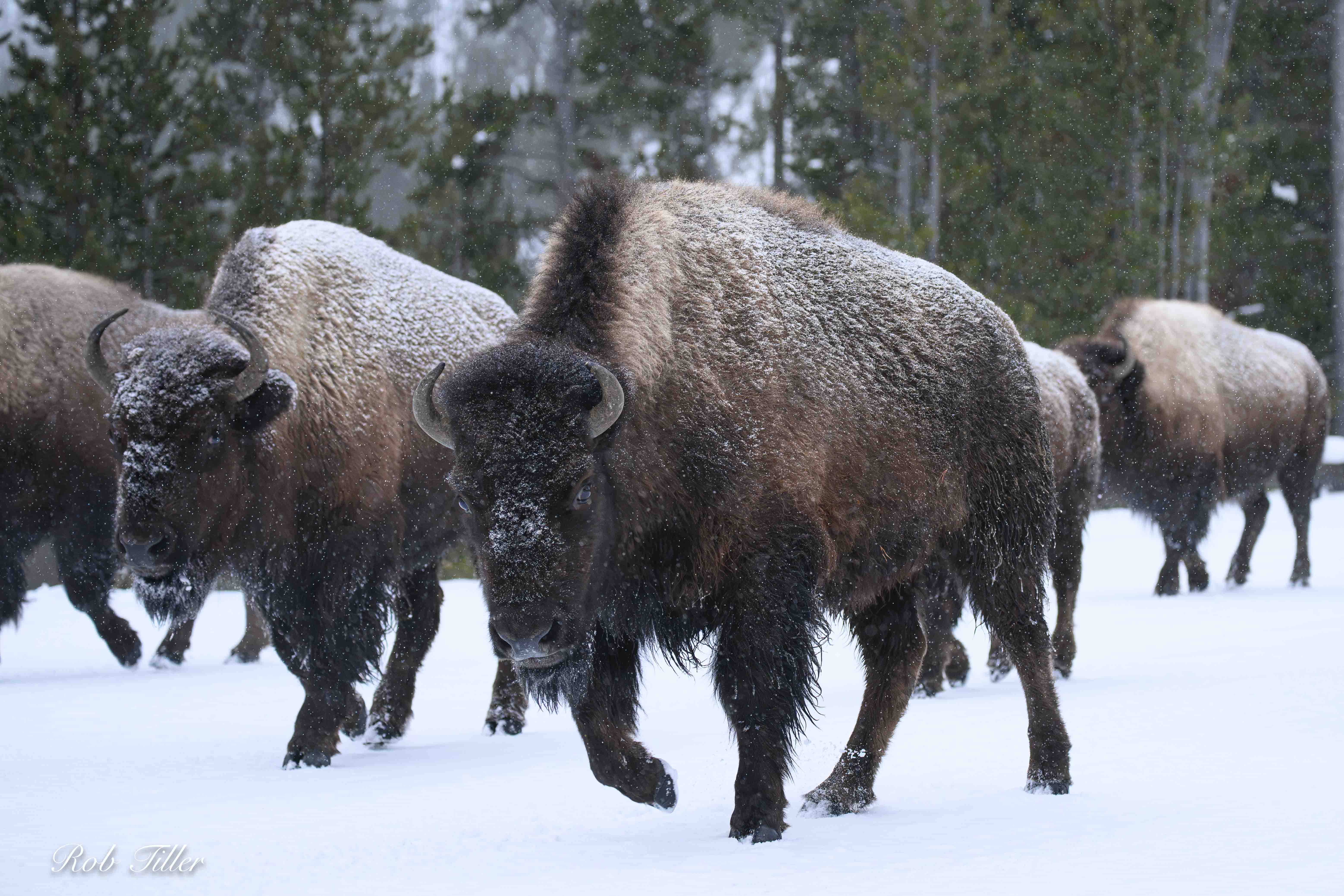
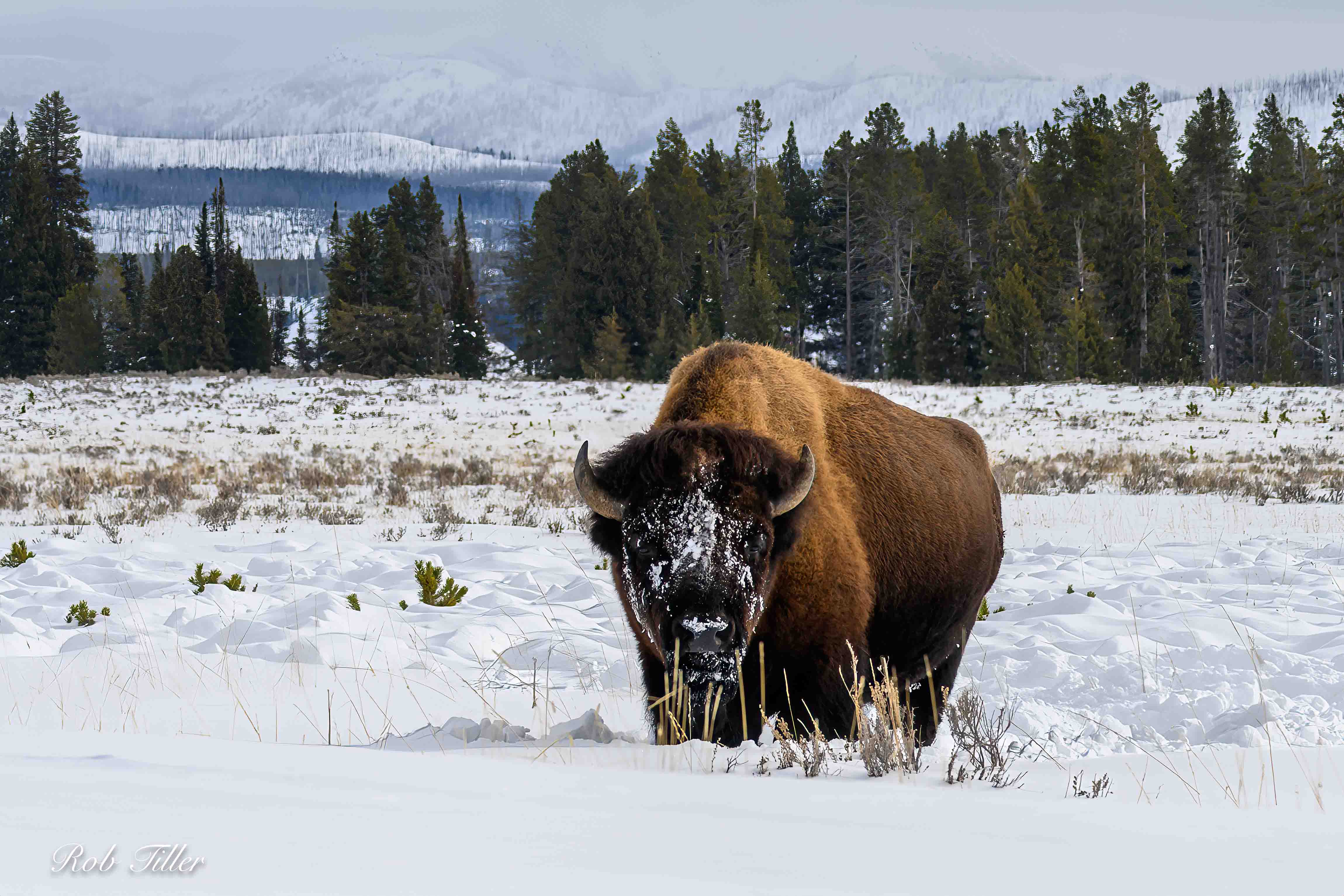
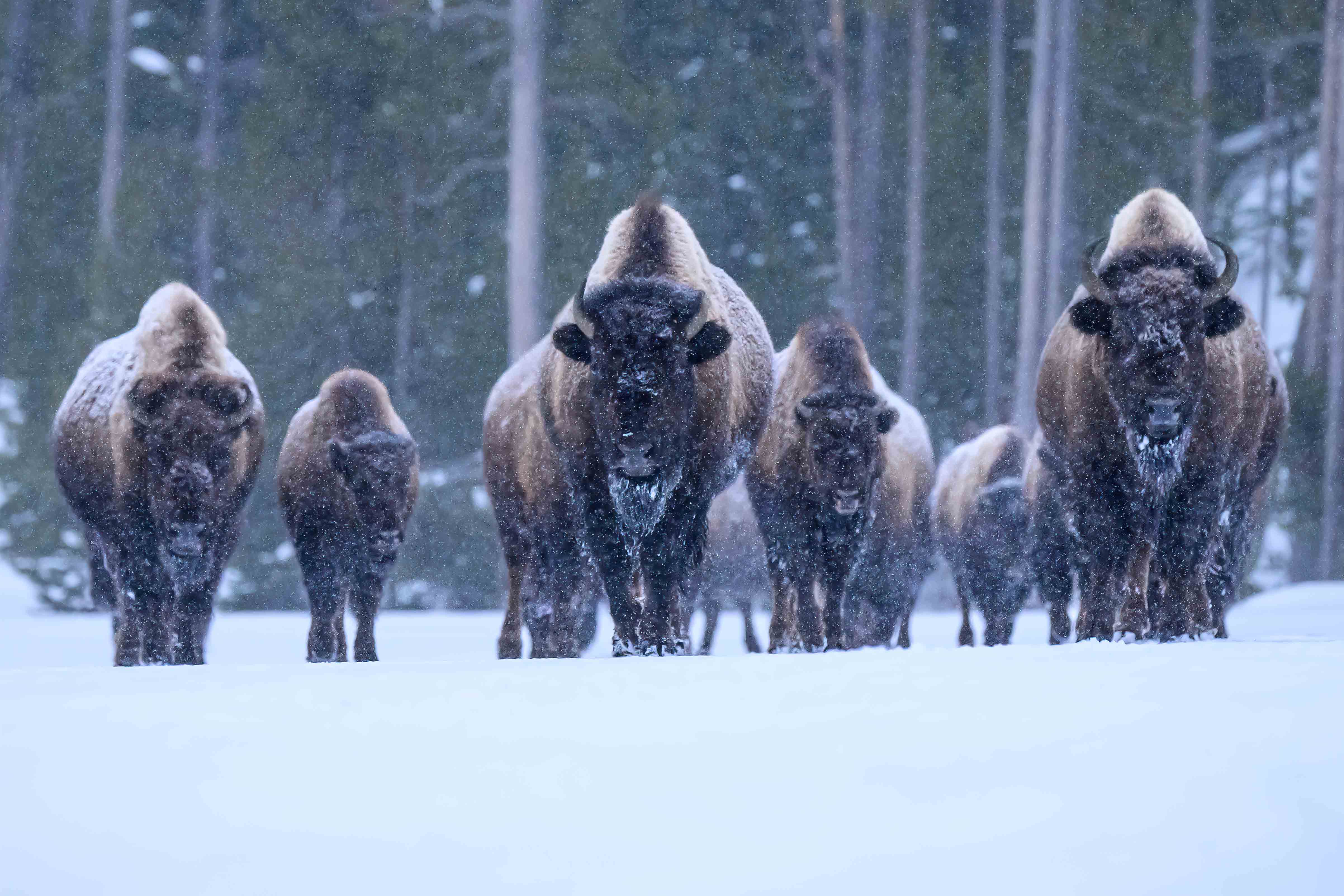
Among the highlights were some close encounters with bison, which are numerous there. These big, powerful icons of the West were usually grazing peacefully, but could be skittish. And of course, they could be dangerous if provoked.
At one point in the Lamar Valley, Barry and I were photographing a large herd, and didn’t notice until too late that some of them had gotten between us and our vehicle. For a few minutes we were wondering about how to escape, but when another car came along, we jogged behind it as the bison got out of the way.
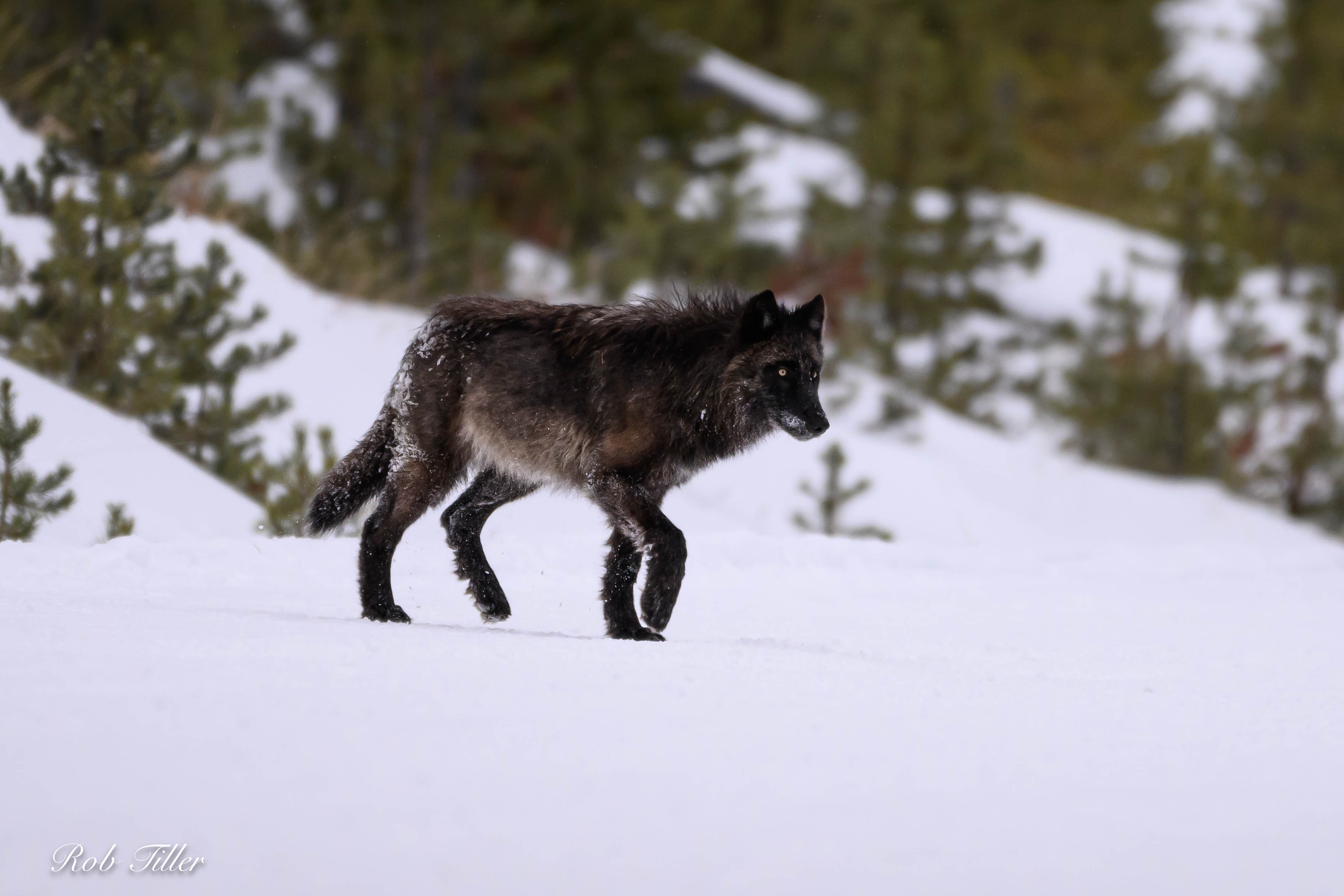
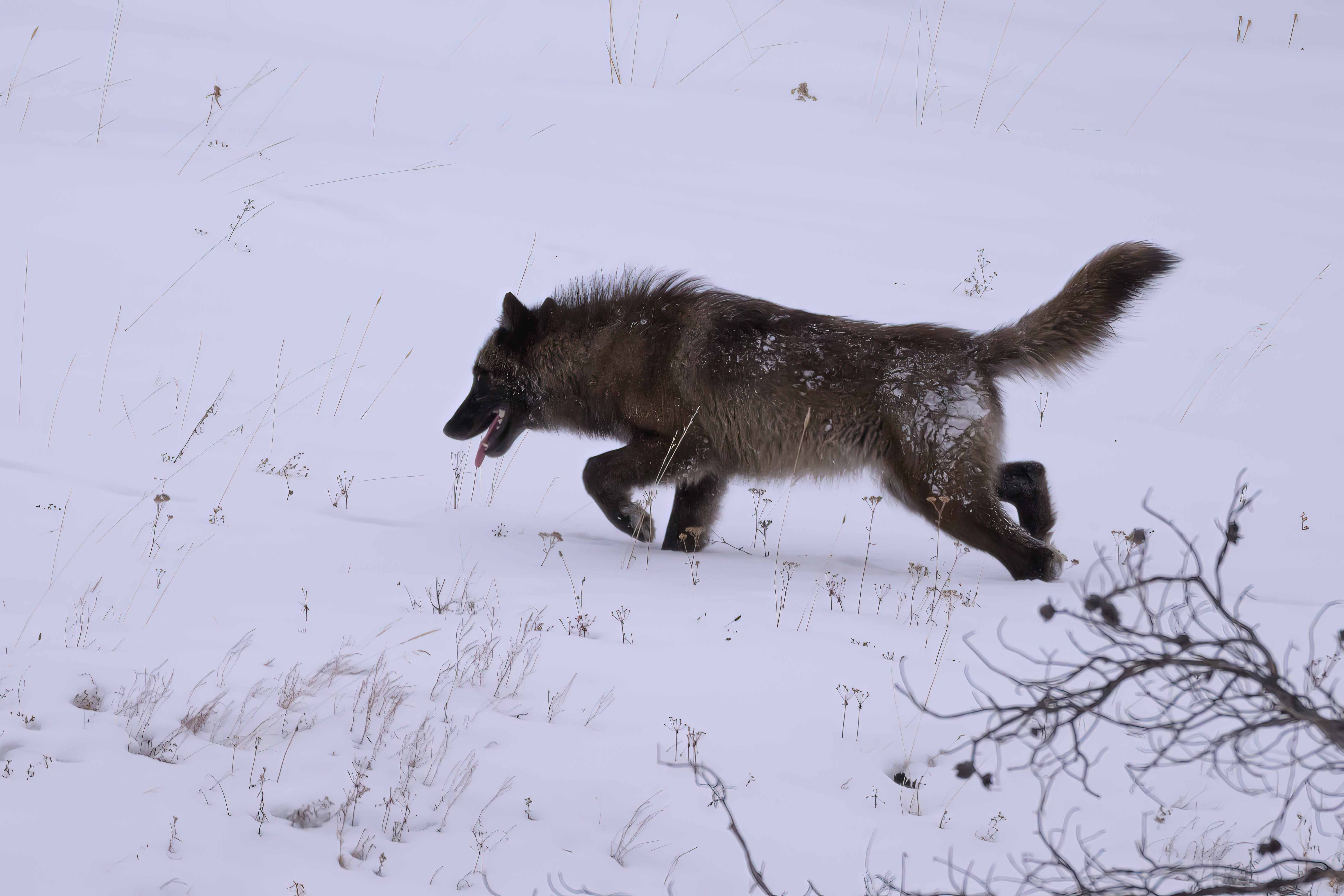
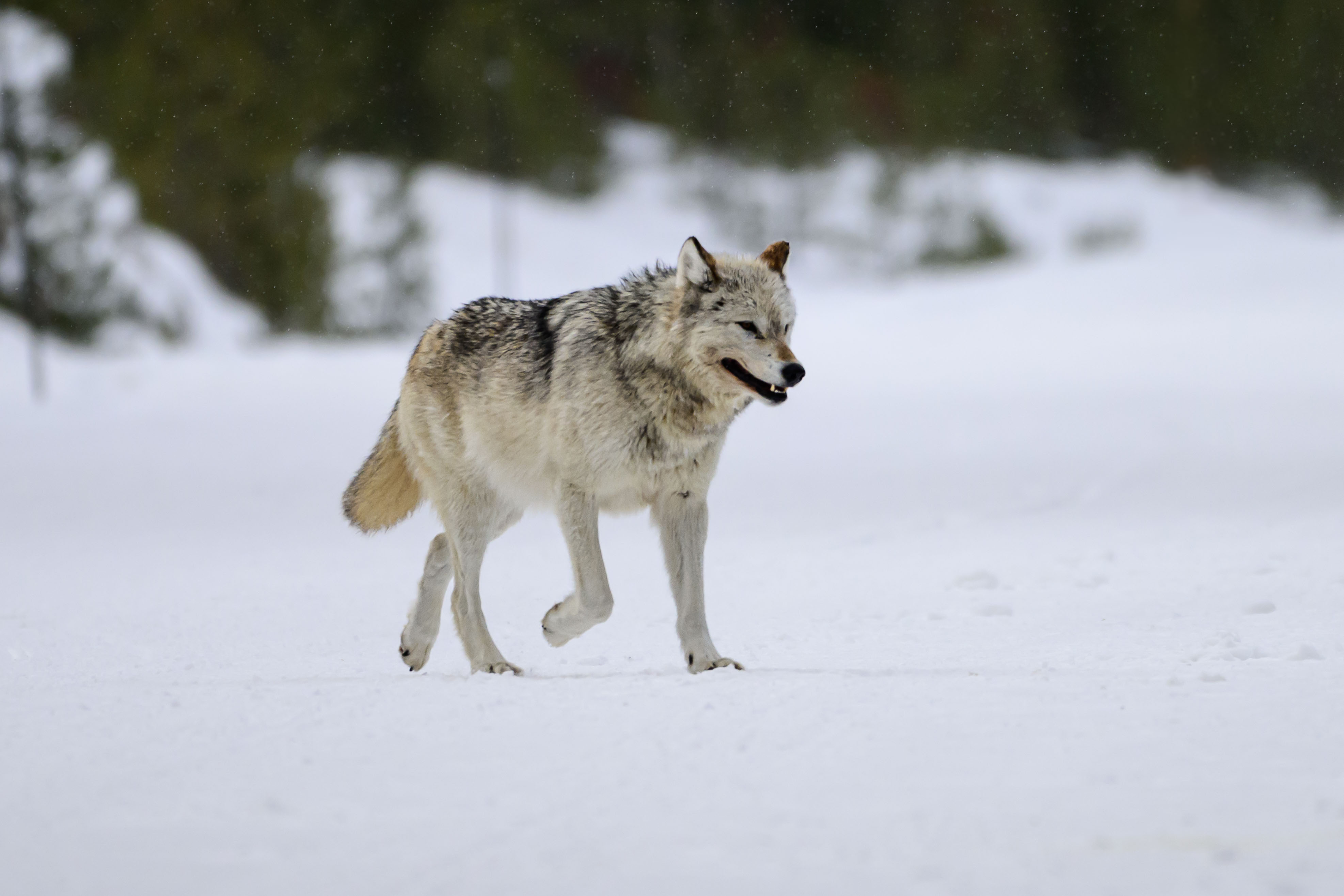
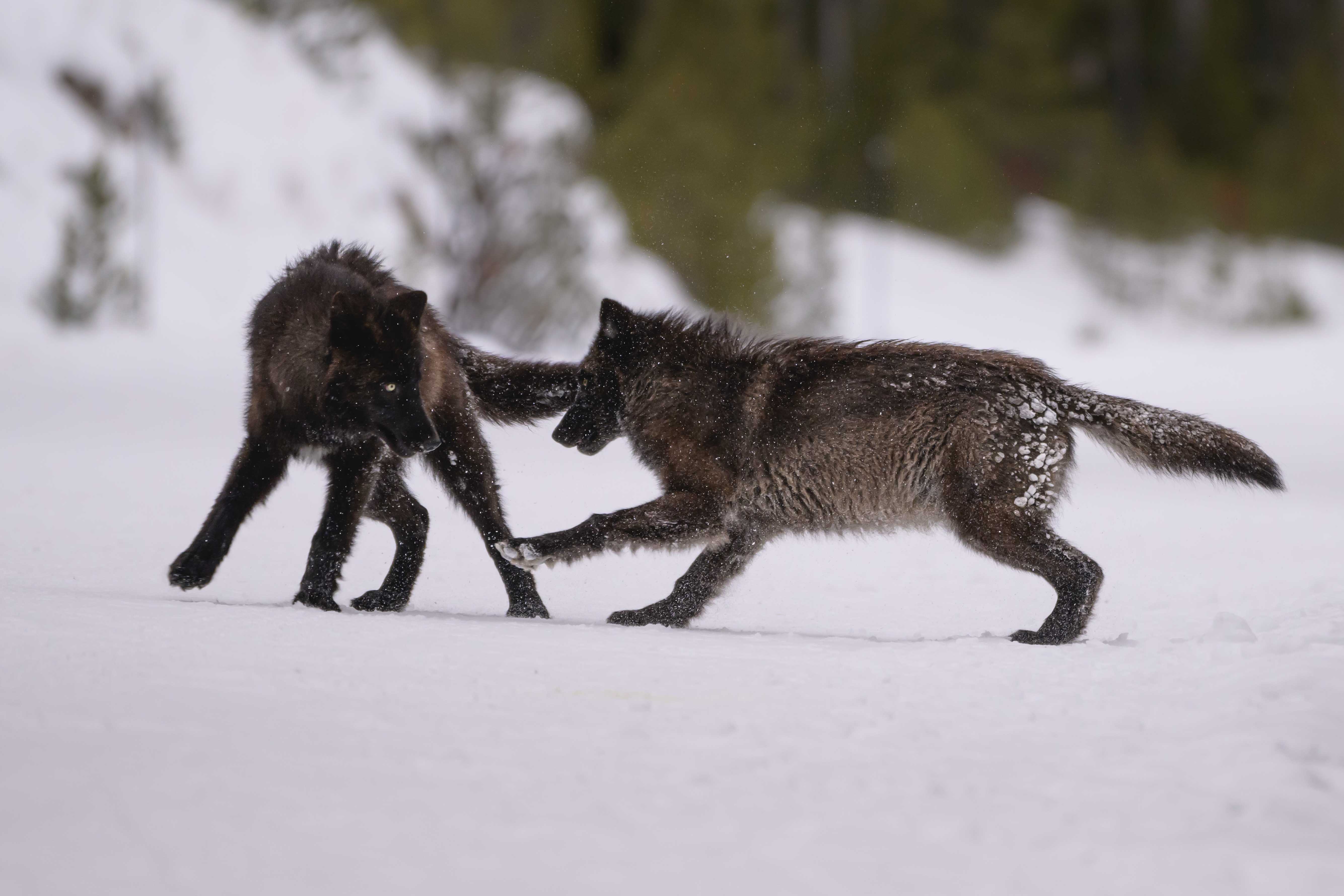
We were privileged to see a dozen or so of the resident gray wolves (some of which are black), which are usually not easy to find. Wolves have a bad rap as scary beasts, drummed into us from childhood by stories like little red riding hood, the three little pigs, and the boy who cried wolf. In fact, wolf attacks on humans are very rare.
On the other hand, humans are highly threatening to wolves. We very nearly caused their extinction in the last century, and continue out of ignorance, perversity, or greed to kill them and destroy their habitats. Still, there’s a wider understanding now that as apex predators, wolves are important contributors to their ecosystems. For example, gray wolves keep elk, moose, and deer populations in check, preventing overgrazing by the ungulates and providing nourishment to other species.
The NY Times had a good summary of the current controversies surrounding wolves. The anti-wolf movement involves the interests of ranchers, who don’t like it when wolves kill their cattle. One of the solutions to that problem is a program for the state to pay ranchers for animals killed by wolves, which apparently lessens the conflicts, but not perfectly.
It seems to me self-evident that wolves are not just inconvenient objects to be subjugated, but sentient beings entitled to respect. They have interests, families, and friends. We have started to learn how to live alongside them and work out human-wolf conflicts, and I’m hoping we’ll continue that process, and continue enjoying their mysterious beauty.
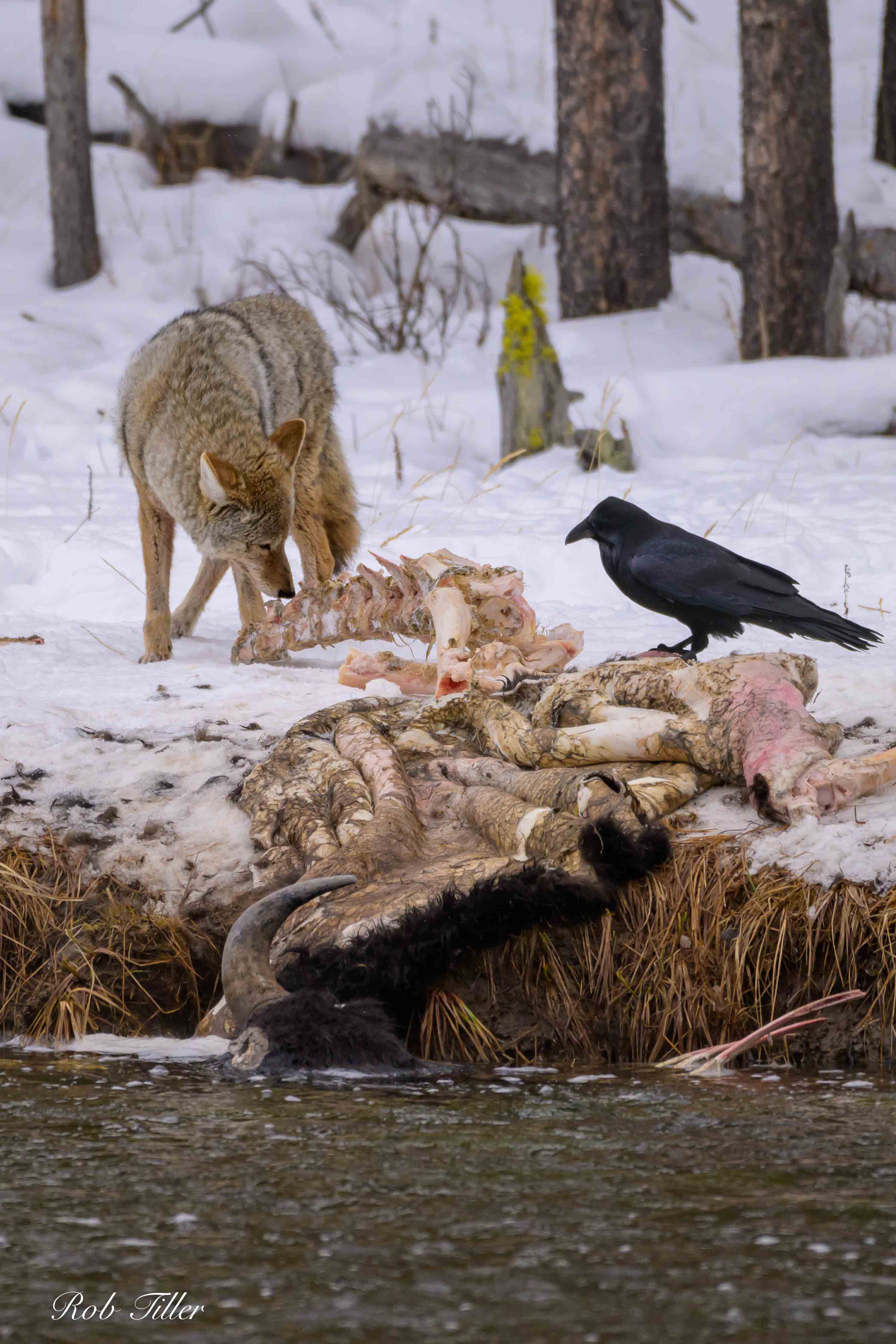
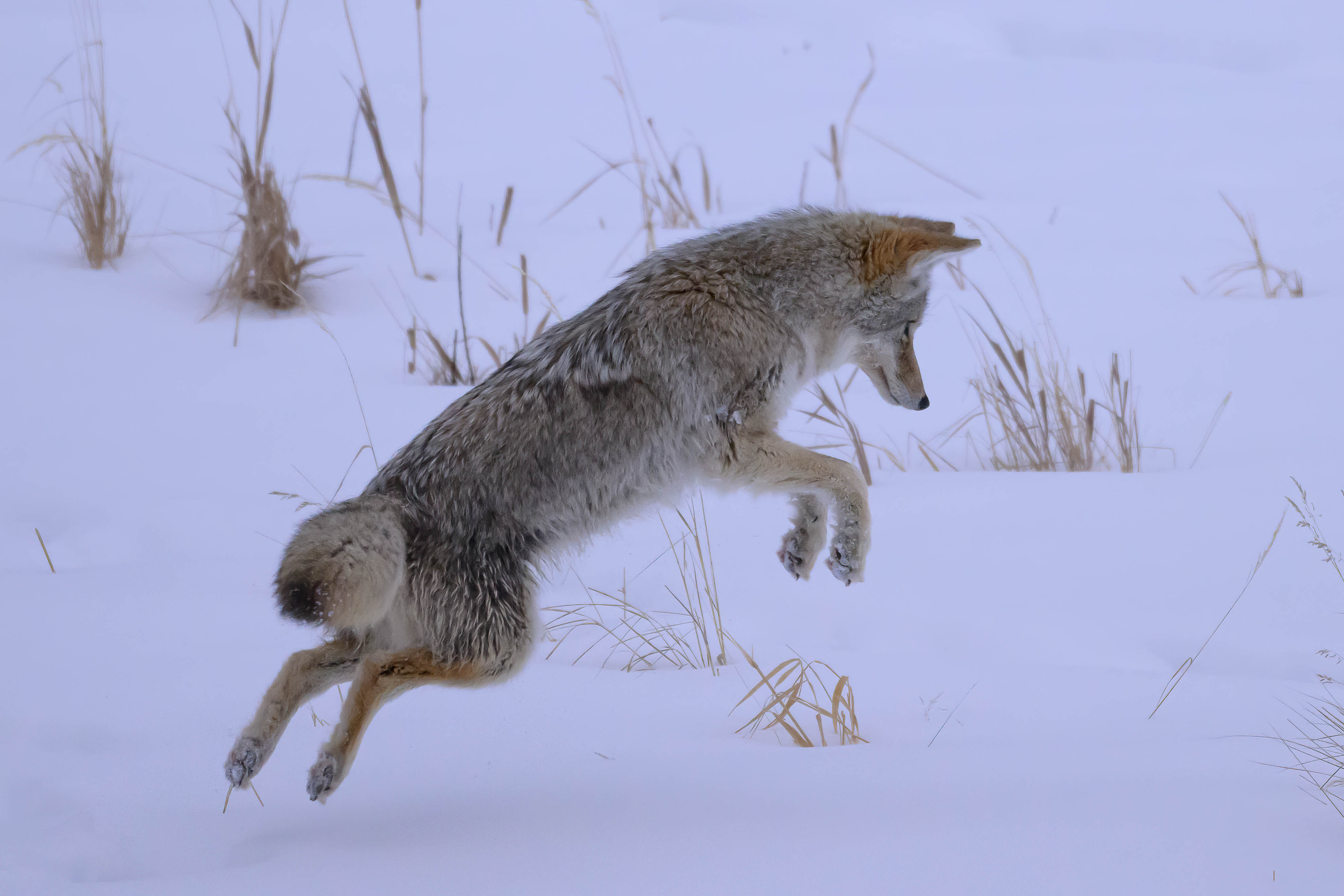
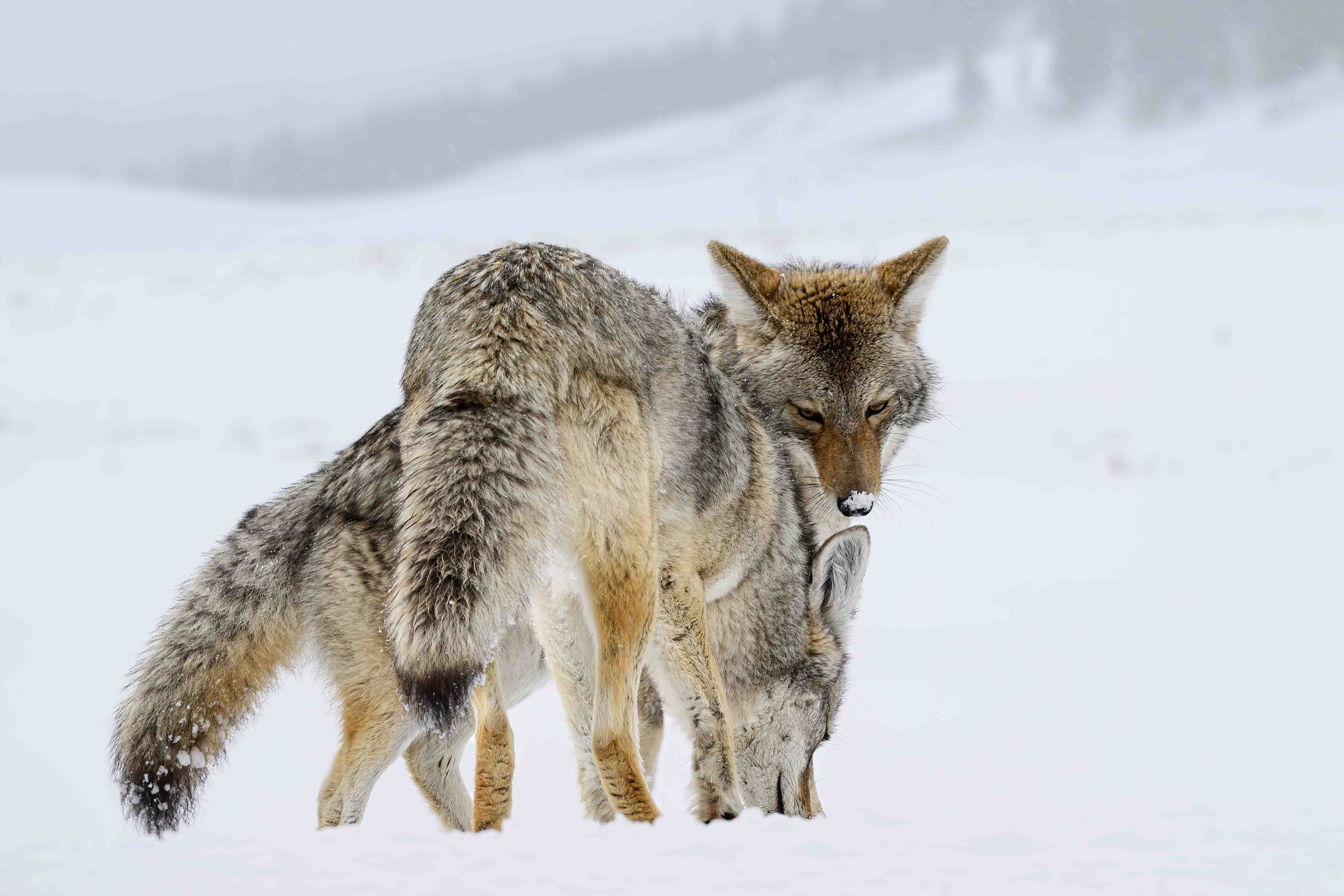
Among nature enthusiasts, coyotes don’t inspire as much excitement as wolves, but I was still excited to see several of them in Yellowstone. They are close relatives to wolves and look a lot like them, but smaller, with narrower features and larger ears.
It’s hard to argue they’re less pretty than wolves, so their poor PR probably has to do with their being relatively common. Their prey includes mice, which they can hear tunneling under the snow, and catch by leaping on them. I got one shot of a leap, which yielded no mouse, and also saw a pair of them flirting.
One thing I like about a long trip is having a good block of time to read. I’ve really been enjoying rereading the first few Aubrey-Matarin novels by Patrick O’Brian, and finished the fourth one in Yellowstone. These are historical novels about life in the British Royal Navy around 1800, when Britain was fighting hard to rule the waves. O’Brian was clearly passionate about getting the history right, but also brilliant in his depictions of navy life and the inner lives of his characters.
In the twenty-five or so years since I first read O’Brian’s series, I’ve learned some things about the history of the British empire and its depredations, including violent exploitation of entire civilizations, slavery, piracy, and drug dealing. These, though not discussed by O’Brian, were part of the mission of the Royal Navy. But those sailors also embodied more admirable objectives and virtues, such as scientific research, artistic expression, decency, honor, and courage. Like us, they were complicated.
Speaking of the arts, David Brooks recently had a good column in the NY Times making the case for reading literature and welcoming other cultural experiences. He made a good argument for the liberal arts as vehicles for greater self understanding. Great novels, for example, deepen our understanding of the inner lives of others and ourselves.
“Artistic creation is the elemental human act. When they are making pictures or poems or stories, artists are constructing a complex, coherent representation of the world. That’s what all of us are doing every minute as we’re looking around. We’re all artists of a sort. The universe is a silent, colorless place. It’s just waves and particles out there. But by using our imaginations, we construct colors and sounds, tastes and stories, drama, laughter, joy and sorrow.
“Works of culture make us better perceivers. We artists learn from other artists. Paintings, poems, novels and music help multiply and refine the models we use to perceive and construct reality.”
These thoughts are particularly timely as universities across the U.S. are cutting their liberal arts programs, apparently on the theory that the only point of higher education is to prepare young folks to do a particular kind of job. As a former liberal arts student myself, I have a bias, but I think treating education as purely instrumental is a disservice to students, both materially and spiritually.
With advancing technology, including AI, many technical skills that are valuable today will be useless down the road, and students with only those skills will be in trouble. They’ll need a broader base, including the meta skill of quickly learning new skills. Meanwhile, without exposure to the world of the arts and ideas, they may miss so much that makes life meaningful and rewarding.
I’m still processing my trip to northern Manitoba, and wanted to share a few more photographs from that extraordinary journey. I also made a short YouTube slideshow of favorites. Recently I’ve been making a particular point of cultivating gratitude, having so much to be grateful for, and that expedition was especially worthy.
Alongside those good feelings, I’m feeling discombobulated about what is happening in American politics. At this point, it’s virtually certain that the Republican party, traditionally a cheerleader for conservatism, will nominate for President a most unconservative candidate: Donald J. Trump. And polls say there’s a reasonable possibility that Trump will win.
This in spite of what by now it’s hard not to know about Trump: his deep dishonesty, his ignorance, his cruelty, his contempt for others (other races, other nationalities, other gender identities), his indifference to the dire straits of our planet. Plus his track record of crimes (including molesting women), inciting hatred, undermining the rule of law, encouraging thuggery, promoting deranged conspiracy theories, and threatening nuclear war. Also, he made a determined attempt to overthrow the U.S. government and seize power. Now he’s acknowledging his intention to act as a dictator and treat his opponents “like vermin.”
A lot of people, including some that are dear to me, are not much put off by this appalling record. This has given a hard shake to some of my long-held beliefs and assumptions. What we take to be reality really seems to vary a lot from brain to brain. There’s a lot less agreement than I thought about fundamental moral concepts like right and wrong.
I am grateful, though, for this wake up call: it’s good to reexamine our assumptions about how people work, individually and collectively. We have a lot of deep-seated, pre-Trump systemic problems, such as inability to face up to climate change and the horrors of animal agribusiness, that suggest systematic brain malfunctions. Maybe if we understood ourselves better, we could behave better.
Against this background I’ve been processing the ideas of Robert Sapolsky in his new book, Determined: A Science of Life Without Free Will. I read Sapolsky’s last book, Behave, but so far have only read reviews and listened to podcasts discussing Determined. The most thought-provoking of these was Nikhil Krishnan writing in The New Yorker.
Sapolsky contends that there is no such thing as free will, because our every action and thought is the result of causes outside of ourselves. In his view, the only significant differences between people are physical and environmental. Individuals deserve neither praise for their achievements nor blame for their failures, because both are the result of forces outside of themselves.
Sapolsky recognizes that his view is hard to square with life as most of us live it. It’s hard to imagine not being grateful for a kindness or resentful of a slight, and hard to think that serious crimes are not deserving of punishment. But he marshals plenty of evidence for the position that we are at bottom the result of genes and environment, and our usual habits of mind fail to reckon with that reality.
I’m a big proponent of trying to see our connectedness with everything – to each other, to animals, to sun, air, water, soil, and so on – and acknowledging that we can hardly exist as unconnected individuals. I’m with Sapolsky as far as that. But it seems paralyzing to hold that none of our decisions can fairly be called our own. There wouldn’t be much point in trying to figure out the right thing to do and then doing it. The very concept of the individual, which we seem to need in some contexts, seems to collapse.
This is disturbing, and I’ve been struggling with what to make of it. I don’t have a comprehensive response to Sapolsky, but I will note one big problem with his framework. There’s plenty of evidence that human ideas, coming out of individual minds, affect the world.
The way we think matters at every level, from how we care for ourselves to how we conduct our politics. And guiding ideas change. We’ve seen bad ideas that had terrible effects, and we’ve seen some of those get rejected and replaced over time. We have good reasons for examining our own ideas, and those of others – including Sapolsky’s.
On a less philosophical note, I recently discovered a very fine history podcast called Empire. The subject matter is various empires of history, with the initial episodes focussing on the British East India Company in (of course) India.
The hosts are accomplished scholars but not at all stuffy. Indeed, they are wonderfully human and quite witty. Some of their subjects involve gruesome violence, but the hosts point up a better moral perspective than some of our forebears had. A historical perspective can be helpful in these trying times.
Finally, Sally and I just finished watching Life On Our Planet, a documentary series on Netflix, and I highly recommend it. In eight episodes, it beautifully summarizes four billion years of evolution. The dinosaur parts were especially impressive; the animations looked amazingly realistic. Here again, when I worry about where we’re going, it’s helpful to get some perspective from the long history of life. Species rise and fall, and new ones rise.
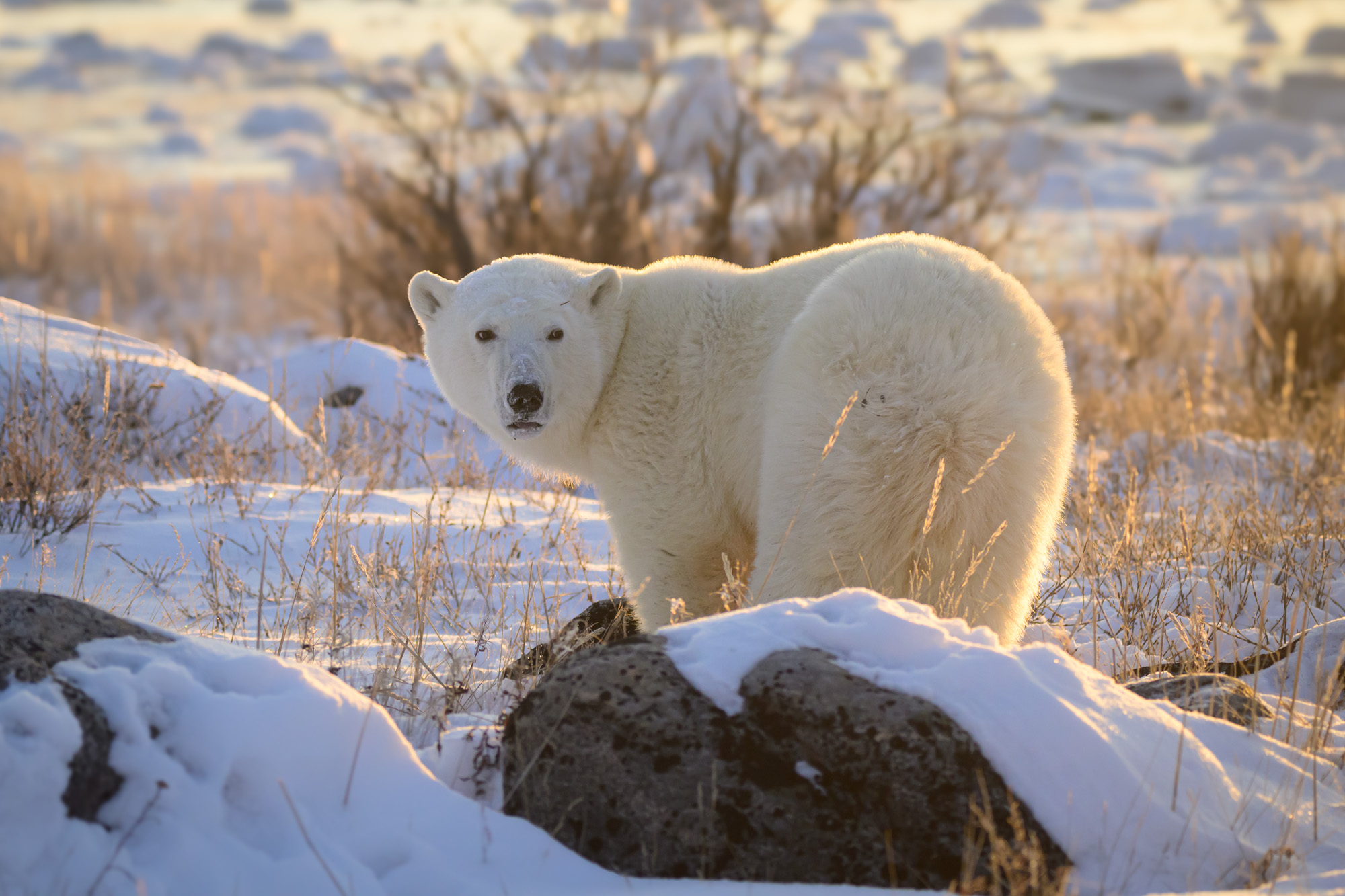
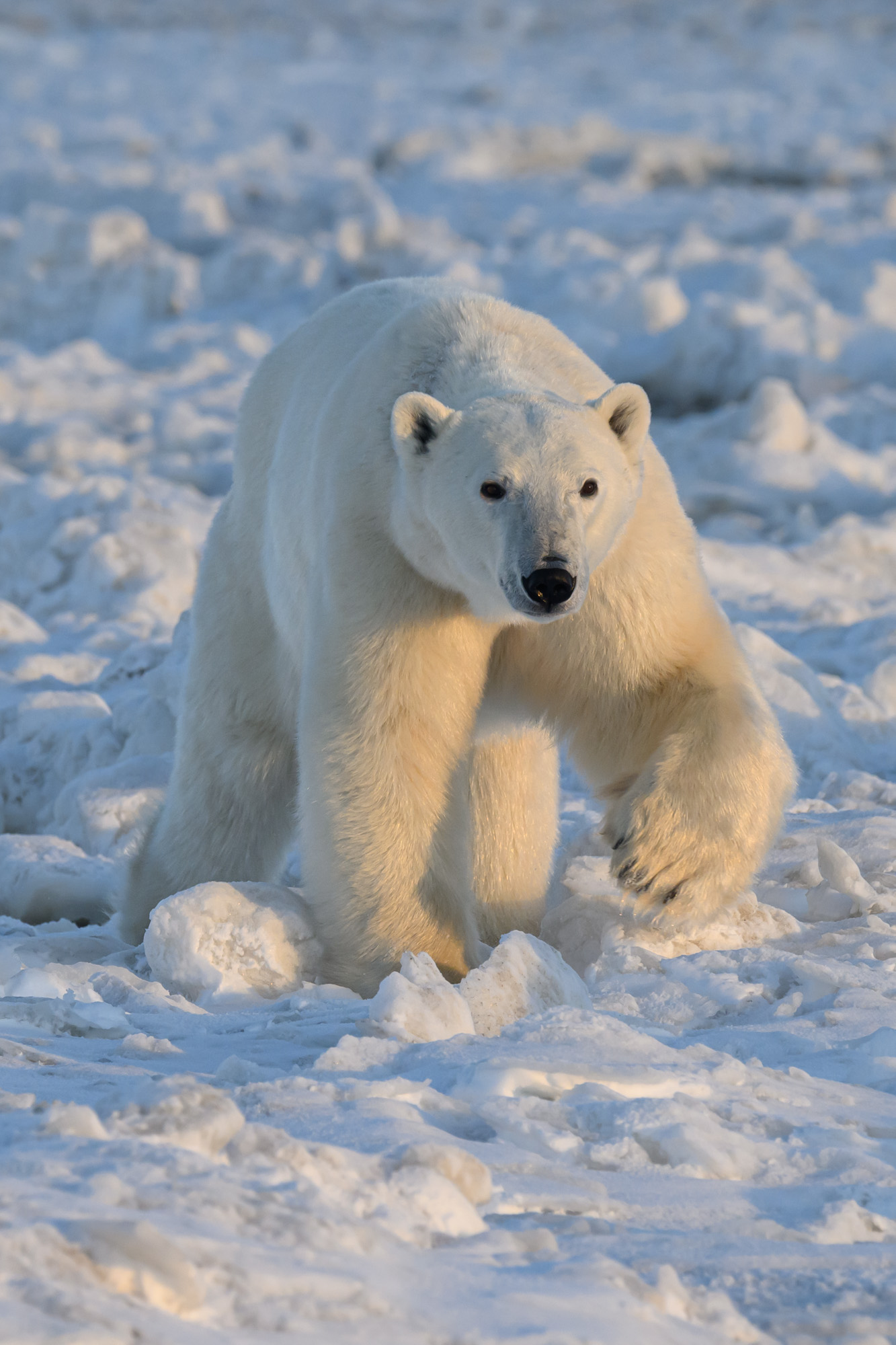
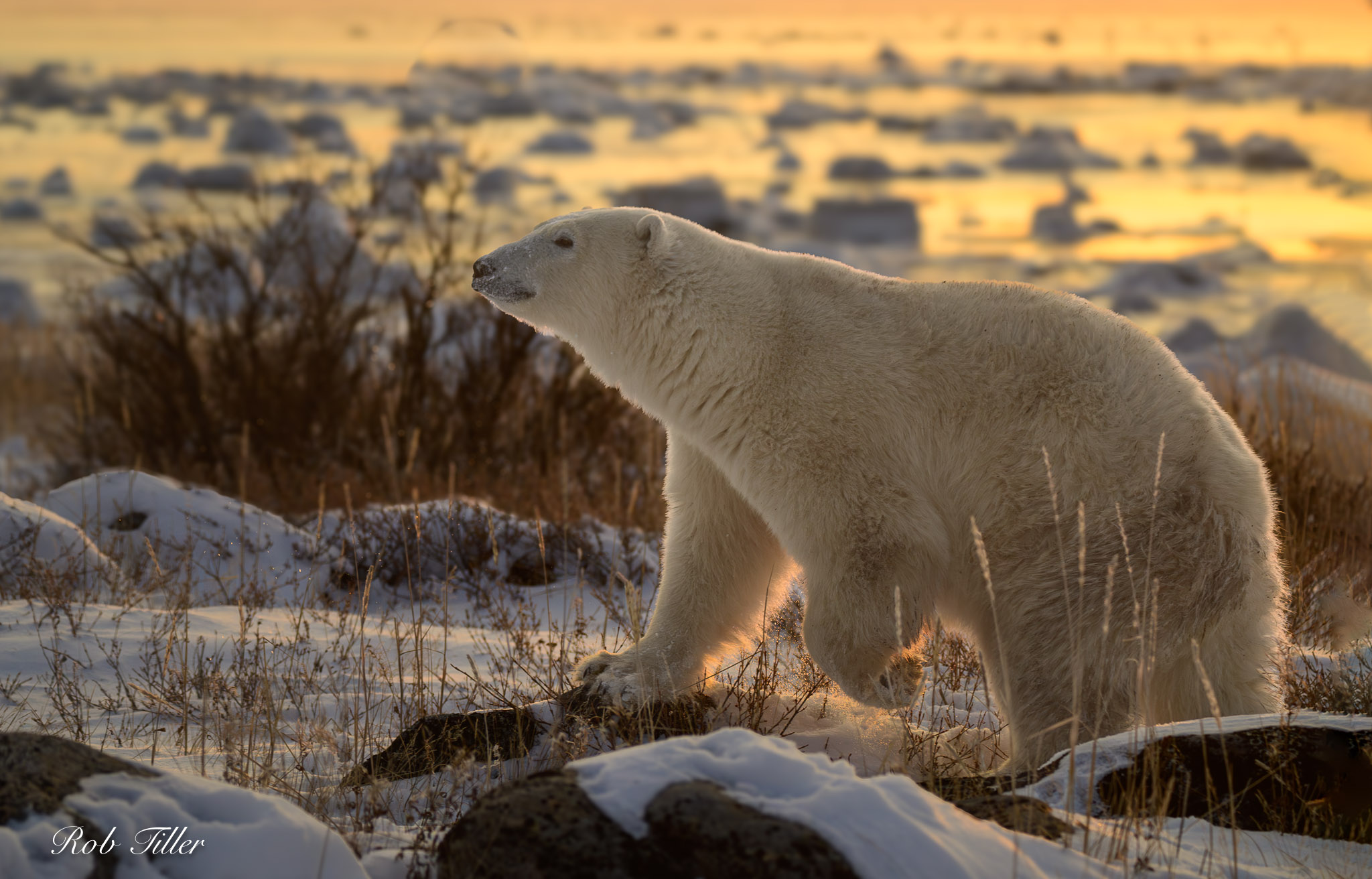
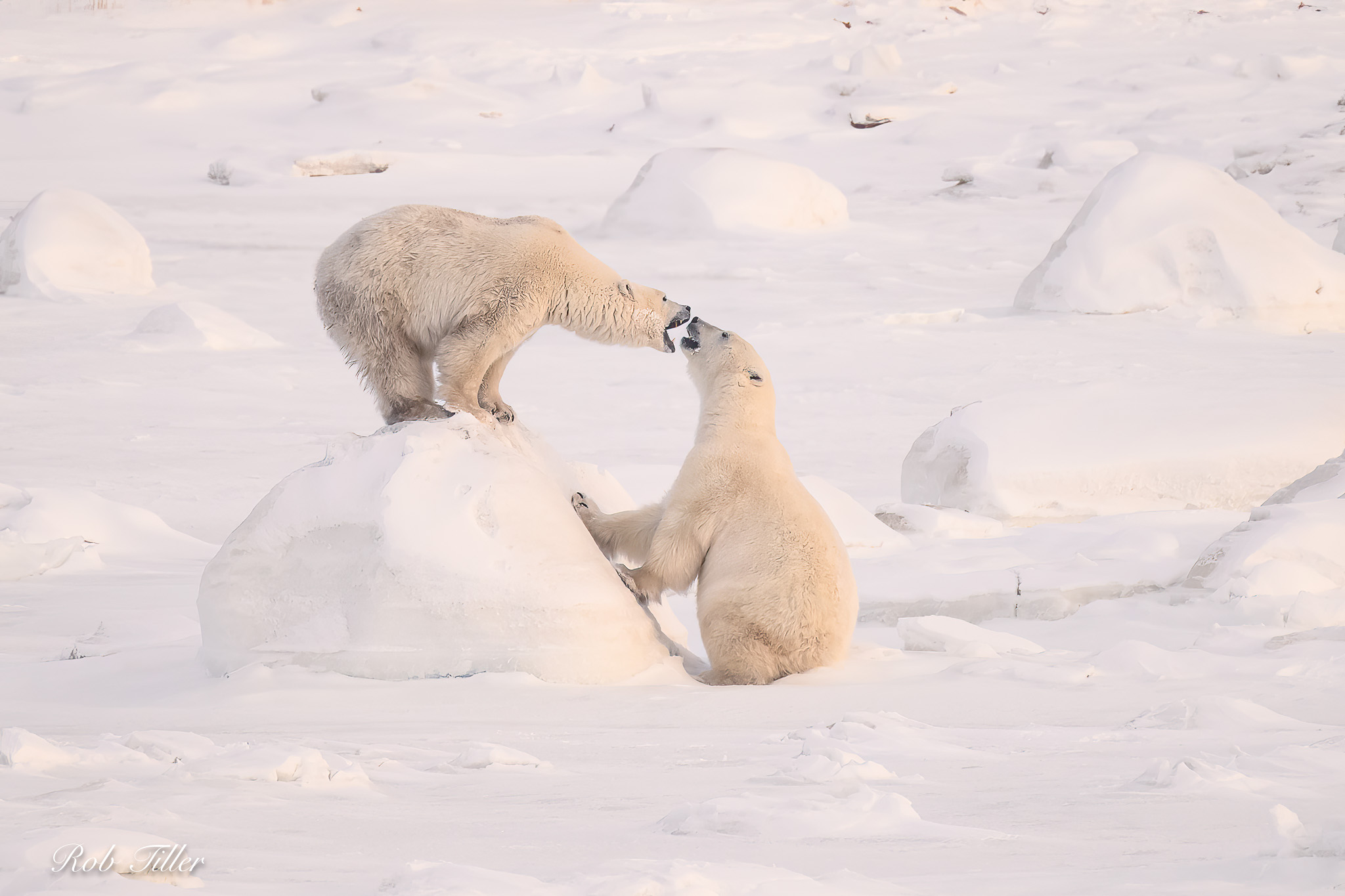
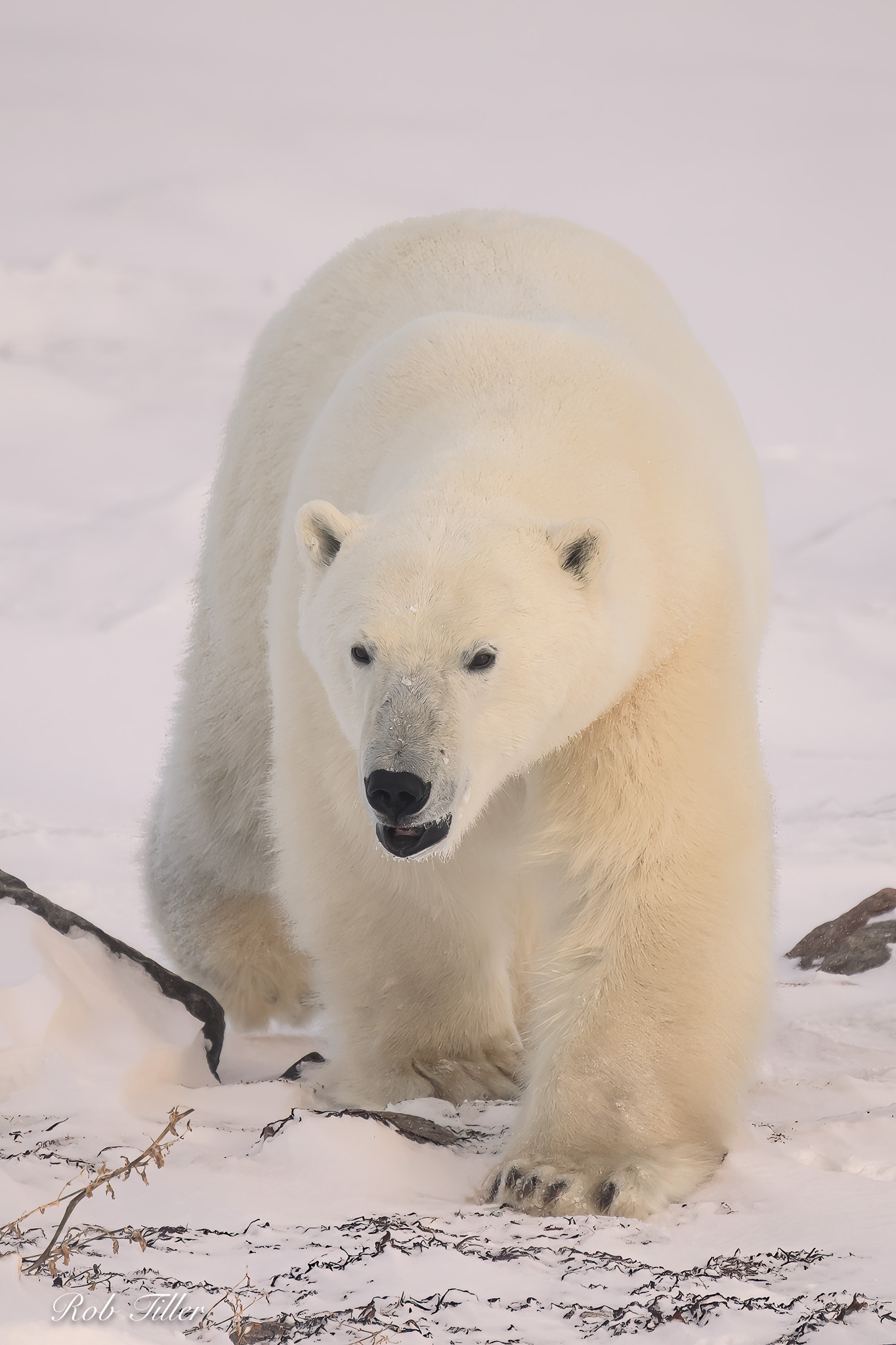
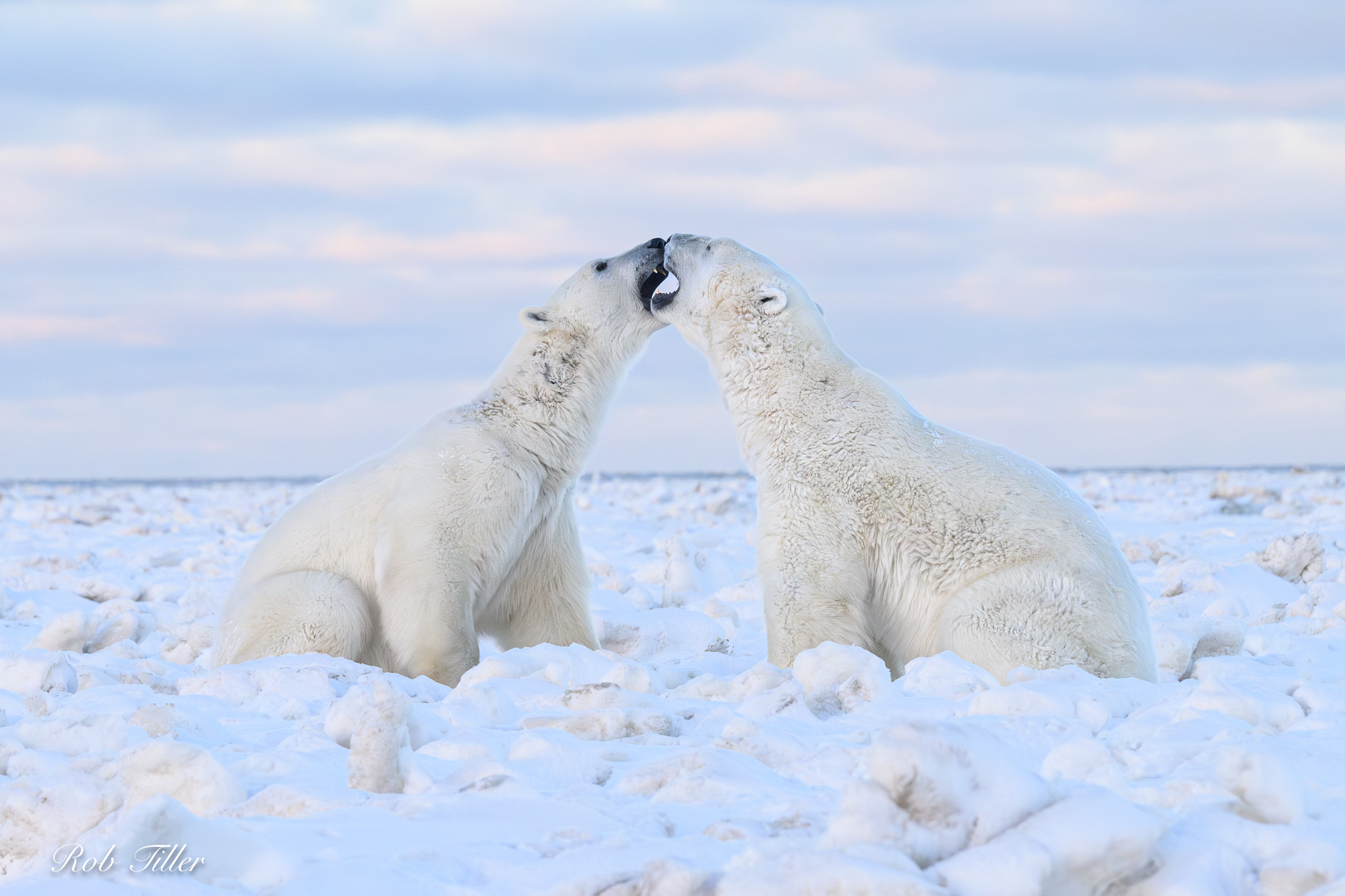
In the first half of November I went to northern Manitoba to see some Arctic creatures, including especially polar bears. It was a huge thrill to spend some time with these amazing animals. I’m still sorting through the thousands of photographs I took, but the ones here are some of my favorites so far.
Polar bears are Earth’s largest land-based carnivores. An average adult weighs around a thousand pounds and stands about eight feet tall. There aren’t a lot of them left in the world – about 25,000. About two-thirds of these are in Canada, and the southern Hudson Bay population that I visited is Canada’s largest.
Polar bears’ primary food is seals, which they capture on the ice. When I was there, the bears were waiting for the Hudson Bay to freeze, which was a bit behind schedule, with warmer temperatures than normal. The bears hadn’t eaten a substantial meal for some months, but most of them looked healthy.
Although the bears are usually solitary, we saw a few pairs of them playing and sparring. They paused and seemed to think carefully when they encountered us. Of course, they can be very dangerous, though the ones we saw usually seemed curious, rather than threatening.
Of course, it’s hard to be sure; maybe they want us to think that. There’s a lot about them that we don’t know, since they spend most of their lives in a harsh environment far from humans. We do know they are very strong, and very stealthy. They are well insulated against the arctic cold, and good swimmers. Their sense of smell is orders of magnitude better than ours, and they use it to detect prey from great distances. They are superbly adapted for their environment.
Global warming is particularly bad news for polar bears, whose seal-hunting livelihood depends on cold and ice. I was glad to hear that the southern Hudson Bay population is holding steady for now, though elsewhere the bears are seriously threatened by warming and habitat loss. These unique creatures are another good reason we need to get more serious about getting off fossil fuels and mitigating climate change.
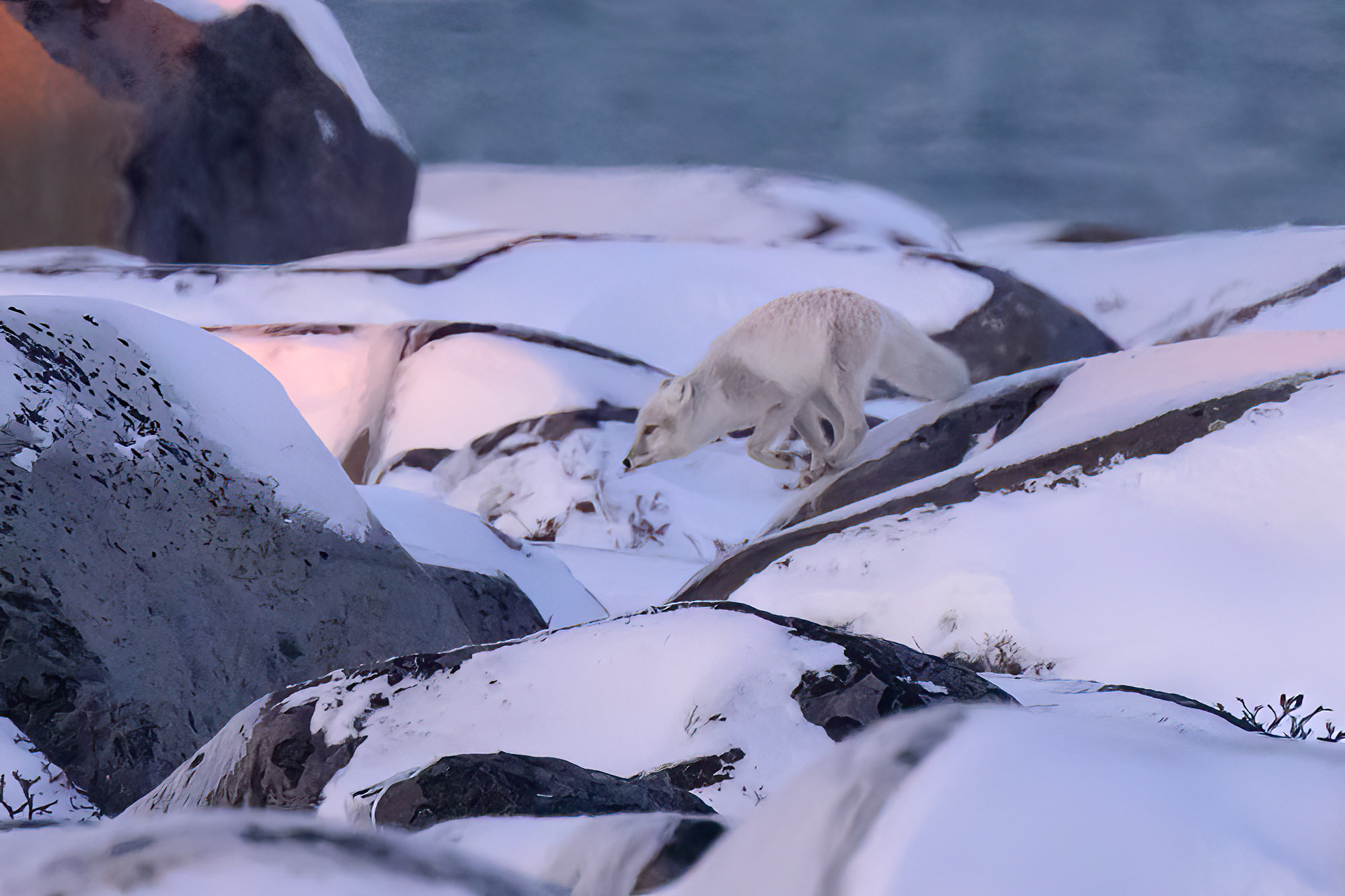
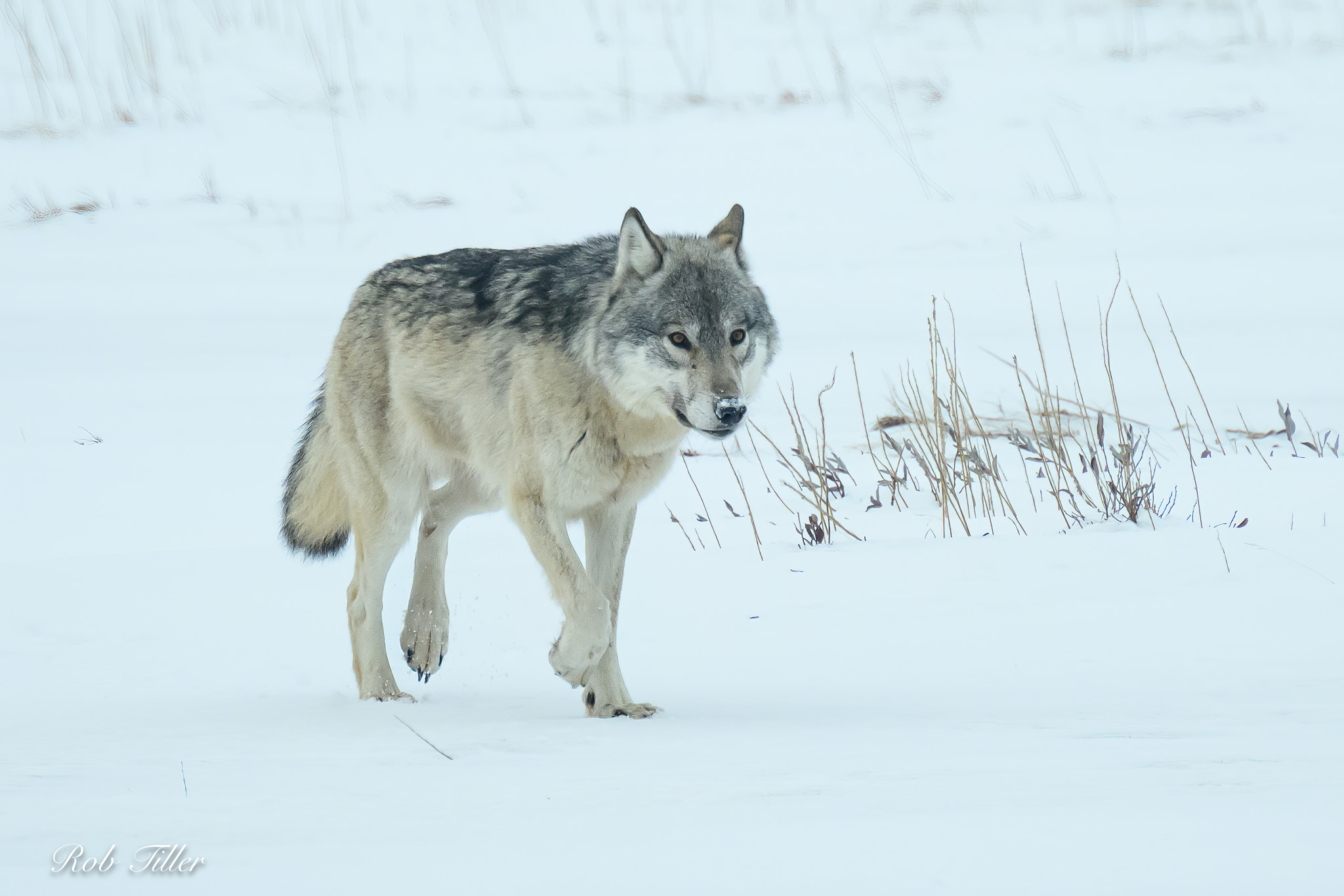
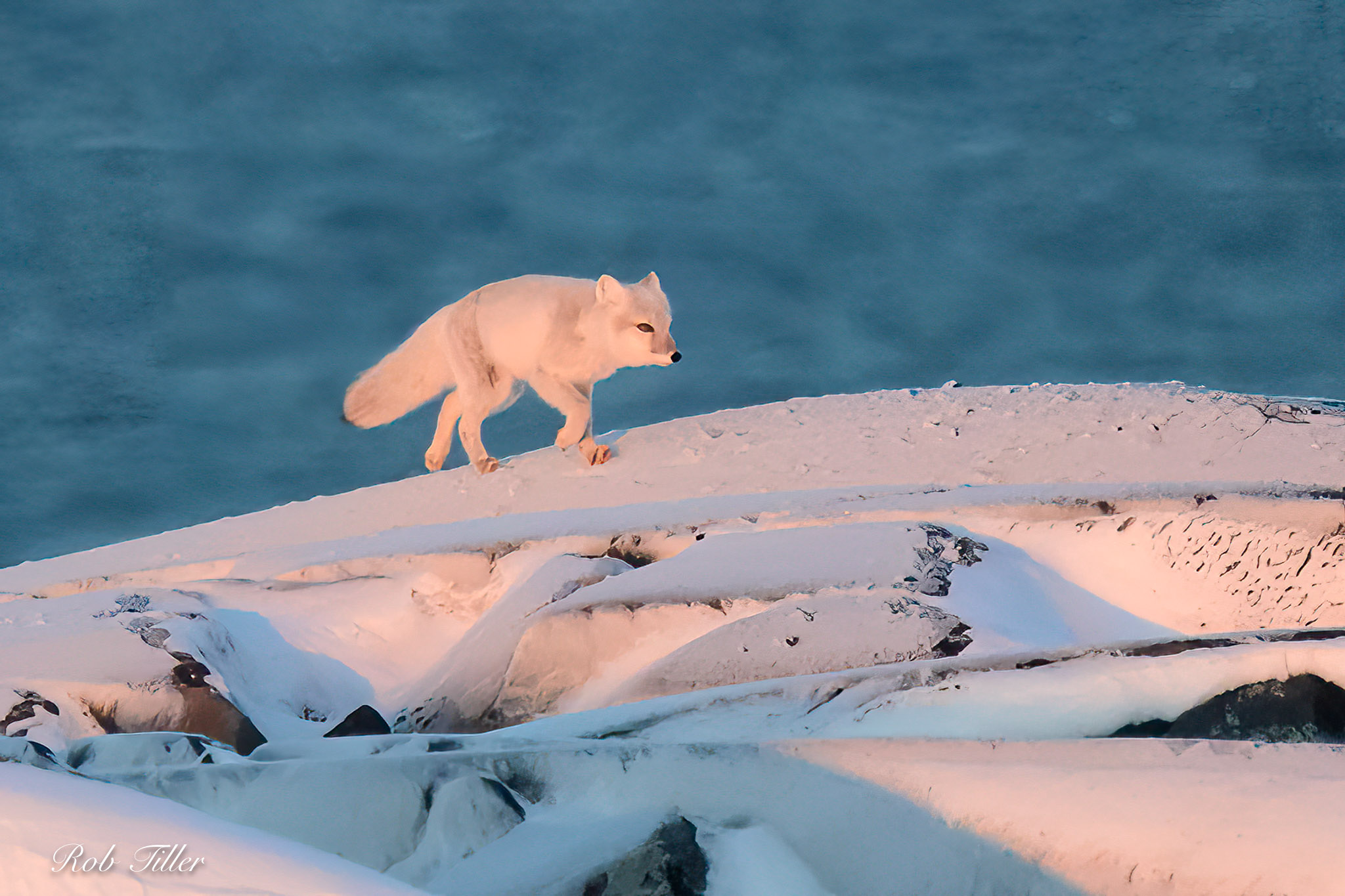
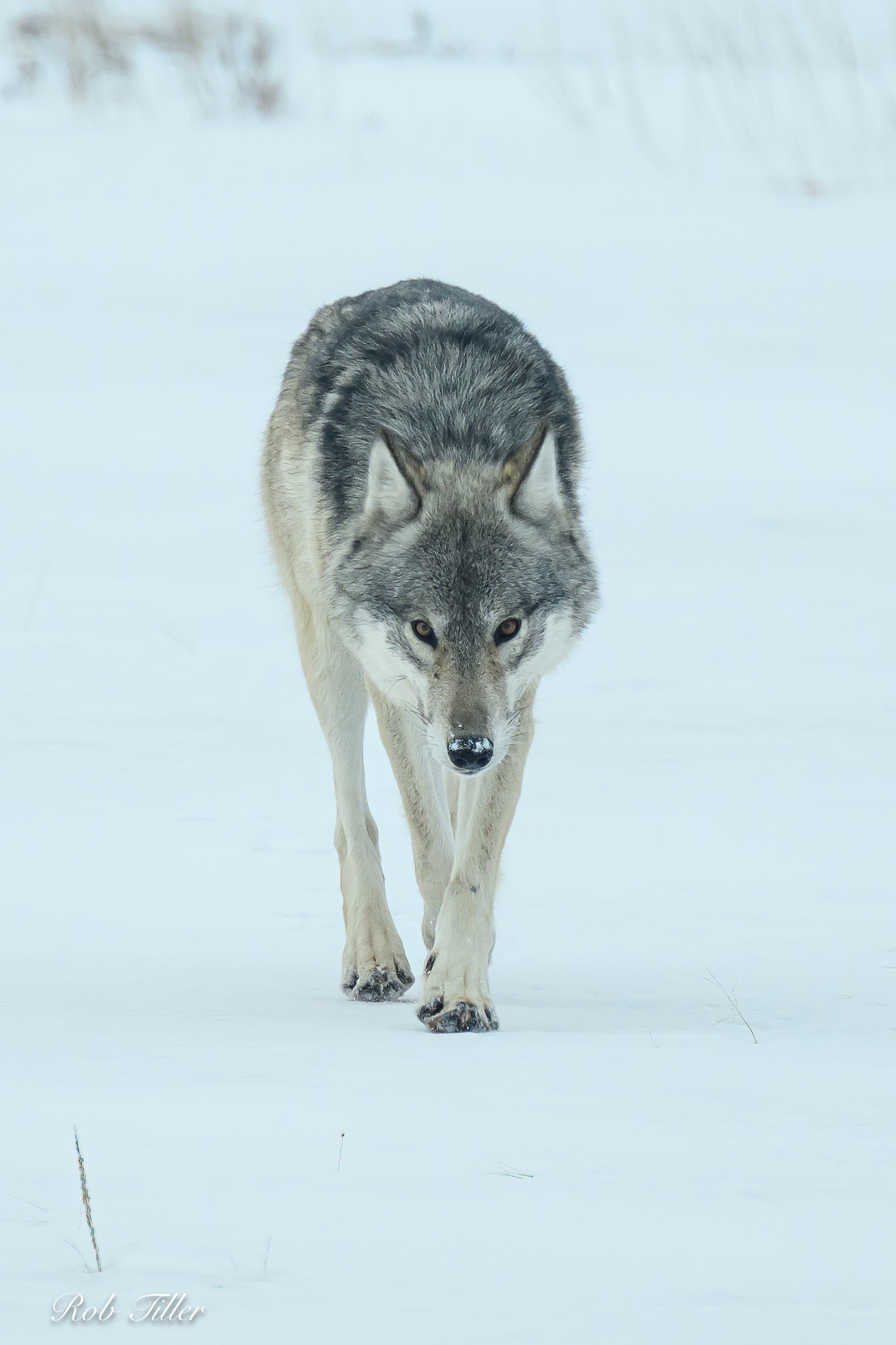
The southern Hudson Bay is also home to other iconic creatures, including wolves. These usually keep well clear of humans, but we were privileged to have a couple of close encounters. We also saw an Arctic fox in Churchill.
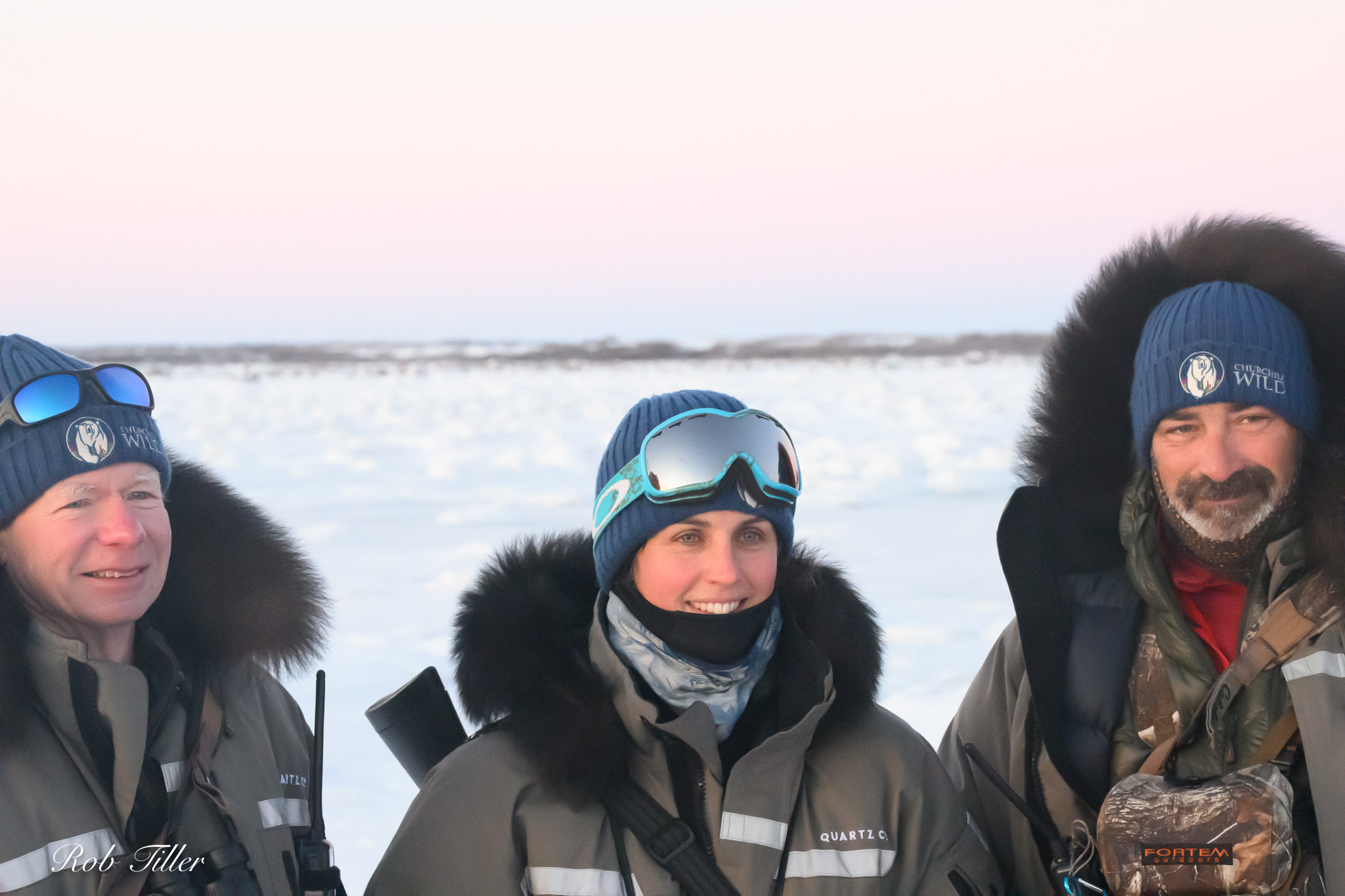
The trip was organized and led by Chas Glatzer, a master wildlife photographer and gifted teacher. We stayed at two lodges on the Hudson Bay that we reached by small plane from Churchill – Seal River and Nanuk – run by Churchill Wild. Both lodges were comfy and served delicious food, including options for the plant-based eaters like me.
Our guides at Seal River were Jess, Boomer, and Marco, and at Nanuk we had Michael, Emri, and Adam. All of them were experienced, and had amazing talents, like spotting a polar bear asleep on the ice half a mile away and talking with them.
At Seal River the guides explained the safety procedures for walking in bear territory, which included staying close together so as to present ourselves as a bigger creature. When bears approached us too closely, the guides would speak firmly to them, and usually quickly persuaded them to turn around.
A couple of times they had to escalate by throwing a rock, which got the bears headed the other way. If the rocks hadn’t worked, they had louder noises to make, including a starter pistol. If all else failed, they had shotguns, though happily none of them had ever had to shoot a bear.
Throughout our stay, bears frequently came right up to the fence around the lodges. The guides spoke firmly to discourage them from chewing on the fence wire. They also spoke firmly to us about not standing right next to the fence when we had bear visitors.
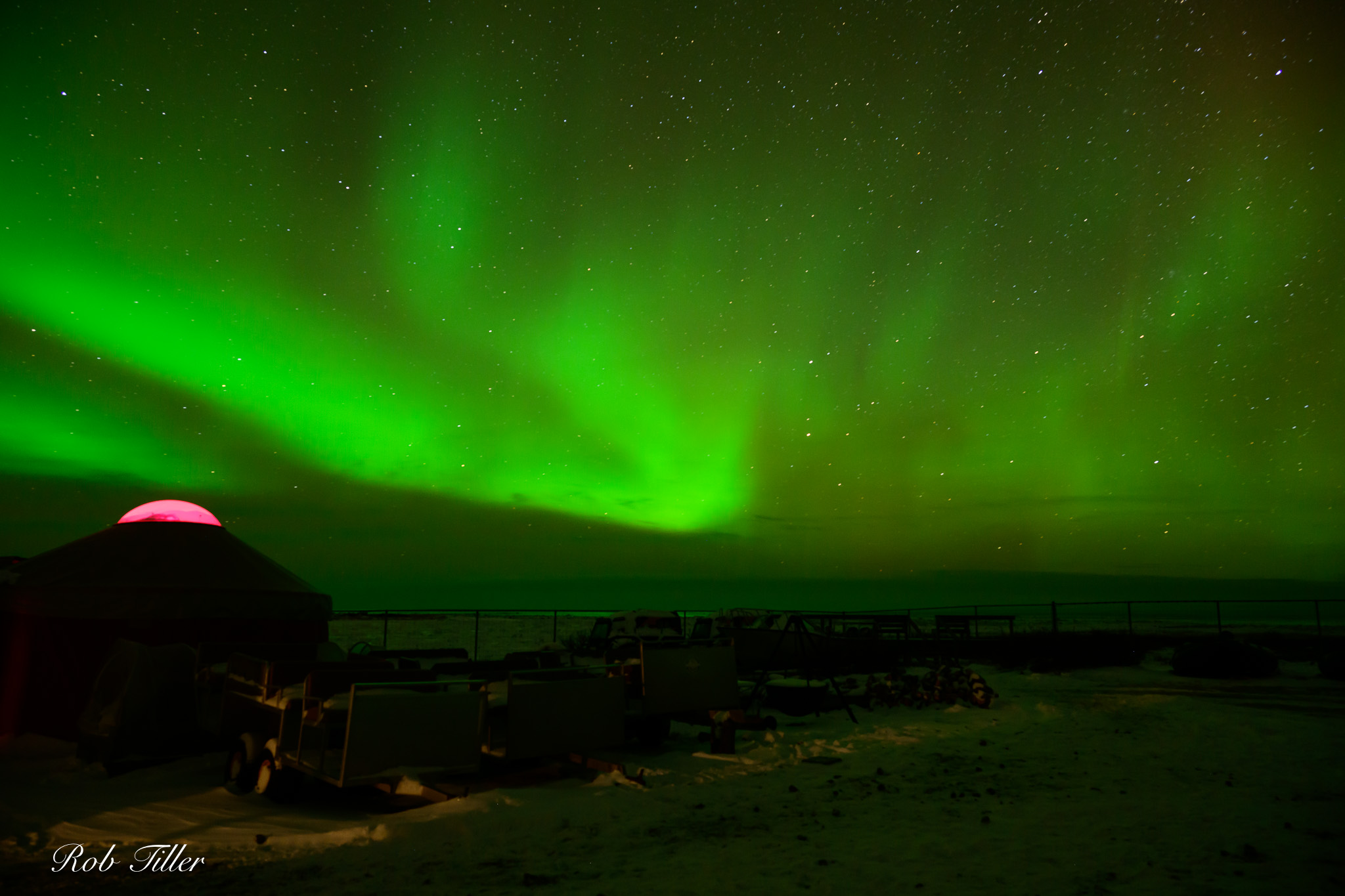
I’d looked forward to seeing the northern lights for the first time. It was cloudy most nights, but we did have a couple of mostly clear nights, and I got to see what they were about. They were not strong enough to excite the locals, but I was still happy.
My main anxiety ahead of the trip was the possibility of frostbite, since I need good nerves in my fingers for piano playing. Churchill Wild furnished me with a very warm parka, insulated pants, and boots, and my own Heat gloves-inside-mittons combo, with a chemical hand warmer, worked well. On windy days, I wore a balaclava mask and ski goggles to protect my face.
I also dreaded the commercial flights, though they mostly went smoothly. (The low flying small-plane segments were fun.) The only serious glitch was on our flight out of Churchill, which, after loading us up, had an equipment problem, and had to unload us. We had to stay an extra night in Churchill and get new plane tickets.
I booked my new flight with Delta, which had only one possibility for me – Winnipeg to Atlanta, and Atlanta to Raleigh. The connection in Atlanta was 46 minutes, which I expected would be impossible to make in that large airport. We arrived 20 minutes behind schedule, in Terminal A, and my Raleigh flight was boarding in far off Terminal D.
I rushed down Terminal D to the train, and up the length of A as fast as I could, but the gate for the Raleigh flight had closed when I got there. I could see that the plane had not departed, but things did not look good. I knew the usual rule was, once the gate closes, it doesn’t open again.
This time, though, the gate agent, observing it was the holiday season, opened this one up and sent me aboard. A flight attendant, seeing my heavy camera backpack, suggested I put it in an open overhead bin in first class! As I prepared to wedge in a center seat in row 32, another flight attendant said she had an open aisle seat I was welcome to! Wow! Thanks a lot to that kind and helpful Delta crew.
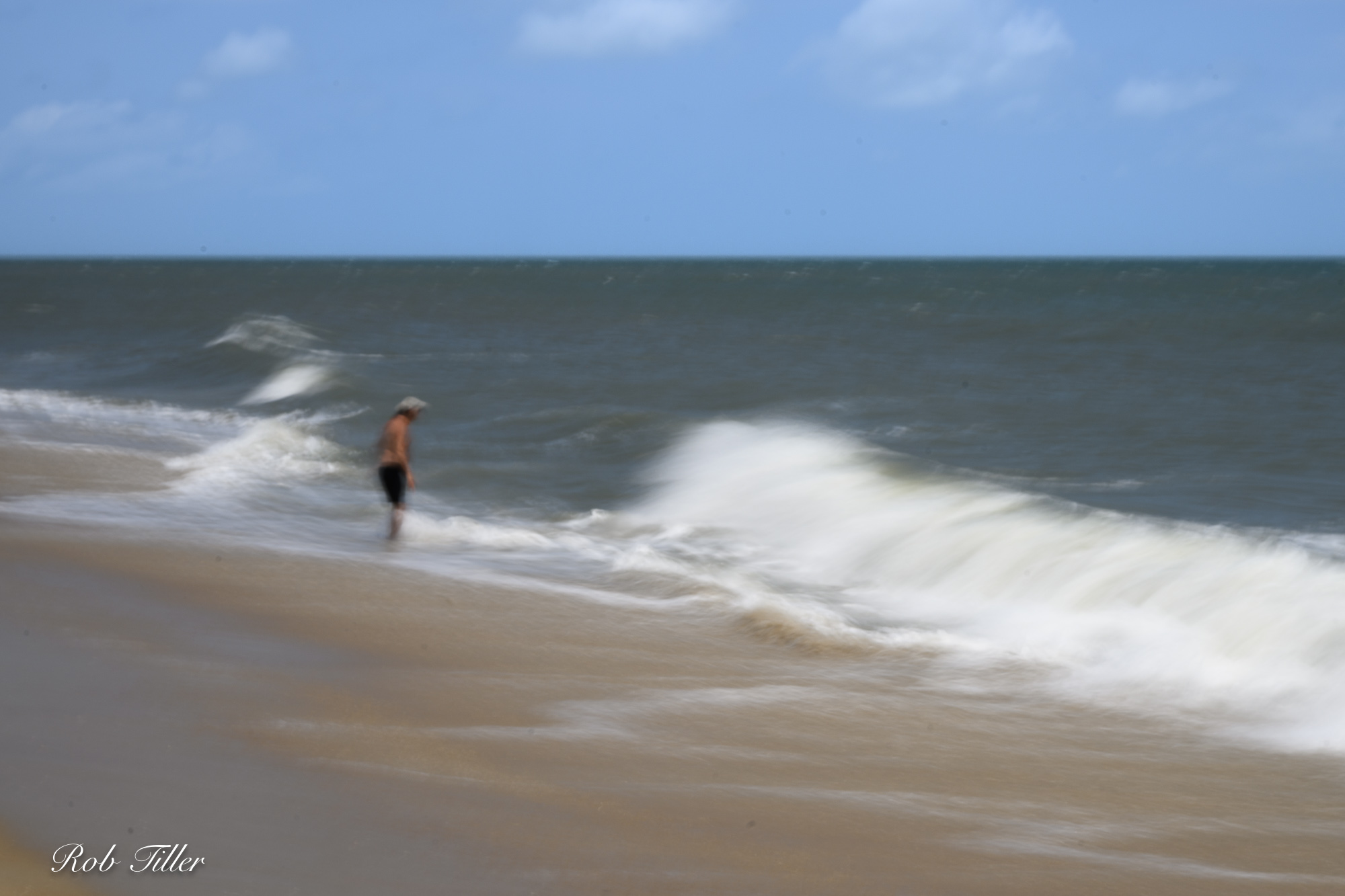
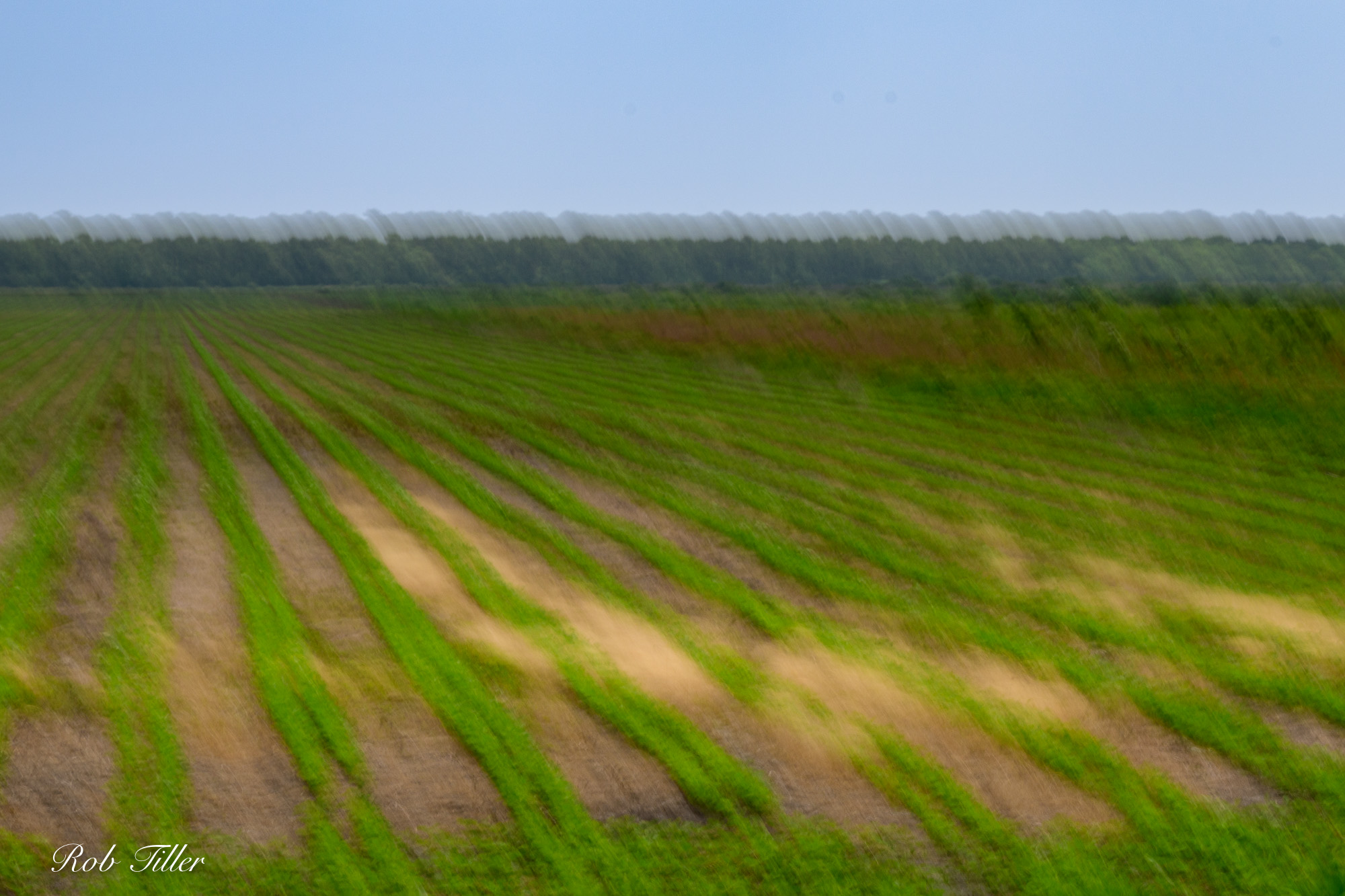
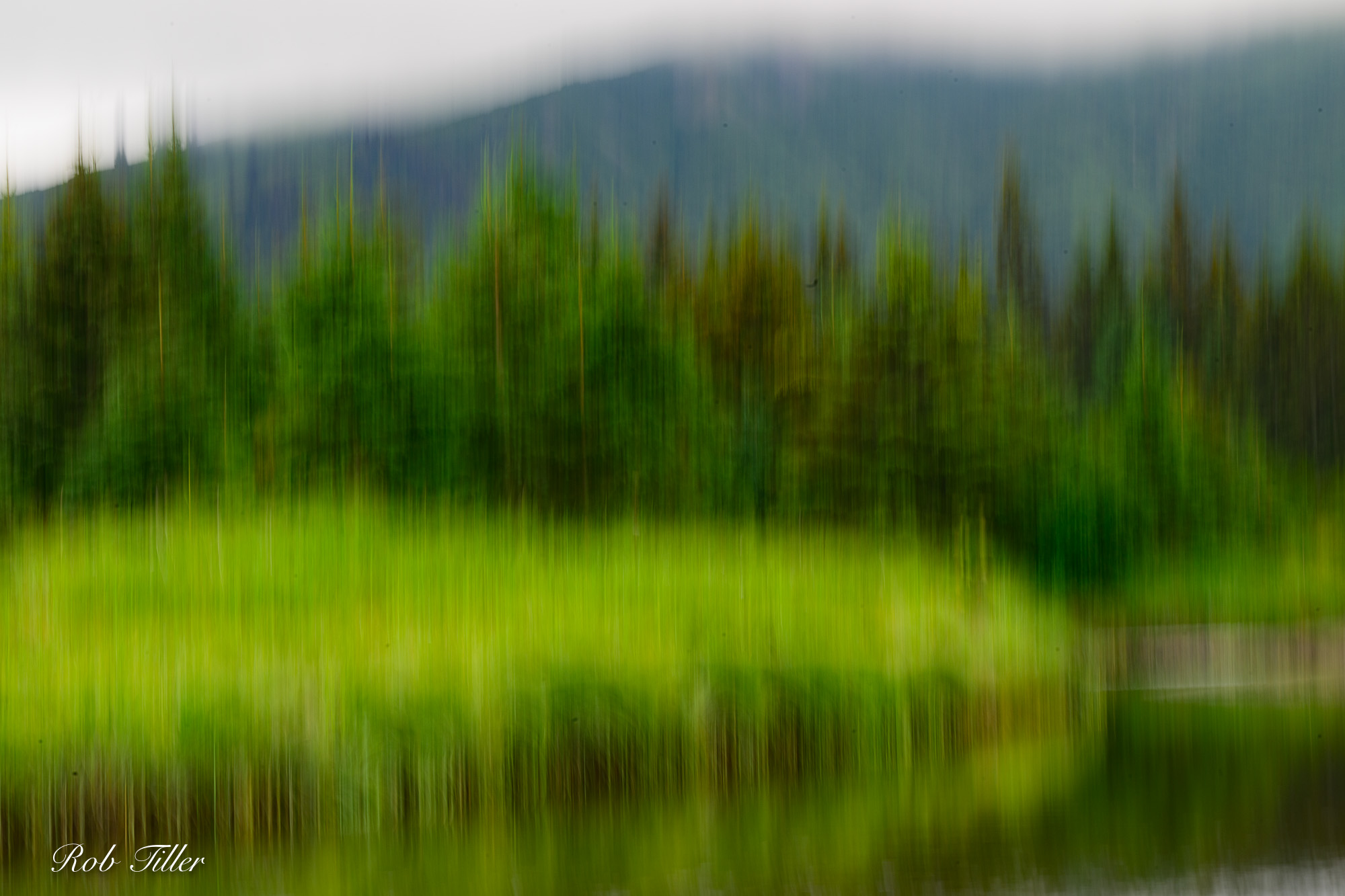
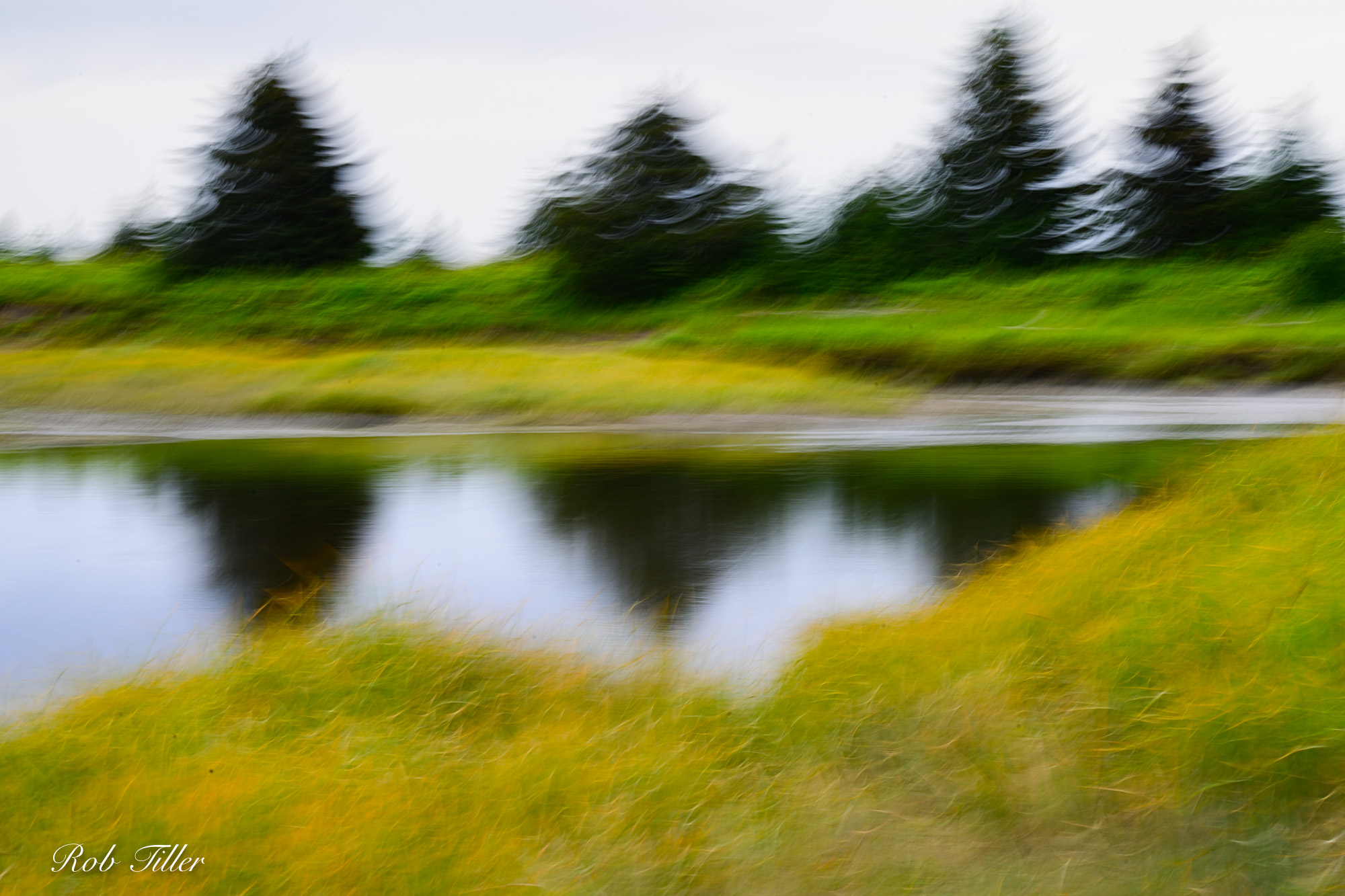
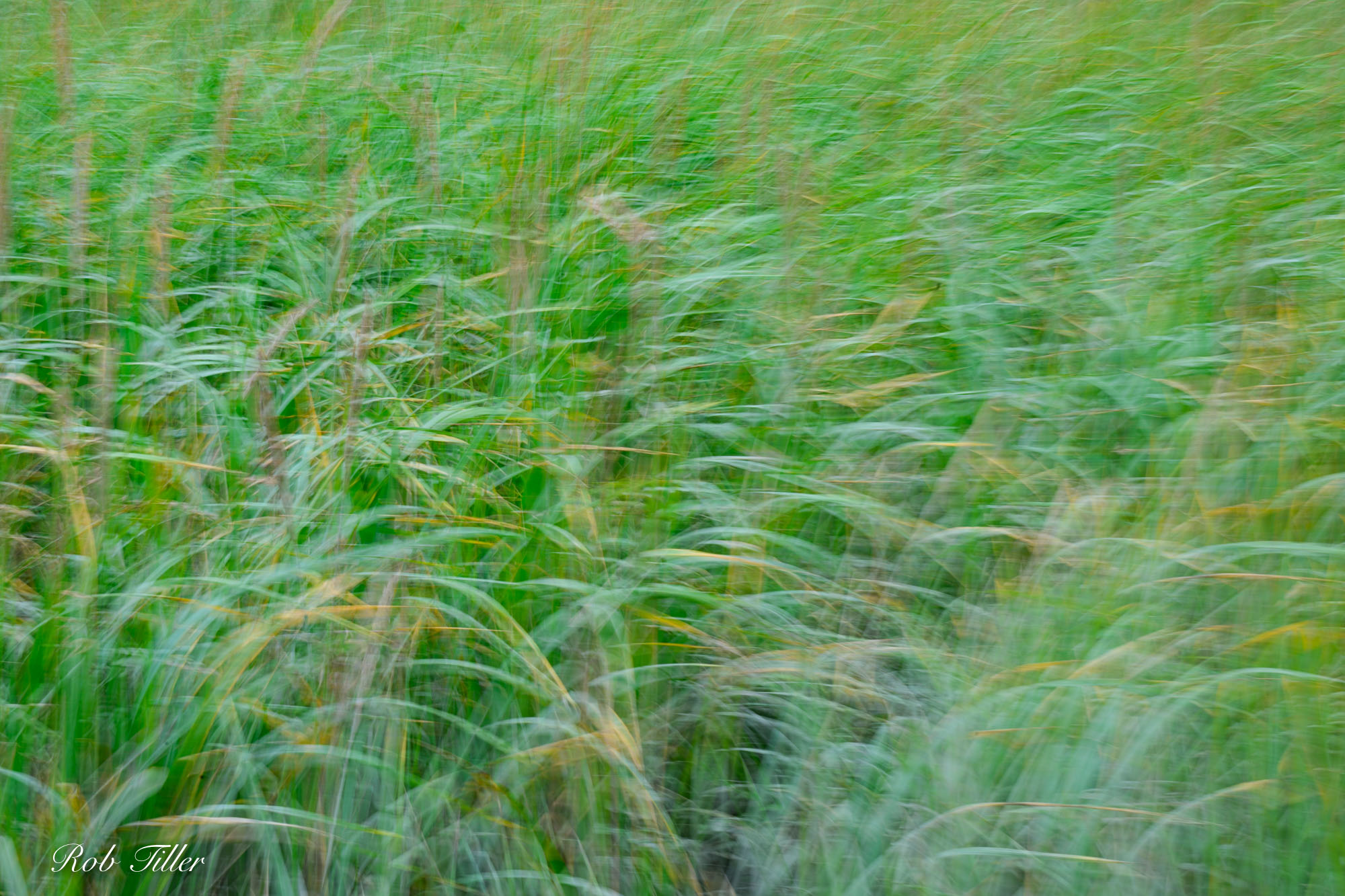
The photographs here (except for this barred owl) are ones I made using intentional camera movement, or ICM, in eastern North Carolina and Alaska. I was inspired to try this technique when my local photo club had a program on it. The results remind me of nineteenth-century impressionist painting, sometimes with more abstraction. It’s hard to say how far I can get using a camera and software in this way, but it’s fun to try something new.
We’ve been busy with getting the new house furnished and otherwise organized. This week I’ve been assembling book cases, which turned out to be a lot more work than expected. Every time I had to make a guess as to what the directions were trying to say, I seemed to guess wrong, but wouldn’t discover the mistake until quite a few screws were in that had to be unscrewed.
But I guess it was a learning experience. Elsewhere on the learning front, I’ve been continuing my language studies, concentrating on Spanish and German. Lately I’ve been using the Duolingo app, which is surprisingly fun. The lessons are short and game-like, and it seems like I’m making progress. The process is absorbing, and afterwards I feel a pleasant sense of having used my brain in a good way.
There was a fascinating piece by Sonia Shah in the NY Times last week about language and animals. Shah describes several research efforts that are showing that various animals have communications systems that are much more elaborate than we’ve imagined.
For those of us with an interest in this, we know that there’s been some progress in appreciating that quite a few species have communications systems, and some of those systems are complex. Shah notes work with, among others, elephants, birds, dolphins, monkeys, chimpanzees, gorillas, seals, whales, and mice. (The work with mice involved rendering a group of them deaf, which, unfortunately, Shah seemed to consider normal and reasonable.)
But we’re still a long way from decoding in depth any of these communications systems. Perhaps we’re worried about what we might find out. Understanding more animal languages might undermine our traditional ideas about the superiority of humans as compared to other animals. We might rather not know whether the animals we torture, eat, and otherwise exploit have complex inner and social lives. It could make us uncomfortable, and might even require us to change our behavior.
It’s encouraging, though, that research is going forward. One of the most interesting points from Shah is that examining animals’ languages is giving us new ideas about how human languages evolved and the function they play. She points out the possibility of a continuum of language, ranging from the signaling of plants being attacked by insects to the gestural communication of chimps to opera. This was a thought-provoking piece, and I made a note to keep an eye out for the book Shah is now working on.
I’ve suggested before that recent advances in artificial intelligence might help us toward a richer understanding of animal communication, and I was pleased to learn that this is in fact happening. Elizabeth Kolbert has a piece in a recent New Yorker describing research on the communication systems of sperm whales. These creatures are the world’s largest predators, with primary prey being squid. They are social animals that migrate at least twenty thousand miles a year and can dive downward a mile.
The main research effort Kolbert described was in the waters of the Caribbean island nation of Dominica. Sally and I did a diving trip to that beautiful country a few years back and were privileged to get some views of the whales. We also spent an afternoon cruising with a whale researcher who was recording their clicks, which are called codas, and which the whales seem to exchange in a conversational way.
Work is ongoing to collect more examples of these codas. In theory, an app like ChatGPT could decode them, as it has human speech, but it would require many more examples for training. It doesn’t sound like this is around the corner, but it also doesn’t sound impossible.
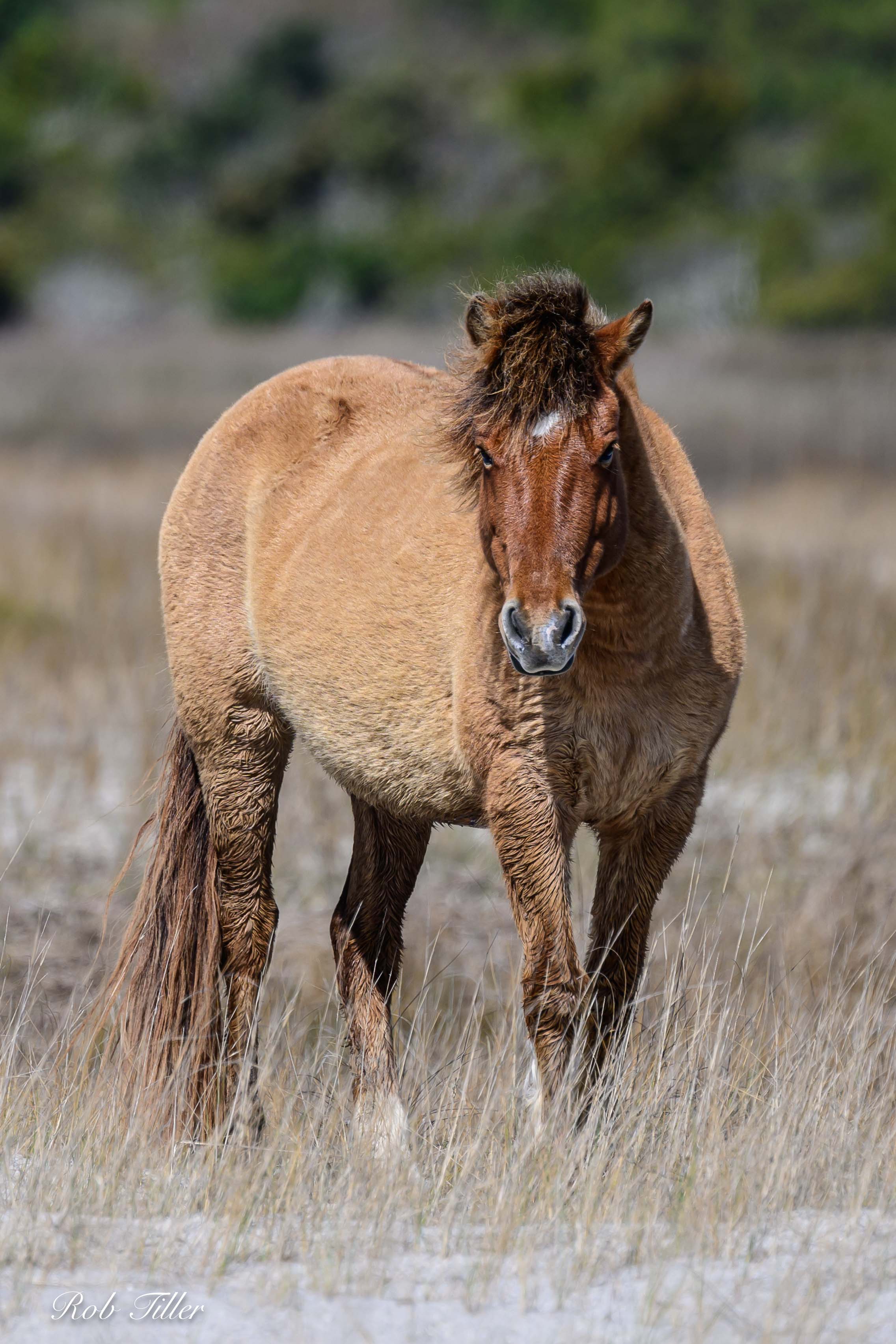
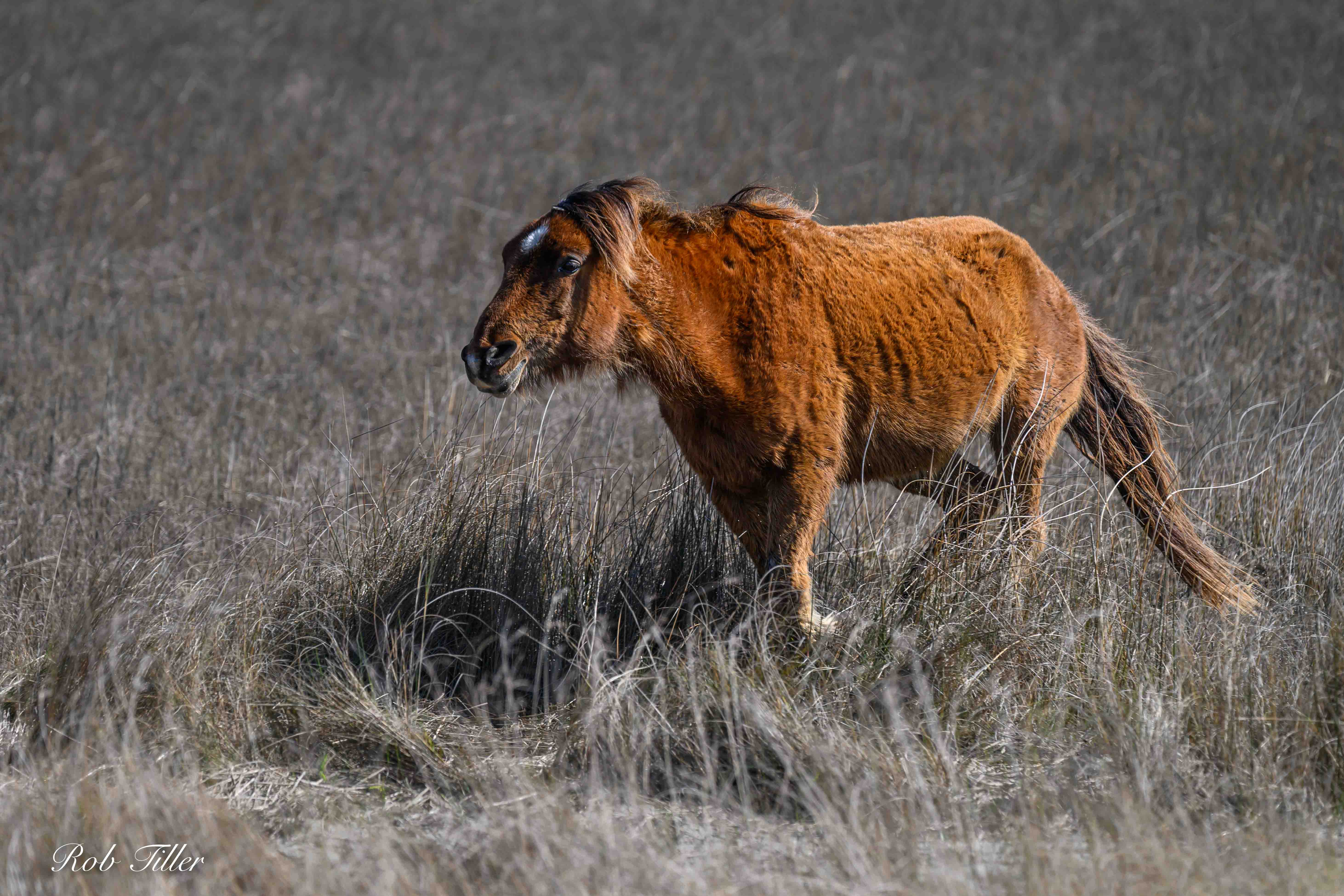
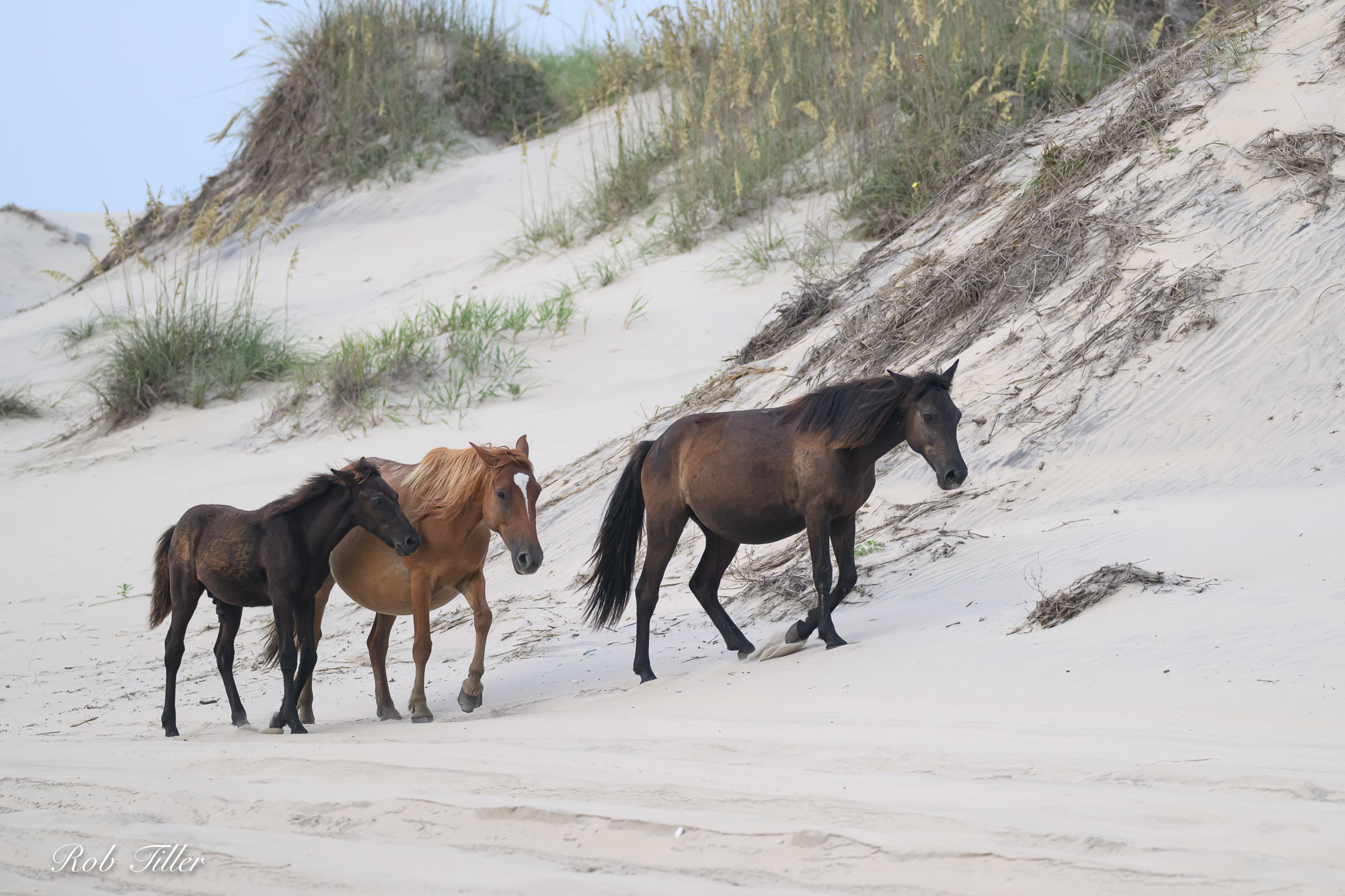
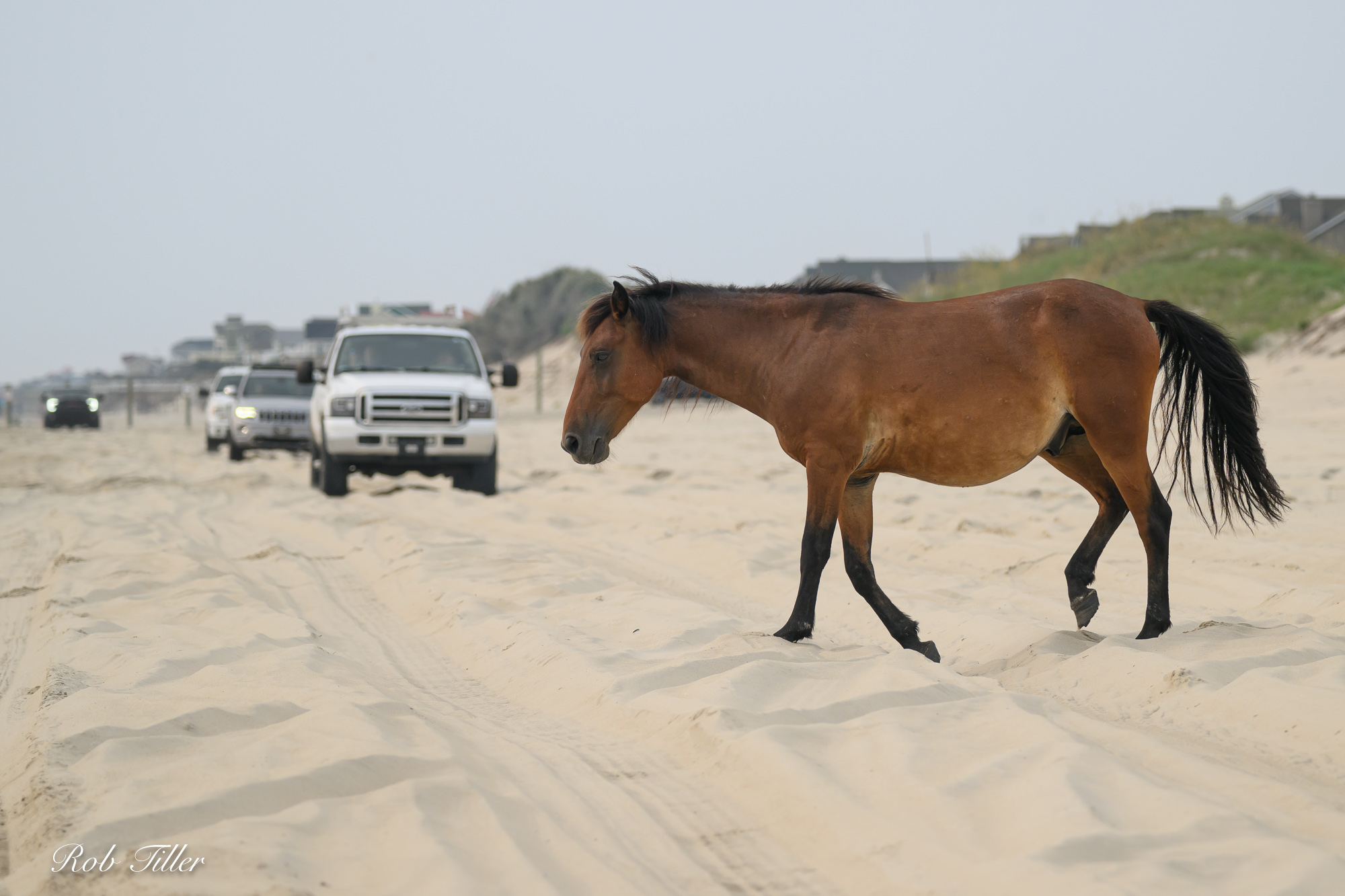
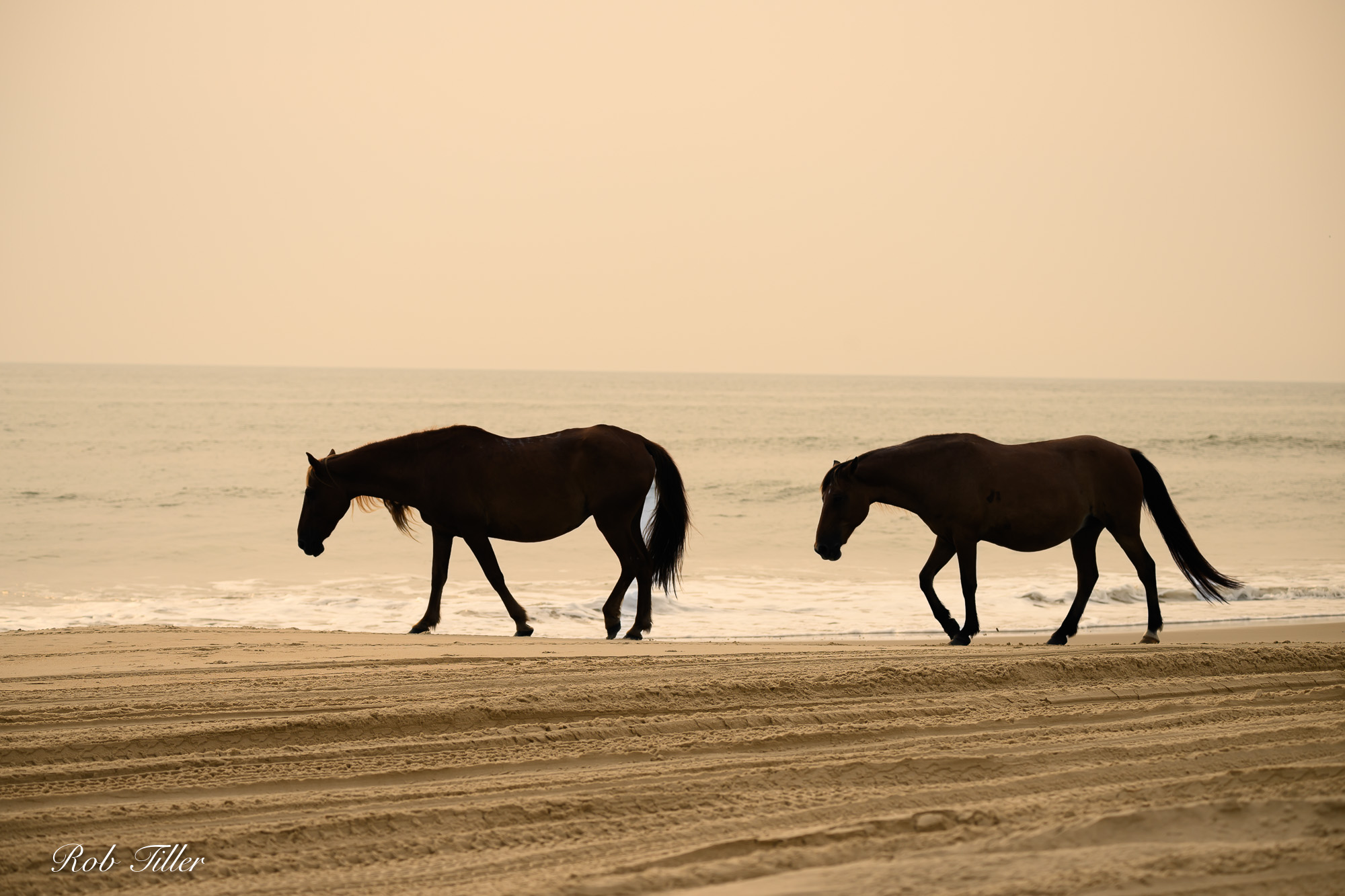
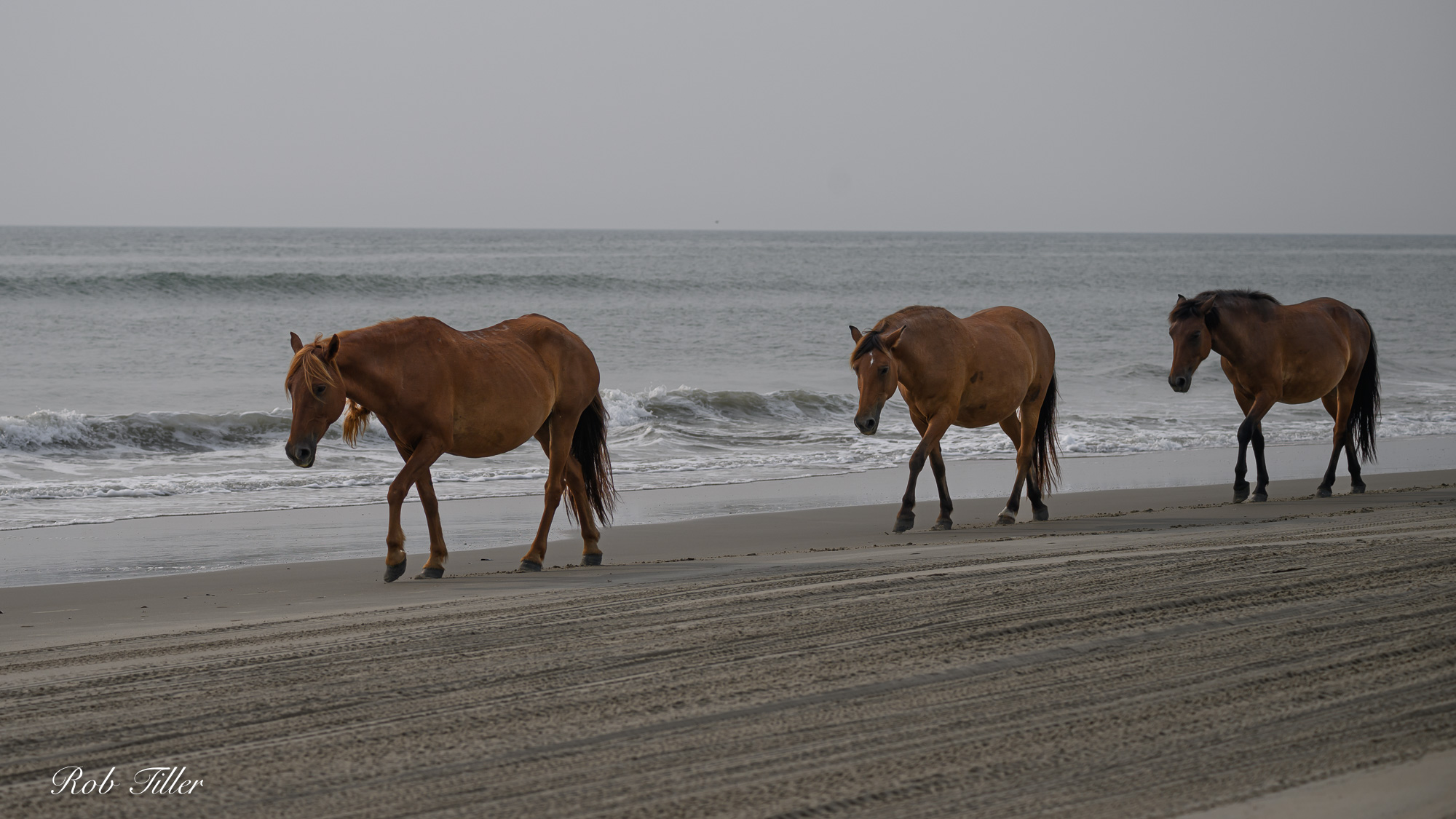
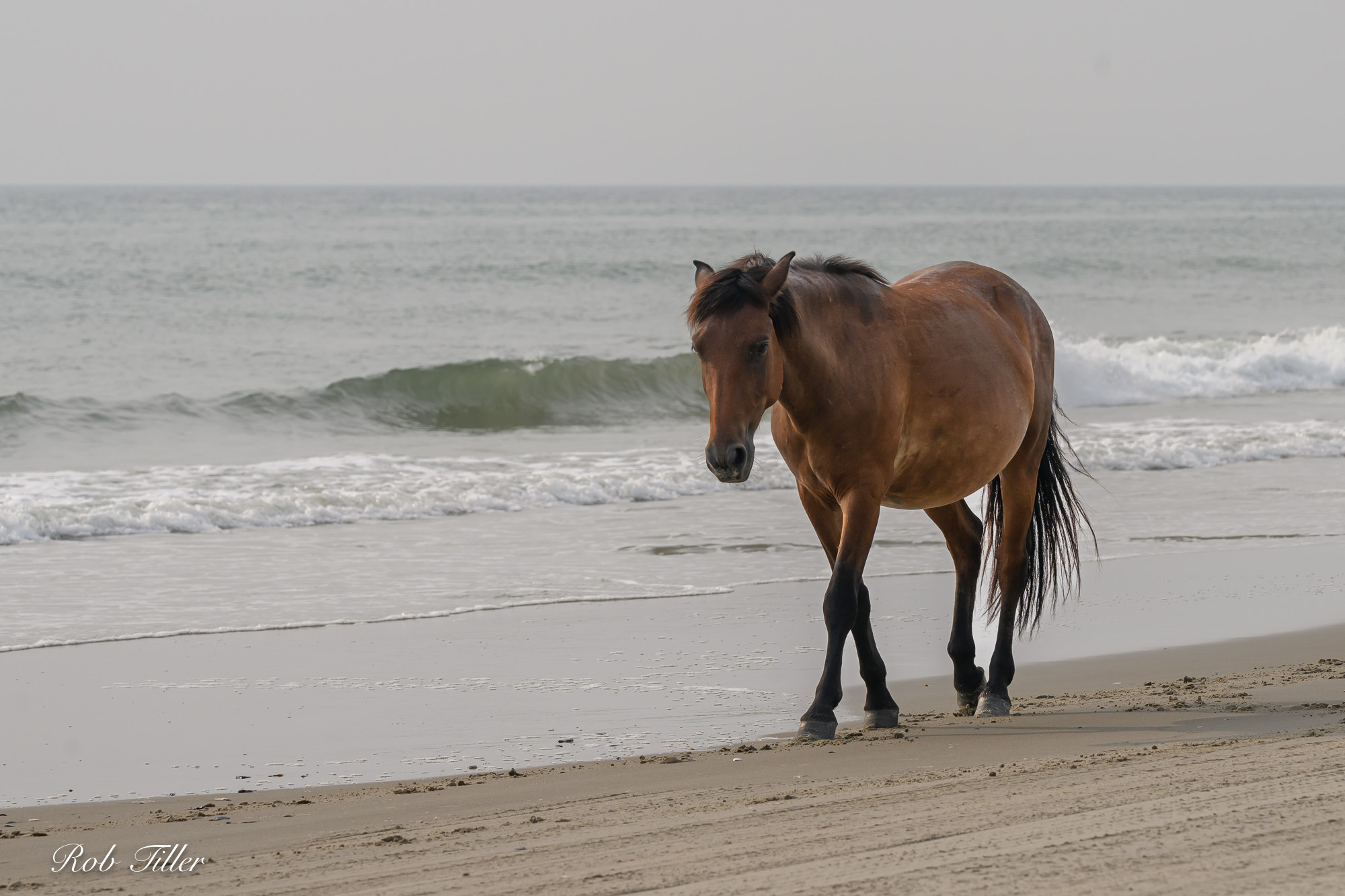
Last week we had a family vacation at Corolla, a community on the Outer Banks of North Carolina. Early every morning I went for a drive on the beach to look for the wild horses that live there. Most days I didn’t see any, but one day I did. Here are a few images of them.
I wanted to share a few more of my photos of bears and other creatures from my recent Alaska trip, so I made a short (4 minute) slide show of some of my favorites and put it on YouTube. You can find it here.
One of the things I value about wildlife photography is getting to know the animals better. Of course, it’s very rewarding to spend time in the field with other creatures. But also, reviewing the still images, I always get some new insights into the lives they live, and I hope others do, too.
Non-human animals have hard lives, and in general humans make their existence harder. Part of the problem, I think, is the widespread failure to see members of other species as more than mere objects to be exploited. I hope my photography helps to challenge that view, and suggests how we might see each creature as worthy of respect and compassion.
I’m afraid that in general, people don’t have much interest in non-human animals, unless they can be eaten or exploited for profit or amusement. This has been true for a long time. This way of thinking is problematic for people as well as other animals, and I’ve been thinking a lot about why it is so pervasive, and how it might change.
It seems natural to enjoy being with other creatures, and indeed, young children bond easily with them. But from an early age, we are taught that they are essentially different from us, and inferior. The lesson is pounded in, over and over: humans are not animals, and animals are inferior to humans.
The idea that humans are not animals is not only questionable – it’s wrong. It has nothing in science or reason to back it up. Darwin debunked it more than a century and a half ago, and his basic theory has been repeatedly tested and confirmed. From an evolutionary perspective, all living animal species, including homo sapiens, are closely related to each other.
Moreover, as scientific knowledge has expanded, it’s obvious that non-humans have many similar sensory capacities to humans, and some have vision, hearing, smell, touch, or other unusual senses that are vastly more acute.
There have been various qualities we once supposed made humans unique, including reasoning ability, memory, tool use, planning, and problem solving. But one by one, with more studies of more species, those ideas have turned out to be the product of our ignorance, as first one and then many creatures demonstrate such capacities in various degrees.
So why do homo sapiens persist in believing that we’re separate and apart, and superior? It’s plainly a flattering thought – we’re number one! And if we’re confident that non-humans are vastly inferior, we can justify eating them and otherwise treating them with indifference and terrible cruelty. It’s convenient.
But I’m coming to think that the notion that privileges humans over non-human animals is part of a pervasive, and deeply flawed, thought system. Our various ideas of inherent superiority and inherent inferiority are interconnected and mutually reinforcing. They form a powerful network that limits our appreciation of each other and the natural world.
Beliefs that one race is superior to another, that men are superior to women, or that straight is superior to gay, are all without any scientific basis. The same is true for holding Ivy League grads to be fundamentally superior to non-Ivies, white collars over blue collars, or homeowners over homeless. The list of our arbitrary and baseless hierarchical gradations goes on and on.
Nevertheless, they are so deeply ingrained in our consciousness as to seem part of nature. Like the belief in the superiority of humans over other animals, they’re part of our habitual way of thinking – that is, our culture.
Hierarchical thinking – deeming one group inferior to another – is more advantageous to some than others, but even those lower in the caste system accept at least some of it as natural and good. An example is poor working whites, who historically have found solace in the baseless notion that they are at least superior to Blacks. And racial and religious minorities have their own within-group grading systems based on skin color, wealth, education, and other factors.
As for non-human animals, almost all humans put them at the bottom of their hierarchies. They are still the standard metaphor for those who are most frightening and least deserving, as in “those awful [insert group name here] are animals”! We rank some animals over others, such as our dogs over pigs, but even the favored species members are usually deemed expendable objects, rather than beings with inherent dignity.
The fundamental problem with such hierarchical thinking is that it is divisive. Human hierarchies divide us from each other, and make it difficult to appreciate and bond with others. Even those high up in hierarchies are emotionally limited and morally depleted by the system. The hierarchies foster defensiveness, paranoia, and hate. At the same time, they lessen the opportunities for loving connection.
Our delusions of natural hierarchies do enormous damage, but they haven’t destroyed all our intuitions of fairness or our ability to perceive individuals. Though deeply embedded, those notions are subject to change.
In my lifetime, we’ve managed to revise for the better some of our worst prejudices on race, patriarchy, and minority sexuality. There’s even been progress in seeing animals as more than mere objects. For example, we’ve reduced the slaughter of whales, elephants, and certain other creatures, and acknowledged the injustice of our driving various species to extinction.
But there’s a lot of work still to be done, both for disfavored humans and non-humans. I don’t have a comprehensive solution, but I do have an idea for where to start: respect and compassion. These are attitudes we all know something about. Most all of us have respect and compassion for at least a few others, and to get started we can build on that.
I propose the following experiment. For each being we encounter, let us try saying to ourselves, “Although we are different, I respect you as an individual and wish you well.” This reorientated attitude would change us, in a small way, and multiplied enough times, would make a vast change.
I’ve been doing this experiment, and I think it has changed me and my surroundings a bit for the better. Recently a family of deer with two spotted fawns has been quietly visiting our yard to graze. While admiring their beauty and grace, I’ve been consciously seeing them as individuals with their own concerns. It’s hard to tell what they think, but they’ve certainly noticed me, and don’t run away. They definitely like our grass.
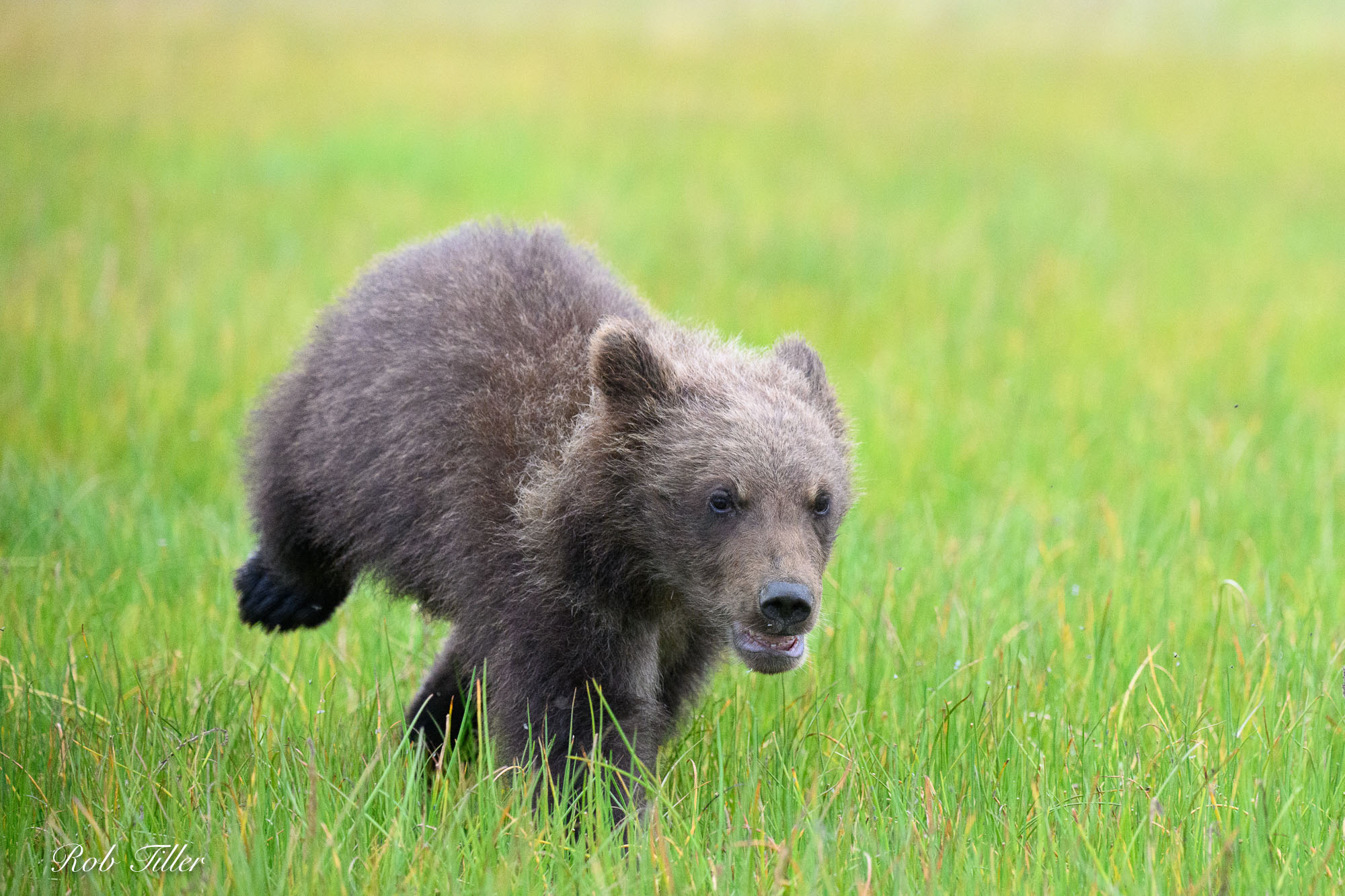
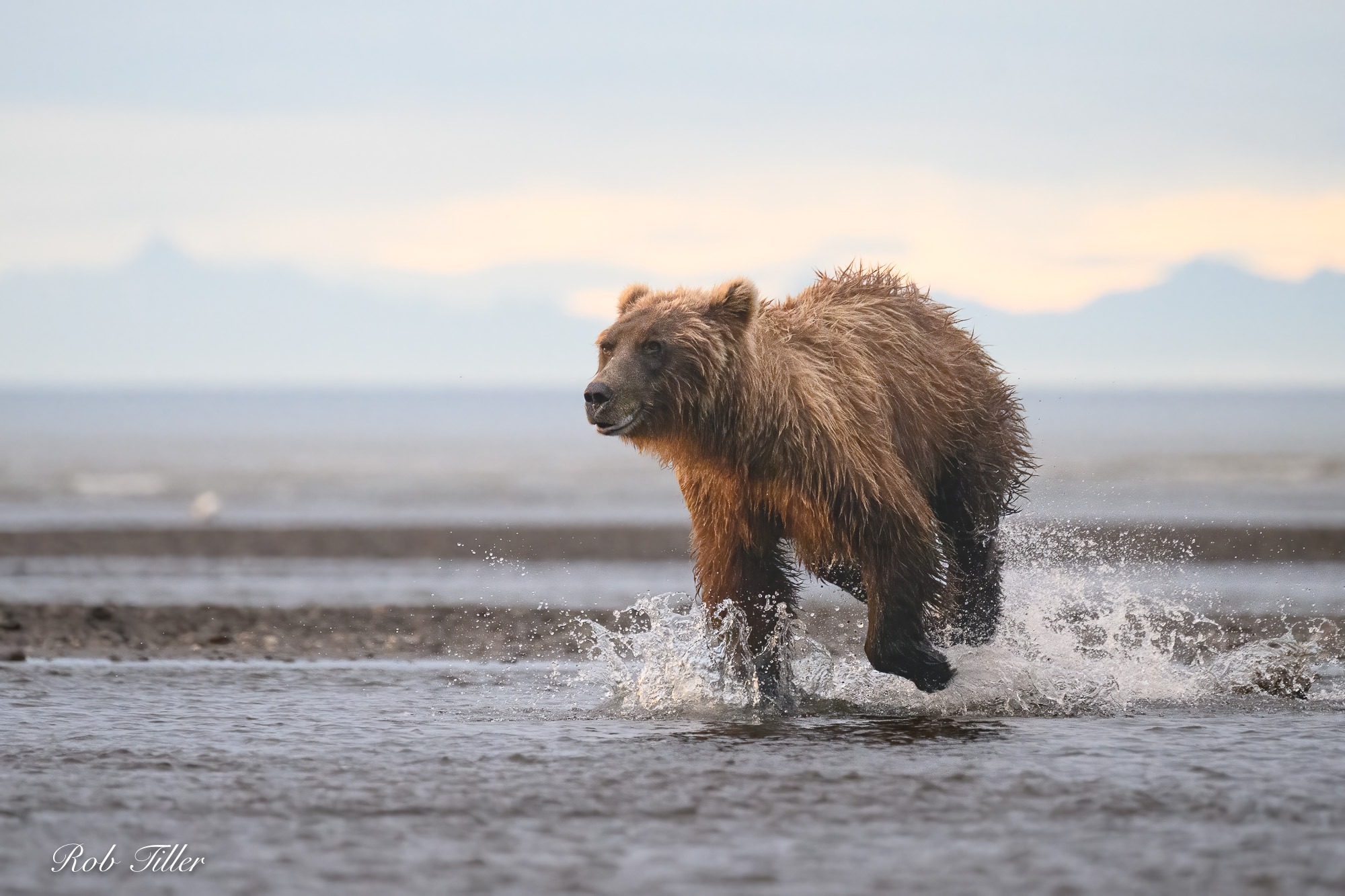
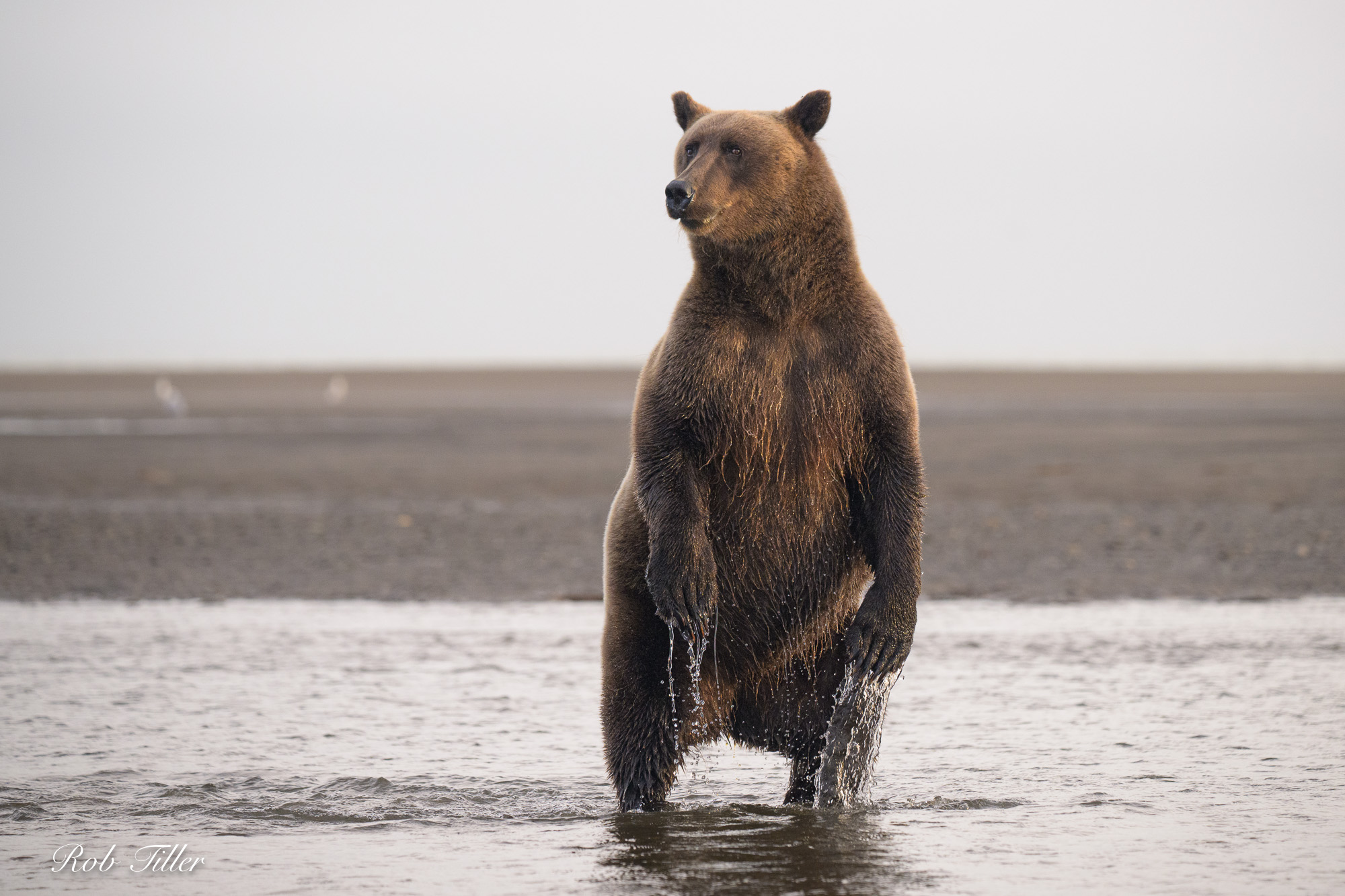
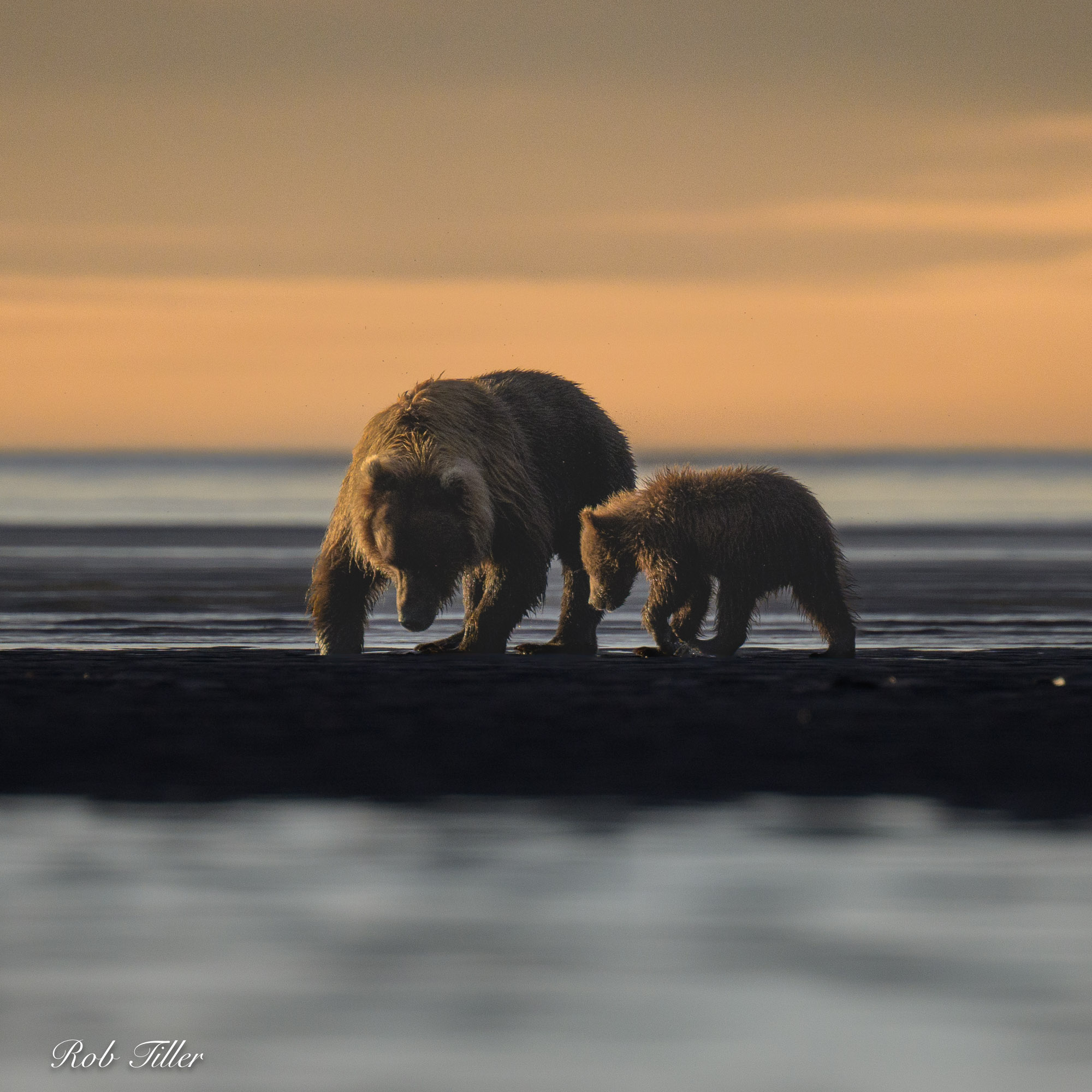
I took these pictures last week in Alaska at Lake Clark National Park. I got thousands of pictures of grizzly bears and other creatures, and it will take some time to sort out the best ones. I wanted to share a few that immediately struck me, and also to share a few thoughts about the animals.
But first, a word about the misery of modern air travel. It is just remarkable how, in the course of my lifetime, commercial flying has gone from being kind of a romantic adventure to a grim endurance test. I appreciate that the airlines operate with a good safety record, and more often than not get you where you want to go. And I’m grateful that airline employees usually work hard to solve problems and help as best they can.
Still, the cold-heartedness of our airline system is deplorable! Take, for example, the walk of shame. If, like me, you resist paying a lot of money to sit in the small group of comfortable seats at the front of the plane, you must wait for those of greater means to board first. When your boarding group is finally called (most recently for me, group 7), you must with lowered eyes shuffle past the well heeled folks sipping their drinks, signaling your pathetic lower status in the flight and in life in general.
For a long time, I thought this humiliation ritual was an unfortunate accident, but I’ve come to think it must be part of the larger plan. The airlines seem prepared to take any measure that might drive me to spend more for a ticket. Thus economy seats have gone from uncomfortable to torturous, and food service has gone from minimal to ludicrous.
On my photography trips, I have a particular dread at getting a high boarding group number, because I’m toting expensive camera gear in a backpack that is not armored against rough baggage handling. Escalating fees for baggage have driven everyone toward carry on bags, and there are often not enough storage bins for all those bags. Late boarding folks are just out of luck. So as big groups of my higher status flight mates board, I get pretty worried about what’s going to happen to my gear.
On my recent trip with American Airlines, their automated kiosk offered to let me have an earlier boarding group for thirty some dollars. Reluctantly, I agreed, since I wanted to offload the worry about getting a spot in the overhead bins. But it turned out that the fee was only good for the first of my two flights, and I was still in group 7 for the second. Arrrgh!
I’ll call out American for one other bit of callousness: lack of food. My flight back left Anchorage at 8:30 p.m. and was to take 6.5 hours to get to Dallas. I figured there’d surely be a meal, but no. In fact, I got offered the choice of a tiny bag of pretzels or a little cookie. I asked the attendant if I could have both, and the answer was no. So, hungrily, I took the pretzels.
Is there anyone who’s content to spend hundreds of dollars only to be treated to ritualized humiliation, anxiety, and starvation? We know it doesn’t have to be like this, because other rich and not-so-rich countries have much better air travel. Indeed, years ago it was better right here.
There are a lot of problems stemming from the US’s brutal version of capitalism (including deficient health care, public transportation, public housing, etc.), and air travel is not the most urgent. But still, it’s bad, and it would be relatively easy to make it a lot better.
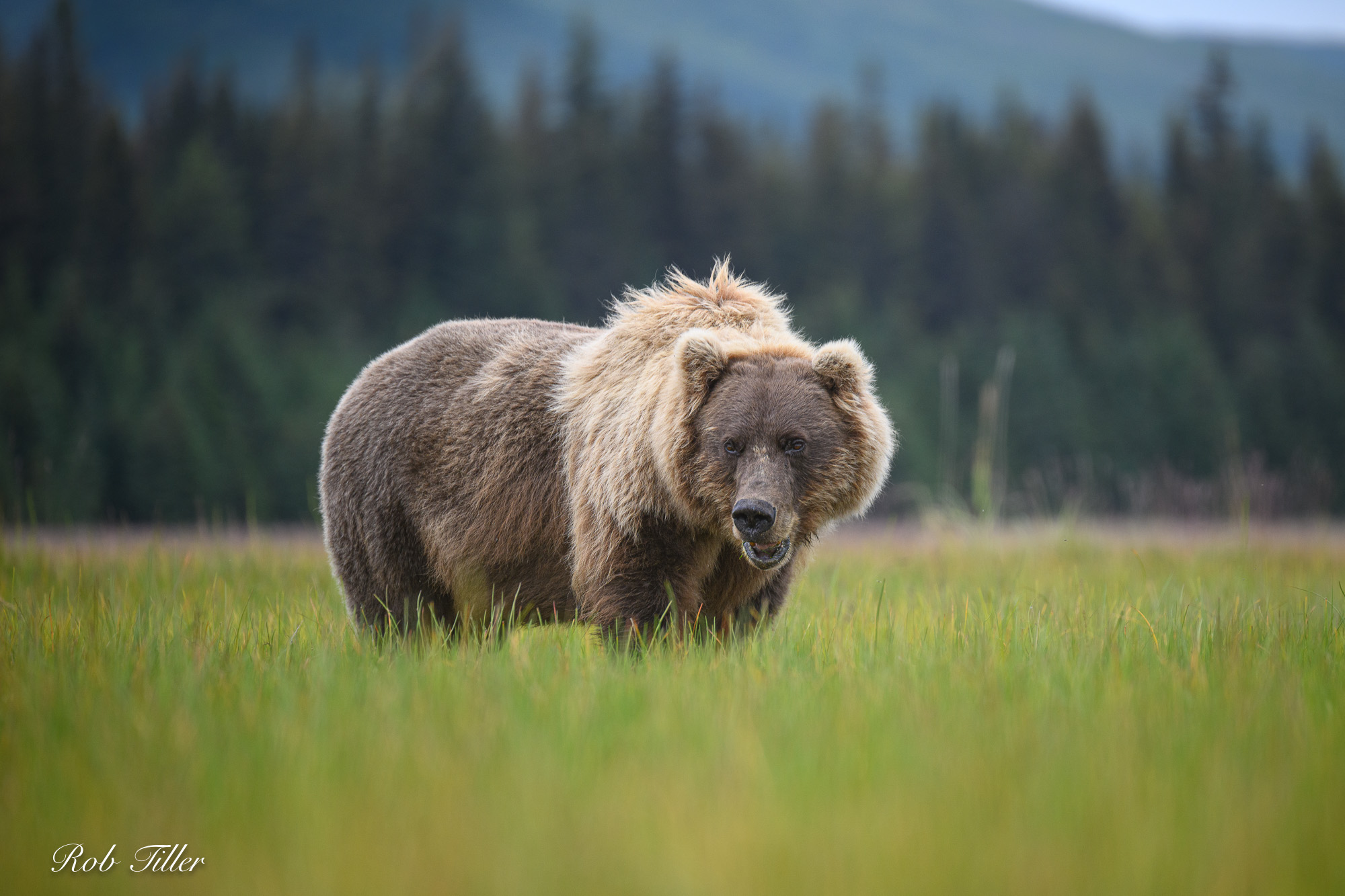
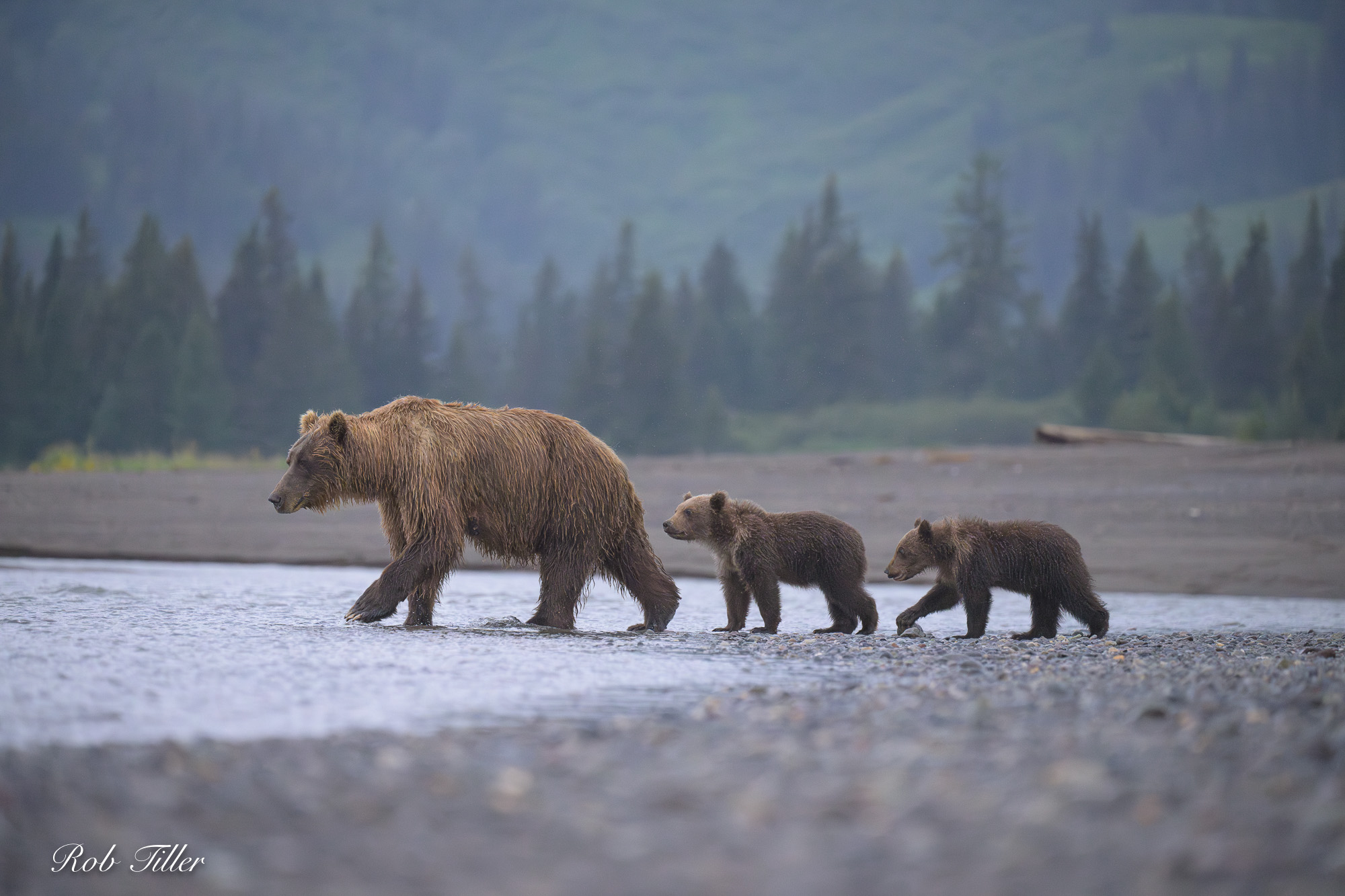
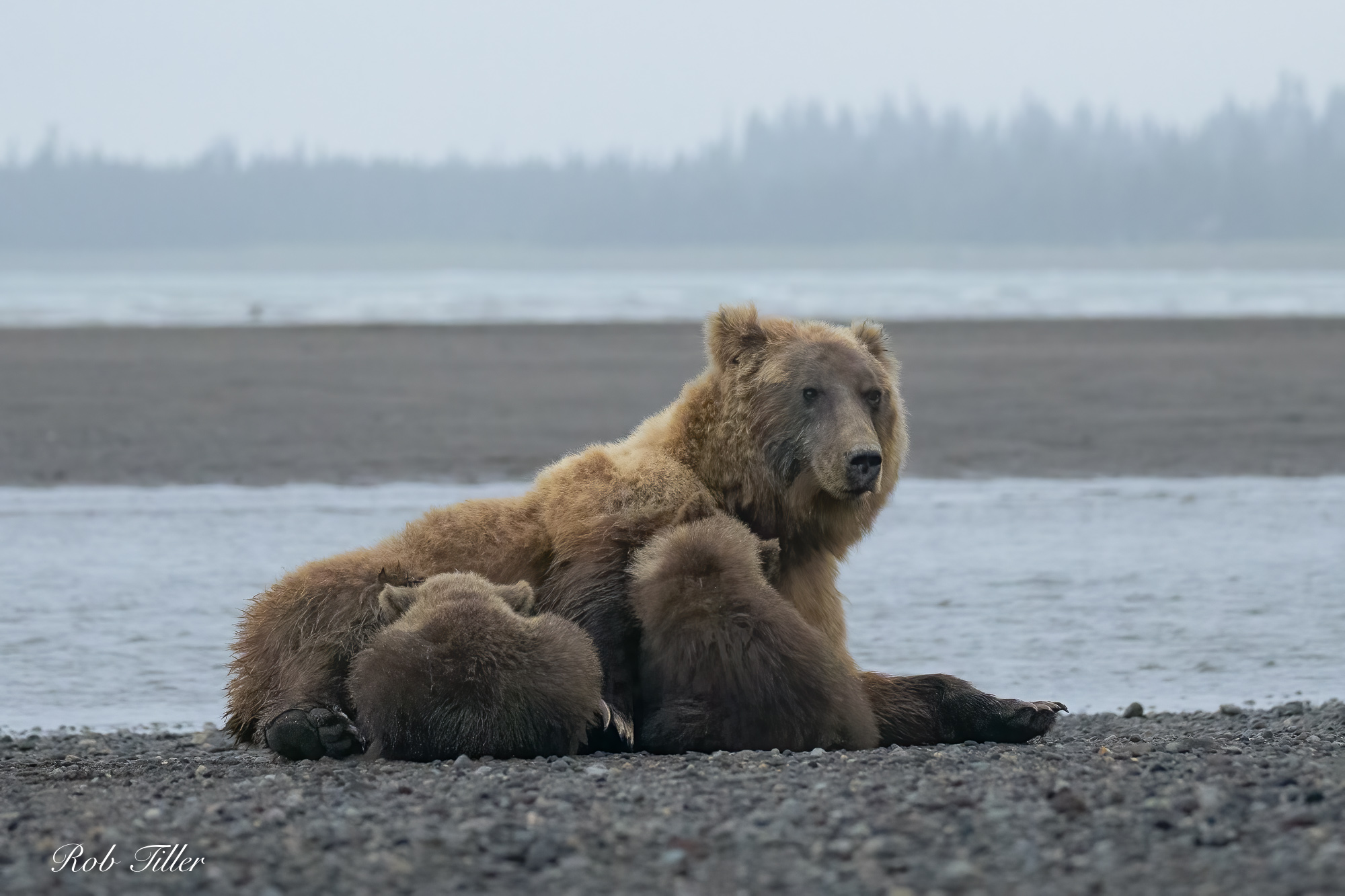
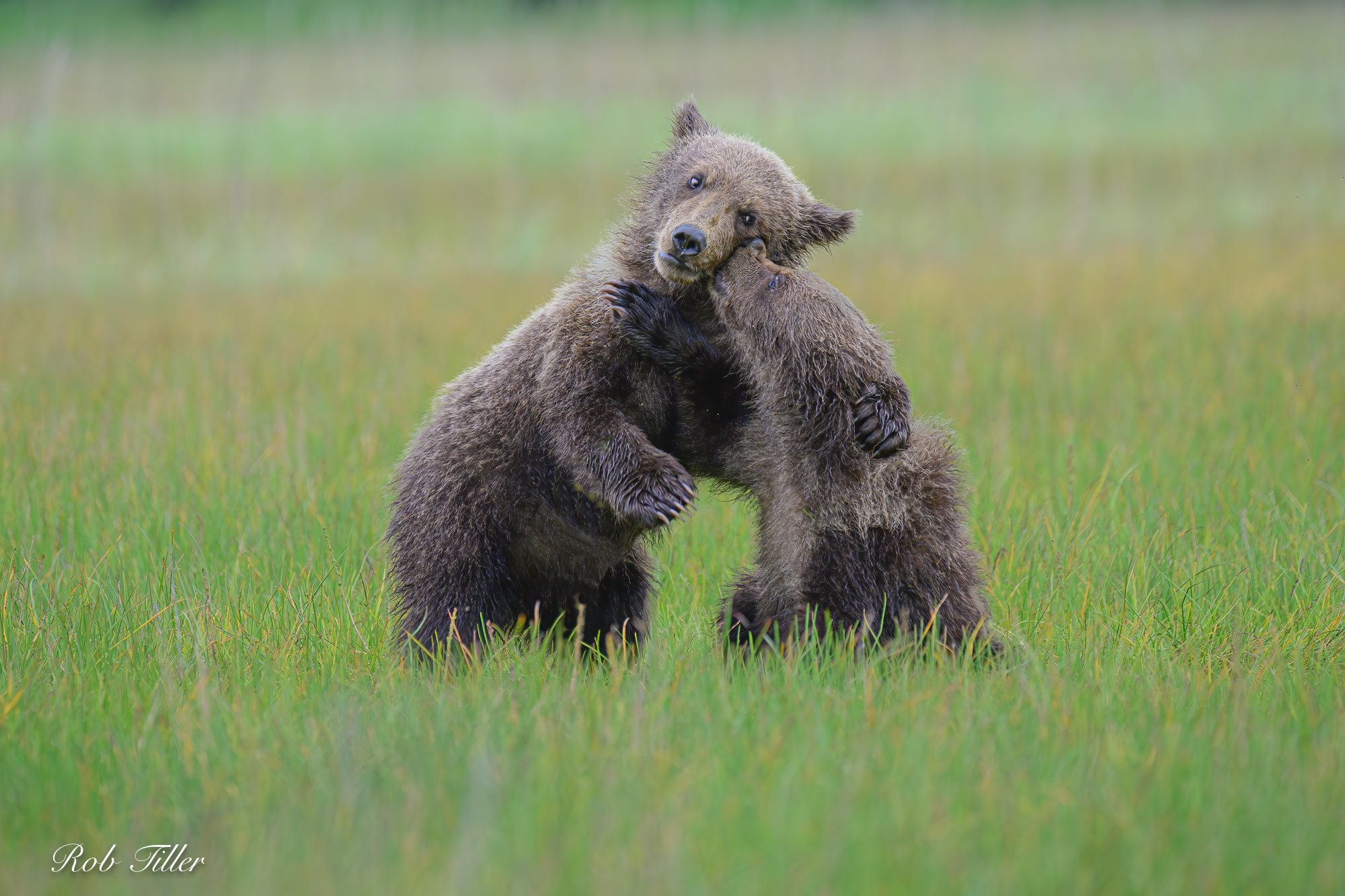
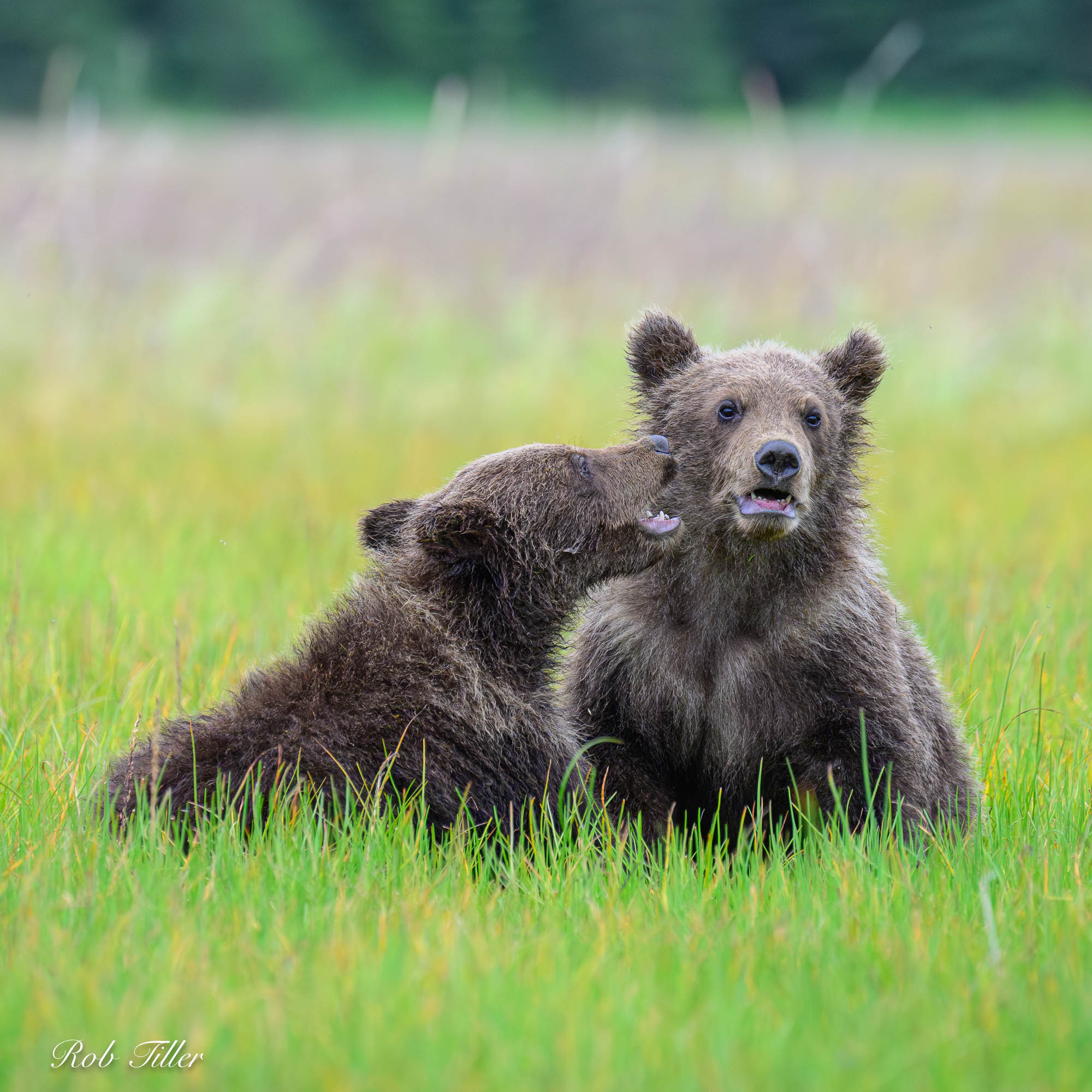
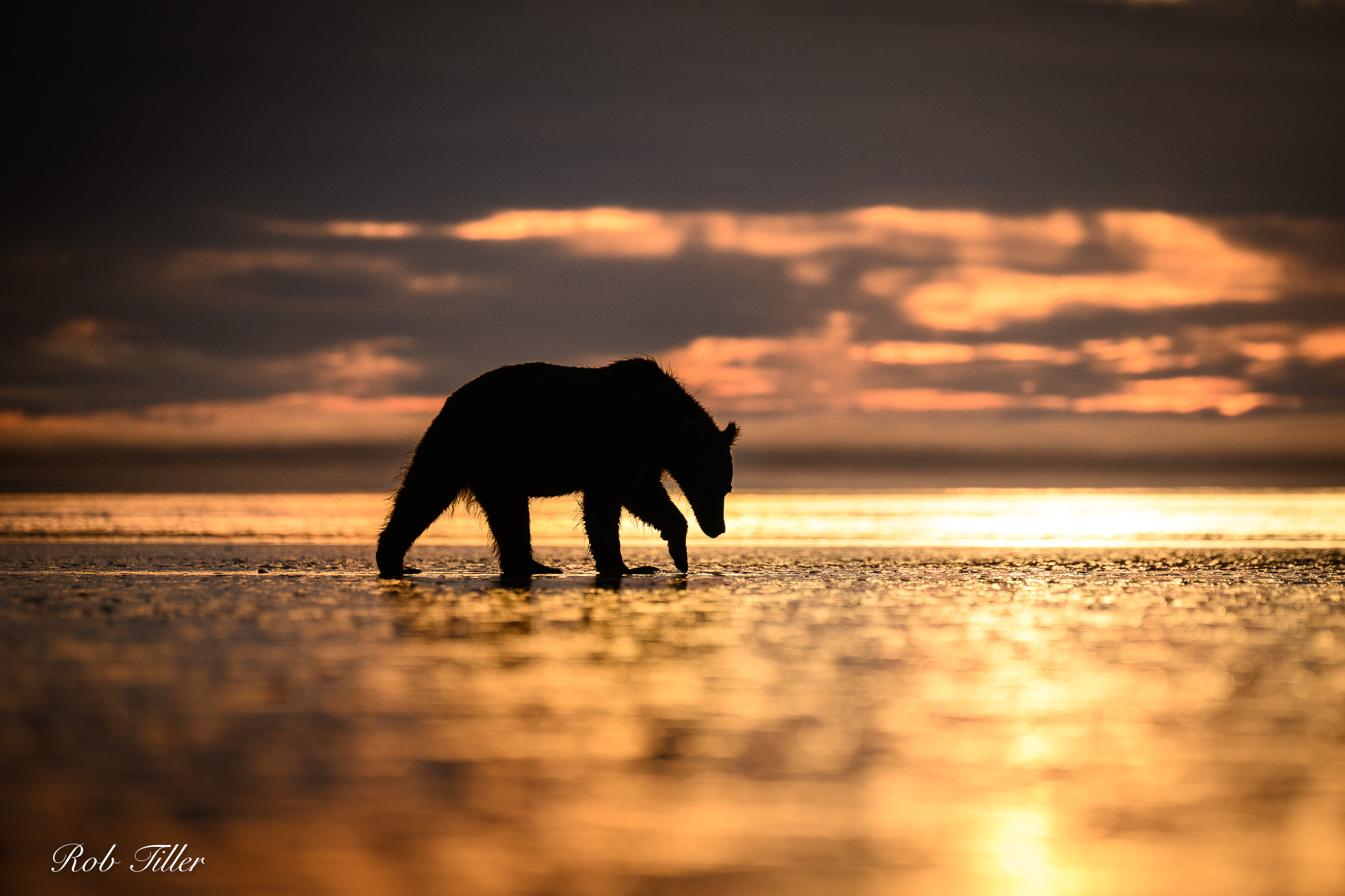
How different it is with the bears! Coastal brown bears, a/k/a grizzlies, are numerous at Lake Clark. I especially enjoyed seeing the new cubs, some of which were very playful. Some of the bears grazed peacefully in the grasslands, and others dug for clams in the tidal flats. They were waiting for the salmon to arrive in numbers, which was a bit behind schedule this year.
After spending some time close to these animals, it seems amazing that they have a reputation as remorseless killers. The ones we saw were peacefully going about their business of getting fat and taking care of the young. Of course, they are very powerful, and if provoked can be dangerous. But in Lake Clark, many bears are used to humans, and those that don’t like them normally just keep out of their way.
At times we’d watch a bear eating grass or seafood, and then see it flop down to take a nap. And we’d wait a while for it to wake up. Of course, I was most interested in photographing bears in motion, but I also enjoyed relaxing and watching them relaxing.
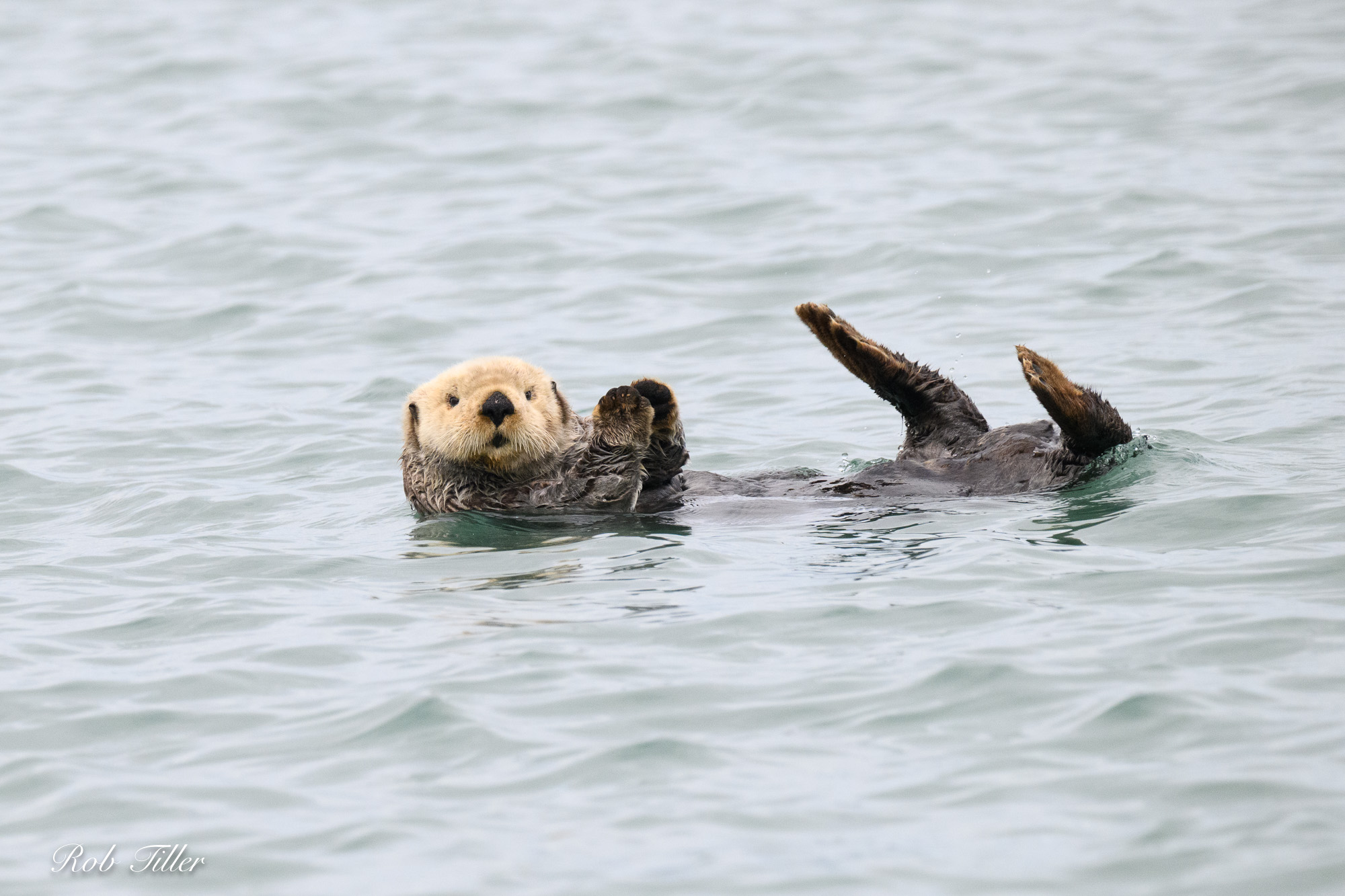
An unexpected treat was a boat trip to Duck Island, a small craggy island with nesting puffins. I’d never seen horned puffins before, and was excited to get close to them. I also saw my first sea otter, which looked very mellow.
I was part of a workshop at Silver Salmon Creek Lodge led by Jared Lloyd and Annalise Kaylor. I was happy to finally meet Jared, whose photography and writing have inspired me for several years. He was a very fine teacher and leader, and I really enjoyed working with him. Likewise with Annalise; she was a highly accomplished photographer and had many good suggestions. Our guide, Dave R, was also a pro – very experienced with the bears, and he worked hard to help us get good images and keep us safe.
The staff at Silver Salmon Creek was friendly and hardworking. I want to give a special shout out to chef Andrew Maxwell, who pleased everyone while creating consistently delicious plant-based food especially for me.



























 The Casual Blog