The last week of 2020 was mostly cold and cloudy here, with extended periods of rain. I wanted to check on the eagles and other birds at Jordan Lake, but wasn’t sure the weather would work, or if I’d have the necessary willpower. One morning, when it was still dark, I managed to drag myself out of bed, verified it wasn’t raining, put on long underwear, and drove out of town and down US 1. Below Jordan dam, there were lots of big birds: eagles, herons, vultures, and gulls.
I found a promising spot to set up my tripod, directly across the river from a couple of young bald eagles perched in a pine tree, and hoped to get a shot of them catching fish. One of them took a dive close to me — too close to shoot with the long lens — but they caught no fish while I was there. Still, I liked the rushing water, and the many birds flying and calling.
Last week I learned that one of my favorite nature writers, Barry Lopez, just died at age 75. These last few months I’ve been reading some of his nonfiction writing on the Arctic and other challenging environments, as I planned my own trips to Alaska and Antarctica (postponed because of the pandemic to 2021).
Lopez insists that these wild places matter, even when there are no humans in the vicinity. He’s in favor of animals, rocks, ice, and wind. His writing has an austere beauty and clarity. I was glad to see he got an admiring obit in the NY TImes, which compared him to Thoreau and Muir. There was also an appreciative obit in the Economist of January 2d.
I was also pleased to see that another of my helpful sources, Heather Cox Richardson, got some mainstream recognition in the NY Times. A few months back, Sally put me on to HCR’s daily email newsletter on political matters. She basically gives a high level summary of the most worrisome news of Trumpworld, with the calm explanatory voice of a professor of American history. She provides persuasive evidence that sanity persists.
A couple of months back I listened to HCR’s latest book, How the South Won the Civil War. I expected the book to focus on the post-Reconstruction, Jim Crow era. In fact, it’s a lively and dramatic overview of American history from colonization till now, with special attention to enslaved and indigenous people.
HCR’s discussion of Western settlement after the Civil War was particularly interesting, with persuasive evidence that both anti-Black and anti-Asian racism shaped the political framework. She also traces the rise of Movement Conservatism, from Barry Goldwater, through Ronald Reagan, and to the Republican leadership today.
Richardson shows that our current political system is closely related to the oligarchical and racist system of the antebellum South — a system that never really went away. It’s a difficult and uncomfortable lesson.
But she doesn’t seem to have given up on the democratic ideals that have also long been part of the American system. I’m sure she’d agree, there’s still a chance we can make a better democracy. With the inauguration around the corner, it could be a good time to renew our vows to build on what’s good in that system.
We like Christmas, but didn’t do much celebrating this year. For decorations, Sally put up some colored lights on our balcony rails, and that was it. The other balconies we could see were even less festive. Maybe we weren’t the only ones having a hard time getting in the holiday spirit.
The news of the day is mostly about continuing disease and death from covid-19, and the continuing grotesqueries of Trump. He’s handing out presidential pardons right and left, some to his personal henchmen, some to criminal friends of friends, and some to mass murderers. While continuing to insist that he actually won the election, he’s explored the possibility of declaring martial law and using the military to get a vote with a different outcome. Another hare-brained-but scary-Trump idea is to get Congress to reject the electoral college results.
Talk about a war on Christmas! That would be the ultimate anti-gift: Grumpy Trump and his Capitol Trumpettes Steal Democracy!
I don’t view that as likely. Still, it’s depressing that something like 70% of Republican voters say they believe that Biden stole the election, and very few are speaking out against Trump’s reckless talk of a coup. After having several years to observe Trump’s dishonesty, incompetence, and brutality, they love him as much as ever, and maybe more. Most evangelical Christian voters are particularly firm in their commitment to this flagrantly un-Christian president. About 80% of them voted for him.
Many find this puzzling. As an atheist and former evangelical, I’ve given this puzzle some thought, and have a theory that may help explain it. For those with no religious background or one unrelated to evangelical Christianity (EC), I’ll share my own in-a-nutshell version of EC’s fundamental tenets.
First, in heaven there is an all powerful, all knowing, entity named God, who is in charge of everything. He listens to millions of prayers asking for things, which he ignores, and observes lots of earthly disasters (like hurricanes, floods, fires, earthquakes, spreading cancers, and little children on bikes getting run over), which he also ignores.
God’s favorite non-work activity is being worshipped, and he gets quite grouchy if the worship is not to his liking. In God’s view, all humans are sinners who deserve to be tormented in hell for all eternity, but he is prepared to give them full pardons and save them if (1) they confess to being sinners and (2) their worship of him is up to his standards.
I’m leaving out a lot of details, like the baby Jesus, the wise men, water turning into wine, and so on, but this is only a slight parodizing of evangelical ontology as it was taught to me. It’s not hard to see how EC adherents find it easy to relate to Trump.
Like God, Trump is big and has powerful weapons. He’s authoritarian, but we need a strong leader. He’s moody, and the best way to keep him happy is to keep telling him how great he is. If you get on his enemies list, you may lose business, go to jail, or worse. But if you manage to not do anything he doesn’t like and make him really happy, he may give you a pardon.
So if you were someone who thought, God is a good fellow, someone who understands me and cares for my personal welfare and wants to torture and kill my enemies, you could easily think the same of Trump. Their personalities and interests are surprisingly similar.
But that’s not all. Although being saved (that is, accepting Jesus as your personal savior, along with adopting the EC ontology already discussed), seems undemanding, in fact it requires developing a subtle, far-from-natural skill in mental gymnastics.
Being saved requires the unfortunate sinner to do a twisting back flip over the area of everyday thinking and land in a spot where the usual rules for processing reality do not apply. In this landing area, there is no need for evidence, and indeed, curiosity and questioning are unwelcome.
Of course the EC doctrine doesn’t make sense. It’s not supposed to. Accepting the absence of facts and logic is part of how believers define faith, and how they prove they have it.
I used to view EC thinking as simple, but I’ve come to realize that it’s actually not so easy. Somehow the EC believer develops two kinds of brains that think in opposite ways. There’s an EC brain, where things that otherwise make no sense are enthusiastically endorsed, and a non-EC brain, which covers holding down a 9-to-5 job, safely operating a vehicle, paying the bills, cooking, taking care of kids, and everything else in day-to-day reality other than EC rituals, including Republican politics.
The EC brain professes an extreme level of certainty as to EC beliefs. At the same time, that brain is very anxious, constantly on high alert for threats from enemies, and easily alarmed. There is a strong and clear distinction between good and evil, with evil defined as anything not aligned with EC. Enemies are evil, and evil must never be tolerated.
In ordinary times, the EC brain does not seem like such a big deal. People, including non-religious people, believe all kinds of odd things, and they still generally function and get along together. EC thinking doesn’t normally bother me, and I wouldn’t have thought it worth discussing here, if it were not for one problem.
Trumpism has shown that groups that become expert in suspending rational thought are hazardous in certain situations, such as our current one. The EC brain is fully primed to believe Trumpian statements that contradict facts or physical reality. That brain is also much more likely to push the panic button when told that ordinary political opponents are evil enemies seeking destruction of our way of life.
For example, EC mental gymnastics allow the believer to screen out and ignore all evidence that the presidential election was fair and valid, and all evidence that the president-elect is not a dangerous communist. Our traditional reality-based correctives don’t work, once the believer accepts (as Trump maintains) that mainstream media is the enemy of the people and full of lies, and that only right-wing sources that support Trump are reliable.
The EC believer can easily follow Trump’s lead and recategorize peaceful Black Lives Matter protests against police brutality to read that police are under attack by dangerous Black radicals who want to destroy our cities and then invade the white suburbs. On the other hand, after developing a fact-free-but-anxiety-filled operating system, the believer can more easily buy into anti-liberal conspiracy theories, like birtherism or QAnon.
Of course, some EC believers are extremely intelligent and gifted, and some manage to stay in much closer touch to reality. In their non-EC brains, some of these have good ideas and projects, including supporting equality for minorities, fighting climate change, and refusing to acquiesce in a Trump coup. These believers will not be viewing the pandemic as a hoax or signing on for QAnon, and they might even support health care for all.
I’m not so sure about that last thought. In fact, it may be I’m off track on the EC thought process, which I once shared, but haven’t for many years. But it certainly looks like Trump figured out how to make the most of the authoritarianism, reality-denialism, and anxiety that are part of EC culture, and Trumpism seems hard to explain without the support of EC.
I am not proposing anything against EC, other than to challenge its ideas. I’m strongly in favor of religious tolerance, both on principle and for reasons of self preservation. But I see no reason why EC shouldn’t be called to account and asked to explain its Trumpism. As things stand now, a lot of EC believers seem ready to support the next Trump, and our poor system may not be able to survive another one.
On the news this week, there were a lot of shots of the first covid-19 shots, and it was surprisingly cheering. Nurses were sticking needles into shoulders. At first I flinched at the sight, but I got over that in short order. Developing safe and effective vaccines in record time was an extraordinary achievement, for which gratitude is in order. There seems to be a light at the end of the pandemic tunnel.
For the moment, though, the pandemic is still raging, and we’re still in the tunnel. Especially in the short days and long nights of the holiday season, it’s difficult. We miss getting together with friends and loved ones. Masks and social distancing are still no fun. Infection rates and death rates are still high, and we’re running low on good cheer.
There really doesn’t seem to be any reasonable choice except to press on with medically recommended safety measures, especially when it looks like there’s a good chance we’ll make it back to happier life. That’s why it keeps surprising me that a good many Trumpists choose to refuse masks as a political statement and continue holding get-togethers as though they think the pandemic is a gigantic hoax.
At first I thought this might be caused by pure ignorance, and surely there’s some of that. But for some, pandemic denialism seems to be tied to a fairly elaborate set of ideas that are woven into our culture. It might help to tease them out.
Part of pandemic denialist thinking involves taking the idea of individual freedom to a perverse, though also logical, conclusion. The extreme idea that personal freedom should be completely unrestrained sees mask requirements as un-American tyranny. The denialist feels that he or she is standing up for principle and resisting oppression.
Preferring to symbolically defend an exaggerated, idealized notion of freedom rather than to avoid serious illness or death is hard to understand. Denialist thinking must have some other drivers. For one, there’s the frustration, sadness, and boredom many of us are experiencing. Also, there’s economic pressure, including the urgent need to earn enough for gas, food, and rent, which are pressing problems for many, including some denialists. At some point, a reasonable person might well choose the possibility of death from covid-19 over actual hunger.
But for many mask opponents, there’s still food in the pantry, and starvation is not the issue. Their pandemic denialism is closely connected to other kinds of denialism, including denial of man-made climate change and of racial equality. These ideas all have in common a rejection of science and other expertise.
This mindset seems self-defeating — indeed, self-destructive — but it makes a strange kind of sense. Accepting the authority of science and consensus views of experts would make it impossible to maintain certain parts of the denialist world view.
For example, traditional views of racial hierarchies (with distinct races, and some understood to be inferior to others) are inconsistent with genetic research. Similarly, the traditional view of nature as limitless and existing solely to satisfy human appetites is undermined by ecology. Likewise, creationism can’t comfortably co-exist with evolution.
Even if pandemic denialists weren’t counter-science, they’d still be driven by polarization. Extreme denialists have dug in on the notion that liberals are dangerous and not to be trusted on anything. Denialists will be inclined to believe the opposite of whatever liberals say, simply because they think the source is not only wrong, but evil.
So how do you have a discussion on pandemic safety with a denialist, if you’re not one? Very carefully! We don’t want to get them even more upset, and logic and facts just won’t work. I’m still holding onto hope that respect and compassion, consistently applied, will eventually build understanding and trust. In the meantime, it’s a good idea to keep using masks and get in line as soon as possible for the vaccine.
I took the pictures here one morning last week at Shelley Lake in Raleigh.
We’re having a difficult holiday season. The pandemic is still raging, as is Trump, who seems to be trying to vandalize our democracy on his way out of the White House. I’ve been trying to stay positive and look forward to better, healthier times, but his antics are raising difficult questions.
Are there some things that we can take for granted? That is, are there certain things that we can safely assume we all agree about, where there’s no possibility of any argument — things we can call facts?
For most of my life I’ve assumed that there are a huge number of facts on which we almost all agree, with a much smaller number being things subject to debate. Even in politics, I understood there was a large foundation of agreed-upon reality, with disagreements confined to relatively small areas. Of course, I realized that there were people with completely nutty ideas, like the flat earthers and alien invasionists, but they seemed to be a small minority.
Now I’m not so sure. As of this writing, a majority of Republicans apparently still hold the view that Trump was the true winner of the last presidential election, and that the election was marred by a diabolically clever voting fraud. There is overwhelming evidence that none of this is true, and that Biden won in the ordinary way by margins not subject to any reasonable doubt.
For millions of Republicans to stand by Trump despite this evidence is not normal politics. Trump has proposed, in broad daylight, to nullify the election and illegally take over the government based on an outrageous lie, and a majority of Republicans see no problem with that. Their support has shaken my lifelong presumption as to most people’s sanity and rationality. To put it directly, it seems like a huge number of otherwise normal Republicans either intentionally or unintentionally have taken leave of their senses.
There is some possibility that this is just the biggest gaslighting of all time. Under this theory, millions of Republicans are pretending that Trump won, knowing quite well that he didn’t, in order to drive the rest of us out of our minds. Once we nonbelievers are certified as insane and safely locked in institutions, Republican elites can continue with whatever they’re planning, like eliminating all taxes for the rich, cutting all social programs for the poor, and destroying what remains of the natural world.
It Trumpist election-denialism were gaslighting, it would be dastardly, but it would make some sort of sense. But if, instead, the Trump deadenders are sincere and serious, we’ve got a really big problem: a large fraction of our fellow citizens share a strong commitment to ending democracy as we’ve known it, paired with a determination to withdraw from our previously shared reality.
This is bad. The Trump deadenders have gone out on a dangerous ledge, and really need our help. But helping them off the ledge is tricky, because they don’t think they need any help, and they’re inclined to think that anyone who thinks otherwise is a dangerous enemy.
We need experts, including skilled hostage negotiators. This problem could use the talents of our most gifted psychologists, philosophers, economists, engineers, and politicians. When we non experts are confronted with a desperate case, we can try to stay calm and project as much warmth and respectful concern as we can, and avoid making any sudden loud noises or alarming movements.
I wish I had something more cheerful to share, and in fact, I do. As we’ve been holding on through this dreadful pandemic, we’ve been watching some really good TV. Last night on Netflix we watched a fine documentary, titled Dolly Parton: Here I Am. I’ve always liked Dolly’s singing, but I hadn’t realized how hard she worked at songwriting and everything else. Her persona looks comically simple but it’s not; she makes us laugh, feel, and think. She’s amazing!
Because of the pandemic, we had an extremely quiet Thanksgiving — leftover pasta, Netflix, and an extra glass of wine. There were, as always, many things to be grateful for, including the hope that next Thanksgiving we’ll still be here and can do a big happy family gathering.
We’re also thankful that Joe Biden, Kamala Harris, and company were elected and will soon be taking over the presidency of the United States. My anxiety level about politics has been falling, and I’m now able to go more than three hours without checking the headlines for a new Trumpian outrage or disaster.
Great blue heron at Jordan Lake
But Covid-19 is still rampant. So far, the pandemic has killed enough Americans to depopulate a mid-size American city, or to fight a mid-size war. Joe B has attempted to get and follow qualified scientific advice and model best practices on masking and social distancing, which is a big improvement over what’s his name. With a true crisis in progress, it isn’t surprising that Joe has declared that we’re at war with the coronavirus.
But here’s a suggestion: the war metaphor needs to be retired. We’ve had the war on terror, which has killed many more people than any possible definition of terrorism, with no end in sight. For generations, we’ve been fighting a war on drugs, which has cost billions of dollars and thousands of lives, and drugs are more popular than ever. We’ve also had wars on cancer, on poverty, and on crime, not to mention continuing culture wars. In none has there been anything like victory.
Bonaparte’s gulls at Jordan Lake
Our tendency to default to war language suggests a deeper cultural assumption: that addressing our serious problems usually requires something like intensive violence. You don’t have to be a full on pacifist to question that. With a little thought, it’s not hard to see other options, like negotiation or Niebuhrian considered acceptance. And the horrendous losses in life and treasure from our more recent actual wars (like Vietnam, Iraq, and Afghanistan) suggest we should always look for a path of non-violence.
Apropos of Afghanistan, I recommend an op-ed piece this week by Timothy Kudo, a Marine who served in Afghanistan, about coming to grips with our disaster there. After spending some $6 trillion and with more than half a million people dead, it is difficult to argue we accomplished anything. There was, of course, valor and sacrifice by honorable soldiers, but to what end?
Hooded mergansers at Shelley Lake
The new Biden administration will have plenty of crises to address, including Covid-19 and getting our remaining troops out of Afghanistan with as little additional damage to them and others as possible. Even though they’ll be busy, perhaps our new defense establishment can take a few minutes to read Kudo’s piece, and reflect on strategies for avoiding future needless, bloody wars.
I took the pictures here in the last two weeks at Shelley Lake in Raleigh and Jordan Lake in Chatham County. As always, I was grateful to have some time with the birds and their world.
We were not really happy with the yellow we chose for our living room (too bright), and so we got the painter to come back to put on a slightly calmer shade this week. It being the season for expressions of gratitude, I’m grateful he could do it, and we could pay him. Though I must admit, it’s been a long and not very fun process, and I’m glad the end is in sight.
I’d say the same for the Trump presidency. It looks like we’re going to survive it, though with our democracy somewhat the worse for wear. I’m still having a hard time getting my head around his continuing claim that he won the election, and that millions of Republicans are buying that claim. This is, of course, ridiculous nonsense, but it says something about us.
In the campaign, Trump actually said that the only way he could lose the election was if there was fraud. The natural corollary to this is the election is illegitimate unless he is declared the winner. This is Ministry of Truth material, at least as bizarre as anything conceived by Orwell. It means that, contrary to what we previously understood as reality, in Trumpworld elections have nothing to do with choosing a leader. It means that democracy as we’ve practiced should be deemed a farce.
It’s shocking that most Republican leaders have gone along with this attempt to steal the presidential election, which is in clear violation of their oath to protect the Constitution. It is also shocking that seemingly respectable attorneys have filed lawsuits lacking any factual basis in support of the effort, which plainly violated both their constitutional oath and their professional ethical obligations. Lawyers can be disbarred for filing lawsuits without a legal or factual basis, and for lying to courts. Now that most of Trump’s election lawsuits have been kicked out of court and into the trash, the state bar ethics committees need to get to work investigating this misconduct.
As the courts and election officials have overwhelmingly confirmed there was no gigantic election fraud, it’s increasingly hard to understand why Trump and his supporters continue to attack the election. Can they really accept as normal and laudable an attempt to steal the presidency?
I doubt it, but who knows? Possibly even the proponents don’t expect the theft to work this year, but are working towards an end that is even more deplorable: destroying faith in democracy. It sounds hard to do, but it’s starting to seem that the foundations of our system are more fragile than we knew. We used to think it was almost automatic for people to agree on basic facts, and hard to get people confused as to what is reality.
But plainly, Trump has confused a lot of people. It sounds counterproductive, but non-stop lying and obfuscation can be an effective political strategy. Vladimir Putin’s “chef,” Yevgeny Prigozhin, has been a pioneer in this field.
Part of the idea is that if the government incessantly pumps out outrageous lies, ordinary political discourse becomes impossible. Opponents spend all their energy trying to counter the lies, with none left for more substantive opposition. Meanwhile, the public is increasingly not only confused but also cynical, persuaded that there’s no way to get the real truth, that all politicians lie, and that ordinary politics is pointless.
At this point, a lot of people might tune out of politics entirely, figuring the status quo is no worse than any known alternative. Or they might come to the view that we should give up on messy traditional politics and replace them with something that doesn’t depend on agreeing on relevant facts and searching for compromises. As the Germans and Italians once put it, a Leader.
If you wanted to push along in this direction, you’d likely quit talking about political opponents with terms like “the loyal opposition” and insist that they be treated as enemies. Political opposition, formerly considered a normal and necessary part of democracy, would be reclassified as subversion or treason.
For example, liberals who supported, say, universal health care would be attacked as disloyal socialists or communists. Indeed, conservatives would find that consideration of any policies supported by liberals would be evidence of their disloyalty. Compromises with liberal enemies would be morally anathema, akin to consorting with Satan worshippers, child-abuse ring leaders, and cannibals.
Let’s face it, white nationalist militias and QAnon conspiracists are already here, and they don’t seem ready to leave along with Trump. Millions of ordinary Republicans seem to be rejecting the new Biden administration as illegitimate. Just when you thought polarization couldn’t get any worse . . . . For those concerned about the future of democracy, this does not bode well.
Fortunately, we also have a long tradition of non-fascist politics. We know a lot about compassion, respect, and tolerance for others. We have a lot of experience with scientific study, curiosity, and openness. Even with our many differences in ancestry, religion, and culture, we have widely shared norms of decency, fairness, and justice.
Maybe the fever that is Trumpism will suddenly break. More likely, though, we’ll need to keep confronting a Trump who thinks he may make a comeback, and continue to be patient and careful with those Trumpically infected. It may be a long, slow process to build relationships of trust and confidence, and persuade ex-Trumpists that progressive politics have nothing to do with communism, Satan worship, or child molestation.
We can start right away, since, thankfully, we’ve already got a lot in common. We want to know how each other’s kids are doing, and how the job’s going. We like a lot of the same things, like sports, music, or books. We already know how to talk about a range of things, and with some work we can expand the list. We might eventually be able to work on more charged subjects, like, say, taxes, or health care.
As I mentioned last week, while we were having our apartment repainted we went on a big road trip. One of our stops was Philadelphia, where we’d planned to see the museums and historical sights like Independence Hall. It so happened we arrived the day after election day. To our surprise, our hotel, which was close to the Convention Center, was around the corner from the nationally televised political protests about the Pennsylvania vote count.
We kept back a bit from the protests out of coronavirus concerns, and also out of some concern for possible violent conflicts. There was a big group that supported counting all the votes and another than supported four more years of Trump. The protesters, a diverse group, were peaceful while we were there, but loud, with lots of drumming, chanting, and dancing. There were hovering helicopters and a lot of police, but they rode bicycles, rather than military vehicles, and looked relaxed.
The next day, we’d planned to visit the Barnes Foundation museum, but it was closed. Instead, we spent the morning in the Mutter Museum, a collection of medical specimens and oddities, including numerous skulls and other body parts. As a former surgical technologist, Sally was keen to take all this in, while for me it was intriguing but trying. Confronting death can wear you out. After the Mutter, we walked to the Philadelphia Museum of Art, which has a world class collection of Impressionist and Post-Impressionist painting, among other attractions — art comfort food.
As we walked back from the PMA toward the protests the next afternoon, a young Black man approached from the other direction, and said as he walked by, “White people are angry about Trump.” I thought at first he was looking for solidarity, and I said something like, “They have good reason to be.”
What I was thinking was, Yes, Trump supporters are unhappy about losing, and that’s just fine. But I realized almost instantly that my comment was ambiguous, and I probably sounded to him like a Trump supporter. He most likely had assumed that I, as a white person and no spring chicken, was a MAGA type, and was hoping to rile me a little. Since, unfortunately, the majority of people who looked more or less like me voted for Trump, this would not be an unreasonable assumption. But still, it felt a bit unfair. It isn’t nice to be stereotyped! As any Black American could tell you.
A Eurasian eagle owl
One day, race may be a matter of only historical interest in America, but right now that day doesn’t seem anywhere close to happening. Race is still a significant driver in our political alignments and has all sorts of subtle influences in our personal lives.
I’ve been genuinely puzzled that many mostly sane white people characterized the Black Lives Matter protests as mainly violent and scary, rather than mainly peaceful and hopeful. Part of the reason may be Fox News and similar media that focused obsessively on rare violent episodes and generally ignored the much more prevalent non-violent expressions.
But here’s another possible explanation: in the American caste system, protests relating to race will always be viewed as violent, or at least, as threatening violence. Indeed, a serious challenge to oppression of the subordinate caste is by definition a threat to the existing order. Loud, rhythmic chants to end police killings of Blacks will sound to some like violent attacks against civilization.
For those with comfortable positions in the caste system and unquestioning commitment to it, it’s hard to conceive of protests by Black people that are peaceful. Thus such peaceful protests are redefined as violent invasions. Which are likely coming to the suburbs! Our minds do some strange things.
As of this writing, Trump has still not conceded that he lost the election, and has an army of unprincipled lawyers and hacks making evidence-free arguments and threats to get judges, election officials, or legislators to change the result. One upon a time, this would have been considered scandalous, borderline criminal, or just criminal.
For lots of us now, it’s just Trump being Trump, that crazy old uncle, at it again with the stories. But amazingly, about half of Republicans now believe that he won. That is, many, many Republicans are buying his whole cloth lie that the election was a fraud and our entire system is not to be trusted.
A red-shouldered hawk
This is fascinating from a social-psychological point of view, but fairly alarming from every other point of view. I keep thinking we’ve finally hit bottom in terms of Americans’ gullibility and capacity for destructive self delusion, and keep discovering, no, it just got worse.
The good news, or at least, the less appalling news, is that he’s also starting to talk about possibly running for President in 2024. Presumably he understands that he could not do this if he had won in 2020. So it’s looking unlikely that he’ll stage an actual coup at this time, but he might be back to promote Act II of Trumpworld before we’ve fully recovered from Act I.
In the meantime, he’ll likely continue his B grade showmanship for his grotesque and deplorable enthusiasms. His ratings will likely slip. But the dark forces that animate him, including racism and xenophobia, have been with us since long before he hit the scene, and whatever he does, they are not about to suddenly vanish.
A barred owl
One good thing Trump accomplished was to pull back the covers on some deep American problems. While whipping up our traditional fears of those who are different, he’s also exposed the close relationships among racism, xenophobia, misogyny, homophobia, speciesism and other forms of othering. We’ve been schooled in these closely related systems of dominance and hierarchy for so long that they feel natural. But they’re human creations, and we’re capable of undoing them and doing better.
So for those who are wondering, what are we going to do now that we’re almost done with the daily possibility that there’s about to be yet another Trump moral disaster, not to worry. First, we’ll catch up on our sleep. Then, for those who are interested in working on building a more just, equitable, and peaceful world, there’s almost no risk of running out of interesting projects.
As to these pictures: Sally and I went to the Carolina Raptor Center near Charlotte last week and saw some beautiful birds that were either being rehabilitated or were unable to live in the wild. It was inspiring to spend some time with these remarkable creatures.
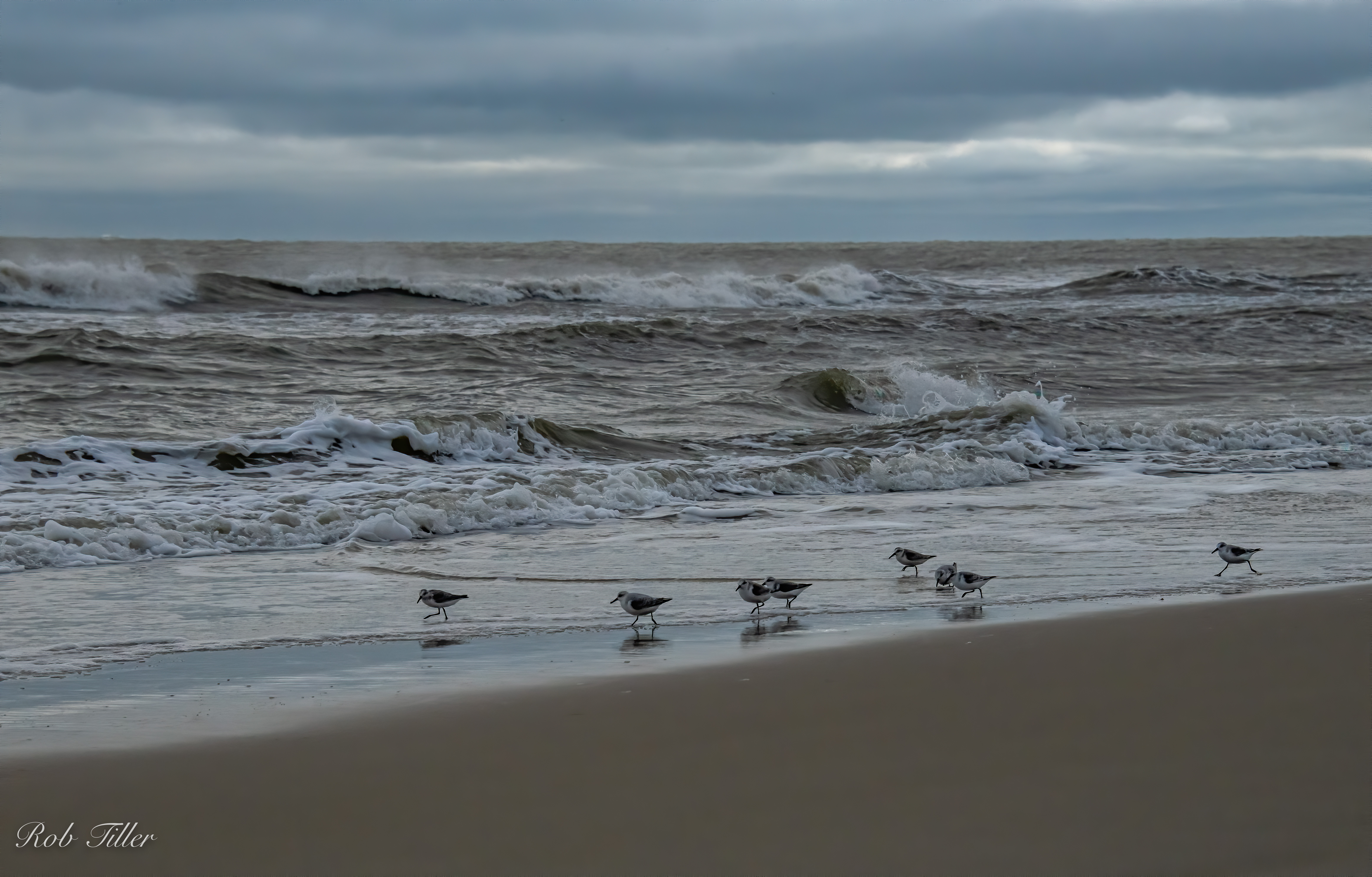
Corolla, NC, shortly after sunrise and shortly before high tide
Sally and I have been on a road trip for the last couple of weeks while our apartment was being painted. We visited beloved relatives and saw the sights in several eastern states, including the Outer Banks of North Carolina, where I took these pictures. The painters did a nice job. Thanks, guys!
Meanwhile, we all made history. Of course, that’s always true, but from time to time we’re particularly aware of a major shift. Getting rid of Trump is one of those moments.
Sanderlings
I won’t lie: the Trump years have been tough for me. So much of what he’s done has been directed against the things I took as hopeful and positive aspects of this country, like Americans’ usual tolerance, curiosity, and courage, and directed towards our fear, ignorance, and greed. He was surprisingly successful in bringing out the worst in us, and convincing many that there was nothing to be ashamed of. To some extent he created a type of alternative reality, where facts, rationality, and ethics were severely discounted.
After three days of vote counting, almost all election experts agreed that Trump decisively lost both the electoral college and popular vote. Oh joy!
Still, I was disappointed that there was not a massive repudiation of Trump. He seems to have won about 47% of the popular vote. Even more disturbing, he won well over half of white people’s votes, and increased his percentage of that group from the last election. How incompetent, dishonest, and racist would he have had to be to be buried in a landslide? Other than the obvious, what is going on with all those Trump supporters? More research is needed.
Wild horses at Corolla
Part of the reason for Trump’s showing surely relates to the long term Republican project to suppress votes by the opposition. Measures including gerrymandering, cutting early voting, closing voting sites in Democratic leaning areas, and requiring more voter IDs were part of the equation. So were threats and intimidation. The system we call democracy has been under attack.
To overcome those obstacles, Democrats, always a diverse and motley assemblage, had to pull together in an unprecedented effort. Amazingly, it happened. And now we’re finally done with Trump’s alt-reality. Or are we?
I expected that Republicans would need some time to process Trump’s defeat. It’s tough to lose. It’s emotional. So it wasn’t surprising that Republicans’ first reaction was denial. But now they’ve had some time, and there’s a problem.
Trump continues to claim, contrary to overwhelming evidence, that he won the election. Just as he promised, he is refusing to acknowledge defeat and cooperate in a peaceful transition. Few Republican leaders have rejected what could be construed as an attempted coup d’etat. This is, to put it mildly, unprecedented.
It’s admittedly a strange thing to say, but there may be an upside to Trump’s profound corruptness. It could easily be that his lust for wealth at all costs, rather than all out treason, is what’s driving his latest ruse. He’s reportedly soliciting donations for his election challenge fund which will actually be going to his personal slush fund.
In any case, there’s a clear upside to Trump’s incompetence and stupidity: whatever his despicable hopes and dreams, he’s unlikely to engineer anything nearly as complicated as an overthrow of the government. So far, his supporters have remained peaceful, and some of them are starting to come to terms with losing. Two cheers for that. This painful episode may soon feel as strange and immaterial as a bad dream, as a new day dawns. Fingers crossed!
We’re getting ready to have our apartment painted, and it feels a lot like getting ready to move. All the books are coming off the shelves and going into boxes or the used bookseller, and some old furniture is going to charity or the dump. It’s unsettling, but we’re ready for some new colors. Change can be good.
We’re feeling a little shaky as we enter the home stretch of the presidential election. I still haven’t recovered from the shock of the disastrous election four years ago, and I doubt those scars will ever heal entirely. Of course, we all always knew, anything can happen, but the 2016 election was a point when we realized, truly, anything could happen. That is, of course, still true.
But it’s also true that we know a few things we didn’t in 2016, and we’re learning more all the time. We may or may not have hit bottom for degraded hypocrisy by Republican Senators with the confirmation process for Judge Barrett. But one good moment in the process came from Senator Sheldon Whitehouse (D., RI), who managed to shed a bit of light in the darkness.
Specifically Senator Whitehouse called out the contributions of millions of dollars in dark money that went into confirming Trump’s Supreme Court nominees. That is, boatloads of money from rich individuals and corporations have been and are being spent to get a Supreme Court that concerns almost exclusively with the well being of corporations and wealthy people, and the favored beliefs of one type of religion. It should be shocking.
A new report by Senator Whitehouse, Senator Warren, and others gives more details about the dark money and its success in controlling the courts. It’s here.
The enormous changes that the rich have wrought in our society in the last 50 years are the subject of Kurt Andersen’s new book, which I’ve almost finished. In Evil Geniuses: The Unmaking of America (A Recent History), Andersen gives a lively and readable account of changes in politics, law, and finance that quietly transformed our lives. The elites got much, much richer, and most everyone else got leftovers.
As Andersen explains, the ideas behind the changes were not complicated. The main objectives were and still are about lower taxes for rich people, and eliminating regulations on corporations. The implementation involved enormous expenditures by people like the Kochs, Scaifes, and Olins to maximize political influence. Beginning in the 1970s, they cleverly normalized their extreme position by establishing a network of conservative think tanks, endowed positions for friendly academics, politicians, and eventually, judges.
Among the happy recipients of all that dark money was the Federalist Society, which engineered the nomination of Judge Barrett and boosted five current Justices, not to mention many other federal judges. The group has been funded by a rogues gallery of super wealthy right wingers, including the Kochs, Olins, Scaifes, andMercers, and now gets millions of dollars annually from such sources.
The publicly expressed ideology of the Federalist Society is all about freedom, constitutional rights, and tradition. Much of its actual work is all about making sure the rich get to keep all the money they have and get a lot more. Otherwise, group members generally support right wing positions on social issues of special interest to a regressive branch of Christianity, including abortion, gay marriage, and maintaining the racial status quo.
As Andersen explains, we arrived at our current situation of oligarchic control and extreme inequality in small steps, many of which were legally and financially complicated. Most of us didn’t even realize the takeover was happening. But with raw and unapologetic power plays like the Barrett confirmation process, the big picture is snapping into focus: one nation, under God, with liberty and justice for the rich.
Getting to this point took a very long, careful, intensive effort on the part of the super greedy. The good news is, the brutal oligarchic system we’ve now got is not set in stone. We can change it and make one that’s fairer and more compassionate. It may be we’re just about to start that work. We’ll have a better idea in a couple of weeks.
One quick postscript to my post of October 9 regarding Judge Barrett, Justice Scalia, and originalism. Erwin Chemerinsky, an eminent constitutional scholar, reinforced a couple of my points in a NY Times op ed this week . He notes that originalism is not at all what it pretends to be, in terms of its certainty and objectivity. He also points out that some of its positions run directly counter to our basic ideals regarding equality.
There are a lot of different ways of looking at the world, aren’t there? Although President Trump looks to be headed at full speed towards an election cliff, I still keep hearing startling interviews with his supporters. There are some who think he’s honest and effective, and they like his style. They find him both admirable and lovable.
This week I heard normal seeming people saying it’s unfair to tag Trump as racist. Didn’t they hear him calling neo-Nazis very fine people, and telling the Proud Boys to stand by? What’s going on? I have a few thoughts.
Racism is not the only problem we’ve got in the U.S., but it’s a big one. Not so long ago, I thought white people (my birth group) were making great progress in putting behind us the myth that people of color are inferior. We’d enacted laws requiring racial equality, and started seeing the pervasiveness of more subtle discrimination.
So I assumed that when Black people started pointing up the fact that they are too frequently targets of police violence and other discrimination, most white people would be receptive and sympathetic. I figured those who were unaware would want to learn more. I thought most everyone would be interested in how to fix the problem.
And happily, a lot of white people have spoken along these lines. But there has been a strong counter reaction by others. The storyline for them goes something like this: Black protesters are violent ne’er-do-wells who are unfairly targeting the police, who have done nothing wrong. The real problem (in this view) is how to stop the protesters, and how to prevent them from destroying businesses and invading the suburbs. White people, not Black people, are the real victims.
This upside down storyline has been promoted in right wing media such as Fox News and Rush Limbaugh-type talk radio, and, of course, President Trump. At first I thought the torrent of slick, angry, fear mongering media accounted entirely for the right wing narrative. That is, I imagined that those who saw white people as the true victims were were overwhelmed by the propaganda of Fox and its various friends, and simply not getting enough correct information.
But I’ve come to think this is not a complete explanation. There are some who fail to see the point of Black Lives Matter protests who do not live entirely in a right-wing media bubble. They are exposed to other information sources. For them, the problem is not lack of information, but something more complicated.
I don’t have all the data, of course, but I assume Trump supporters are in most regards the same as everybody else. That is, we all have basically the same physical make up, the same genetic components, and the same brain structures. There are individual variations among Trumpists, with some being loud and obnoxious, and others quiet and thoughtful. I’m sure there are many who are loving parents, good employees, and charitable community members. There are certainly some that I like as people and respect, except for their Trumpism.
The big difference between us has to do with information processing. We ordinarily think that if we see, say, a star, everyone in the vicinity is seeing the same thing. Similarly, if we hear a story about children being separated from their parents and held in cages, or about hundreds of thousands of people dying in a pandemic, we think our reaction is about the same as everyone else’s. But this, it turns out, is not necessarily so.
We don’t usually think of reality as something we each create and maintain with our brains, but it is, in a way. As infants, we learn to distinguish significant from insignificant, and pay attention mostly to those things that are either pleasant or threatening. Eventually we learn how, without conscious effort, to filter out the great majority of sound waves, light waves, and other potential stimuli.
We couldn’t function otherwise. Our brains don’t have the processing power to render coherent all the sound, light, and other physical activity around us. We can choose to train ourselves to notice some things we might not otherwise notice, like rocks that may actually be fossils or meteorites. But in general we take the mental framework we’ve built up, and don’t perceive much outside of it.
Our social reality is similar, in that it’s something we each construct, piece by piece. We start as infants learning who and what to trust, and who and what to fear. We accumulate a library full of working assumptions about what sort of behavior is normal, and what sort is alarming. And we situate ourselves in communities of people with similar assumptions about normal and abnormal ideas and behavior.
There are significant advantages in being in a community with its own culture. We can outsource a lot of the work, relying on others to detect threats or opportunities. The community helps its members with food, clothing, and social contact. But the community also imposes restrictions. These include the requirement not to question basic assumptions of the community.
So for example, in a mining community, raising questions as to the risks of global warming may be unwelcome. For a long time, I assumed that in such situations, many people might have doubts on factual or moral questions but consciously keep quiet about them, so they could remain community members.
But now I’m thinking it’s more likely that they have no doubts. That is, if being in a community requires that you believe something, you may well sincerely believe it — even if it has no factual basis.
And if there’s a challenge from outside the community to the belief (such as, say, a broad consensus of expert opinion that man made climate change is happening and potentially disastrous), it takes no conscious effort to ignore it. You don’t register conflicting information, or instantly dismiss it. The belief carries with it a kind of filter that traps and isolates dissonance, so that inconsistent information has no effect on the thinking of the community.
How could we test this theory? We could do surveys or brain scan experiments, and probably should, because it would be helpful to get more data about how our minds can settle on conclusions at odds with our basic moral principles and all known evidence. But in the meantime, it’s worth keeping in mind the possibility that people develop thought patterns that have nothing to do with physical reality while remaining otherwise sane and productive members of the community.
This week I had a minor epiphany listening to an interview with a Trump supporter. The supporter was defending Trump against what he viewed as unfair charges of racism. When the interviewer asked how he’d describe racism, the supporter gave a surprising explanation: it’s when you consciously hate Black people and want to hurt them. The Trump supporter said he’d never personally known a racist.
Conscious hatred and malice is a very narrow definition of racism, obviously. For this Trump supporter, and probably a lot of others, racism is not a big problem, because as they define it, it is only rarely found in the real world.
This would explain why Trump supporters reject and resent suggestions that they themselves are racist. They don’t consider themselves malicious towards Black people, and think it’s unfair that anyone one would think that of them. This is understandable.
But racism is actually much broader. A fair understanding of racism takes in a range of attitudes and behaviors, from violence and hate speech all the way and to hurtful social slights and indifference. A lot of our behavior and institutions have strong and non-obvious assumptions as to one race being superior and others inferior. Under a broader definition, almost all of us are raised as racists, and are to some degree racist. Understanding and correcting for our own inherited and unconscious racism is hard work.
Isabel Wilkerson has argued in her new book Caste that it’s helpful to talk about the American system using the terminology of caste, rather than race. That is, the American system is in some ways like other caste systems of history, such as the Indian, South African, and German ones. Like us, other countries have had elaborate systems for defining degrees of inferiority and permitting oppression. Using this caste approach might be a good workaround for the definition problem with the word racism.
Anyhow, I now get why Trump may actually think he’s not a racist, and his supporters may agree. I would argue that redefining racism to exclude most of the actual social problem is nonsense driven by what we’ve traditionally called racism. But I don’t expect that will be at all convincing to Trump supporters.
For these supporters, I doubt that any unapproved argument will get through the filtering system and affect their thinking. But even so, it’s important to keep talking, and maintain loving and respectful relations. Most of the time, we can have differing world views and still enjoy each other’s humor, intelligence, creativity, and affection. In fact, you never know how things will turn out. From time to time, people change their minds.