The Casual Blog

Category: technology

Piano v. synthesizer
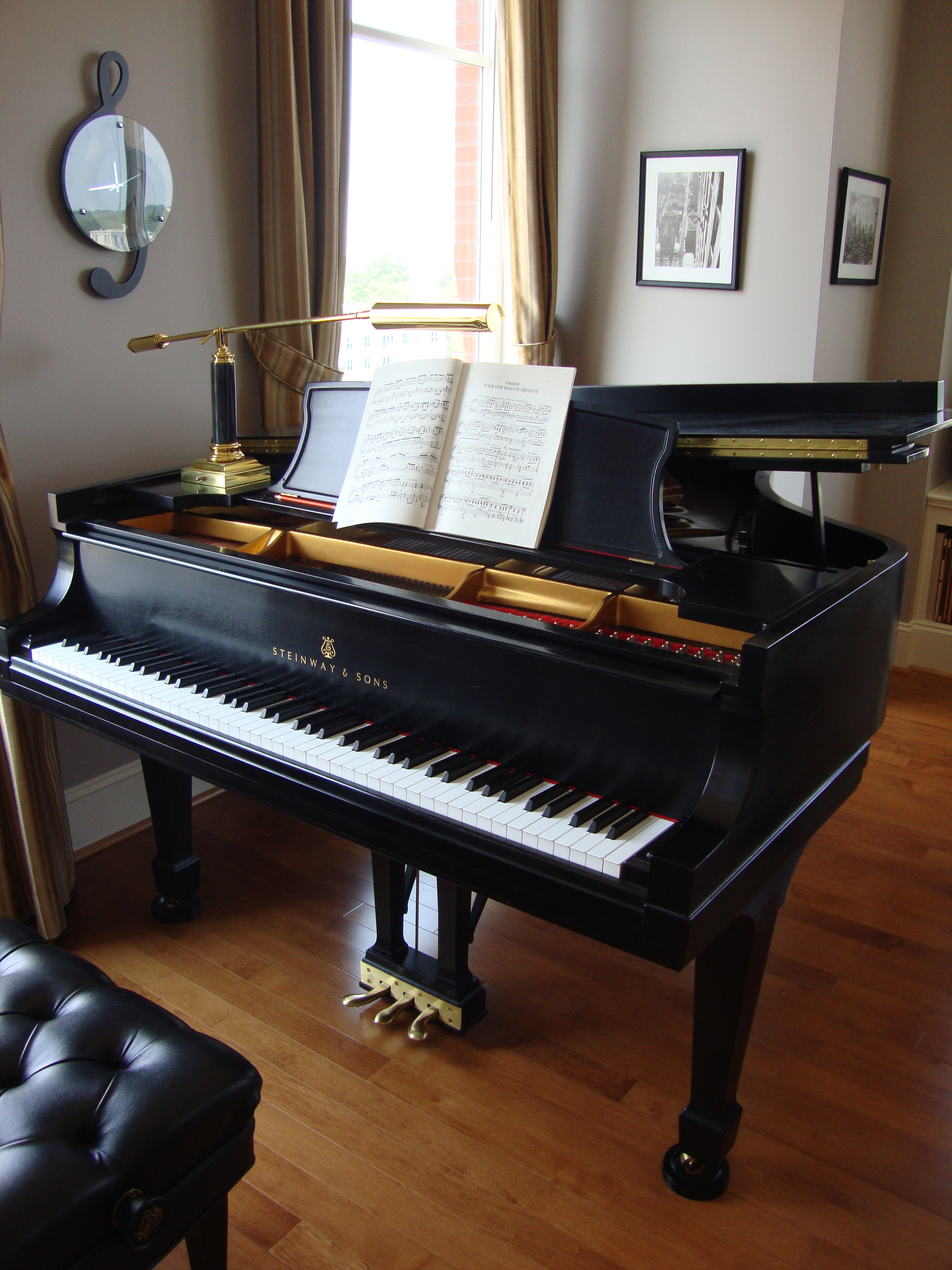
After several lessons, Olga, my new piano teacher, recently departed for Rumania for the summer, leaving me with a lot of musical ideas, but with no particular urgency to practice up for the next lesson. And so I found a sliver of time and energy to explore an area I’d been curious about for a while: musical technology and synthesizers.

My computing devices contain synthesizers and virtual studios, and after some casual experimenting I realized there’s a lot of potential for musical fun. Without any particular effort or expenditure, I have at my disposal musical tools that would have cost tens of thousands of dollars thirty years ago. But figuring out how to make them more expressive takes some time and energy.

My first objective was to make some techno dance music. It’s odd, I know, for a person with predominantly classical tastes, but I sometimes enjoy listening to this stuff when driving for fun. GarageBand, an Apple program, includes prefab loops that can be used for this purpose, and I soon had some sonic space that was reasonably entertaining. I then got curious about what else could be done, and started to experiment with non-pre-fab elements. It was sufficiently fun that I bought a cheap MIDI keyboard and a little wireless auxiliary speaker.

This was a significant step, because I have a strong prejudice against electronic keyboards. The interface looks like that of a real piano, which is deceptive, because the two instruments are very different. A great piano, like my Steinway grand, allows for a subtle connection between the human and the string. The basic technology is now antique (19th century), but still, they have thousands of parts and are said to be among the most complicated mechanical machines on earth. Each piano is also an individual, in a way that each electronic keyboard is not. The wood comes from particular trees that grew as they grew in a particular place during particular years.

A great piano has the capacity for nuance. I used to think of a key on the keyboard as similar to an on-off switch, but Olga persuaded me this is a mistake bordering on sacrilege. Her thing is to focus on nuances of touch and the associated nuances of sound. She hears details so tiny that it took a while for her to convince me they really existed, another period for me to begin perceiving them, and another period for me to begin to use them. It’s a little embarrassing to admit I was previously barely aware of this level of listening and touching, in spite of many years of making music.

Once you begin really listening hard at this level, the experience of music changes. There’s good news and bad news. It’s harder to reach a point of complete satisfaction with a performance, but at the same time the experience is richer and deeper. Anyhow, there’s no going back. Once your ears are opened, focused concentration on subtle nuances seems essential to any significant musical experience.

In revealing a level of this, Olga did a demonstration of various ways of touching C-5 for different colors of sound. One way she thinks of the touch is like dance, with the gesture of the hand choreographed to produce a particular color. Speaking of the subtle differences in sound produced by different gestures, she said (with a Russian accent), “I don’t know why it makes a difference. It just does. The piano is a mysterious instrument.”

Electronic keyboards are complicated, but somehow not mysterious. I have doubts that digital sound creation will ever be as personal and emotionally rich for me. But there is an amazing variety of things that the synthesizer can do. It’s different, and it’s good to change things up from time to time. So I’ll be experimenting, and see where it leads.

Emergency diving, cell phone woes, and a new gym

With almost a hundred logged dives under my belt, I’ve decided it’s time to improve my emergency and first aid skills. This is not to suggest that scuba is particularly hazardous, which ordinarily it’s not. But as with any human activity, accidents will happen. Understanding common accident scenarios is a great way to minimize risks. Plus, it would be a great thing to help a person out of a crisis — and a terrible thing to watch a serious accident unfold where help might make a difference, but be unable to help. I’ve signed up to take the PADI rescue diver course next month, and I’ve begun working my way through the materials.

There are a lot of risks we can’t do much about as individuals, including technology failure. It’s scary how dependent I am on my digital devices, though it isn’t usually noticeable. The dependency came into focus quickly for me this week, when my cell phone inexplicably quit working.

It turned out that it was not simple or stress free to get help from AT&T. I spent more time than I wanted scrutinizing their website, and couldn’t find a service phone number. I tried their online “chat” service, which took 10 minutes to get connected and 10 minutes to get questioned, after which I was disconnected as “timed out.” The next day at lunch time I drove over to the place where I’d bought the phone, only to find they’d closed the store. Since I didn’t have a cell service, I couldn’t find another store that day.

Yesterday I drove to the closest mall with an AT&T store (Crabtree), where there was one dude tending the sales kiosk. Fortunately, he figured out how to fix the thing. He asked me how my day was going, and I told him he’d made it a lot better.

After I got cell phone fixed, I went to check out the local YMCA. Since my neighborhood gym closed, I’ve been in a state of mild gym withdrawal. Sally’s tennis pro suggested she check out the downtown Y, and she delegated the task to me. It’s good! They’ve got an adequate collection of weight machines, aerobic machines, and spaces to do exercise classes. There’s a swimming pool. What was distinctive was the staff — they were unbelievably friendly! I signed up with enthusiasm, and then did my first Y workout: an upper body circuit, forty vigorous minutes on the elliptical machine listening to Mozart’s Cosi Fan Tutti, and some yoga stretching.

Artificial intelligence, The Most Human Human, and a walk at Crabtree Creek

I’m still feeling odd and shaken by Watson’s victory over the human champions of Jeopardy. It is truly awe-inspiring that our greatest software engineers have created a program that behaves in some ways like human intelligence, but, at least as far as raw knowledge and research is concerned, much better. What’s unsettling to me is not just the economic implications of this new generation of artificial intelligence, but also the moral/ ethical ones. The new AI is getting very good at the sort of intelligence that we’ve always considered the crowning and distinctive feature of the human race. It’s now clear that our destiny is not to be the most intelligent beings in the universe. So then, what is it? What do we do?

Like Ken Jennings, the former Jeopardy champ who acknowledged defeat with becoming humor and grace, I also welcome our new computer overlords. They already are making daily life better in some ways. I recently had an encounter by telephone with a computer dealing with a travel reservation problem that performed substantially more efficiently than some humans. Later, when I found myself in a phone conversation with a human on another routine matter (activating a new credit card), as I tried to understand the person’s accent and waited for a sales pitch to conclude, I thought affectionately and longingly of my dear computer. Our computers are getting to be good clerks, and I expect they will soon be good scientists, doctors, and lawyers. The trend is clear.

So, what’s left to aspire to? I’ve been reading The Most Human Human: What Talking to Computers Teaches Us About What It Means to Be Alive, by Brian Christian (in the Kindle edition). Christian treats the implications of artificial intelligence for humanity in a lively way. He takes off from his participation in an annual competition for the Loebner Prize, which involves the Turing test. Human judges converse (via networked computers) with both humans and AI programs, and the annual prize goes to the program that does the best job of convincing the human judges that it is human. There’s also a prize for the humans that talk with the judges, and Christian competed for this: the most human human.

The success of some programs points up how much of human discourse is routine and predictable. The weaknesses of the program show that there’s still some human behavior that is creative and (so far) unpredictable. Christian uses the Loebner Prize as a jumping off point for an entertaining, though jumpy and digressive, introduction to AI and its philosophical implications.

As Christian notes, humans are distinguishable from programs with respect to the physical world. We have bodies that are, in their non-rational way, intelligent. Our cells are connected with each other, and our individual bodies are connected to other humans, other species, and the earth, the air, and the Sun. We depend on all these connections. As obvious as this sounds, we still as a race we have trouble keeping in mind our connection to physical reality.

This may be part of the explanation for the right-wing attack on the environment. In the NY Times today, there’s a front page story by with the headline Push in States to Deregulate the Environment. As the story notes, Republicans in North Carolina are proposing enormous cuts to the budget of the NC Department of Environment and Natural Resources. I’d been monitoring the NC story, but learned that the same thing is happening in other states. At the same time, the Republicans in Congress are looking to cut the EPA and gear back environmental regulation.

What is the matter with these people! In the midst of ongoing extinction of entire species and global warming that threatens entire human populations, there should be no debate about the need for new and more effective conservation of natural resources. I have assumed that the opponents of science and environmental regulation are either unbelievably ignorant or unbelievably greedy and cynical, concerned only with immediate short-term gain and without concern for future generations or the earth itself. But to give them a slight benefit of a doubt, perhaps the problem is that they’ve really lost touch with their bodies and the earth.

Anyhow, in addition to enjoying new AI tools, I’ve been trying to make a point to spend a little more time outside. This morning I went to the swamp area of Crabtree Creek off Raleigh Boulevard. It was overcast and windy, but there were hundreds of birds singing and flying. I walked along the boardwalk at the side of the swamp. There were six great egrets, several great blue herons, and numerous swifts and swallows. I saw a black-and-white warbler, a phoebe, a yellow-rumped warbler, cedar waxwings, and heard, along with the common residents, a parula, and a hooded warbler, as well as a handful of songs I couldn’t identify. I love the spring migration season. It’s good to just clear out the mind and just look and listen.

Technology, new art forms, food, and ballet

I’m fortunate to have a ring side seat as information technology is transforming the world, but it doesn’t always look pretty. It makes me wonder, at times, whether, as machines get smarter, humans on average are becoming more and more like the race depicted in the wonderful animated picture Wall-E: fatter, lazier, and dumber. But I haven’t given up all hope, and there are some signs pointing the other direction.

A case in point: this week when my son Gabe (pictured here at Alta last week) sent along his first self-produced short video, which is here. He shot it with a tiny body cam over the course of 3 days skiing in Telluride, CO. The finished product reminded me strongly of some of the beautiful skiing we did together. It’s hard to describe the complex sensations and emotions of skiing far from away from the crowd when its steep and deep, but Gabe managed to convey some of it. The flamenco score heightens the sense of edginess — wild joy with stabs of fear.

Good skiing sometimes seems like art, almost like dance, but the work is seldom shared with other humans by the skier-creator. Until recently, filming the experience was a costly and difficult undertaking. In the past couple of years, though, video cameras have gotten much cheaper as well as tinier, and easier to use, and the software for recording and editing has become highly accessible. The tools for communicating the work instantly and almost cost-free over the internet now exist. The learning curve for use of all this technology is short. And so a new class of artist is being born — the skier-auteur. Technology advances are likewise enabling new types of musical expression, and undoubtedly many other artistic expressions. Perhaps the day will come when everyone will be an artist.

Is food art? I argued about this years ago with my friend Tom, a gourmand who took a strong position that great chefs were artists. Over the years, I’ve moved closer to his position. A great restaurant is a multi-media experience, with sets, lighting, sound, and actors, and also smells and tastes.

Last night Sally and I tried a new Thai restaurant off of Moore Square — Fai Thai. It has replaced the Duck & Dumpling, an Asian fusion spot that was one of our favorites, and that we were sad to see close. The emphasis is less on standard Thai fare than on local ingredients and variety. The decor changes involved colorful parasols and lanterns, which were engaging. The menu had fewer vegetarian options than we hoped, but enough to get started. We found the three dishes we tried each quite different and delicious. The spiciness hit the Goldilocks point — not too much, not too little. Our waiter was friendly and attentive, and the manager took some time to talk to us about the aspirations of the place. He appeared to take on board our suggestions for more attention to vegetarians. Thai food fans should try it.

After dinner, we saw the Carolina Ballet perform Carmen. This is the third time we’ve seen the company do Weiss’s ballet, which is one of our favorites in the repertory. Bizet’s music is unforgettable, and the story is sort of perfect for ballet — love, jealousy, death. For all my admiration of Peggy Severin-Hansen’s great talent, I had my doubts about her as Carmen, who is a sensual, cynical heartbreaker. Peggy’s long suit is purity and innocence — the perfect Firebird. Her Carmen was sweeter than normal, not completely cynical, but this turned out to give the tragedy a new bit of bite — more tragic in a way. Richard Krusch as the Toreador was highly serious, and convincing. He’s a fine dancer who keeps getting better. As always, the story ended with a violent shock, but the production was wonderful.

Artificial intelligence, vanishing legal jobs, and art

Is technology rendering humans obsolete? The answer is, as to some activities, yes. But could it help us better understand our true nature? It could.

Last week the NY Times reported that new computer programs were able to do legal review of electronic documents more accurately and much cheaper than human lawyers. http://www.nytimes.com/2011/03/05/science/05legal.html?scp=1&sq=computer%20legal%20document%20review&st=cse This is a milestone in technology, and one with big implications for the legal profession, and other professions, too.

In my professional capacity at Red Hat as a purchaser of legal services, I’m happy to consider using these money-saving tools. And having as a young lawyer spent hours doing dreary document review, I’m happy to think that humans may be able to hand such drudgery off to computers and do more stimulating things with themselves. But lots of law firms survive and thrive by selling document review services. Automating such work will cause painful dislocations, as many legal jobs go down the tubes.

It’s strange to think of part of lawyering going the way of the gas station attendant. As computer-driven technology replace partially or completely entire categories of work, such as huge swathes of manufacturing, educated professionals have assumed that they were immune. But that is clearly wrong. The triumph of Watson on Jeopardy a couple of weeks ago and the success of legal document review programs shows that more change is on the way.

This is somewhat frightening. But it also forces us to confront the interesting question of what we can usefully do, other than the logic-driven work that computers are now taking over. Since Peraclesian Athens, we’ve assumed that human reasoning was the crowning glory of creation, but we need to revisit that understanding of nature, and human nature.

A few months back I read The Science of Fear, by Daniel Gardner, which offers some interesting thinking on the inherent flaws in human rationality. Gardner focuses on how we systematically underestimate some risks, like the risk of highway accidents, and overestimate others, such as the risk of terrorism and violent crime. Our journalism establishment is heavily invested in promulgating scare stories on such subjects, and we seem in general to like such stories, or at least eat them up. Gardner discusses the psychological basis of this odd characteristic, and the possibility that with more quantitative analysis we could work around the problem. I’m in favor of more careful quantitative analysis of problems, but I doubt that will much affect how human minds work.

David Brooks wrote a surprisingly thoughtful (especially for a conservative) column in the Times this week about human nature. http://www.nytimes.com/2011/03/08/opinion/08brooks.html?_r=1&src=me&ref=homepage He posited that various kinds of scientists are coming to think of humans are fundamentally social, and that it’s a mistake to think of them as isolated individuals. He also emphasized that our unconscious, emotional capacities are more important than our reasoning. In other words, the way our minds work is mostly non-rational. We aren’t just poorly fashioned reasoning machines, but a different kind of being.

This is worth a lot more exploring. There are various things that humans do that are non-rational, but not unintelligent. Artistic activity is a prime example. When we sing or dance, we’re connecting to our selves and others in a way that is richly human. Telling stories in various media is a constant of our lives. These are things that we as a species are really good at, and we enjoy. They aren’t peripheral to our lives and culture — they’re central. Our computers may get at making art, but they can’t replace us in those activities, because we realize ourselves in them.

Watson, human games, and the twilight of the gods

Sally and I flew out to Telluride, CO yesterday for a late winter ski adventure. On the flight from Raleigh were our good friend Charles and Chuck, and we looked forward to meeting up with Gabe and Jocelyn. The flights took off on time and progressed in an orderly way. I made some progress getting through back issues of The New Yorker, Scientific American and Golf Digest, listened to Mozart and Debussy. And as often happens when I travel at 35,000 feet, I found myself in a contemplative mood. As Garrison Keillor says of his private eye character: one man’s still trying to find the answer to life’s eternal questions.

What is the meaning of play? When humans have taken care of the essentials — food, clothing, shelter, sex — it is a large part of what they do. I suspect the same is true of all animals, based on the birds, squirrels, fish, cats, dogs, and other creatures I’ve observed. They all love to play. Children love to play. Put a random group of four-year olds together and a game will almost always develop.

The games people play vary widely according to their age, traditions, fitness, intelligence, financial resources, and moxy. Some like skiing, some prefer bowing. Some go for chess, and others like checkers. The arts are unquestionably a form of play; we even refer to musical activity as playing music. A lot of our verbal activity has little to do with survival and qualifies as mostly play.

Smarter-than-normal people tend to like games requiring a good memory and a quick tongue, and to view success in those games as a badge of honor. Before this week, we mostly felt confident that, whatever our weaknesses and failings, we were superior to all other known beings at such activities. After Watson’s triumphant performance at Jeopardy this week, that’s over.

I didn’t see the entire three Jeopardy sessions, but I saw enough to get the idea. The gifted engineers at IBM have taken artificial intelligence to a whole new level. (By the way, congratulations, guys.) Watson has incredible facility with language and memory. The humans never had a chance. I was reminded of the song about John Henry, the great swinger of the hammer, who drove himself to death but couldn’t beat the machine. (Bruce Springstein does a great high-energy version of the song.). Admittedly, Watson’s abilities don’t extend to the entire range of human intelligence. For example, it isn’t good at creative reasoning — yet. But the day when it will be considered hopelessly romantic to think that humans could be more intelligent than machines is well within view.

So where does that leave us as a species? Consciously or subconsciously, we justify a lot of atrocities on the theory that we’re superior as a species to all others, Could Watson make us just a bit more humble? Could it inspire a bit of self-examination? If intelligence isn’t our greatest achievement, if compared to our computers we’re not really very bright, perhaps we’ll come to view our most important defining characteristics as other human qualities, like love and kindness. What if we consciously cultivated those qualities?

Congratulations to courageous young revolutionaries of Egypt, and best wishes

Yesterday a group of brave young people in Egypt accomplished something astonishing. They rid their country of a tyrant. They did so mainly through peaceful but strenuous protests. The group is hard to sum up. They didn’t fit into one of the few usual story lines that Western news sources normally recycle, such as radical Muslims or corrupt elites. The protesters lacked a clear leader or ideology.

But one thing they had in abundance was courage. They faced a security apparatus famous for torturing opponents and making them disappear, an awesomely powerful military, and leaders with no apparent humanity or conscience. The faced a very real risk of widespread imprisonment, injury, or death. No one before had ever done exactly what they did. But they overcame their fears and doubts, and changed the world. Their accomplishment bears comparison to those of Gandhi and King — but they did it faster, with less bloodshed, and without a Gandhi or King.

Was technology an enabler of the Egyptian revolution? There were early stories about Twitter and Facebook facilitating organization of the protests. However, the protests continued to grow after the government crippled the internet. It seems too simple (and suspiciously western-centric) to give too much credit to Twitter. Still, it may have played a role. Even this possibility will make dissidents, and entrenched dictatorships, think differently about the internet from now on. It isn’t hard to believe that new internet tools will help humans organize more powerfully.

Exciting revolutionary moments have often been succeeded by periods of monstrous brutality, as in France, Russia, and China. But it doesn’t always work out that way. The revolution generation in the United States somehow managed to fashion a fairer government. Plainly, the young revolutionaries of Egypt believe it can be done. So we shall see. Whatever the outcome, I honor those courageous young Egyptians and wish them well.

A note on corporations and on a Porsche museum

Last week the Red Hat senior management team met for two days in Raleigh. We’re an international company with management that’s widely distributed, and so there were a few team members that I had not met before, and others I got to know better. They were for the most part lively and interesting.

So what is a corporation? In our meetings we spent some time discussing public ownership and shareholder value. But the profit motive is generic. Just as every human has to eat, every corporation has to make money. There are many ways to do those things. There are also many attitudes and activities that make a corporation, or a person, distinctive. The reason the workers get excited about coming to work (if they do) is something other than the excitement of enriching investors.

Red Hat has a lot of people who are passionate about their work, in part because of the exciting technological challenges, and in part because of a set of widely shared values. Our open source products grow out of values and customs that include transparency and collaboration. This is one of the things about the company that I find distinctive and inspiring, but it also presents challenges. In acting as an attorney, there are obvious limits to transparency, because attorneys must take account of and honor competing values, including confidentiality. There’s a built in tension in the value sets that’s challenging.

A special treat of the meeting was dinner at the Ingram collection in downtown in Durham. It’s a semi-secret institution that turned out to be a proper museum devoted to my favorite automobile, the Porsche. It had some 35 vintage and rare Porsches along with a couple of stray but also gorgeous new Ferraris. The Porsches included several historic 356’s, many variations of the 911 (though they didn’t have anything to line up with my particular 911s (Clara)) a Carrera GT supercar and a recent GT3. Some of the examples took years to obtain. They were all lovingly restored and displayed. One could trace the stylistic touches through the years that connected the designs organically, like DNA.

The Ingram collection could be viewed as conspicuous consumption that takes the category to a whole new level of wretched excess. But it felt more like the Rodin sculptures at the NC Museum, or the Frick collection in NYC. Frick’s former house, a mansion facing Central Park, contains a collection of old master and Impressionist art that is pound for pound one of the best in the world. I presume, without having studied the issue, that Mr. Frick was a robber baron with the worst of them. But whatever his personal failings, his collecting became itself a creative act. And so has Mr. Ingram created a sort of collective work.

It was interesting that the collection not only discourages photographs, but goes so far as to impound cameras from its guests. I can understand the need to be security conscious, but I wondered if anything else was going on. It did occur to me that if class warfare ever breaks out, the mobs with pitchforks might show up in a state of dangerously high excitement. But they might settle for a Porsche.

Copyright and musical creativity

One of the great things about my job as an intellectual property lawyer in a software company is that I get to play with some big ideas. Sometimes it’s fun. But I also have to deal head on with complex legal constructions that cause confusion and mischief. I’m thinking particularly of aspects of patent and copyright law. I’ve written a number of times, including this week on opensource.com, about the problem of bad software patents that hinder innovation. Another concern is the expansion of copyright law in a way that inhibits creativity.

I was fortunate to hear a lecture this week at Duke Law School by Jennifer Jenkins, who discussed aspects of copyright law as applied to music. She ambitiously took on the entire western tradition, starting with Plato, and was entertaining to boot. Although Jennifer didn’t summarize it like this, her examples suggested that copying has always been a part of the creative process in music. Laws against copying music are relatively recent, and they’re expanding and being applied at a more and more granular level. This blocks an important part of creative activity.

Viewing imitation and copying as creative forces is not the traditional way of thinking about creativity. But the traditional notion that technical innovation is principally the work of lone geniuses makes is largely a myth. There is no single inventive or creative act that does not actually incorporate a long series of preceding inventions or creations. If you look over the shoulders of James Watt, Eli Whitney, Thomas Edison, or the Wright Brothers, the inventions for which they are famous incorporated both many generations of preceding technology and the work of contemporaries. Brian Arthur, in The Nature of Technology looks at this process through the lens of evolutionary biology.

The same is true with music. Each creative musician takes the tools of preceding generations (scales, tunings, harmonic systems, instruments, notation systems, electronics, etc.) and tries to express something that’s both personal and universal. In some musical traditions, literal copying is an accepted procedure. This is certainly true in jazz and blues. It is difficult to imagine how either form could have developed unless later musicians borrowed from earlier ones. The same is true in the classical tradition, where composers borrow from other composers, and musician’s take the composer’s written text and performance norms of predecessors.

Jenifer threw out the idea that social control of music and reining in dangerous new sounds was a continuing theme of western civilization, from the Greeks, through the efforts of the Church in the middle ages, to the lawsuits against sampling by hip hop artists in our time. She pointed out that sampling technology made possible new forms of creativity, which our copyright system has quashed without any careful thought. Our repeated expansion of the term of copyrights has diminished the amount of material that our artists have to work with even as technology has expanded creative possibilities. Expanded copyright assures a wealth transfer from society at large to those with significant copyright assets, but serves no larger purpose. This policy really makes no sense as social engineering. And to the extent that it actually discourages and diminishes creativity, it’s just plain wrong.

The only consoling thought is that no amount of regulation will entirely stop the musical creativity. It is a fundamental human activity, like as eating and talking. If music were outlawed entirely, it would go underground, like alcohol in the prohibition era, or recreational drugs in our time. This may already have happened with certain genres of hip hop.

Until Jennifer’s talk, I hadn’t thought to consider myself particularly lucky that most of the music I work with is old enough to be in the public domain, so I’m not directly encumbered by the copyright problem. I refer to the great European piano music of the eighteenth, nineteenth, and early twentieth centuries. Although the music is written, there are many aspects of it that are unwritten. The tradition is passed along from teacher to student. It is a thoroughly unmodern, untechnological process. It’s a pleasing counterpoint to my highly modern day job.

For example, I got over to Durham again yesterday for a piano lesson with my teacher, Randall Love. Randy is an associate professor in the music department at Duke, and, like me, a graduate of Oberlin. (He was a year ahead of me, but our paths never crossed.) He has a speciality in fortepiano, and I originally went to him with a view to getting deeper into Bach. And I did. But in the past few years, he’s taken me much deeper into my current main interests: Chopin, Liszt, and Debussy. Our lessons are at irregular intervals, which I schedule when I feel it’s time to get significant feedback on a piece I’ve fallen in love with and tried to make my own. They usually last more than two hours. Although we begin by catching up on each other’s news, most of the lesson involves intense concentration and effort.

At the lesson yesterday, I departed from our recent pattern (no Liszt or Debussy) and brought Robert Schumann’s Arabeske Op. 18 and Chopin’s prelude in C. The Arabeske begins as a light, lyrical game but has sections of brooding and dreaming. I thought I played it rather well the first time through, but Randy found many aspects in need of closer examination, such as various ways to treat the appoggiatura. Although we mainly discussed musical issues, such as balance and phrasing, Randy had some interesting ideas relating to technique involving the wrist and arm. He recommended that I consider more arm focus when playing extremely soft.

After I’d played the music I’d prepared, Randy played for me one of Chopin’s most famous concert works, the third ballade. It’s a gorgeous piece of music, and I enjoyed his interpretation. It was a well modulated, thoughtful approach to the musical ideas, with ample sonority in the big parts. What a rare treat to get a personal performance by a concert artist.

Accessing a delightful comic opera

On Saturday I went to my first live opera in a movie theatre: Don Pasquale, transmitted live in HD from the Metropolitan Opera at Lincoln Center to Raleigh’s North Hills Shopping Center (among hundreds of other theatres around the globe). When I lived in New York, I sometimes bought the best tickets I could afford for the Met, which were for standing room. There were always people who left after act one, so it was usually possible to get a good orchestra seat for the rest of the show. And so I learned that the Met is a magical place, with some of the most incredible singing on the planet, and also some of the most astonishing stagecraft. It was great to be back.

I put my interest in opera on the back burner after leaving New York for law school, and with the normal pressures of career and parenthood it fell off the priority list. I’ve come back to it recently with fresh enthusiasm. Part of the reason was my passion for the piano music of Chopin. He enjoyed what we know as the bel canto repertory (Donizetti, Bellini, Rossini), and I started listening to that music to better understand his musical thinking. It’s a kind of time travel, a visit to another culture that’s both submerged and still alive. A lot of bel canto music is not particularly deep, but it is charming and at times brilliant.

Sally took her tennis team to the state finals in Winston-Salem this week, and so was not able to go to Don Pasquale. Diane, Sally’s mom, is a big opera buff, and we went to the show together. I sent an email to the Red Hat local employees’ list offering her ticket for free, and Roger H. accepted. I had not reckoned on how difficult it would be to find parking at North Hills, and we ended up running late. Roger came to the rescue. As we circled the parking lot, he called my cell, and said he was saving good seats for us.

James Levine conducted. The camera faced him as he did the overture. He was very expressive, at times smiling, at times heroic, and full of enthusiasm. He’s had many health problems recently, and I felt privileged to see him, especially in this revealing aspect. He’s a national treasure.

Don Pasquale, which was new to me and to others I talked to, is the 64th of Donizetti’s 66 operas, first produced in 1843 (when Chopin was 33). It’s a comedy that concerns young lovers’ efforts to overcome the aged don, who fancies himself a young lover, and unite. The plot is not especially intricate or elegant, but the main characters are funny and lively, and the music is a masterpiece of the tuneful bel canto genre. Anna Netrebko was fabulous as Norina — flirtatious and sexy, even if she had put on a few pounds, and with an amazingly powerful and flexible voice. Barry Banks was Ernesto, her lover, and though his character was less interesting, his singing was very musical. John Del Carlo was hilarious as the Don. The photography was skillful, with varied angles and close-ups, and the sound quality was good. There were English subtitles. The music was delightful throughout.

Between scenes, the broadcast showed the work backstage on scene changes. I love backstage views, and getting a close up of how the magic works at this state-of-the-art theatre was fascinating. There were also good-natured interviews by Susan Graham with the principals. We also had a chance to get to know Roger, who grew up in Hong Kong, and briefed us on the music scene there. He said he really enjoyed the show.

Opera is an acquired taste. Once acquired, it’s incredibly enjoyable, but initially, it can seem mannered, strange, or boring. The audience for opera has always been limited, partly because it’s been so difficult to try it out and get accustomed to its conventions. It’s wonderful that the Met is using HD simulcasts of high quality to multiply by orders of magnitude the opportunities to experience this great art. I expect there will be many who try it and like it. I’m looking forward to seeing many more.