The Casual Blog

Category: sports

A juicy yoga class and other educational experiences

As much as I really love yoga, I go back and forth on Yvonne’s once-a-month Juicy Flow class at Blue Lotus. I like doing a class on Saturday mornings, and I like Yvonne, but I have the same issue the first Saturday every month.

Rather than her usual hour-and-a-half of Vinyasa (which is a lot), Juicy Flow is two hours, with a lot of fast movements. It’s eclectic. She puts a lot of thought into the music mix, which can range from goofy 80s pop to the world. In terms of movement, it’s always different, and there’s always something lively and fun. But it’s always exhausting, and tends to make me sore for a couple of days afterwards.

I was particularly hesitant about Juicy Flow this week, because I’ve been having some issues with my shoulders, and the class ordinarily stresses those parts. But I decided to give it a go. As usual, she’d come up with some demanding variations of traditional asanas, and several three-minute-long Kriya sequences of fast, big movements, including shoulder turns, squats, rolling up and down, scissoring legs, and open palm punches. There was also some free-form dancing.

Like every good yoga class, it was a learning experience — finding out some new things about what my body can and cannot do, and what the possibilities are. It was sufficiently demanding that I was not thinking about much of anything other than Yvonne’s directions. The two hours went fast. It was sweaty and exhausting, but also fun, and left me feeling amazingly calm and relaxed.

I was pleased to see news reports this week that Harvard and MIT are starting a free online education initiative called EdX. I might be interested in some courses. In fact, I’ve been auditing Michael Sandel’s Harvard course on justice (i.e. theories of ethics) through iTunes U. I usually watch Sandel or a Ted Talk in the early morning while getting my heart rate up on an exercise machine. It gets my head going.

Opening up the Ivy ivory tower strikes me as a very good thing for society in general, and I hope a lot of people will use it for continuing their education. It’s worrisome that anyone could think of college as the completion of an education. Seriously, has there ever been anyone who is reasonably well-educated after four years of college? College is kindergarten for adulthood. Getting fairly well educated takes a long time, and even then, there’s always more to explore.

Utah skiing, a relaxing massage, and The Righteous Mind

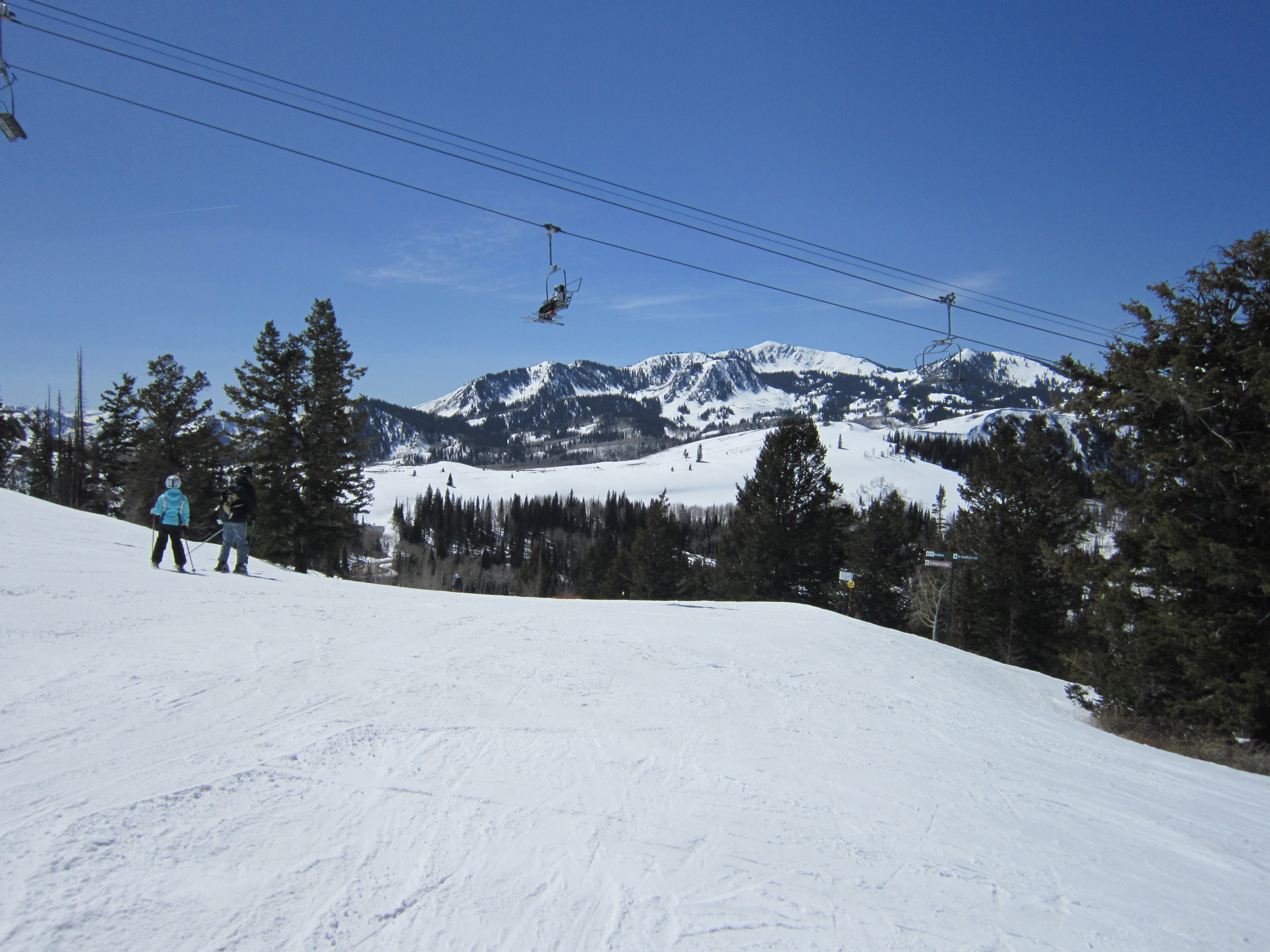
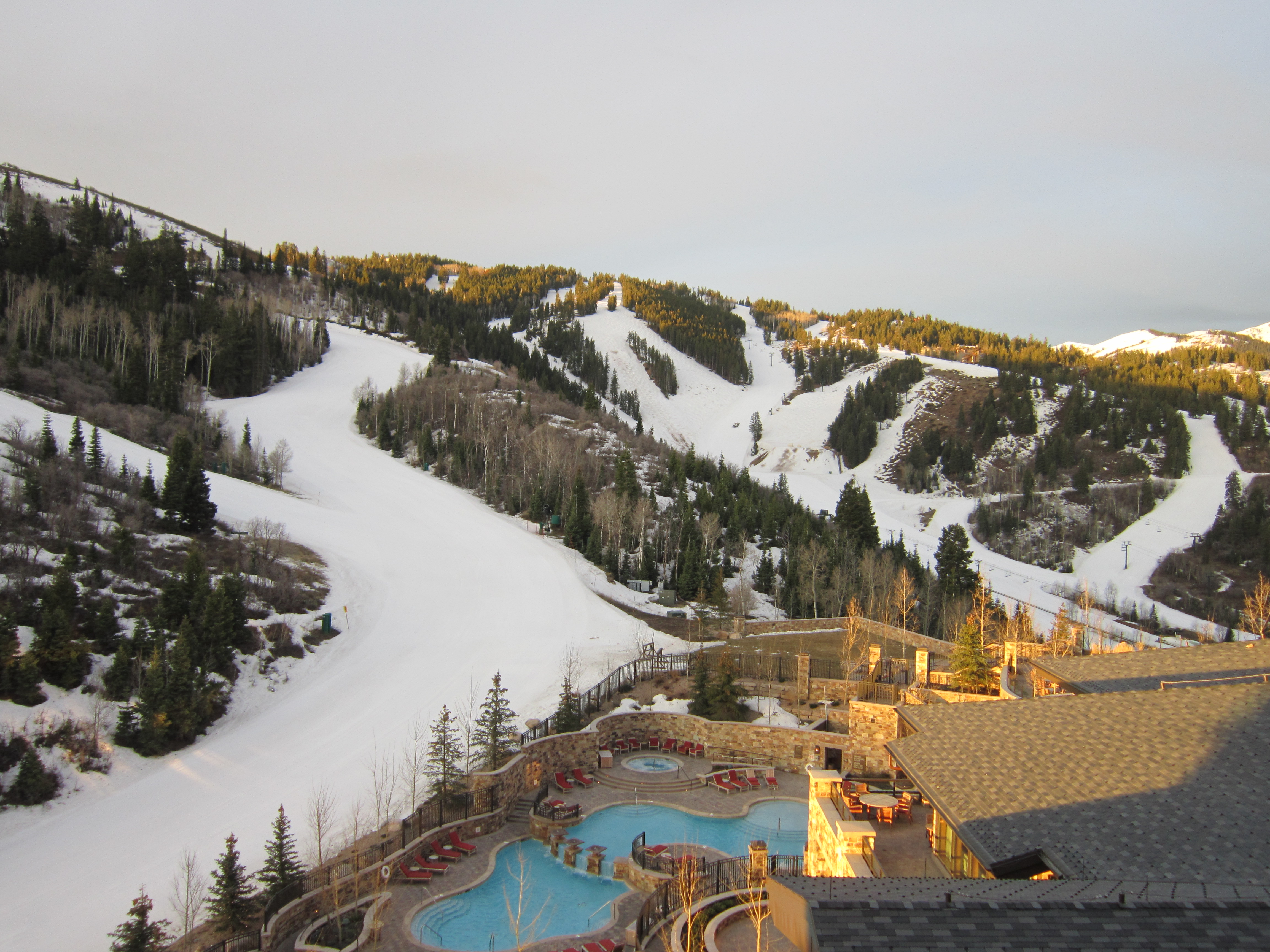
The view from room at Deer Valley, Utah

Last week I had some meetings in Deer Valley, Utah, and also managed to get in one last bout of skiing for the season. Deer Valley is famous for coddling a high-end clientele with personal service and carefully groomed slopes. This doesn’t sit well with my personal skiing value system, which is more about rugged natural beauty, self-reliance, adventure, and transcendence. But I have to say, particularly in variable spring conditions, Deer Valley was pretty sweet.

At my hotel, there was friendly, attentive service. A personable young people offered to help you get boots on and off (to which I said no thank you), and carried your skis on and off the slopes. I rented Volkyl Mantra skis, which Gabe had recommended last year. They turned out to be a good choice – a very versatile all mountain ski that performed well in powder, packed powder, crud, and mush, all of which I eventually experienced. It was reasonably quick edge to edge, stable when carving at higher speeds, and workable in bumps and trees.

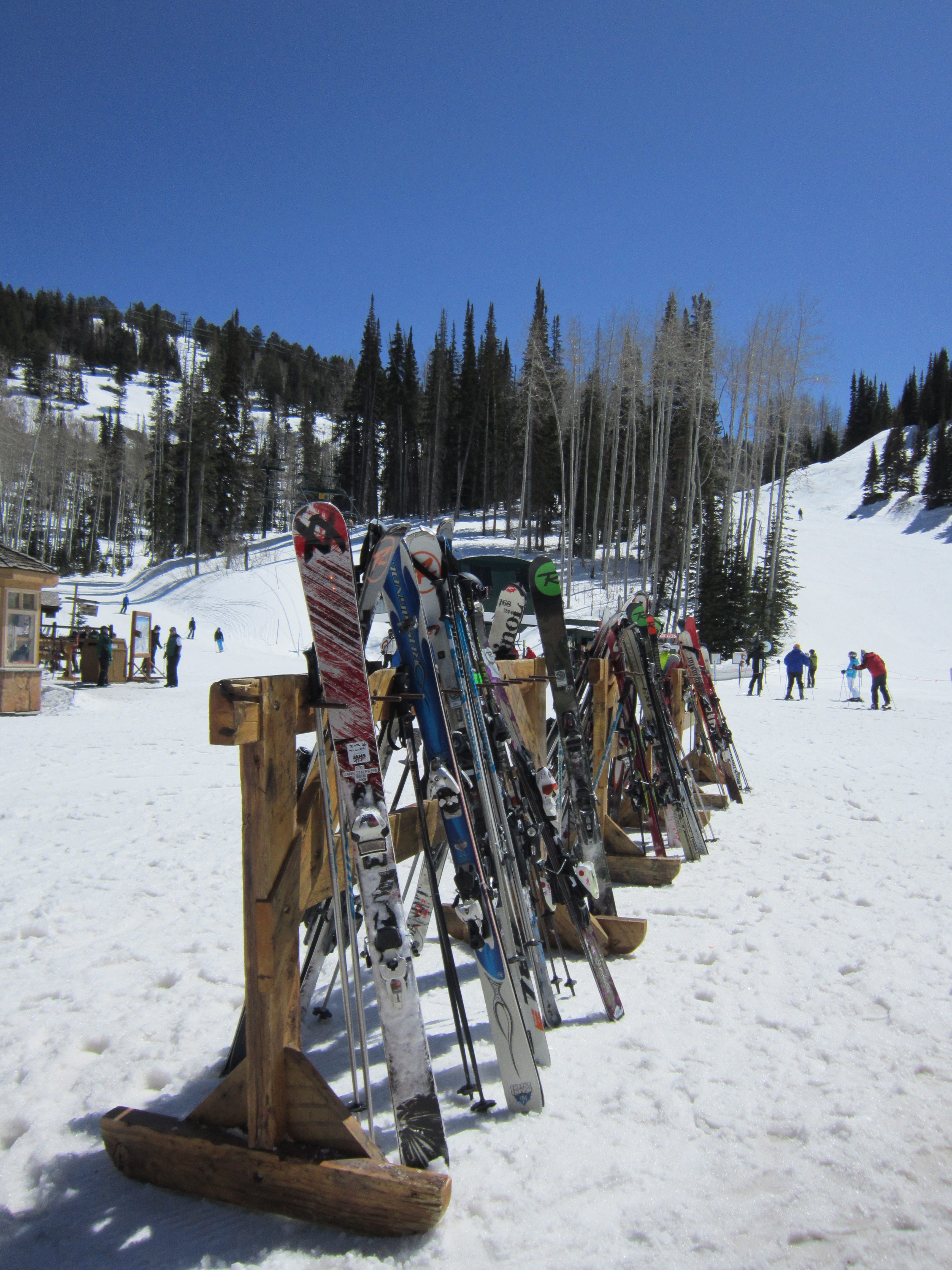
My rented Volka Mantras (the red and white ones on the end)

It’s been a disappointing year for snow over most of the U.S. Could global warming be to blame? Utah had not had snow for some time, and the mountains looked much more brown than white on the drive from the SLC airport. I had my doubts as to whether skiing would be worth the pain, but in the end, it was.

On Wednesday I skied with business friends and did mostly blue cruisers, with a few bump runs. It was a beautiful, sunny day, with temperatures in the 40s. The snow got soft and mushy in the afternoon, but it was still skiable. Spring skiing, as they say.

Thursday I had work to do, but Friday I got over to Park City to do some skiing by myself. It snowed most of the day, but only lightly, and visibility was limited. The winds were so strong in the morning that only half the lifts were operating. The only double black terrain open in the morning was off the McConkey lift. There were swatches of powder, but much of the skiable area was hard, rutted ice, or worse, ice with a deceptive thin dusting of snow – ice that looked like powder. On one lift ride, I chatted with a couple who’d lived there ten years. They wanted to apologize to visitors for the conditions, which were the worst they’d ever seen. But it got better in the afternoon. The Jupiter lift opened after lunch, and I found some fun steeps that hadn’t been skiied. The bumps were crusty. There were some interesting looking gladed areas that were, unfortunately, closed for lack of snow.

On Saturday it was another chilly bluebird day, which I spent at Deer Valley. The packed powder stayed good until mid-afternoon. I spent most of the time working the Empire and Lady Morgan lifts, both high speed quads that I generally had to myself, and listened to Mahler symphonies on my iPod. I particularly liked the Lady Morgan bowl, where I saw only a handful of other skiers. The lower part of the run is gladed, and after following the tracks of others, I began composing my own routes. It went well, except for one collision between my left ski and a pine tree.

After lunch, I did some carving on the cruisers off the Northside and Silverstrike lifts. After watching one kid catch some good air on a small jump, I tried to follow suit, but figured out a beat too late that the jump was canted to one side. I came down hard on my right hip, lost the right ski, and sprained my left thumb. It hurt! I’ve hurt that thumb the same way before, and it took a long time to heal. But I regrouped and pressed on.

Late in the afternoon, I treated myself to a massage at the Remede spa. Although I’ve become a big fan of deep tissue massage as therapy, I’ve assume that spa massage was mostly about relaxing, which is something I tend to regard as time-wasting. A sad legacy of my Calvinist heritage, no doubt, and I’m working on it. Anyhow, the Swedish massage was wonderful. It was a bit rougher in places than I expected, but also more sweet and sensual. My masseuse put hot was bags on my feet, which made no logical sense yet somehow worked. Over the course of the hour, my little fears melted away. Afterwards, I soaked for a bit in the hot tub, cooled off in the shower, and then sweated for a few minutes in the steam room. I felt a bit limp, and thoroughly relaxed.

On the way home I finished reading The Righteous Mind: Why Good People Are Divided by Politics and Religion, by Jonathan Haidt. In this new book, Haidt, a psychology professor at University of Virginia, offers a theory of the origins of morality and an explanation of the divide between liberals and conservatives. It’s ambitious, and he’s not kidding. I found it easy to accept his view that most human activity is driven primarily by emotion and intuition rather than reason. He was also persuasive in arguing that moral philosophy is primarily instrumental – a tool in service of other social goals, rather than a disinterested search for truth. He sees it as a vital instrument for human communities, and therefore for progress.

I was less persuaded, but still intrigued, by his idea that conservatives had a richer array of moral values than liberals. He argues that liberals define morality primarily in terms of reducing harm and increasing fairness, whereas conservatives also place significant weight on values such as loyalty, authority, and sacredness. That seems possible, but it doesn’t seem to connect up to the truly goofy aspects of conservative ideology, like demonization of liberals and discounting of science. I’ll go along with his idea that we need to figure out how to engage with ideas we don’t necessarily agree with if we’re to overcome our dysfunctional politics. I found the book thought provoking, and especially considering the density and breadth of the ideas, a surprisingly lively read.

How to keep lost weight from coming back

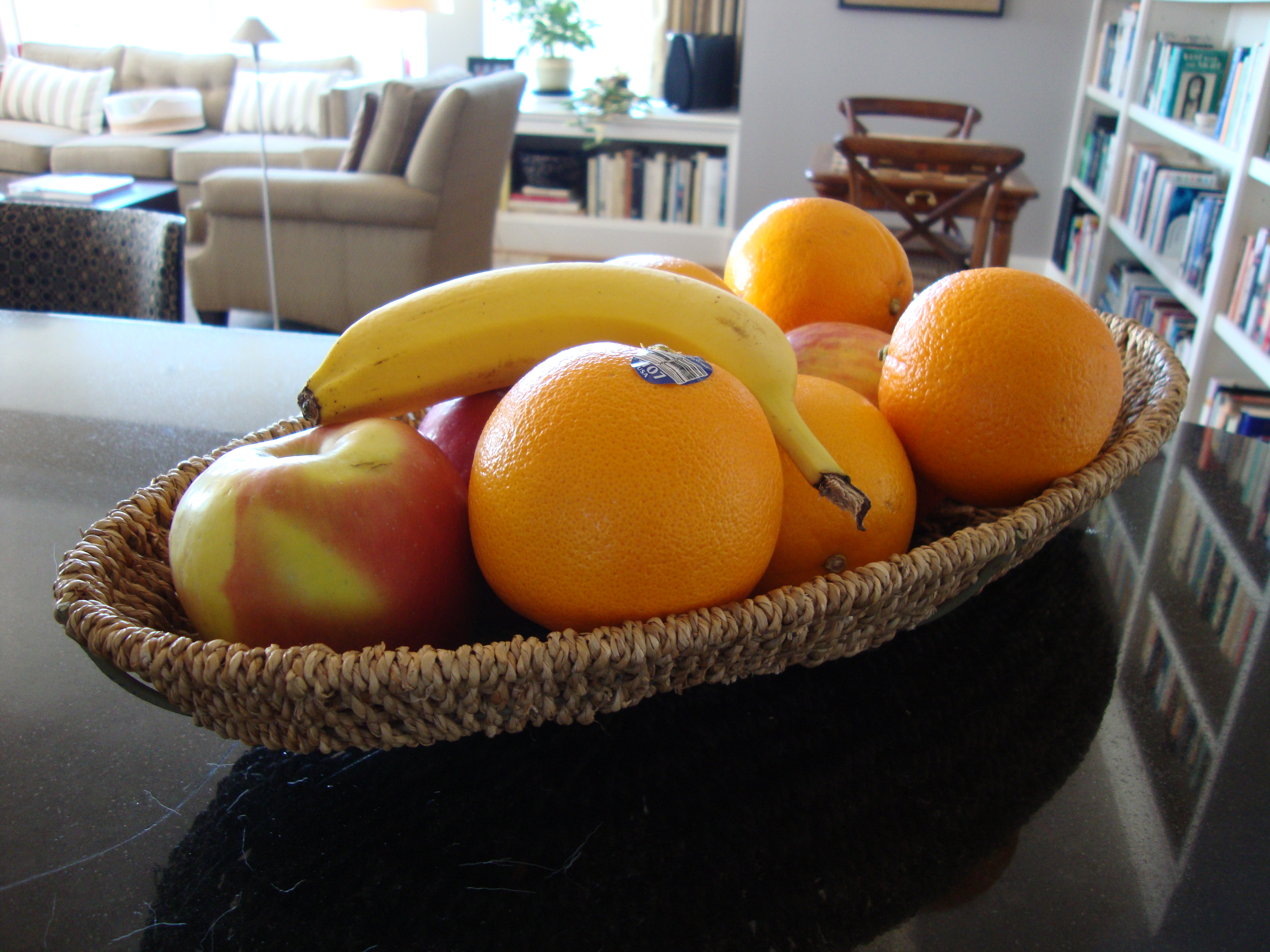
Healthy snacks on the counter at Casa Tiller

Returning from travels over the holiday break, I stepped on the scales to find myself three pounds heavier. It always happens! I swear, though there were temptations aplenty, I was reasonably moderate in my eating and drinking. How amazing that the body can accumulate mass so quickly! Also, a little scary.

In recent years, I’ve not been much concerned with losing weight, but I’ve been working hard not to add it. This basically means being careful about eating and diligent about exercising. That sounds — so — boring! Even if you do it, who wants to hear about it!

Thus, I was interested to read the NY Times magazine piece titled The Fat Trap: Do You Have to Be Superhuman to Lose Weight? by Tara Parker-Pope. According to the article, sustaining a healthy weight after losing a lot of pounds is not just unusual — it’s extraordinary. Those who do it are a “tiny percentage.”

That’s a bummer, both for the individuals who struggle with their weight and for our health as a society. Scientists are trying to figure out why people usually gain back weight after losing it and what can be done about it. Meanwhile, as a member of the fortunate “tiny percentage”, I may have something helpful to contribute. I’ve previously posted about losing 50 pounds, but here are some additional thoughts specifically related to how I’ve kept that weight off for several years.

It isn’t easy, but it also isn’t impossible — obviously! In fact, the methodology is basically the same as any worthwhile achievement that takes sustained effort. If you’ve learned to play the piano, speak a foreign language, play golf, or whatever, you’ve probably already employed most of the same methods you need for ongoing weight control. You need to find your motivation, keep it simple, be empirical, and have fun.

1. Find your motivation. Actors talk about needing to find a character’s motivation to bring the character to life. Try it: ask yourself what you really want, and why. For anything that’s going to take a long, sustained effort, you’ll need a motive that carries real meaning for you — something that’s more important than simply feeling good right now. It helps to articulate it clearly. My own guiding motivation has to do with the battle with father time. More concretely, I’m working today to be able to ski the deep snow in the big mountains of Colorado and Utah when I’m in my eighties. The snow on the mountains is beautiful. I sometimes think of this in the very early morning when it’s still dark and I’m making myself go to the gym.

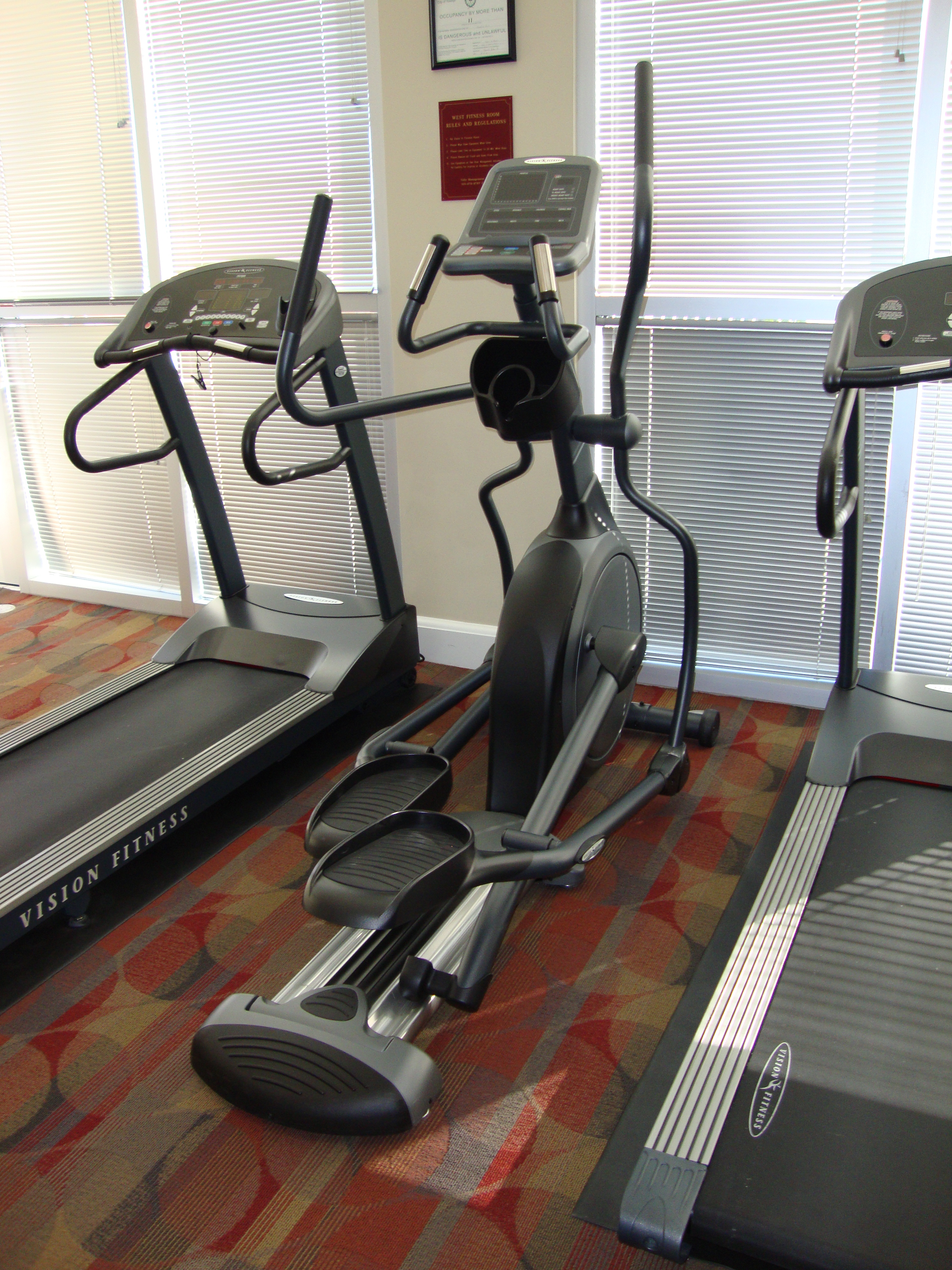
My friend in the gym on the roof -- the elliptical machine

2. Keep it simple. If a system is too complicated, it will not be sustainable. A good system is one you don’t have to think about very much once it’s in place. It involves turning good intentions into good habits. For myself, I have some simple rules that help in avoiding bad eating decisions, such as: no chips, no sodas, and no candy bars. For snacks, I put in place simple and nutritious substitutes, like apples, bananas, and baby carrots. If you are considering going vegetarian, I’ll note that one of its many benefits is helping to simplify the challenge of eating a healthy, less fattening diet. Anyhow, these types of snack choices have gradually become habitual for me, and as habits they don’t take much mental energy. Of course, there’s the countervailing powerful force of other lifelong personal habits, customs, traditions, and advertising tempting you to make bad eating choices. There will be slip ups — and hello, there’s three new pounds. Then you refocus, and move on.

3. Be empirical. Look at the available data, and consciously monitor how you feel. I bought a digital bathroom scale and use it every day. I watch food portions carefully, and notice whether I’m feeling too hungry or unenergetic. I have not adopted a single off-the-shelf theory of eating and exercise, because I think every body has somewhat different needs. What works for you may not work for me. You need to be experimental. If an approach isn’t working, chuck it, and try something else. If you test a healthy snack or an exercise approach that seems to work for you, try it again and see if it still works.

4. Be creative and playful. We’re talking about a long-term approach here, and if it is no fun, you will eventually give it up. Simple repetition is boring. Try out interesting new healthy foods and new exercises and sports. When traveling, I make it a little game in airports to find the least unhealthy meal, and to find something interesting to do in the little hotel gym. I vary activities over the course of a normal week, so that at the moment I alternate among the elliptical machine, the stationary bike, and swimming, and various types of resistance training. For more fun, I enjoy listening to music and reading while doing the elliptical. I’ve found that classes liven up the cycling experience. Every so often, I change the mix of activities and try something new.

So there you are, for whatever it’s worth. Having said all that, I’ll note again, sustaining weight loss isn’t easy. It takes conscious work every day and every meal. But it doesn’t have to be white-knuckle misery or boredom. The guidelines of motivation, simplicity, empiricism, and playfulness help. And developing skill with the guidelines could lead to other good things. They can be applied to any rewarding long-term objective, like learning a sport or a musical instrument.

Some thoughts on golf and Miami

One of the things I’d really like to improve in 2012 is chipping. Sure, I’d like to get more fit, be a better person, etc., but fulfilling this resolution could be transformative in a small, practical way. My golf game would be so pleased if I could consistently get short shots from off the green closer to the hole. Compared to a lot of things, it’s not that hard. It’s just a matter of practice.

You may ask, what is the point of golf? I’ve asked the same question many times. It can be, as the old saying goes, a good walk spoiled. It’s fears, frustrations, humiliations, and disappointments. At times it’s uncomfortable and even painful. But it’s also about overcoming these things. It’s about courage and strength. It’s very much about honesty and integrity, and friendship.

Golf is full of beauty — the beauty of unique gardens with flowers, trees, lakes, and birds, of magnificent vistas. The beauty of the little dimpled white ball flying as hoped for in a high parabola against a clear sky. It is wonderful to stroke a long putt that curves several feet before finding its way to the bottom of the hole. For all the horrors and rigors, there are incredible moments of transcendence.

And so it was with hope and pleasant anticipation that on Wednesday I played my first eighteen holes of 2012 at the Doral club, in Miami. The skies were blue, and although it was a bit cool and breezy, the palm trees seemed calm and welcoming. With some business colleagues I played Greg Norman’s Great White course. (The other, more famous course, the Blue Monster, was about to host a tournament and closed to the public.) There was lots of water, and lots of sandy waste areas. My tee shots were fairly consistent, and I hit some long and satisfying fairway woods. I did not find the greens particularly difficult. The trouble spots had to do with chips. I’d like to wipe a few of those from memory, such as shots within a few yards off the green that didn’t get to the green. Aaargh!

I stayed two nights at South Beach in a gorgeous little hotel called The Betsy. The lobby has dark wood, palms, and ceiling fans. My room had white furnishings accented with surprising tastefulness in bright pink and orange. There was a television in the bathroom mirror. I’d never thought of needing such a thing, but I loved it immediately. It really improved the shaving experience.

The art deco architecture and bright colors of South Beach are lovely. I’ve thought of Miami in recent years primarily as an airport which, once in, I looked forward to escaping, but I started to see it as a unique and lively international city. It reminded me that I need to keep working on my Spanish.

Cultural diversity: yoga, Gambia, Lucretius, hockey, and Wagner

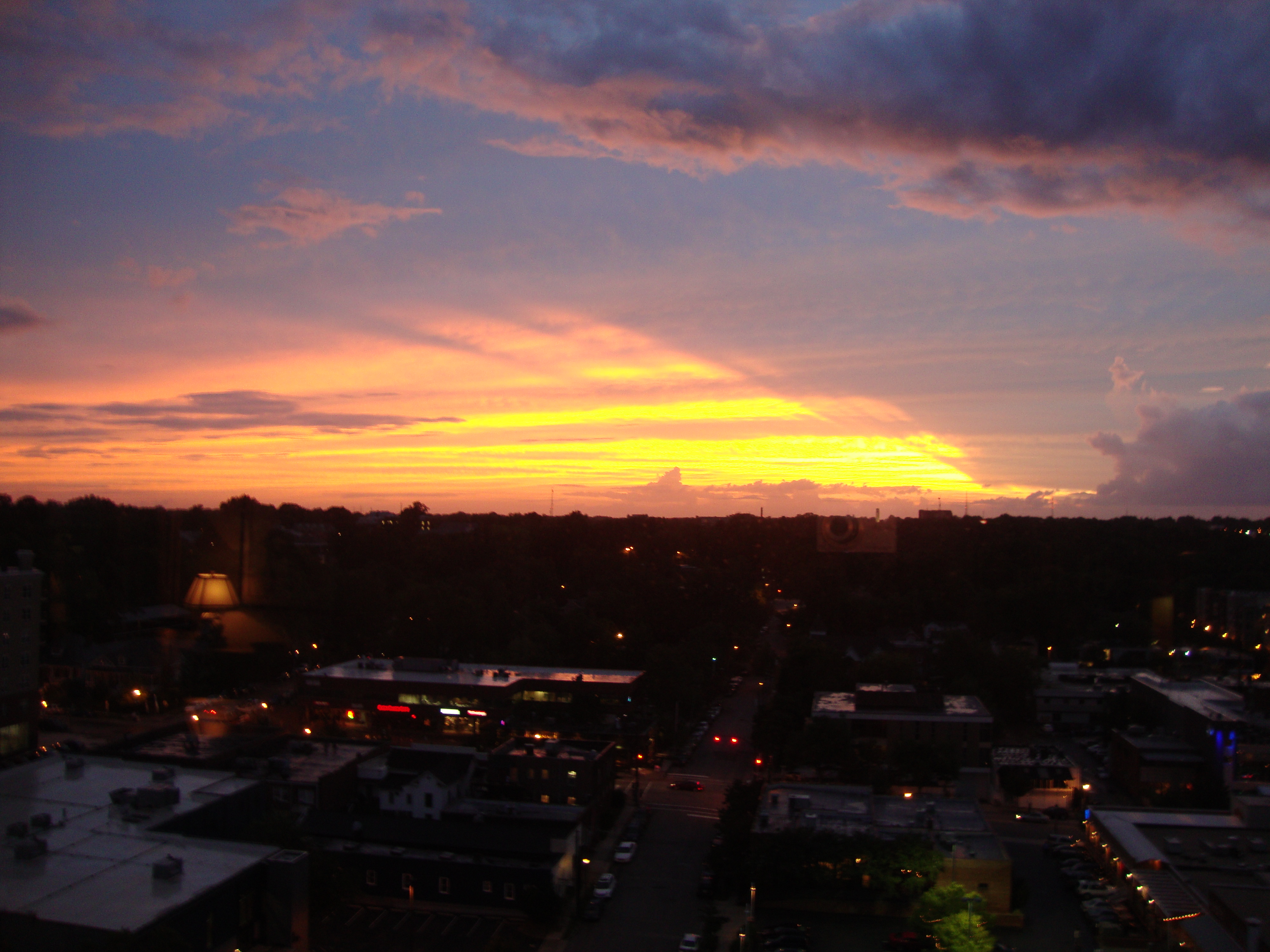
Looking west from the balcony

Daylight savings time ended this morning, and so we gained back the hour we lost in the spring. It’s strange that hours can be moved from one season to another. Anyhow, the leaves are changing, with yellows, oranges, and reds, and the temperatures are cooler. It’s fall.

Tuesday is my usual day for the Early Bird Yoga class at Blue Lotus with Suzanne. I normally get up at 5:30, do half an hour of interval work on the elliptical machine in my building, change out of my sweaty tee shirt into a fresh one, grab my yoga mat, and get to the 6:30 class in good time. Some yoga breathing, lowering, lifting, balancing and stretching is a good way to start the day.

Suzanne’s instructions are direct and clear, and her strength and grace are beautiful and inspiring. Each class is different, and lately she’s been taking us noticeably beyond our comfort zone. She seemed really pleased last week when she got us all up in tripod headstands. This week she had us all try side crow. This did not work at all for anyone (except her). Lately I’ve been working on front crow, and making progress, so perhaps we’ll do side crow one day.

Early Wednesday morning (5:40) I got in a cab to go to the airport. The cab driver was winded, and said he’d been doing jumping jacks to stay awake while waiting for me. It was better, he said, not to drink too much coffee. I agreed. He asked me where I was going, and I told him the bare fact (Boston), thinking I’d rather not get involved in a chat. There’s effort involved, and no guaranteed reward. But after a couple of minutes of silence, I relented. I figured I would try to be a decent chap and throw a lifeline to a lonely soul, so I asked him where he was from. Answer: Gambia, a tiny country in west Africa which I knew almost nothing about, and which he dearly loved.

He was a lively guy, and much more interesting than NPR. He described the government in terms that sounded benign though authoritarian, and improvements in roads, schools, and hospitals. He said that most people were at least part-time farmers and described how they stored crops in their own warehouses. When I asked him about his languages, he said he spoke seven, including three from Gambia and French, Spanish, and German. His English was accented but just fine.

The weather was clear and mild in northern Massachusetts, but there was still snow on the ground from an early season storm that had left many thousands without power. I did a bunch of meetings in Westford and then went down to Cambridge for more. On the flight back I read How to Read Montaigne by Terence Cave. Montaigne (1533-1592) is a startlingly original, modern thinker.

I was inspired to start exploring Montaigne by a few comments in an excellent book I finished a couple of weeks back: The Swerve: How the World Became Modern, by Stephen Greenblatt. The Swerve recounts the discovery in a monastery in 1417 of a copy of an ancient Roman manuscript, and explains how that discovery changed history. The discoverer, Poggio Bracciolini, was a former apostolic secretary for a deposed Pope with a classical education and passion for finding and saving ancient books. The book that was almost lost, On the Nature of Things, was written by Lucretius about 50 BCE. It’s an epic poem that describes the philosophy of Epicureanism. Greenblatt covers a lot of ground, from the philosophers of Greece and Rome, the creation of libraries, the fanaticism of early Christianity, the preservation of books in medieval monasteries, the intrigues of the popes, religious wars, the intellectuals of the Renaissance (including Montaigne), and onward.

In addition to a lot of lively history, there’s a pithy account of the ideas of Epicurus (b. 342 BCE), including the notion that the entire universe is constructed of tiny indivisible building blocks called atoms. This carried with it a view of the world as a natural phenomenon, not something magical created and controlled by gods. Epicurus espoused freedom from superstition and the pursuit of pleasure.

By pleasure he meant not pursuit of wealth or debauchery, but something more nuanced that included a sense of wonder at the beauty of the natural world.. According to Philodemus, a follower of Epicurus, “It is impossible to live pleasurably … without living prudently and honourably and justly, and also without living courageously and temperately and magnanimously, and without making friends, and without being philanthropic.” The Epicureans celebrated friendship, emphasized charity and forgiveness, and were suspicious of worldly ambition.

According to Greenblatt, Epicureans, including Lucretius, believed that the gods existed, but that they couldn’t possibly be concerned with human beings. Along with atoms, Lucretius’s ideas encompassed the notion that living beings have evolved through a long process of trial and error, that the world exists for reasons that have nothing to do with humans, that humans are not unique but rather linked to all other life forms and to inorganic matter, there is no afterlife, that religions are superstitious delusions based on longings, fears, and ignorance, and that by fashioning gods humans became enslaved to their own dreams. Happiness could be attained through discarding delusions through reasons, looking squarely at the true nature of things, and discovering a sense of wonder.

These ideas were, of course, not congenial to early Christians, who almost succeeded in stamping them out. But somehow a copy survived, which Poggio discovered and copied, and which is recopied many times, and ultimately influenced thinkers in subsequent generations up to our own. Greenblatt’s book is a true pleasure.

We saw some professional hockey on Friday night: the Caroline Hurricanes vs. the Washington Capitols. I’d learned from my new assistant about a free bus that runs between downtown and the hockey games, and it turned out that it made a stop right at our building. The bus arrived on time, with many cheerful fans dressed in Hurricanes red and white. We had a good view from box seats.

The Hurricanes started strong but collapsed in the third period and got trounced. As long as the game was close, it was fun. As with soccer, the more hockey I watch, the more I see and appreciate the incredible athleticism. The drama is simple, but effective: there’s a surge of great joy at every goal our team makes, and stab of pain at a goal of the opponents. The bus trip back home seemed slower and much less cheerful.

On Saturday we saw quite a different sort of drama, Siegfried, the third opera of Wager’s Ring cycle, broadcast live from the Metropolitan Opera to all over the world, including the North Hills Cinema. I know the music well from CDs, and love it, but had some qualms about the amount of sitting required: five and a half hours. Wagner is musically dense, and that’s a lot of Wagner. It was, it turned out, for us, incredibly powerful.

The story is about courage. Siegfried is a callow young hero who forges a magic sword and uses it to slay a dragon and an evil dwarf, then travels though a ring of fire to save and win a beautiful maiden. In pre-broadcast comments, Renee Fleming (a great soprano who would know) described Siegfried as the most difficult tenor role in the world. Our Siegfried was Jay Hunter Morris, a relative unknown who subbed in at the last moment and had a total of three performances under his belt when he performed before a worldwide audience of many thousands yesterday. This took true courage. Morris gave a performance for the ages, vocally powerful but nuanced throughout. The entire cast was superb, and the technical effects (especially the ring of fire) were impressive. Fabio Luisi conducted brilliantly. The famous horn solo, the exciting few bars that horn players test and polish their whole lives, was perfect.

This Siegfried, the opera, moved me deeply (tears). Driving home afterwards, I felt wrung out but exhilarated. Sally also loved it, and announced that she was now a Wagnerian. I found this very cheering.
Hitting balls at the country club and watching chimney swifts

On Friday one of my Red Hat colleagues took some pictures of me for our website. In recent years I’ve got over some of the awkward self-consciousness of being peered into by a camera, though it is still slightly embarrassing. Anyhow, here is one of the pictures.

After work, I went over to Raleigh Country Club to practice at the driving range. I became a member at RCC a few weeks back. This is primarily a wonderful thing for which I am deeply grateful, but at the same time I have some cognitive dissonance. I do not come from a country club background. As a kid, I had friends who belonged and ones who didn’t, and didn’t see any systematic differences. But at some point I formed a view of country clubs as islands of unearned privilege, and of country clubbers as shallow, selfish snobs — people whose main political driver was paying less in taxes. Over time, I’ve known plenty of people who put the lie to that stereotype, but I still had trouble picturing myself wanting to join (to paraphrase Groucho Marx) any club that would have me as a member.

What changed? The most important thing was a deepening appreciation of golf. And the golf course at RCC is special. It’s the last course of Donald Ross, the legendary Scottish designer. The land rises and falls in a pleasing rhythm, with lakes and streams and bunkers, and mature trees, bushes, and flowers. It is beautiful, and also quite challenging. And it is less than 10 minutes from my apartment.

The staff has been really welcoming and friendly, as have most of the members. I really enjoy hitting balls on the driving range. When I hit a bad one, I just tee up another. I am playing with the concept that a more beautiful swing makes a more beautiful ball flight, and some of mine are flying well. But every now and again, I have an anxious moment when I feel out-of-place, and wonder if someone is about to quietly ask me to leave.

After hitting my quota at the range, I drove downtown and met Sally at the corner of Salisbury and Hargett Streets. She’d seen a story in the News and Observer about chimney swifts roosting in the Oddfellows Building there. We climbed the stairs of a parking garage across the street and looked upward.

Shortly before 7:00 pm, we saw the first few swifts appear from the northwest, and then there were more. Ultimately there were hundreds and hundreds, swarms of chimney swifts. They fluttered and veered, catching insects and making a high-pitched chatter. It was amazing. There was a kestrel that perched on the logo sign at the top of the Wachovia Building and occasionally swooped down, but the flock would counterattack. We’d hoped to see the swifts go down the Oddfellows Building chimney, but did not have a good angle to view the chimney. Finally it got dark, and we walked a couple of blocks to Dos Taquitos for dinner.

An earthquake, a hurricane, a massage, a yoga lesson, and a haircut

Sunset before Hurricane Irene

We’ve had a couple of unusual disturbances this week. On Tuesday, Raleigh was shaken for a few seconds by an earthquake that was centered in northern Virginia. In my office, it felt at first like heavy equipment was passing by, but it got more intense, and I started to consider evacuating. We seldom have earthquakes in the eastern U.S. We’re used to thinking of the earth as something solid that does not move, and it’s disturbing when it does.

A hurricane named Irene has been heading toward the eastern U.S. for several days, and finally hit the Outer Banks of N.C. this morning. We get hurricanes here from time to time, but this one has caused more than usual worry. In 1996 when Hurricane Fran hit our area, trees snapped in two in my yard, and the storm left us without power for days. Ever since, I’ve taken hurricanes seriously. At the moment, we’re getting light rain and gusty winds.

Meanwhile life goes on, with chores and challenges. This week I was particularly conscious of being part of a pleasing network of humans, including some who helped take good care of me, with some vivid moments of connection.

On Monday, I got over to Hands on Health, where Meredith had agreed to come in on her day off to give me a deep tissue massage. I’d anticipated that all the driving to, from, and at Road Atlanta would leave me with a tight neck and back, which it did, and that Meredith could help, which she did. She was cheerful and chatty, but deadly serious when it came to knotty muscles. There were some intense and difficult moments, but I left feeling wonderful.

On Wednesday, I had my first individual yoga lesson with Suzanne. I’ve taken one or two “early bird” classes a week with her for the last year or so, and have gradually come to really trust her. My main objective in taking an individual lesson was to make sure I had sound mechanics for my head stand and wasn’t about to hurt my neck. I also wanted to understand more about increasing my flexibility. Lately I’ve gone to a few advanced classes, and found them fairly humbling. There are certain things they do that I just can’t do.

Anyway, Suzanne helped me adjust expectations and feel better about where I am, as well as improving in some areas. For head stands, she taught me how to find the top of my head and where my weight needed to be. We did some bending and twisting, and talked about how you can have too much of a good thing. Although it looks good in class to have loose joints, as she does, she noted that looseness brings with it more risk of certain injuries. I also got her guidance on what to do with my mind during savasana. I’ve slowly come to really value yoga’s insistence on relaxation as an integral part of class. At the end of the session, I felt tremendous gratitude, both for Suzanne, and for my good health and well-being.

Because of the Road Atlanta trip, I’d missed my regular monthly haircut with Ann. She invited me to come in after work as her last appointment on Wednesday. Ann’s been cutting hair for me, Sally, and Gabe for many years. It’s always fun seeing her. She likes to talk, and we have great chats about our families, cars, restaurants, travel, and sports. As usual, I left looking better, and smiling.

Driving at Road Atlanta

Clara and friends at Road Atlanta

I had a few butterflies about taking Clara down to Road Atlanta for the Rezoom track event. There is, after all, an element of risk to pushing a car as hard as you can. But at the same time, there is something that felt right about the trip. A Porsche 911S was not created to be mere transportation. It is a sports car.

After a simple breakfast at the Holiday Inn, I was loading Clara when I saw some working-guy types staring at me. My first reaction was to assume they thought I was a twit. Then I realized they were admiring the car. This wasn’t exactly pleasant, but not exactly unpleasant. I wasn’t interested in attracting their attention, but I could understand it. It occurred to me that this is something that very attractive people must deal with: the slightly unsettling attention of strangers.

I had more butterflies when I saw the field, which included some true racing machines, stripped of creature comforts and equipped for massive speed. My instructor, Bryan, had one such: a Miata with everything torn out that didn’t have to do with the business of moving.

Bryan and his Miata

It also had an awesome paint job. Bryan introduced me to his track buddies, all from Jackson, Mississippi, and invited me to hang out at their canopy area.

The track was 2.54 miles — about the same size and shape as VIR, but more difficult. There are big elevation changes, and vertigo-inducing blind curves. Where VIR has fields to run off into if you misjudge a turn, RA has hard walls. Bryan took me as a passenger out as a passenger on the first session, and scared the bejesus out of me. It was a fast, very rough ride. I felt car sick, but managed, barely, to avoid spewing.

The drivers were divided into notice, intermediate, and advanced groups, and each drove 30 minutes per session. As a novice, with an hour between sessions, I looked at the other cars as they prepared to run or ran. I enjoyed talking with Bryan and his friends.

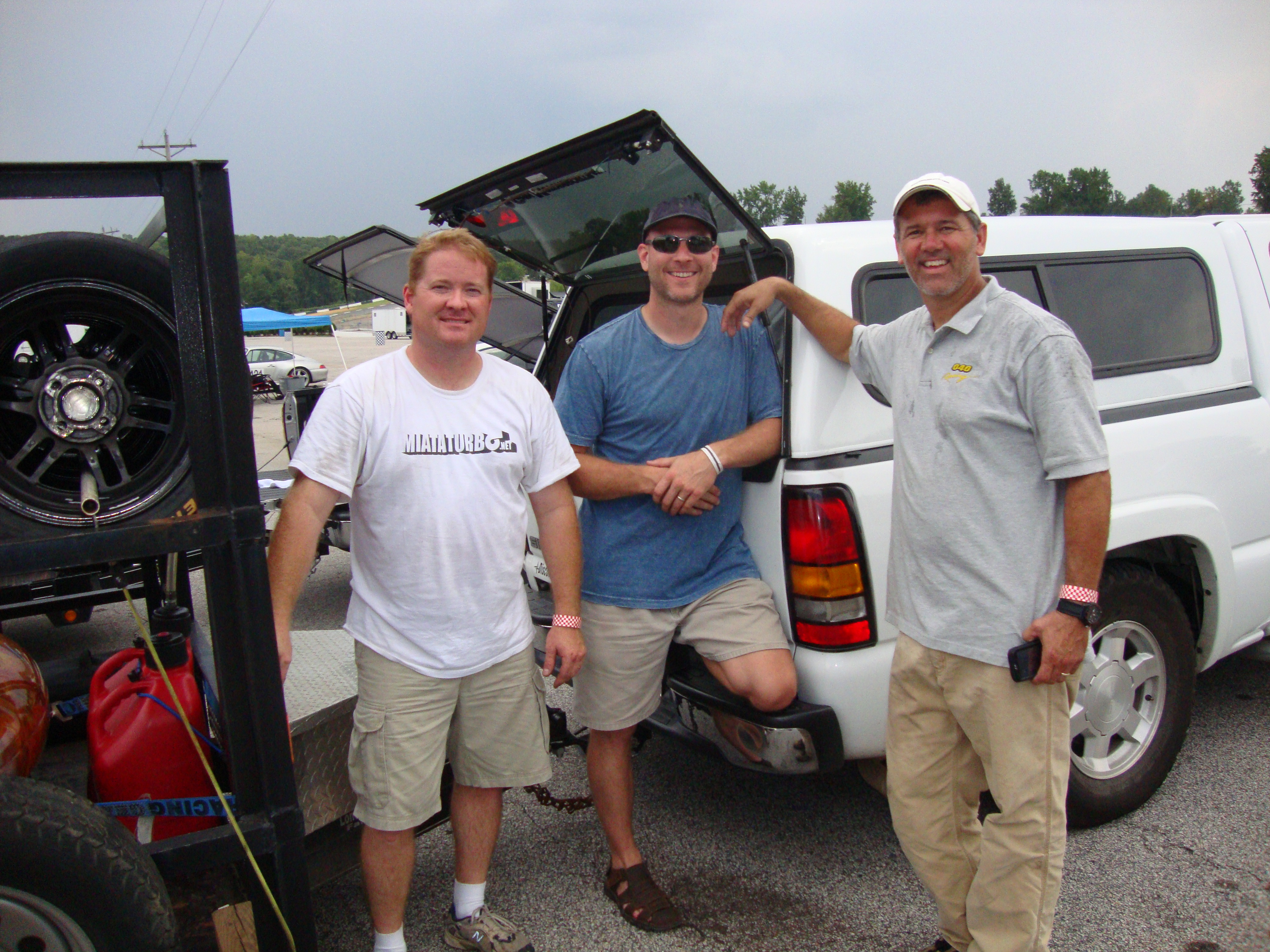
Bryan, Chris, and Snookie

They knew an amazing amount about cars. They must have thought I seemed a bit different, but they were really kind to me, and went out of their way to explain things and be helpful. It was great to hang out with them.

After the first couple of half-hour sessions, I began to get a feel for the track. It demanded total concentration. The senses are overloaded with sensations — screaming engines, rushing edges. There is no room for ordinary thought. Bryan kept coaching me to use more of the track and carry more speed through the turns. Gradually I got faster.

At times I couldn’t stop smiling. There were, however, some harrowing moments. Once I hit the gators at speed coming off the blind turn at number 12, and skidded dangerously. That scared me, and it took a few laps to regroup. As I kept pushing against the limits of the turns, a few times I found them, and barely hung on.

But with each session, my confidence increased, and on the second day I broke the two-minute barrier for a lap — a milestone. As I prepared for the fourth run of the day, Bryan announced I was ready to solo. He asked me not to do anything that would embarrass him. I was really pleased, and I didn’t.

Gary Player’s diet and exercise routine, and a few thoughts on yoga

One of the nice things about getting older is that you gradually worry less about being cool. You slowly realize it’s almost impossible to be old and cool, and give up on the idea. Letting go of such worry frees up some energy for more fun.

Age is tough on a body. Fight as we will, eventually we’ll all succumb. But I see no real choice but to fight. Over time I’ve become more dedicated to the battle for good health, though it occasionally strikes me that it could be viewed as hopeless, ridiculous, or both. A middle-aged white guy sweating — for what? It’s certainly not cool.

Thus I was cheered and inspired this week by an account of Gary Player’s fitness program now that he’s 75. As golfers know, Player is a legendary player, with more than 160 tournament victories. In his prime, the man was known to be serious about exercise, and he still is. His routine involves 1,000 sit ups and push ups every morning. He does lunges and squats, works with weights, and runs, swims, and does stairs. As for diet, Player says that it’s 70 percent of the fitness puzzle. He eats a mostly vegetarian diet heavy in fruits and vegetables, and aims for portions about half the size he used to eat. He says he has more energy since he cut the meat, and his stomach works better.

I also have found that a diet of moderate portions of plant foods is energizing. And so is regular morning exercising. Lately I’ve been noticing how during most of my waking hours I feel really good, and feeling grateful for it.

I’m especially grateful to my yoga teachers (Yvonne, Suzanne, Kathleen, Jill, and others). Over the past couple of years, yoga has gradually insinuated itself into my life, and has become a good friend. Lately I’ve been doing two or three classes a week at Blue Lotus. Every teacher and every class of every teacher is different. Some classes are quite arduous (think high heart rates and lots of sweat) with an element of risk, and some are very slow and calm.

When I began, I’d expected that yoga would help my flexibility and balance, which it has, but it has done some other good things that I hadn’t expected. It has made me a better breather and more conscious of the significance of breath. It has helped my focus and concentration. And it has made me view relaxation as an essential element of good health.

There’s also something pleasing about exercising in a class. It’s sometimes humbling but often inspiring to see so much strength and grace in the group as it moves together. I like the sound of people breathing in unison. It’s good to be with people who are committed to taking good care of their bodies. And it’s fun.

Golfing at Turnberry, Scotland

Turnberry, Scotland (Kintyre)

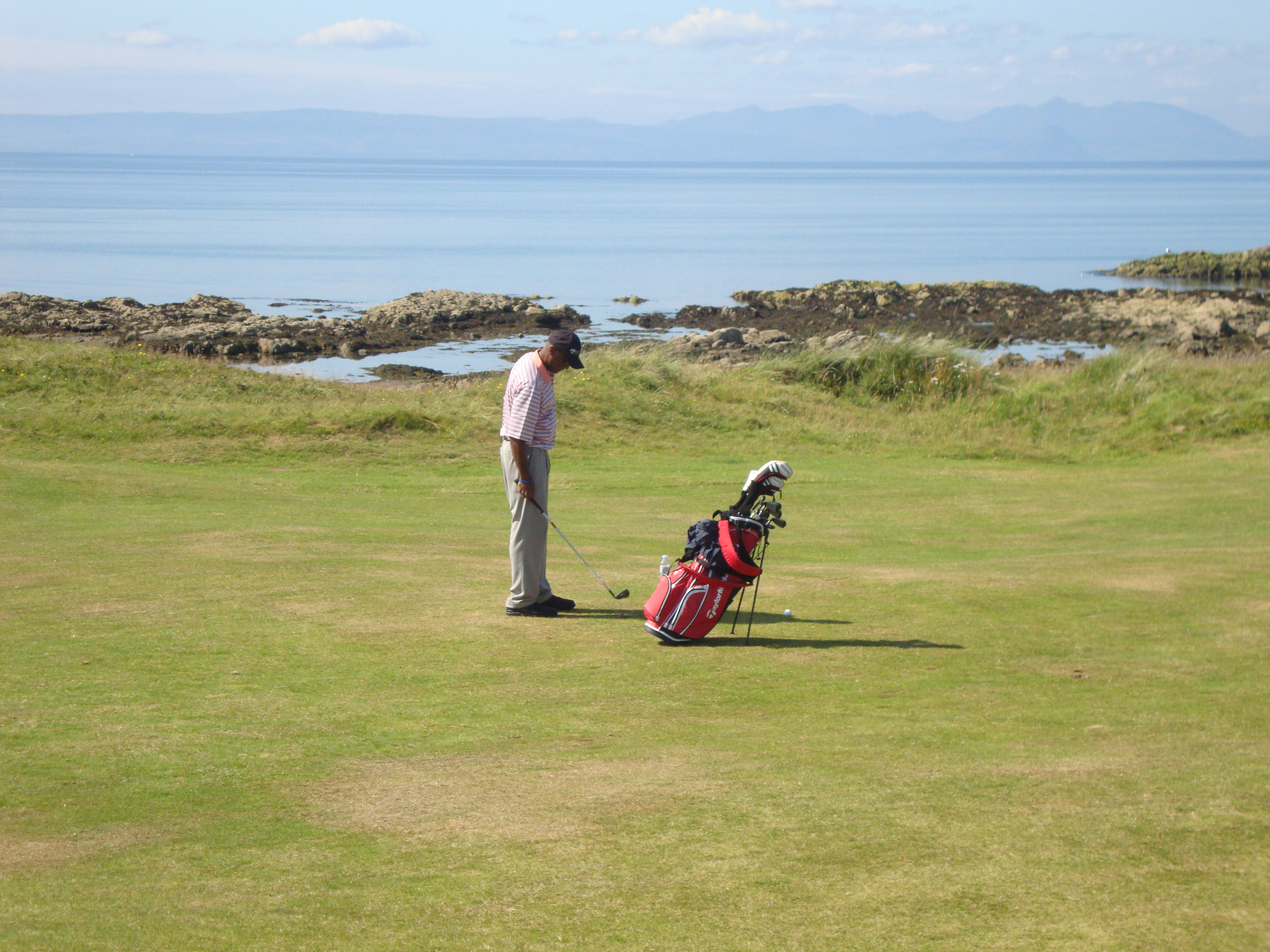
Last week I played golf at Turnberry, Scotland, rated the number one course in the British Isles, and the site of numerous British Opens. Is it really so great? In a word, yes. It was golf nirvana.

I played the famous Ailsa course the day I arrived, immediately after traveling all night. The day was sunny and mild — possibly too pleasant for a representative experience. At almost every hole, I had a shiver at the beauty. It had a raw, untamed quality, but I gradually realized that it brilliantly combined the natural contours of the terrain with a deep understanding of the essence of golf. Its authors and keepers loved the land, and the game.

It demanded constant vigilance and focus. The hazards were, in golfing terms, serious — deep bunkers with walled backs, knee-high grass, spiny gorse, and water. I had one disastrous descent into a bunker, costing four strokes to get out. But I generally controlled the ball well, with a handful of excellent shots. I did not putt particularly well till the end, when I finished with a flourish — sinking a thirty-footer on 18 for a birdy. I ended up with a 92.

I played the Kintyre course the next day. The skies were overcast, threatening (but never quite delivering) rain, and there were gusty winds — proper Scottish golfing weather. The ocean is a bigger element in this course, and the bunkers less. It seemed less imposing than Ailsa, with views of the surrounding hills and pastures, but the level of difficulty was challenging enough. I played reasonably well for me on the first nine (46), but had a couple of bad blow ups in the second and finished with a 99.

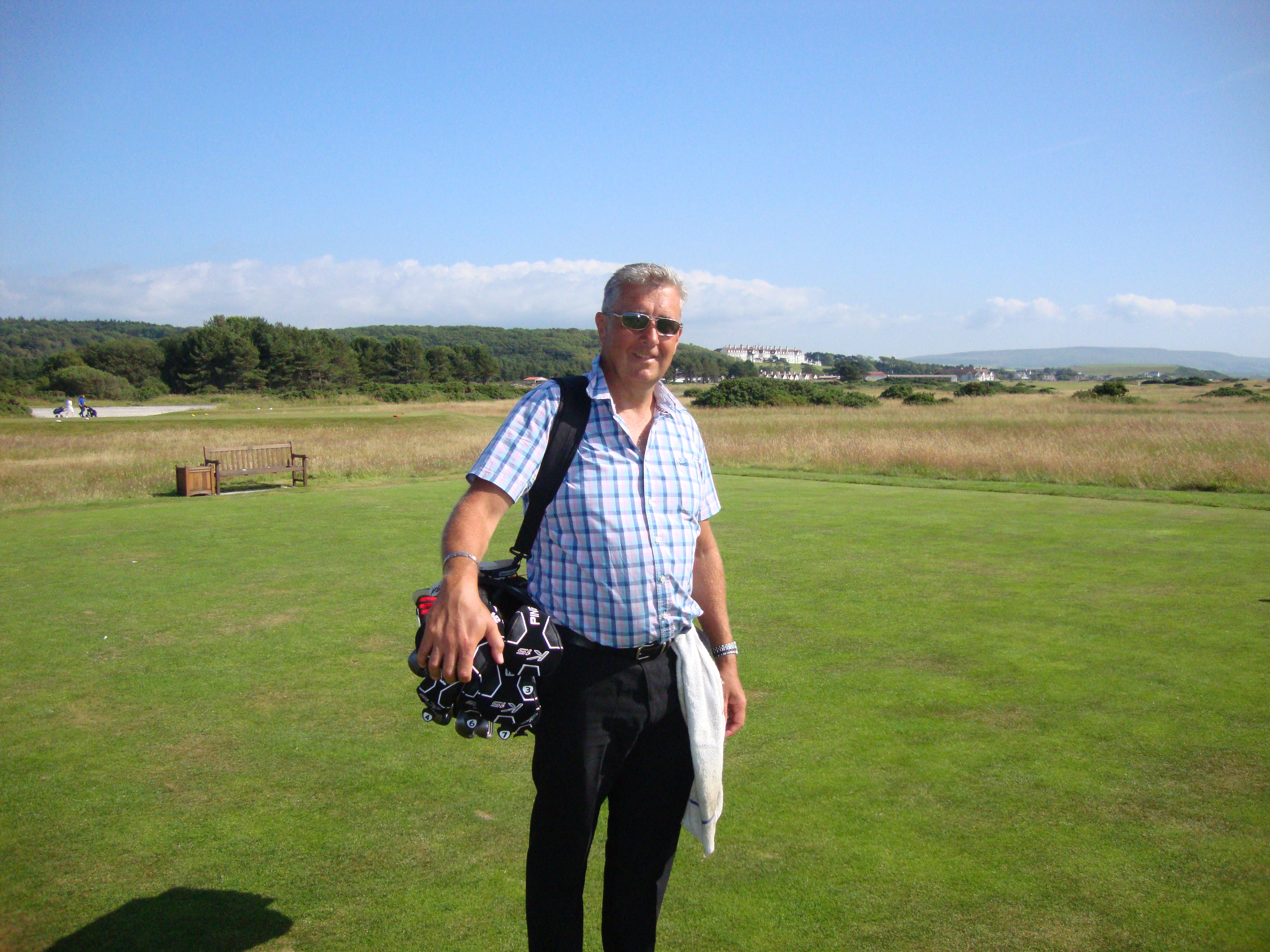
Jim, my caddie, and a Linux fan

There is something about Scotland that spoke to me powerfully. The people seemed friendly, but practical and tough and very proud of their country. The countryside was rolling and rugged. I got a lesson in single malt whiskey, and learned that it a dash of water loosens it up.

After finishing my meetings, I had a few hours to walk about in Glasgow, and found it a lively, modern city with Victorian charm. I made a stop at the Gallery of Modern Art to see works of several contemporary artists, and also visited the Kelvingrove Museum. Their collection of Impressionists and Post Impressionists is quite good, and I also liked their collection of 16th century armor. There were lots of people out in Kelvingrove Park, which reminded me of Central Park in New York, but with grass tennis courts and lawn bowling.

The trip back was long — about 19 hours all told. It started with a 5 hour delay because of weather in Newark, and the 7 air hours were bumpy. One good word for Continental — they provided surprisingly tasty curry as part of my requested vegetarian meal. I ran out of electricity on both my iPod and iPad, and came close to running out of other reading material (horrors!).

The Newark to Raleigh leg was uneventful until near the end, when the pilot suddenly pulled up from the final approach and banked to circle around. My first thought was that I might have a rookie pilot, but he explained that there was a local thunderstorm with microbursts of wind. A few minutes later we made the final approach, and the plane began bucking and shimmying. I focused on deep calming yoga breaths.