The Casual Blog

Category: music

A Philip Glass opera and remembering B Berkeley

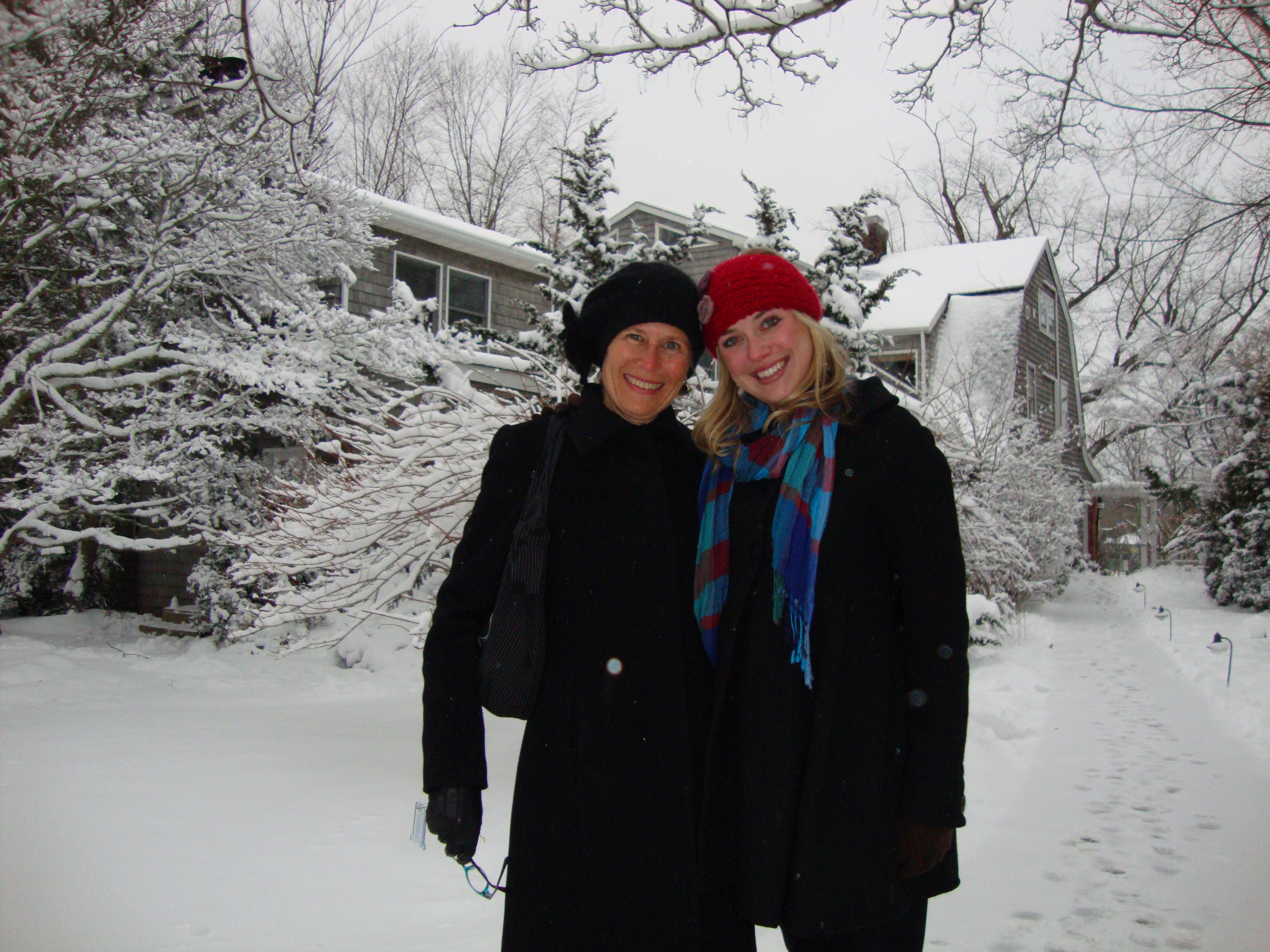
Sally and Jocelyn at the Mill House Inn, East Hampton, New York

Thursday night I went with friends to see the NC Opera’s production of Les Enfants Terrible by Philip Glass. I was interested for three reasons: I like some of Glass’s minimalist music, I like to support the NC Opera, and this production was billed as a dance opera. Ricky Weiss, artistic director of the Carolina Ballet, choreographed and directed the production.

I liked it. The story is a strange, surreal, dark tale of a brother and sister who are close — too close. The music is both driving and dreamlike. Each character had two physical bodies — a singer and a dancer — and each body expressed part of the emotional reality. This opened up interesting expressive possibilities. Opera fans are familiar with the enormous range of emotional possibilities from singing plus acting, and adding dance in as a vital element was fascinating.

One problem, though, was that the dancers could so easily steal their scenes, without meaning to. They are so much more graceful and expressive than ordinary humans, and even more than trained actors. At times it was difficult to give equal weight to the non-dance parts of the action, because the dancers were so compelling. The singing was rather good, particularly the soprano Jessica Cates as Lise. But her dancer twin, Lara O’Brien, had tremendous emotional range, and a kind of wildness. I thought the idea of the singer-dancer pairs was great, and worth exploring further.

The next day Sally and I flew to New York to attend the memorial service for her father, Norborne Berkeley, Jr., affectionately known to my generation as B. Gabe and Jocelyn flew in from Colorado and we rendezvoused at a hotel near La Guardia, then drove out to East Hampton. I was so happy to see the kids! We stayed in a lovely bed and breakfast called The Mill House Inn. It was good to see the Berkeley side of the family, and revive happy memories of East Hampton from our younger days.

We drove by the old Berkeley place in Bridgehampton and did a little shopping in East Hampton. I bought Gabe a pair of corduroy pants and The Unbearable Lightness of Being by Milan Kundera, on the sole condition that once he finished it he tell me his impressions. Such a rich book, and I know too few people who have read it. It snowed six inches that night.

The service on Saturday was in an Episcapol church and was well attended despite the snow. It had a heavier religious component than I expected from this relatively unreligious family. But Bill Berkeley did a fine job in his eulogy recognizing the strengths and accomplishments of B, and the good qualities we’ll want to remember. B meant a great deal in my own life, and I’ll miss him.

The Nutcracker and a piano lesson

We went to the Carolina Ballet’s new production of The Nutcracker last week. Over the years, I’ve seen many Nutcrackers, from student productions to the NY City Ballet’s. In days gone by we used to listen to the Tchaikovsky music when we decorated the Christmas tree. I’ve never actually gotten sick of it, but a few years back I started to worry that it could happen. With the ballet music, just as earlier happened with the Brahms symphonies, I decided that I needed to be careful not to get so familiar as to lose the great joy of the thing. And so we hadn’t gone to the Carolina Ballet’s Nutcracker for the last couple of years.

I’m glad we returned. The CB production was substantially upgraded with new sets and effects. I enjoyed the upgraded magic tricks in Act 1, and thought the costumes in the ball scene were opulent. Act 1 is the children’s act — with magic tricks and children playing, but not a lot of dancing. Act 2 is more for the grown-ups, with a variety of virtuosic classical dance. The leading female roles in the performance I saw were wonderful, including Lilyan Vigo as a regal Sugarplum Fairy, Jan Burkhard as an outgoing Dewdrop, and Lara O’Brien as an unusually poignant, melancholy Tea. The men seemed especially athletic (gravity-defying) this year, including a particularly impressive Richard Krusch and Nikolai Smirnov.

Before the show, we agreed to celebrate the occasion by relaxing as completely as possible and just drink in the production — that is, clear the mind of everything except the beauty in the moment. We mostly succeeded. There were a couple of rough spots with the props, including the giant book with the false back that didn’t quite get closed in time. The sound quality from the live orchestra coming through speakers was less than excellent. But mostly we were swept away to a beautiful, magical place.

We met up with Lola and her boyfriend, Rodrigo, after the show, and learned that she’d had to switch roles at the last minute and, due to another dancer’s health problem, perform in a position she’d never done before. She said it was one of the least enjoyable shows of her life, because it took so much work, and was very far from solid. Of course, none of that was visible to us — she looked great. It was good, though, to be reminded of how hard the performers work to create the appearance of effortlessness.

At my piano lesson last week, Olga touched on this point. I’ve been bringing at least some memorized music to our lessons, and from time to time memory glitches occur. To fix this, part of her approach is to minimize dependence on muscle memory and build security through harmonic analysis. At the same time, she recommends thinking about the movements of the arms, wrists, and fingers as choreography — that is, gestures that have beauty separate from the beauty of the sound (but contributing to it). Planning the gestures and getting them ingrained is part of learning the piece.

At the lesson I began with Chopin’s mazurka opus 63, no. 3 (c sharp minor). (It’s unfortunate that great composers of the Romantic period passed on giving their works names. With 51 published mazurkas, it’s hard even for musicians to keep them straight by number. I generally try to think of a name for the ones I learn. I think of this one as: Sharp Longing.) It has unusually strange, sad harmonies and dissonances. I managed to play it coherently, and was pleased that Olga noted some interesting and lovely things. But, she noted, there was still a lot of work to do.

It is daunting to face Olga’s listening powers. At one point she perceived, correctly, that I was not carefully listening to what I was doing. “You’re faking it,” she said. Note, I was playing the right notes, but not balancing them in a considered way. This is a high standard — not just playing right, but playing with deep understanding. She acknowledges that there are many possible ways to play a phrase, but it is not acceptable to just play the notes without understanding and feeling.

As best I can tell, she does not draw a sharp line between the physical, intellectual, and emotional aspects of playing the piano. She recommended that I think about touching the keys as though I were speaking, which I found helpful. She also forced me to consider carefully about how my thumb moved to contact a key as opposed to the other fingers. We also talked for a while about the role of the elbow in certain situations. Not to mention the wrists! And that’s before we even get to the form or the music, or what it is trying to say. After the mazurka, we worked on the Etude Op. 25, No. 1, and Debussy’s Reverie. At the end, I felt tired, but inspired: there’s so much more challenging, beautiful music ahead.

Cultural diversity: yoga, Gambia, Lucretius, hockey, and Wagner

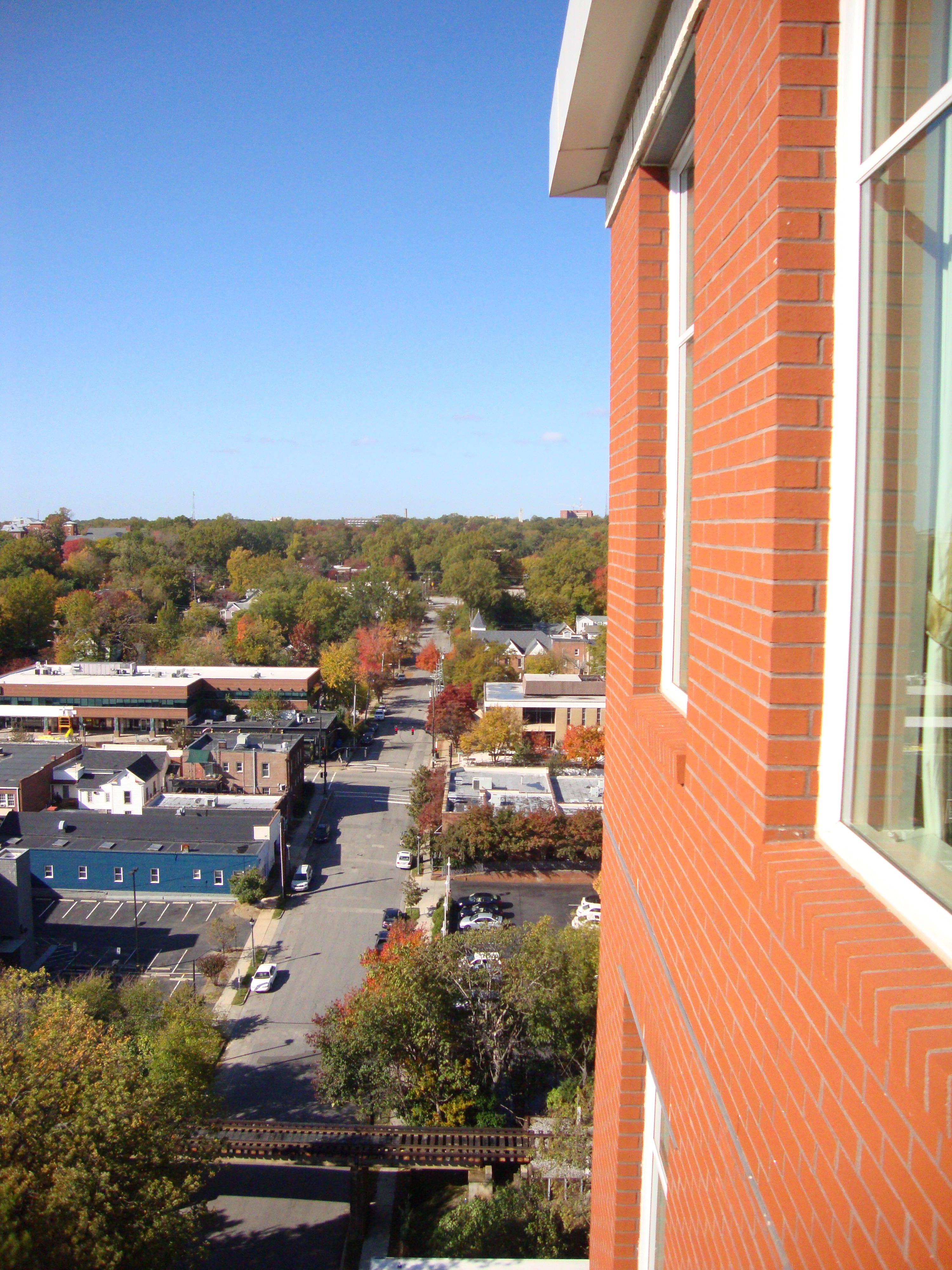
Looking west from the balcony

Daylight savings time ended this morning, and so we gained back the hour we lost in the spring. It’s strange that hours can be moved from one season to another. Anyhow, the leaves are changing, with yellows, oranges, and reds, and the temperatures are cooler. It’s fall.

Tuesday is my usual day for the Early Bird Yoga class at Blue Lotus with Suzanne. I normally get up at 5:30, do half an hour of interval work on the elliptical machine in my building, change out of my sweaty tee shirt into a fresh one, grab my yoga mat, and get to the 6:30 class in good time. Some yoga breathing, lowering, lifting, balancing and stretching is a good way to start the day.

Suzanne’s instructions are direct and clear, and her strength and grace are beautiful and inspiring. Each class is different, and lately she’s been taking us noticeably beyond our comfort zone. She seemed really pleased last week when she got us all up in tripod headstands. This week she had us all try side crow. This did not work at all for anyone (except her). Lately I’ve been working on front crow, and making progress, so perhaps we’ll do side crow one day.

Early Wednesday morning (5:40) I got in a cab to go to the airport. The cab driver was winded, and said he’d been doing jumping jacks to stay awake while waiting for me. It was better, he said, not to drink too much coffee. I agreed. He asked me where I was going, and I told him the bare fact (Boston), thinking I’d rather not get involved in a chat. There’s effort involved, and no guaranteed reward. But after a couple of minutes of silence, I relented. I figured I would try to be a decent chap and throw a lifeline to a lonely soul, so I asked him where he was from. Answer: Gambia, a tiny country in west Africa which I knew almost nothing about, and which he dearly loved.

He was a lively guy, and much more interesting than NPR. He described the government in terms that sounded benign though authoritarian, and improvements in roads, schools, and hospitals. He said that most people were at least part-time farmers and described how they stored crops in their own warehouses. When I asked him about his languages, he said he spoke seven, including three from Gambia and French, Spanish, and German. His English was accented but just fine.

The weather was clear and mild in northern Massachusetts, but there was still snow on the ground from an early season storm that had left many thousands without power. I did a bunch of meetings in Westford and then went down to Cambridge for more. On the flight back I read How to Read Montaigne by Terence Cave. Montaigne (1533-1592) is a startlingly original, modern thinker.

I was inspired to start exploring Montaigne by a few comments in an excellent book I finished a couple of weeks back: The Swerve: How the World Became Modern, by Stephen Greenblatt. The Swerve recounts the discovery in a monastery in 1417 of a copy of an ancient Roman manuscript, and explains how that discovery changed history. The discoverer, Poggio Bracciolini, was a former apostolic secretary for a deposed Pope with a classical education and passion for finding and saving ancient books. The book that was almost lost, On the Nature of Things, was written by Lucretius about 50 BCE. It’s an epic poem that describes the philosophy of Epicureanism. Greenblatt covers a lot of ground, from the philosophers of Greece and Rome, the creation of libraries, the fanaticism of early Christianity, the preservation of books in medieval monasteries, the intrigues of the popes, religious wars, the intellectuals of the Renaissance (including Montaigne), and onward.

In addition to a lot of lively history, there’s a pithy account of the ideas of Epicurus (b. 342 BCE), including the notion that the entire universe is constructed of tiny indivisible building blocks called atoms. This carried with it a view of the world as a natural phenomenon, not something magical created and controlled by gods. Epicurus espoused freedom from superstition and the pursuit of pleasure.

By pleasure he meant not pursuit of wealth or debauchery, but something more nuanced that included a sense of wonder at the beauty of the natural world.. According to Philodemus, a follower of Epicurus, “It is impossible to live pleasurably … without living prudently and honourably and justly, and also without living courageously and temperately and magnanimously, and without making friends, and without being philanthropic.” The Epicureans celebrated friendship, emphasized charity and forgiveness, and were suspicious of worldly ambition.

According to Greenblatt, Epicureans, including Lucretius, believed that the gods existed, but that they couldn’t possibly be concerned with human beings. Along with atoms, Lucretius’s ideas encompassed the notion that living beings have evolved through a long process of trial and error, that the world exists for reasons that have nothing to do with humans, that humans are not unique but rather linked to all other life forms and to inorganic matter, there is no afterlife, that religions are superstitious delusions based on longings, fears, and ignorance, and that by fashioning gods humans became enslaved to their own dreams. Happiness could be attained through discarding delusions through reasons, looking squarely at the true nature of things, and discovering a sense of wonder.

These ideas were, of course, not congenial to early Christians, who almost succeeded in stamping them out. But somehow a copy survived, which Poggio discovered and copied, and which is recopied many times, and ultimately influenced thinkers in subsequent generations up to our own. Greenblatt’s book is a true pleasure.

We saw some professional hockey on Friday night: the Caroline Hurricanes vs. the Washington Capitols. I’d learned from my new assistant about a free bus that runs between downtown and the hockey games, and it turned out that it made a stop right at our building. The bus arrived on time, with many cheerful fans dressed in Hurricanes red and white. We had a good view from box seats.

The Hurricanes started strong but collapsed in the third period and got trounced. As long as the game was close, it was fun. As with soccer, the more hockey I watch, the more I see and appreciate the incredible athleticism. The drama is simple, but effective: there’s a surge of great joy at every goal our team makes, and stab of pain at a goal of the opponents. The bus trip back home seemed slower and much less cheerful.

On Saturday we saw quite a different sort of drama, Siegfried, the third opera of Wager’s Ring cycle, broadcast live from the Metropolitan Opera to all over the world, including the North Hills Cinema. I know the music well from CDs, and love it, but had some qualms about the amount of sitting required: five and a half hours. Wagner is musically dense, and that’s a lot of Wagner. It was, it turned out, for us, incredibly powerful.

The story is about courage. Siegfried is a callow young hero who forges a magic sword and uses it to slay a dragon and an evil dwarf, then travels though a ring of fire to save and win a beautiful maiden. In pre-broadcast comments, Renee Fleming (a great soprano who would know) described Siegfried as the most difficult tenor role in the world. Our Siegfried was Jay Hunter Morris, a relative unknown who subbed in at the last moment and had a total of three performances under his belt when he performed before a worldwide audience of many thousands yesterday. This took true courage. Morris gave a performance for the ages, vocally powerful but nuanced throughout. The entire cast was superb, and the technical effects (especially the ring of fire) were impressive. Fabio Luisi conducted brilliantly. The famous horn solo, the exciting few bars that horn players test and polish their whole lives, was perfect.

This Siegfried, the opera, moved me deeply (tears). Driving home afterwards, I felt wrung out but exhilarated. Sally also loved it, and announced that she was now a Wagnerian. I found this very cheering.
Work, Pilates, Bjork, and musical play time

Nocturne in D flat major by Frederic Chopin

It was another busy week of many meetings, calls, and issues, with business dinners almost every night, and my email backlog continuing to pile up. But interesting, always interesting. On Friday I was scheduled to go to the coast for two days of wreck diving, but bad weather arrived and the trip was cancelled. I was not heartbroken. It was good to get some down time.

On Saturday morning it was cold and rainy. I thought of taking Yvonne’s open level Vinyasa yoga class at Blue Lotus, but learned from the web site that someone else was filling in for her. I check for alternatives, and found an early Pilates class at the Y. And so it was that I had my first Pilates experience. It was similar to yoga, with its emphasis on breathing throughout a series of exercises with unusual stretches and contractions. I found this particular class less strenuous than my normal yoga classes, and also less serenity-inducing. Still, I would do it again, especially if there’s no yoga available.

Other new things: earlier in the week I read a news story about Biophilia, the new multimedia production of Bjork, the Icelandic singer-songwriter, and downloaded the work to my iPad. Biophilia is in part a collection of songs about nature and science, but rather than being an album, it’s something we don’t have a word for yet. Bjork worked with scientists and artists to make interactive productions that allowed the listener to participate actively in the music by adding notes and altering images. After a few minutes of experimenting, I could make a bit of music with the tools provided, and participate in some of Bjork’s visions of microscopic, geologic, and celestial phenomena.

The idea of sharing a vision this way — not just providing passive entertainment, but inviting participation as a way of inspiring and teaching — is exciting, and the NY Times story took the view that it was ground breaking. For me, the experience was intriguing but not really thrilling. I liked being allowed to work with Bjork’s electronic instruments and play with her, but the musical possibilities were narrowly circumscribed and not expressive enough to satisfy me.

For example, by using the touch screen, in various songs you can add to Bjork’s fairly simple musical backdrop more harp notes or more synth notes, and play faster or slower, but so far as I could figure out without taking any new harmonic direction. The videos were in some cases beautiful, but the songs themselves were more performance art than either art music or dance music. Still, I liked the ideas, and I will probably play some more with Biophilia.

Phoebe, Holtkotter lamp, and music technology

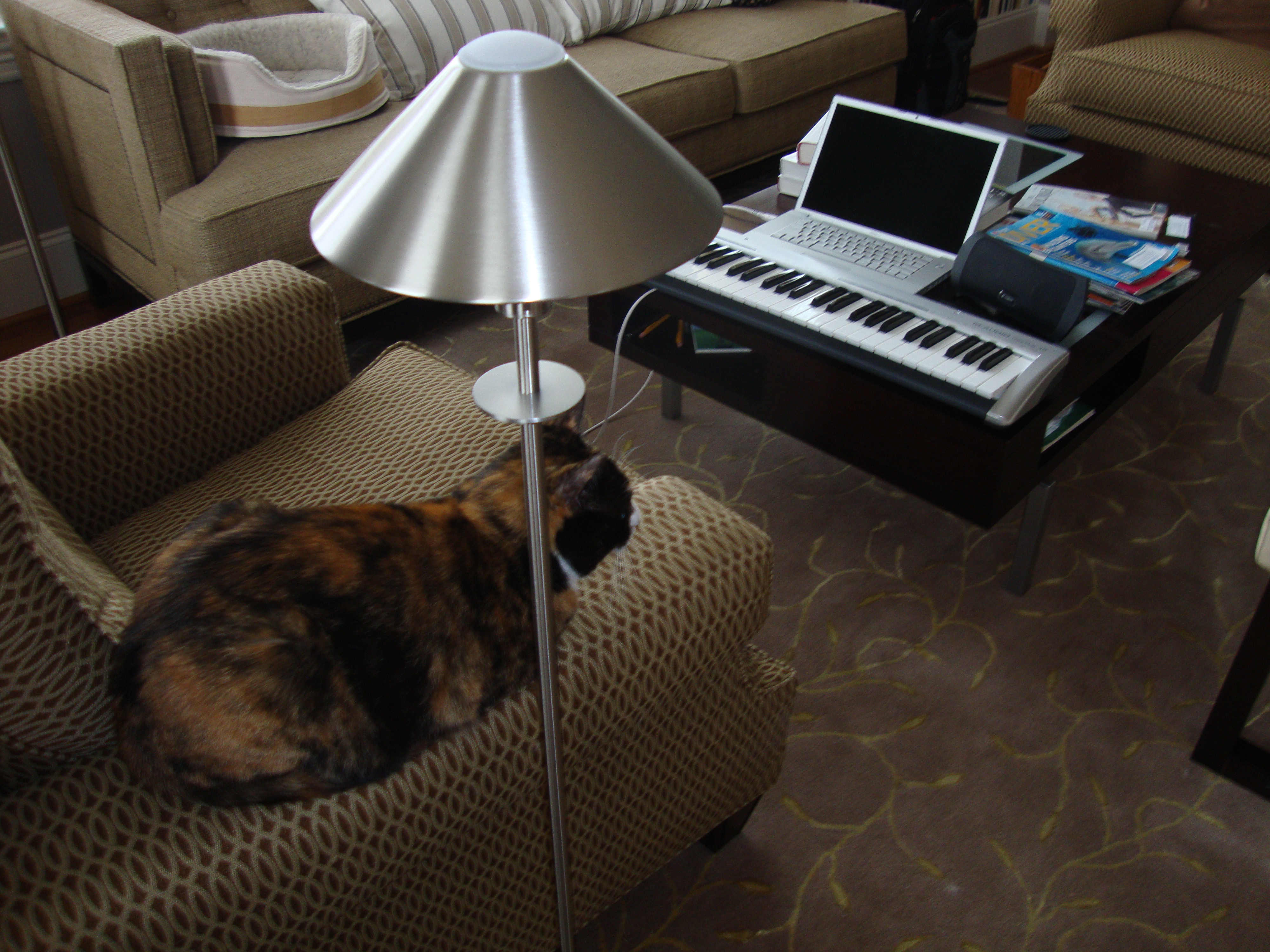
The idea of using technology to express new musical thoughts has interested me for a while. This past spring, I began playing with the instruments built into GarageBand (a Mac application), and eventually purchased a cheap electronic keyboard and a cheap auxiliary speaker to experiment with. One of my ideas was to translate early music (1500s) through synthesizer voices to see what new things emerged. The sheet music came with a lot of interpretive problems, so I didn’t get far on the vector. But I had fun improvising with various synthesizer personalities using various systems, like Greek modes and pentatonic scales. I thought of it as playing, in the sense of playing a game. It’s a different kind of musical outlet.

Bjork’s idea of engineering a collaboration with an unknown audience has a distinguished heritage. It’s what we do when we open a volume of Chopin nocturnes and start to play. Chopin left us the architectural drawings, which the pianist uses to create musical in real time, while at the same time personalizing the structure with thousands of unwritten details according to the pianist’s experience, intelligence, and feelings.

This system — master composer, written music, trained pianist — has worked amazingly well for a couple of hundred years. It does, however, depend on musical education — there has to be a support system for training pianists, and also listeners. For music with the harmonic complexity of the great Western tradition, you have to learn a lot before you can interpret it, and you have to learn a fair bit to get deep enjoyment from listening to it. It is worth the effort.

I sometimes worry that there is a long historic curve in which our music devolves from the complex and brilliant to the simple and sweet, and from there to the just plain dumb. The traditional system of classical music education and performance is not in good health. But perhaps humans are just getting started in discovering what music can do. Who knows where it goes? We have to keep experimenting, keep creating. That’s what Bjork is doing, and good for her.

Track driving at VIR and chamber music

Clara and friends at VIR on 10 September 2011

We had plans to go to the North Carolina coast for some wreck diving this weekend, but the trip was cancelled because of rough (eight-foot!) seas. I was a little disappointed, but also a little relieved. The last couple of weeks have been turbo-charged at work, and on top of that I’ve had lots of extracurriculars. Today is gray, drizzly, and chilly — a great day to relax and reflect.

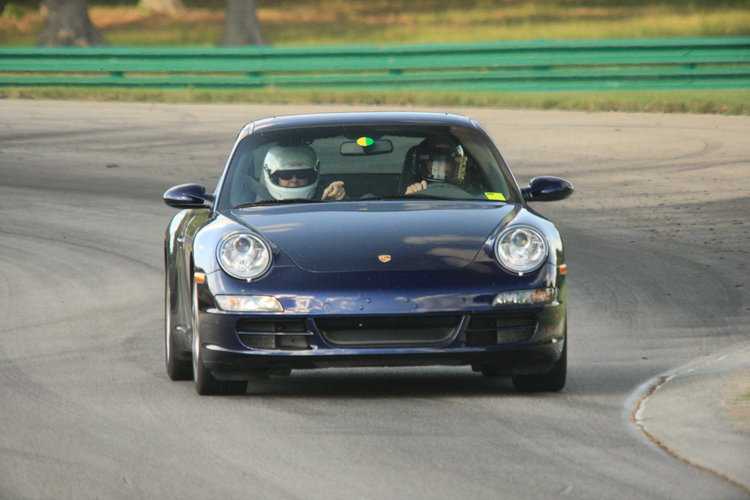
Last weekend was exciting, but not relaxing. I took Clara, my 911S, out for two days of hard track driving at Virginia International Raceway. She’s a great car, and did almost everything I asked. The weather was pleasantly warm and clear. My instructor, M, was very experienced and initiated me into some new aspects of track driving.

M gives a pointer

M stressed that the key to faster laps is smoothness and consistency — threshold braking at the same spot, hitting the same apex, coming into the throttle and tracking out all the way to the same track edge. It sounds like consistency could get boring, but for me it didn’t — perhaps because it’s so hard to do. As I got better in a particular difficult turn, it required throttle and brake adjustments for the following turns, which were seldom perfect. I had a couple of hair-raising moments, including a skid off the track and into the field (too much speed into turn 1), but no damage was done. There was plenty of exhilaration, and over all I felt an increase in competence.

This week I had two meetings with the Raleigh Chamber Music Guild, which recently elected me to its board of directors. I’ve loved chamber music, especially string quartets, since high school, and I’m pleased to be able to lend a hand to sustaining this great tradition. The RCMG is 70 years old, and has brought many world-class ensembles to this area. From what I’ve seen so far, the board seems like a good group. I’ve tried to make peace with the fact that some people don’t like chamber music (though I confess I cannot understand why), and just be grateful for the music and the people who enjoy it. They tend to be an educated, articulate demographic. But it isn’t easy for these music lovers to find each other or communicate about the music. It’s partly normal shyness, and also the difficulty of translating music and related feelings into words. RCMG may be a good venue for me and others to make some of these connections.

Another night this week I had a class on wreck diving, in preparation for diving on the Hyde and the Markham. Penetrating wrecks involves a higher level of risk than reef diving that we generally do, and it requires some training and careful preparation. I learned about various safety measures, including hazard assessment, redundant equipment, and laying a guide linet. I’m hoping to do the dives in late October.

Why do people engage in even mildly perilous situations, and imagine themselves in dire ones, when they don’t have to? People do it, at least to some degree, all the time — in sports, amusement parks, and scary movies. We’re funny animals, for sure, and we do some stupid things, but theres some sense to it. Maybe we confront manageable risks in play to prepare ourselves for real dangers. It could help develop some reserves of courage. And risk takes us out of our daily routine and out of ourselves. We forget ourselves, and feel more alive.

A recording session at Manifold Studios with Michael Tiemann, John Q. Walker, and the ghost of Oscar Peterson

Last weekend I attended a recording session at Maniford Recording, my friend Michael Tiemann’s new recording facility in Chatham County near Jordan Lake. Michael’s been working on this project for four years, and it is clearly a labor of love. The setting is rural piedmont North Carolina, surrounded by farms and forest with lots of songbirds. (I heard a whippoorwill singing ardently for the first time this year or last.) The architect was inspired by Frank Lloyd Wright, and incorporated the golden ratio throughout the design. Michael explained his his purpose in terms of making great recordings with a total devotion to truthful sound. I noted that this is swimming against the tide of contemporary culture, which Michael conceded, but he noted that tides can turn.

The recording was done by software developed by Zemph, a company founded by John Q. Walker, who was also at the session. The objective was to reengineer a recording by Oscar Peterson (jazz pianist) and Ray Brown (bass) from 1949. A hundred-year-old Steinway that had once been at Carnegie Hall had been fitted out to play itself using Zemph’s software, and the Zemph folks had created a new instrument to reproduce the bass. The sound was uncanny. It was unsettling, but kind of moving, to see the piano keys moving, and the sound had authority.

I went through a long period of studying and really loving jazz. I still enjoy it from time to time. I particularly enjoy music from the big band era. But jazz sometimes gets more reverences than it deserves, based in part on the myth of improvisation. The non-musician perceives improvisation as a bold experiment, but it’s usually not. What improvisation mostly means is either variations on prior melodies or laying prefabricated riffs in various orders on top of fairly simple, repetitious chord structures. It can sometimes have energy and heart, but it can also be fairly boring. When I started to feel a little bored, I found my way back to the Western European musical tradition, in which composers wrote down ideas so rich that we still find, centuries afterwards, it interesting, and sometimes transcendently moving, to confront them. I don’t get that from Oscar Peterson.

John graciously allowed me try out the pianos after the session. I found the Carnegie Steinway a bit loose and diffuse, but the Hamburg Steinway was wonderful — brilliant colors and clarity. I worried that the reproduction equipment, including circuit boards attached to the keys, could affect either the sound or the action, but I couldn’t perceive any such effects. I played a bit of Chopin, including the Minute Waltz, and a bit of Debussy’s First Arabesque.

I enjoyed seeing the technology for recreating the performance, and the mixing session in the studio. And it was inspiring to see how passionate Michael and John were about the music. I have a soft spot for people that are absolutely passionate about art that will never win a popularity contest or make a dollar. It’s a reminder that art matters at the most intimate human level, and can inspire love so intense as surpass all rationality.

Piano v. synthesizer

After several lessons, Olga, my new piano teacher, recently departed for Rumania for the summer, leaving me with a lot of musical ideas, but with no particular urgency to practice up for the next lesson. And so I found a sliver of time and energy to explore an area I’d been curious about for a while: musical technology and synthesizers.

My computing devices contain synthesizers and virtual studios, and after some casual experimenting I realized there’s a lot of potential for musical fun. Without any particular effort or expenditure, I have at my disposal musical tools that would have cost tens of thousands of dollars thirty years ago. But figuring out how to make them more expressive takes some time and energy.

My first objective was to make some techno dance music. It’s odd, I know, for a person with predominantly classical tastes, but I sometimes enjoy listening to this stuff when driving for fun. GarageBand, an Apple program, includes prefab loops that can be used for this purpose, and I soon had some sonic space that was reasonably entertaining. I then got curious about what else could be done, and started to experiment with non-pre-fab elements. It was sufficiently fun that I bought a cheap MIDI keyboard and a little wireless auxiliary speaker.

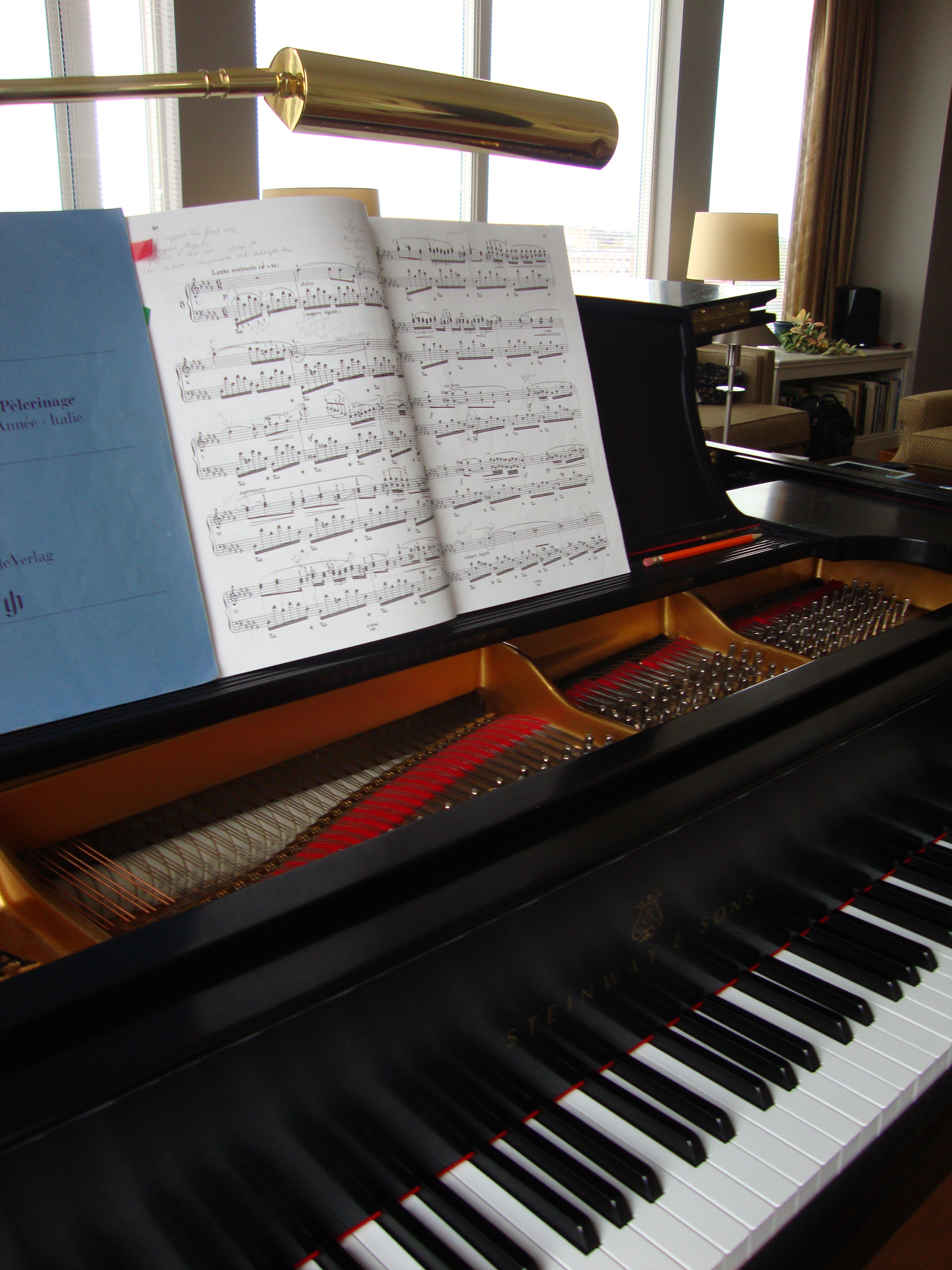
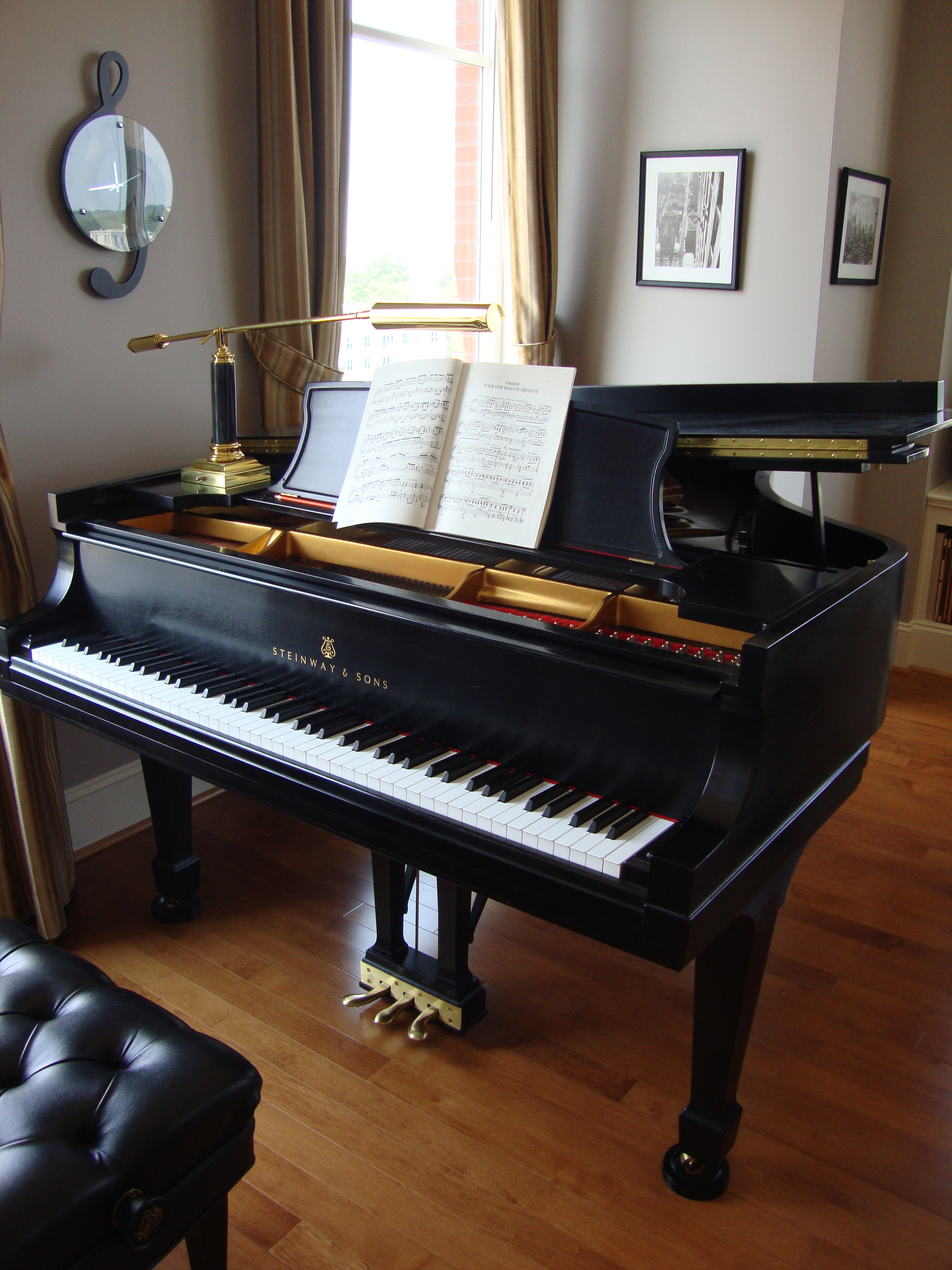
This was a significant step, because I have a strong prejudice against electronic keyboards. The interface looks like that of a real piano, which is deceptive, because the two instruments are very different. A great piano, like my Steinway grand, allows for a subtle connection between the human and the string. The basic technology is now antique (19th century), but still, they have thousands of parts and are said to be among the most complicated mechanical machines on earth. Each piano is also an individual, in a way that each electronic keyboard is not. The wood comes from particular trees that grew as they grew in a particular place during particular years.

A great piano has the capacity for nuance. I used to think of a key on the keyboard as similar to an on-off switch, but Olga persuaded me this is a mistake bordering on sacrilege. Her thing is to focus on nuances of touch and the associated nuances of sound. She hears details so tiny that it took a while for her to convince me they really existed, another period for me to begin perceiving them, and another period for me to begin to use them. It’s a little embarrassing to admit I was previously barely aware of this level of listening and touching, in spite of many years of making music.

Once you begin really listening hard at this level, the experience of music changes. There’s good news and bad news. It’s harder to reach a point of complete satisfaction with a performance, but at the same time the experience is richer and deeper. Anyhow, there’s no going back. Once your ears are opened, focused concentration on subtle nuances seems essential to any significant musical experience.

In revealing a level of this, Olga did a demonstration of various ways of touching C-5 for different colors of sound. One way she thinks of the touch is like dance, with the gesture of the hand choreographed to produce a particular color. Speaking of the subtle differences in sound produced by different gestures, she said (with a Russian accent), “I don’t know why it makes a difference. It just does. The piano is a mysterious instrument.”

Electronic keyboards are complicated, but somehow not mysterious. I have doubts that digital sound creation will ever be as personal and emotionally rich for me. But there is an amazing variety of things that the synthesizer can do. It’s different, and it’s good to change things up from time to time. So I’ll be experimenting, and see where it leads.

Nixon in China

Saturday afternoon Sally and I made it to North Hills Cinema to see the Metropolitan Opera’s simulcast of Nixon in China by John Adams. I’d been looking forward to the event all season. Although I’d never seen NIC, I’m a big fan of Adams’s music for orchestra. It builds on the spare vocabulary of American minimalism both rhythmically and harmonically towards something that I think of as edgy romanticism.

The idea of an opera about Nixon going to China seemed at first outrageous and possibly hopeless. For those of us who observed Nixon in his lifetime, he seems a most unlikely hero. In retrospect, he looks a lot more moderate, responsible, and intelligent than we liberals thought at the time, particularly in comparison with today’s leading so-called conservatives. But even after giving extra credit, Nixon simply does not fit any standard opera hero template. At his very best, he was awkward, unsexy, and egotistical in an almost comic way.

Nixon in China takes all that and works with it. There is a comic and ironic aspect to the work, but that’s only one of many levels. The historical events are treated with some respect, and the humanity of the characters is acknowledged. But the music takes this material in surprising directions. Along with the simple storyline (the Nixons go to China) are several individual story lines that have the gauzy jumpy quality of dreams.

Adams himself conducted the performance on Saturday. At one intermission, he referred to the Met orchestra as a Ferrari of an orchestra — one of the best in the world — which I think is true. As Nixon, James Maddalena captures something of the weird contradictions of the man, though he seemed to have some difficult moments vocally. Janis Kelly was surprisingly touching as Pat Nixon, and had the vocal strength of a Wagnerian soprano. Kathleen Kim was funny but also terrifying as Madame Mao. It was good to hear the interviews with Peter Sellars, who’s both brilliant and comic, and Mark Morris, who’s brilliant as well.

I liked the music a lot, but I didn’t think this was necessarily the ultimate Nixon production. The Mark Morris dance sections were wonderful, but elsewhere big chunks of Sellars’s staging were surprisingly static. I thought the sets were in places too literal and in places too conceptual. But I would definitely watch it again, and I will be thinking about it for a while.

Piano lesson

One door closes, and another one opens. My piano teacher for the last four years, Randy Love, left for a sabbatical in China last month. Our piano lessons, at intervals of once a month or so, have taken me a long way along the path of the great western piano music tradition. The tradition is based on written texts, but much of it is unwritten, transmitted from teacher to student. Randy has transmitted much, and been an excellent master and a good friend.

During that time, I’ve enjoyed gaining fluency at the keyboard, but I don’t view increased technical mastery as the most valuable accomplishment. Much more important, and also much harder to express, is a change in the experience of the music. “Music is feeling, not sound,” according to Wallace Stevens (in Peter Quince at the Clavier). Stevens was on to something, although music is, obviously, sound. There’s a type of emotional energy stored in written musical texts and released and renewed with each performance. And there are many levels to that emotional experience.

So I went in search of a new master, and found myself yesterday at the music building at N.C. State in the studio of Olga Kleiankina. She’s a Russian with degrees from schools in Moldova and Romania, a masters from Bowling Green and a doctorate from University of Michigan, and joined the NCSU faculty last years as head of the piano program. She’s got an impressive amount of performance experience, and is an active concert artist. She was friendly but focussed. Straight away, she invited me to try out her two pianos, and after playing a bit of Chopin on each, I settled on the Mason and Hamlin over the Yamaha. Then she asked me what I’d brought to play for her. I played the first half of Chopin’s nocturne in D flat, Op. 27, No. 2, one of Chopin’s most beautiful, lyrical pieces, very like an operatic aria, with a broad emotional range. I played it rather well, with real feeling, I thought.

Olga was polite, but wasted no time with compliments. She said she could help me with my technique, and plunged in. It was quite bracing. We worked hard on weight transfer, activating the back and arm and relaxing the wrist. She showed me different ways of positioning the fingers on the keys for different sounds. She also talked about the shape of the gestures of the hand as it related to the flow of the music. She demonstrated this in various ways, including taking my hand and guiding it. I’ve usually thought of the physical aspect of piano playing as supporting but separate from the musical part, but Olga seemed to view the two as unified. Beautiful movements make beautiful sounds. She also demonstrated a level of attention to detail that was inspiring, and daunting.

At the end of the lesson, I felt like I could be at the foot of a new mountain. There’s a long way to go to reconfigure my playing along the dimension Olga pointed to. It will be challenging, and maybe transformative.

Your brain on music

Why do we love music? The question has always bothered me. There’s no doubt that music is a powerful force, but how does it work? It seems like a fundamental human activity, practiced in every society now and as far back as we have knowledge. As a thoroughgoing Darwinist, I assume musical activity must confer some evolutionary advantage, like being able to throw a spear well or make a fire. But it’s by no means obvious what music contributes to survival, or even what it does to make us happier.

For a philosophically inclined musician, that’s troubling. The question has a moral aspect. We can use our limited energy in various ways, with various positive or negative outputs. We can, for example, help feed the poor, ignore the poor, or rob the poor, and the choice partially defines us. If we’re making music, and not feeding the poor or doing some equally valuable thing, how can we justify it?

Last week I learned of a study that gave a new perspective on these questions. Neurologists at McGill University did brain imaging using PET and fMRI techniques that established that the music can cause the neurotransmitter dopamine to be released in the brian. http://tiny.cc/38ko7 Dopamine is part of the deep reward system involving the limbic system. It makes it pleasurable for individuals to do things that are good for the species, like eating and having sex. In other words, dopamine is connected to key behaviors, and drives those behaviors.

So in some sense, music is as significant as eating and sex. We can do without any of those things, at least for a while, but they are fundamental to human animals as a whole. This doesn’t answer the basic why questions of music, but it suggests the possibility of an answer. At any rate, it shows that music can be something powerful.

The McGill researchers found that dopamine release levels vary with different kinds of music, and related those variations to the what they called “chills,” and I call goosebumps. So not all music is created equal. I’ve developed as my own test for when music is most effective the monitor of when it makes a lot of goosebumps. Thanks to the neurologists for a new way of thinking about this amazing thing.