The Casual Blog

Category: moral causes

Sensationalizing homophobia, engaging with aging, and testing mindful eating

Coming back yesterday from a short trip to Manhattan, I had a few minutes to spare in the crowded Delta terminal at LaGuardia. There were no seats near my departure gate, but I found one three gates away, and flipped through The New Yorker magazine. With only a few minutes, I purposely chose a story I expected to be relatively uninteresting — a piece by Ian Parker titled A Reporter at Large: The Story of a Suicide: Two College Roommates, a Webcam, and a Tragedy.

The story keyed off a widely reported incident at Rutgers University in 2010 in which a student spied on his roommate with a webcam and tweeted that he’d spotted homosexual behavior. The ensuing mediathon developed the story line that a heartless homophobe had posted video on the web that caused a vulnerable closeted gay student to kill himself — an emblematic hate crime.

In Parker’s reexamination, the popular media story turns out to be a gross distortion. Dharun Ravi, the surviving roommate, is now facing a criminal trial on vague charges with the potential of years in prison. Ravi created an extensive record of tweets, texts, and other communications that seem stupid and immature, but not unusually so for a 17-year-old. There turned out to be no web cast of video. The suicide victim was actually out of the closet. Ravi’s juvenile online socializing comes across as frenetic and somewhat pathetic. He seems smart, selfish, insecure, and not all that unusual.

I got a few a columns into the story before I decided with boarding time approaching I needed to position myself closer to my gate. I wheeled my possessions a hundred yards or so. Somewhere in that process, my New Yorker disappeared. I retraced my steps, but it had vanished. How annoying! I hope whoever recovered it enjoyed it. After I got home, I managed to download the piece to my iPad and finished it.

It’s too bad, in a way, that the facts don’t support the story line of a bullied gay martyr. Homophobia plainly exists, and violence against gays exists, and those things need to be publicly condemned and appropriately punished. Tyler Clementi’s suicide was unquestionably a tragedy. But, as Parker’s story shows, the cause is unknown, and probably complex. There’s no simple way to assign blame for it. The media’s hype and erroneous reporting fed hysteria and calls for revenge, and now comes a criminal trial that will at a minimum scar a second life.

As an alumnus of the editorial staff of The New Yorker, I enjoy flipping through it every week, though I admit to reading less of it than in days gone by. Last week I read with intense pleasure in the January 23d issue a piece by Donald Hall titled Out the Window: The View in Winter.

The 83-year-old poet has written about getting old. He now needs a wheelchair and has various physical problems. He’s conscious of being “a separate form of life,” treated with either indifference or too much solicitude. He spends a lot of time looking out the window at his bird feeder and the countryside beyond. The outline of his life sounds sad and dull.

This is the amazing thing, though: his life is full of incredible beauty! His descriptions of the drama at his bird feeder are marvelously clear and vivid. He writes of the sequential blossoming of spring flowers with rhythmic, muscular prose. To think that this depth of perception and power of expression can be part of growing old is inspiring.

I’d like to become more conscious of ordinary sensory experience, and to reduce, if only a little, the percentage of each day lived on autopilot. It’s challenging, though, to engage with the present. There are distractions inside and out. Art, like Hall’s essay, can help. I find yoga is also helpful. I hadn’t really thought of meal time as a possible aid, but was inspired by a column this week in the NY Times headed Mindful Eating as Food for Thought.

The basic notion is to focus carefully and completely while eating on the sensations of eating — the flavors, smells, and textures, down to tiny details. The way I normally eat involves talking to people, reading, listening to music, thinking about things, and sometimes combinations of these, jumping from one to the next, hardly noticing the food. Mindful eating is the opposite — quiet and slow.

According to the column, this approach to food is an antidote to over eating and helps with distractedness. It also could lead to greater pleasure. I was reminded of my old friend Tom, now departed many years, a casualty of AIDS, who considered great cooking to be an art entitled to no less respect than painting or music. Accordingly, he had an enthusiasm for high-end restaurants at a time when neither of us could well afford them. He once used part of his Watson fellowship money to treat me to a meal in a four-star restaurant in Paris. His only request was that we not talk while we ate. We enjoyed the incredible meal in perfect silence.

More recently, on an average day I have a hard time focusing for half an hour on anything, and that includes eating. But at least now I’m thinking about it. So far, I’ve managed to eat only a few mindful bites at the beginning of a meal, but I’m going to keep trying.
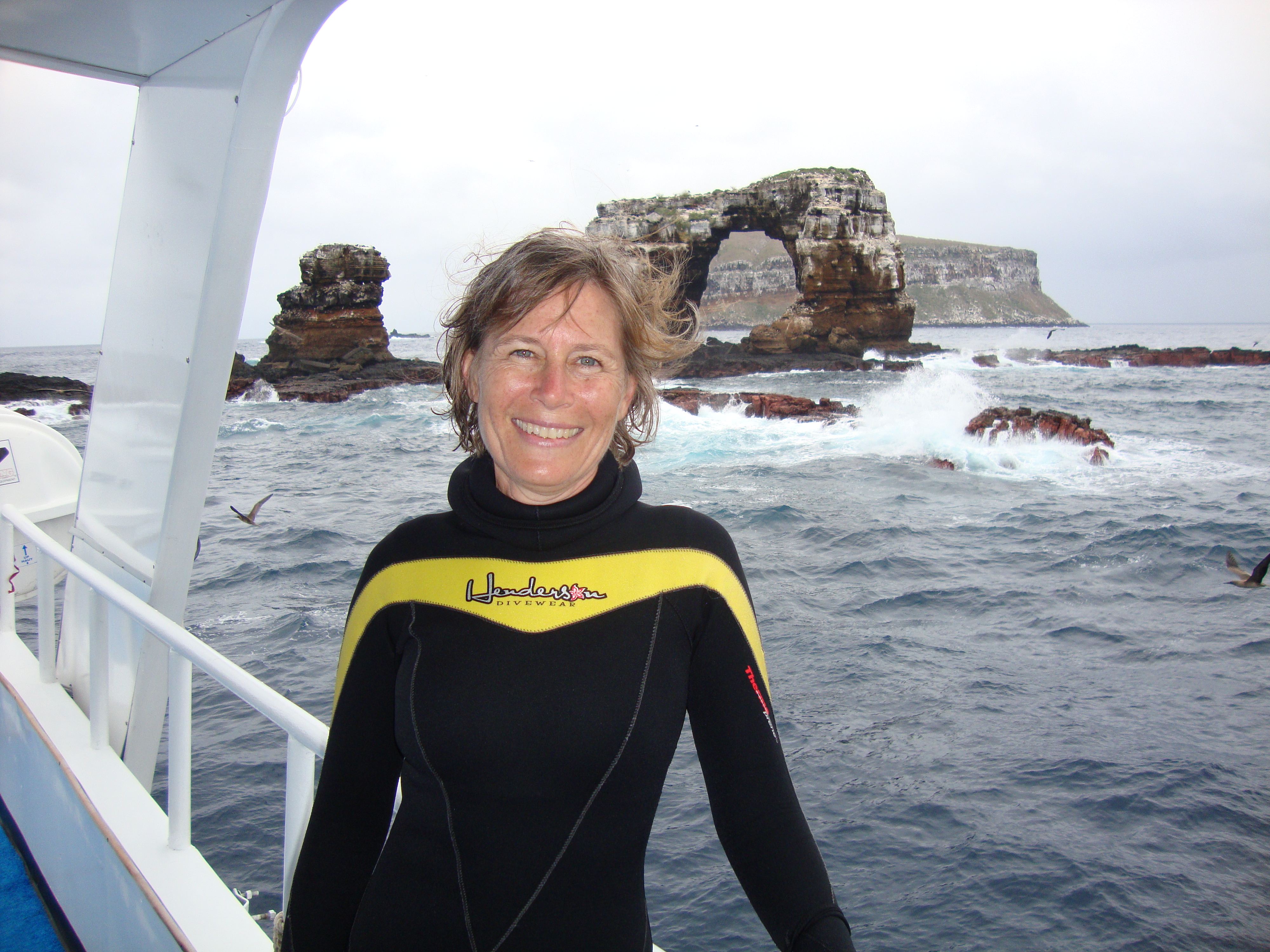

Diving in the Galapagos Islands

Sally at Darwin's Arch, Galapagos

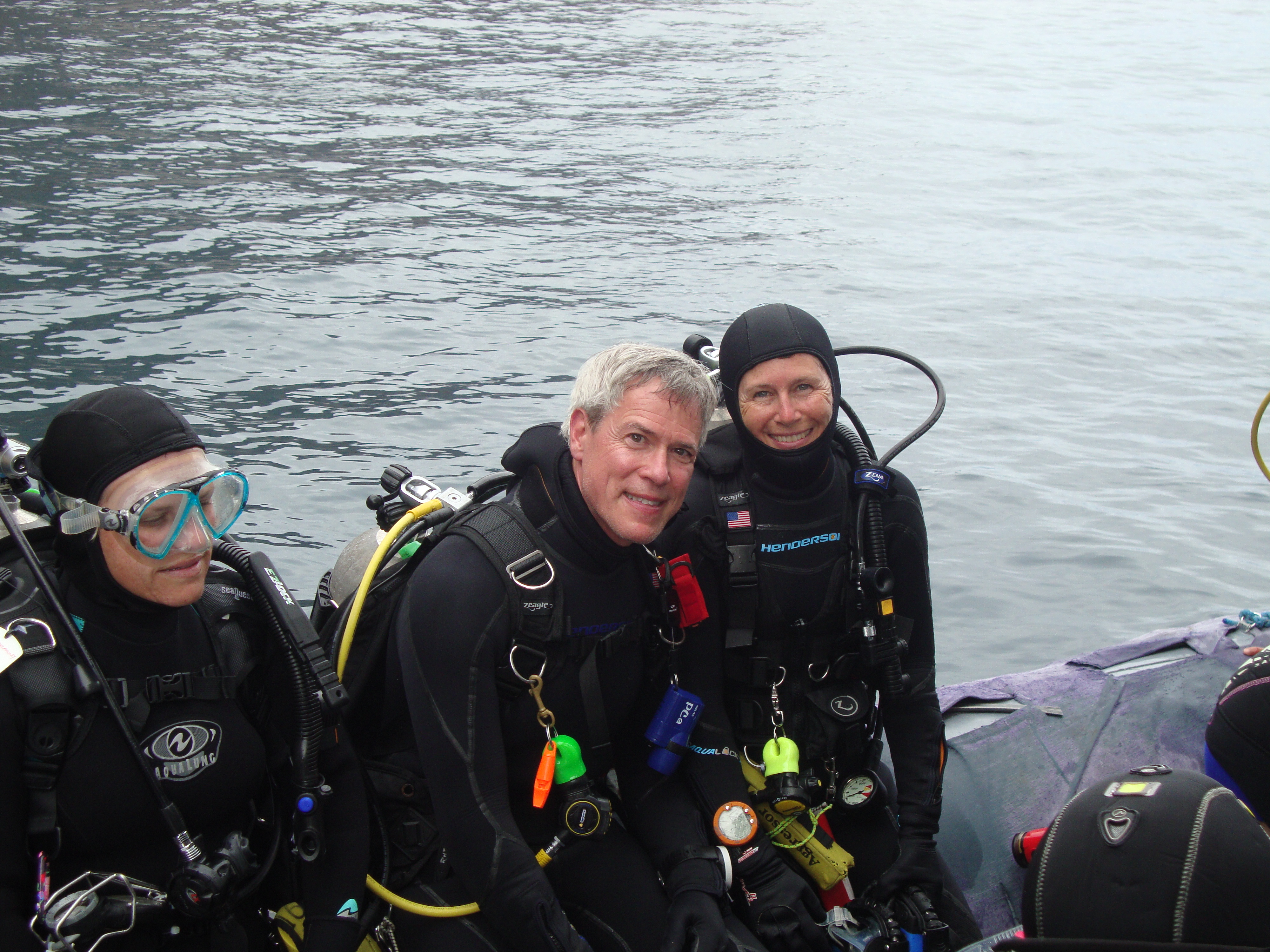
On Christmas day, we did our third day of scuba diving in the Galapagos Islands, some 600 miles west of the coast of Ecuador, at the foot of Darwin’s Arch. There was a strong current, and so we spent most of the fifty-minute dive clinging to barnacle-covered rocks. There were many patrolling hammerhead sharks, as well as a couple of large Galapagos sharks. We saw many large sea turtles and fine spotted moray eels. There were hundreds of small colorful tropical fish, such as Moorish idols, king angelfish, trumpetfish razor surgeonfish, Guineafowl puffers, barberfish and parrotfish, as well as huge schools of creolefish. It was fantastic!

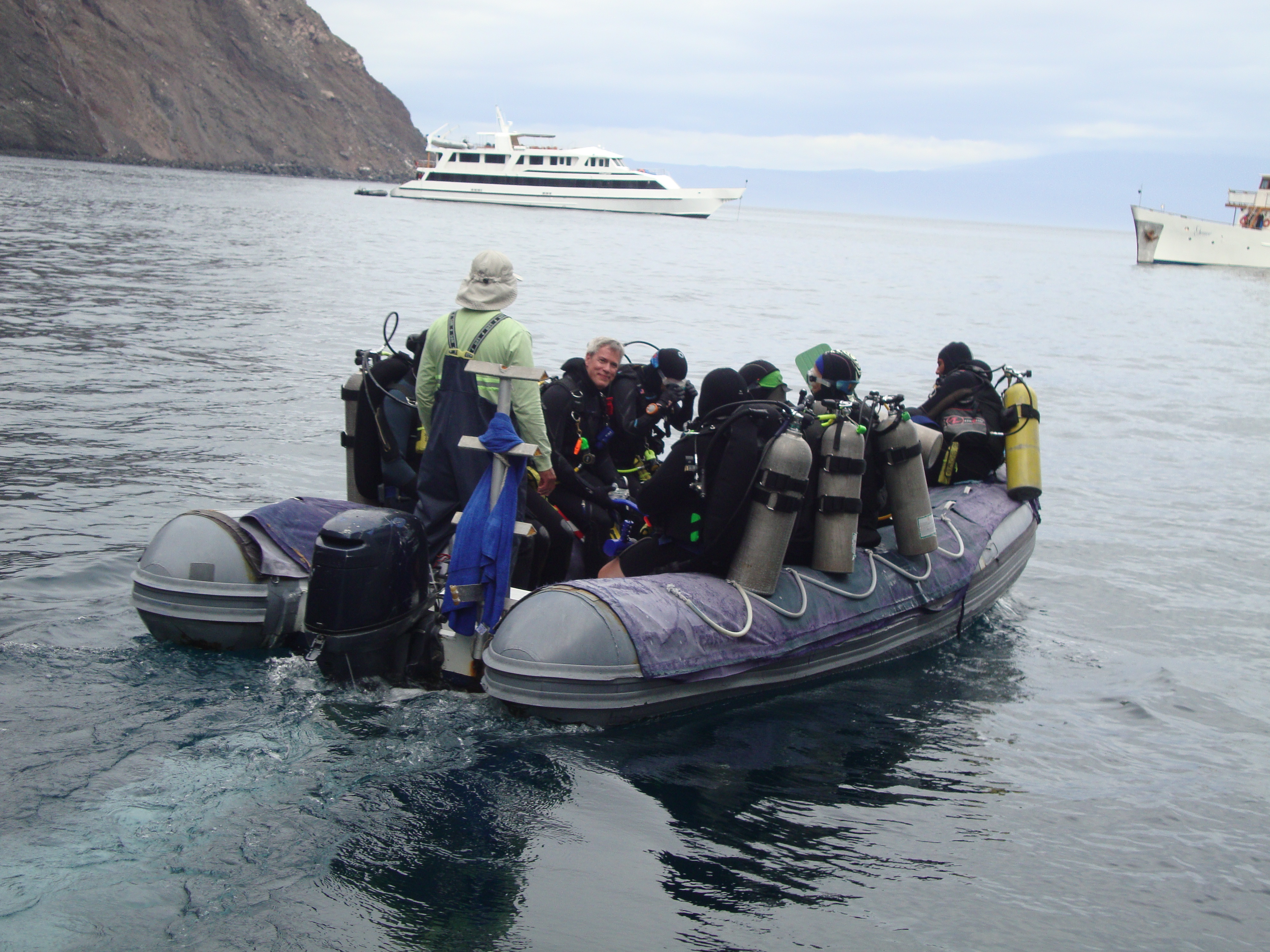
After the dive, we hoisted ourselves over the side of the inflatable dingy (or panga) and returned to the mother ship, the Galapagos Aggressor II. It was Sally’s hundredth dive. The crew presented her with a certificate, and our fellow divers gave her congratulations and hugs.

The Galapagos Aggressor II

From the boat, we watched hundreds of flying boobies (large sea birds that resemble gulls with webbed feet) (Nazcas, red-footeds, and a few blue-footeds), frigate birds, swallow-tailed gulls, and storm petrols. Groups of dolphins came by periodically. Later that day, we did some snorkeling a few yards off of Darwin Island. The dolphins weren’t very interested in us, although I swam briefly with a group of six. We had better luck with a group of sea lions, who were curious about us, and came close by doing flips and loops.

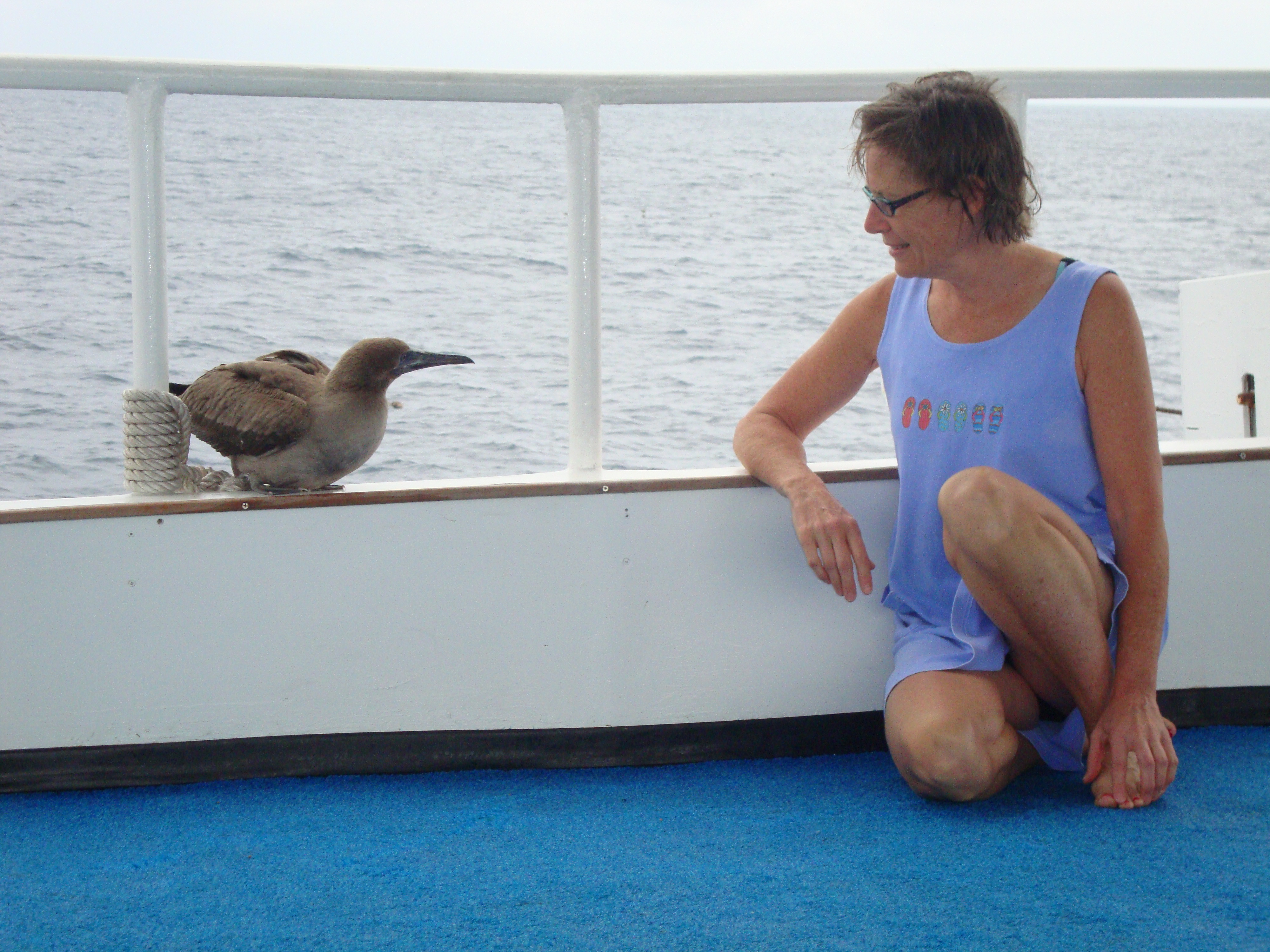
Sally and a curious juvenile boobie (red footed, I think)

Darwin, like all of the islands we visited during the week, was the remains of a volcano that originated four or five million years ago — a mere babe in geological terms. It was mostly gray rock wall rising sharply several hundred feet to a plateau on top. It was very stark, but also thrumming with bird and sea life. We saw no other humans. It felt like the earth was brand new. The creativity and resourcefulness of nature was awe inspiring.

On the panga

During the trip, I finished reading The Better Angels of Our Nature by Steven Pinker. Pinker’s theseis is that human violence has declined dramatically over the course of history, and he explores the possible reasons for this. The book covers a lot of territory (all of human history) using a lot of tools (history, philosophy, statistics, biology, psychology), and still manages to be surprisingly lively and readable. Part of the book examines the increase in the last century of concerns for animal welfare — the sense that mindless cruelty to animals is unacceptable, and the suffering of animals is a moral concern. As with most violence, we’re ordinarily concerned with (and overgeneralize from) the violence and cruelty we observe, and tend to ignore examples of kindness and decency. It was cheering to learn of a trend toward greater respect for animal rights, and to consider that the trend could continue.

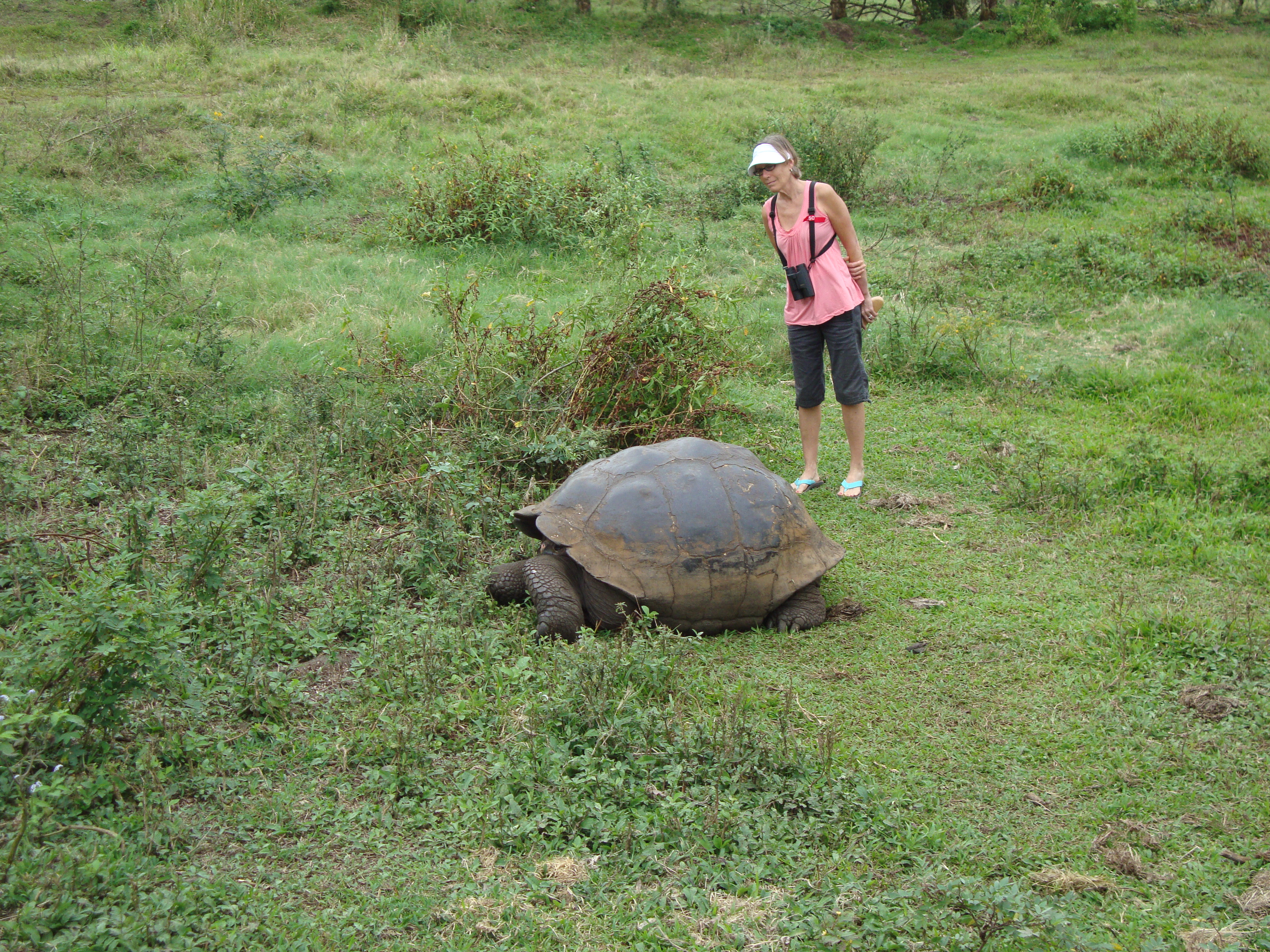
In our group of 11 divers, Sally and I were the only ones who did not dive with cameras. They were a cheerful, intelligent, and sociable group of folks, and all significantly more experienced at diving than we were. I’d taken the view that I’d prefer to look hard at what was in front of me without the distraction and intermediation of a camera, but especially after viewing some of their pictures, I was a little sorry that I didn’t get pictures of some of the amazing, strange, and beautiful things we saw under water. Perhaps next time. Here are some other above-water pictures from our trip.


My budget solution: end the wars (Iraq, Afghanistan, and Drugs)

Yesterday the newspapers reported that the last U.S. soldiers would be out of Iraq by the end of this year. When the U.S. invaded Iraq eight years ago, I thought it was a terrible mistake, and everything I’ve learned about it since has strengthened that conviction, as thousands of U.S. soldiers and tens of thousands of Iraqis lost their lives, and as we increased our exposure to financial collapse by spending more than 800 billion borrowed dollars.

It’s good news that it’s over, and I wish I could feel happier about it. We’ve wreaked a lot of havoc in Iraq, and now we’re stopping. Have we learned anything? That’s doubtful. As a society, we’ve hardly thought about it at all.

As an undergraduate at Oberlin College, I had a concentration in political theory. I read Plato, Aristotle, Augustine, Aquinas, Montesqieu, Machiavelli, Hobbes, Locke, Rousseau, Adams, Marx, Nietzche, Bentham, Mill, Arendt, Rawls, and a lot of other interesting and challenging thinkers. For a long time, though, I had my doubts as to whether I’d learned anything at all useful.

Eventually, I came to the view that I learned one very useful thing: critical thinking. Engaging with lots of powerful ideas that were all, at least to some degree, wrong or unworkable helped develop a mental toolbox. This toolbox is useful in recognizing the weak points in arguments, discarding unfounded assumptions, and sometimes in making better decisions.

War is powerfully attractive at certain times and places. I am not immune to that attraction. Like lots of kids, I’m fascinated by weaponry (especially tanks and fighter jets), and I find military history interesting. But something in my moral education left me with the settled view that killing sentient beings is deeply tragic, and in most cases morally wrong.

Add this ethical orientation to a skeptical turn of mind, and maybe I can see through the attractions of war to the underlying horror more easily than most. Or perhaps I’m kidding myself. In any case, I have a high degree of confidence on the right way to go on this. While we’re wrapping things up in Iraq, let’s also quit sending our kids to kill and be killed in Afghanistan. There is no good reason for that war, either. We’ve spent more than $450 billion on it. Let’s stop the physical and financial bleeding.

Ditto on the war on drugs. This week’s (Oct. 17) New Yorker has a piece on the subject by Michael Specter. (Unfortunately only the first few paragraphs are available without charge online.) It starts with a discussion of Portugal’s experience of decriminalizing drugs ten years ago and treating addiction as a medical problem. “In most respects, the law seems to have worked: serious drug use is down significantly, particularly among young people; the burden on the criminal-justice system has eased; the number of people seeking treatment has grown; and the rates of drug-related deaths and cases of infectious diseases have fallen.”

Specter gives a balanced account of Portugal’s experience, and including quotes from critics of the change. Their criticisms seem mostly based on their belief that drugs are evil. Fine. But in Portugal lots of law enforcement and political leaders have given up on the idea that treating drug use as a crime can possibly succeed.

There was another good anti-drug-war piece this week by Doug Bandow, a fellow at the conservative a Cato Institute published in Forbes and republished by the Huffington Post.
According to Bandow,

Perhaps the most obvious cost of enforcing the drug laws is financial. Government must create an expansive and expensive enforcement apparatus, including financial and military aid to other governments. At the same time, the U.S. authorities must forgo any tax revenue from a licit drug market.According to Harvard’s Jeffrey A. Miron and doctoral candidate Katherine Waldock, in the U.S. alone “legalizing drugs would save roughly $41.3 billion per year in government expenditure on enforcement of prohibition” and “yield tax revenue of $46.7 billion annually.”

This cost is appalling, and it doesn’t even count such costs as ever expanding prison systems, corruption of law enforcement and government, breeding organized crime, and of course the human costs of broken families and lives.

But I see a little ray of hope. The national debt problem has come to be viewed as both serious and impossible to solve. However true that may be, it has created a sense of desperation in Washington. It’s just possible that drug war diehards could come to accept drug legalization as a necessary revenue-generating measure. This was part of what led to the repeal of Prohibition — the realists won the argument that we needed the tax revenues from liquor. Legalization, combined with a sensible regulation and taxation system, could make a significant dint in our budget shortfalls. Add that to ending unnecessary wars, controlling excessive military costs, cutting farm subsidies, getting health care costs under control, and voila!

Post-Enlightenment thinking and Michelle Bachmann

Is there any question that science, logic, and reason are excellent tools for problem solving? OK, these systems aren’t perfect, and they don’t apply to every problem. But can any thoughtful person fail to recognize their power to transform civilization and improve lives?

The answer is yes. Some people rely primarily on myth and magic as thought systems. But I normally think of these people as a not-very-significant minority. It may be, though, that that minority is getting more significant.

A column in the NY Times today by Neal Gabler posits that we live in a post-Enlightenment society that has gone backward intellectually to a method that does not employ rational thought. Gabler takes this as settled, and argues that it’s even worse: that we are moving into a post-idea world, where thinking is simply no longer done. Instead, we exchange undigested facts. As evidence, he cites social media such as Twitter and Facebook.

I’m not persuaded that social media is killing ideas, or even that the post-Enlightenment has arrived. But anti-rationalism is alive and well. Exhibit A: Michelle Bachmann. Yesterday Bachmann won the Iowa straw poll. In this week’s New Yorker, Ryan Lizza discusses the ideas that shaped her thinking.

Bachmann comes out of a tradition that believes the Bible is the literal, infallible, and unerring word of God. She claims to have a personal relationship with Jesus Christ, and believes that he controls her life. She’s also been influenced by various fundamentalist thinkers who have some disturbing notions, including a revisionist view of slavery that holds that it was not all that bad.

It strikes me as implausible that Bachmann could be a serious contender for the presidency, but her style of thinking is having an impact on public policy. It’s hard to understand how the Tea Partiers could refuse to discuss the issue of tax rates, and be prepared to insist on this point at the cost of economic catastrophe. But if you believe that your ideas are coming directly from God, how could you question them? Why would you care to listen to opposing views? Why would you consider compromise? Thus usually harmless nonsensical beliefs become dangerous.

Looking for good news, and finding some about prisons

These are stressful times. Current stressors include wars, riots, financial turmoil, unemployment, political gridlock, nuclear weapons, droughts, earthquakes, volcanic eruptions, tsunamis, global warming, and mass extinction. It doesn’t feel right to be indifferent to so much suffering and so many potential disasters, but taking it all fully on board seems impossible.

When I took the PADI scuba rescue course last month, I had in mind the possibility of helping someone in an emergency. One of the lessons, though, was that sometimes you can’t help. You may see someone in dire peril, and be the only person in a position to act, but lack the necessary equipment, experience, or strength to save the person without endangering yourself. In such a case, you should not attempt a rescue. Not acting would be traumatic, but it would be the least bad choice.

Some of the current crises feel bad in this way: we have a ringside seat as the disasters unfold, and there’s very little you or I can do directly. Well, we could try to avoid electing as our representatives people who are delusional. And maybe it does some good to keep talking about good choices as opposed to delusional ones. Maybe more sane days lie ahead. But meanwhile, even to have a chance, we need to take care of our own mental and physical health.

One of my strategies is to take special note of the occasional story involving something really positive. Good news is often disfavored for the front page, so you have to keep a sharp eye out for it. Recently I’ve spotted good news about decreasing crime rates, decreasing highway fatalities, decreasing intolerance for gays, and increasing skepticism about the war on drugs.

Here’s the latest from the NY Times: “Trend to Lighten Harsh Sentences Catches on in Conservative States.” The story by Charlie Savage identifies sentencing and parole reforms in a number of states that are lowering the prison population, helping drug addicts with treatment programs, and assisting convicts in reentering society. The driving force is not humanitarian concerns, but rather budgetary ones — imprisonment is expensive.

The prison overhaul movement is happening in Texas, South Carolina, Kentucky, Arkansas, Ohio, and elsewhere. The movement is supported by a number of prominent conservatives, including Edwin Meese III, Newt Gingrich, and William J. Bennett — all strict law-and-order authoritarians from way back. This is quite amazing.

The story notes that there are also a few states that have revoked programs for early parole, including New Jersey, which changed its policy after two inmates released early committed murder. It is difficult for statistical evidence of social benefits, no matter how strong, to overcome a vivid anecdote. So the whole thing could still fall apart. But maybe it won’t.

Processed and unprocessed food

This week's Mid-Chatham CSA box

We’ve been eating lots of fresh organic local produce recently. Sally subscribed us to the Mid-Chatham Farmers’ Alliance CSA (Community Supported Agriculture), which furnishes a box filled with fresh produce once a week through the local growing season. The food has been amazing! There’s so much taste! Even some vegetables that I’ve long avoided, based on bitter early encounters, like beets and turnips, have been remarkable. With the various greens, I’ve made some fantastic green smoothies.

I was momentarily cheered when Red Hat served veggie hot dogs at a gathering this week. I appreciated some recognition of plant-food eaters, but when the crucial moment came, I couldn’t get myself to try one. I’ve gotten used to eating very little processed food, and now the idea of snacking on man-made chemicals is sort of disturbing. As it happened, I wasn’t very hungry anyway.

There was an interesting New Yorker article titled Snacks for a Fat Planet: PepsiCo takes stock of the obesity epidemic by John Brooks a couple of weeks back. Did you know that PepsiCo is the largest food company in the US, with $60 billion in annual revenues? Its Frito-Lay division is by itself enormous, and other brands include Tropicana and Quaker Oats. Its CEO, Indra Nooyi, is the first female, first Hindu, and first vegetarian to lead the company, and she sounds like a brilliant and dynamic leader. She also seems genuinely concerned about the health problems that are associated with some of the highly processed sugary or salty foods that have made PepsiCo vast quantities of money.

I don’t envy her, for she’s taken on an impossible job. It’s nice to work on making the fatty snacks on which PepsiCo has thrived less unhealthy. But the whole business of not only engineering snacks but also programming people to eat more and more processed junk is wrong. It contributes to vast numbers of premature deaths.

Our junk food culture is like the smoking culture, but before the Surgeon General’s report in 1964. We’re done something (though not enough) to address the health risks of tobacco, and we need to do at least as much to address the deadly culture of junk food. I realize this message is kind of depressing, and junk food purports to be, and is accepted as being, innocent fun. But that’s, in part anyway, the problem.

Facing facts — the car needed body work, and the planet does, too

Clara restored in a moment of tranquility

Facing unpleasant facts is no fun, but you generally feel better after you’ve done it. And so I’m happy that I got my sports car repaired this week. I’d had not one but two embarrassing parking garage incidents recently. In one, I took a sharp a turn at an unfamiliar entrance, and hit an unusually high curb, producing a horrible scraping noise and an unsightly gouge. In the other, I (partially) woke up in the middle of the night, thought it was early morning, and headed out for a swim at Pullen Park. In my dazed state I backed into a neighbor’s parked vehicle. This broke a tail light on my car and produced lesser damage on his bumper, which he eventually determined was not worth repairing, in view of other prior dinks.

But part of what I enjoy about my car (Clara) is her beauty, and I knew I would never feel good trying to ignore the damage. So I contacted the good folks at State Farm insurance, and I found my way to Paragon Collision, which specializes in body work with loving care. The repairs took two weeks and two substantial deductibles, but it was worth it. Clara is gorgeous again.

I was sorry that my neighborhood gym, Rapid Fitness, closed this week. It was not a beautiful gym, but it was fabulously convenient — right across the street. And it was good enough to inspire me to regularly get up at 5:30 a.m. for a workout. It provided my introducing to spinning, which raised my heart rate to new heights. They are planning to open a less convenient replacement gym late in the summer. We’ll see.

Much more dramatic events were unfolding across the country this week, including floods on the Mississippi and killer tornadoes ranging across the country. On a quick trip to Dallas, I came in behind a massive hailstorm that totalled half the cars in the Hertz fleet at DFW and took a large number of planes there out of commission. The next day, when I was there, the skies were clear. The flight back was bumpy.

According to the NY Times, there is not a scientific consensus that the rash of bizarre weather disasters is associated with global warming, but you wonder, right? Anyhow, there is scientific consensus that global warming is occurring, and that absent dramatic change more disasters lie ahead. The News & Observer reported this morning that Republican presidential hopefuls, including those who have previously acknowledged the imperative of reducing greenhouse gas emissions, are now taking the position that science is wrong and there is no problem. One party operative said that a requirement for these Republican candidates to succeed is to oppose all solutions.

This is really appalling. To some extent we all step around hard problems, and kid ourselves about unpleasant realities. But this is huge — bigger even than mass catastrophe for the human race. We’re facing, or in the midst of, a mass extinction of species comparable to the end of the age of dinosaurs. Self-delusion is unacceptable, and willfully obscuring reality is reprehensible. We’ve got to face facts, and get to work on possible solutions.

Birther psychology, lacrosse, and another call to end the war on drugs

Some of the nicest people I know are Republicans, so I say this with all due respect: how is it that 45% of Republicans are birthers? That’s a lot of Republicans! As the NY Times noted this week, not for the first time, there’s overwhelming evidence that the President is a natural born citizen, and so a birther is almost by definition someone resistant to considering evidence and applying reason. The Times got opinions from various academics and pundits about this odd phenomenon, and one by David Redlawske struck me as particularly thoughtful. He observed that feelings often trump facts:

We are all somewhat impervious to new information, preferring the beliefs in which we are already invested. We often ignore new contradictory information, actively argue against it or discount its source, all in an effort to maintain existing evaluations. Reasoning away contradictions this way is psychologically easier than revising our feelings. In this sense, our emotions color how we perceive “facts.”

This isn’t groundbreaking, of course, but it’s easy to forget how fragile and subject to failure rationality is, and how hard it is for the reason to overcome prejudice. Major political issues can get invented, distorted, or ignored based on likes and dislikes, without regard to evidence or analysis. We all do this to some extent, but some more than others. And our dysfunctional political process is a result of this resistance to evidence and reason.

Friday night Sally, Diane (Sally’s Mom), and I went over to Durham to see some lacrosse — Duke and Virginia in the ACC championship semifinals. Diane has developed an unlikely passion for lacrosse, and with her encouragement we’ve been to a couple of games this season. It’s a great sport, with some of the speed and fury of hockey and the strategy and finesse of soccer. The evening was cool and drizzly, and we were damp and shivering by the end. The Dukies had their way with the UVa, 19-10.

On the way back, I asked Diane about her views on the war on drugs. She wasn’t familiar with the term. Diane reads the NY Times every day and is extremely well-informed on current events, so her lack of knowledge on this subject worried me. I suspect that a lot of bright people filter out news on the drug issue, because the news is confusing and frequently painful. The drug war is costing billions of dollars, exhausting the capacities of our courts and prisons, destroying lives, financing organized crime, and destabilizing entire countries (Mexico, Afghanistan, Honduras, Nicuragua, El Salvador etc.).

But some good news: there are more and more people ready to talk about our failed drug policy and what to do about it. According to a reliable sounding blog in the Huffington Post (how’s that for sourcing?), the Obama administration invited questions for various “town meetings,” and the most frequently raised topic was drug legalization. Unfortunately the President avoided the issue. But the political tide is moving, and may be turning.

So what’s the problem? Almost everyone knows that many people like mood and perception altering substances. That was true of our remote ancestors, and it’s true of us. But too much media coverage of the drug issue is alarmist fear mongering, which creates fearful beliefs that make it difficult to proceed with reasoned discourse. Thus we’ve had the rise and fall of the crack epidemic — a drug originally reported to be so addictive that no one could use it responsibly and so powerful that it was going to destroy our cities. This was plainly a huge exaggeration. Before that were such stories as the tendency of LSD to induce psychosis (huge exaggeration), and of pot to cause bizarre criminal behavior (Reefer Madness) (a complete fabrication). The fact in plain view that was ignored, and is still ignored: most people that use illegal recreational drugs are functioning just fine.

I say this not to encourage illegal drug use. It’s been many moons since I myself used an illegal drug. I avoid them because I think they’re too risky, both in terms of criminal liability and otherwise. Some people (you? me?) are prone to addiction, which is a serious health problem with multiple dimensions. Also, there is no particular reason to trust an unknown unregulated chemist, and no reason to be confident that his chemical product will not cause either immediate or long-term physical harm. There are plainly many degrees of risk, and individual preferences for risk taking vary. Some people like to jump out of airplanes, and some people like to try new designer drugs. Others, like me, are uncomfortable with such levels of risk.

But as a matter of ethics, there’s just no distinction between most of the intoxicating substances that we’ve legalized and those that we put people in jail for. Alcoholic beverages for most people are pleasant diversions, and for an unfortunate minority they are career-destroying, family-destroying, health-destroying addictions. The same is true of cocaine, and the same is true of recreational use of legal pharmaceuticals. The Times reported this week that Oxycontin abuse is widespread in Ohio, and resulting in addiction and deadly overdoses. These health problems should be recognized and addressed, but not exaggerated. We need to confront fears and assumptions with evidence, and figure out how to make an orderly withdrawal from the war on drugs.

Artificial intelligence, The Most Human Human, and a walk at Crabtree Creek

I’m still feeling odd and shaken by Watson’s victory over the human champions of Jeopardy. It is truly awe-inspiring that our greatest software engineers have created a program that behaves in some ways like human intelligence, but, at least as far as raw knowledge and research is concerned, much better. What’s unsettling to me is not just the economic implications of this new generation of artificial intelligence, but also the moral/ ethical ones. The new AI is getting very good at the sort of intelligence that we’ve always considered the crowning and distinctive feature of the human race. It’s now clear that our destiny is not to be the most intelligent beings in the universe. So then, what is it? What do we do?

Like Ken Jennings, the former Jeopardy champ who acknowledged defeat with becoming humor and grace, I also welcome our new computer overlords. They already are making daily life better in some ways. I recently had an encounter by telephone with a computer dealing with a travel reservation problem that performed substantially more efficiently than some humans. Later, when I found myself in a phone conversation with a human on another routine matter (activating a new credit card), as I tried to understand the person’s accent and waited for a sales pitch to conclude, I thought affectionately and longingly of my dear computer. Our computers are getting to be good clerks, and I expect they will soon be good scientists, doctors, and lawyers. The trend is clear.

So, what’s left to aspire to? I’ve been reading The Most Human Human: What Talking to Computers Teaches Us About What It Means to Be Alive, by Brian Christian (in the Kindle edition). Christian treats the implications of artificial intelligence for humanity in a lively way. He takes off from his participation in an annual competition for the Loebner Prize, which involves the Turing test. Human judges converse (via networked computers) with both humans and AI programs, and the annual prize goes to the program that does the best job of convincing the human judges that it is human. There’s also a prize for the humans that talk with the judges, and Christian competed for this: the most human human.

The success of some programs points up how much of human discourse is routine and predictable. The weaknesses of the program show that there’s still some human behavior that is creative and (so far) unpredictable. Christian uses the Loebner Prize as a jumping off point for an entertaining, though jumpy and digressive, introduction to AI and its philosophical implications.

As Christian notes, humans are distinguishable from programs with respect to the physical world. We have bodies that are, in their non-rational way, intelligent. Our cells are connected with each other, and our individual bodies are connected to other humans, other species, and the earth, the air, and the Sun. We depend on all these connections. As obvious as this sounds, we still as a race we have trouble keeping in mind our connection to physical reality.

This may be part of the explanation for the right-wing attack on the environment. In the NY Times today, there’s a front page story by with the headline Push in States to Deregulate the Environment. As the story notes, Republicans in North Carolina are proposing enormous cuts to the budget of the NC Department of Environment and Natural Resources. I’d been monitoring the NC story, but learned that the same thing is happening in other states. At the same time, the Republicans in Congress are looking to cut the EPA and gear back environmental regulation.

What is the matter with these people! In the midst of ongoing extinction of entire species and global warming that threatens entire human populations, there should be no debate about the need for new and more effective conservation of natural resources. I have assumed that the opponents of science and environmental regulation are either unbelievably ignorant or unbelievably greedy and cynical, concerned only with immediate short-term gain and without concern for future generations or the earth itself. But to give them a slight benefit of a doubt, perhaps the problem is that they’ve really lost touch with their bodies and the earth.

Anyhow, in addition to enjoying new AI tools, I’ve been trying to make a point to spend a little more time outside. This morning I went to the swamp area of Crabtree Creek off Raleigh Boulevard. It was overcast and windy, but there were hundreds of birds singing and flying. I walked along the boardwalk at the side of the swamp. There were six great egrets, several great blue herons, and numerous swifts and swallows. I saw a black-and-white warbler, a phoebe, a yellow-rumped warbler, cedar waxwings, and heard, along with the common residents, a parula, and a hooded warbler, as well as a handful of songs I couldn’t identify. I love the spring migration season. It’s good to just clear out the mind and just look and listen.

Religious intolerance in Afghanistan and Raleigh

I’m not a big fan of either the Bible or the Koran, though I don’t think it’s a good thing to burn either of them. Burning any book as an expressive act seems angry, hateful, and benighted. I imagine that if I thought a book contained unusual insight or beauty that meant something to me, I’d be pissed off if someone burned it.

But I wouldn’t murder them! Much less join a mob to murder random people who had nothing to do with the burning! In Afghanistan this week, hundreds of Muslims have rioted and killed several United Nations employees and injured hundreds of westerners. The reason? First, a plainly disturbed fundamentalist preacher in Florida burned a copy of the Koran a couple of weeks ago. Then political and religious leaders in Afghanistan publicized the event.

What’s up with these rioting Afghanis and their random killing? Do they mean by this to show the world their love of Islam? Their hatred of invading westerners? Are they expressing their anger at the violence, corruption, and poverty that engulfs them?

Harnessing religious zeal, ignorance, and intolerance for political purposes is nothing new. In this case, it appears that Hamid Karzai, the beneficiary of billions of American taxpayer dollars, has again shown his appreciation for this benevolence by encouraging the most radical elements of his society toward anti-western violence. This raises yet again the good question: what in the name of all that’s holy are we doing sacrificing our children’s lives (1,521 so far) and almost $400 billion in Afghanistan? But I’ll shut up. Nobody seems to want to talk about this, I guess because it’s depressing. But isn’t the solution here really simple?

Moving on to more cheerful news: our local paper, the News & Observer, ran a front page, above-the-fold story this morning about North Carolina unbelievers coming out of the closet and attempting to build a more positive image. A billboard campaign with pro-humanist messages has been rolled out by the Triangle Freethought Society. A few local citizens who are otherwise unfamous have lent their names, photos, and four or five words, like “Science is my co-pilot!” or “Freethinking moves America forward!”

It will be interesting to see whether this helps promote tolerance, which would be good. It could certainly serve to smoke out intolerance, of which there is plenty. An example: the North Carolina Constitution officially disqualifies from public office any person “who shall deny the being of Almighty God.” This provision should be held invalid under the U.S. Constitution (Art. 6), though I’d hate to have to test that before a Bible-believing federal judge. The point is, there’s a long, strong tradition of intolerance in these parts for non-mainstream views on religion.

Hatred of atheists is almost certainly much stronger than, say, hatred of minority races or gays. And so it’s not surprising that most non-believers in these parts keep a low profile. But views on minorities and gays have changed in the direction of greater tolerance in recent years (which is not to say the work is done). It’s possible that there could be a quiet increase in tolerance for non-believers. Hats off to the brave souls willing to test that proposition with their own names on billboards. I hope they stay happy and safe.