The Casual Blog

Category: fitness

Emergency diving, cell phone woes, and a new gym

With almost a hundred logged dives under my belt, I’ve decided it’s time to improve my emergency and first aid skills. This is not to suggest that scuba is particularly hazardous, which ordinarily it’s not. But as with any human activity, accidents will happen. Understanding common accident scenarios is a great way to minimize risks. Plus, it would be a great thing to help a person out of a crisis — and a terrible thing to watch a serious accident unfold where help might make a difference, but be unable to help. I’ve signed up to take the PADI rescue diver course next month, and I’ve begun working my way through the materials.

There are a lot of risks we can’t do much about as individuals, including technology failure. It’s scary how dependent I am on my digital devices, though it isn’t usually noticeable. The dependency came into focus quickly for me this week, when my cell phone inexplicably quit working.

It turned out that it was not simple or stress free to get help from AT&T. I spent more time than I wanted scrutinizing their website, and couldn’t find a service phone number. I tried their online “chat” service, which took 10 minutes to get connected and 10 minutes to get questioned, after which I was disconnected as “timed out.” The next day at lunch time I drove over to the place where I’d bought the phone, only to find they’d closed the store. Since I didn’t have a cell service, I couldn’t find another store that day.

Yesterday I drove to the closest mall with an AT&T store (Crabtree), where there was one dude tending the sales kiosk. Fortunately, he figured out how to fix the thing. He asked me how my day was going, and I told him he’d made it a lot better.

After I got cell phone fixed, I went to check out the local YMCA. Since my neighborhood gym closed, I’ve been in a state of mild gym withdrawal. Sally’s tennis pro suggested she check out the downtown Y, and she delegated the task to me. It’s good! They’ve got an adequate collection of weight machines, aerobic machines, and spaces to do exercise classes. There’s a swimming pool. What was distinctive was the staff — they were unbelievably friendly! I signed up with enthusiasm, and then did my first Y workout: an upper body circuit, forty vigorous minutes on the elliptical machine listening to Mozart’s Cosi Fan Tutti, and some yoga stretching.
Improved propaganda and healthier diets

For all the money and energy we spend on health care, you’d think we’d be more focussed on eating practices that improved our health. But changing eating habits is difficult. The forces of advertising and tradition powerfully reinforce our bad habits. Thus I was pleasantly surprised to see the government’s replacement for the food pyramid this week.
It’s far from perfect, but it’s a significant improvement.

The pyramid was supposed to help us eat healthier, but it didn’t do that very well. The various versions of the pyramid were confusing where they weren’t downright misleading. In the past, the food industry has battled hard against changing the food pyramid, as well described in Food Politics by Marion Nestle. It would be interesting to know what happened to bring about the new symbol. Could it be Michelle Obama?

In any case, the new symbol emphasizes that half of your diet should be fruit and vegetables, and another significant portion should be whole grains. The other large chunk is dubbed protein.

The oddity, of course, is that there isn’t anything in the grocery store called protein. Many believe that eating meat is necessary to get adequate protein, although this is a myth. In fact, many plant foods (whole grains, legumes, vegetables, and nuts) are good sources of protein. It may be that the meat lobby figured that the meat-protein association is so firmly lodged in public consciousness that it will not be shaken loose any time soon, and so their markets won’t be threatened

The new graphic treats dairy products in a confusing way — a circle to one side of the main plate. This could be interpreted as a suggestion to drink lots of milk, but it could also mean that dairy is not entitled to the same status as the main dietary categories. This smacks of a political compromise with the dairy industry. There’s a growing body of evidence that cow’s milk is not good for humans, but the official new guidelines contain no hint of this. It’s good, though, that they recommend low-fat options.

Another subtle problem with the new graphic is that by depicting a plate completely covered with food groups, it reinforces our tendency to eat too much. Americans already have trouble not covering every square inch of their plates with food, and eating all of it. Our obesity epidemic proves the point. To be fair, the new web site (see link above) acknowledges the importance of reasonable serving sizes. Still, a better graphic would show that we should eat only as much as we really need to nourish ourselves, which for most of us means: eat less.

Processed and unprocessed food

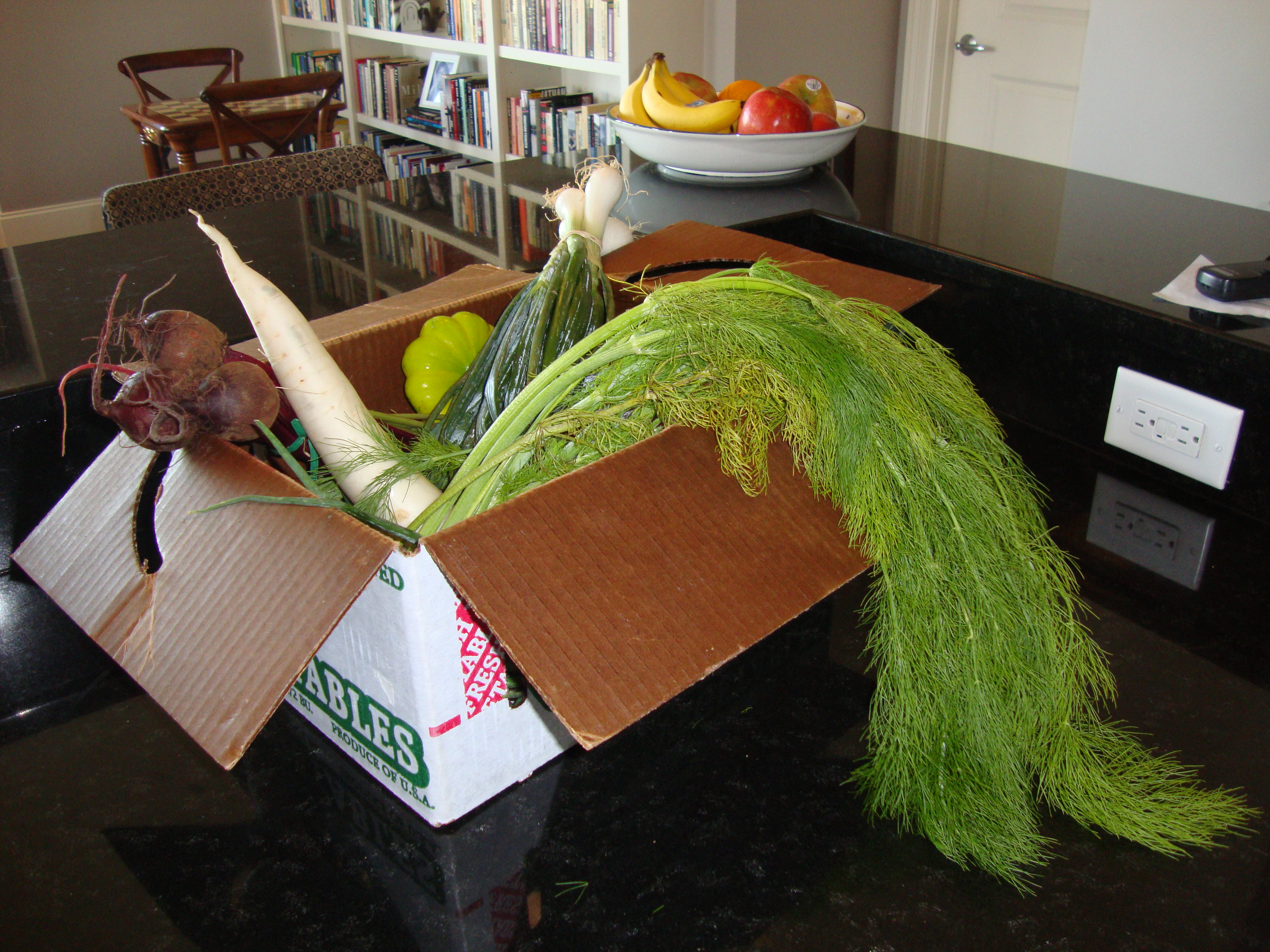
This week's Mid-Chatham CSA box

We’ve been eating lots of fresh organic local produce recently. Sally subscribed us to the Mid-Chatham Farmers’ Alliance CSA (Community Supported Agriculture), which furnishes a box filled with fresh produce once a week through the local growing season. The food has been amazing! There’s so much taste! Even some vegetables that I’ve long avoided, based on bitter early encounters, like beets and turnips, have been remarkable. With the various greens, I’ve made some fantastic green smoothies.

I was momentarily cheered when Red Hat served veggie hot dogs at a gathering this week. I appreciated some recognition of plant-food eaters, but when the crucial moment came, I couldn’t get myself to try one. I’ve gotten used to eating very little processed food, and now the idea of snacking on man-made chemicals is sort of disturbing. As it happened, I wasn’t very hungry anyway.

There was an interesting New Yorker article titled Snacks for a Fat Planet: PepsiCo takes stock of the obesity epidemic by John Brooks a couple of weeks back. Did you know that PepsiCo is the largest food company in the US, with $60 billion in annual revenues? Its Frito-Lay division is by itself enormous, and other brands include Tropicana and Quaker Oats. Its CEO, Indra Nooyi, is the first female, first Hindu, and first vegetarian to lead the company, and she sounds like a brilliant and dynamic leader. She also seems genuinely concerned about the health problems that are associated with some of the highly processed sugary or salty foods that have made PepsiCo vast quantities of money.

I don’t envy her, for she’s taken on an impossible job. It’s nice to work on making the fatty snacks on which PepsiCo has thrived less unhealthy. But the whole business of not only engineering snacks but also programming people to eat more and more processed junk is wrong. It contributes to vast numbers of premature deaths.

Our junk food culture is like the smoking culture, but before the Surgeon General’s report in 1964. We’re done something (though not enough) to address the health risks of tobacco, and we need to do at least as much to address the deadly culture of junk food. I realize this message is kind of depressing, and junk food purports to be, and is accepted as being, innocent fun. But that’s, in part anyway, the problem.

A spring baseball game and a crazy yoga class

In early spring, it is most pleasant to go to a minor league baseball game. On Friday night, Sally and I went over to Durham to see our first Bulls game of the season, where they played Syracuse. Just as we got to the stadium parking, it began to rain, and just as we got to the gate to hand over our home-printed ticket, it started to pour — so much so that the scanner had trouble reading our tickets. So we got wet, and it continued to rain for most of the next hour. But the sky kept getting brighter, and we had pizza and beer, talked, and looked at the types in the crowd.

When the rain finally stopped, we watched the stadium crew roll up the giant tarps that covered the infield and sweep the baselines. We watched the Syracuse pitcher warm up, throwing gently at first, then harder and harder. We’d bought tickets four rows back from the field halfway down the third base line, but after some quick soul-searching decided to award ourselves a free upgrade to empty seats in the area immediately behind home plate. I used my jacket to dry the seats as best I could (i.e. not completely), which Sally supplemented with paper napkins, and we sat down.

Both pitchers were throwing fastballs around 91 MPH, which doesn’t look amazing on TV, but from behind home plate is fairly impressive. The batters on deck warmed up directly in front of us, and I studied their mechanics with the thought of improving my golf swing. These were strong young guys. And the game unfolded slowly but distinctly, as baseball games will. The first Bulls batter hit a home run on the first pitch, and there was no further scoring for several innings. Yet there were jabs of excitement here and there — a close play at first, a double, a stolen base, an out at home plate, a double play. Between innings there were mascot antics, T-shirt giveaways, and contests for little kids. We never quite got dry, though, and as it got cooler we felt chilly. We packed it in after six innings. The Bulls eventually won 3-1.

I was disdainful of baseball for part of my youth and generally indifferent to it for many years. I still don’t find it very engaging on television, but a live game is something else. It isn’t so much the drama, but something else. The combination of genes and training that makes a ball move quickly from pitcher to batter, from batter to shortstop, and shortstop to first is awesome. The green grass, the red clay, and the white baselines are beautiful.

The next morning I did a two-hour yoga class at Blue Lotus with Yvonne aptly named Juicy Flow yoga. Yvonne likes to push herself and her classes to their limits, and her normal Saturday classes of an hour and a half are not for sissies. Her longer Juicy Flow class is about moving with music, sometimes rapidly for several minutes, in unfamiliar ways. The music is an eclectic mix of east and west, soul, disco, rock, and other. It’s lively fun, at least at first. I sweated a ton, and my mat got so wet it was difficult to do a down dog. I pushed hard for an hour and a half, then suddenly hit the wall and felt like I might get sick. I noted with some alarm that my upper body strength, which is usually good, was gone; I couldn’t hold my arms over my head. Never was I more relieved to lie on my back in shavasana for a few minutes, just breathing.

New Year’s skiing in Telluride

To ring out the old year, I flew to Telluride CO to see Gabe and Jocelyn and do some skiing. Sally could not be persuaded to go; she said it was too much travel for her after our Bonaire trip. It was in fact a tough journey, with multiple cancelled or delayed flights, and ended up taking 22 hours. I got my wish for heavy snow (so much so that I worried whether we’d make a landing in Colorado), and the mountains were well covered with a 49-inch base when I arrived. I slept for 3 hours, and then got up in hopes of getting first tracks with Gabe and his girlfriend Lindsey.

It was still snowing lightly that morning as I went out to find some rental skis. I found my way to Bob at the Boot Doctor, who seemed to know everything about skis and proposed several options. I wanted to try a hybrid rocker all mountain ski, and Bob set me up with K2 Aftershocks. I ended up liking them a lot. They turned easily and handled well in the heavy stuff.

Gabe and Lindsey made the considerable sacrifice of missing a couple of early runs while I completed my preparations, and were of good cheer when we met at the gondola in Mountain Village. I had not met Lindsey before, and had a little trouble spotting Gabe, because he and most everyone else had covered up their faces against the brutal cold. The reported high for the day was 9, but I’d wager it never reached 0 on the mountain. Lindsey, who’d experienced plenty of cold days skiing in her native New Hampshire, got the shivers after the first couple of runs. We took a hot chocolate break at Giuseppe’s, and she decided to head home.

Plenty of others made the same reasonable decision — which left the mountain largely unpopulated for us diehards. I reminded Gabe that it was my first day going from 300 feet above sea level to 12,000 or so, and my first day of the season on skis. He acknowledged these challenges and proceeded to take me down some of the toughest double-black terrain on the mountain. I suspect he wanted to show off his new skiing prowess, and I was impressed with his accomplishments, as a proud parent should be. I held my own for a few runs, but leg fatigue eventually caught up with me. We skied the last part of the day mostly on groomers.

That evening to celebrate New Year’s, I took Gabe, Lindsey, and Jocelyn to Excelsior’s, an Italian restaurant. It turned out that Lindsey had worked there as a server and knew everyone. We got the royal treatment.

The next morning I felt like I’d gone 16 rounds with the champ — sore from top to bottom. I took a megadose of Advil and headed to my ski lesson with some doubts as to my ability to make it through. Once again, the cold was harsh. But my soreness somehow abated once I got to the top of the mountain. My teacher, Jim Schwartz, was an affable guy of roughly my vintage with a lot of teaching experience. He had some interesting ideas that were new to me, such as focusing on the little toe. We spent the last part of the lesson working on mogul technique. I skied by myself in the afternoon with new confidence and joy.

During one lift ride, Jim opined that people skied for 3 main reasons. Some are excitement junkies that are only happy if they can scare themselves on steep rugged terrain. Others love the alpine beauty. Still others love the kinetic fun of dodging and swooping at speed in a kind of dance. I thought he was generally right. However, I’d add that it’s possible to cross categories. For me, the pleasure is some of all three — excitement, beauty, and grace.

My finger health problem

Why is it other people’s health problems are so uninteresting, and my own are so fascinating? I’m kidding. Kind of. At one level, I understand that my own health problems are of no particular general interest, but I do find them relatively interesting. It would not surprise me at all to learn that everybody else thinks the same.

At any rate, I work hard to minimize certain health risks. I consciously avoid eating things that have no nutritional value, and consciously eat a balanced vegetarian diet. I get up early to exercise most days, either swimming, spinning, lifting, doing yoga, or the elliptical machine. I use sunscreen and drink filtered water. And so on. I even quit using pans with Teflon.

None of which will help me against the wrong piece of bad luck, be it my own cells malfunctioning, an invading superbug, or a drunk driver running a stop light. But I like improving the odds. And for the most part, I like the process. True, I still haven’t figured out how to make an omelette that doesn’t stick without Teflon, which is unfortunate. But I actually look forward happily to yoga class, for example. (Which reminds me, after some struggle, I finally managed to do an unaided head stand for the first time this week. Hurray!)

The net of my exercise-and-eating program, good genes, and good luck has been a long run of no health problems that seemed interesting enough to talk about, even to me. I didn’t have even a cold in three years (though that particular string was broken by an enterprising but not particularly dramatic virus last week).

But starting last Sunday, I had a bizarre problem that seemed small at first: the tip of my left forefinger was exceedingly tender. I initially thought I must have somehow bruised it, but this seemed unlikely — it would have taken a memorable blow, like slamming it in a car door, to produce such discomfort. Over the next couple of days, it became swollen and took on hues of red or purple. It was warm to the touch, and it throbbed. I couldn’t play the piano without causing great pain, and any small ordinary knock on the finger was agonizing. I began to wonder what life would be like after amputation of a left forefinger, or the possibility that there was a serious internal problem there that could spread.

So I made a rare appointment with my GP, Dr. Gagliardi, who generally knows me only from check ups that are not as frequent as he would like. He diagnosed the problem in a matter of seconds as paronychia (an infection), and said he would cut it to let out the fluid. I noted that I have a reasonably high pain threshold, but because of the extreme sensitivity of the finger, it would be nice to have some anesthetic for this operation. He said that was impractical. So I took a deep breath.

Fortunately, he found some deed skin to cut on, and I never felt a thing when he did the cutting. And in a moment a yellow pus began to emerge in surprising quantities. I began to feel better almost immediately. I’m using a prescription antibiotic cream and band aids to complete my recovery. The wonders of modern medicine! Every now and again, it works really well! Thanks, Dr. G!

Good sports

Last Friday I reached my latest swimming objective: 1500 meters of freestyle without a break. This was for me, a considerable achievement, which not so long ago I found almost impossible to imagine. I’ve been doing a 1500-meter workout for some months, but with 30 second breaks at various intervals. A few weeks back, I decided to work towards doing the distance non-stop. I began gradually reducing the breaks, from 10, to 5, to 3, to 2, and finally to 1. Then, finally, none.

On Saturday morning I did an hour and a half of Vinyasa yoga in an open level class at Blue Lotus with Yvonne. That’s a lot of yoga! I tried very hard not to look at my watch, but once I was well drenched with sweat, I checked to see if we were almost done — and we were only half way through. I still can’t figure out at all why this strange system works, but it does: I felt absolutely wonderful at the end.

That evening Sally and I went out to Zebulon to see the Carolina Mudcats play the Mobile Baybears. It was a warm but not sweltering night, and we had great seats — a few yards beyond first base on the first row, close to the visitor’s bull pen. From this close in view, we could see how fast they run, how hard they throw, and generally how amazing they are. This is AA-level baseball, where the players are serious contenders for the big leagues. The pitchers were throwing fastballs in the mid-90s, and I don’t think I saw any errors. There is something really pleasing about seeing a real life high-quality baseball game on an August evening. The competitive drama is involving, but the whole experience is also relaxing. It’s good to have a beer and slice of pizza, listen to the buzz of the crowd, the organ, the announcer, the crack of the bat. It was a good, close game, which Mobile won 2-1.

When I stop to think about it, it amazes me how much I’ve changed with regard to physical activity and sports in recent years. As a kid, I played the usual sports, and used to imagine that I would play well one day, but in competition I never managed a level much higher than average or worse. And gradually, I came to think of myself as a non-athlete and sports-phobe. Particularly during adolescence, it was annoying to see the social advantages (in particular, success with girls) that accrued to the gifted athletes. I looked forward to adulthood as a time in which sports and athletics would be no longer relevant, and my lack of any particular athletic giftedness would cease to be a liability.

In retrospect, I can see this was partly a problem of lack of time. Part of the problem with athletic skills and kids is the same as with academic skills, which is that kids learn at different rates. This is kind of obvious, but schools are not set up to address accommodate different rates of learning. Instead, a class is given a set time in which everyone must master a set of skills, and those who are slower are shamed and punished. And those slower kids eventually figure out how to avoid the painful activity, perhaps by dropping out. While I was generally one of the quicker kids at mastering schoolwork skills, I was not so in sports. Because of my July birthday, I was always one of the youngest in the class, which was part of the problem. But of course, I had no idea of that issue at the time. I just knew that my relative lack of success in sports was somewhat painful. Like other slow learners, I eventually opted out.

Fortunately, over the years, I’ve found that the level of mastery needed for enjoyment of many activities activity is not impossibly high and with no tight time deadlines I’ve reached that level in some things I really enjoy. This has been the trajectory with swimming, skiing and golf, and I’m starting to see the outlines of that level of accomplishment for yoga. Slow and steady wins the race.

Water skiing and fun, healthy, ethical food

My shoulders are aching from the fun we had yesterday skiing on Falls Lake.   Ken and Carol took us out, along with their friends Ken and Kristen, on their plush and powerful ski boat.  Moving over the water at relatively high speed may be the ideal way to enjoy the outdoors in the middle of a massive heat wave.  I hadn’t water skied since I was twelve or so, but had vivid memories — the smell of gasoline, the anxiety as the boat worked into position, the sudden roar of the engine, the jerk of the rope, and the thrill of a transformation — water going soft to hard, something on which you can travel upright.

Ken encouraged us to try his wake board, which he said was easier than skis.  I decided to give it a shot, based on my rule of thumb to always accept an offer to try something new if it looks like it could be fun and isn’t illegal, immoral, or seriously dangerous.  Of five tries, I crashed and burned in the first three, came close to getting up on four, and bombed again on number five.  At that point, I decided to revert to skis.  I hated to admit defeat with the wake board, but it was unclear whether I was on the verge of success or still far from it, and I did not feel good claiming any bigger share of boat time.

Happily, I could still manage to ski.  The attempt was a learning experience:  I learned that for me it isn’t easier than skis, and that to get securely out of the water I need to do something different from what I was doing.  Later, while Carol drove, Ken demonstrated a hydrofoil device, a board with a seat above and a metal extension below so that the board came two or three feet above the water.  It looked both bizarre and fun, but Carol said it took many tries to get the hang of it.

Sally and I got back to the apartment shortly before eight and discovered we had a yen for Thai food within walking distance, so we had dinner at Thai Phoon on Glenwood.  We ordered two different spicy garlic tofu dishes from a good array of vegetarian options.  Just as we were starting to wonder why the food hadn’t arrived, our server showed up to apologize for the delay.  To make up for it, she said the soup was on her.  A nice gesture.

We continued our discussion of the mystery of unhealthy eating and resistance to vegetarianism.  Why do so many people put so much of so many things in their bodies that make them fat and shorten their lives?  Could it be lack of knowledge, when good information is so readily available?   Most of us would never consider fueling our cars with anything other than standard quality gasoline, so how can we stand to put any old thing in our irreplaceable bodies?  It can’t be explained based simply on calculated pleasure-seeking, since there are so many wonderful and interesting plant-based foods.

And how can so many thoughtful, decent, well-meaning people tolerate the massive cruelty of industrialized slaughter houses that turn living animals into dead meat?  Surely most of us respect the integrity of individual members of other animal species and would never consider intentionally torturing them.  So how can we stand the cruelty?   I do not know.  But I know each individual is capable of change for the better, because of my own journey.  There’s still hope for a healthier, more ethical society.  If it comes, it will be through many small, thoughtful, individual choices.  Like spicy garlic tofu.

A bunion, a birthday, and an edible work of art

While we were at the class at the Carolina Ballet studio last week, at one point Peggy Severin-Hansen sat on the floor beside me and did some work on her feet.  We’ve been watching her for many years as she rose through the company ranks to become a soloist, and we just love her dancing.  Having the chance to see her working on the bandages on her toes was  intimate, like being in the family.  I thought of sharing with her that I too have foot problems (a bunion) but thought better of it.  She probably wouldn’t have appreciated the comparison.

One of the problems of a bunion, in addition to discomfort, is that it isn’t a good conversational topic. Other people’s health problems are usually uninteresting, but not all are equally off-putting.  There’s no particular stigma to talking about knee problems, wrist problems, or back problems.  But bunions are generally an older person’s issue.  Who likes to think about getting old?  Not me.  I do, however, now understand why there is a section for Dr. Scholl’s foot care products in the pharmacy.  It’s become one of my favorite sections.

As of yesterday, I know how it feels to be 55 years old.  I hate to make a big deal of birthdays, but I’m struck by how big a number this is.  It is clearly no longer the early fifties.  It is old enough to be a parent to two full-grown adults, and in theory old enough to be a grandparent.

But I feel young!  Both in good ways (plenty of energy and enthusiasm) and not-so-good ways (areas of uncertainty and insecurity).  In many ways, I’m healthier and happier than I was in my twenties.  I never completely lose sight of the possibility that there could be a piano hanging over my head and about to drop, in the form of a serious illness or random accident.  But with enough time and some good luck, perhaps I’ll someday look back over many years and think how young I was in 2010, but how I still feel remarkably young, all things considered.  Of course, this may turn out to be my apogee.

To celebrate the day, Sally got us a table at Second Empire, one of our favorite restaurants, and we walked there from our apartment.  It’s a restored grand old residence with elaborate ornamentation, and very traditional in a way.  But it avoids being stuffy with eclectic art, jazz, a great staff and highly imaginative food.  Our server was Katrina.  She was lively, smart, and friendly, and completely undaunted when I told her that we were vegetarians and wanted them to create something special for us.  She assured us they liked vegetarians and would enjoy the challenge to their creativity.  Music to my ears!

In fact, everything on the menu looked great except the animals, and our only suggestions were that there be pasta and perhaps a Spanish theme.  The dish that arrived had rigatoni and spices, with a unique combination of textures and tastes.  It was excellent!  For dessert, I planned to sample Sally’s cake, but they brought me delicious ice cream with a candle in it and a happy birthday message written on the plate in chocolate.  When we got the check, I thought they’d accidentally undercharged us, since there was just one main dish listed.  When I asked Katrina, she assured me that they’d considered the dish that we shared to be one.  Truly, this a great and wonderful restaurant.

Dropping some weight and hitting some golf balls

I came back from the long weekend in St. Croix five pounds heavier than when I left.  It’s difficult to account for the sudden gain, since I was reasonably careful about not over eating and held the veggie line against temptation.  Perhaps our very pleasant seaside daiquiris, pina coladas, and pain killers had something to do with it.  In any case, I managed to shed all the extra weight this week with some vigorous early morning workouts, and as of this morning was at my fighting weight of 160.

Earlier this week the NY Times published a piece by Gretchen Reynolds on the positive effects of exercise on the brain.  http://tiny.cc/deokh  Studies with rats show the exercising rats with much superior brain functioning (“little rat geniuses”), and the apparent interaction of BMP and Noggin leading to increased production of neurons.  I can believe it.   When I first began regular exercise in my college years, I viewed it as primarily benefitting the cardiovascular system, but especially in recent times, I find that I feel duller if I can’t find time for a workout.

We’ve had a record-setting heat wave this week.  This Saturday morning, I was hoping to get an outdoor swim at Lifetime Fitness, but unfortunately the outdoor lanes were all taken when I got there at 6:40.  I made do with the indoor pool for 60 laps, then 15 minutes of yoga in the sauna, then 5 minutes in the steam room (whew!).  Then I headed over to Lake Jordan to drive my sports car on some backwoods roads.

I ended up at the end of a gravel road off US 64 at a down-on-its-luck golf range with a old barn on one side.  There was no one there when I showed up, but a guy emerged from a small adjacent house and got me a bucket of golf balls.  He couldn’t take a credit card, and couldn’t break a $20, but he agreed to let me have a $9 bucket for all the smaller bills I had ($7).  Then he drove off, and left me alone to practice.   The grass was very long, and so I was effectively working on shots from the rough.  A good thing to practice, though not so fun.  I got sweaty and tired, and was happy to get to the bottom of the bucket and see the last ball fly away.