The Casual Blog

Category: fitness

Take care of your body

I used to regard the taking care of my body as sort of a bother — something much less important and interesting than, say, reading a good book. As I’ve gotten older, I’ve come round to thinking of it as a fundamental — the thing that has to be done before anything else can get done. Being happy depends in large part on being healthy. And just as some people look forward to taking care of their pets or their cars, I’ve come to value the opportunity to care of my body with healthy food and exercise.

Getting healthier has made me happier, and happy about getting healthier — a virtuous cycle. It’s hard to believe — ten years ago I wouldn’t have believed it myself — but I actually look forward to getting up at 5:15 and going to the gym.

Lately I’ve particularly enjoyed my once-a-week early morning workout with Larissa at Studio Revolution. She’s sparky and cheery, and always innovative. This past week she had me doing a lot of new movements that required balance and coordination, and thus concentration. It isn’t always clear why we’re doing these things, but over all they seem to be producing good results. My rule of decision is, when in doubt, just trust her, and do the exercise. This is, I think, a good general rule: if you want to accomplish something, find a good guru, and then do what she says.

I applied this rule recently to a nagging shoulder injury. Most of my joints were working just fine, but my right shoulder did not feel good. What caused it I do not know. I could do most of the activities of daily life, but certain movements, like reaching behind my back to wash it, or taking off a tee-shirt, were painful.

After trying to ignore it, I tried healing it myself through strengthening it, which didn’t work, and then tried resting it, which didn’t work I tried massage, which helped a bit, but then the problem returned. I finally decided to return to the same physical therapist who resolved my lower back problems some years ago, Geert Audiens at Avante Physical Therapy. And two weeks later I’m feeling much better.

Geert (prouncounded Heert) diagnosed a small rotator cuff injury. To fully explain the situation, he had to use a lot of vocabulary I didn’t know. But the bottom line was clear: I had an imbalance of muscles that was causing pressure on nerves. He treated it with various stretches, exercises, and icing, and prescribed a somewhat involved set of these measures as homework. The exercises mostly involved 3-pound weights, which are so small I found it hard to believe they could do anything. But, they do! It’s amazing! If you have this problem, I recommend seeing Geert, and do what he tells you to do.

Getting over personal trainer-phobia

Although I’ve worked out at various gyms over the years, I haven’t had a personal trainer — until now. My reasoning was that exercising isn’t all that complicated, and if I couldn’t figure out how to do something by myself I wouldn’t care to admit it. Some people seemed to find trainers helpful in getting motivated, but I didn’t really have a problem motivating myself. But I recently was got over my trainer-phobia, and it made me reflect on the value of good teachers.

To state the obvious, staying reasonably fit is a good idea for a lot of reasons: feel better, get sick less, look better, think more clearly, live longer, etc. But it isn’t so easy. It takes persistent, continuous effort. It’s a challenge to find the necessary time (early mornings work for me) and to find ways of moving that you enjoy. But over time, it can get to be a habit.

At that point, there’s a different kind of problem. Doing the same thing over and over gets boring, and also at a certain point stops producing improvements. You need to change things up now and again. So staying fit takes some creativity and a willingness to try new things. In recent times, I’ve gotten out of my comfort zone by exploring yoga, and more recently got an introduction to the Pilates system. My teacher, Julee, recently left to go to med school, but not before reminding me of the value of having a guide in a new area.

In domains other than fitness, I already knew this. Learning new things is wonderful. Through trying to teach myself about things as diverse as science, music, and various languages, I’ve come to the general view that the best way to learn a new thing is to find a good teacher. It isn’t the only way, but it’s the most efficient and fun, and so the one most likely to succeed. A good teacher knows the ultimate goal, but also the interim levels, and taking into account your particular strengths and weaknesses, she will propose various possible ways for you to get to the next level. She guides you past blind alleys and hazards. You waste less time, and make faster progress. This makes it less likely you will give up. You work harder when someone else challenges you. You want to acquire the skill, but you also want to please your teacher. And if you’re fortunate, you and your teacher will form a meaningful human connection.

Anyhow, Julee’s departure, though sad for me, made me think about other things that I might like to try. My yoga teachers at Blue Lotus directed me towards Studio Revolution, just a few doors down the street. And so it was that I began working once a week on functional and TRX training with Larisa. We’re doing lots of variations on lunges, bends, twists, and squats, pulling against cords, moving sand bags, throwing heavy balls, and other tools for increasing core strength. She has introduced me to foam rollers. Larisa’s also making me conscious of which muscles are working in various movements, and which ones aren’t. I’m meeting some parts of my own body for the first time.

A juicy yoga class and other educational experiences

As much as I really love yoga, I go back and forth on Yvonne’s once-a-month Juicy Flow class at Blue Lotus. I like doing a class on Saturday mornings, and I like Yvonne, but I have the same issue the first Saturday every month.

Rather than her usual hour-and-a-half of Vinyasa (which is a lot), Juicy Flow is two hours, with a lot of fast movements. It’s eclectic. She puts a lot of thought into the music mix, which can range from goofy 80s pop to the world. In terms of movement, it’s always different, and there’s always something lively and fun. But it’s always exhausting, and tends to make me sore for a couple of days afterwards.

I was particularly hesitant about Juicy Flow this week, because I’ve been having some issues with my shoulders, and the class ordinarily stresses those parts. But I decided to give it a go. As usual, she’d come up with some demanding variations of traditional asanas, and several three-minute-long Kriya sequences of fast, big movements, including shoulder turns, squats, rolling up and down, scissoring legs, and open palm punches. There was also some free-form dancing.

Like every good yoga class, it was a learning experience — finding out some new things about what my body can and cannot do, and what the possibilities are. It was sufficiently demanding that I was not thinking about much of anything other than Yvonne’s directions. The two hours went fast. It was sweaty and exhausting, but also fun, and left me feeling amazingly calm and relaxed.

I was pleased to see news reports this week that Harvard and MIT are starting a free online education initiative called EdX. I might be interested in some courses. In fact, I’ve been auditing Michael Sandel’s Harvard course on justice (i.e. theories of ethics) through iTunes U. I usually watch Sandel or a Ted Talk in the early morning while getting my heart rate up on an exercise machine. It gets my head going.

Opening up the Ivy ivory tower strikes me as a very good thing for society in general, and I hope a lot of people will use it for continuing their education. It’s worrisome that anyone could think of college as the completion of an education. Seriously, has there ever been anyone who is reasonably well-educated after four years of college? College is kindergarten for adulthood. Getting fairly well educated takes a long time, and even then, there’s always more to explore.

Coping with pollen, trying Pilates, and news on how to eat to reduce cancer risks

Spring is definitely here, greener and greener and blossoms everywhere. Also here is a cloud of heavy yellow pine pollen settling on cars, including mine. The pollen surprises me every year. Last year it arrived the day after I got Clara detailed, and the pollen turned the beautiful dark blue car yellow. This year, I resolved to get the big spring car cleaning done well in advance of pine pollination, and got the full treatment from Dave of A to Z Auto Detailing. She looked great, until the pollen arrived, two days later. Pine trees, stop trying to impregnate Clara!

It was a homey week — no travel — and I got up early each day and had a work out done by 7:00 or 7:30. On Monday, I did intervals on the elliptical machine on the roof and then some weights and stretching. Tuesday I did forty minutes on the elliptical machine first, then went across the street to early bird yoga at Blue Lotus. Wednesday I went to Pullen Park pool and swam intervals and then stretched. A lifeguard complimented my stretch routine (though not, I noted, my swimming).

Friday I went to O2 gym at Seaboard Station for an hour-long RPM spinning class. Spinning means riding an exercise bike to loud music at the intensity the teacher directs, and it is much more demanding than it sounds. The teacher Friday was a substitute who was six months pregnant. At the start, I felt fairly confident that I could keep up with her, but in fact she kicked my butt. I predict her baby will be a champion.

Backing up, Thursday I had my third Pilates lesson at Evolve with Julee. What is Pilates? My friend Chuck and others had recommended it, but I found it hard to get a clear description. But I felt ready to try some new type of exercising. It’s good to shake things up from time to time. Meredith, my wonderful massage therapist, turned out to be a big Pilates fan, and she recommended Julee, whom she regarded as highly gifted.

Pilates is named for its inventor, a German named Joseph Pilates, who came up with his system early in the twentieth century. It involves various contraptions that he invented. It entails a particular way of breathing, of focusing on the core area, and of contracting various muscles. Yes, it could be yet another nutty exercise fad, but there seems to be more to it. I say this based on (1) my very limited experience trying it and (2) observing that Pilates students are exceptionally fit looking.

It seems to involve a sophisticated understanding of human biology, and as an experience it nicely balances the physical and the mental. As Julee has introduced me to the various exercises, I’ve found myself focusing hard on just one thing: the movements. I’m just starting to get my bearings on the system, but so far it seems stimulating in a healthy, fun way.

In other health news, there was an interesting news story this week on the health effects of aspirin. Two significant new British studies found that a daily dose of aspirin was associated with large reductions in cancer. One study found a 46% reduction in colon, lung, and prostate cancer, and both found large reductions in other common cancers. That’s huge!

I’d taken a baby aspirin for some time to reduce the risk of a heart attack, but quit after a recent study indicated that for healthy patients the heart benefits may not outweigh the risks. I was sufficiently impressed by the new studies to dig out my aspirin bottle and start taking the little pill again.

Also noteworthy is a NY Times report of a new study that eating red meat is associated with death from heart disease and cancer, with the risk increasing with increased consumption of meat. The study involved 121,342 men and women and data from 1980 to 2006. Each increase of meat consumption by three ounces increased the risk of death from cancer by 10 percent and death from cardiovascular disease by 16 percent. It sounds like, if the norm is six ounces of meat a day, eating no meat would reduce your cancer risk by 20 percent and cardiovascular disease by 32 percent. That’s also huge!

For some reason, the Times did not put this on the front page, or even as the lead item in the health section, but rather buried it deep in general news section. A new drug that dramatically reduced cancer and heart disease would surely have been treated as a major news event. I’d think this new study would be something most people would want to think about.

Of course, people generally don’t like hearing that their ingrained habits are unhealthy, and tune out news that causes dissonance, so I will leave the subject for now. On a more cheerful note, I will just mention that I greatly enjoyed listening to some Haydn symphonies on my iPod touch while exercising and doing other activities this week. I had sort of forgotten how wonderful they are. I was listening to numbers 100, 101, 103, and 104. Here’s the second movement of number 100. My recording, which I prefer, is by Christopher Hogwood directing the Academy of Ancient Music (on period instruments).

How to keep lost weight from coming back

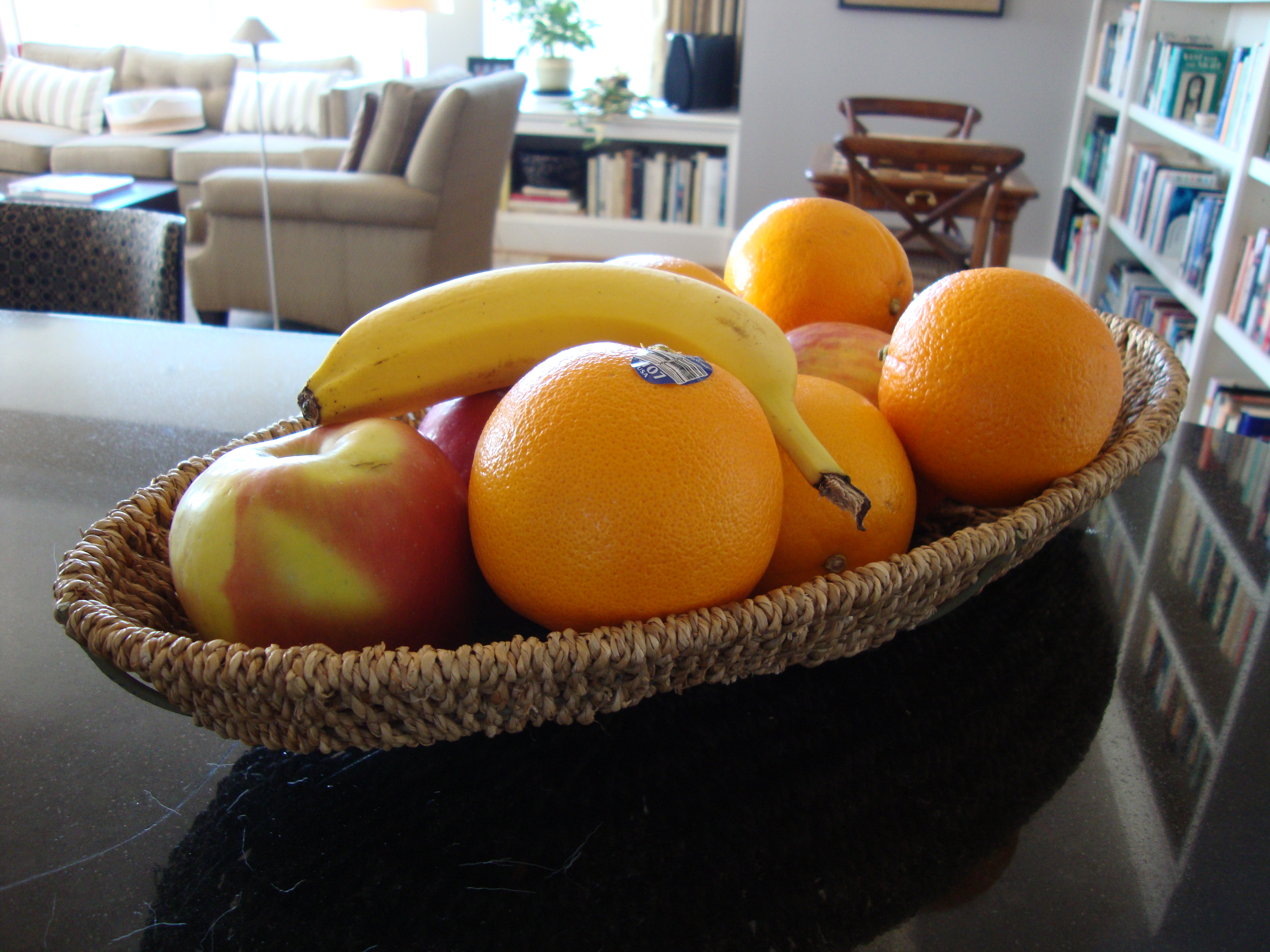
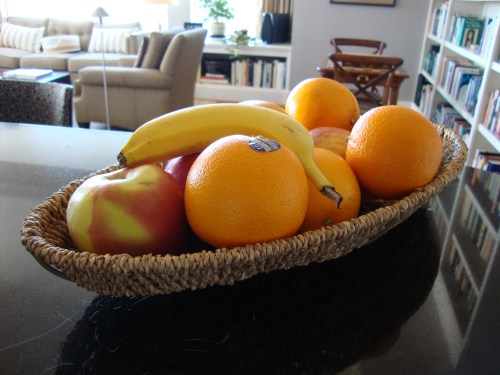
Healthy snacks on the counter at Casa Tiller

Returning from travels over the holiday break, I stepped on the scales to find myself three pounds heavier. It always happens! I swear, though there were temptations aplenty, I was reasonably moderate in my eating and drinking. How amazing that the body can accumulate mass so quickly! Also, a little scary.

In recent years, I’ve not been much concerned with losing weight, but I’ve been working hard not to add it. This basically means being careful about eating and diligent about exercising. That sounds — so — boring! Even if you do it, who wants to hear about it!

Thus, I was interested to read the NY Times magazine piece titled The Fat Trap: Do You Have to Be Superhuman to Lose Weight? by Tara Parker-Pope. According to the article, sustaining a healthy weight after losing a lot of pounds is not just unusual — it’s extraordinary. Those who do it are a “tiny percentage.”

That’s a bummer, both for the individuals who struggle with their weight and for our health as a society. Scientists are trying to figure out why people usually gain back weight after losing it and what can be done about it. Meanwhile, as a member of the fortunate “tiny percentage”, I may have something helpful to contribute. I’ve previously posted about losing 50 pounds, but here are some additional thoughts specifically related to how I’ve kept that weight off for several years.

It isn’t easy, but it also isn’t impossible — obviously! In fact, the methodology is basically the same as any worthwhile achievement that takes sustained effort. If you’ve learned to play the piano, speak a foreign language, play golf, or whatever, you’ve probably already employed most of the same methods you need for ongoing weight control. You need to find your motivation, keep it simple, be empirical, and have fun.

1. Find your motivation. Actors talk about needing to find a character’s motivation to bring the character to life. Try it: ask yourself what you really want, and why. For anything that’s going to take a long, sustained effort, you’ll need a motive that carries real meaning for you — something that’s more important than simply feeling good right now. It helps to articulate it clearly. My own guiding motivation has to do with the battle with father time. More concretely, I’m working today to be able to ski the deep snow in the big mountains of Colorado and Utah when I’m in my eighties. The snow on the mountains is beautiful. I sometimes think of this in the very early morning when it’s still dark and I’m making myself go to the gym.
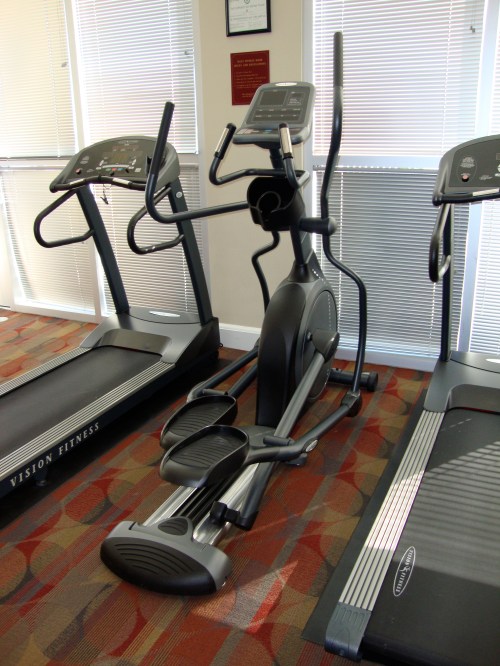
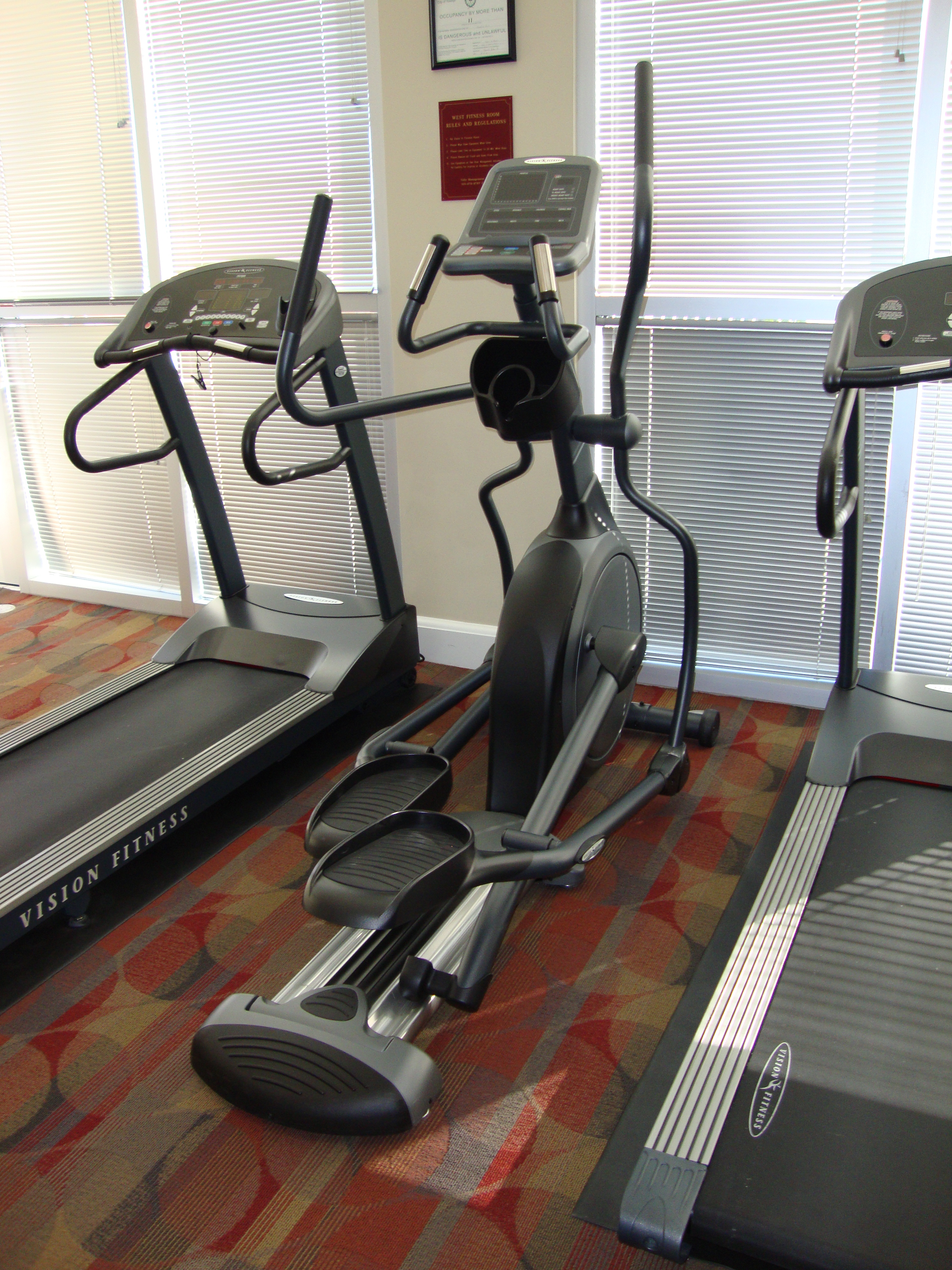
My friend in the gym on the roof -- the elliptical machine

2. Keep it simple. If a system is too complicated, it will not be sustainable. A good system is one you don’t have to think about very much once it’s in place. It involves turning good intentions into good habits. For myself, I have some simple rules that help in avoiding bad eating decisions, such as: no chips, no sodas, and no candy bars. For snacks, I put in place simple and nutritious substitutes, like apples, bananas, and baby carrots. If you are considering going vegetarian, I’ll note that one of its many benefits is helping to simplify the challenge of eating a healthy, less fattening diet. Anyhow, these types of snack choices have gradually become habitual for me, and as habits they don’t take much mental energy. Of course, there’s the countervailing powerful force of other lifelong personal habits, customs, traditions, and advertising tempting you to make bad eating choices. There will be slip ups — and hello, there’s three new pounds. Then you refocus, and move on.

3. Be empirical. Look at the available data, and consciously monitor how you feel. I bought a digital bathroom scale and use it every day. I watch food portions carefully, and notice whether I’m feeling too hungry or unenergetic. I have not adopted a single off-the-shelf theory of eating and exercise, because I think every body has somewhat different needs. What works for you may not work for me. You need to be experimental. If an approach isn’t working, chuck it, and try something else. If you test a healthy snack or an exercise approach that seems to work for you, try it again and see if it still works.

4. Be creative and playful. We’re talking about a long-term approach here, and if it is no fun, you will eventually give it up. Simple repetition is boring. Try out interesting new healthy foods and new exercises and sports. When traveling, I make it a little game in airports to find the least unhealthy meal, and to find something interesting to do in the little hotel gym. I vary activities over the course of a normal week, so that at the moment I alternate among the elliptical machine, the stationary bike, and swimming, and various types of resistance training. For more fun, I enjoy listening to music and reading while doing the elliptical. I’ve found that classes liven up the cycling experience. Every so often, I change the mix of activities and try something new.

So there you are, for whatever it’s worth. Having said all that, I’ll note again, sustaining weight loss isn’t easy. It takes conscious work every day and every meal. But it doesn’t have to be white-knuckle misery or boredom. The guidelines of motivation, simplicity, empiricism, and playfulness help. And developing skill with the guidelines could lead to other good things. They can be applied to any rewarding long-term objective, like learning a sport or a musical instrument.

Work, Pilates, Bjork, and musical play time

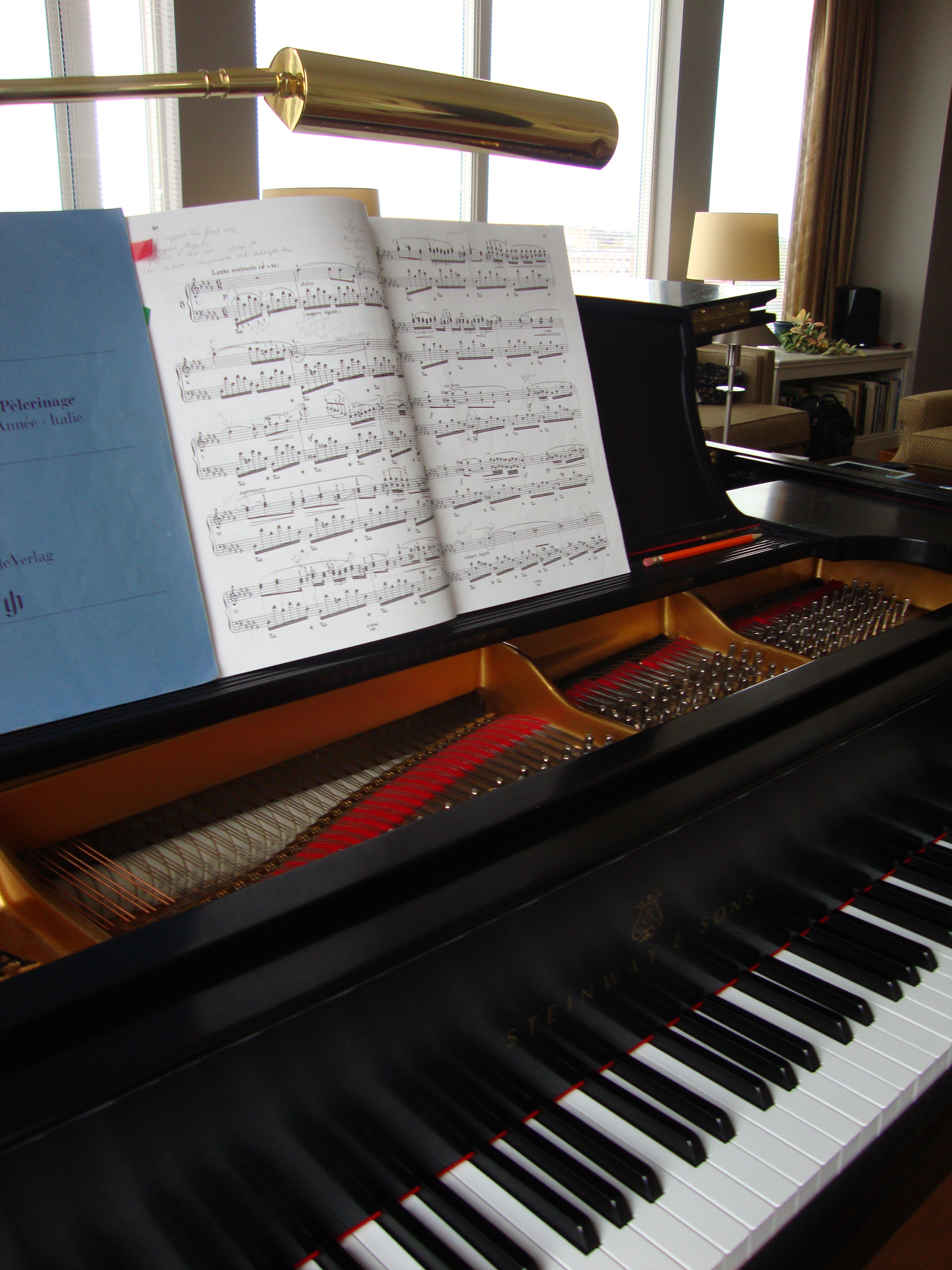
Nocturne in D flat major by Frederic Chopin

It was another busy week of many meetings, calls, and issues, with business dinners almost every night, and my email backlog continuing to pile up. But interesting, always interesting. On Friday I was scheduled to go to the coast for two days of wreck diving, but bad weather arrived and the trip was cancelled. I was not heartbroken. It was good to get some down time.

On Saturday morning it was cold and rainy. I thought of taking Yvonne’s open level Vinyasa yoga class at Blue Lotus, but learned from the web site that someone else was filling in for her. I check for alternatives, and found an early Pilates class at the Y. And so it was that I had my first Pilates experience. It was similar to yoga, with its emphasis on breathing throughout a series of exercises with unusual stretches and contractions. I found this particular class less strenuous than my normal yoga classes, and also less serenity-inducing. Still, I would do it again, especially if there’s no yoga available.

Other new things: earlier in the week I read a news story about Biophilia, the new multimedia production of Bjork, the Icelandic singer-songwriter, and downloaded the work to my iPad. Biophilia is in part a collection of songs about nature and science, but rather than being an album, it’s something we don’t have a word for yet. Bjork worked with scientists and artists to make interactive productions that allowed the listener to participate actively in the music by adding notes and altering images. After a few minutes of experimenting, I could make a bit of music with the tools provided, and participate in some of Bjork’s visions of microscopic, geologic, and celestial phenomena.

The idea of sharing a vision this way — not just providing passive entertainment, but inviting participation as a way of inspiring and teaching — is exciting, and the NY Times story took the view that it was ground breaking. For me, the experience was intriguing but not really thrilling. I liked being allowed to work with Bjork’s electronic instruments and play with her, but the musical possibilities were narrowly circumscribed and not expressive enough to satisfy me.

For example, by using the touch screen, in various songs you can add to Bjork’s fairly simple musical backdrop more harp notes or more synth notes, and play faster or slower, but so far as I could figure out without taking any new harmonic direction. The videos were in some cases beautiful, but the songs themselves were more performance art than either art music or dance music. Still, I liked the ideas, and I will probably play some more with Biophilia.

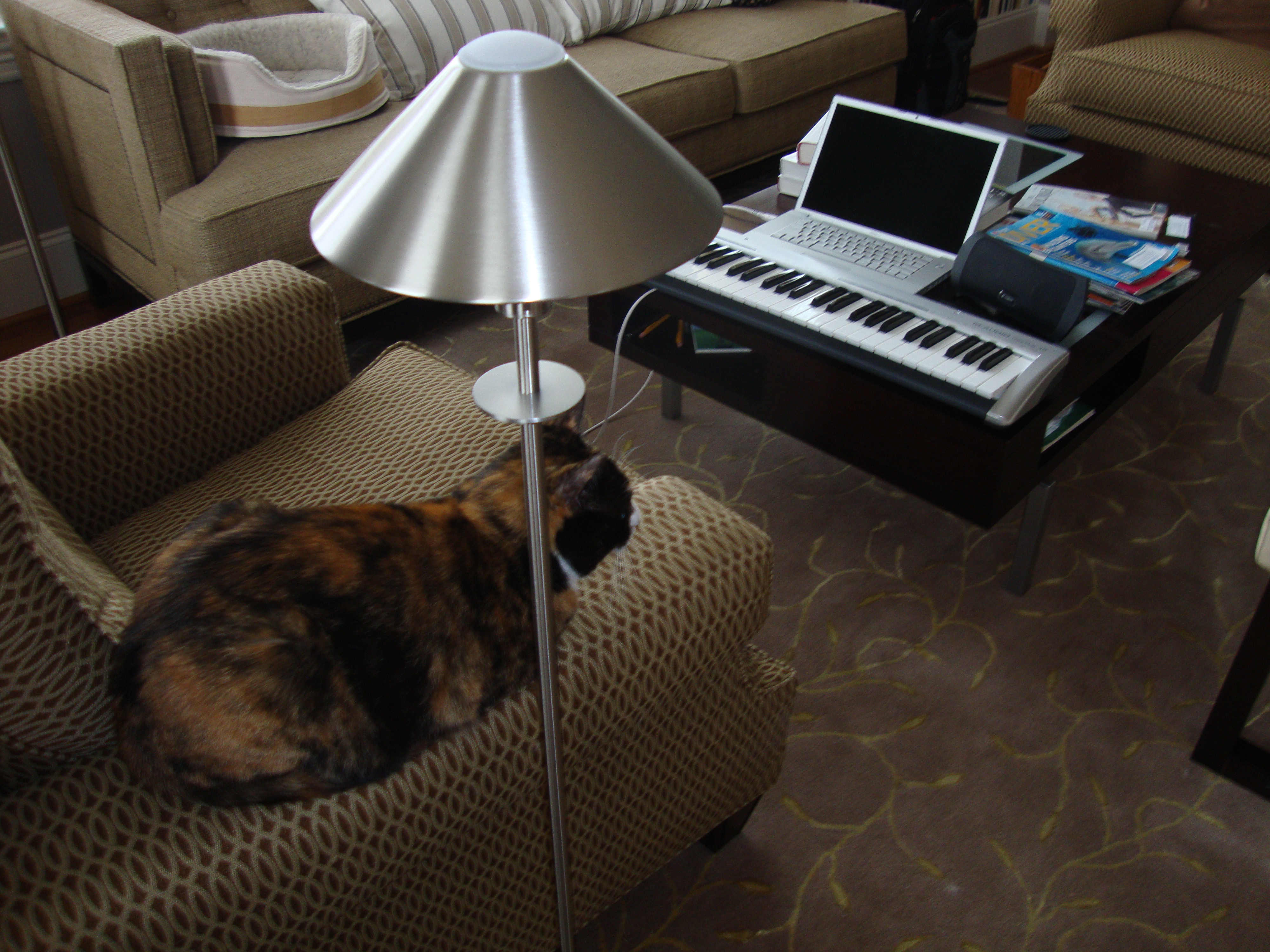
Phoebe, Holtkotter lamp, and music technology

The idea of using technology to express new musical thoughts has interested me for a while. This past spring, I began playing with the instruments built into GarageBand (a Mac application), and eventually purchased a cheap electronic keyboard and a cheap auxiliary speaker to experiment with. One of my ideas was to translate early music (1500s) through synthesizer voices to see what new things emerged. The sheet music came with a lot of interpretive problems, so I didn’t get far on the vector. But I had fun improvising with various synthesizer personalities using various systems, like Greek modes and pentatonic scales. I thought of it as playing, in the sense of playing a game. It’s a different kind of musical outlet.

Bjork’s idea of engineering a collaboration with an unknown audience has a distinguished heritage. It’s what we do when we open a volume of Chopin nocturnes and start to play. Chopin left us the architectural drawings, which the pianist uses to create musical in real time, while at the same time personalizing the structure with thousands of unwritten details according to the pianist’s experience, intelligence, and feelings.

This system — master composer, written music, trained pianist — has worked amazingly well for a couple of hundred years. It does, however, depend on musical education — there has to be a support system for training pianists, and also listeners. For music with the harmonic complexity of the great Western tradition, you have to learn a lot before you can interpret it, and you have to learn a fair bit to get deep enjoyment from listening to it. It is worth the effort.

I sometimes worry that there is a long historic curve in which our music devolves from the complex and brilliant to the simple and sweet, and from there to the just plain dumb. The traditional system of classical music education and performance is not in good health. But perhaps humans are just getting started in discovering what music can do. Who knows where it goes? We have to keep experimenting, keep creating. That’s what Bjork is doing, and good for her.

An earthquake, a hurricane, a massage, a yoga lesson, and a haircut

Sunset before Hurricane Irene

We’ve had a couple of unusual disturbances this week. On Tuesday, Raleigh was shaken for a few seconds by an earthquake that was centered in northern Virginia. In my office, it felt at first like heavy equipment was passing by, but it got more intense, and I started to consider evacuating. We seldom have earthquakes in the eastern U.S. We’re used to thinking of the earth as something solid that does not move, and it’s disturbing when it does.

A hurricane named Irene has been heading toward the eastern U.S. for several days, and finally hit the Outer Banks of N.C. this morning. We get hurricanes here from time to time, but this one has caused more than usual worry. In 1996 when Hurricane Fran hit our area, trees snapped in two in my yard, and the storm left us without power for days. Ever since, I’ve taken hurricanes seriously. At the moment, we’re getting light rain and gusty winds.

Meanwhile life goes on, with chores and challenges. This week I was particularly conscious of being part of a pleasing network of humans, including some who helped take good care of me, with some vivid moments of connection.

On Monday, I got over to Hands on Health, where Meredith had agreed to come in on her day off to give me a deep tissue massage. I’d anticipated that all the driving to, from, and at Road Atlanta would leave me with a tight neck and back, which it did, and that Meredith could help, which she did. She was cheerful and chatty, but deadly serious when it came to knotty muscles. There were some intense and difficult moments, but I left feeling wonderful.

On Wednesday, I had my first individual yoga lesson with Suzanne. I’ve taken one or two “early bird” classes a week with her for the last year or so, and have gradually come to really trust her. My main objective in taking an individual lesson was to make sure I had sound mechanics for my head stand and wasn’t about to hurt my neck. I also wanted to understand more about increasing my flexibility. Lately I’ve gone to a few advanced classes, and found them fairly humbling. There are certain things they do that I just can’t do.

Anyway, Suzanne helped me adjust expectations and feel better about where I am, as well as improving in some areas. For head stands, she taught me how to find the top of my head and where my weight needed to be. We did some bending and twisting, and talked about how you can have too much of a good thing. Although it looks good in class to have loose joints, as she does, she noted that looseness brings with it more risk of certain injuries. I also got her guidance on what to do with my mind during savasana. I’ve slowly come to really value yoga’s insistence on relaxation as an integral part of class. At the end of the session, I felt tremendous gratitude, both for Suzanne, and for my good health and well-being.

Because of the Road Atlanta trip, I’d missed my regular monthly haircut with Ann. She invited me to come in after work as her last appointment on Wednesday. Ann’s been cutting hair for me, Sally, and Gabe for many years. It’s always fun seeing her. She likes to talk, and we have great chats about our families, cars, restaurants, travel, and sports. As usual, I left looking better, and smiling.

Gary Player’s diet and exercise routine, and a few thoughts on yoga

One of the nice things about getting older is that you gradually worry less about being cool. You slowly realize it’s almost impossible to be old and cool, and give up on the idea. Letting go of such worry frees up some energy for more fun.

Age is tough on a body. Fight as we will, eventually we’ll all succumb. But I see no real choice but to fight. Over time I’ve become more dedicated to the battle for good health, though it occasionally strikes me that it could be viewed as hopeless, ridiculous, or both. A middle-aged white guy sweating — for what? It’s certainly not cool.

Thus I was cheered and inspired this week by an account of Gary Player’s fitness program now that he’s 75. As golfers know, Player is a legendary player, with more than 160 tournament victories. In his prime, the man was known to be serious about exercise, and he still is. His routine involves 1,000 sit ups and push ups every morning. He does lunges and squats, works with weights, and runs, swims, and does stairs. As for diet, Player says that it’s 70 percent of the fitness puzzle. He eats a mostly vegetarian diet heavy in fruits and vegetables, and aims for portions about half the size he used to eat. He says he has more energy since he cut the meat, and his stomach works better.

I also have found that a diet of moderate portions of plant foods is energizing. And so is regular morning exercising. Lately I’ve been noticing how during most of my waking hours I feel really good, and feeling grateful for it.

I’m especially grateful to my yoga teachers (Yvonne, Suzanne, Kathleen, Jill, and others). Over the past couple of years, yoga has gradually insinuated itself into my life, and has become a good friend. Lately I’ve been doing two or three classes a week at Blue Lotus. Every teacher and every class of every teacher is different. Some classes are quite arduous (think high heart rates and lots of sweat) with an element of risk, and some are very slow and calm.

When I began, I’d expected that yoga would help my flexibility and balance, which it has, but it has done some other good things that I hadn’t expected. It has made me a better breather and more conscious of the significance of breath. It has helped my focus and concentration. And it has made me view relaxation as an essential element of good health.

There’s also something pleasing about exercising in a class. It’s sometimes humbling but often inspiring to see so much strength and grace in the group as it moves together. I like the sound of people breathing in unison. It’s good to be with people who are committed to taking good care of their bodies. And it’s fun.

Getting better (scuba rescues)

If I like doing something, I like getting better at it. In fact, I probably won’t like it for long if I can’t get better at it. They would mean doing the same thing over and over, and why would anyone want to do that?

I’ve recently been improving at several things I like, including playing the piano, golf, and scuba diving. This weekend, I took a big step forward in scuba when I took the PADI rescue diver course.

As I’ve noted in a prior post, I really like the idea of having enough first aid skills to help save a life, and so this project was particularly meaningful to me. The reading and classroom sessions gave me a greater knowledge base on the various things that could go wrong for careless or unlucky divers — equipment problems, encounters with venomous plants and animals, or underlying medical conditions. In each of these situations, there are ways to help, even if there are not complete solutions.

In the two-day skills class at Fantasy Lake Scuba Park (a former quarry), I was fortunate to have an experienced teacher (Nikki) with three able assistants, and a class (counting me) of four. There was a lot of individual attention. My fellow students were experienced divers who were focused and good humored. Charlie, a UPS driver, was particularly impressive in his emergency problem solving skills.

We were tasked with various stressful problems. A tired diver. A panicked diver. A missing diver. And many others. The required skills were many. We dealt constantly with situations that were novel and unsettling. This was, of course, tiring, but also stimulating.

There were physical challenges. I cut a finger, got stung by a yellow jacket on another finger, and got a bruise on an arm. Propelling a victim in while giving rescue breaths and removing equipment was complicated and exhausting.

There were also psychological challenges. I particularly dreaded trying to find a missing diver underwater; the combined problems of navigation in low visibility and a potential fatality were anxiety producing. I also dreaded the issues of rescue breathing for an unconscious diver in the water. The physical intimacy of face to face contact (even, as we did it, with simulated mouth-to-mouth breaths) with a relative stranger, even in the practice situation, was something I would rather have avoided. But in the end, it was manageable, thanks to my teacher and the assistants. With the benefit of the practice, I have a high degree of confidence I could actually take a run at helping someone in dire distress.

The exercise inspired thoughts of mortality, and life. I felt happy to be as healthy as I am. My regular morning exercise routine paid major dividends in the physically demanding parts of the course. My careful eating with an emphasis on things that are good for my body gave me good energy and balance. It worked out well. I would be very happy never to have to use these new skills, but I feel like I can do it, if necessary.

A post-drive neck massage

The road trip last weekend was great fun, but the many miles of sport driving left me with a stiff neck. It was difficult to turn my head enough to back Clara out of her parking space. After three days, it was not much better. I got to early bird yoga early to ask Suzanne if she had a recommendation for a massage therapist. She did, and also was so kind as to take the class through some neck and shoulder stretches.

The next day I got the first appointment of the day with Meredith at Hands on Health. I was impressed with the professional atmosphere. The place seemed like a PT’s office, with a reception area, waiting room, and offices for several massage specialist. Meredith seemed friendly and chipper, and turned out to know a lot about neck problems.

She worked on my shoulders and lower back as well as my neck. In spite of her friendliness, she was not all sweetness and light. Parts of the work were amazingly painful. This was deep tissue work. She located muscular knots, and spent time digging into them. She’d given me permission to ask her to stop, but I wanted to get results. But it was a struggle. I worked on breathing deeply.

But afterwards I felt much better. Massage, like yoga, is a thing that I used to consider somewhat bogus, and have gradually come to think of as a wonderful gift.

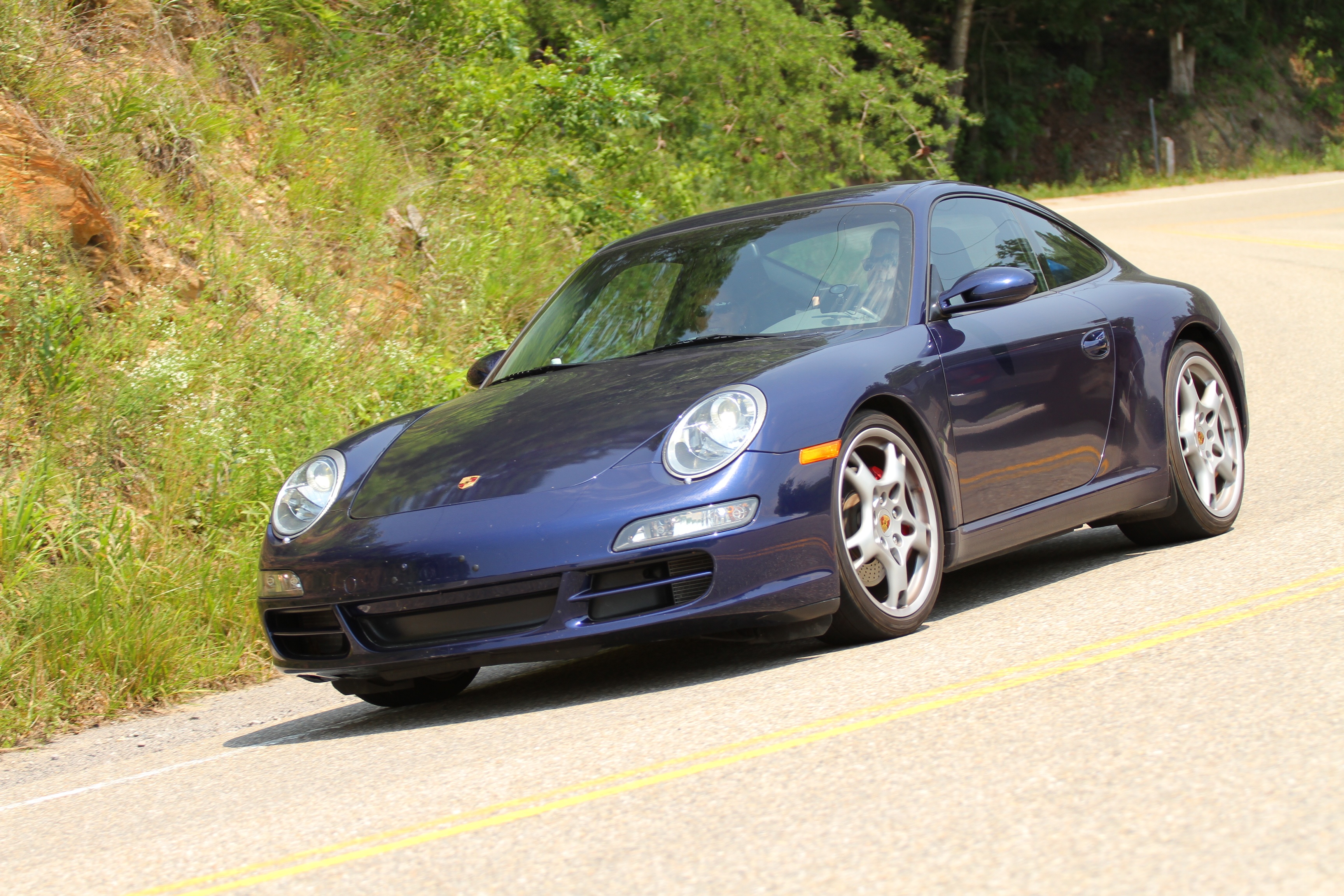
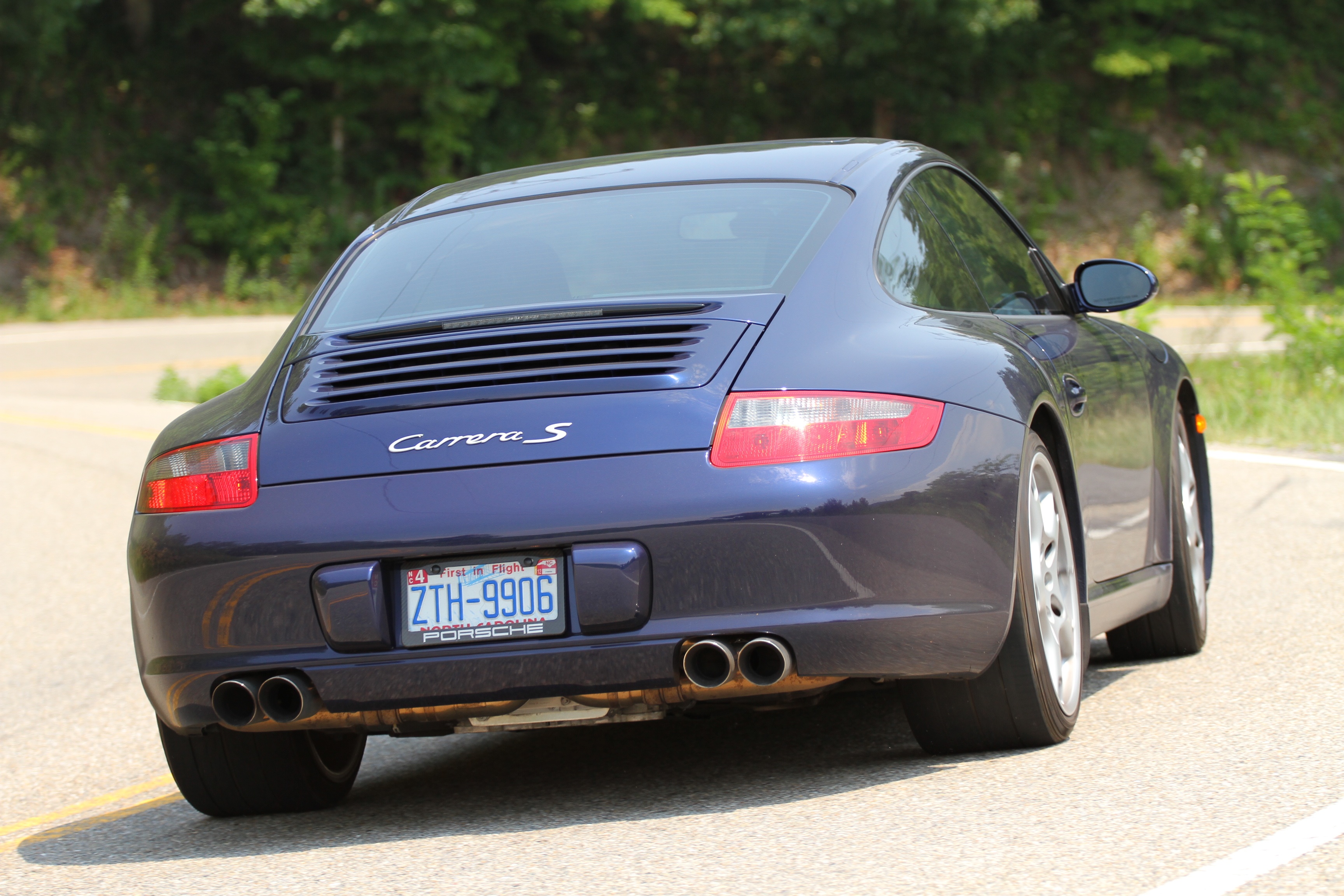
Thanks to killboy.com for the pictures of Clara on US 129, the Tail of the Dragon, on July 3, 2011.