The Casual Blog

Category: diet

Why I am a vegetarian

Being a vegetarian is, in my view, a wonderful thing. Otherwise I would have eaten a plant-based diet for the last 15 years. But it is by moments challenging. One of the challenges is dealing with a question that comes up all the time, usually when I’m eating with people I don’t know well. At the worst possible moment — just as the food arrives — my companion asks, “So, why are you a vegetarian?” This is awkward. If you’re not already familiar with the issues, it could make you a bit uncomfortable, and spoil your appetite.

But as long as we’re not eating, let me satisfy the curious who wonder, Why be so difficult? Why not just enjoy a steak? I’ve tried to boil it down, and have ended up with three main reasons: better health, concern for other living creatures, and care for the environment.

I’ll start with good health, on the grounds that it is our most valuable possible possession — more than any number of mansions, yachts, and planes. It’s worth some time and effort to improve your odds for having a healthy life.

A simple way to improve those odds is eating a plant-based diet. Vegetarians typically have lower cholesterol, lower blood pressure, and a lower body mass index. They consume less dietary fat, which is associated with heart disease and cancer. They’re less exposed to the excessive antibiotics and hormones fed to farm animals. Studies have shown that they have a reduced risk of the big killer diseases of our society: heart disease, diabetes, obesity, and several forms of cancer.

At the same time, eating fruits and vegetables gives you the health benefits of antioxidants, including carotenoids, Vitamin C, and Vitamin E, and a wonderfully complete collection of other nutrients. It gives you more than enough protein, from such sources as whole grains, beans, nuts, and some vegetables.

Now, it is possible to have an unhealthy vegetarian diet. You could, for instance, subsist on Snickers and Cokes. To benefit from a veggie diet, you need to eat less processed food and sugar, and more whole grains, fruits and vegetables. Especially in the beginning, that takes some conscious effort. But there’s impressive evidence that it’s worth it, in terms of a healthier, and therefore happier, life.

My second main reason for not eating meat has to do with what meat is. Let me put this as delicately as possible. A hamburger is a cow that has passed on, and barbecue is a pig that has gone on to its reward. These animals are members of one of the great kingdoms of life — the kingdom animalia. Like humans. Farm animals have social structures, solve problems, and feel pleasure and pain. I believe their lives that are entitled to respect, and we make our lives nobler by giving that respect.

We generally recognize the worth of at least some non-human animals. Take my little dog, Stu, the sweetest dog in the world. He loves taking walks and being petted, and he makes strangers smile. I wouldn’t consider eating Stu, and I feel pretty much the same way about eating cows, pigs, and chickens. There’s hardly any difference, from a biological point of view. Most of the genes of Stu and farm animals are the same.

Most of us are revolted by wanton cruelty to animals. For me, it’s hard to ignore the cruelty associated with a steak or plate of barbecue. Most of the farm animals turned into food endure wretched lives filled with what amounts to torture before they are slaughtered. If you have any doubts about this, I recommend that you to watch the documentary Food, Inc., on factory farming and industrial slaughterhouses. Or read the Wikipedia article on factory farming. It is deeply disturbing.

My third reason for a plant-based diet is both ethical and practical: the meat industry is bad for the earth and the humans on the earth. Factory farming causes a host of environmental problems, including pollution of soil, water, and air, overuse of pesticides and herbicides, and habitat destruction.

Meat is a highly inefficient food. It takes 30 pounds of grain to make one pound of meat. We could feed 50 percent more people if we switched to a vegetarian diet. By eating meat, we waste a lot of energy, and burn a lot more fossil fuels. This contributes to global warming, which is an existential threat to the human race.

So there are my three main reasons for a plant-based diet – a healthier and happier life, respect for other living creatures, and taking better care of the environment. There’s actually one other reason, which is more selfish but also important. Taste! There are so many tasty plant foods, and so many textures and tastes that you start to notice when you eat less meat. Ancient cultures have developed exquisite cuisines based largely on plant foods. Think of Indian food, Thai food, and the Mediterranean diet.

Anyhow, those are my reasons for eating a plant-based diet. From now on, I can refer my interlocutors to my blog.
Sensationalizing homophobia, engaging with aging, and testing mindful eating

Coming back yesterday from a short trip to Manhattan, I had a few minutes to spare in the crowded Delta terminal at LaGuardia. There were no seats near my departure gate, but I found one three gates away, and flipped through The New Yorker magazine. With only a few minutes, I purposely chose a story I expected to be relatively uninteresting — a piece by Ian Parker titled A Reporter at Large: The Story of a Suicide: Two College Roommates, a Webcam, and a Tragedy.

The story keyed off a widely reported incident at Rutgers University in 2010 in which a student spied on his roommate with a webcam and tweeted that he’d spotted homosexual behavior. The ensuing mediathon developed the story line that a heartless homophobe had posted video on the web that caused a vulnerable closeted gay student to kill himself — an emblematic hate crime.

In Parker’s reexamination, the popular media story turns out to be a gross distortion. Dharun Ravi, the surviving roommate, is now facing a criminal trial on vague charges with the potential of years in prison. Ravi created an extensive record of tweets, texts, and other communications that seem stupid and immature, but not unusually so for a 17-year-old. There turned out to be no web cast of video. The suicide victim was actually out of the closet. Ravi’s juvenile online socializing comes across as frenetic and somewhat pathetic. He seems smart, selfish, insecure, and not all that unusual.

I got a few a columns into the story before I decided with boarding time approaching I needed to position myself closer to my gate. I wheeled my possessions a hundred yards or so. Somewhere in that process, my New Yorker disappeared. I retraced my steps, but it had vanished. How annoying! I hope whoever recovered it enjoyed it. After I got home, I managed to download the piece to my iPad and finished it.

It’s too bad, in a way, that the facts don’t support the story line of a bullied gay martyr. Homophobia plainly exists, and violence against gays exists, and those things need to be publicly condemned and appropriately punished. Tyler Clementi’s suicide was unquestionably a tragedy. But, as Parker’s story shows, the cause is unknown, and probably complex. There’s no simple way to assign blame for it. The media’s hype and erroneous reporting fed hysteria and calls for revenge, and now comes a criminal trial that will at a minimum scar a second life.

As an alumnus of the editorial staff of The New Yorker, I enjoy flipping through it every week, though I admit to reading less of it than in days gone by. Last week I read with intense pleasure in the January 23d issue a piece by Donald Hall titled Out the Window: The View in Winter.

The 83-year-old poet has written about getting old. He now needs a wheelchair and has various physical problems. He’s conscious of being “a separate form of life,” treated with either indifference or too much solicitude. He spends a lot of time looking out the window at his bird feeder and the countryside beyond. The outline of his life sounds sad and dull.

This is the amazing thing, though: his life is full of incredible beauty! His descriptions of the drama at his bird feeder are marvelously clear and vivid. He writes of the sequential blossoming of spring flowers with rhythmic, muscular prose. To think that this depth of perception and power of expression can be part of growing old is inspiring.

I’d like to become more conscious of ordinary sensory experience, and to reduce, if only a little, the percentage of each day lived on autopilot. It’s challenging, though, to engage with the present. There are distractions inside and out. Art, like Hall’s essay, can help. I find yoga is also helpful. I hadn’t really thought of meal time as a possible aid, but was inspired by a column this week in the NY Times headed Mindful Eating as Food for Thought.

The basic notion is to focus carefully and completely while eating on the sensations of eating — the flavors, smells, and textures, down to tiny details. The way I normally eat involves talking to people, reading, listening to music, thinking about things, and sometimes combinations of these, jumping from one to the next, hardly noticing the food. Mindful eating is the opposite — quiet and slow.

According to the column, this approach to food is an antidote to over eating and helps with distractedness. It also could lead to greater pleasure. I was reminded of my old friend Tom, now departed many years, a casualty of AIDS, who considered great cooking to be an art entitled to no less respect than painting or music. Accordingly, he had an enthusiasm for high-end restaurants at a time when neither of us could well afford them. He once used part of his Watson fellowship money to treat me to a meal in a four-star restaurant in Paris. His only request was that we not talk while we ate. We enjoyed the incredible meal in perfect silence.

More recently, on an average day I have a hard time focusing for half an hour on anything, and that includes eating. But at least now I’m thinking about it. So far, I’ve managed to eat only a few mindful bites at the beginning of a meal, but I’m going to keep trying.

How to keep lost weight from coming back

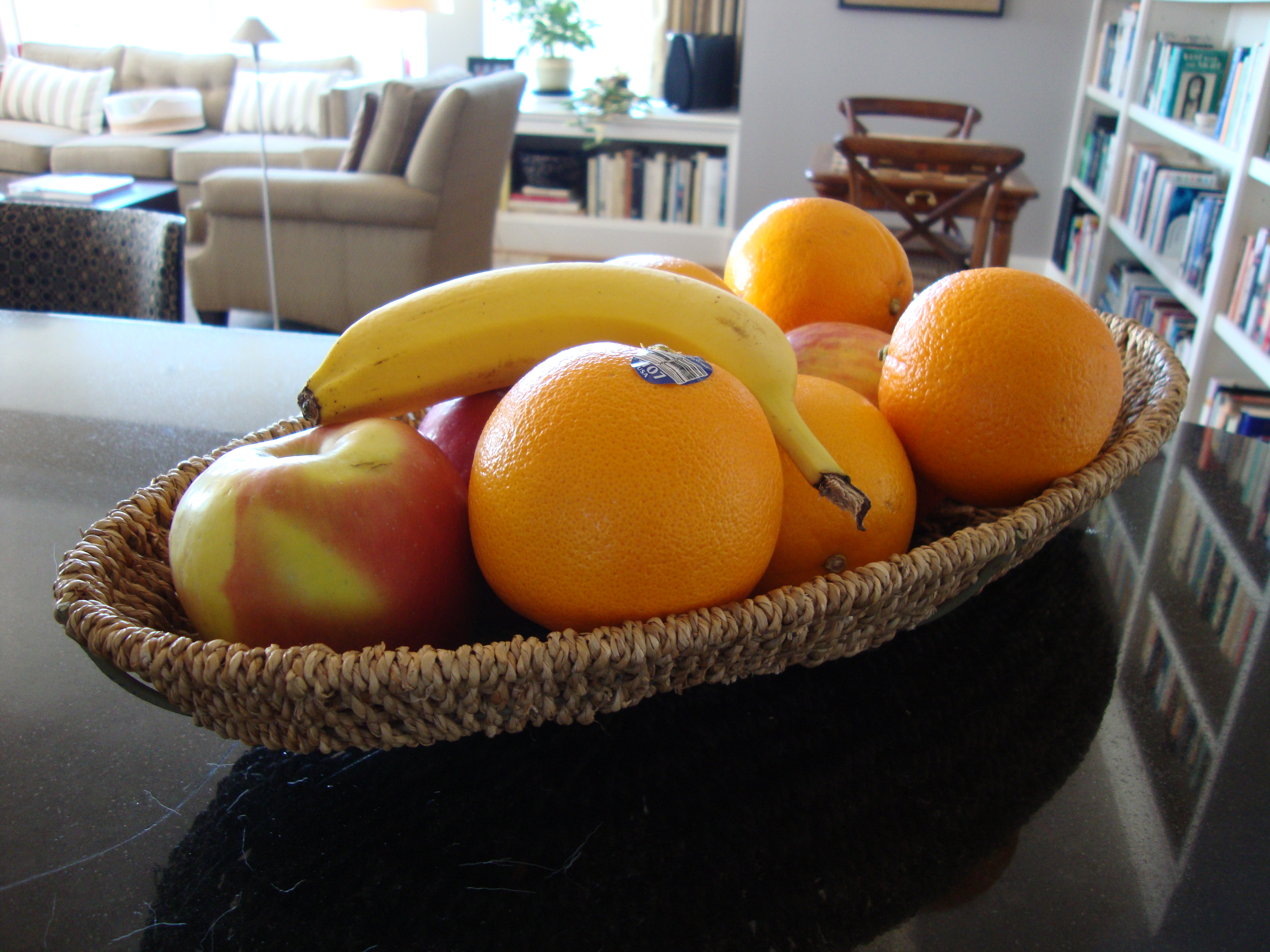
Healthy snacks on the counter at Casa Tiller

Returning from travels over the holiday break, I stepped on the scales to find myself three pounds heavier. It always happens! I swear, though there were temptations aplenty, I was reasonably moderate in my eating and drinking. How amazing that the body can accumulate mass so quickly! Also, a little scary.

In recent years, I’ve not been much concerned with losing weight, but I’ve been working hard not to add it. This basically means being careful about eating and diligent about exercising. That sounds — so — boring! Even if you do it, who wants to hear about it!

Thus, I was interested to read the NY Times magazine piece titled The Fat Trap: Do You Have to Be Superhuman to Lose Weight? by Tara Parker-Pope. According to the article, sustaining a healthy weight after losing a lot of pounds is not just unusual — it’s extraordinary. Those who do it are a “tiny percentage.”

That’s a bummer, both for the individuals who struggle with their weight and for our health as a society. Scientists are trying to figure out why people usually gain back weight after losing it and what can be done about it. Meanwhile, as a member of the fortunate “tiny percentage”, I may have something helpful to contribute. I’ve previously posted about losing 50 pounds, but here are some additional thoughts specifically related to how I’ve kept that weight off for several years.

It isn’t easy, but it also isn’t impossible — obviously! In fact, the methodology is basically the same as any worthwhile achievement that takes sustained effort. If you’ve learned to play the piano, speak a foreign language, play golf, or whatever, you’ve probably already employed most of the same methods you need for ongoing weight control. You need to find your motivation, keep it simple, be empirical, and have fun.

1. Find your motivation. Actors talk about needing to find a character’s motivation to bring the character to life. Try it: ask yourself what you really want, and why. For anything that’s going to take a long, sustained effort, you’ll need a motive that carries real meaning for you — something that’s more important than simply feeling good right now. It helps to articulate it clearly. My own guiding motivation has to do with the battle with father time. More concretely, I’m working today to be able to ski the deep snow in the big mountains of Colorado and Utah when I’m in my eighties. The snow on the mountains is beautiful. I sometimes think of this in the very early morning when it’s still dark and I’m making myself go to the gym.

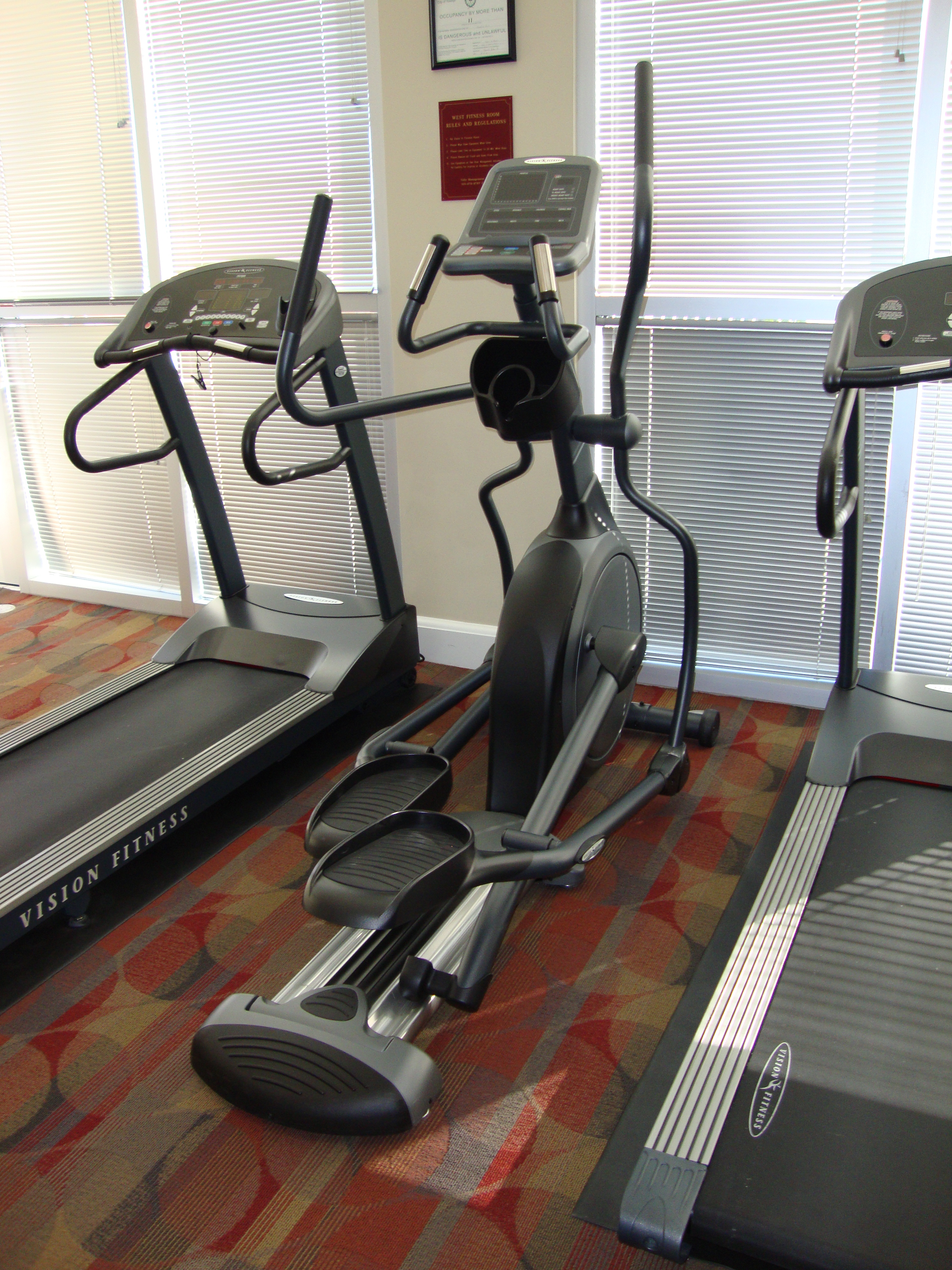
My friend in the gym on the roof -- the elliptical machine

2. Keep it simple. If a system is too complicated, it will not be sustainable. A good system is one you don’t have to think about very much once it’s in place. It involves turning good intentions into good habits. For myself, I have some simple rules that help in avoiding bad eating decisions, such as: no chips, no sodas, and no candy bars. For snacks, I put in place simple and nutritious substitutes, like apples, bananas, and baby carrots. If you are considering going vegetarian, I’ll note that one of its many benefits is helping to simplify the challenge of eating a healthy, less fattening diet. Anyhow, these types of snack choices have gradually become habitual for me, and as habits they don’t take much mental energy. Of course, there’s the countervailing powerful force of other lifelong personal habits, customs, traditions, and advertising tempting you to make bad eating choices. There will be slip ups — and hello, there’s three new pounds. Then you refocus, and move on.

3. Be empirical. Look at the available data, and consciously monitor how you feel. I bought a digital bathroom scale and use it every day. I watch food portions carefully, and notice whether I’m feeling too hungry or unenergetic. I have not adopted a single off-the-shelf theory of eating and exercise, because I think every body has somewhat different needs. What works for you may not work for me. You need to be experimental. If an approach isn’t working, chuck it, and try something else. If you test a healthy snack or an exercise approach that seems to work for you, try it again and see if it still works.

4. Be creative and playful. We’re talking about a long-term approach here, and if it is no fun, you will eventually give it up. Simple repetition is boring. Try out interesting new healthy foods and new exercises and sports. When traveling, I make it a little game in airports to find the least unhealthy meal, and to find something interesting to do in the little hotel gym. I vary activities over the course of a normal week, so that at the moment I alternate among the elliptical machine, the stationary bike, and swimming, and various types of resistance training. For more fun, I enjoy listening to music and reading while doing the elliptical. I’ve found that classes liven up the cycling experience. Every so often, I change the mix of activities and try something new.

So there you are, for whatever it’s worth. Having said all that, I’ll note again, sustaining weight loss isn’t easy. It takes conscious work every day and every meal. But it doesn’t have to be white-knuckle misery or boredom. The guidelines of motivation, simplicity, empiricism, and playfulness help. And developing skill with the guidelines could lead to other good things. They can be applied to any rewarding long-term objective, like learning a sport or a musical instrument.

Twenty-seven, headed down hill fast, and a note on healthy eating

Gabe Tiller at Telluride (February 9, 2011)

Gabe turned twenty-seven this week. I called to wish him a happy birthday, and felt more than usually happy myself. How wonderful to be twenty-seven! Particularly if you’re healthy, bright, athletic, good-looking, agreeable, upstanding, and employed, what could be more wonderful? Of course, that’s leaving aside all fears, insecurities, and uncertainties, of which there could be any number. But still, how marvelous to have traversed the perils of childhood and the agonies of adolescence, and stand no longer on the verge of adulthood, but actually there, strong, in your prime.

I told Gabe that it’s all down hill from here, but I was kidding. His first twenty-seven are, of course, my last twenty-seven, and I have to say that in many ways I feel healthier, more energetic, and happier than when he was born. How stressful it was to be a new parent. Also to be a grizzled veteran parent. And now, all that stress is gone! After all those years of parental anxiety and self-doubt, now he inspires me.

The picture above (which is Sally’s screen saver) reminds me of some of our skiing together the last couple of years. Even more vivid is his first POV ski video made at Telluride last March, which is exciting but I’m sure not nearly as hair-raising as the reality (such as that narrow chute). Seeing these images reminds me that I need to stay in really good shape so we can share more adventures next winter. As I mentioned to him this week, I’m thinking we should try heli-skiing (accessing backcountry powder by helicopter). He was definitely up for it.

The possibility of new adventures helps keep me focused with my continuing project to take good care of myself and eat healthy as much as reasonably possible. I’m trying to approach everyday eating in the spirit of doing a good, nourishing thing for my body — an act of kindness to my physical self. I’m steering clear of junk food, fast food, soda, and most processed food. It’s going pretty well.

Most days for breakfast I make a smoothie with dark green leafy plants (such as spinach, kale, collards, swiss chard, dandelion greens, etc.) and fruit (such as bananas and strawberries, or, this week, fresh pineapple and blueberries). In fact, I recently wore out our blender pitcher, which started leaking just outside the one-year warranty. Here’s a shout out to the good folks at Kitchen Aid, who did the right thing and agreed to replace it anyway! My smoothies are different every day and are mostly tasty (though sometimes less so — the mustard greens did not work for me) and always very green.

I’ve organized a system for addressing hunger pangs with healthy snacks such as unsalted cashews and almonds, apples, bananas, oranges, low-fat soy yogurt, and celery with peanut butter. For lunch, I typically have something like a microwave vegetarian Indian meal (Amy’s organic is good). And most nights Sally cooks a delicious vegetarian dinner, which just this week including Thai noodles with tofu (with whole wheat noodles) and Mom’s zucchini pie. She and I have gotten in the habit of having smaller portions. So my diet is mostly organic plant food of many types. I enjoy it very much.

Golfing at Turnberry, Scotland

Turnberry, Scotland (Kintyre)

Last week I played golf at Turnberry, Scotland, rated the number one course in the British Isles, and the site of numerous British Opens. Is it really so great? In a word, yes. It was golf nirvana.

I played the famous Ailsa course the day I arrived, immediately after traveling all night. The day was sunny and mild — possibly too pleasant for a representative experience. At almost every hole, I had a shiver at the beauty. It had a raw, untamed quality, but I gradually realized that it brilliantly combined the natural contours of the terrain with a deep understanding of the essence of golf. Its authors and keepers loved the land, and the game.

It demanded constant vigilance and focus. The hazards were, in golfing terms, serious — deep bunkers with walled backs, knee-high grass, spiny gorse, and water. I had one disastrous descent into a bunker, costing four strokes to get out. But I generally controlled the ball well, with a handful of excellent shots. I did not putt particularly well till the end, when I finished with a flourish — sinking a thirty-footer on 18 for a birdy. I ended up with a 92.

I played the Kintyre course the next day. The skies were overcast, threatening (but never quite delivering) rain, and there were gusty winds — proper Scottish golfing weather. The ocean is a bigger element in this course, and the bunkers less. It seemed less imposing than Ailsa, with views of the surrounding hills and pastures, but the level of difficulty was challenging enough. I played reasonably well for me on the first nine (46), but had a couple of bad blow ups in the second and finished with a 99.

Jim, my caddie, and a Linux fan

There is something about Scotland that spoke to me powerfully. The people seemed friendly, but practical and tough and very proud of their country. The countryside was rolling and rugged. I got a lesson in single malt whiskey, and learned that it a dash of water loosens it up.

After finishing my meetings, I had a few hours to walk about in Glasgow, and found it a lively, modern city with Victorian charm. I made a stop at the Gallery of Modern Art to see works of several contemporary artists, and also visited the Kelvingrove Museum. Their collection of Impressionists and Post Impressionists is quite good, and I also liked their collection of 16th century armor. There were lots of people out in Kelvingrove Park, which reminded me of Central Park in New York, but with grass tennis courts and lawn bowling.

The trip back was long — about 19 hours all told. It started with a 5 hour delay because of weather in Newark, and the 7 air hours were bumpy. One good word for Continental — they provided surprisingly tasty curry as part of my requested vegetarian meal. I ran out of electricity on both my iPod and iPad, and came close to running out of other reading material (horrors!).

The Newark to Raleigh leg was uneventful until near the end, when the pilot suddenly pulled up from the final approach and banked to circle around. My first thought was that I might have a rookie pilot, but he explained that there was a local thunderstorm with microbursts of wind. A few minutes later we made the final approach, and the plane began bucking and shimmying. I focused on deep calming yoga breaths.

Improved propaganda and healthier diets

For all the money and energy we spend on health care, you’d think we’d be more focussed on eating practices that improved our health. But changing eating habits is difficult. The forces of advertising and tradition powerfully reinforce our bad habits. Thus I was pleasantly surprised to see the government’s replacement for the food pyramid this week.
It’s far from perfect, but it’s a significant improvement.

The pyramid was supposed to help us eat healthier, but it didn’t do that very well. The various versions of the pyramid were confusing where they weren’t downright misleading. In the past, the food industry has battled hard against changing the food pyramid, as well described in Food Politics by Marion Nestle. It would be interesting to know what happened to bring about the new symbol. Could it be Michelle Obama?

In any case, the new symbol emphasizes that half of your diet should be fruit and vegetables, and another significant portion should be whole grains. The other large chunk is dubbed protein.

The oddity, of course, is that there isn’t anything in the grocery store called protein. Many believe that eating meat is necessary to get adequate protein, although this is a myth. In fact, many plant foods (whole grains, legumes, vegetables, and nuts) are good sources of protein. It may be that the meat lobby figured that the meat-protein association is so firmly lodged in public consciousness that it will not be shaken loose any time soon, and so their markets won’t be threatened

The new graphic treats dairy products in a confusing way — a circle to one side of the main plate. This could be interpreted as a suggestion to drink lots of milk, but it could also mean that dairy is not entitled to the same status as the main dietary categories. This smacks of a political compromise with the dairy industry. There’s a growing body of evidence that cow’s milk is not good for humans, but the official new guidelines contain no hint of this. It’s good, though, that they recommend low-fat options.

Another subtle problem with the new graphic is that by depicting a plate completely covered with food groups, it reinforces our tendency to eat too much. Americans already have trouble not covering every square inch of their plates with food, and eating all of it. Our obesity epidemic proves the point. To be fair, the new web site (see link above) acknowledges the importance of reasonable serving sizes. Still, a better graphic would show that we should eat only as much as we really need to nourish ourselves, which for most of us means: eat less.

Processed and unprocessed food

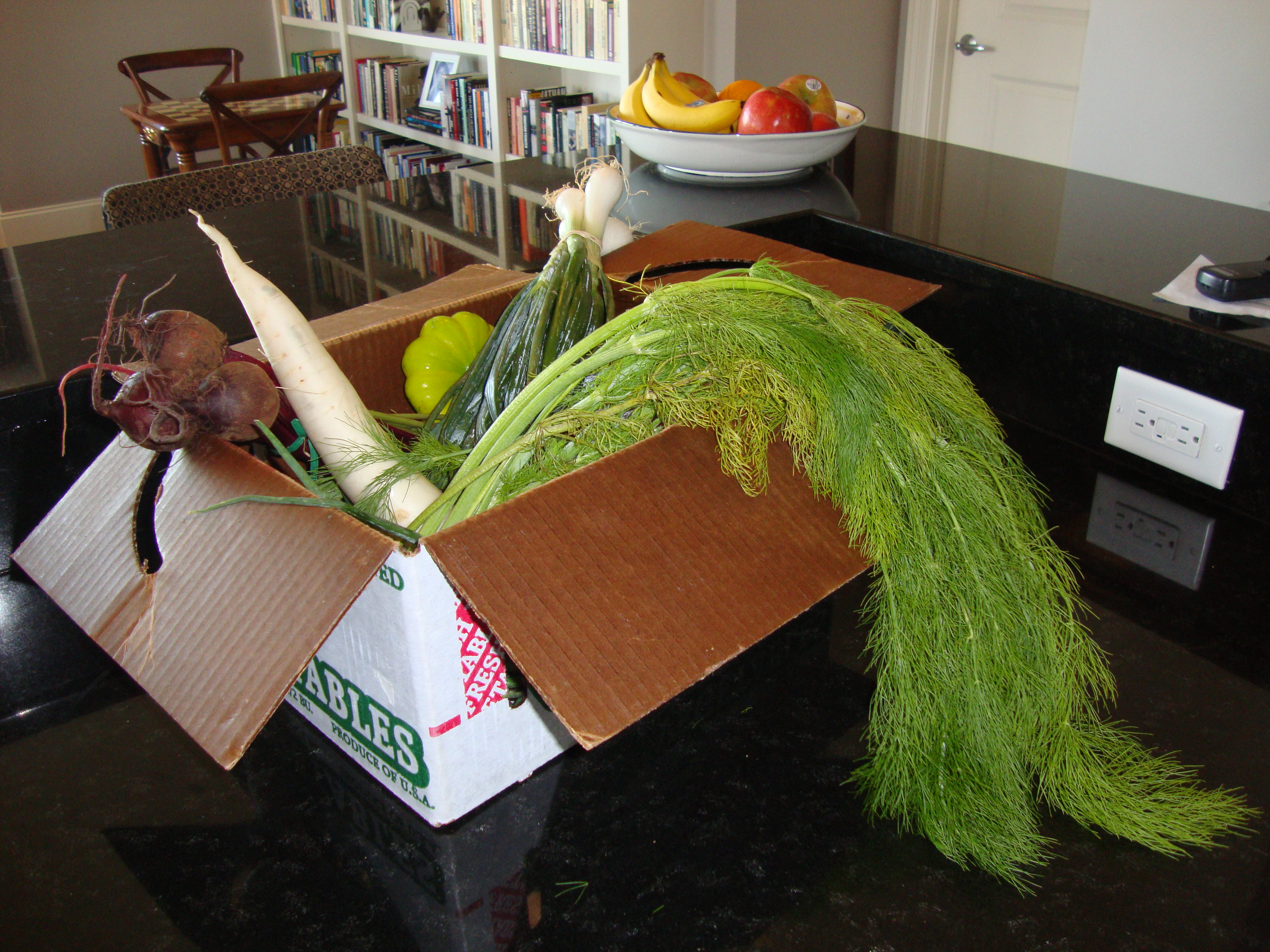
This week's Mid-Chatham CSA box

We’ve been eating lots of fresh organic local produce recently. Sally subscribed us to the Mid-Chatham Farmers’ Alliance CSA (Community Supported Agriculture), which furnishes a box filled with fresh produce once a week through the local growing season. The food has been amazing! There’s so much taste! Even some vegetables that I’ve long avoided, based on bitter early encounters, like beets and turnips, have been remarkable. With the various greens, I’ve made some fantastic green smoothies.

I was momentarily cheered when Red Hat served veggie hot dogs at a gathering this week. I appreciated some recognition of plant-food eaters, but when the crucial moment came, I couldn’t get myself to try one. I’ve gotten used to eating very little processed food, and now the idea of snacking on man-made chemicals is sort of disturbing. As it happened, I wasn’t very hungry anyway.

There was an interesting New Yorker article titled Snacks for a Fat Planet: PepsiCo takes stock of the obesity epidemic by John Brooks a couple of weeks back. Did you know that PepsiCo is the largest food company in the US, with $60 billion in annual revenues? Its Frito-Lay division is by itself enormous, and other brands include Tropicana and Quaker Oats. Its CEO, Indra Nooyi, is the first female, first Hindu, and first vegetarian to lead the company, and she sounds like a brilliant and dynamic leader. She also seems genuinely concerned about the health problems that are associated with some of the highly processed sugary or salty foods that have made PepsiCo vast quantities of money.

I don’t envy her, for she’s taken on an impossible job. It’s nice to work on making the fatty snacks on which PepsiCo has thrived less unhealthy. But the whole business of not only engineering snacks but also programming people to eat more and more processed junk is wrong. It contributes to vast numbers of premature deaths.

Our junk food culture is like the smoking culture, but before the Surgeon General’s report in 1964. We’re done something (though not enough) to address the health risks of tobacco, and we need to do at least as much to address the deadly culture of junk food. I realize this message is kind of depressing, and junk food purports to be, and is accepted as being, innocent fun. But that’s, in part anyway, the problem.

A difficult but ultimately satisfying swim, beautiful blossoms, and some good news regarding veggie burgers

It seems that the greater the struggle to swim some laps, the better I feel afterwards. At 6:00 a.m. this morning, I got to the pool with a plan to swim 40 lengths of freestyle (more than half a mile), and felt my heart racing uncomfortably after the first 4. But I struggled along, finished the 40, and then did 8 kickboard laps, 8 backstroke, and 8 breaststroke, and then 15 minutes of yoga. The endorphins were excellent! Driving home, I just couldn’t get over how beautiful everything looked! Blossoming dogwoods and cherry trees, blooming azaleas, and thousands of dewy green buds.

For breakfast I made myself a green smoothy in the blender with rainbow chard, apple, and banana, with some orange juice and soy milk. It tasted earthy — not delicious, exactly, but satisfying as a kindness to the body. And, reading the NY Times, along with frightening and disturbing news (nuclear plant catastrophe in Japan, mayhem in Libya), I found a cheery story: veggie burgers are getting better and more popular. http://tiny.cc/p97hm Admittedly, veggie burgers have a checkered history, but the ones in the Times story sounded delicious. According to the story, there was a 26 percent increase in menu items labeled vegetarian or vegan between the late 2008 and late 2010. That’s a remarkable increase.

I’ve been a committed plant food eater for about 15 years now, and my personal experiment has been highly successful in this respect: I feel happier and healthier than I did 15 (or even 30) years ago. But as a social matter, the veggie life has been a challenge. My non-veggie friends don’t get the point, and there’s way too much friction in figuring out ways to eat out together. It’s cheering to think that help may be on the way, in terms of increasing numbers of veggie menu items. Cheering also to think more people are eating plant-based diets that will help them be healthier.

So long, Krispy Kreme, and hello health

It was bittersweet to learn last week that the Krispy Kreme store in downtown Raleigh was closing due to lack of business. When a business fails, individuals suffer hardships. As a downtown Raleigh resident, I’m particularly eager to see businesses here succeed.

And Krispy Kreme and I go way back. As a boy I was a patron of the first Krispy Kreme store, in Winston-Salem. There you could sit at the counter and eat hot glazed doughnuts while watching more fresh ones coming off the conveyer belt. It was one of the few places in town open 24 hours. After finishing my paper route at 5:30 a.m., I’d sometimes stop in there for a delicious sugary treat. It was also a favorite late night spot for teenage munchie runs. Good times.

But in recent years I’ve come to associate Krispy Kreme doughnuts and similar sweet products with less cheerful things, like obesity, diabetes, heart disease, and death. The products are more like cigarettes than food. The nutritional content is minimal, and the high sugar and fat content are unhealthy. This is not exactly big news. In a sense, everyone knows that too much fat and sugar are bad for you. But it continues to be a difficult fact for people to face and do something about. That much is obvious from our obesity epidemic.

We’ve made slow but meaningful progress in the last 50 years addressing the deadly public health effects of smoking. We’ve substantially reduced smoking rates, and therefore smoking deaths. The basic facts about smoking and cancer are now common knowledge, as a result of government requirements for warnings on cigarette labeling and restrictions on cigarette advertising. We have not done anything like this with risky sweet food products that kill people.

If anything, we’ve headed in the opposite direction. Information about nutrition is obscured by industry and federal agencies. Our government transfers our tax dollars to agribusinesses as large subsidies for production of excess corn, which is processed into high fructose corn syrup and added to many common food items. Thus healthy unprocessed food seems unusual and, by comparison, expensive. Thousands of advertisements have convinced us that sweet, fatty food products produce good feelings of love and fun.

Sure, it’s possible to get sound nutrition information and it’s possible to eat in a healthy way, but our culture makes it quite challenging. People who make a point of trying to avoid unhealthy food are viewed with puzzlement and sometimes anger. It’s no fun being ridiculed as a food nut. It’s easier to go along with the crowd.

Lifetime Fitness gym recently published an article by Pilar Gerasimo titled “Being Healthy is a Revolutionary Act,” That’s putting it too strongly, but it is certainly an act that defies settled conventions. The related web site does a good job of putting in bumper-sticker form some home truths about health and nutrition. http://revolutionaryact.com/ The first home truth gets down to business: “The Way We are Live Is Crazy,” based on our rates of obesity and chronic illness. But, it says, we can change.

Maybe so. If Krispy Kreme is doing less business, it probably isn’t because their doughnuts don’t taste good. They taste too good! It’s possible that more people are facing the fact that we can’t go on eating like this.

My finger health problem

Why is it other people’s health problems are so uninteresting, and my own are so fascinating? I’m kidding. Kind of. At one level, I understand that my own health problems are of no particular general interest, but I do find them relatively interesting. It would not surprise me at all to learn that everybody else thinks the same.

At any rate, I work hard to minimize certain health risks. I consciously avoid eating things that have no nutritional value, and consciously eat a balanced vegetarian diet. I get up early to exercise most days, either swimming, spinning, lifting, doing yoga, or the elliptical machine. I use sunscreen and drink filtered water. And so on. I even quit using pans with Teflon.

None of which will help me against the wrong piece of bad luck, be it my own cells malfunctioning, an invading superbug, or a drunk driver running a stop light. But I like improving the odds. And for the most part, I like the process. True, I still haven’t figured out how to make an omelette that doesn’t stick without Teflon, which is unfortunate. But I actually look forward happily to yoga class, for example. (Which reminds me, after some struggle, I finally managed to do an unaided head stand for the first time this week. Hurray!)

The net of my exercise-and-eating program, good genes, and good luck has been a long run of no health problems that seemed interesting enough to talk about, even to me. I didn’t have even a cold in three years (though that particular string was broken by an enterprising but not particularly dramatic virus last week).

But starting last Sunday, I had a bizarre problem that seemed small at first: the tip of my left forefinger was exceedingly tender. I initially thought I must have somehow bruised it, but this seemed unlikely — it would have taken a memorable blow, like slamming it in a car door, to produce such discomfort. Over the next couple of days, it became swollen and took on hues of red or purple. It was warm to the touch, and it throbbed. I couldn’t play the piano without causing great pain, and any small ordinary knock on the finger was agonizing. I began to wonder what life would be like after amputation of a left forefinger, or the possibility that there was a serious internal problem there that could spread.

So I made a rare appointment with my GP, Dr. Gagliardi, who generally knows me only from check ups that are not as frequent as he would like. He diagnosed the problem in a matter of seconds as paronychia (an infection), and said he would cut it to let out the fluid. I noted that I have a reasonably high pain threshold, but because of the extreme sensitivity of the finger, it would be nice to have some anesthetic for this operation. He said that was impractical. So I took a deep breath.

Fortunately, he found some deed skin to cut on, and I never felt a thing when he did the cutting. And in a moment a yellow pus began to emerge in surprising quantities. I began to feel better almost immediately. I’m using a prescription antibiotic cream and band aids to complete my recovery. The wonders of modern medicine! Every now and again, it works really well! Thanks, Dr. G!